Mike McGuire
MV Community College
COM 101
An Introduction to
Persuasion and Argument
Moving people to a belief,
position, or course of action
The Importance of
Argument and Persuasion
 In everyday life…
appealing a grade, asking for a raise, applying for a job, negotiating the
price of a new car, arguing in traffic court
 In academic life…
defending your ideas, engaging in intellectual debate
 On the job…
getting people to listen to your ideas, winning buy-in, getting your boss to
notice, getting cooperation, moving people to action
 In writing…
irrefutably making your point, writing to be read
 In reading and listening…
critically evaluating other’s arguments, protecting yourself from
unethical persuasive tactics, recognizing faulty reasoning when
you see it
What Exactly is an Argument?
 an argument involves the process of establishing
a claim and then proving it with the use of logical
reasoning, examples, and research
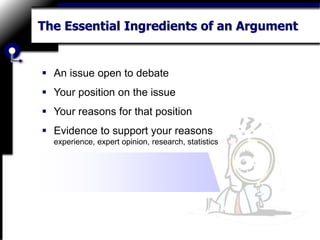
The Essential Ingredients of an Argument
 An issue open to debate
 Your position on the issue
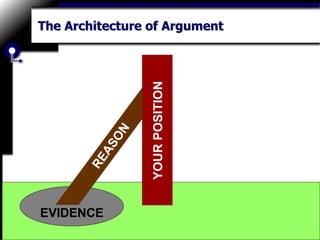
 Your reasons for that position
 Evidence to support your reasons
experience, expert opinion, research, statistics
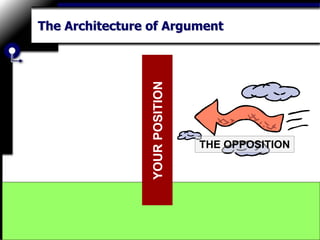
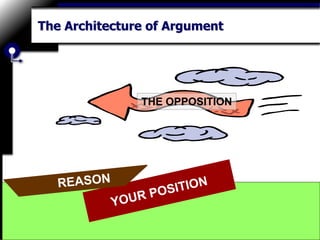
The Architecture of Argument
YOUR
POSITION
THE OPPOSITION
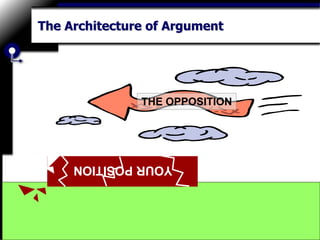
The Architecture of Argument
THE OPPOSITION
YOUR
POSITION
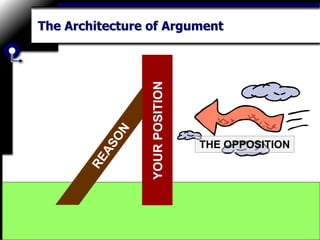
The Architecture of Argument
YOUR
POSITION
THE OPPOSITION
The Architecture of Argument
THE OPPOSITION
The Architecture of Argument
YOUR
POSITION
EVIDENCE
THE OPPOSITION
The Structure of Classical Argument
Introduction
Thesis Statement
Background Information
Reasons and Evidence
The Opposing View and the Refutation
Conclusion






Mike McGuire
MV Community College
COM 101
The Three
Persuasive Appeals
Logos, Pathos, and Ethos
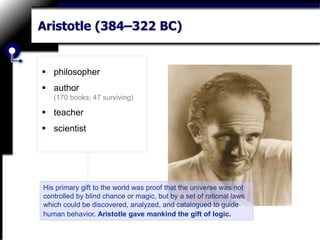
Aristotle (384–322 BC)
 philosopher
 author
(170 books; 47 surviving)
 teacher
 scientist
His primary gift to the world was proof that the universe was not
controlled by blind chance or magic, but by a set of rational laws
which could be discovered, analyzed, and catalogued to guide
human behavior. Aristotle gave mankind the gift of logic.
Three persuasive appeals
 Logos (Logic)
 The appeal to reason
 Pathos (Emotion)
 The appeal to emotion
 Ethos (Credibility)
 The appeal of one’s character
All persuasive appeals are really
about involving your audience.
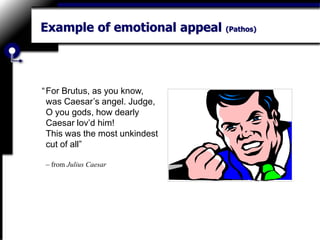
Example of emotional appeal (Pathos)
“For Brutus, as you know,
was Caesar’s angel. Judge,
O you gods, how dearly
Caesar lov’d him!
This was the most unkindest
cut of all”
– from Julius Caesar
Leveraging your credibility (Ethos)
 credibility is the audience’s
response to you as the source of
the message
 credibility has three sources:
 knowledge
 image
 relationships
Questions to test credibility
 Has the reader been able to rely on what you have
said in the past? If they are unfamiliar with you…
 Do you know what you’re talking about? Are you
familiar with all sides of the issue?
 Have you done your research on the issue?
 Have you documented your research
thoroughly and accurately?
 Have your thoughtfully addressed
the opposition?
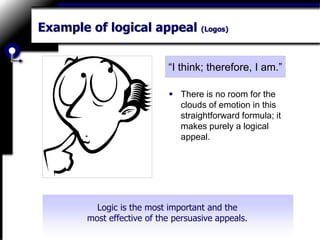
“I think; therefore, I am.”
Example of logical appeal (Logos)
 There is no room for the
clouds of emotion in this
straightforward formula; it
makes purely a logical
appeal.
Logic is the most important and the
most effective of the persuasive appeals.
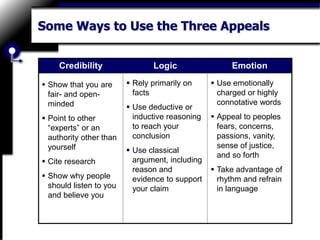
Some Ways to Use the Three Appeals
Credibility Logic Emotion
 Show that you are
fair- and open-
minded
 Point to other
“experts” or an
authority other than
yourself
 Cite research
 Show why people
should listen to you
and believe you
 Rely primarily on
facts
 Use deductive or
inductive reasoning
to reach your
conclusion
 Use classical
argument, including
reason and
evidence to support
your claim
 Use emotionally
charged or highly
connotative words
 Appeal to peoples
fears, concerns,
passions, vanity,
sense of justice,
and so forth
 Take advantage of
rhythm and refrain
in language
If you wish to persuade me, you
must think my thoughts, feel my
feelings, and speak my words.
–MARCUS TULLIUS CICERO

Introduction to winning an arguments.ppt

  • 1.
    Mike McGuire MV CommunityCollege COM 101 An Introduction to Persuasion and Argument Moving people to a belief, position, or course of action
  • 2.
    The Importance of Argumentand Persuasion  In everyday life… appealing a grade, asking for a raise, applying for a job, negotiating the price of a new car, arguing in traffic court  In academic life… defending your ideas, engaging in intellectual debate  On the job… getting people to listen to your ideas, winning buy-in, getting your boss to notice, getting cooperation, moving people to action  In writing… irrefutably making your point, writing to be read  In reading and listening… critically evaluating other’s arguments, protecting yourself from unethical persuasive tactics, recognizing faulty reasoning when you see it
  • 3.
    What Exactly isan Argument?  an argument involves the process of establishing a claim and then proving it with the use of logical reasoning, examples, and research
  • 4.
    The Essential Ingredientsof an Argument  An issue open to debate  Your position on the issue  Your reasons for that position  Evidence to support your reasons experience, expert opinion, research, statistics
  • 5.
    The Architecture ofArgument YOUR POSITION THE OPPOSITION
  • 6.
    The Architecture ofArgument THE OPPOSITION YOUR POSITION
  • 7.
    The Architecture ofArgument YOUR POSITION THE OPPOSITION
  • 8.
    The Architecture ofArgument THE OPPOSITION
  • 9.
    The Architecture ofArgument YOUR POSITION EVIDENCE THE OPPOSITION
  • 10.
    The Structure ofClassical Argument Introduction Thesis Statement Background Information Reasons and Evidence The Opposing View and the Refutation Conclusion      
  • 11.
    Mike McGuire MV CommunityCollege COM 101 The Three Persuasive Appeals Logos, Pathos, and Ethos
  • 12.
    Aristotle (384–322 BC) philosopher  author (170 books; 47 surviving)  teacher  scientist His primary gift to the world was proof that the universe was not controlled by blind chance or magic, but by a set of rational laws which could be discovered, analyzed, and catalogued to guide human behavior. Aristotle gave mankind the gift of logic.
  • 13.
    Three persuasive appeals Logos (Logic)  The appeal to reason  Pathos (Emotion)  The appeal to emotion  Ethos (Credibility)  The appeal of one’s character All persuasive appeals are really about involving your audience.
  • 14.
    Example of emotionalappeal (Pathos) “For Brutus, as you know, was Caesar’s angel. Judge, O you gods, how dearly Caesar lov’d him! This was the most unkindest cut of all” – from Julius Caesar
  • 15.
    Leveraging your credibility(Ethos)  credibility is the audience’s response to you as the source of the message  credibility has three sources:  knowledge  image  relationships
  • 16.
    Questions to testcredibility  Has the reader been able to rely on what you have said in the past? If they are unfamiliar with you…  Do you know what you’re talking about? Are you familiar with all sides of the issue?  Have you done your research on the issue?  Have you documented your research thoroughly and accurately?  Have your thoughtfully addressed the opposition?
  • 17.
    “I think; therefore,I am.” Example of logical appeal (Logos)  There is no room for the clouds of emotion in this straightforward formula; it makes purely a logical appeal. Logic is the most important and the most effective of the persuasive appeals.
  • 18.
    Some Ways toUse the Three Appeals Credibility Logic Emotion  Show that you are fair- and open- minded  Point to other “experts” or an authority other than yourself  Cite research  Show why people should listen to you and believe you  Rely primarily on facts  Use deductive or inductive reasoning to reach your conclusion  Use classical argument, including reason and evidence to support your claim  Use emotionally charged or highly connotative words  Appeal to peoples fears, concerns, passions, vanity, sense of justice, and so forth  Take advantage of rhythm and refrain in language
  • 19.
    If you wishto persuade me, you must think my thoughts, feel my feelings, and speak my words. –MARCUS TULLIUS CICERO