Ant Phillips
antphill@uk.ibm.com


Introduction to WebSphere Message Broker


                                           © 2012 IBM Corporation
Introduction to Integration

    ▪ Enterprise systems consist of many logical endpoints
       ▪ Off-the-shelf applications, services, packaged applications (SAP, Siebel etc)
       Web applications, devices, appliances, custom built software and many more!


    ▪ Endpoints expose a set of inputs and outputs, which comprise:
       ▪ Protocols such as MQ, TCP/IP, database, HTTP, files, FTP, SMTP, POP3
       ▪ Formats like (C/COBOL), XML, industry (SWIFT, EDI, HL7), user-defined


    ▪ Point-to-point connections quickly deteriorate into spaghetti
       ▪ Inflexible architecture which is expensive to maintain and resistant to change


    ▪ Message Broker connects these endpoints together in meaningful ways
       ▪ Message Broker simplifies application and device integration!
       ▪ Avoids rewrites in response to new integration requirements
       ▪ Simplifies maintenance by reducing expensive coupling
       ▪ Flexibility adding anonymity between producers and consumers of data
       ▪ Adds insight into applications and business value they bring
2                                                                                         © 2012 IBM Corporation
Healthcare Integration
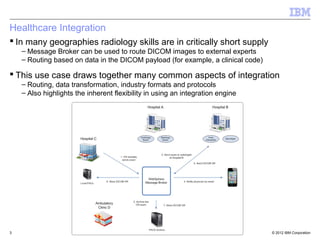
 In many geographies radiology skills are in critically short supply
    – Message Broker can be used to route DICOM images to external experts
    – Routing based on data in the DICOM payload (for example, a clinical code)

 This use case draws together many common aspects of integration
    – Routing, data transformation, industry formats and protocols
    – Also highlights the inherent flexibility in using an integration engine


3                                                                                 © 2012 IBM Corporation
Retail Integration

 Retail is a great example of the broad landscape of integration
    – Many different end points both inside and outside the organisation
    – Multiple formats and protocols (TLOG, files, JSON/HTTP etc) plus devices
    – Flexibility is key as new capabilities need to blend in (mobile, analytics etc)

                   Web eCommerce                                  Analytics &
                                                                  Optimization

                                             Commerce                                                     Suppliers


                                   DMZ                                                      DMZ
                                           APP        Service
                                                                             APP

                                           APP        Service                      DB
                                                 DB             APP   DB     APP
    Store –PoS                                                                                        Internet
                       Internet


                                                                Enterprise
      Customer                                                                          Trading partner
     Mobile Apps                                                                         communities
                    Customer communities


4                                                                                                         © 2012 IBM Corporation
WebSphere Message Broker
 Universal connectivity from anywhere, to anywhere
    – Simplify application connectivity for a flexible and dynamic infrastructure
 Comprehensive protocols, transports, data formats and processing
    – Connect to applications, services, systems and devices:
          • MQ, JMS, HTTP(S), SOAP, REST, file (including FTP, FTE, ConnectDirect), database, TCP/IP,
            MQTT, CICS, IMS, SAP, SEBL, .NET, PeopleSoft, JDEdwards, SCA, CORBA, email and more!
    – Understands the broadest range of data formats:
          • Binary (C/COBOL), XML, CSV, DFDL, JSON, industry (SWIFT, EDI, HL7 etc), IDOCs, user-defined
    – Built-in suite of request processors:
          • Route, filter, transform, enrich, monitor, publish, decompose, sequence, correlate, detect…

 Simple programming with patterns and graphical data flows
    – Patterns for top-down, parameterized connectivity of common use cases
          • For example, service façades, message processing, queue to file etc
          • IBM and user-defined patterns for development reuse and governance
    – Graphical data flows represent application and service connectivity
          • Custom logic via graphical mapping, PHP, Java, ESQL, XSL and Microsoft .NET

 Extensive management, performance and scalability
    –   Extensive administration and systems management facilities for developed solutions
    –   Wide range of operating system and hardware platforms including virtual and cloud
    –   High performance transactional processing, additional vertical & horizontal scalability
    –   Deployment options include Trial, Express, Standard and Advanced
5                                                                                                 © 2012 IBM Corporation
Concepts


           © 2012 IBM Corporation
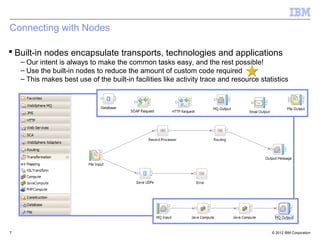
Connecting with Nodes

 Built-in nodes encapsulate transports, technologies and applications
    – Our intent is always to make the common tasks easy, and the rest possible!
    – Use the built-in nodes to reduce the amount of custom code required
    – This makes best use of the built-in facilities like activity trace and resource statistics


7                                                                                         © 2012 IBM Corporation
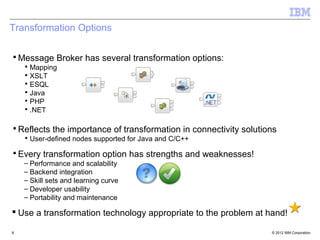
Transformation Options

▪ Message Broker has several transformation options:
    ▪ Mapping
    ▪ XSLT
    ▪ ESQL
    ▪ Java
    ▪ PHP
    ▪ .NET

▪ Reflects the importance of transformation in connectivity solutions
    ▪ User-defined nodes supported for Java and C/C++

▪ Every transformation option has strengths and weaknesses!
    – Performance and scalability
    – Backend integration
    – Skill sets and learning curve
    – Developer usability
    – Portability and maintenance

 Use a transformation technology appropriate to the problem at hand!

8                                                                  © 2012 IBM Corporation
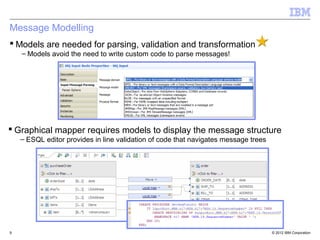
Message Modelling
 Models are needed for parsing, validation and transformation
    – Models avoid the need to write custom code to parse messages!


 Graphical mapper requires models to display the message structure
    – ESQL editor provides in line validation of code that navigates message trees


9                                                                                    © 2012 IBM Corporation
Administration

 ▪ Message Broker Explorer has a wealth of monitoring tools!
     ▪ Statistics monitor resource usage across execution groups
     ▪ Range of options to update and visualise the resource statistics


10                                                                        © 2012 IBM Corporation
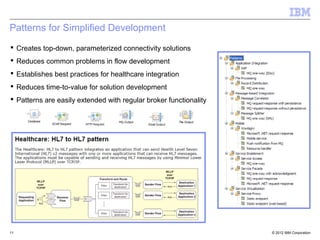
Patterns for Simplified Development
 Creates top-down, parameterized connectivity solutions
 Reduces common problems in flow development
 Establishes best practices for healthcare integration
 Reduces time-to-value for solution development
 Patterns are easily extended with regular broker functionality


11                                                                 © 2012 IBM Corporation
Integration Usage Patterns


                             © 2012 IBM Corporation
Integration Usage Patterns


      Extending the reach of existing applications
      Connect file and online for end-to-end efficiency
     ▪ Beyond applications – integrate devices into the enterprise
     ▪ Mobile integration and service enablement
     ▪ Packaged applications provide best of breed business function
     ▪ Distribute database information to where it is needed!
     ▪ Provide secure access (CIAA) to applications and services
     ▪ Monitor your business and act intelligently
     ▪ Connectivity within Microsoft .NET environments


13                                                                     © 2012 IBM Corporation
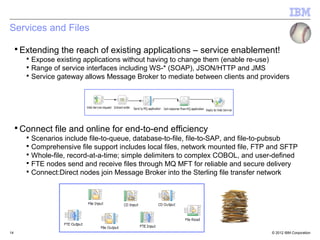
Services and Files

 ▪ Extending the reach of existing applications – service enablement!
     ▪ Expose existing applications without having to change them (enable re-use)
     ▪ Range of service interfaces including WS-* (SOAP), JSON/HTTP and JMS
     ▪ Service gateway allows Message Broker to mediate between clients and providers


 ▪ Connect file and online for end-to-end efficiency
     ▪ Scenarios include file-to-queue, database-to-file, file-to-SAP, and file-to-pubsub
     ▪ Comprehensive file support includes local files, network mounted file, FTP and SFTP
     ▪ Whole-file, record-at-a-time; simple delimiters to complex COBOL, and user-defined
     ▪ FTE nodes send and receive files through MQ MFT for reliable and secure delivery
     ▪ Connect:Direct nodes join Message Broker into the Sterling file transfer network


14                                                                               © 2012 IBM Corporation
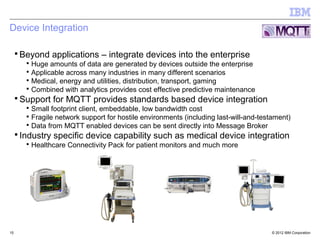
Device Integration

 ▪ Beyond applications – integrate devices into the enterprise
     ▪ Huge amounts of data are generated by devices outside the enterprise
     ▪ Applicable across many industries in many different scenarios
     ▪ Medical, energy and utilities, distribution, transport, gaming
     ▪ Combined with analytics provides cost effective predictive maintenance
 ▪ Support for MQTT provides standards based device integration
     ▪ Small footprint client, embeddable, low bandwidth cost
     ▪ Fragile network support for hostile environments (including last-will-and-testament)
     ▪ Data from MQTT enabled devices can be sent directly into Message Broker
 ▪ Industry specific device capability such as medical device integration
     ▪ Healthcare Connectivity Pack for patient monitors and much more


15                                                                                  © 2012 IBM Corporation
Mobile

  Worklight integration makes developing mobile services simple!
     – Four patterns makes mobile service integration quick and easy
     – Pattern source included for flexible customization to many other tools

  Message Broker provides a range of mobile patterns
     – Mobile enablement for Microsoft .NET applications
     – Create flexible mobile services on top of Message Broker
     – Resource management including security and caching
     – Outbound push notifications for asynchronous data delivery


16                                                                              © 2012 IBM Corporation
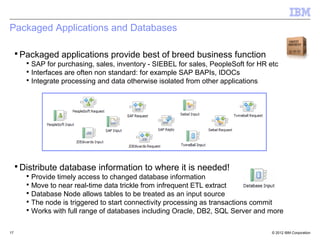
Packaged Applications and Databases

 ▪ Packaged applications provide best of breed business function
     ▪ SAP for purchasing, sales, inventory - SIEBEL for sales, PeopleSoft for HR etc
     ▪ Interfaces are often non standard: for example SAP BAPIs, IDOCs
     ▪ Integrate processing and data otherwise isolated from other applications


 ▪ Distribute database information to where it is needed!
     ▪ Provide timely access to changed database information
     ▪ Move to near real-time data trickle from infrequent ETL extract
     ▪ Database Node allows tables to be treated as an input source
     ▪ The node is triggered to start connectivity processing as transactions commit
     ▪ Works with full range of databases including Oracle, DB2, SQL Server and more


17                                                                                 © 2012 IBM Corporation
Security and Analytics

 ▪ Provide secure access (CIAA) to applications and services
     ▪ Understand and convert broad range of security domain identities
     ▪ Provide secure external access services to partners
     ▪ Variety of security tokens: user/password, X509, SAML, Kerberos, LTPA and more
     ▪ Integration engine is Policy Enforcement Point (PEP)
     ▪ Security is enforced in Message Broker, policy is owned by PDP
 ▪ Monitor your business and act intelligently
     ▪ Message Broker processes data and events from many different sources
     ▪ Straightforward to take additional feeds of that data for value added uses
     ▪ Data flowing through Message Broker can be published for downstream applications
     ▪ Enables business monitoring and event correlation (for example, fraud detection)


18                                                                             © 2012 IBM Corporation
Microsoft .NET


 ▪ Connectivity within Microsoft .NET environments
     ▪ Easily bridge Microsoft and non-Microsoft systems and applications
     ▪ Dynamics (CRM/ERP), SharePoint, Excel, .NET applications and COM
     ▪ Call .NET programs directly via CLR V4; application domains for isolation
     ▪ Tooling is provided in Visual Studio for natural developer experience
     ▪ C#, VB .NET (COM), JScript and F# programming available natively
     ▪ Extensive range of .NET data types supported for easy integration


19                                                                                 © 2012 IBM Corporation
Introduction to Message Broker


      Use the features of Message Broker to their full extent!
        – Message modelling, transformation options, applications and libraries
        – Capabilities link in with activity trace, record edit replay, and more

      Libraries and subflows make for simpler designs
        – Deployable subflows and libraries extend the benefits to the runtime

      Consider production and performance early on in your design
        – In particular, applications and configurable services
        – Your system administrator will thank you for this!

      Patterns address time-to-value for your solutions
        – It takes just a few minutes to create a pattern!
        – Why not create a patterns community in your organisation?

      Tell us what you need in Message Broker – we really do listen


20                                                                                 © 2012 IBM Corporation

Introduction to WebSphere Message Broker

  • 1.
    Ant Phillips antphill@uk.ibm.com Introduction toWebSphere Message Broker © 2012 IBM Corporation
  • 2.
    Introduction to Integration ▪ Enterprise systems consist of many logical endpoints ▪ Off-the-shelf applications, services, packaged applications (SAP, Siebel etc) Web applications, devices, appliances, custom built software and many more! ▪ Endpoints expose a set of inputs and outputs, which comprise: ▪ Protocols such as MQ, TCP/IP, database, HTTP, files, FTP, SMTP, POP3 ▪ Formats like (C/COBOL), XML, industry (SWIFT, EDI, HL7), user-defined ▪ Point-to-point connections quickly deteriorate into spaghetti ▪ Inflexible architecture which is expensive to maintain and resistant to change ▪ Message Broker connects these endpoints together in meaningful ways ▪ Message Broker simplifies application and device integration! ▪ Avoids rewrites in response to new integration requirements ▪ Simplifies maintenance by reducing expensive coupling ▪ Flexibility adding anonymity between producers and consumers of data ▪ Adds insight into applications and business value they bring 2 © 2012 IBM Corporation
  • 3.
    Healthcare Integration  Inmany geographies radiology skills are in critically short supply – Message Broker can be used to route DICOM images to external experts – Routing based on data in the DICOM payload (for example, a clinical code)  This use case draws together many common aspects of integration – Routing, data transformation, industry formats and protocols – Also highlights the inherent flexibility in using an integration engine 3 © 2012 IBM Corporation
  • 4.
    Retail Integration  Retailis a great example of the broad landscape of integration – Many different end points both inside and outside the organisation – Multiple formats and protocols (TLOG, files, JSON/HTTP etc) plus devices – Flexibility is key as new capabilities need to blend in (mobile, analytics etc) Web eCommerce Analytics & Optimization Commerce Suppliers DMZ DMZ APP Service APP APP Service DB DB APP DB APP Store –PoS Internet Internet Enterprise Customer Trading partner Mobile Apps communities Customer communities 4 © 2012 IBM Corporation
  • 5.
    WebSphere Message Broker Universal connectivity from anywhere, to anywhere – Simplify application connectivity for a flexible and dynamic infrastructure  Comprehensive protocols, transports, data formats and processing – Connect to applications, services, systems and devices: • MQ, JMS, HTTP(S), SOAP, REST, file (including FTP, FTE, ConnectDirect), database, TCP/IP, MQTT, CICS, IMS, SAP, SEBL, .NET, PeopleSoft, JDEdwards, SCA, CORBA, email and more! – Understands the broadest range of data formats: • Binary (C/COBOL), XML, CSV, DFDL, JSON, industry (SWIFT, EDI, HL7 etc), IDOCs, user-defined – Built-in suite of request processors: • Route, filter, transform, enrich, monitor, publish, decompose, sequence, correlate, detect…  Simple programming with patterns and graphical data flows – Patterns for top-down, parameterized connectivity of common use cases • For example, service façades, message processing, queue to file etc • IBM and user-defined patterns for development reuse and governance – Graphical data flows represent application and service connectivity • Custom logic via graphical mapping, PHP, Java, ESQL, XSL and Microsoft .NET  Extensive management, performance and scalability – Extensive administration and systems management facilities for developed solutions – Wide range of operating system and hardware platforms including virtual and cloud – High performance transactional processing, additional vertical & horizontal scalability – Deployment options include Trial, Express, Standard and Advanced 5 © 2012 IBM Corporation
  • 6.
    Concepts © 2012 IBM Corporation
  • 7.
    Connecting with Nodes Built-in nodes encapsulate transports, technologies and applications – Our intent is always to make the common tasks easy, and the rest possible! – Use the built-in nodes to reduce the amount of custom code required – This makes best use of the built-in facilities like activity trace and resource statistics 7 © 2012 IBM Corporation
  • 8.
    Transformation Options ▪ MessageBroker has several transformation options: ▪ Mapping ▪ XSLT ▪ ESQL ▪ Java ▪ PHP ▪ .NET ▪ Reflects the importance of transformation in connectivity solutions ▪ User-defined nodes supported for Java and C/C++ ▪ Every transformation option has strengths and weaknesses! – Performance and scalability – Backend integration – Skill sets and learning curve – Developer usability – Portability and maintenance  Use a transformation technology appropriate to the problem at hand! 8 © 2012 IBM Corporation
  • 9.
    Message Modelling  Modelsare needed for parsing, validation and transformation – Models avoid the need to write custom code to parse messages!  Graphical mapper requires models to display the message structure – ESQL editor provides in line validation of code that navigates message trees 9 © 2012 IBM Corporation
  • 10.
    Administration ▪ MessageBroker Explorer has a wealth of monitoring tools! ▪ Statistics monitor resource usage across execution groups ▪ Range of options to update and visualise the resource statistics 10 © 2012 IBM Corporation
  • 11.
    Patterns for SimplifiedDevelopment  Creates top-down, parameterized connectivity solutions  Reduces common problems in flow development  Establishes best practices for healthcare integration  Reduces time-to-value for solution development  Patterns are easily extended with regular broker functionality 11 © 2012 IBM Corporation
  • 12.
    Integration Usage Patterns © 2012 IBM Corporation
  • 13.
    Integration Usage Patterns  Extending the reach of existing applications  Connect file and online for end-to-end efficiency ▪ Beyond applications – integrate devices into the enterprise ▪ Mobile integration and service enablement ▪ Packaged applications provide best of breed business function ▪ Distribute database information to where it is needed! ▪ Provide secure access (CIAA) to applications and services ▪ Monitor your business and act intelligently ▪ Connectivity within Microsoft .NET environments 13 © 2012 IBM Corporation
  • 14.
    Services and Files ▪ Extending the reach of existing applications – service enablement! ▪ Expose existing applications without having to change them (enable re-use) ▪ Range of service interfaces including WS-* (SOAP), JSON/HTTP and JMS ▪ Service gateway allows Message Broker to mediate between clients and providers ▪ Connect file and online for end-to-end efficiency ▪ Scenarios include file-to-queue, database-to-file, file-to-SAP, and file-to-pubsub ▪ Comprehensive file support includes local files, network mounted file, FTP and SFTP ▪ Whole-file, record-at-a-time; simple delimiters to complex COBOL, and user-defined ▪ FTE nodes send and receive files through MQ MFT for reliable and secure delivery ▪ Connect:Direct nodes join Message Broker into the Sterling file transfer network 14 © 2012 IBM Corporation
  • 15.
    Device Integration ▪Beyond applications – integrate devices into the enterprise ▪ Huge amounts of data are generated by devices outside the enterprise ▪ Applicable across many industries in many different scenarios ▪ Medical, energy and utilities, distribution, transport, gaming ▪ Combined with analytics provides cost effective predictive maintenance ▪ Support for MQTT provides standards based device integration ▪ Small footprint client, embeddable, low bandwidth cost ▪ Fragile network support for hostile environments (including last-will-and-testament) ▪ Data from MQTT enabled devices can be sent directly into Message Broker ▪ Industry specific device capability such as medical device integration ▪ Healthcare Connectivity Pack for patient monitors and much more 15 © 2012 IBM Corporation
  • 16.
    Mobile  Worklightintegration makes developing mobile services simple! – Four patterns makes mobile service integration quick and easy – Pattern source included for flexible customization to many other tools  Message Broker provides a range of mobile patterns – Mobile enablement for Microsoft .NET applications – Create flexible mobile services on top of Message Broker – Resource management including security and caching – Outbound push notifications for asynchronous data delivery 16 © 2012 IBM Corporation
  • 17.
    Packaged Applications andDatabases ▪ Packaged applications provide best of breed business function ▪ SAP for purchasing, sales, inventory - SIEBEL for sales, PeopleSoft for HR etc ▪ Interfaces are often non standard: for example SAP BAPIs, IDOCs ▪ Integrate processing and data otherwise isolated from other applications ▪ Distribute database information to where it is needed! ▪ Provide timely access to changed database information ▪ Move to near real-time data trickle from infrequent ETL extract ▪ Database Node allows tables to be treated as an input source ▪ The node is triggered to start connectivity processing as transactions commit ▪ Works with full range of databases including Oracle, DB2, SQL Server and more 17 © 2012 IBM Corporation
  • 18.
    Security and Analytics ▪ Provide secure access (CIAA) to applications and services ▪ Understand and convert broad range of security domain identities ▪ Provide secure external access services to partners ▪ Variety of security tokens: user/password, X509, SAML, Kerberos, LTPA and more ▪ Integration engine is Policy Enforcement Point (PEP) ▪ Security is enforced in Message Broker, policy is owned by PDP ▪ Monitor your business and act intelligently ▪ Message Broker processes data and events from many different sources ▪ Straightforward to take additional feeds of that data for value added uses ▪ Data flowing through Message Broker can be published for downstream applications ▪ Enables business monitoring and event correlation (for example, fraud detection) 18 © 2012 IBM Corporation
  • 19.
    Microsoft .NET ▪Connectivity within Microsoft .NET environments ▪ Easily bridge Microsoft and non-Microsoft systems and applications ▪ Dynamics (CRM/ERP), SharePoint, Excel, .NET applications and COM ▪ Call .NET programs directly via CLR V4; application domains for isolation ▪ Tooling is provided in Visual Studio for natural developer experience ▪ C#, VB .NET (COM), JScript and F# programming available natively ▪ Extensive range of .NET data types supported for easy integration 19 © 2012 IBM Corporation
  • 20.
    Introduction to MessageBroker  Use the features of Message Broker to their full extent! – Message modelling, transformation options, applications and libraries – Capabilities link in with activity trace, record edit replay, and more  Libraries and subflows make for simpler designs – Deployable subflows and libraries extend the benefits to the runtime  Consider production and performance early on in your design – In particular, applications and configurable services – Your system administrator will thank you for this!  Patterns address time-to-value for your solutions – It takes just a few minutes to create a pattern! – Why not create a patterns community in your organisation?  Tell us what you need in Message Broker – we really do listen 20 © 2012 IBM Corporation