© 2012 IBM Corporation
IBM Integration Bus
Introduction to Healthcare Standards
Ant Phillips
antphill@uk.ibm.com
© 2012 IBM Corporation
HL7 Introduction
 Messaging standard for the exchange of healthcare information
– Health Level-7 refers to the application (top) layer in the ISO OSI Reference Model
– Version 2.2 of the standard was ANSI accredited in 1996
– Standards compliance is variable between the main vendors
– HL7 is the key connectivity standard in the provider space
 HL7 covers a range of standards areas:
– Conceptual standards – HL7 Reference Implementation Model (RIM)
– Document standards – HL7 Clinical Document Architecture (CDA)
– Messaging standards – HL7 v2.x (including XML variant) and v3.x
 Deployment specific message segments are supported (Z-segments)
 Supports variety of character encodings (ASCII, ISO-8859 and Unicode)
 Latest version (v2.6) was approved by ANSI in October 2007
– Compliance as always lags behind the standardisation process
– HL7 sample in Message Broker is up to date for v2.5 of the standard
2
© 2012 IBM Corporation
Scope
 There are quite a few things that the HL7 v.2x standard does not cover!
 The standard is not a complete systems integration solution
– Lack of process conformity within healthcare delivery environments
– This effectively leads to a unique use of the standard at each site
– Standard is really a common framework for integrating systems
 Standard is largely silent about authentication and confidentiality of data!
– No standard way to encrypt the data flowing down TCP/IP connections
– Likewise there are no audit trails, security controls and/or access procedures
– No controlled disclosure or notification of disclosed information
 No inter-system database locking or transaction coordination
 Standard builds on other coding systems such as LOINC and SNOMED
3
© 2012 IBM Corporation
HL7 v2.x Chapters
4
© 2012 IBM Corporation
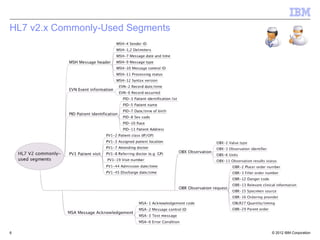
MSH      Message Header Segment
EVN      Event type segment
PID      Patient Identification segment
  [PD1]  Patient Additional Demographic segment
[{NK1}]  Next of Kin / Associated Parties
[PV1]    Patient Visit segment
MSH|^~&|HNAM|CAPIOUK|JDE|JDE|20030821153359||ADT^A04|Q590076T590056X77||2.3
EVN|A04|20030822172800|||1
PID|1|151^^^CD:678893^CD:1079^""|151^^^CD:678893^CD:10^""||ZZTEST^selfpayGT^^^^^CD:766||
20030820000000|CD:363||""|1^test^chester^""^ch11ab^CD:312726^CD:756^^cheshire||
01234567890^CD:170||""|CD:309239|""|166^^^CD:678894^CD:1077^""||||""|||0|""|""|""||""
PD1|""|""||589824^Waller^Dave^Jones|""||""|""
HL7 v2.x Message Example (ADT)
Code Description
ADT^A01 Admit a patient
ADT^A02 Transfer a patient
ADT^A03 Discharge a patient
ADT^A04 Register a patient
ADT^A05 Pre-admit a patient
5
© 2012 IBM Corporation
HL7 v2.x Commonly-Used Segments
6
© 2012 IBM Corporation
Observation Results Example (ORU)
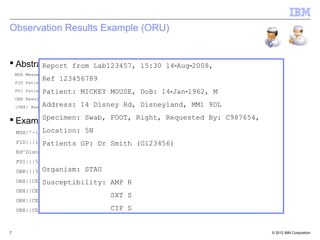
 Abstract syntax for an ORU HL7 v2.x message:
MSH Message header
PID Patient Identification Details
PV1 Patient Visit
OBR Results header
{OBX} Results detail (repeats)
 Example message conforming to this definition:
MSH|^~&||^123457^Labs|||200808141530||ORU^R01|123456789|P|2.4
PID|||123456^^^SMH^PI||MOUSE^MICKEY||19620114|M|||14 Disney
Rd^Disneyland^^^MM1 9DL
PV1|||5N|||||G123456^DR SMITH
OBR|||54321|666777^CULTURE^LN|||20080802||||||||SW^^^FOOT^RT|C987654
OBX||CE|0^ORG|01|STAU||||||F
OBX||CE|500152^AMP|01||||R|||F
OBX||CE|500155^SXT|01||||S|||F
OBX||CE|500162^CIP|01||||S|||F
Report from Lab123457, 15:30 14 Aug 2008,‐ ‐
Ref 123456789
Patient: MICKEY MOUSE, DoB: 14 Jan 1962, M‐ ‐
Address: 14 Disney Rd, Disneyland, MM1 9DL
Specimen: Swab, FOOT, Right, Requested By: C987654,
Location: 5N
Patients GP: Dr Smith (G123456)
Organism: STAU
Susceptibility: AMP R
SXT S
CIP S
7
© 2012 IBM Corporation
Clinical Terminology
© 2012 IBM Corporation
Clinical Terminology - Introduction
9
 Most scientific fields of endeavour have a well defined terminology
– Healthcare covers a huge breadth of scientific levels – radiologists work with subatomic
particles, haematologists study blood cells, physicians are concerned with abnormal
body functions, and public health doctors study the spread of disease in populations
© 2012 IBM Corporation
Coding vs Classification
 Classification collects things into groups or classes
– It is the basis for the majority of statistical analysis, accountancy and much more
– By its very nature, the process of classifying things loses accuracy
 Coding is the allocation of identifiers to things – an alternative name
– No more interest to end users than a bar code on a cereal packet!
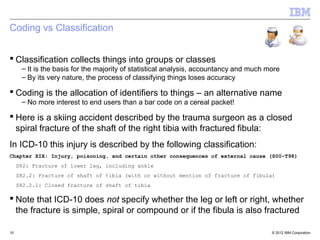
 Here is a skiing accident described by the trauma surgeon as a closed
spiral fracture of the shaft of the right tibia with fractured fibula:
In ICD-10 this injury is described by the following classification:
Chapter XIX: Injury, poisoning, and certain other consequences of external cause (S00-T98)
S82: Fracture of lower leg, including ankle
S82.2: Fracture of shaft of tibia (with or without mention of fracture of fibula)
S82.2.1: Closed fracture of shaft of tibia
 Note that ICD-10 does not specify whether the leg or left or right, whether
the fracture is simple, spiral or compound or if the fibula is also fractured
10
© 2012 IBM Corporation
ICD-10
 International Statistical Classification of Diseases and Health Problems
 Enables the recording, analysis and interpretation for patient mortality
– ICD-10 contains more than 140K codes (ICD-9 contains 17K codes)
 In practice, it has become the standard classification for all general
epidemiological and many health management purposes
 ICD-10 is not suitable for coding distinct clinical entities
 Format XXX.XXX X [category.etiology/site/severity extension]:
K50.013 Crohn’s disease of small intestine with fistula
K71.51 Toxic liver disease with chronic active hepatitis with ascites
H02.835 Dermatochalasis of left lower eyelid
T81.530 Perforation due to foreign body accidently left in body following surgical operation
 ICD-10 widely used for medical reimbursements in the US (HIPPA)
11
Epidemiology is the study of patterns of health and illness and associated factors at the population
level
© 2012 IBM Corporation
Read Codes
 Read Codes are widely used by GPs in the UK NHS and New Zealand
– Used by clinicians to record patient findings and procedures
– Read codes come in two versions – v2 and v3 (Clinical Terms v3)
– Codes are organised into chapters identified by the first character
 Codes are five characters long with missing letters replaced by a dot
– Letters are 0-9, A-Z and a-z (omitting O and I to reduce coding errors)
– Results in a very large potential code space > 750M codes (605
)
H Respiratory disease (H33zz Asthma NOS)
J Digestive system diseases (J20.. Acute appendicitis)
G Circulatory system diseases (G3z.. Ischaemic heart disease NOS)
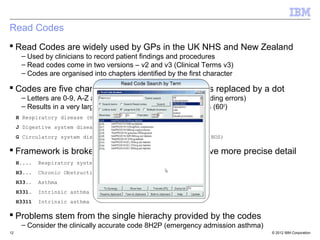
 Framework is broken down into subchapters to give more precise detail
H.... Respiratory system disease
H3... Chronic Obstructive Pulmonary Disease
H33.. Asthma
H331. Intrinsic asthma
H3311 Intrinsic asthma with status asthmaticus
 Problems stem from the single hierachy provided by the codes
– Consider the clinically accurate code 8H2P (emergency admission asthma)
12
© 2012 IBM Corporation
SNOMED CT - Overview
 SNOMED has a long history dating back more than 40 years
 Comprehensive (multi-lingual) clinical terminology for recording the health
and care of individual patients
– Codes can be indexed and retrieved for use at the clinical point-of-care
– SNOMED codes can also be re-used for management and research
 Latest evolution of the standard (SNOMED CT) was formed in 1999
– Merger of SNOMED with NHS Clinical Terms v3
– Every Read Code and existing SNOMED code is represented
 In 2007 the International Health Terminology Standards Development
Organisation (IHTSDO) acquired the SNOMED IPR
 SNOMED CT is sufficiently complex to only be useful in an IT context
– By January 2009, it contained over 350K active concepts, ~1M descriptions and 1.38M
relationships – the sheer size of the standard is an on-going maintenance issue
13
© 2012 IBM Corporation
SNOMED CT – Building Blocks
14
 Building blocks of SNOMED are concepts, descriptions and relationships
– Each concept represents a single specific clinical meaning
– Concepts have a fully specified name (FSN) which may not be the preferred term
 Every concept, relationship and description has an identifier (SCTID)
– SCTID contains the unique identifier, partition identifier and a trailing check digit
© 2012 IBM Corporation
SNOMED CT – Expressions and Grammar
 Expressions are usually presented using a composition grammar
87628006 | bacterial infectious disease |
 Concepts can be combined in post-coordinated expressions to create a
more accurate clinical meaning
87628006 | bacterial infectious disease |:
246075003 | causative agent |= 9861002 | streptococcus pneumoniae |
 Nested expressions supported through the use of parenthesis:
87628006 | bacterial infectious disease |:
246075003 | causative agent |= 9861002 | streptococcus pneumoniae |,
363698007 | finding site |= (45653009 | structure of upper lobe of lung |:
272741003 | laterality |= 7771999 | left |)
 Concepts can be combined using the plus sign:
87628006 | bacterial infectious disease | + 50043002 | disorder of respiratory system |
15
© 2012 IBM Corporation
SNOMED CT and HL7
 SNOMED CT and HL7 do not always sit easily together
– Not surprising when message structure and terminology have evolved separately
 For example consider the transport of Taurine deficiency
– No pre-coordinated term exists in SNOMED CT for this disorder
 Transmit the data as a post coordinated term in OBX.5:
70241007 | Nutritional deficiency |: 47429007 | Associated with |= 10944007 | Taurine |
 Alternatively use observation sub IDs in HL7 messages:
OBX|1|CE|29308-4|1|70241007^Nutritional deficiency^SCT|...
OBX|2|CE|29308-4|1.1|47429007 ^Associated with^SCT|...
OBX|3|CE|29308-4|1.1.1| 10944007^Taurine^SCT|...
 Impossible to draw a clean dividing line between the two!
– Guidelines exist to provide some clarity – for example use HL7 message structure to
transmit dates, times, people and places - use SNOMED CT for semantic relationships
such as laterality and other post coordinated information
16
© 2012 IBM Corporation
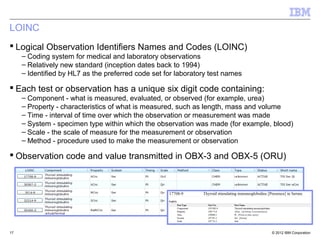
LOINC
 Logical Observation Identifiers Names and Codes (LOINC)
– Coding system for medical and laboratory observations
– Relatively new standard (inception dates back to 1994)
– Identified by HL7 as the preferred code set for laboratory test names
 Each test or observation has a unique six digit code containing:
– Component - what is measured, evaluated, or observed (for example, urea)
– Property - characteristics of what is measured, such as length, mass and volume
– Time - interval of time over which the observation or measurement was made
– System - specimen type within which the observation was made (for example, blood)
– Scale - the scale of measure for the measurement or observation
– Method - procedure used to make the measurement or observation
 Observation code and value transmitted in OBX-3 and OBX-5 (ORU)
17

Healthcare Standards for Connecting Clinical Applications

  • 1.
    © 2012 IBMCorporation IBM Integration Bus Introduction to Healthcare Standards Ant Phillips antphill@uk.ibm.com
  • 2.
    © 2012 IBMCorporation HL7 Introduction  Messaging standard for the exchange of healthcare information – Health Level-7 refers to the application (top) layer in the ISO OSI Reference Model – Version 2.2 of the standard was ANSI accredited in 1996 – Standards compliance is variable between the main vendors – HL7 is the key connectivity standard in the provider space  HL7 covers a range of standards areas: – Conceptual standards – HL7 Reference Implementation Model (RIM) – Document standards – HL7 Clinical Document Architecture (CDA) – Messaging standards – HL7 v2.x (including XML variant) and v3.x  Deployment specific message segments are supported (Z-segments)  Supports variety of character encodings (ASCII, ISO-8859 and Unicode)  Latest version (v2.6) was approved by ANSI in October 2007 – Compliance as always lags behind the standardisation process – HL7 sample in Message Broker is up to date for v2.5 of the standard 2
  • 3.
    © 2012 IBMCorporation Scope  There are quite a few things that the HL7 v.2x standard does not cover!  The standard is not a complete systems integration solution – Lack of process conformity within healthcare delivery environments – This effectively leads to a unique use of the standard at each site – Standard is really a common framework for integrating systems  Standard is largely silent about authentication and confidentiality of data! – No standard way to encrypt the data flowing down TCP/IP connections – Likewise there are no audit trails, security controls and/or access procedures – No controlled disclosure or notification of disclosed information  No inter-system database locking or transaction coordination  Standard builds on other coding systems such as LOINC and SNOMED 3
  • 4.
    © 2012 IBMCorporation HL7 v2.x Chapters 4
  • 5.
    © 2012 IBMCorporation MSH      Message Header Segment EVN      Event type segment PID      Patient Identification segment   [PD1]  Patient Additional Demographic segment [{NK1}]  Next of Kin / Associated Parties [PV1]    Patient Visit segment MSH|^~&|HNAM|CAPIOUK|JDE|JDE|20030821153359||ADT^A04|Q590076T590056X77||2.3 EVN|A04|20030822172800|||1 PID|1|151^^^CD:678893^CD:1079^""|151^^^CD:678893^CD:10^""||ZZTEST^selfpayGT^^^^^CD:766|| 20030820000000|CD:363||""|1^test^chester^""^ch11ab^CD:312726^CD:756^^cheshire|| 01234567890^CD:170||""|CD:309239|""|166^^^CD:678894^CD:1077^""||||""|||0|""|""|""||"" PD1|""|""||589824^Waller^Dave^Jones|""||""|"" HL7 v2.x Message Example (ADT) Code Description ADT^A01 Admit a patient ADT^A02 Transfer a patient ADT^A03 Discharge a patient ADT^A04 Register a patient ADT^A05 Pre-admit a patient 5
  • 6.
    © 2012 IBMCorporation HL7 v2.x Commonly-Used Segments 6
  • 7.
    © 2012 IBMCorporation Observation Results Example (ORU)  Abstract syntax for an ORU HL7 v2.x message: MSH Message header PID Patient Identification Details PV1 Patient Visit OBR Results header {OBX} Results detail (repeats)  Example message conforming to this definition: MSH|^~&||^123457^Labs|||200808141530||ORU^R01|123456789|P|2.4 PID|||123456^^^SMH^PI||MOUSE^MICKEY||19620114|M|||14 Disney Rd^Disneyland^^^MM1 9DL PV1|||5N|||||G123456^DR SMITH OBR|||54321|666777^CULTURE^LN|||20080802||||||||SW^^^FOOT^RT|C987654 OBX||CE|0^ORG|01|STAU||||||F OBX||CE|500152^AMP|01||||R|||F OBX||CE|500155^SXT|01||||S|||F OBX||CE|500162^CIP|01||||S|||F Report from Lab123457, 15:30 14 Aug 2008,‐ ‐ Ref 123456789 Patient: MICKEY MOUSE, DoB: 14 Jan 1962, M‐ ‐ Address: 14 Disney Rd, Disneyland, MM1 9DL Specimen: Swab, FOOT, Right, Requested By: C987654, Location: 5N Patients GP: Dr Smith (G123456) Organism: STAU Susceptibility: AMP R SXT S CIP S 7
  • 8.
    © 2012 IBMCorporation Clinical Terminology
  • 9.
    © 2012 IBMCorporation Clinical Terminology - Introduction 9  Most scientific fields of endeavour have a well defined terminology – Healthcare covers a huge breadth of scientific levels – radiologists work with subatomic particles, haematologists study blood cells, physicians are concerned with abnormal body functions, and public health doctors study the spread of disease in populations
  • 10.
    © 2012 IBMCorporation Coding vs Classification  Classification collects things into groups or classes – It is the basis for the majority of statistical analysis, accountancy and much more – By its very nature, the process of classifying things loses accuracy  Coding is the allocation of identifiers to things – an alternative name – No more interest to end users than a bar code on a cereal packet!  Here is a skiing accident described by the trauma surgeon as a closed spiral fracture of the shaft of the right tibia with fractured fibula: In ICD-10 this injury is described by the following classification: Chapter XIX: Injury, poisoning, and certain other consequences of external cause (S00-T98) S82: Fracture of lower leg, including ankle S82.2: Fracture of shaft of tibia (with or without mention of fracture of fibula) S82.2.1: Closed fracture of shaft of tibia  Note that ICD-10 does not specify whether the leg or left or right, whether the fracture is simple, spiral or compound or if the fibula is also fractured 10
  • 11.
    © 2012 IBMCorporation ICD-10  International Statistical Classification of Diseases and Health Problems  Enables the recording, analysis and interpretation for patient mortality – ICD-10 contains more than 140K codes (ICD-9 contains 17K codes)  In practice, it has become the standard classification for all general epidemiological and many health management purposes  ICD-10 is not suitable for coding distinct clinical entities  Format XXX.XXX X [category.etiology/site/severity extension]: K50.013 Crohn’s disease of small intestine with fistula K71.51 Toxic liver disease with chronic active hepatitis with ascites H02.835 Dermatochalasis of left lower eyelid T81.530 Perforation due to foreign body accidently left in body following surgical operation  ICD-10 widely used for medical reimbursements in the US (HIPPA) 11 Epidemiology is the study of patterns of health and illness and associated factors at the population level
  • 12.
    © 2012 IBMCorporation Read Codes  Read Codes are widely used by GPs in the UK NHS and New Zealand – Used by clinicians to record patient findings and procedures – Read codes come in two versions – v2 and v3 (Clinical Terms v3) – Codes are organised into chapters identified by the first character  Codes are five characters long with missing letters replaced by a dot – Letters are 0-9, A-Z and a-z (omitting O and I to reduce coding errors) – Results in a very large potential code space > 750M codes (605 ) H Respiratory disease (H33zz Asthma NOS) J Digestive system diseases (J20.. Acute appendicitis) G Circulatory system diseases (G3z.. Ischaemic heart disease NOS)  Framework is broken down into subchapters to give more precise detail H.... Respiratory system disease H3... Chronic Obstructive Pulmonary Disease H33.. Asthma H331. Intrinsic asthma H3311 Intrinsic asthma with status asthmaticus  Problems stem from the single hierachy provided by the codes – Consider the clinically accurate code 8H2P (emergency admission asthma) 12
  • 13.
    © 2012 IBMCorporation SNOMED CT - Overview  SNOMED has a long history dating back more than 40 years  Comprehensive (multi-lingual) clinical terminology for recording the health and care of individual patients – Codes can be indexed and retrieved for use at the clinical point-of-care – SNOMED codes can also be re-used for management and research  Latest evolution of the standard (SNOMED CT) was formed in 1999 – Merger of SNOMED with NHS Clinical Terms v3 – Every Read Code and existing SNOMED code is represented  In 2007 the International Health Terminology Standards Development Organisation (IHTSDO) acquired the SNOMED IPR  SNOMED CT is sufficiently complex to only be useful in an IT context – By January 2009, it contained over 350K active concepts, ~1M descriptions and 1.38M relationships – the sheer size of the standard is an on-going maintenance issue 13
  • 14.
    © 2012 IBMCorporation SNOMED CT – Building Blocks 14  Building blocks of SNOMED are concepts, descriptions and relationships – Each concept represents a single specific clinical meaning – Concepts have a fully specified name (FSN) which may not be the preferred term  Every concept, relationship and description has an identifier (SCTID) – SCTID contains the unique identifier, partition identifier and a trailing check digit
  • 15.
    © 2012 IBMCorporation SNOMED CT – Expressions and Grammar  Expressions are usually presented using a composition grammar 87628006 | bacterial infectious disease |  Concepts can be combined in post-coordinated expressions to create a more accurate clinical meaning 87628006 | bacterial infectious disease |: 246075003 | causative agent |= 9861002 | streptococcus pneumoniae |  Nested expressions supported through the use of parenthesis: 87628006 | bacterial infectious disease |: 246075003 | causative agent |= 9861002 | streptococcus pneumoniae |, 363698007 | finding site |= (45653009 | structure of upper lobe of lung |: 272741003 | laterality |= 7771999 | left |)  Concepts can be combined using the plus sign: 87628006 | bacterial infectious disease | + 50043002 | disorder of respiratory system | 15
  • 16.
    © 2012 IBMCorporation SNOMED CT and HL7  SNOMED CT and HL7 do not always sit easily together – Not surprising when message structure and terminology have evolved separately  For example consider the transport of Taurine deficiency – No pre-coordinated term exists in SNOMED CT for this disorder  Transmit the data as a post coordinated term in OBX.5: 70241007 | Nutritional deficiency |: 47429007 | Associated with |= 10944007 | Taurine |  Alternatively use observation sub IDs in HL7 messages: OBX|1|CE|29308-4|1|70241007^Nutritional deficiency^SCT|... OBX|2|CE|29308-4|1.1|47429007 ^Associated with^SCT|... OBX|3|CE|29308-4|1.1.1| 10944007^Taurine^SCT|...  Impossible to draw a clean dividing line between the two! – Guidelines exist to provide some clarity – for example use HL7 message structure to transmit dates, times, people and places - use SNOMED CT for semantic relationships such as laterality and other post coordinated information 16
  • 17.
    © 2012 IBMCorporation LOINC  Logical Observation Identifiers Names and Codes (LOINC) – Coding system for medical and laboratory observations – Relatively new standard (inception dates back to 1994) – Identified by HL7 as the preferred code set for laboratory test names  Each test or observation has a unique six digit code containing: – Component - what is measured, evaluated, or observed (for example, urea) – Property - characteristics of what is measured, such as length, mass and volume – Time - interval of time over which the observation or measurement was made – System - specimen type within which the observation was made (for example, blood) – Scale - the scale of measure for the measurement or observation – Method - procedure used to make the measurement or observation  Observation code and value transmitted in OBX-3 and OBX-5 (ORU) 17