RESTful Arch
Benjamin Tan
1
about
• Benjamin Tan
• @tanbamboo
• github.com/tanbamboo
2
agenda
• Lesson 1
• what?
• why?
• Lesson 2
• how?
• how? in Java(using JAX-RS)
• Lesson 3
• good practice? bad practice?
• more?
3
what?
• what is REST? what is RESTful arch?
4
what?
• Representational state transfer (REST) is a style
of software architecture for distributed systems
such as the World Wide Web. REST has
emerged as a predominant web API design
model.
• Representational State
Transfer REST Roy Fielding
2000
5
the Author of REST
• Fielding HTTP 1.0
1.1 Apache
Apache
•
• REST
6
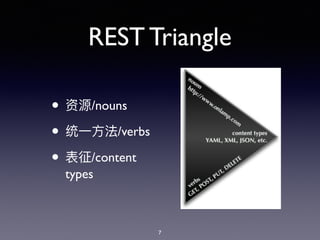
REST Triangle
• /nouns
• /verbs
• /content
types
7
/Resources
• REST " " " "
" " Resources " "
• " "
•
• URI
URI
• URI URI
8
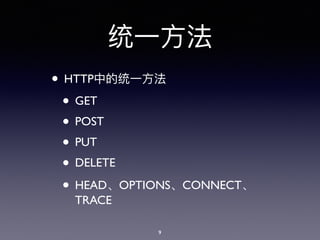
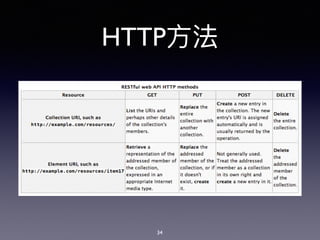
• HTTP
• GET
• POST
• PUT
• DELETE
• HEAD OPTIONS CONNECT
TRACE
9
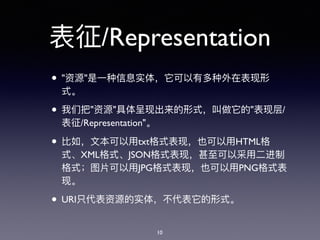
/Representation
• " "
• " " " /
/Representation"
• txt HTML
XML JSON
JPG PNG
• URI
10
key goals
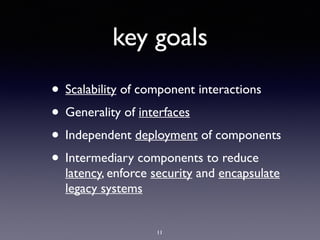
• Scalability of component interactions
• Generality of interfaces
• Independent deployment of components
• Intermediary components to reduce
latency, enforce security and encapsulate
legacy systems
11
Constraints
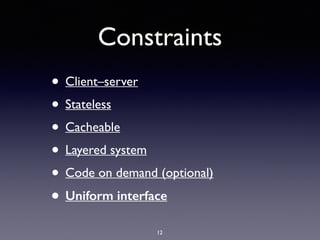
• Client–server
• Stateless
• Cacheable
• Layered system
• Code on demand (optional)
• Uniform interface
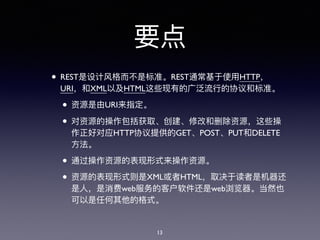
12
• REST REST HTTP
URI XML HTML
• URI
•
HTTP GET POST PUT DELETE
•
• XML HTML
web web
13
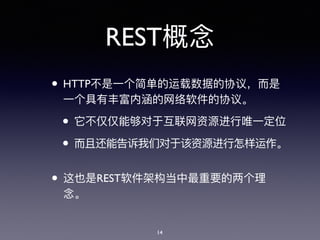
REST
• HTTP
•
•
• REST
14
HATEOAS
•
15
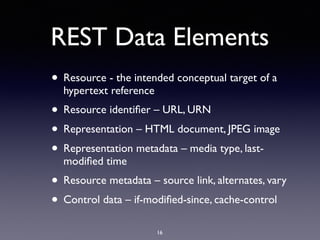
REST Data Elements
• Resource - the intended conceptual target of a
hypertext reference
• Resource identifier – URL, URN
• Representation – HTML document, JPEG image
• Representation metadata – media type, last-
modified time
• Resource metadata – source link, alternates, vary
• Control data – if-modified-since, cache-control
16
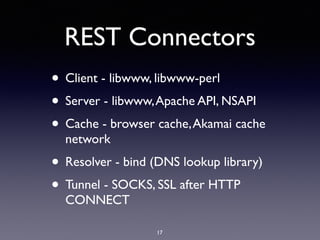
REST Connectors
• Client - libwww, libwww-perl
• Server - libwww,Apache API, NSAPI
• Cache - browser cache,Akamai cache
network
• Resolver - bind (DNS lookup library)
• Tunnel - SOCKS, SSL after HTTP
CONNECT
17
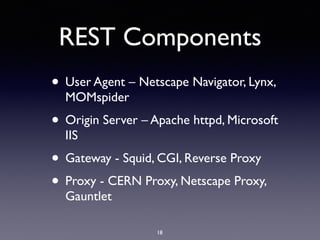
REST Components
• User Agent – Netscape Navigator, Lynx,
MOMspider
• Origin Server – Apache httpd, Microsoft
IIS
• Gateway - Squid, CGI, Reverse Proxy
• Proxy - CERN Proxy, Netscape Proxy,
Gauntlet
18
why?
19
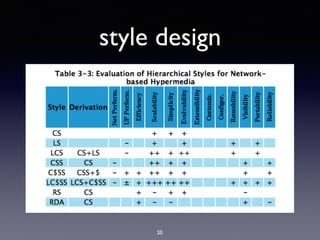
style design
20
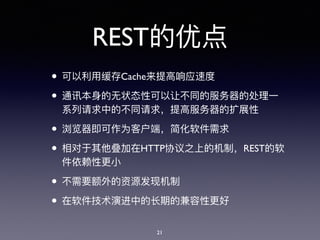
REST
• Cache
•
•
• HTTP REST
•
•
21
network application
style
• / (MQ WebSocket)
• (P2P ZooKeeper)
• /
22
•
• The PUT and DELETE methods are
idempotent methods.
• The GET method is a safe method (or
nullipotent), meaning that calling it
23
Samples broken
Idempotent
• WebScan
• Robot
• http://stackoverflow.com/questions/
10519064/why-is-using-a-http-get-to-
update-state-on-the-server-in-a-restful-
call-incorrec
24
RESTful & Cloud
•
• RESTful API
• AWS API
• Twitter API
• http://www.infoq.com/news/2011/01/rest-
cloud
25
RESTful & SOA
26
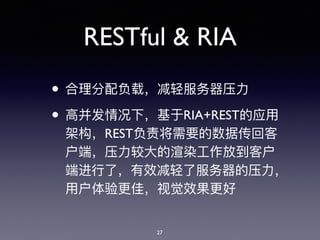
RESTful & RIA
•
• RIA+REST
REST
27
RESTful & Mobile
28
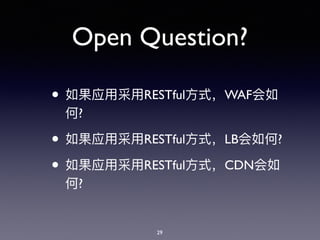
Open Question?
• RESTful WAF
?
• RESTful LB ?
• RESTful CDN
?
29
the philosophy of
design
•
30
how?
31
Guiding principles of
the interface
• The uniform interface that any REST interface must provide is considered fundamental to the design of
any REST service.
• Identification of resources
• Individual resources are identified in requests, for example using URIs in web-based REST systems.
The resources themselves are conceptually separate from the representations that are returned
to the client. For example, the server does not send its database, but rather, perhaps, some HTML,
XML or JSON that represents some database records expressed, for instance, in Swahili and
encoded in UTF-8, depending on the details of the request and the server implementation.
• Manipulation of resources through these representations
• When a client holds a representation of a resource, including any metadata attached, it has enough
information to modify or delete the resource on the server, provided it has permission to do so.
• Self-descriptive messages
• Each message includes enough information to describe how to process the message. For example,
which parser to invoke may be specified by an Internet media type (previously known as a MIME
type). Responses also explicitly indicate their cacheability.[1]
• Hypermedia as the engine of application state (aka HATEOAS)
• Clients make state transitions only through actions that are dynamically identified within
hypermedia by the server (e.g., by hyperlinks within hypertext). Except for simple fixed entry
points to the application, a client does not assume that any particular action is available for any
particular resources beyond those described in representations previously received from the
server.
32
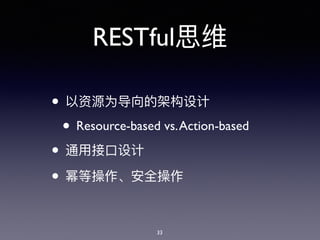
RESTful
•
• Resource-based vs.Action-based
•
•
33
HTTP
34
35
Cache
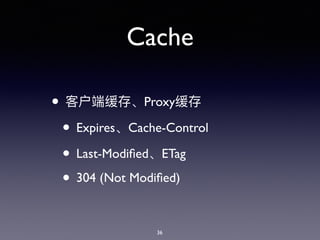
• Proxy
• Expires Cache-Control
• Last-Modified ETag
• 304 (Not Modified)
36
in one stentence
• REST is everywhere. It is the part of the web
that makes it work well. If you want to build
distributed applications that can scale like
the web, be resilient to change like the web
and promote re-use as the web has done,
then follow the same rules they did when
building web browsers.
• http://stackoverflow.com/questions/1368014/
why-do-we-need-restful-web-services
37
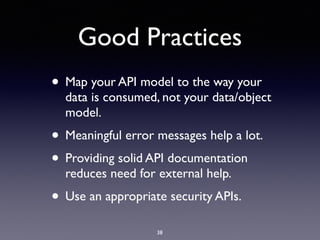
Good Practices
• Map your API model to the way your
data is consumed, not your data/object
model.
• Meaningful error messages help a lot.
• Providing solid API documentation
reduces need for external help.
• Use an appropriate security APIs.
38
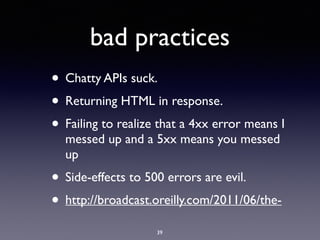
bad practices
• Chatty APIs suck.
• Returning HTML in response.
• Failing to realize that a 4xx error means I
messed up and a 5xx means you messed
up
• Side-effects to 500 errors are evil.
• http://broadcast.oreilly.com/2011/06/the-
39
how? in Java
(using JAX-RS)
40
JAX-RS
• JSR 311: JAX-RS:The Java API for RESTful Web Services
• Java EE 6 JSR-311 JSR-311
Java
REST
• JSR 339: JAX-RS 2.0
• Java EE 7 with JAX-RS 2.0 brings several useful features,
which further simplify development and lead to the
creation of even more-sophisticated, but lean, Java SE/EE
RESTful applications.
41
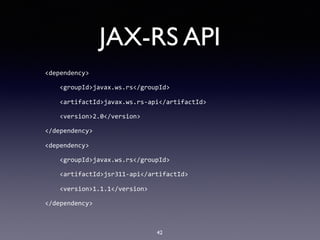
JAX-RS API
<dependency>	
				<groupId>javax.ws.rs</groupId>	
				<artifactId>javax.ws.rs-api</artifactId>	
				<version>2.0</version>	
</dependency>	
<dependency>	
				<groupId>javax.ws.rs</groupId>	
				<artifactId>jsr311-api</artifactId>	
				<version>1.1.1</version>	
</dependency>
42
JAX-RS
• @POST @GET @PUT
@DELETE 4 HTTP
• @Path
43
JAX-RS
• JAX-RS Resource
@PathParam @MatrixParam @QueryParam
@FormParam @HeaderParam
@CookieParam @DefaultValue @Encoded
• @PathParam
@Path
44
JAX-RS
• Web
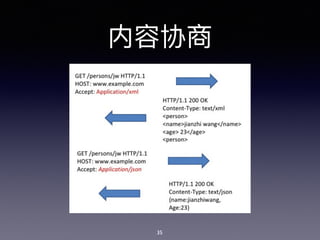
Content Negotiation
• Resource @Produces
MIME @Consumes
• Accept Content-
Type
• JAX-RS MessageBodyReader MessageBodyWriter
XML / Java JAXB
• @Provider MessageBodyProvider
45
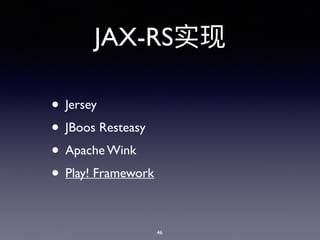
JAX-RS
• Jersey
• JBoos Resteasy
• Apache Wink
• Play! Framework
46
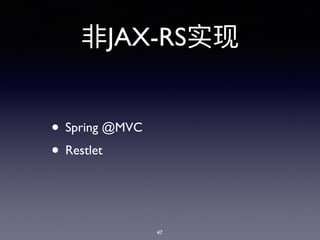
JAX-RS
• Spring @MVC
• Restlet
47
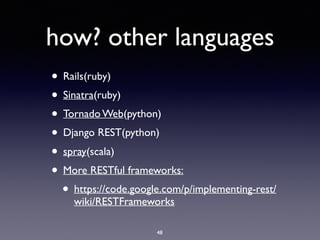
how? other languages
• Rails(ruby)
• Sinatra(ruby)
• Tornado Web(python)
• Django REST(python)
• spray(scala)
• More RESTful frameworks:
• https://code.google.com/p/implementing-rest/
wiki/RESTFrameworks
48
more?
49
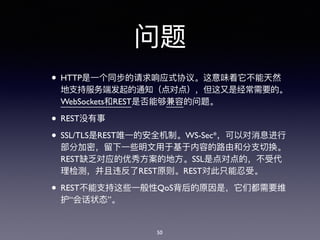
• HTTP
WebSockets REST
• REST
• SSL/TLS REST WS-Sec*
REST SSL
REST REST
• REST QoS
“ ”
50
API versioning
• API REST
51
POST
• post
•
52
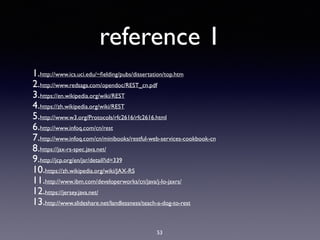
reference 1
1.http://www.ics.uci.edu/~fielding/pubs/dissertation/top.htm
2.http://www.redsaga.com/opendoc/REST_cn.pdf
3.https://en.wikipedia.org/wiki/REST
4.https://zh.wikipedia.org/wiki/REST
5.http://www.w3.org/Protocols/rfc2616/rfc2616.html
6.http://www.infoq.com/cn/rest
7.http://www.infoq.com/cn/minibooks/restful-web-services-cookbook-cn
8.https://jax-rs-spec.java.net/
9.http://jcp.org/en/jsr/detail?id=339
10.https://zh.wikipedia.org/wiki/JAX-RS
11.http://www.ibm.com/developerworks/cn/java/j-lo-jaxrs/
12.https://jersey.java.net/
13.http://www.slideshare.net/landlessness/teach-a-dog-to-rest
53
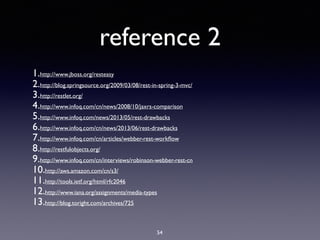
reference 2
1.http://www.jboss.org/resteasy
2.http://blog.springsource.org/2009/03/08/rest-in-spring-3-mvc/
3.http://restlet.org/
4.http://www.infoq.com/cn/news/2008/10/jaxrs-comparison
5.http://www.infoq.com/news/2013/05/rest-drawbacks
6.http://www.infoq.com/cn/news/2013/06/rest-drawbacks
7.http://www.infoq.com/cn/articles/webber-rest-workflow
8.http://restfulobjects.org/
9.http://www.infoq.com/cn/interviews/robinson-webber-rest-cn
10.http://aws.amazon.com/cn/s3/
11.http://tools.ietf.org/html/rfc2046
12.http://www.iana.org/assignments/media-types
13.http://blog.toright.com/archives/725
54

Restful风格ž„web服务架构