The New Kids on the Data Block		JSON 		and		REST
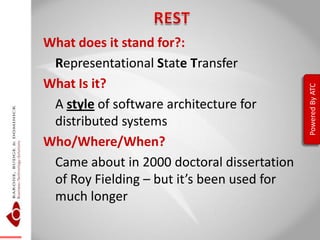
RESTWhat does it stand for?: 	Representational StateTransfer What Is it?A style of software architecture for distributed systemsWho/Where/When?	Came about in 2000 doctoral dissertation of Roy Fielding – but it’s been used for much longer
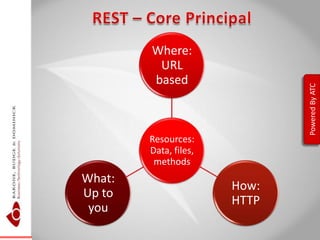
REST – Core Principal
REST – Where/How: Simple ExamplePremise: Data in a table could be a resource we want to read	Database server called  bbddb01Database called northwindTable called usershttp://bbddb01/northwind/users
What, What, What?What type of content you return is up to you.Compare to SOAP where you must return XML.Most common are XML or JSON. You could return complex types like a picture.
REST – Is it used?Web sites are RESTfulRSS is RESTfulTwitter, Flickr and Amazon expose data using RESTSome things are “accidentally RESTful” in that they offer limited support.
Real Life: Flickr APIResource: PhotosWhere:http://farm{farm-id}.static.flickr.com/{server-id}/{id}_{secret}.jpg
http://farm{farm-id}.static.flickr.com/{server-id}/{id}_{secret}_[mstb].jpg
 http://farm{farm-id}.static.flickr.com/{server-id}/{id}_{o-secret}_o.(jpg|gif|png)What: JPEG, GIF or PNG (defined in the URL)http://farm1.static.flickr.com/2/1418878_1e92283336_m.jpg
REST – MethodsHTTP Methods are a key corner stone in REST. They define the action to be taken with a URL.Proper RESTful services expose all four – “accidental” expose less.Nothing stopping you doing some Mix & MatchSome URL’s offering all of them and others a limited setWhat are the four methods and what should they do?
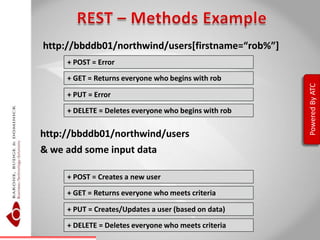
REST – Methods Examplehttp://bbddb01/northwind/users[firstname=“rob%”]+ POST = Error + GET = Returns everyone who begins with rob+ PUT = Error+ DELETE = Deletes everyone who begins with robhttp://bbddb01/northwind/users& we add some input data+ POST = Creates a new user+ GET = Returns everyone who meets criteria+ PUT = Creates/Updates a user (based on data)+ DELETE = Deletes everyone who meets criteria
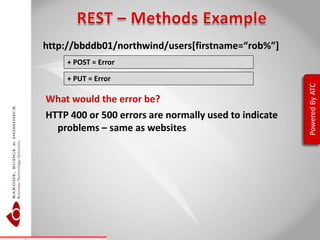
REST – Methods Examplehttp://bbddb01/northwind/users[firstname=“rob%”]+ POST = Error + PUT = ErrorWhat would the error be?HTTP 400 or 500 errors are normally used to indicate problems – same as websites
REST – CommandsYou can associate commands with a resource. Commands can replace the need for using HTTP methods and can provide a more familiar way of dealing with data.Example:userResource = new Resource('http://example.com/users/001') userResource.delete()
Comparing apples and orangesFIGHT: REST vs. SOAP
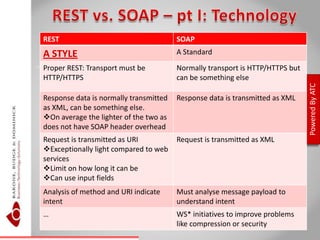
REST vs. SOAP – pt I: Technology
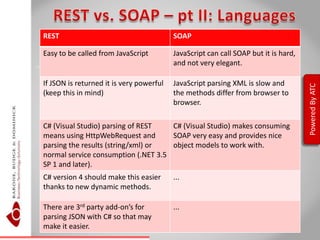
REST vs. SOAP – pt II: Languages
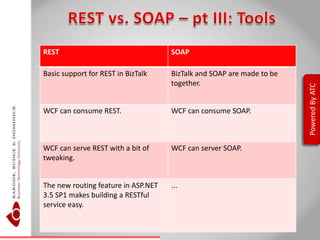
REST vs. SOAP – pt III: Tools
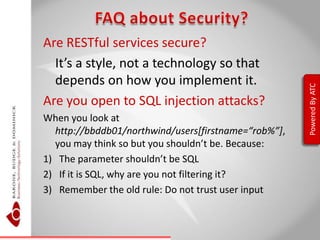
FAQ about Security?Are RESTful services secure?	It’s a style, not a technology so that depends on how you implement it.Are you open to SQL injection attacks?When you look at http://bbddb01/northwind/users[firstname=“rob%”], you may think so but you shouldn’t be. Because:The parameter shouldn’t be SQLIf it is SQL, why are you not filtering it?Remember the old rule: Do not trust user input
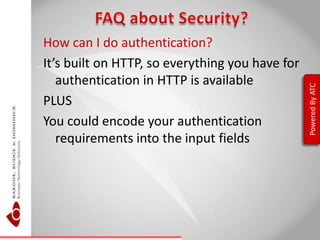
FAQ about Security?How can I do authentication?It’s built on HTTP, so everything you have for authentication in HTTP is availablePLUSYou could encode your authentication requirements into the input fields
DEMOBuilding a RESTful database with ADO.NET Data Services
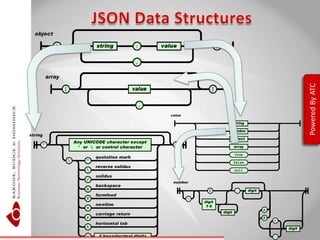
JSON – What is it?“JSON (JavaScript Object Notation) is a lightweight data-interchange format. It is easy for humans to read and write. It is easy for machines to parse and generate” – JSON.orgImportantly: JSON is a subset of JavaScript
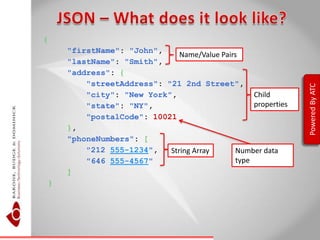
JSON – What does it look like?{"firstName": "John","lastName": "Smith","address": {"streetAddress": "21 2nd Street","city": "New York","state": "NY","postalCode": 10021},"phoneNumbers": ["212 555-1234","646 555-4567"]}Name/Value PairsChild propertiesNumber data typeString Array
JSON Data Structures
DemoJSON Basics
ADO.NET Data Services & JSONDemo
More on jQuery?What: jQuery TRWho: ReinWhere: BB&D CollabWhen: 20th May 2009
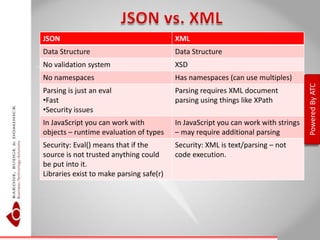
Aren’t they the same?FIGHT: JSON vs XML

JSON and REST

  • 1.
    The New Kidson the Data Block JSON and REST
  • 2.
    RESTWhat does itstand for?: Representational StateTransfer What Is it?A style of software architecture for distributed systemsWho/Where/When? Came about in 2000 doctoral dissertation of Roy Fielding – but it’s been used for much longer
  • 3.
    REST – CorePrincipal
  • 4.
    REST – Where/How:Simple ExamplePremise: Data in a table could be a resource we want to read Database server called bbddb01Database called northwindTable called usershttp://bbddb01/northwind/users
  • 5.
    What, What, What?Whattype of content you return is up to you.Compare to SOAP where you must return XML.Most common are XML or JSON. You could return complex types like a picture.
  • 6.
    REST – Isit used?Web sites are RESTfulRSS is RESTfulTwitter, Flickr and Amazon expose data using RESTSome things are “accidentally RESTful” in that they offer limited support.
  • 7.
    Real Life: FlickrAPIResource: PhotosWhere:http://farm{farm-id}.static.flickr.com/{server-id}/{id}_{secret}.jpg
  • 8.
  • 9.
    http://farm{farm-id}.static.flickr.com/{server-id}/{id}_{o-secret}_o.(jpg|gif|png)What: JPEG,GIF or PNG (defined in the URL)http://farm1.static.flickr.com/2/1418878_1e92283336_m.jpg
  • 10.
    REST – MethodsHTTPMethods are a key corner stone in REST. They define the action to be taken with a URL.Proper RESTful services expose all four – “accidental” expose less.Nothing stopping you doing some Mix & MatchSome URL’s offering all of them and others a limited setWhat are the four methods and what should they do?
  • 11.
    REST – MethodsExamplehttp://bbddb01/northwind/users[firstname=“rob%”]+ POST = Error + GET = Returns everyone who begins with rob+ PUT = Error+ DELETE = Deletes everyone who begins with robhttp://bbddb01/northwind/users& we add some input data+ POST = Creates a new user+ GET = Returns everyone who meets criteria+ PUT = Creates/Updates a user (based on data)+ DELETE = Deletes everyone who meets criteria
  • 12.
    REST – MethodsExamplehttp://bbddb01/northwind/users[firstname=“rob%”]+ POST = Error + PUT = ErrorWhat would the error be?HTTP 400 or 500 errors are normally used to indicate problems – same as websites
  • 13.
    REST – CommandsYoucan associate commands with a resource. Commands can replace the need for using HTTP methods and can provide a more familiar way of dealing with data.Example:userResource = new Resource('http://example.com/users/001') userResource.delete()
  • 14.
    Comparing apples andorangesFIGHT: REST vs. SOAP
  • 15.
    REST vs. SOAP– pt I: Technology
  • 16.
    REST vs. SOAP– pt II: Languages
  • 17.
    REST vs. SOAP– pt III: Tools
  • 18.
    FAQ about Security?AreRESTful services secure? It’s a style, not a technology so that depends on how you implement it.Are you open to SQL injection attacks?When you look at http://bbddb01/northwind/users[firstname=“rob%”], you may think so but you shouldn’t be. Because:The parameter shouldn’t be SQLIf it is SQL, why are you not filtering it?Remember the old rule: Do not trust user input
  • 19.
    FAQ about Security?Howcan I do authentication?It’s built on HTTP, so everything you have for authentication in HTTP is availablePLUSYou could encode your authentication requirements into the input fields
  • 20.
    DEMOBuilding a RESTfuldatabase with ADO.NET Data Services
  • 21.
    JSON – Whatis it?“JSON (JavaScript Object Notation) is a lightweight data-interchange format. It is easy for humans to read and write. It is easy for machines to parse and generate” – JSON.orgImportantly: JSON is a subset of JavaScript
  • 22.
    JSON – Whatdoes it look like?{"firstName": "John","lastName": "Smith","address": {"streetAddress": "21 2nd Street","city": "New York","state": "NY","postalCode": 10021},"phoneNumbers": ["212 555-1234","646 555-4567"]}Name/Value PairsChild propertiesNumber data typeString Array
  • 23.
  • 24.
  • 25.
  • 26.
    More on jQuery?What:jQuery TRWho: ReinWhere: BB&D CollabWhen: 20th May 2009
  • 27.
    Aren’t they thesame?FIGHT: JSON vs XML
  • 28.
  • 29.
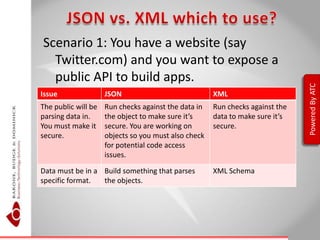
    JSON vs. XMLwhich to use?Scenario 1: You have a website (say Twitter.com) and you want to expose a public API to build apps.
  • 30.
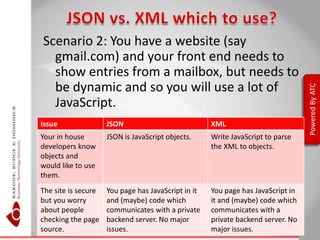
    JSON vs. XMLwhich to use?Scenario 2: You have a website (say gmail.com) and your front end needs to show entries from a mailbox, but needs to be dynamic and so you will use a lot of JavaScript.
  • 31.
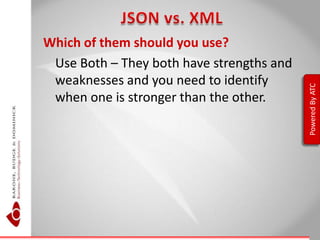
    JSON vs. XMLWhichof them should you use? Use Both – They both have strengths and weaknesses and you need to identify when one is stronger than the other.