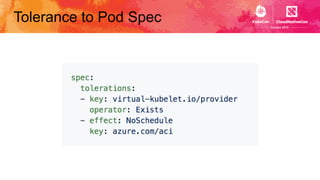
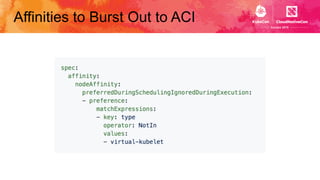
This document introduces Virtual Kubelet, which extends the Kubernetes API to serverless container platforms. It treats the concept of pods and nodes abstractly, allowing pods to run on platforms like ACI and Fargate. Virtual Kubelet implements a provider interface to manage the pod lifecycle on these platforms. It also allows hybrid use cases like running traditional and serverless pods together. The document demonstrates how Virtual Kubelet can schedule pods to ACI from an AKS cluster and to Nomad from a Kubernetes cluster.
Introduction to Virtual Kubelet by key Microsoft and HashiCorp figures: Ria Bhatia and Anubhav Mishra, highlighting their roles and contributions.
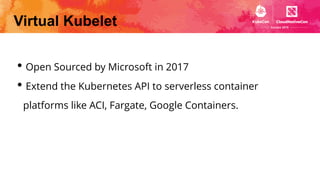
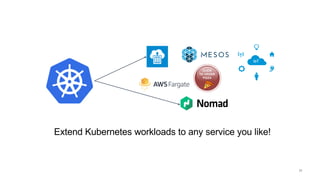
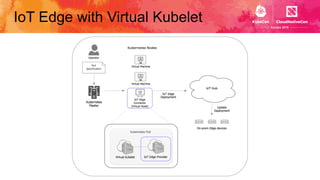
Virtual Kubelet extends Kubernetes API to serverless platforms, offering flexibility, granularity, and hybrid use cases like IoT Edge.
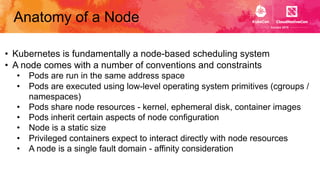
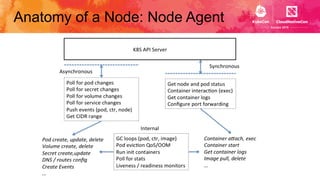
Describes Kubernetes nodes, including resource constraints, pod execution, and the role of node agents in scheduling.Virtual Kubelet extends Kubernetes API to serverless platforms, offering flexibility, granularity, and hybrid use cases like IoT Edge.
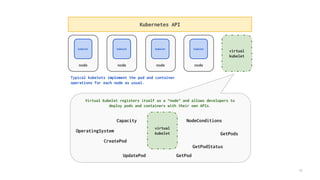
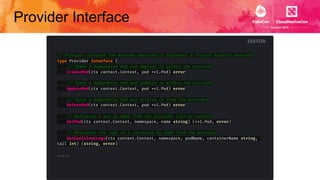
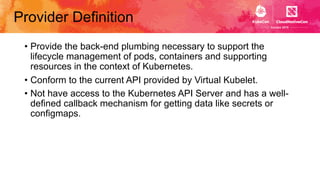
Defines the methods and backend necessary for managing pods and containers, including lifecycle operations.
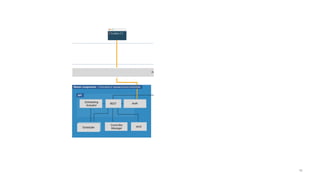
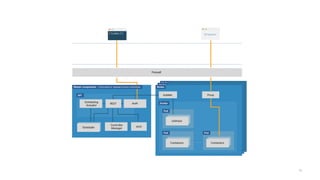
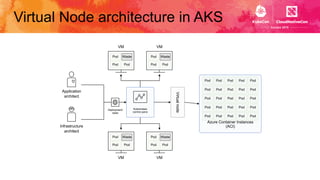
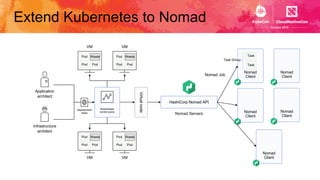
Illustrates the architecture of Virtual Kubelet in AKS and integration with HashiCorp Nomad for extended Kubernetes workloads.
Live demonstrations of Virtual Kubelet functionality in AKS and integration with Nomad to showcase real-world applications.
Illustrates the architecture of Virtual Kubelet in AKS and integration with HashiCorp Nomad for extended Kubernetes workloads.
Live demonstrations of Virtual Kubelet functionality in AKS and integration with Nomad to showcase real-world applications.
Wrap-up of the presentation with a Q&A segment, featuring a deep dive session planned for further exploration of Virtual Kubelet.
Anatomy of aNode
• Kubernetes is fundamentally a node-based scheduling system
• A node comes with a number of conventions and constraints
• Pods are run in the same address space
• Pods are executed using low-level operating system primitives (cgroups /
namespaces)
• Pods share node resources - kernel, ephemeral disk, container images
• Pods inherit certain aspects of node configuration
• Node is a static size
• Privileged containers expect to interact directly with node resources
• A node is a single fault domain - affinity consideration
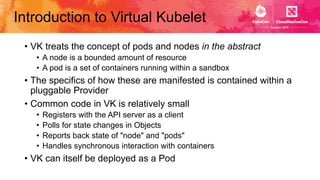
Introduction to VirtualKubelet
• VK treats the concept of pods and nodes in the abstract
• A node is a bounded amount of resource
• A pod is a set of containers running within a sandbox
• The specifics of how these are manifested is contained within a
pluggable Provider
• Common code in VK is relatively small
• Registers with the API server as a client
• Polls for state changes in Objects
• Reports back state of "node" and "pods"
• Handles synchronous interaction with containers
• VK can itself be deployed as a Pod
16.
Why Virtual Kubelet?
•Flexibility of abstraction
• Flexibility of resource consumption
• Greater granularity – pay for pods, not nodes
• Hybrid use-case - traditional cluster with a VK node for bursting
/ batch / on-demand pricing
• Single cluster high availability - a VK in each availability zone
• IOT edge connector - a VK schedules to a set of IOT devices
• Alternate Kubelet – VK as a node agent in a different kind of
node
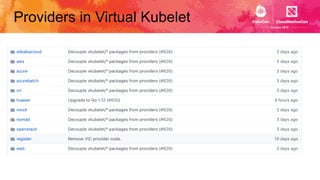
Provider Interface
EDITOR
// Providercontains the methods required to implement a Virtual Kubelet provider
type Provider interface {
// Takes a Kubernetes Pod and deploys it within the provider
CreatePod(ctx context.Context, pod *v1.Pod) error
// Takes a Kubernetes Pod and updates it within the provider
UpdatePod(ctx context.Context, pod *v1.Pod) error
// Takes a Kubernetes Pod and deletes it from the provider
DeletePod(ctx context.Context, pod *v1.Pod) error
// Retrieves a pod by name from the provider (can be cached)
GetPod(ctx context.Context, namespace, name string) (*v1.Pod, error)
// Retrieves the logs of a container by name from the provider
GetContainerLogs(ctx context.Context, namespace, podName, containerName string,
tail int) (string, error)
.....
19.
Provider Definition
• Providethe back-end plumbing necessary to support the
lifecycle management of pods, containers and supporting
resources in the context of Kubernetes.
• Conform to the current API provided by Virtual Kubelet.
• Not have access to the Kubernetes API Server and has a well-
defined callback mechanism for getting data like secrets or
configmaps.
Virtual Node architecturein AKS
Kubernetes
control pane
Application
architect
Infrastructure
architect
Azure Container Instances
(ACI)
Virtualnode
Pod
Pod Pod
Pod
Pod Pod
Pod
Pod Pod
Pod
Pod Pod
VM VM
VM VM
Deployment/
tasks
Pod Pod Pod Pod Pod
Pod Pod Pod Pod Pod
Pod Pod Pod Pod Pod
Pod Pod Pod Pod Pod
Pod Pod Pod Pod Pod
WasteWaste
WasteWaste
Extend Kubernetes toNomad
Kubernetes
control pane
Application
architect
Infrastructure
architect
HashiCorp Nomad API
VirtualnodePod
Pod Pod
Pod
Pod Pod
Pod
Pod Pod
Pod
Pod Pod
VM VM
VM VM
Deployment/
tasks
WasteWaste
WasteWaste
Nomad Servers
Nomad
Client
Nomad
Client
Nomad
Client
Nomad
Client
Nomad
Client
Nomad Job
Task
Task
Task Group