Copyright © 2020 HashiCorp
Using New Sentinel Features in
Terraform Cloud and Terraform
Enterprise
Roger Berlind
Technology Specialist
HashiCorp
Copyright © 2020 HashiCorp
▪ Sentinel in Terraform Cloud (TFC) and Terraform Enterprise (TFE)
▪ Two New Sentinel Features
– Sentinel Modules
– Terraform Sentinel v2 Imports
▪ The Evolution of Sentinel Policies
▪ Some Prototypical Third-Generation Sentinel Policies
▪ The Third-Generation Common Functions
▪ Testing and Using the Third Generation Sentinel Policies
▪ A Demo
Agenda
Copyright © 2020 HashiCorp
Sentinel in Terraform Cloud and
Terraform Enterprise
Copyright © 2020 HashiCorp
▪ HashiCorp's Sentinel is a framework for implementing governance
policies as code in the same way that Terraform implements
infrastructure as code.
▪ It includes its own language and is embedded in HashiCorp's
enterprise products.
▪ Using Sentinel ensures that your governance policies are actually
being checked rather than just being listed in a spreadsheet.
▪ It supports fine-grained policies that use conditional logic.
▪ It includes a CLI that allows you to test and run policies.
What is Sentinel?
Copyright © 2020 HashiCorp
Terraform Cloud and Terraform Enterprise
▪ A User Interface
▪ Workspace Management
▪ Team Management
▪ State Management
▪ Secure Variable Management
▪ Remote Runs and State
▪ VCS Integrations
▪ HTTP/JSON API
▪ Private Module Registry
▪ Configuration Editor
▪ Sentinel (policy as code)
▪ SSO via SAML Integration
▪ Audit Logging
Terraform Cloud (TFC) includes the following advanced functionality that
makes it easier for teams and organizations to use Terraform:
Customers can install Terraform Enterprise (TFE) servers to self-host
TFC in their own virtual private networks or in their data centers.
Copyright © 2020 HashiCorp
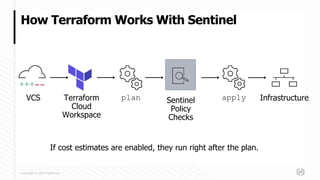
▪ Sentinel policies are checked between the standard plan and apply
steps of Terraform runs.
▪ Policies have different enforcement levels: advisory, soft-mandatory, and
hard-mandatory.
▪ Violations prevent runs from being applied unless a user with sufficient
authority overrides them.
▪ Sentinel policies can evaluate the attributes (arguments and exported
attributes) of existing and new resources and data sources based on
information from the current run:
– the plan, the configuration, the current state, and other run data
including cost estimates
▪ This ensures that resources comply with all policies before they are
provisioned.
Where is Sentinel Used in Terraform?
Copyright © 2020 HashiCorp
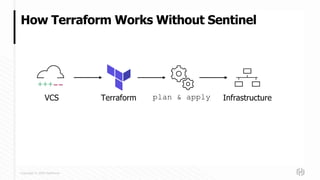
How Terraform Works Without Sentinel
VCS Terraform Infrastructureplan & apply
Copyright © 2020 HashiCorp
How Terraform Works With Sentinel
VCS Terraform
Cloud
Workspace
Infrastructureplan Sentinel
Policy
Checks
apply
If cost estimates are enabled, they run right after the plan.
Copyright © 2020 HashiCorp
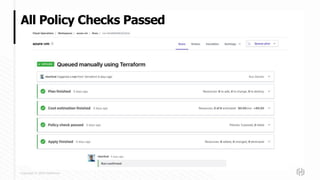
All Policy Checks Passed
Copyright © 2020 HashiCorp
▪ HashiCorp customers are using Sentinel to implement governance
policies like the following in Terraform Cloud/Enterprise:
– Enforce security standards:
▪ Require all S3 buckets use the private ACL and be encrypted by KMS.
▪ Restrict which roles the AWS provider can assume.
▪ Blacklist/whitelist resources, data sources, providers, or provisioners.
– Avoid excessive costs:
▪ Limit the sizes of VMs and Kubernetes clusters in public clouds.
▪ Limit the monthly spend of each Terraform workspace.
– Enforce mandatory tags on resources provisioned by Terraform.
– Mandate that all modules come from a Private Module Registry.
– Enforce specific Terraform coding conventions.
How Customers are Using Sentinel in Terraform
Copyright © 2020 HashiCorp
Two New Sentinel
Features
Copyright © 2020 HashiCorp
▪ A Sentinel Module defines Sentinel functions and rules in a file that can
be used by Sentinel policies with a single import statement.
▪ This avoids the need to paste the functions into every policy that calls
them, improving the reusability of Sentinel functions.
▪ Sentinel modules are registered in Sentinel CLI configuration files and in
TFC/TFE policy set configuration files.
▪ The terraform-guides repository includes 5 "third-generation" modules:
– tfplan-functions, tfstate-functions, tfconfig-functions, tfrun-functions,
and aws-functions
▪ Each function is documented in a separate MD file.
▪ Note that these are NOT standard functions.
Sentinel Modules
Copyright © 2020 HashiCorp
▪ The new v2 versions of three Terraform Sentinel imports (tfplan,
tfstate, and tfconfig) are aligned more closely with native
Terraform 0.12 data structures.
▪ This makes the v2 imports easier to use than the v1 imports.
▪ Additionally, since resource instances are stored in a single flat
map that spans across all Terraform modules and resource types, it
is much easier to find all resources instances of a specific type or a
sub-collection of them.
▪ However, there is a catch:
– The v2 imports can only be used with Terraform 0.12.
New v2 Versions of the Terraform Sentinel Imports
Copyright © 2020 HashiCorp
▪ The tfplan/v2 gives data generated from Terraform plans.
– https://www.terraform.io/docs/cloud/sentinel/import/tfplan-v2.html
▪ The tfconfig/v2 import gives data about the Terraform configuration.
– https://www.terraform.io/docs/cloud/sentinel/import/tfconfig-v2.html
▪ The tfstate/v2 import gives data about the current state of a
workspace.
– https://www.terraform.io/docs/cloud/sentinel/import/tfstate-v2.html
▪ The tfrun import provides metadata for Terraform runs and their
workspaces as well as cost estimate data. (There is no v2 version of it.)
– https://www.terraform.io/docs/cloud/sentinel/import/tfrun.html
Sentinel Imports in Terraform
Copyright © 2020 HashiCorp
The Evolution of Sentinel Policies
Copyright © 2020 HashiCorp
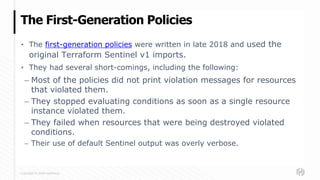
▪ The first-generation policies were written in late 2018 and used the
original Terraform Sentinel v1 imports.
▪ They had several short-comings, including the following:
– Most of the policies did not print violation messages for resources
that violated them.
– They stopped evaluating conditions as soon as a single resource
instance violated them.
– They failed when resources that were being destroyed violated
conditions.
– Their use of default Sentinel output was overly verbose.
The First-Generation Policies
Copyright © 2020 HashiCorp
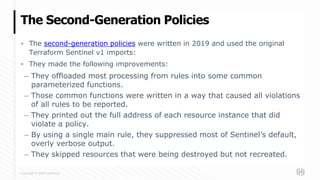
▪ The second-generation policies were written in 2019 and used the original
Terraform Sentinel v1 imports:
▪ They made the following improvements:
– They offloaded most processing from rules into some common
parameterized functions.
– Those common functions were written in a way that caused all violations
of all rules to be reported.
– They printed out the full address of each resource instance that did
violate a policy.
– By using a single main rule, they suppressed most of Sentinel’s default,
overly verbose output.
– They skipped resources that were being destroyed but not recreated.
The Second-Generation Policies
Copyright © 2020 HashiCorp
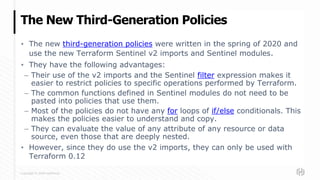
▪ The new third-generation policies were written in the spring of 2020 and
use the new Terraform Sentinel v2 imports and Sentinel modules.
▪ They have the following advantages:
– Their use of the v2 imports and the Sentinel filter expression makes it
easier to restrict policies to specific operations performed by Terraform.
– The common functions defined in Sentinel modules do not need to be
pasted into policies that use them.
– Most of the policies do not have any for loops of if/else conditionals. This
makes the policies easier to understand and copy.
– They can evaluate the value of any attribute of any resource or data
source, even those that are deeply nested.
▪ However, since they do use the v2 imports, they can only be used with
Terraform 0.12
The New Third-Generation Policies
Copyright © 2020 HashiCorp
Some Prototypical Third-
Generation Sentinel Policies
Copyright © 2020 HashiCorp
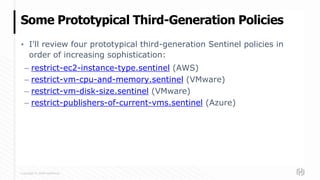
▪ I'll review four prototypical third-generation Sentinel policies in
order of increasing sophistication:
– restrict-ec2-instance-type.sentinel (AWS)
– restrict-vm-cpu-and-memory.sentinel (VMware)
– restrict-vm-disk-size.sentinel (VMware)
– restrict-publishers-of-current-vms.sentinel (Azure)
Some Prototypical Third-Generation Policies
Copyright © 2020 HashiCorp
The Third-Generation Common
Functions
Copyright © 2020 HashiCorp
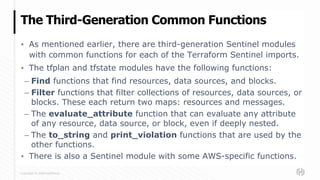
▪ As mentioned earlier, there are third-generation Sentinel modules
with common functions for each of the Terraform Sentinel imports.
▪ The tfplan and tfstate modules have the following functions:
– Find functions that find resources, data sources, and blocks.
– Filter functions that filter collections of resources, data sources, or
blocks. These each return two maps: resources and messages.
– The evaluate_attribute function that can evaluate any attribute
of any resource, data source, or block, even if deeply nested.
– The to_string and print_violation functions that are used by the
other functions.
▪ There is also a Sentinel module with some AWS-specific functions.
The Third-Generation Common Functions
Copyright © 2020 HashiCorp
Testing and Using the Third-
Generation Sentinel Policies
Copyright © 2020 HashiCorp
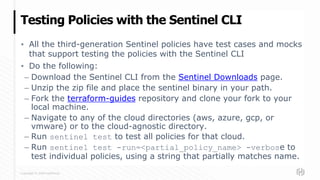
▪ All the third-generation Sentinel policies have test cases and mocks
that support testing the policies with the Sentinel CLI
▪ Do the following:
– Download the Sentinel CLI from the Sentinel Downloads page.
– Unzip the zip file and place the sentinel binary in your path.
– Fork the terraform-guides repository and clone your fork to your
local machine.
– Navigate to any of the cloud directories (aws, azure, gcp, or
vmware) or to the cloud-agnostic directory.
– Run sentinel test to test all policies for that cloud.
– Run sentinel test -run=<partial_policy_name> -verbose to
test individual policies, using a string that partially matches name.
Testing Policies with the Sentinel CLI
Copyright © 2020 HashiCorp
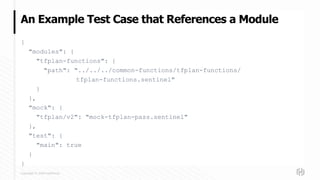
{
"modules": {
"tfplan-functions": {
"path": "../../../common-functions/tfplan-functions/
tfplan-functions.sentinel"
}
},
"mock": {
"tfplan/v2": "mock-tfplan-pass.sentinel"
},
"test": {
"main": true
}
}
An Example Test Case that References a Module
Copyright © 2020 HashiCorp
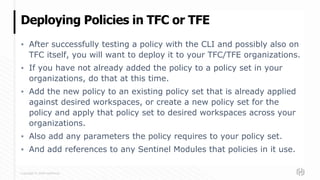
▪ After successfully testing a policy with the CLI and possibly also on
TFC itself, you will want to deploy it to your TFC/TFE organizations.
▪ If you have not already added the policy to a policy set in your
organizations, do that at this time.
▪ Add the new policy to an existing policy set that is already applied
against desired workspaces, or create a new policy set for the
policy and apply that policy set to desired workspaces across your
organizations.
▪ Also add any parameters the policy requires to your policy set.
▪ And add references to any Sentinel Modules that policies in it use.
Deploying Policies in TFC or TFE
Copyright © 2020 HashiCorp
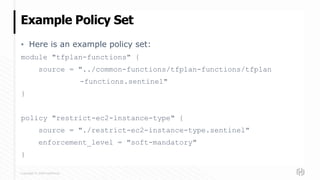
▪ Here is an example policy set:
module "tfplan-functions" {
source = "../common-functions/tfplan-functions/tfplan
-functions.sentinel"
}
policy "restrict-ec2-instance-type" {
source = "./restrict-ec2-instance-type.sentinel"
enforcement_level = "soft-mandatory"
}
Example Policy Set
Copyright © 2020 HashiCorp
Demo
Copyright © 2020 HashiCorp
▪ Here are some useful Links
▪ Documentation
– https://www.terraform.io/docs/cloud/sentinel/index.html
– https://www.terraform.io/docs/cloud/sentinel/manage-
policies.html
– https://docs.hashicorp.com/sentinel
▪ Other Resources:
– Blog for this webinar
– Sentinel in Terraform v2 Workshop (including hands-on Instruqt
track that teaches you how to write and test policies)
Some Useful Links
Thank you.
hello@hashicorp.comwww.hashicorp.com

Using new sentinel features in terraform cloud

  • 1.
    Copyright © 2020HashiCorp Using New Sentinel Features in Terraform Cloud and Terraform Enterprise Roger Berlind Technology Specialist HashiCorp
  • 2.
    Copyright © 2020HashiCorp ▪ Sentinel in Terraform Cloud (TFC) and Terraform Enterprise (TFE) ▪ Two New Sentinel Features – Sentinel Modules – Terraform Sentinel v2 Imports ▪ The Evolution of Sentinel Policies ▪ Some Prototypical Third-Generation Sentinel Policies ▪ The Third-Generation Common Functions ▪ Testing and Using the Third Generation Sentinel Policies ▪ A Demo Agenda
  • 3.
    Copyright © 2020HashiCorp Sentinel in Terraform Cloud and Terraform Enterprise
  • 4.
    Copyright © 2020HashiCorp ▪ HashiCorp's Sentinel is a framework for implementing governance policies as code in the same way that Terraform implements infrastructure as code. ▪ It includes its own language and is embedded in HashiCorp's enterprise products. ▪ Using Sentinel ensures that your governance policies are actually being checked rather than just being listed in a spreadsheet. ▪ It supports fine-grained policies that use conditional logic. ▪ It includes a CLI that allows you to test and run policies. What is Sentinel?
  • 5.
    Copyright © 2020HashiCorp Terraform Cloud and Terraform Enterprise ▪ A User Interface ▪ Workspace Management ▪ Team Management ▪ State Management ▪ Secure Variable Management ▪ Remote Runs and State ▪ VCS Integrations ▪ HTTP/JSON API ▪ Private Module Registry ▪ Configuration Editor ▪ Sentinel (policy as code) ▪ SSO via SAML Integration ▪ Audit Logging Terraform Cloud (TFC) includes the following advanced functionality that makes it easier for teams and organizations to use Terraform: Customers can install Terraform Enterprise (TFE) servers to self-host TFC in their own virtual private networks or in their data centers.
  • 6.
    Copyright © 2020HashiCorp ▪ Sentinel policies are checked between the standard plan and apply steps of Terraform runs. ▪ Policies have different enforcement levels: advisory, soft-mandatory, and hard-mandatory. ▪ Violations prevent runs from being applied unless a user with sufficient authority overrides them. ▪ Sentinel policies can evaluate the attributes (arguments and exported attributes) of existing and new resources and data sources based on information from the current run: – the plan, the configuration, the current state, and other run data including cost estimates ▪ This ensures that resources comply with all policies before they are provisioned. Where is Sentinel Used in Terraform?
  • 7.
    Copyright © 2020HashiCorp How Terraform Works Without Sentinel VCS Terraform Infrastructureplan & apply
  • 8.
    Copyright © 2020HashiCorp How Terraform Works With Sentinel VCS Terraform Cloud Workspace Infrastructureplan Sentinel Policy Checks apply If cost estimates are enabled, they run right after the plan.
  • 9.
    Copyright © 2020HashiCorp All Policy Checks Passed
  • 10.
    Copyright © 2020HashiCorp ▪ HashiCorp customers are using Sentinel to implement governance policies like the following in Terraform Cloud/Enterprise: – Enforce security standards: ▪ Require all S3 buckets use the private ACL and be encrypted by KMS. ▪ Restrict which roles the AWS provider can assume. ▪ Blacklist/whitelist resources, data sources, providers, or provisioners. – Avoid excessive costs: ▪ Limit the sizes of VMs and Kubernetes clusters in public clouds. ▪ Limit the monthly spend of each Terraform workspace. – Enforce mandatory tags on resources provisioned by Terraform. – Mandate that all modules come from a Private Module Registry. – Enforce specific Terraform coding conventions. How Customers are Using Sentinel in Terraform
  • 11.
    Copyright © 2020HashiCorp Two New Sentinel Features
  • 12.
    Copyright © 2020HashiCorp ▪ A Sentinel Module defines Sentinel functions and rules in a file that can be used by Sentinel policies with a single import statement. ▪ This avoids the need to paste the functions into every policy that calls them, improving the reusability of Sentinel functions. ▪ Sentinel modules are registered in Sentinel CLI configuration files and in TFC/TFE policy set configuration files. ▪ The terraform-guides repository includes 5 "third-generation" modules: – tfplan-functions, tfstate-functions, tfconfig-functions, tfrun-functions, and aws-functions ▪ Each function is documented in a separate MD file. ▪ Note that these are NOT standard functions. Sentinel Modules
  • 13.
    Copyright © 2020HashiCorp ▪ The new v2 versions of three Terraform Sentinel imports (tfplan, tfstate, and tfconfig) are aligned more closely with native Terraform 0.12 data structures. ▪ This makes the v2 imports easier to use than the v1 imports. ▪ Additionally, since resource instances are stored in a single flat map that spans across all Terraform modules and resource types, it is much easier to find all resources instances of a specific type or a sub-collection of them. ▪ However, there is a catch: – The v2 imports can only be used with Terraform 0.12. New v2 Versions of the Terraform Sentinel Imports
  • 14.
    Copyright © 2020HashiCorp ▪ The tfplan/v2 gives data generated from Terraform plans. – https://www.terraform.io/docs/cloud/sentinel/import/tfplan-v2.html ▪ The tfconfig/v2 import gives data about the Terraform configuration. – https://www.terraform.io/docs/cloud/sentinel/import/tfconfig-v2.html ▪ The tfstate/v2 import gives data about the current state of a workspace. – https://www.terraform.io/docs/cloud/sentinel/import/tfstate-v2.html ▪ The tfrun import provides metadata for Terraform runs and their workspaces as well as cost estimate data. (There is no v2 version of it.) – https://www.terraform.io/docs/cloud/sentinel/import/tfrun.html Sentinel Imports in Terraform
  • 15.
    Copyright © 2020HashiCorp The Evolution of Sentinel Policies
  • 16.
    Copyright © 2020HashiCorp ▪ The first-generation policies were written in late 2018 and used the original Terraform Sentinel v1 imports. ▪ They had several short-comings, including the following: – Most of the policies did not print violation messages for resources that violated them. – They stopped evaluating conditions as soon as a single resource instance violated them. – They failed when resources that were being destroyed violated conditions. – Their use of default Sentinel output was overly verbose. The First-Generation Policies
  • 17.
    Copyright © 2020HashiCorp ▪ The second-generation policies were written in 2019 and used the original Terraform Sentinel v1 imports: ▪ They made the following improvements: – They offloaded most processing from rules into some common parameterized functions. – Those common functions were written in a way that caused all violations of all rules to be reported. – They printed out the full address of each resource instance that did violate a policy. – By using a single main rule, they suppressed most of Sentinel’s default, overly verbose output. – They skipped resources that were being destroyed but not recreated. The Second-Generation Policies
  • 18.
    Copyright © 2020HashiCorp ▪ The new third-generation policies were written in the spring of 2020 and use the new Terraform Sentinel v2 imports and Sentinel modules. ▪ They have the following advantages: – Their use of the v2 imports and the Sentinel filter expression makes it easier to restrict policies to specific operations performed by Terraform. – The common functions defined in Sentinel modules do not need to be pasted into policies that use them. – Most of the policies do not have any for loops of if/else conditionals. This makes the policies easier to understand and copy. – They can evaluate the value of any attribute of any resource or data source, even those that are deeply nested. ▪ However, since they do use the v2 imports, they can only be used with Terraform 0.12 The New Third-Generation Policies
  • 19.
    Copyright © 2020HashiCorp Some Prototypical Third- Generation Sentinel Policies
  • 20.
    Copyright © 2020HashiCorp ▪ I'll review four prototypical third-generation Sentinel policies in order of increasing sophistication: – restrict-ec2-instance-type.sentinel (AWS) – restrict-vm-cpu-and-memory.sentinel (VMware) – restrict-vm-disk-size.sentinel (VMware) – restrict-publishers-of-current-vms.sentinel (Azure) Some Prototypical Third-Generation Policies
  • 21.
    Copyright © 2020HashiCorp The Third-Generation Common Functions
  • 22.
    Copyright © 2020HashiCorp ▪ As mentioned earlier, there are third-generation Sentinel modules with common functions for each of the Terraform Sentinel imports. ▪ The tfplan and tfstate modules have the following functions: – Find functions that find resources, data sources, and blocks. – Filter functions that filter collections of resources, data sources, or blocks. These each return two maps: resources and messages. – The evaluate_attribute function that can evaluate any attribute of any resource, data source, or block, even if deeply nested. – The to_string and print_violation functions that are used by the other functions. ▪ There is also a Sentinel module with some AWS-specific functions. The Third-Generation Common Functions
  • 23.
    Copyright © 2020HashiCorp Testing and Using the Third- Generation Sentinel Policies
  • 24.
    Copyright © 2020HashiCorp ▪ All the third-generation Sentinel policies have test cases and mocks that support testing the policies with the Sentinel CLI ▪ Do the following: – Download the Sentinel CLI from the Sentinel Downloads page. – Unzip the zip file and place the sentinel binary in your path. – Fork the terraform-guides repository and clone your fork to your local machine. – Navigate to any of the cloud directories (aws, azure, gcp, or vmware) or to the cloud-agnostic directory. – Run sentinel test to test all policies for that cloud. – Run sentinel test -run=<partial_policy_name> -verbose to test individual policies, using a string that partially matches name. Testing Policies with the Sentinel CLI
  • 25.
    Copyright © 2020HashiCorp { "modules": { "tfplan-functions": { "path": "../../../common-functions/tfplan-functions/ tfplan-functions.sentinel" } }, "mock": { "tfplan/v2": "mock-tfplan-pass.sentinel" }, "test": { "main": true } } An Example Test Case that References a Module
  • 26.
    Copyright © 2020HashiCorp ▪ After successfully testing a policy with the CLI and possibly also on TFC itself, you will want to deploy it to your TFC/TFE organizations. ▪ If you have not already added the policy to a policy set in your organizations, do that at this time. ▪ Add the new policy to an existing policy set that is already applied against desired workspaces, or create a new policy set for the policy and apply that policy set to desired workspaces across your organizations. ▪ Also add any parameters the policy requires to your policy set. ▪ And add references to any Sentinel Modules that policies in it use. Deploying Policies in TFC or TFE
  • 27.
    Copyright © 2020HashiCorp ▪ Here is an example policy set: module "tfplan-functions" { source = "../common-functions/tfplan-functions/tfplan -functions.sentinel" } policy "restrict-ec2-instance-type" { source = "./restrict-ec2-instance-type.sentinel" enforcement_level = "soft-mandatory" } Example Policy Set
  • 28.
    Copyright © 2020HashiCorp Demo
  • 29.
    Copyright © 2020HashiCorp ▪ Here are some useful Links ▪ Documentation – https://www.terraform.io/docs/cloud/sentinel/index.html – https://www.terraform.io/docs/cloud/sentinel/manage- policies.html – https://docs.hashicorp.com/sentinel ▪ Other Resources: – Blog for this webinar – Sentinel in Terraform v2 Workshop (including hands-on Instruqt track that teaches you how to write and test policies) Some Useful Links
  • 30.

Editor's Notes

  • #2 These slides are intended to accompany the Sentinel for Terraform v2 workshop They should be used with the Sentinel for Terraform v2 Instruqt track: https://instruqt.com/hashicorp/tracks/sentinel-for-terraform-v2
  • #4 Let's talk about Sentinel and how it fits into Terraform Cloud and Terraform Enterprise. We'll also discuss how customers are using Sentinel in TFC and TFE.
  • #5 Sentinel is a framework for implementing governance policies as code It has its own language It has a CLI for testing and running policies
  • #6 Let's level set about Terraform Cloud and Terraform Enterprise Note that Terraform Cloud (TFC) refers both to the actual application used and the implementation hosted by HashiCorp at app.terraform.io. Since TFE uses the TFC application, we will mostly just talk about TFC. But anything we say about TFC is true of TFE too except when we discuss very new features that have been released to TFC. But those new features generally end up in TFE within 4-6 weeks.
  • #7 Let's talk about where Sentinel is used in TFC and TFE. It is run between the plan and the apply of a run. If cost estimates are enabled for a workspace, the Sentinel policies are checked after the cost estimates are collected. "Arguments" are the inputs to Terraform resources and data sources. Each resource and data source also exports certain attributes that are computed during the apply. These are called "exported attributes". But since the arguments or a resource are also exported, it is common to use "attributes" to refer to the union of a resource's arguments and exported attributes.
  • #8 Here is how Terraform works without Sentinel.
  • #9 Here is how Terraform works with Sentinel. Note that if cost estimates are enabled for the workspace, they will run right after the plan.
  • #10 A screenshot from TFC showing that all policy checks passed for a run.
  • #11 Let's talk about some use cases for Sentinel in TFC and TFE.
  • #12 Let's spend some time discussing the Sentinel language.
  • #13 Sentinel modules allow for the reuse of Sentinel functions and rules. They are registered in Sentinel CLI configuration files and in TFC/TFE policy set configuration files.
  • #14 Sentinel has some builtin functions that you can use in any policy.
  • #15 This is a good point to discuss the Terraform-specific Sentinel imports. Terraform Cloud/Enterprise adds 4 Sentinel imports beyond the standard ones. This version of the workshop uses the v2 versions of the tfplan, tfconfig, and tfstate imports. The v2 versions are more closely aligned to Terraform 0.12's internal data structures. There is only 1 version of the tfrun import.
  • #16 Now we will do the first two workshop challenges on the Instruqt platform
  • #17 The first-generation policies had several limitations.
  • #18 The second-generation policies made many improvements.
  • #19 The new workshop exercises leverage the Instruqt platform and make solving the exercises much easier. Be sure to use the Sentinel Instruqt track that ends in v2, not the one that ends in v1.
  • #20 Now let's walk through the basic 8 step methodology of the Writing and Testing Sentinel Policies for Terraform guide.
  • #21 This slide gives the basic 8 step methodology of writing and testing Sentinel policies from the Writing and Testing Sentinel Policies for Terraform guide. We will focus on 5-7 in this workshop.
  • #22 Now let's walk through the basic 8 step methodology of the Writing and Testing Sentinel Policies for Terraform guide.
  • #23 After testing new Sentinel policies with the Sentinel CLI, you can test them in an organization on a TFC or TFE server.
  • #24 While we won't be using Sentinel in Terraform Cloud or Terraform Enterprise today, we did want to review this topic After all, that is where your Sentinel policies will really be running. You'll get a chance to complete and test some more Sentinel policies with the Sentinel CLI after this section.
  • #25 After testing new Sentinel policies with the Sentinel CLI, you can test them in an organization on a TFC or TFE server.
  • #26 The stanza at the top declares a Sentinel Modules with functions that can be called by Sentinel policies that import them. In this case, the file "tfplan-functions.sentinel" is being declared as the module "tfplan-functions". Recall that when we imported it in our policy, we gave it the alias "plan". We also indicate that the test case should use the mock-tfplan-pass.sentinel mock and that the main rule should evaluate to true. If using tfconfig/v2, tfstate/v2, or tfrun mock files, you need to specify the mock type accordingly (instead of using "tfplan/v2").
  • #27 After testing a policy with the Sentinel CLI and possibly in a TFC/TFE organization, you'll want to deploy it to your TFC organizations.
  • #28 You'll need to create policy sets that contain the policies you want to use in TFC or TFE You can now specify Sentinel modules in your policy sets, but the modules must be in or under the directory with the sentinel.hcl file at this time. In the near future, we will support loading of modules from remote locations.
  • #29 While we won't be using Sentinel in Terraform Cloud or Terraform Enterprise today, we did want to review this topic After all, that is where your Sentinel policies will really be running. You'll get a chance to complete and test some more Sentinel policies with the Sentinel CLI after this section.
  • #31 Thanks for attending the Sentinel in Terraform Workshop or reviewing these slides.