Chapter # 1
Introductionto Vectors
Notes:
1. A physical quantity with has magnitude (Length) as well as direction is
called vector. For example velocity, Force etc.
2. Vectors are denoted by letters having arrows above, below or bold face
e.g. Ԧ
𝑎 𝑜𝑟 ՜
𝑎
𝑜𝑟 𝒂. Vectors can also be denoted by putting CAP upon a
letter e.g. ො
𝑎. CAP notation is usually used for unit vector.
3. Vector having magnitude ONE is called UNIT vector denoted by ො
𝑎 𝑜𝑟 ො
𝑛
etc.
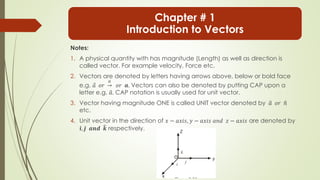
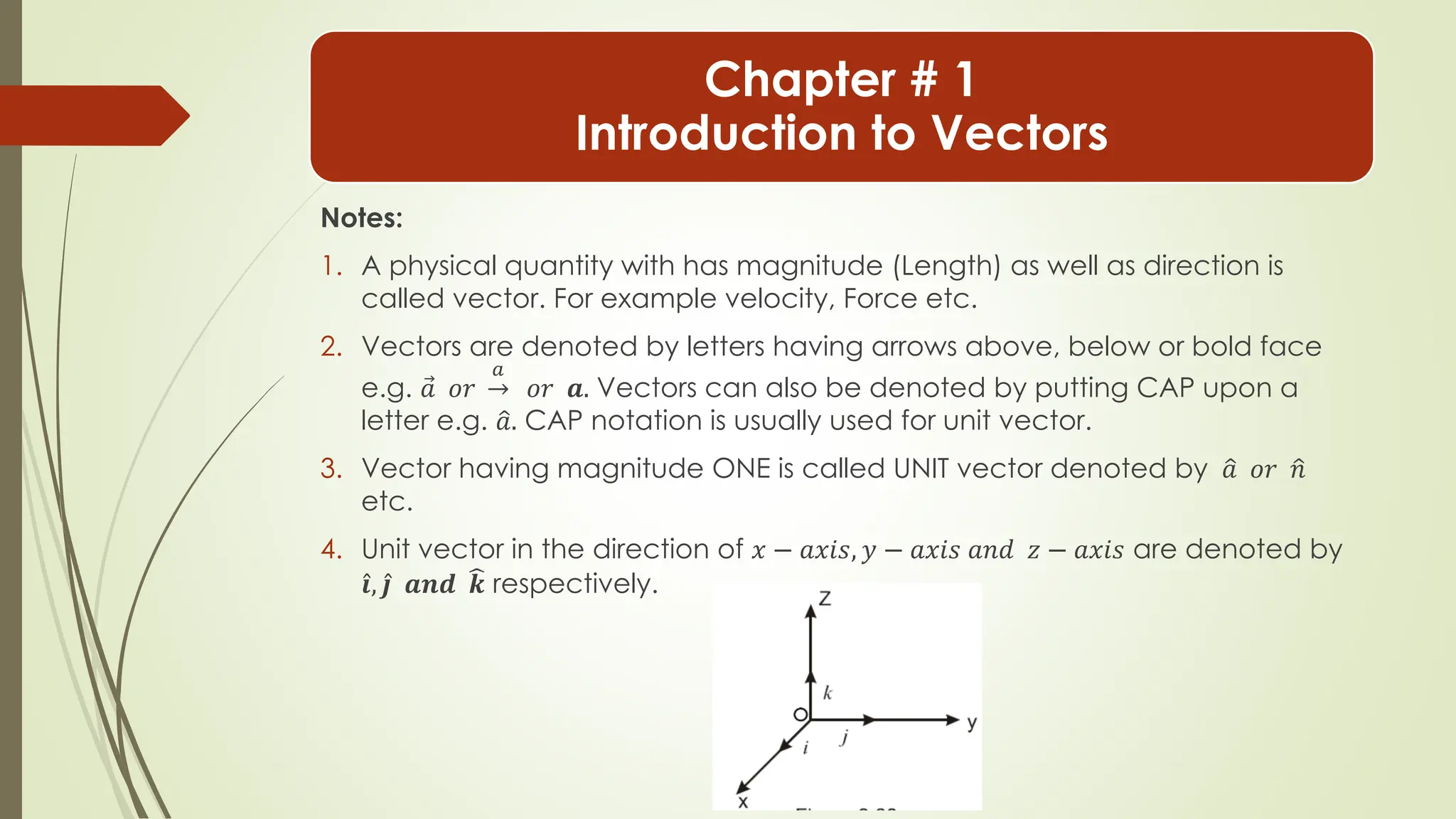
4. Unit vector in the direction of 𝑥 − 𝑎𝑥𝑖𝑠, 𝑦 − 𝑎𝑥𝑖𝑠 𝑎𝑛𝑑 𝑧 − 𝑎𝑥𝑖𝑠 are denoted by
Ƹ
𝒊, Ƹ
𝒋 𝒂𝒏𝒅
𝒌 respectively.
2.
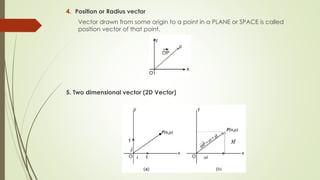
4. Position orRadius vector
Vector drawn from some origin to a point in a PLANE or SPACE is called
position vector of that point.
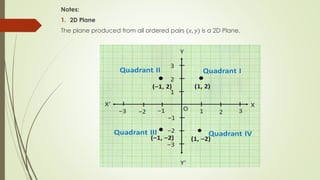
5. Two dimensional vector (2D Vector)
3.
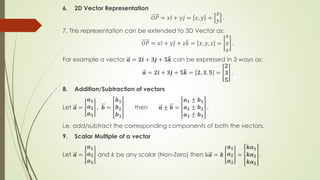
6. 2D VectorRepresentation
𝑂𝑃 = 𝑥 Ƹ
𝑖 + 𝑦 Ƹ
𝑗 = 𝑥, 𝑦 =
𝑥
𝑦 .
7. This representation can be extended to 3D Vector as:
𝑂𝑃 = 𝑥 Ƹ
𝑖 + 𝑦 Ƹ
𝑗 + 𝑧
𝑘 = 𝑥, 𝑦, 𝑧 =
𝑥
𝑦
𝑧
.
For example a vector 𝒂 = 𝟐 Ƹ
𝒊 + 𝟑 Ƹ
𝒋 + 𝟓
𝒌 can be expressed in 3 ways as:
𝒂 = 𝟐 Ƹ
𝒊 + 𝟑 Ƹ
𝒋 + 𝟓
𝒌 = 𝟐, 𝟑, 𝟓 =
𝟐
𝟑
𝟓
.
8. Addition/Subtraction of vectors
Let 𝒂 =
𝒂𝟏
𝒂𝟐
𝒂𝟑
, 𝒃 =
𝒃𝟏
𝒃𝟐
𝒃𝟑
then 𝒂 ± 𝒃 =
𝒂𝟏 ± 𝒃𝟏
𝒂𝟐 ± 𝒃𝟐
𝒂𝟑 ± 𝒃𝟑
.
i.e. add/subtract the corresponding components of both the vectors.
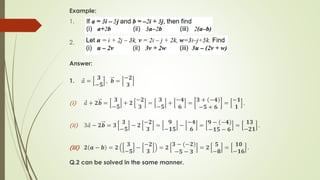
9. Scalar Multiple of a vector
Let 𝒂 =
𝒂𝟏
𝒂𝟐
𝒂𝟑
and 𝑘 be any scalar (Non-Zero) then k𝒂 = 𝒌
𝒂𝟏
𝒂𝟐
𝒂𝟑
=
𝒌𝒂𝟏
𝒌𝒂𝟐
𝒌𝒂𝟑
.
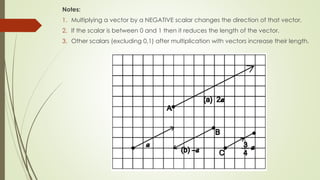
Notes:
1. Multiplying avector by a NEGATIVE scalar changes the direction of that vector.
2. If the scalar is between 0 and 1 then it reduces the length of the vector.
3. Other scalars (excluding 0,1) after multiplication with vectors increase their length.
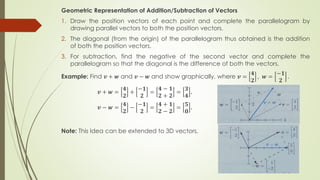
Geometric Representation ofAddition/Subtraction of Vectors
1. Draw the position vectors of each point and complete the parallelogram by
drawing parallel vectors to both the position vectors.
2. The diagonal (from the origin) of the parallelogram thus obtained is the addition
of both the position vectors.
3. For subtraction, find the negative of the second vector and complete the
parallelogram so that the diagonal is the difference of both the vectors.
Example: Find 𝒗 + 𝒘 and 𝒗 − 𝒘 and show graphically, where 𝒗 =
𝟒
𝟐
, 𝒘 =
−𝟏
𝟐
.
𝒗 + 𝒘 =
𝟒
𝟐
+
−𝟏
𝟐
=
𝟒 − 𝟏
𝟐 + 𝟐
=
𝟑
𝟒
.
𝒗 − 𝒘 =
𝟒
𝟐
−
−𝟏
𝟐
=
𝟒 + 𝟏
𝟐 − 𝟐
=
𝟓
𝟎
.
Note: This Idea can be extended to 3D vectors.
8.
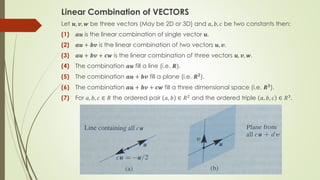
Linear Combination ofVECTORS
Let 𝒖, 𝒗, 𝒘 be three vectors (May be 2D or 3D) and 𝑎, 𝑏, 𝑐 be two constants then:
(1) 𝒂𝒖 is the linear combination of single vector 𝒖.
(2) 𝒂𝒖 + 𝒃𝒗 is the linear combination of two vectors 𝒖, 𝒗.
(3) 𝒂𝒖 + 𝒃𝒗 + 𝒄𝒘 is the linear combination of three vectors 𝒖, 𝒗, 𝒘.
(4) The combination 𝒂𝒖 fill a line (i.e. 𝑹).
(5) The combination 𝒂𝒖 + 𝒃𝒗 fill a plane (i.e. 𝑹𝟐
).
(6) The combination 𝒂𝒖 + 𝒃𝒗 + 𝒄𝒘 fill a three dimensional space (i.e. 𝑹𝟑
).
(7) For 𝑎, 𝑏, 𝑐 ∈ 𝑅 the ordered pair 𝑎, 𝑏 ∈ 𝑅2
and the ordered triple 𝑎, 𝑏, 𝑐 ∈ 𝑅3
.
9.
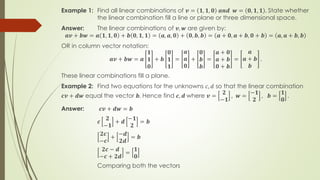
Example 1: Findall linear combinations of 𝒗 = 𝟏, 𝟏, 𝟎 𝒂𝒏𝒅 𝒘 = 𝟎, 𝟏, 𝟏 . State whether
the linear combination fill a line or plane or three dimensional space.
Answer: The linear combinations of 𝒗, 𝒘 are given by:
𝒂𝒗 + 𝒃𝒘 = 𝒂 𝟏, 𝟏, 𝟎 + 𝒃 𝟎, 𝟏, 𝟏 = 𝒂, 𝒂, 𝟎 + 𝟎, 𝒃, 𝒃 = 𝒂 + 𝟎, 𝒂 + 𝒃, 𝟎 + 𝒃 = 𝒂, 𝒂 + 𝒃, 𝒃
OR in column vector notation:
𝒂𝒗 + 𝒃𝒘 = 𝒂
𝟏
𝟏
𝟎
+ 𝒃
𝟎
𝟏
𝟏
=
𝒂
𝒂
𝟎
+
𝟎
𝒃
𝒃
=
𝒂 + 𝟎
𝒂 + 𝒃
𝟎 + 𝒃
=
𝒂
𝒂 + 𝒃
𝒃
.
These linear combinations fill a plane.
Example 2: Find two equations for the unknowns 𝑐, 𝑑 so that the linear combination
𝒄𝒗 + 𝒅𝒘 equal the vector 𝒃. Hence find 𝒄, 𝒅 where 𝒗 =
𝟐
−𝟏
, 𝒘 =
−𝟏
𝟐
, 𝒃 =
𝟏
𝟎
.
Answer: 𝒄𝒗 + 𝒅𝒘 = 𝒃
𝒄
𝟐
−𝟏
+ 𝒅
−𝟏
𝟐
= 𝒃
𝟐𝒄
−𝒄
+
−𝒅
𝟐𝒅
= 𝒃
𝟐𝒄 − 𝒅
−𝒄 + 𝟐𝒅
=
𝟏
𝟎
Comparing both the vectors
10.
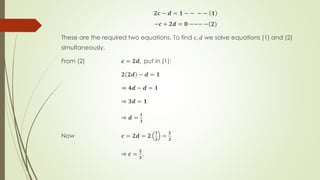
𝟐𝒄 − 𝒅= 𝟏 − − − − 𝟏
−𝒄 + 𝟐𝒅 = 𝟎 −−− −(𝟐)
These are the required two equations. To find 𝑐, 𝑑 we solve equations (1) and (2)
simultaneously.
From (2) 𝒄 = 𝟐𝒅, put in (1):
𝟐 𝟐𝒅 − 𝒅 = 𝟏
⇒ 𝟒𝒅 − 𝒅 = 𝟏
⇒ 𝟑𝒅 = 𝟏
⇒ 𝒅 =
𝟏
𝟑
Now 𝒄 = 𝟐𝒅 = 𝟐
𝟏
𝟑
=
𝟐
𝟑
⇒ 𝒄 =
𝟐
𝟑
.


![Vector[1]](https://cdn.slidesharecdn.com/ss_thumbnails/vector1-120618011208-phpapp02-thumbnail.jpg?width=640&height=640&fit=bounds)


