
Packet of pieces Groups of 5 One observer appointment in each group Rules: Members cannot take from another member Members cannot talk to each other Members cannot signal to each other Each member must have  a complete square
Creative Thinking in an interconnected context Susan.V.McLaren University of Edinburgh  Design and Technology
Interconnected Thinking “ We need people who think broadly and who understand systems, connections, patterns, and root causes.” David Orr,  Earth in Mind ESD teaches students  how and when to ask the “big questions”  how to separate the trivial from the important.
Aims of session Encourage creative thinking  in redesigning the future  Explore interlinked values and implications of design decisions Explore consumption & consider consequences Consider role and responsibility of design, engineering, business, appropriate technology, and individual lifestyle in sustainable development
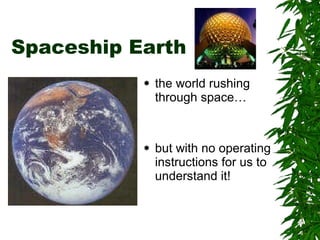
Spaceship Earth the world rushing through space… but with no operating instructions for us to understand it!
 
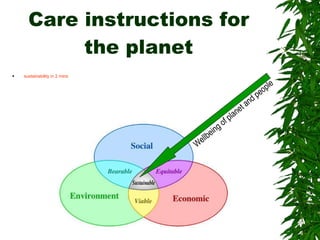
Care instructions for the planet sustainability in 2 mins Wellbeing of planet and people
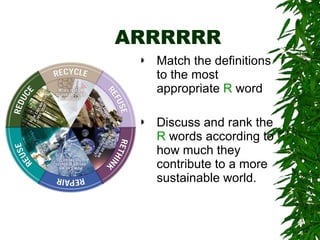
ARRRRRR Match the definitions to the most appropriate  R  word Discuss and rank the  R  words according to how much they contribute to a more sustainable world.
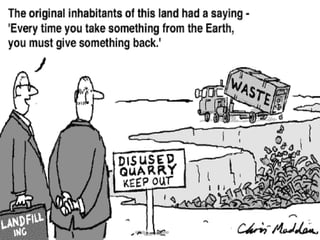
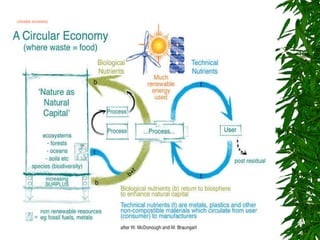
take - make - waste
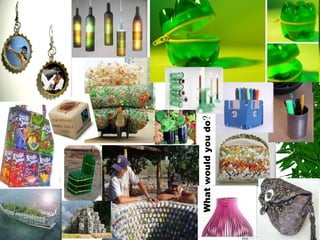
101   ideas for  reusing up-cycling rethinking reconfiguring..
What would you do ?
circular economy
Technologies Education:  Opportunities to apply  sustainable designerly thinking  and K&U simultaneously the design, use and maintenance of  energy, transport, leisure, build and operate our homes, services and infrastructures…. production and waste….
 
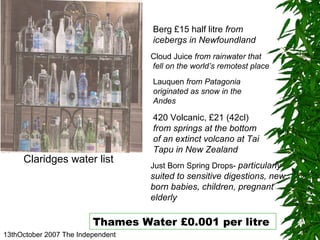
13thOctober 2007 The Independent Claridges water list 420 Volcanic, £21 (42cl)  from springs at the bottom of an extinct volcano at Tai Tapu in New Zealand Cloud Juice  from rainwater that fell on the world’s remotest place Lauquen  from Patagonia originated as snow in the Andes Just Born Spring Drops-  particularly suited to sensitive digestions, new born babies, children, pregnant elderly Thames Water £0.001 per litre  Berg £15 half litre  from  icebergs in Newfoundland
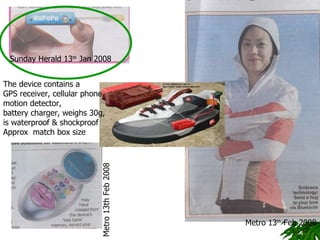
Metro 13 th  Feb 2008 Metro 13th Feb 2008 Sunday Herald 13 th  Jan 2008 The device contains a  GPS receiver, cellular phone,  motion detector,  battery charger, weighs 30g,  is waterproof & shockproof  Approx  match box size
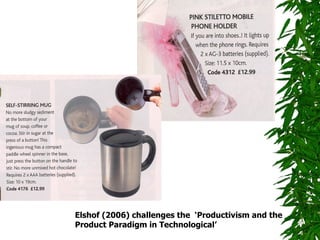
Elshof (2006) challenges the  ‘Productivism and the  Product Paradigm in Technological’
 
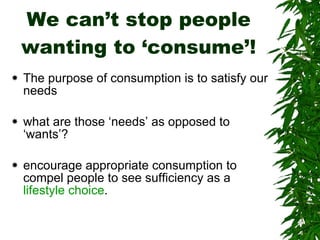
We can’t stop people wanting to ‘consume’! The purpose of consumption is to satisfy our needs  what are those ‘needs’ as opposed to ‘wants’? encourage appropriate consumption to compel people to see sufficiency as a  lifestyle choice .
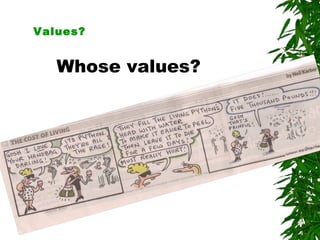
Values?   Whose values?
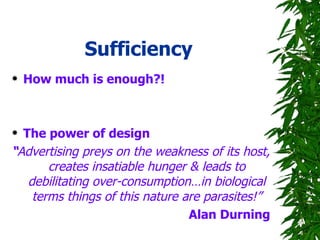
Sufficiency How much is enough?! The power of design “ Advertising preys on the weakness of its host, creates insatiable hunger & leads to debilitating over-consumption…in biological terms things of this nature are parasites!” Alan Durning
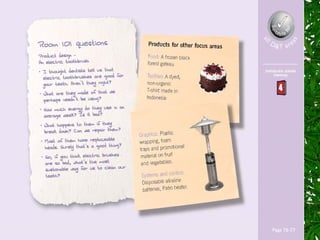
Room 101 what’s ‘hot’ and what’s not? In or out? You decide.
 
 
A good design goes beyond appearances No longer enough to be pretty on outside, cheap and available
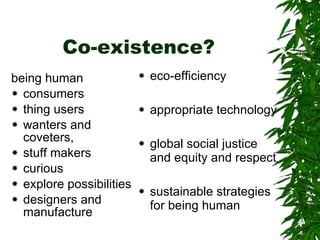
Co-existence? being human  consumers  thing users wanters and coveters, stuff makers curious  explore possibilities designers and manufacture eco-efficiency  appropriate technology global social justice and equity and respect sustainable strategies  for being human
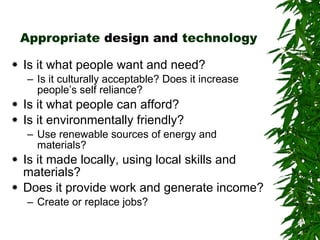
Appropriate  design and  technology Is it what people want and need?  Is it culturally acceptable? Does it increase people’s self reliance? Is it what people can afford?  Is it environmentally friendly?  Use renewable sources of energy and materials? Is it made locally, using local skills and materials?  Does it provide work and generate income? Create or replace jobs?
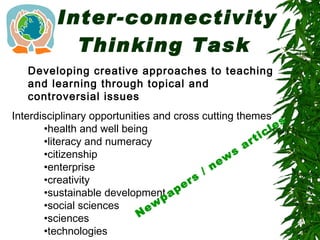
Inter-connectivity Thinking Task   Developing creative approaches to teaching and learning through topical and controversial issues Interdisciplinary opportunities and cross cutting themes  health and well being  literacy and numeracy citizenship enterprise creativity  sustainable development   social sciences sciences technologies Newpapers / news articles
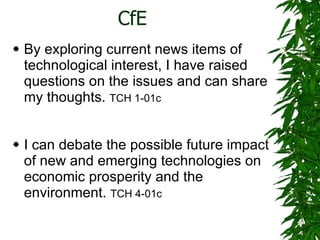
CfE By exploring current news items of technological interest, I have raised questions on the issues and can share my thoughts.  TCH 1-01c I can debate the possible future impact of new and emerging technologies on economic prosperity and the environment.  TCH 4-01c
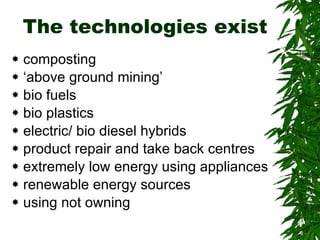
The technologies exist composting ‘ above ground mining’ bio fuels bio plastics electric/ bio diesel hybrids product repair and take back centres extremely low energy using appliances renewable energy sources using not owning
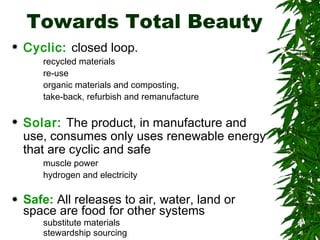
Towards Total Beauty Cyclic:   closed loop. recycled materials re-use organic materials and composting, take-back, refurbish and remanufacture Solar:   The product, in manufacture and use, consumes only uses renewable energy that are cyclic and safe muscle power hydrogen and electricity Safe:   All releases to air, water, land or space are food for other systems   substitute materials  stewardship sourcing
need to maximise the utility of resources in a finite world….. Life extension durability upgradeability repairability complementary components extremely long view Using less increased efficiency of materials and energy increased utility dematerialise every little counts be more local multi- functionality fine control work with seasons biomimicry
all companies have an impact on the people who work for them and the communities within which they operate…… Social:   The product and its components and raw materials are manufactured under fair and just operating conditions for the workers involved and the local communities.
Note to self record your ideas about : ‘ sustainability’  and  ‘ sustainable development’
Purposes of learning in the   CfE  technologies develop understanding of the role and impact of technologies in changing and influencing societies  contribute to building a better world by taking responsible ethical actions to improve their lives, the lives of others and the environment  become informed consumers and producers who have an appreciation of the merits and impacts of products and services  be capable of making reasoned choices relating to the environment, to sustainable development and to ethical, economic and cultural issues
CfE Technologies I can examine a range of materials, processes or designs in my local community to consider and discuss their environmental, social and economic impact, discussing the possible lifetime cost to the environment in Scotland or beyond.  TCH 4-02a
Through exploring non-renewable energy sources, I can describe how they are used in Scotland today and express an informed view on the implications for their future use.  SCN 2-04b By investigating renewable energy sources and taking part in practical activities to harness them, I can discuss their benefits and potential problems.  SCN 3-04b
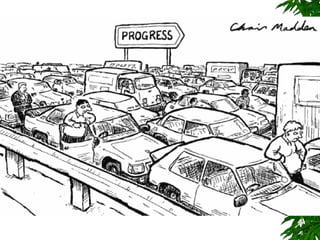
rhetoric and reality
 
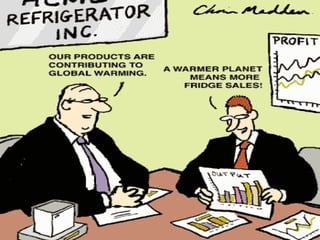
Winners and Losers Consequences of  Microwave Automobiles Aeroplanes Mobile phones Good things ::::::Bad things
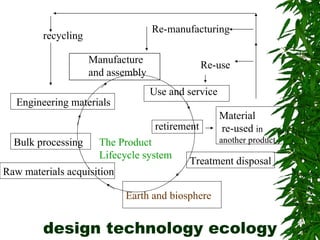
design technology ecology Manufacture and assembly Use and service retirement Material re-used  in another product Treatment disposal Earth and biosphere Raw materials acquisition Bulk processing Engineering materials Re-manufacturing Re-use recycling The Product  Lifecycle system
 
Sustainable development Development  (through design)   that is good for people, good for profits and good for the planet.
Technology democracy Building on local knowledge, what they do and how to do it better Redirecting research efforts towards the poor Preventing privatisation by trans-nationals Involving people in the technology decisions that affect their lives and those of future generations
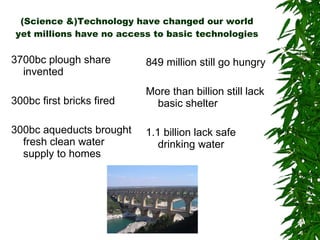
(Science &)Technology have changed our world yet millions have no access to basic technologies 3700bc plough share invented 300bc first bricks fired 300bc aqueducts brought fresh clean water supply to homes 849 million still go hungry More than billion still lack basic shelter 1.1 billion lack safe drinking water
Technology democracy 1455AD first metal printing press 1796AD first vaccine inoculation 1879AD first electric light bulb invented 1996AD anti retroviral drugs developed for HIV / AIDS I billion cannot read or write ¼ of all babies not inoculated  1.6 billion no electricity 36 million no access to the drugs
Perspectives individuals are global citizens  Individual consumer decisions and other actions effect resources extraction and manufacturing in distant places employing the precautionary principle  take action to avoid the possibility of serious or irreversible environmental or social harm (even when scientific knowledge is incomplete or inconclusive)
essential to the promotion of sustainability  an informed and engaged populace is critical to any broad change citizens who possess broader awareness and understanding of the challenges facing the world regarding natural resources and economic development  thoughtful consumers, producers, and policymakers
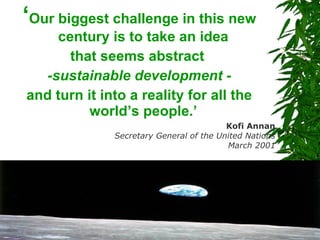
‘ Our biggest challenge in this new century is to take an idea  that seems abstract  -sustainable development - and turn it into a reality for all the world’s people.’  Kofi Annan Secretary General of the United Nations March 2001

Creative thinking in an interconnected context sv mclaren

  • 1.
  • 2.
    Packet of piecesGroups of 5 One observer appointment in each group Rules: Members cannot take from another member Members cannot talk to each other Members cannot signal to each other Each member must have a complete square
  • 3.
    Creative Thinking inan interconnected context Susan.V.McLaren University of Edinburgh Design and Technology
  • 4.
    Interconnected Thinking “We need people who think broadly and who understand systems, connections, patterns, and root causes.” David Orr, Earth in Mind ESD teaches students how and when to ask the “big questions” how to separate the trivial from the important.
  • 5.
    Aims of sessionEncourage creative thinking in redesigning the future Explore interlinked values and implications of design decisions Explore consumption & consider consequences Consider role and responsibility of design, engineering, business, appropriate technology, and individual lifestyle in sustainable development
  • 6.
    Spaceship Earth theworld rushing through space… but with no operating instructions for us to understand it!
  • 7.
  • 8.
    Care instructions forthe planet sustainability in 2 mins Wellbeing of planet and people
  • 9.
    ARRRRRR Match thedefinitions to the most appropriate R word Discuss and rank the R words according to how much they contribute to a more sustainable world.
  • 10.
    take - make- waste
  • 11.
    101 ideas for reusing up-cycling rethinking reconfiguring..
  • 12.
  • 13.
  • 14.
    Technologies Education: Opportunities to apply sustainable designerly thinking and K&U simultaneously the design, use and maintenance of energy, transport, leisure, build and operate our homes, services and infrastructures…. production and waste….
  • 15.
  • 16.
    13thOctober 2007 TheIndependent Claridges water list 420 Volcanic, £21 (42cl) from springs at the bottom of an extinct volcano at Tai Tapu in New Zealand Cloud Juice from rainwater that fell on the world’s remotest place Lauquen from Patagonia originated as snow in the Andes Just Born Spring Drops- particularly suited to sensitive digestions, new born babies, children, pregnant elderly Thames Water £0.001 per litre Berg £15 half litre from icebergs in Newfoundland
  • 17.
    Metro 13 th Feb 2008 Metro 13th Feb 2008 Sunday Herald 13 th Jan 2008 The device contains a GPS receiver, cellular phone, motion detector, battery charger, weighs 30g, is waterproof & shockproof Approx match box size
  • 18.
    Elshof (2006) challengesthe ‘Productivism and the Product Paradigm in Technological’
  • 19.
  • 20.
    We can’t stoppeople wanting to ‘consume’! The purpose of consumption is to satisfy our needs what are those ‘needs’ as opposed to ‘wants’? encourage appropriate consumption to compel people to see sufficiency as a lifestyle choice .
  • 21.
    Values? Whose values?
  • 22.
    Sufficiency How muchis enough?! The power of design “ Advertising preys on the weakness of its host, creates insatiable hunger & leads to debilitating over-consumption…in biological terms things of this nature are parasites!” Alan Durning
  • 23.
    Room 101 what’s‘hot’ and what’s not? In or out? You decide.
  • 24.
  • 25.
  • 26.
    A good designgoes beyond appearances No longer enough to be pretty on outside, cheap and available
  • 27.
    Co-existence? being human consumers thing users wanters and coveters, stuff makers curious explore possibilities designers and manufacture eco-efficiency appropriate technology global social justice and equity and respect sustainable strategies for being human
  • 28.
    Appropriate designand technology Is it what people want and need? Is it culturally acceptable? Does it increase people’s self reliance? Is it what people can afford? Is it environmentally friendly? Use renewable sources of energy and materials? Is it made locally, using local skills and materials? Does it provide work and generate income? Create or replace jobs?
  • 29.
    Inter-connectivity Thinking Task Developing creative approaches to teaching and learning through topical and controversial issues Interdisciplinary opportunities and cross cutting themes health and well being literacy and numeracy citizenship enterprise creativity sustainable development social sciences sciences technologies Newpapers / news articles
  • 30.
    CfE By exploringcurrent news items of technological interest, I have raised questions on the issues and can share my thoughts. TCH 1-01c I can debate the possible future impact of new and emerging technologies on economic prosperity and the environment. TCH 4-01c
  • 31.
    The technologies existcomposting ‘ above ground mining’ bio fuels bio plastics electric/ bio diesel hybrids product repair and take back centres extremely low energy using appliances renewable energy sources using not owning
  • 32.
    Towards Total BeautyCyclic: closed loop. recycled materials re-use organic materials and composting, take-back, refurbish and remanufacture Solar: The product, in manufacture and use, consumes only uses renewable energy that are cyclic and safe muscle power hydrogen and electricity Safe: All releases to air, water, land or space are food for other systems substitute materials stewardship sourcing
  • 33.
    need to maximisethe utility of resources in a finite world….. Life extension durability upgradeability repairability complementary components extremely long view Using less increased efficiency of materials and energy increased utility dematerialise every little counts be more local multi- functionality fine control work with seasons biomimicry
  • 34.
    all companies havean impact on the people who work for them and the communities within which they operate…… Social: The product and its components and raw materials are manufactured under fair and just operating conditions for the workers involved and the local communities.
  • 35.
    Note to selfrecord your ideas about : ‘ sustainability’ and ‘ sustainable development’
  • 36.
    Purposes of learningin the CfE technologies develop understanding of the role and impact of technologies in changing and influencing societies contribute to building a better world by taking responsible ethical actions to improve their lives, the lives of others and the environment become informed consumers and producers who have an appreciation of the merits and impacts of products and services be capable of making reasoned choices relating to the environment, to sustainable development and to ethical, economic and cultural issues
  • 37.
    CfE Technologies Ican examine a range of materials, processes or designs in my local community to consider and discuss their environmental, social and economic impact, discussing the possible lifetime cost to the environment in Scotland or beyond. TCH 4-02a
  • 38.
    Through exploring non-renewableenergy sources, I can describe how they are used in Scotland today and express an informed view on the implications for their future use. SCN 2-04b By investigating renewable energy sources and taking part in practical activities to harness them, I can discuss their benefits and potential problems. SCN 3-04b
  • 39.
  • 40.
  • 41.
    Winners and LosersConsequences of Microwave Automobiles Aeroplanes Mobile phones Good things ::::::Bad things
  • 42.
    design technology ecologyManufacture and assembly Use and service retirement Material re-used in another product Treatment disposal Earth and biosphere Raw materials acquisition Bulk processing Engineering materials Re-manufacturing Re-use recycling The Product Lifecycle system
  • 43.
  • 44.
    Sustainable development Development (through design) that is good for people, good for profits and good for the planet.
  • 45.
    Technology democracy Buildingon local knowledge, what they do and how to do it better Redirecting research efforts towards the poor Preventing privatisation by trans-nationals Involving people in the technology decisions that affect their lives and those of future generations
  • 46.
    (Science &)Technology havechanged our world yet millions have no access to basic technologies 3700bc plough share invented 300bc first bricks fired 300bc aqueducts brought fresh clean water supply to homes 849 million still go hungry More than billion still lack basic shelter 1.1 billion lack safe drinking water
  • 47.
    Technology democracy 1455ADfirst metal printing press 1796AD first vaccine inoculation 1879AD first electric light bulb invented 1996AD anti retroviral drugs developed for HIV / AIDS I billion cannot read or write ¼ of all babies not inoculated 1.6 billion no electricity 36 million no access to the drugs
  • 48.
    Perspectives individuals areglobal citizens Individual consumer decisions and other actions effect resources extraction and manufacturing in distant places employing the precautionary principle take action to avoid the possibility of serious or irreversible environmental or social harm (even when scientific knowledge is incomplete or inconclusive)
  • 49.
    essential to thepromotion of sustainability an informed and engaged populace is critical to any broad change citizens who possess broader awareness and understanding of the challenges facing the world regarding natural resources and economic development thoughtful consumers, producers, and policymakers
  • 50.
    ‘ Our biggestchallenge in this new century is to take an idea that seems abstract -sustainable development - and turn it into a reality for all the world’s people.’ Kofi Annan Secretary General of the United Nations March 2001

Editor's Notes

  • #50 who will begin their awareness in the classroom.