6 Sigma Intro
Definitions What Is Six Sigma?
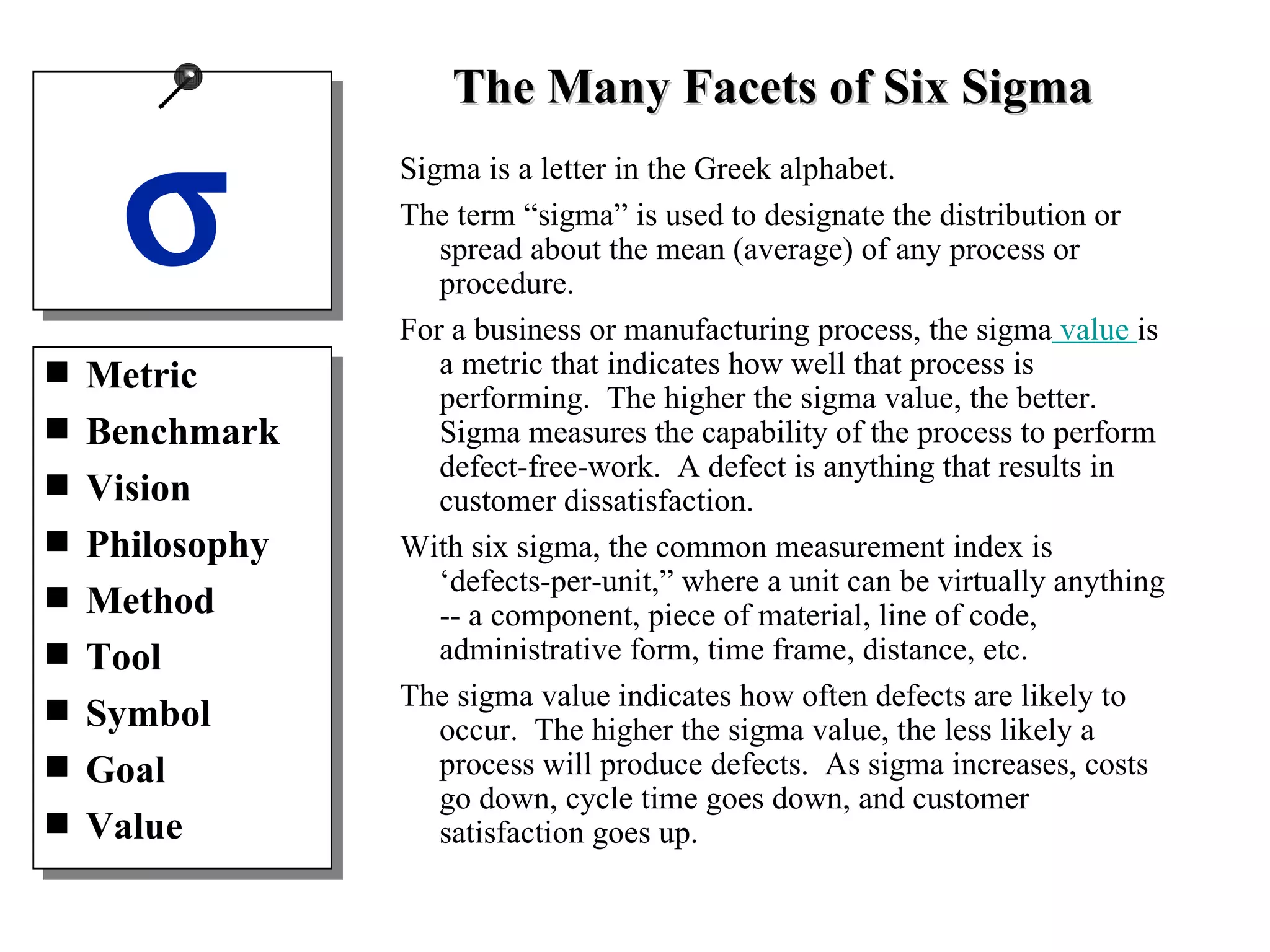
Sigma is a letter in the Greek alphabet. The term “sigma” is used to designate the distribution or spread about the mean (average) of any process or procedure. For a business or manufacturing process, the sigma  value  is a metric that indicates how well that process is performing.  The higher the sigma value, the better. Sigma measures the capability of the process to perform defect-free-work.  A defect is anything that results in customer dissatisfaction. With six sigma, the common measurement index is ‘defects-per-unit,” where a unit can be virtually anything -- a component, piece of material, line of code, administrative form, time frame, distance, etc. The sigma value indicates how often defects are likely to occur.  The higher the sigma value, the less likely a process will produce defects.  As sigma increases, costs go down, cycle time goes down, and customer satisfaction goes up. The Many Facets of Six Sigma Metric Benchmark Vision Philosophy Method Tool Symbol Goal Value 
A  MEASUREMENT
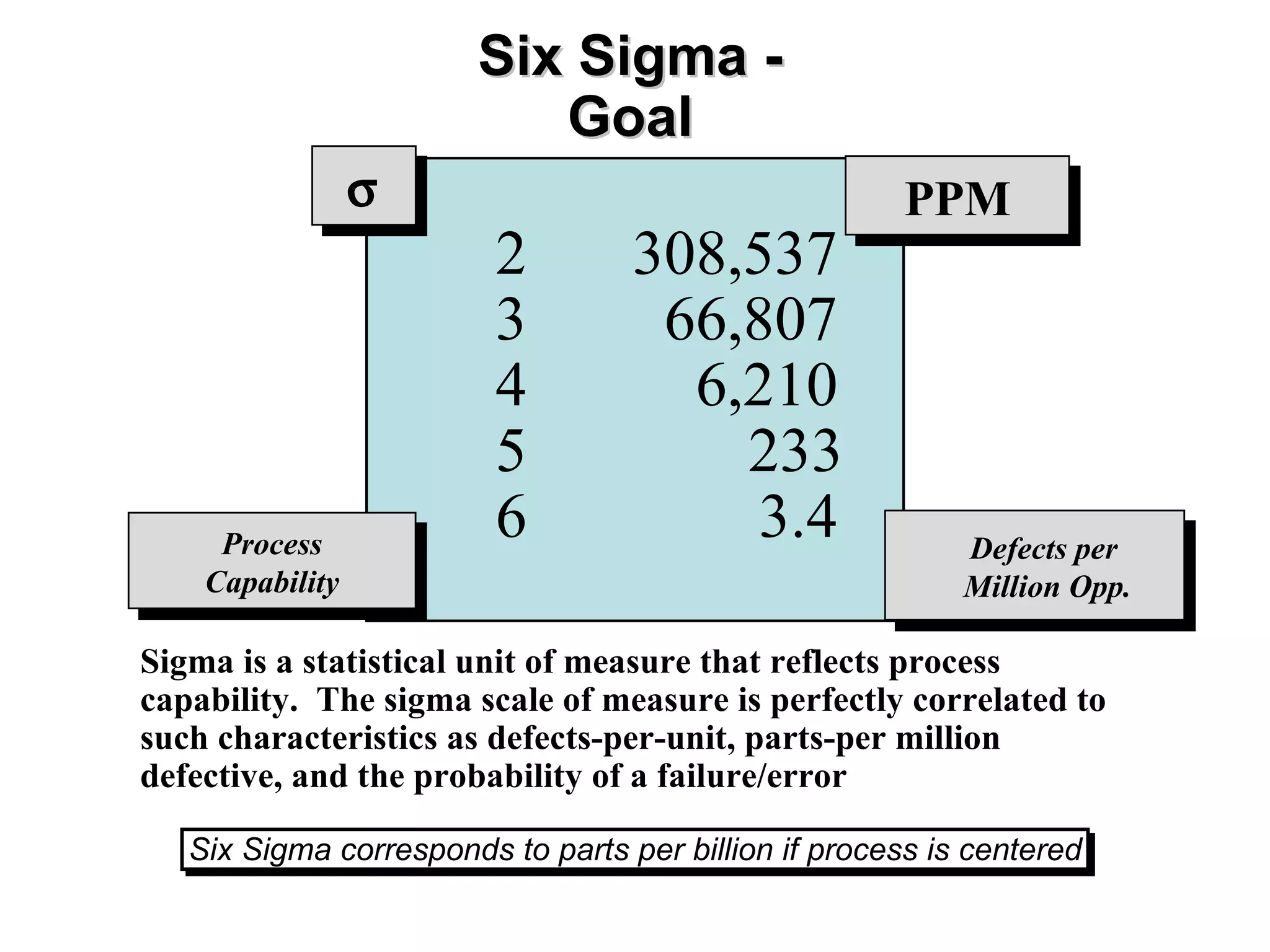
Six Sigma - Goal Sigma is a statistical unit of measure that reflects process capability.  The sigma scale of measure is perfectly correlated to such characteristics as defects-per-unit, parts-per million defective, and the probability of a failure/error  PPM Process Capability Defects per Million Opp. Six Sigma corresponds to parts per billion if process is centered
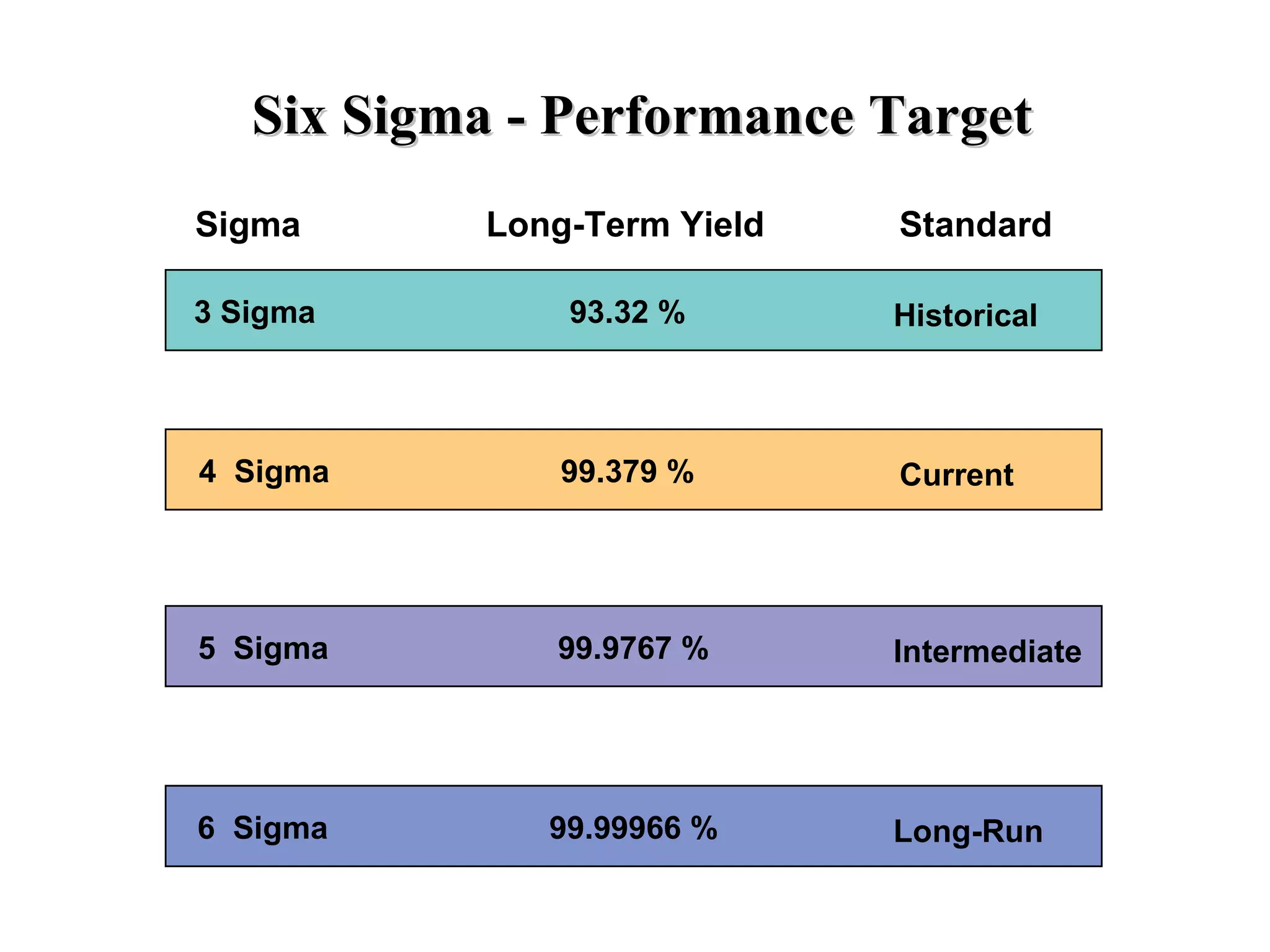
3 Sigma  6  Sigma 5  Sigma 4  Sigma  93.32 % 99.379 % 99.9767 % 99.99966 % Historical Current Intermediate Long-Run Sigma Long-Term Yield Standard Six Sigma - Performance Target
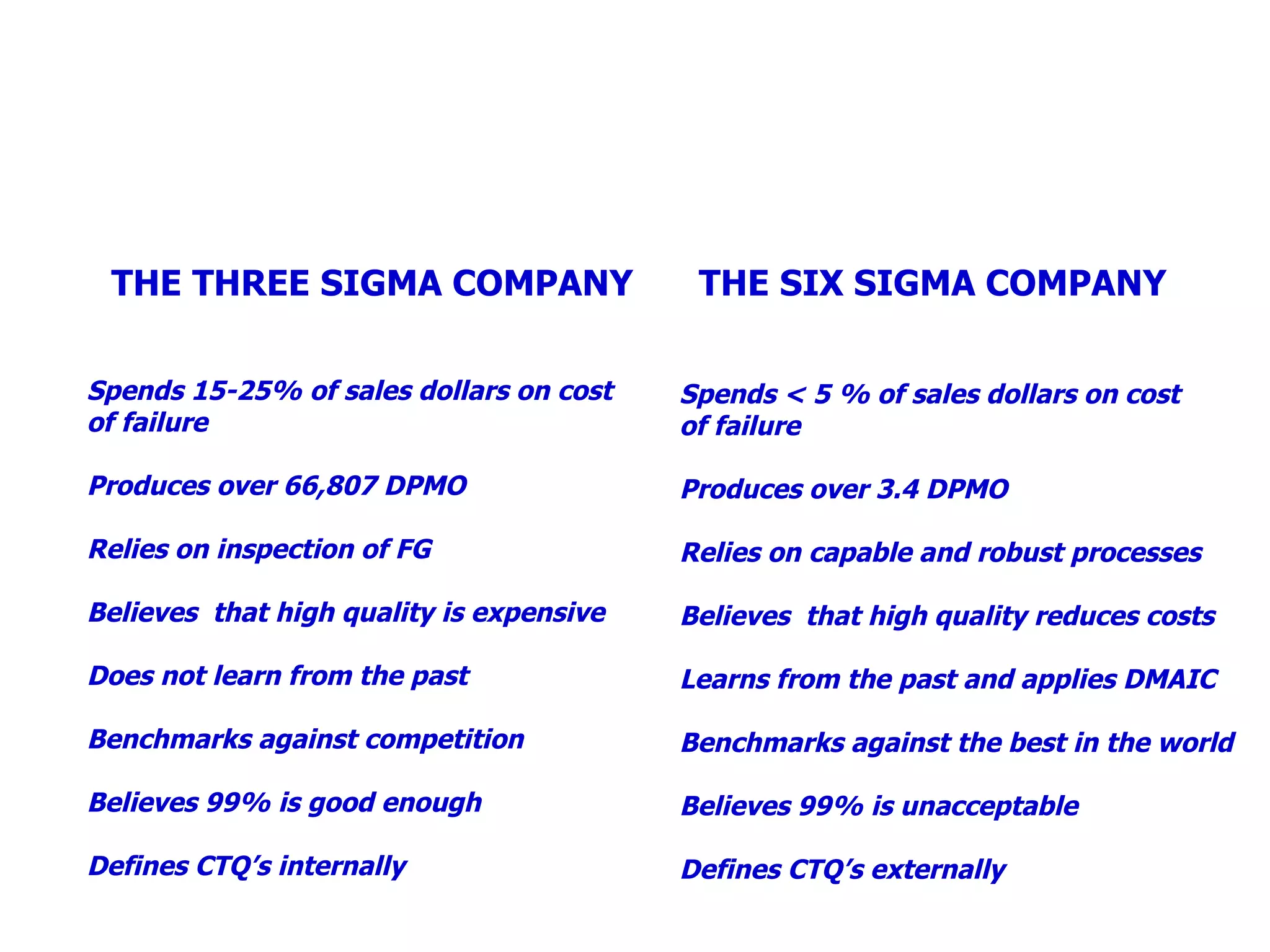
Spends 15-25% of sales dollars on cost of failure Produces over 66,807 DPMO Relies on inspection of FG Believes  that high quality is expensive Does not learn from the past Benchmarks against competition Believes 99% is good enough Defines CTQ’s internally Spends < 5 % of sales dollars on cost of failure Produces over 3.4 DPMO Relies on capable and robust processes Believes  that high quality reduces costs Learns from the past and applies DMAIC Benchmarks against the best in the world Believes 99% is unacceptable Defines CTQ’s externally THE THREE SIGMA COMPANY THE SIX SIGMA COMPANY
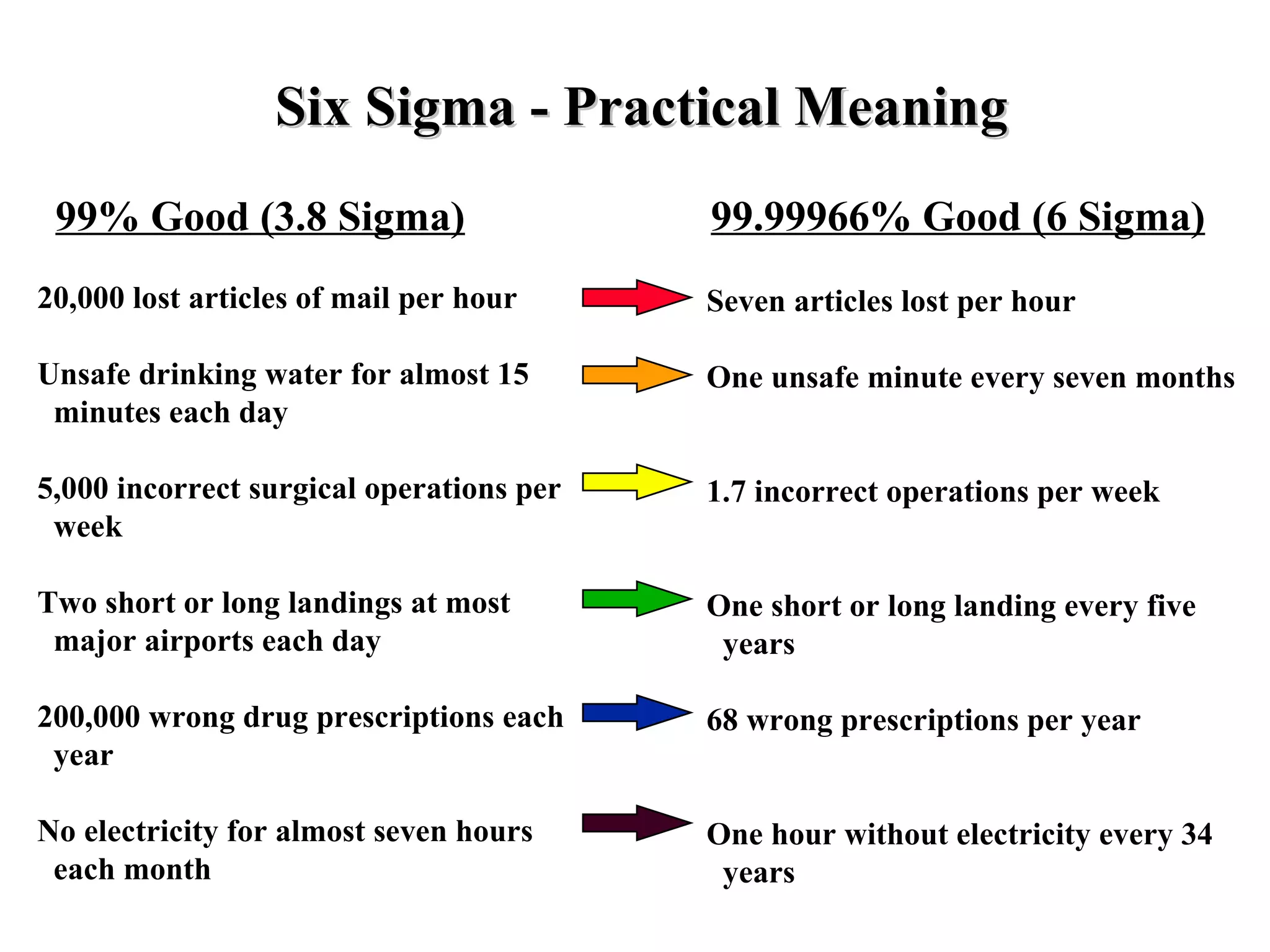
Six Sigma - Practical Meaning 99.99966% Good (6 Sigma) 20,000 lost articles of mail per hour Unsafe drinking water for almost 15 minutes each day 5,000 incorrect surgical operations per week Two short or long landings at most major airports each day 200,000 wrong drug prescriptions each year No electricity for almost seven hours each month Seven articles lost per hour One unsafe minute every seven months 1.7 incorrect operations per week One short or long landing every five years 68 wrong prescriptions per year One hour without electricity every 34 years 99% Good (3.8 Sigma)
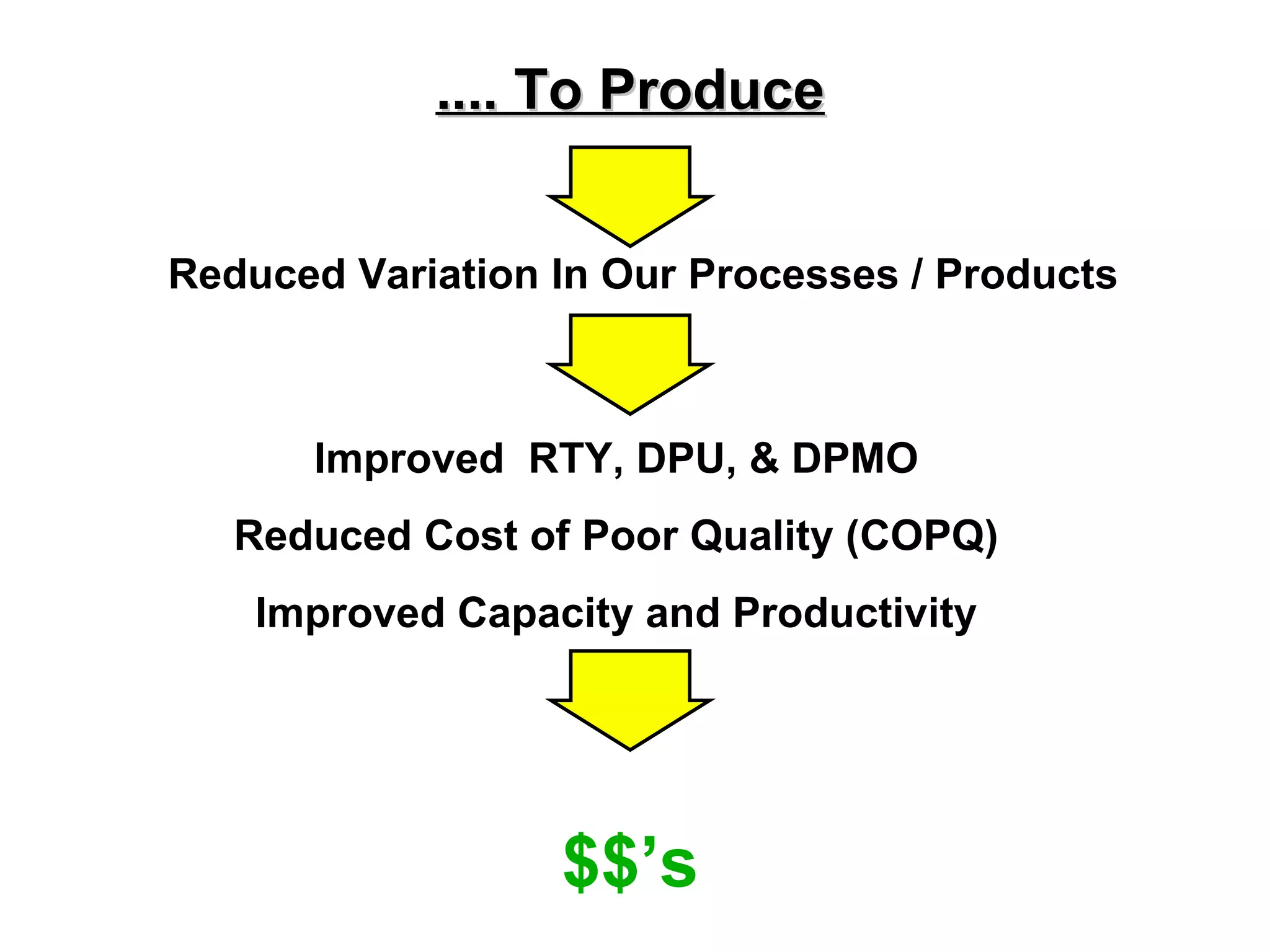
.... To Produce Improved  RTY, DPU, & DPMO Reduced Cost of Poor Quality (COPQ) Improved Capacity and Productivity Reduced Variation In Our Processes / Products $$’s
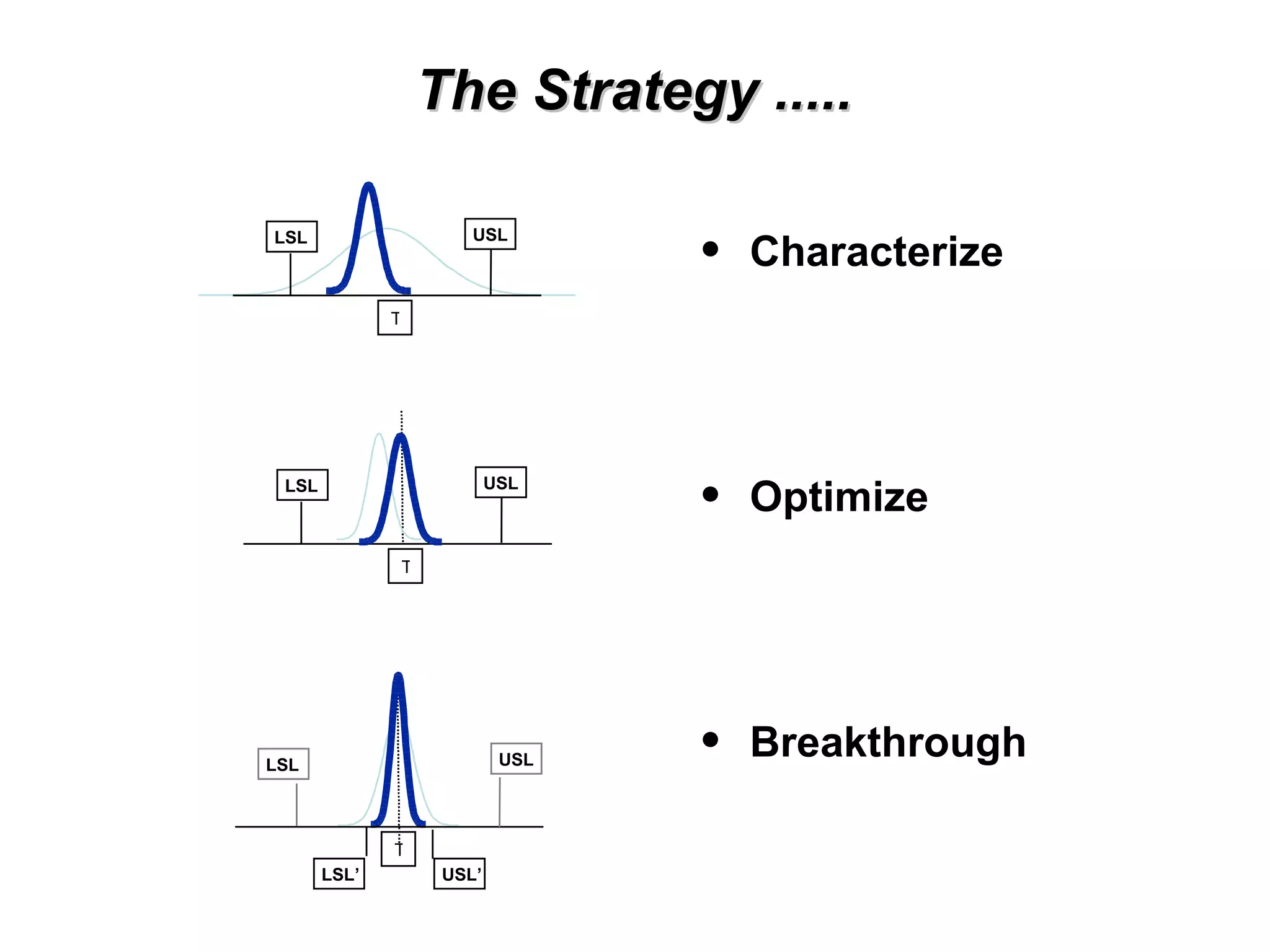
The Strategy ..... Characterize Optimize Breakthrough USL T LSL USL T LSL T USL LSL USL’ LSL’
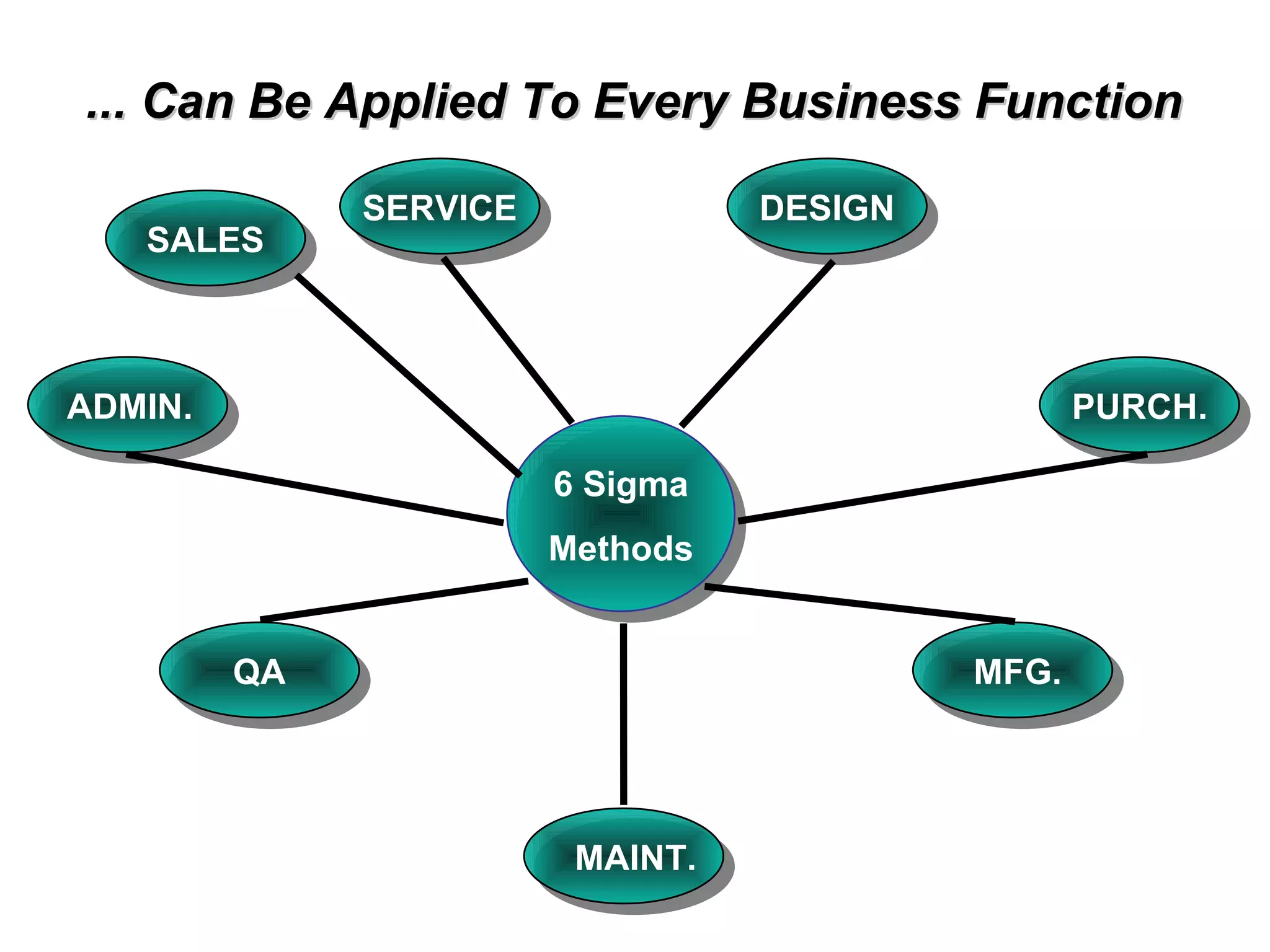
6 Sigma Methods MFG. DESIGN SERVICE PURCH. MAINT. ADMIN. QA ... Can Be Applied To Every Business Function SALES
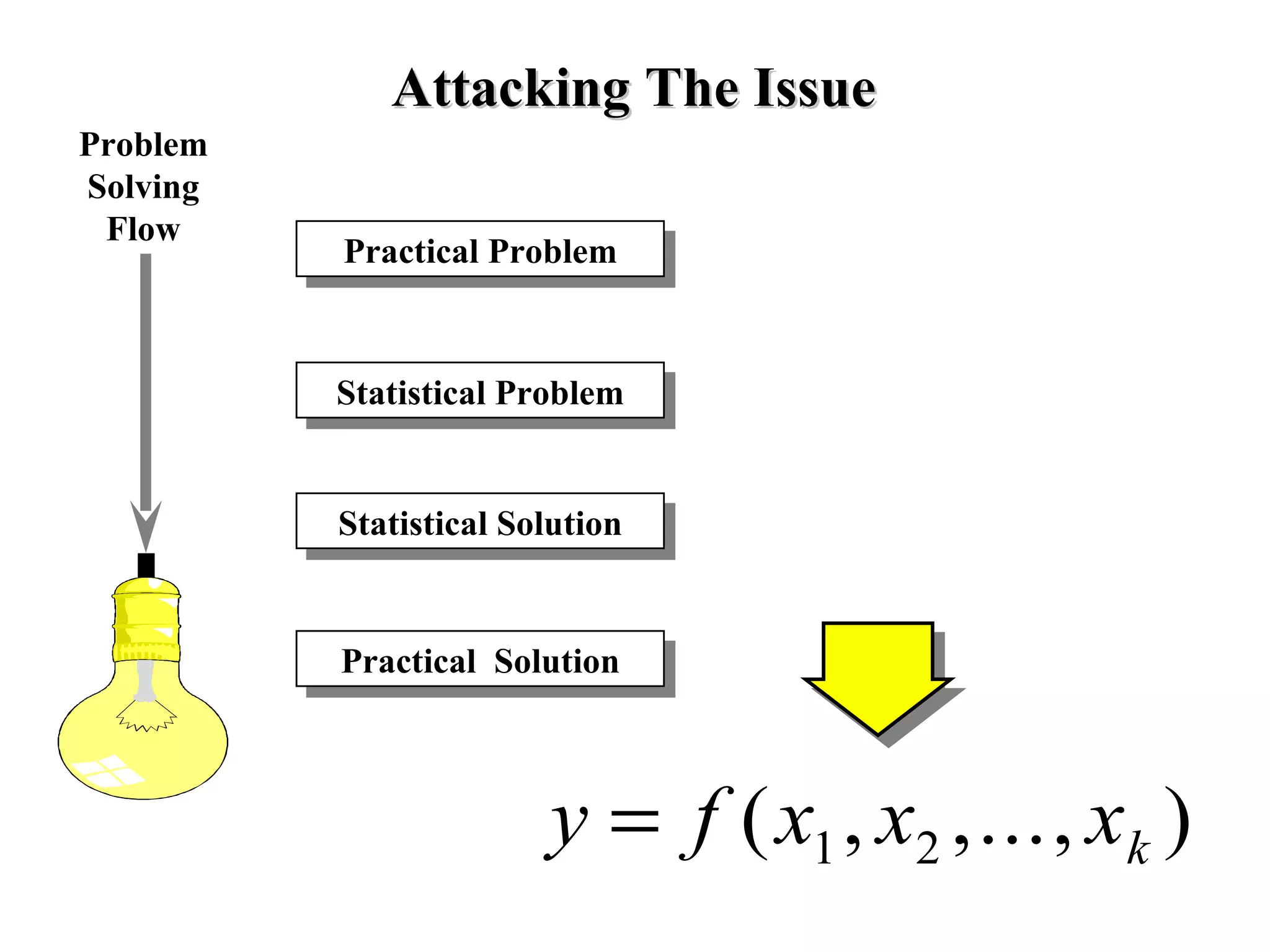
Practical Problem Statistical Problem Statistical Solution Practical  Solution Attacking The Issue Problem Solving Flow
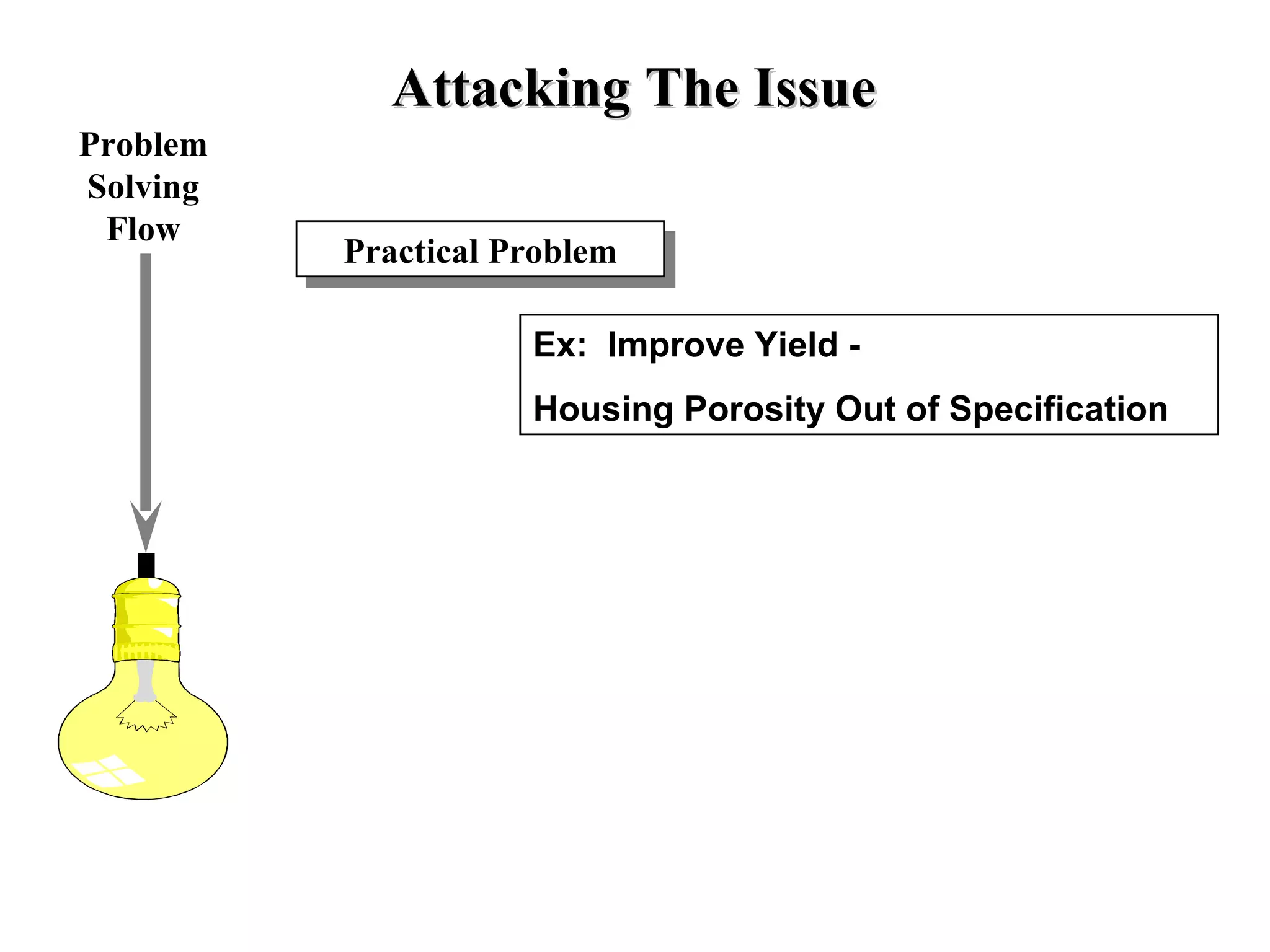
Ex:  Improve Yield - Housing Porosity Out of Specification Attacking The Issue Practical Problem Problem Solving Flow
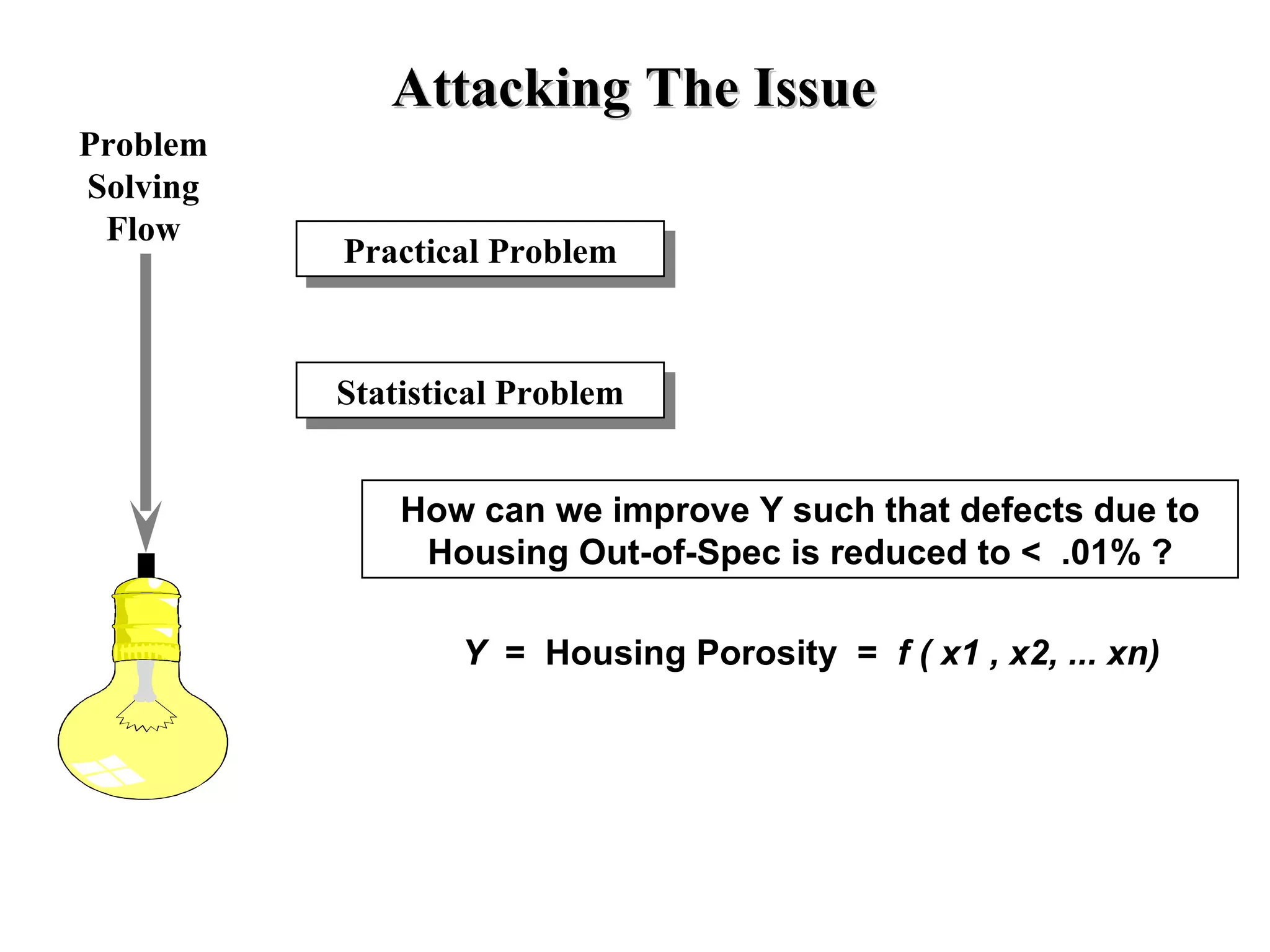
Practical Problem Statistical Problem How can we improve Y such that defects due to Housing Out-of-Spec is reduced to <  .01% ? Y  =  Housing Porosity  =  f ( x1 , x2, ... xn) Attacking The Issue Problem Solving Flow
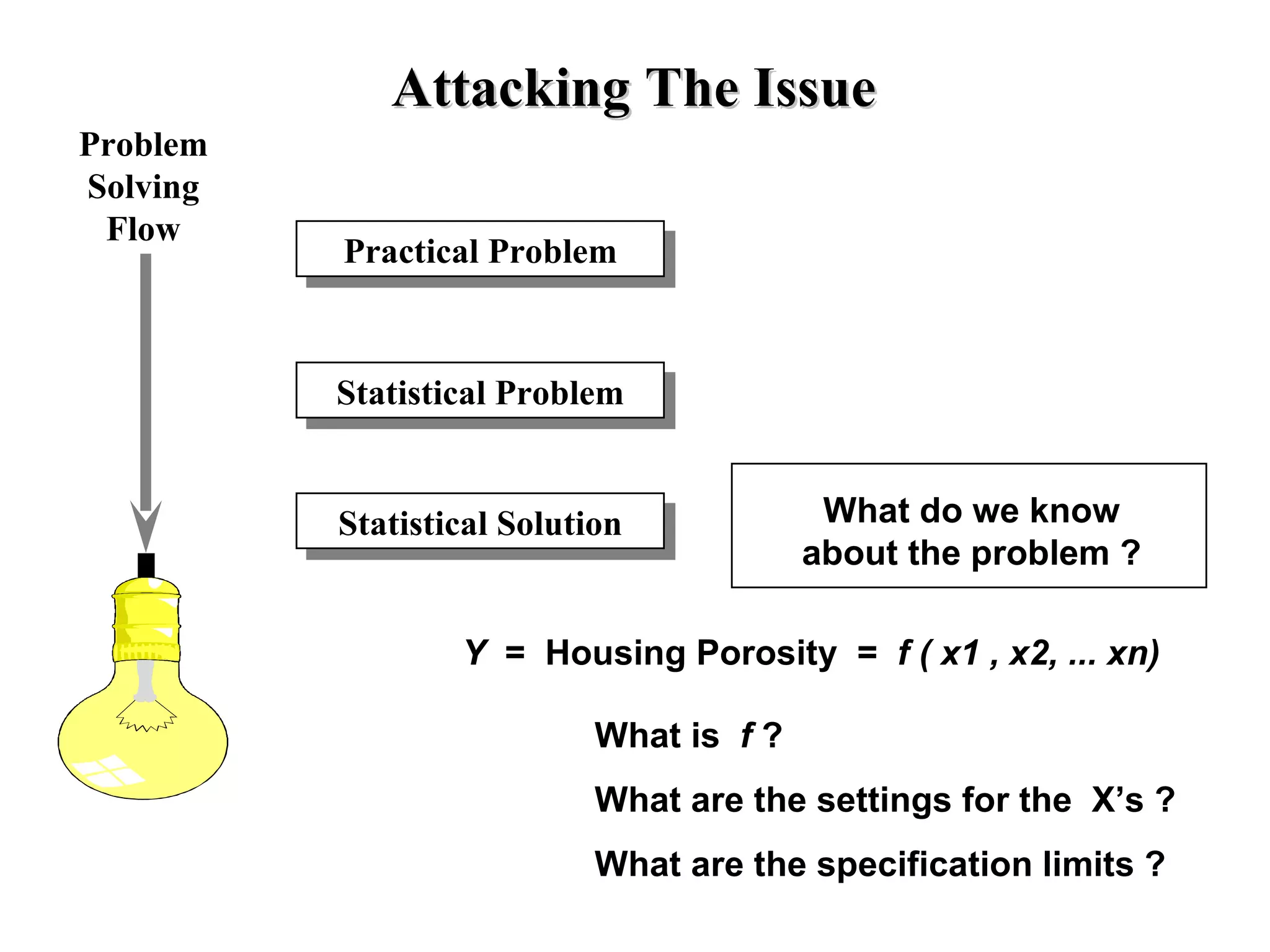
Practical Problem Statistical Problem Statistical Solution Y  =  Housing Porosity  =  f ( x1 , x2, ... xn) What is  f  ? What are the settings for the  X’s ? What are the specification limits ? Attacking The Issue What do we know about the problem ? Problem Solving Flow
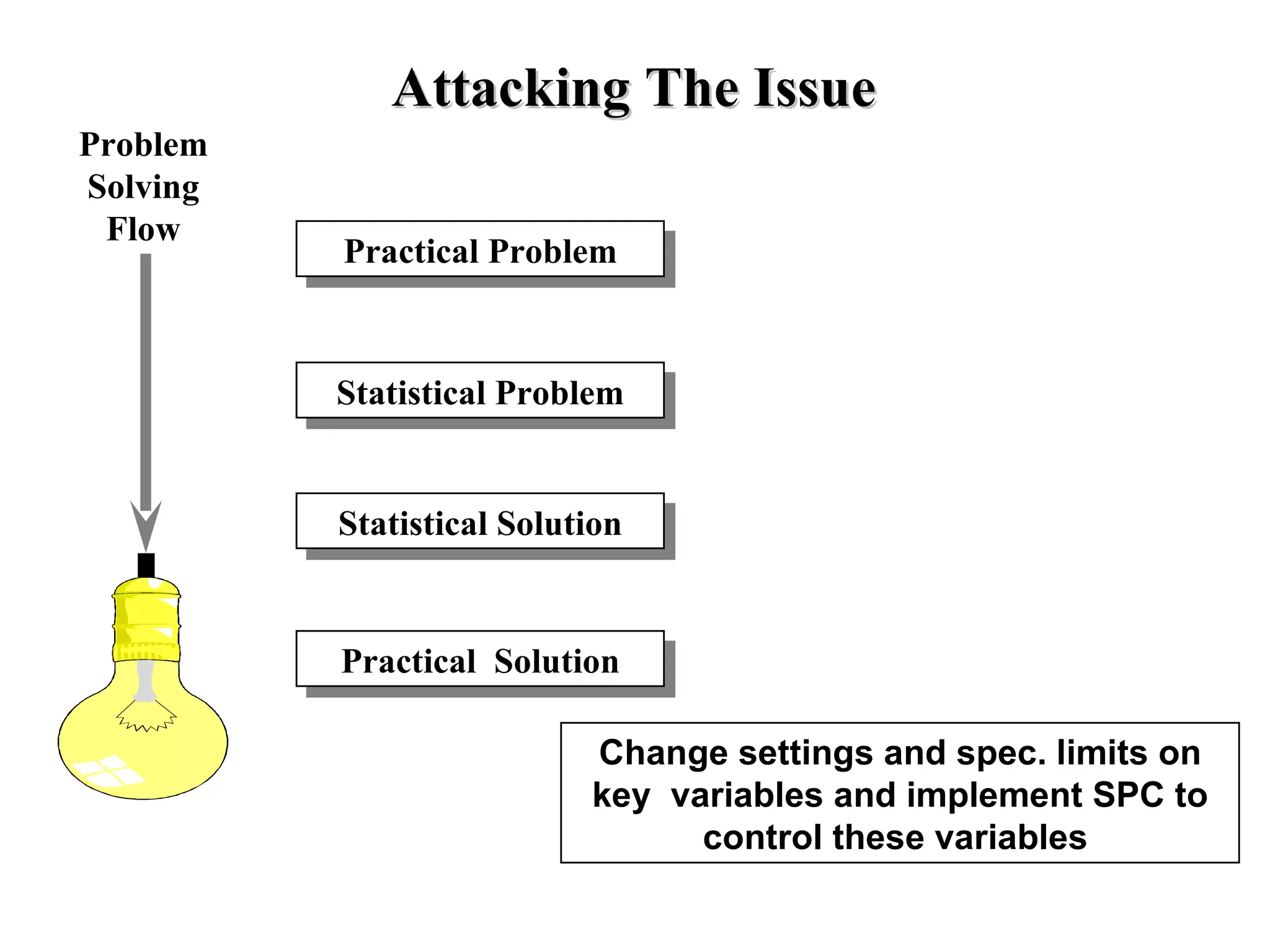
Practical Problem Statistical Problem Statistical Solution Practical  Solution Change settings and spec. limits on key  variables and implement SPC to control these variables  Attacking The Issue Problem Solving Flow
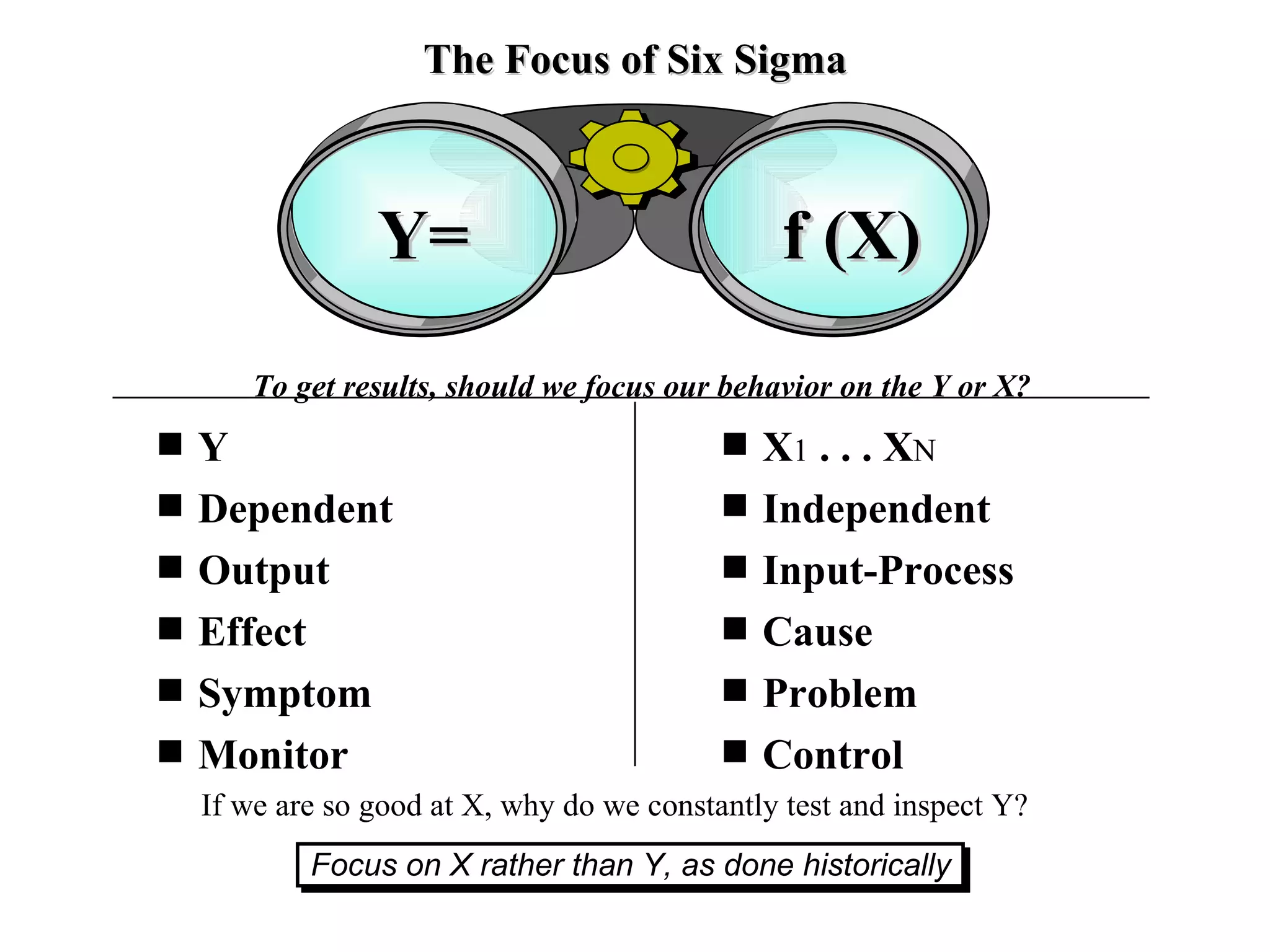
If we are so good at X, why do we constantly test and inspect Y? Y Dependent Output Effect Symptom Monitor X 1  . . . X N Independent Input-Process Cause Problem Control To get results, should we focus our behavior on the Y or X? The Focus of Six Sigma Focus on X rather than Y, as done historically f (X) Y=
Definitions Why Six Sigma ?
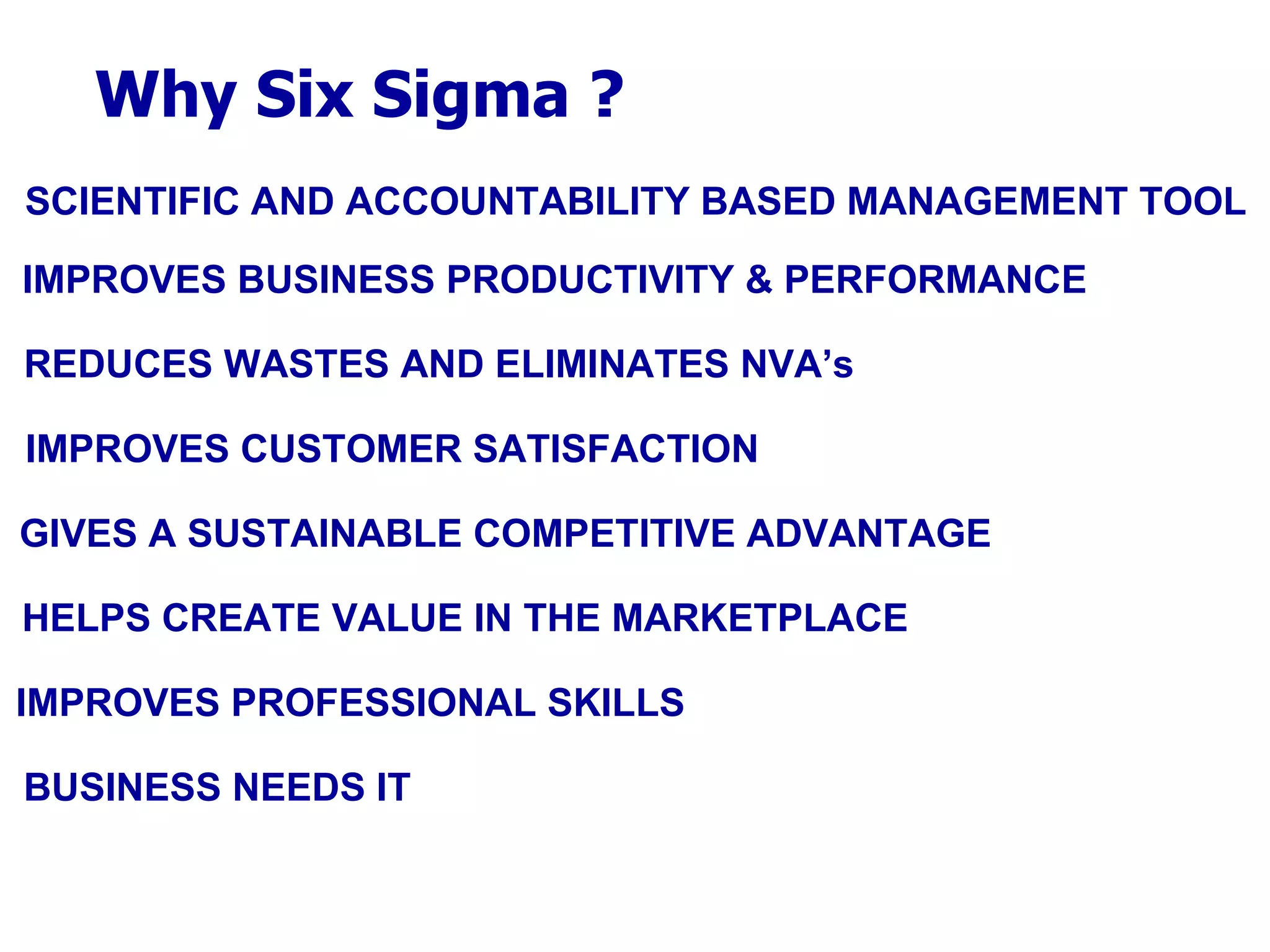
Why Six Sigma ? SCIENTIFIC AND ACCOUNTABILITY BASED MANAGEMENT TOOL IMPROVES BUSINESS PRODUCTIVITY & PERFORMANCE REDUCES WASTES AND ELIMINATES NVA’s IMPROVES CUSTOMER SATISFACTION GIVES A SUSTAINABLE COMPETITIVE ADVANTAGE HELPS CREATE VALUE IN THE MARKETPLACE IMPROVES PROFESSIONAL SKILLS BUSINESS NEEDS IT
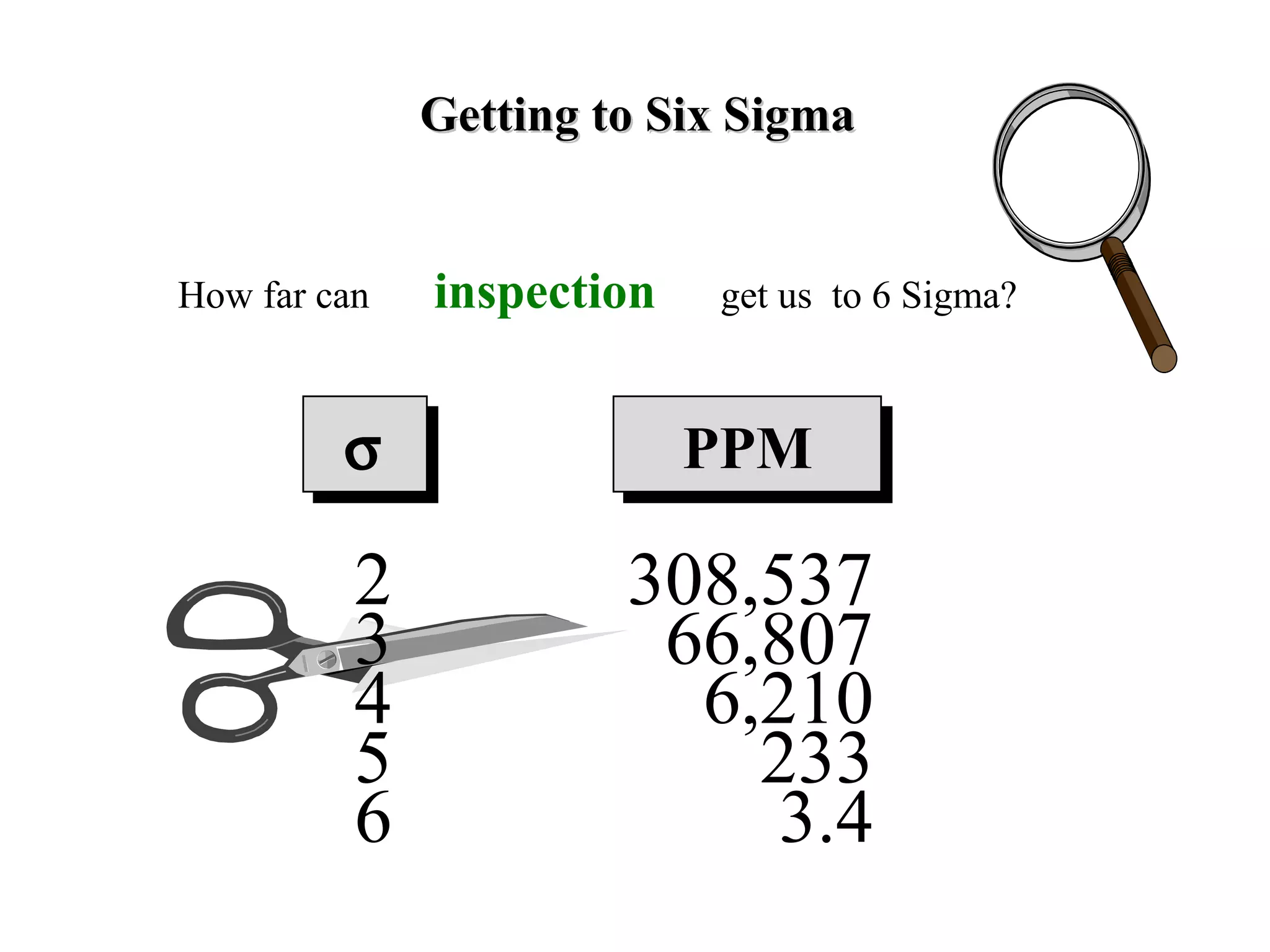
Getting to Six Sigma How far can   inspection  get us  to 6 Sigma?  PPM 2 3 4 5 6 308,537 66,807 6,210 233 3.4
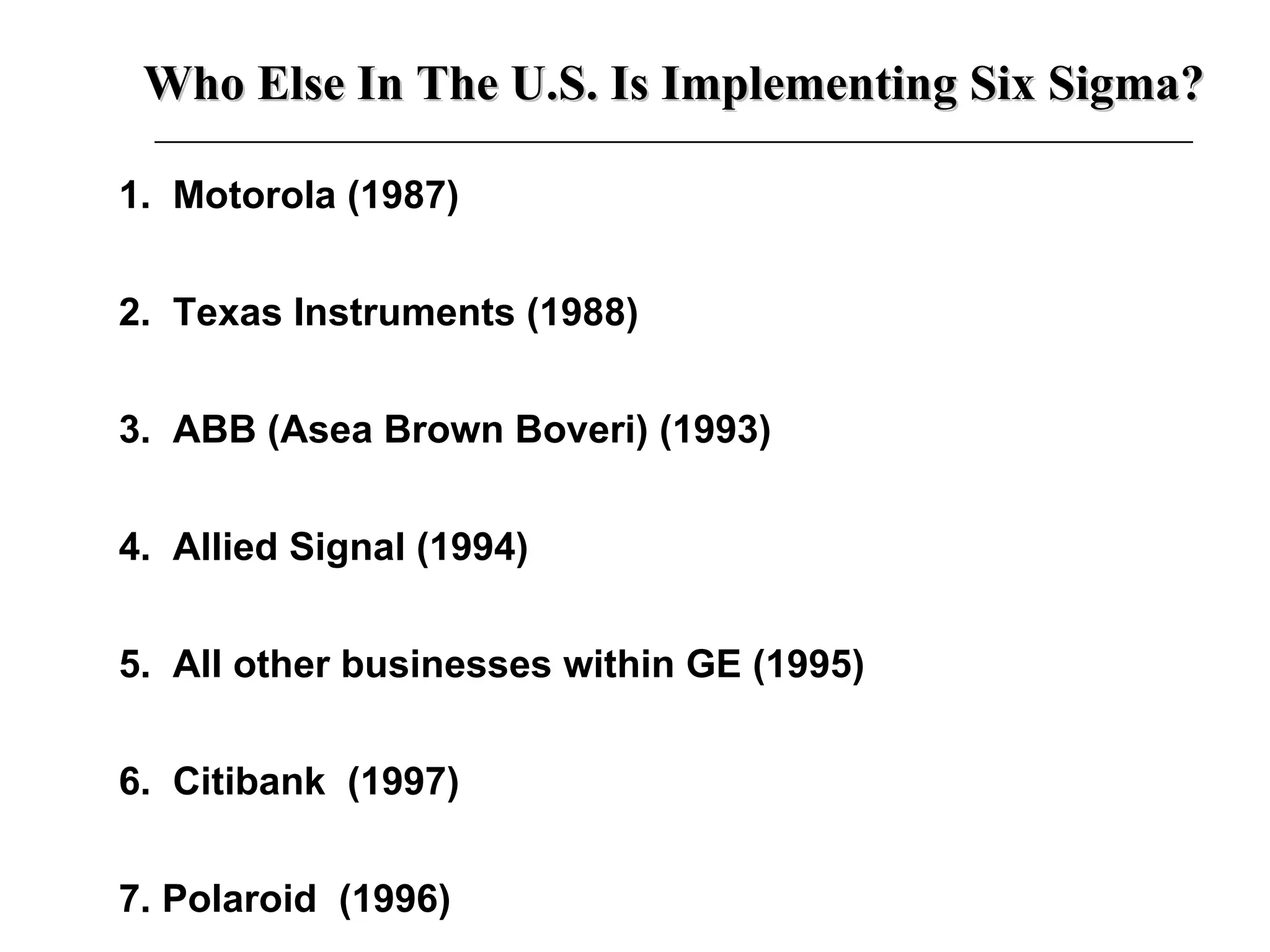
1.  Motorola (1987) 2.  Texas Instruments (1988) 3.  ABB (Asea Brown Boveri) (1993) 4.  Allied Signal (1994) 5.  All other businesses within GE (1995) 6.  Citibank  (1997) 7. Polaroid  (1996) Who Else In The U.S. Is Implementing Six Sigma?
Definitions How To  Deploy 6 Sigma ?
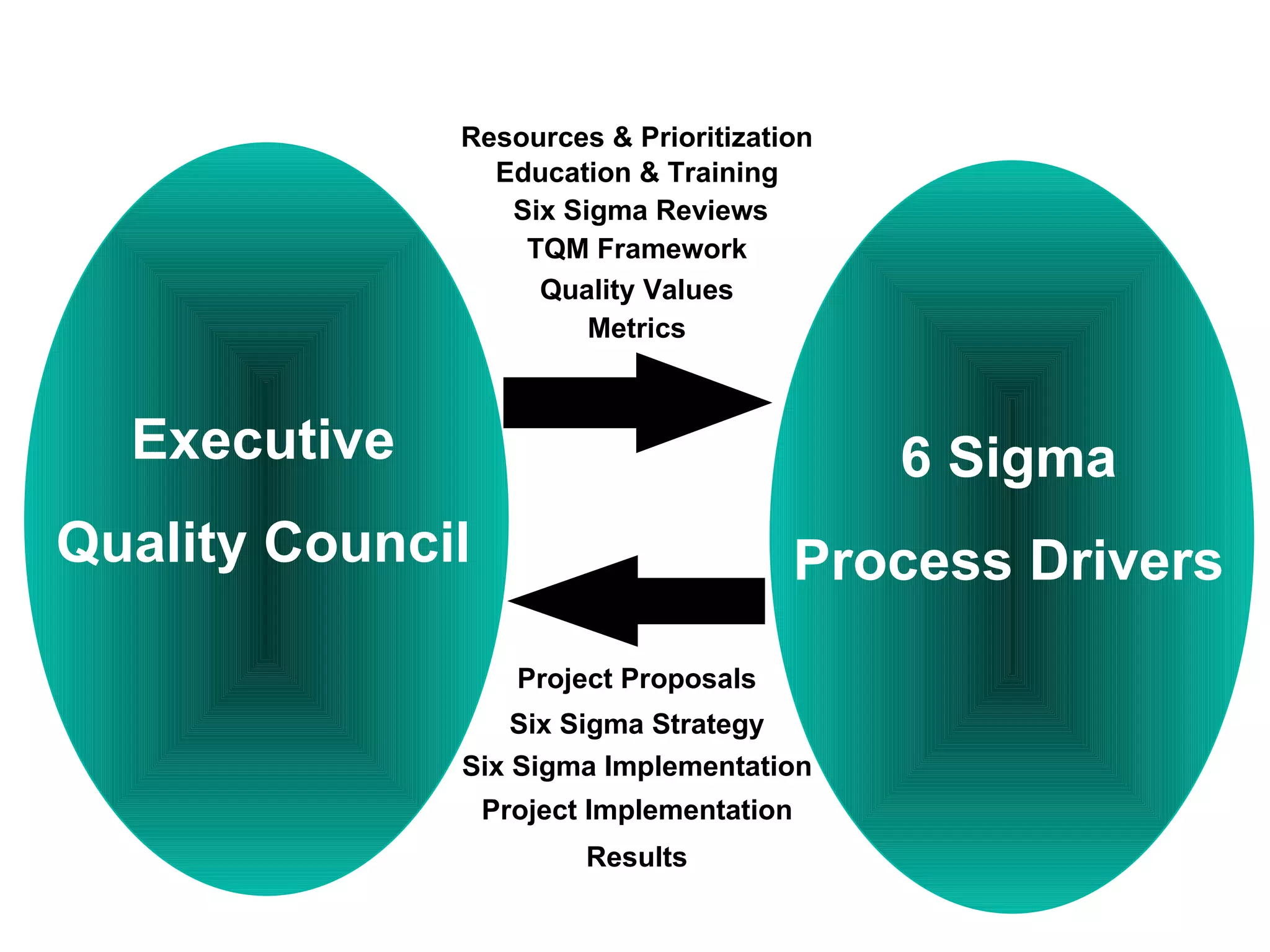
Project Proposals Six Sigma Strategy Project Implementation Results Six Sigma Implementation Executive Quality Council Resources & Prioritization Education & Training TQM Framework Metrics Quality Values Six Sigma Reviews 6 Sigma Process Drivers
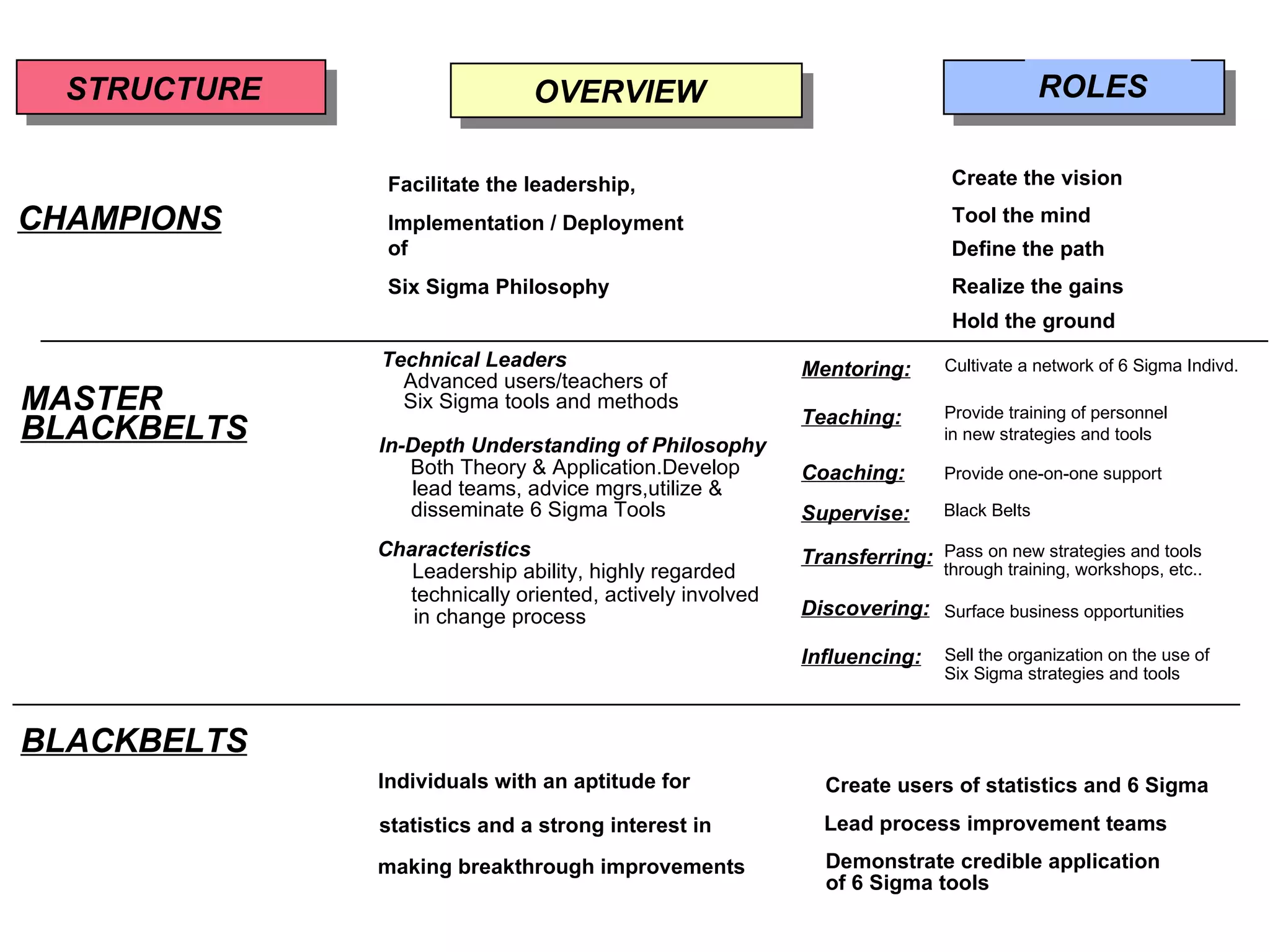
STRUCTURE OVERVIEW ROLES CHAMPIONS Facilitate the leadership, Implementation / Deployment of Six Sigma Philosophy Create the vision Tool the mind Define the path Realize the gains  Hold the ground MASTER BLACKBELTS Mentoring: Cultivate a network of 6 Sigma Indivd. Teaching: Provide training of personnel in new strategies and tools Coaching: Provide one-on-one support Transferring: Pass on new strategies and tools through training, workshops, etc.. Discovering: Surface business opportunities Influencing: Sell the organization on the use of Six Sigma strategies and tools BLACKBELTS Individuals with an aptitude for statistics and a strong interest in making breakthrough improvements Create users of statistics and 6 Sigma Lead process improvement teams Demonstrate credible application of 6 Sigma tools Supervise: Technical Leaders Advanced users/teachers of  Six Sigma tools and methods In-Depth Understanding of Philosophy Characteristics  technically oriented, actively involved Leadership ability, highly regarded Both Theory & Application.Develop lead teams, advice mgrs,utilize & disseminate 6 Sigma Tools in change process Black Belts
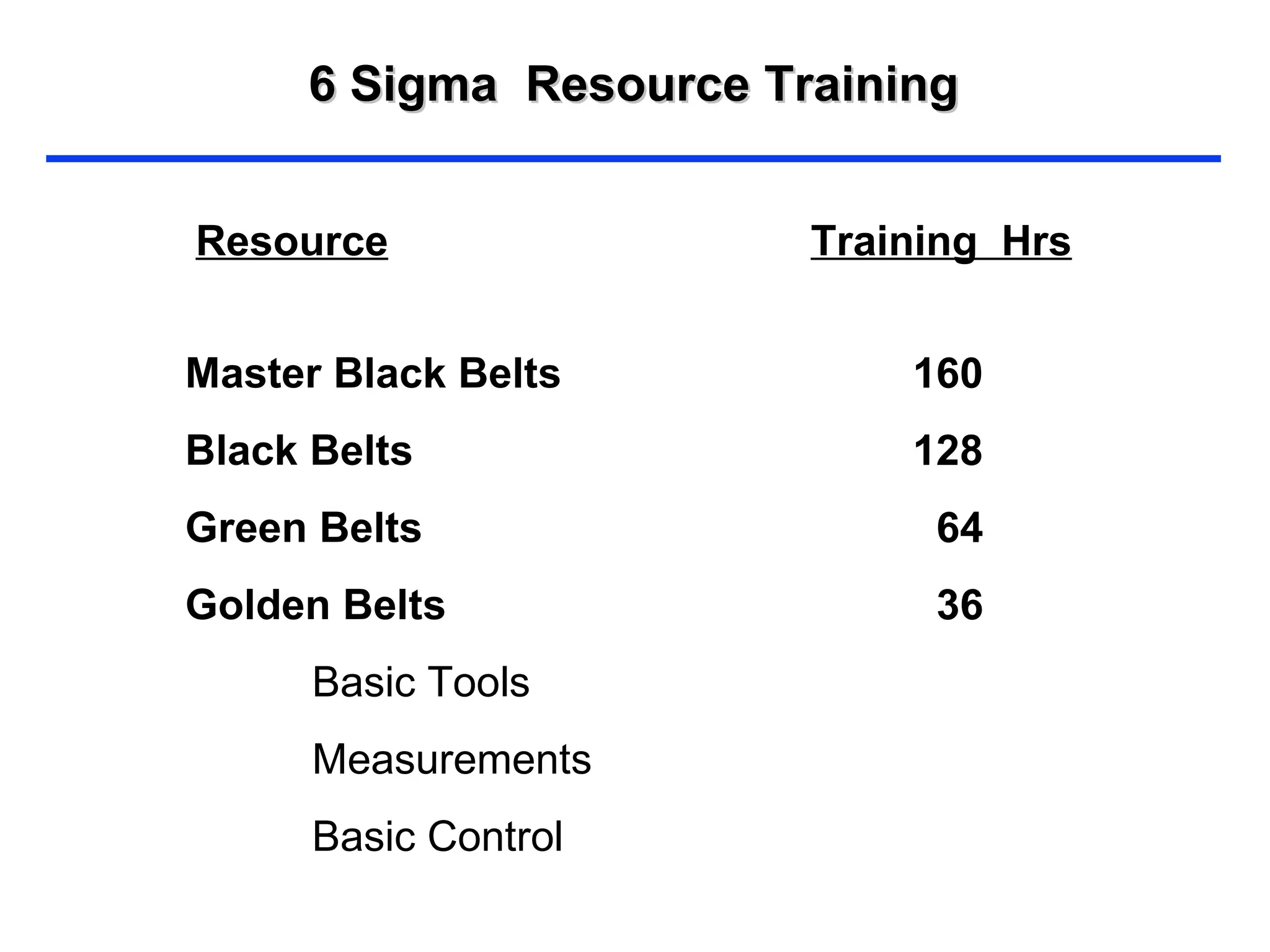
6 Sigma  Resource Training Resource Training  Hrs Master Black Belts Black Belts Green Belts Golden Belts Basic Tools Measurements Basic Control 160 128 64 36
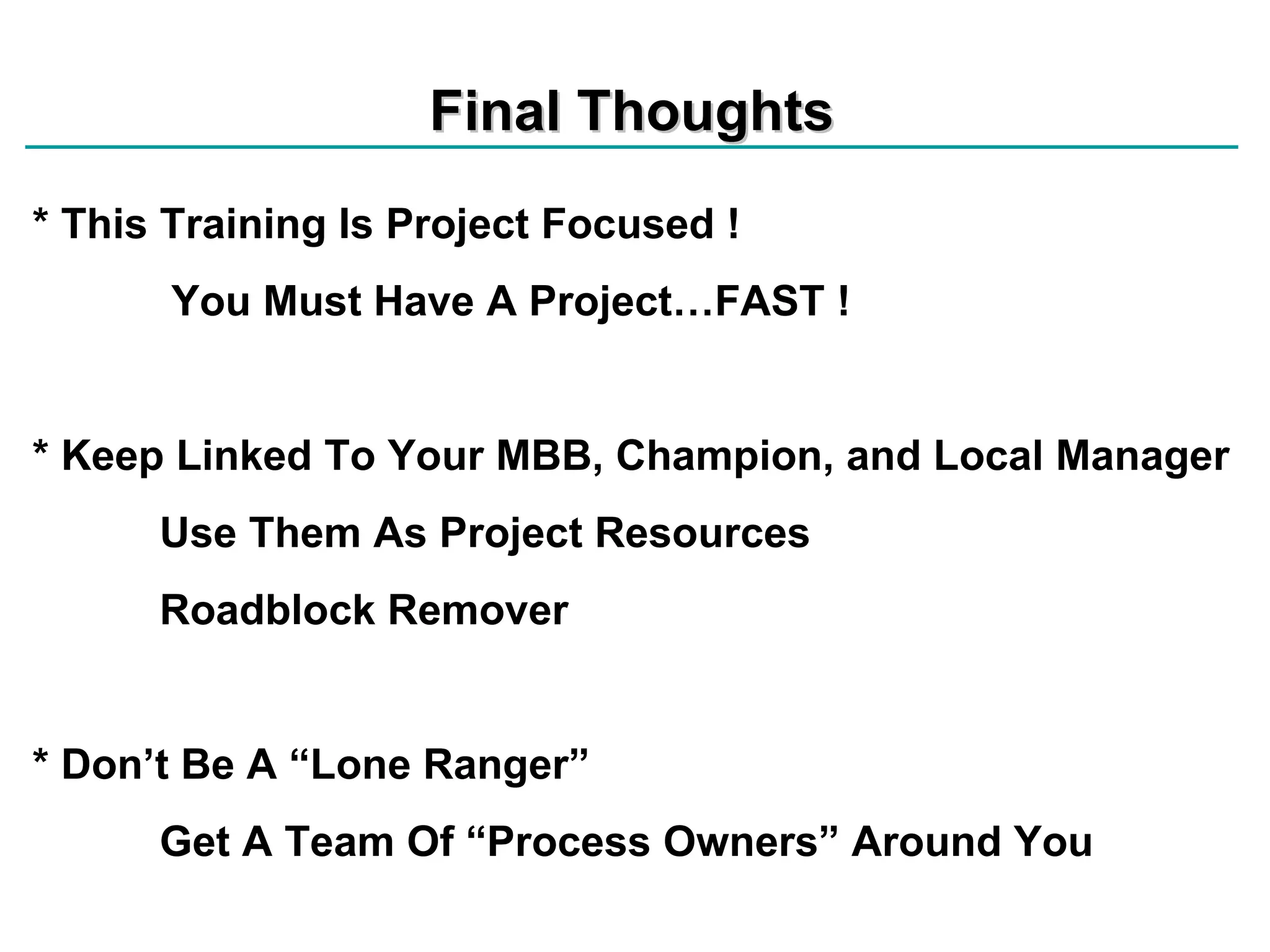
Final Thoughts * This Training Is Project Focused !   You Must Have A Project…FAST !  * Keep Linked To Your MBB, Champion, and Local Manager Use Them As Project Resources Roadblock Remover * Don’t Be A “Lone Ranger” Get A Team Of “Process Owners” Around You
THANKS

Introduction to Six Sigma

  • 1.
  • 2.
  • 3.
    Sigma is aletter in the Greek alphabet. The term “sigma” is used to designate the distribution or spread about the mean (average) of any process or procedure. For a business or manufacturing process, the sigma value is a metric that indicates how well that process is performing. The higher the sigma value, the better. Sigma measures the capability of the process to perform defect-free-work. A defect is anything that results in customer dissatisfaction. With six sigma, the common measurement index is ‘defects-per-unit,” where a unit can be virtually anything -- a component, piece of material, line of code, administrative form, time frame, distance, etc. The sigma value indicates how often defects are likely to occur. The higher the sigma value, the less likely a process will produce defects. As sigma increases, costs go down, cycle time goes down, and customer satisfaction goes up. The Many Facets of Six Sigma Metric Benchmark Vision Philosophy Method Tool Symbol Goal Value 
  • 4.
  • 5.
    Six Sigma -Goal Sigma is a statistical unit of measure that reflects process capability. The sigma scale of measure is perfectly correlated to such characteristics as defects-per-unit, parts-per million defective, and the probability of a failure/error  PPM Process Capability Defects per Million Opp. Six Sigma corresponds to parts per billion if process is centered
  • 6.
    3 Sigma 6 Sigma 5 Sigma 4 Sigma 93.32 % 99.379 % 99.9767 % 99.99966 % Historical Current Intermediate Long-Run Sigma Long-Term Yield Standard Six Sigma - Performance Target
  • 7.
    Spends 15-25% ofsales dollars on cost of failure Produces over 66,807 DPMO Relies on inspection of FG Believes that high quality is expensive Does not learn from the past Benchmarks against competition Believes 99% is good enough Defines CTQ’s internally Spends < 5 % of sales dollars on cost of failure Produces over 3.4 DPMO Relies on capable and robust processes Believes that high quality reduces costs Learns from the past and applies DMAIC Benchmarks against the best in the world Believes 99% is unacceptable Defines CTQ’s externally THE THREE SIGMA COMPANY THE SIX SIGMA COMPANY
  • 8.
    Six Sigma -Practical Meaning 99.99966% Good (6 Sigma) 20,000 lost articles of mail per hour Unsafe drinking water for almost 15 minutes each day 5,000 incorrect surgical operations per week Two short or long landings at most major airports each day 200,000 wrong drug prescriptions each year No electricity for almost seven hours each month Seven articles lost per hour One unsafe minute every seven months 1.7 incorrect operations per week One short or long landing every five years 68 wrong prescriptions per year One hour without electricity every 34 years 99% Good (3.8 Sigma)
  • 9.
    .... To ProduceImproved RTY, DPU, & DPMO Reduced Cost of Poor Quality (COPQ) Improved Capacity and Productivity Reduced Variation In Our Processes / Products $$’s
  • 10.
    The Strategy .....Characterize Optimize Breakthrough USL T LSL USL T LSL T USL LSL USL’ LSL’
  • 11.
    6 Sigma MethodsMFG. DESIGN SERVICE PURCH. MAINT. ADMIN. QA ... Can Be Applied To Every Business Function SALES
  • 12.
    Practical Problem StatisticalProblem Statistical Solution Practical Solution Attacking The Issue Problem Solving Flow
  • 13.
    Ex: ImproveYield - Housing Porosity Out of Specification Attacking The Issue Practical Problem Problem Solving Flow
  • 14.
    Practical Problem StatisticalProblem How can we improve Y such that defects due to Housing Out-of-Spec is reduced to < .01% ? Y = Housing Porosity = f ( x1 , x2, ... xn) Attacking The Issue Problem Solving Flow
  • 15.
    Practical Problem StatisticalProblem Statistical Solution Y = Housing Porosity = f ( x1 , x2, ... xn) What is f ? What are the settings for the X’s ? What are the specification limits ? Attacking The Issue What do we know about the problem ? Problem Solving Flow
  • 16.
    Practical Problem StatisticalProblem Statistical Solution Practical Solution Change settings and spec. limits on key variables and implement SPC to control these variables Attacking The Issue Problem Solving Flow
  • 17.
    If we areso good at X, why do we constantly test and inspect Y? Y Dependent Output Effect Symptom Monitor X 1 . . . X N Independent Input-Process Cause Problem Control To get results, should we focus our behavior on the Y or X? The Focus of Six Sigma Focus on X rather than Y, as done historically f (X) Y=
  • 18.
  • 19.
    Why Six Sigma? SCIENTIFIC AND ACCOUNTABILITY BASED MANAGEMENT TOOL IMPROVES BUSINESS PRODUCTIVITY & PERFORMANCE REDUCES WASTES AND ELIMINATES NVA’s IMPROVES CUSTOMER SATISFACTION GIVES A SUSTAINABLE COMPETITIVE ADVANTAGE HELPS CREATE VALUE IN THE MARKETPLACE IMPROVES PROFESSIONAL SKILLS BUSINESS NEEDS IT
  • 20.
    Getting to SixSigma How far can inspection get us to 6 Sigma?  PPM 2 3 4 5 6 308,537 66,807 6,210 233 3.4
  • 21.
    1. Motorola(1987) 2. Texas Instruments (1988) 3. ABB (Asea Brown Boveri) (1993) 4. Allied Signal (1994) 5. All other businesses within GE (1995) 6. Citibank (1997) 7. Polaroid (1996) Who Else In The U.S. Is Implementing Six Sigma?
  • 22.
    Definitions How To Deploy 6 Sigma ?
  • 23.
    Project Proposals SixSigma Strategy Project Implementation Results Six Sigma Implementation Executive Quality Council Resources & Prioritization Education & Training TQM Framework Metrics Quality Values Six Sigma Reviews 6 Sigma Process Drivers
  • 24.
    STRUCTURE OVERVIEW ROLESCHAMPIONS Facilitate the leadership, Implementation / Deployment of Six Sigma Philosophy Create the vision Tool the mind Define the path Realize the gains Hold the ground MASTER BLACKBELTS Mentoring: Cultivate a network of 6 Sigma Indivd. Teaching: Provide training of personnel in new strategies and tools Coaching: Provide one-on-one support Transferring: Pass on new strategies and tools through training, workshops, etc.. Discovering: Surface business opportunities Influencing: Sell the organization on the use of Six Sigma strategies and tools BLACKBELTS Individuals with an aptitude for statistics and a strong interest in making breakthrough improvements Create users of statistics and 6 Sigma Lead process improvement teams Demonstrate credible application of 6 Sigma tools Supervise: Technical Leaders Advanced users/teachers of Six Sigma tools and methods In-Depth Understanding of Philosophy Characteristics technically oriented, actively involved Leadership ability, highly regarded Both Theory & Application.Develop lead teams, advice mgrs,utilize & disseminate 6 Sigma Tools in change process Black Belts
  • 25.
    6 Sigma Resource Training Resource Training Hrs Master Black Belts Black Belts Green Belts Golden Belts Basic Tools Measurements Basic Control 160 128 64 36
  • 26.
    Final Thoughts *This Training Is Project Focused ! You Must Have A Project…FAST ! * Keep Linked To Your MBB, Champion, and Local Manager Use Them As Project Resources Roadblock Remover * Don’t Be A “Lone Ranger” Get A Team Of “Process Owners” Around You
  • 27.