RELATIONS AND FUNCTIONS
RELATIONS, FUNCTIONS,
VERTICAL TESTS, DOMAIN
AND RANGE
What are relations?
What are functions?
Presenting functions as
tables and graphs
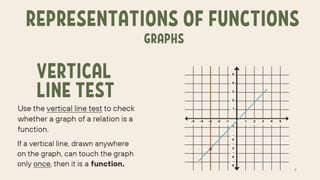
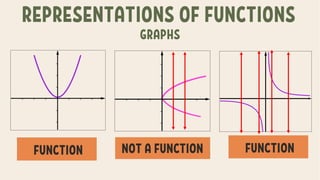
The Vertical Line Test
LESSON OUTLINE
What is a domain?
What is a range?
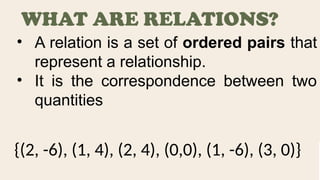
WHAT ARE RELATIONS?
RELATIONS, FUNCTIONS,
VERTICAL TESTS, DOMAIN
AND RANGE
WHAT ARE RELATIONS?
{(2, -6), (1, 4), (2, 4), (0,0), (1, -6), (3, 0)}
• A relation is a set of ordered pairs that
represent a relationship.
• It is the correspondence between two
quantities
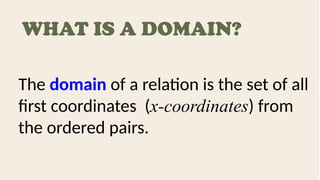
WHAT IS A DOMAIN?
RELATIONS, FUNCTIONS,
VERTICAL TESTS, DOMAIN
AND RANGE
WHAT IS A DOMAIN?
The domain of a relation is the set of all
first coordinates (x-coordinates) from
the ordered pairs.
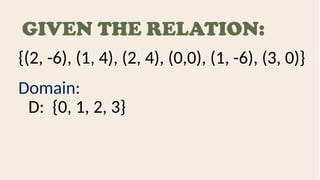
GIVEN THE RELATION:
{(2, -6), (1, 4), (2, 4), (0,0), (1, -6), (3, 0)}
Domain:
D: {0, 1, 2, 3}
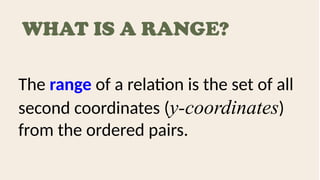
WHAT IS A RANGE?
RELATIONS, FUNCTIONS,
VERTICAL TESTS, DOMAIN
AND RANGE
WHAT IS A RANGE?
The range of a relation is the set of all
second coordinates (y-coordinates)
from the ordered pairs.
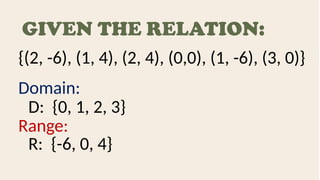
GIVEN THE RELATION:
{(2, -6), (1, 4), (2, 4), (0,0), (1, -6), (3, 0)}
Domain:
D: {0, 1, 2, 3}
Range:
R: {-6, 0, 4}
•Ordered pairs
•Mapping Diagram
•Table of Values
•Graphs
REPRESENTATIONS OF RELATIONS
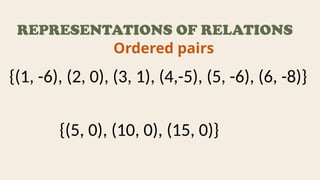
Ordered pairs
REPRESENTATIONS OF RELATIONS
{(1, -6), (2, 0), (3, 1), (4,-5), (5, -6), (6, -8)}
{(5, 0), (10, 0), (15, 0)}
REPRESENTATIONS OF RELATIONS
5
2
1
0
11
12
19
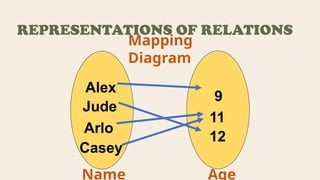
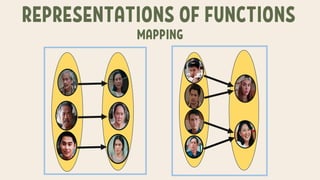
Mapping
Diagram
Mapping
Diagram
REPRESENTATIONS OF RELATIONS
Alex
Jude
Arlo
Casey
9
11
12
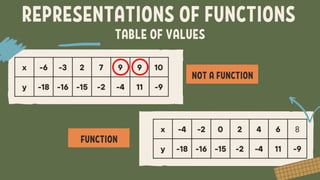
Name Age
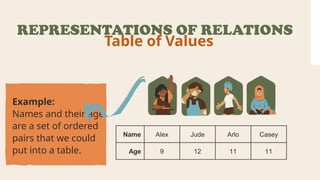
Example:
Names and their age
are a set of ordered
pairs that we could
put into a table.
REPRESENTATIONS OF RELATIONS
Table of Values
REPRESENTATIONS OF RELATIONS
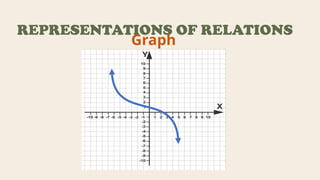
Graph
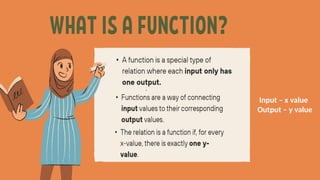
WHAT IS A FUNCTION?
RELATIONS, FUNCTIONS,
VERTICAL TESTS, DOMAIN
AND RANGE
Input – x value
Output – y value
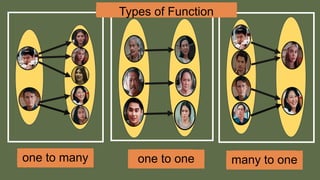
one to many one to one many to one
Types of Function
•Ordered pairs
•Mapping
•Table of Values
•Graphs
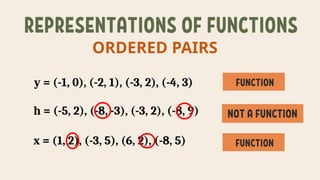
ORDERED PAIRS
y = (-1, 0), (-2, 1), (-3, 2), (-4, 3)
h = (-5, 2), (-8, -3), (-3, 2), (-8, 9)
x = (1, 2), (-3, 5), (6, 2), (-8, 5)
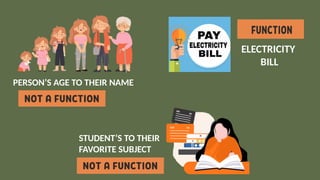
PERSON’S AGE TO THEIR NAME
STUDENT’S TO THEIR
FAVORITE SUBJECT
ELECTRICITY
BILL
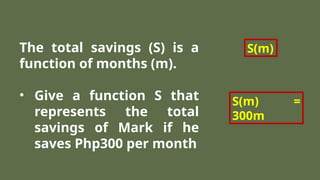
The total savings (S) is a
function of months (m).
• Give a function S that
represents the total
savings of Mark if he
saves Php300 per month
S(m)
S(m) =
300m
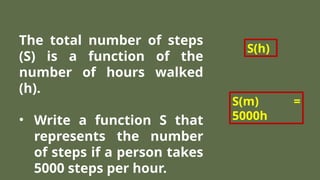
The total number of steps
(S) is a function of the
number of hours walked
(h).
• Write a function S that
represents the number
of steps if a person takes
5000 steps per hour.
S(h)
S(m) =
5000h
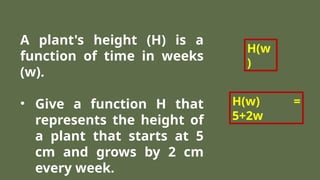
A plant's height (H) is a
function of time in weeks
(w).
• Give a function H that
represents the height of
a plant that starts at 5
cm and grows by 2 cm
every week.
H(w
)
H(w) =
5+2w
EVALUATING
FUNCTIONS
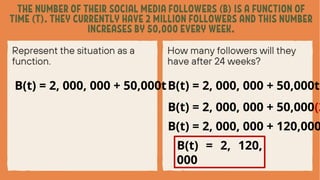
B(t) = 2, 000, 000 + 50,000tB(t) = 2, 000, 000 + 50,000t
B(t) = 2, 000, 000 + 50,000(2
B(t) = 2, 000, 000 + 120,000
B(t) = 2, 120,
000
LET’S RECALL
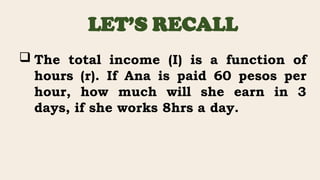
 The total income (I) is a function of
hours (r). If Ana is paid 60 pesos per
hour, how much will she earn in 3
days, if she works 8hrs a day.
LET’S RECALL
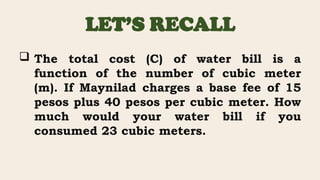
 The total cost (C) of water bill is a
function of the number of cubic meter
(m). If Maynilad charges a base fee of 15
pesos plus 40 pesos per cubic meter. How
much would your water bill if you
consumed 23 cubic meters.
EVALUATING
FUNCTIONS
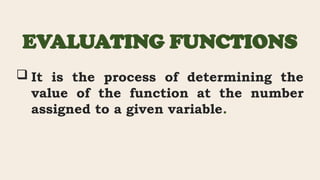
EVALUATING FUNCTIONS
 It is the process of determining the
value of the function at the number
assigned to a given variable.
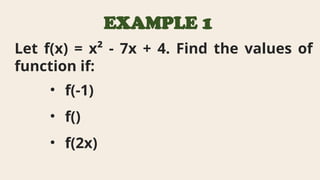
EXAMPLE 1
Let f(x) = x² - 7x + 4. Find the values of
function if:
• f(-1)
• f()
• f(2x)
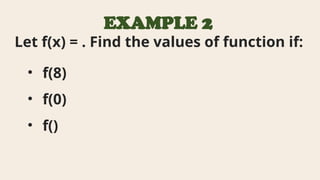
EXAMPLE 2
Let f(x) = . Find the values of function if:
• f(8)
• f(0)
• f()
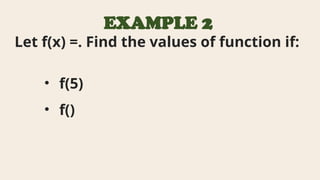
EXAMPLE 2
Let f(x) =. Find the values of function if:
• f(5)
• f()

INTRODUCTION TO RELATION AND FUNCTION.pptx