Lecture 10
Introduction to Neural Networks
and Fuzzy Logic
President University Erwin Sitompul NNFL 10/1
Dr.-Ing. Erwin Sitompul
President University
http://zitompul.wordpress.com
2 0 1 8
President University Erwin Sitompul NNFL 10/2
( )
T T

( )
Tl T
 ( )
Tm T

( C)
T 
1
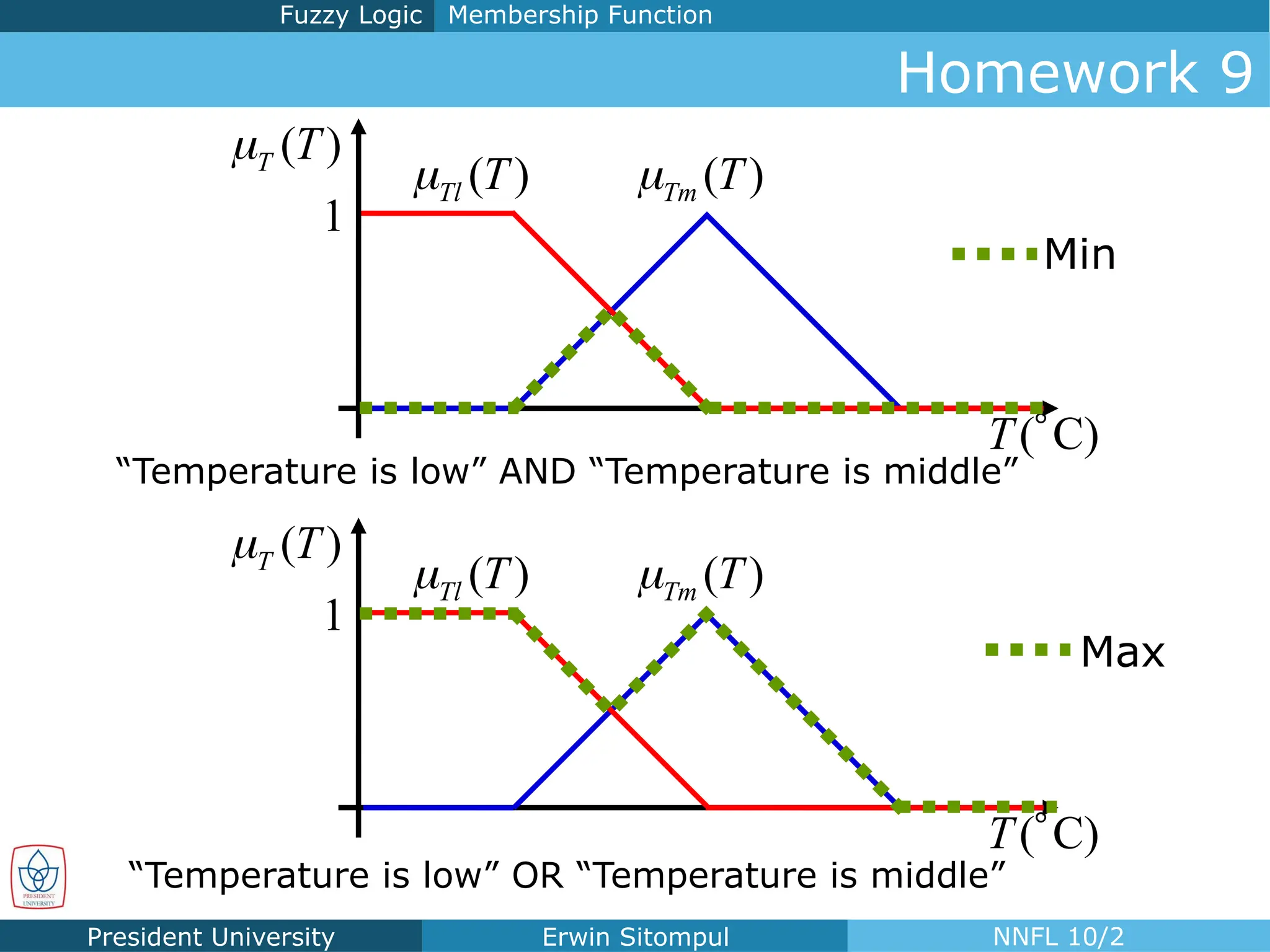
“Temperature is low” AND “Temperature is middle”
( )
T T

( )
Tl T
 ( )
Tm T

( C)
T 
1
“Temperature is low” OR “Temperature is middle”
Min
Max
Membership Function
Fuzzy Logic
Homework 9
President University Erwin Sitompul NNFL 10/3
( )
T T

( )
Tl T
 ( )
Tm T

( C)
T 
1
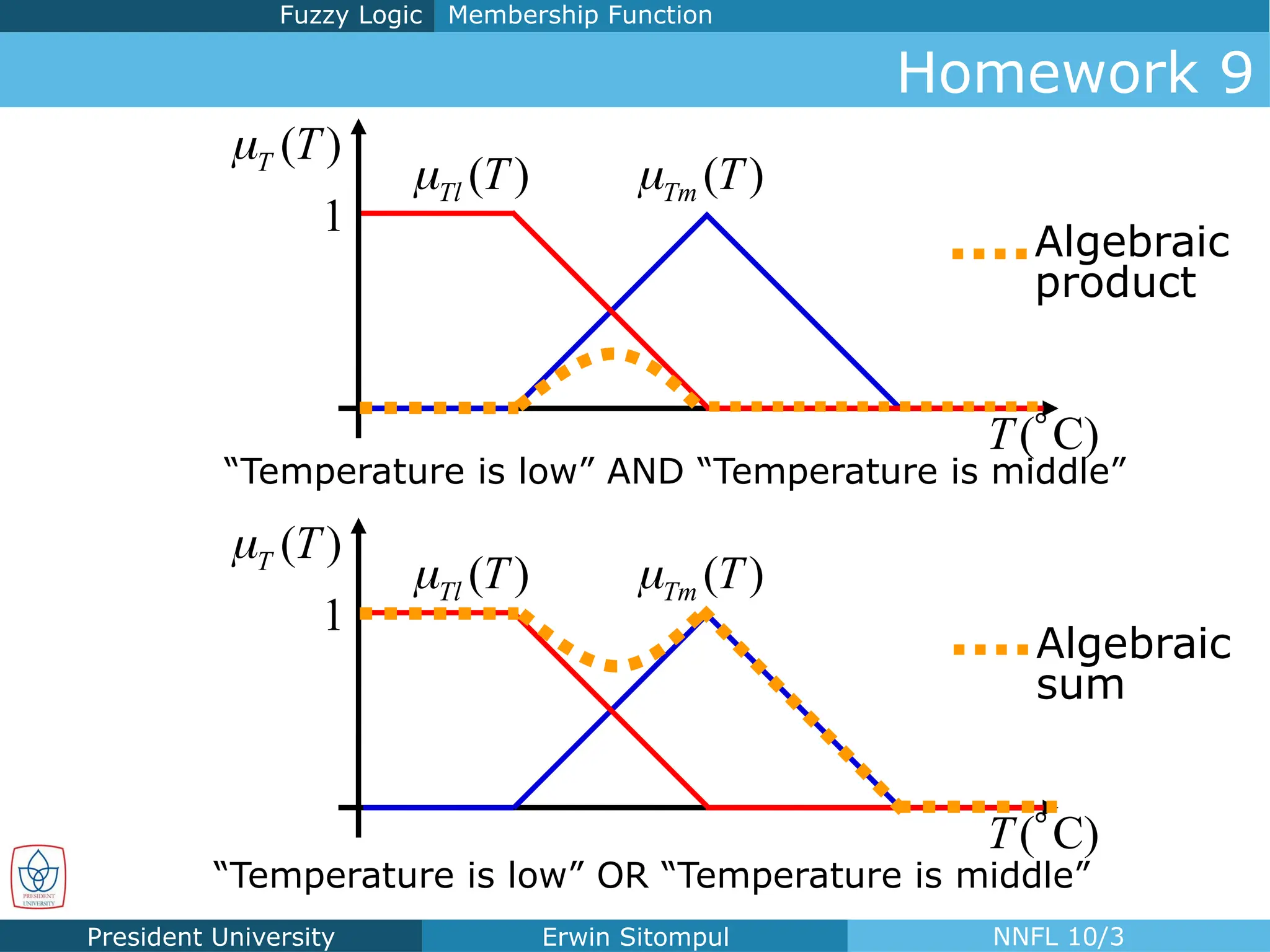
“Temperature is low” AND “Temperature is middle”
( )
T T

( )
Tl T
 ( )
Tm T

( C)
T 
1
“Temperature is low” OR “Temperature is middle”
Algebraic
product
Algebraic
sum
Homework 9
Membership Function
Fuzzy Logic
President University Erwin Sitompul NNFL 10/4
( )
T T

( )
Tl T
 ( )
Tm T

( C)
T 
1
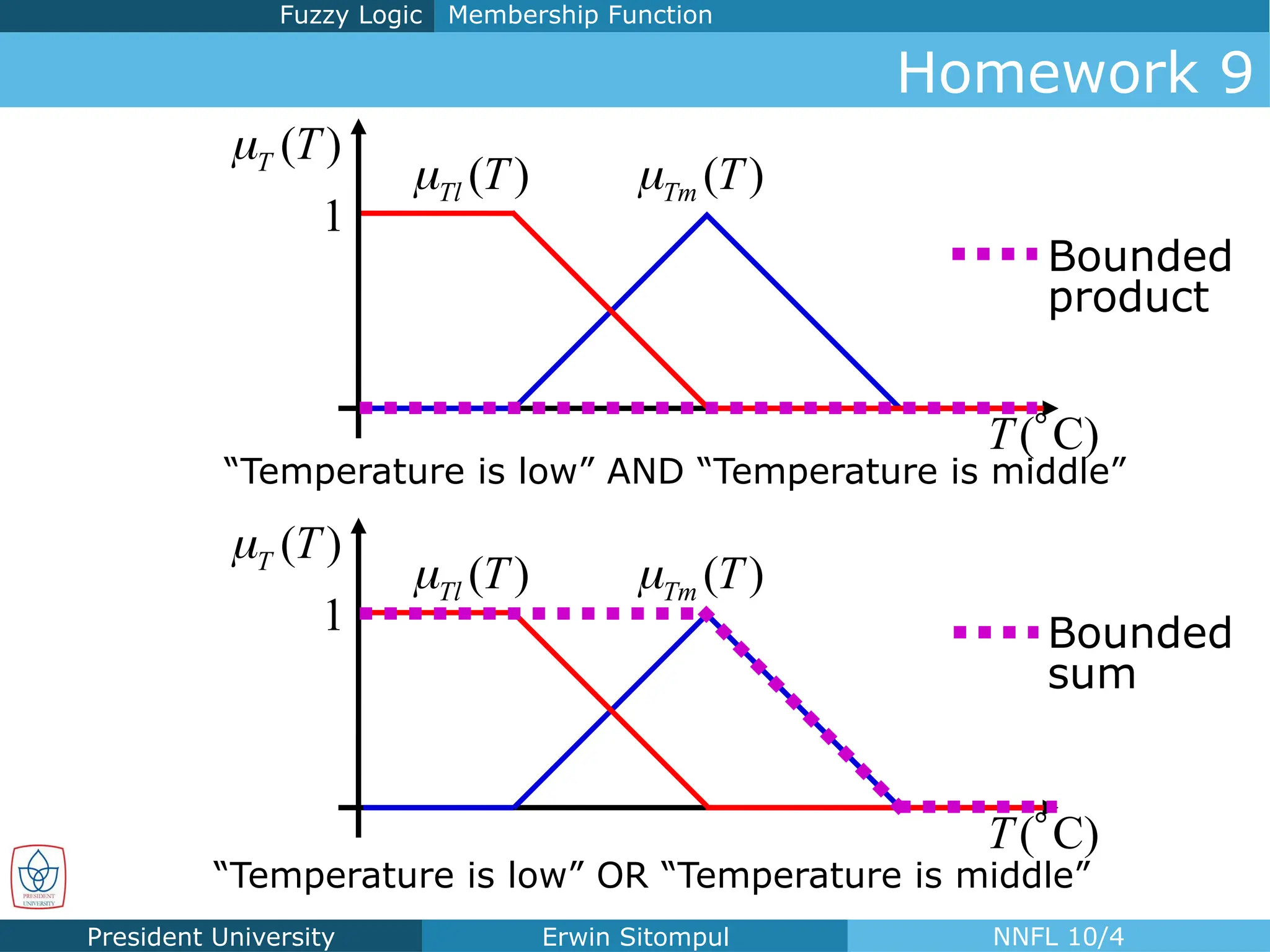
“Temperature is low” AND “Temperature is middle”
( )
T T

( )
Tl T
 ( )
Tm T

( C)
T 
1
“Temperature is low” OR “Temperature is middle”
Bounded
product
Bounded
sum
Homework 9
Membership Function
Fuzzy Logic
President University Erwin Sitompul NNFL 10/5
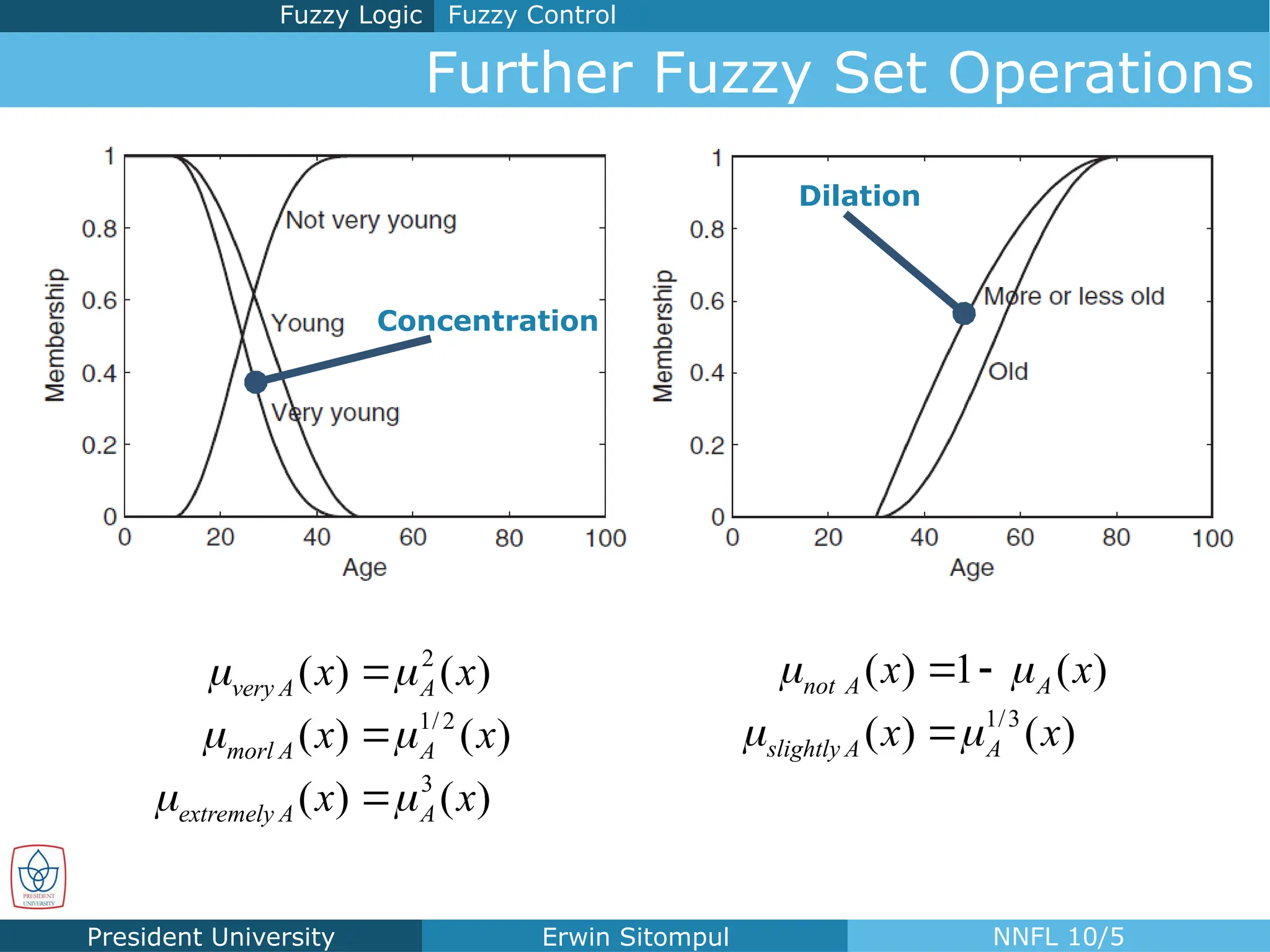
Further Fuzzy Set Operations
2
1/ 2
3
( ) ( )
( ) ( )
( ) ( )
very A A
morl A A
extremely A A
x x
x x
x x
 
 
 



1/3
( ) 1 ( )
( ) ( )
not A A
slightly A A
x x
x x
 
 
 

Fuzzy Control
Fuzzy Logic
Dilation
Concentration
President University Erwin Sitompul NNFL 10/6
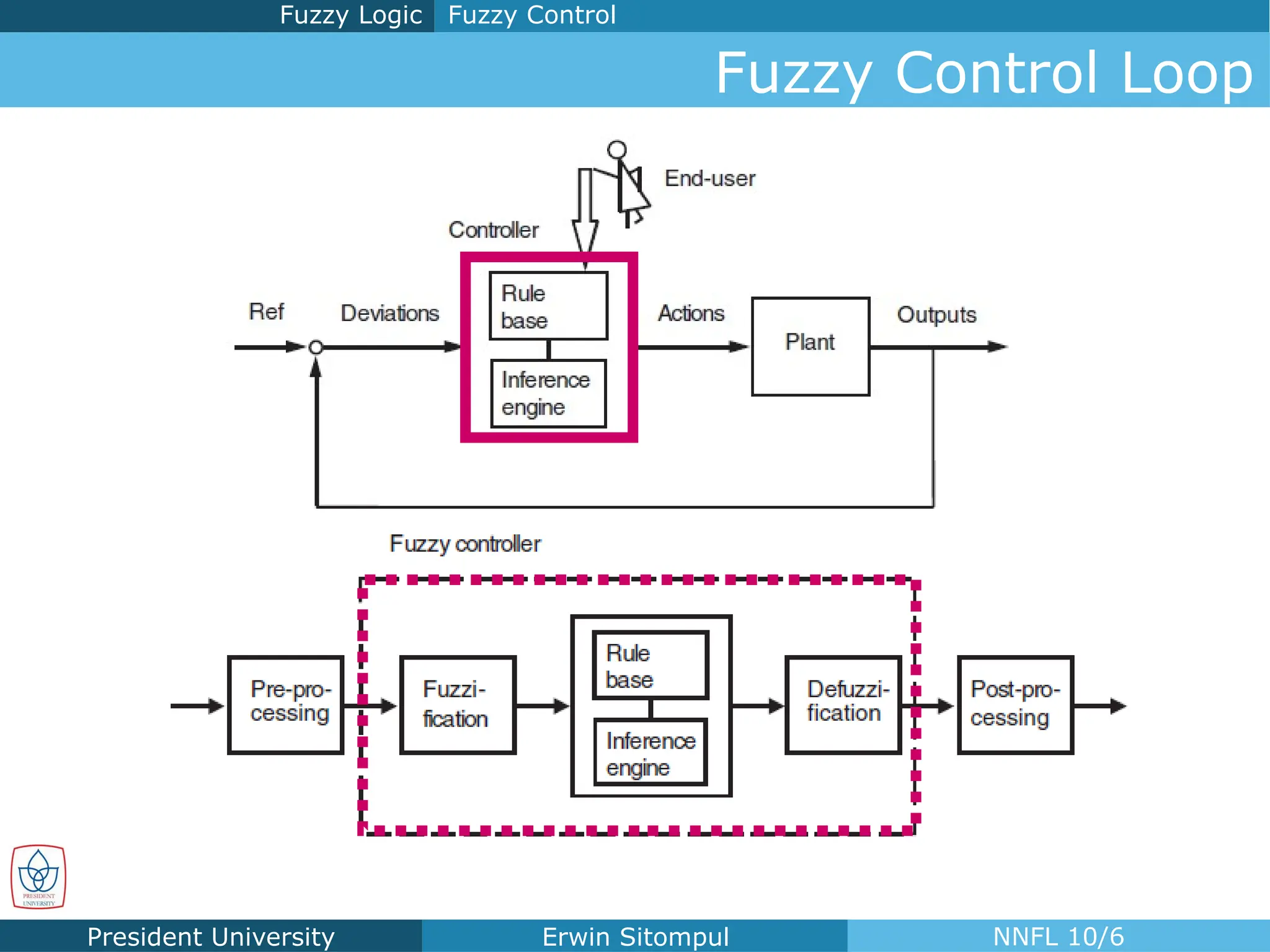
Fuzzy Control Loop
Fuzzy Control
Fuzzy Logic
President University Erwin Sitompul NNFL 9/7
 Prior to fuzzy control, the followings must be defined:
 Fuzzy membership functions
 Fuzzy logic operators
 Fuzzy rules, including fuzzy linguistic value and
linguistic variable
 The processing steps in a fuzzy control include:
 Fuzzification
 Implication / Inference Core
 Accumulation
 Defuzzification
Fuzzy Control
Fuzzy Logic
Fuzzy Inference
President University Erwin Sitompul NNFL 10/8
Fuzzy Control
Fuzzy Logic
Fuzzy Rules
 Example of a fuzzy rule while “Driving a Car”:
“IF the distance to the car in front is small, AND
the distance is decreasing slowly, THEN
decelerate quite big”
 The question that arises:
Given a certain distance and a certain change of
distance, what (crisp) value of acceleration should
we select?
President University Erwin Sitompul NNFL 10/9
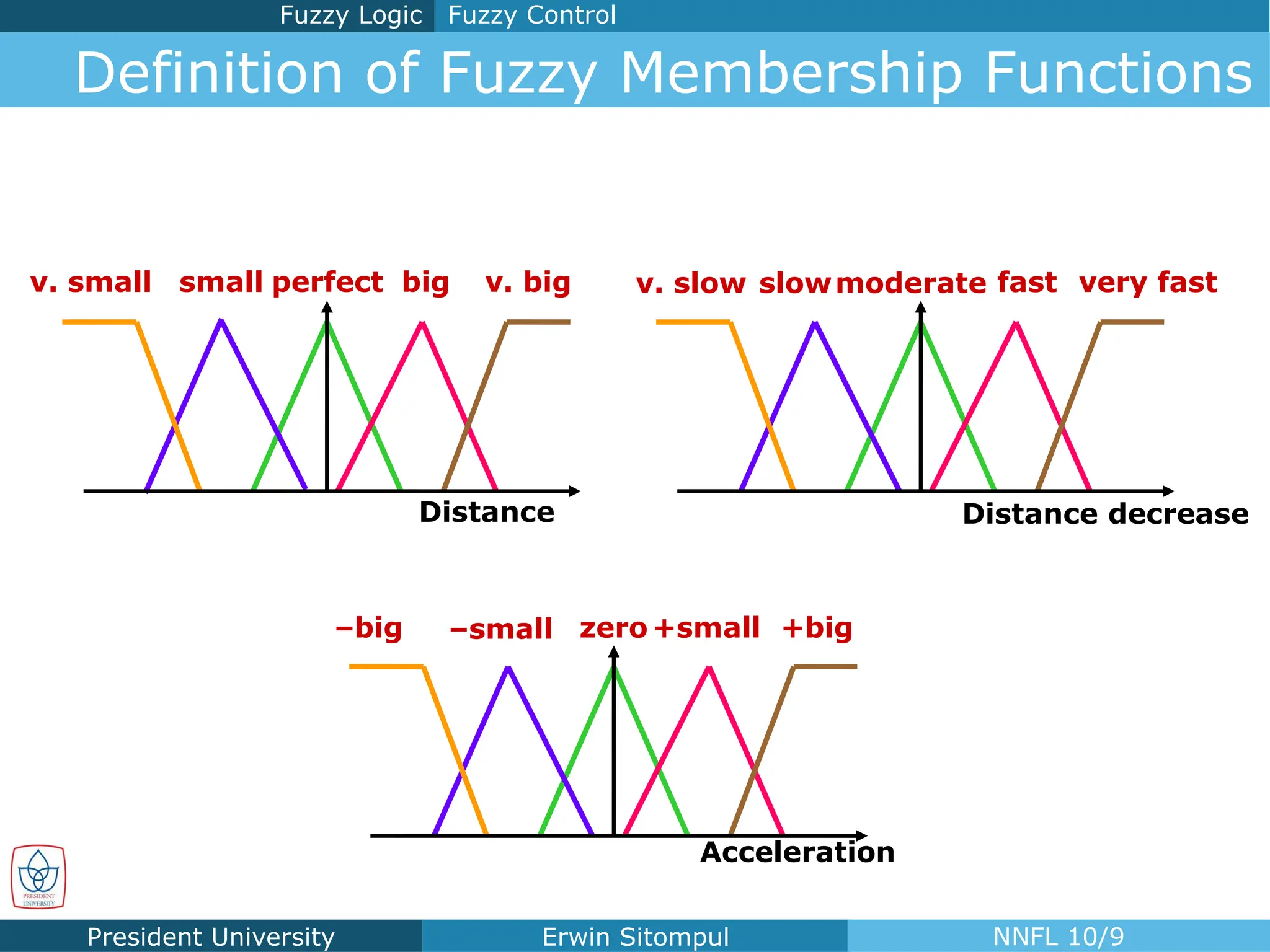
Definition of Fuzzy Membership Functions
v. small
Distance
small perfect big v. big moderate
Distance decrease
slow fast very fast
v. slow
Acceleration
–small zero+small +big
–big
Fuzzy Control
Fuzzy Logic
President University Erwin Sitompul NNFL 10/10
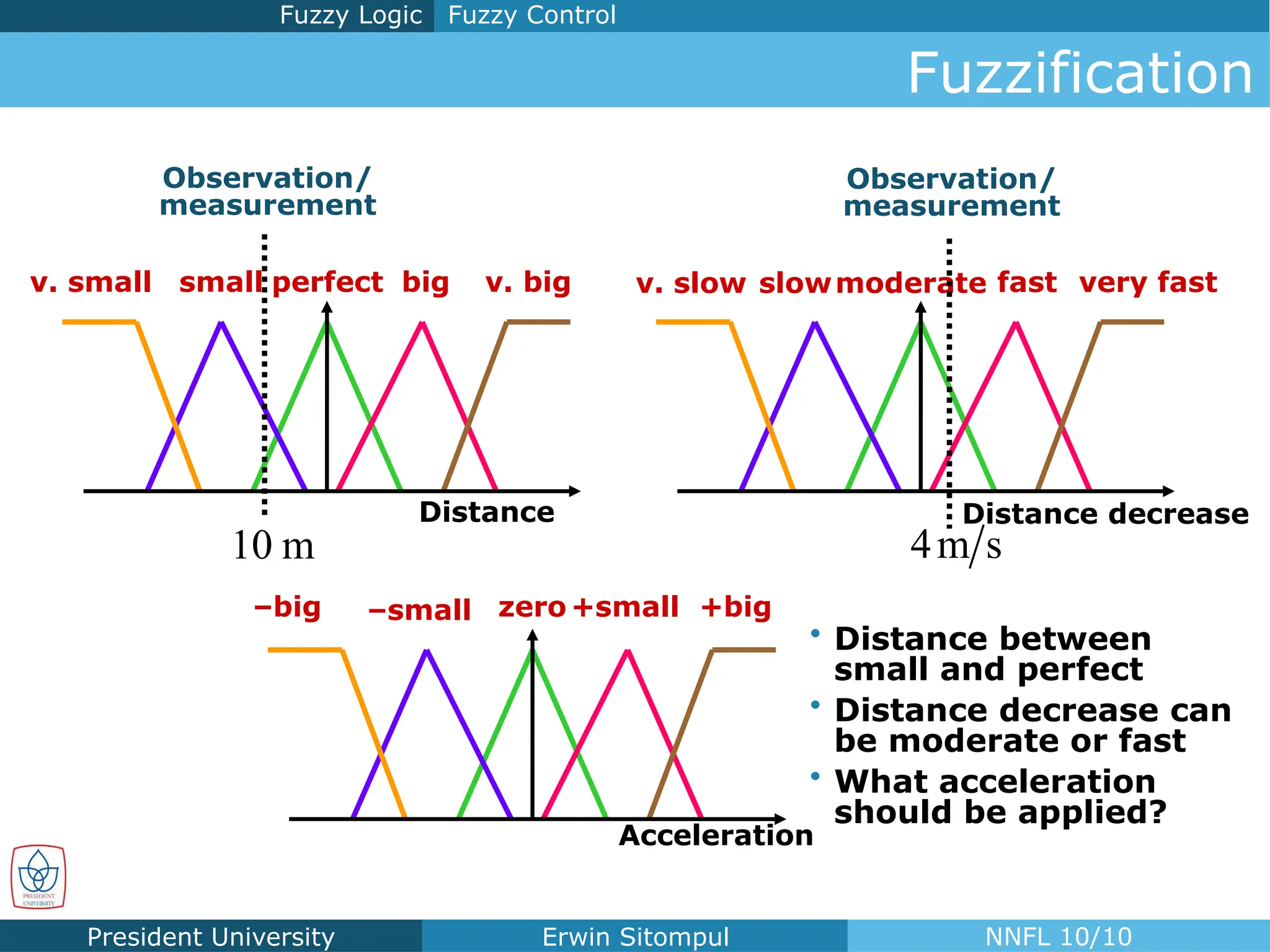
Fuzzification
Observation/
measurement
Observation/
measurement
• Distance between
small and perfect
• Distance decrease can
be moderate or fast
• What acceleration
should be applied?
Fuzzy Control
Fuzzy Logic
v. small
Distance
small perfect big v. big moderate
Distance decrease
slow fast very fast
v. slow
Acceleration
–small zero+small +big
–big
10 m 4m s
President University Erwin Sitompul NNFL 9/11
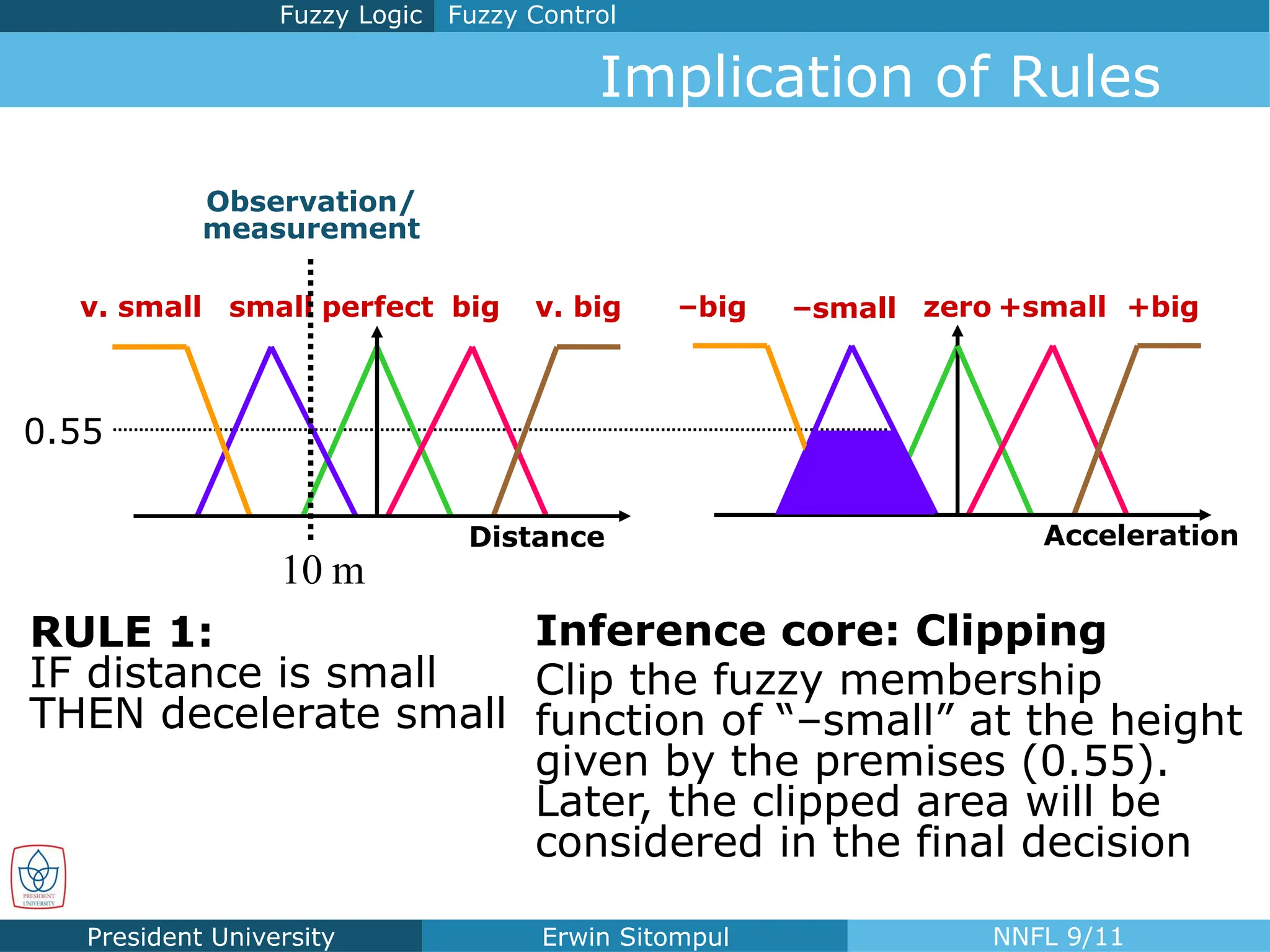
RULE 1:
IF distance is small
THEN decelerate small
0.55
Inference core: Clipping
Clip the fuzzy membership
function of “–small” at the height
given by the premises (0.55).
Later, the clipped area will be
considered in the final decision
Implication of Rules
Fuzzy Control
Fuzzy Logic
v. small
Distance
small perfect big v. big
Observation/
measurement
Acceleration
–small zero +small +big
–big
10 m
President University Erwin Sitompul NNFL 9/12
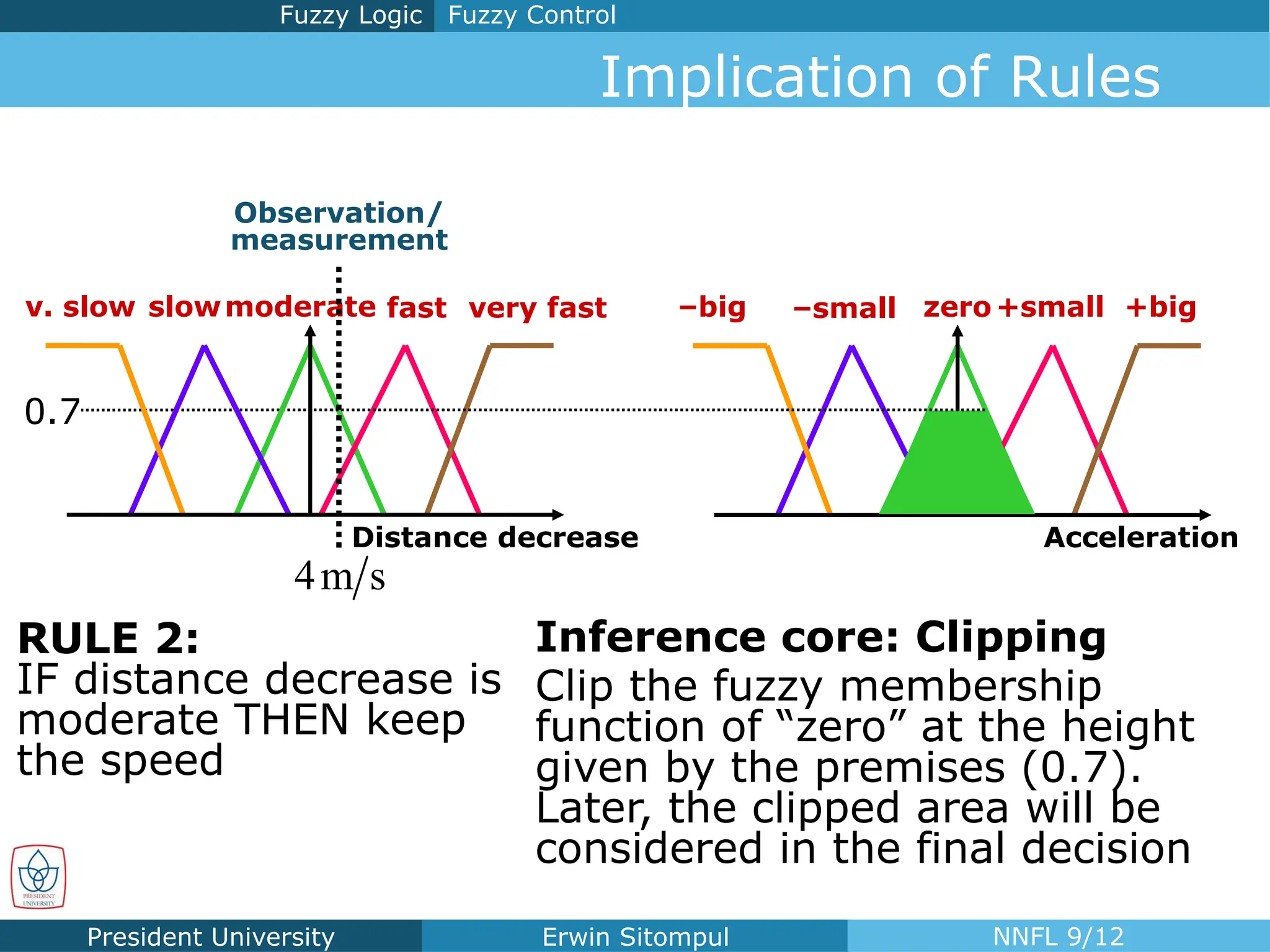
RULE 2:
IF distance decrease is
moderate THEN keep
the speed
Inference core: Clipping
Clip the fuzzy membership
function of “zero” at the height
given by the premises (0.7).
Later, the clipped area will be
considered in the final decision
Implication of Rules
Fuzzy Control
Fuzzy Logic
Observation/
measurement
Acceleration
–small zero+small +big
–big
moderate
Distance decrease
slow fast very fast
v. slow
0.7
4m s
President University Erwin Sitompul NNFL 10/13
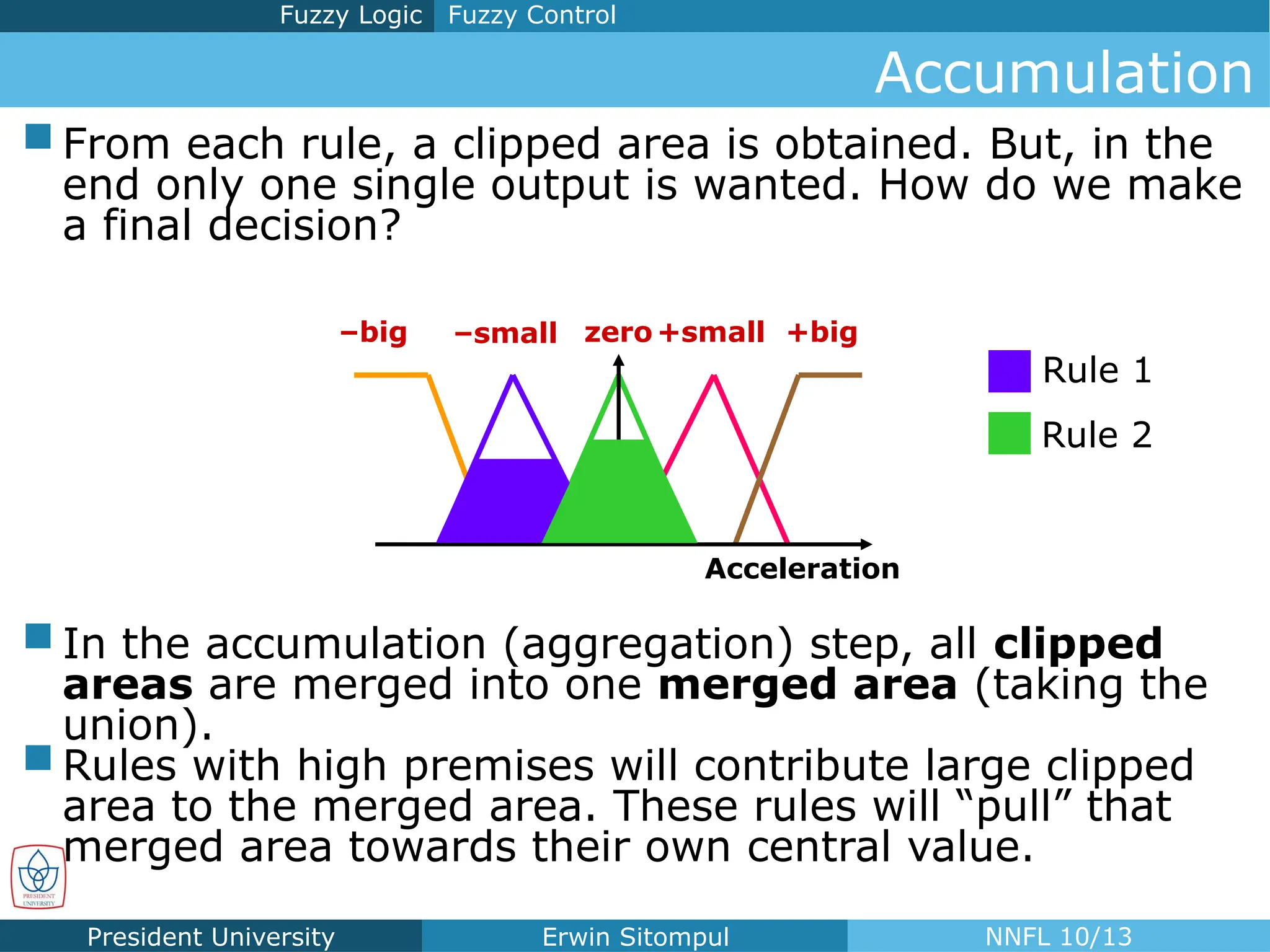
 From each rule, a clipped area is obtained. But, in the
end only one single output is wanted. How do we make
a final decision?
–small zero+small +big
–big
Acceleration
Accumulation
Rule 1
Rule 2
Fuzzy Control
Fuzzy Logic
 In the accumulation (aggregation) step, all clipped
areas are merged into one merged area (taking the
union).
 Rules with high premises will contribute large clipped
area to the merged area. These rules will “pull” that
merged area towards their own central value.
President University Erwin Sitompul NNFL 9/14
–small zero+small +big
–big
Acceleration
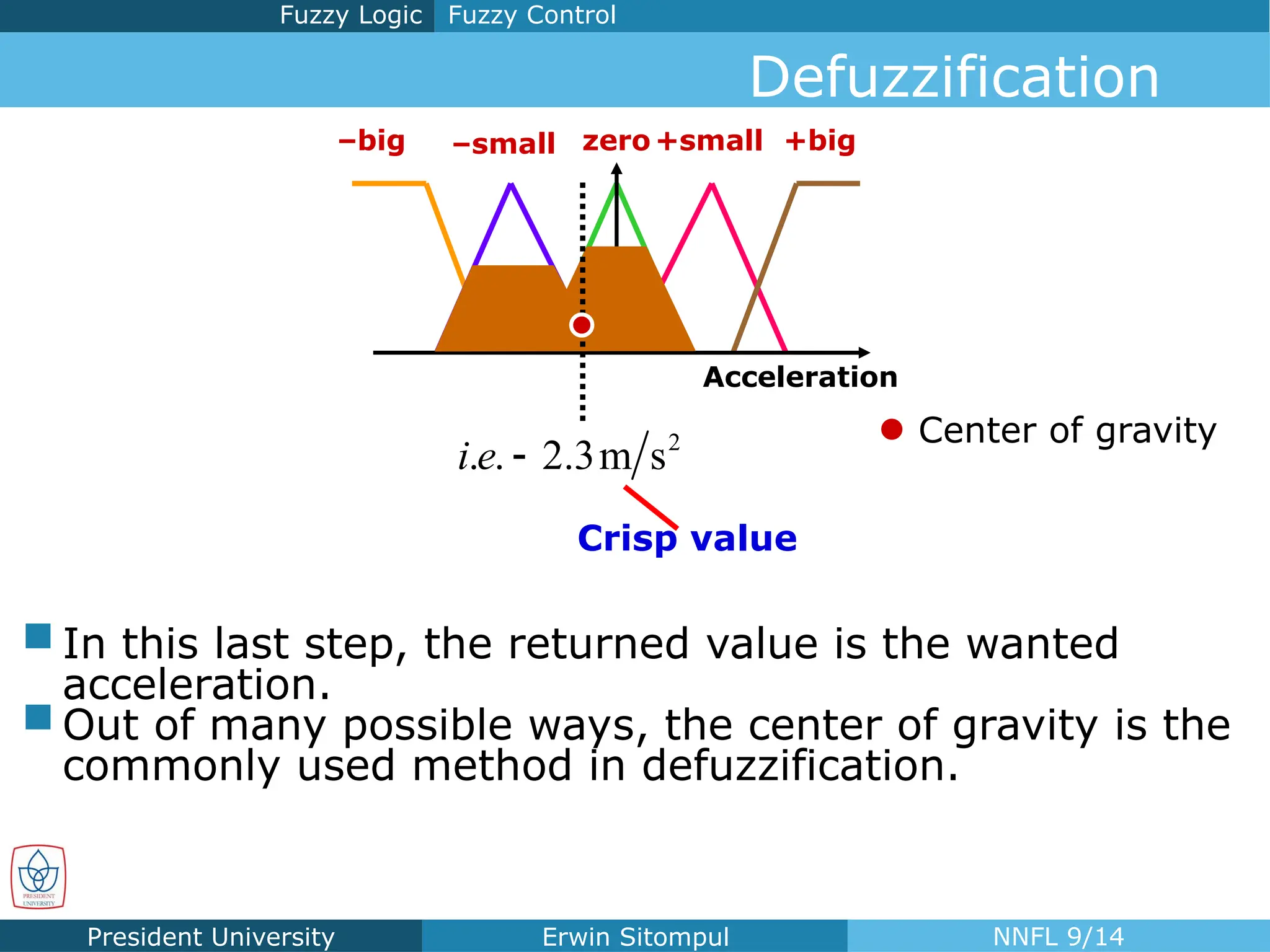
 In this last step, the returned value is the wanted
acceleration.
 Out of many possible ways, the center of gravity is the
commonly used method in defuzzification.
Crisp value
2
. . 2.3m s
i e 
Center of gravity
Fuzzy Control
Fuzzy Logic
Defuzzification
President University Erwin Sitompul NNFL 10/15
0.55
acceleration
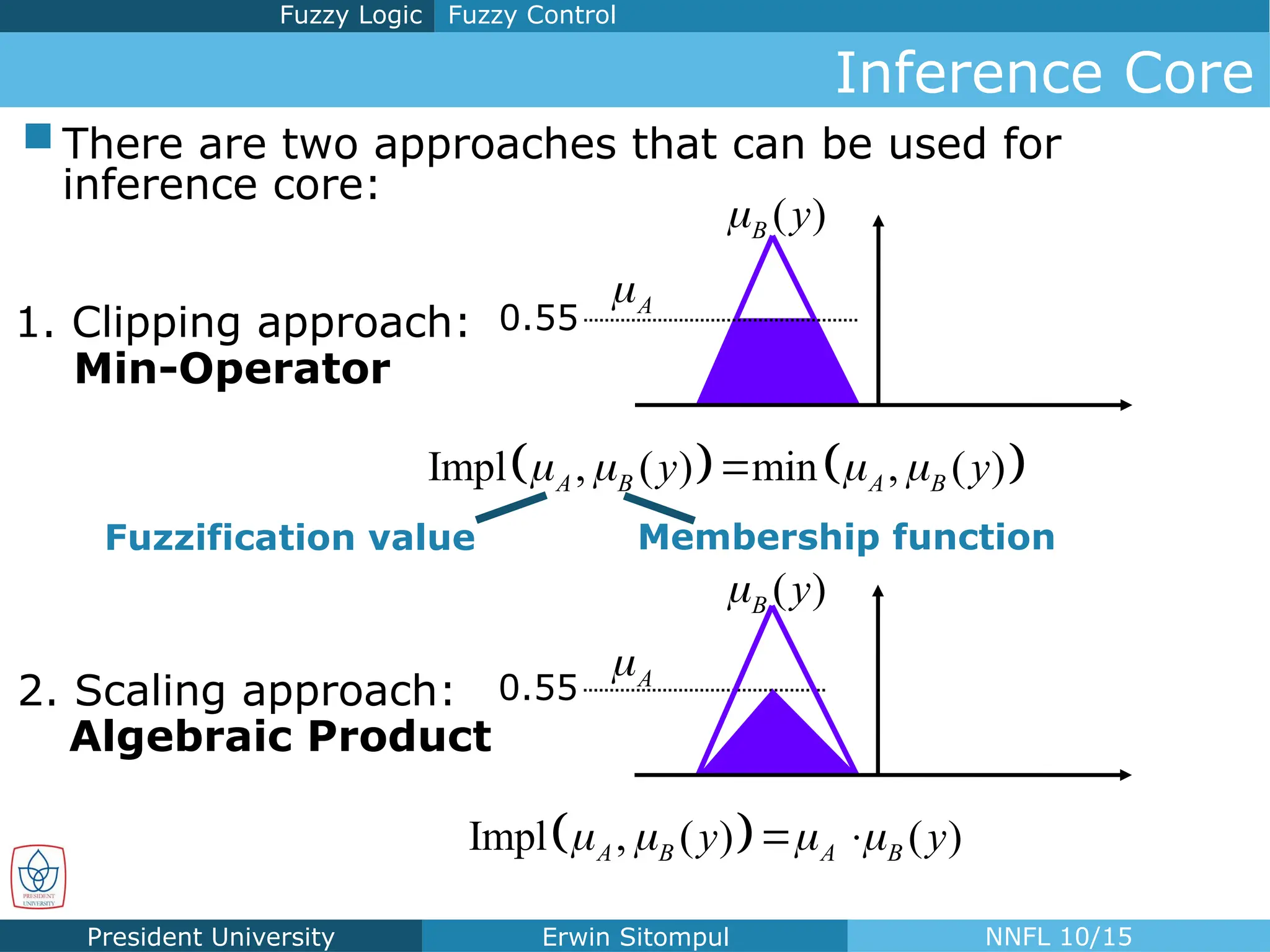
1. Clipping approach:
0.55
acceleration
2. Scaling approach:
   
Impl , ( ) min , ( )
A B A B
y y
   

A

( )
B y

Fuzzification value Membership function
 
Impl , ( ) ( )
A B A B
y y
   
 
A

( )
B y

Min-Operator
Algebraic Product
Fuzzy Control
Fuzzy Logic
Inference Core
 There are two approaches that can be used for
inference core:
President University Erwin Sitompul NNFL 9/16
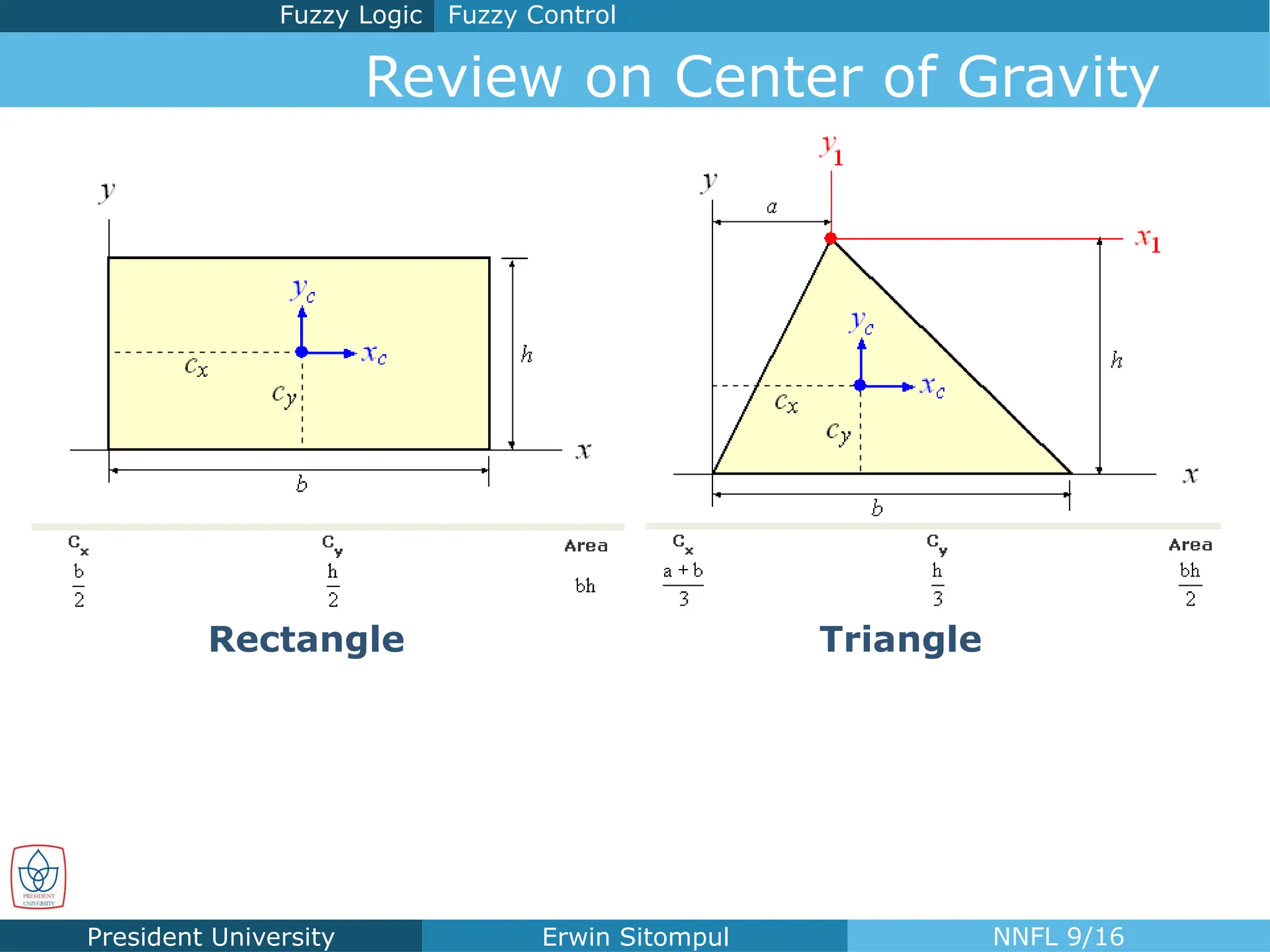
Rectangle Triangle
Fuzzy Control
Fuzzy Logic
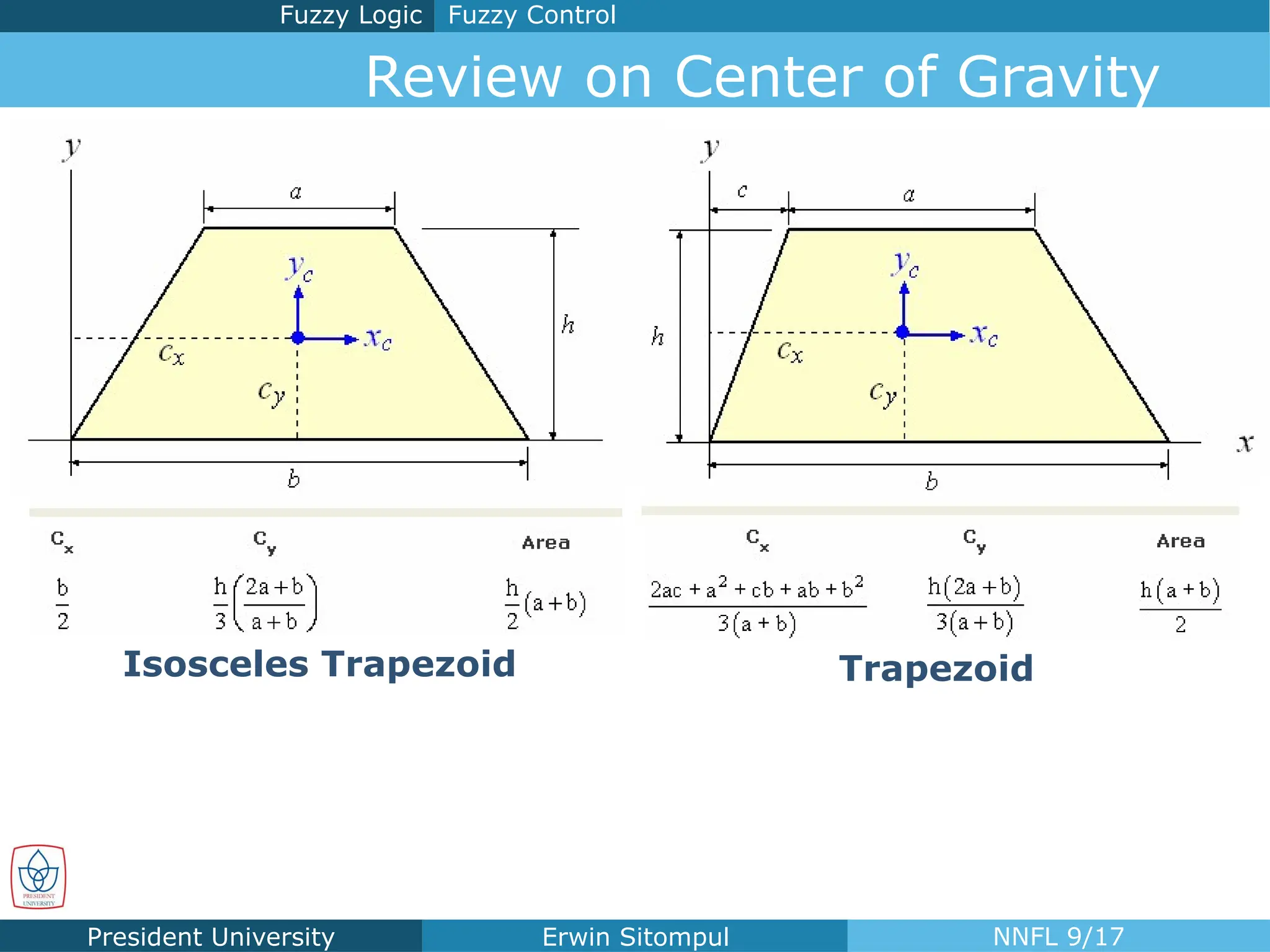
Review on Center of Gravity
President University Erwin Sitompul NNFL 9/17
Isosceles Trapezoid Trapezoid
Fuzzy Control
Fuzzy Logic
Review on Center of Gravity
President University Erwin Sitompul NNFL 10/18
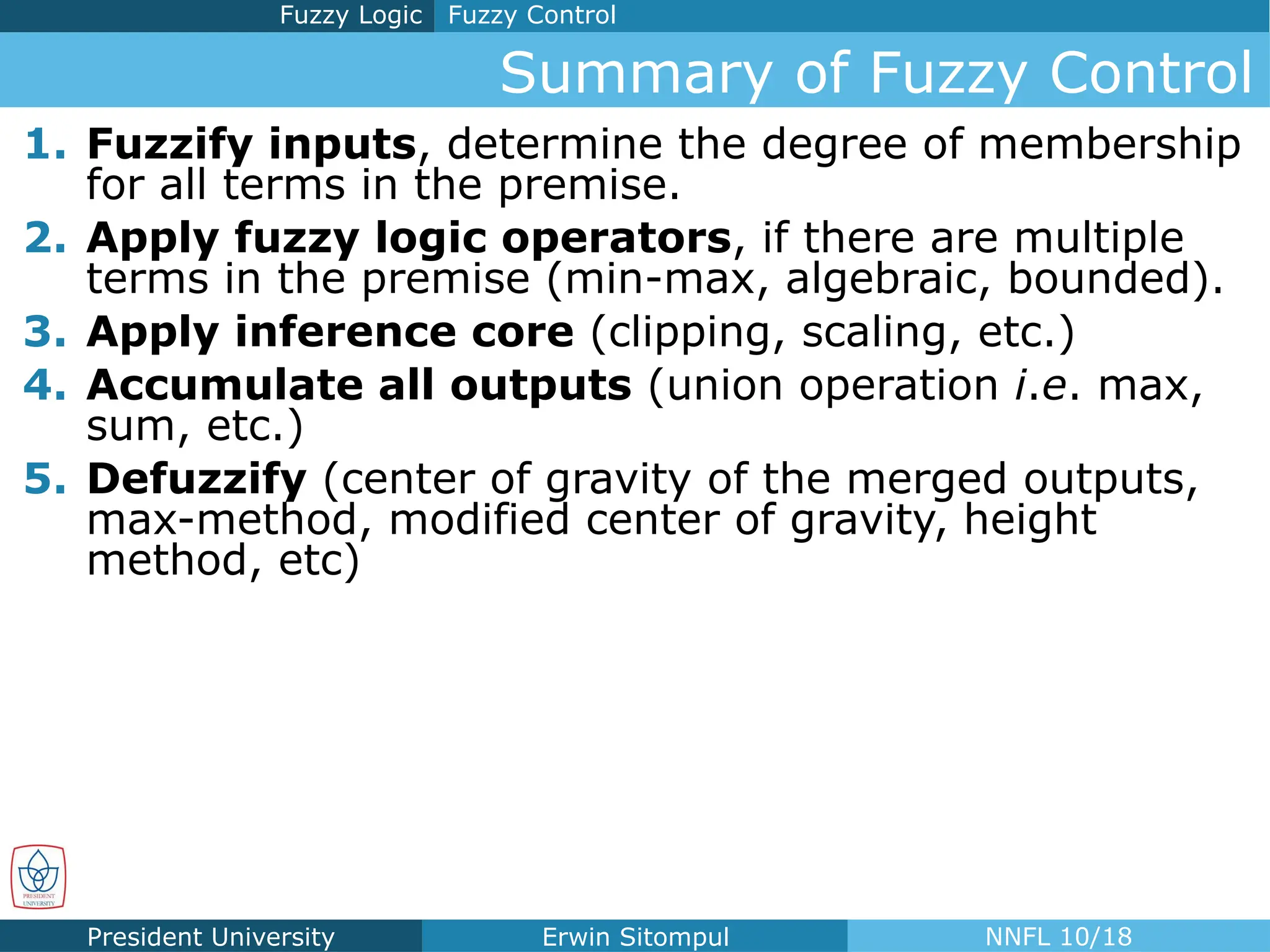
Summary of Fuzzy Control
Fuzzy Control
Fuzzy Logic
1. Fuzzify inputs, determine the degree of membership
for all terms in the premise.
2. Apply fuzzy logic operators, if there are multiple
terms in the premise (min-max, algebraic, bounded).
3. Apply inference core (clipping, scaling, etc.)
4. Accumulate all outputs (union operation i.e. max,
sum, etc.)
5. Defuzzify (center of gravity of the merged outputs,
max-method, modified center of gravity, height
method, etc)
President University Erwin Sitompul NNFL 10/19
Limitations of Fuzzy Control
Fuzzy Control
Fuzzy Logic
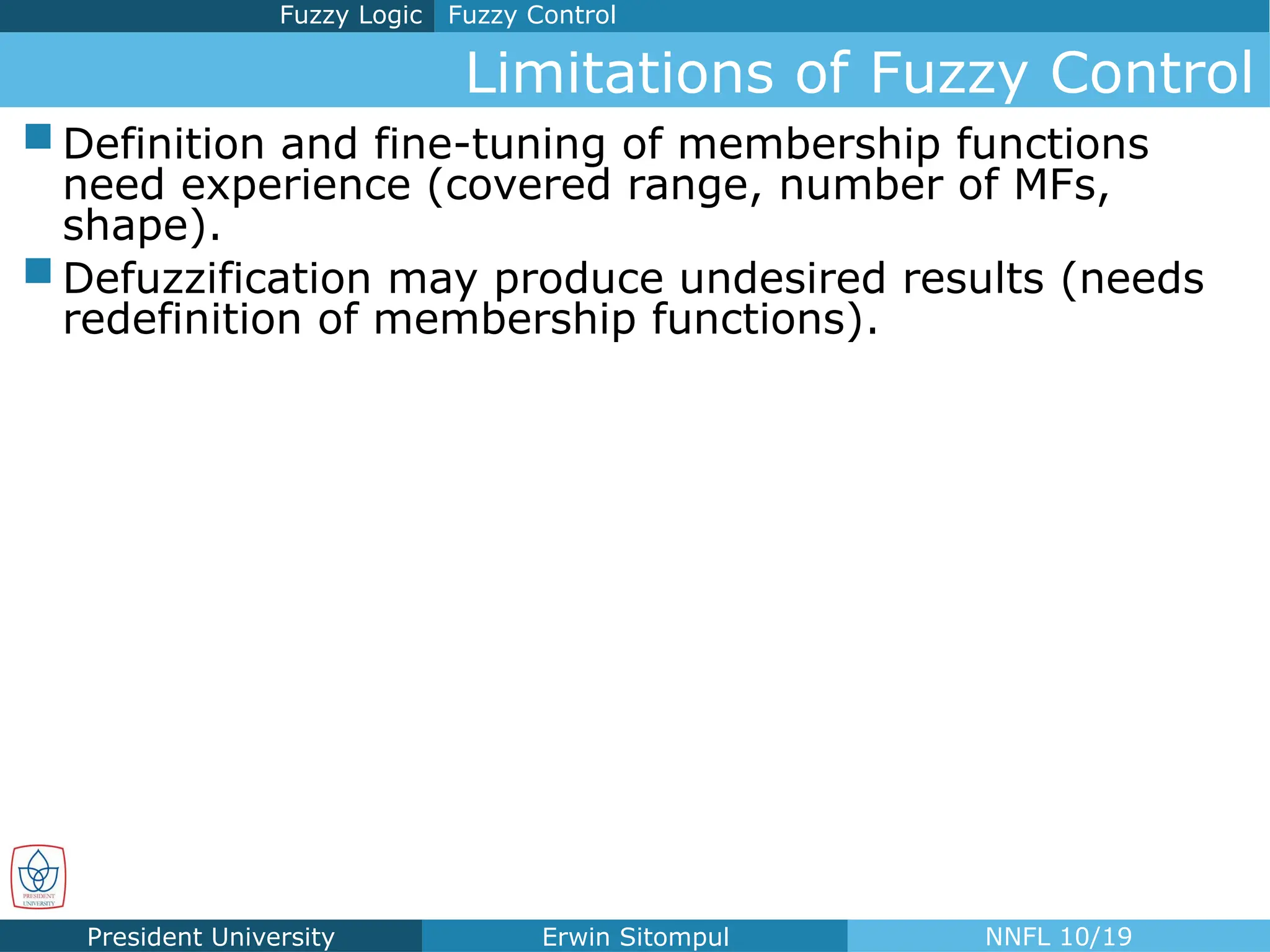
 Definition and fine-tuning of membership functions
need experience (covered range, number of MFs,
shape).
 Defuzzification may produce undesired results (needs
redefinition of membership functions).
President University Erwin Sitompul NNFL 10/20
Homework 10
v. small
Distance to next car [m]
small perfect big v. big
0 5 10 15 20 25
1
Speed change [m/s2
]
constant growing
declining
–small zero +small +big
–big
Acceleration adj. [m/s2
]
–2 –1 0 1 2
1
–10 –5 0 5 10
1
Fuzzy Control
Fuzzy Logic
 A fuzzy controller is to be used in driving a car. The
fuzzy membership functions for the two inputs and one
output are defined as below.
President University Erwin Sitompul NNFL 10/21
Homework 10 (Cont.)
Fuzzy Control
Fuzzy Logic
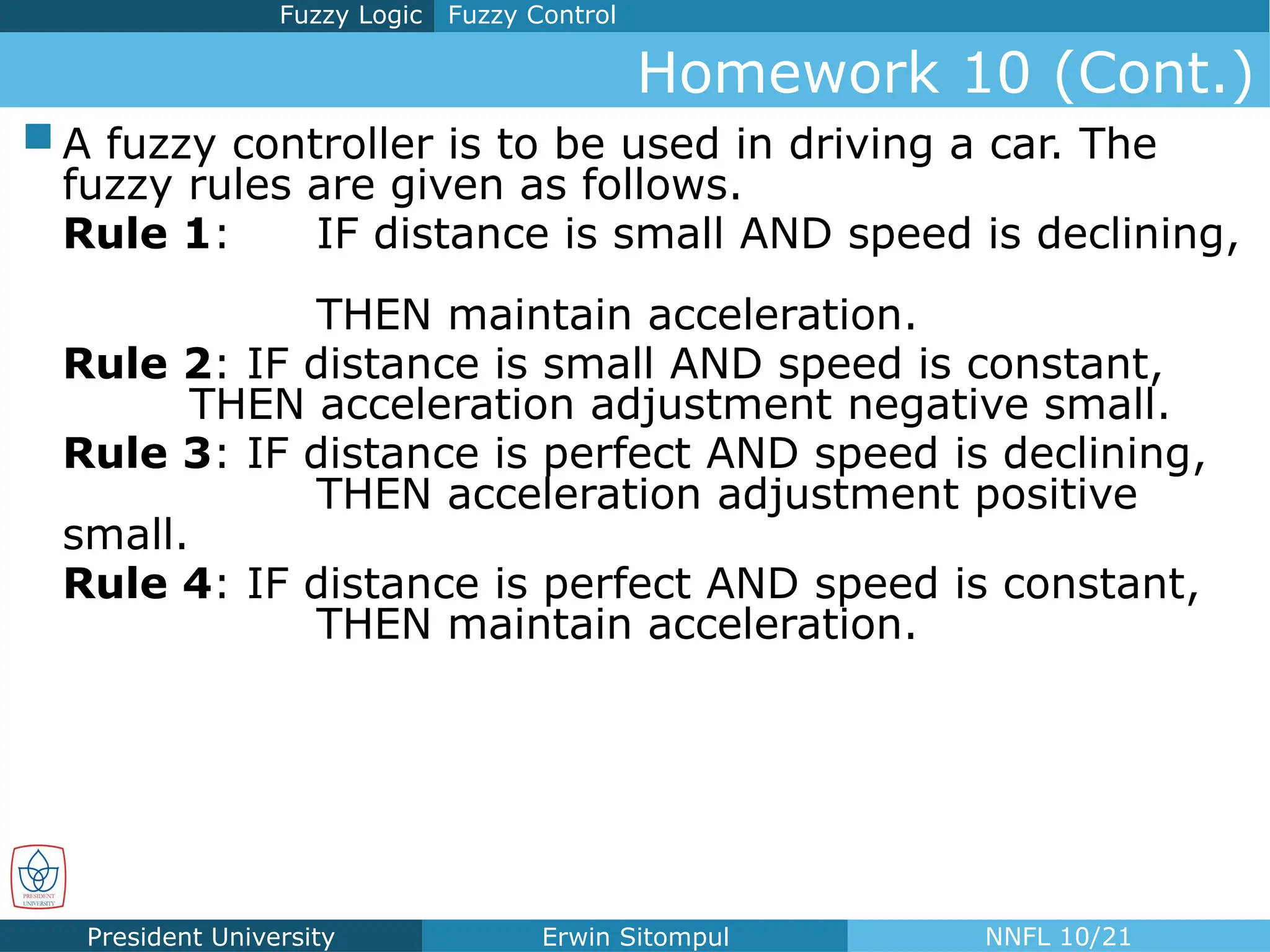
 A fuzzy controller is to be used in driving a car. The
fuzzy rules are given as follows.
Rule 1: IF distance is small AND speed is declining,
THEN maintain acceleration.
Rule 2: IF distance is small AND speed is constant,
THEN acceleration adjustment negative small.
Rule 3: IF distance is perfect AND speed is declining,
THEN acceleration adjustment positive
small.
Rule 4: IF distance is perfect AND speed is constant,
THEN maintain acceleration.
President University Erwin Sitompul NNFL 10/22
Homework 10 (Cont.)
Fuzzy Control
Fuzzy Logic
 Using Min-Max as fuzzy operators, clipping as
inference core, union operator as accumulator, and
center of gravity method as defuzzifier, find the
output of the controller if the measurements confirms
that distance to next car is 13 m and the speed is
increasing by 2.5 m/s2
.
President University Erwin Sitompul NNFL 10/23
Homework 10A
Fuzzy Control
Fuzzy Logic
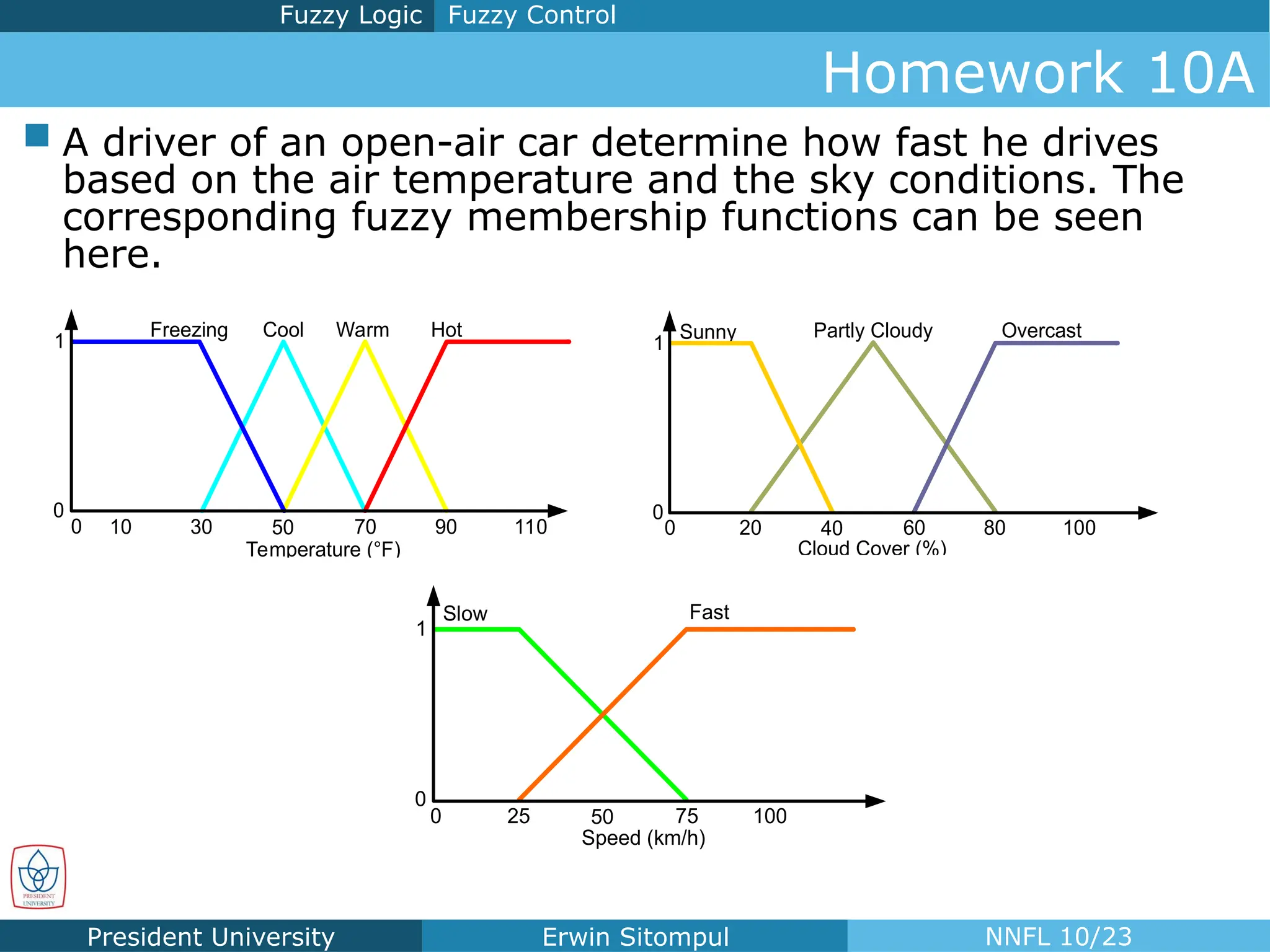
 A driver of an open-air car determine how fast he drives
based on the air temperature and the sky conditions. The
corresponding fuzzy membership functions can be seen
here.
50 70 90 110
30
10
Temperature (°F)
Freezing Cool Warm Hot
0
1
0 40 60 80 100
20
0
Cloud Cover (%)
Overcast
Partly Cloudy
Sunny
0
1
50 75 100
25
0
Speed (km/h)
Slow Fast
0
1
President University Erwin Sitompul NNFL 10/24
Homework 10A (Cont.)
Fuzzy Control
Fuzzy Logic
 After years of experience, he summarizes his personal
driving rules as follows:
Rule 1: IF it is sunny AND warm, THEN drive fast.
Rule 2: IF it is partly cloudy AND hot, THEN drive slow.
Rule 3: IF it is partly cloudy, THEN drive fast.
 You are now assigned to design a fuzzy control with the
following requirements:
 Fuzzy logic operators: algebraic sum / product
 Inference core: scaling
 Accumulator: union operator
 Defuzzification: center of gravity method
 The speed limit is 120 km/h. How fast will the driver go if in
one day the temperature is 65 °F and the cloud cover is
25 %?
 Deadline: Sunday, 25 March 2018.

Introduction to Neural Networks and Fuzzy Logicnnfl-1002.pptx

  • 1.
    Lecture 10 Introduction toNeural Networks and Fuzzy Logic President University Erwin Sitompul NNFL 10/1 Dr.-Ing. Erwin Sitompul President University http://zitompul.wordpress.com 2 0 1 8
  • 2.
    President University ErwinSitompul NNFL 10/2 ( ) T T  ( ) Tl T  ( ) Tm T  ( C) T  1 “Temperature is low” AND “Temperature is middle” ( ) T T  ( ) Tl T  ( ) Tm T  ( C) T  1 “Temperature is low” OR “Temperature is middle” Min Max Membership Function Fuzzy Logic Homework 9
  • 3.
    President University ErwinSitompul NNFL 10/3 ( ) T T  ( ) Tl T  ( ) Tm T  ( C) T  1 “Temperature is low” AND “Temperature is middle” ( ) T T  ( ) Tl T  ( ) Tm T  ( C) T  1 “Temperature is low” OR “Temperature is middle” Algebraic product Algebraic sum Homework 9 Membership Function Fuzzy Logic
  • 4.
    President University ErwinSitompul NNFL 10/4 ( ) T T  ( ) Tl T  ( ) Tm T  ( C) T  1 “Temperature is low” AND “Temperature is middle” ( ) T T  ( ) Tl T  ( ) Tm T  ( C) T  1 “Temperature is low” OR “Temperature is middle” Bounded product Bounded sum Homework 9 Membership Function Fuzzy Logic
  • 5.
    President University ErwinSitompul NNFL 10/5 Further Fuzzy Set Operations 2 1/ 2 3 ( ) ( ) ( ) ( ) ( ) ( ) very A A morl A A extremely A A x x x x x x          1/3 ( ) 1 ( ) ( ) ( ) not A A slightly A A x x x x        Fuzzy Control Fuzzy Logic Dilation Concentration
  • 6.
    President University ErwinSitompul NNFL 10/6 Fuzzy Control Loop Fuzzy Control Fuzzy Logic
  • 7.
    President University ErwinSitompul NNFL 9/7  Prior to fuzzy control, the followings must be defined:  Fuzzy membership functions  Fuzzy logic operators  Fuzzy rules, including fuzzy linguistic value and linguistic variable  The processing steps in a fuzzy control include:  Fuzzification  Implication / Inference Core  Accumulation  Defuzzification Fuzzy Control Fuzzy Logic Fuzzy Inference
  • 8.
    President University ErwinSitompul NNFL 10/8 Fuzzy Control Fuzzy Logic Fuzzy Rules  Example of a fuzzy rule while “Driving a Car”: “IF the distance to the car in front is small, AND the distance is decreasing slowly, THEN decelerate quite big”  The question that arises: Given a certain distance and a certain change of distance, what (crisp) value of acceleration should we select?
  • 9.
    President University ErwinSitompul NNFL 10/9 Definition of Fuzzy Membership Functions v. small Distance small perfect big v. big moderate Distance decrease slow fast very fast v. slow Acceleration –small zero+small +big –big Fuzzy Control Fuzzy Logic
  • 10.
    President University ErwinSitompul NNFL 10/10 Fuzzification Observation/ measurement Observation/ measurement • Distance between small and perfect • Distance decrease can be moderate or fast • What acceleration should be applied? Fuzzy Control Fuzzy Logic v. small Distance small perfect big v. big moderate Distance decrease slow fast very fast v. slow Acceleration –small zero+small +big –big 10 m 4m s
  • 11.
    President University ErwinSitompul NNFL 9/11 RULE 1: IF distance is small THEN decelerate small 0.55 Inference core: Clipping Clip the fuzzy membership function of “–small” at the height given by the premises (0.55). Later, the clipped area will be considered in the final decision Implication of Rules Fuzzy Control Fuzzy Logic v. small Distance small perfect big v. big Observation/ measurement Acceleration –small zero +small +big –big 10 m
  • 12.
    President University ErwinSitompul NNFL 9/12 RULE 2: IF distance decrease is moderate THEN keep the speed Inference core: Clipping Clip the fuzzy membership function of “zero” at the height given by the premises (0.7). Later, the clipped area will be considered in the final decision Implication of Rules Fuzzy Control Fuzzy Logic Observation/ measurement Acceleration –small zero+small +big –big moderate Distance decrease slow fast very fast v. slow 0.7 4m s
  • 13.
    President University ErwinSitompul NNFL 10/13  From each rule, a clipped area is obtained. But, in the end only one single output is wanted. How do we make a final decision? –small zero+small +big –big Acceleration Accumulation Rule 1 Rule 2 Fuzzy Control Fuzzy Logic  In the accumulation (aggregation) step, all clipped areas are merged into one merged area (taking the union).  Rules with high premises will contribute large clipped area to the merged area. These rules will “pull” that merged area towards their own central value.
  • 14.
    President University ErwinSitompul NNFL 9/14 –small zero+small +big –big Acceleration  In this last step, the returned value is the wanted acceleration.  Out of many possible ways, the center of gravity is the commonly used method in defuzzification. Crisp value 2 . . 2.3m s i e  Center of gravity Fuzzy Control Fuzzy Logic Defuzzification
  • 15.
    President University ErwinSitompul NNFL 10/15 0.55 acceleration 1. Clipping approach: 0.55 acceleration 2. Scaling approach:     Impl , ( ) min , ( ) A B A B y y      A  ( ) B y  Fuzzification value Membership function   Impl , ( ) ( ) A B A B y y       A  ( ) B y  Min-Operator Algebraic Product Fuzzy Control Fuzzy Logic Inference Core  There are two approaches that can be used for inference core:
  • 16.
    President University ErwinSitompul NNFL 9/16 Rectangle Triangle Fuzzy Control Fuzzy Logic Review on Center of Gravity
  • 17.
    President University ErwinSitompul NNFL 9/17 Isosceles Trapezoid Trapezoid Fuzzy Control Fuzzy Logic Review on Center of Gravity
  • 18.
    President University ErwinSitompul NNFL 10/18 Summary of Fuzzy Control Fuzzy Control Fuzzy Logic 1. Fuzzify inputs, determine the degree of membership for all terms in the premise. 2. Apply fuzzy logic operators, if there are multiple terms in the premise (min-max, algebraic, bounded). 3. Apply inference core (clipping, scaling, etc.) 4. Accumulate all outputs (union operation i.e. max, sum, etc.) 5. Defuzzify (center of gravity of the merged outputs, max-method, modified center of gravity, height method, etc)
  • 19.
    President University ErwinSitompul NNFL 10/19 Limitations of Fuzzy Control Fuzzy Control Fuzzy Logic  Definition and fine-tuning of membership functions need experience (covered range, number of MFs, shape).  Defuzzification may produce undesired results (needs redefinition of membership functions).
  • 20.
    President University ErwinSitompul NNFL 10/20 Homework 10 v. small Distance to next car [m] small perfect big v. big 0 5 10 15 20 25 1 Speed change [m/s2 ] constant growing declining –small zero +small +big –big Acceleration adj. [m/s2 ] –2 –1 0 1 2 1 –10 –5 0 5 10 1 Fuzzy Control Fuzzy Logic  A fuzzy controller is to be used in driving a car. The fuzzy membership functions for the two inputs and one output are defined as below.
  • 21.
    President University ErwinSitompul NNFL 10/21 Homework 10 (Cont.) Fuzzy Control Fuzzy Logic  A fuzzy controller is to be used in driving a car. The fuzzy rules are given as follows. Rule 1: IF distance is small AND speed is declining, THEN maintain acceleration. Rule 2: IF distance is small AND speed is constant, THEN acceleration adjustment negative small. Rule 3: IF distance is perfect AND speed is declining, THEN acceleration adjustment positive small. Rule 4: IF distance is perfect AND speed is constant, THEN maintain acceleration.
  • 22.
    President University ErwinSitompul NNFL 10/22 Homework 10 (Cont.) Fuzzy Control Fuzzy Logic  Using Min-Max as fuzzy operators, clipping as inference core, union operator as accumulator, and center of gravity method as defuzzifier, find the output of the controller if the measurements confirms that distance to next car is 13 m and the speed is increasing by 2.5 m/s2 .
  • 23.
    President University ErwinSitompul NNFL 10/23 Homework 10A Fuzzy Control Fuzzy Logic  A driver of an open-air car determine how fast he drives based on the air temperature and the sky conditions. The corresponding fuzzy membership functions can be seen here. 50 70 90 110 30 10 Temperature (°F) Freezing Cool Warm Hot 0 1 0 40 60 80 100 20 0 Cloud Cover (%) Overcast Partly Cloudy Sunny 0 1 50 75 100 25 0 Speed (km/h) Slow Fast 0 1
  • 24.
    President University ErwinSitompul NNFL 10/24 Homework 10A (Cont.) Fuzzy Control Fuzzy Logic  After years of experience, he summarizes his personal driving rules as follows: Rule 1: IF it is sunny AND warm, THEN drive fast. Rule 2: IF it is partly cloudy AND hot, THEN drive slow. Rule 3: IF it is partly cloudy, THEN drive fast.  You are now assigned to design a fuzzy control with the following requirements:  Fuzzy logic operators: algebraic sum / product  Inference core: scaling  Accumulator: union operator  Defuzzification: center of gravity method  The speed limit is 120 km/h. How fast will the driver go if in one day the temperature is 65 °F and the cloud cover is 25 %?  Deadline: Sunday, 25 March 2018.