Robust Multi-objective
Iterative Learning Control
Tong Duy Son
Promoters
Prof. Jan Swevers
Prof. Goele Pipeleers
September 2016
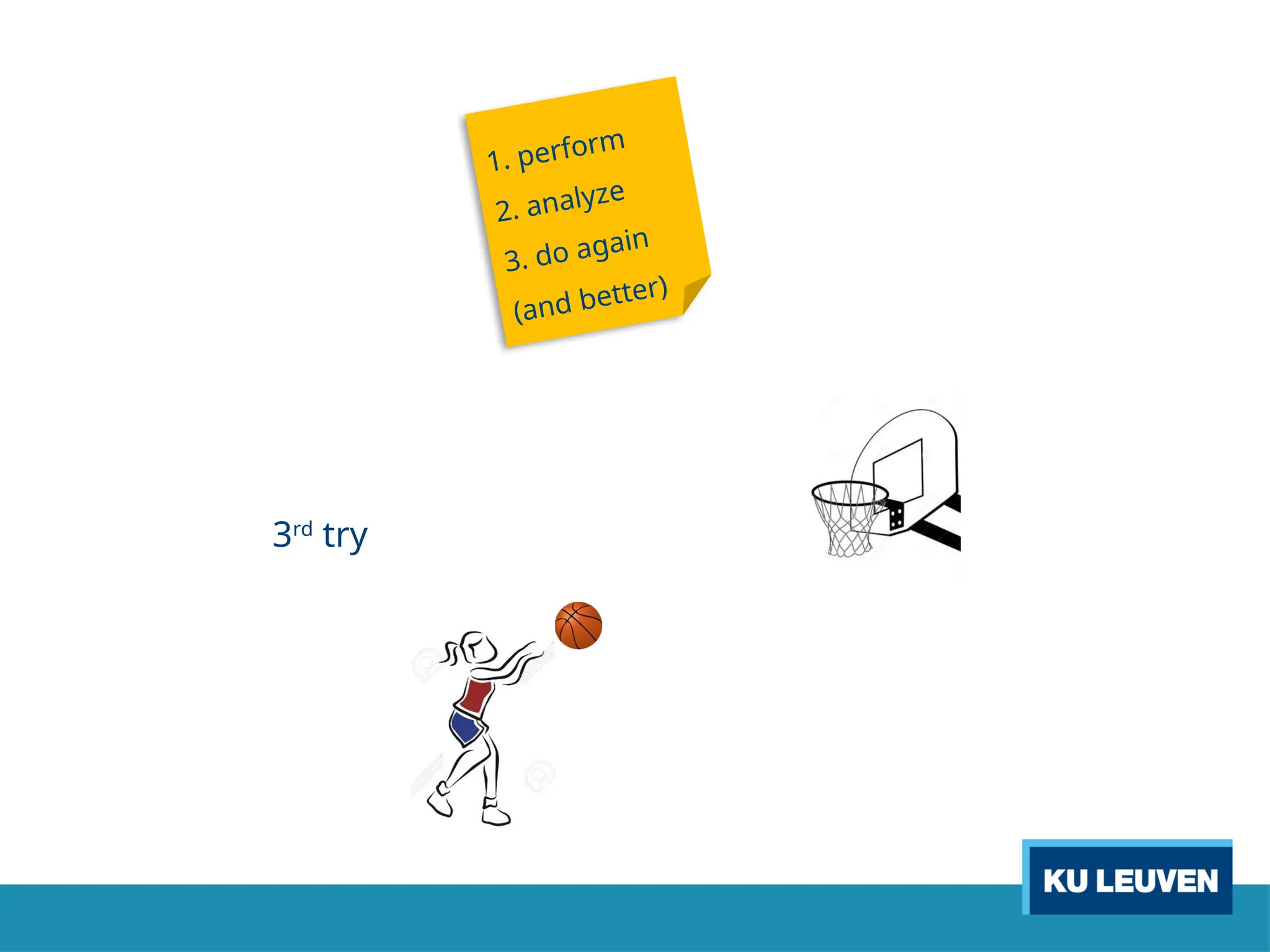
1st try
2nd
try
3rd
try
1. perform
2. analyze
3. do again
(and better)
3rd
try
6
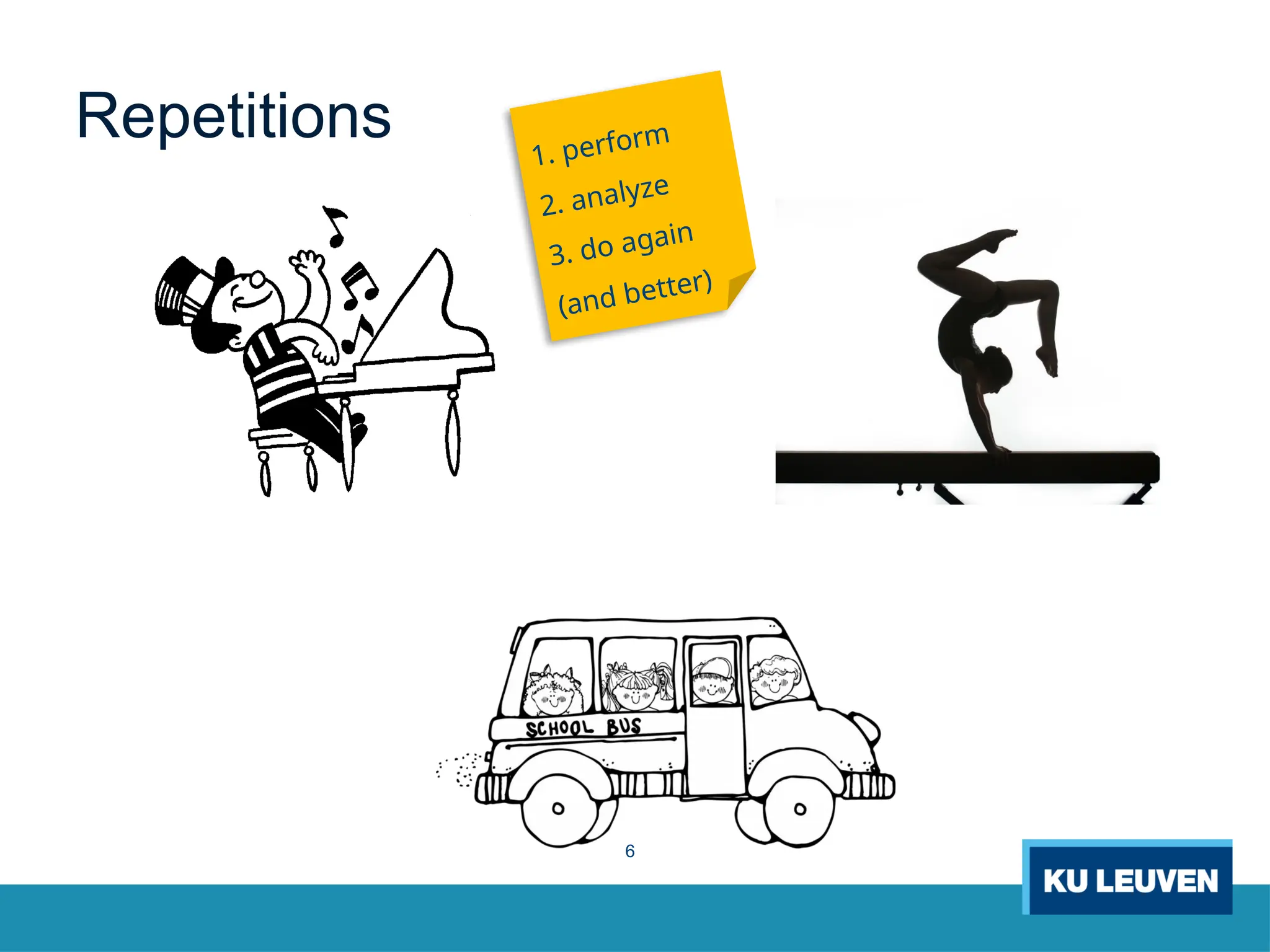
Repetitions 1. perform
2. analyze
3. do again
(and better)
7
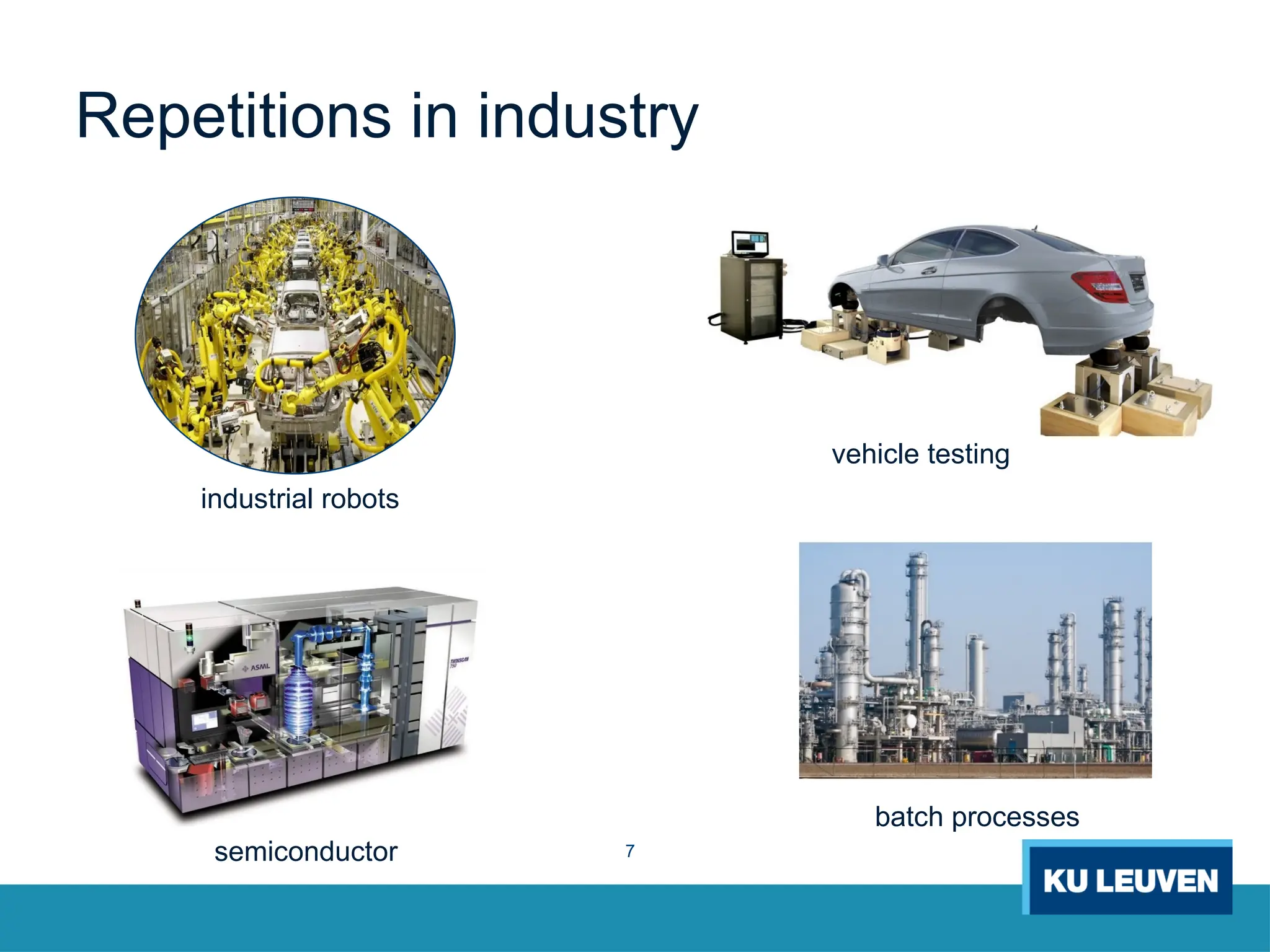
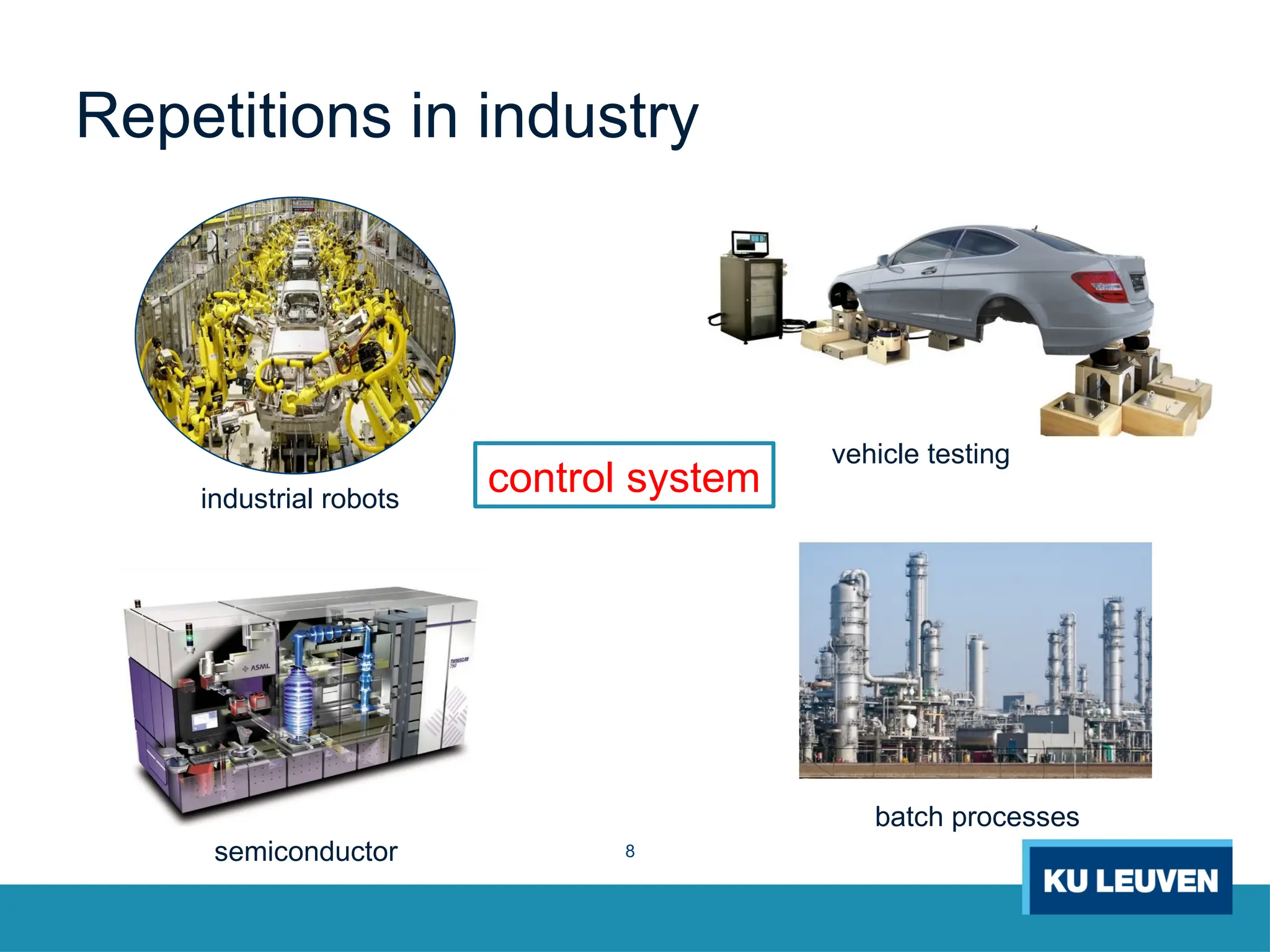
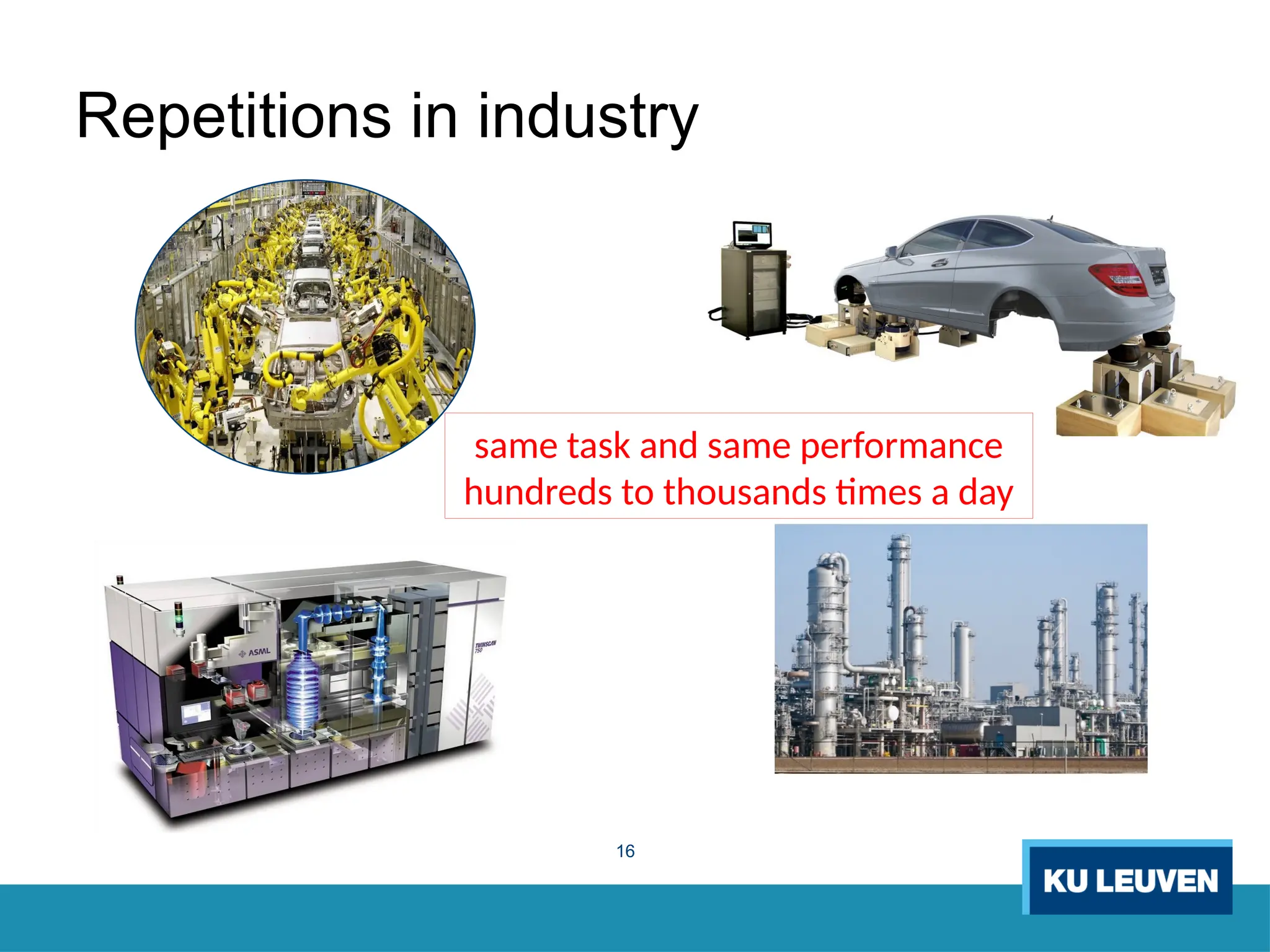
Repetitions in industry
vehicle testing
batch processes
industrial robots
semiconductor
8
Repetitions in industry
vehicle testing
batch processes
industrial robots
semiconductor
control system
9
Challenges
Goal of this thesis
• Improve the control system
• Exploit ‘repetition’
Improvements in
• Robustness
• Precision
• Fast
• Energy efficiency
10
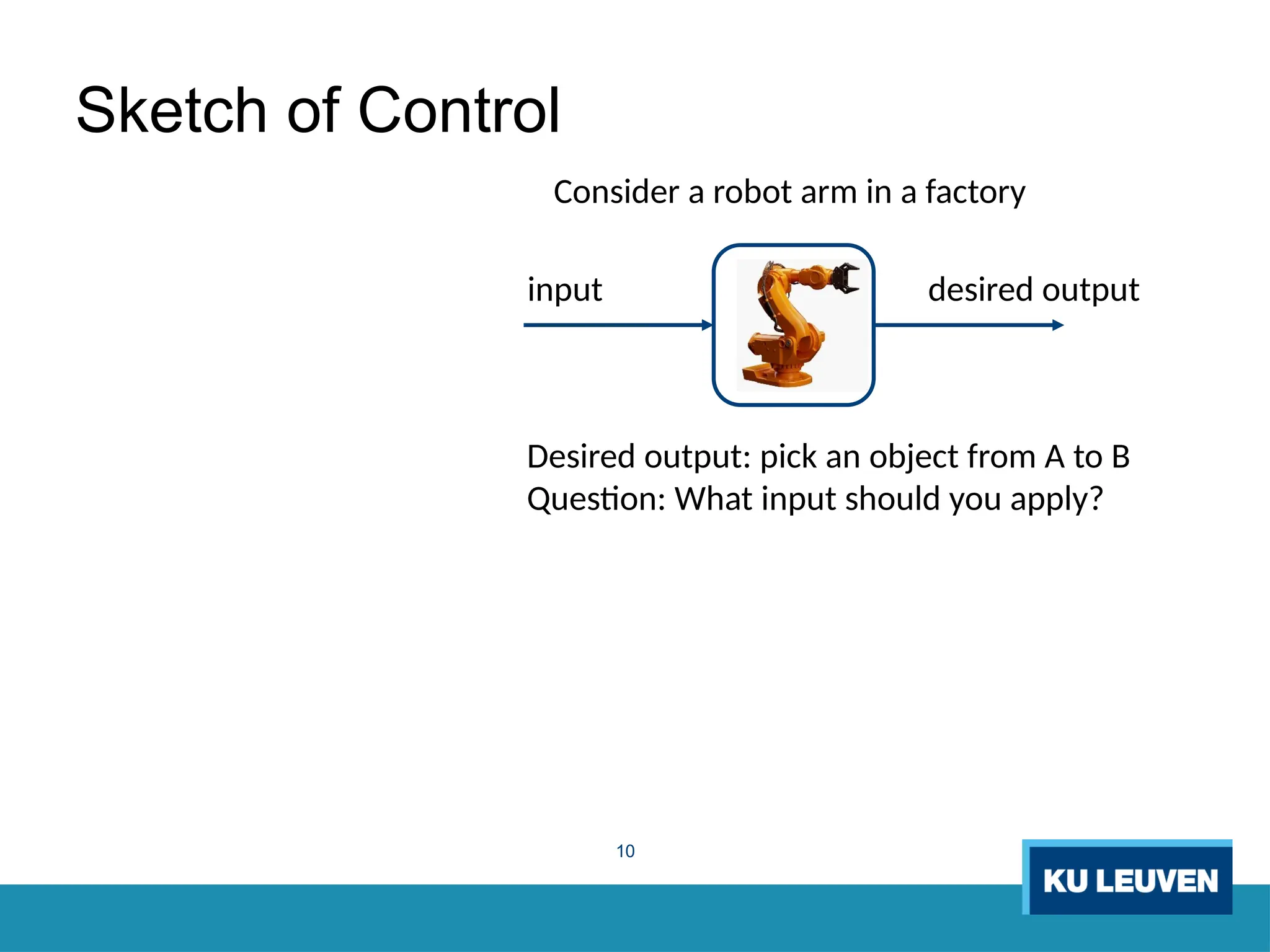
Desired output: pick an object from A to B
Question: What input should you apply?
input desired output
Consider a robot arm in a factory
Sketch of Control
11
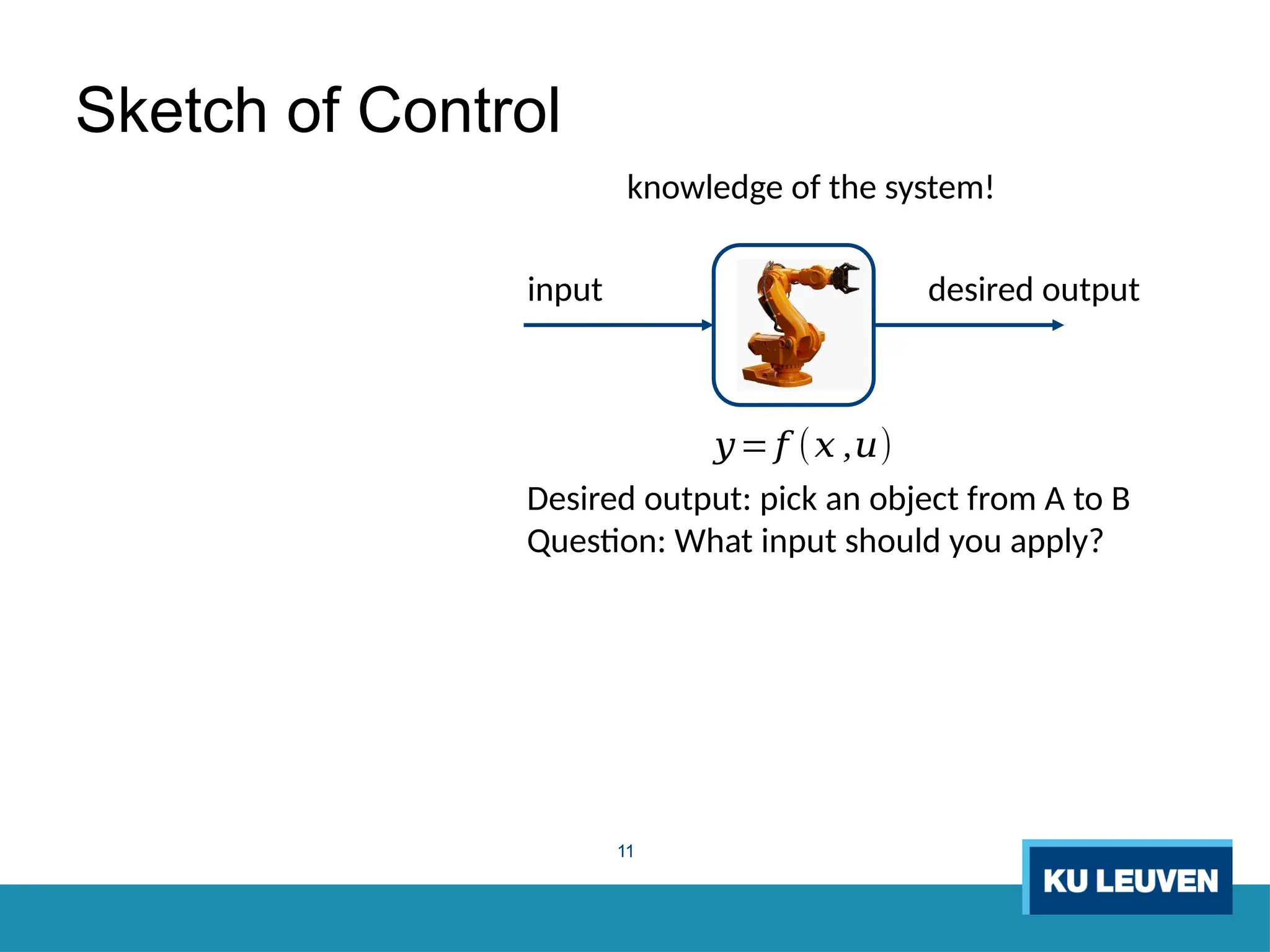
Desired output: pick an object from A to B
Question: What input should you apply?
input desired output
knowledge of the system!
Sketch of Control
𝑦= 𝑓 (𝑥 ,𝑢)
12
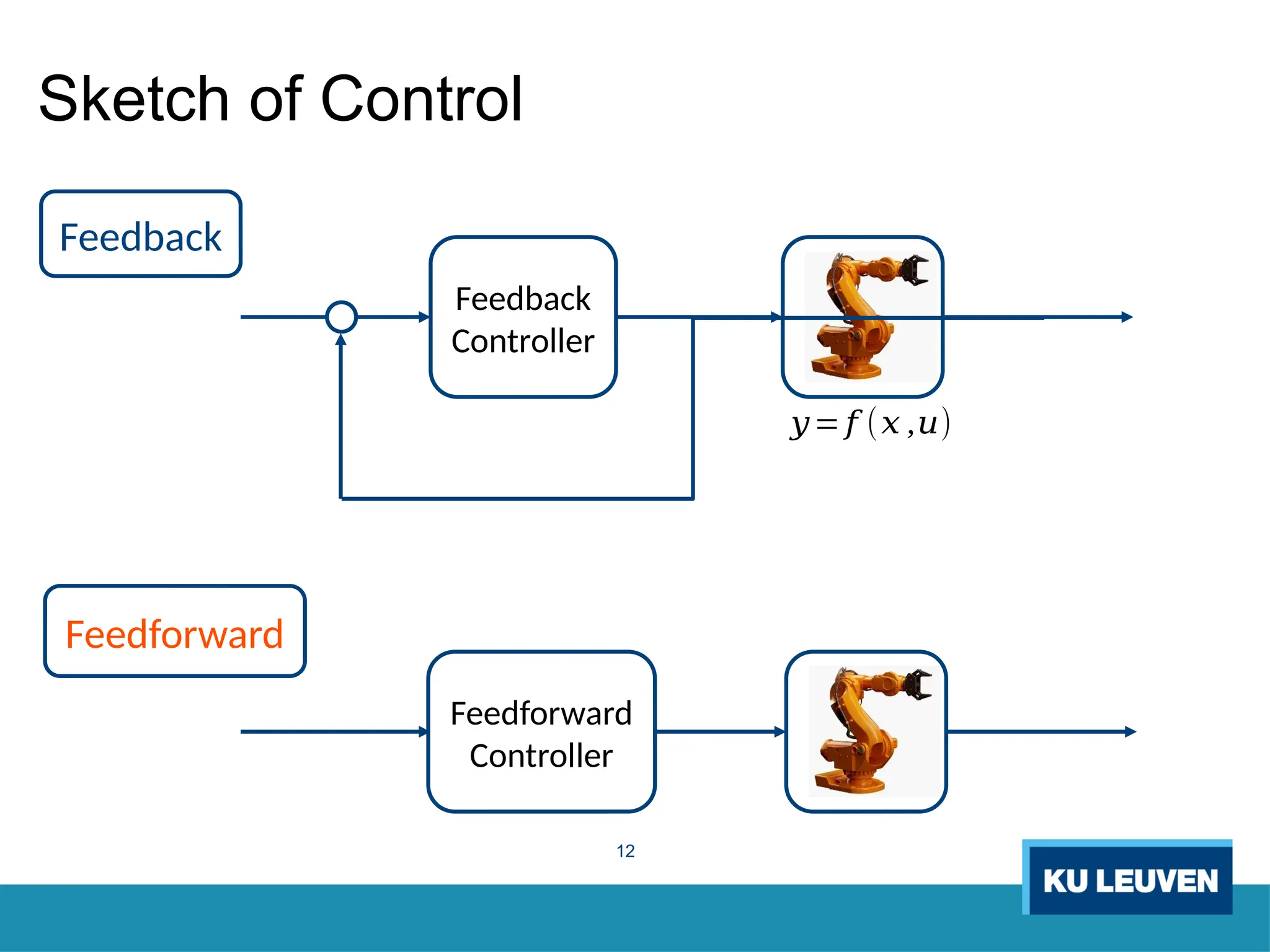
Sketch of Control
Feedback
Controller
𝑦= 𝑓 (𝑥 ,𝑢)
Feedforward
Controller
Feedback
Feedforward
13
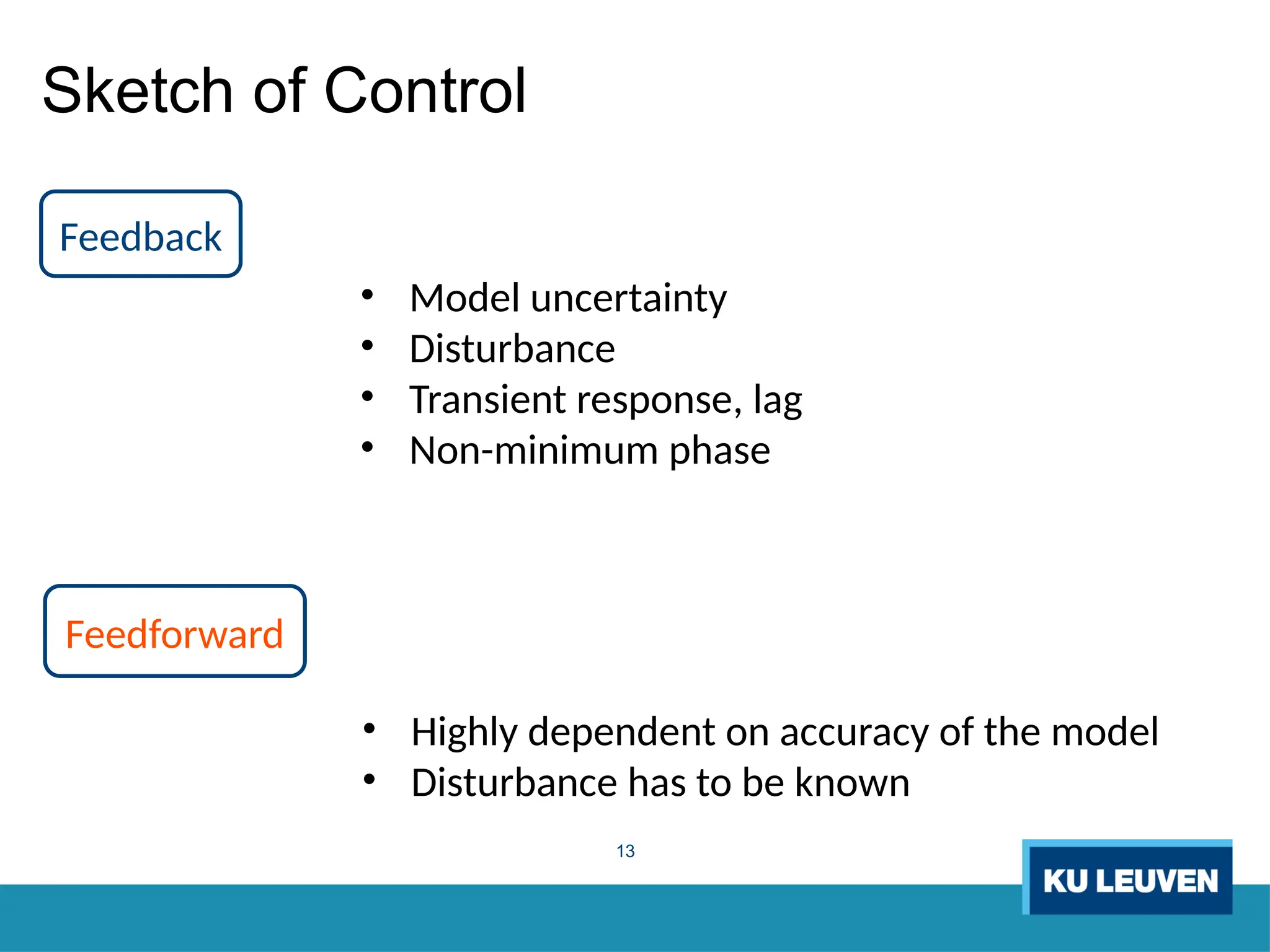
Sketch of Control
• Model uncertainty
• Disturbance
• Transient response, lag
• Non-minimum phase
• Highly dependent on accuracy of the model
• Disturbance has to be known
Feedback
Feedforward
14
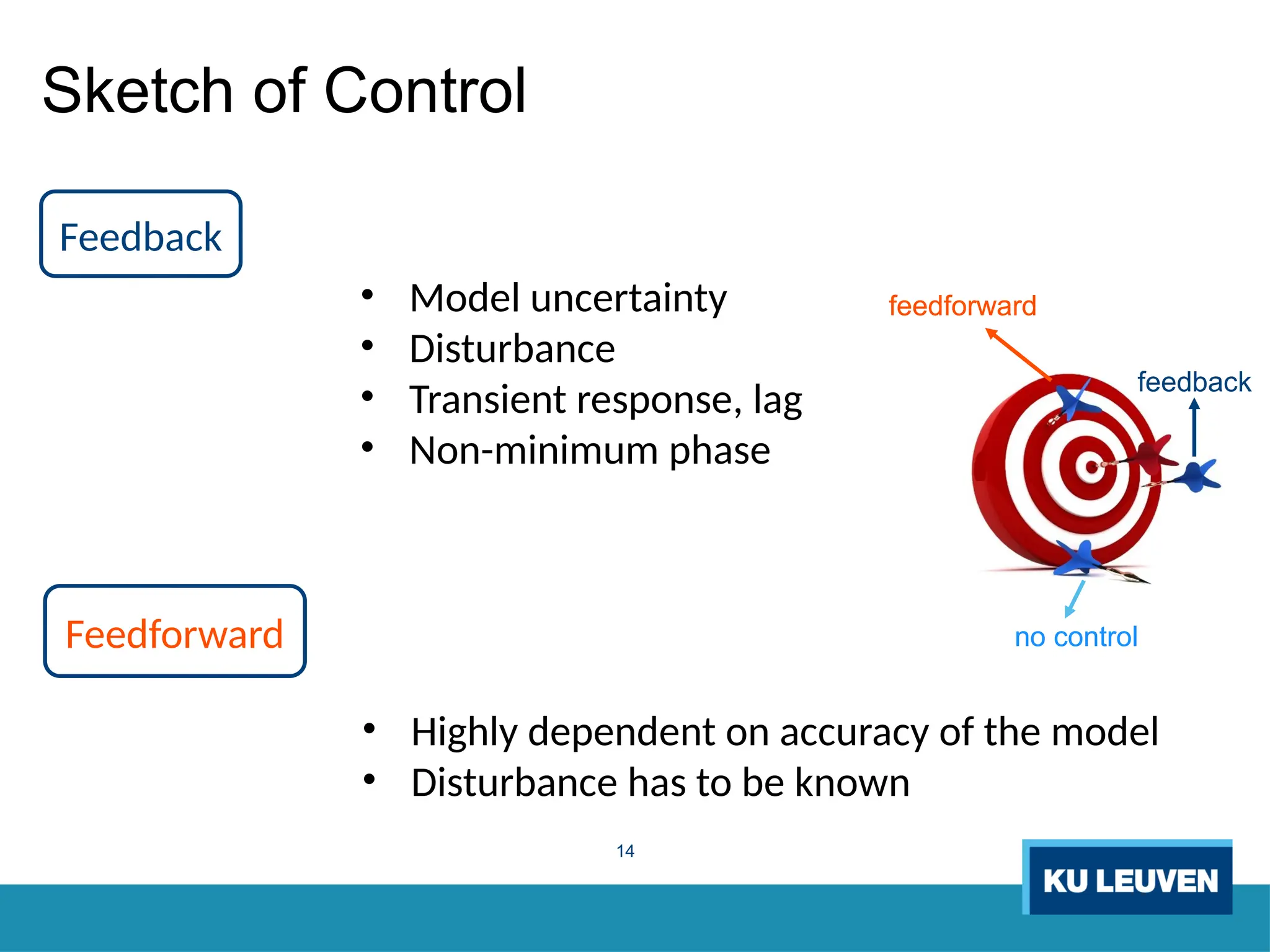
Sketch of Control
• Model uncertainty
• Disturbance
• Transient response, lag
• Non-minimum phase
• Highly dependent on accuracy of the model
• Disturbance has to be known
Feedback
Feedforward
feedforward
feedback
no control
feedforward
feedback
no control
15
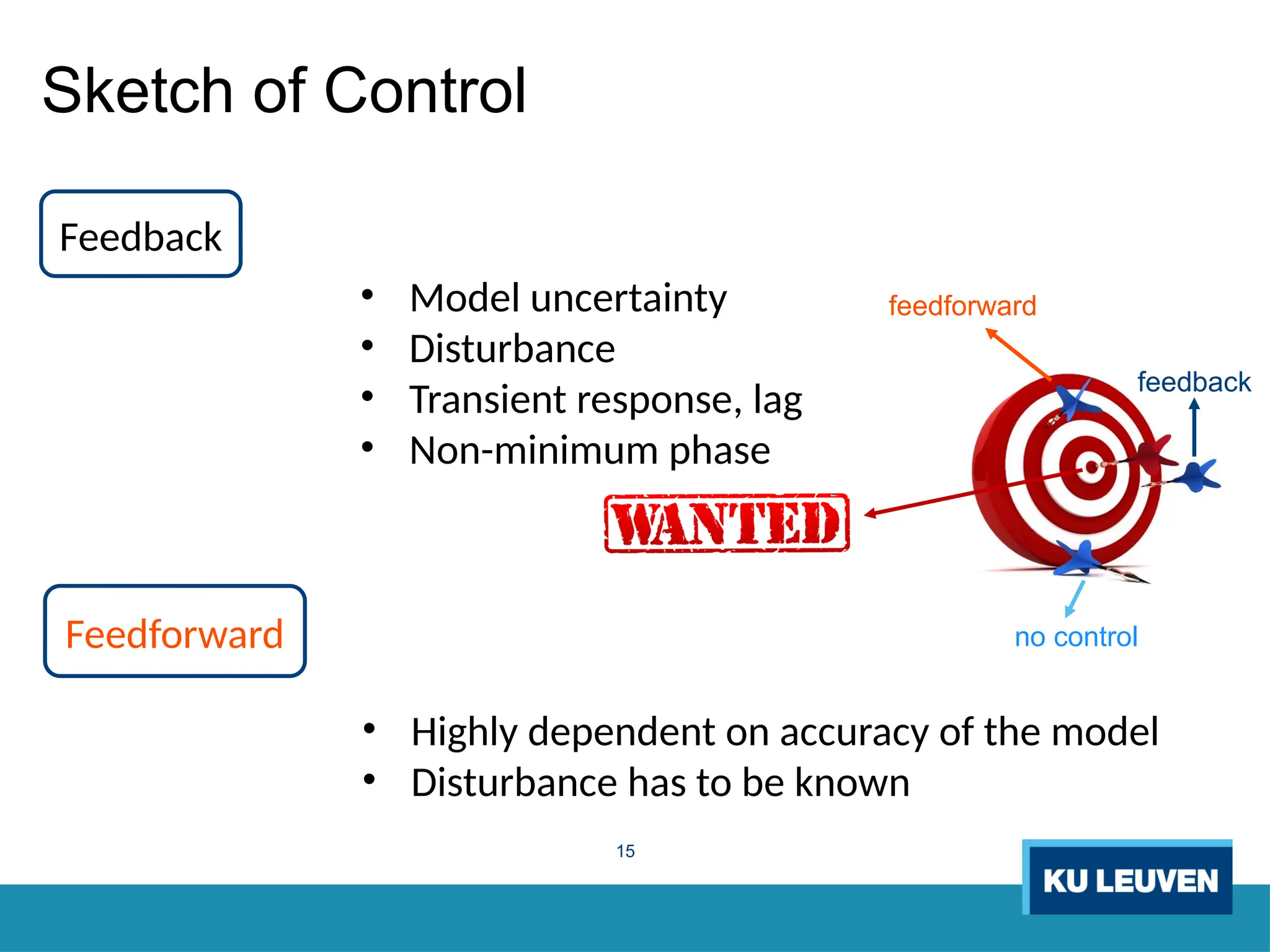
Sketch of Control
• Model uncertainty
• Disturbance
• Transient response, lag
• Non-minimum phase
• Highly dependent on accuracy of the model
• Disturbance has to be known
Feedback
Feedforward
feedforward
feedback
no control
16
Repetitions in industry
same task and same performance
hundreds to thousands times a day
17
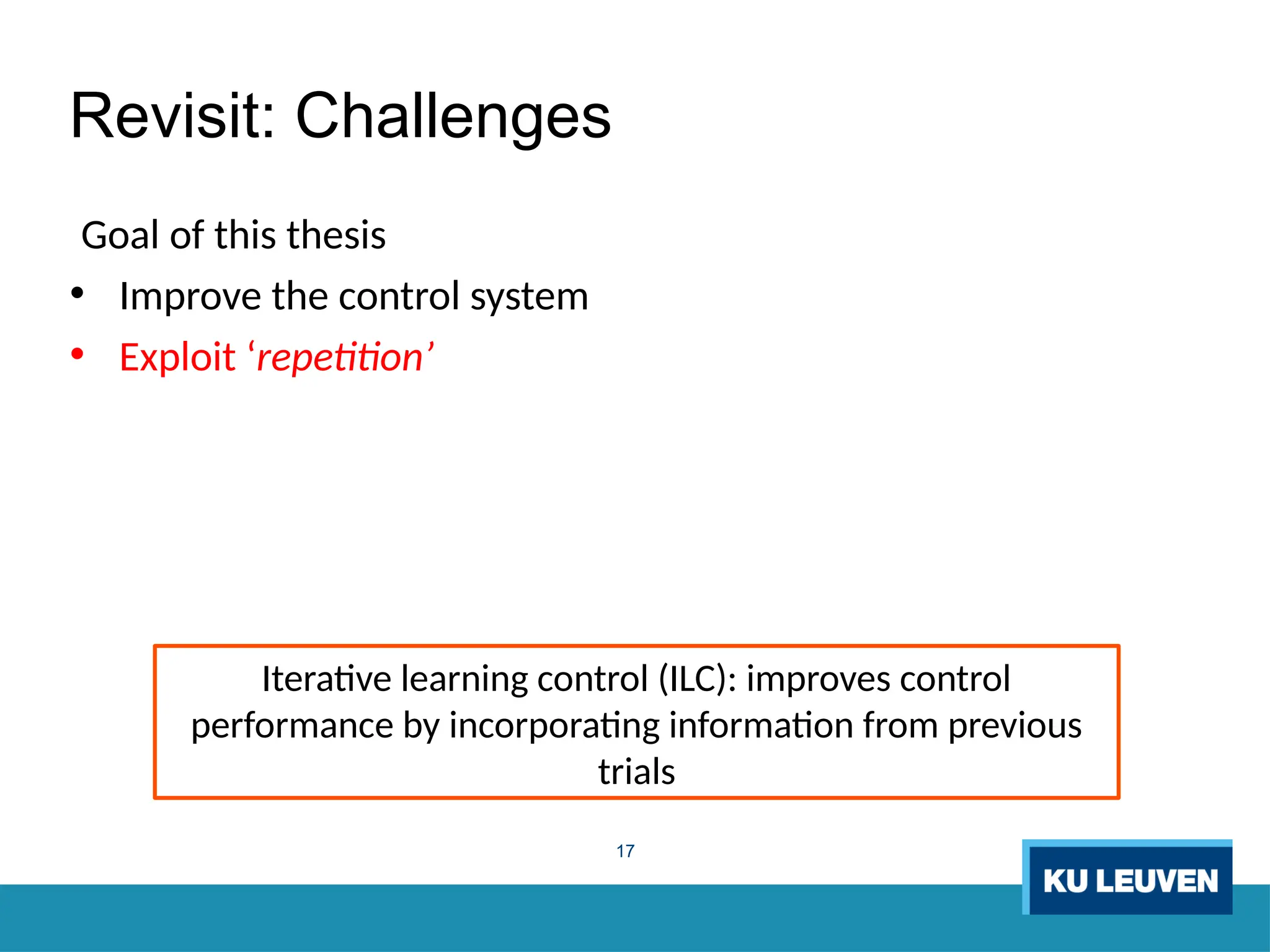
Revisit: Challenges
Goal of this thesis
• Improve the control system
• Exploit ‘repetition’
Iterative learning control (ILC): improves control
performance by incorporating information from previous
trials
18
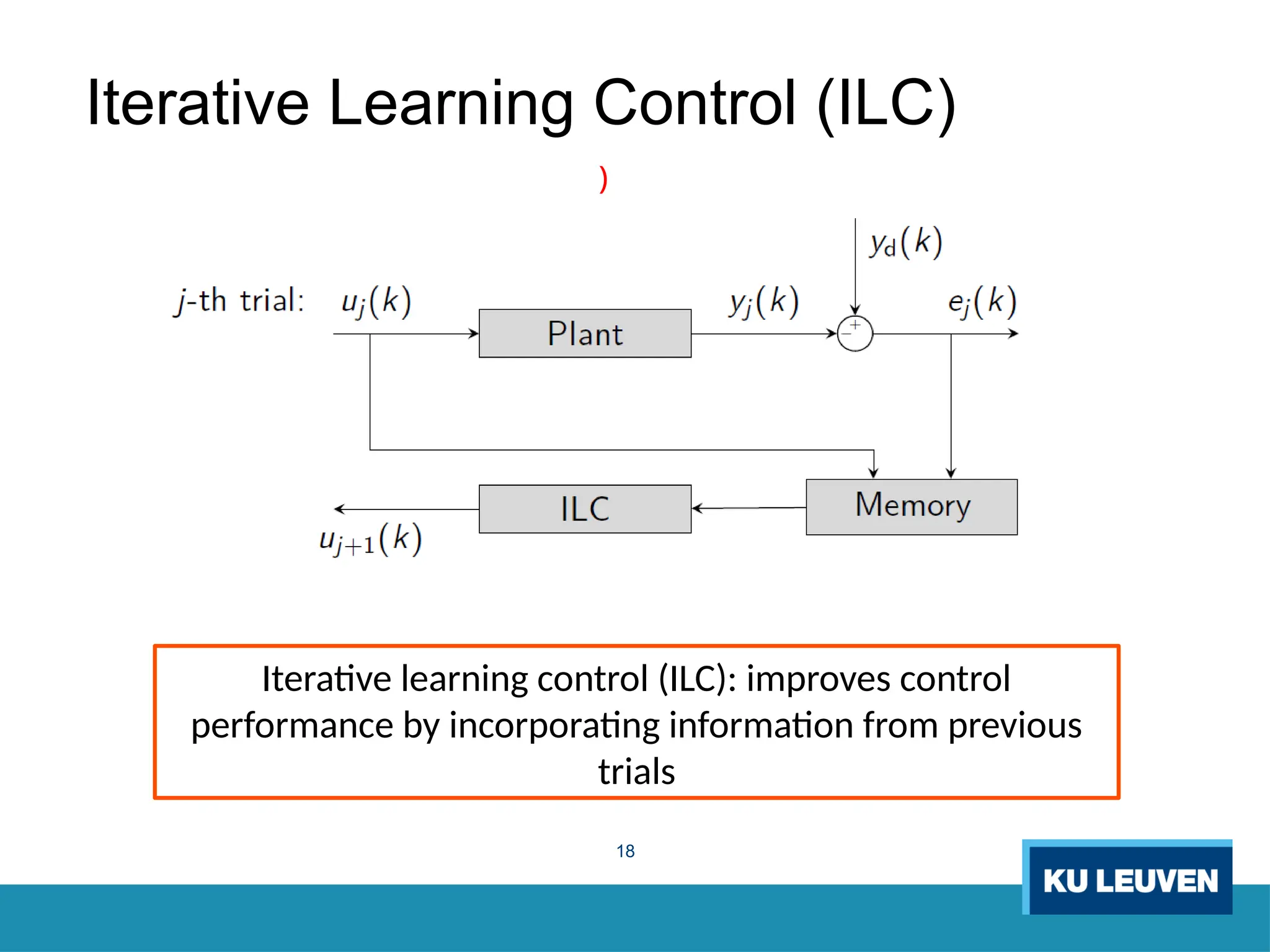
Iterative Learning Control (ILC)
Iterative learning control (ILC): improves control
performance by incorporating information from previous
trials
)
19
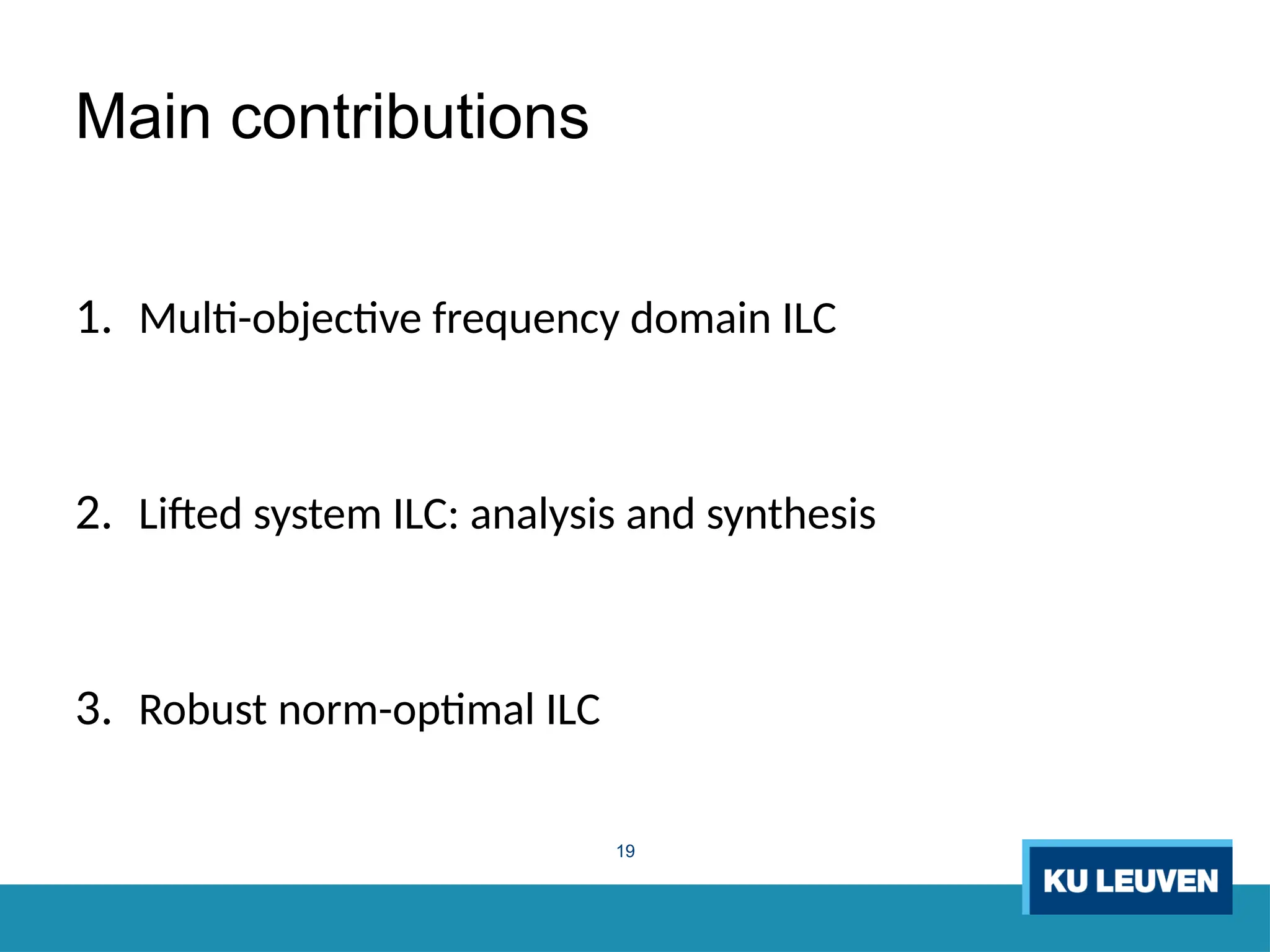
Main contributions
1. Multi-objective frequency domain ILC
2. Lifted system ILC: analysis and synthesis
3. Robust norm-optimal ILC
20
Main contributions
1. Multi-objective frequency domain ILC
2. Lifted system ILC: analysis and synthesis
3. Robust norm-optimal ILC
21
Introduction (1)
Most ILC designs reply on a two-step sequential problem formulation and the
design procedures are usually heuristic:
• Design L then design Q:
1. L as model-inversion or phase-lead type
2. Q as a low-pass filter: depends on designed
• Design Q then design L:
1. design Q
2. find L that optimize the learning speed
• Iterate the previous 2 designs
The design is not optimal while costly and time consuming!
)
designed controller: (Q,L)
22
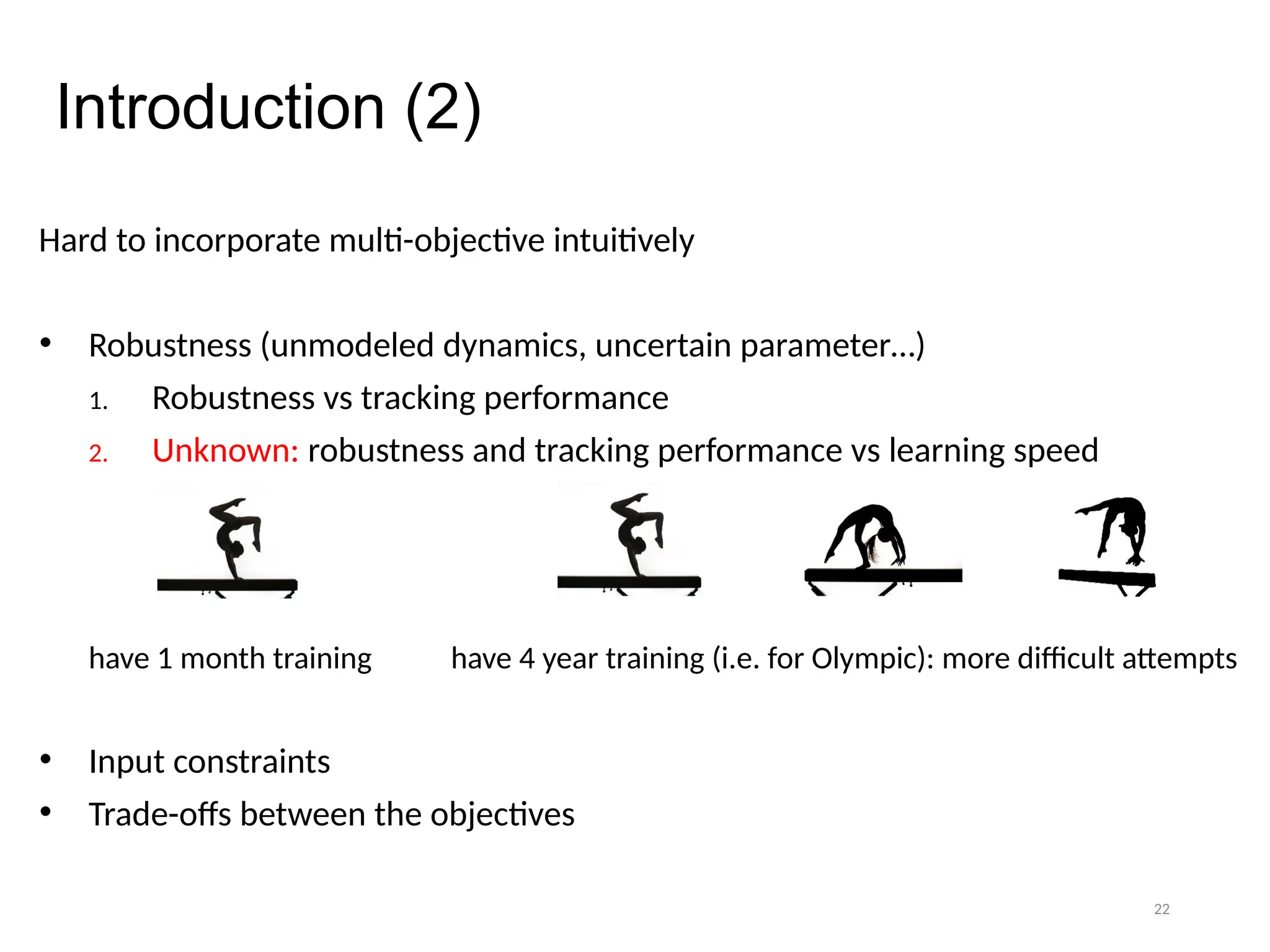
Introduction (2)
Hard to incorporate multi-objective intuitively
• Robustness (unmodeled dynamics, uncertain parameter…)
1. Robustness vs tracking performance
2. Unknown: robustness and tracking performance vs learning speed
have 1 month training have 4 year training (i.e. for Olympic): more difficult attempts
• Input constraints
• Trade-offs between the objectives
23
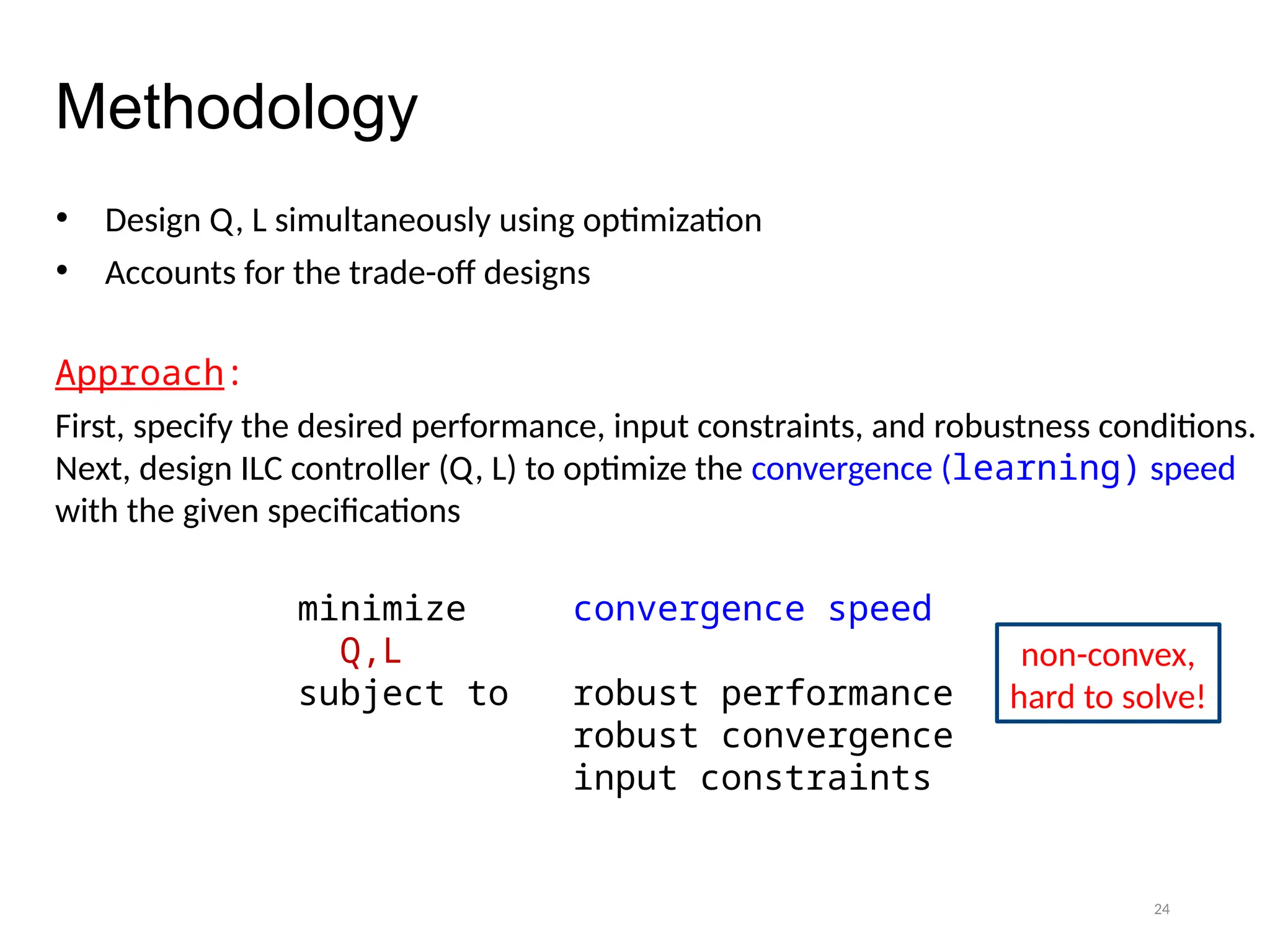
Methodology
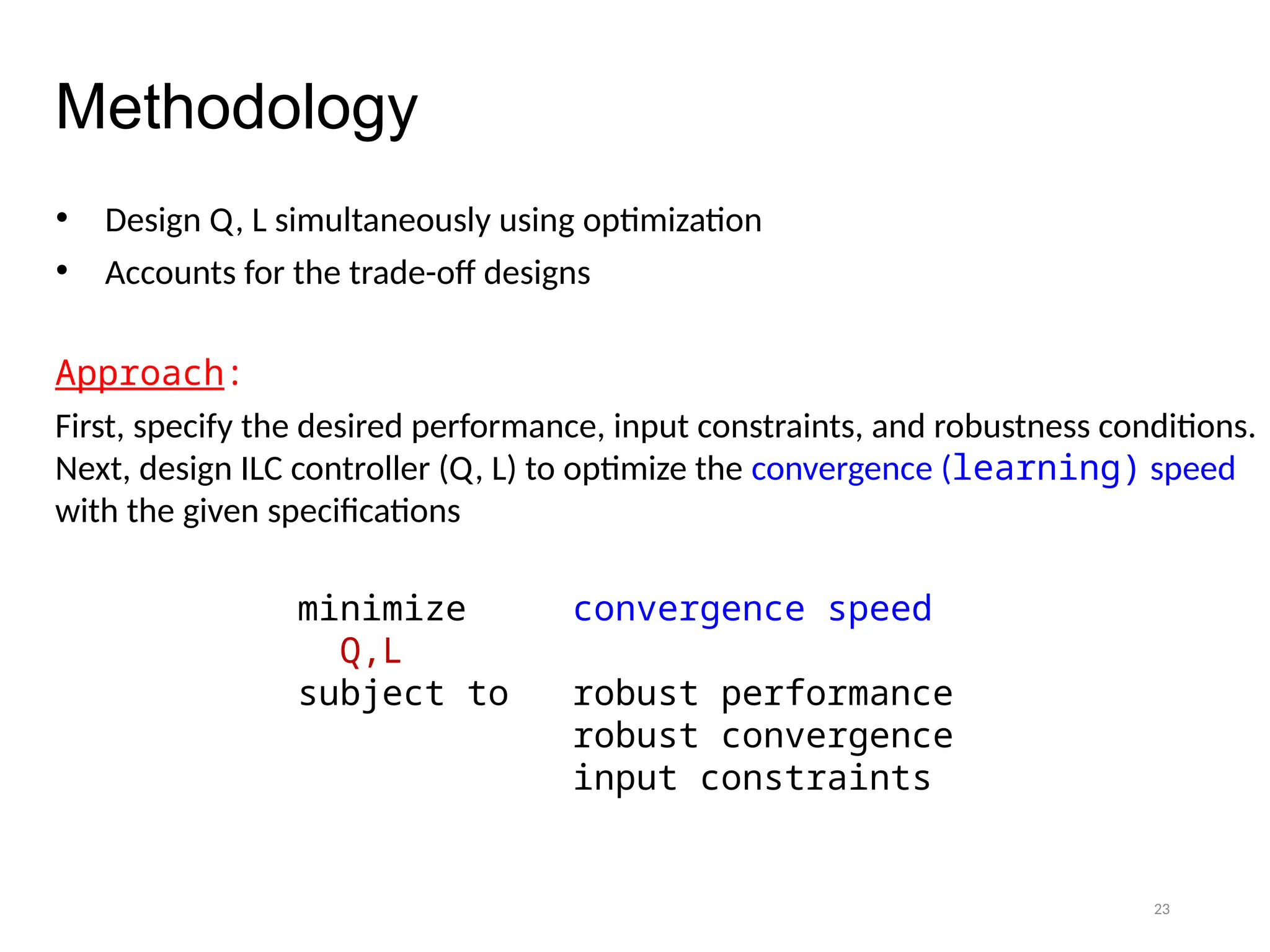
• Design Q, L simultaneously using optimization
• Accounts for the trade-off designs
Approach:
First, specify the desired performance, input constraints, and robustness conditions.
Next, design ILC controller (Q, L) to optimize the convergence (learning) speed
with the given specifications
minimize convergence speed
Q,L
subject to robust performance
robust convergence
input constraints
24
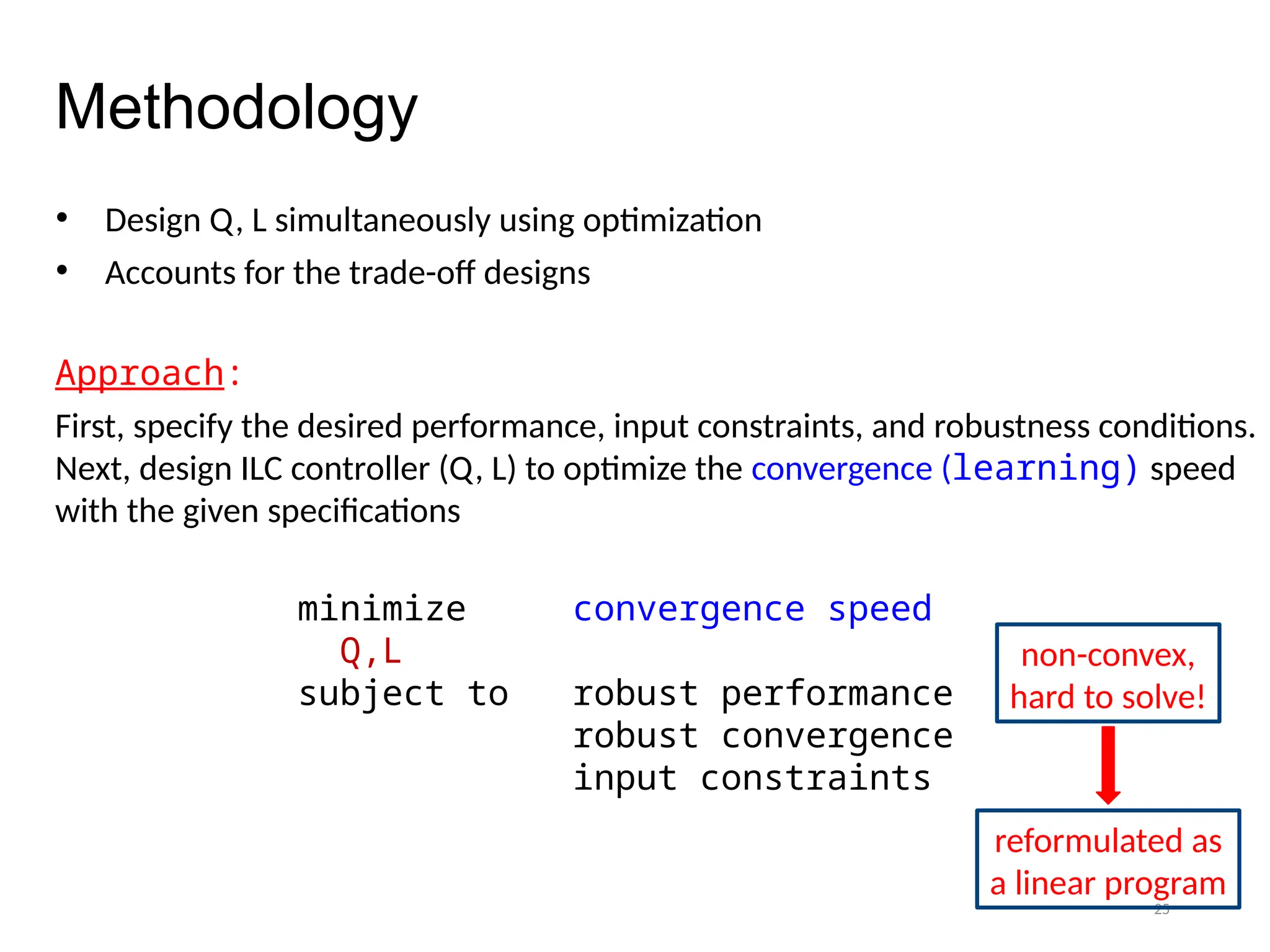
Methodology
• Design Q, L simultaneously using optimization
• Accounts for the trade-off designs
Approach:
First, specify the desired performance, input constraints, and robustness conditions.
Next, design ILC controller (Q, L) to optimize the convergence (learning) speed
with the given specifications
minimize convergence speed
Q,L
subject to robust performance
robust convergence
input constraints
non-convex,
hard to solve!
25
Methodology
• Design Q, L simultaneously using optimization
• Accounts for the trade-off designs
Approach:
First, specify the desired performance, input constraints, and robustness conditions.
Next, design ILC controller (Q, L) to optimize the convergence (learning) speed
with the given specifications
minimize convergence speed
Q,L
subject to robust performance
robust convergence
input constraints
non-convex,
hard to solve!
reformulated as
a linear program
26
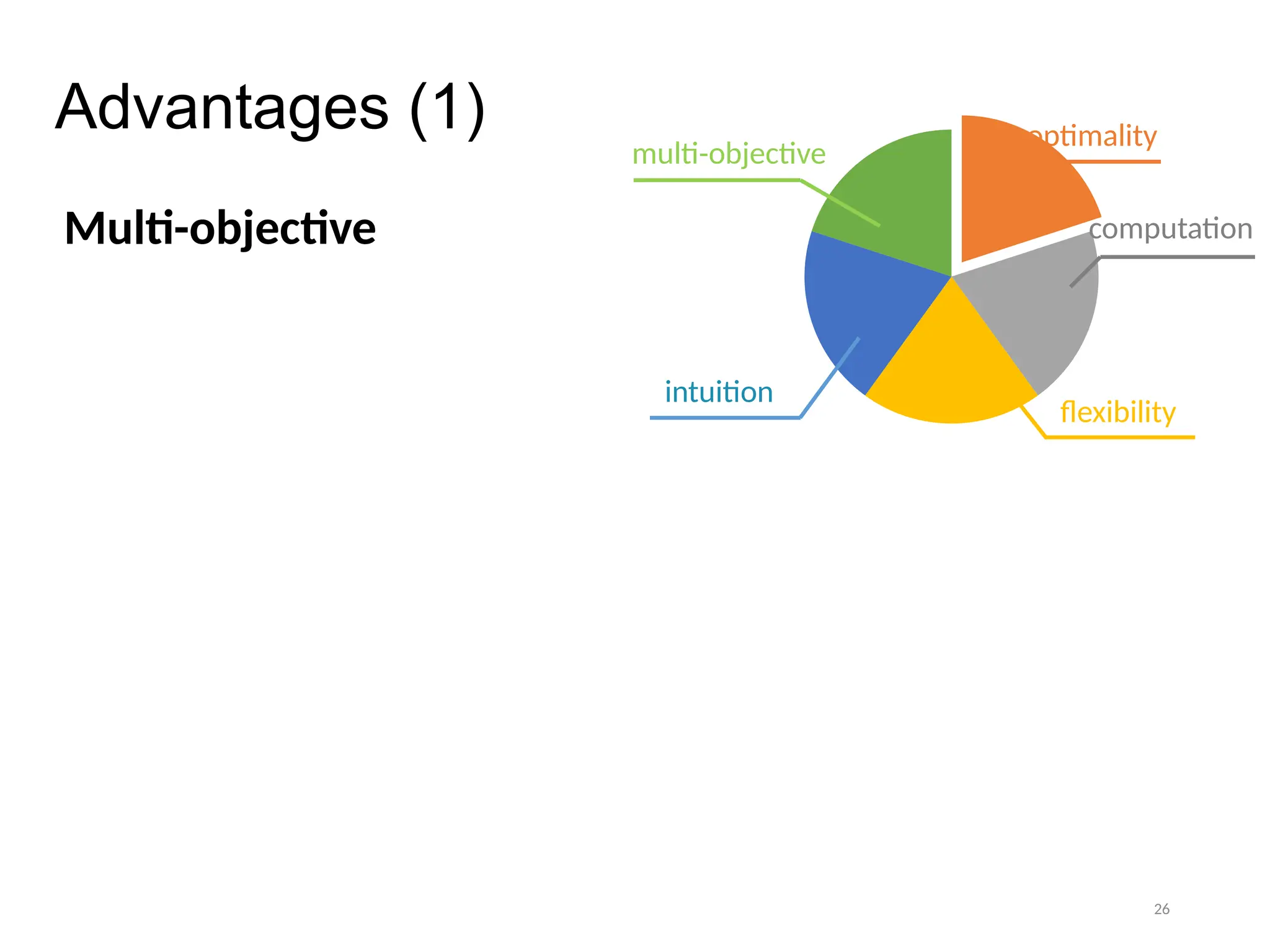
Advantages (1)
Multi-objective
optimality
computation
flexibility
intuition
multi-objective
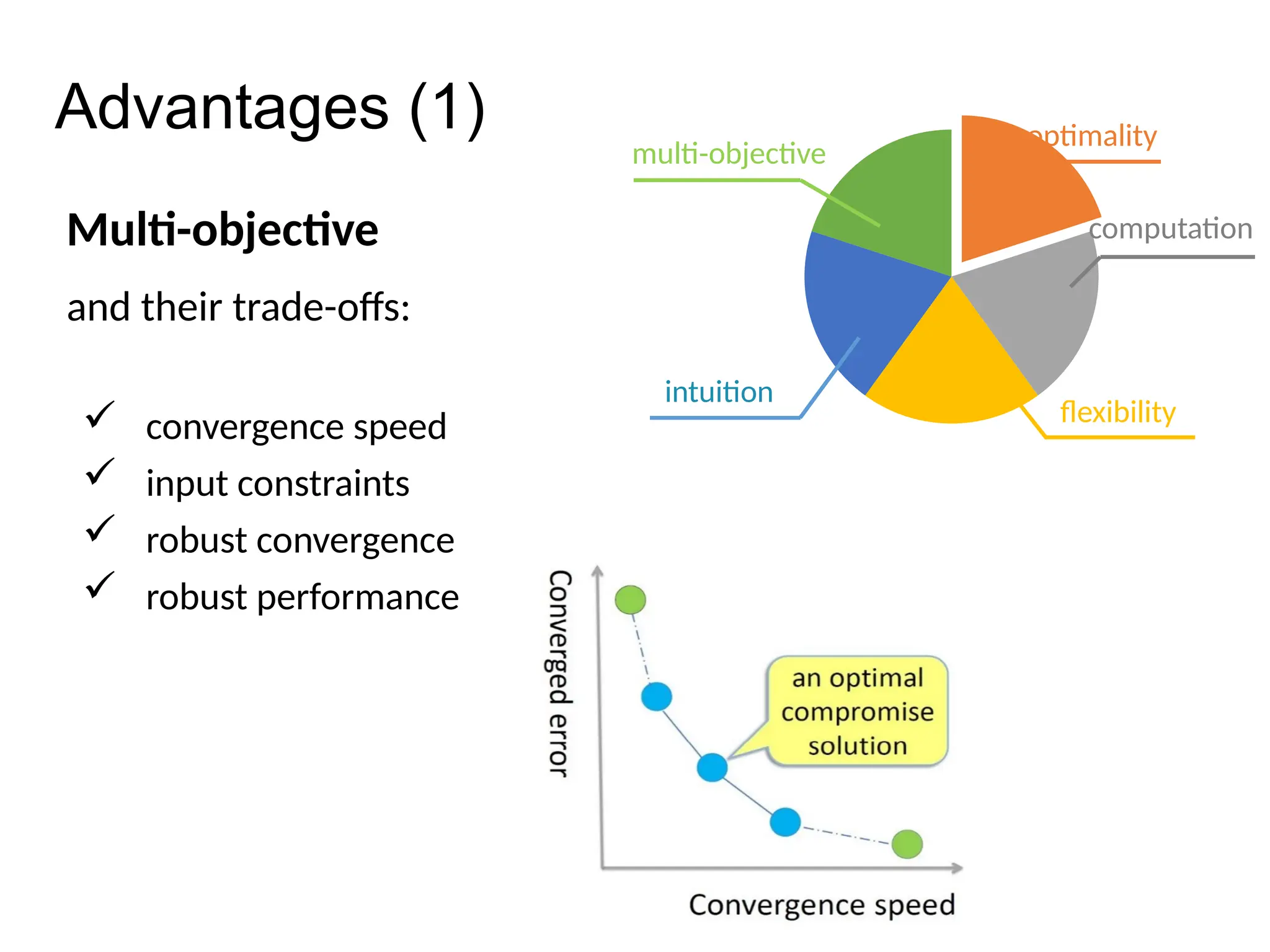
Advantages (1)
Multi-objective
and their trade-offs:
 convergence speed
 input constraints
 robust convergence
 robust performance
optimality
computation
flexibility
intuition
multi-objective
28
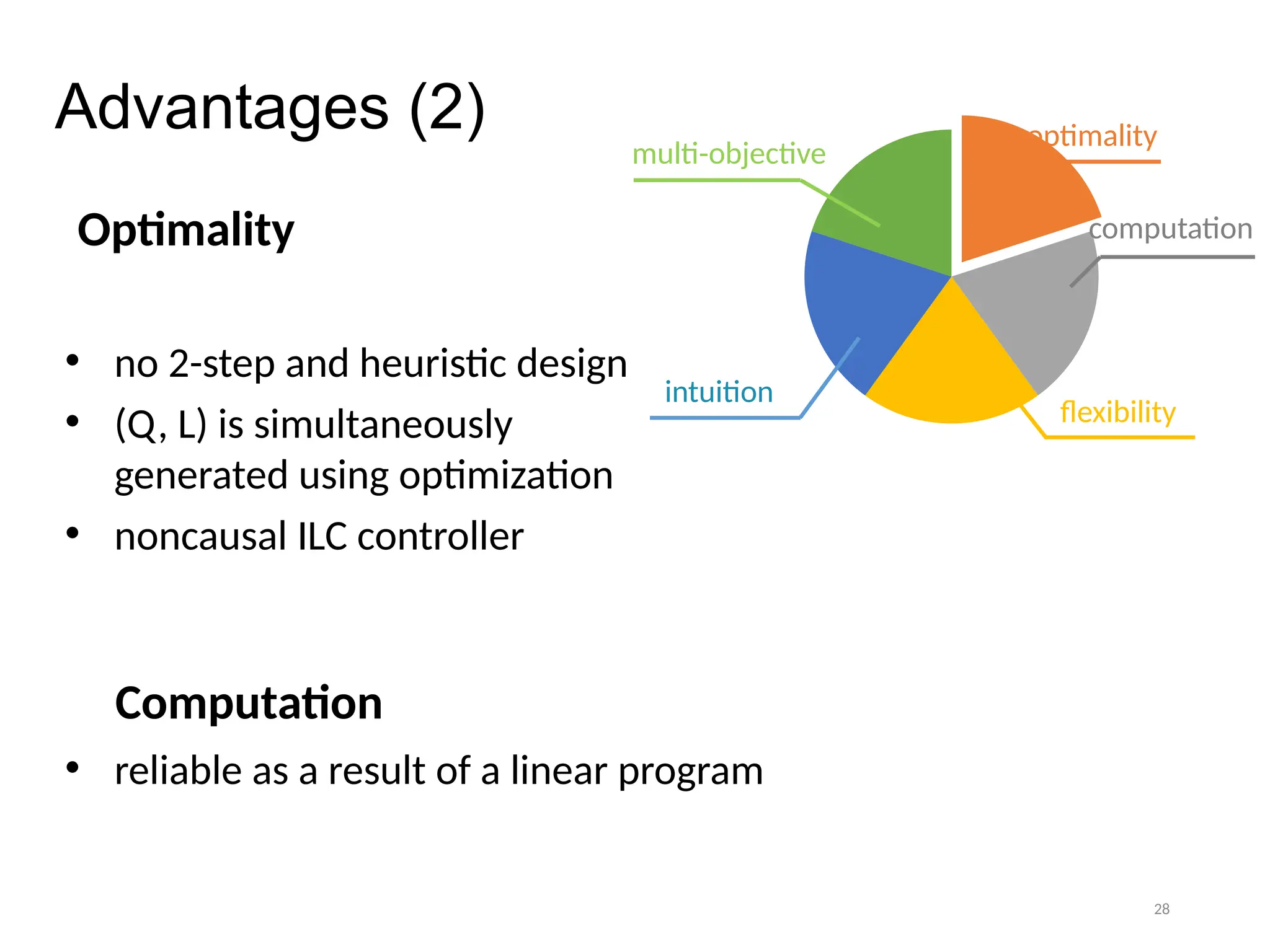
Advantages (2)
Optimality
• no 2-step and heuristic design
• (Q, L) is simultaneously
generated using optimization
• noncausal ILC controller
optimality
computation
flexibility
intuition
multi-objective
• reliable as a result of a linear program
Computation
29
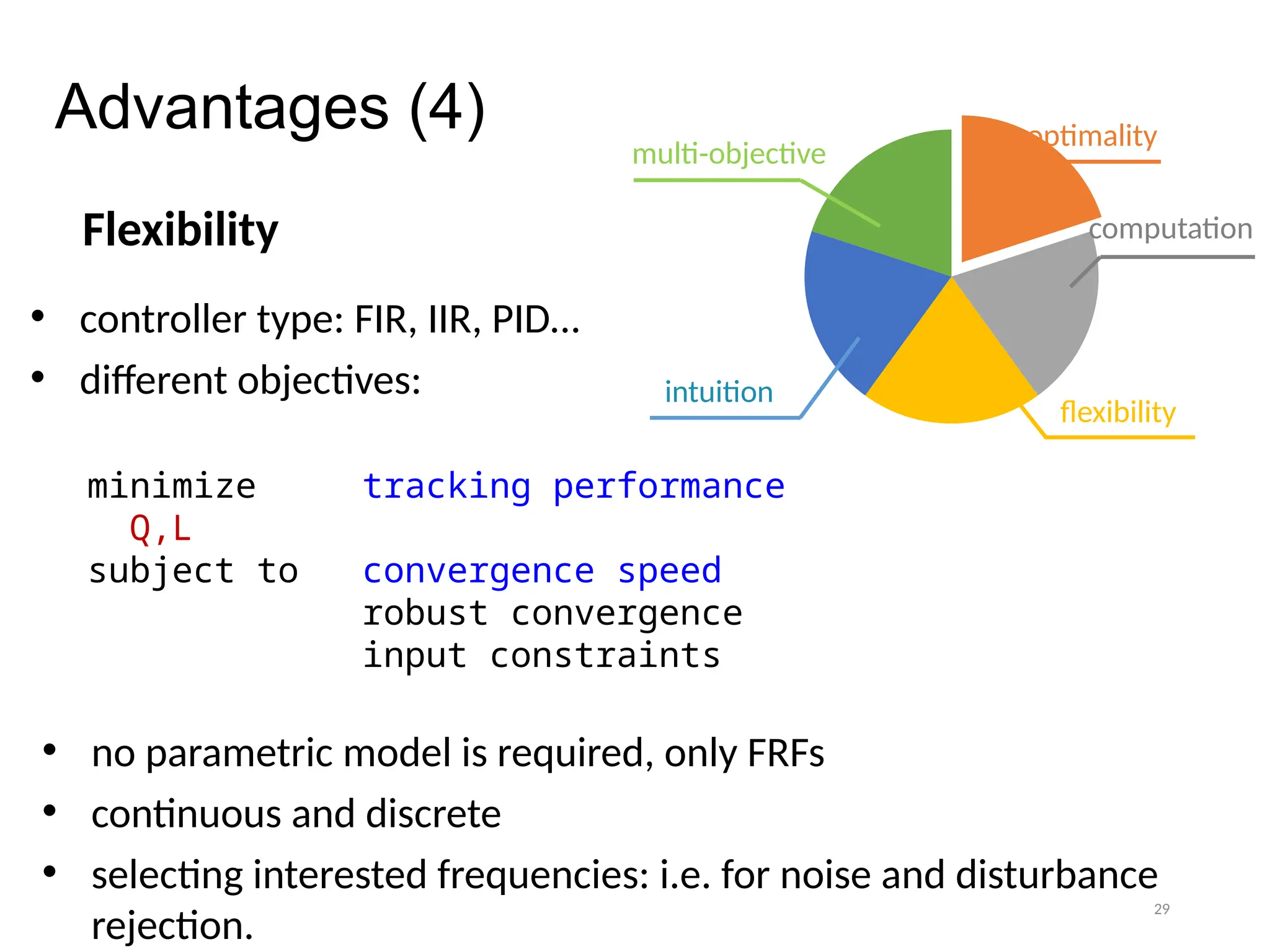
Advantages (4)
Flexibility
• controller type: FIR, IIR, PID...
• different objectives:
minimize tracking performance
Q,L
subject to convergence speed
robust convergence
input constraints
• no parametric model is required, only FRFs
• continuous and discrete
• selecting interested frequencies: i.e. for noise and disturbance
rejection.
optimality
computation
flexibility
intuition
multi-objective
30
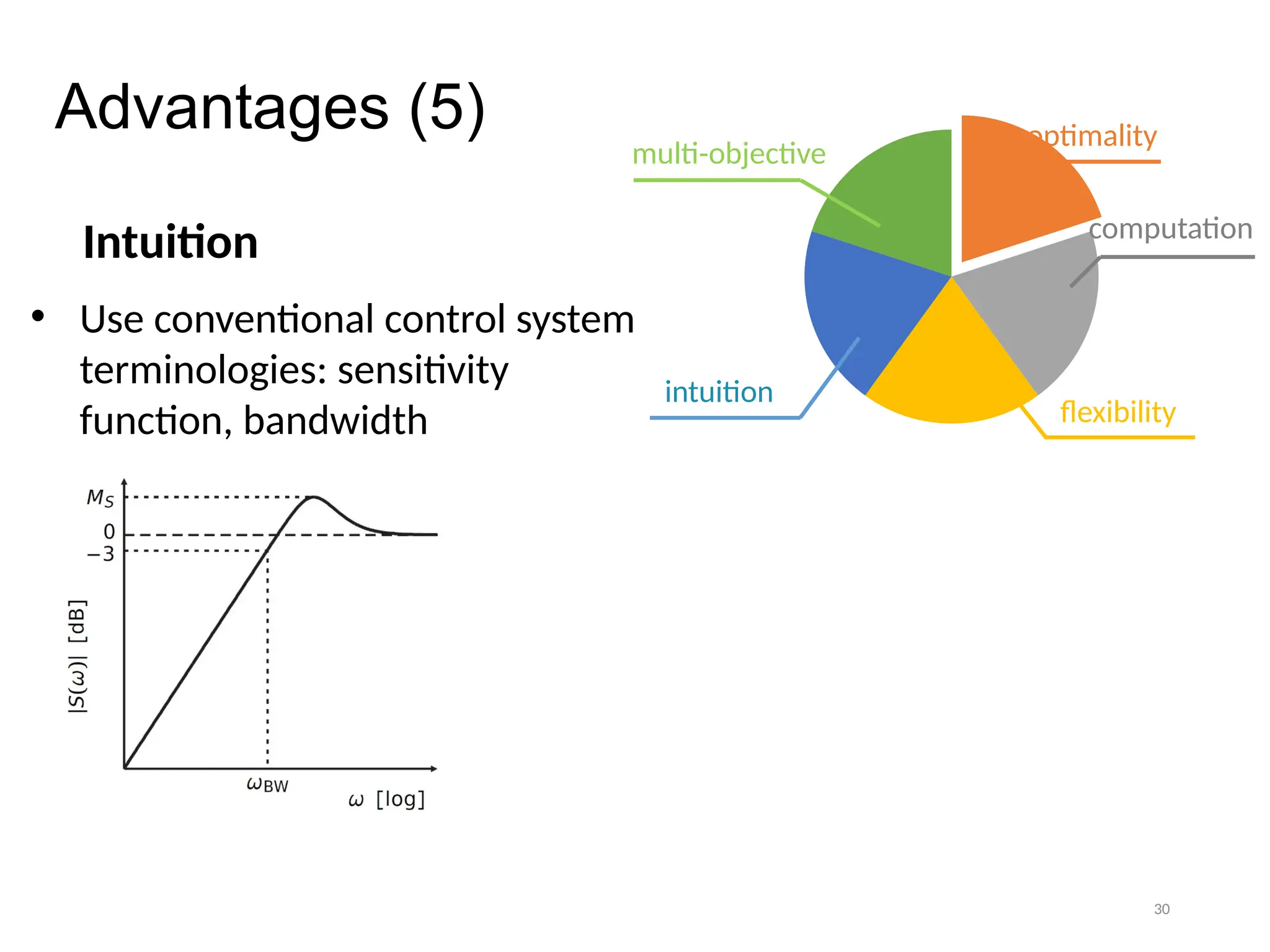
Advantages (5)
Intuition
• Use conventional control system
terminologies: sensitivity
function, bandwidth
optimality
computation
flexibility
intuition
multi-objective
31
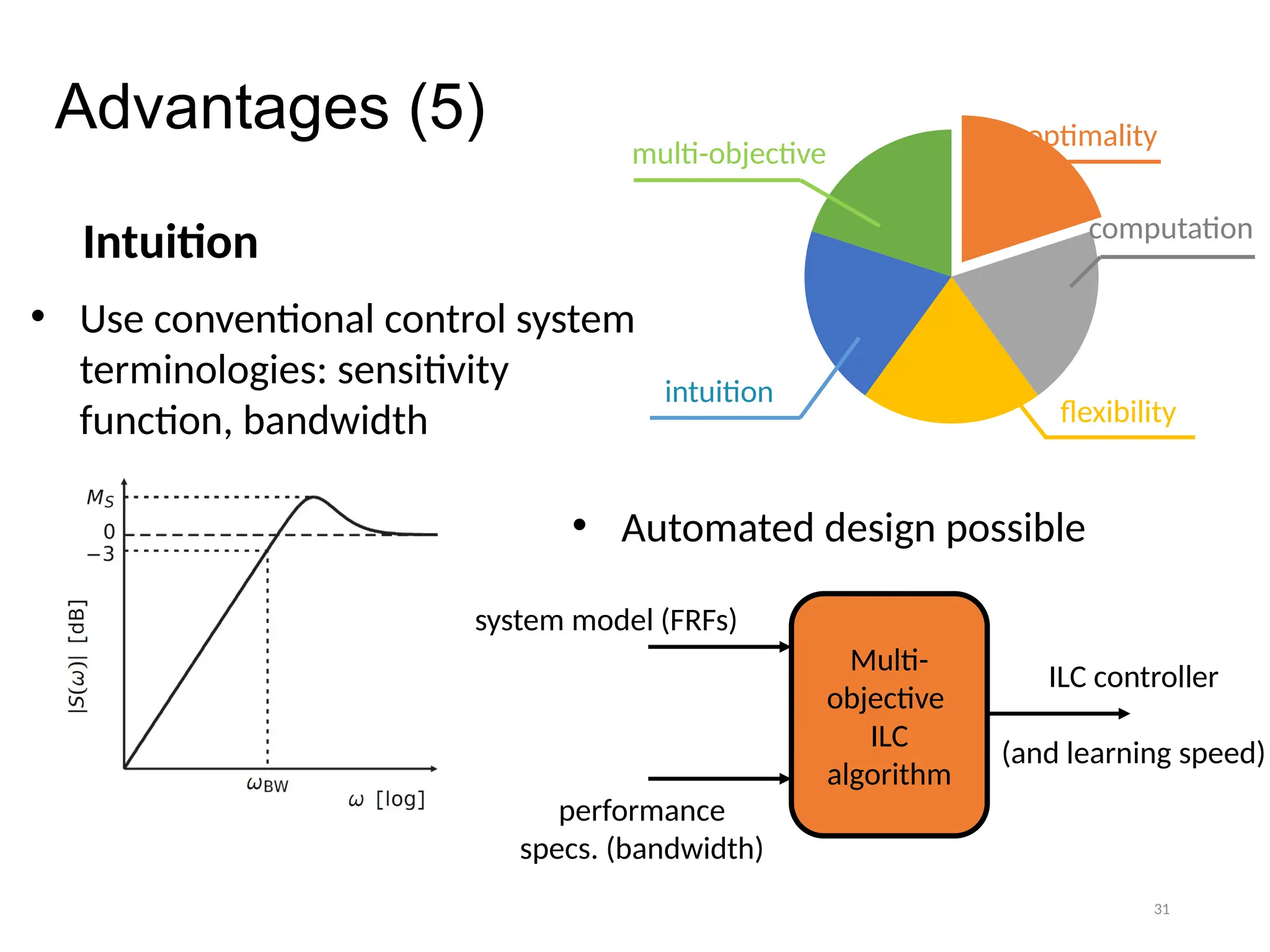
Advantages (5)
Intuition
• Use conventional control system
terminologies: sensitivity
function, bandwidth
optimality
computation
flexibility
intuition
multi-objective
• Automated design possible
Multi-
objective
ILC
algorithm
system model (FRFs)
performance
specs. (bandwidth)
ILC controller
(and learning speed)
32
Validation
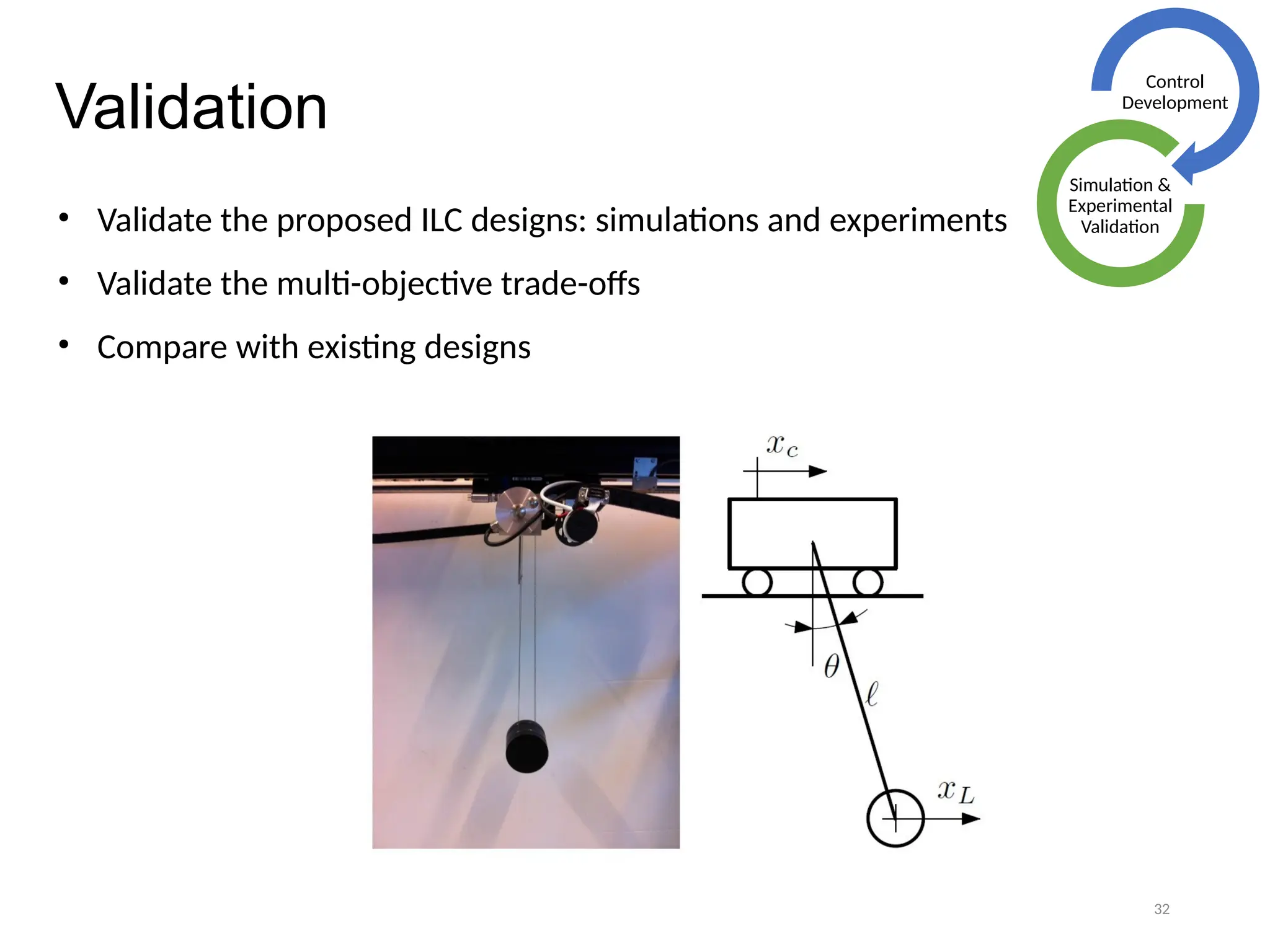
• Validate the proposed ILC designs: simulations and experiments
• Validate the multi-objective trade-offs
• Compare with existing designs
Control
Development
Simulation &
Experimental
Validation
33
Validation
Control
Development
Simulation &
Experimental
Validation
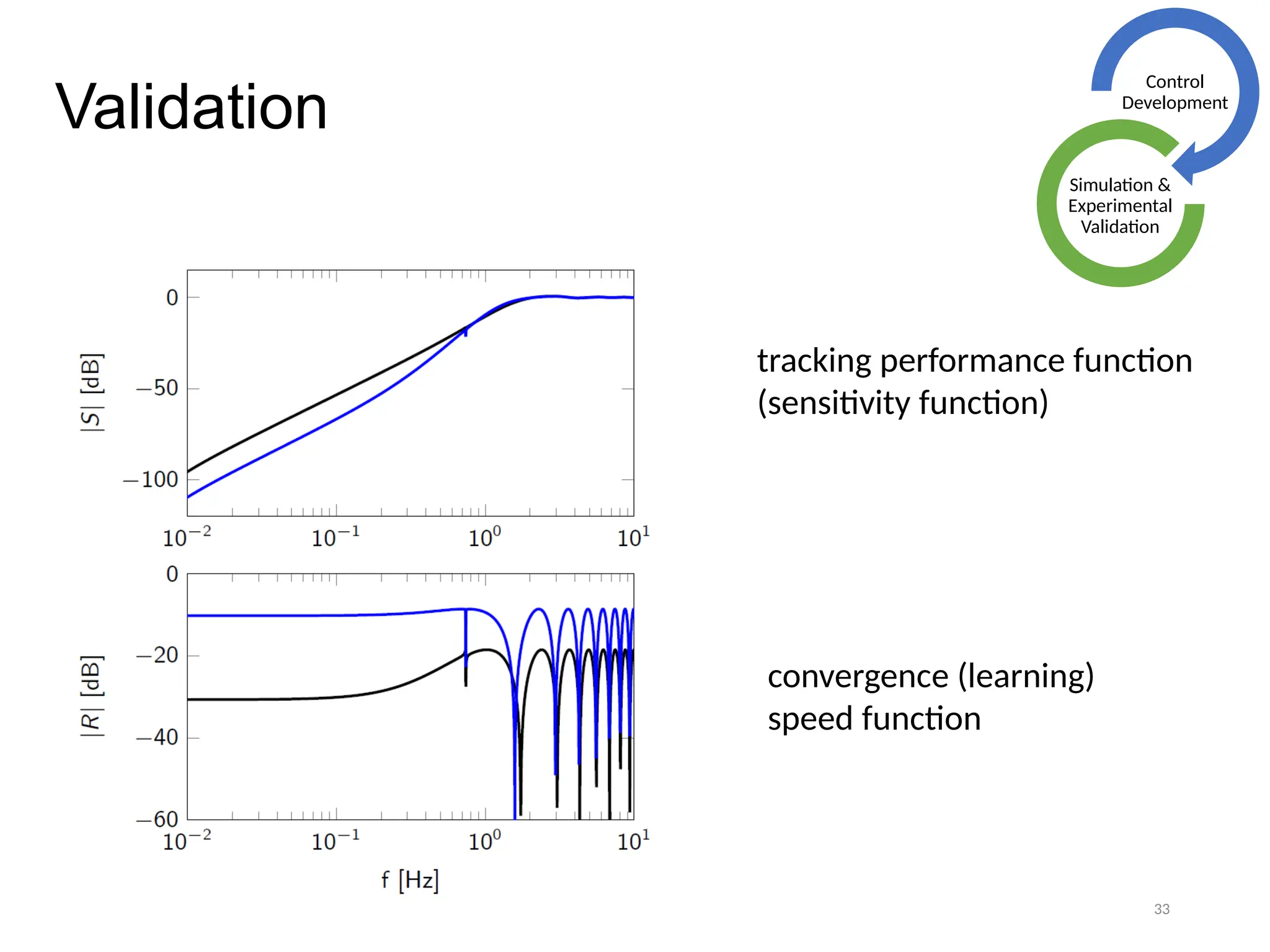
tracking performance function
(sensitivity function)
convergence (learning)
speed function
34
Validation
Control
Development
Simulation &
Experimental
Validation
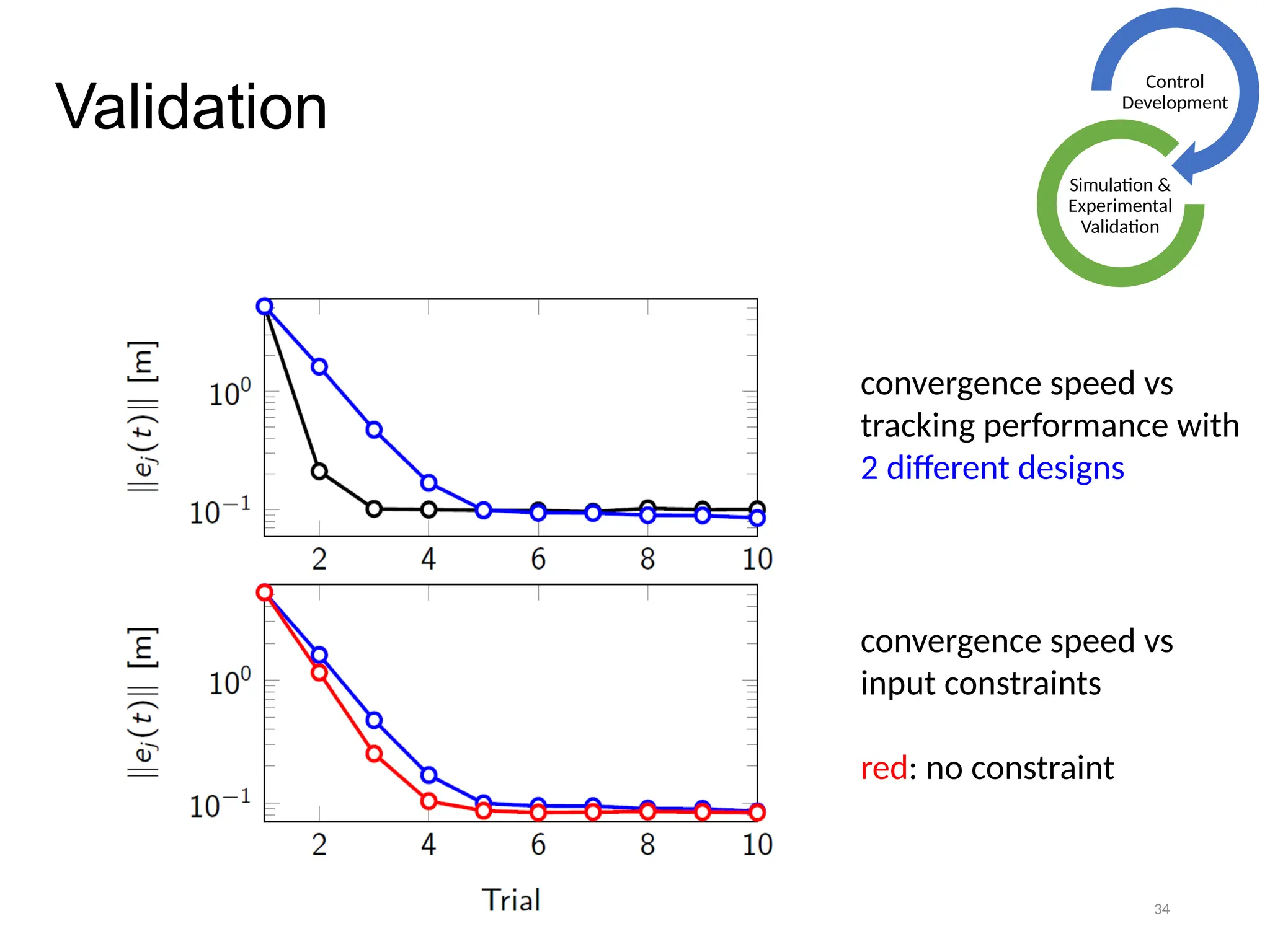
convergence speed vs
tracking performance with
2 different designs
convergence speed vs
input constraints
red: no constraint
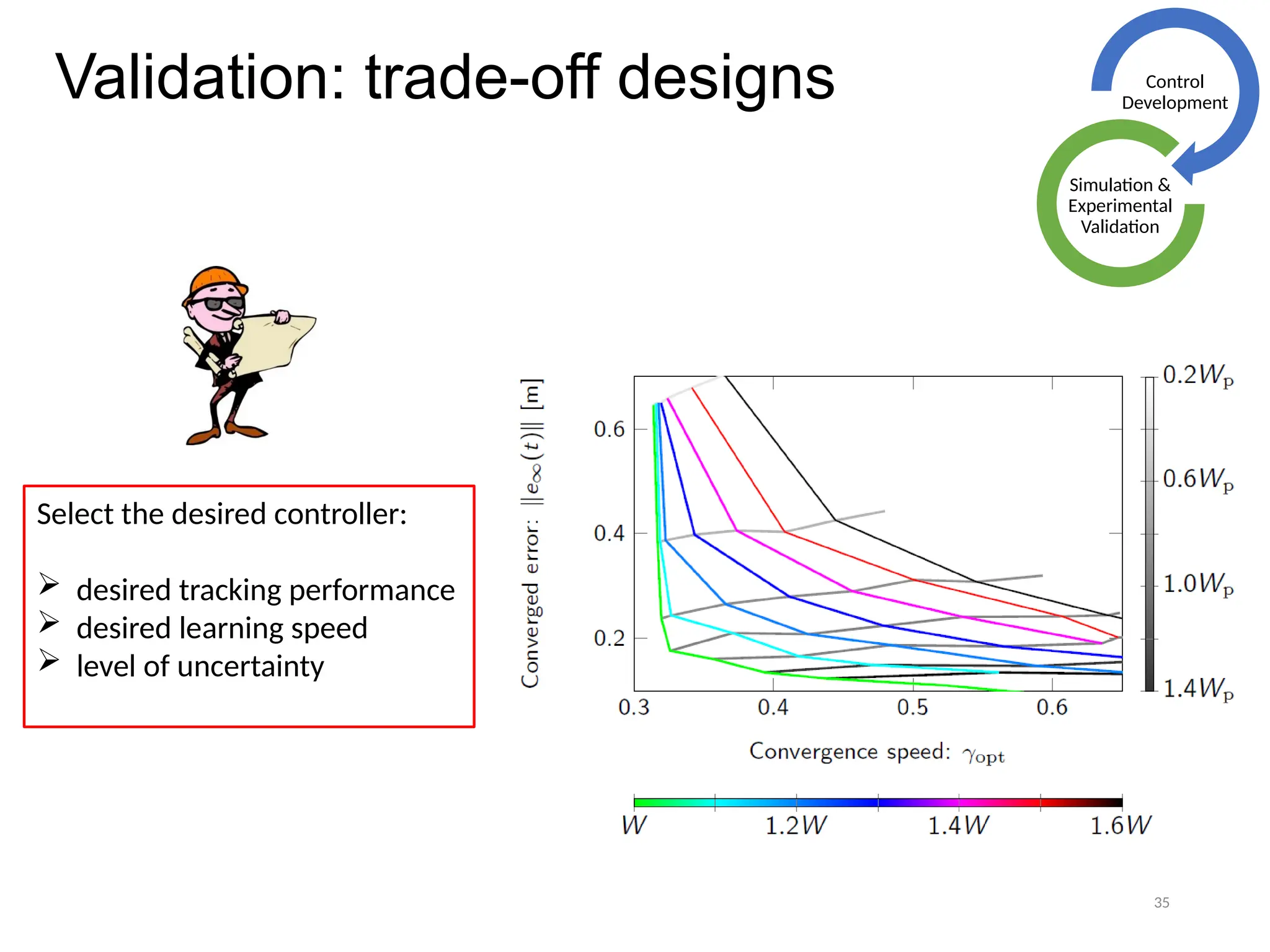
Validation: trade-off designs Control
Development
Simulation &
Experimental
Validation
35
Select the desired controller:
 desired tracking performance
 desired learning speed
 level of uncertainty
36
Main contributions
1. Multi-objective frequency domain ILC
2. Lifted system ILC: analysis and synthesis
3. Robust norm-optimal ILC
37
Introduction
• Consider multiple objectives as previous,
but investigate time domain using lifted system representation
of finite trial length.
• (Q,L) are matrix variables
• Study robust analyses
• Proposes ILC syntheses (designs)
)
designed controller: (Q,L)
38
Robustness
• Robust monotonic convergence and robust performance analyses
an LMI (or BMI) problem
i.e.
• Both unstructured and structured uncertainty are considered
39
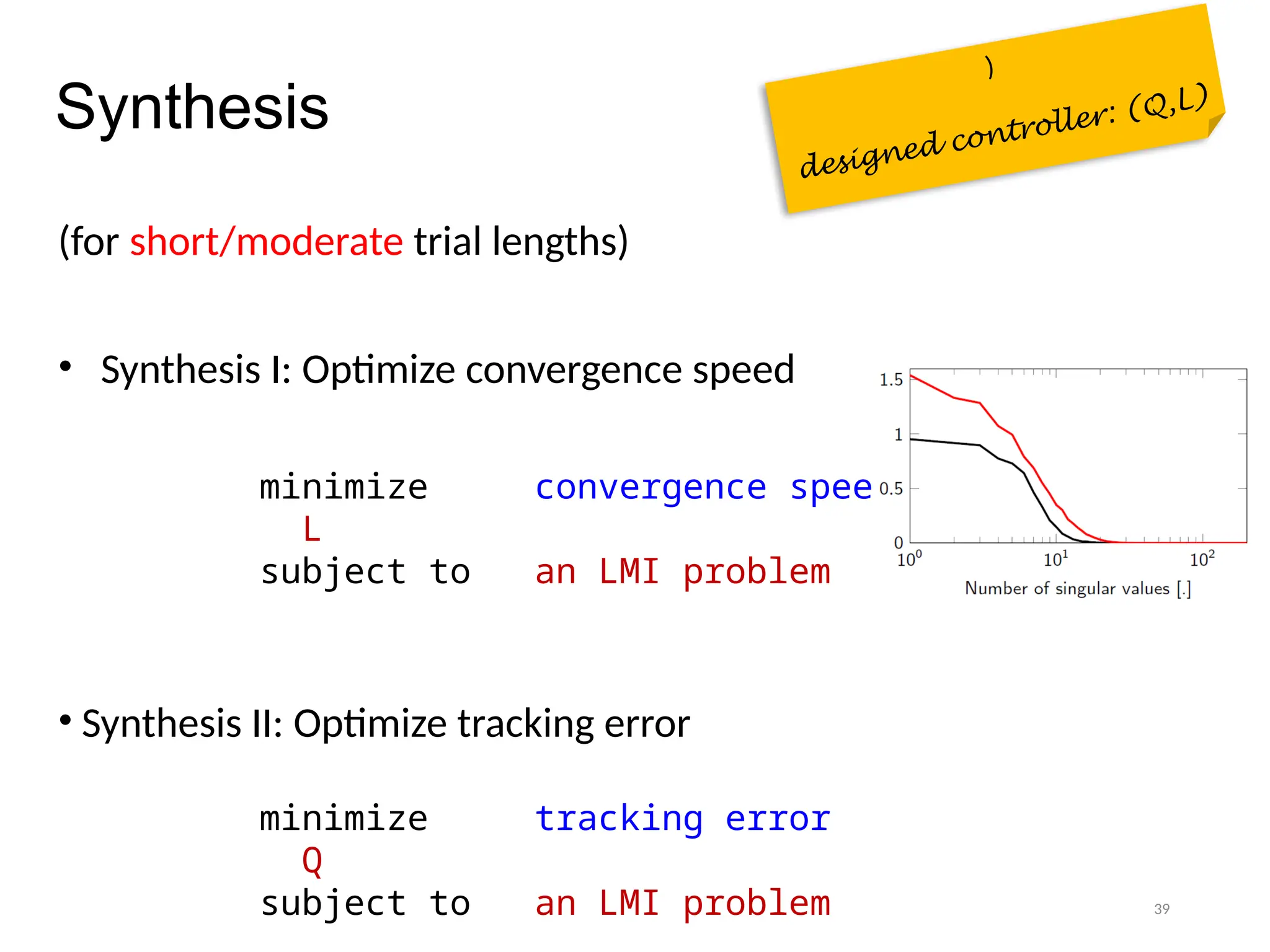
Synthesis
(for short/moderate trial lengths)
• Synthesis I: Optimize convergence speed
• Synthesis II: Optimize tracking error
)
designed controller: (Q,L)
minimize convergence speed
L
subject to an LMI problem
minimize tracking error
Q
subject to an LMI problem
40
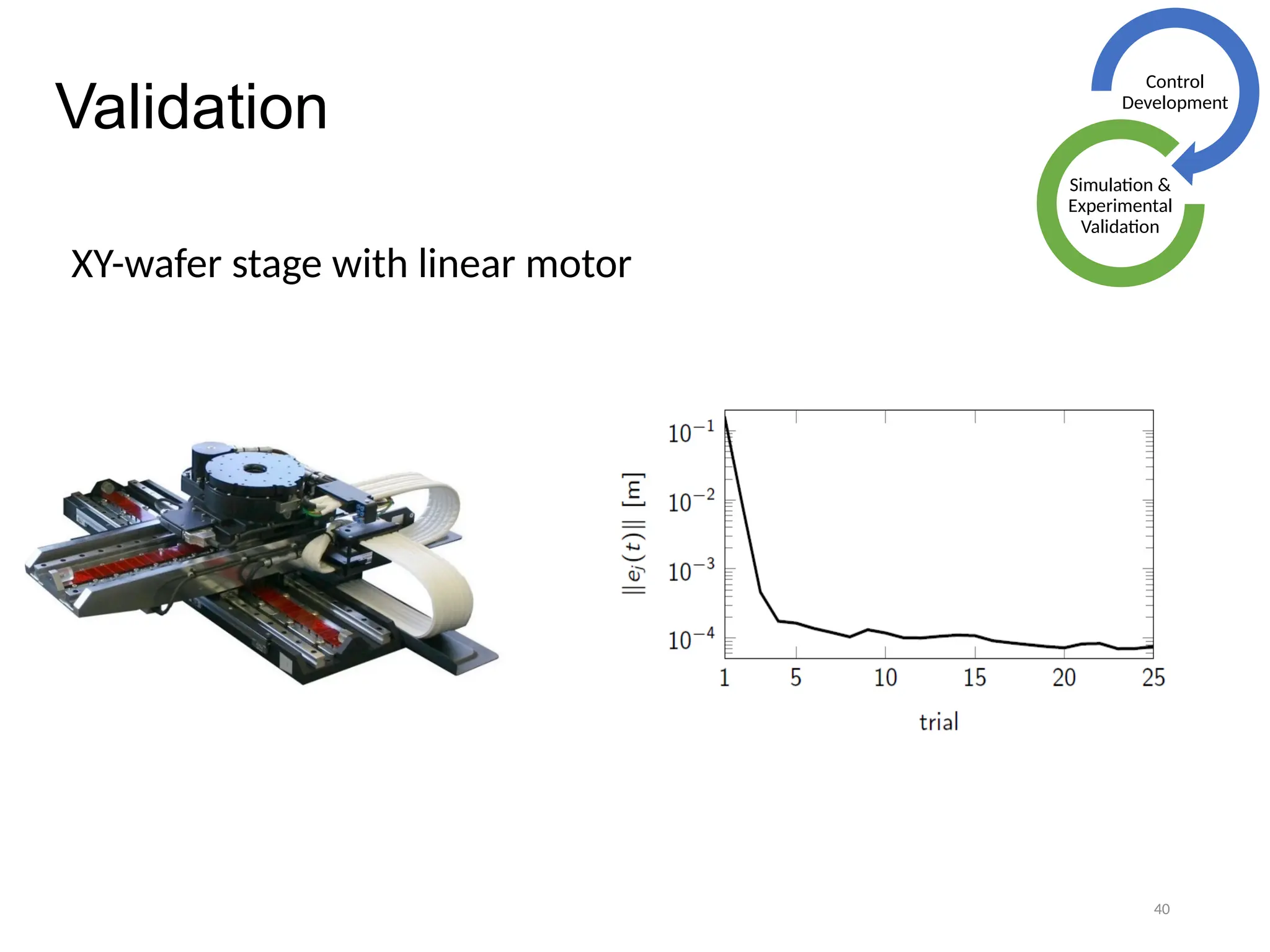
Validation
Control
Development
Simulation &
Experimental
Validation
XY-wafer stage with linear motor
41
Main contributions
1. Multi-objective frequency domain ILC
2. Lifted system ILC: analysis and synthesis
3. Robust norm-optimal ILC
42
Introduction
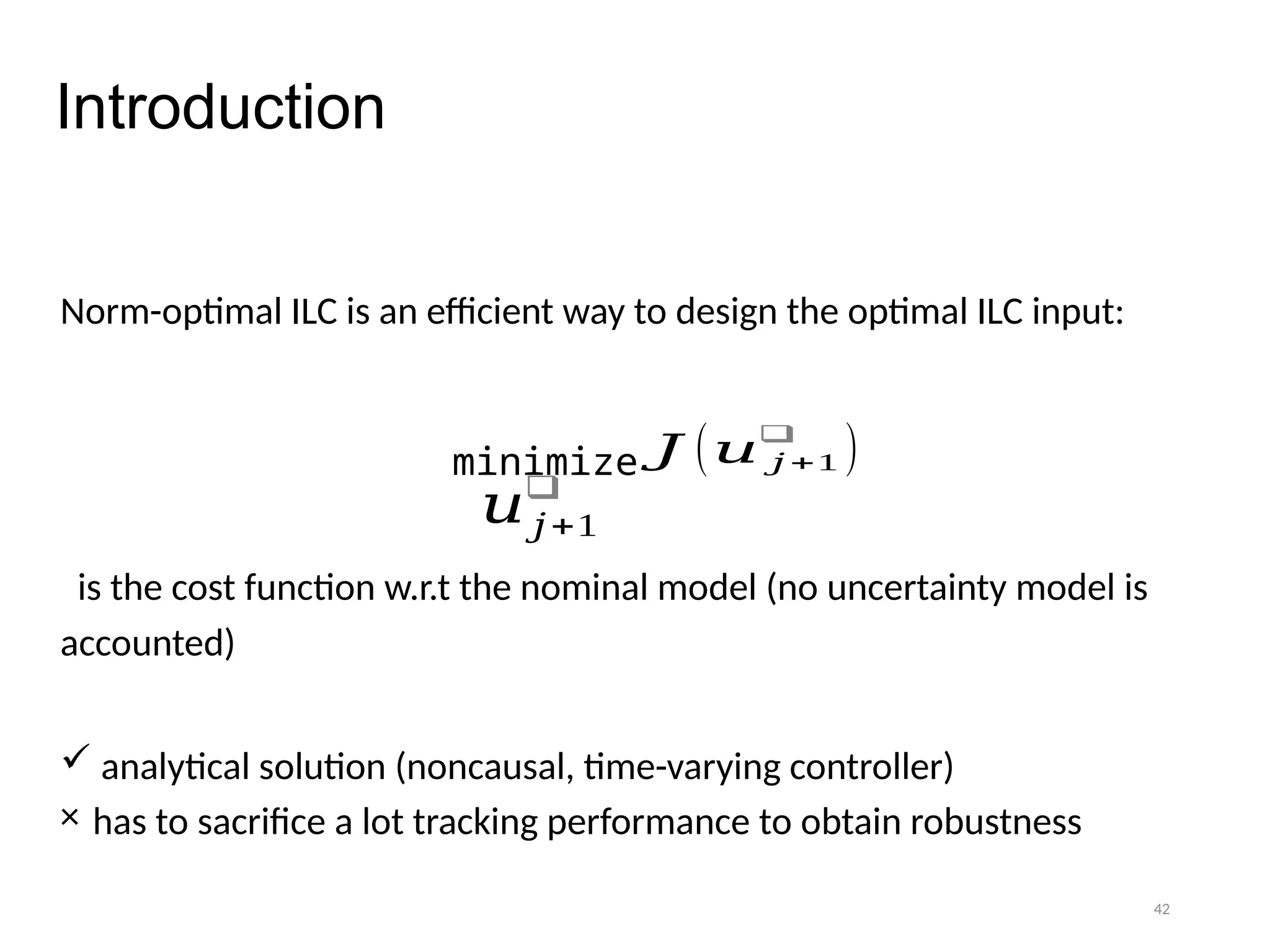
Norm-optimal ILC is an efficient way to design the optimal ILC input:
is the cost function w.r.t the nominal model (no uncertainty model is
accounted)
 analytical solution (noncausal, time-varying controller)
× has to sacrifice a lot tracking performance to obtain robustness
𝐽 (𝑢 𝑗 +1
❑
)
minimize
𝑢𝑗+1
❑
43
Methodology
• obtain both robustness and high tracking performance
• deal with input constraints
• efficient computation
Approach:
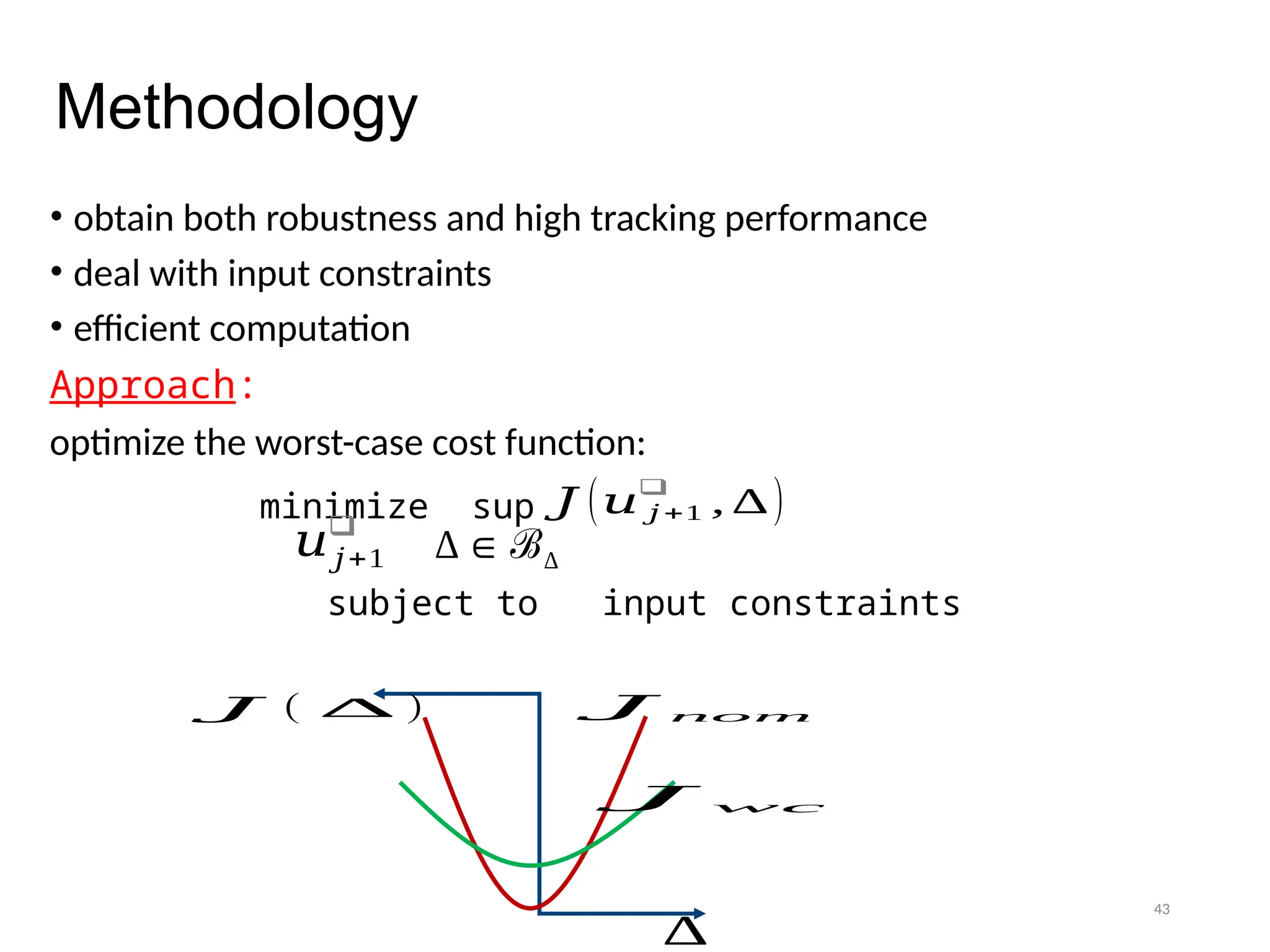
optimize the worst-case cost function:
𝐽 (𝑢 𝑗 +1
❑
, ∆)
minimize sup
𝑢𝑗+1
❑
∆∈ ℬ∆
subject to input constraints
𝐽 ( ∆ )
∆
𝐽 wc
𝐽 nom
44
Methodology
• obtain both robustness and high tracking performance
• deal with input constraints
• efficient computation
Approach:
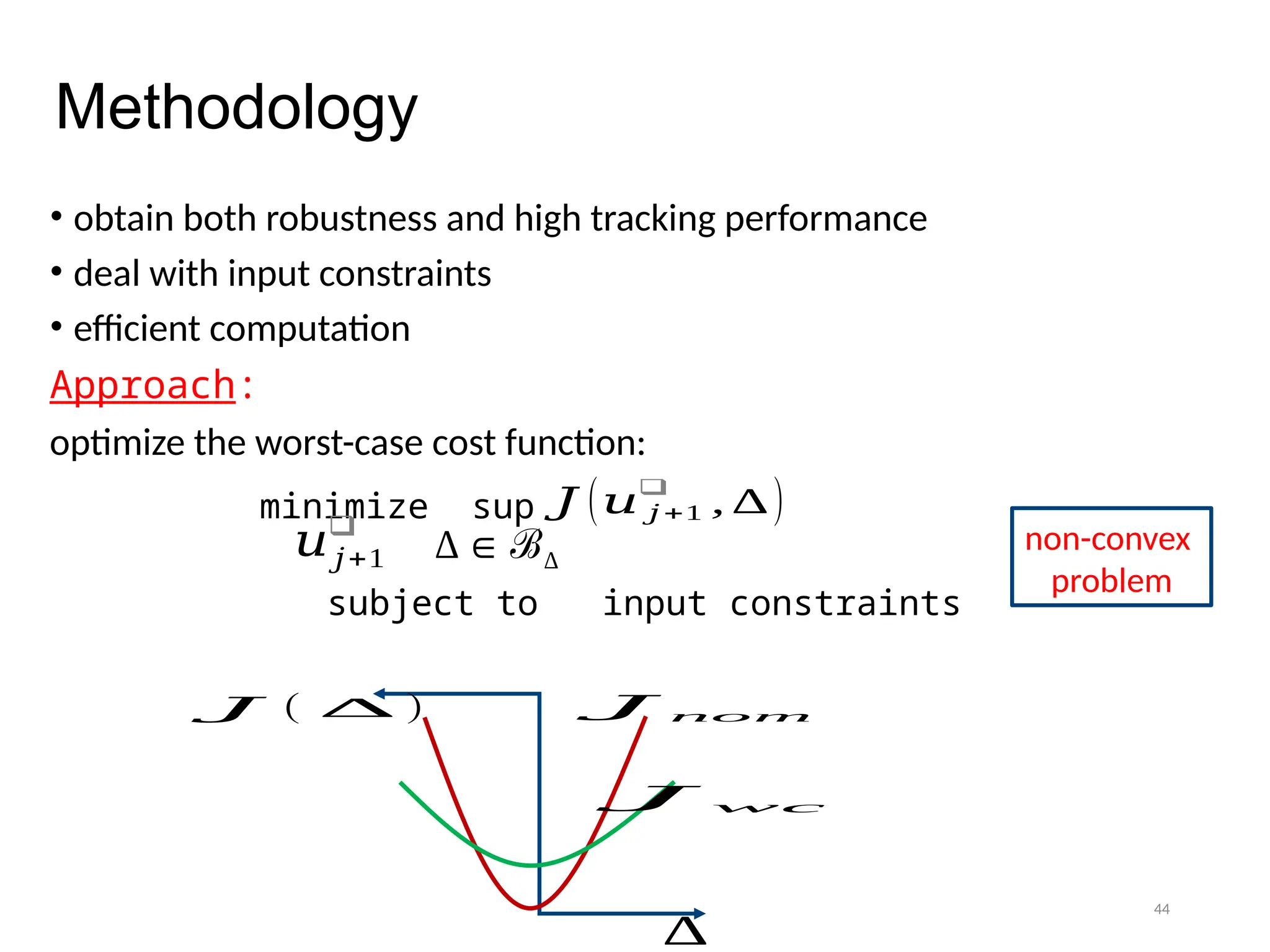
optimize the worst-case cost function:
𝐽 (𝑢 𝑗 +1
❑
, ∆)
minimize sup
𝑢𝑗+1
❑
∆∈ ℬ∆
subject to input constraints
non-convex
problem
𝐽 ( ∆ )
∆
𝐽 wc
𝐽 nom
45
Methodology
• obtain both robustness and high tracking performance
• deal with input constraints
• efficient computation
Approach:
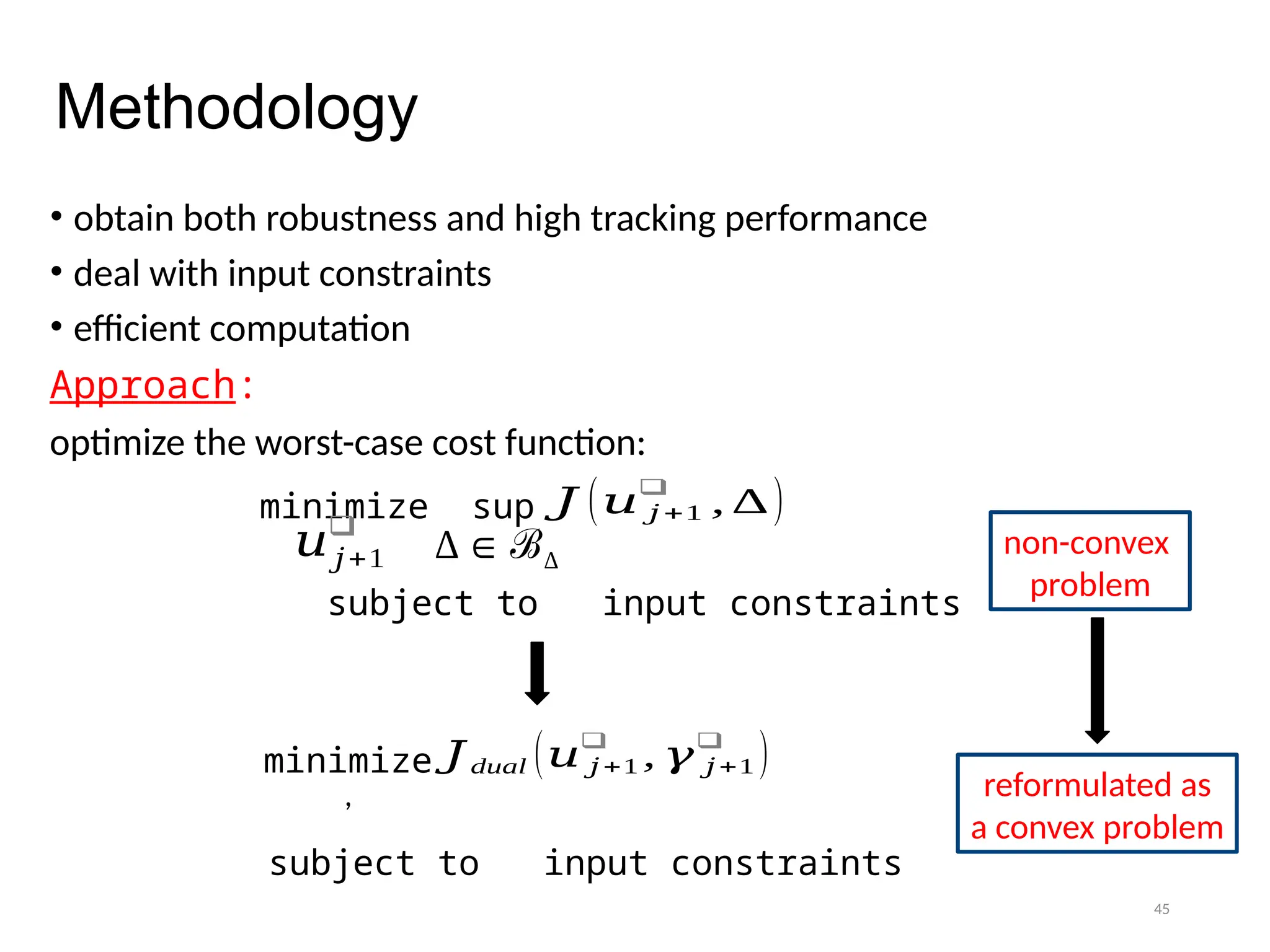
optimize the worst-case cost function:
𝐽 (𝑢 𝑗 +1
❑
, ∆)
minimize sup
𝑢𝑗+1
❑
∆∈ ℬ∆
subject to input constraints
𝐽dual (𝑢 𝑗 +1
❑
, 𝛾 𝑗 +1
❑
)
minimize
,
subject to input constraints
non-convex
problem
reformulated as
a convex problem
46
Advantages
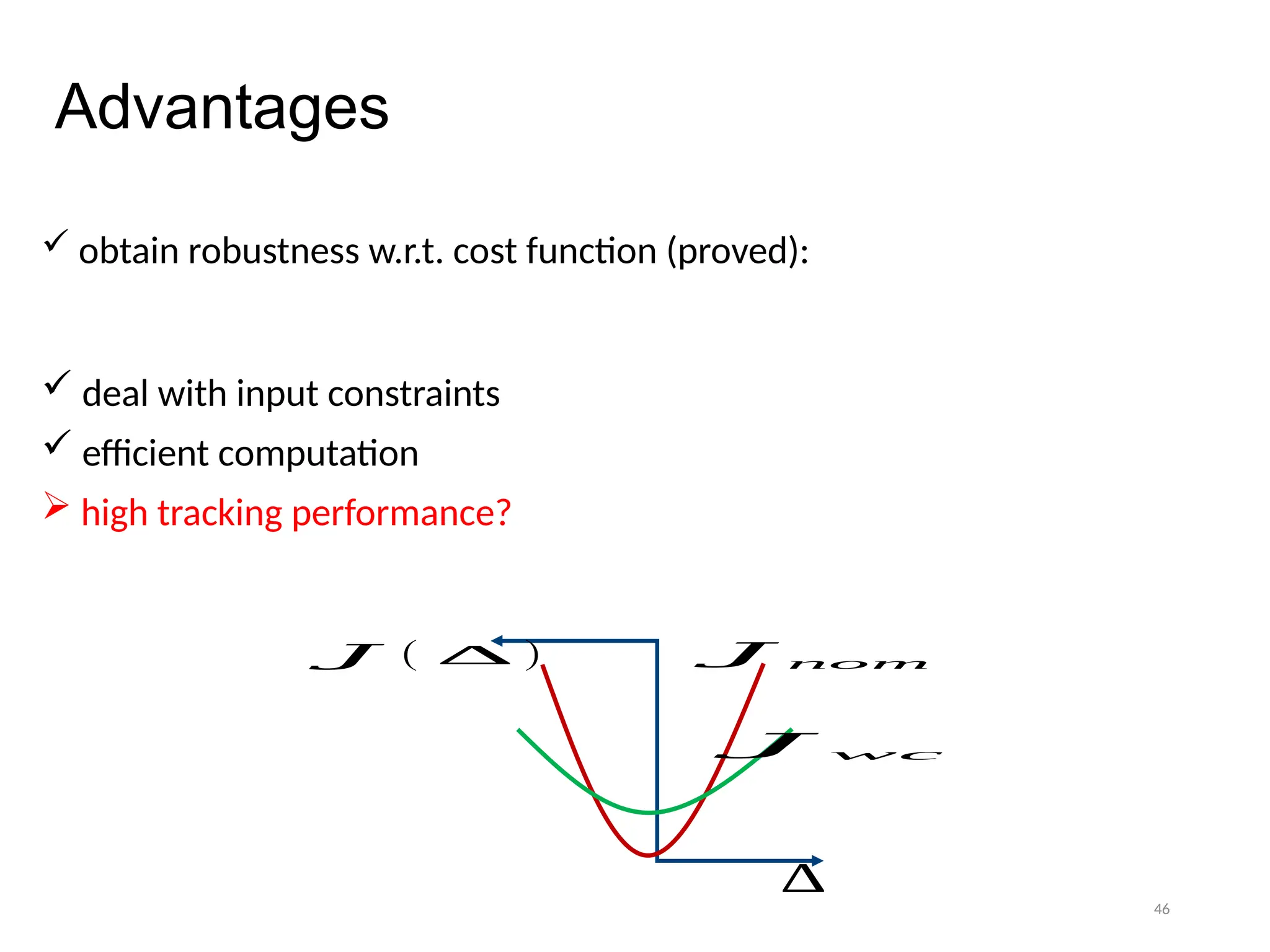
 obtain robustness w.r.t. cost function (proved):
 deal with input constraints
 efficient computation
 high tracking performance?
𝐽 ( ∆ )
∆
𝐽 wc
𝐽 nom
47
Advantages
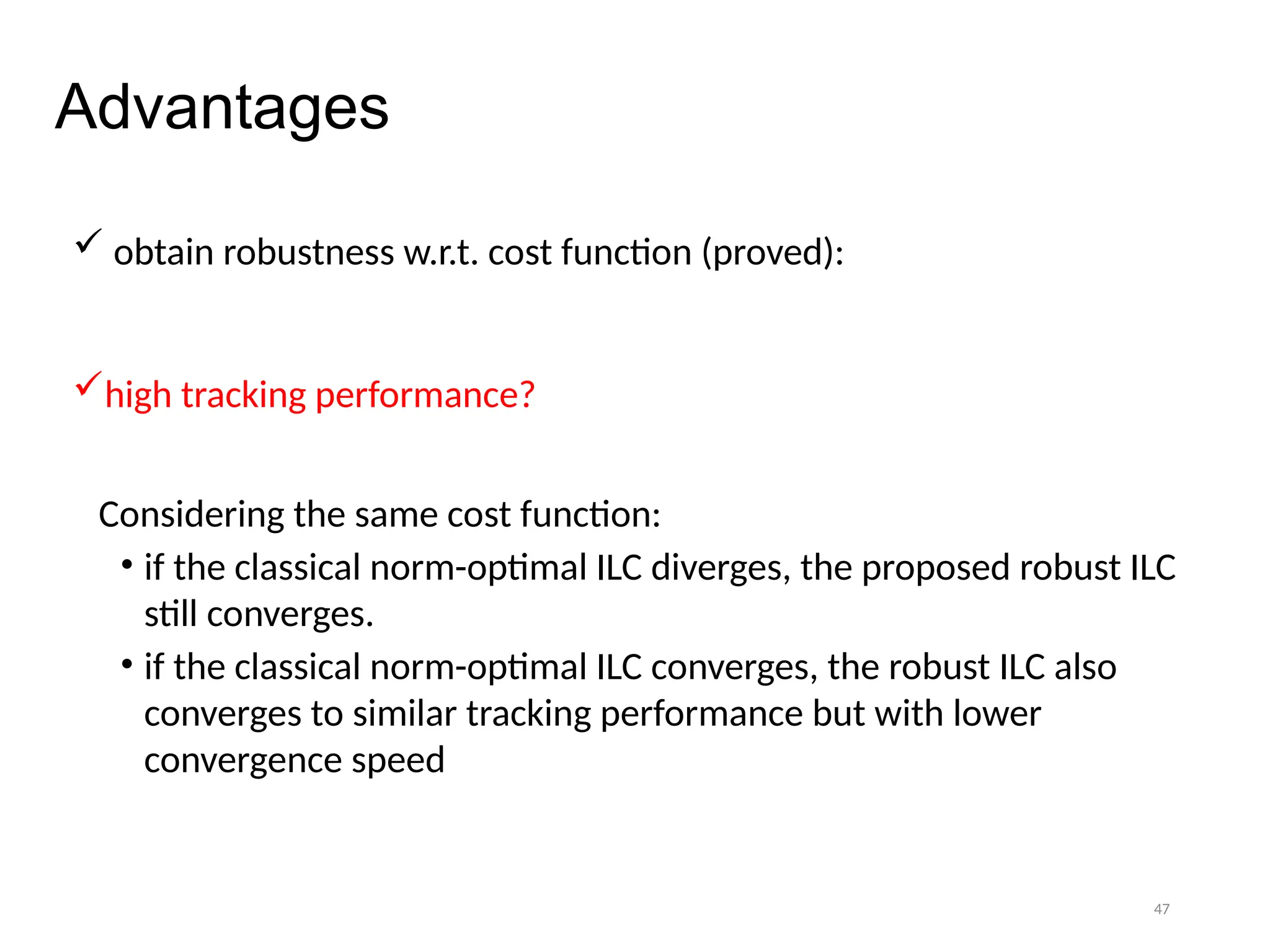
 obtain robustness w.r.t. cost function (proved):
high tracking performance?
Considering the same cost function:
• if the classical norm-optimal ILC diverges, the proposed robust ILC
still converges.
• if the classical norm-optimal ILC converges, the robust ILC also
converges to similar tracking performance but with lower
convergence speed
48
Advantages (cont.)
 deal with input constraints
 efficient computation
 the selection of weight matrices is not critical as other norm-
optimal ILC designs.
 the proof of the equivalence to an adaptive norm-optimal ILC (trial-
varying controller) can be used to avoid solving optimization if
needed (i.e. when convergence is already obtained).
49
Validation
Control
Development
Simulation &
Experimental
Validation
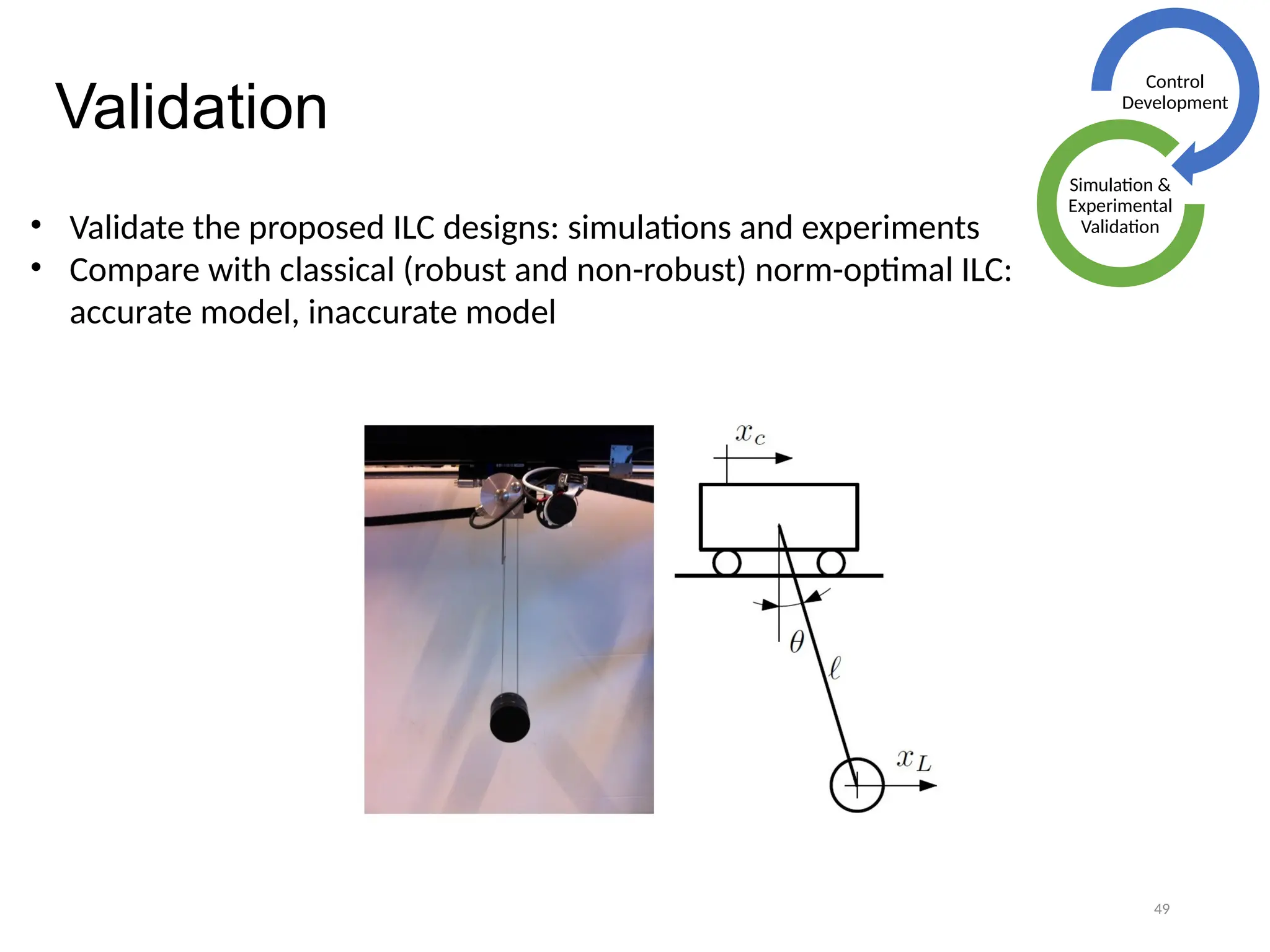
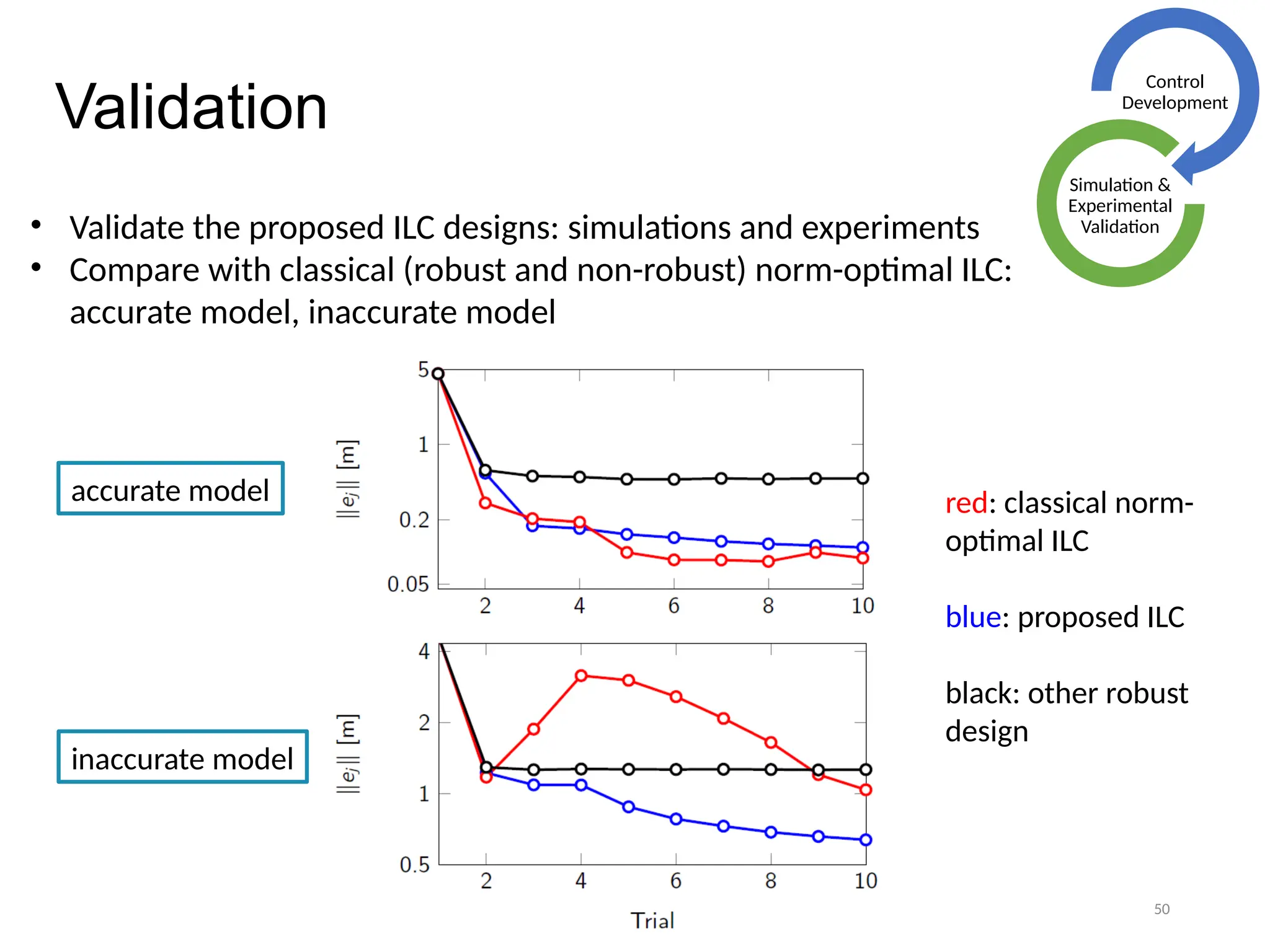
• Validate the proposed ILC designs: simulations and experiments
• Compare with classical (robust and non-robust) norm-optimal ILC:
accurate model, inaccurate model
50
Validation
Control
Development
Simulation &
Experimental
Validation
• Validate the proposed ILC designs: simulations and experiments
• Compare with classical (robust and non-robust) norm-optimal ILC:
accurate model, inaccurate model
accurate model
inaccurate model
red: classical norm-
optimal ILC
blue: proposed ILC
black: other robust
design
51
Validation
Control
Development
Simulation &
Experimental
Validation
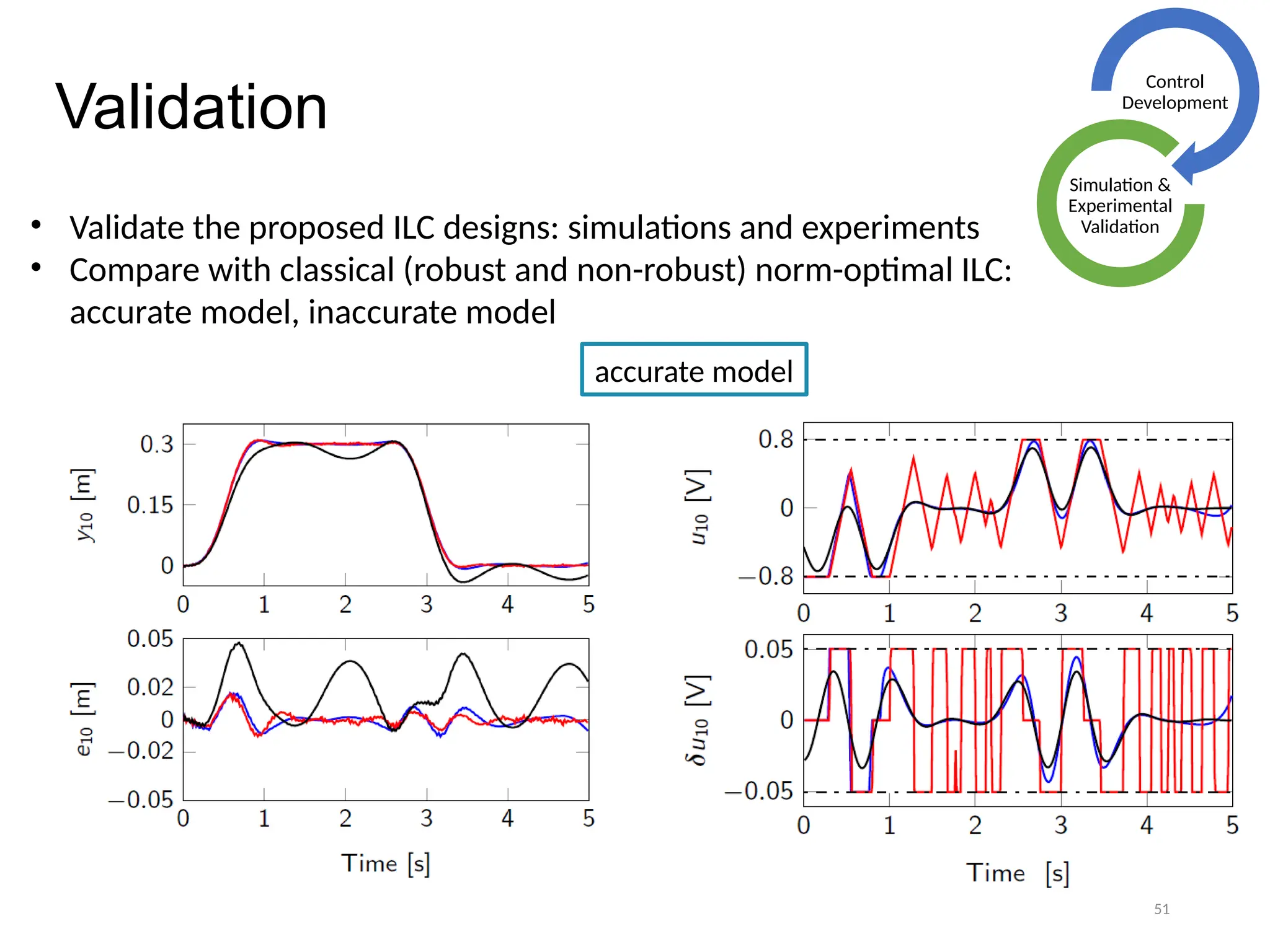
• Validate the proposed ILC designs: simulations and experiments
• Compare with classical (robust and non-robust) norm-optimal ILC:
accurate model, inaccurate model
accurate model
52
Main contributions
1. Multi-objective frequency domain ILC
2. Lifted system ILC: analysis and synthesis
3. Robust norm-optimal ILC
53
Summary
1. Robust ILC: robustness and high tracking performance, frequency and
time domain
2. Multiple objectives and their trade-offs
3. Efficient computation
4. Extensive simulation and experimental validations:
guideline to select the suitable controller
54
Future works
1. Multivariable (MIMO) systems
2. Different classes of uncertainty modelling
3. Robust ILC nonlinear optimization
4. ILC for different purposes: energy optimal, time-optimal…
5. Applications (human in the loop, distributed systems…)
55
Thank you!
More detailed information:
https://tongduyson.github.io/publication.html
56
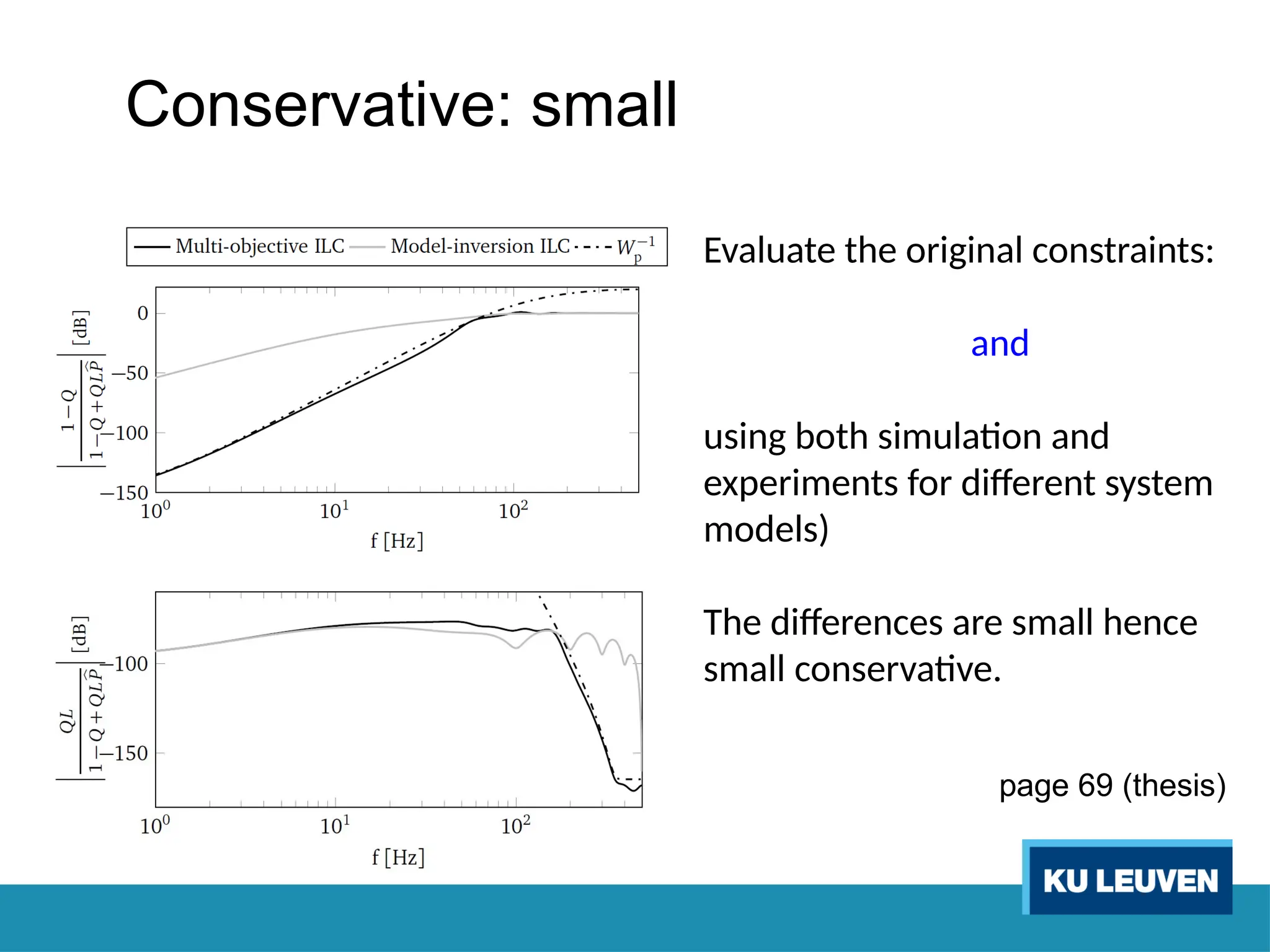
Conservative: small
Evaluate the original constraints:
and
using both simulation and
experiments for different system
models)
The differences are small hence
small conservative.
page 69 (thesis)
57
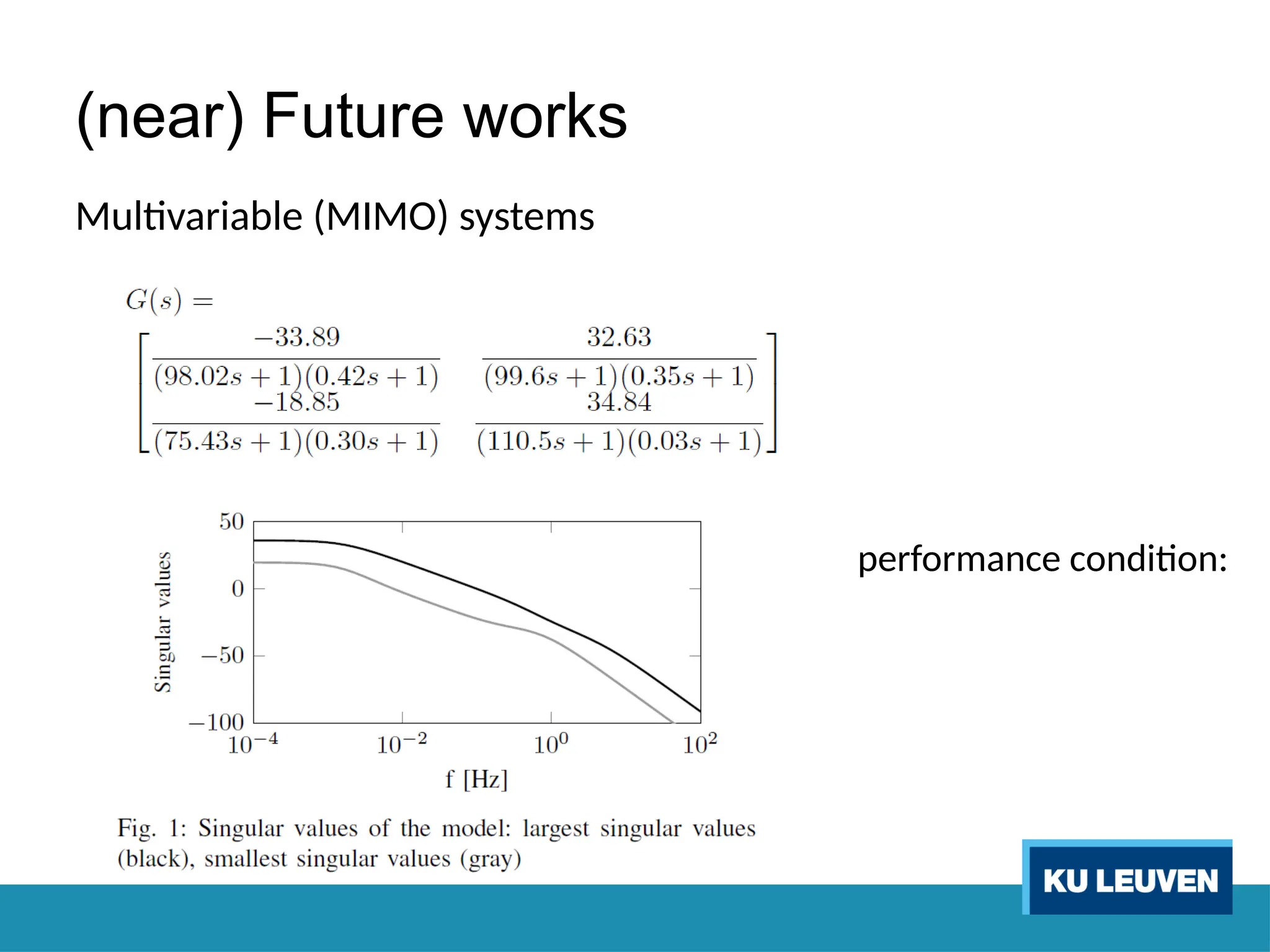
(near) Future works
Multivariable (MIMO) systems
performance condition:
58
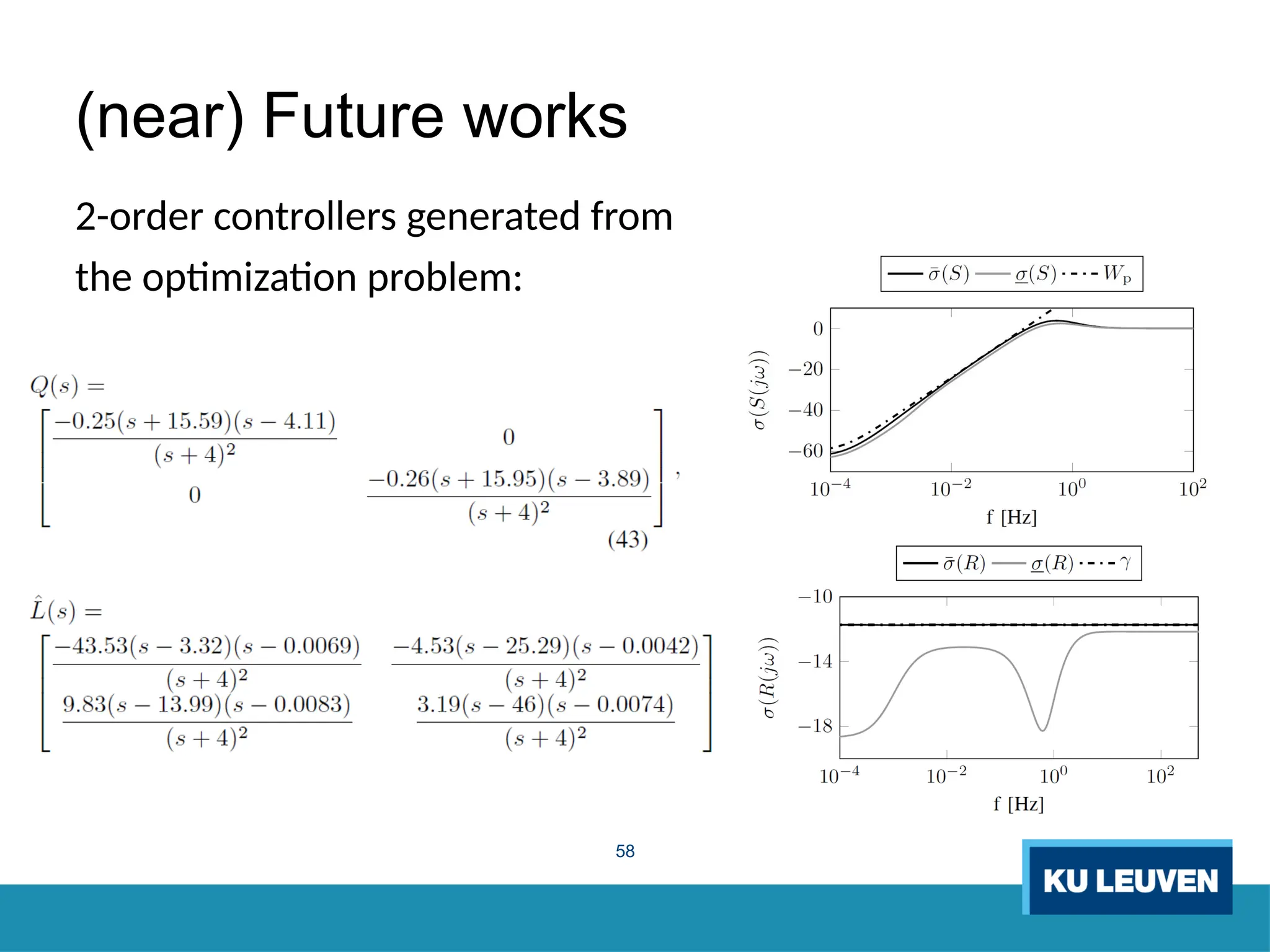
(near) Future works
2-order controllers generated from
the optimization problem:

Robust Multi-objective Iterative Learning Control 13553323.ppt

  • 1.
    Robust Multi-objective Iterative LearningControl Tong Duy Son Promoters Prof. Jan Swevers Prof. Goele Pipeleers September 2016
  • 2.
  • 3.
  • 4.
  • 5.
    1. perform 2. analyze 3.do again (and better) 3rd try
  • 6.
    6 Repetitions 1. perform 2.analyze 3. do again (and better)
  • 7.
    7 Repetitions in industry vehicletesting batch processes industrial robots semiconductor
  • 8.
    8 Repetitions in industry vehicletesting batch processes industrial robots semiconductor control system
  • 9.
    9 Challenges Goal of thisthesis • Improve the control system • Exploit ‘repetition’ Improvements in • Robustness • Precision • Fast • Energy efficiency
  • 10.
    10 Desired output: pickan object from A to B Question: What input should you apply? input desired output Consider a robot arm in a factory Sketch of Control
  • 11.
    11 Desired output: pickan object from A to B Question: What input should you apply? input desired output knowledge of the system! Sketch of Control 𝑦= 𝑓 (𝑥 ,𝑢)
  • 12.
    12 Sketch of Control Feedback Controller 𝑦=𝑓 (𝑥 ,𝑢) Feedforward Controller Feedback Feedforward
  • 13.
    13 Sketch of Control •Model uncertainty • Disturbance • Transient response, lag • Non-minimum phase • Highly dependent on accuracy of the model • Disturbance has to be known Feedback Feedforward
  • 14.
    14 Sketch of Control •Model uncertainty • Disturbance • Transient response, lag • Non-minimum phase • Highly dependent on accuracy of the model • Disturbance has to be known Feedback Feedforward feedforward feedback no control feedforward feedback no control
  • 15.
    15 Sketch of Control •Model uncertainty • Disturbance • Transient response, lag • Non-minimum phase • Highly dependent on accuracy of the model • Disturbance has to be known Feedback Feedforward feedforward feedback no control
  • 16.
    16 Repetitions in industry sametask and same performance hundreds to thousands times a day
  • 17.
    17 Revisit: Challenges Goal ofthis thesis • Improve the control system • Exploit ‘repetition’ Iterative learning control (ILC): improves control performance by incorporating information from previous trials
  • 18.
    18 Iterative Learning Control(ILC) Iterative learning control (ILC): improves control performance by incorporating information from previous trials )
  • 19.
    19 Main contributions 1. Multi-objectivefrequency domain ILC 2. Lifted system ILC: analysis and synthesis 3. Robust norm-optimal ILC
  • 20.
    20 Main contributions 1. Multi-objectivefrequency domain ILC 2. Lifted system ILC: analysis and synthesis 3. Robust norm-optimal ILC
  • 21.
    21 Introduction (1) Most ILCdesigns reply on a two-step sequential problem formulation and the design procedures are usually heuristic: • Design L then design Q: 1. L as model-inversion or phase-lead type 2. Q as a low-pass filter: depends on designed • Design Q then design L: 1. design Q 2. find L that optimize the learning speed • Iterate the previous 2 designs The design is not optimal while costly and time consuming! ) designed controller: (Q,L)
  • 22.
    22 Introduction (2) Hard toincorporate multi-objective intuitively • Robustness (unmodeled dynamics, uncertain parameter…) 1. Robustness vs tracking performance 2. Unknown: robustness and tracking performance vs learning speed have 1 month training have 4 year training (i.e. for Olympic): more difficult attempts • Input constraints • Trade-offs between the objectives
  • 23.
    23 Methodology • Design Q,L simultaneously using optimization • Accounts for the trade-off designs Approach: First, specify the desired performance, input constraints, and robustness conditions. Next, design ILC controller (Q, L) to optimize the convergence (learning) speed with the given specifications minimize convergence speed Q,L subject to robust performance robust convergence input constraints
  • 24.
    24 Methodology • Design Q,L simultaneously using optimization • Accounts for the trade-off designs Approach: First, specify the desired performance, input constraints, and robustness conditions. Next, design ILC controller (Q, L) to optimize the convergence (learning) speed with the given specifications minimize convergence speed Q,L subject to robust performance robust convergence input constraints non-convex, hard to solve!
  • 25.
    25 Methodology • Design Q,L simultaneously using optimization • Accounts for the trade-off designs Approach: First, specify the desired performance, input constraints, and robustness conditions. Next, design ILC controller (Q, L) to optimize the convergence (learning) speed with the given specifications minimize convergence speed Q,L subject to robust performance robust convergence input constraints non-convex, hard to solve! reformulated as a linear program
  • 26.
  • 27.
    Advantages (1) Multi-objective and theirtrade-offs:  convergence speed  input constraints  robust convergence  robust performance optimality computation flexibility intuition multi-objective
  • 28.
    28 Advantages (2) Optimality • no2-step and heuristic design • (Q, L) is simultaneously generated using optimization • noncausal ILC controller optimality computation flexibility intuition multi-objective • reliable as a result of a linear program Computation
  • 29.
    29 Advantages (4) Flexibility • controllertype: FIR, IIR, PID... • different objectives: minimize tracking performance Q,L subject to convergence speed robust convergence input constraints • no parametric model is required, only FRFs • continuous and discrete • selecting interested frequencies: i.e. for noise and disturbance rejection. optimality computation flexibility intuition multi-objective
  • 30.
    30 Advantages (5) Intuition • Useconventional control system terminologies: sensitivity function, bandwidth optimality computation flexibility intuition multi-objective
  • 31.
    31 Advantages (5) Intuition • Useconventional control system terminologies: sensitivity function, bandwidth optimality computation flexibility intuition multi-objective • Automated design possible Multi- objective ILC algorithm system model (FRFs) performance specs. (bandwidth) ILC controller (and learning speed)
  • 32.
    32 Validation • Validate theproposed ILC designs: simulations and experiments • Validate the multi-objective trade-offs • Compare with existing designs Control Development Simulation & Experimental Validation
  • 33.
    33 Validation Control Development Simulation & Experimental Validation tracking performancefunction (sensitivity function) convergence (learning) speed function
  • 34.
    34 Validation Control Development Simulation & Experimental Validation convergence speedvs tracking performance with 2 different designs convergence speed vs input constraints red: no constraint
  • 35.
    Validation: trade-off designsControl Development Simulation & Experimental Validation 35 Select the desired controller:  desired tracking performance  desired learning speed  level of uncertainty
  • 36.
    36 Main contributions 1. Multi-objectivefrequency domain ILC 2. Lifted system ILC: analysis and synthesis 3. Robust norm-optimal ILC
  • 37.
    37 Introduction • Consider multipleobjectives as previous, but investigate time domain using lifted system representation of finite trial length. • (Q,L) are matrix variables • Study robust analyses • Proposes ILC syntheses (designs) ) designed controller: (Q,L)
  • 38.
    38 Robustness • Robust monotonicconvergence and robust performance analyses an LMI (or BMI) problem i.e. • Both unstructured and structured uncertainty are considered
  • 39.
    39 Synthesis (for short/moderate triallengths) • Synthesis I: Optimize convergence speed • Synthesis II: Optimize tracking error ) designed controller: (Q,L) minimize convergence speed L subject to an LMI problem minimize tracking error Q subject to an LMI problem
  • 40.
  • 41.
    41 Main contributions 1. Multi-objectivefrequency domain ILC 2. Lifted system ILC: analysis and synthesis 3. Robust norm-optimal ILC
  • 42.
    42 Introduction Norm-optimal ILC isan efficient way to design the optimal ILC input: is the cost function w.r.t the nominal model (no uncertainty model is accounted)  analytical solution (noncausal, time-varying controller) × has to sacrifice a lot tracking performance to obtain robustness 𝐽 (𝑢 𝑗 +1 ❑ ) minimize 𝑢𝑗+1 ❑
  • 43.
    43 Methodology • obtain bothrobustness and high tracking performance • deal with input constraints • efficient computation Approach: optimize the worst-case cost function: 𝐽 (𝑢 𝑗 +1 ❑ , ∆) minimize sup 𝑢𝑗+1 ❑ ∆∈ ℬ∆ subject to input constraints 𝐽 ( ∆ ) ∆ 𝐽 wc 𝐽 nom
  • 44.
    44 Methodology • obtain bothrobustness and high tracking performance • deal with input constraints • efficient computation Approach: optimize the worst-case cost function: 𝐽 (𝑢 𝑗 +1 ❑ , ∆) minimize sup 𝑢𝑗+1 ❑ ∆∈ ℬ∆ subject to input constraints non-convex problem 𝐽 ( ∆ ) ∆ 𝐽 wc 𝐽 nom
  • 45.
    45 Methodology • obtain bothrobustness and high tracking performance • deal with input constraints • efficient computation Approach: optimize the worst-case cost function: 𝐽 (𝑢 𝑗 +1 ❑ , ∆) minimize sup 𝑢𝑗+1 ❑ ∆∈ ℬ∆ subject to input constraints 𝐽dual (𝑢 𝑗 +1 ❑ , 𝛾 𝑗 +1 ❑ ) minimize , subject to input constraints non-convex problem reformulated as a convex problem
  • 46.
    46 Advantages  obtain robustnessw.r.t. cost function (proved):  deal with input constraints  efficient computation  high tracking performance? 𝐽 ( ∆ ) ∆ 𝐽 wc 𝐽 nom
  • 47.
    47 Advantages  obtain robustnessw.r.t. cost function (proved): high tracking performance? Considering the same cost function: • if the classical norm-optimal ILC diverges, the proposed robust ILC still converges. • if the classical norm-optimal ILC converges, the robust ILC also converges to similar tracking performance but with lower convergence speed
  • 48.
    48 Advantages (cont.)  dealwith input constraints  efficient computation  the selection of weight matrices is not critical as other norm- optimal ILC designs.  the proof of the equivalence to an adaptive norm-optimal ILC (trial- varying controller) can be used to avoid solving optimization if needed (i.e. when convergence is already obtained).
  • 49.
    49 Validation Control Development Simulation & Experimental Validation • Validatethe proposed ILC designs: simulations and experiments • Compare with classical (robust and non-robust) norm-optimal ILC: accurate model, inaccurate model
  • 50.
    50 Validation Control Development Simulation & Experimental Validation • Validatethe proposed ILC designs: simulations and experiments • Compare with classical (robust and non-robust) norm-optimal ILC: accurate model, inaccurate model accurate model inaccurate model red: classical norm- optimal ILC blue: proposed ILC black: other robust design
  • 51.
    51 Validation Control Development Simulation & Experimental Validation • Validatethe proposed ILC designs: simulations and experiments • Compare with classical (robust and non-robust) norm-optimal ILC: accurate model, inaccurate model accurate model
  • 52.
    52 Main contributions 1. Multi-objectivefrequency domain ILC 2. Lifted system ILC: analysis and synthesis 3. Robust norm-optimal ILC
  • 53.
    53 Summary 1. Robust ILC:robustness and high tracking performance, frequency and time domain 2. Multiple objectives and their trade-offs 3. Efficient computation 4. Extensive simulation and experimental validations: guideline to select the suitable controller
  • 54.
    54 Future works 1. Multivariable(MIMO) systems 2. Different classes of uncertainty modelling 3. Robust ILC nonlinear optimization 4. ILC for different purposes: energy optimal, time-optimal… 5. Applications (human in the loop, distributed systems…)
  • 55.
    55 Thank you! More detailedinformation: https://tongduyson.github.io/publication.html
  • 56.
    56 Conservative: small Evaluate theoriginal constraints: and using both simulation and experiments for different system models) The differences are small hence small conservative. page 69 (thesis)
  • 57.
    57 (near) Future works Multivariable(MIMO) systems performance condition:
  • 58.
    58 (near) Future works 2-ordercontrollers generated from the optimization problem:

Editor's Notes