Natural Language Processing for the 
Semantic Web 
Isabelle Augenstein 
Department of Computer Science, University of Sheffield, UK 
i.augenstein@sheffield.ac.uk 
Linked Data for NLP Tutorial, ESWC Summer School 2014 
August 24, 2014
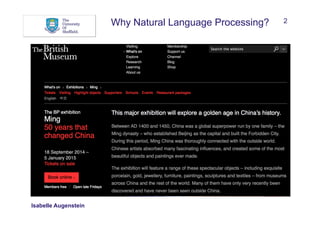
Why Natural Language Processing? 2 
Isabelle Augenstein
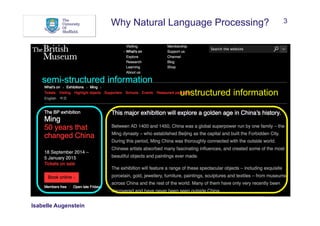
Why Natural Language Processing? 3 
semi-structured information 
Isabelle Augenstein 
unstructured information
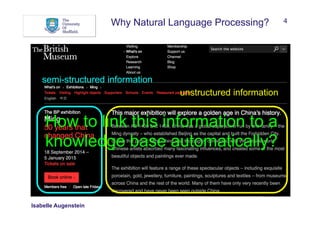
Why Natural Language Processing? 4 
semi-structured information 
Isabelle Augenstein 
unstructured information 
How to link this information to a 
knowledge base automatically?
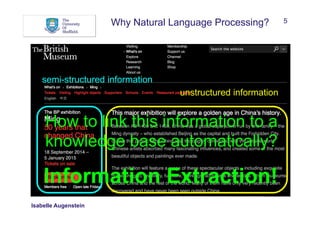
Why Natural Language Processing? 5 
semi-structured information 
Isabelle Augenstein 
unstructured information 
How to link this information to a 
knowledge base automatically? 
Information Extraction!
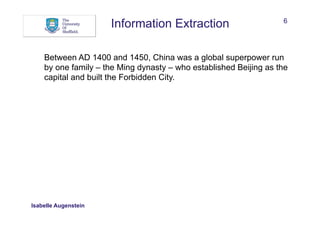
Information Extraction 6 
Between AD 1400 and 1450, China was a global superpower run 
by one family – the Ming dynasty – who established Beijing as the 
capital and built the Forbidden City. 
Isabelle Augenstein
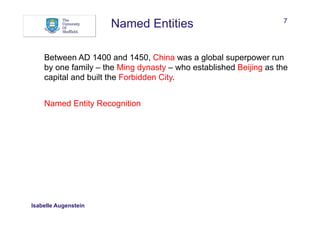
Named Entities 7 
Between AD 1400 and 1450, China was a global superpower run 
by one family – the Ming dynasty – who established Beijing as the 
capital and built the Forbidden City. 
Named Entity Recognition 
Isabelle Augenstein
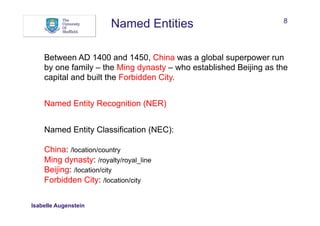
Named Entities 8 
Between AD 1400 and 1450, China was a global superpower run 
by one family – the Ming dynasty – who established Beijing as the 
capital and built the Forbidden City. 
Named Entity Recognition (NER) 
Named Entity Classification (NEC): 
China: /location/country 
Ming dynasty: /royalty/royal_line 
Beijing: /location/city 
Forbidden City: /location/city 
Isabelle Augenstein
Named Entities 9 
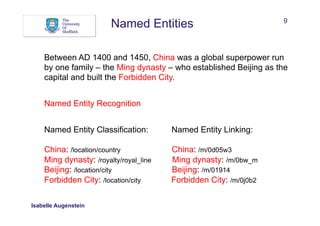
Between AD 1400 and 1450, China was a global superpower run 
by one family – the Ming dynasty – who established Beijing as the 
capital and built the Forbidden City. 
Named Entity Recognition 
Named Entity Classification: Named Entity Linking: 
China: /location/country China: /m/0d05w3 
Ming dynasty: /royalty/royal_line Ming dynasty: /m/0bw_m 
Beijing: /location/city Beijing: /m/01914 
Forbidden City: /location/city Forbidden City: /m/0j0b2 
Isabelle Augenstein
Named Entities: Definition 10 
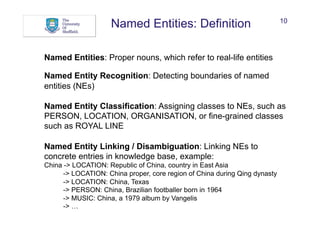
Named Entities: Proper nouns, which refer to real-life entities 
Named Entity Recognition: Detecting boundaries of named 
entities (NEs) 
Named Entity Classification: Assigning classes to NEs, such as 
PERSON, LOCATION, ORGANISATION, or fine-grained classes 
such as ROYAL LINE 
Named Entity Linking / Disambiguation: Linking NEs to 
concrete entries in knowledge base, example: 
China -> LOCATION: Republic of China, country in East Asia 
-> LOCATION: China proper, core region of China during Qing dynasty 
-> LOCATION: China, Texas 
-> PERSON: China, Brazilian footballer born in 1964 
-> MUSIC: China, a 1979 album by Vangelis 
-> …
Relations 11 
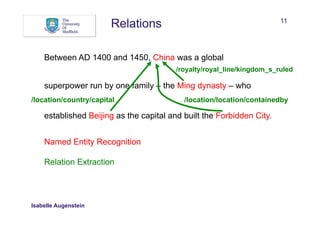
Between AD 1400 and 1450, China was a global 
superpower run by one family – the Ming dynasty – who 
established Beijing as the capital and built the Forbidden City. 
Named Entity Recognition 
Relation Extraction 
Isabelle Augenstein 
/royalty/royal_line/kingdom_s_ruled 
/location/country/capital /location/location/containedby
Relations and Time Expressions 12 
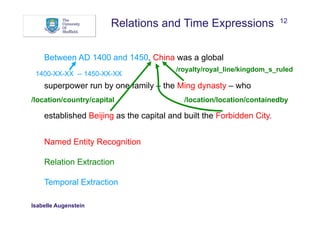
Between AD 1400 and 1450, China was a global 
1400-XX-XX -- 1450-XX-XX 
superpower run by one family – the Ming dynasty – who 
established Beijing as the capital and built the Forbidden City. 
Named Entity Recognition 
Relation Extraction 
Temporal Extraction 
Isabelle Augenstein 
/royalty/royal_line/kingdom_s_ruled 
/location/country/capital /location/location/containedby
Relations, Time Expressions 13 
and Events 
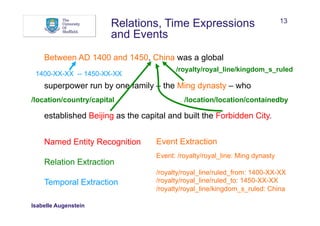
Between AD 1400 and 1450, China was a global 
1400-XX-XX -- 1450-XX-XX 
superpower run by one family – the Ming dynasty – who 
established Beijing as the capital and built the Forbidden City. 
Named Entity Recognition 
Relation Extraction 
Temporal Extraction 
Isabelle Augenstein 
/royalty/royal_line/kingdom_s_ruled 
/location/country/capital /location/location/containedby 
Event Extraction 
Event: /royalty/royal_line: Ming dynasty 
/royalty/royal_line/ruled_from: 1400-XX-XX 
/royalty/royal_line/ruled_to: 1450-XX-XX 
/royalty/royal_line/kingdom_s_ruled: China
Relations, Time Expressions 14 
and Events: Definition 
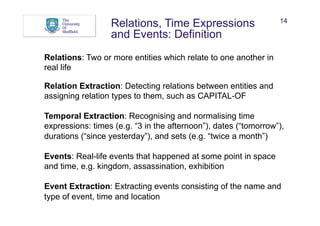
Relations: Two or more entities which relate to one another in 
real life 
Relation Extraction: Detecting relations between entities and 
assigning relation types to them, such as CAPITAL-OF 
Temporal Extraction: Recognising and normalising time 
expressions: times (e.g. “3 in the afternoon”), dates (“tomorrow”), 
durations (“since yesterday”), and sets (e.g. “twice a month”) 
Events: Real-life events that happened at some point in space 
and time, e.g. kingdom, assassination, exhibition 
Event Extraction: Extracting events consisting of the name and 
type of event, time and location
Summary: Introduction 15 
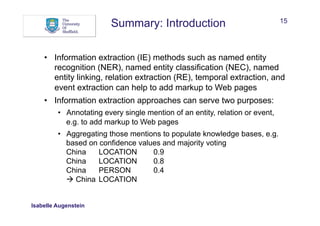
• Information extraction (IE) methods such as named entity 
recognition (NER), named entity classification (NEC), named 
entity linking, relation extraction (RE), temporal extraction, and 
event extraction can help to add markup to Web pages 
• Information extraction approaches can serve two purposes: 
• Annotating every single mention of an entity, relation or event, 
e.g. to add markup to Web pages 
• Aggregating those mentions to populate knowledge bases, e.g. 
based on confidence values and majority voting 
China LOCATION 0.9 
China LOCATION 0.8 
China PERSON 0.4 
à China LOCATION 
Isabelle Augenstein
Information Extraction: Methods 16 
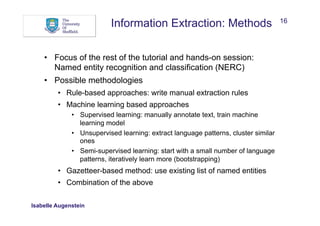
• Focus of the rest of the tutorial and hands-on session: 
Named entity recognition and classification (NERC) 
• Possible methodologies 
• Rule-based approaches: write manual extraction rules 
• Machine learning based approaches 
• Supervised learning: manually annotate text, train machine 
learning model 
• Unsupervised learning: extract language patterns, cluster similar 
ones 
• Semi-supervised learning: start with a small number of language 
patterns, iteratively learn more (bootstrapping) 
• Gazetteer-based method: use existing list of named entities 
• Combination of the above 
Isabelle Augenstein
Information Extraction: Methods 17 
Developing a NERC involves programming based around APIs.. 
Isabelle Augenstein
Information Extraction: Methods 18 
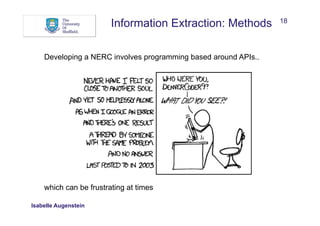
Developing a NERC involves programming based around APIs.. 
which can be frustrating at times 
Isabelle Augenstein
Information Extraction: Methods 19 
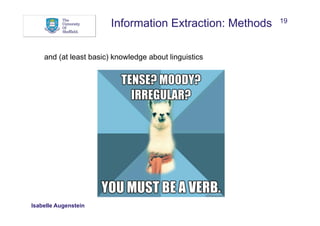
and (at least basic) knowledge about linguistics 
Isabelle Augenstein
Background: Linguistics 20 
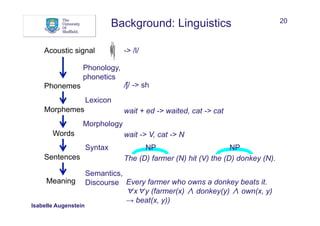
Acoustic signal 
Phonemes 
Phonology, 
phonetics 
Morphemes 
Words 
Sentences 
Meaning 
Lexicon 
Morphology 
Isabelle Augenstein 
-> /l/ 
Syntax 
Semantics, 
Discourse 
/ʃ/ -> sh 
wait + ed -> waited, cat -> cat 
wait -> V, cat -> N 
NP 
NP 
The (D) farmer (N) hit (V) the (D) donkey (N). 
Every farmer who owns a donkey beats it. 
∀x∀y (farmer(x) ∧ donkey(y) ∧ own(x, y) 
→ beat(x, y))
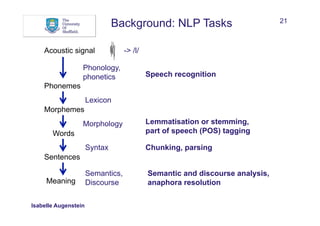
Background: NLP Tasks 21 
Acoustic signal 
Phonemes 
Morphemes 
Words 
Sentences 
Meaning 
Isabelle Augenstein 
Speech recognition 
Phonology, 
phonetics 
Morphology 
-> /l/ 
Syntax 
Lemmatisation or stemming, 
part of speech (POS) tagging 
Chunking, parsing 
Lexicon 
Semantics, 
Discourse 
Semantic and discourse analysis, 
anaphora resolution
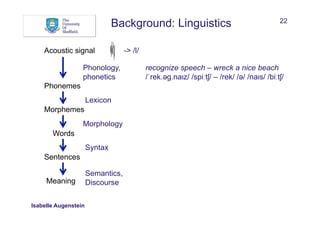
Background: Linguistics 22 
Acoustic signal 
Phonemes 
Morphemes 
Words 
Sentences 
Meaning 
Isabelle Augenstein 
recognize speech – wreck a nice beach 
/ˈrek.əәɡ.naɪz/ /spiːtʃ/ – /rek/ /əә/ /naɪs/ /biːtʃ/ 
Phonology, 
phonetics 
Lexicon 
Morphology 
-> /l/ 
Syntax 
Semantics, 
Discourse
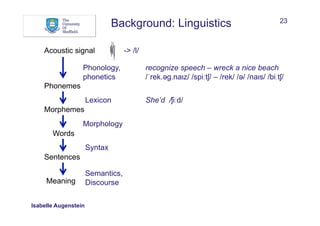
Background: Linguistics 23 
Acoustic signal 
Phonemes 
Morphemes 
Words 
Sentences 
Meaning 
Isabelle Augenstein 
recognize speech – wreck a nice beach 
/ˈrek.əәɡ.naɪz/ /spiːtʃ/ – /rek/ /əә/ /naɪs/ /biːtʃ/ 
Phonology, 
phonetics 
Lexicon She’d /ʃiːd/ 
Morphology 
-> /l/ 
Syntax 
Semantics, 
Discourse
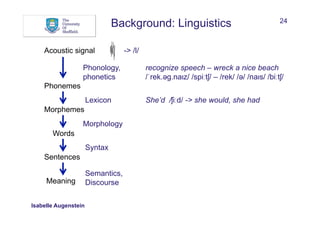
Background: Linguistics 24 
Acoustic signal 
Phonemes 
Morphemes 
Words 
Sentences 
Meaning 
Isabelle Augenstein 
recognize speech – wreck a nice beach 
/ˈrek.əәɡ.naɪz/ /spiːtʃ/ – /rek/ /əә/ /naɪs/ /biːtʃ/ 
Phonology, 
phonetics 
Lexicon She’d /ʃiːd/ -> she would, she had 
Morphology 
-> /l/ 
Syntax 
Semantics, 
Discourse
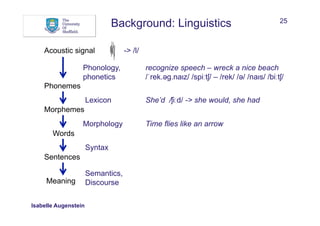
Background: Linguistics 25 
Acoustic signal 
Phonemes 
Morphemes 
Words 
Sentences 
Meaning 
Isabelle Augenstein 
recognize speech – wreck a nice beach 
/ˈrek.əәɡ.naɪz/ /spiːtʃ/ – /rek/ /əә/ /naɪs/ /biːtʃ/ 
Phonology, 
phonetics 
Lexicon She’d /ʃiːd/ -> she would, she had 
Morphology 
-> /l/ 
Syntax 
Time flies like an arrow 
Semantics, 
Discourse
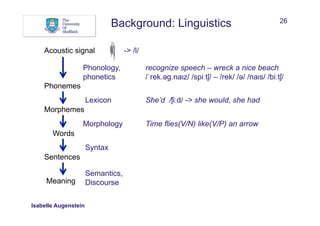
Background: Linguistics 26 
Acoustic signal 
Phonemes 
Morphemes 
Words 
Sentences 
Meaning 
Isabelle Augenstein 
recognize speech – wreck a nice beach 
/ˈrek.əәɡ.naɪz/ /spiːtʃ/ – /rek/ /əә/ /naɪs/ /biːtʃ/ 
Phonology, 
phonetics 
Lexicon She’d /ʃiːd/ -> she would, she had 
Morphology 
-> /l/ 
Syntax 
Time flies(V/N) like(V/P) an arrow 
Semantics, 
Discourse
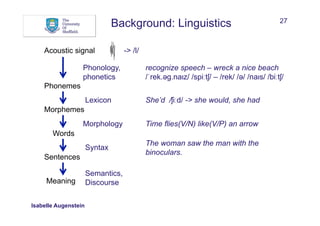
Background: Linguistics 27 
Acoustic signal 
Phonemes 
Morphemes 
Words 
Sentences 
Meaning 
Isabelle Augenstein 
recognize speech – wreck a nice beach 
/ˈrek.əәɡ.naɪz/ /spiːtʃ/ – /rek/ /əә/ /naɪs/ /biːtʃ/ 
Phonology, 
phonetics 
Lexicon She’d /ʃiːd/ -> she would, she had 
Morphology 
-> /l/ 
Syntax 
Time flies(V/N) like(V/P) an arrow 
The woman saw the man with the 
binoculars. 
Semantics, 
Discourse
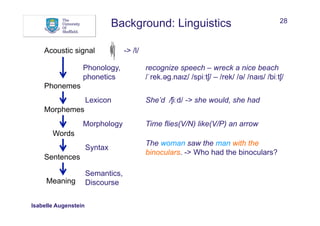
Background: Linguistics 28 
Acoustic signal 
Phonemes 
Morphemes 
Words 
Sentences 
Meaning 
Isabelle Augenstein 
recognize speech – wreck a nice beach 
/ˈrek.əәɡ.naɪz/ /spiːtʃ/ – /rek/ /əә/ /naɪs/ /biːtʃ/ 
Phonology, 
phonetics 
Lexicon She’d /ʃiːd/ -> she would, she had 
Morphology 
-> /l/ 
Syntax 
Time flies(V/N) like(V/P) an arrow 
The woman saw the man with the 
binoculars. -> Who had the binoculars? 
Semantics, 
Discourse
Background: Linguistics 29 
Acoustic signal 
Phonemes 
Morphemes 
Words 
Sentences 
Meaning 
Isabelle Augenstein 
recognize speech – wreck a nice beach 
/ˈrek.əәɡ.naɪz/ /spiːtʃ/ – /rek/ /əә/ /naɪs/ /biːtʃ/ 
Phonology, 
phonetics 
Lexicon She’d /ʃiːd/ -> she would, she had 
Morphology 
-> /l/ 
Syntax 
Time flies(V/N) like(V/P) an arrow 
The woman saw the man with the 
binoculars. -> Who had the binoculars? 
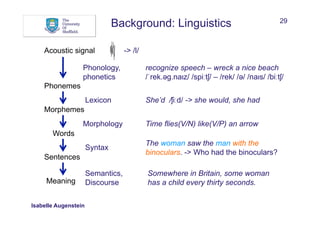
Semantics, 
Discourse 
Somewhere in Britain, some woman 
has a child every thirty seconds.
Background: Linguistics 30 
Acoustic signal 
Phonemes 
Morphemes 
Words 
Sentences 
Meaning 
Isabelle Augenstein 
recognize speech – wreck a nice beach 
/ˈrek.əәɡ.naɪz/ /spiːtʃ/ – /rek/ /əә/ /naɪs/ /biːtʃ/ 
Phonology, 
phonetics 
Lexicon She’d /ʃiːd/ -> she would, she had 
Morphology 
-> /l/ 
Syntax 
Time flies(V/N) like(V/P) an arrow 
The woman saw the man with the 
binoculars. -> Who had the binoculars? 
Semantics, 
Discourse 
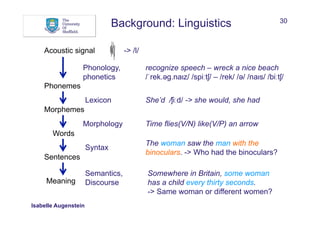
Somewhere in Britain, some woman 
has a child every thirty seconds. 
-> Same woman or different women?
Background: Linguistics 31 
Acoustic signal 
Phonemes 
Morphemes 
Words 
Sentences 
Meaning 
Isabelle Augenstein 
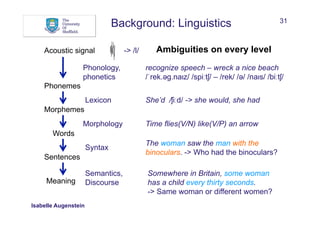
Ambiguities on every level 
recognize speech – wreck a nice beach 
/ˈrek.əәɡ.naɪz/ /spiːtʃ/ – /rek/ /əә/ /naɪs/ /biːtʃ/ 
Phonology, 
phonetics 
Lexicon She’d /ʃiːd/ -> she would, she had 
Morphology 
-> /l/ 
Syntax 
Time flies(V/N) like(V/P) an arrow 
The woman saw the man with the 
binoculars. -> Who had the binoculars? 
Semantics, 
Discourse 
Somewhere in Britain, some woman 
has a child every thirty seconds. 
-> Same woman or different women?
Background: Linguistics 32 
Acoustic signal 
Phonemes 
Morphemes 
Words 
Sentences 
Meaning 
Isabelle Augenstein 
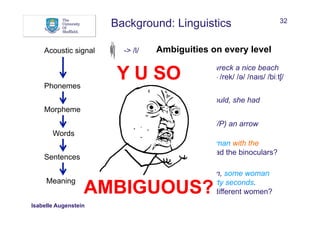
Ambiguities on every level 
Y U SO 
recognize speech – wreck a nice beach 
/ˈrek.əәɡ.naɪz/ /spiːtʃ/ – /rek/ /əә/ /naɪs/ /biːtʃ/ 
Phonology, 
phonetics 
Lexicon She’d /ʃiːd/ -> she would, she had 
Morphology 
-> /l/ 
Syntax 
Time flies(V/N) like(V/P) an arrow 
The woman saw the man with the 
binoculars. -> Who had the binoculars? 
Semantics, 
Discourse 
Somewhere in Britain, some woman 
has a child every thirty seconds. 
-> Same woman or different women? 
AMBIGUOUS?
Information Extraction 33 
Language is ambiguous.. 
Can we still build named entity extractors that extract all 
entities from unseen text correctly? 
Isabelle Augenstein
Information Extraction 34 
Language is ambiguous.. 
Can we still build named entity extractors that extract all 
entities from unseen text correctly? 
Isabelle Augenstein
Information Extraction 35 
Language is ambiguous.. 
Can we still build named entity extractors that extract all 
entities from unseen text correctly? 
However, we can try to extract most of them correctly 
using linguistic cues and background knowledge! 
Isabelle Augenstein
NERC: Features 36 
What can help to recognise and/or classify named entities? 
• Words: 
• Words in window before and after mention 
• Sequences 
• Bags of words 
Between AD 1400 and 1450, China was a global superpower 
w: China w-1: , w-2: 1450 w+1: was w+2: a 
seq[-]: 1450, seq[+]: was a 
bow: China bow[-]: , bow[-]: 1450 bow[+]: was bow[+]: a 
Isabelle Augenstein
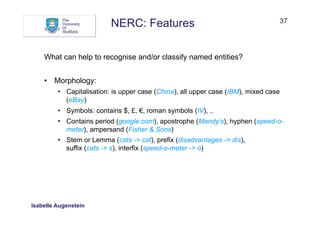
NERC: Features 37 
What can help to recognise and/or classify named entities? 
• Morphology: 
• Capitalisation: is upper case (China), all upper case (IBM), mixed case 
(eBay) 
• Symbols: contains $, £, €, roman symbols (IV), .. 
• Contains period (google.com), apostrophe (Mandy’s), hyphen (speed-o-meter), 
ampersand (Fisher & Sons) 
• Stem or Lemma (cats -> cat), prefix (disadvantages -> dis), 
suffix (cats -> s), interfix (speed-o-meter -> o) 
Isabelle Augenstein
our learning component. 
4.1 Part-of-Speech Tags 
Part-Of-Speech (POS) tags have often been considered as 
an important discriminative feature for term identification. 
Many works on key term identification apply either fixed 
or regular expression POS tag patterns to improve their ef-fectiveness. 
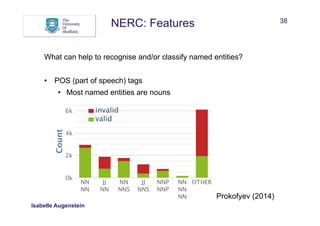
NERC: Features 38 
Nonetheless, POS tags alone cannot produce 
What can help to recognise and/or classify named entities? 
high-quality results. As can be seen from the overall POS 
tag distribution graph extracted from one of our collections 
(see Figure 3), many of the most frequent tag patterns (e.g., 
JJNN tagging adjectives and nouns6) are far from yielding 
perfect results. 
• POS (part of speech) tags 
• Most named entities are nouns 


• Prokofyev (2014) 
Isabelle Augenstein
Figure 3: Top 6 most frequent part-of-speech tag 
patterns of the SIGIR collection, where JJ stands 
comma, while the n-gram“automatic which is indeed a valid the beginning or at the end The contingency tables given this: The +punctuation respectively, the counts of the punctuation mark in any of of the n-grams that have no occurrences. From the tables, of punctuation marks (+punctuation) an n-gram occurs twice as often valid entities compared to the that the absence of punctuation less frequently for the valid ones. 
Table 1: Contingency table appearing immediately before Valid +punctuation 1622 punctuation 6523 Totals 8145 Table 2: Contingency table appearing immediately after Valid +punctuation 4887
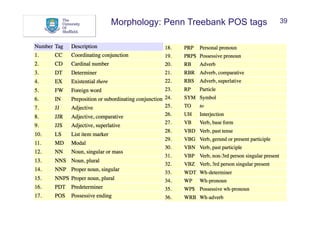
Morphology: Penn Treebank POS tags 39
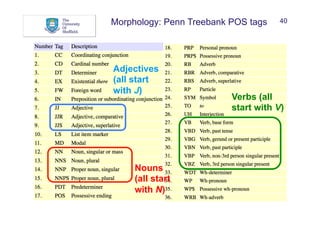
Morphology: Penn Treebank POS tags 40 
Nouns 
(all start 
with N) 
Verbs (all 
start with V) 
Adjectives 
(all start 
with J)
our learning component. 
4.1 Part-of-Speech Tags 
Part-Of-Speech (POS) tags have often been considered as 
an important discriminative feature for term identification. 
Many works on key term identification apply either fixed 
or regular expression POS tag patterns to improve their ef-fectiveness. 
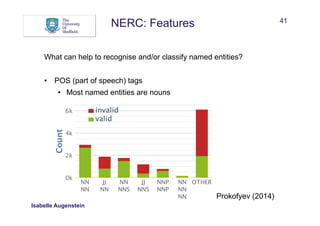
NERC: Features 41 
Nonetheless, POS tags alone cannot produce 
What can help to recognise and/or classify named entities? 
high-quality results. As can be seen from the overall POS 
tag distribution graph extracted from one of our collections 
(see Figure 3), many of the most frequent tag patterns (e.g., 
JJNN tagging adjectives and nouns6) are far from yielding 
perfect results. 
• POS (part of speech) tags 
• Most named entities are nouns 


• Prokofyev (2014) 
Isabelle Augenstein
Figure 3: Top 6 most frequent part-of-speech tag 
patterns of the SIGIR collection, where JJ stands 
comma, while the n-gram“automatic which is indeed a valid the beginning or at the end The contingency tables given this: The +punctuation respectively, the counts of the punctuation mark in any of of the n-grams that have no occurrences. From the tables, of punctuation marks (+punctuation) an n-gram occurs twice as often valid entities compared to the that the absence of punctuation less frequently for the valid ones. 
Table 1: Contingency table appearing immediately before Valid +punctuation 1622 punctuation 6523 Totals 8145 Table 2: Contingency table appearing immediately after Valid +punctuation 4887
NERC: Features 42 
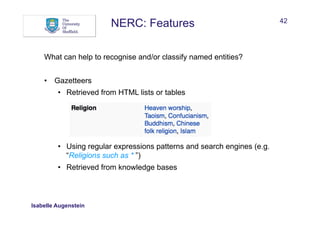
What can help to recognise and/or classify named entities? 
• Gazetteers 
• Retrieved from HTML lists or tables 
• Using regular expressions patterns and search engines (e.g. 
“Religions such as * ”) 
• Retrieved from knowledge bases 
Isabelle Augenstein
NERC: Training Models 43 
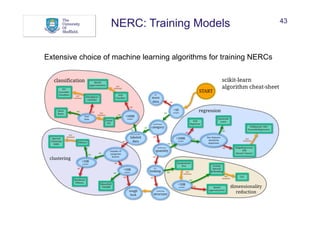
Extensive choice of machine learning algorithms for training NERCs
NERC: Training Models 44 
Extensive choice of machine learning algorithms for training NERCs
NERC: Training Models 45 
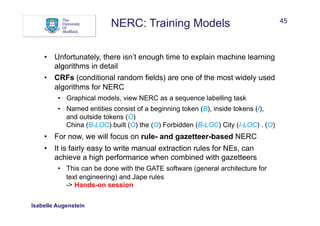
• Unfortunately, there isn’t enough time to explain machine learning 
algorithms in detail 
• CRFs (conditional random fields) are one of the most widely used 
algorithms for NERC 
• Graphical models, view NERC as a sequence labelling task 
• Named entities consist of a beginning token (B), inside tokens (I), 
and outside tokens (O) 
China (B-LOC) built (O) the (O) Forbidden (B-LOC) City (I-LOC) . (O) 
• For now, we will focus on rule- and gazetteer-based NERC 
• It is fairly easy to write manual extraction rules for NEs, can 
achieve a high performance when combined with gazetteers 
• This can be done with the GATE software (general architecture for 
text engineering) and Jape rules 
- Hands-on session 
Isabelle Augenstein
Outlook: NLP  ML Software 46 
Natural Language Processing: 
- GATE (general purpose architecture, includes other NLP and ML 
software as plugins) 
- Stanford NLP (Java) 
- OpenNLP (Java) 
- NLTK (Python) 
Machine Learning: 
- scikit-learn (Python, rich documentation, highly recommended!) 
- Mallet (Java) 
- WEKA (Java) 
- Alchemy (graphical models, Java) 
- FACTORIE (graphical models, Scala) 
- CRFSuite (efficient implementation of CRFs, Python) 
Isabelle Augenstein

Natural Language Processing for the Semantic Web

  • 1.
    Natural Language Processingfor the Semantic Web Isabelle Augenstein Department of Computer Science, University of Sheffield, UK i.augenstein@sheffield.ac.uk Linked Data for NLP Tutorial, ESWC Summer School 2014 August 24, 2014
  • 2.
    Why Natural LanguageProcessing? 2 Isabelle Augenstein
  • 3.
    Why Natural LanguageProcessing? 3 semi-structured information Isabelle Augenstein unstructured information
  • 4.
    Why Natural LanguageProcessing? 4 semi-structured information Isabelle Augenstein unstructured information How to link this information to a knowledge base automatically?
  • 5.
    Why Natural LanguageProcessing? 5 semi-structured information Isabelle Augenstein unstructured information How to link this information to a knowledge base automatically? Information Extraction!
  • 6.
    Information Extraction 6 Between AD 1400 and 1450, China was a global superpower run by one family – the Ming dynasty – who established Beijing as the capital and built the Forbidden City. Isabelle Augenstein
  • 7.
    Named Entities 7 Between AD 1400 and 1450, China was a global superpower run by one family – the Ming dynasty – who established Beijing as the capital and built the Forbidden City. Named Entity Recognition Isabelle Augenstein
  • 8.
    Named Entities 8 Between AD 1400 and 1450, China was a global superpower run by one family – the Ming dynasty – who established Beijing as the capital and built the Forbidden City. Named Entity Recognition (NER) Named Entity Classification (NEC): China: /location/country Ming dynasty: /royalty/royal_line Beijing: /location/city Forbidden City: /location/city Isabelle Augenstein
  • 9.
    Named Entities 9 Between AD 1400 and 1450, China was a global superpower run by one family – the Ming dynasty – who established Beijing as the capital and built the Forbidden City. Named Entity Recognition Named Entity Classification: Named Entity Linking: China: /location/country China: /m/0d05w3 Ming dynasty: /royalty/royal_line Ming dynasty: /m/0bw_m Beijing: /location/city Beijing: /m/01914 Forbidden City: /location/city Forbidden City: /m/0j0b2 Isabelle Augenstein
  • 10.
    Named Entities: Definition10 Named Entities: Proper nouns, which refer to real-life entities Named Entity Recognition: Detecting boundaries of named entities (NEs) Named Entity Classification: Assigning classes to NEs, such as PERSON, LOCATION, ORGANISATION, or fine-grained classes such as ROYAL LINE Named Entity Linking / Disambiguation: Linking NEs to concrete entries in knowledge base, example: China -> LOCATION: Republic of China, country in East Asia -> LOCATION: China proper, core region of China during Qing dynasty -> LOCATION: China, Texas -> PERSON: China, Brazilian footballer born in 1964 -> MUSIC: China, a 1979 album by Vangelis -> …
  • 11.
    Relations 11 BetweenAD 1400 and 1450, China was a global superpower run by one family – the Ming dynasty – who established Beijing as the capital and built the Forbidden City. Named Entity Recognition Relation Extraction Isabelle Augenstein /royalty/royal_line/kingdom_s_ruled /location/country/capital /location/location/containedby
  • 12.
    Relations and TimeExpressions 12 Between AD 1400 and 1450, China was a global 1400-XX-XX -- 1450-XX-XX superpower run by one family – the Ming dynasty – who established Beijing as the capital and built the Forbidden City. Named Entity Recognition Relation Extraction Temporal Extraction Isabelle Augenstein /royalty/royal_line/kingdom_s_ruled /location/country/capital /location/location/containedby
  • 13.
    Relations, Time Expressions13 and Events Between AD 1400 and 1450, China was a global 1400-XX-XX -- 1450-XX-XX superpower run by one family – the Ming dynasty – who established Beijing as the capital and built the Forbidden City. Named Entity Recognition Relation Extraction Temporal Extraction Isabelle Augenstein /royalty/royal_line/kingdom_s_ruled /location/country/capital /location/location/containedby Event Extraction Event: /royalty/royal_line: Ming dynasty /royalty/royal_line/ruled_from: 1400-XX-XX /royalty/royal_line/ruled_to: 1450-XX-XX /royalty/royal_line/kingdom_s_ruled: China
  • 14.
    Relations, Time Expressions14 and Events: Definition Relations: Two or more entities which relate to one another in real life Relation Extraction: Detecting relations between entities and assigning relation types to them, such as CAPITAL-OF Temporal Extraction: Recognising and normalising time expressions: times (e.g. “3 in the afternoon”), dates (“tomorrow”), durations (“since yesterday”), and sets (e.g. “twice a month”) Events: Real-life events that happened at some point in space and time, e.g. kingdom, assassination, exhibition Event Extraction: Extracting events consisting of the name and type of event, time and location
  • 15.
    Summary: Introduction 15 • Information extraction (IE) methods such as named entity recognition (NER), named entity classification (NEC), named entity linking, relation extraction (RE), temporal extraction, and event extraction can help to add markup to Web pages • Information extraction approaches can serve two purposes: • Annotating every single mention of an entity, relation or event, e.g. to add markup to Web pages • Aggregating those mentions to populate knowledge bases, e.g. based on confidence values and majority voting China LOCATION 0.9 China LOCATION 0.8 China PERSON 0.4 à China LOCATION Isabelle Augenstein
  • 16.
    Information Extraction: Methods16 • Focus of the rest of the tutorial and hands-on session: Named entity recognition and classification (NERC) • Possible methodologies • Rule-based approaches: write manual extraction rules • Machine learning based approaches • Supervised learning: manually annotate text, train machine learning model • Unsupervised learning: extract language patterns, cluster similar ones • Semi-supervised learning: start with a small number of language patterns, iteratively learn more (bootstrapping) • Gazetteer-based method: use existing list of named entities • Combination of the above Isabelle Augenstein
  • 17.
    Information Extraction: Methods17 Developing a NERC involves programming based around APIs.. Isabelle Augenstein
  • 18.
    Information Extraction: Methods18 Developing a NERC involves programming based around APIs.. which can be frustrating at times Isabelle Augenstein
  • 19.
    Information Extraction: Methods19 and (at least basic) knowledge about linguistics Isabelle Augenstein
  • 20.
    Background: Linguistics 20 Acoustic signal Phonemes Phonology, phonetics Morphemes Words Sentences Meaning Lexicon Morphology Isabelle Augenstein -> /l/ Syntax Semantics, Discourse /ʃ/ -> sh wait + ed -> waited, cat -> cat wait -> V, cat -> N NP NP The (D) farmer (N) hit (V) the (D) donkey (N). Every farmer who owns a donkey beats it. ∀x∀y (farmer(x) ∧ donkey(y) ∧ own(x, y) → beat(x, y))
  • 21.
    Background: NLP Tasks21 Acoustic signal Phonemes Morphemes Words Sentences Meaning Isabelle Augenstein Speech recognition Phonology, phonetics Morphology -> /l/ Syntax Lemmatisation or stemming, part of speech (POS) tagging Chunking, parsing Lexicon Semantics, Discourse Semantic and discourse analysis, anaphora resolution
  • 22.
    Background: Linguistics 22 Acoustic signal Phonemes Morphemes Words Sentences Meaning Isabelle Augenstein recognize speech – wreck a nice beach /ˈrek.əәɡ.naɪz/ /spiːtʃ/ – /rek/ /əә/ /naɪs/ /biːtʃ/ Phonology, phonetics Lexicon Morphology -> /l/ Syntax Semantics, Discourse
  • 23.
    Background: Linguistics 23 Acoustic signal Phonemes Morphemes Words Sentences Meaning Isabelle Augenstein recognize speech – wreck a nice beach /ˈrek.əәɡ.naɪz/ /spiːtʃ/ – /rek/ /əә/ /naɪs/ /biːtʃ/ Phonology, phonetics Lexicon She’d /ʃiːd/ Morphology -> /l/ Syntax Semantics, Discourse
  • 24.
    Background: Linguistics 24 Acoustic signal Phonemes Morphemes Words Sentences Meaning Isabelle Augenstein recognize speech – wreck a nice beach /ˈrek.əәɡ.naɪz/ /spiːtʃ/ – /rek/ /əә/ /naɪs/ /biːtʃ/ Phonology, phonetics Lexicon She’d /ʃiːd/ -> she would, she had Morphology -> /l/ Syntax Semantics, Discourse
  • 25.
    Background: Linguistics 25 Acoustic signal Phonemes Morphemes Words Sentences Meaning Isabelle Augenstein recognize speech – wreck a nice beach /ˈrek.əәɡ.naɪz/ /spiːtʃ/ – /rek/ /əә/ /naɪs/ /biːtʃ/ Phonology, phonetics Lexicon She’d /ʃiːd/ -> she would, she had Morphology -> /l/ Syntax Time flies like an arrow Semantics, Discourse
  • 26.
    Background: Linguistics 26 Acoustic signal Phonemes Morphemes Words Sentences Meaning Isabelle Augenstein recognize speech – wreck a nice beach /ˈrek.əәɡ.naɪz/ /spiːtʃ/ – /rek/ /əә/ /naɪs/ /biːtʃ/ Phonology, phonetics Lexicon She’d /ʃiːd/ -> she would, she had Morphology -> /l/ Syntax Time flies(V/N) like(V/P) an arrow Semantics, Discourse
  • 27.
    Background: Linguistics 27 Acoustic signal Phonemes Morphemes Words Sentences Meaning Isabelle Augenstein recognize speech – wreck a nice beach /ˈrek.əәɡ.naɪz/ /spiːtʃ/ – /rek/ /əә/ /naɪs/ /biːtʃ/ Phonology, phonetics Lexicon She’d /ʃiːd/ -> she would, she had Morphology -> /l/ Syntax Time flies(V/N) like(V/P) an arrow The woman saw the man with the binoculars. Semantics, Discourse
  • 28.
    Background: Linguistics 28 Acoustic signal Phonemes Morphemes Words Sentences Meaning Isabelle Augenstein recognize speech – wreck a nice beach /ˈrek.əәɡ.naɪz/ /spiːtʃ/ – /rek/ /əә/ /naɪs/ /biːtʃ/ Phonology, phonetics Lexicon She’d /ʃiːd/ -> she would, she had Morphology -> /l/ Syntax Time flies(V/N) like(V/P) an arrow The woman saw the man with the binoculars. -> Who had the binoculars? Semantics, Discourse
  • 29.
    Background: Linguistics 29 Acoustic signal Phonemes Morphemes Words Sentences Meaning Isabelle Augenstein recognize speech – wreck a nice beach /ˈrek.əәɡ.naɪz/ /spiːtʃ/ – /rek/ /əә/ /naɪs/ /biːtʃ/ Phonology, phonetics Lexicon She’d /ʃiːd/ -> she would, she had Morphology -> /l/ Syntax Time flies(V/N) like(V/P) an arrow The woman saw the man with the binoculars. -> Who had the binoculars? Semantics, Discourse Somewhere in Britain, some woman has a child every thirty seconds.
  • 30.
    Background: Linguistics 30 Acoustic signal Phonemes Morphemes Words Sentences Meaning Isabelle Augenstein recognize speech – wreck a nice beach /ˈrek.əәɡ.naɪz/ /spiːtʃ/ – /rek/ /əә/ /naɪs/ /biːtʃ/ Phonology, phonetics Lexicon She’d /ʃiːd/ -> she would, she had Morphology -> /l/ Syntax Time flies(V/N) like(V/P) an arrow The woman saw the man with the binoculars. -> Who had the binoculars? Semantics, Discourse Somewhere in Britain, some woman has a child every thirty seconds. -> Same woman or different women?
  • 31.
    Background: Linguistics 31 Acoustic signal Phonemes Morphemes Words Sentences Meaning Isabelle Augenstein Ambiguities on every level recognize speech – wreck a nice beach /ˈrek.əәɡ.naɪz/ /spiːtʃ/ – /rek/ /əә/ /naɪs/ /biːtʃ/ Phonology, phonetics Lexicon She’d /ʃiːd/ -> she would, she had Morphology -> /l/ Syntax Time flies(V/N) like(V/P) an arrow The woman saw the man with the binoculars. -> Who had the binoculars? Semantics, Discourse Somewhere in Britain, some woman has a child every thirty seconds. -> Same woman or different women?
  • 32.
    Background: Linguistics 32 Acoustic signal Phonemes Morphemes Words Sentences Meaning Isabelle Augenstein Ambiguities on every level Y U SO recognize speech – wreck a nice beach /ˈrek.əәɡ.naɪz/ /spiːtʃ/ – /rek/ /əә/ /naɪs/ /biːtʃ/ Phonology, phonetics Lexicon She’d /ʃiːd/ -> she would, she had Morphology -> /l/ Syntax Time flies(V/N) like(V/P) an arrow The woman saw the man with the binoculars. -> Who had the binoculars? Semantics, Discourse Somewhere in Britain, some woman has a child every thirty seconds. -> Same woman or different women? AMBIGUOUS?
  • 33.
    Information Extraction 33 Language is ambiguous.. Can we still build named entity extractors that extract all entities from unseen text correctly? Isabelle Augenstein
  • 34.
    Information Extraction 34 Language is ambiguous.. Can we still build named entity extractors that extract all entities from unseen text correctly? Isabelle Augenstein
  • 35.
    Information Extraction 35 Language is ambiguous.. Can we still build named entity extractors that extract all entities from unseen text correctly? However, we can try to extract most of them correctly using linguistic cues and background knowledge! Isabelle Augenstein
  • 36.
    NERC: Features 36 What can help to recognise and/or classify named entities? • Words: • Words in window before and after mention • Sequences • Bags of words Between AD 1400 and 1450, China was a global superpower w: China w-1: , w-2: 1450 w+1: was w+2: a seq[-]: 1450, seq[+]: was a bow: China bow[-]: , bow[-]: 1450 bow[+]: was bow[+]: a Isabelle Augenstein
  • 37.
    NERC: Features 37 What can help to recognise and/or classify named entities? • Morphology: • Capitalisation: is upper case (China), all upper case (IBM), mixed case (eBay) • Symbols: contains $, £, €, roman symbols (IV), .. • Contains period (google.com), apostrophe (Mandy’s), hyphen (speed-o-meter), ampersand (Fisher & Sons) • Stem or Lemma (cats -> cat), prefix (disadvantages -> dis), suffix (cats -> s), interfix (speed-o-meter -> o) Isabelle Augenstein
  • 38.
    our learning component. 4.1 Part-of-Speech Tags Part-Of-Speech (POS) tags have often been considered as an important discriminative feature for term identification. Many works on key term identification apply either fixed or regular expression POS tag patterns to improve their ef-fectiveness. NERC: Features 38 Nonetheless, POS tags alone cannot produce What can help to recognise and/or classify named entities? high-quality results. As can be seen from the overall POS tag distribution graph extracted from one of our collections (see Figure 3), many of the most frequent tag patterns (e.g., JJNN tagging adjectives and nouns6) are far from yielding perfect results. • POS (part of speech) tags • Most named entities are nouns • Prokofyev (2014) Isabelle Augenstein
  • 39.
    Figure 3: Top6 most frequent part-of-speech tag patterns of the SIGIR collection, where JJ stands comma, while the n-gram“automatic which is indeed a valid the beginning or at the end The contingency tables given this: The +punctuation respectively, the counts of the punctuation mark in any of of the n-grams that have no occurrences. From the tables, of punctuation marks (+punctuation) an n-gram occurs twice as often valid entities compared to the that the absence of punctuation less frequently for the valid ones. Table 1: Contingency table appearing immediately before Valid +punctuation 1622 punctuation 6523 Totals 8145 Table 2: Contingency table appearing immediately after Valid +punctuation 4887
  • 40.
  • 41.
    Morphology: Penn TreebankPOS tags 40 Nouns (all start with N) Verbs (all start with V) Adjectives (all start with J)
  • 42.
    our learning component. 4.1 Part-of-Speech Tags Part-Of-Speech (POS) tags have often been considered as an important discriminative feature for term identification. Many works on key term identification apply either fixed or regular expression POS tag patterns to improve their ef-fectiveness. NERC: Features 41 Nonetheless, POS tags alone cannot produce What can help to recognise and/or classify named entities? high-quality results. As can be seen from the overall POS tag distribution graph extracted from one of our collections (see Figure 3), many of the most frequent tag patterns (e.g., JJNN tagging adjectives and nouns6) are far from yielding perfect results. • POS (part of speech) tags • Most named entities are nouns • Prokofyev (2014) Isabelle Augenstein
  • 43.
    Figure 3: Top6 most frequent part-of-speech tag patterns of the SIGIR collection, where JJ stands comma, while the n-gram“automatic which is indeed a valid the beginning or at the end The contingency tables given this: The +punctuation respectively, the counts of the punctuation mark in any of of the n-grams that have no occurrences. From the tables, of punctuation marks (+punctuation) an n-gram occurs twice as often valid entities compared to the that the absence of punctuation less frequently for the valid ones. Table 1: Contingency table appearing immediately before Valid +punctuation 1622 punctuation 6523 Totals 8145 Table 2: Contingency table appearing immediately after Valid +punctuation 4887
  • 44.
    NERC: Features 42 What can help to recognise and/or classify named entities? • Gazetteers • Retrieved from HTML lists or tables • Using regular expressions patterns and search engines (e.g. “Religions such as * ”) • Retrieved from knowledge bases Isabelle Augenstein
  • 45.
    NERC: Training Models43 Extensive choice of machine learning algorithms for training NERCs
  • 46.
    NERC: Training Models44 Extensive choice of machine learning algorithms for training NERCs
  • 47.
    NERC: Training Models45 • Unfortunately, there isn’t enough time to explain machine learning algorithms in detail • CRFs (conditional random fields) are one of the most widely used algorithms for NERC • Graphical models, view NERC as a sequence labelling task • Named entities consist of a beginning token (B), inside tokens (I), and outside tokens (O) China (B-LOC) built (O) the (O) Forbidden (B-LOC) City (I-LOC) . (O) • For now, we will focus on rule- and gazetteer-based NERC • It is fairly easy to write manual extraction rules for NEs, can achieve a high performance when combined with gazetteers • This can be done with the GATE software (general architecture for text engineering) and Jape rules - Hands-on session Isabelle Augenstein
  • 48.
    Outlook: NLP ML Software 46 Natural Language Processing: - GATE (general purpose architecture, includes other NLP and ML software as plugins) - Stanford NLP (Java) - OpenNLP (Java) - NLTK (Python) Machine Learning: - scikit-learn (Python, rich documentation, highly recommended!) - Mallet (Java) - WEKA (Java) - Alchemy (graphical models, Java) - FACTORIE (graphical models, Scala) - CRFSuite (efficient implementation of CRFs, Python) Isabelle Augenstein