Public Relations. Digital Marketing. Reputation Management.
What do you want to learn about
today?
What are your questions?
Today, We’ll Cover
Purpose of this Class
Advertising? Marketing? PR? What do you need?
Marketing/PR Strategy
Digital? Traditional? Or Both?
Budgeting
Measuring Effectiveness
Hiring an Agency or Consultant
Your Questions
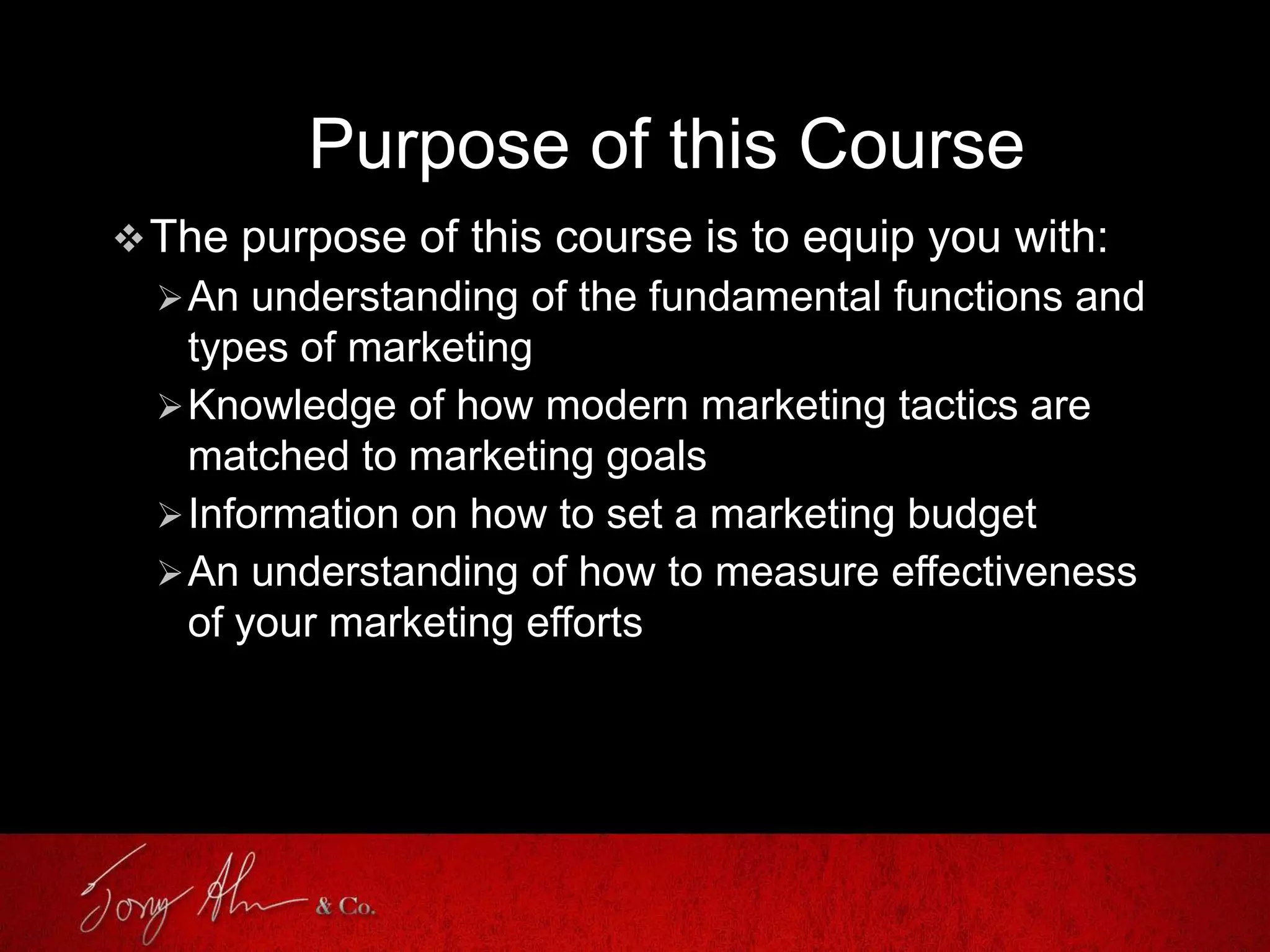
Purpose of this Course
The purpose of this course is to equip you with:
An understanding of the fundamental functions and
types of marketing
Knowledge of how modern marketing tactics are
matched to marketing goals
Information on how to set a marketing budget
An understanding of how to measure effectiveness
of your marketing efforts
What do you need?
Advertising, Marketing, PR, Sales
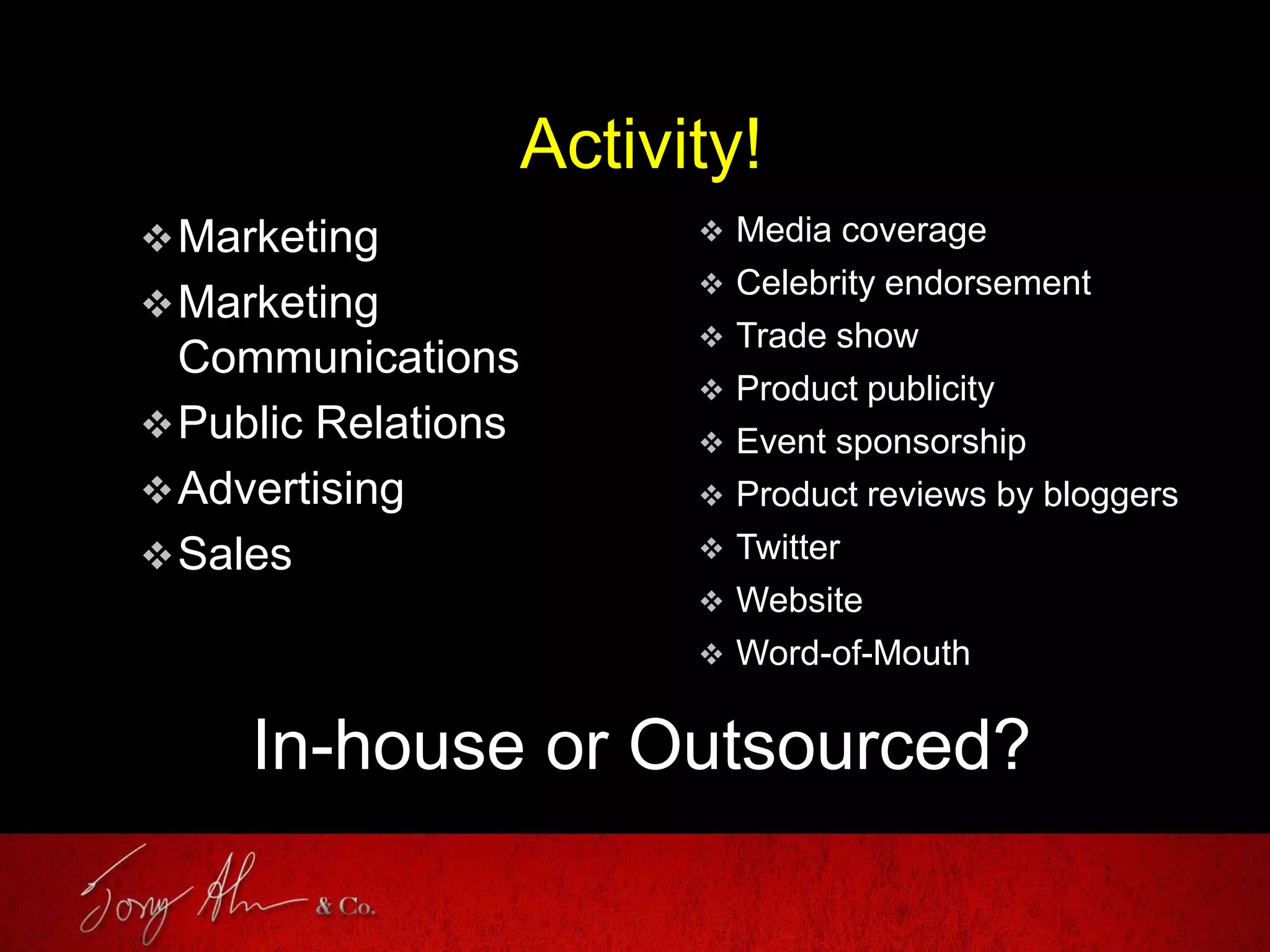
Activity!
Marketing
Marketing
Communications
Public Relations
Advertising
Sales
 Media coverage
 Celebrity endorsement
 Trade show
 Product publicity
 Event sponsorship
 Product reviews by bloggers
 Twitter
 Website
 Word-of-Mouth
In-house or Outsourced?
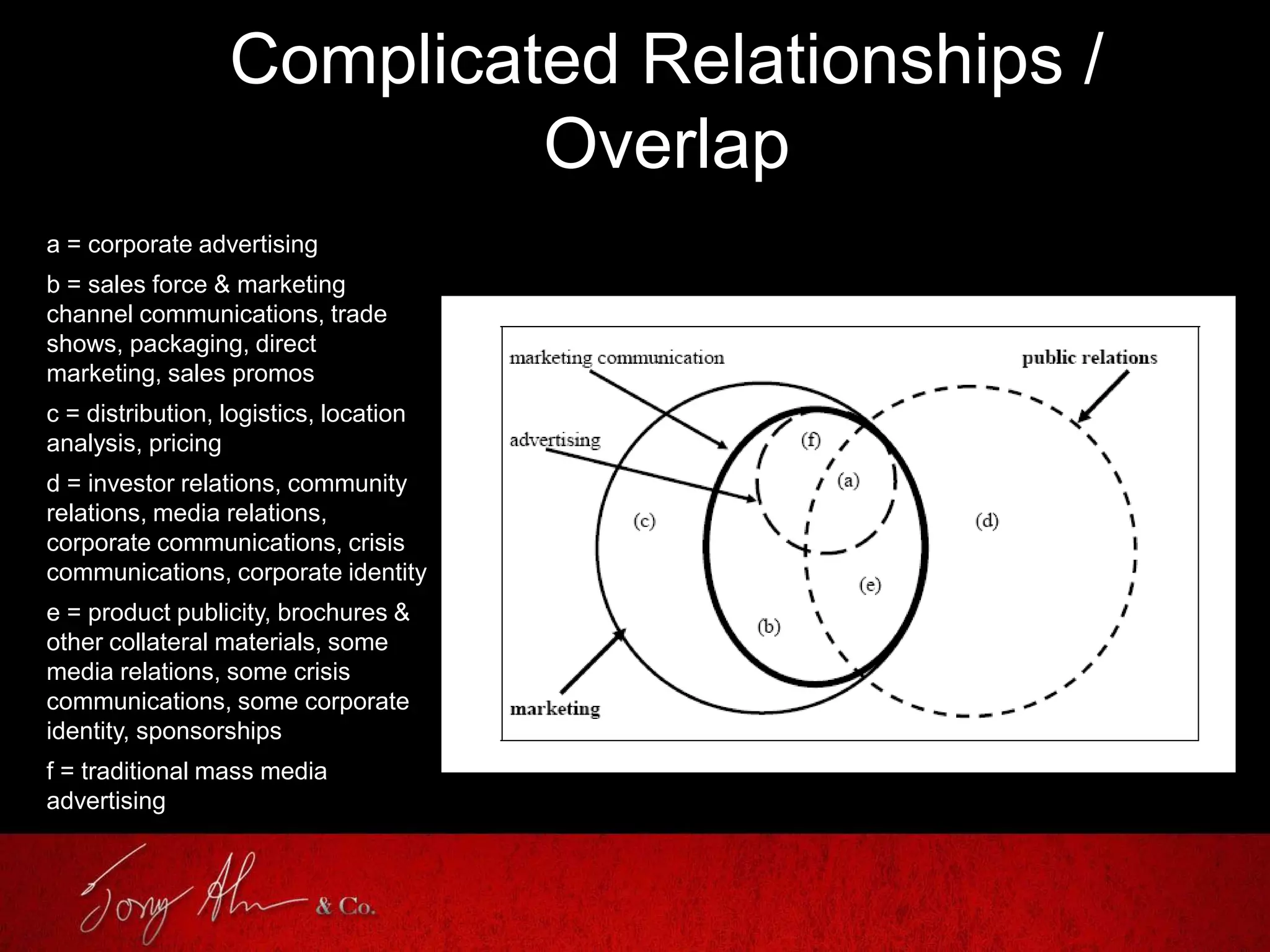
Complicated Relationships /
Overlap
a = corporate advertising
b = sales force & marketing
channel communications, trade
shows, packaging, direct
marketing, sales promos
c = distribution, logistics, location
analysis, pricing
d = investor relations, community
relations, media relations,
corporate communications, crisis
communications, corporate identity
e = product publicity, brochures &
other collateral materials, some
media relations, some crisis
communications, some corporate
identity, sponsorships
f = traditional mass media
advertising
Why is Digital/Online Missing?
Digital is not a function, it is a tool (actually a
collection of tools)
Digital can be used in many of the above
functions to carry out the mission and realize the
goals of those function
Digital has revolutionized marketing the way
power tools have revolutionized carpentry.
So What Do You Need?
Big-ticket products and services usually require a
sales staff, plus marketing to bring in “warm
leads”
Inexpensive products and services usually do not
make a sales staff cost effective
Every business
requires marketing and PR
How Much of Each Do You
Need?
Public relations is primarily about influencing
beliefs.
Marketing is primarily about influencing behavior.
Advertising is primarily about improving recall
(memory).
Activity!
Determine What Your Business Needs
More of
The real question is:
What kind of marketing and PR
does your business require to be
successful?
Your Positioning Statement
Positioning Statement
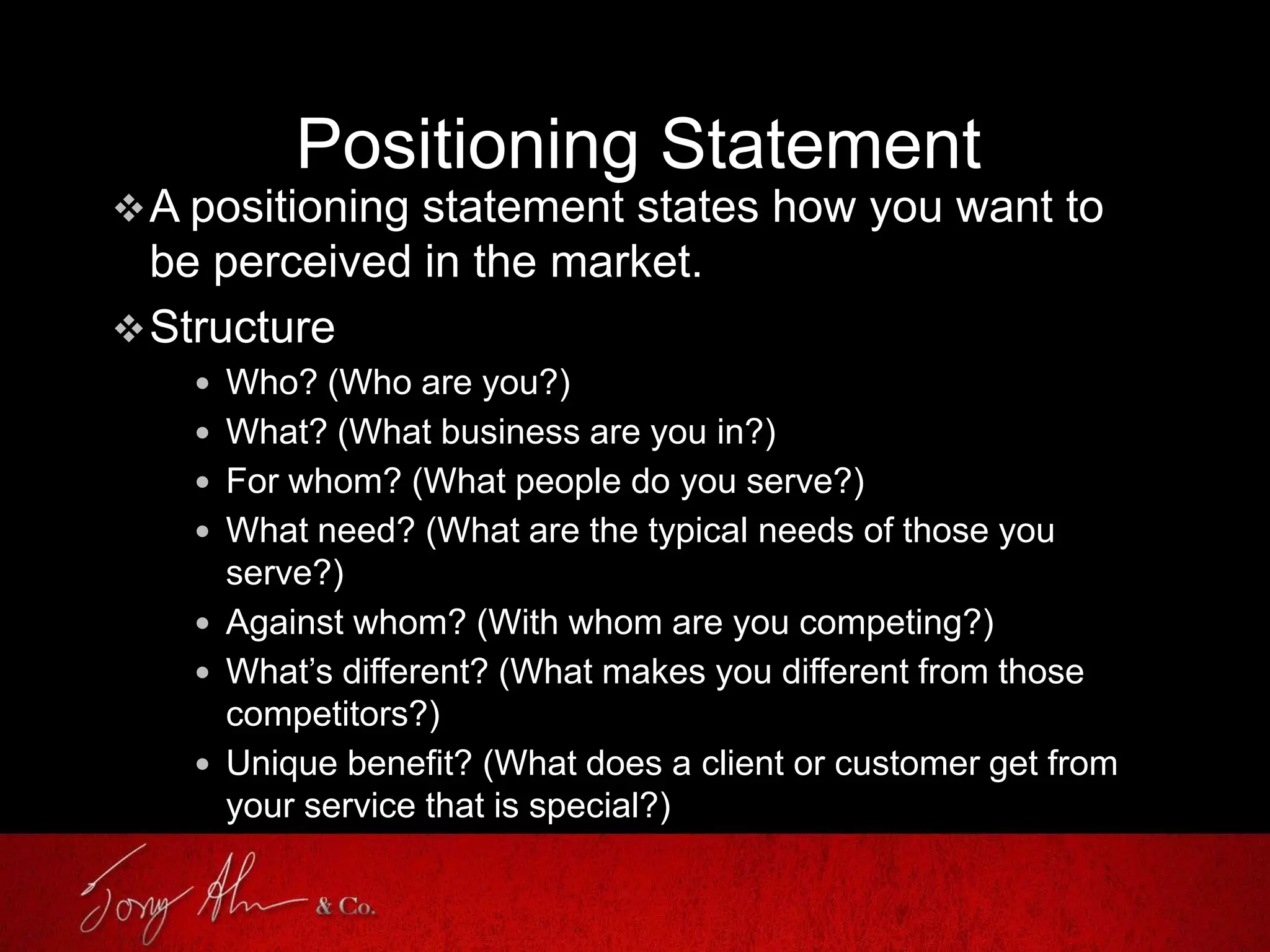
A positioning statement states how you want to
be perceived in the market.
Structure
 Who? (Who are you?)
 What? (What business are you in?)
 For whom? (What people do you serve?)
 What need? (What are the typical needs of those you
serve?)
 Against whom? (With whom are you competing?)
 What’s different? (What makes you different from those
competitors?)
 Unique benefit? (What does a client or customer get from
your service that is special?)
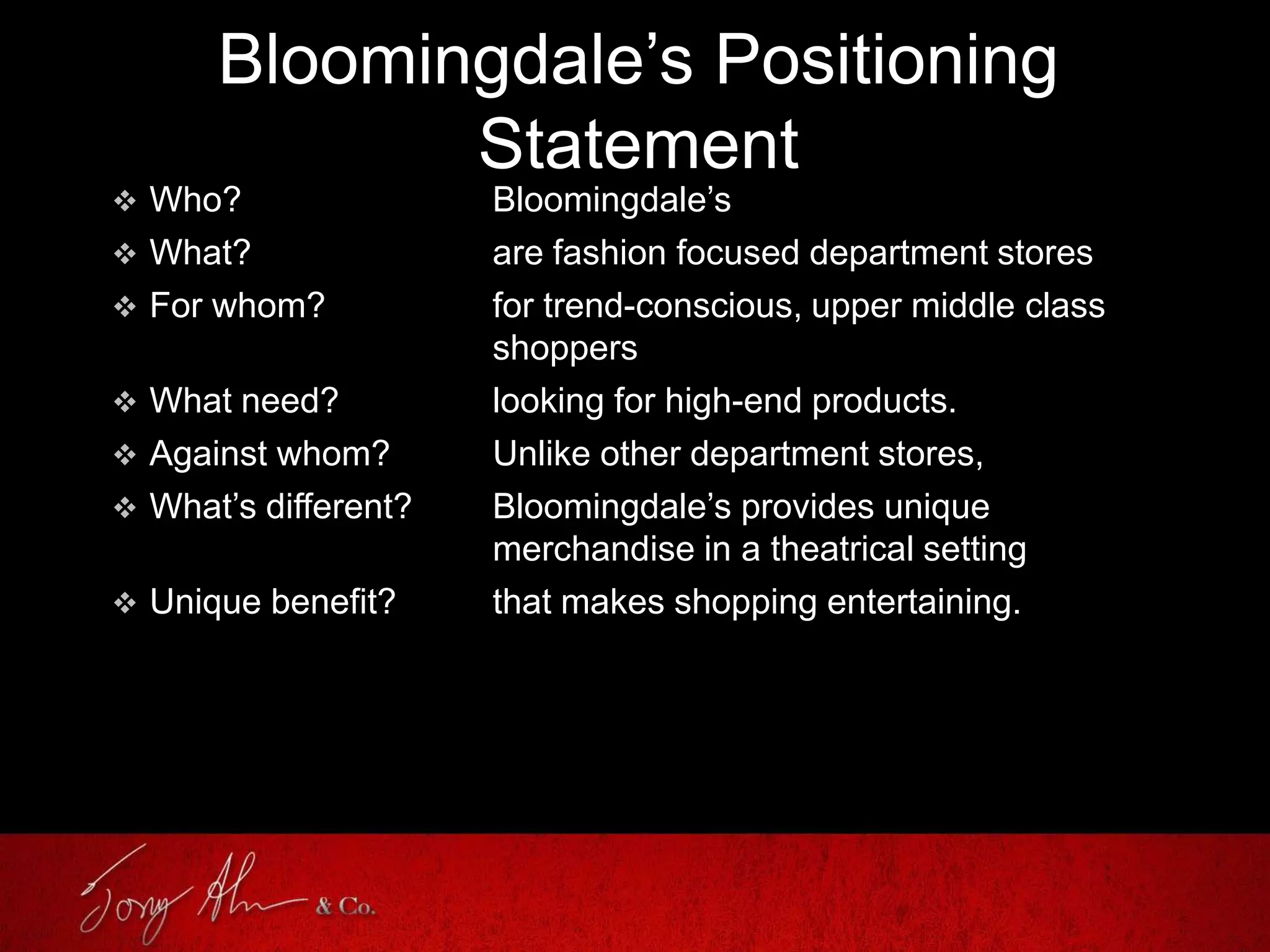
Bloomingdale’s Positioning
Statement
 Who? Bloomingdale’s
 What? are fashion focused department stores
 For whom? for trend-conscious, upper middle class
shoppers
 What need? looking for high-end products.
 Against whom? Unlike other department stores,
 What’s different? Bloomingdale’s provides unique
merchandise in a theatrical setting
 Unique benefit? that makes shopping entertaining.
Activity!
Create a positioning statement for your company
Marketing/PR Strategy
Before Strategy: Target Market
The target market will determine which strategies
and channels will be most effective.
Demographics
Psychographics
Technographics
You must match your strategy and tactics up to
your target market.
Marketing/PR Strategies
Influencer Marketing
Direct Marketing
Advertising
Promotions
Media/Blogger Relations
Digital Engagement
Influencer Marketing
Marketing to influencers, to increase awareness
of the company/product within the influencer
community.
Marketing through influencers, using influencers
to increase market awareness of the
company/product amongst target markets.
Marketing with influencers, turning influencers
into advocates of the company/product.
Influencer Marketing
Who are influencers?
Not just movie stars and singers.
Influencers are anyone that lots of people listen
to.
Influencer marketing is very powerful in the
Philippines.
Direct Marketing
Email Marketing
Online Tools
Mobile
Direct Mail
Telemarketing
Couponing
Direct Response TV
(Infomercials)*
Insert Media
Out-of-Home*
Direct Selling
Grassroots/
Community Marketing
Advertising
Print
Radio
TV
Outdoor
Flyering
Product Placement
Digital
Celebrity
Sales Promotions
 Price deal
 Loyal Reward Program: Consumers
collect points, miles, or credits for
purchases and redeem them for
rewards.
 Cents-off deal: Offers a brand at a
lower price. Price reduction may be
a percentage marked on the
package.
 Price-pack deal: The packaging
offers a consumer a certain
percentage more of the product for
the same price (for example, 25
percent extra).
 Coupons: coupons have become a
standard mechanism for sales
promotions.
 Loss leader
 Free-standing insert (FSI): A coupon
booklet is inserted into the local
newspaper for delivery.
 On-shelf couponing: Coupons are
present at the shelf where the
product is available.
 Checkout dispensers: On checkout
the customer is given a coupon
based on products purchased.
 On-line couponing: Consumers print
them out and take them to the store.
 Mobile couponing: Coupons are
available on a mobile phone.
Consumers show the offer on a
mobile phone to a salesperson for
redemption.
Sales Promotions
Trade Sales Promos Online interactive promotion game:
Consumers play an interactive
game associated with the promoted
product.
 Rebates
 Contests/sweepstakes/games: The
consumer is automatically entered
into the event by purchasing the
product.
 Point-of-sale displays
 Kids eat free specials
 Sampling: Consumers get one
sample for free, after their trial and
then could decide whether to buy or
not.
 Trade allowances: short term
incentive offered to induce a retailer
to stock up on a product.
 Dealer loader: An incentive given to
induce a retailer to purchase and
display a product.
 Trade contest: A contest to reward
retailers that sell the most product.
 Point-of-purchase displays: Used to
create the urge of "impulse" buying
and selling your product on the spot.
 Training programs: dealer
employees are trained in selling the
product.
Media/Blogger Relations
Newspaper, radio, TV, and blogs.
There are tactics to get coverage without paying
Or you can pay a PR agency for insertions
Digital Engagement
Engagement is a two way conversation, not a
one-way message
Can be through a number of mediums
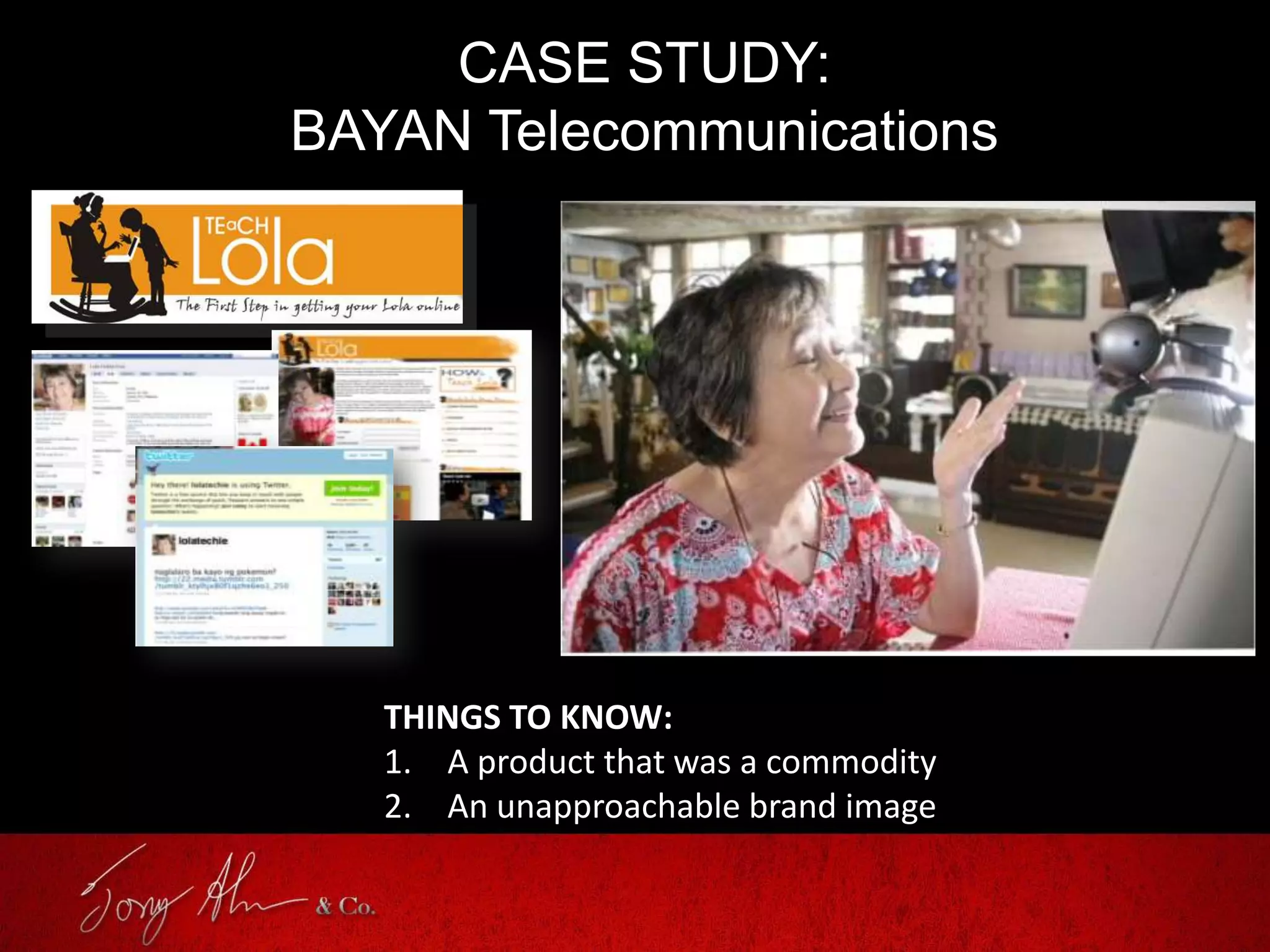
Can be very creative (see case study)
CASE STUDY:
BAYAN Telecommunications
THINGS TO KNOW:
1. A product that was a commodity
2. An unapproachable brand image
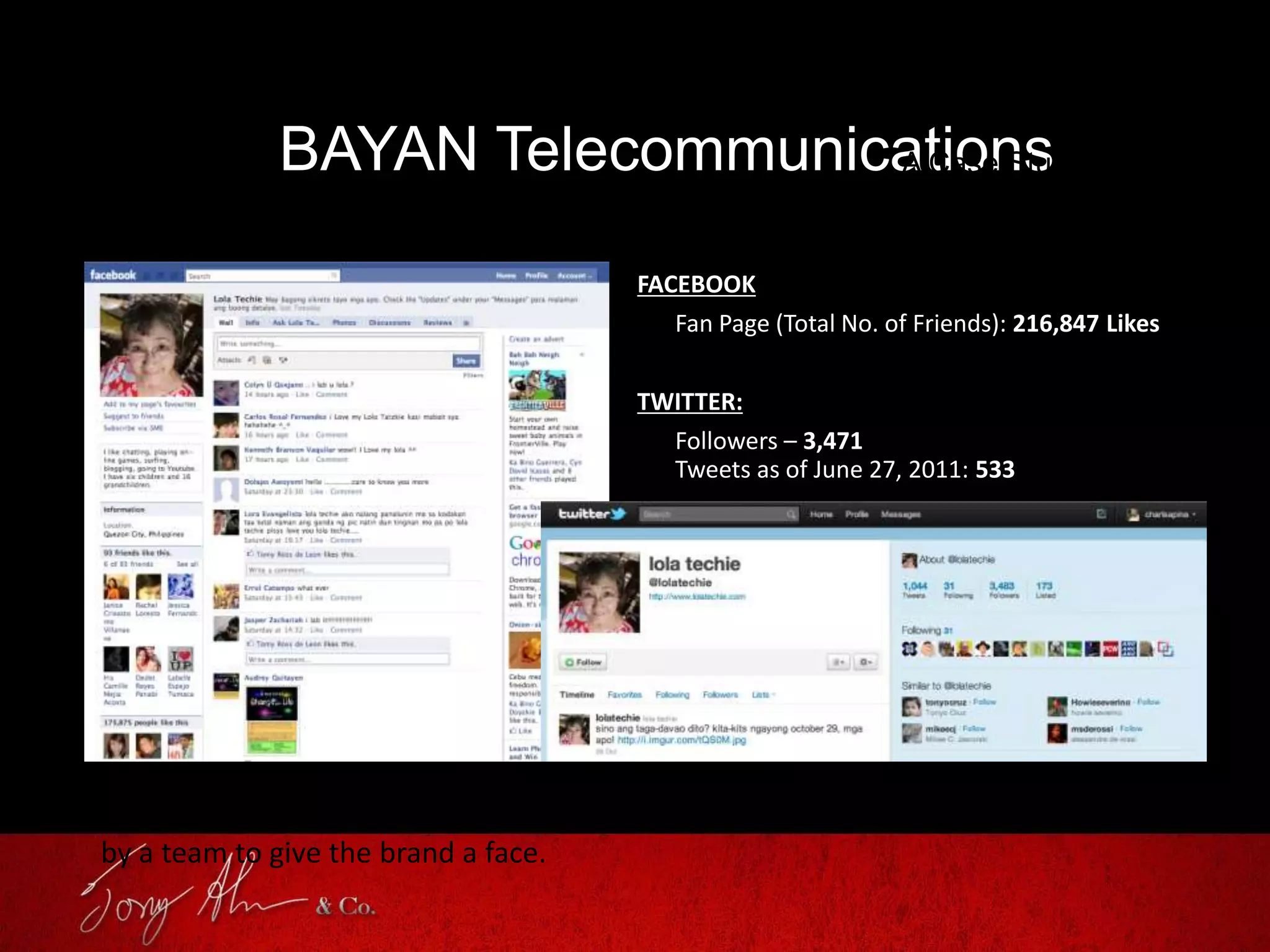
FACEBOOK
Fan Page (Total No. of Friends): 216,847 Likes
TWITTER:
Followers – 3,471
Tweets as of June 27, 2011: 533
BAYAN TelecommunicationsA Case Study
A COMPOSITE PERSONALITY is a community manager executed
by a team to give the brand a face.
CREATE-A-CELEBRITY
BAYAN TelecommunicationsA Case Study
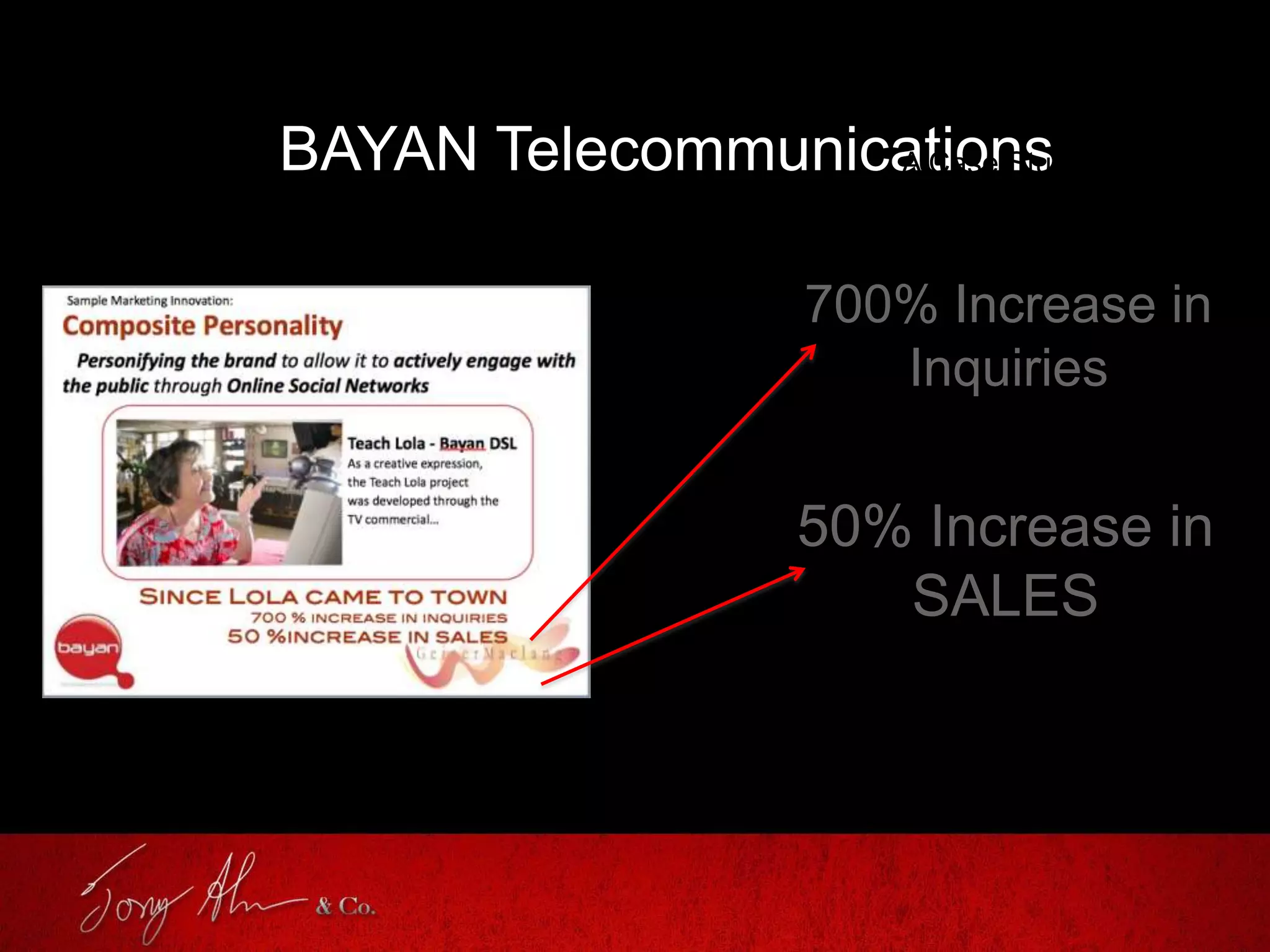
700% Increase in
Inquiries
50% Increase in
SALES
(If your target market is online, both)
Digital? Traditional? Or both?
Digital Tools/Channels
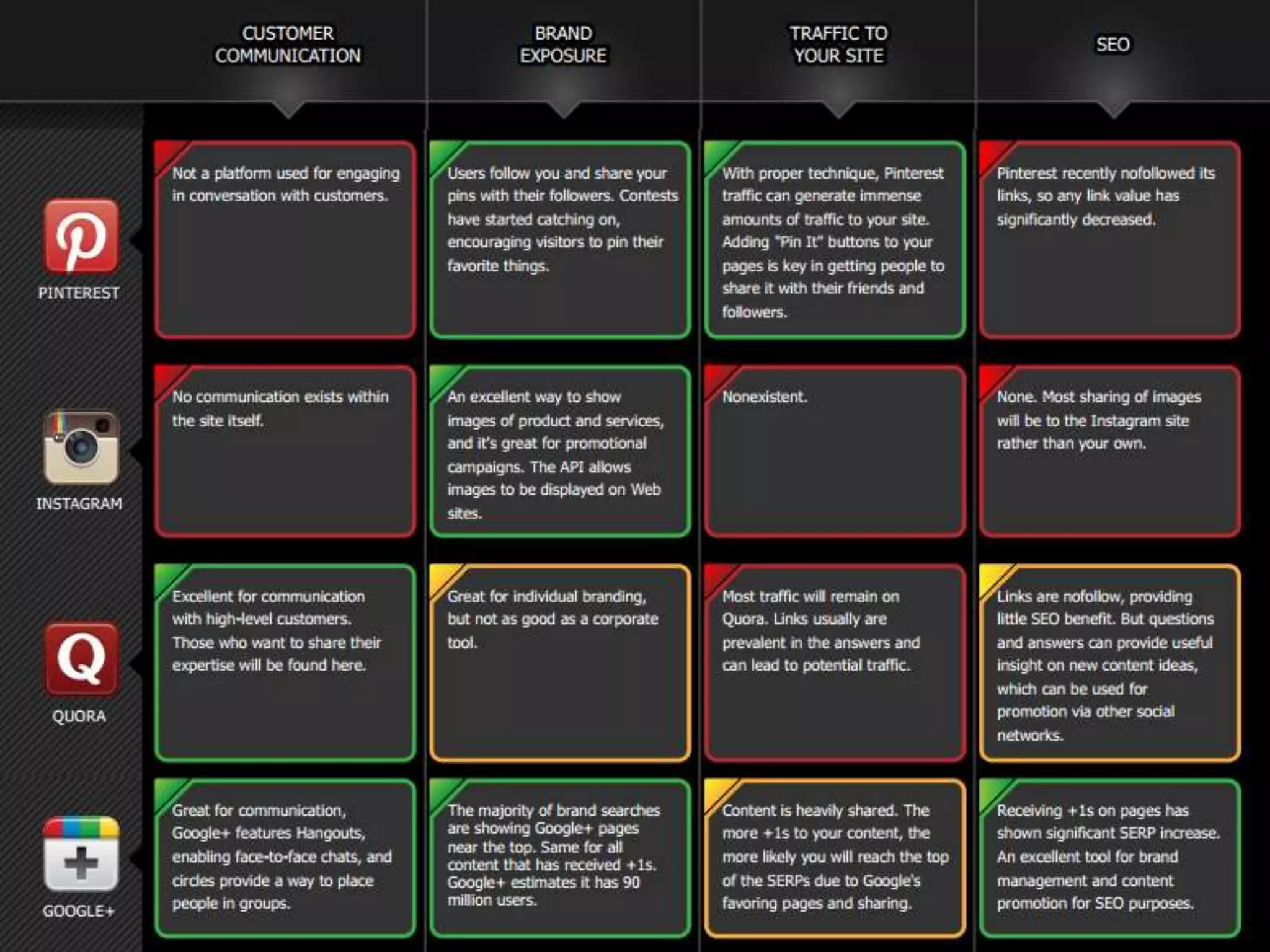
Not all digital tools are good for the same types of
communciation
Not all digital tools reach the same people
Not all digital tools reach people the same way
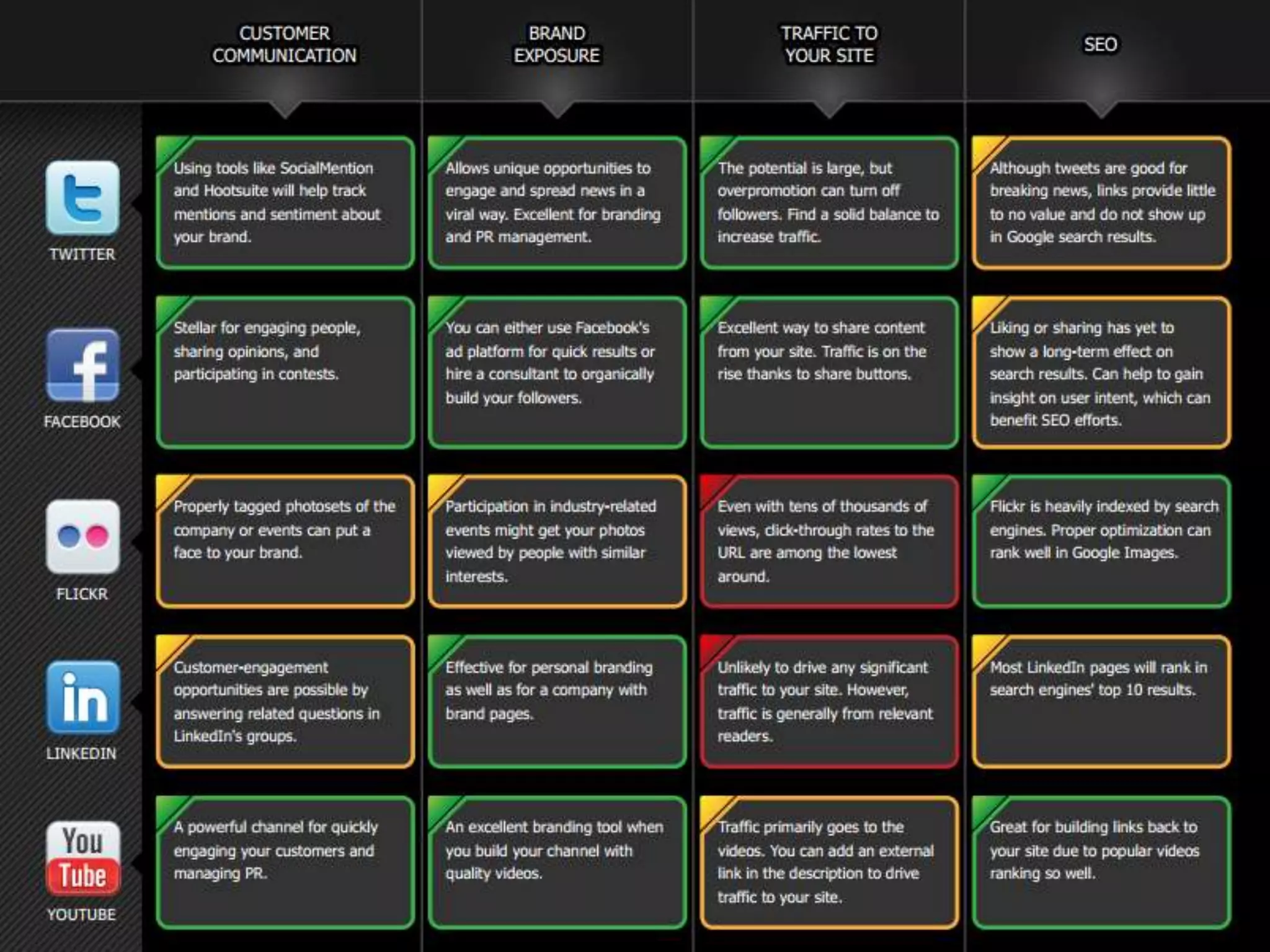
Let’s take a look at the relative strengths and
weaknesses of some of the most popular social
media tools.
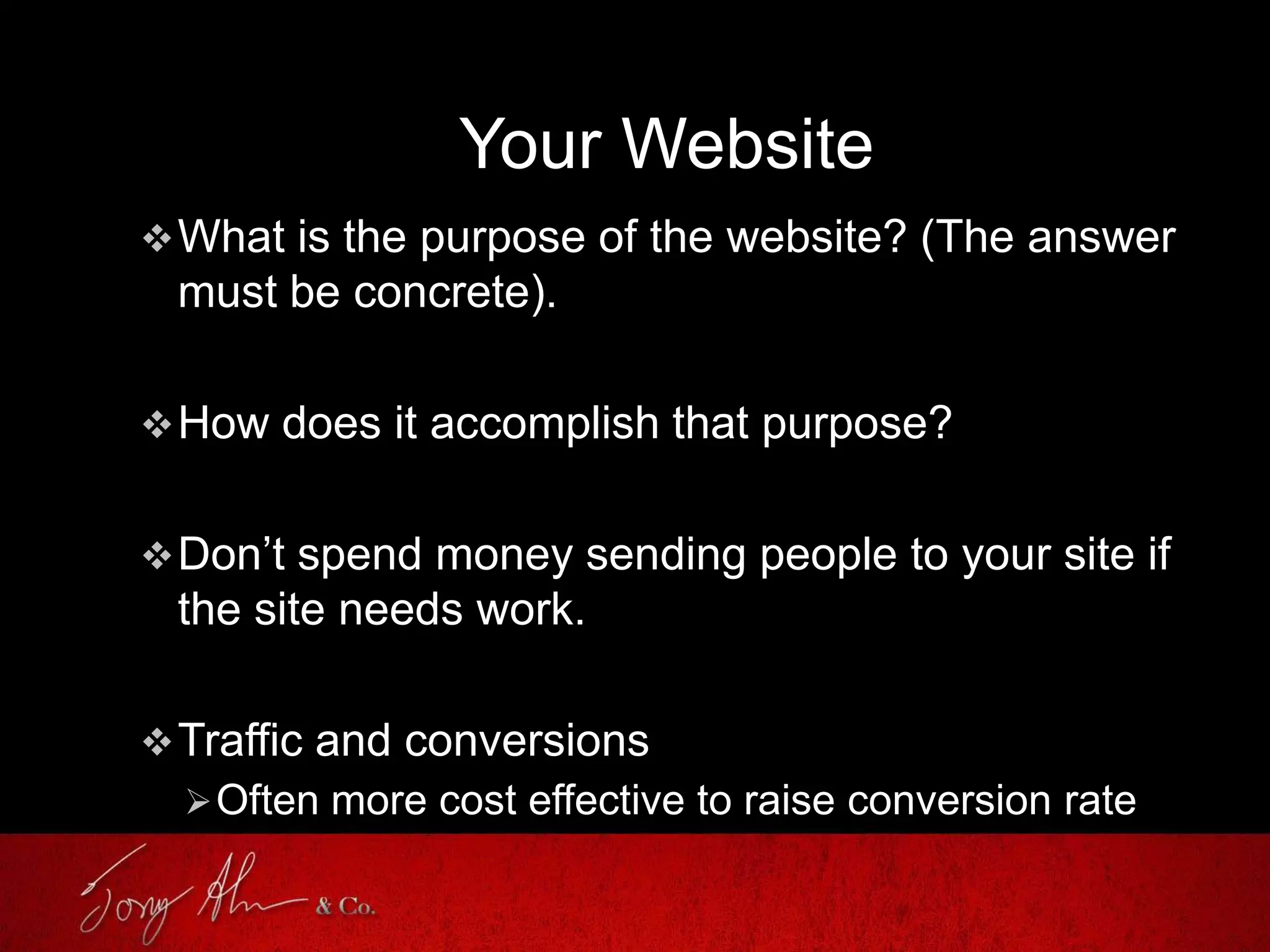
Your Website
What is the purpose of the website? (The answer
must be concrete).
How does it accomplish that purpose?
Don’t spend money sending people to your site if
the site needs work.
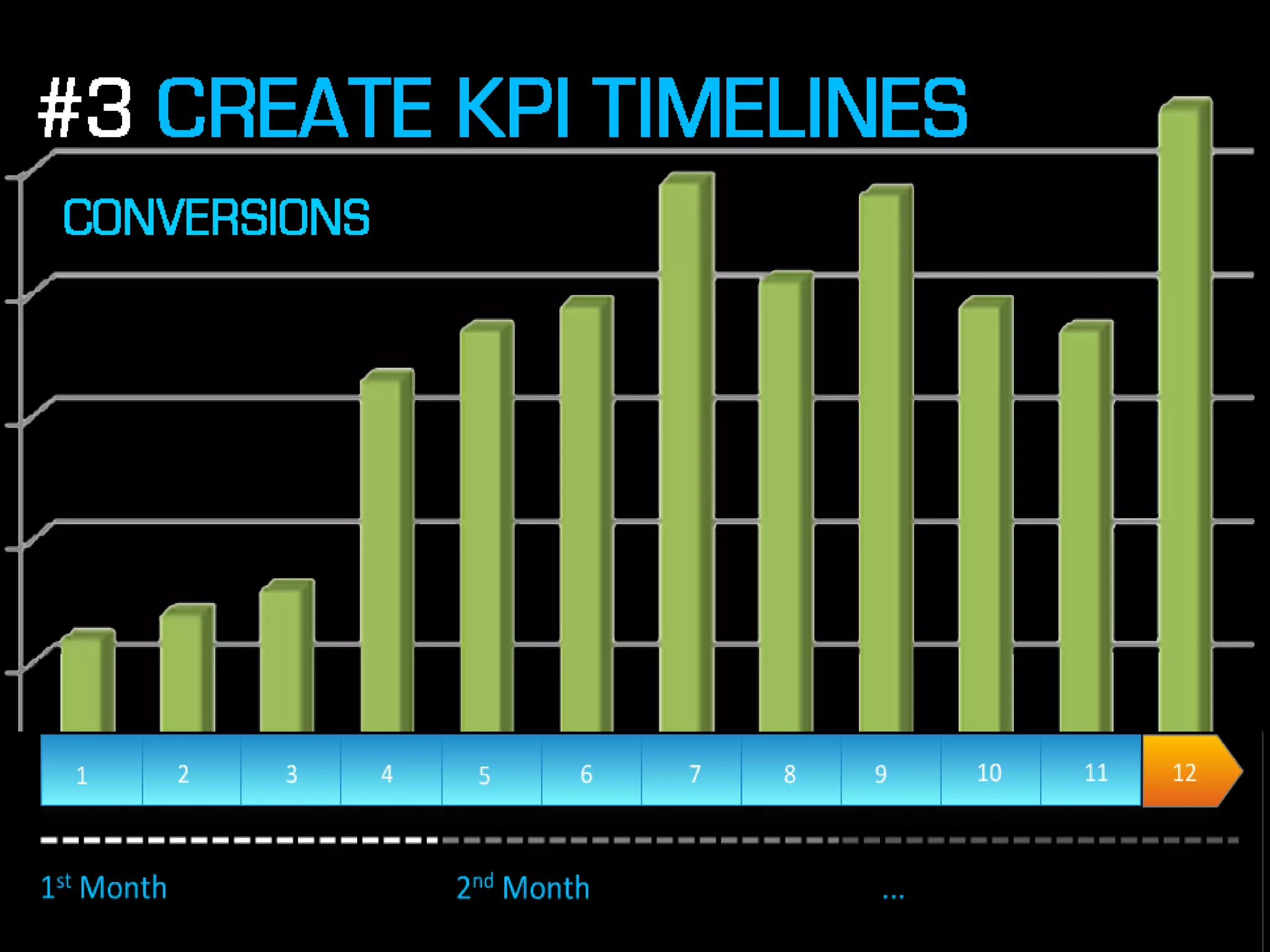
Traffic and conversions
Often more cost effective to raise conversion rate
Budgeting
Methods to determine your
budget
Percentage of Sales
Flat-Rate (What the company can afford)
Competitive Parity (Follow the leader)
Objective-based Budgeting
Measuring Marketing
Effectiveness
Demand Accountability
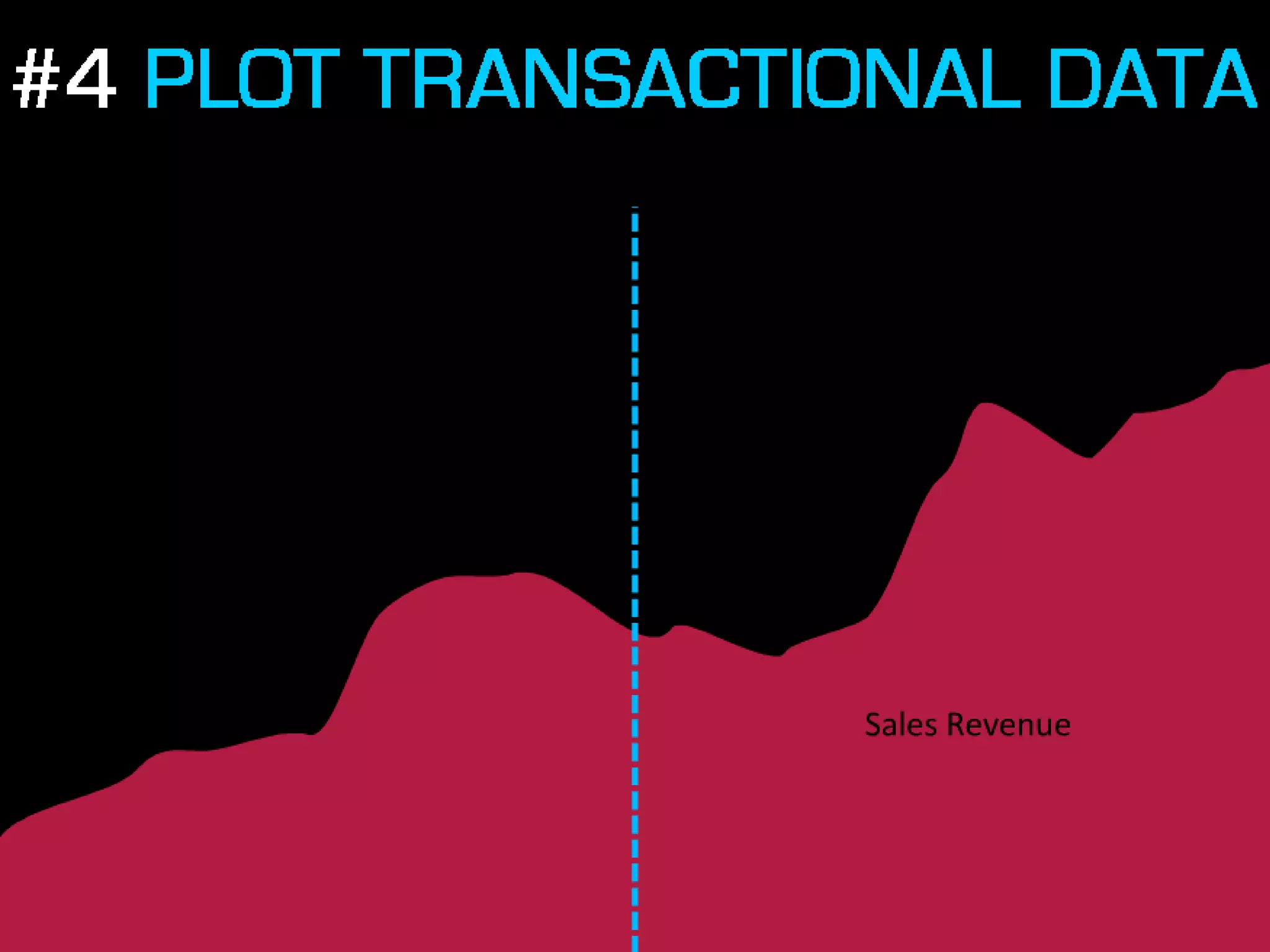
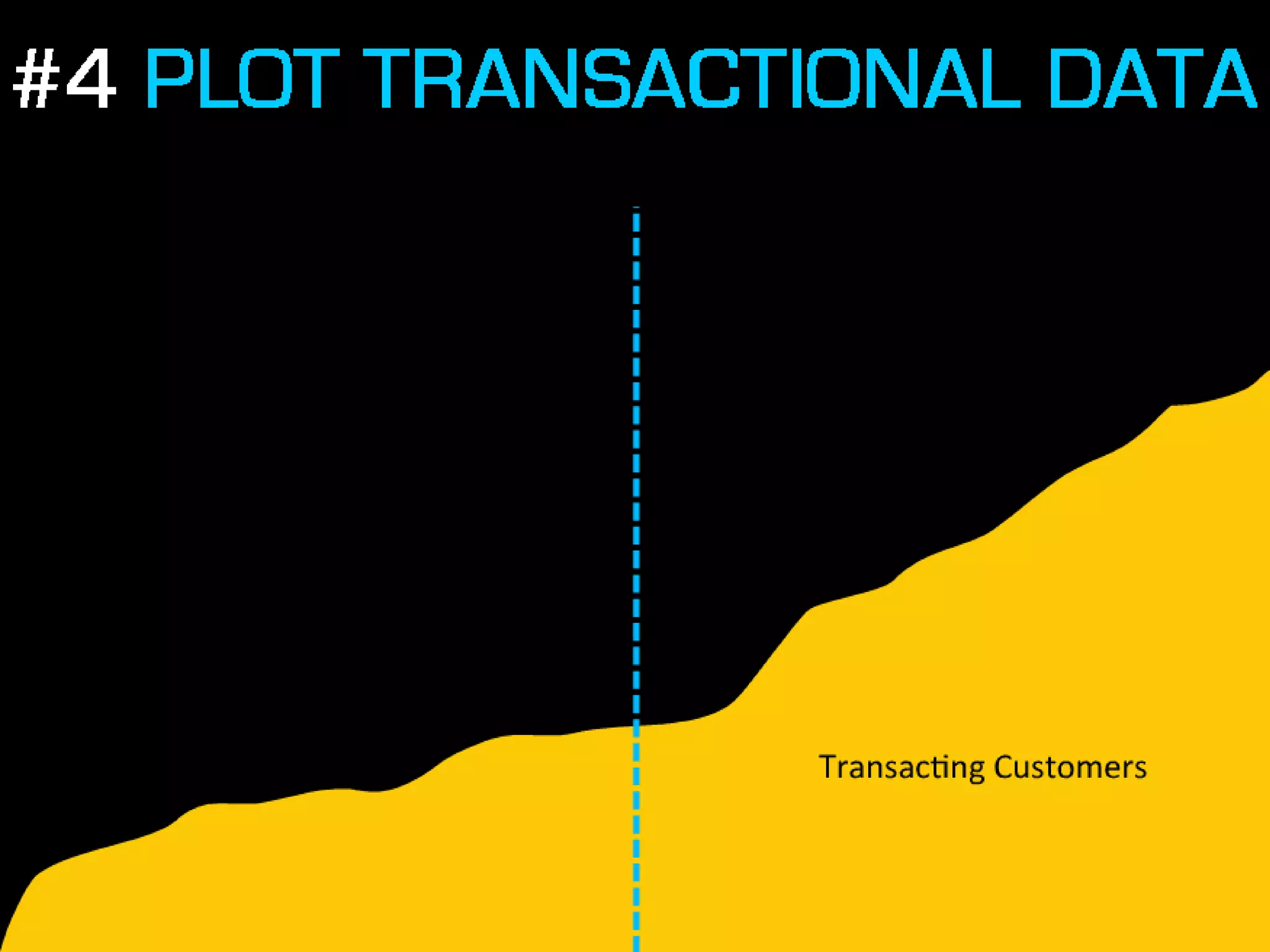
Your marketing head needs to calculate expected
and actual ROI for every marketing plan and
initiative they approve and/or implement.
They need to account for any discrepancies
between the two.
Pay Attention to Cost of
Acquisition
What does it cost to make someone visit a
website or walk into a store?
Case Study: Email Marketing vs. Facebook
The target audience dictates the most appropriate
medium (getting interest of existing clients vs.
creating brand awareness for new customers
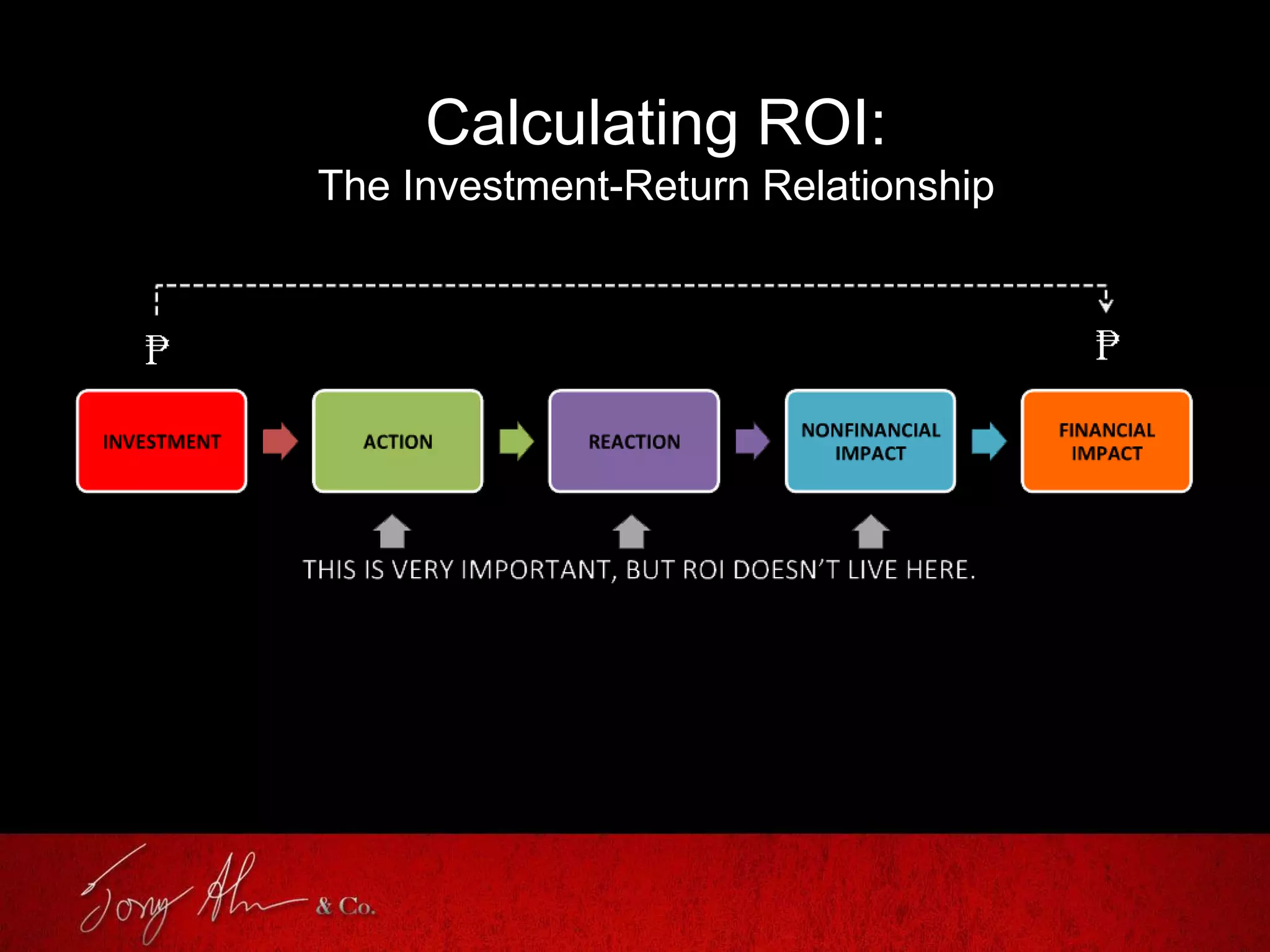
Calculating ROI:
The Investment-Return Relationship
Digital ROI
Web
Clicks  Conversions
Email
Deliveries  Opens  Clickthroughs 
Conversions
Hiring an Agency or Consultant
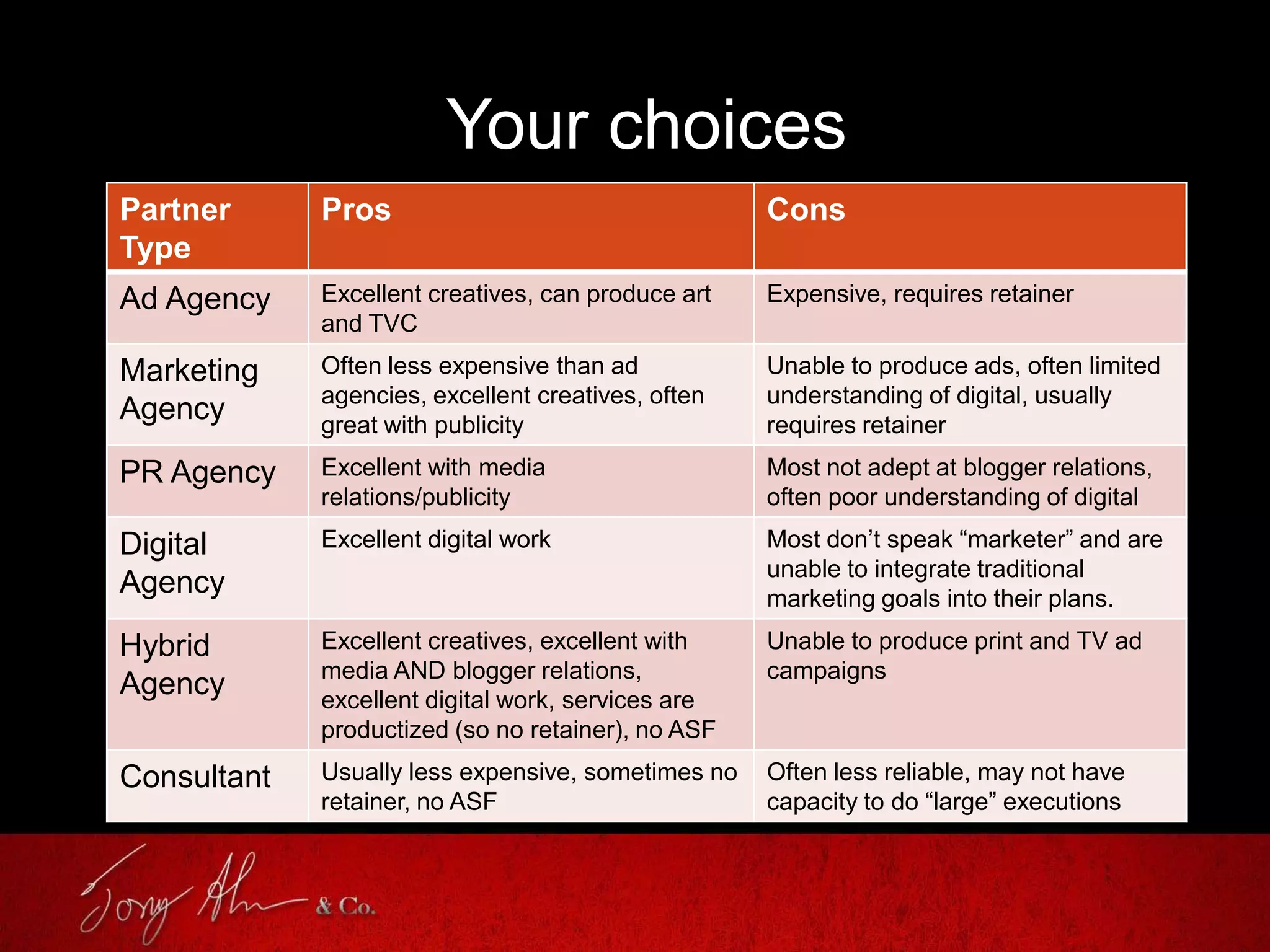
Your choices
Partner
Type
Pros Cons
Ad Agency Excellent creatives, can produce art
and TVC
Expensive, requires retainer
Marketing
Agency
Often less expensive than ad
agencies, excellent creatives, often
great with publicity
Unable to produce ads, often limited
understanding of digital, usually
requires retainer
PR Agency Excellent with media
relations/publicity
Most not adept at blogger relations,
often poor understanding of digital
Digital
Agency
Excellent digital work Most don’t speak “marketer” and are
unable to integrate traditional
marketing goals into their plans.
Hybrid
Agency
Excellent creatives, excellent with
media AND blogger relations,
excellent digital work, services are
productized (so no retainer), no ASF
Unable to produce print and TV ad
campaigns
Consultant Usually less expensive, sometimes no
retainer, no ASF
Often less reliable, may not have
capacity to do “large” executions
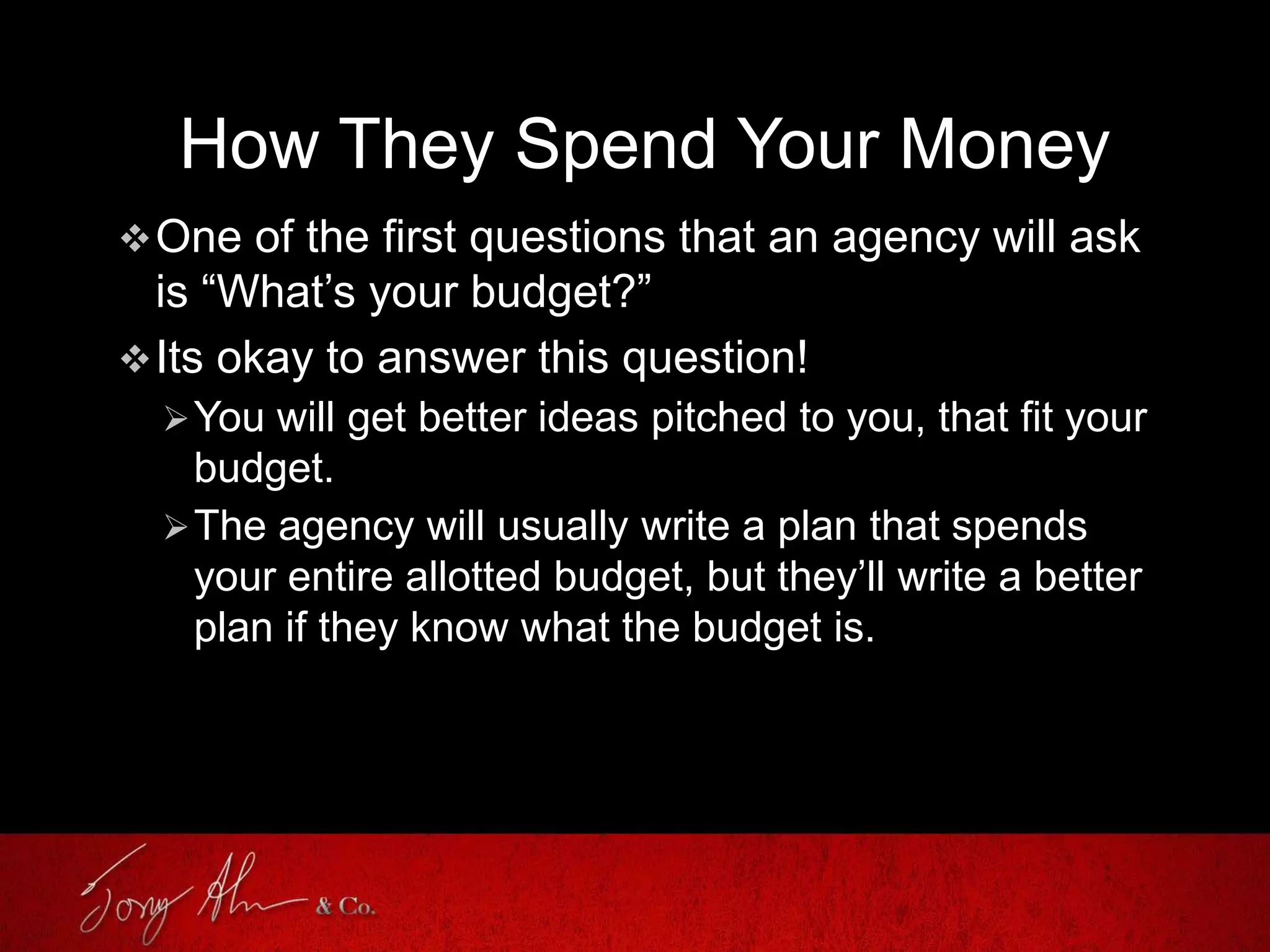
How They Spend Your Money
One of the first questions that an agency will ask
is “What’s your budget?”
Its okay to answer this question!
You will get better ideas pitched to you, that fit your
budget.
The agency will usually write a plan that spends
your entire allotted budget, but they’ll write a better
plan if they know what the budget is.

Introduction to Marketing for Managers

  • 1.
    Public Relations. DigitalMarketing. Reputation Management.
  • 2.
    What do youwant to learn about today? What are your questions?
  • 3.
    Today, We’ll Cover Purposeof this Class Advertising? Marketing? PR? What do you need? Marketing/PR Strategy Digital? Traditional? Or Both? Budgeting Measuring Effectiveness Hiring an Agency or Consultant Your Questions
  • 4.
  • 5.
    Purpose of thisCourse The purpose of this course is to equip you with: An understanding of the fundamental functions and types of marketing Knowledge of how modern marketing tactics are matched to marketing goals Information on how to set a marketing budget An understanding of how to measure effectiveness of your marketing efforts
  • 6.
    What do youneed? Advertising, Marketing, PR, Sales
  • 7.
    Activity! Marketing Marketing Communications Public Relations Advertising Sales  Mediacoverage  Celebrity endorsement  Trade show  Product publicity  Event sponsorship  Product reviews by bloggers  Twitter  Website  Word-of-Mouth In-house or Outsourced?
  • 8.
    Complicated Relationships / Overlap a= corporate advertising b = sales force & marketing channel communications, trade shows, packaging, direct marketing, sales promos c = distribution, logistics, location analysis, pricing d = investor relations, community relations, media relations, corporate communications, crisis communications, corporate identity e = product publicity, brochures & other collateral materials, some media relations, some crisis communications, some corporate identity, sponsorships f = traditional mass media advertising
  • 9.
    Why is Digital/OnlineMissing? Digital is not a function, it is a tool (actually a collection of tools) Digital can be used in many of the above functions to carry out the mission and realize the goals of those function Digital has revolutionized marketing the way power tools have revolutionized carpentry.
  • 10.
    So What DoYou Need? Big-ticket products and services usually require a sales staff, plus marketing to bring in “warm leads” Inexpensive products and services usually do not make a sales staff cost effective Every business requires marketing and PR
  • 11.
    How Much ofEach Do You Need? Public relations is primarily about influencing beliefs. Marketing is primarily about influencing behavior. Advertising is primarily about improving recall (memory). Activity! Determine What Your Business Needs More of
  • 12.
    The real questionis: What kind of marketing and PR does your business require to be successful?
  • 13.
  • 14.
    Positioning Statement A positioningstatement states how you want to be perceived in the market. Structure  Who? (Who are you?)  What? (What business are you in?)  For whom? (What people do you serve?)  What need? (What are the typical needs of those you serve?)  Against whom? (With whom are you competing?)  What’s different? (What makes you different from those competitors?)  Unique benefit? (What does a client or customer get from your service that is special?)
  • 15.
    Bloomingdale’s Positioning Statement  Who?Bloomingdale’s  What? are fashion focused department stores  For whom? for trend-conscious, upper middle class shoppers  What need? looking for high-end products.  Against whom? Unlike other department stores,  What’s different? Bloomingdale’s provides unique merchandise in a theatrical setting  Unique benefit? that makes shopping entertaining.
  • 16.
    Activity! Create a positioningstatement for your company
  • 17.
  • 18.
    Before Strategy: TargetMarket The target market will determine which strategies and channels will be most effective. Demographics Psychographics Technographics You must match your strategy and tactics up to your target market.
  • 19.
    Marketing/PR Strategies Influencer Marketing DirectMarketing Advertising Promotions Media/Blogger Relations Digital Engagement
  • 20.
    Influencer Marketing Marketing toinfluencers, to increase awareness of the company/product within the influencer community. Marketing through influencers, using influencers to increase market awareness of the company/product amongst target markets. Marketing with influencers, turning influencers into advocates of the company/product.
  • 21.
    Influencer Marketing Who areinfluencers? Not just movie stars and singers. Influencers are anyone that lots of people listen to. Influencer marketing is very powerful in the Philippines.
  • 22.
    Direct Marketing Email Marketing OnlineTools Mobile Direct Mail Telemarketing Couponing Direct Response TV (Infomercials)* Insert Media Out-of-Home* Direct Selling Grassroots/ Community Marketing
  • 23.
  • 24.
    Sales Promotions  Pricedeal  Loyal Reward Program: Consumers collect points, miles, or credits for purchases and redeem them for rewards.  Cents-off deal: Offers a brand at a lower price. Price reduction may be a percentage marked on the package.  Price-pack deal: The packaging offers a consumer a certain percentage more of the product for the same price (for example, 25 percent extra).  Coupons: coupons have become a standard mechanism for sales promotions.  Loss leader  Free-standing insert (FSI): A coupon booklet is inserted into the local newspaper for delivery.  On-shelf couponing: Coupons are present at the shelf where the product is available.  Checkout dispensers: On checkout the customer is given a coupon based on products purchased.  On-line couponing: Consumers print them out and take them to the store.  Mobile couponing: Coupons are available on a mobile phone. Consumers show the offer on a mobile phone to a salesperson for redemption.
  • 25.
    Sales Promotions Trade SalesPromos Online interactive promotion game: Consumers play an interactive game associated with the promoted product.  Rebates  Contests/sweepstakes/games: The consumer is automatically entered into the event by purchasing the product.  Point-of-sale displays  Kids eat free specials  Sampling: Consumers get one sample for free, after their trial and then could decide whether to buy or not.  Trade allowances: short term incentive offered to induce a retailer to stock up on a product.  Dealer loader: An incentive given to induce a retailer to purchase and display a product.  Trade contest: A contest to reward retailers that sell the most product.  Point-of-purchase displays: Used to create the urge of "impulse" buying and selling your product on the spot.  Training programs: dealer employees are trained in selling the product.
  • 26.
    Media/Blogger Relations Newspaper, radio,TV, and blogs. There are tactics to get coverage without paying Or you can pay a PR agency for insertions
  • 27.
    Digital Engagement Engagement isa two way conversation, not a one-way message Can be through a number of mediums Can be very creative (see case study)
  • 28.
    CASE STUDY: BAYAN Telecommunications THINGSTO KNOW: 1. A product that was a commodity 2. An unapproachable brand image
  • 29.
    FACEBOOK Fan Page (TotalNo. of Friends): 216,847 Likes TWITTER: Followers – 3,471 Tweets as of June 27, 2011: 533 BAYAN TelecommunicationsA Case Study A COMPOSITE PERSONALITY is a community manager executed by a team to give the brand a face. CREATE-A-CELEBRITY
  • 30.
    BAYAN TelecommunicationsA CaseStudy 700% Increase in Inquiries 50% Increase in SALES
  • 31.
    (If your targetmarket is online, both) Digital? Traditional? Or both?
  • 39.
    Digital Tools/Channels Not alldigital tools are good for the same types of communciation Not all digital tools reach the same people Not all digital tools reach people the same way Let’s take a look at the relative strengths and weaknesses of some of the most popular social media tools.
  • 42.
    Your Website What isthe purpose of the website? (The answer must be concrete). How does it accomplish that purpose? Don’t spend money sending people to your site if the site needs work. Traffic and conversions Often more cost effective to raise conversion rate
  • 43.
  • 44.
    Methods to determineyour budget Percentage of Sales Flat-Rate (What the company can afford) Competitive Parity (Follow the leader) Objective-based Budgeting
  • 45.
  • 46.
    Demand Accountability Your marketinghead needs to calculate expected and actual ROI for every marketing plan and initiative they approve and/or implement. They need to account for any discrepancies between the two.
  • 47.
    Pay Attention toCost of Acquisition What does it cost to make someone visit a website or walk into a store? Case Study: Email Marketing vs. Facebook The target audience dictates the most appropriate medium (getting interest of existing clients vs. creating brand awareness for new customers
  • 48.
  • 60.
    Digital ROI Web Clicks Conversions Email Deliveries  Opens  Clickthroughs  Conversions
  • 61.
    Hiring an Agencyor Consultant
  • 62.
    Your choices Partner Type Pros Cons AdAgency Excellent creatives, can produce art and TVC Expensive, requires retainer Marketing Agency Often less expensive than ad agencies, excellent creatives, often great with publicity Unable to produce ads, often limited understanding of digital, usually requires retainer PR Agency Excellent with media relations/publicity Most not adept at blogger relations, often poor understanding of digital Digital Agency Excellent digital work Most don’t speak “marketer” and are unable to integrate traditional marketing goals into their plans. Hybrid Agency Excellent creatives, excellent with media AND blogger relations, excellent digital work, services are productized (so no retainer), no ASF Unable to produce print and TV ad campaigns Consultant Usually less expensive, sometimes no retainer, no ASF Often less reliable, may not have capacity to do “large” executions
  • 63.
    How They SpendYour Money One of the first questions that an agency will ask is “What’s your budget?” Its okay to answer this question! You will get better ideas pitched to you, that fit your budget. The agency will usually write a plan that spends your entire allotted budget, but they’ll write a better plan if they know what the budget is.

Editor's Notes

  • #19 Would you take out an ad in FHM to reach women? Or a newspaper ad to reach high school students?
  • #21 Through = Getting a celebrity to shop in your store every day for two weeks. Getting a celebrity to conspicuously use your product/service (apparel companies sponsor celebs and give them clothes. Belo does this by doing plastic surgery for free or at a discount for celebs)With = Getting a celebrity to talk about your product or service. I did Daphne’s wikipedia article for free, for example.
  • #29 Message – It is easy to use; To involve the other members of the familyCommercial Value: Fastest and easiest to use (Advertising) – it does not necessarily translate to PR campaignSocial Value: PR campaign should always have this
  • #43 Max’s example
  • #45 Objective-Based Budgeting: Using this method, a business bases its advertising budget on what it will cost to meet the marketing objectives it had defined. The bank then weighs this cost against the expected net benefit of the new business to ensure that the cost of advertising will not reduce the profit margin on the newly acquired deposits or loans beyond acceptable limits. For example, assume that a brand’s goal is to increase its sales of handbags by PHP10 million over its expected normal growth during a promotion period. It calculates that the profit margin on those funds will be 30% percent (PHP3 million). The brand must then decide how much it is willing to invest in advertising in order to generate an extra 3 million pesos of income. This method also has its drawbacks. While it works for specific promotions that have immediately measurable results, such as increased sales, it cannot be used to determine the level of advertising necessary to build awareness of the bank and to develop and maintain an image for it. A brand that advertises only when it has a specific promotion to communicate may be out of the media for considerable periods of time. Most marketers agree that some maintenance level of advertising, either product or institutional, is a necessary investment, simply to keep the brand’s name in front of its target market.
  • #49 So now I’m going to teach you all about ROI calculations. And the reason why is because you are all executives or managers, which means that most of you have budget responsibility, so you need to know how marketing affects your budget and what questions you should be asking when it comes to performance.