Marketing
Associate (BSC 206)
Trainers guide
Chapter-1
IntegratedMarketingCommunication
inChangingEconomicOrder
• Political factors and environment of a country
impacts any business organization and can also
introduce a risk factor can cause the business to
suffer losses or compromise over its profit stream.
• Political environment can change because of the
policies and actions of the prevailing government at
every level, federal to local level. It is very important
that a business should plan for the variability in the
policies and regulations of the government to
maintain a stable business environment.
2
IntegratedMarketing
Communication
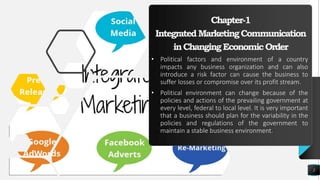
• To stay in business, every business needs to convert
prospects to closed sales. How a company markets to
potential customers is a marketing strategy.
• A company may have more than one strategy in place
at any given time, using various marketing platforms -
- including networking, digital media and traditional
print advertising.
• Plan your marketing strategies so that you can
evaluate the successful campaigns and build upon
them, while adjusting or stopping unsuccessful ones.
3
Market Segmentation
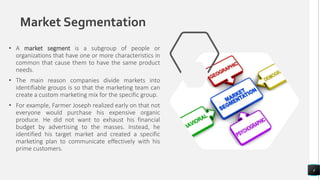
• A market segment is a subgroup of people or
organizations that have one or more characteristics in
common that cause them to have the same product
needs.
• The main reason companies divide markets into
identifiable groups is so that the marketing team can
create a custom marketing mix for the specific group.
• For example, Farmer Joseph realized early on that not
everyone would purchase his expensive organic
produce. He did not want to exhaust his financial
budget by advertising to the masses. Instead, he
identified his target market and created a specific
marketing plan to communicate effectively with his
prime customers.
4
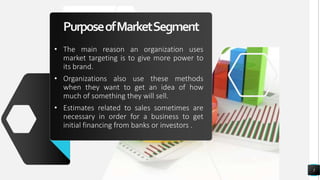
PurposeofMarketSegment
• The main reason an organization uses
market targeting is to give more power to
its brand.
• Organizations also use these methods
when they want to get an idea of how
much of something they will sell.
• Estimates related to sales sometimes are
necessary in order for a business to get
initial financing from banks or investors .
5
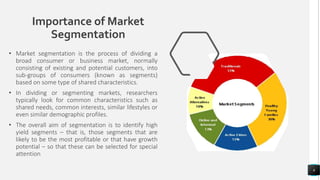
Importance of Market
Segmentation
• Market segmentation is the process of dividing a
broad consumer or business market, normally
consisting of existing and potential customers, into
sub-groups of consumers (known as segments)
based on some type of shared characteristics.
• In dividing or segmenting markets, researchers
typically look for common characteristics such as
shared needs, common interests, similar lifestyles or
even similar demographic profiles.
• The overall aim of segmentation is to identify high
yield segments – that is, those segments that are
likely to be the most profitable or that have growth
potential – so that these can be selected for special
attention
6
EffectiveBranding
• Effective branding is one of the cornerstones of
any viable marketing strategy, and if you have an
interest in growing your business, it is one of the
most important parts of your business plan.
• Effective branding creates an enduring perception
in the minds of your customers and distinguishes
you from your competitors. An investment in
branding can pay off in several ways.
7
Importanceofeffectivebrand
• Effective branding creates an enduring perception in
the minds of your customers and distinguishes you
from your competitors. An investment in branding
can pay off in several ways.
• Increase mind share
• Build loyalty
• Benefit from referrals
• Command a premium price
• Lower your marketing cost in the long run
8
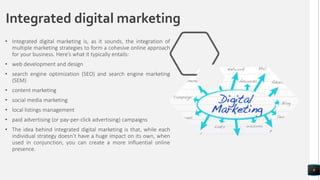
Integrated digital marketing
• Integrated digital marketing is, as it sounds, the integration of
multiple marketing strategies to form a cohesive online approach
for your business. Here’s what it typically entails:
• web development and design
• search engine optimization (SEO) and search engine marketing
(SEM)
• content marketing
• social media marketing
• local listings management
• paid advertising (or pay-per-click advertising) campaigns
• The idea behind integrated digital marketing is that, while each
individual strategy doesn’t have a huge impact on its own, when
used in conjunction, you can create a more influential online
presence.
9
Digitalmarketingstrategy
• Digital marketing strategy is challenging
even for large enterprise organizations
because what works changes frequently.
• Google algorithm updates, declining
Twitter engagement, shifts in
demographics across digital networks, new
phones with ad blockers are just a few of
the many recent changes that impact the
success of your marketing efforts.
10
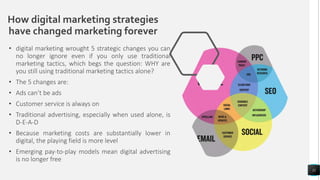
How digital marketing strategies
have changed marketing forever
• digital marketing wrought 5 strategic changes you can
no longer ignore even if you only use traditional
marketing tactics, which begs the question: WHY are
you still using traditional marketing tactics alone?
• The 5 changes are:
• Ads can’t be ads
• Customer service is always on
• Traditional advertising, especially when used alone, is
D-E-A-D
• Because marketing costs are substantially lower in
digital, the playing field is more level
• Emerging pay-to-play models mean digital advertising
is no longer free
11
AdvantagesofPayPerClick
Advertising
• Pay only for results (clicks)
• Ability to select where your ads will be shown, giving a
better chance to reach target audiences
• Can generate immediate visibility, as ads go live
immediately
• Ads can be easily modified, adjusted even deleted
instantaneously depending on the results
• Allows for quick, easy tracking of the effectiveness of
the campaign allowing you to better analyze the return
on your investments (ROI)
12
Chapter-2
CustomerRelationshipManagement
• Political factors and environment of a country
impacts any business organization and can also
introduce a risk factor can cause the business to
suffer losses or compromise over its profit stream.
• Political environment can change because of the
policies and actions of the prevailing government at
every level, federal to local level. It is very important
that a business should plan for the variability in the
policies and regulations of the government to
maintain a stable business environment.
13
Effect on customer satisfaction
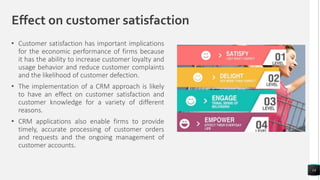
• Customer satisfaction has important implications
for the economic performance of firms because
it has the ability to increase customer loyalty and
usage behavior and reduce customer complaints
and the likelihood of customer defection.
• The implementation of a CRM approach is likely
to have an effect on customer satisfaction and
customer knowledge for a variety of different
reasons.
• CRM applications also enable firms to provide
timely, accurate processing of customer orders
and requests and the ongoing management of
customer accounts.
14
Customerbenefits
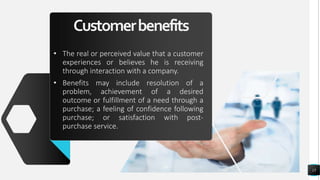
• The real or perceived value that a customer
experiences or believes he is receiving
through interaction with a company.
• Benefits may include resolution of a
problem, achievement of a desired
outcome or fulfillment of a need through a
purchase; a feeling of confidence following
purchase; or satisfaction with post-
purchase service.
15
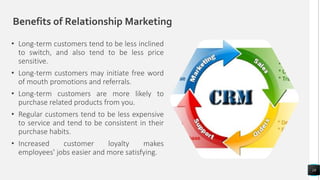
Relationship marketing
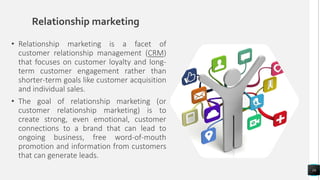
• Relationship marketing is a facet of
customer relationship management (CRM)
that focuses on customer loyalty and long-
term customer engagement rather than
shorter-term goals like customer acquisition
and individual sales.
• The goal of relationship marketing (or
customer relationship marketing) is to
create strong, even emotional, customer
connections to a brand that can lead to
ongoing business, free word-of-mouth
promotion and information from customers
that can generate leads.
16
WhyRelationshipMarketing?
• Relationship marketing is all about emotion.
Customers should feel engaged with you, as if you
are sharing your business story with them.
• You want to create an emotional connection with
this customer.
• This boosts loyalty and makes it tougher for them
to leave you for another brand. Think about some
of the emails you receive from your favorite
companies.
17
Benefits of Relationship Marketing
• Long-term customers tend to be less inclined
to switch, and also tend to be less price
sensitive.
• Long-term customers may initiate free word
of mouth promotions and referrals.
• Long-term customers are more likely to
purchase related products from you.
• Regular customers tend to be less expensive
to service and tend to be consistent in their
purchase habits.
• Increased customer loyalty makes
employees' jobs easier and more satisfying.
18
Campaignmanagement
• Campaign management implements public
relations, product development, and sales to
create, execute, monitor, and measure marketing
programs directed at specifically target audiences.
• The potential demand for products and services is
estimated and the most cost effective and efficient
means of reaching consumers is determined.
Campaign management involves developing a
pricing as well as a sales strategy to maximize
profits.
19
Sales
• A sale is a transaction between two parties where
the buyer receives goods (tangible or intangible),
services, and/or assets in exchange for money.
• It can also refer to an agreement between a
buyer and seller on the price of a security. A sale
functions as a contract between the buyer and
seller of the selected good or service.
• A sale dictates that, in exchange for a certain
amount of money or particular assets, the seller
provides the buyer with aforementioned good or
service.
• In order to complete a sale, both parties must be
deemed competent and be in agreement
regarding the terms as set forth.
20
Territorymanagement
• Territory management is an account sharing system
that grants access to accounts based on the
characteristics of the accounts.
• It enables your company to structure your
Salesforce data and users the same way you
structure your sales territories.
• A territory is a flexible collection of accounts and
users where the users have at least read access to
the accounts, regardless of who owns the account.
21
B2Bmarketing
• B2B (business-to-business) marketing is
marketing of products to businesses or
other organizations for use in
production of goods, for use in general
business operations (such as office
supplies), such as a wholesaler selling
to a retailer.
22
Difference from Consumer Market
1. Fewer customers - There are about
316,000,000 potential individual consumers in
the U.S. alone. The number of businesses in
comparison is much lower.
2. Derivative demand - A significant amount of
business demand is derivative of consumer
demand. This may not affect the retailer much,
but it hurts the traditional publishing industry.
3. Complex Transactions - The products and
buying process are often more complicated.
The products purchased are often very complex
and expensive, like manufacturing equipment,
and sometimes even custom made.
23
Chapter-3
InternationalMarketingin
changingEconomicEnvironment
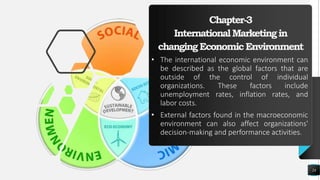
• The international economic environment can
be described as the global factors that are
outside of the control of individual
organizations. These factors include
unemployment rates, inflation rates, and
labor costs.
• External factors found in the macroeconomic
environment can also affect organizations'
decision-making and performance activities.
24
BusinessCycle
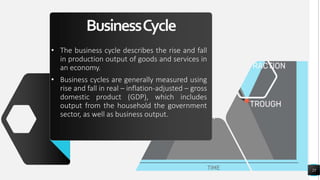
• The business cycle describes the rise and fall
in production output of goods and services in
an economy.
• Business cycles are generally measured using
rise and fall in real – inflation-adjusted – gross
domestic product (GDP), which includes
output from the household the government
sector, as well as business output.
25
Stages of business cycle
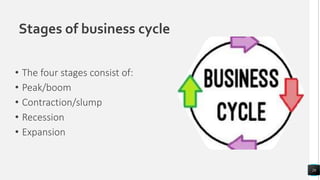
• The four stages consist of:
• Peak/boom
• Contraction/slump
• Recession
• Expansion
26
GlobalMarketing
Environment
• Global marketing involve the performance of
activities designed to plan, price, promote and
direct to flow of an organization’s offerings in
more than one country for a profit.
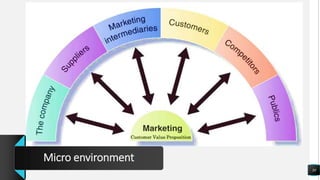
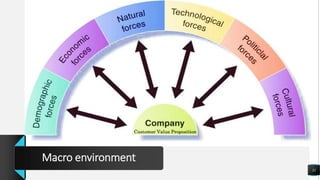
• It is useful to classify these forces into 2
categories:
• Microenvironment
• Macroenvironment
27
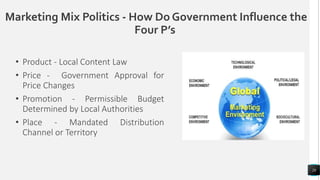
Marketing Mix Politics - How Do Government Influence the
Four P’s
• Product - Local Content Law
• Price - Government Approval for
Price Changes
• Promotion - Permissible Budget
Determined by Local Authorities
• Place - Mandated Distribution
Channel or Territory
28
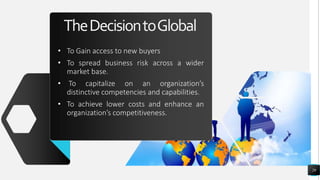
TheDecisiontoGlobal
• To Gain access to new buyers
• To spread business risk across a wider
market base.
• To capitalize on an organization’s
distinctive competencies and capabilities.
• To achieve lower costs and enhance an
organization’s competitiveness.
29
30
Micro environment
31
Macro environment
Domesticmarketing
• A domestic market, also referred to as
an internal market or domestic trading, is the
supply and demand of goods, services, and
securities within a single country.
• In domestic trading, a firm faces only one set
of competitive, economic, and market issues
and essentially must deal with only one set of
customers, although the company may have
several segments in a market.
32
Difference between Domestic Marketing and International Marketing
Domestic Marketing
• Domestic marketing is actually the selling of a
company’s items in financial market of the country
or we can say that company sell items locally.
• It manages with one consumer, one competition
and less economic issues which make it more
helpful to do. There are no language obstruction
and getting and interpreting information on local
promoting patterns and demand of consumers is
simpler and quicker to do.
• It offers the organization some assistance with
making decisions and makes strategies related to
marketing that are more compelling and proficient.
International Marketing
• International marketing is actually the selling and
promotion of a company’s items to consumers in
distinctive nations.
• It is extremely complex and requires a tremendous
amount of financial resources. Each nation has its
own particular laws related to business and an
organization that goes for going into business in
another nation should first think about them.
• Customer’s preferences and tastes might likewise
vary so strategies related to marketing must be
figured to take into account the requirements of
diverse buyers.
33
Chapter-4
Strategic Marketing
• Political factors and environment of a country
impacts any business organization and can also
introduce a risk factor can cause the business to
suffer losses or compromise over its profit stream.
• Political environment can change because of the
policies and actions of the prevailing government at
every level, federal to local level. It is very important
that a business should plan for the variability in the
policies and regulations of the government to
maintain a stable business environment.
34
Strategicmarketing
planning
• To stay in business, every business needs to convert
prospects to closed sales. How a company markets to
potential customers is a marketing strategy.
• A company may have more than one strategy in place
at any given time, using various marketing platforms -
- including networking, digital media and traditional
print advertising.
• Plan your marketing strategies so that you can
evaluate the successful campaigns and build upon
them, while adjusting or stopping unsuccessful ones.
35
Situation Analysis
• Before you can develop a plan, you need to
determine exactly where your business
currently sits.
• Perhaps your company is meeting revenue
goals but wants to scale up or move into
new markets.
• If you aren't meeting goals, take an honest
assessment of why. No marketing plan can
change things if your sales team is
unmotivated or untrained.
36
WhyStrategic
Management?
• Strategic management provides the route map for
the firm. It lends a framework, which can ensure
that decisions concerning the future are taken in a
systematic and purposeful way.
• Strategic management also serves as a hedge
against uncertainty, a hedge against totally
unexpected developments on the business
horizon. It lends a frame of reference for
investment decisions. It aids the concentration of
resources on vital areas of best potential.
37
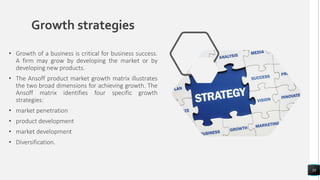
Growth strategies
• Growth of a business is critical for business success.
A firm may grow by developing the market or by
developing new products.
• The Ansoff product market growth matrix illustrates
the two broad dimensions for achieving growth. The
Ansoff matrix identifies four specific growth
strategies:
• market penetration
• product development
• market development
• Diversification.
38
Horizontalintegration
• A horizontal integration strategy may be
indicated in fast changing work environments
as well as providing a broad knowledge base
for the business and employees.
• A benefit of horizontal diversification is that it
is an open platform for a business to expand
and build away from the already existing
market.
39
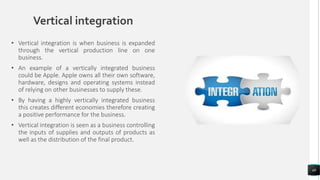
Vertical integration
• Vertical integration is when business is expanded
through the vertical production line on one
business.
• An example of a vertically integrated business
could be Apple. Apple owns all their own software,
hardware, designs and operating systems instead
of relying on other businesses to supply these.
• By having a highly vertically integrated business
this creates different economies therefore creating
a positive performance for the business.
• Vertical integration is seen as a business controlling
the inputs of supplies and outputs of products as
well as the distribution of the final product.
40
Currentscenario
• The scenario analysis necessary to the development of a
user centered tool was carried out mainly through two
different means.
• On one hand, a focused literature analysis, aiming to
better understand the issues related to operative hospitals
and their design process and also to deepen the different
facets of the sustainability concept.
• On the other hand, on field studies, conducted by visiting
some of the most innovative and modern hospitals in Italy
and Europe and through comprehensive meetings with
scholars and designers who already tackled the issue of
sustainability in healthcare.
41
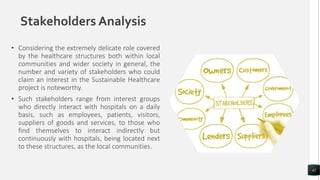
Stakeholders Analysis
• Considering the extremely delicate role covered
by the healthcare structures both within local
communities and wider society in general, the
number and variety of stakeholders who could
claim an interest in the Sustainable Healthcare
project is noteworthy.
• Such stakeholders range from interest groups
who directly interact with hospitals on a daily
basis, such as employees, patients, visitors,
suppliers of goods and services, to those who
find themselves to interact indirectly but
continuously with hospitals, being located next
to these structures, as the local communities.
42
TargetMarket
• Companies can become successful by identifying
themselves with a particular target group. This
focus should not be limited only to demographic
segmentation (i.e., age, income, education,
gender, income, family life-cycle, culture) but also
by psychographic indicators.
• For example, by understanding the values,
attitudes, opinions, and lifestyles of a company’s
customers, the organization can better provide
ways in which to meet its customers’ needs.
43
Thank You

Marketing associate

  • 1.
  • 2.
    Chapter-1 IntegratedMarketingCommunication inChangingEconomicOrder • Political factorsand environment of a country impacts any business organization and can also introduce a risk factor can cause the business to suffer losses or compromise over its profit stream. • Political environment can change because of the policies and actions of the prevailing government at every level, federal to local level. It is very important that a business should plan for the variability in the policies and regulations of the government to maintain a stable business environment. 2
  • 3.
    IntegratedMarketing Communication • To stayin business, every business needs to convert prospects to closed sales. How a company markets to potential customers is a marketing strategy. • A company may have more than one strategy in place at any given time, using various marketing platforms - - including networking, digital media and traditional print advertising. • Plan your marketing strategies so that you can evaluate the successful campaigns and build upon them, while adjusting or stopping unsuccessful ones. 3
  • 4.
    Market Segmentation • Amarket segment is a subgroup of people or organizations that have one or more characteristics in common that cause them to have the same product needs. • The main reason companies divide markets into identifiable groups is so that the marketing team can create a custom marketing mix for the specific group. • For example, Farmer Joseph realized early on that not everyone would purchase his expensive organic produce. He did not want to exhaust his financial budget by advertising to the masses. Instead, he identified his target market and created a specific marketing plan to communicate effectively with his prime customers. 4
  • 5.
    PurposeofMarketSegment • The mainreason an organization uses market targeting is to give more power to its brand. • Organizations also use these methods when they want to get an idea of how much of something they will sell. • Estimates related to sales sometimes are necessary in order for a business to get initial financing from banks or investors . 5
  • 6.
    Importance of Market Segmentation •Market segmentation is the process of dividing a broad consumer or business market, normally consisting of existing and potential customers, into sub-groups of consumers (known as segments) based on some type of shared characteristics. • In dividing or segmenting markets, researchers typically look for common characteristics such as shared needs, common interests, similar lifestyles or even similar demographic profiles. • The overall aim of segmentation is to identify high yield segments – that is, those segments that are likely to be the most profitable or that have growth potential – so that these can be selected for special attention 6
  • 7.
    EffectiveBranding • Effective brandingis one of the cornerstones of any viable marketing strategy, and if you have an interest in growing your business, it is one of the most important parts of your business plan. • Effective branding creates an enduring perception in the minds of your customers and distinguishes you from your competitors. An investment in branding can pay off in several ways. 7
  • 8.
    Importanceofeffectivebrand • Effective brandingcreates an enduring perception in the minds of your customers and distinguishes you from your competitors. An investment in branding can pay off in several ways. • Increase mind share • Build loyalty • Benefit from referrals • Command a premium price • Lower your marketing cost in the long run 8
  • 9.
    Integrated digital marketing •Integrated digital marketing is, as it sounds, the integration of multiple marketing strategies to form a cohesive online approach for your business. Here’s what it typically entails: • web development and design • search engine optimization (SEO) and search engine marketing (SEM) • content marketing • social media marketing • local listings management • paid advertising (or pay-per-click advertising) campaigns • The idea behind integrated digital marketing is that, while each individual strategy doesn’t have a huge impact on its own, when used in conjunction, you can create a more influential online presence. 9
  • 10.
    Digitalmarketingstrategy • Digital marketingstrategy is challenging even for large enterprise organizations because what works changes frequently. • Google algorithm updates, declining Twitter engagement, shifts in demographics across digital networks, new phones with ad blockers are just a few of the many recent changes that impact the success of your marketing efforts. 10
  • 11.
    How digital marketingstrategies have changed marketing forever • digital marketing wrought 5 strategic changes you can no longer ignore even if you only use traditional marketing tactics, which begs the question: WHY are you still using traditional marketing tactics alone? • The 5 changes are: • Ads can’t be ads • Customer service is always on • Traditional advertising, especially when used alone, is D-E-A-D • Because marketing costs are substantially lower in digital, the playing field is more level • Emerging pay-to-play models mean digital advertising is no longer free 11
  • 12.
    AdvantagesofPayPerClick Advertising • Pay onlyfor results (clicks) • Ability to select where your ads will be shown, giving a better chance to reach target audiences • Can generate immediate visibility, as ads go live immediately • Ads can be easily modified, adjusted even deleted instantaneously depending on the results • Allows for quick, easy tracking of the effectiveness of the campaign allowing you to better analyze the return on your investments (ROI) 12
  • 13.
    Chapter-2 CustomerRelationshipManagement • Political factorsand environment of a country impacts any business organization and can also introduce a risk factor can cause the business to suffer losses or compromise over its profit stream. • Political environment can change because of the policies and actions of the prevailing government at every level, federal to local level. It is very important that a business should plan for the variability in the policies and regulations of the government to maintain a stable business environment. 13
  • 14.
    Effect on customersatisfaction • Customer satisfaction has important implications for the economic performance of firms because it has the ability to increase customer loyalty and usage behavior and reduce customer complaints and the likelihood of customer defection. • The implementation of a CRM approach is likely to have an effect on customer satisfaction and customer knowledge for a variety of different reasons. • CRM applications also enable firms to provide timely, accurate processing of customer orders and requests and the ongoing management of customer accounts. 14
  • 15.
    Customerbenefits • The realor perceived value that a customer experiences or believes he is receiving through interaction with a company. • Benefits may include resolution of a problem, achievement of a desired outcome or fulfillment of a need through a purchase; a feeling of confidence following purchase; or satisfaction with post- purchase service. 15
  • 16.
    Relationship marketing • Relationshipmarketing is a facet of customer relationship management (CRM) that focuses on customer loyalty and long- term customer engagement rather than shorter-term goals like customer acquisition and individual sales. • The goal of relationship marketing (or customer relationship marketing) is to create strong, even emotional, customer connections to a brand that can lead to ongoing business, free word-of-mouth promotion and information from customers that can generate leads. 16
  • 17.
    WhyRelationshipMarketing? • Relationship marketingis all about emotion. Customers should feel engaged with you, as if you are sharing your business story with them. • You want to create an emotional connection with this customer. • This boosts loyalty and makes it tougher for them to leave you for another brand. Think about some of the emails you receive from your favorite companies. 17
  • 18.
    Benefits of RelationshipMarketing • Long-term customers tend to be less inclined to switch, and also tend to be less price sensitive. • Long-term customers may initiate free word of mouth promotions and referrals. • Long-term customers are more likely to purchase related products from you. • Regular customers tend to be less expensive to service and tend to be consistent in their purchase habits. • Increased customer loyalty makes employees' jobs easier and more satisfying. 18
  • 19.
    Campaignmanagement • Campaign managementimplements public relations, product development, and sales to create, execute, monitor, and measure marketing programs directed at specifically target audiences. • The potential demand for products and services is estimated and the most cost effective and efficient means of reaching consumers is determined. Campaign management involves developing a pricing as well as a sales strategy to maximize profits. 19
  • 20.
    Sales • A saleis a transaction between two parties where the buyer receives goods (tangible or intangible), services, and/or assets in exchange for money. • It can also refer to an agreement between a buyer and seller on the price of a security. A sale functions as a contract between the buyer and seller of the selected good or service. • A sale dictates that, in exchange for a certain amount of money or particular assets, the seller provides the buyer with aforementioned good or service. • In order to complete a sale, both parties must be deemed competent and be in agreement regarding the terms as set forth. 20
  • 21.
    Territorymanagement • Territory managementis an account sharing system that grants access to accounts based on the characteristics of the accounts. • It enables your company to structure your Salesforce data and users the same way you structure your sales territories. • A territory is a flexible collection of accounts and users where the users have at least read access to the accounts, regardless of who owns the account. 21
  • 22.
    B2Bmarketing • B2B (business-to-business)marketing is marketing of products to businesses or other organizations for use in production of goods, for use in general business operations (such as office supplies), such as a wholesaler selling to a retailer. 22
  • 23.
    Difference from ConsumerMarket 1. Fewer customers - There are about 316,000,000 potential individual consumers in the U.S. alone. The number of businesses in comparison is much lower. 2. Derivative demand - A significant amount of business demand is derivative of consumer demand. This may not affect the retailer much, but it hurts the traditional publishing industry. 3. Complex Transactions - The products and buying process are often more complicated. The products purchased are often very complex and expensive, like manufacturing equipment, and sometimes even custom made. 23
  • 24.
    Chapter-3 InternationalMarketingin changingEconomicEnvironment • The internationaleconomic environment can be described as the global factors that are outside of the control of individual organizations. These factors include unemployment rates, inflation rates, and labor costs. • External factors found in the macroeconomic environment can also affect organizations' decision-making and performance activities. 24
  • 25.
    BusinessCycle • The businesscycle describes the rise and fall in production output of goods and services in an economy. • Business cycles are generally measured using rise and fall in real – inflation-adjusted – gross domestic product (GDP), which includes output from the household the government sector, as well as business output. 25
  • 26.
    Stages of businesscycle • The four stages consist of: • Peak/boom • Contraction/slump • Recession • Expansion 26
  • 27.
    GlobalMarketing Environment • Global marketinginvolve the performance of activities designed to plan, price, promote and direct to flow of an organization’s offerings in more than one country for a profit. • It is useful to classify these forces into 2 categories: • Microenvironment • Macroenvironment 27
  • 28.
    Marketing Mix Politics- How Do Government Influence the Four P’s • Product - Local Content Law • Price - Government Approval for Price Changes • Promotion - Permissible Budget Determined by Local Authorities • Place - Mandated Distribution Channel or Territory 28
  • 29.
    TheDecisiontoGlobal • To Gainaccess to new buyers • To spread business risk across a wider market base. • To capitalize on an organization’s distinctive competencies and capabilities. • To achieve lower costs and enhance an organization’s competitiveness. 29
  • 30.
  • 31.
  • 32.
    Domesticmarketing • A domesticmarket, also referred to as an internal market or domestic trading, is the supply and demand of goods, services, and securities within a single country. • In domestic trading, a firm faces only one set of competitive, economic, and market issues and essentially must deal with only one set of customers, although the company may have several segments in a market. 32
  • 33.
    Difference between DomesticMarketing and International Marketing Domestic Marketing • Domestic marketing is actually the selling of a company’s items in financial market of the country or we can say that company sell items locally. • It manages with one consumer, one competition and less economic issues which make it more helpful to do. There are no language obstruction and getting and interpreting information on local promoting patterns and demand of consumers is simpler and quicker to do. • It offers the organization some assistance with making decisions and makes strategies related to marketing that are more compelling and proficient. International Marketing • International marketing is actually the selling and promotion of a company’s items to consumers in distinctive nations. • It is extremely complex and requires a tremendous amount of financial resources. Each nation has its own particular laws related to business and an organization that goes for going into business in another nation should first think about them. • Customer’s preferences and tastes might likewise vary so strategies related to marketing must be figured to take into account the requirements of diverse buyers. 33
  • 34.
    Chapter-4 Strategic Marketing • Politicalfactors and environment of a country impacts any business organization and can also introduce a risk factor can cause the business to suffer losses or compromise over its profit stream. • Political environment can change because of the policies and actions of the prevailing government at every level, federal to local level. It is very important that a business should plan for the variability in the policies and regulations of the government to maintain a stable business environment. 34
  • 35.
    Strategicmarketing planning • To stayin business, every business needs to convert prospects to closed sales. How a company markets to potential customers is a marketing strategy. • A company may have more than one strategy in place at any given time, using various marketing platforms - - including networking, digital media and traditional print advertising. • Plan your marketing strategies so that you can evaluate the successful campaigns and build upon them, while adjusting or stopping unsuccessful ones. 35
  • 36.
    Situation Analysis • Beforeyou can develop a plan, you need to determine exactly where your business currently sits. • Perhaps your company is meeting revenue goals but wants to scale up or move into new markets. • If you aren't meeting goals, take an honest assessment of why. No marketing plan can change things if your sales team is unmotivated or untrained. 36
  • 37.
    WhyStrategic Management? • Strategic managementprovides the route map for the firm. It lends a framework, which can ensure that decisions concerning the future are taken in a systematic and purposeful way. • Strategic management also serves as a hedge against uncertainty, a hedge against totally unexpected developments on the business horizon. It lends a frame of reference for investment decisions. It aids the concentration of resources on vital areas of best potential. 37
  • 38.
    Growth strategies • Growthof a business is critical for business success. A firm may grow by developing the market or by developing new products. • The Ansoff product market growth matrix illustrates the two broad dimensions for achieving growth. The Ansoff matrix identifies four specific growth strategies: • market penetration • product development • market development • Diversification. 38
  • 39.
    Horizontalintegration • A horizontalintegration strategy may be indicated in fast changing work environments as well as providing a broad knowledge base for the business and employees. • A benefit of horizontal diversification is that it is an open platform for a business to expand and build away from the already existing market. 39
  • 40.
    Vertical integration • Verticalintegration is when business is expanded through the vertical production line on one business. • An example of a vertically integrated business could be Apple. Apple owns all their own software, hardware, designs and operating systems instead of relying on other businesses to supply these. • By having a highly vertically integrated business this creates different economies therefore creating a positive performance for the business. • Vertical integration is seen as a business controlling the inputs of supplies and outputs of products as well as the distribution of the final product. 40
  • 41.
    Currentscenario • The scenarioanalysis necessary to the development of a user centered tool was carried out mainly through two different means. • On one hand, a focused literature analysis, aiming to better understand the issues related to operative hospitals and their design process and also to deepen the different facets of the sustainability concept. • On the other hand, on field studies, conducted by visiting some of the most innovative and modern hospitals in Italy and Europe and through comprehensive meetings with scholars and designers who already tackled the issue of sustainability in healthcare. 41
  • 42.
    Stakeholders Analysis • Consideringthe extremely delicate role covered by the healthcare structures both within local communities and wider society in general, the number and variety of stakeholders who could claim an interest in the Sustainable Healthcare project is noteworthy. • Such stakeholders range from interest groups who directly interact with hospitals on a daily basis, such as employees, patients, visitors, suppliers of goods and services, to those who find themselves to interact indirectly but continuously with hospitals, being located next to these structures, as the local communities. 42
  • 43.
    TargetMarket • Companies canbecome successful by identifying themselves with a particular target group. This focus should not be limited only to demographic segmentation (i.e., age, income, education, gender, income, family life-cycle, culture) but also by psychographic indicators. • For example, by understanding the values, attitudes, opinions, and lifestyles of a company’s customers, the organization can better provide ways in which to meet its customers’ needs. 43
  • 44.