Kavitha .R,
Asst.Professor, Dept.of Hospital
Administration,
Bon Secours College for Women,
Thanjavur.
Introduction to Management
Contents
 Meaning
Definition
Principles
Functions
Management
Meaning
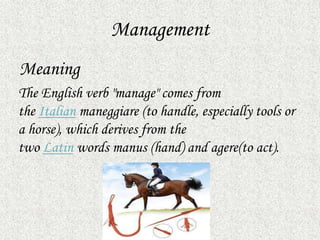
The English verb "manage" comes from
the Italian maneggiare (to handle, especially tools or
a horse), which derives from the
two Latin words manus (hand) and agere(to act).
Management
Definition
 “Management is the art of getting things done
through others and with formally organised groups.”
- Harold koontz
 “Management is the art of knowing what you want
to do and then seeing that they do it in the best and
the cheapest manner.”- F.W. Taylor
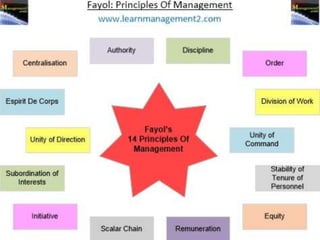
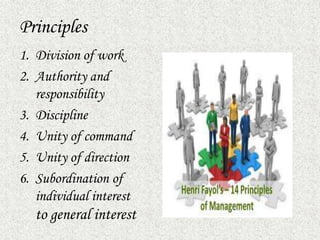
Principles
1. Division of work
2. Authority and
responsibility
3. Discipline
4. Unity of command
5. Unity of direction
6. Subordination of
individual interest
to general interest
Principles
7. Remuneration
of personnel
8. Centralisation
9. Scalar chain
10. Order
11. Equity
12. Stability of
tenure
13. Initiative
14. Esprit de corps
Management Principles
1.Division of work
Leading to specialisation results in increased human
efficiency; as through the application of this principle,
much more production is possible with the same amount
of human efforts.
Fayol recommends the application of this principle at
both the levels in an organisation operational and
managerial.
Management Principles
2. Authority and Responsibility
Managers need to have the authority (and with it
responsibility) to command their teams. When
managers have teams reporting to them they are
usually responsible for the team's performance.
Management Principles
3. Discipline
Teams need to have the discipline to complete their
tasks and they need to follow organisation rules.
This includes accepting the authority of their
managers and upholding the chain of command.
Management Principles
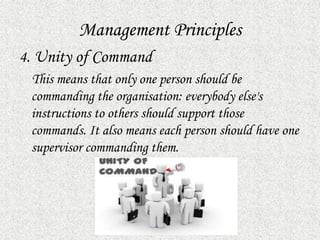
4. Unity of Command
This means that only one person should be
commanding the organisation: everybody else's
instructions to others should support those
commands. It also means each person should have one
supervisor commanding them.
Management Principles
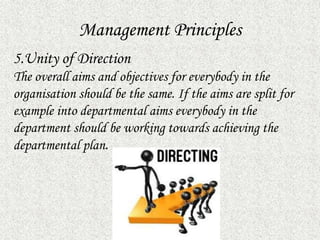
5.Unity of Direction
The overall aims and objectives for everybody in the
organisation should be the same. If the aims are split for
example into departmental aims everybody in the
department should be working towards achieving the
departmental plan.
Management Principles
6. Subordination of individual interests to general
interests
Organisational interests are more important than the
interests of one person; this includes managers as well
as workers.
Management Principles
7. Remuneration
A worker's rate of pay for the work (or services) they
provide should be fair especially as pay and benefits
are usually high in the list things motivating
employees.
Management Principles
8.Centralisation
In a centralised organisation power is held by head
office or a small number of managers, whilst
decentralised organisations allow departments and
individuals to make decisions.
Fayol believes that its important to have a balance
between centralisation and decentralisation; the
appropriate level of centralisation will depend on the
organisation structure and objectives.
Management Principles
9. Scalar Chain
This is about organisational hierarchy, where the
person at the top of the organisation (e.g. chief
executive officer) has the most authority and the
amount of authority decreases as you go down each
level of management through to supervisors and
finally employees without direct reports and authority
to command others. Fayol believes hierarchy is
important for organisational success and employees
should know their position in the chain of command.
Management Principles
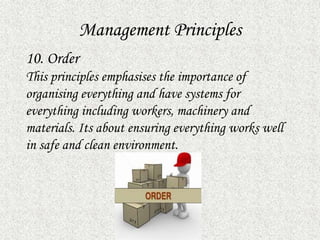
10. Order
This principles emphasises the importance of
organising everything and have systems for
everything including workers, machinery and
materials. Its about ensuring everything works well
in safe and clean environment.
Management Principles
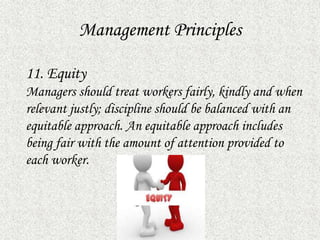
11. Equity
Managers should treat workers fairly, kindly and when
relevant justly; discipline should be balanced with an
equitable approach. An equitable approach includes
being fair with the amount of attention provided to
each worker.
Management Principles
12. Stability of Tenure of Personnel
Firms should ensure that employees remain in each
position for at least the minimum amount of time
required to be effective.
Fayol asserts that if workers move positions too
quickly they will not have enough time to learn how
to complete the work. Stability of tenure also includes
ensuring employees do not leave the company as it
costs money to recruit and train workers.
Management Principles
13. Initiative
Employee initiative will help the organisation improve,
provide new ideas and motivate employees so
organisations should encourage initiative. Employee
initiative can include employee suggestions, solutions to
a problem and dealing with situations without being
asked to do so.
Employee initiative will need boundaries otherwise it
could affect unity of command, centralisation and the
scalar chain.
Management Principles
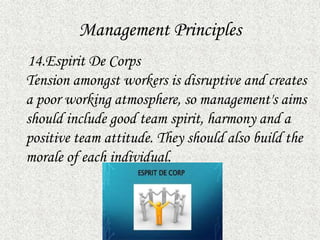
14.Espirit De Corps
Tension amongst workers is disruptive and creates
a poor working atmosphere, so management's aims
should include good team spirit, harmony and a
positive team attitude. They should also build the
morale of each individual.
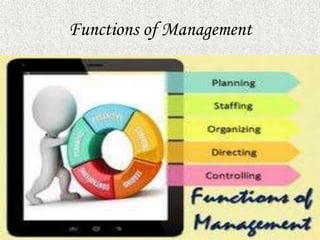
Functions of Management
Planning
Planning is a key management function; Managers
should set team objectives and write action plans
detailing how the team's objectives will be met.
Functions of Management
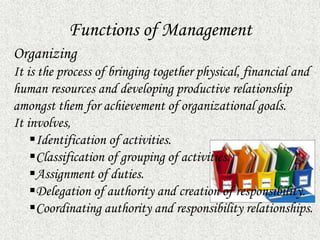
Organizing
It is the process of bringing together physical, financial and
human resources and developing productive relationship
amongst them for achievement of organizational goals.
It involves,
Identification of activities.
Classification of grouping of activities.
Assignment of duties.
Delegation of authority and creation of responsibility.
Coordinating authority and responsibility relationships.
Functions of Management
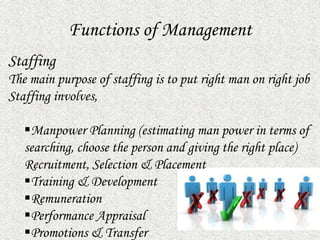
Staffing
The main purpose of staffing is to put right man on right job
Staffing involves,
Manpower Planning (estimating man power in terms of
searching, choose the person and giving the right place)
Recruitment, Selection & Placement
Training & Development
Remuneration
Performance Appraisal
Promotions & Transfer
Functions of Management
Directing
Direction is that inert-personnel aspect of management
which deals directly with influencing, guiding,
supervising, motivating sub-ordinate for the achievement
of organizational goals.
Direction has following elements:
-Supervision
-Motivation
-Leadership
-Communication
Functions of Management
Controlling
“Controlling is the measurement & correction of performance
activities of subordinates in order to make sure that the
enterprise objectives and plans desired to obtain them as being
accomplished”.
1. Establishment of standard performance.
2. Measurement of actual performance.
3. Comparison of actual performance with the standards and
finding out deviation if any.
4. Corrective action.
...

Introduction to management

  • 1.
    Kavitha .R, Asst.Professor, Dept.ofHospital Administration, Bon Secours College for Women, Thanjavur.
  • 2.
  • 3.
  • 4.
    Management Meaning The English verb"manage" comes from the Italian maneggiare (to handle, especially tools or a horse), which derives from the two Latin words manus (hand) and agere(to act).
  • 5.
    Management Definition  “Management isthe art of getting things done through others and with formally organised groups.” - Harold koontz  “Management is the art of knowing what you want to do and then seeing that they do it in the best and the cheapest manner.”- F.W. Taylor
  • 7.
    Principles 1. Division ofwork 2. Authority and responsibility 3. Discipline 4. Unity of command 5. Unity of direction 6. Subordination of individual interest to general interest
  • 8.
    Principles 7. Remuneration of personnel 8.Centralisation 9. Scalar chain 10. Order 11. Equity 12. Stability of tenure 13. Initiative 14. Esprit de corps
  • 9.
    Management Principles 1.Division ofwork Leading to specialisation results in increased human efficiency; as through the application of this principle, much more production is possible with the same amount of human efforts. Fayol recommends the application of this principle at both the levels in an organisation operational and managerial.
  • 10.
    Management Principles 2. Authorityand Responsibility Managers need to have the authority (and with it responsibility) to command their teams. When managers have teams reporting to them they are usually responsible for the team's performance.
  • 11.
    Management Principles 3. Discipline Teamsneed to have the discipline to complete their tasks and they need to follow organisation rules. This includes accepting the authority of their managers and upholding the chain of command.
  • 12.
    Management Principles 4. Unityof Command This means that only one person should be commanding the organisation: everybody else's instructions to others should support those commands. It also means each person should have one supervisor commanding them.
  • 13.
    Management Principles 5.Unity ofDirection The overall aims and objectives for everybody in the organisation should be the same. If the aims are split for example into departmental aims everybody in the department should be working towards achieving the departmental plan.
  • 14.
    Management Principles 6. Subordinationof individual interests to general interests Organisational interests are more important than the interests of one person; this includes managers as well as workers.
  • 15.
    Management Principles 7. Remuneration Aworker's rate of pay for the work (or services) they provide should be fair especially as pay and benefits are usually high in the list things motivating employees.
  • 16.
    Management Principles 8.Centralisation In acentralised organisation power is held by head office or a small number of managers, whilst decentralised organisations allow departments and individuals to make decisions. Fayol believes that its important to have a balance between centralisation and decentralisation; the appropriate level of centralisation will depend on the organisation structure and objectives.
  • 17.
    Management Principles 9. ScalarChain This is about organisational hierarchy, where the person at the top of the organisation (e.g. chief executive officer) has the most authority and the amount of authority decreases as you go down each level of management through to supervisors and finally employees without direct reports and authority to command others. Fayol believes hierarchy is important for organisational success and employees should know their position in the chain of command.
  • 18.
    Management Principles 10. Order Thisprinciples emphasises the importance of organising everything and have systems for everything including workers, machinery and materials. Its about ensuring everything works well in safe and clean environment.
  • 19.
    Management Principles 11. Equity Managersshould treat workers fairly, kindly and when relevant justly; discipline should be balanced with an equitable approach. An equitable approach includes being fair with the amount of attention provided to each worker.
  • 20.
    Management Principles 12. Stabilityof Tenure of Personnel Firms should ensure that employees remain in each position for at least the minimum amount of time required to be effective. Fayol asserts that if workers move positions too quickly they will not have enough time to learn how to complete the work. Stability of tenure also includes ensuring employees do not leave the company as it costs money to recruit and train workers.
  • 21.
    Management Principles 13. Initiative Employeeinitiative will help the organisation improve, provide new ideas and motivate employees so organisations should encourage initiative. Employee initiative can include employee suggestions, solutions to a problem and dealing with situations without being asked to do so. Employee initiative will need boundaries otherwise it could affect unity of command, centralisation and the scalar chain.
  • 22.
    Management Principles 14.Espirit DeCorps Tension amongst workers is disruptive and creates a poor working atmosphere, so management's aims should include good team spirit, harmony and a positive team attitude. They should also build the morale of each individual.
  • 23.
  • 24.
    Functions of Management Planning Planningis a key management function; Managers should set team objectives and write action plans detailing how the team's objectives will be met.
  • 25.
    Functions of Management Organizing Itis the process of bringing together physical, financial and human resources and developing productive relationship amongst them for achievement of organizational goals. It involves, Identification of activities. Classification of grouping of activities. Assignment of duties. Delegation of authority and creation of responsibility. Coordinating authority and responsibility relationships.
  • 26.
    Functions of Management Staffing Themain purpose of staffing is to put right man on right job Staffing involves, Manpower Planning (estimating man power in terms of searching, choose the person and giving the right place) Recruitment, Selection & Placement Training & Development Remuneration Performance Appraisal Promotions & Transfer
  • 27.
    Functions of Management Directing Directionis that inert-personnel aspect of management which deals directly with influencing, guiding, supervising, motivating sub-ordinate for the achievement of organizational goals. Direction has following elements: -Supervision -Motivation -Leadership -Communication
  • 28.
    Functions of Management Controlling “Controllingis the measurement & correction of performance activities of subordinates in order to make sure that the enterprise objectives and plans desired to obtain them as being accomplished”. 1. Establishment of standard performance. 2. Measurement of actual performance. 3. Comparison of actual performance with the standards and finding out deviation if any. 4. Corrective action.
  • 29.