Philippine Literature
What is
Literature?
Why study
Literature?
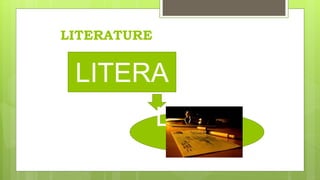
LITERATURE
LITERA
LETTE
R
What is Literature?
Is an Art
Is a presentation of LIFE. It
uses words to present to
readers and not to tell readers
what life is.
It does not define to us
directly what life is
Why Study Literature?
To develop a critical
appreciation and
discrimination of what life is.
To acquire mental maturity.
To get out from daily routine in
life and entertained.
To develop a taste for the true,
the goo and the beautiful.
1. Classification
2. kinds
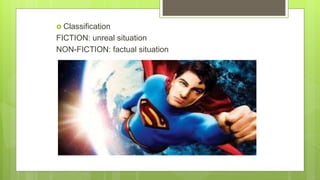
 Classification
FICTION: unreal situation
NON-FICTION: factual situation
NON-FICTION
1. Narrative Nonfiction
1. Autobiography - A writer tells his life in a first-person point of
view, using the pronoun I, and typically focuses on the most significant
events that happened to him or her.
2. Memoir - A writer also uses the first-person point of view to
relate events from his or her life. Memoirs differ from autobiographies
such that they typically focus on one period of a person’s life. In a
memoir, a writer will tend to emphasize his or her relationships with other
people of the impact of significant historical events on his or her own life.
3. Biography - A writer uses the third-person point of view to write
about the life of someone else. Narrative essay o A writer may use
either the first or third-person point of view to relate a true story in a
short composition
NON-FICTION
2. Informative Nonfiction
1. Expository essays - Explain a topic. Articles that
explain the steps in a process, report the news, or analyze
a work of literature are all examples of expository writing.
2.Persuasive essays - Promote an opinion. Advice
columns, movie reviews, and editorials are all examples of
persuasive writing. Many persuasive and expository essays
follow a general structure of lead, body and conclusion.
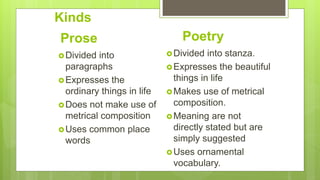
Kinds
Prose
Divided into
paragraphs
Expresses the
ordinary things in life
Does not make use of
metrical composition
Uses common place
words
Poetry
Divided into stanza.
Expresses the beautiful
things in life
Makes use of metrical
composition.
Meaning are not
directly stated but are
simply suggested
Uses ornamental
vocabulary.
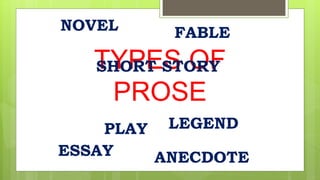
TYPES OF
PROSE
NOVEL
SHORT STORY
PLAY LEGEND
FABLE
ANECDOTEESSAY
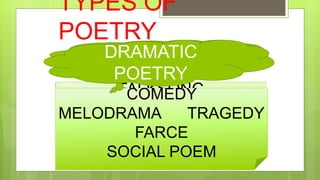
TYPES OF
POETRY
EPIC
METRICAL TALE
BALLAD
FALKSONG
SONNET
ELEGY ODE
PSALM
COMEDY
MELODRAMA TRAGEDY
FARCE
SOCIAL POEM
NARATIVELYRIC POETRYDRAMATIC
POETRY
THE
END

Introduction to Literature Lesson 1

  • 1.
  • 2.
  • 3.
    What is Literature? Isan Art Is a presentation of LIFE. It uses words to present to readers and not to tell readers what life is. It does not define to us directly what life is
  • 4.
    Why Study Literature? Todevelop a critical appreciation and discrimination of what life is. To acquire mental maturity. To get out from daily routine in life and entertained. To develop a taste for the true, the goo and the beautiful.
  • 5.
  • 6.
     Classification FICTION: unrealsituation NON-FICTION: factual situation
  • 7.
    NON-FICTION 1. Narrative Nonfiction 1.Autobiography - A writer tells his life in a first-person point of view, using the pronoun I, and typically focuses on the most significant events that happened to him or her. 2. Memoir - A writer also uses the first-person point of view to relate events from his or her life. Memoirs differ from autobiographies such that they typically focus on one period of a person’s life. In a memoir, a writer will tend to emphasize his or her relationships with other people of the impact of significant historical events on his or her own life. 3. Biography - A writer uses the third-person point of view to write about the life of someone else. Narrative essay o A writer may use either the first or third-person point of view to relate a true story in a short composition
  • 8.
    NON-FICTION 2. Informative Nonfiction 1.Expository essays - Explain a topic. Articles that explain the steps in a process, report the news, or analyze a work of literature are all examples of expository writing. 2.Persuasive essays - Promote an opinion. Advice columns, movie reviews, and editorials are all examples of persuasive writing. Many persuasive and expository essays follow a general structure of lead, body and conclusion.
  • 9.
    Kinds Prose Divided into paragraphs Expresses the ordinarythings in life Does not make use of metrical composition Uses common place words Poetry Divided into stanza. Expresses the beautiful things in life Makes use of metrical composition. Meaning are not directly stated but are simply suggested Uses ornamental vocabulary.
  • 10.
    TYPES OF PROSE NOVEL SHORT STORY PLAYLEGEND FABLE ANECDOTEESSAY
  • 11.
    TYPES OF POETRY EPIC METRICAL TALE BALLAD FALKSONG SONNET ELEGYODE PSALM COMEDY MELODRAMA TRAGEDY FARCE SOCIAL POEM NARATIVELYRIC POETRYDRAMATIC POETRY
  • 13.