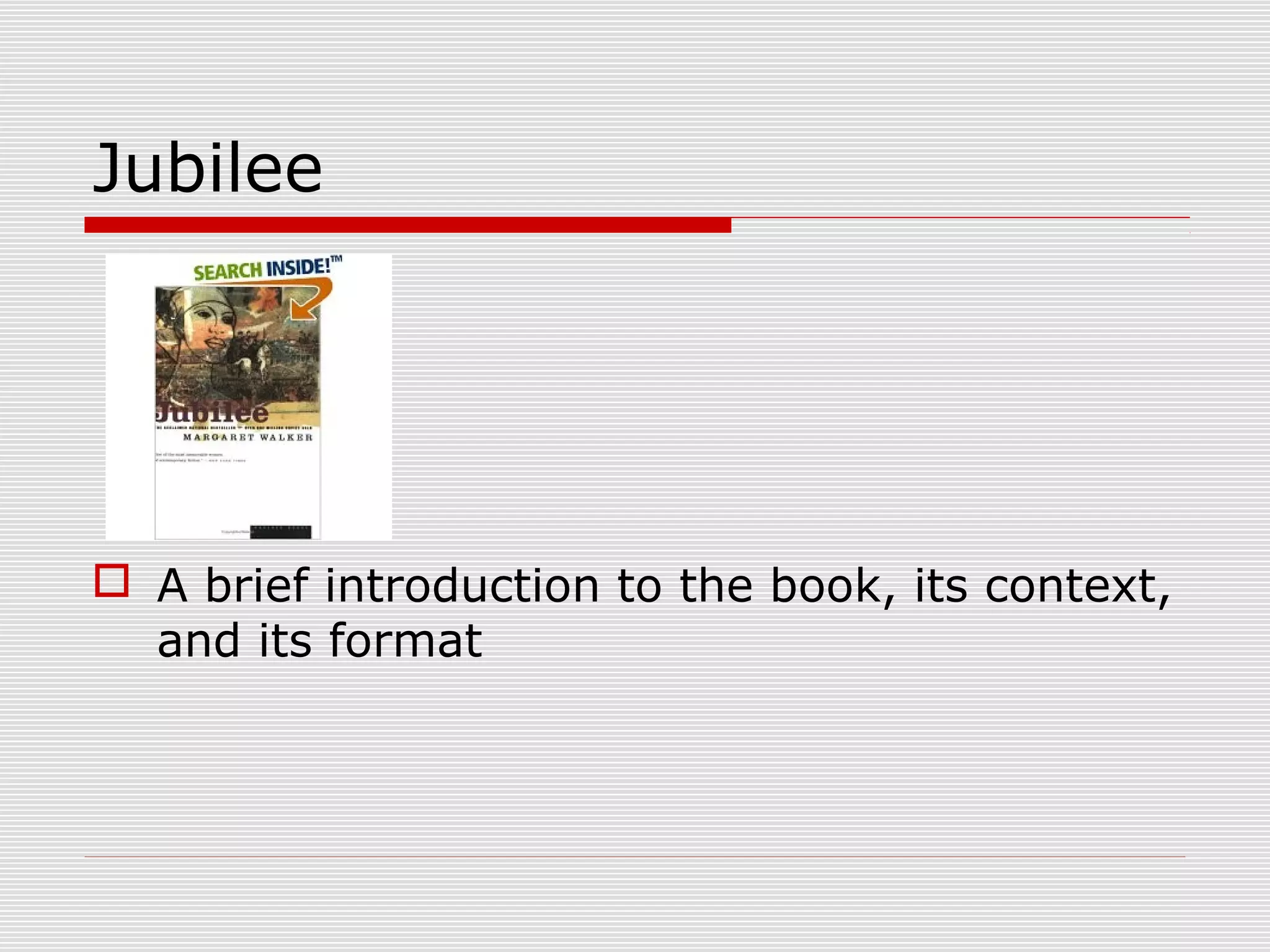
Jubilee

 A brief introduction to the book, its context,
and its format
Answer this:
 Have you written any papers, essays,
that could possibly evolve into a
book?
 Would you be willing to write about
the history of your family for a book
to be assigned to an undergraduate
English course?
 What would you title it?
The Genesis of Jubilee
 Based upon Walker’s maternal
grandmother – Elvira Ware Dozier
 Dozier told Walker stories about slave
life in Georgia; Walker first used the
stories for a class assignment
 The collected stories grew into
Walker’s dissertation
 The dissertation became the book in
1966
“How I Wrote Jubilee”
 Essay written by Walker details the
process of writing the book
 From 1934-1966, the book was
written and worked on (rough drafts)
 The book was completed during the
Black Arts Movement (great timing for
marketing)

 Considered a slave narrative novel
 A reflective history: 1966 (author) to
1839 (character)
Basic Framework
 Based on the lives of Walker’s
maternal grandparents
 Begins with a death-ends with a birth
(significant and symbolic since death gives life
reality)

 Told from the point of view of a Black
woman
 Focus on family and life on the
plantation
Consider this:
 How does Walker’s present history
impact the history that she writes
about?
 Does our present perspective alter
the reality of the past truth?
 Can Walker be truly objective or is
fiction safer to be subjective?
 Why NOT write a biography instead of
a novel of grandma Dozier?
Ponder this….
 What is the true difference between
fiction and biography?
 Are all biographies true? What then is
the difference between an authorized
biography and an unauthorized
biography?
 How do you know the content of a
biography is accurate?
Walker states:
 “I had always intended Jubilee to be a
folk novel based on folk material: folk
sayings, folk beliefs, and folkways…”
 Note the title of her sections
 Note the epigraphs (old spirituals and
slave songs)
 Note the Biblical references
 Note the language, dialect of slaves
General format
 Follows format for slave narratives
 Oral history of Vyry
 The protagonist is a slave woman (a
more modern premise); most
protagonists were men
 Historic references are important in
this text; look for specific references
in each section
Sections of the Book
Section 1 = 1839-1860 (Bondage)
Section 2 = 1861-1865 (Escape)
Section 3 = 1866-1870 (Freedom)
Section 2 coincides with the Civil War
Section 3 coincides with the
Reconstruction Period
 Notes the events that occur during
each period





Similar to:
 Harriet Tubman (Do you know who
she is?)
 Maria Child – Incidents of a Life of A
Slave Girl
 Other slave narratives and oral
histories of early African American
writers
 Alex Haley’s Roots
Interesting facts
 Book was never considered for a film
because of Haley’s Roots
 The “seed” of the book was a
personal essay Walker had to write
for an English class
 L. Hughes felt that Walker modeled
Randall off of Wright; Wright was
mad

Introduction to Jubilee

  • 1.
    Jubilee  A briefintroduction to the book, its context, and its format
  • 2.
    Answer this:  Haveyou written any papers, essays, that could possibly evolve into a book?  Would you be willing to write about the history of your family for a book to be assigned to an undergraduate English course?  What would you title it?
  • 3.
    The Genesis ofJubilee  Based upon Walker’s maternal grandmother – Elvira Ware Dozier  Dozier told Walker stories about slave life in Georgia; Walker first used the stories for a class assignment  The collected stories grew into Walker’s dissertation  The dissertation became the book in 1966
  • 4.
    “How I WroteJubilee”  Essay written by Walker details the process of writing the book  From 1934-1966, the book was written and worked on (rough drafts)  The book was completed during the Black Arts Movement (great timing for marketing)  Considered a slave narrative novel  A reflective history: 1966 (author) to 1839 (character)
  • 5.
    Basic Framework  Basedon the lives of Walker’s maternal grandparents  Begins with a death-ends with a birth (significant and symbolic since death gives life reality)  Told from the point of view of a Black woman  Focus on family and life on the plantation
  • 6.
    Consider this:  Howdoes Walker’s present history impact the history that she writes about?  Does our present perspective alter the reality of the past truth?  Can Walker be truly objective or is fiction safer to be subjective?  Why NOT write a biography instead of a novel of grandma Dozier?
  • 7.
    Ponder this….  Whatis the true difference between fiction and biography?  Are all biographies true? What then is the difference between an authorized biography and an unauthorized biography?  How do you know the content of a biography is accurate?
  • 8.
    Walker states:  “Ihad always intended Jubilee to be a folk novel based on folk material: folk sayings, folk beliefs, and folkways…”  Note the title of her sections  Note the epigraphs (old spirituals and slave songs)  Note the Biblical references  Note the language, dialect of slaves
  • 9.
    General format  Followsformat for slave narratives  Oral history of Vyry  The protagonist is a slave woman (a more modern premise); most protagonists were men  Historic references are important in this text; look for specific references in each section
  • 10.
    Sections of theBook Section 1 = 1839-1860 (Bondage) Section 2 = 1861-1865 (Escape) Section 3 = 1866-1870 (Freedom) Section 2 coincides with the Civil War Section 3 coincides with the Reconstruction Period  Notes the events that occur during each period     
  • 11.
    Similar to:  HarrietTubman (Do you know who she is?)  Maria Child – Incidents of a Life of A Slave Girl  Other slave narratives and oral histories of early African American writers  Alex Haley’s Roots
  • 12.
    Interesting facts  Bookwas never considered for a film because of Haley’s Roots  The “seed” of the book was a personal essay Walker had to write for an English class  L. Hughes felt that Walker modeled Randall off of Wright; Wright was mad