Presented By
Md. Shohel Rana
M.Sc in CSE KUET
Head of CST - NUBNGPI
IP -Introduction
What is IP ?
• An Internet Protocol address (IP address) is a logical numeric
address that is assigned to every single computer, printer, switch,
router, tablets, smartphones or any other device that is part of a
TCP/IP-based network.
• It is used to identify itself and communicate with other devices in
the IP network. Any device connected to the TCP/IP-based
network must have a unique IP address within the network.
What does that mean?
• An Internet Protocol is a set of rules that govern Internet activity
and facilitate completion of a variety of actions on the World Wide
Web
• An IP address is an identifier for a computer or device on a TCP/IP
network.
Types of IP address
1) static IP address
2) dynamic IP address
When you sign up with an Internet Service Provider you will either end
up with a static IP address or a dynamic IP address. What's the difference
between the two?
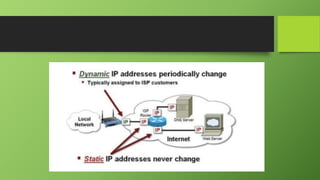
• Dynamic means "constantly changing “ .dynamic IP addresses aren't
more powerful, but they can change.
• Static means staying the same. Static. Stand. Stable. Yes, static IP
addresses don't change.
• Most IP addresses assigned today by Internet Service Providers are
dynamic IP addresses. It's more cost effective for the ISP and you.
static IP address
• A static IP address is an address that is permanently assigned to you by your
ISP and does not change even if your computer reboots.
• A static IP address is usually assigned to a server hosting websites, and
providing email, database and FTP services.
• A static IP address is also assigned to a commercial leased line, or public
organization requiring same IP address each and every time. Since static IP
address is assigned to you, you'll have to manually configure your machine
(router or server) to use the static IP address assigned to you.
dynamic IP address
• A dynamic IP address is an IP address dynamically assigned to your
computer by your ISP. Each time your computer (or router) is rebooted,
your ISP dynamically assigns an IP address to your networking device
using DHCP protocol.
• Since your ISP dynamically assigns an IP address to a computing device
on reboot, your device may not always receive the same IP address
previous assigned to it.
• Even if your machine is always on and permanently connected, some
ISPs do change IP address on-the-fly even though this is very rare.
• A sticky nature of DHCP generally reassigns same IP address to the same
machine, it is not guaranteed to receive same IP address as IP pool may
exhaust at times and lease time may expire.
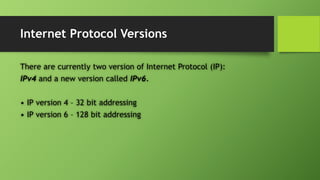
Internet Protocol Versions
There are currently two version of Internet Protocol (IP):
IPv4 and a new version called IPv6.
• IP version 4 – 32 bit addressing
• IP version 6 – 128 bit addressing
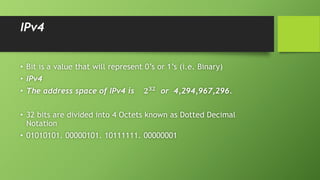
IPv4
• Bit is a value that will represent 0’s or 1’s (i.e. Binary)
• IPv4
• The address space of IPv4 is 𝟐𝟑𝟐 or 4,294,967,296.
• 32 bits are divided into 4 Octets known as Dotted Decimal
Notation
• 01010101. 00000101. 10111111. 00000001

Introduction to IP address concept - Computer Networking

  • 1.
    Presented By Md. ShohelRana M.Sc in CSE KUET Head of CST - NUBNGPI IP -Introduction
  • 2.
    What is IP? • An Internet Protocol address (IP address) is a logical numeric address that is assigned to every single computer, printer, switch, router, tablets, smartphones or any other device that is part of a TCP/IP-based network. • It is used to identify itself and communicate with other devices in the IP network. Any device connected to the TCP/IP-based network must have a unique IP address within the network.
  • 3.
    What does thatmean? • An Internet Protocol is a set of rules that govern Internet activity and facilitate completion of a variety of actions on the World Wide Web • An IP address is an identifier for a computer or device on a TCP/IP network.
  • 4.
    Types of IPaddress 1) static IP address 2) dynamic IP address When you sign up with an Internet Service Provider you will either end up with a static IP address or a dynamic IP address. What's the difference between the two? • Dynamic means "constantly changing “ .dynamic IP addresses aren't more powerful, but they can change. • Static means staying the same. Static. Stand. Stable. Yes, static IP addresses don't change. • Most IP addresses assigned today by Internet Service Providers are dynamic IP addresses. It's more cost effective for the ISP and you.
  • 5.
    static IP address •A static IP address is an address that is permanently assigned to you by your ISP and does not change even if your computer reboots. • A static IP address is usually assigned to a server hosting websites, and providing email, database and FTP services. • A static IP address is also assigned to a commercial leased line, or public organization requiring same IP address each and every time. Since static IP address is assigned to you, you'll have to manually configure your machine (router or server) to use the static IP address assigned to you.
  • 6.
    dynamic IP address •A dynamic IP address is an IP address dynamically assigned to your computer by your ISP. Each time your computer (or router) is rebooted, your ISP dynamically assigns an IP address to your networking device using DHCP protocol. • Since your ISP dynamically assigns an IP address to a computing device on reboot, your device may not always receive the same IP address previous assigned to it. • Even if your machine is always on and permanently connected, some ISPs do change IP address on-the-fly even though this is very rare. • A sticky nature of DHCP generally reassigns same IP address to the same machine, it is not guaranteed to receive same IP address as IP pool may exhaust at times and lease time may expire.
  • 8.
    Internet Protocol Versions Thereare currently two version of Internet Protocol (IP): IPv4 and a new version called IPv6. • IP version 4 – 32 bit addressing • IP version 6 – 128 bit addressing
  • 9.
    IPv4 • Bit isa value that will represent 0’s or 1’s (i.e. Binary) • IPv4 • The address space of IPv4 is 𝟐𝟑𝟐 or 4,294,967,296. • 32 bits are divided into 4 Octets known as Dotted Decimal Notation • 01010101. 00000101. 10111111. 00000001