AR. VIJAY KUMAR
INTERIOR DESIGN - VIII
Lecture – 1
Introduction to interior design
Course content
• Introduction to interior design , history of interior design,
role of an interior designer & the skills
• Theory of design & the constraints involved in an interior
design process.
• Role of different Art forms in interior design
• Furniture – their evolution & importance.
• Color in interior design, relationship with light.
• Lighting design – principles of lighting layout & how to
determine position of fixtures
• Accessories in interior design, materials & finishes.
• Electrical wiring and fixtures, materials and methods
• Presentation in class – 5 marks per class.
• Design problem – Jewelers showroom. ( 30 Marks )
Marking system
Introduction to Interior design
Interior design is the process of shaping the experience
of interior space, through the manipulation of spatial
volume as well as surface treatment.
Interior design is not only an art form but also a
communication skill depends upon the understanding
of vocabulary.
Ar.Rupika Ashtt
Designprocess
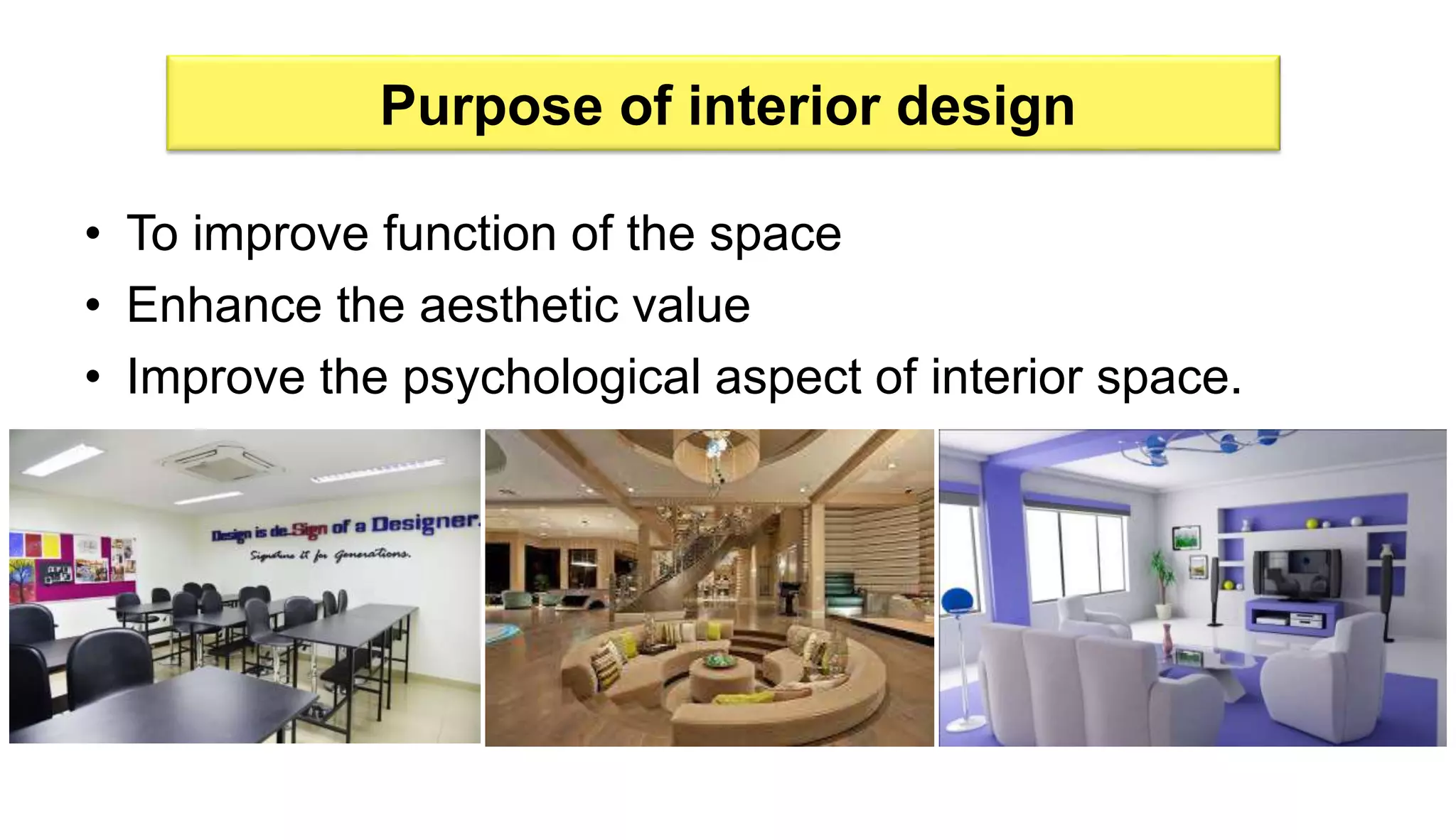
• To improve function of the space
• Enhance the aesthetic value
• Improve the psychological aspect of interior space.
Purpose of interior design
• Human civilization & emergence of interior design:
Practice of interior design began when the first cave dwellers made
decisions about where to level & pad an area for sleeping, where
to place & how to arrange facilities for cooking & where to store
tools & weapons.
• Centuries passed & civilizations developed by changing the
interior:
• Forms
• Function
• Complexity
• Materials
History of interior design
• Stone Age - 6000 – 2000BC
• Egyptian - 2700 – 30BC
• Neolithic Europe - 2000 -
1700BC
• Greek - 1200 – 31BC
• Roman - 753BC – 480AD
• Byzantine - 500 – 1500AD
• Dark Ages - 900 - 1100AD
• Gothic - 1140 – 1400AD
• Renaissance - 1400 – 1600AD
• Baroque - 1590 – 1725AD
• Rococo Style - 1700AD
• Traditional - 1700AD – Now
• Industrial Revolution - 1760 –
1820AD
• Neoclassical Style - 1780 –
1880AD
• Tropical - 1800s – Now
• Aesthetic Movement - 1800s
• Victorian - 1837 – 1901AD
• Tuscan - 1840s – Now
• Arts & Crafts - 1860 – 1910AD
• Rustic - 1870s – Now
• Art Nouveau - 1890 - 1910AD
• Asian - 1900s – Now
• Colonial Revival - 1905 –Now
• Modern - 1918 – 1950
• Mediterranean - 1920s – Now
• Art Deco - 1920s – 1960s
• Mid-Century Modern - 1930s
• Transitional - 1950s – Now
• Contemporary - 1980s – Now
History of interior design
• International interior design association mentions the role of
an interior designer:
• Properly analyzing clients needs, goals, life & safety
requirements.
• Formulation of preliminary design concepts the are
functional & appropriate.
• Development of final design through presentation media.
• Review & evaluation of design solution during
implementation & upon completion.
Role of interior designer

Introduction to interior design

  • 1.
    AR. VIJAY KUMAR INTERIORDESIGN - VIII Lecture – 1 Introduction to interior design
  • 2.
    Course content • Introductionto interior design , history of interior design, role of an interior designer & the skills • Theory of design & the constraints involved in an interior design process. • Role of different Art forms in interior design • Furniture – their evolution & importance. • Color in interior design, relationship with light. • Lighting design – principles of lighting layout & how to determine position of fixtures • Accessories in interior design, materials & finishes. • Electrical wiring and fixtures, materials and methods
  • 3.
    • Presentation inclass – 5 marks per class. • Design problem – Jewelers showroom. ( 30 Marks ) Marking system
  • 4.
    Introduction to Interiordesign Interior design is the process of shaping the experience of interior space, through the manipulation of spatial volume as well as surface treatment. Interior design is not only an art form but also a communication skill depends upon the understanding of vocabulary.
  • 6.
  • 7.
  • 8.
    • To improvefunction of the space • Enhance the aesthetic value • Improve the psychological aspect of interior space. Purpose of interior design
  • 9.
    • Human civilization& emergence of interior design: Practice of interior design began when the first cave dwellers made decisions about where to level & pad an area for sleeping, where to place & how to arrange facilities for cooking & where to store tools & weapons. • Centuries passed & civilizations developed by changing the interior: • Forms • Function • Complexity • Materials History of interior design
  • 10.
    • Stone Age- 6000 – 2000BC • Egyptian - 2700 – 30BC • Neolithic Europe - 2000 - 1700BC • Greek - 1200 – 31BC • Roman - 753BC – 480AD • Byzantine - 500 – 1500AD • Dark Ages - 900 - 1100AD • Gothic - 1140 – 1400AD • Renaissance - 1400 – 1600AD • Baroque - 1590 – 1725AD • Rococo Style - 1700AD • Traditional - 1700AD – Now • Industrial Revolution - 1760 – 1820AD • Neoclassical Style - 1780 – 1880AD • Tropical - 1800s – Now • Aesthetic Movement - 1800s • Victorian - 1837 – 1901AD • Tuscan - 1840s – Now • Arts & Crafts - 1860 – 1910AD • Rustic - 1870s – Now • Art Nouveau - 1890 - 1910AD • Asian - 1900s – Now • Colonial Revival - 1905 –Now • Modern - 1918 – 1950 • Mediterranean - 1920s – Now • Art Deco - 1920s – 1960s • Mid-Century Modern - 1930s • Transitional - 1950s – Now • Contemporary - 1980s – Now History of interior design
  • 11.
    • International interiordesign association mentions the role of an interior designer: • Properly analyzing clients needs, goals, life & safety requirements. • Formulation of preliminary design concepts the are functional & appropriate. • Development of final design through presentation media. • Review & evaluation of design solution during implementation & upon completion. Role of interior designer

Editor's Notes

  • #5 Interior design is all about how we experience spaces. Comfortable homes, functional workplaces, beautiful public spaces. our needs and appeal to our emotions. Interior design is more than just aesthetics. finding creative design solutions for interior environments while supporting the health, safety and well being of occupants . They don’t just enhance the looks, theyy enhance the function of a room.