Adv. Vijay Jayshwal
Kathmandu University School of Law
Social Secuirty and Labour Law
12/27/2019
Social security..
 Social security is declared as a human right in the major
United Nations human rights instruments. However, at the
beginning of the twenty-first century, access to any form of
social protection remains a dream for 80 per cent of the
world’s population.
 Social protection is a powerful tool for alleviating poverty and
inequality.
 In accordance with the aims and purposes set out in the
Preamble to the ILO Constitution (1919), the extension of
social security worldwide has consistently been one of
the main objectives of the Organization.
 This mandate, restated in 1944 in the Declaration of
Philadelphia, part of the ILO Constitution, recognizes the
“solemn obligation of the International Labour Organization to
further among the nations of the world programmes which will
achieve”, among others, “the extension of social security
measures to provide a basic income to all in need of such
protection and comprehensive medical care”, as well as
“provision for child welfare and maternity protection”,
thereby extending the protection from workers to all those
12/27/2019
 Based on international human rights instruments, ILO
constitutive documents and social security Conventions
and Recommendations subsequently adopted by the ILO,
social security may be defined as:
 “The adoption of public measures to ensure basic income
security to all in need of protection, in order to relieve want
and prevent destitution by restoring up to a certain level
income which is lost or reduced by reason of inability to
work or to obtain remunerative work due to the occurrence
of various contingencies: sickness, unemployment, old
age, employment injury, family responsibilities, maternity,
invalidity or death of the breadwinner.”
 Social security therefore occupies a predominant place in
the activities of the ILO.
 Pursuant to its mandate, the strengthening of social
security was established as one of the four strategic
objectives of the Decent Work Agenda, presented by
the ILO Director General and adopted by the
International Labour Conference in 1999. 12/27/2019
Development of Social Security
 The first generation of standards corresponds to the
instruments adopted from the creation of the ILO to the
end of the Second World War. Most of these standards
envisage social insurance as the means for their
application.
 The second generation of standards corresponds to the
era of social security. While no ILO Conventions were
adopted between 1940 and 1945, these were years of
intensive creation in the field of modern social security,
with standard-setting activities taking on a more
global and broader conception of social security.
 Two important Recommendations, adopted in 1944, set
forth this new conception: the Income Security
Recommendation, 1944 (No. 67), and the Medical Care
Recommendation, 1944 (No. 69).
 These Recommendations opened the way for the adoption
of the Social Security (Minimum Standards) Convention,
1952 (No. 102), which is the landmark Convention in the
12/27/2019
 The third generation of standards corresponds
to the instruments adopted after Convention No.
102. They offer a higher level of protection in
terms of the population covered and the level of
benefits and revise first-generation standards.
 Since the establishment of the ILO, the
International Labour Conference has adopted 31
Conventions and 23 Recommendations on social
security.
 The first international Convention on social
security (maternity protection) was adopted at
the 1st Session of the Conference, in 1919, while
the most recent one, revising earlier standards on
maternity protection, was adopted in 2000.
 In 2002, the ILO Governing Body confirmed six
out of these 31 Conventions as up-to-date social12/27/2019
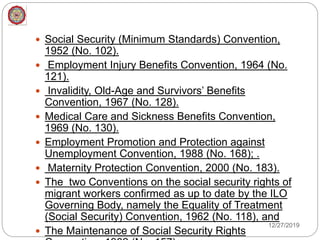
 Social Security (Minimum Standards) Convention,
1952 (No. 102).
 Employment Injury Benefits Convention, 1964 (No.
121).
 Invalidity, Old-Age and Survivors’ Benefits
Convention, 1967 (No. 128).
 Medical Care and Sickness Benefits Convention,
1969 (No. 130).
 Employment Promotion and Protection against
Unemployment Convention, 1988 (No. 168); .
 Maternity Protection Convention, 2000 (No. 183).
 The two Conventions on the social security rights of
migrant workers confirmed as up to date by the ILO
Governing Body, namely the Equality of Treatment
(Social Security) Convention, 1962 (No. 118), and
 The Maintenance of Social Security Rights
12/27/2019
Principles of Social Security
 Social security as a human rights
 Obligation of solidarity
 Flexibility towards universality
 Financing : Contributory and Non- Contributory
System
 Organizations and administration : Public or
Private management?
 Entitlements
1. Method for calculating cash benefits
2.Suspension, refusal, withdrawal of benefits
3.The beneficiaries right to appeal
12/27/2019
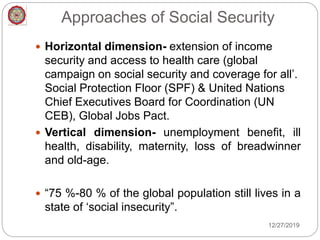
Approaches of Social Security
 Horizontal dimension- extension of income
security and access to health care (global
campaign on social security and coverage for all’.
Social Protection Floor (SPF) & United Nations
Chief Executives Board for Coordination (UN
CEB), Global Jobs Pact.
 Vertical dimension- unemployment benefit, ill
health, disability, maternity, loss of breadwinner
and old-age.
 “75 %-80 % of the global population still lives in a
state of ‘social insecurity”.
12/27/2019
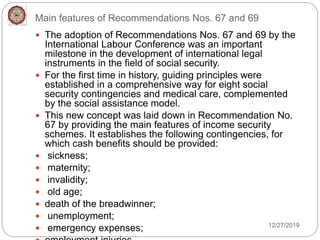
Main features of Recommendations Nos. 67 and 69
 The adoption of Recommendations Nos. 67 and 69 by the
International Labour Conference was an important
milestone in the development of international legal
instruments in the field of social security.
 For the first time in history, guiding principles were
established in a comprehensive way for eight social
security contingencies and medical care, complemented
by the social assistance model.
 This new concept was laid down in Recommendation No.
67 by providing the main features of income security
schemes. It establishes the following contingencies, for
which cash benefits should be provided:
 sickness;
 maternity;
 invalidity;
 old age;
 death of the breadwinner;
 unemployment;
 emergency expenses; 12/27/2019
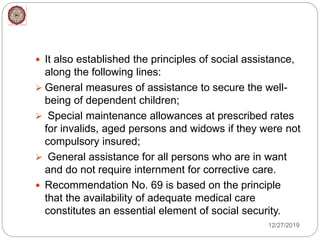
 It also established the principles of social assistance,
along the following lines:
 General measures of assistance to secure the well-
being of dependent children;
 Special maintenance allowances at prescribed rates
for invalids, aged persons and widows if they were not
compulsory insured;
 General assistance for all persons who are in want
and do not require internment for corrective care.
 Recommendation No. 69 is based on the principle
that the availability of adequate medical care
constitutes an essential element of social security.
12/27/2019
Main features of Convention No. 102
 Convention No. 102 is the flagship of the six up-to-date
social security Conventions. It is the only international
Convention which defines the nine classical branches of
social security and sets minimum standards for each.
These are:
 Medical care: The contingencies covered include any
morbid condition, whatever its cause, and the medical care
required as a result, as well as the medical care
necessitated by pregnancy, confinement and their
consequences; medical care of a preventive nature is also
covered.
 Sickness benefit: The contingency covered includes
incapacity for work resulting from a morbid condition and
involving suspension of earnings.
 Unemployment benefit: The contingency covered
includes suspension or loss of earnings due to inability to
obtain suitable employment.
 Old-age benefit: The contingency covered is survival
beyond a prescribed age (normally not higher than 65
years).
12/27/2019
 Family benefit: The contingency covered is the
responsibility for the maintenance of children, i.e.,
under school-leaving age or under 15 years of age.
 Maternity benefit: The contingencies covered are the
medical care required by pregnancy, confinement and
their consequences and the resulting suspension of
earnings.
 Invalidity benefit: The contingency covered is the
inability to engage in any gainful activity where such
inability is likely to be permanent or persists after the
period during which the beneficiary is entitled to
benefit from temporary incapacity.
 Survivors’ benefit: The contingency covered is the
loss of support suffered by the widow or children as a
result of the death of the breadwinner 12/27/2019

Social security and Labour Law

  • 1.
    Adv. Vijay Jayshwal KathmanduUniversity School of Law Social Secuirty and Labour Law 12/27/2019
  • 2.
    Social security..  Socialsecurity is declared as a human right in the major United Nations human rights instruments. However, at the beginning of the twenty-first century, access to any form of social protection remains a dream for 80 per cent of the world’s population.  Social protection is a powerful tool for alleviating poverty and inequality.  In accordance with the aims and purposes set out in the Preamble to the ILO Constitution (1919), the extension of social security worldwide has consistently been one of the main objectives of the Organization.  This mandate, restated in 1944 in the Declaration of Philadelphia, part of the ILO Constitution, recognizes the “solemn obligation of the International Labour Organization to further among the nations of the world programmes which will achieve”, among others, “the extension of social security measures to provide a basic income to all in need of such protection and comprehensive medical care”, as well as “provision for child welfare and maternity protection”, thereby extending the protection from workers to all those 12/27/2019
  • 3.
     Based oninternational human rights instruments, ILO constitutive documents and social security Conventions and Recommendations subsequently adopted by the ILO, social security may be defined as:  “The adoption of public measures to ensure basic income security to all in need of protection, in order to relieve want and prevent destitution by restoring up to a certain level income which is lost or reduced by reason of inability to work or to obtain remunerative work due to the occurrence of various contingencies: sickness, unemployment, old age, employment injury, family responsibilities, maternity, invalidity or death of the breadwinner.”  Social security therefore occupies a predominant place in the activities of the ILO.  Pursuant to its mandate, the strengthening of social security was established as one of the four strategic objectives of the Decent Work Agenda, presented by the ILO Director General and adopted by the International Labour Conference in 1999. 12/27/2019
  • 4.
    Development of SocialSecurity  The first generation of standards corresponds to the instruments adopted from the creation of the ILO to the end of the Second World War. Most of these standards envisage social insurance as the means for their application.  The second generation of standards corresponds to the era of social security. While no ILO Conventions were adopted between 1940 and 1945, these were years of intensive creation in the field of modern social security, with standard-setting activities taking on a more global and broader conception of social security.  Two important Recommendations, adopted in 1944, set forth this new conception: the Income Security Recommendation, 1944 (No. 67), and the Medical Care Recommendation, 1944 (No. 69).  These Recommendations opened the way for the adoption of the Social Security (Minimum Standards) Convention, 1952 (No. 102), which is the landmark Convention in the 12/27/2019
  • 5.
     The thirdgeneration of standards corresponds to the instruments adopted after Convention No. 102. They offer a higher level of protection in terms of the population covered and the level of benefits and revise first-generation standards.  Since the establishment of the ILO, the International Labour Conference has adopted 31 Conventions and 23 Recommendations on social security.  The first international Convention on social security (maternity protection) was adopted at the 1st Session of the Conference, in 1919, while the most recent one, revising earlier standards on maternity protection, was adopted in 2000.  In 2002, the ILO Governing Body confirmed six out of these 31 Conventions as up-to-date social12/27/2019
  • 6.
     Social Security(Minimum Standards) Convention, 1952 (No. 102).  Employment Injury Benefits Convention, 1964 (No. 121).  Invalidity, Old-Age and Survivors’ Benefits Convention, 1967 (No. 128).  Medical Care and Sickness Benefits Convention, 1969 (No. 130).  Employment Promotion and Protection against Unemployment Convention, 1988 (No. 168); .  Maternity Protection Convention, 2000 (No. 183).  The two Conventions on the social security rights of migrant workers confirmed as up to date by the ILO Governing Body, namely the Equality of Treatment (Social Security) Convention, 1962 (No. 118), and  The Maintenance of Social Security Rights 12/27/2019
  • 7.
    Principles of SocialSecurity  Social security as a human rights  Obligation of solidarity  Flexibility towards universality  Financing : Contributory and Non- Contributory System  Organizations and administration : Public or Private management?  Entitlements 1. Method for calculating cash benefits 2.Suspension, refusal, withdrawal of benefits 3.The beneficiaries right to appeal 12/27/2019
  • 8.
    Approaches of SocialSecurity  Horizontal dimension- extension of income security and access to health care (global campaign on social security and coverage for all’. Social Protection Floor (SPF) & United Nations Chief Executives Board for Coordination (UN CEB), Global Jobs Pact.  Vertical dimension- unemployment benefit, ill health, disability, maternity, loss of breadwinner and old-age.  “75 %-80 % of the global population still lives in a state of ‘social insecurity”. 12/27/2019
  • 9.
    Main features ofRecommendations Nos. 67 and 69  The adoption of Recommendations Nos. 67 and 69 by the International Labour Conference was an important milestone in the development of international legal instruments in the field of social security.  For the first time in history, guiding principles were established in a comprehensive way for eight social security contingencies and medical care, complemented by the social assistance model.  This new concept was laid down in Recommendation No. 67 by providing the main features of income security schemes. It establishes the following contingencies, for which cash benefits should be provided:  sickness;  maternity;  invalidity;  old age;  death of the breadwinner;  unemployment;  emergency expenses; 12/27/2019
  • 10.
     It alsoestablished the principles of social assistance, along the following lines:  General measures of assistance to secure the well- being of dependent children;  Special maintenance allowances at prescribed rates for invalids, aged persons and widows if they were not compulsory insured;  General assistance for all persons who are in want and do not require internment for corrective care.  Recommendation No. 69 is based on the principle that the availability of adequate medical care constitutes an essential element of social security. 12/27/2019
  • 11.
    Main features ofConvention No. 102  Convention No. 102 is the flagship of the six up-to-date social security Conventions. It is the only international Convention which defines the nine classical branches of social security and sets minimum standards for each. These are:  Medical care: The contingencies covered include any morbid condition, whatever its cause, and the medical care required as a result, as well as the medical care necessitated by pregnancy, confinement and their consequences; medical care of a preventive nature is also covered.  Sickness benefit: The contingency covered includes incapacity for work resulting from a morbid condition and involving suspension of earnings.  Unemployment benefit: The contingency covered includes suspension or loss of earnings due to inability to obtain suitable employment.  Old-age benefit: The contingency covered is survival beyond a prescribed age (normally not higher than 65 years). 12/27/2019
  • 12.
     Family benefit:The contingency covered is the responsibility for the maintenance of children, i.e., under school-leaving age or under 15 years of age.  Maternity benefit: The contingencies covered are the medical care required by pregnancy, confinement and their consequences and the resulting suspension of earnings.  Invalidity benefit: The contingency covered is the inability to engage in any gainful activity where such inability is likely to be permanent or persists after the period during which the beneficiary is entitled to benefit from temporary incapacity.  Survivors’ benefit: The contingency covered is the loss of support suffered by the widow or children as a result of the death of the breadwinner 12/27/2019