Mutia Hariati HussinMutia Hariati Hussin
20142014
HUMAN RIGHTSHUMAN RIGHTS
The Role of StateThe Role of State
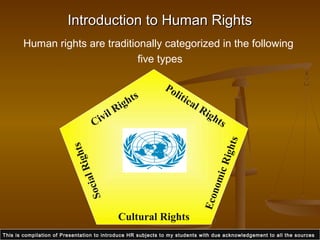
Introduction to Human RightsIntroduction to Human Rights
Human rights are traditionally categorized in the following
five types
Civil Rights
Political Rights
EconomicRights
Cultural Rights
SocialRights
This is compilation of Presentation to introduce HR subjects to my students with due acknowledgement to all the sources
FRAMING OUR HUMAN RIGHTS
QUESTIONS
 How does the Universal Declaration of HumanHow does the Universal Declaration of Human
Rights and our stories connect to HumanRights and our stories connect to Human
Rights Education?Rights Education?
HUMAN RIGHTS EDUCATIONHUMAN RIGHTS EDUCATION
 ““Human Rights EducationHuman Rights Education isis a meansa means towards socialtowards social
change;change; aa tooltool to transform the theory and practicalto transform the theory and practical
applications into everyday social practice.”applications into everyday social practice.”
 ““In conflict situations and in peace building,In conflict situations and in peace building, HREHRE must be seenmust be seen
to benefit the target populations’ daily lives.”to benefit the target populations’ daily lives.”
“HRE focuses especially on social goals and ideals that“HRE focuses especially on social goals and ideals that
emphasize the dignity of all human beings and the need foremphasize the dignity of all human beings and the need for
laws and institutions that enforce those standards. In so doing,laws and institutions that enforce those standards. In so doing,
HRE contributes directly to the process of building a societyHRE contributes directly to the process of building a society
based on freedom, peace and Justice.”based on freedom, peace and Justice.”
Paul Martin, et al.Paul Martin, et al.
 “Where, after all do universal rights begin? In small
places, close to home – so close and so small that
they cannot be seen on any maps of the world. Yet
they are the world of the individual person; the
neighborhood he lives in; the school or college
he attends; the factory, farm or office where he
works. Such are the places where every man,
woman, and child seeks equal justice, equal
opportunity, equal dignity without
discrimination. Unless these rights have meaning
there, they have little meaning anywhere. Without
concerted citizen action to uphold them close to home,
we shall look in vain for progress in the larger world.”
Elenor RoosweltElenor Rooswelt
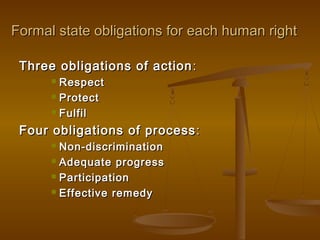
Formal state obligations for each human rightFormal state obligations for each human right
Three obligations of actionThree obligations of action ::
 RespectRespect
 ProtectProtect
 FulfilFulfil
Four obligations of processFour obligations of process ::
 Non-discriminationNon-discrimination
 Adequate progressAdequate progress
 ParticipationParticipation
 Effective remedyEffective remedy
Formal state obligations for each human rightFormal state obligations for each human right
Obligation Meaning
RespectRespect The stateThe state must notmust not interfere directlyinterfere directly withwith
people realising their rightspeople realising their rights
Protect The state must stop others from interfering with
people’s rights
FulfilFulfil The stateThe state must buildmust build the legislation, institutions,the legislation, institutions,
norms to realise the rightnorms to realise the right
Non
discrimination
The state must not discriminate in meeting its
obligations
Adequate progress Progress must occur at a rate that show
commitment
Participation People must be able to participate in realising their
rights
Effective remedy There must be a remedy for violations of obligations
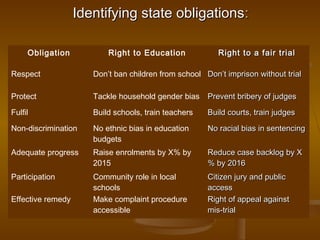
Identifying state obligationsIdentifying state obligations::
Obligation Right to Education Right to a fair trialRight to a fair trial
Respect Don’t ban children from school Don’t imprison without trialDon’t imprison without trial
Protect Tackle household gender bias Prevent bribery of judgesPrevent bribery of judges
Fulfil Build schools, train teachers Build courts, train judgesBuild courts, train judges
Non-discrimination No ethnic bias in education
budgets
No racial bias in sentencingNo racial bias in sentencing
Adequate progress Raise enrolments by X% by
2015
Reduce case backlog by XReduce case backlog by X
% by 2016% by 2016
Participation Community role in local
schools
Citizen jury and publicCitizen jury and public
accessaccess
Effective remedy Make complaint procedure
accessible
Right of appeal againstRight of appeal against
mis-trialmis-trial
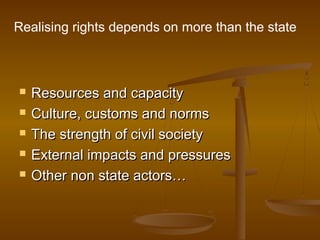
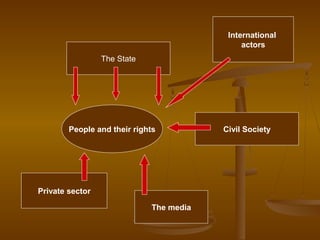
Realising rights depends on more than the state
 Resources and capacityResources and capacity
 Culture, customs and normsCulture, customs and norms
 The strength of civil societyThe strength of civil society
 External impacts and pressuresExternal impacts and pressures
 Other non state actors…Other non state actors…
People and their rights
The State
Private sector
The media
International
actors
Civil Society
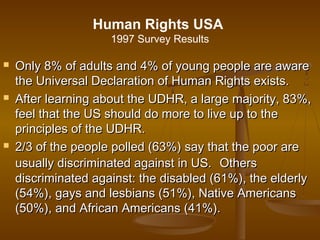
Human Rights USA
1997 Survey Results
 Only 8% of adults and 4% of young people are awareOnly 8% of adults and 4% of young people are aware
the Universal Declaration of Human Rights exists.the Universal Declaration of Human Rights exists.
 After learning about the UDHR, a large majority, 83%,After learning about the UDHR, a large majority, 83%,
feel that the US should do more to live up to thefeel that the US should do more to live up to the
principles of the UDHR.principles of the UDHR.
 2/3 of the people polled (63%) say that the poor are2/3 of the people polled (63%) say that the poor are
usually discriminated against in US.usually discriminated against in US. OthersOthers
discriminated against: the disabled (61%), the elderlydiscriminated against: the disabled (61%), the elderly
(54%), gays and lesbians (51%), Native Americans(54%), gays and lesbians (51%), Native Americans
(50%), and African Americans (41%).(50%), and African Americans (41%).
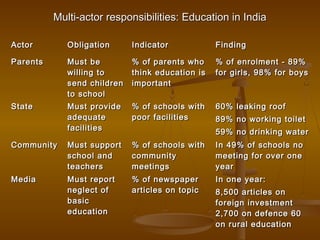
Multi-actor responsibilities: Education in IndiaMulti-actor responsibilities: Education in India
ActorActor ObligationObligation IndicatorIndicator FindingFinding
ParentsParents Must beMust be
willing towilling to
send childrensend children
to schoolto school
% of parents who% of parents who
think education isthink education is
importantimportant
% of enrolment - 89%% of enrolment - 89%
for girls, 98% for boysfor girls, 98% for boys
StateState Must provideMust provide
adequateadequate
facilitiesfacilities
% of schools with% of schools with
poor facilitiespoor facilities
60% leaking roof60% leaking roof
89% no working toilet89% no working toilet
59% no drinking water59% no drinking water
CommunityCommunity Must supportMust support
school andschool and
teachersteachers
% of schools with% of schools with
communitycommunity
meetingsmeetings
In 49% of schools noIn 49% of schools no
meeting for over onemeeting for over one
yearyear
MediaMedia Must reportMust report
neglect ofneglect of
basicbasic
educationeducation
% of newspaper% of newspaper
articles on topicarticles on topic
In one year:In one year:
8,500 articles on8,500 articles on
foreign investmentforeign investment
2,700 on defence 602,700 on defence 60
on rural educationon rural education
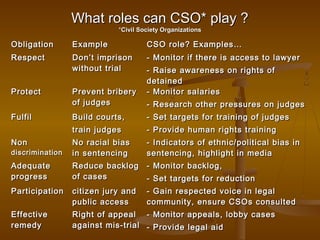
What roles can CSO* play ?What roles can CSO* play ?
**Civil Society OrganizationsCivil Society Organizations
ObligationObligation ExampleExample CSO role? Examples…CSO role? Examples…
RespectRespect Don’t imprisonDon’t imprison
without trialwithout trial
- Monitor if there is access to lawyer- Monitor if there is access to lawyer
- Raise awareness on rights of- Raise awareness on rights of
detaineddetained
ProtectProtect Prevent briberyPrevent bribery
of judgesof judges
- Monitor salaries- Monitor salaries
- Research other pressures on judges- Research other pressures on judges
FulfilFulfil Build courts,Build courts,
train judgestrain judges
- Set targets for training of judges- Set targets for training of judges
- Provide human rights training- Provide human rights training
NonNon
discriminationdiscrimination
No racial biasNo racial bias
in sentencingin sentencing
- Indicators of ethnic/political bias in- Indicators of ethnic/political bias in
sentencing, highlight in mediasentencing, highlight in media
AdequateAdequate
progressprogress
Reduce backlogReduce backlog
of casesof cases
- Monitor backlog,- Monitor backlog,
- Set targets for reduction- Set targets for reduction
ParticipationParticipation citizen jury andcitizen jury and
public accesspublic access
- Gain respected voice in legal- Gain respected voice in legal
community, ensure CSOs consultedcommunity, ensure CSOs consulted
EffectiveEffective
remedyremedy
Right of appealRight of appeal
against mis-trialagainst mis-trial
- Monitor appeals, lobby cases- Monitor appeals, lobby cases
- Provide legal aid- Provide legal aid

Introduction to Human Rights State

  • 1.
    Mutia Hariati HussinMutiaHariati Hussin 20142014 HUMAN RIGHTSHUMAN RIGHTS The Role of StateThe Role of State
  • 2.
    Introduction to HumanRightsIntroduction to Human Rights Human rights are traditionally categorized in the following five types Civil Rights Political Rights EconomicRights Cultural Rights SocialRights This is compilation of Presentation to introduce HR subjects to my students with due acknowledgement to all the sources
  • 3.
    FRAMING OUR HUMANRIGHTS QUESTIONS  How does the Universal Declaration of HumanHow does the Universal Declaration of Human Rights and our stories connect to HumanRights and our stories connect to Human Rights Education?Rights Education?
  • 4.
    HUMAN RIGHTS EDUCATIONHUMANRIGHTS EDUCATION  ““Human Rights EducationHuman Rights Education isis a meansa means towards socialtowards social change;change; aa tooltool to transform the theory and practicalto transform the theory and practical applications into everyday social practice.”applications into everyday social practice.”  ““In conflict situations and in peace building,In conflict situations and in peace building, HREHRE must be seenmust be seen to benefit the target populations’ daily lives.”to benefit the target populations’ daily lives.” “HRE focuses especially on social goals and ideals that“HRE focuses especially on social goals and ideals that emphasize the dignity of all human beings and the need foremphasize the dignity of all human beings and the need for laws and institutions that enforce those standards. In so doing,laws and institutions that enforce those standards. In so doing, HRE contributes directly to the process of building a societyHRE contributes directly to the process of building a society based on freedom, peace and Justice.”based on freedom, peace and Justice.” Paul Martin, et al.Paul Martin, et al.
  • 5.
     “Where, afterall do universal rights begin? In small places, close to home – so close and so small that they cannot be seen on any maps of the world. Yet they are the world of the individual person; the neighborhood he lives in; the school or college he attends; the factory, farm or office where he works. Such are the places where every man, woman, and child seeks equal justice, equal opportunity, equal dignity without discrimination. Unless these rights have meaning there, they have little meaning anywhere. Without concerted citizen action to uphold them close to home, we shall look in vain for progress in the larger world.” Elenor RoosweltElenor Rooswelt
  • 6.
    Formal state obligationsfor each human rightFormal state obligations for each human right Three obligations of actionThree obligations of action ::  RespectRespect  ProtectProtect  FulfilFulfil Four obligations of processFour obligations of process ::  Non-discriminationNon-discrimination  Adequate progressAdequate progress  ParticipationParticipation  Effective remedyEffective remedy
  • 7.
    Formal state obligationsfor each human rightFormal state obligations for each human right Obligation Meaning RespectRespect The stateThe state must notmust not interfere directlyinterfere directly withwith people realising their rightspeople realising their rights Protect The state must stop others from interfering with people’s rights FulfilFulfil The stateThe state must buildmust build the legislation, institutions,the legislation, institutions, norms to realise the rightnorms to realise the right Non discrimination The state must not discriminate in meeting its obligations Adequate progress Progress must occur at a rate that show commitment Participation People must be able to participate in realising their rights Effective remedy There must be a remedy for violations of obligations
  • 8.
    Identifying state obligationsIdentifyingstate obligations:: Obligation Right to Education Right to a fair trialRight to a fair trial Respect Don’t ban children from school Don’t imprison without trialDon’t imprison without trial Protect Tackle household gender bias Prevent bribery of judgesPrevent bribery of judges Fulfil Build schools, train teachers Build courts, train judgesBuild courts, train judges Non-discrimination No ethnic bias in education budgets No racial bias in sentencingNo racial bias in sentencing Adequate progress Raise enrolments by X% by 2015 Reduce case backlog by XReduce case backlog by X % by 2016% by 2016 Participation Community role in local schools Citizen jury and publicCitizen jury and public accessaccess Effective remedy Make complaint procedure accessible Right of appeal againstRight of appeal against mis-trialmis-trial
  • 9.
    Realising rights dependson more than the state  Resources and capacityResources and capacity  Culture, customs and normsCulture, customs and norms  The strength of civil societyThe strength of civil society  External impacts and pressuresExternal impacts and pressures  Other non state actors…Other non state actors…
  • 10.
    People and theirrights The State Private sector The media International actors Civil Society
  • 11.
    Human Rights USA 1997Survey Results  Only 8% of adults and 4% of young people are awareOnly 8% of adults and 4% of young people are aware the Universal Declaration of Human Rights exists.the Universal Declaration of Human Rights exists.  After learning about the UDHR, a large majority, 83%,After learning about the UDHR, a large majority, 83%, feel that the US should do more to live up to thefeel that the US should do more to live up to the principles of the UDHR.principles of the UDHR.  2/3 of the people polled (63%) say that the poor are2/3 of the people polled (63%) say that the poor are usually discriminated against in US.usually discriminated against in US. OthersOthers discriminated against: the disabled (61%), the elderlydiscriminated against: the disabled (61%), the elderly (54%), gays and lesbians (51%), Native Americans(54%), gays and lesbians (51%), Native Americans (50%), and African Americans (41%).(50%), and African Americans (41%).
  • 12.
    Multi-actor responsibilities: Educationin IndiaMulti-actor responsibilities: Education in India ActorActor ObligationObligation IndicatorIndicator FindingFinding ParentsParents Must beMust be willing towilling to send childrensend children to schoolto school % of parents who% of parents who think education isthink education is importantimportant % of enrolment - 89%% of enrolment - 89% for girls, 98% for boysfor girls, 98% for boys StateState Must provideMust provide adequateadequate facilitiesfacilities % of schools with% of schools with poor facilitiespoor facilities 60% leaking roof60% leaking roof 89% no working toilet89% no working toilet 59% no drinking water59% no drinking water CommunityCommunity Must supportMust support school andschool and teachersteachers % of schools with% of schools with communitycommunity meetingsmeetings In 49% of schools noIn 49% of schools no meeting for over onemeeting for over one yearyear MediaMedia Must reportMust report neglect ofneglect of basicbasic educationeducation % of newspaper% of newspaper articles on topicarticles on topic In one year:In one year: 8,500 articles on8,500 articles on foreign investmentforeign investment 2,700 on defence 602,700 on defence 60 on rural educationon rural education
  • 13.
    What roles canCSO* play ?What roles can CSO* play ? **Civil Society OrganizationsCivil Society Organizations ObligationObligation ExampleExample CSO role? Examples…CSO role? Examples… RespectRespect Don’t imprisonDon’t imprison without trialwithout trial - Monitor if there is access to lawyer- Monitor if there is access to lawyer - Raise awareness on rights of- Raise awareness on rights of detaineddetained ProtectProtect Prevent briberyPrevent bribery of judgesof judges - Monitor salaries- Monitor salaries - Research other pressures on judges- Research other pressures on judges FulfilFulfil Build courts,Build courts, train judgestrain judges - Set targets for training of judges- Set targets for training of judges - Provide human rights training- Provide human rights training NonNon discriminationdiscrimination No racial biasNo racial bias in sentencingin sentencing - Indicators of ethnic/political bias in- Indicators of ethnic/political bias in sentencing, highlight in mediasentencing, highlight in media AdequateAdequate progressprogress Reduce backlogReduce backlog of casesof cases - Monitor backlog,- Monitor backlog, - Set targets for reduction- Set targets for reduction ParticipationParticipation citizen jury andcitizen jury and public accesspublic access - Gain respected voice in legal- Gain respected voice in legal community, ensure CSOs consultedcommunity, ensure CSOs consulted EffectiveEffective remedyremedy Right of appealRight of appeal against mis-trialagainst mis-trial - Monitor appeals, lobby cases- Monitor appeals, lobby cases - Provide legal aid- Provide legal aid

Editor's Notes

  • #2 Taken from An Introduction To Human Rights by Srinivasan Rengasamy, Professor of Social Work (Rtd)  at Madurai Institute of Social Sciences on Aug 20, 2008 This presentation is a compilation of slides taken from several sources to introduce human rights for social workers This is compilation of Presentation to introduce HR subjects to my students with due acknowledgement to all the sources
  • #3 Taken from An Introduction To Human Rights by Srinivasan Rengasamy, Professor of Social Work (Rtd)  at Madurai Institute of Social Sciences on Aug 20, 2008 This presentation is a compilation of slides taken from several sources to introduce human rights for social workers This is compilation of Presentation to introduce HR subjects to my students with due acknowledgement to all the sources