Introduction
 HRM are the most important assets of a company
 The real challenge in managing HRM lies in
motivating them.
 The get the best out of people , the employer need to
involve them, trust them and encourage them to
come out with winning ideas and useful suggestion.
 Above all, they must be treated fairly and equitably.
 Employees join an organization with lots of
expectations- rewards meritorious performance,
incentives for excellence, challenging and exciting
work, growth opportunities and good work
environment.
 Skilled employees are fairly mobile, as they are
armed with requisite knowledge and expertise.
 They do not hesitate to step out of an organization
that fails to meet their expectation.
 To achieve success in a competitive environment ,
every organization need to pay close attention to
attracting and retaining talent.
 HRM play a critical role in bridging the gap between
employee expectation and organizational needs by
adopting appropriate HR policies and practices
 The basic purpose of HRM is to improve the
productive contributions of people to an
organization .
 To this end , it tries to bring people and
organization together so that goals of each
are met.
 HRM is the art of procuring, developing and
maintaining a competent workforce to achieve
the goal of an organization in an effective and
efficient manner.
The scope of HRM is very wide. It deals with all
matters, related to talent acquisition, development and
retention.
Broadly it stated three things:
 Personnel aspect
 Welfare aspect
 Industrial relation aspect.
 Personnel aspect
This is concerned with manpower planning,
recruitment, selection, placement , transfer, promotion,
training and development, layoff and retrenchment,
incentive, productivity etc.
 Welfare aspect
It deals with working conditions and amenities such as
canteen, rest and lunch rooms, house rooms, transport,
medical assistance, education, health and safety and
recreation facilities.
 Industrial relation
This covers union management relation, joint
consultation, collective bargaining , grievance and
disciplinary procedures and settlement of disputes
 HRM is concerned with employees both as
individuals and as a group in attaining goals.
It is also concerned with behavior , emotional
and social aspect of human resource.
 It is concerned with the development of HR.
i.e. knowledge, capabilities, skill, potentials
and attaining achievement employee goals,
including job satisfaction.
 HRM covers all levels ( low, middle, and top)
and categories (unskilled. Skilled, technical,
professional, clerical and managerial) of
employees. It covers both organized and
unorganized employee.
 It applies the all types of organizations
(industry, trade, service, commerce,
economic, social, religious, political and
government department)
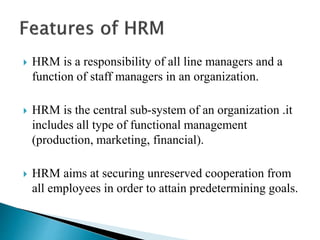
 HRM is a responsibility of all line managers and a
function of staff managers in an organization.
 HRM is the central sub-system of an organization .it
includes all type of functional management
(production, marketing, financial).
 HRM aims at securing unreserved cooperation from
all employees in order to attain predetermining goals.
 HRM is continuous and never ending process.
Organization goal may include survival growth and
development ,in addition to profitability, productivity
,innovation, excellence etc.
Individual employee-goals consist of job satisfaction,
job security, high salary, attractive benefits, challenging
work, pride, status , recognition, opportunity for
development, etc.
 Goals of society includes equal employment
opportunity, protecting the disadvantages sections
and physically handicapped, minimization of
inequalities in the distribution of income by
minimizing wage differentials, developing the society
in general by organizing development activities etc.
TWO MAIN FUNCTIONS:
 Managerial functions
 Operative functions
Introduction to hrm

Introduction to hrm

  • 1.
  • 2.
     HRM arethe most important assets of a company  The real challenge in managing HRM lies in motivating them.  The get the best out of people , the employer need to involve them, trust them and encourage them to come out with winning ideas and useful suggestion.  Above all, they must be treated fairly and equitably.
  • 3.
     Employees joinan organization with lots of expectations- rewards meritorious performance, incentives for excellence, challenging and exciting work, growth opportunities and good work environment.  Skilled employees are fairly mobile, as they are armed with requisite knowledge and expertise.  They do not hesitate to step out of an organization that fails to meet their expectation.
  • 4.
     To achievesuccess in a competitive environment , every organization need to pay close attention to attracting and retaining talent.  HRM play a critical role in bridging the gap between employee expectation and organizational needs by adopting appropriate HR policies and practices
  • 5.
     The basicpurpose of HRM is to improve the productive contributions of people to an organization .  To this end , it tries to bring people and organization together so that goals of each are met.
  • 6.
     HRM isthe art of procuring, developing and maintaining a competent workforce to achieve the goal of an organization in an effective and efficient manner.
  • 7.
    The scope ofHRM is very wide. It deals with all matters, related to talent acquisition, development and retention. Broadly it stated three things:  Personnel aspect  Welfare aspect  Industrial relation aspect.
  • 8.
     Personnel aspect Thisis concerned with manpower planning, recruitment, selection, placement , transfer, promotion, training and development, layoff and retrenchment, incentive, productivity etc.
  • 9.
     Welfare aspect Itdeals with working conditions and amenities such as canteen, rest and lunch rooms, house rooms, transport, medical assistance, education, health and safety and recreation facilities.
  • 10.
     Industrial relation Thiscovers union management relation, joint consultation, collective bargaining , grievance and disciplinary procedures and settlement of disputes
  • 11.
     HRM isconcerned with employees both as individuals and as a group in attaining goals. It is also concerned with behavior , emotional and social aspect of human resource.  It is concerned with the development of HR. i.e. knowledge, capabilities, skill, potentials and attaining achievement employee goals, including job satisfaction.
  • 12.
     HRM coversall levels ( low, middle, and top) and categories (unskilled. Skilled, technical, professional, clerical and managerial) of employees. It covers both organized and unorganized employee.  It applies the all types of organizations (industry, trade, service, commerce, economic, social, religious, political and government department)
  • 13.
     HRM isa responsibility of all line managers and a function of staff managers in an organization.  HRM is the central sub-system of an organization .it includes all type of functional management (production, marketing, financial).  HRM aims at securing unreserved cooperation from all employees in order to attain predetermining goals.
  • 14.
     HRM iscontinuous and never ending process. Organization goal may include survival growth and development ,in addition to profitability, productivity ,innovation, excellence etc. Individual employee-goals consist of job satisfaction, job security, high salary, attractive benefits, challenging work, pride, status , recognition, opportunity for development, etc.
  • 15.
     Goals ofsociety includes equal employment opportunity, protecting the disadvantages sections and physically handicapped, minimization of inequalities in the distribution of income by minimizing wage differentials, developing the society in general by organizing development activities etc.
  • 16.
    TWO MAIN FUNCTIONS: Managerial functions  Operative functions