What is ForensicChemistry?
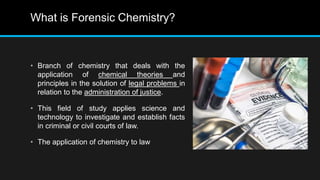
• Branch of chemistry that deals with the
application of chemical theories and
principles in the solution of legal problems in
relation to the administration of justice.
• This field of study applies science and
technology to investigate and establish facts
in criminal or civil courts of law.
• The application of chemistry to law
3.
Etymology
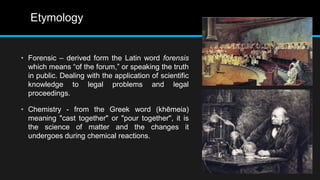
• Forensic –derived form the Latin word forensis
which means “of the forum,” or speaking the truth
in public. Dealing with the application of scientific
knowledge to legal problems and legal
proceedings.
• Chemistry - from the Greek word (khēmeia)
meaning "cast together" or "pour together", it is
the science of matter and the changes it
undergoes during chemical reactions.
4.
History of ForensicChemistry
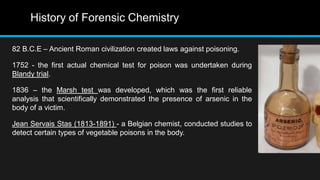
82 B.C.E – Ancient Roman civilization created laws against poisoning.
1752 - the first actual chemical test for poison was undertaken during
Blandy trial.
1836 – the Marsh test was developed, which was the first reliable
analysis that scientifically demonstrated the presence of arsenic in the
body of a victim.
Jean Servais Stas (1813-1891) - a Belgian chemist, conducted studies to
detect certain types of vegetable poisons in the body.
5.
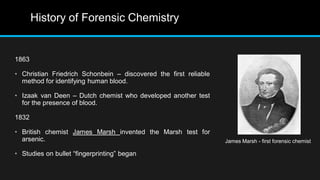
History of ForensicChemistry
1863
• Christian Friedrich Schonbein – discovered the first reliable
method for identifying human blood.
• Izaak van Deen – Dutch chemist who developed another test
for the presence of blood.
1832
• British chemist James Marsh invented the Marsh test for
arsenic.
• Studies on bullet “fingerprinting” began
James Marsh - first forensic chemist
6.
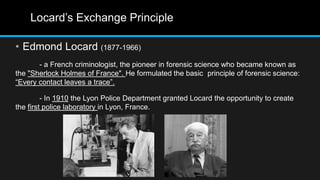
Locard’s Exchange Principle
•Edmond Locard (1877-1966)
- a French criminologist, the pioneer in forensic science who became known as
the "Sherlock Holmes of France". He formulated the basic principle of forensic science:
“Every contact leaves a trace”.
- In 1910 the Lyon Police Department granted Locard the opportunity to create
the first police laboratory in Lyon, France.
7.
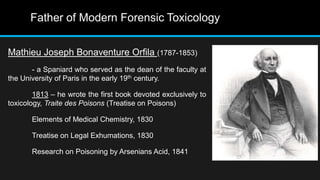
Father of ModernForensic Toxicology
Mathieu Joseph Bonaventure Orfila (1787-1853)
- a Spaniard who served as the dean of the faculty at
the University of Paris in the early 19th century.
1813 – he wrote the first book devoted exclusively to
toxicology, Traite des Poisons (Treatise on Poisons)
Elements of Medical Chemistry, 1830
Treatise on Legal Exhumations, 1830
Research on Poisoning by Arsenians Acid, 1841
8.
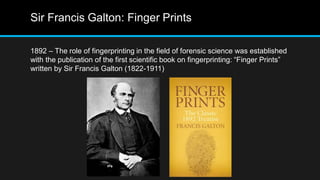
Sir Francis Galton:Finger Prints
1892 – The role of fingerprinting in the field of forensic science was established
with the publication of the first scientific book on fingerprinting: “Finger Prints”
written by Sir Francis Galton (1822-1911)
9.
Importance of ForensicChemistry
• Crime laboratory > the same principles and laws of chemistry are used to
examine evidence.
• Establishing the causes of unnatural death, detecting illegal drugs in blood and
urine, and determining the causes of fire.
• Reconstructing the sequence of events that constitute the crime being
investigated
• Accurate information may eventually lead to perpetrator’s identification, arrest,
and conviction.
10.
Forensic Laboratory inthe Philippines
• The practice of forensic began with the passage of the Royal Decree No. 188
by King Philip during the Spanish rule in the Philippines.
• Forensic physicians (Medicos Titulares) -were assigned to the Philippine
provinces to perform public sanitary and medico-legal duties.
• Valenzuela City and Marikina City
• Regional and provincial offices of the Philippine National Police (PNP)
• University of the Philippines- Philippine General Hospital (UP-PGH) in Manila
• Philippine Drug Enforcement Agency (PDEA) in Quezon City
• National Bureau of Investigation (NBI) in Manila and its regional and provincial
offices.
11.
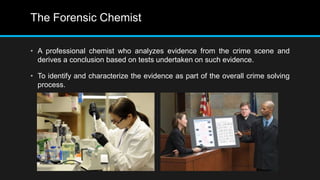
The Forensic Chemist
•A professional chemist who analyzes evidence from the crime scene and
derives a conclusion based on tests undertaken on such evidence.
• To identify and characterize the evidence as part of the overall crime solving
process.
12.
Characteristics of aForensic Chemist
Republic Act No. 754 – The Chemistry Law- enacted on June 18, 1952.
Registered Chemist- any person who is engaged in the professional
practice of chemistry, and is duly registered with the Board of Chemistry and
the Professional Regulation Commission to undertake the professional practice
of chemistry.
1. Be able to spend hours rigorously applying analytical techniques to
evidence;
2. Clearly and concisely answers challenges to his findings; and
3. Possess moral integrity
13.
Functions of ForensicChemist
1. Conduct qualitative and quantitative examination of dangerous drugs
as well as volatile substances.
2. Conduct examination of explosives and/or explosives ingredients.
3. Conduct examination of firearms and paraffin casts to detect the
presence of gunpowder nitrates or gunpowder residue.
4. Conduct gunpowder examination of clothing to verify possible
gunshots distance.
5. Conduct chemico-toxicological examination of human internal organs,
gastric contents, blood water, food samples and other substances.
14.
Functions of ForensicChemist
6. Conduct examination of fake products in case of unfair trade
competition. (e.g., bleach, cement, cigarette, beer or liquor brands,
etc.)
7. Conduct blood alcohol determination.
8. Examine urine and other bodily fluids for the presence of dangerous
drugs
9. Conduct research and training related to the cases being examined.
10.Deliver lectures on forensic chemistry and toxicology to police and
military training centers, investigative units, schools and universities.
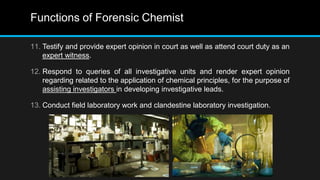
15.
Functions of ForensicChemist
11. Testify and provide expert opinion in court as well as attend court duty as an
expert witness.
12. Respond to queries of all investigative units and render expert opinion
regarding related to the application of chemical principles, for the purpose of
assisting investigators in developing investigative leads.
13. Conduct field laboratory work and clandestine laboratory investigation.
16.
Four Stages inthe Practice of Forensic Chemistry
• Stage 1: Collection and reception of the specimen – Collection refers to the
proper collection, handling, and packaging of specimen before an analysis
can be started. Reception refers to the process of receiving the specimen by
entering the specimen condition on the log book.
• Stage 2: Actual examination: The conduct of various examination procedures
for different specimens submitted as requested by the requesting party.
• Stage 3: Report writing of the result: This step involves drafting of the positive
or negative result.
• Stage 4: Court appearance: This is the final stage, wherein the chemist must
explain to the court the findings of the examination conducted on the
specimen submitted.
17.
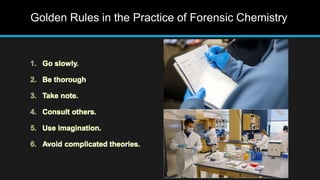
Golden Rules inthe Practice of Forensic Chemistry
1. Go slowly.
2. Be thorough
3. Take note.
4. Consult others.
5. Use imagination.
6. Avoid complicated theories.



![FORENSIC CHEMISTRY AND TOXICOLOGY [Autosaved] - Copy [Autosaved].pdf](https://cdn.slidesharecdn.com/ss_thumbnails/forensicchemistryandtoxicologyautosaved-copyautosaved-241017231040-bdfaa3c0-thumbnail.jpg?width=640&height=640&fit=bounds)


