FEDERATED LEARNING FOR
MEDICAL IMAGING
SUBMITTED BY :
Group No. 10
Guide Name – Dr Rashmi Ranjan Sahoo
Ankita Patra(2101109131)
Ansuman Simanta Shekar Bhujabala(2101109132)
Hritik Dash(2101109143)
Purnima Prusty(2101109185)
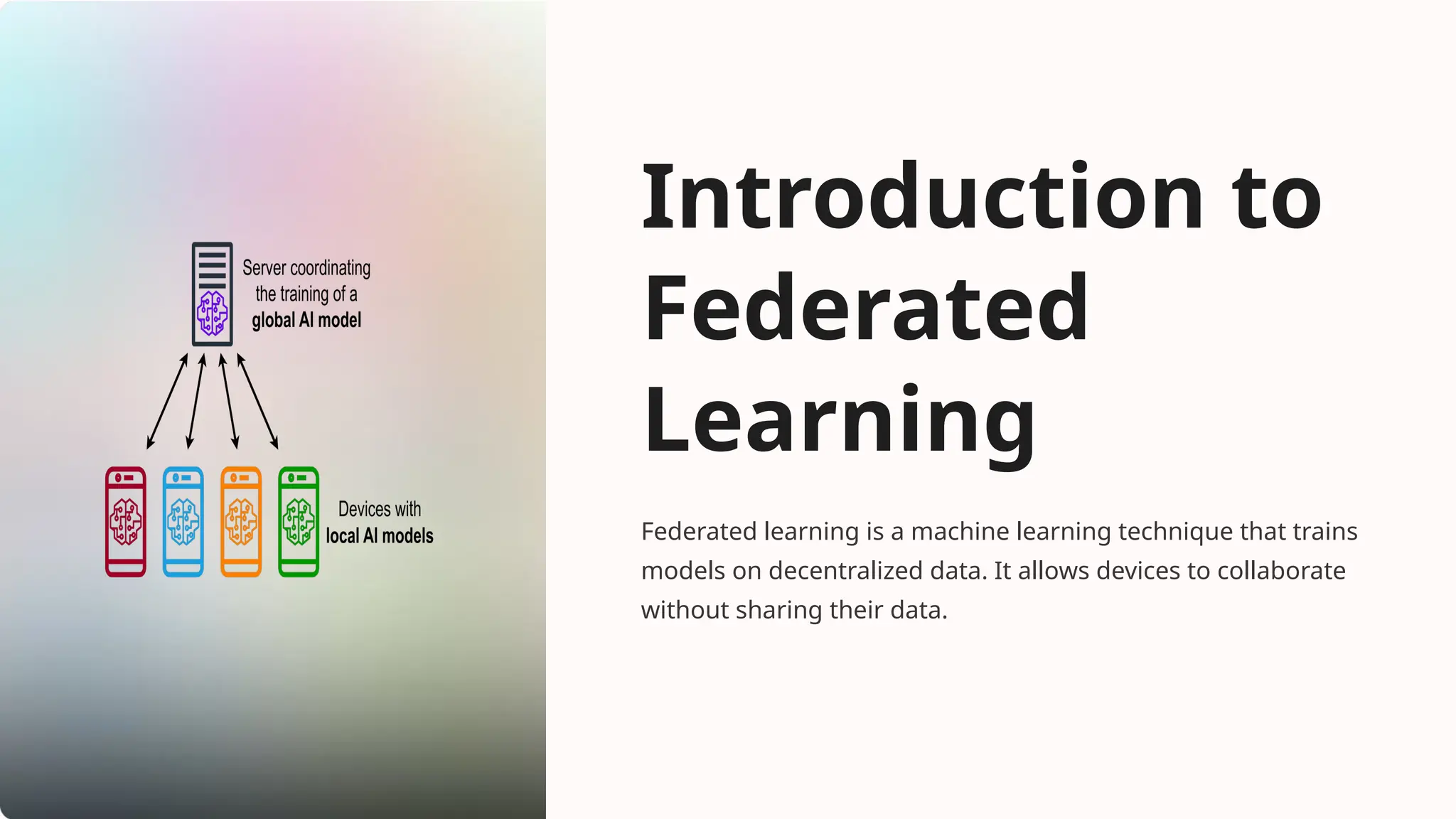
Introduction to
Federated
Learning
Federated learning is a machine learning technique that trains
models on decentralized data. It allows devices to collaborate
without sharing their data.
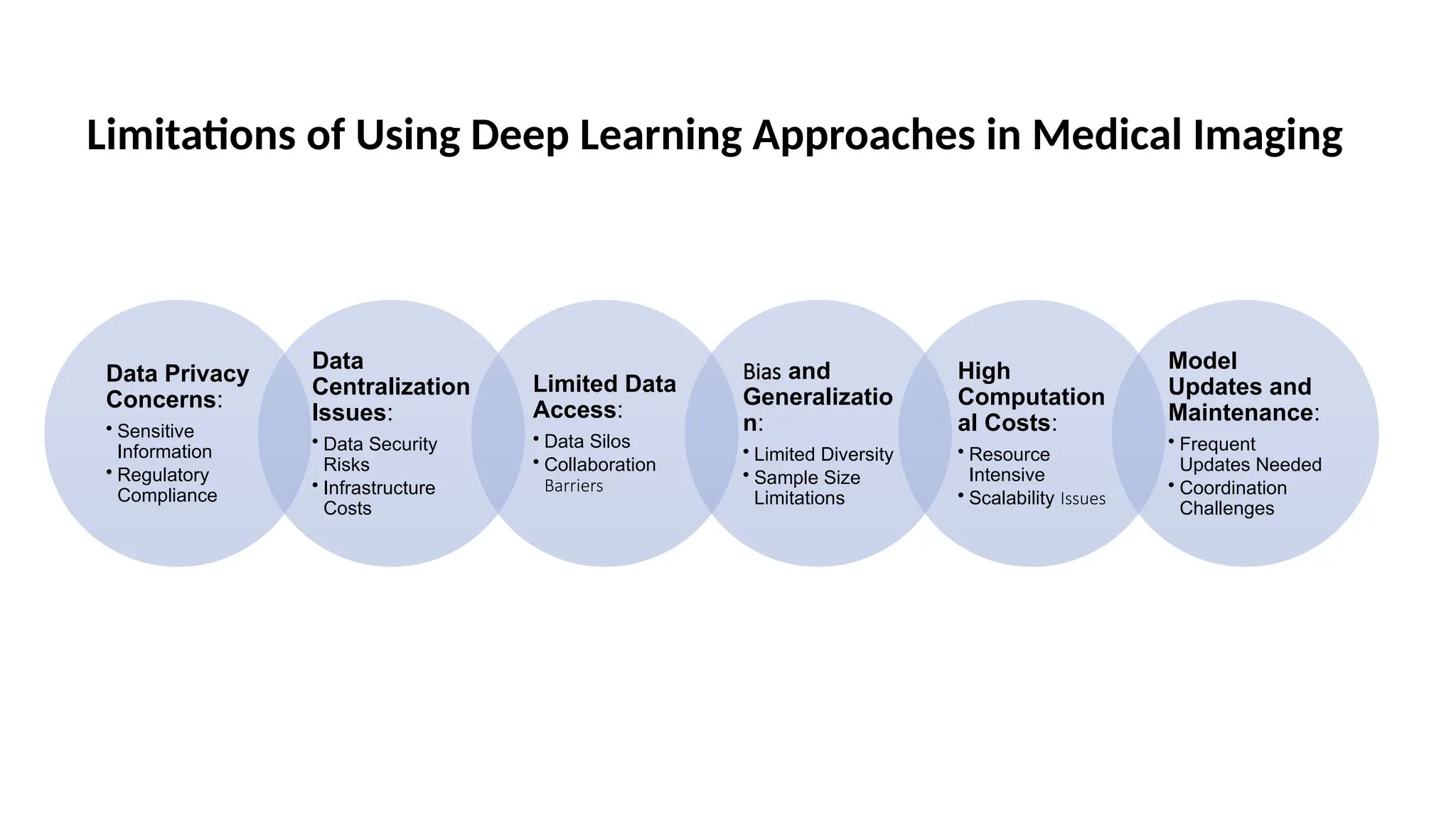
Limitations of Using Deep Learning Approaches in Medical Imaging
Data Privacy
Concerns:
• Sensitive
Information
• Regulatory
Compliance
Data
Centralization
Issues:
• Data Security
Risks
• Infrastructure
Costs
Limited Data
Access:
• Data Silos
• Collaboration
Barriers
Bias and
Generalizatio
n:
• Limited Diversity
• Sample Size
Limitations
High
Computation
al Costs:
• Resource
Intensive
• Scalability Issues
Model
Updates and
Maintenance:
• Frequent
Updates Needed
• Coordination
Challenges
Benefits of using Federated Learning for medical
imaging
Data Privacy
Devices don't need to share their raw data with each other or a central server.
Data Security
It reduces the risk of data breaches or unauthorized access to sensitive information.
Scalability
It can effectively train models on massive datasets distributed across numerous devices.
Flexibility
It allows models to be trained on data from different sources and domains.
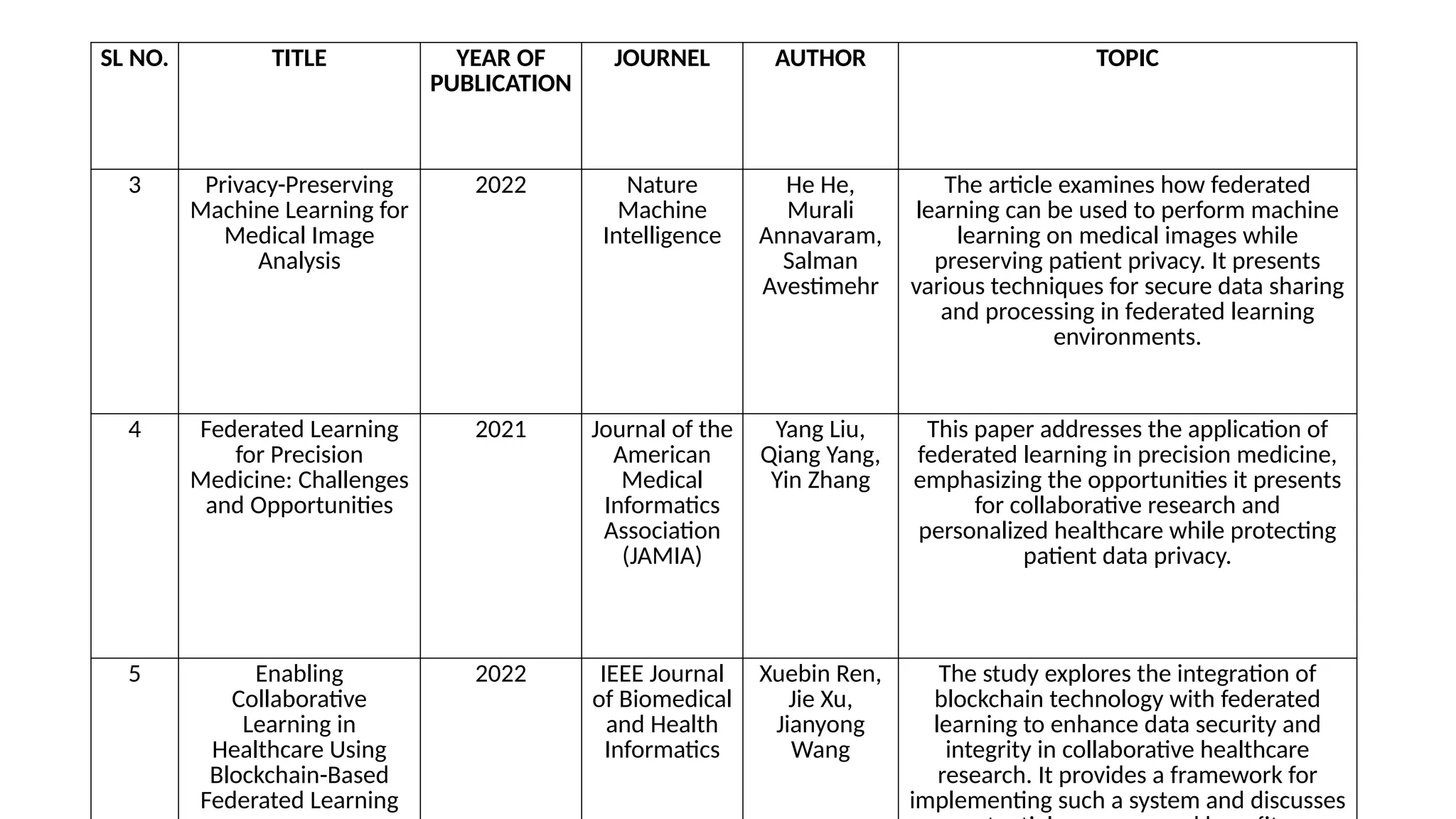
LITERATURE SURVEY
SL NO. TITLE YEAR OF
PUBLICATION
JOURNEL AUTHOR TOPIC
1 Federated Learning for
Healthcare Informatics
2020 IEEE
Transactions
on Artificial
Intelligence
Andrew R.
Willis,
Juncheng Li,
Tianlong
Chen,
Zhangyang
Wang
The paper discusses how federated
learning can be applied to healthcare
data to improve machine learning
models while maintaining patient
privacy. It covers methodologies, case
studies, and potential challenges.
2 Federated Learning in
Medical Imaging: A Survey
2021 Medical
Image
Analysis
Daniel
Rueckert, Jo
Schlemper,
Christian
Baumgartner
This survey explores the applications
of federated learning in medical
imaging, including segmentation,
classification, and prediction tasks. It
reviews existing literature, highlights
the benefits of federated approaches,
and discusses the future directions of
this field.
SL NO. TITLE YEAR OF
PUBLICATION
JOURNEL AUTHOR TOPIC
3 Privacy-Preserving
Machine Learning for
Medical Image
Analysis
2022 Nature
Machine
Intelligence
He He,
Murali
Annavaram,
Salman
Avestimehr
The article examines how federated
learning can be used to perform machine
learning on medical images while
preserving patient privacy. It presents
various techniques for secure data sharing
and processing in federated learning
environments.
4 Federated Learning
for Precision
Medicine: Challenges
and Opportunities
2021 Journal of the
American
Medical
Informatics
Association
(JAMIA)
Yang Liu,
Qiang Yang,
Yin Zhang
This paper addresses the application of
federated learning in precision medicine,
emphasizing the opportunities it presents
for collaborative research and
personalized healthcare while protecting
patient data privacy.
5 Enabling
Collaborative
Learning in
Healthcare Using
Blockchain-Based
Federated Learning
2022 IEEE Journal
of Biomedical
and Health
Informatics
Xuebin Ren,
Jie Xu,
Jianyong
Wang
The study explores the integration of
blockchain technology with federated
learning to enhance data security and
integrity in collaborative healthcare
research. It provides a framework for
implementing such a system and discusses
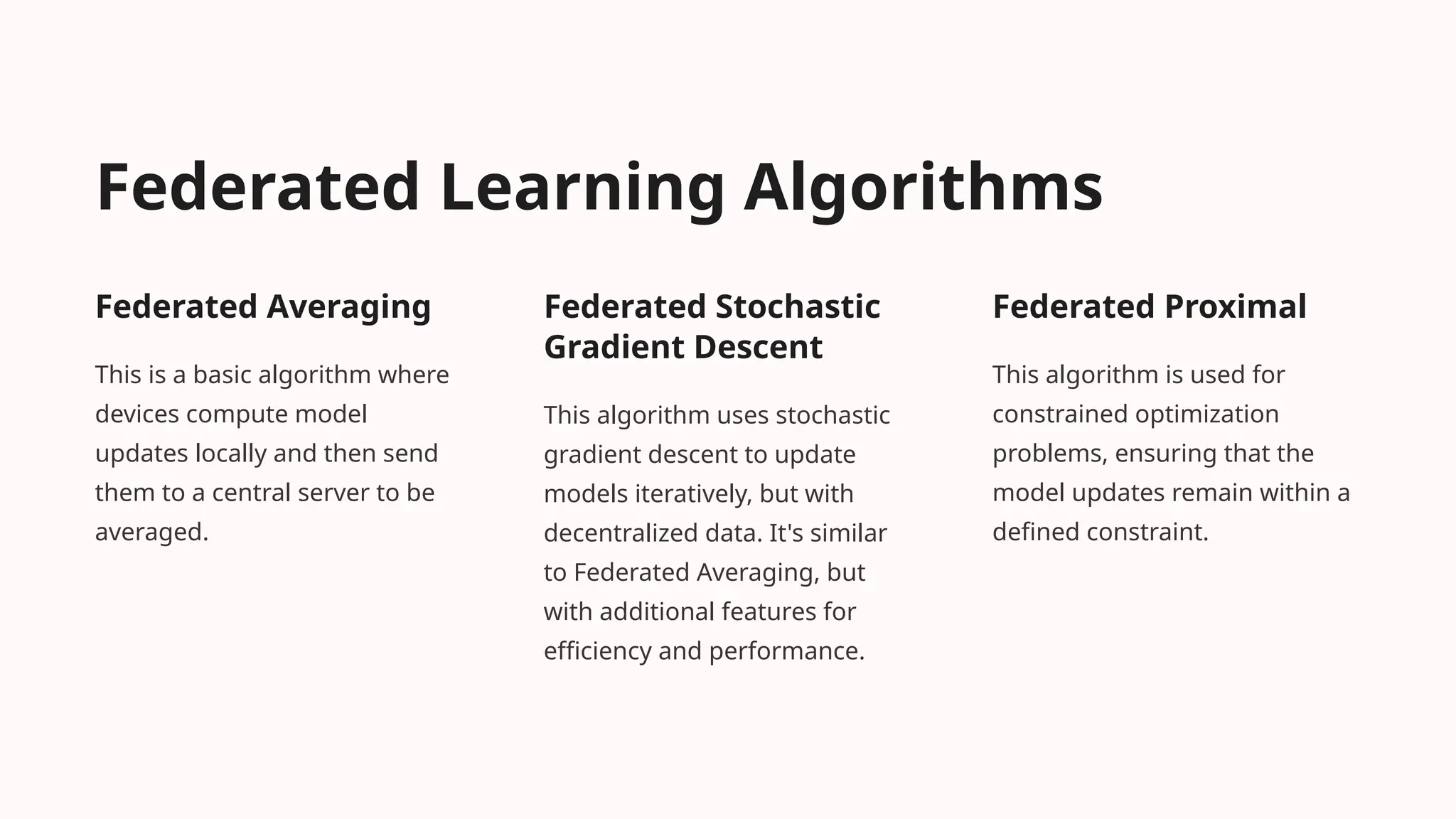
Federated Learning Algorithms
Federated Averaging
This is a basic algorithm where
devices compute model
updates locally and then send
them to a central server to be
averaged.
Federated Stochastic
Gradient Descent
This algorithm uses stochastic
gradient descent to update
models iteratively, but with
decentralized data. It's similar
to Federated Averaging, but
with additional features for
efficiency and performance.
Federated Proximal
This algorithm is used for
constrained optimization
problems, ensuring that the
model updates remain within a
defined constraint.
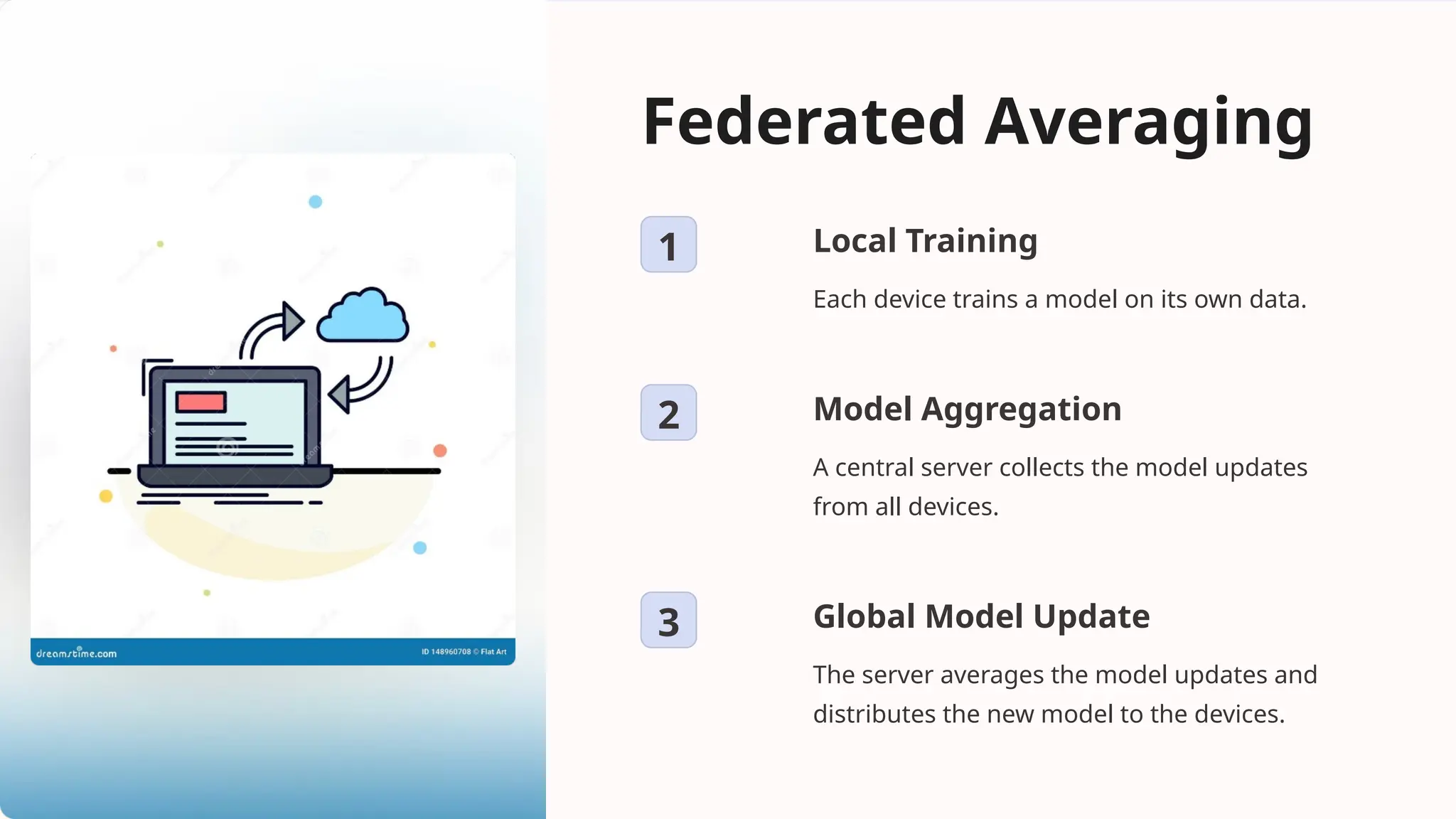
Federated Averaging
1 Local Training
Each device trains a model on its own data.
2 Model Aggregation
A central server collects the model updates
from all devices.
3 Global Model Update
The server averages the model updates and
distributes the new model to the devices.
Federated Stochastic Gradient
Descent
1 Stochastic Updates
Each device uses stochastic gradient descent to update the model, using only a
subset of its data.
2 Noise Reduction
The algorithm introduces techniques like momentum and adaptive learning
rates to reduce the noise in the stochastic updates.
3 Communication Efficiency
It optimizes communication by sending smaller updates to the server.
4 Convergence
The algorithm aims to converge to a globally optimal model, even with
decentralized data.
Federated Proximal
Problem Setup
The problem involves minimizing a loss function while satisfying certain
constraints.
Local Updates
Each device computes a local update that minimizes the loss function, subject
to its local constraints.
Server Aggregation
The server aggregates the local updates and applies a projection operator to
ensure that the global model satisfies the overall constraints.
Model Distribution
The server distributes the updated model to all devices for further local
training.
Applications of Federated Learning
Healthcare Train models for disease prediction, personalized
medicine, and medical imaging.
Mobile Devices Improve device performance, personalize user
experiences, and detect fraud.
Finance Develop fraud detection systems, risk assessment
models, and personalized financial advice.
Internet of Things Optimize resource allocation, predict equipment
failures, and enhance user experiences.
Federated Learning Frameworks
TensorFlow Federated
A framework designed for federated learning,
providing tools for model development, training, and
evaluation.
Flower
An open-source framework for decentralized machine
learning, with a focus on flexibility and customization.
TensorFlow Federated
Codebase
Provides a high-level API for creating and training federated learning models.
Scalability
Handles large-scale federated learning scenarios with numerous devices and datasets.
Visualization
Provides tools for visualizing the training process and model performance.
Analysis
Offers mechanisms for analyzing the training data and evaluating the model's performance.
Flower
Flexibility
Supports various federated learning strategies and custom algorithms.
Customization
Allows for modifications and extensions to meet specific needs.
Open Source
It's an open-source framework, allowing for community contributions and collaboration.
Documentation
Provides comprehensive documentation and tutorials to guide users.
Conclusion and Future Directions
Federated learning is a transformative technology with the potential to revolutionize
machine learning while addressing data privacy concerns. As research and development
continue, we can expect to see even more innovative applications and advancements in
this exciting field.
Conclusion
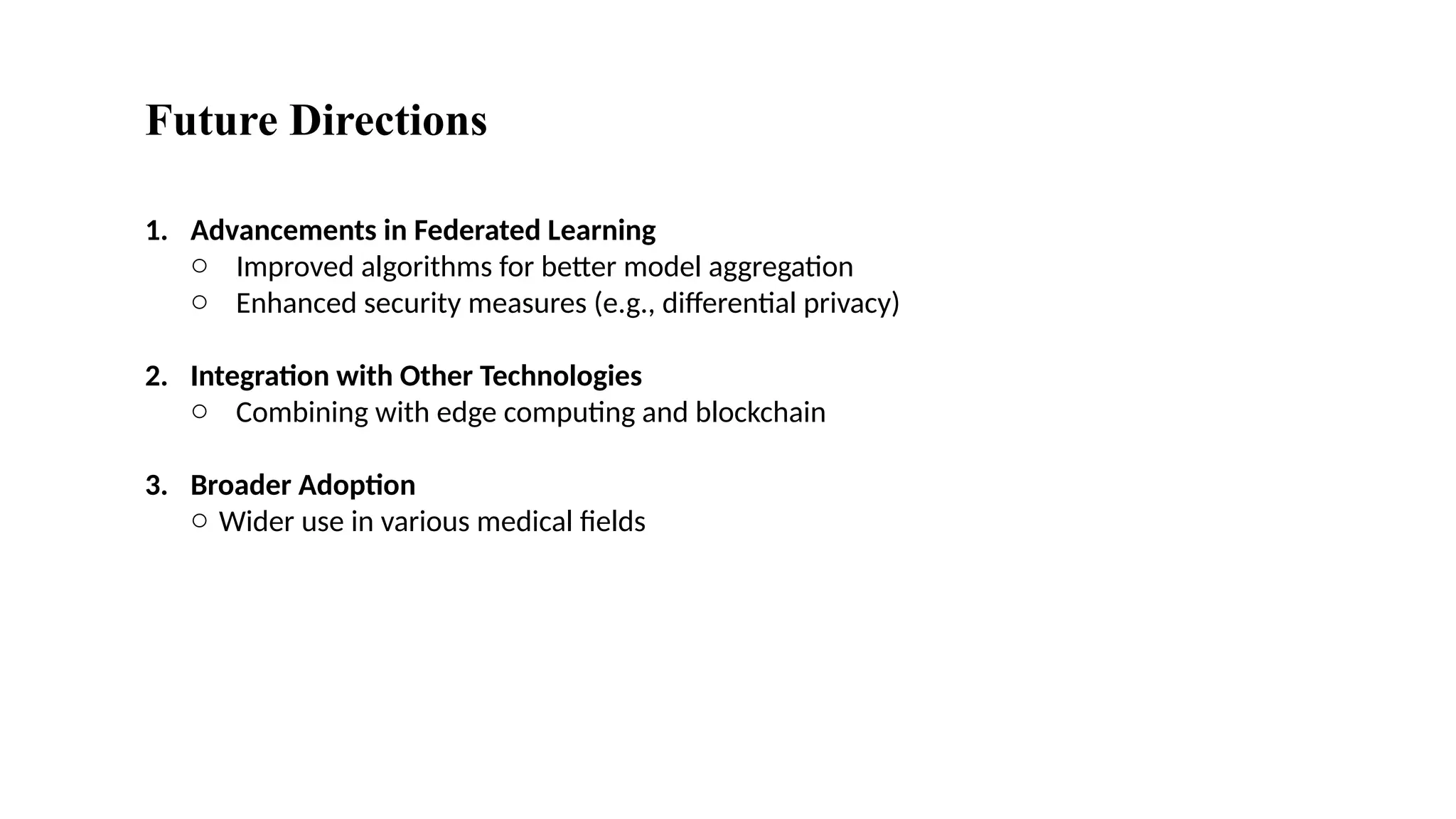
Future Directions
1. Advancements in Federated Learning
o Improved algorithms for better model aggregation
o Enhanced security measures (e.g., differential privacy)
2. Integration with Other Technologies
o Combining with edge computing and blockchain
3. Broader Adoption
o Wider use in various medical fields
Introduction-to-Federated-Learning (1).pptx

Introduction-to-Federated-Learning (1).pptx

  • 1.
    FEDERATED LEARNING FOR MEDICALIMAGING SUBMITTED BY : Group No. 10 Guide Name – Dr Rashmi Ranjan Sahoo Ankita Patra(2101109131) Ansuman Simanta Shekar Bhujabala(2101109132) Hritik Dash(2101109143) Purnima Prusty(2101109185)
  • 2.
    Introduction to Federated Learning Federated learningis a machine learning technique that trains models on decentralized data. It allows devices to collaborate without sharing their data.
  • 3.
    Limitations of UsingDeep Learning Approaches in Medical Imaging Data Privacy Concerns: • Sensitive Information • Regulatory Compliance Data Centralization Issues: • Data Security Risks • Infrastructure Costs Limited Data Access: • Data Silos • Collaboration Barriers Bias and Generalizatio n: • Limited Diversity • Sample Size Limitations High Computation al Costs: • Resource Intensive • Scalability Issues Model Updates and Maintenance: • Frequent Updates Needed • Coordination Challenges
  • 4.
    Benefits of usingFederated Learning for medical imaging Data Privacy Devices don't need to share their raw data with each other or a central server. Data Security It reduces the risk of data breaches or unauthorized access to sensitive information. Scalability It can effectively train models on massive datasets distributed across numerous devices. Flexibility It allows models to be trained on data from different sources and domains.
  • 5.
    LITERATURE SURVEY SL NO.TITLE YEAR OF PUBLICATION JOURNEL AUTHOR TOPIC 1 Federated Learning for Healthcare Informatics 2020 IEEE Transactions on Artificial Intelligence Andrew R. Willis, Juncheng Li, Tianlong Chen, Zhangyang Wang The paper discusses how federated learning can be applied to healthcare data to improve machine learning models while maintaining patient privacy. It covers methodologies, case studies, and potential challenges. 2 Federated Learning in Medical Imaging: A Survey 2021 Medical Image Analysis Daniel Rueckert, Jo Schlemper, Christian Baumgartner This survey explores the applications of federated learning in medical imaging, including segmentation, classification, and prediction tasks. It reviews existing literature, highlights the benefits of federated approaches, and discusses the future directions of this field.
  • 6.
    SL NO. TITLEYEAR OF PUBLICATION JOURNEL AUTHOR TOPIC 3 Privacy-Preserving Machine Learning for Medical Image Analysis 2022 Nature Machine Intelligence He He, Murali Annavaram, Salman Avestimehr The article examines how federated learning can be used to perform machine learning on medical images while preserving patient privacy. It presents various techniques for secure data sharing and processing in federated learning environments. 4 Federated Learning for Precision Medicine: Challenges and Opportunities 2021 Journal of the American Medical Informatics Association (JAMIA) Yang Liu, Qiang Yang, Yin Zhang This paper addresses the application of federated learning in precision medicine, emphasizing the opportunities it presents for collaborative research and personalized healthcare while protecting patient data privacy. 5 Enabling Collaborative Learning in Healthcare Using Blockchain-Based Federated Learning 2022 IEEE Journal of Biomedical and Health Informatics Xuebin Ren, Jie Xu, Jianyong Wang The study explores the integration of blockchain technology with federated learning to enhance data security and integrity in collaborative healthcare research. It provides a framework for implementing such a system and discusses
  • 7.
    Federated Learning Algorithms FederatedAveraging This is a basic algorithm where devices compute model updates locally and then send them to a central server to be averaged. Federated Stochastic Gradient Descent This algorithm uses stochastic gradient descent to update models iteratively, but with decentralized data. It's similar to Federated Averaging, but with additional features for efficiency and performance. Federated Proximal This algorithm is used for constrained optimization problems, ensuring that the model updates remain within a defined constraint.
  • 8.
    Federated Averaging 1 LocalTraining Each device trains a model on its own data. 2 Model Aggregation A central server collects the model updates from all devices. 3 Global Model Update The server averages the model updates and distributes the new model to the devices.
  • 9.
    Federated Stochastic Gradient Descent 1Stochastic Updates Each device uses stochastic gradient descent to update the model, using only a subset of its data. 2 Noise Reduction The algorithm introduces techniques like momentum and adaptive learning rates to reduce the noise in the stochastic updates. 3 Communication Efficiency It optimizes communication by sending smaller updates to the server. 4 Convergence The algorithm aims to converge to a globally optimal model, even with decentralized data.
  • 10.
    Federated Proximal Problem Setup Theproblem involves minimizing a loss function while satisfying certain constraints. Local Updates Each device computes a local update that minimizes the loss function, subject to its local constraints. Server Aggregation The server aggregates the local updates and applies a projection operator to ensure that the global model satisfies the overall constraints. Model Distribution The server distributes the updated model to all devices for further local training.
  • 11.
    Applications of FederatedLearning Healthcare Train models for disease prediction, personalized medicine, and medical imaging. Mobile Devices Improve device performance, personalize user experiences, and detect fraud. Finance Develop fraud detection systems, risk assessment models, and personalized financial advice. Internet of Things Optimize resource allocation, predict equipment failures, and enhance user experiences.
  • 12.
    Federated Learning Frameworks TensorFlowFederated A framework designed for federated learning, providing tools for model development, training, and evaluation. Flower An open-source framework for decentralized machine learning, with a focus on flexibility and customization.
  • 13.
    TensorFlow Federated Codebase Provides ahigh-level API for creating and training federated learning models. Scalability Handles large-scale federated learning scenarios with numerous devices and datasets. Visualization Provides tools for visualizing the training process and model performance. Analysis Offers mechanisms for analyzing the training data and evaluating the model's performance.
  • 14.
    Flower Flexibility Supports various federatedlearning strategies and custom algorithms. Customization Allows for modifications and extensions to meet specific needs. Open Source It's an open-source framework, allowing for community contributions and collaboration. Documentation Provides comprehensive documentation and tutorials to guide users.
  • 15.
    Conclusion and FutureDirections Federated learning is a transformative technology with the potential to revolutionize machine learning while addressing data privacy concerns. As research and development continue, we can expect to see even more innovative applications and advancements in this exciting field. Conclusion
  • 16.
    Future Directions 1. Advancementsin Federated Learning o Improved algorithms for better model aggregation o Enhanced security measures (e.g., differential privacy) 2. Integration with Other Technologies o Combining with edge computing and blockchain 3. Broader Adoption o Wider use in various medical fields