Privacy and Federated Learning:
Principles, Techniques and Emerging Frontiers
AAAI Workshop of Privacy Preserving Artificial Intelligence (PPAI-21)
Peter
Kairouz
Presenting the work of many
Brendan
McMahan
Kallista
Bonawitz
Tutorial Outline
Part 1: What is Federated Learning?
Part 2: Privacy for Federated Technologies
Part 2.1: Private Aggregation & Trust
Part 2.2: Differentially Private Federated Training
Part 3: Other topics (very brief)
Part I: What is Federated Learning?
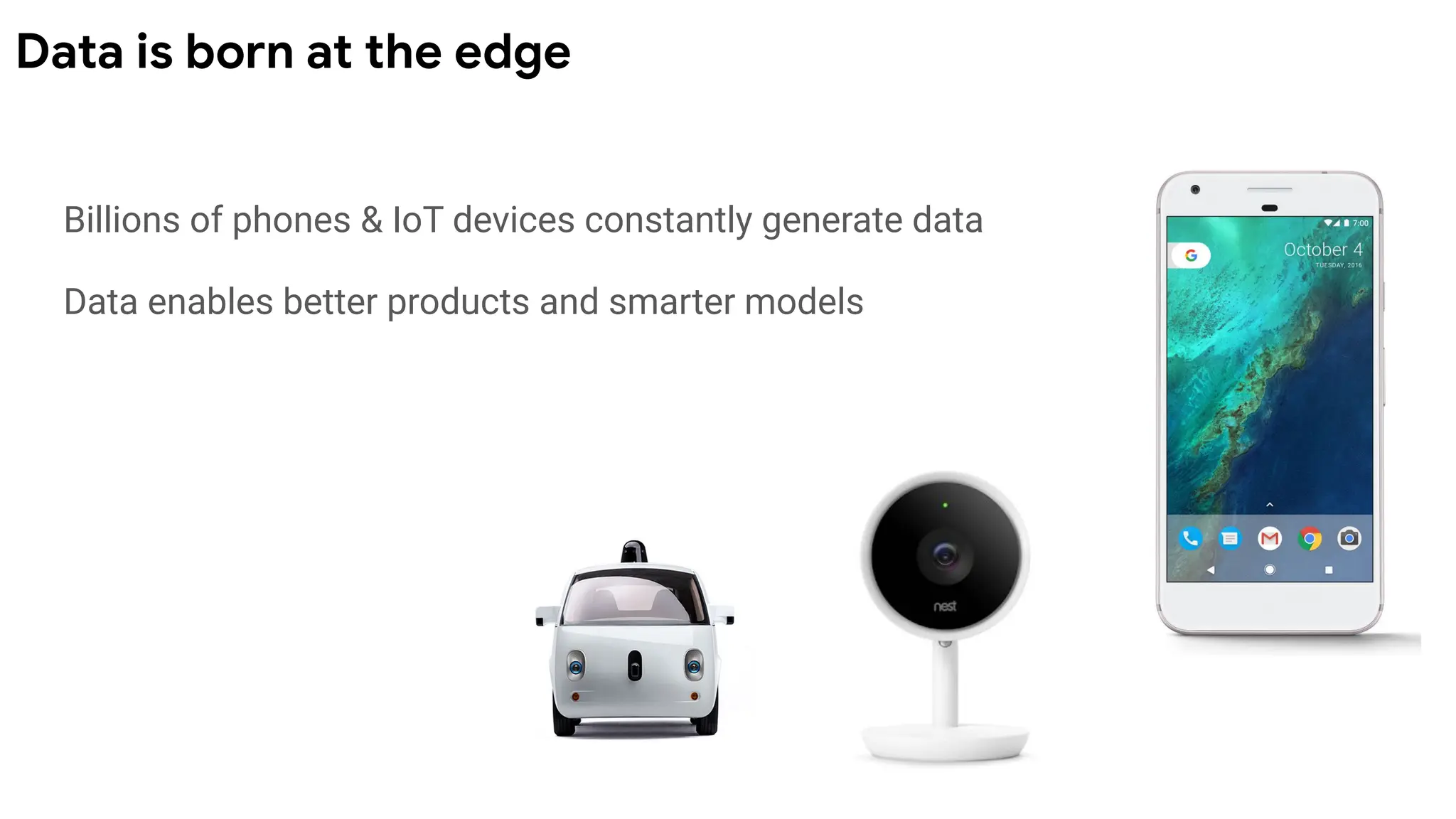
Billions of phones & IoT devices constantly generate data
Data enables better products and smarter models
Data is born at the edge
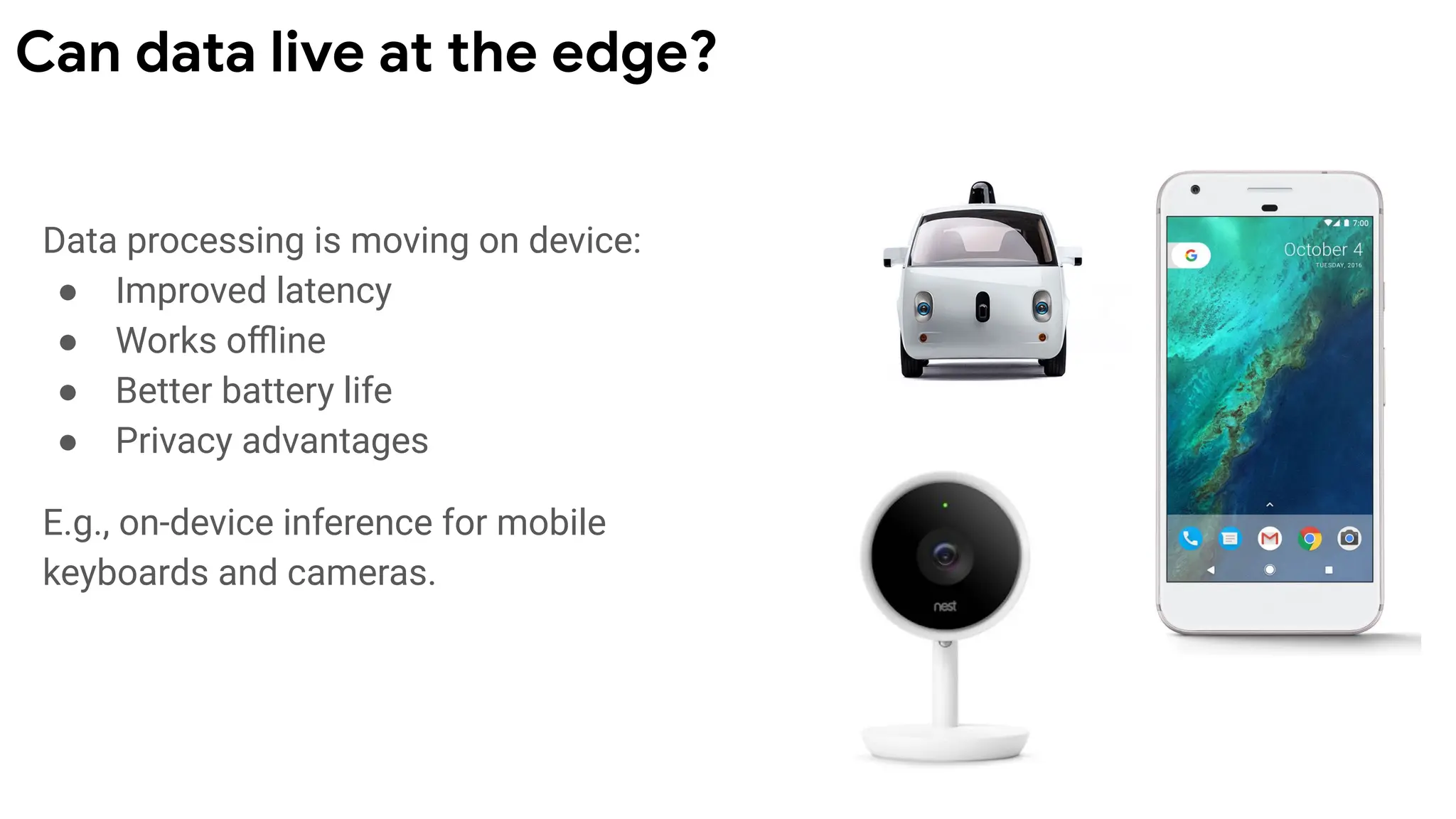
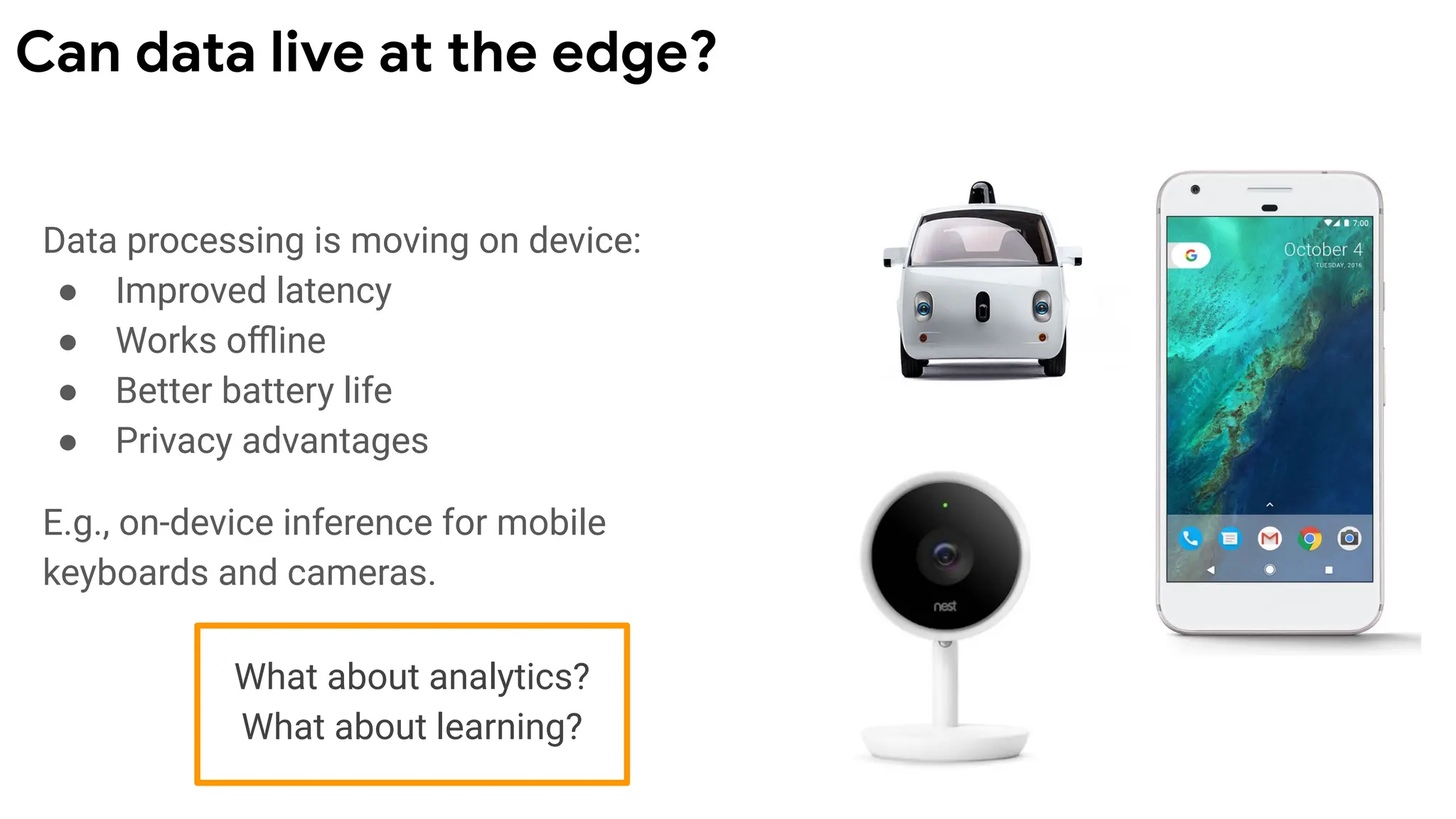
Data processing is moving on device:
● Improved latency
● Works offline
● Better battery life
● Privacy advantages
E.g., on-device inference for mobile
keyboards and cameras.
Can data live at the edge?
Data processing is moving on device:
● Improved latency
● Works offline
● Better battery life
● Privacy advantages
E.g., on-device inference for mobile
keyboards and cameras.
Can data live at the edge?
What about analytics?
What about learning?
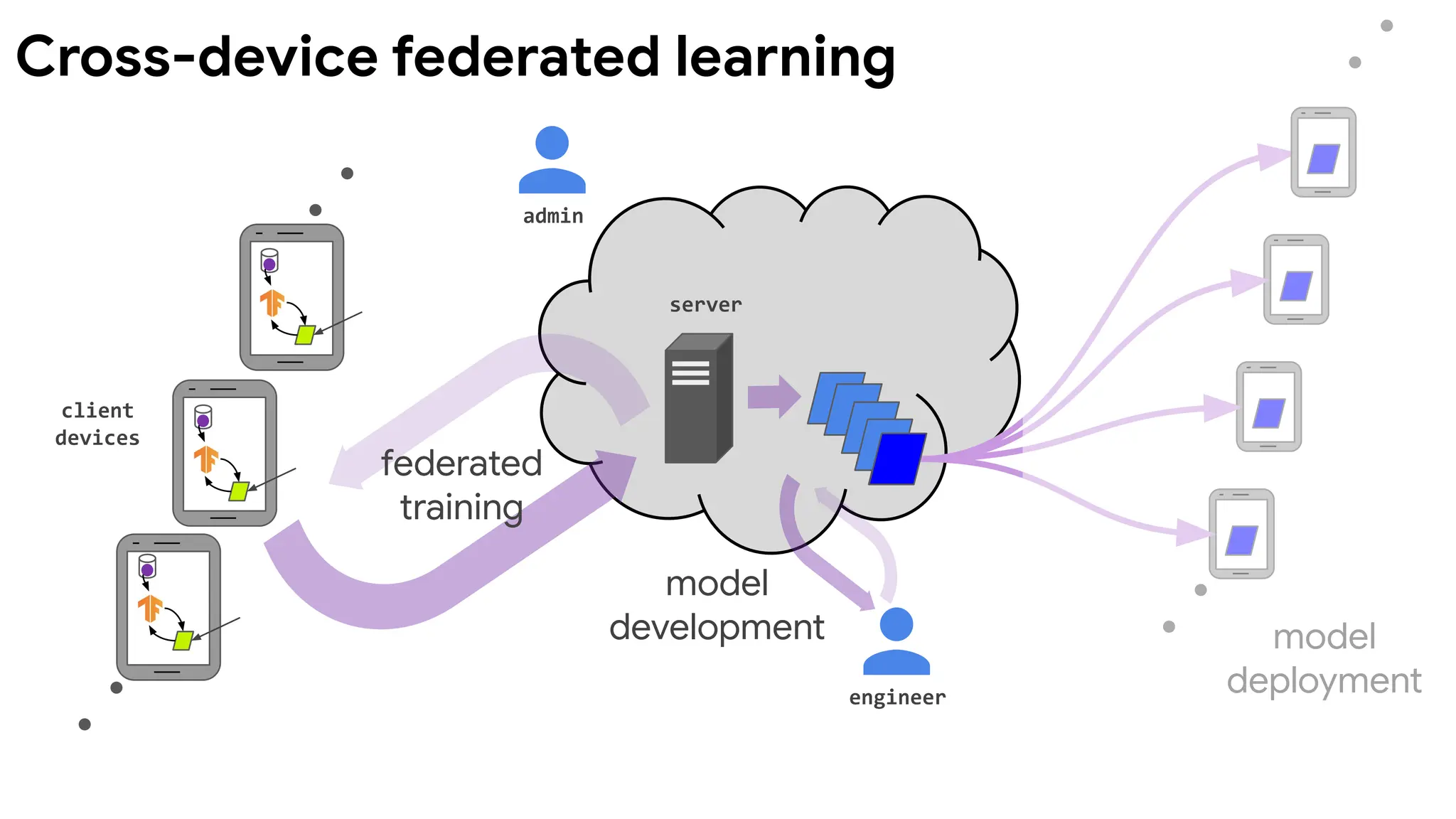
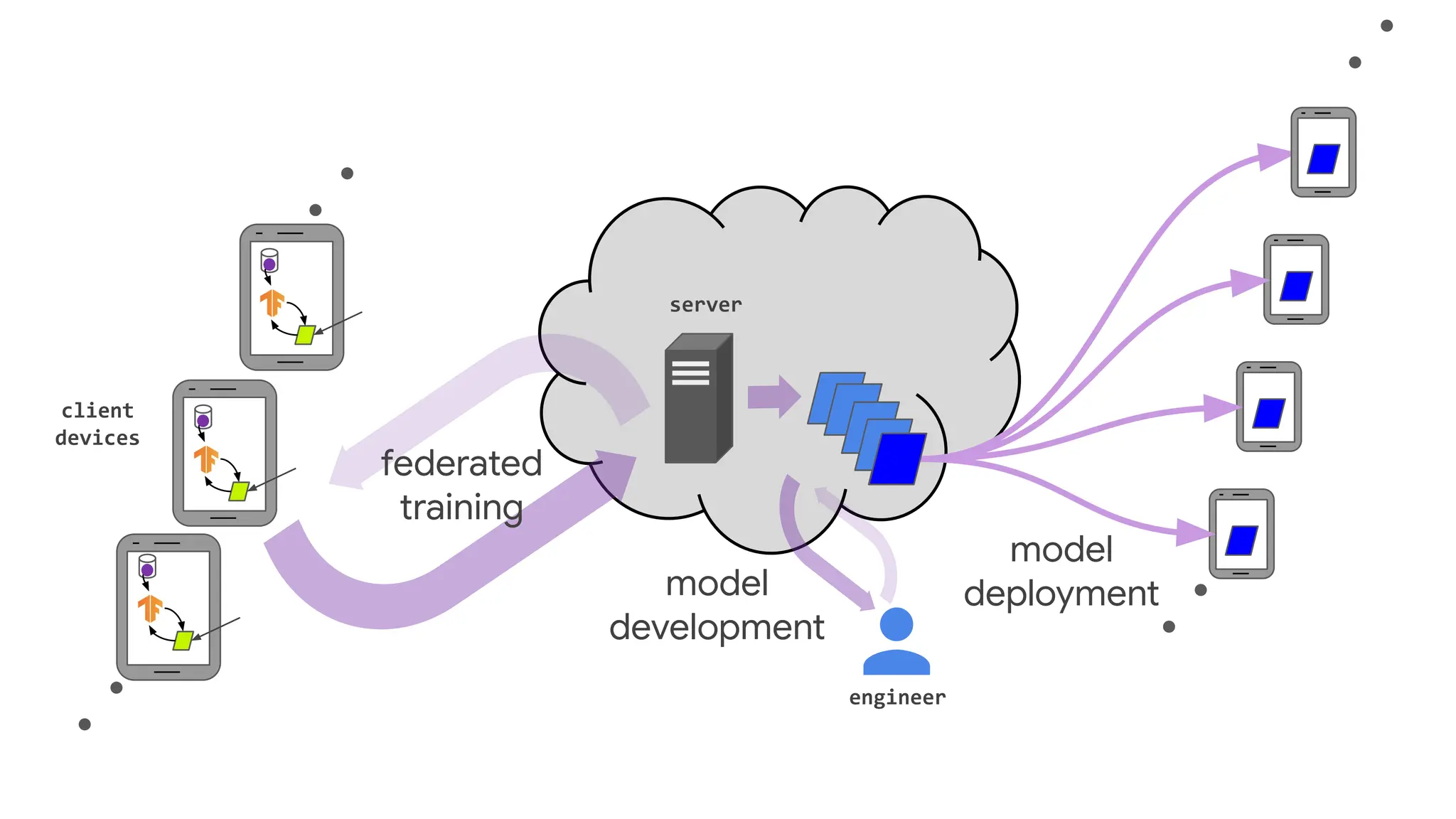
client
devices
server
engineer
model
deployment
federated
training
model
development
admin
Cross-device federated learning
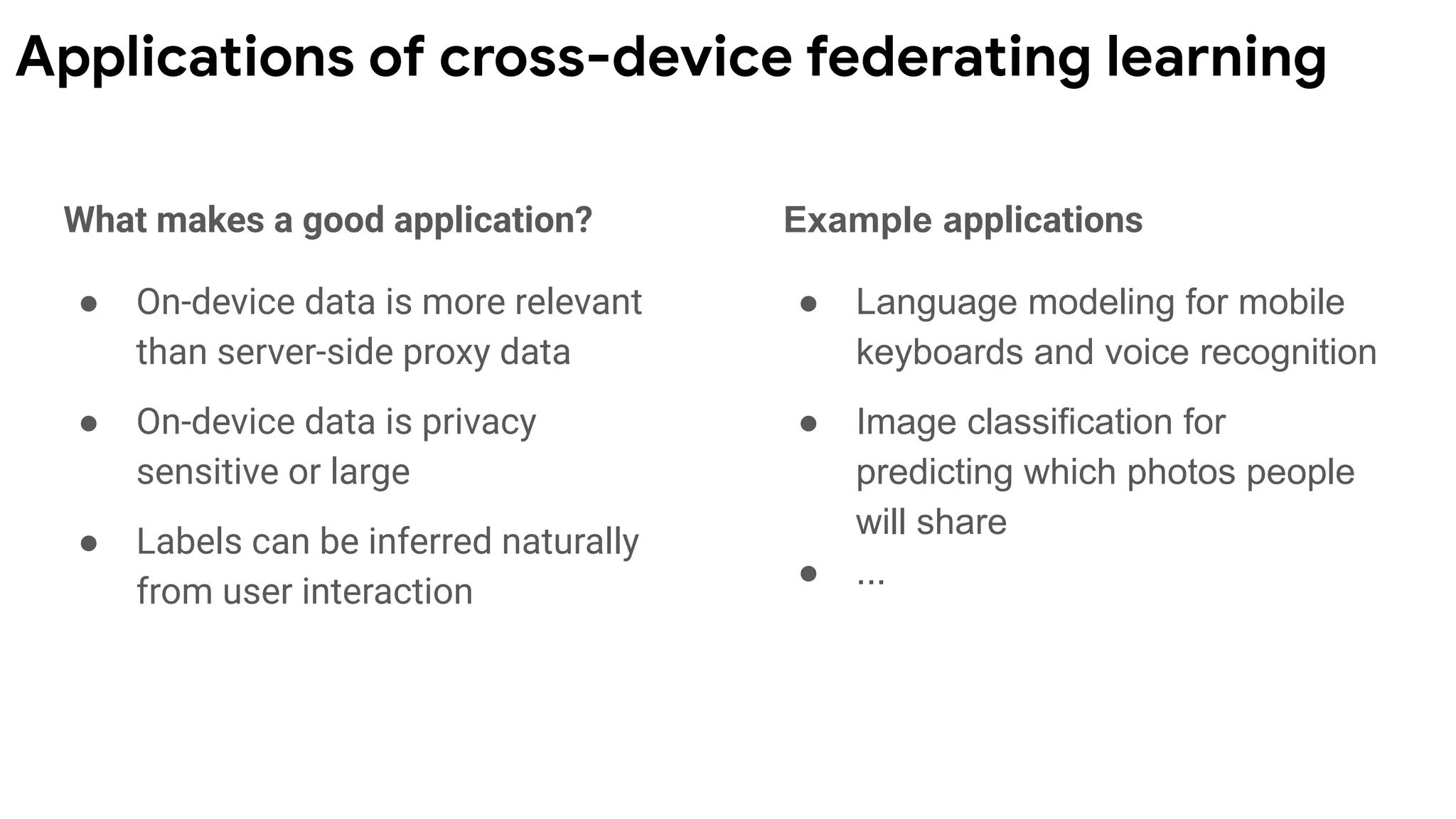
What makes a good application?
● On-device data is more relevant
than server-side proxy data
● On-device data is privacy
sensitive or large
● Labels can be inferred naturally
from user interaction
Example applications
● Language modeling for mobile
keyboards and voice recognition
● Image classification for
predicting which photos people
will share
● ...
Applications of cross-device federating learning
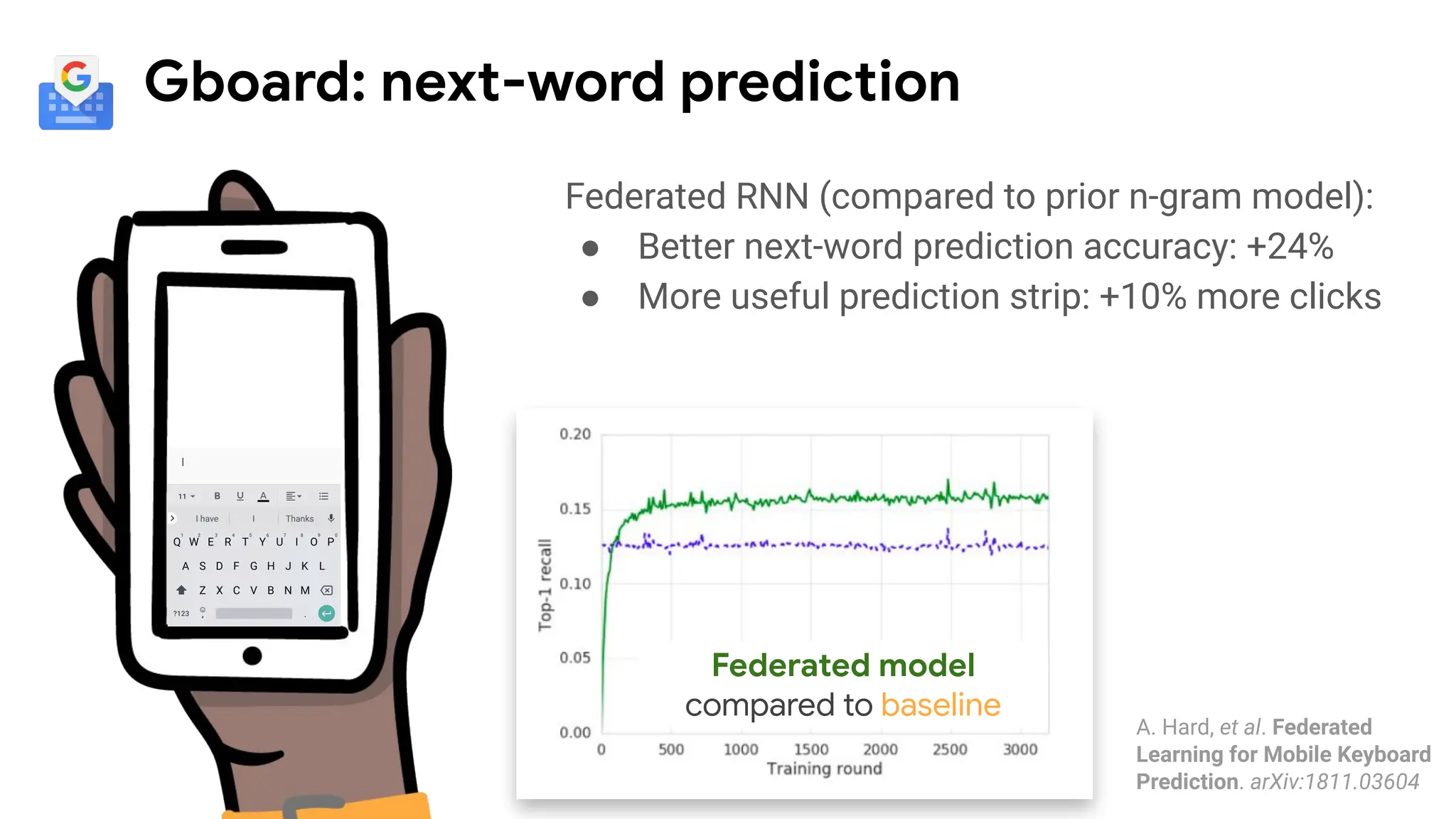
Gboard: next-word prediction
Federated RNN (compared to prior n-gram model):
● Better next-word prediction accuracy: +24%
● More useful prediction strip: +10% more clicks
Federated model
compared to baseline
A. Hard, et al. Federated
Learning for Mobile Keyboard
Prediction. arXiv:1811.03604
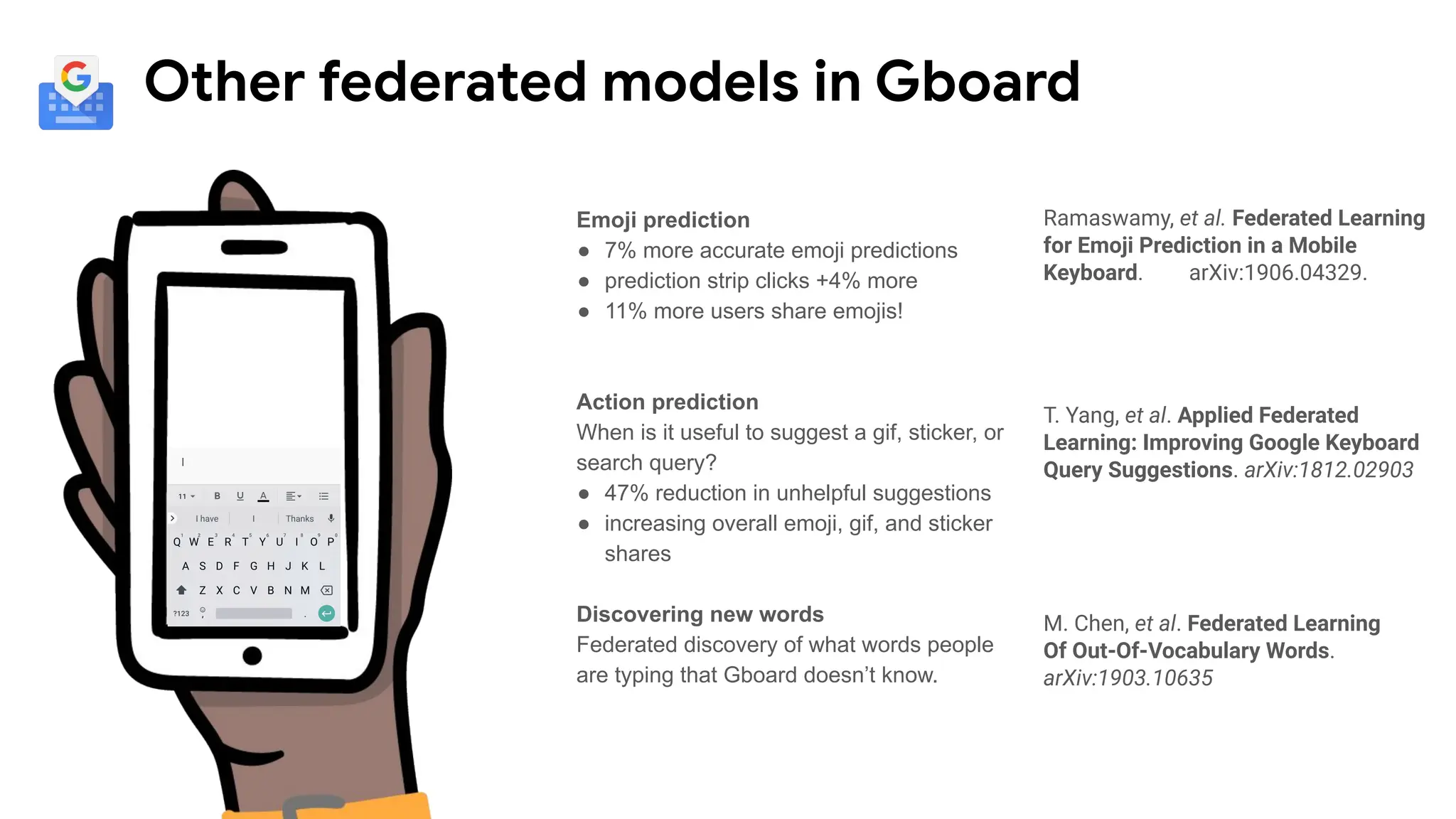
Other federated models in Gboard
Emoji prediction
● 7% more accurate emoji predictions
● prediction strip clicks +4% more
● 11% more users share emojis!
Action prediction
When is it useful to suggest a gif, sticker, or
search query?
● 47% reduction in unhelpful suggestions
● increasing overall emoji, gif, and sticker
shares
Discovering new words
Federated discovery of what words people
are typing that Gboard doesn’t know.
T. Yang, et al. Applied Federated
Learning: Improving Google Keyboard
Query Suggestions. arXiv:1812.02903
M. Chen, et al. Federated Learning
Of Out-Of-Vocabulary Words.
arXiv:1903.10635
Ramaswamy, et al. Federated Learning
for Emoji Prediction in a Mobile
Keyboard. arXiv:1906.04329.
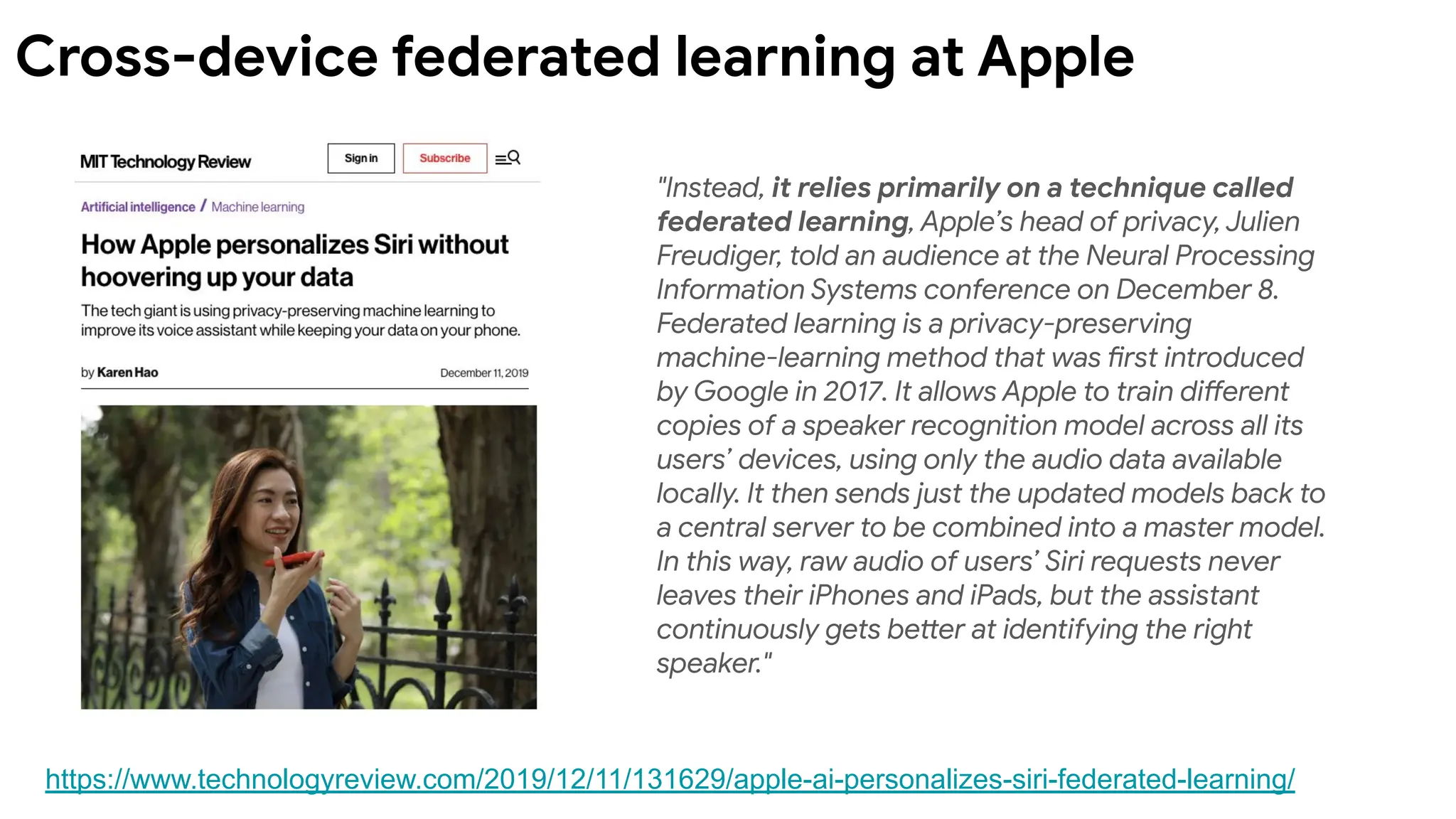
"Instead, it relies primarily on a technique called
federated learning, Apple’s head of privacy, Julien
Freudiger, told an audience at the Neural Processing
Information Systems conference on December 8.
Federated learning is a privacy-preserving
machine-learning method that was first introduced
by Google in 2017. It allows Apple to train different
copies of a speaker recognition model across all its
users’ devices, using only the audio data available
locally. It then sends just the updated models back to
a central server to be combined into a master model.
In this way, raw audio of users’ Siri requests never
leaves their iPhones and iPads, but the assistant
continuously gets better at identifying the right
speaker."
https://www.technologyreview.com/2019/12/11/131629/apple-ai-personalizes-siri-federated-learning/
Cross-device federated learning at Apple
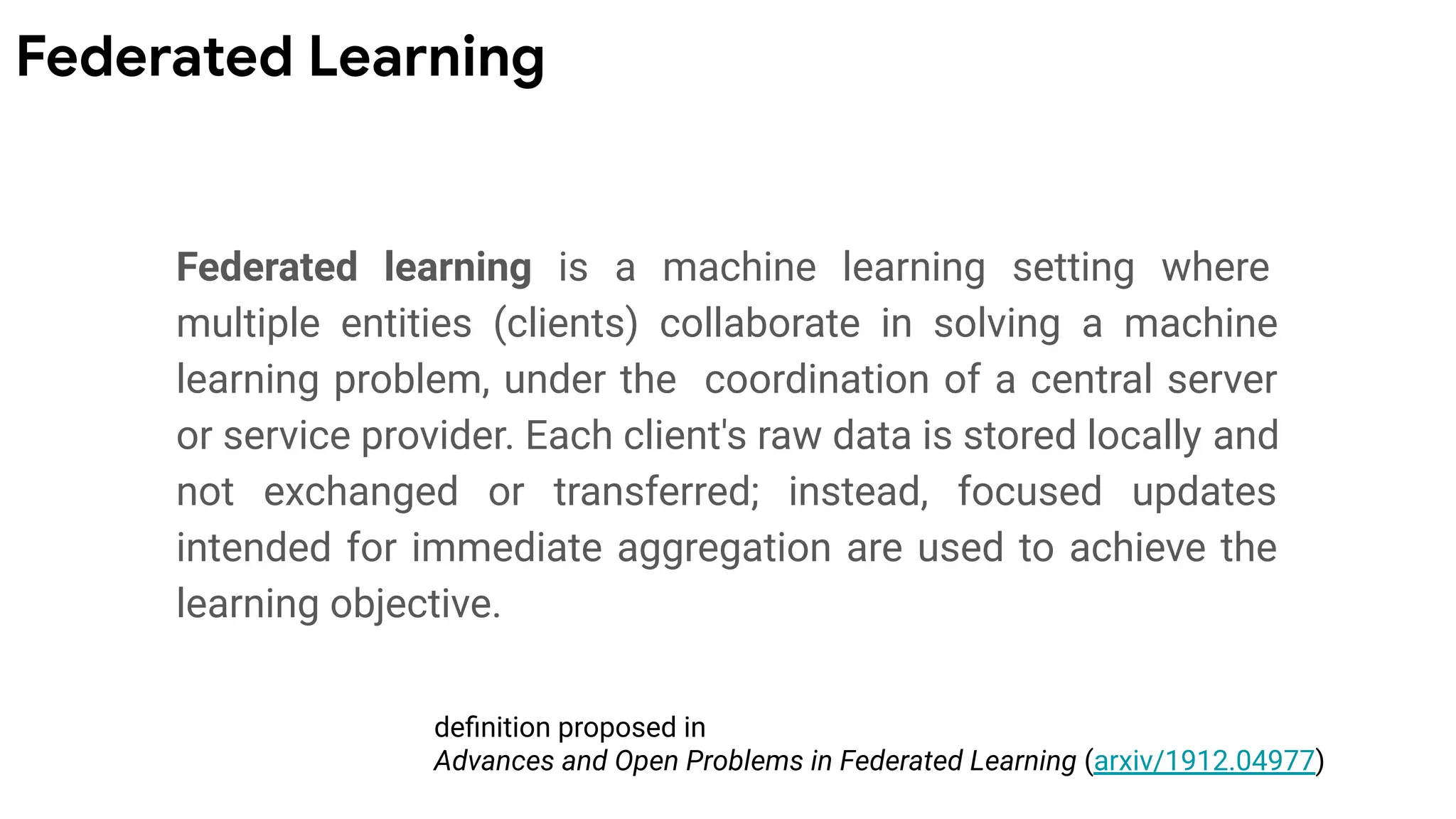
Federated learning is a machine learning setting where
multiple entities (clients) collaborate in solving a machine
learning problem, under the coordination of a central server
or service provider. Each client's raw data is stored locally and
not exchanged or transferred; instead, focused updates
intended for immediate aggregation are used to achieve the
learning objective.
definition proposed in
Advances and Open Problems in Federated Learning (arxiv/1912.04977)
Federated Learning
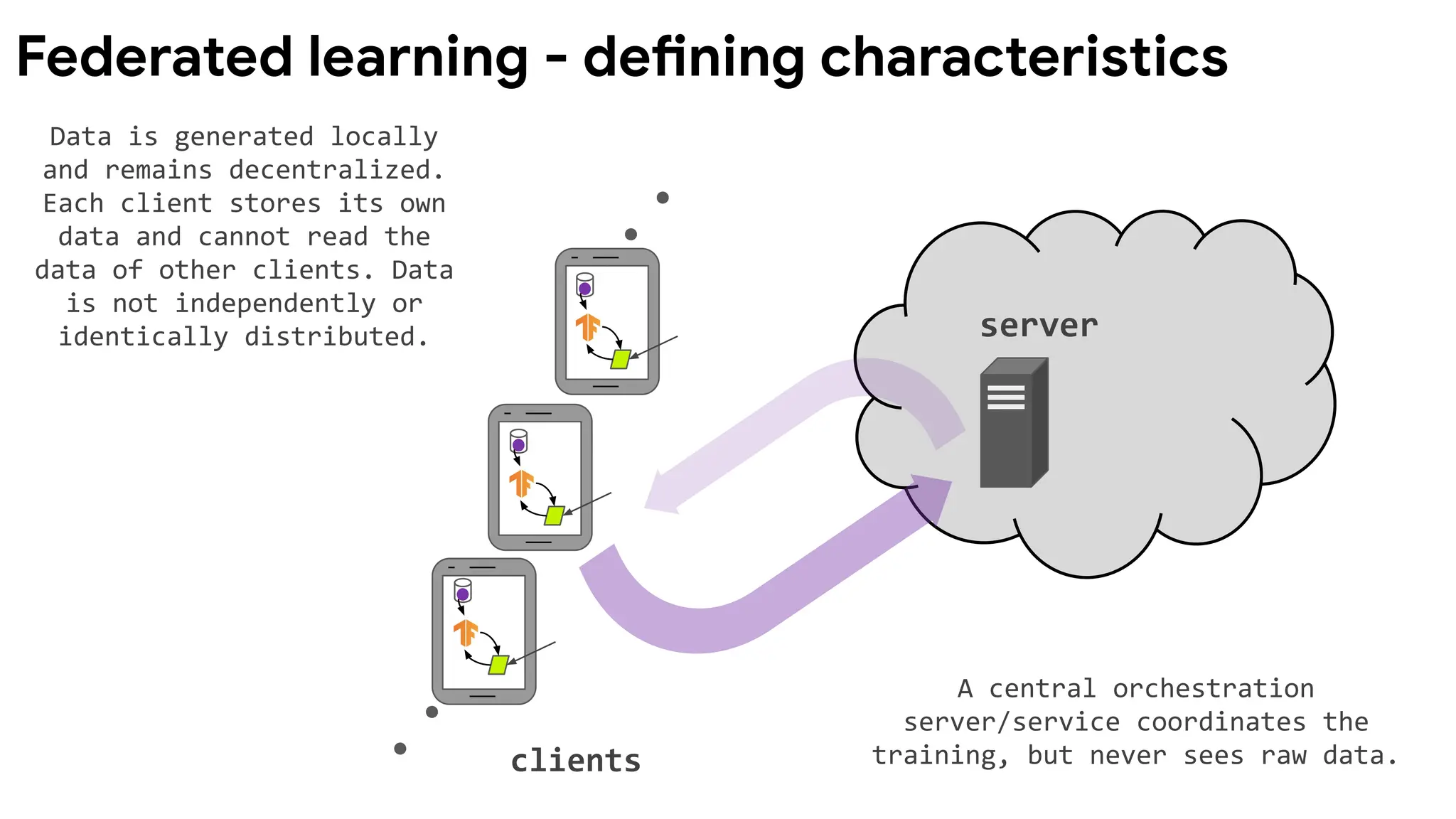
clients
server
Federated learning - defining characteristics
Data is generated locally
and remains decentralized.
Each client stores its own
data and cannot read the
data of other clients. Data
is not independently or
identically distributed.
A central orchestration
server/service coordinates the
training, but never sees raw data.
server
federated
training
admin
federated
training
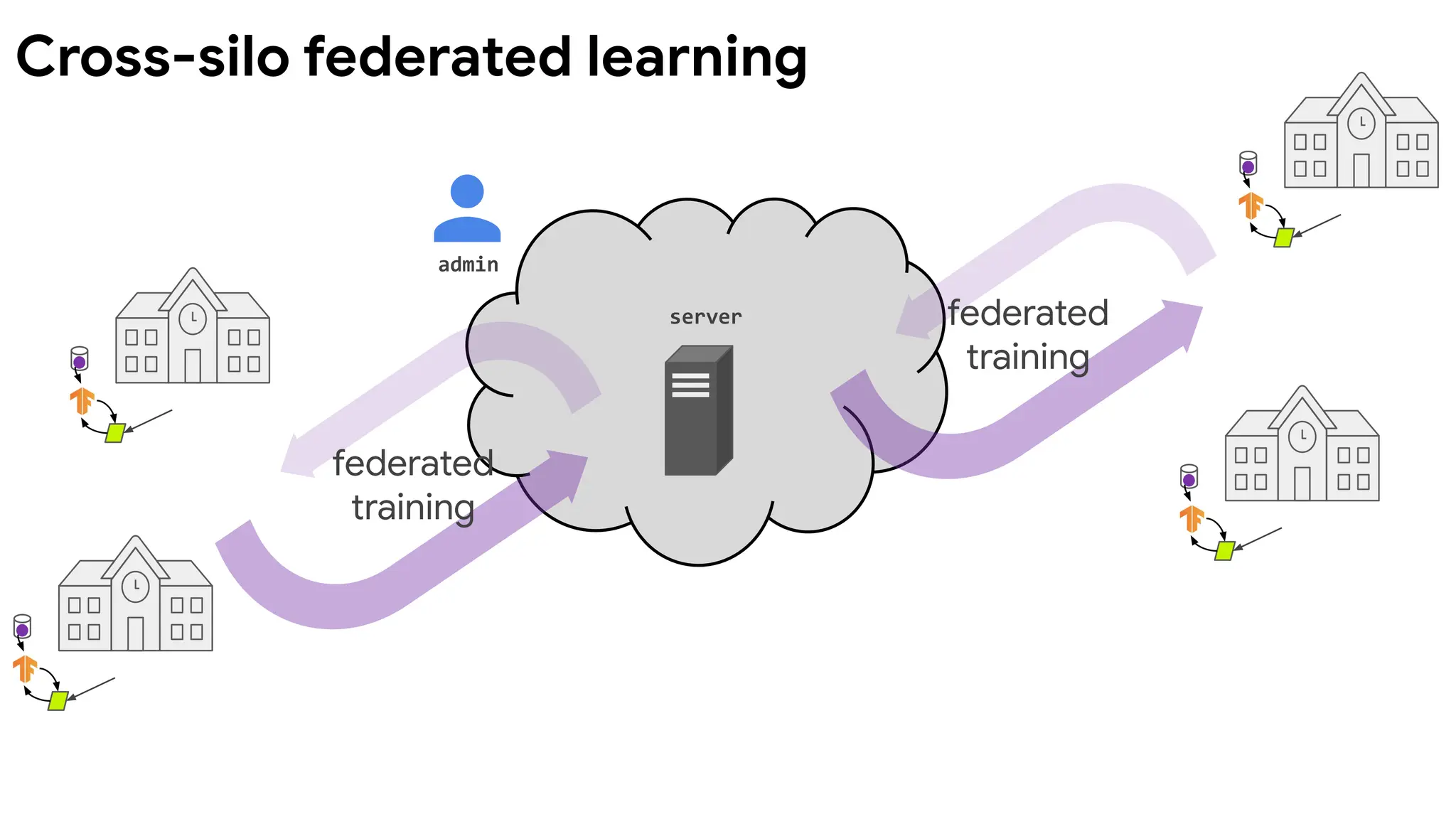
Cross-silo federated learning
"The University of Pennsylvania and chipmaker Intel are forming a
partnership to enable 29 heatlhcare and medical research institutions
around the world to train artificial intelligence models to detect brain
tumors early."
"The program will rely on a technique known as federated learning,
which enables institutions to collaborate on deep learning projects
without sharing patient data. The partnership will bring in institutions in
the U.S., Canada, U.K., Germany, Switzerland and India. The centers –
which include Washington University of St. Louis; Queen’s University in
Kingston, Ontario; University of Munich; Tata Memorial Hospital in
Mumbai and others – will use Intel’s federated learning hardware and
software."
[1] https://medcitynews.com/2020/05/upenn-intel-partner-to-use-federated-learning-ai-for-early-brain-tumor-detection/
[2] https://www.allaboutcircuits.com/news/can-machine-learning-keep-patient-privacy-for-tumor-research-intel-says-yes-with-federated-learning/
[3] https://venturebeat.com/2020/05/11/intel-partners-with-penn-medicine-to-develop-brain-tumor-classifier-with-federated-learning/
[4] http://www.bio-itworld.com/2020/05/28/intel-penn-medicine-launch-federated-learning-model-for-brain-tumors.aspx
Cross-silo federated learning from Intel
"Federated learning addresses this challenge, enabling different
institutions to collaborate on AI model development without sharing
sensitive clinical data with each other. The goal is to end up with
more generalizable models that perform well on any dataset,
instead of an AI biased by the patient demographics or imaging
equipment of one specific radiology department."
[1] https://blogs.nvidia.com/blog/2020/04/15/federated-learning-mammogram-assessment/
[2] https://venturebeat.com/2020/04/15/healthcare-organizations-use-nvidias-clara-federated-learning-to-improve-mammogram-analysis-ai/
[3] https://medcitynews.com/2020/01/nvidia-says-it-has-a-solution-for-healthcares-data-problems/
[4] https://venturebeat.com/2020/06/23/nvidia-and-mercedes-benz-detail-self-driving-system-with-automated-routing-and-parking/
Cross-silo federated learning from NVIDIA
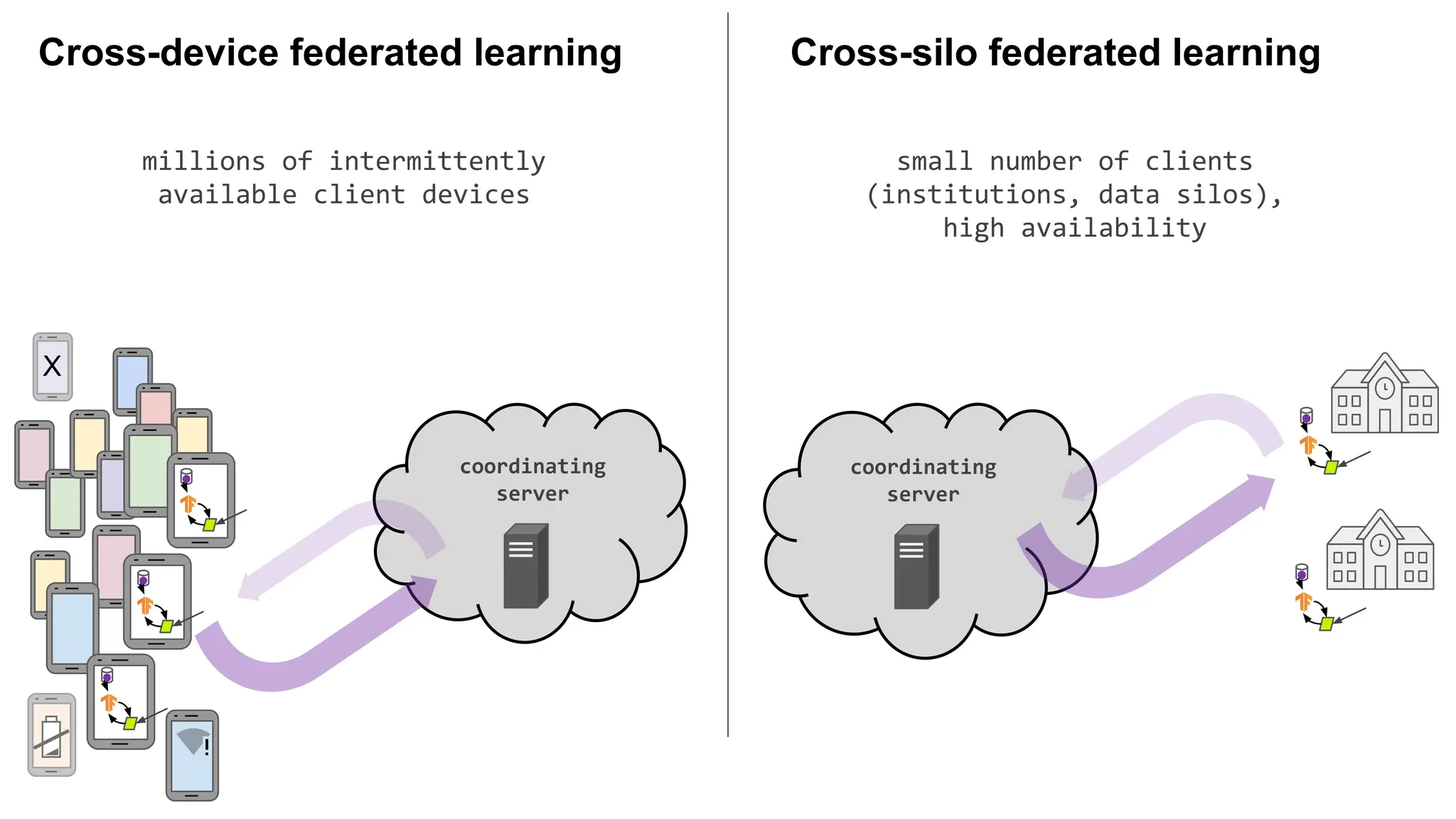
millions of intermittently
available client devices
coordinating
server
Cross-device federated learning
X
coordinating
server
small number of clients
(institutions, data silos),
high availability
Cross-silo federated learning
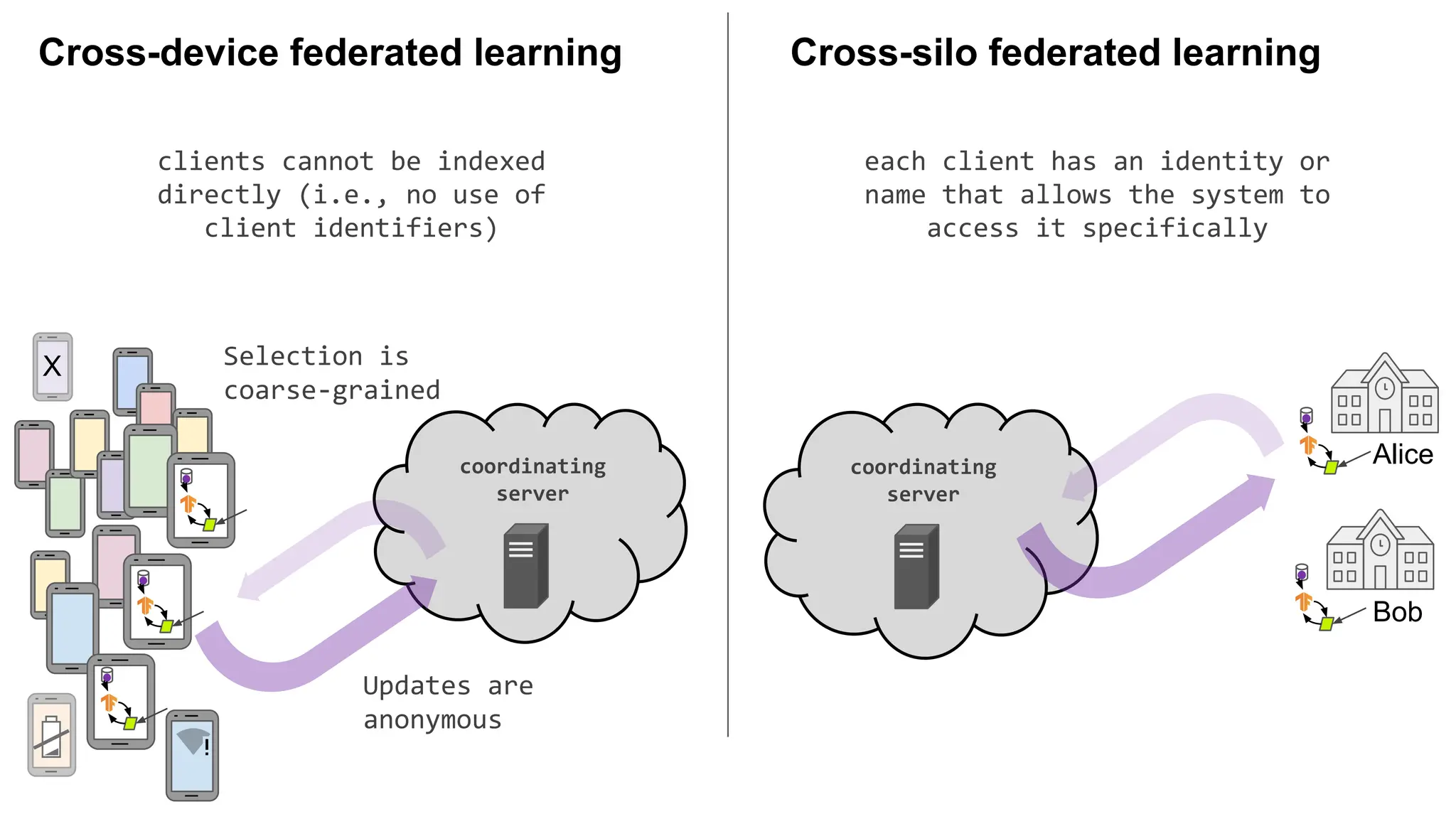
clients cannot be indexed
directly (i.e., no use of
client identifiers)
coordinating
server
Cross-device federated learning
X
coordinating
server
each client has an identity or
name that allows the system to
access it specifically
Cross-silo federated learning
Alice
Bob
Updates are
anonymous
Selection is
coarse-grained
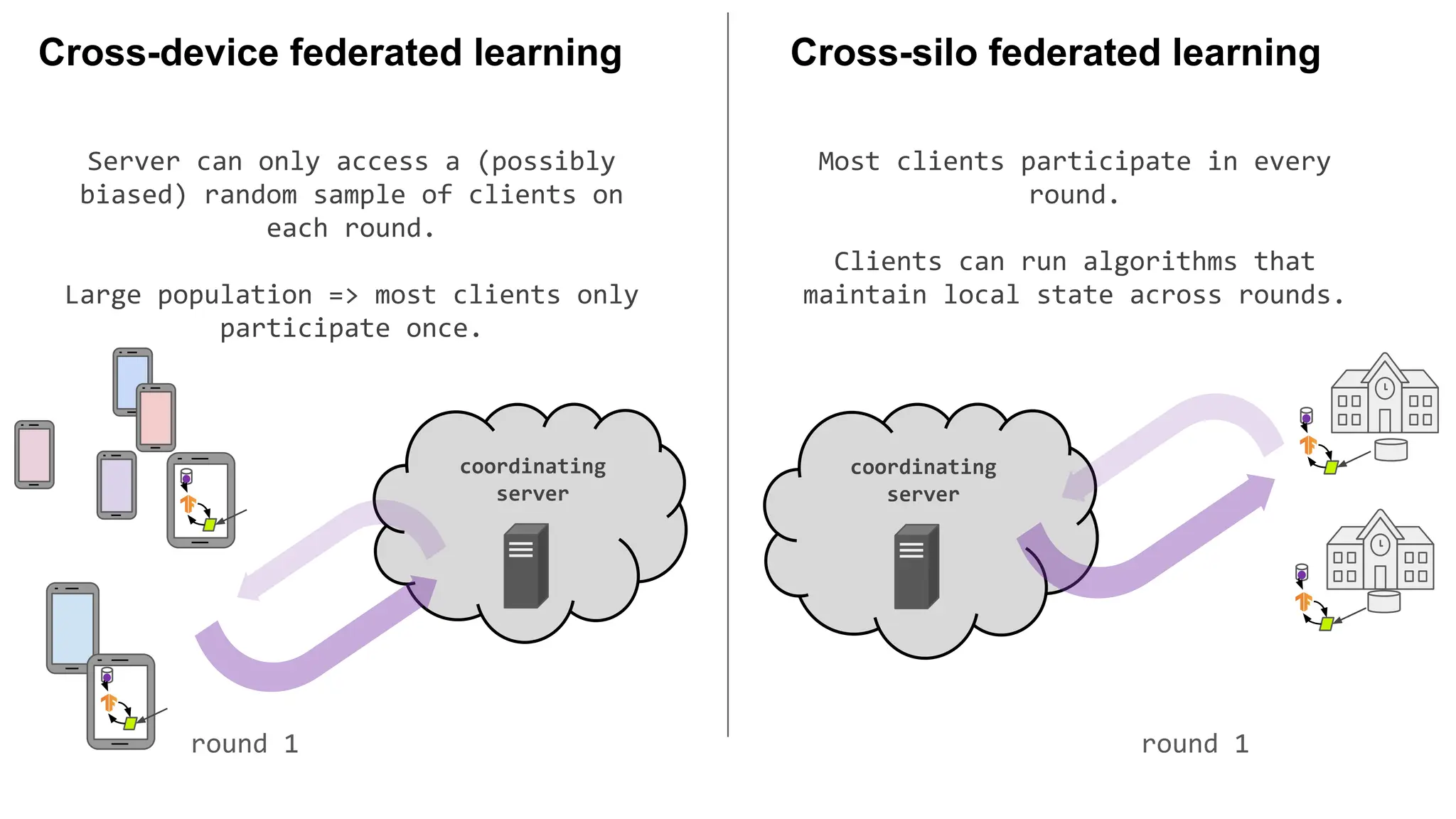
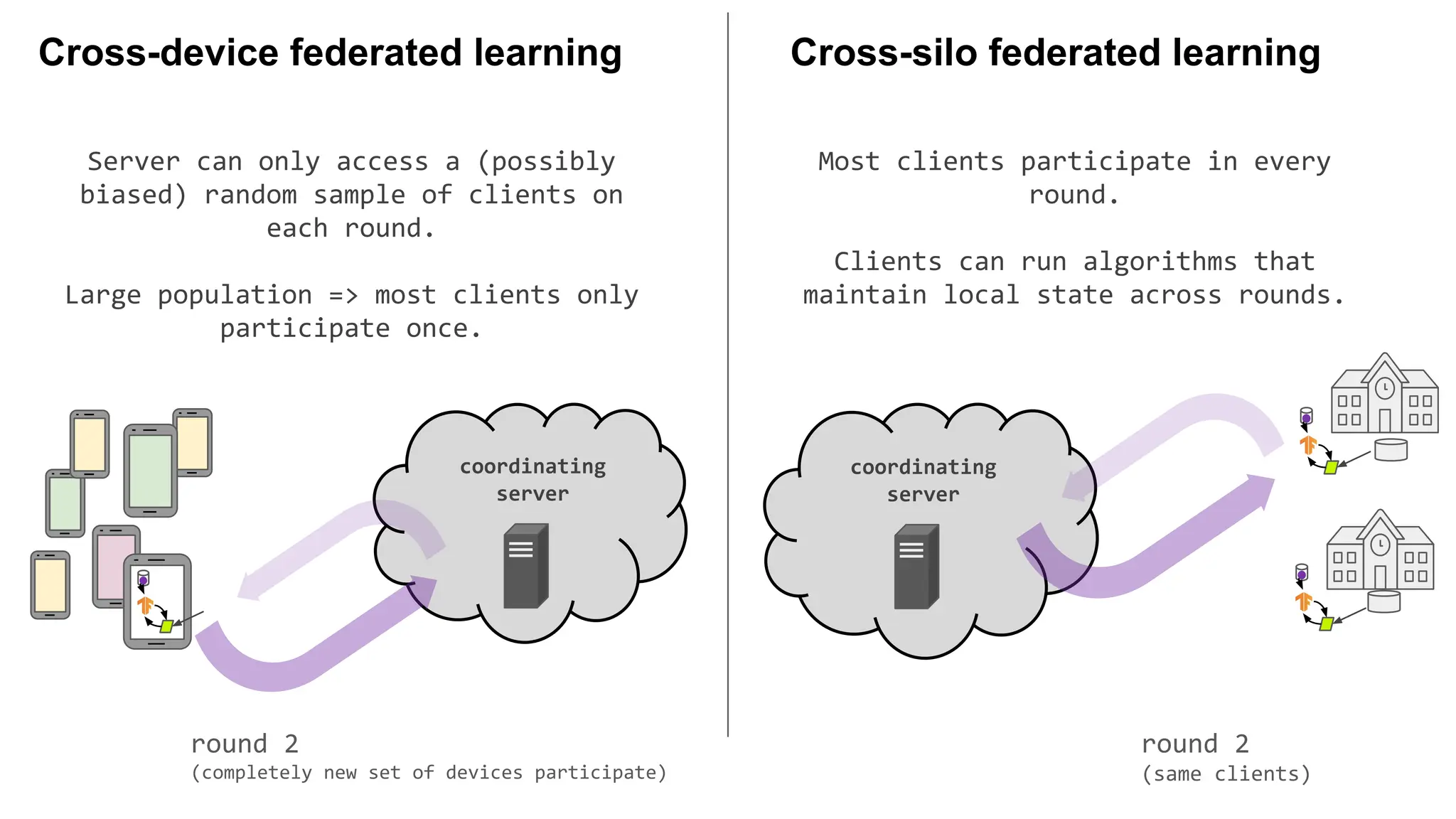
Server can only access a (possibly
biased) random sample of clients on
each round.
Large population => most clients only
participate once.
coordinating
server
Cross-device federated learning
coordinating
server
Most clients participate in every
round.
Clients can run algorithms that
maintain local state across rounds.
Cross-silo federated learning
round 1 round 1
coordinating
server
Cross-device federated learning
coordinating
server
Cross-silo federated learning
round 2
(completely new set of devices participate)
round 2
(same clients)
Server can only access a (possibly
biased) random sample of clients on
each round.
Large population => most clients only
participate once.
Most clients participate in every
round.
Clients can run algorithms that
maintain local state across rounds.
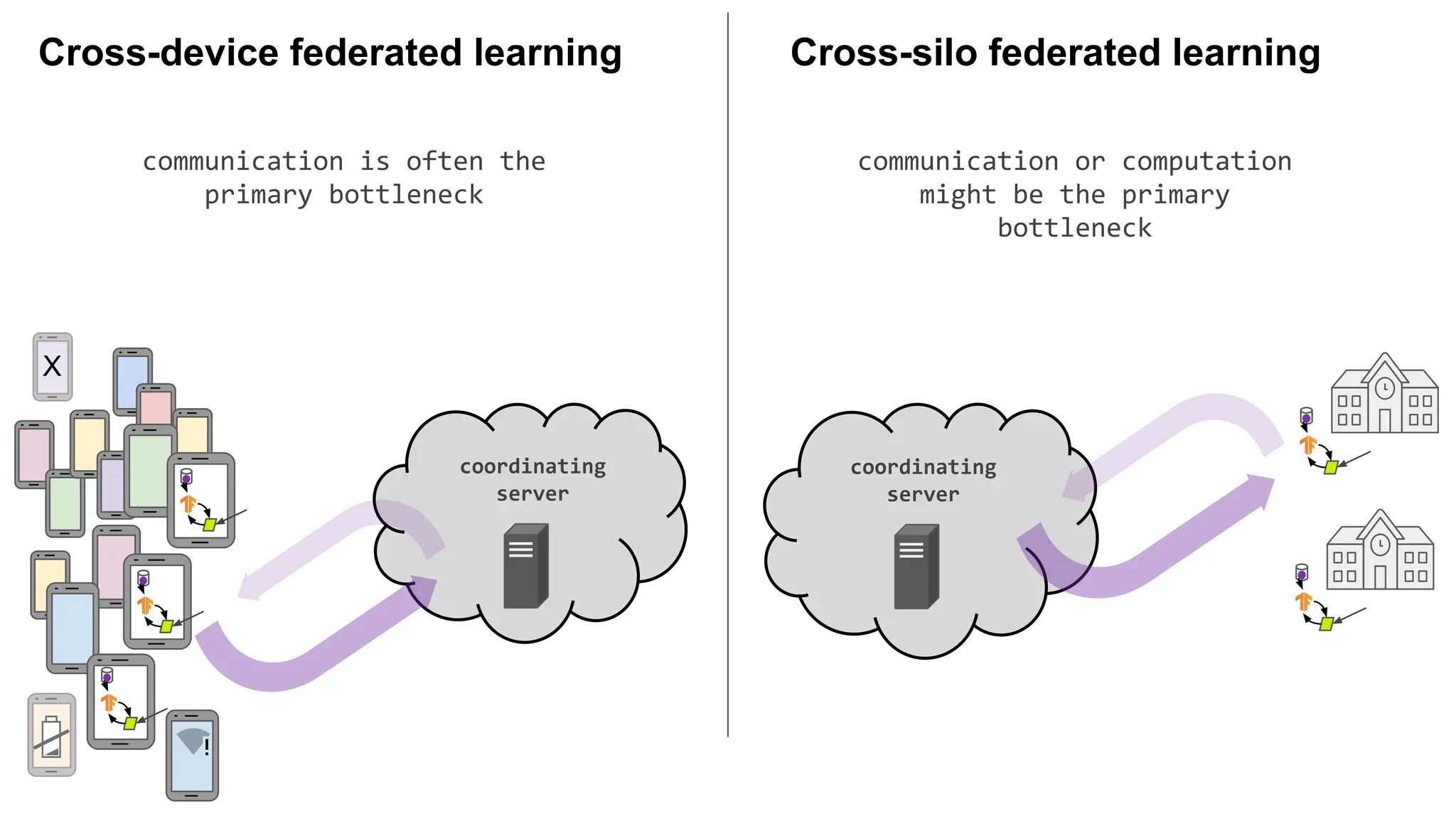
communication is often the
primary bottleneck
coordinating
server
Cross-device federated learning
X
coordinating
server
communication or computation
might be the primary
bottleneck
Cross-silo federated learning
coordinating
server
Cross-device federated learning
X
coordinating
server
Cross-silo federated learning
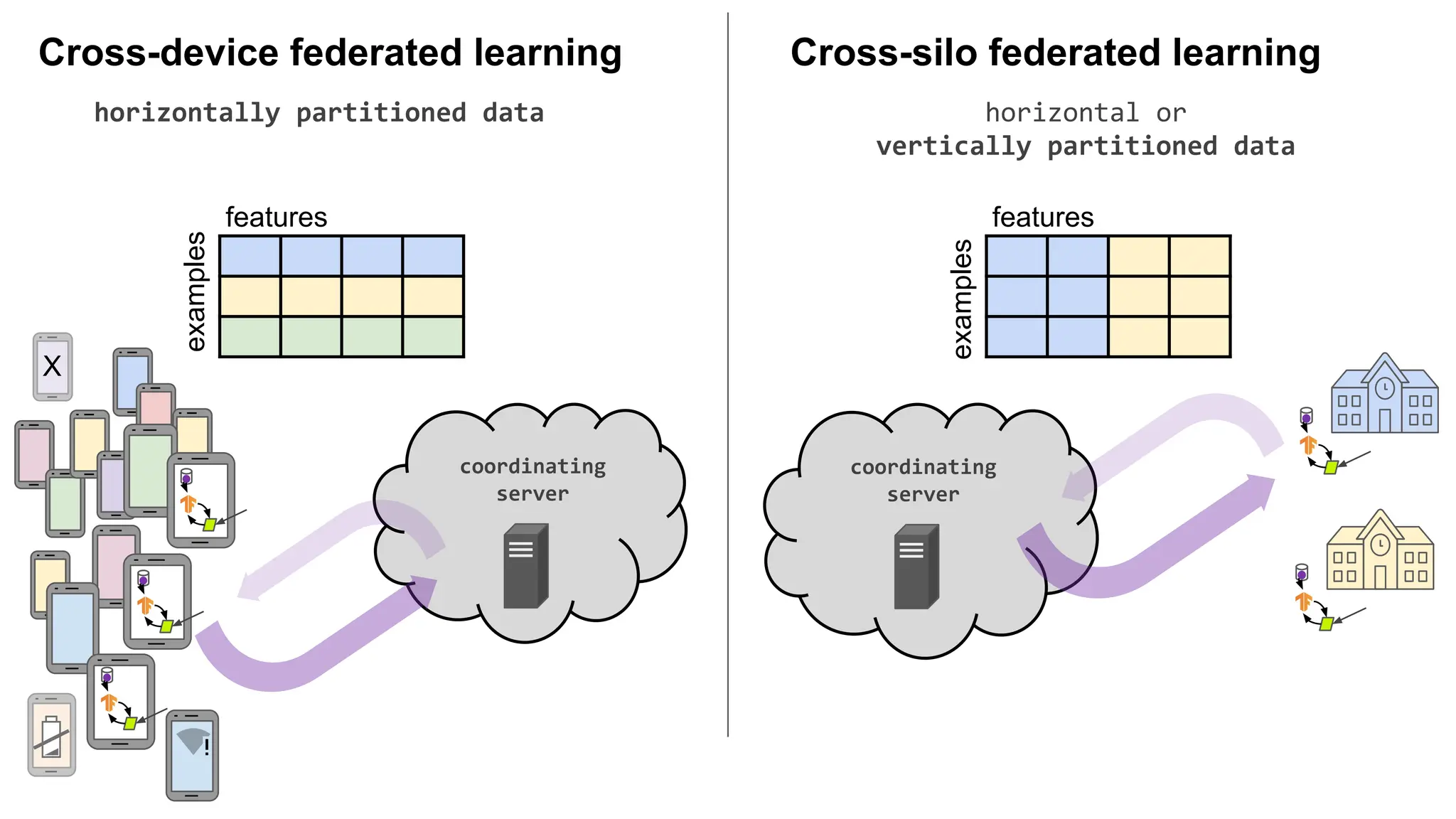
features
examples
horizontally partitioned data
features
examples
horizontal or
vertically partitioned data
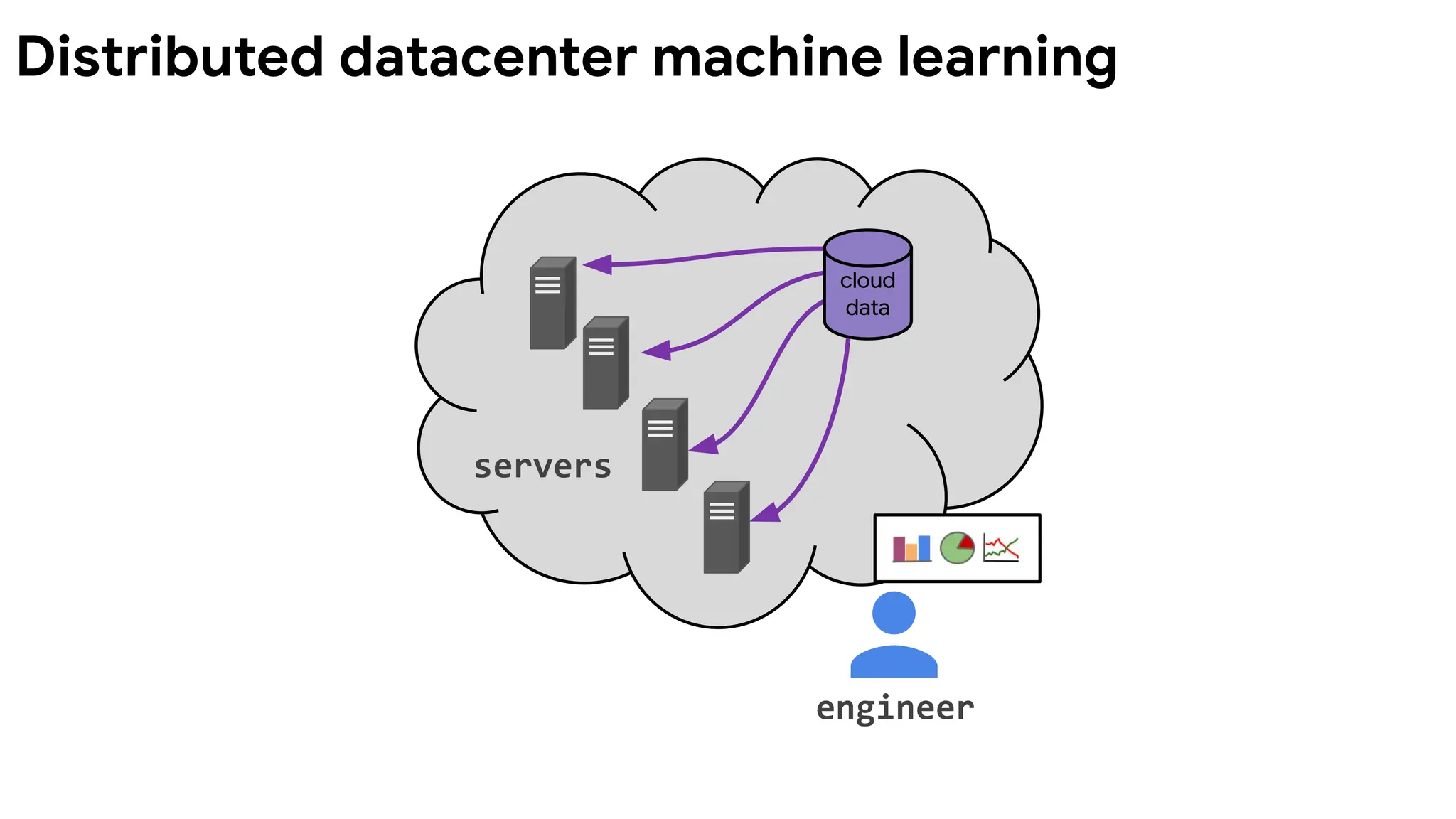
Distributed datacenter machine learning
servers
cloud
data
engineer
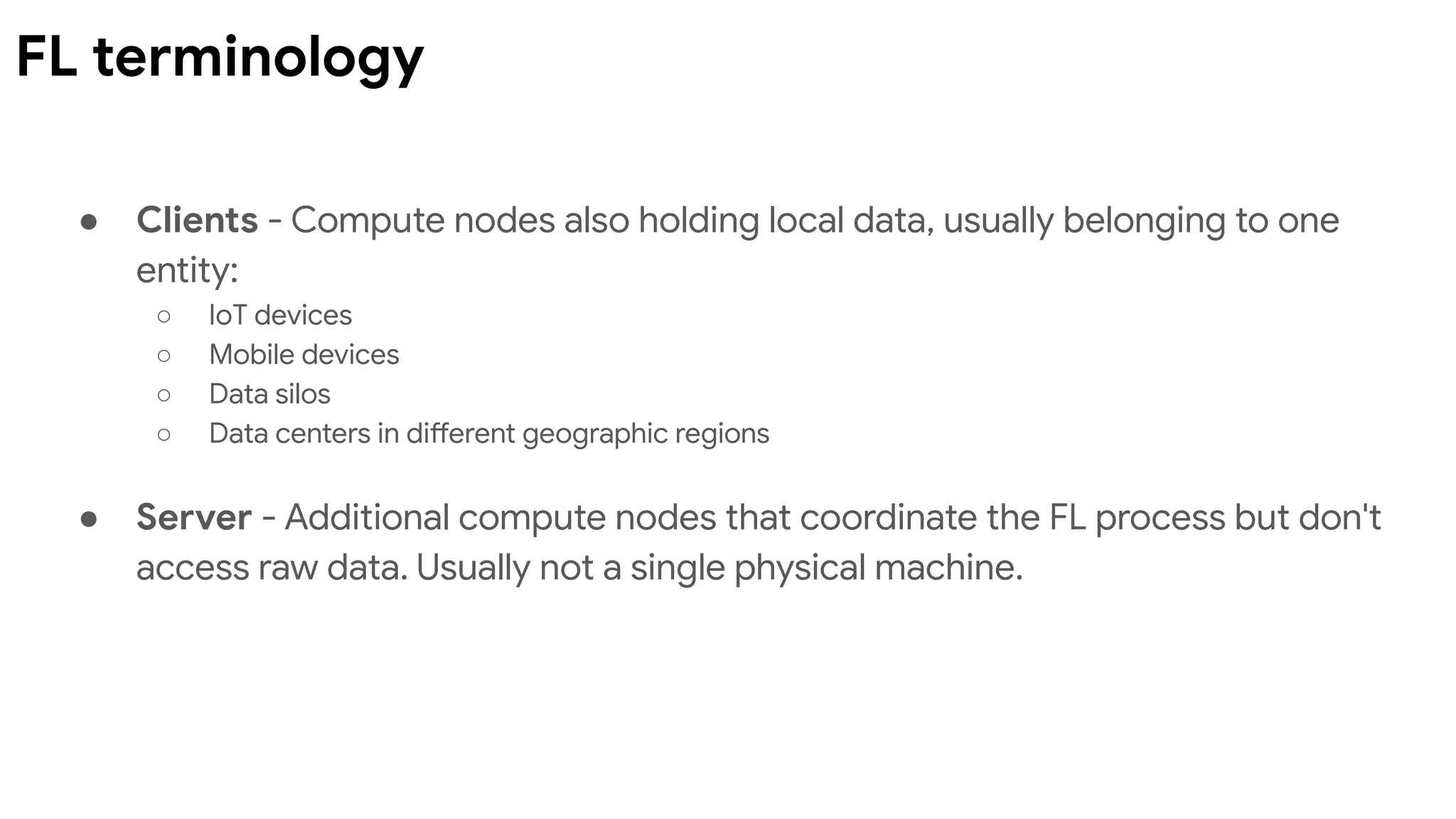
● Clients - Compute nodes also holding local data, usually belonging to one
entity:
○ IoT devices
○ Mobile devices
○ Data silos
○ Data centers in different geographic regions
● Server - Additional compute nodes that coordinate the FL process but don't
access raw data. Usually not a single physical machine.
FL terminology
Characteristics of the federated learning setting
Datacenter distributed learning Cross-silo
federated learning
Cross-device
federated learning
Setting Training a model on a large but
"flat" dataset. Clients are compute
nodes in a single cluster or
datacenter.
Training a model on siloed data.
Clients are different organizations
(e.g., medical or financial) or
datacenters in different geographical
regions.
The clients are a very large number of mobile
or IoT devices.
Data distribution Data is centrally stored, so it can
be shuffled and balanced across
clients. Any client can read any
part of the dataset.
Data is generated locally and remains decentralized. Each client stores its own
data and cannot read the data of other clients. Data is not independently or identically
distributed.
Orchestration Centrally orchestrated. A central orchestration server/service organizes the training, but never sees raw data.
Wide-area
communication
None (fully connected clients in
one datacenter/cluster).
Typically hub-and-spoke topology, with the hub representing a coordinating service
provider (typically without data) and the spokes connecting to clients.
Data availability All clients are almost always available. Only a fraction of clients are available at any
one time, often with diurnal and other
variations.
Distribution scale Typically 1 - 1000 clients. Typically 2 - 100 clients. Massively parallel, up to 1010
clients.
Adapted from Table 1 in Advances and Open Problems in Federated Learning (arxiv/1912.04977)
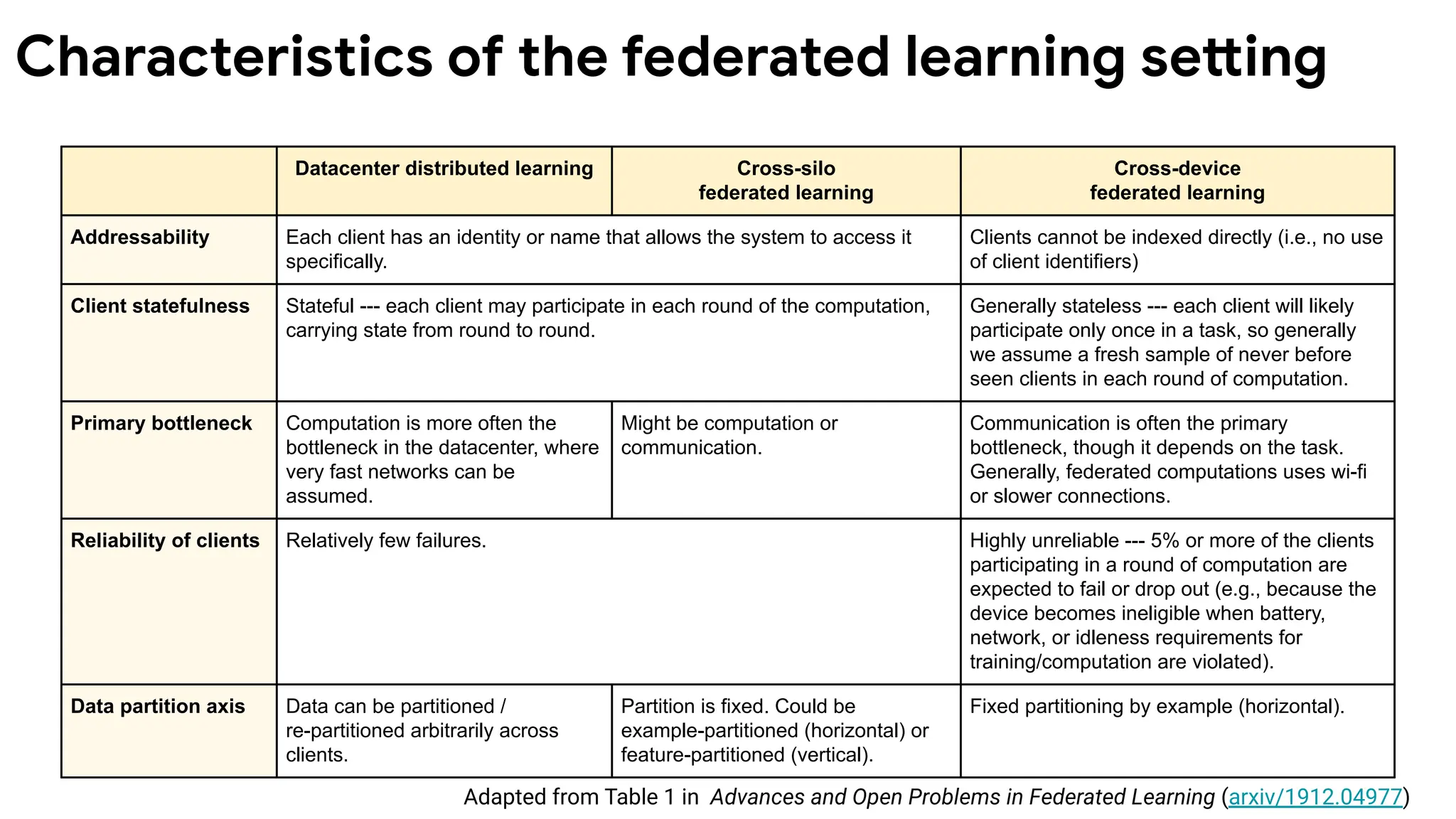
Characteristics of the federated learning setting
Datacenter distributed learning Cross-silo
federated learning
Cross-device
federated learning
Addressability Each client has an identity or name that allows the system to access it
specifically.
Clients cannot be indexed directly (i.e., no use
of client identifiers)
Client statefulness Stateful --- each client may participate in each round of the computation,
carrying state from round to round.
Generally stateless --- each client will likely
participate only once in a task, so generally
we assume a fresh sample of never before
seen clients in each round of computation.
Primary bottleneck Computation is more often the
bottleneck in the datacenter, where
very fast networks can be
assumed.
Might be computation or
communication.
Communication is often the primary
bottleneck, though it depends on the task.
Generally, federated computations uses wi-fi
or slower connections.
Reliability of clients Relatively few failures. Highly unreliable --- 5% or more of the clients
participating in a round of computation are
expected to fail or drop out (e.g., because the
device becomes ineligible when battery,
network, or idleness requirements for
training/computation are violated).
Data partition axis Data can be partitioned /
re-partitioned arbitrarily across
clients.
Partition is fixed. Could be
example-partitioned (horizontal) or
feature-partitioned (vertical).
Fixed partitioning by example (horizontal).
Adapted from Table 1 in Advances and Open Problems in Federated Learning (arxiv/1912.04977)
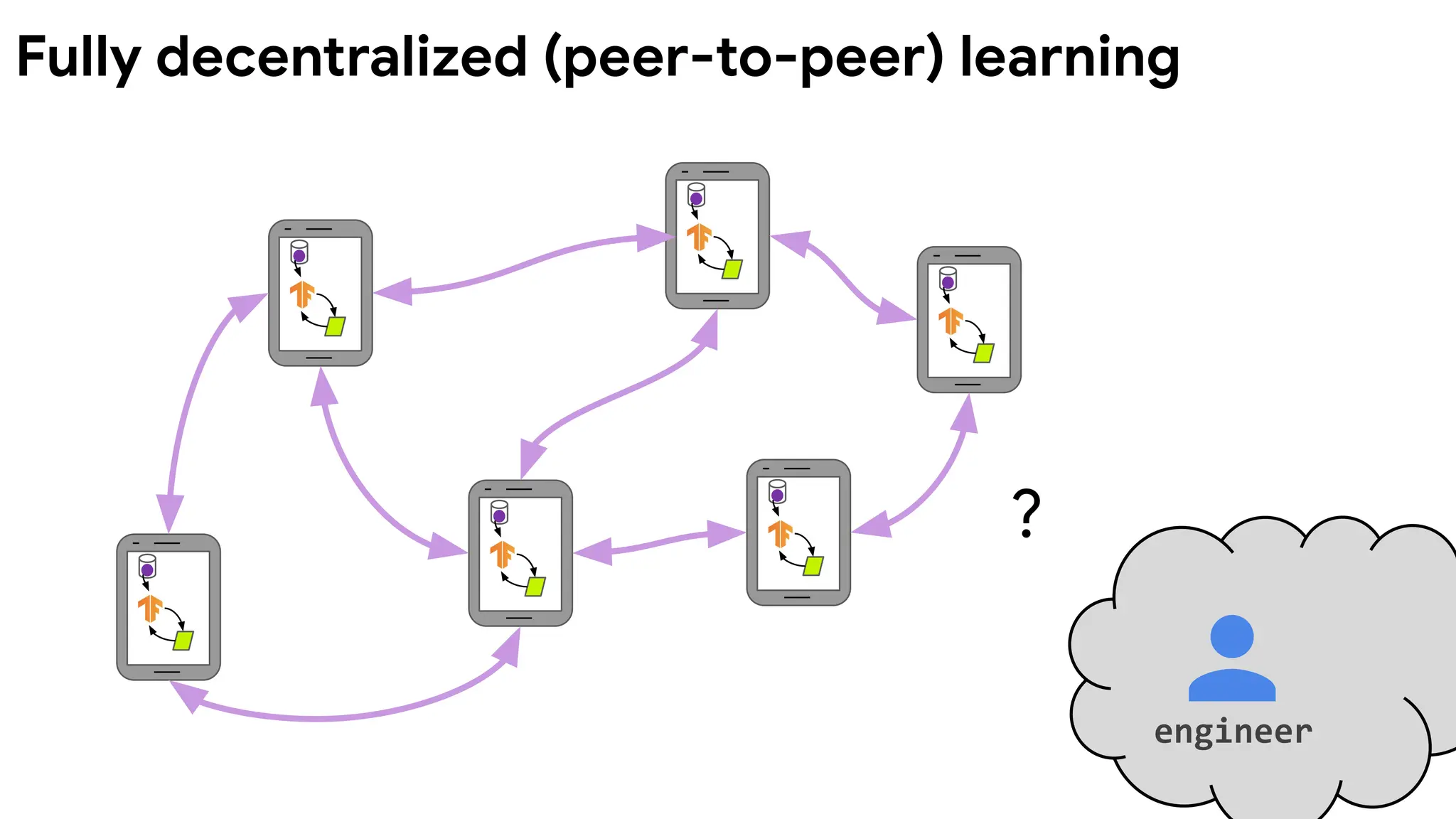
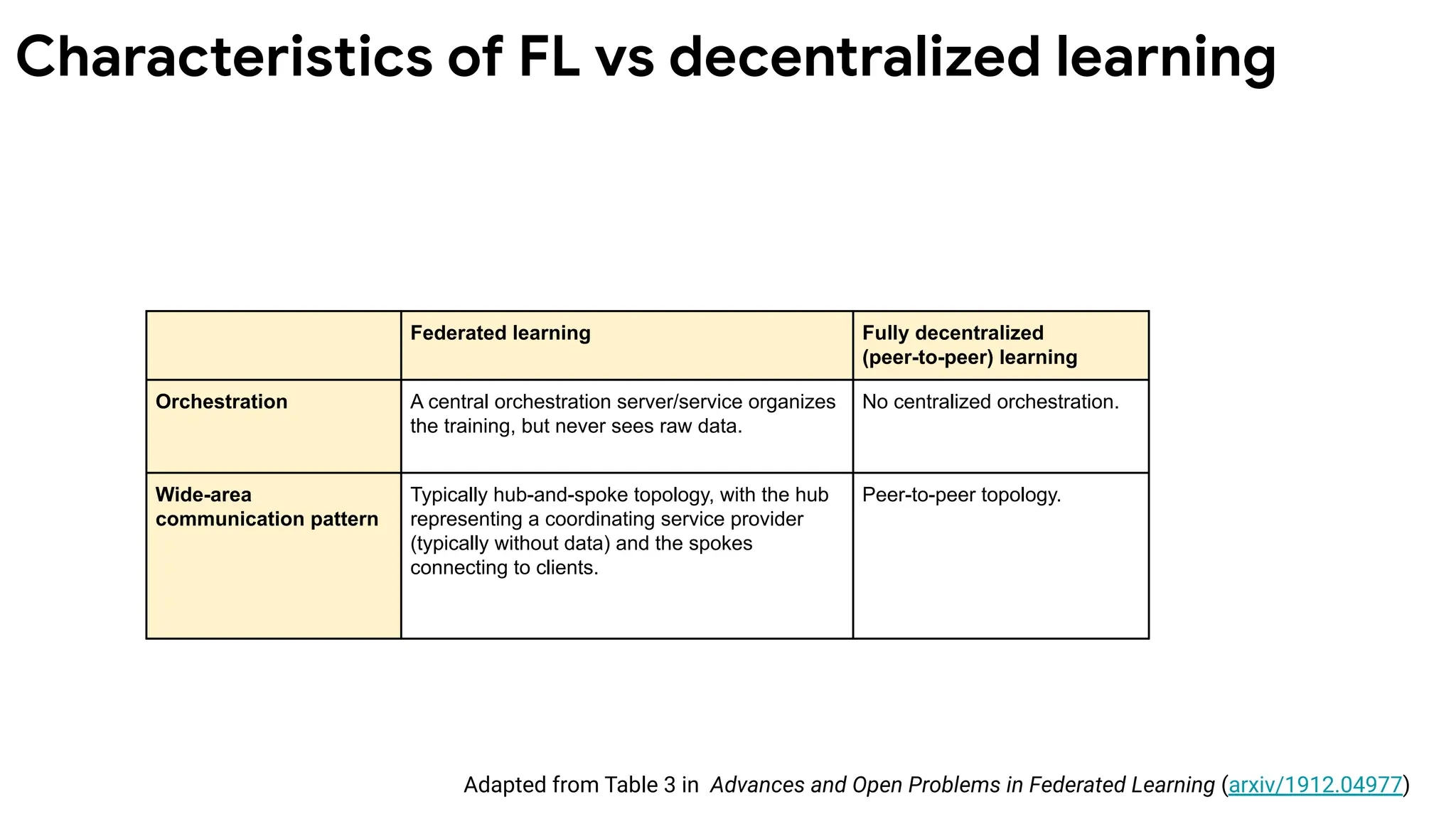
Fully decentralized (peer-to-peer) learning
engineer
?
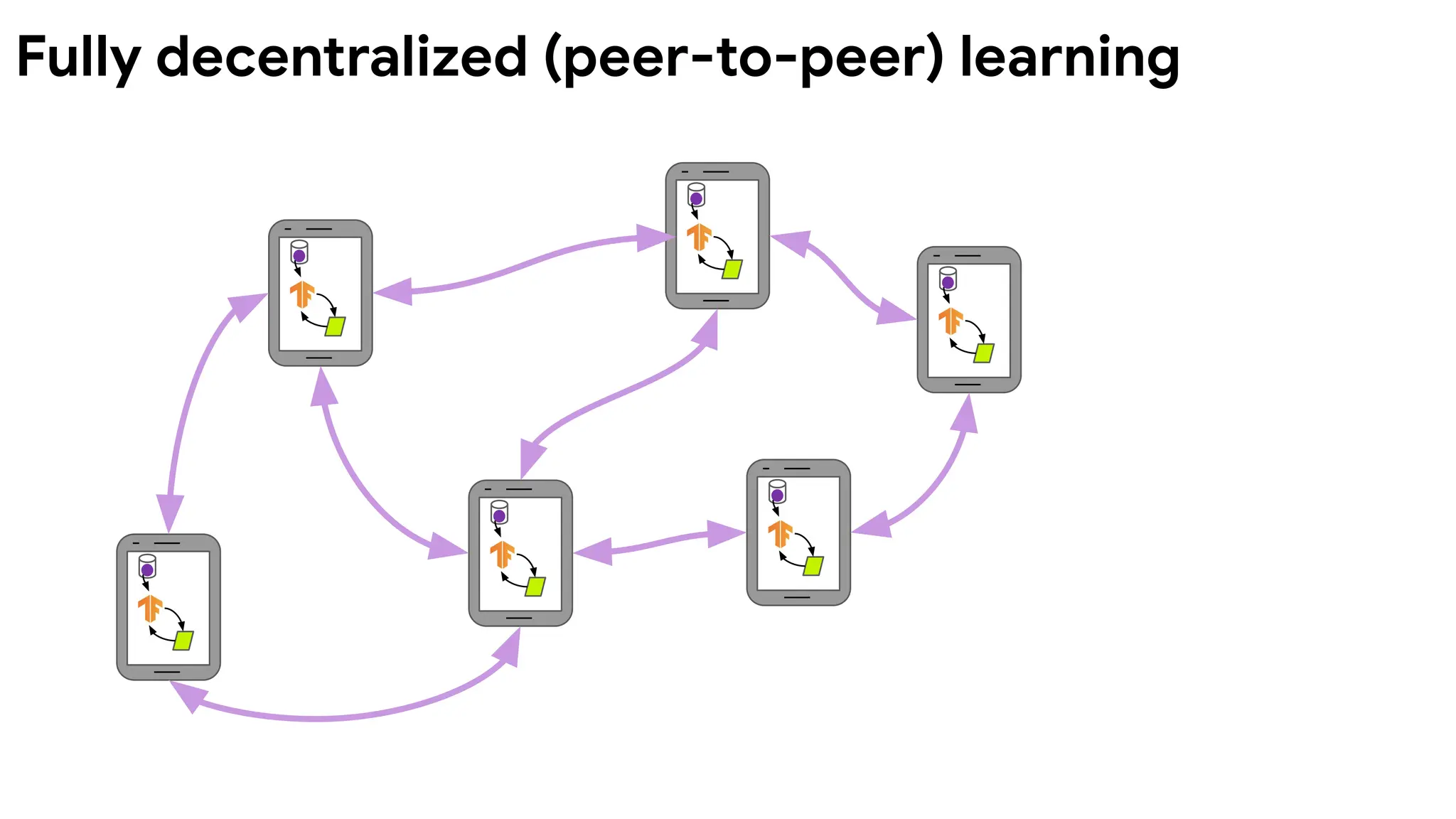
Fully decentralized (peer-to-peer) learning
Federated learning Fully decentralized
(peer-to-peer) learning
Orchestration A central orchestration server/service organizes
the training, but never sees raw data.
No centralized orchestration.
Wide-area
communication pattern
Typically hub-and-spoke topology, with the hub
representing a coordinating service provider
(typically without data) and the spokes
connecting to clients.
Peer-to-peer topology.
Adapted from Table 3 in Advances and Open Problems in Federated Learning (arxiv/1912.04977)
Characteristics of FL vs decentralized learning
Cross-Device Federated Learning
engineer
cloud
data
Train & evaluate
on cloud data
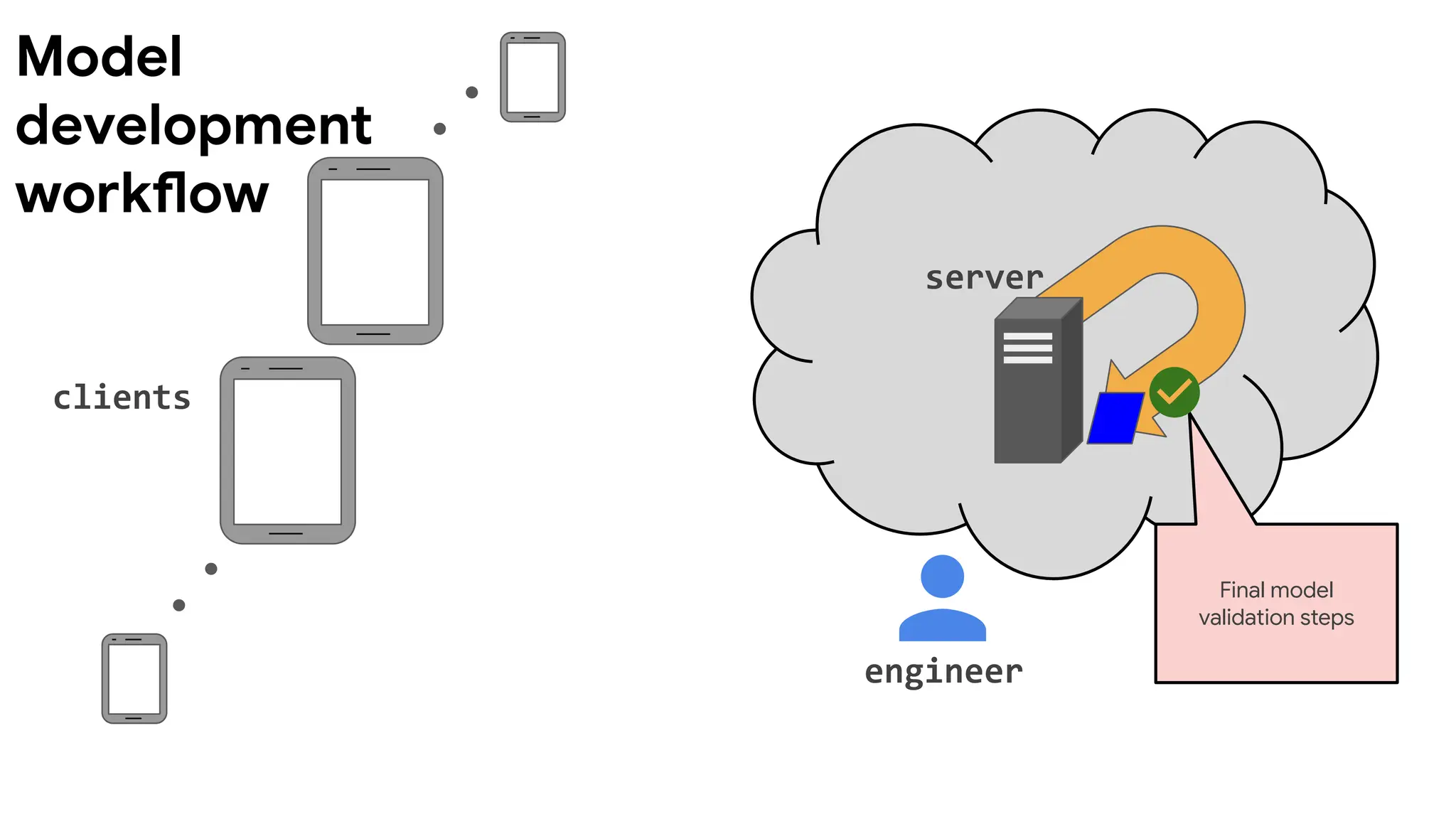
server
Model
development
workflow
clients
server
Final model
validation steps
engineer
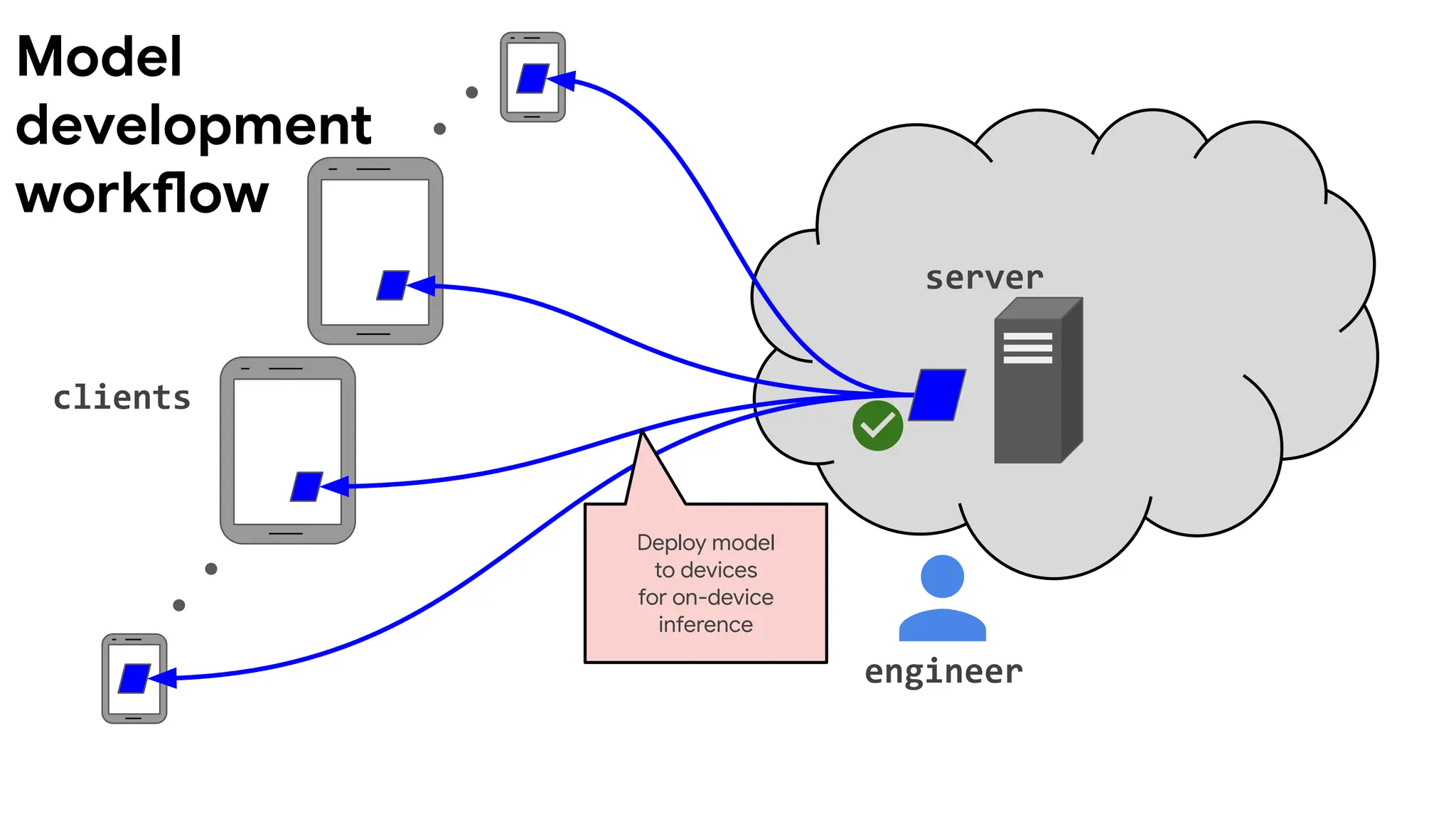
Model
development
workflow
clients
server
engineer
Deploy model
to devices
for on-device
inference
Model
development
workflow
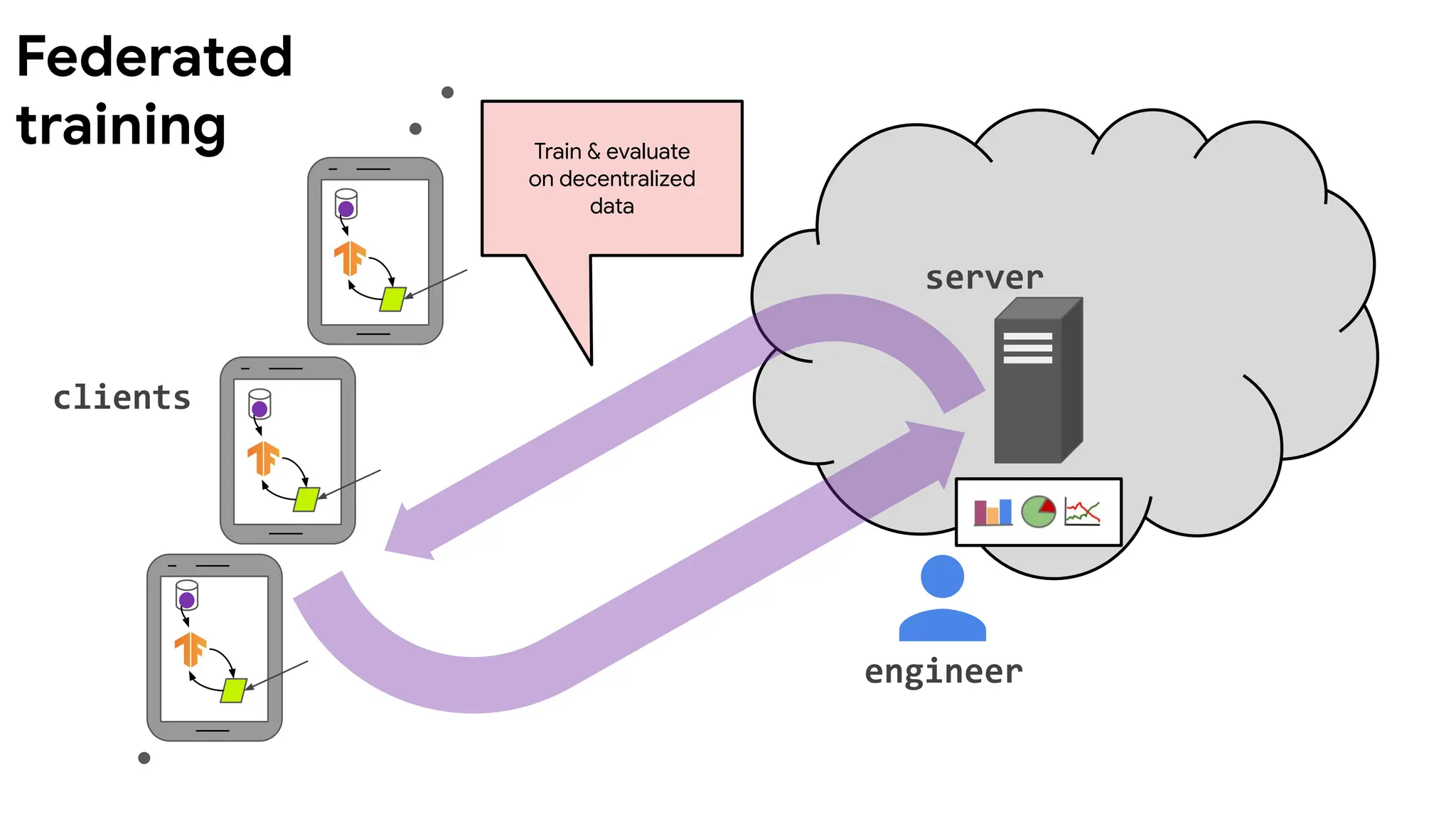
Train & evaluate
on decentralized
data
clients
server
engineer
Federated
training
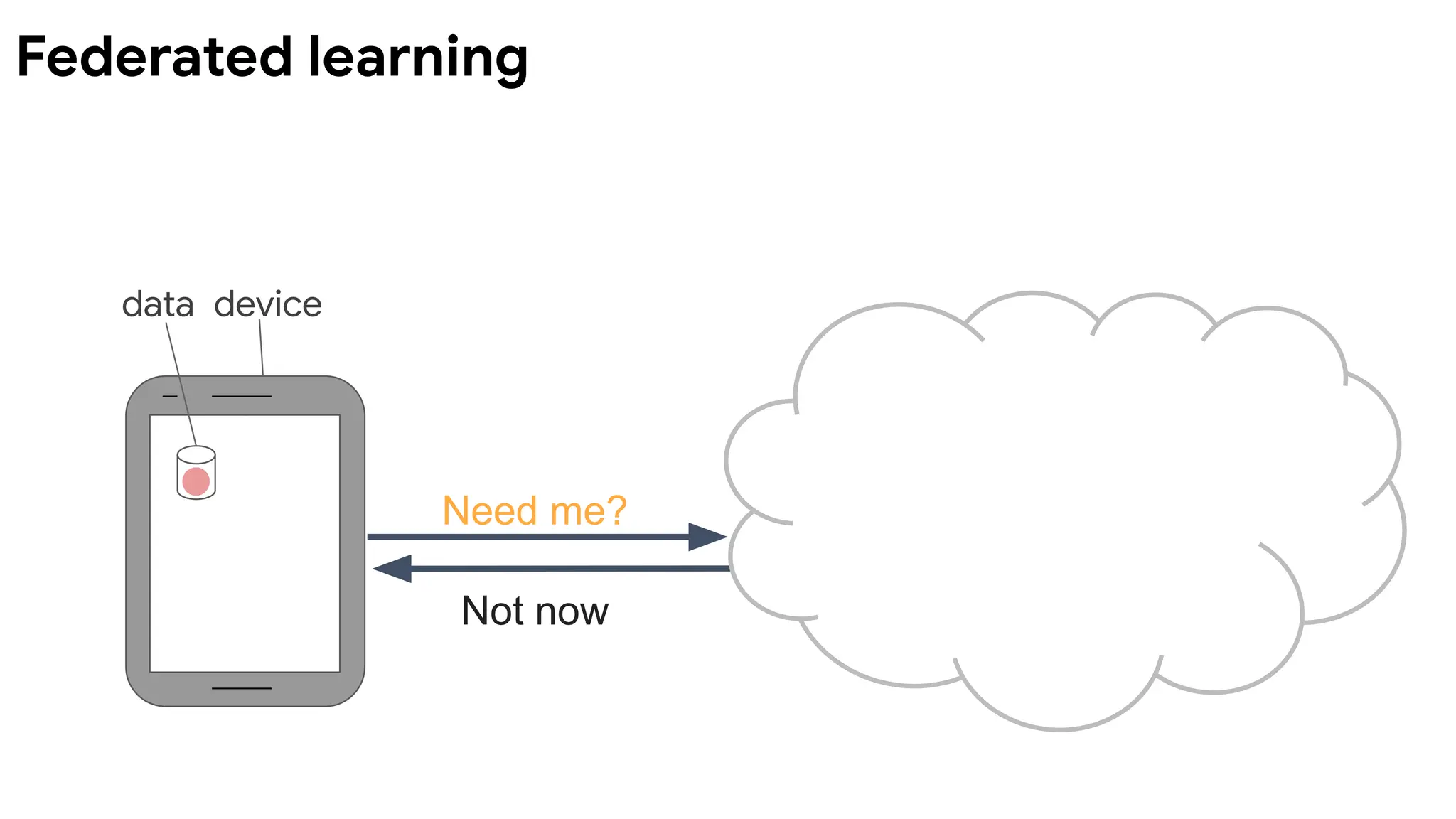
opted-in
data device
Need me?
Federated learning
data device
Need me?
Not now
Federated learning
data device
Need me?
Yes!
Federated learning
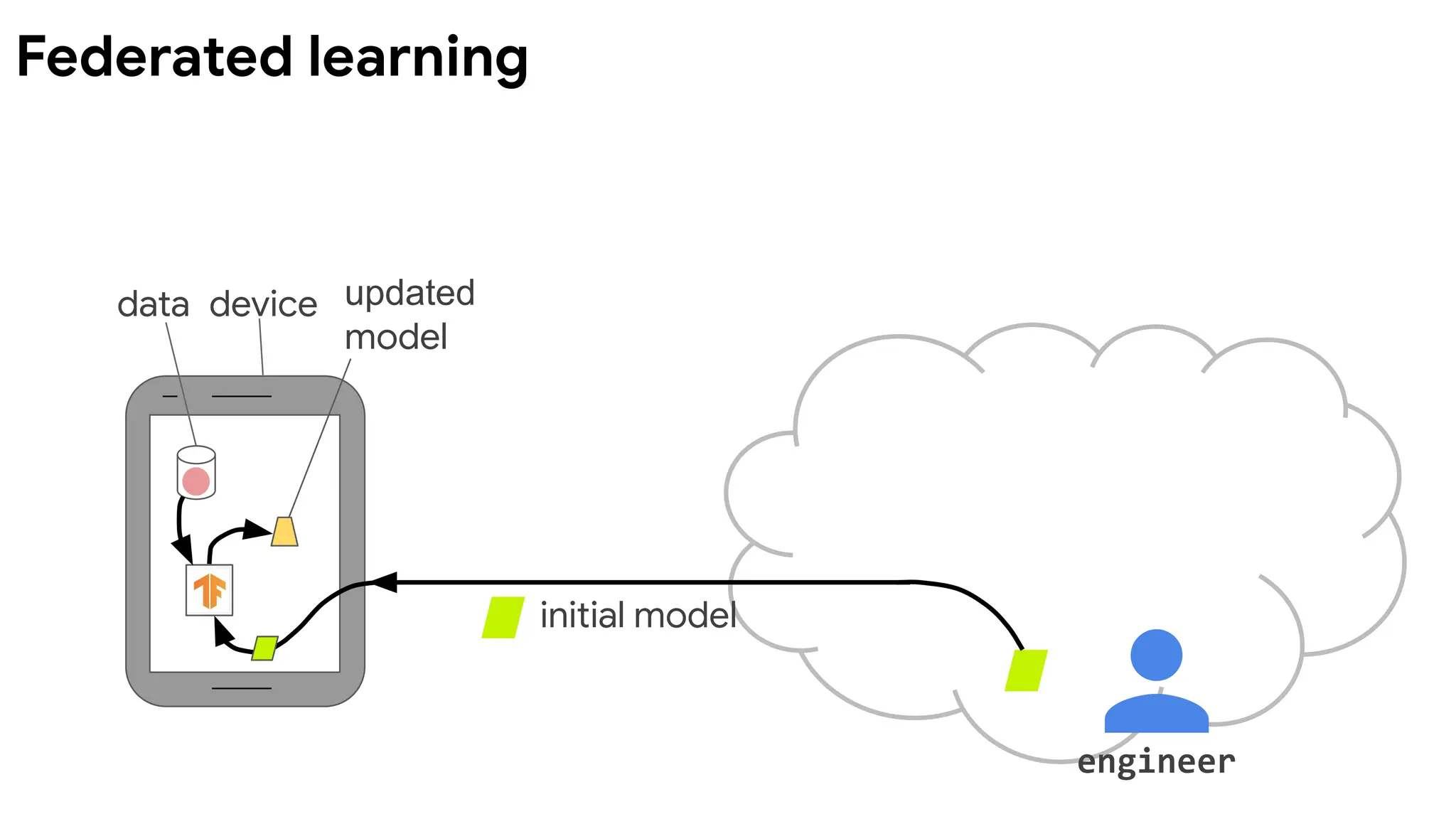
initial model
engineer
data device updated
model
Federated learning
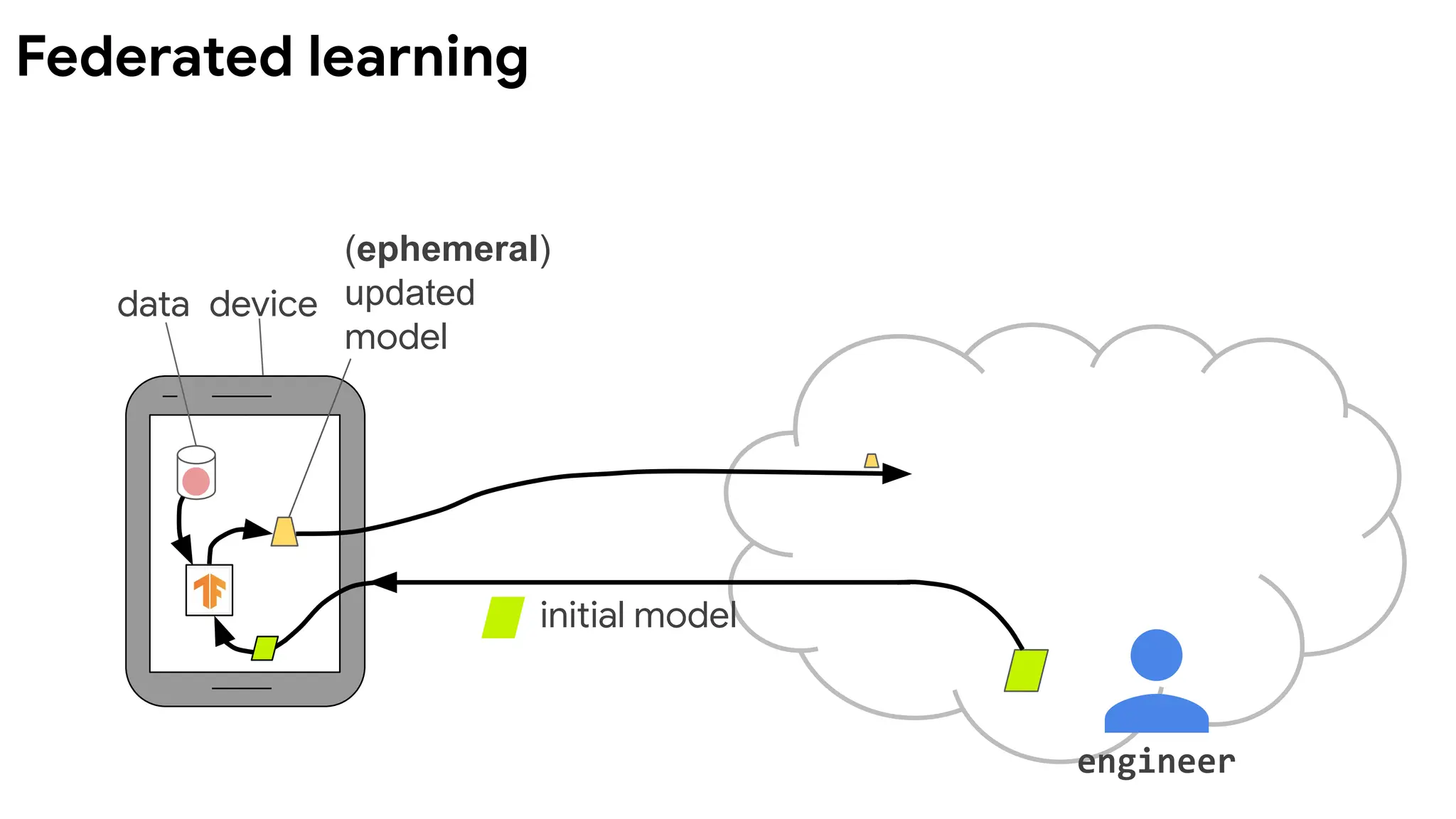
data device
initial model
engineer
(ephemeral)
updated
model
Federated learning
data device
initial model
engineer
updated
model
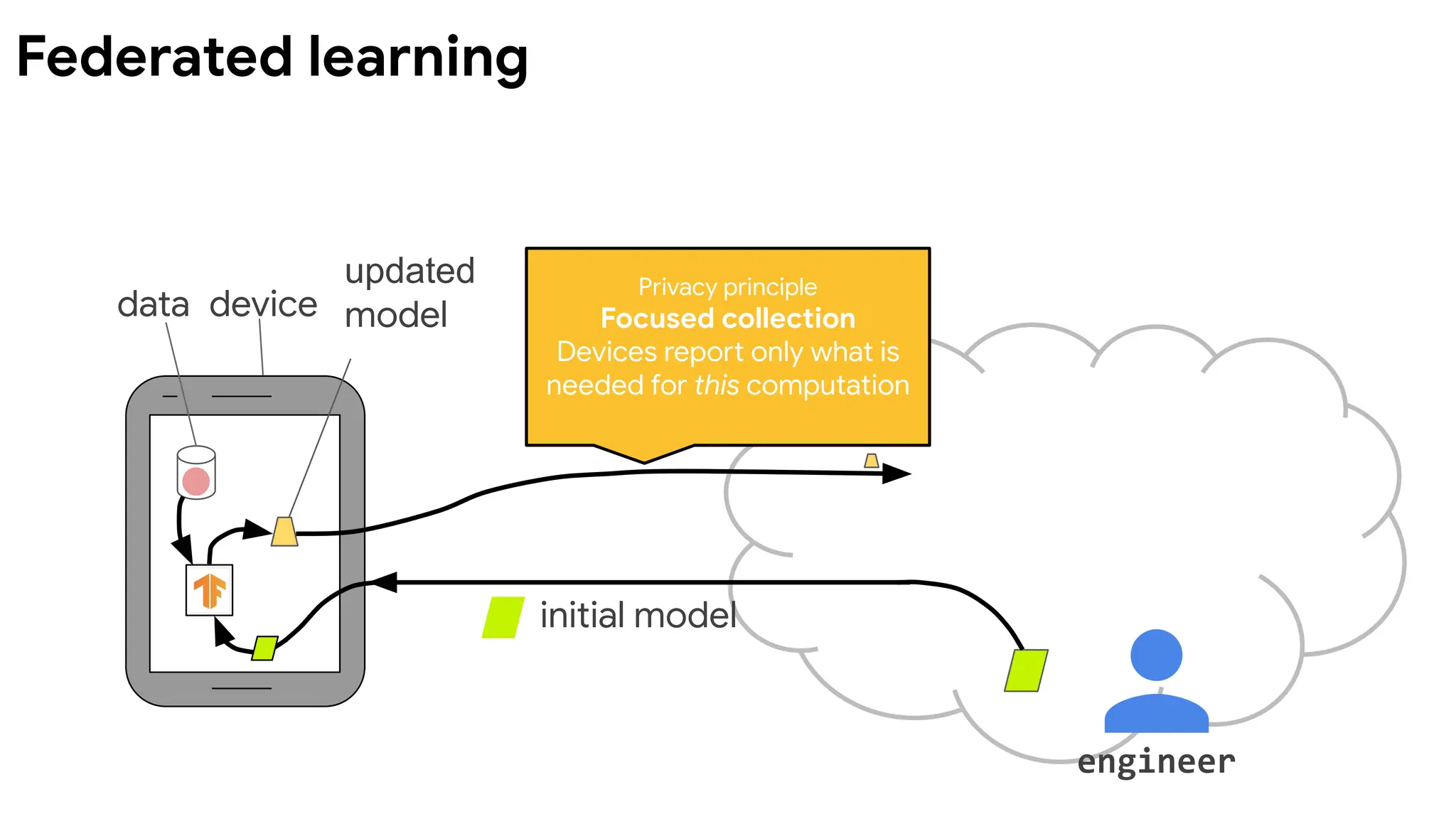
Privacy principle
Focused collection
Devices report only what is
needed for this computation
Federated learning
data device
initial model
engineer
updated
model
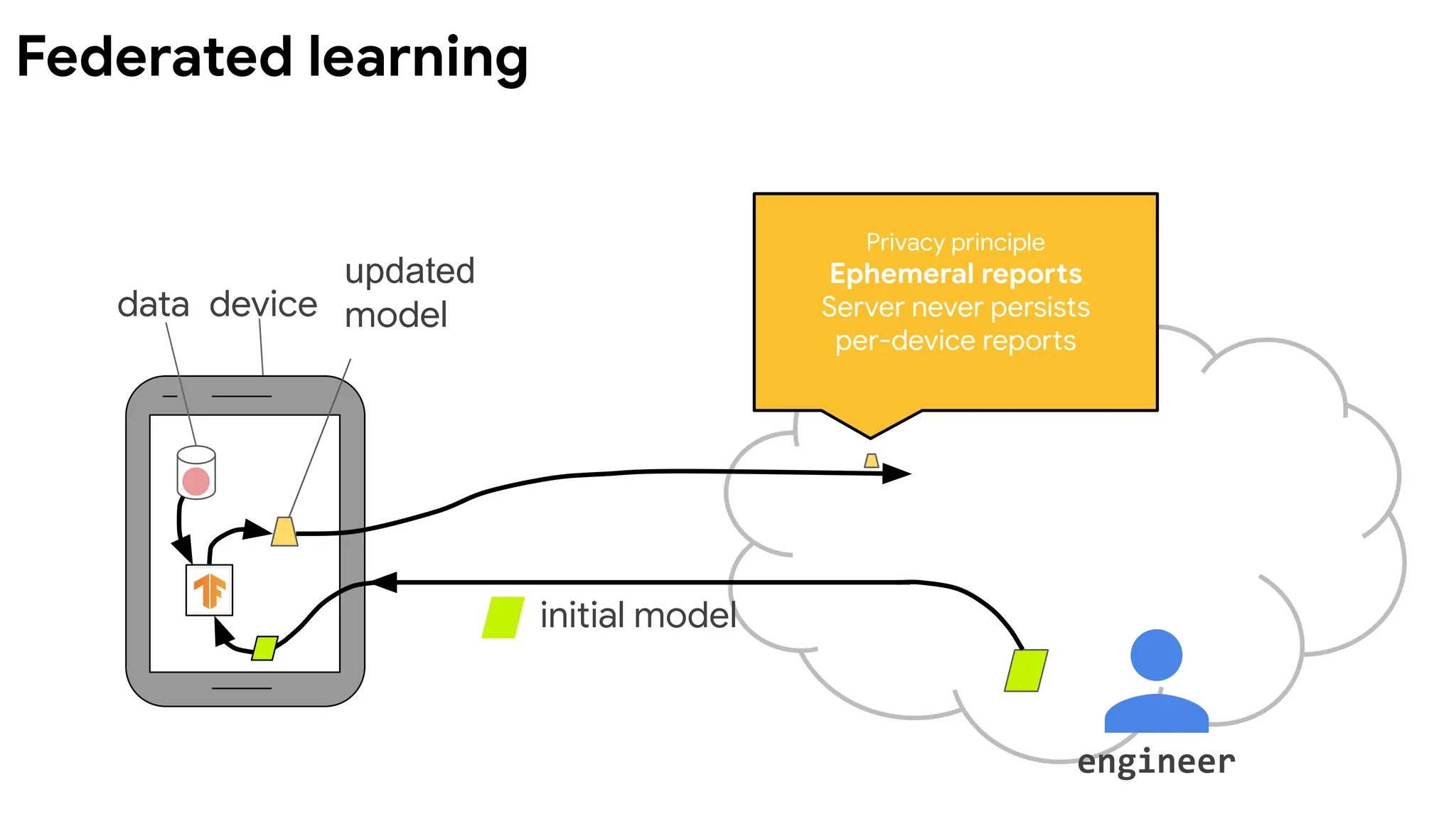
Privacy principle
Ephemeral reports
Server never persists
per-device reports
Federated learning
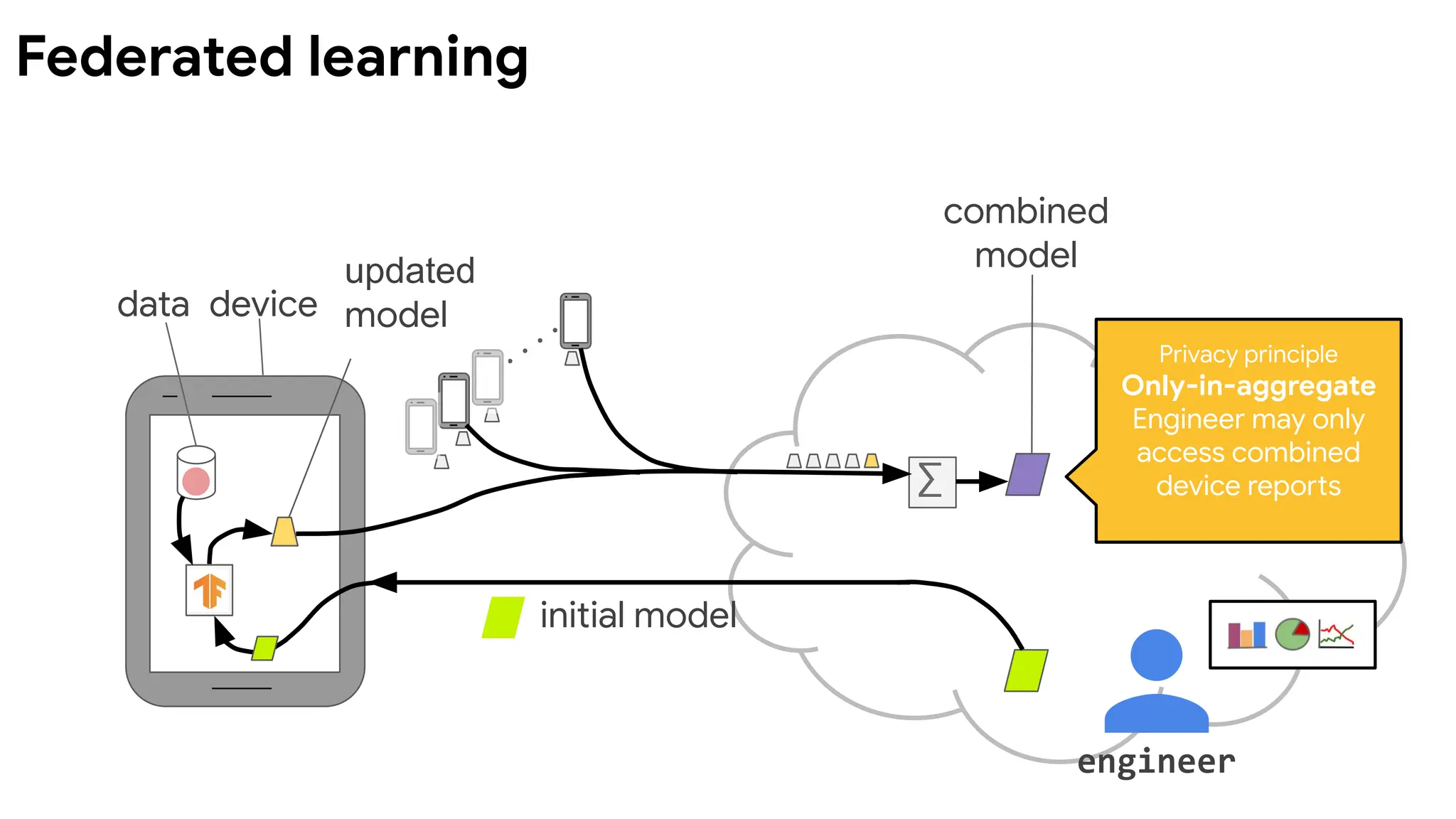
data device
combined
model
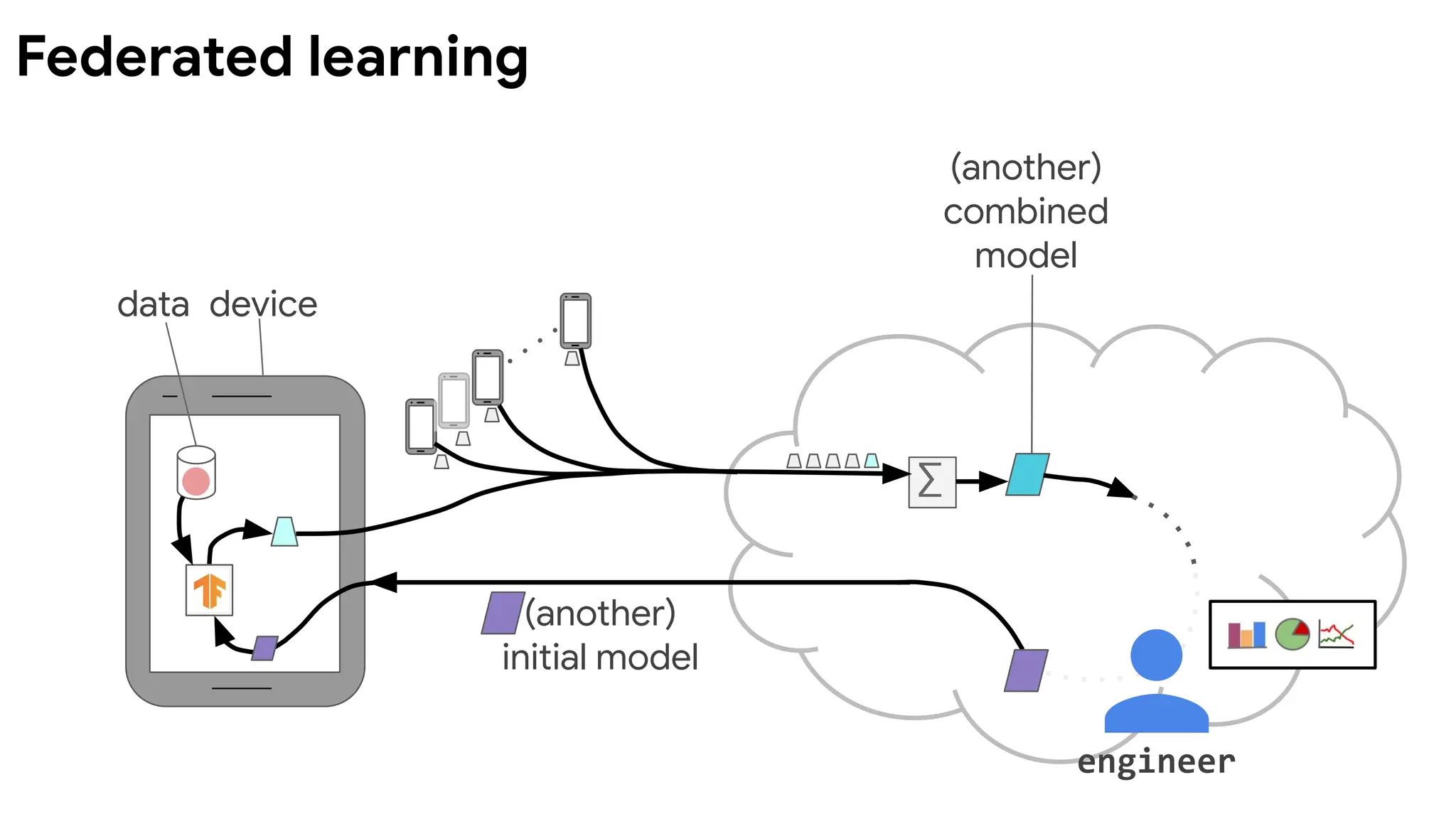
∑
initial model
engineer
updated
model
Privacy principle
Only-in-aggregate
Engineer may only
access combined
device reports
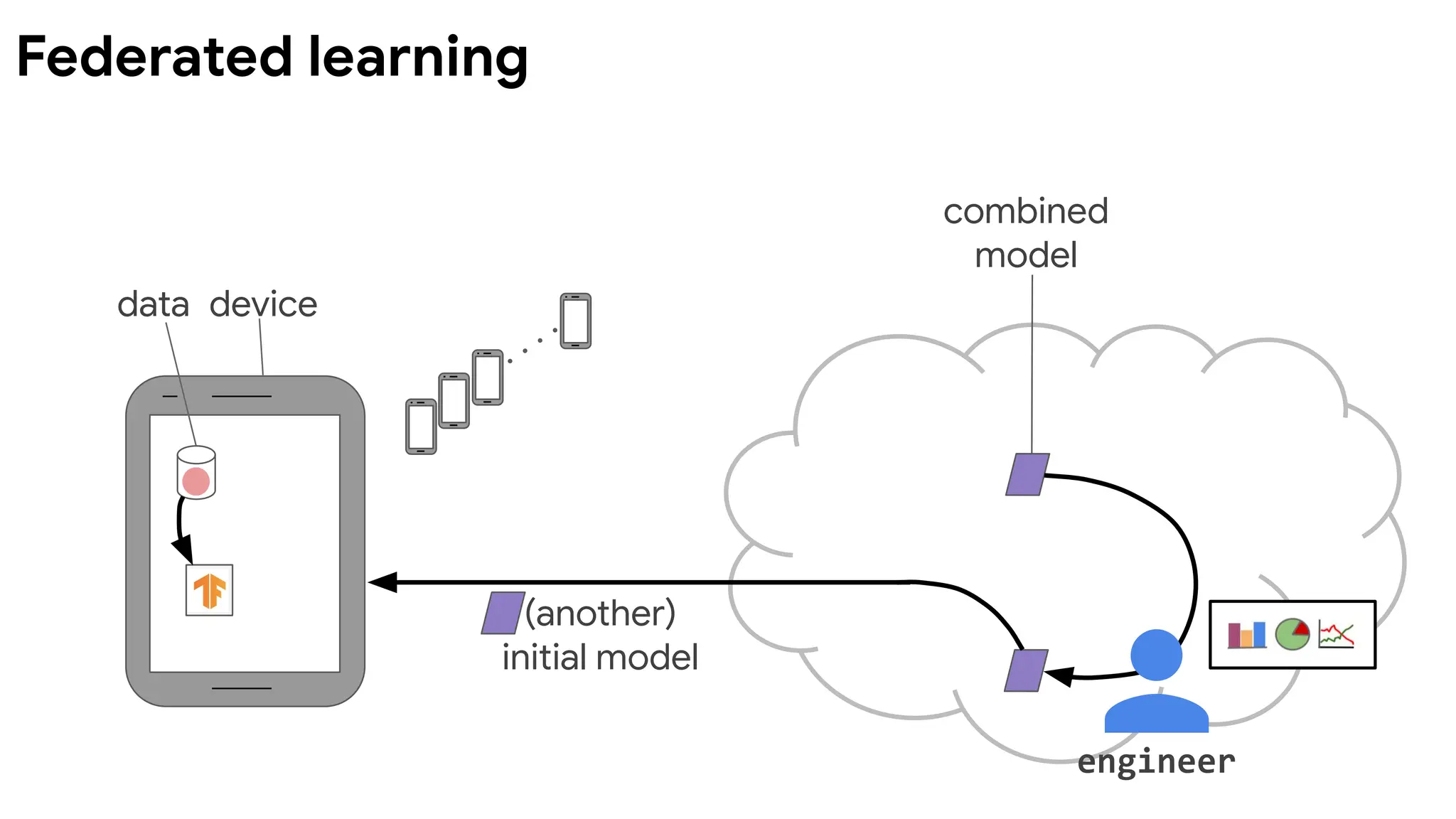
Federated learning
(another)
initial model
data device
combined
model
engineer
Federated learning
(another)
combined
model
(another)
initial model
∑
engineer
data device
Federated learning
data device
(another)
combined
model
(another)
initial model
∑
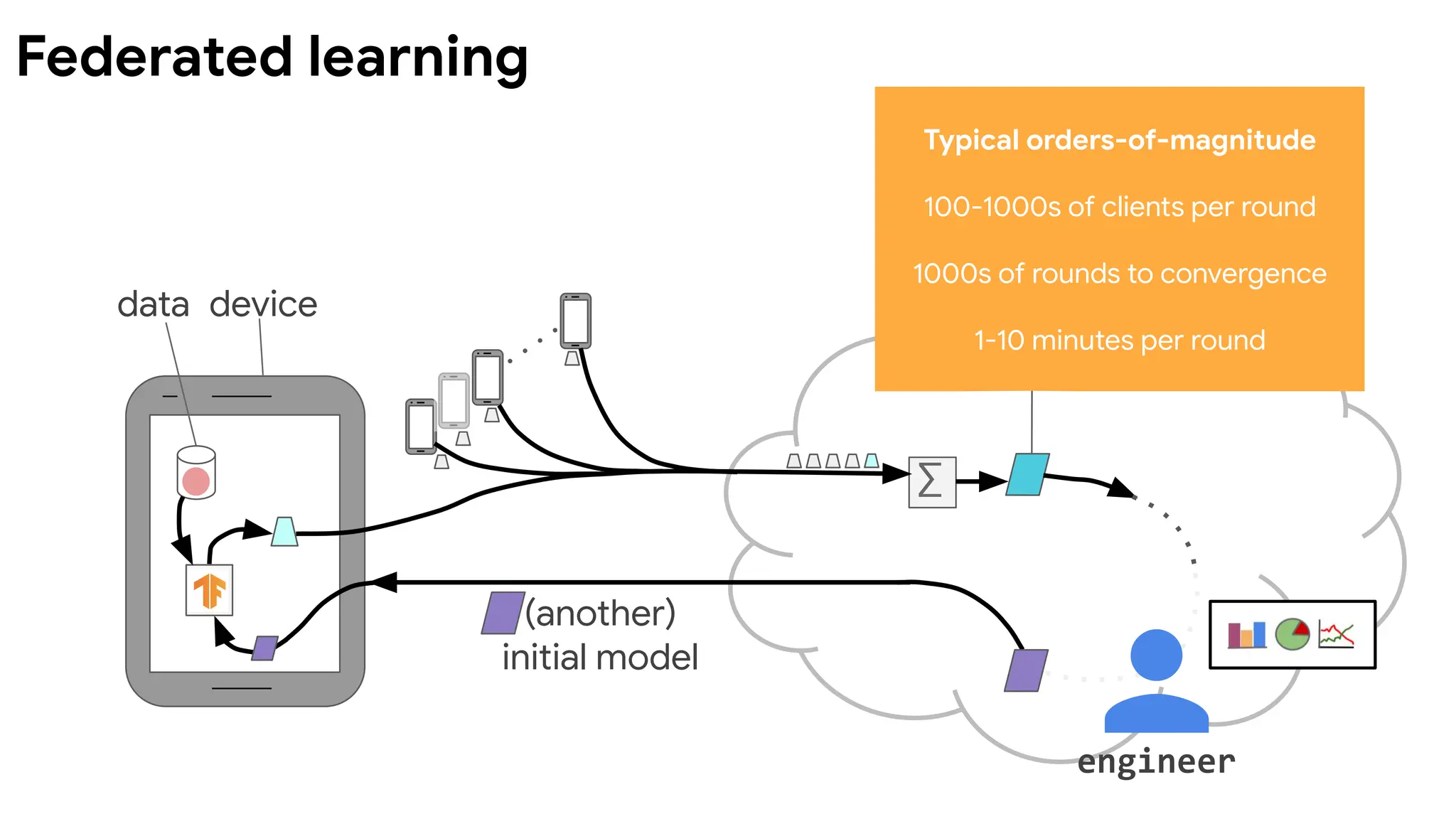
Typical orders-of-magnitude
100-1000s of clients per round
1000s of rounds to convergence
1-10 minutes per round
engineer
Federated learning
data device
(another)
combined
model
(another)
initial model
∑
engineer
Devices run multiple
steps of SGD on their
local data to compute
an update.
Server computes
overall update using
a simple weighted
average.
McMahan, et al. Communication-Efficient Learning of Deep
Networks from Decentralized Data. AISTATS 2017.
Federated Averaging (FedAvg) algorithm
Beyond Learning: Federated
Analytics
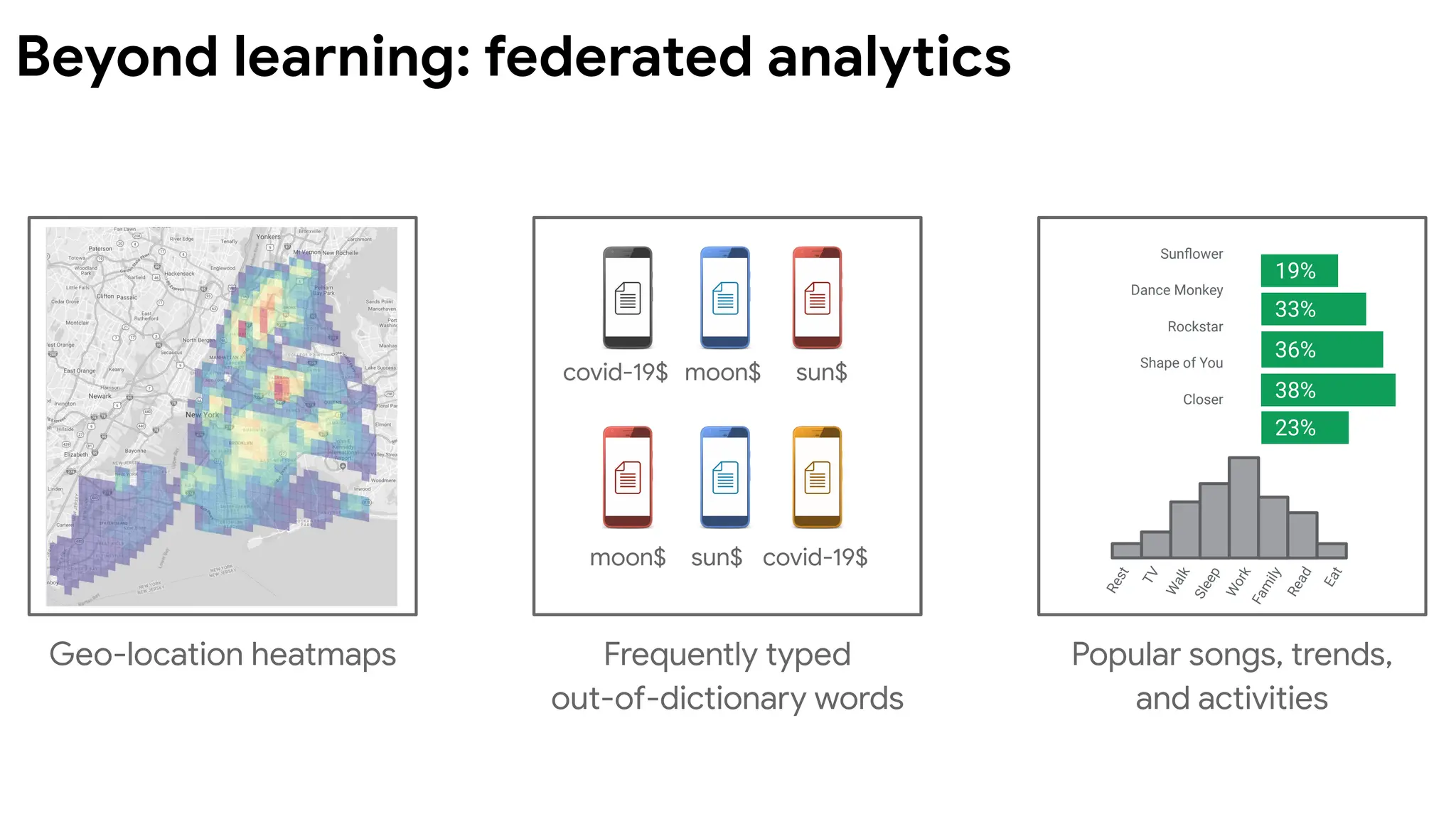
Beyond learning: federated analytics
Sunflower
Dance Monkey
Rockstar
Shape of You
Closer
19%
33%
36%
38%
23%
moon$
moon$ sun$
sun$
covid-19$
covid-19$
Geo-location heatmaps Frequently typed
out-of-dictionary words
Popular songs, trends,
and activities
R
e
s
t
T
V
W
a
l
k
S
l
e
e
p
W
o
r
k
F
a
m
i
l
y
R
e
a
d
E
a
t
Federated analytics is the practice of applying data science methods to
the analysis of raw data that is stored locally on users’ devices. Like
federated learning, it works by running local computations over each
device’s data, and only making the aggregated results — and never any
data from a particular device — available to product engineers. Unlike
federated learning, however, federated analytics aims to support basic
data science needs.
definition proposed in https://ai.googleblog.com/2020/05/federated-analytics-collaborative-data.html
Federated analytics
● Federated histograms over closed sets
● Federated quantiles and distinct element counts
● Federated heavy hitters discovery over open sets
● Federated density of vector spaces
● Federated selection of random data subsets
● Federated SQL
● Federated computations?
● etc...
Federated analytics
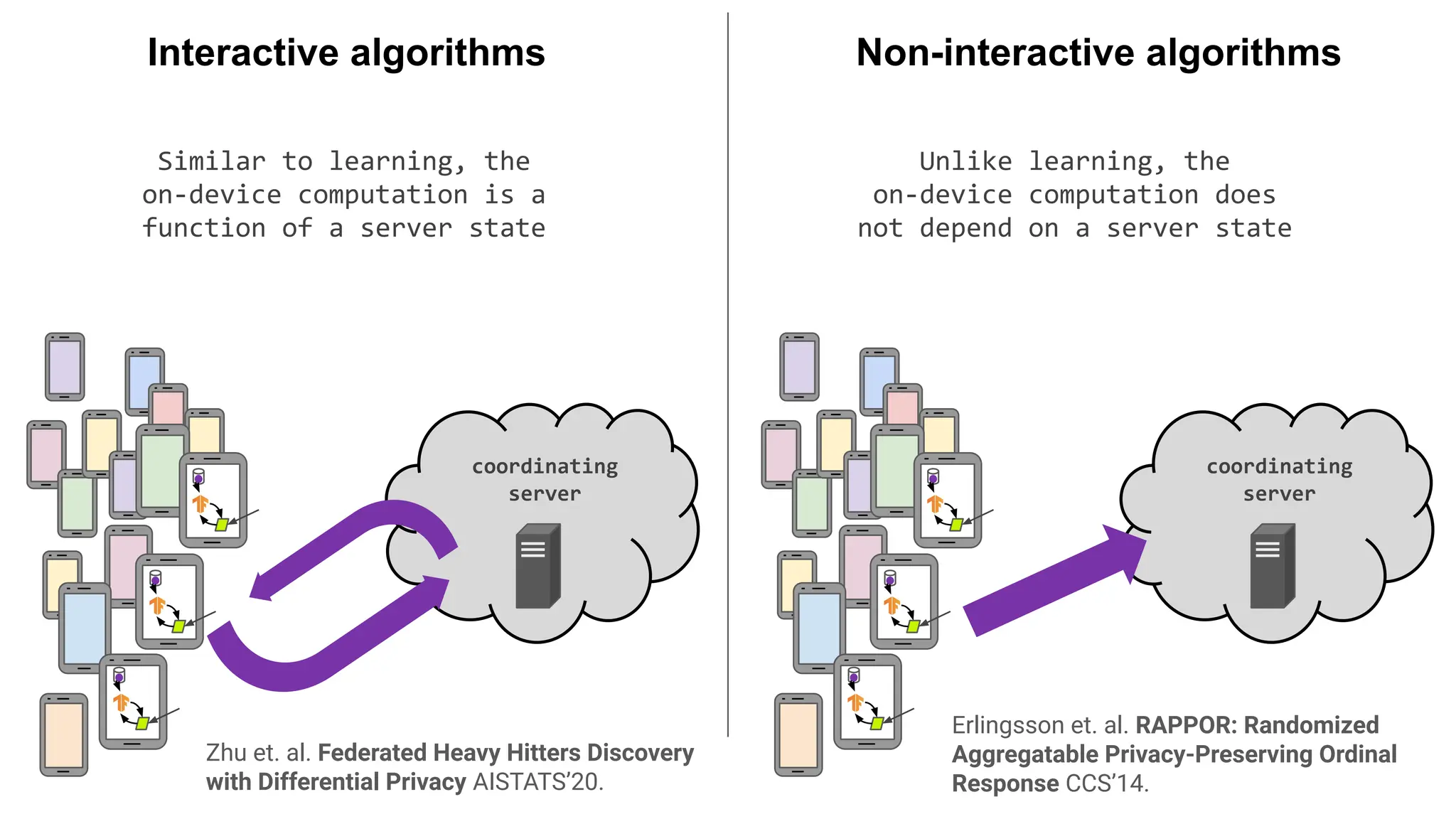
Similar to learning, the
on-device computation is a
function of a server state
Interactive algorithms
Unlike learning, the
on-device computation does
not depend on a server state
Non-interactive algorithms
coordinating
server
coordinating
server
Zhu et. al. Federated Heavy Hitters Discovery
with Differential Privacy AISTATS’20.
Erlingsson et. al. RAPPOR: Randomized
Aggregatable Privacy-Preserving Ordinal
Response CCS’14.
Part II: Privacy for Federated
Learning and Analytics
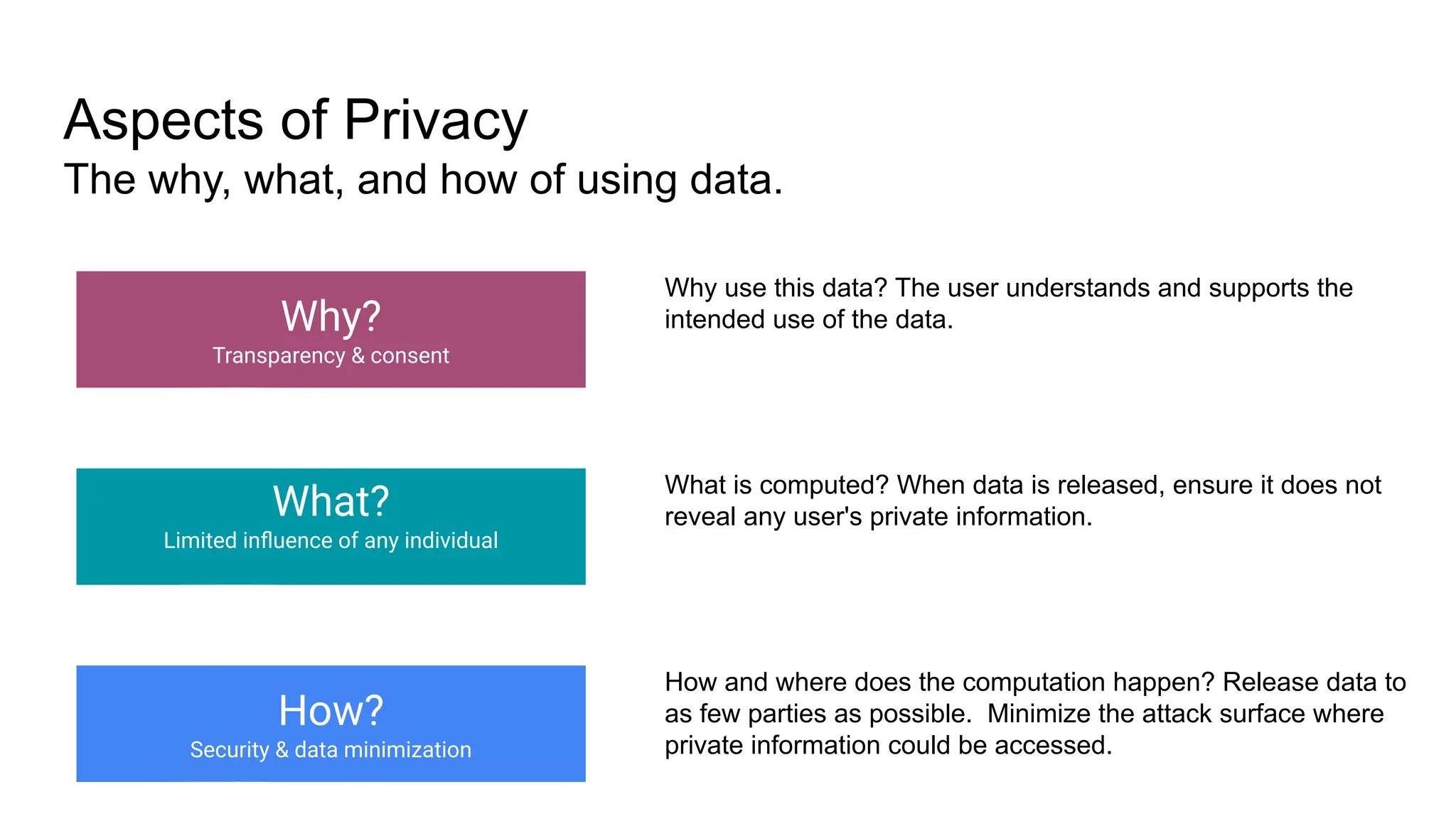
Aspects of Privacy
The why, what, and how of using data.
Why?
Transparency & consent
Why use this data? The user understands and supports the
intended use of the data.
What?
Limited influence of any individual
What is computed? When data is released, ensure it does not
reveal any user's private information.
How?
Security & data minimization
How and where does the computation happen? Release data to
as few parties as possible. Minimize the attack surface where
private information could be accessed.
Aspects of Privacy
The why, what, and how of using data.
Why?
Transparency & consent
Why use this data? The user understands and supports the
intended use of the data.
What?
Limited influence of any individual
What is computed? When data is released, ensure it does not
reveal any user's private information.
How?
Security & data minimization
How and where does the computation happen? Release data to
as few parties as possible. Minimize the attack surface where
private information could be accessed.
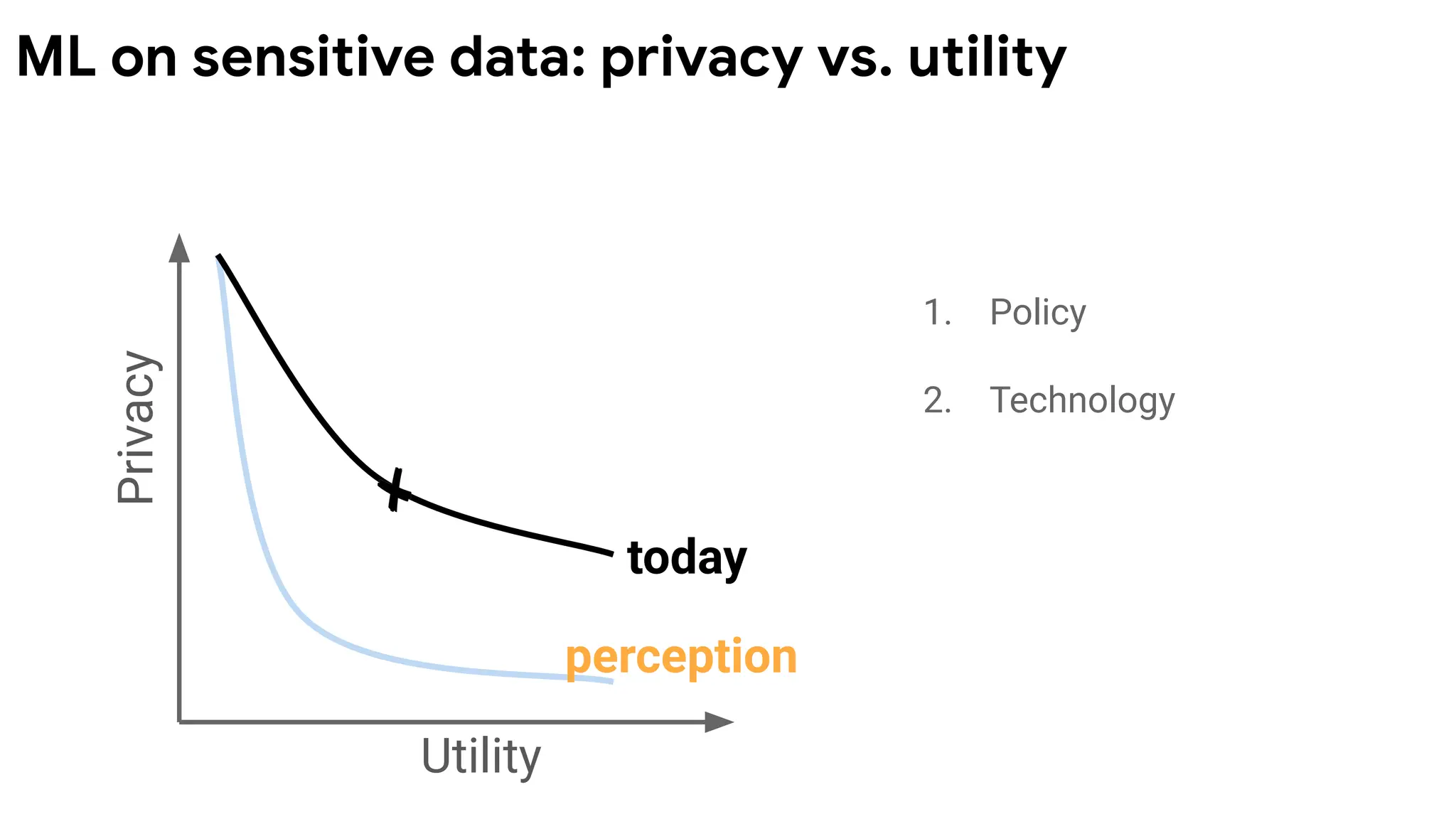
Privacy
Utility
ML on sensitive data: privacy vs. utility
Privacy
Utility
perception
ML on sensitive data: privacy vs. utility
today
Privacy
Utility
1. Policy
2. Technology
perception
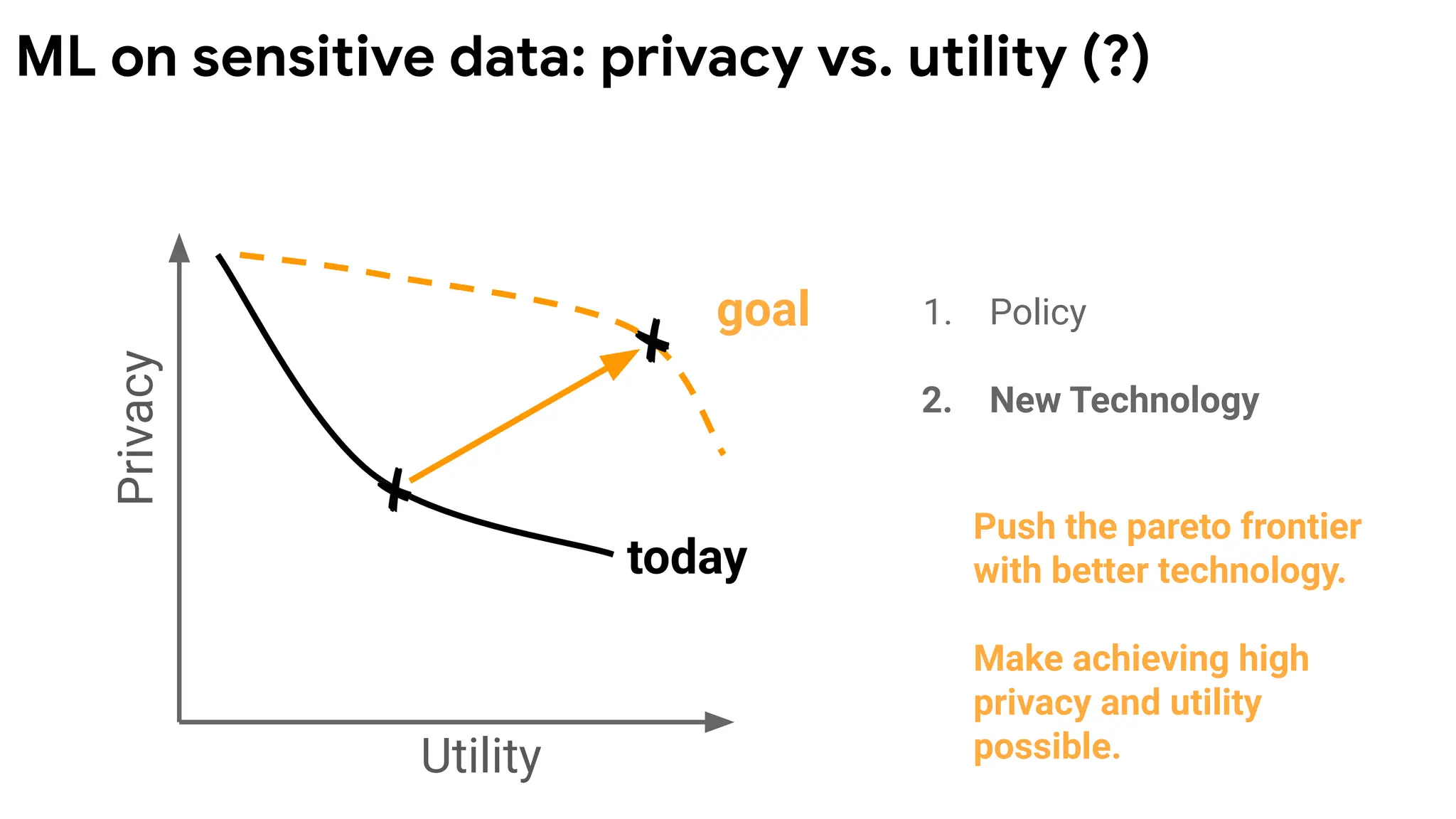
ML on sensitive data: privacy vs. utility
Privacy
Utility
goal 1. Policy
2. New Technology
Push the pareto frontier
with better technology.
Make achieving high
privacy and utility
possible.
today
ML on sensitive data: privacy vs. utility (?)
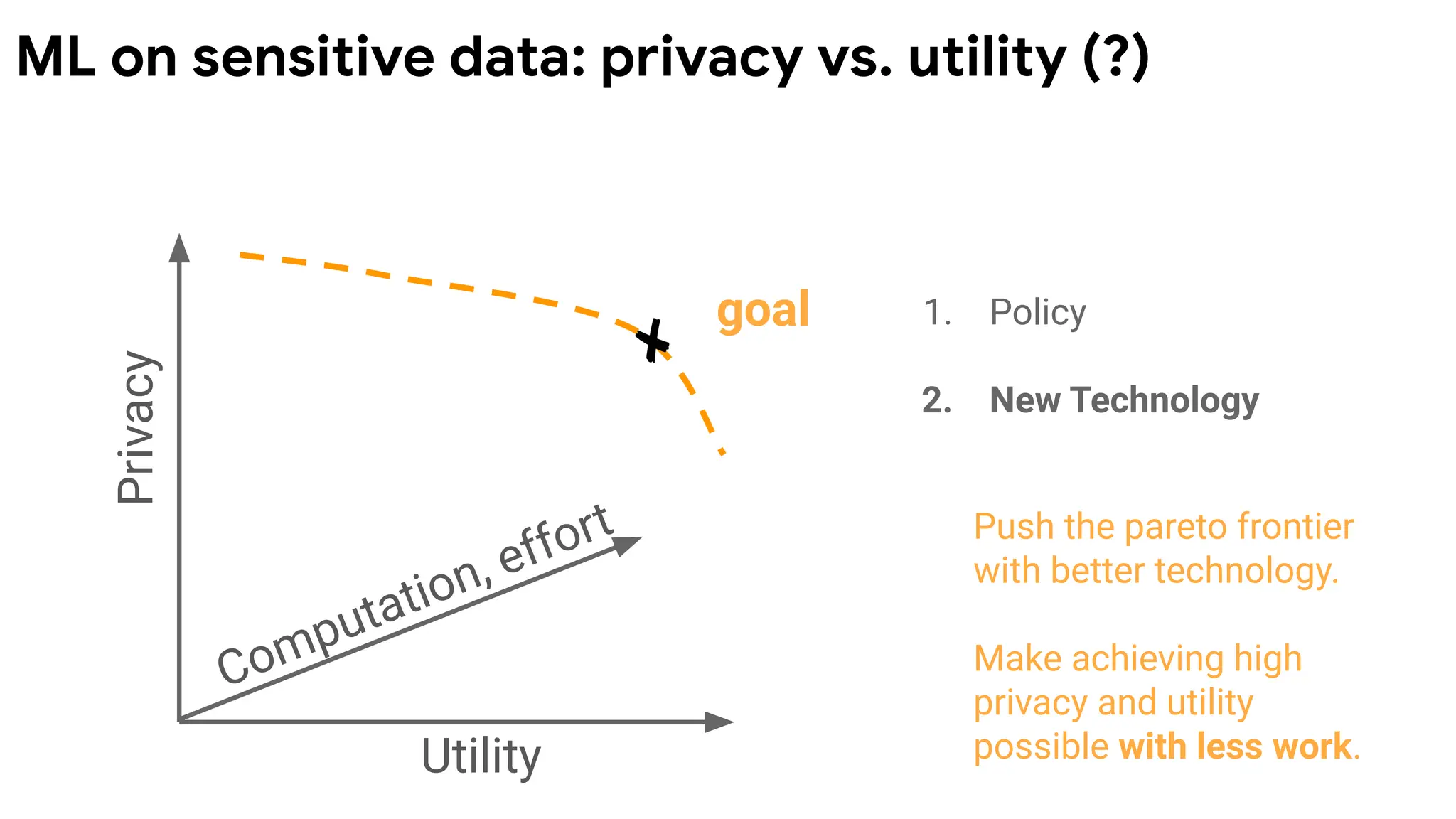
Privacy
Utility
goal 1. Policy
2. New Technology
Push the pareto frontier
with better technology.
Make achieving high
privacy and utility
possible with less work.
ML on sensitive data: privacy vs. utility (?)
Computation, effort
client
devices
server
engineer
model
deployment
federated
training
model
development
client
devices
server
engineer
model
deployment
federated
training
model
development
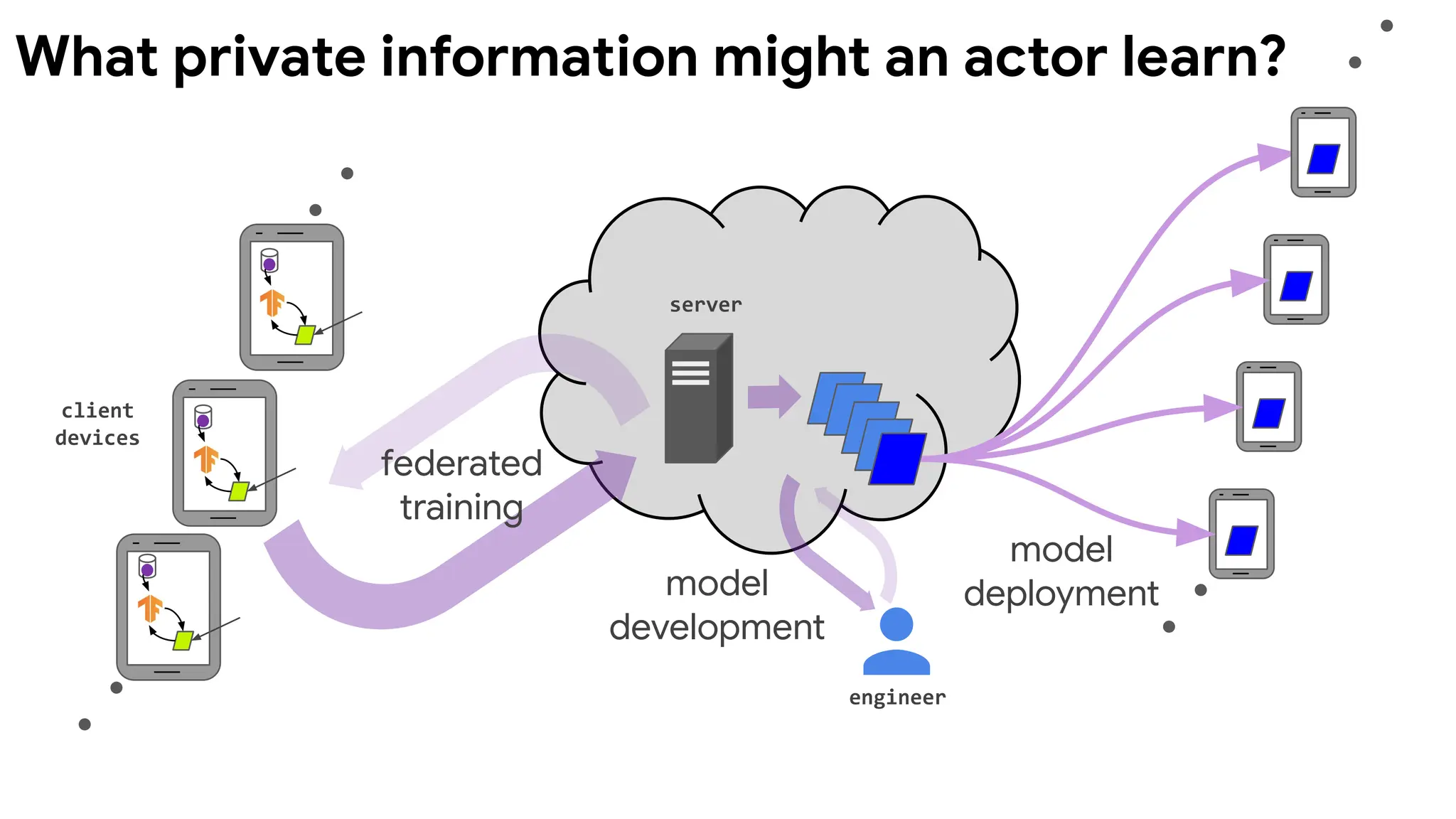
What private information might an actor learn?
client
devices
server
engineer
federated
training
model
development
... the
network?
… the
device?
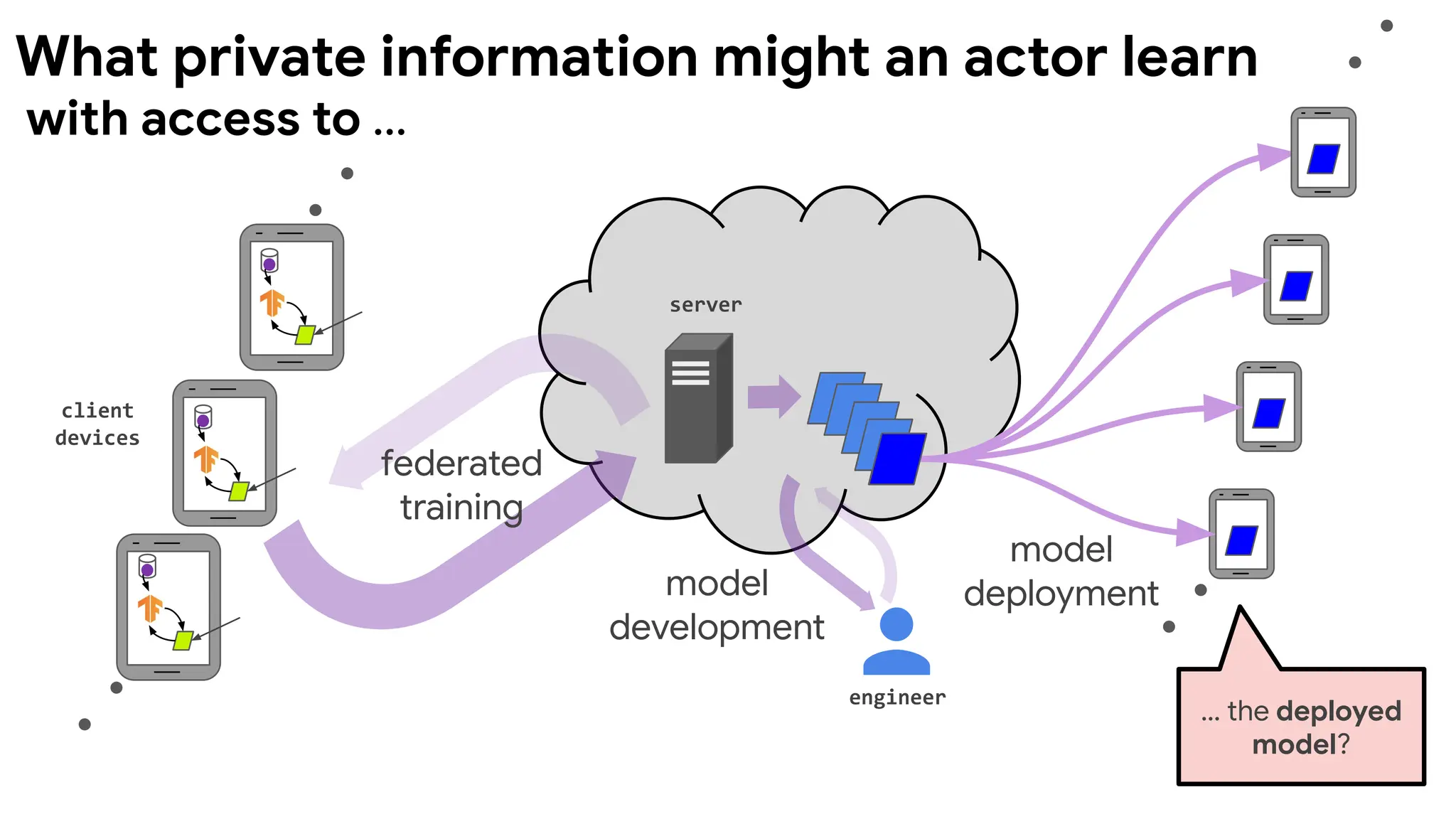
with access to ...
What private information might an actor learn
client
devices
server
engineer
federated
training
model
development
... the released
models and
metrics?
… the server?
with access to ...
What private information might an actor learn
client
devices
server
engineer
model
deployment
federated
training
model
development
… the deployed
model?
with access to ...
What private information might an actor learn
client
devices
server
engineer
model
deployment
federated
training
model
development
… the deployed
model?
... the
network?
… the
device? ... the released
models and
metrics?
… the server?
with access to ...
What private information might an actor learn
client
devices
server
engineer
model
deployment
federated
training
model
development
… the deployed
model?
... the
network?
… the
device? ... the released
models and
metrics?
… the server?
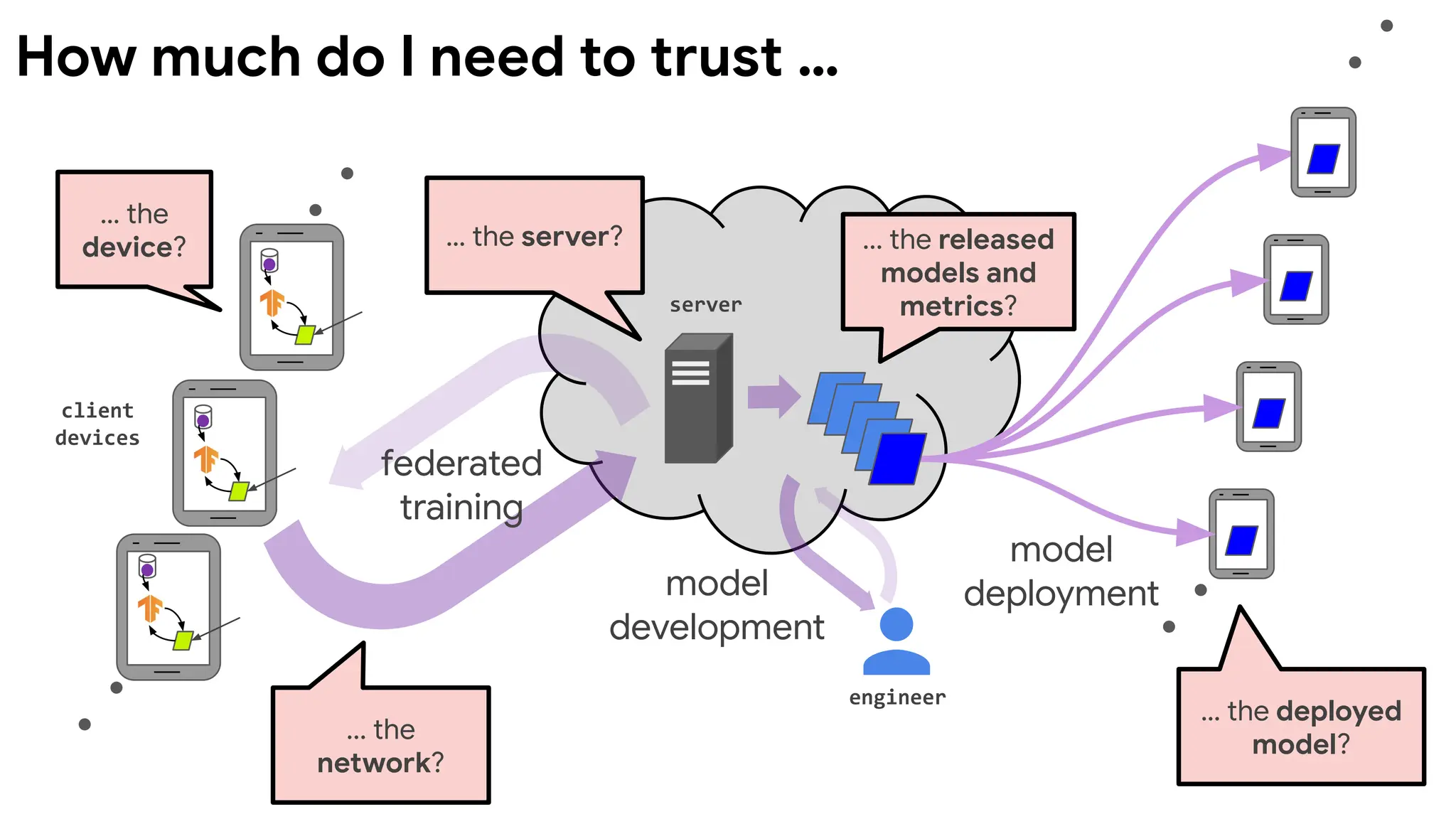
How much do I need to trust …
client
devices
server
engineer
model
deployment
federated
training
model
development
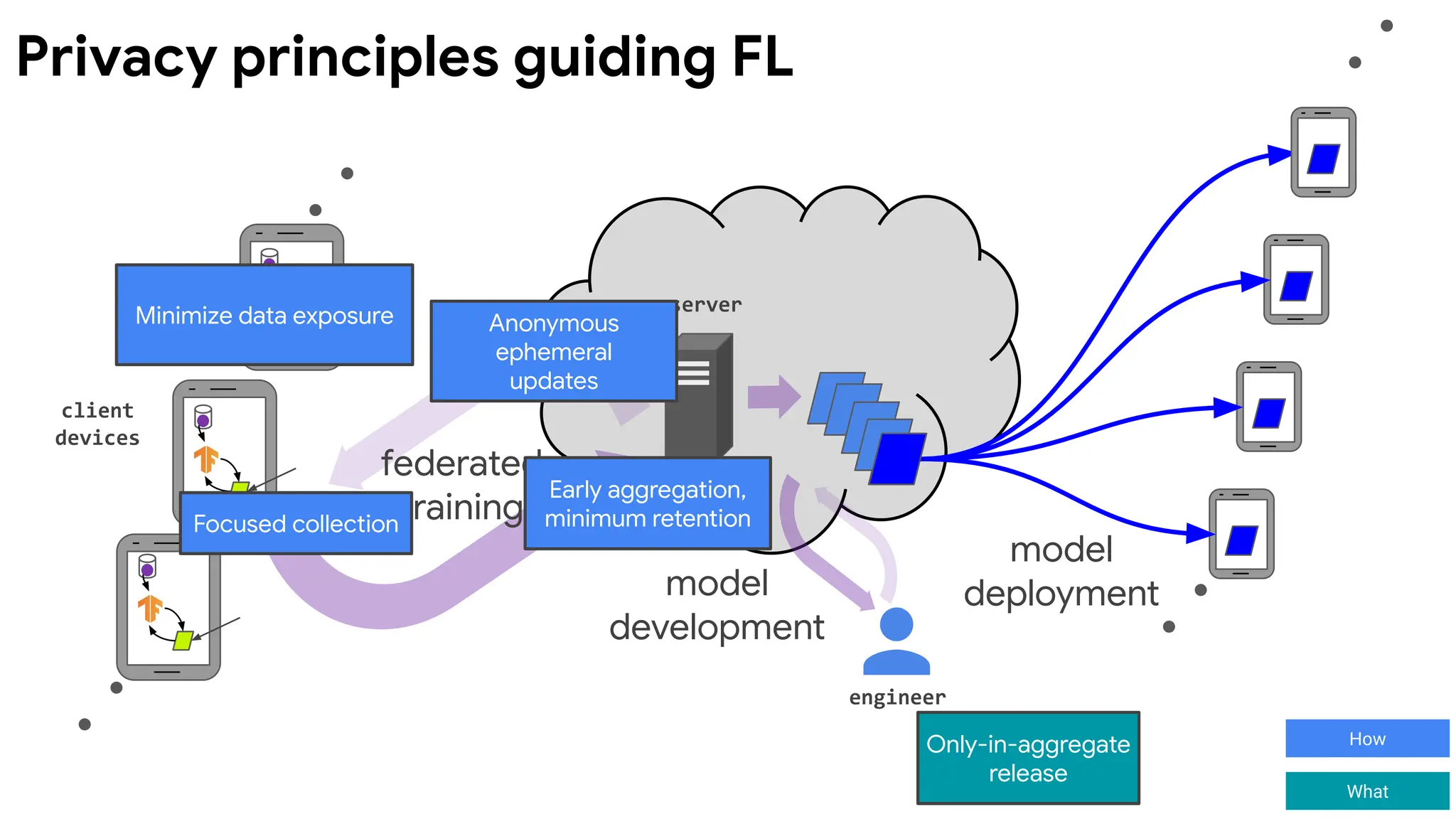
Early aggregation,
minimum retention
Only-in-aggregate
release
Minimize data exposure Anonymous
ephemeral
updates
Privacy principles guiding FL
Focused collection
How
What
client
devices
server
engineer
model
deployment
federated
training
model
development
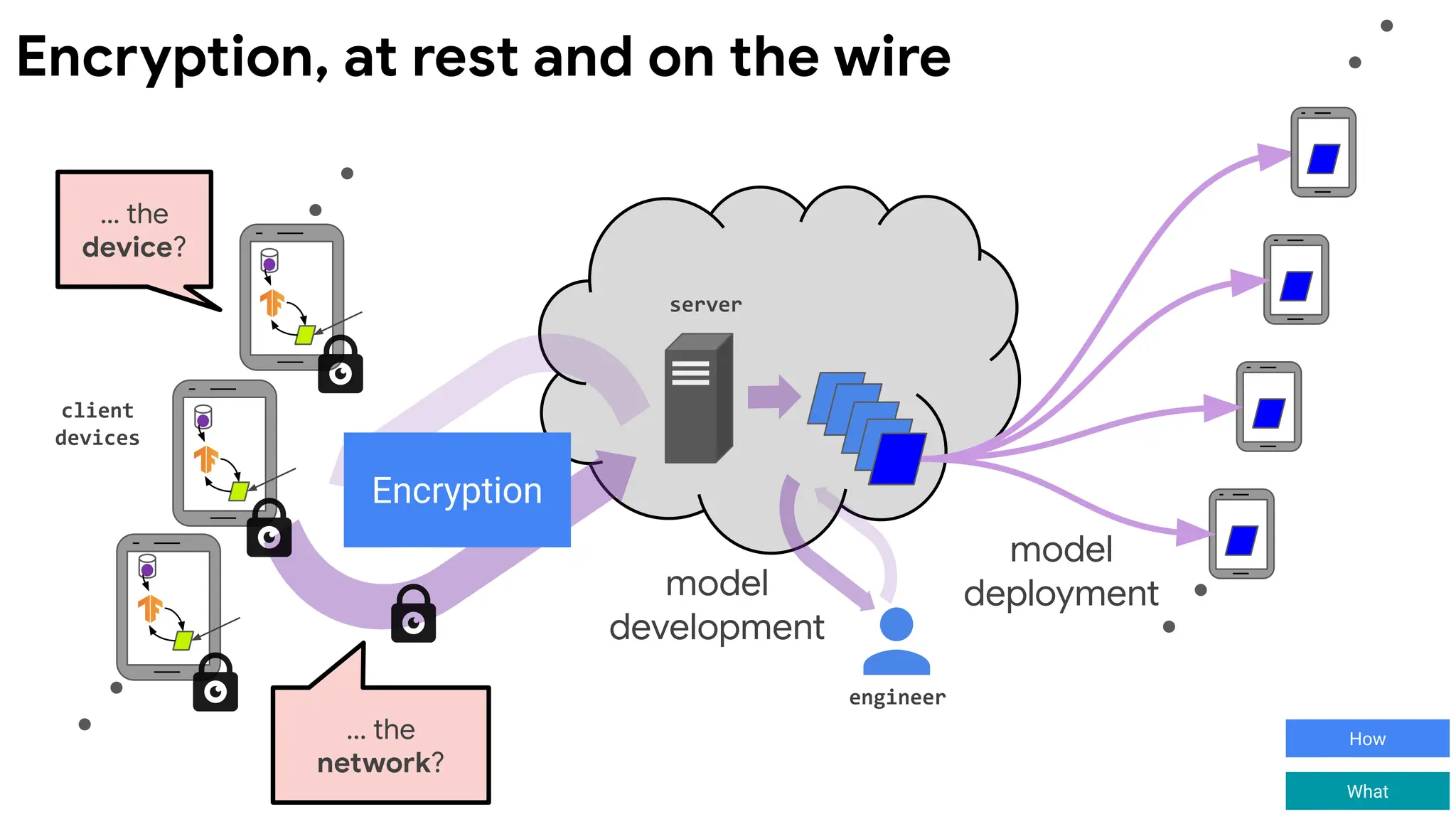
... the
network?
… the
device?
with access to ...
What private information might an actor learn
client
devices
server
engineer
model
deployment
federated
training
model
development
... the
network?
… the
device?
Encryption
Encryption, at rest and on the wire
How
What
client
devices
server
engineer
model
deployment
federated
training
model
development
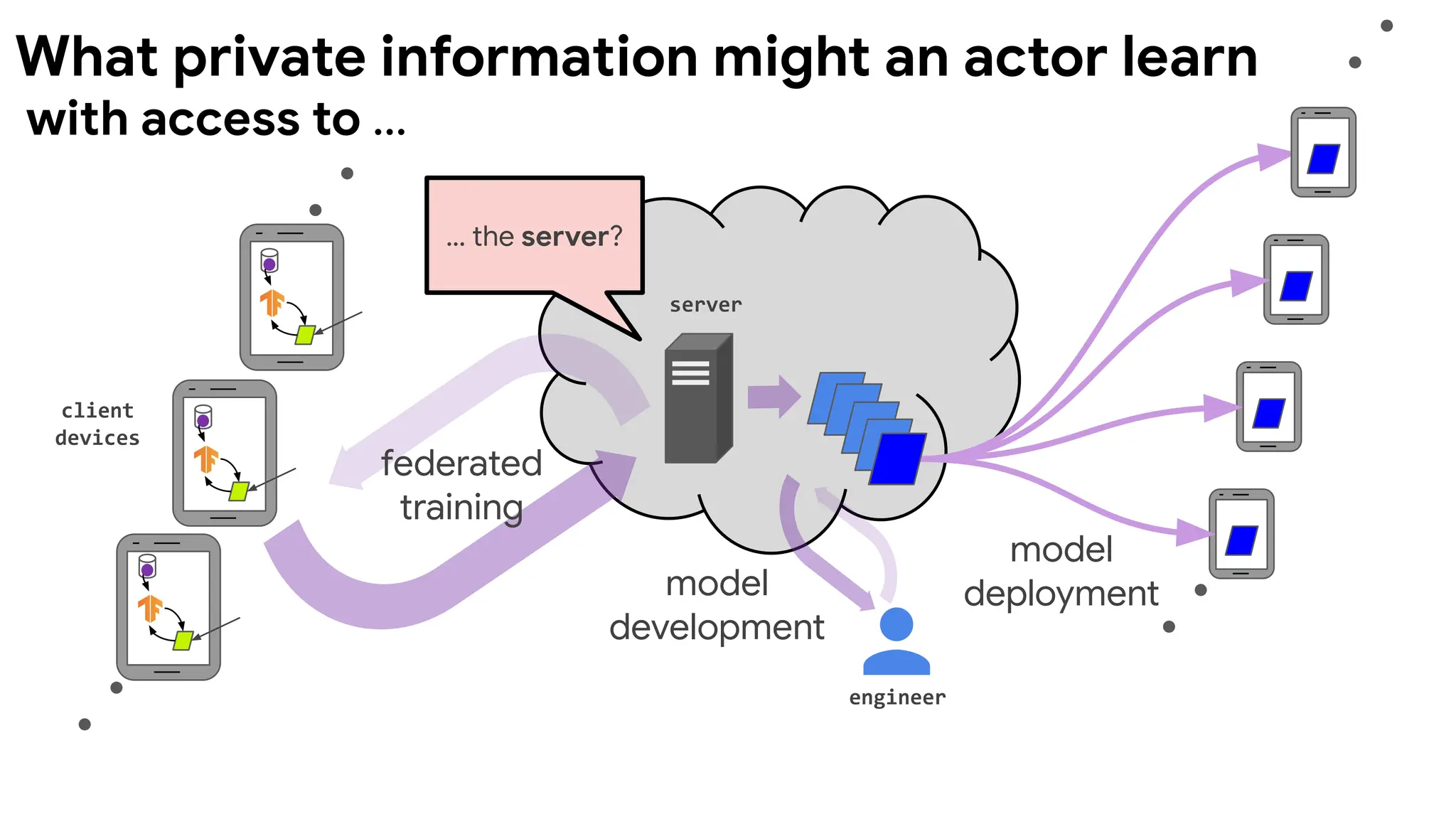
… the server?
with access to ...
What private information might an actor learn
client
devices
server
engineer
model
deployment
federated
training
model
development
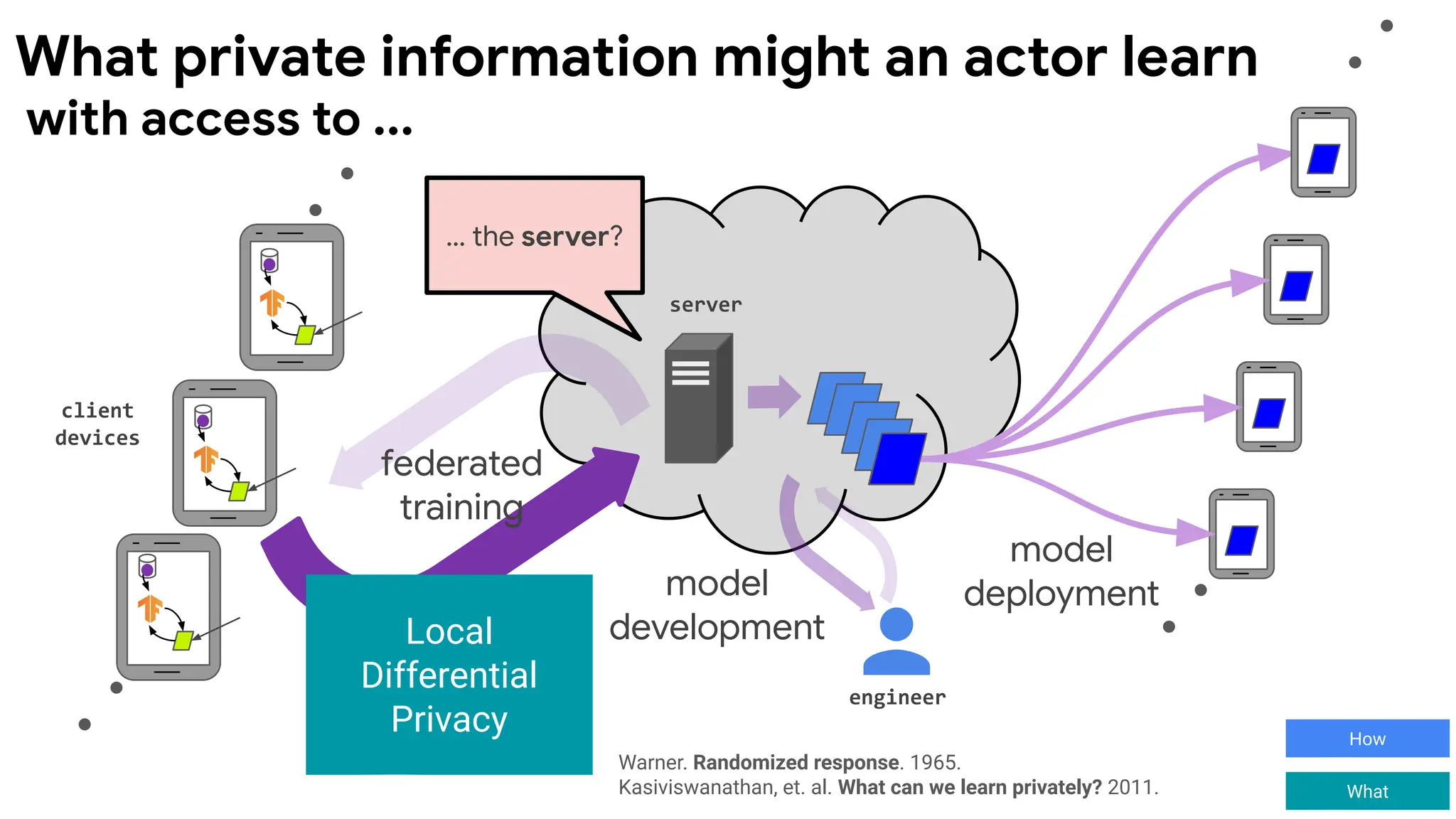
… the server?
Local
Differential
Privacy
Warner. Randomized response. 1965.
Kasiviswanathan, et. al. What can we learn privately? 2011.
with access to ...
What private information might an actor learn
How
What
client
devices
server
engineer
model
deployment
federated
training
model
development
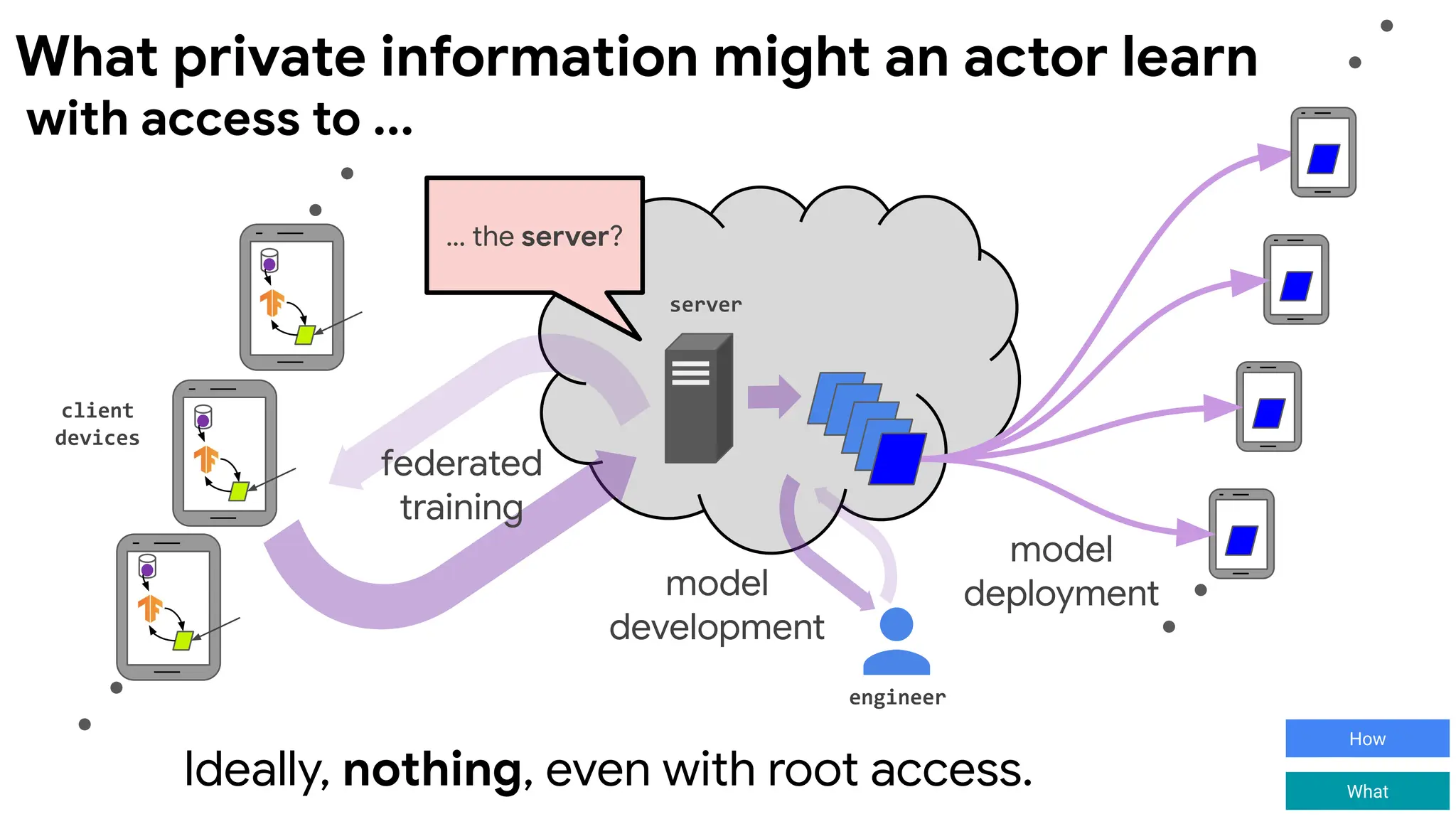
… the server?
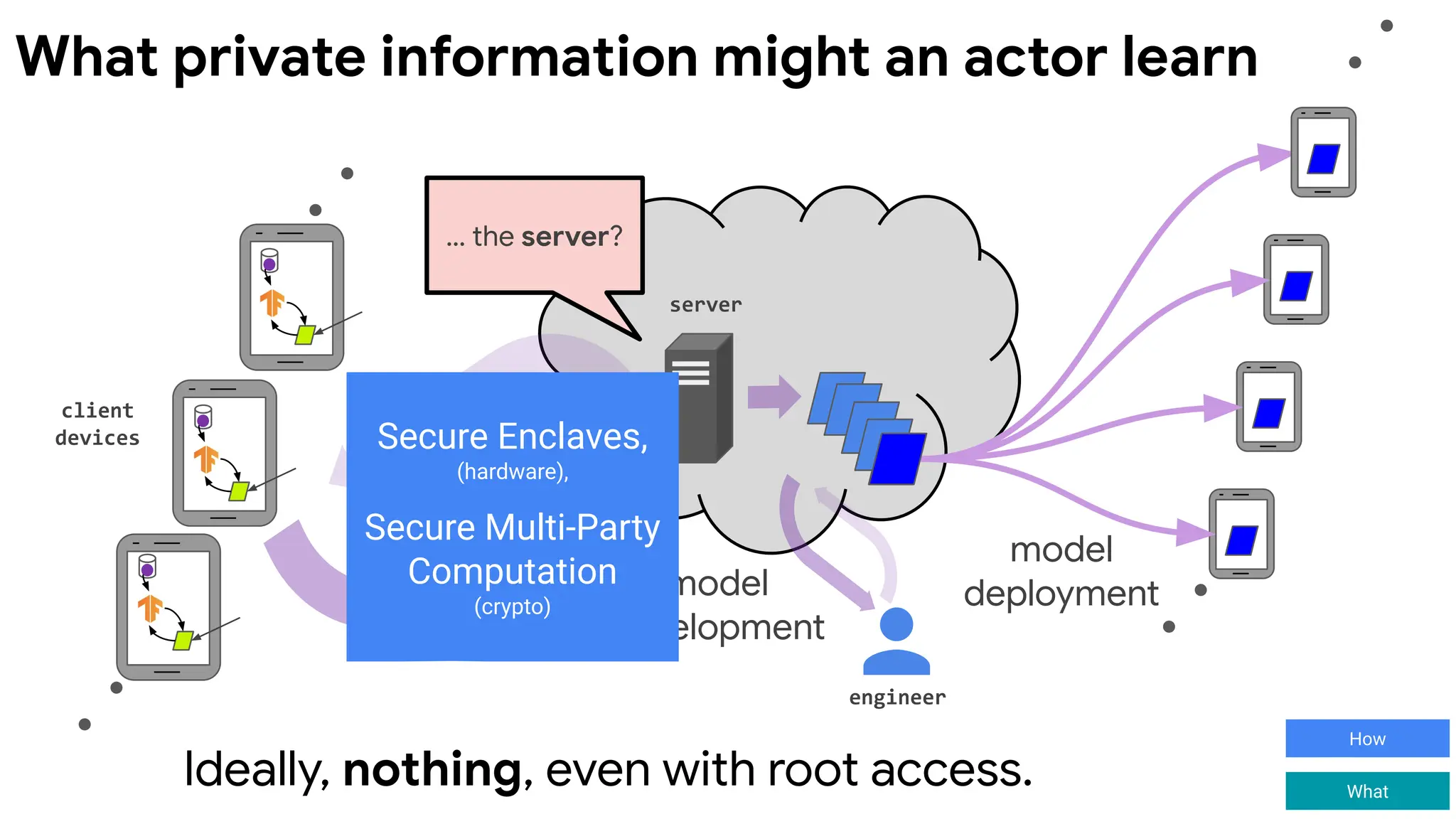
Ideally, nothing, even with root access.
with access to ...
What private information might an actor learn
How
What
client
devices
server
engineer
model
deployment
model
development
Secure Enclaves,
(hardware),
Secure Multi-Party
Computation
(crypto)
… the server?
How
What
Ideally, nothing, even with root access.
What private information might an actor learn
client
devices
server
engineer
model
deployment
federated
training
model
development
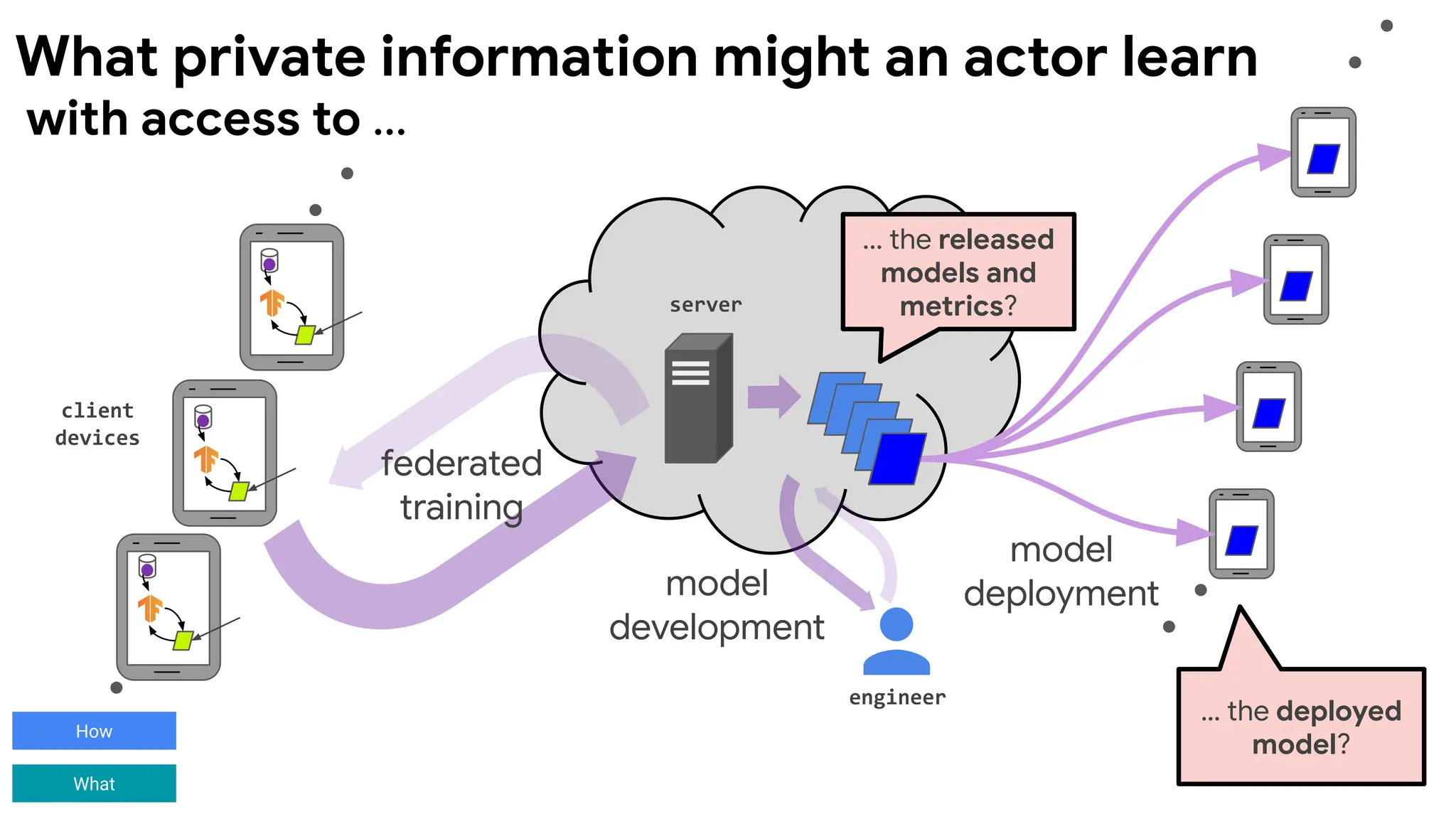
... the released
models and
metrics?
with access to ...
What private information might an actor learn
… the deployed
model?
How
What
client
devices
server
engineer
model
deployment
federated
training
model
development
... the released
models and
metrics?
Central
Differential
Privacy
Dwork and Roth. The Algorithmic
Foundations of Differential Privacy. 2014.
… the deployed
model?
with access to ...
What private information might an actor learn
How
What
client
devices
server
engineer
model
deployment
federated
training
model
development
... the released
models and
metrics?
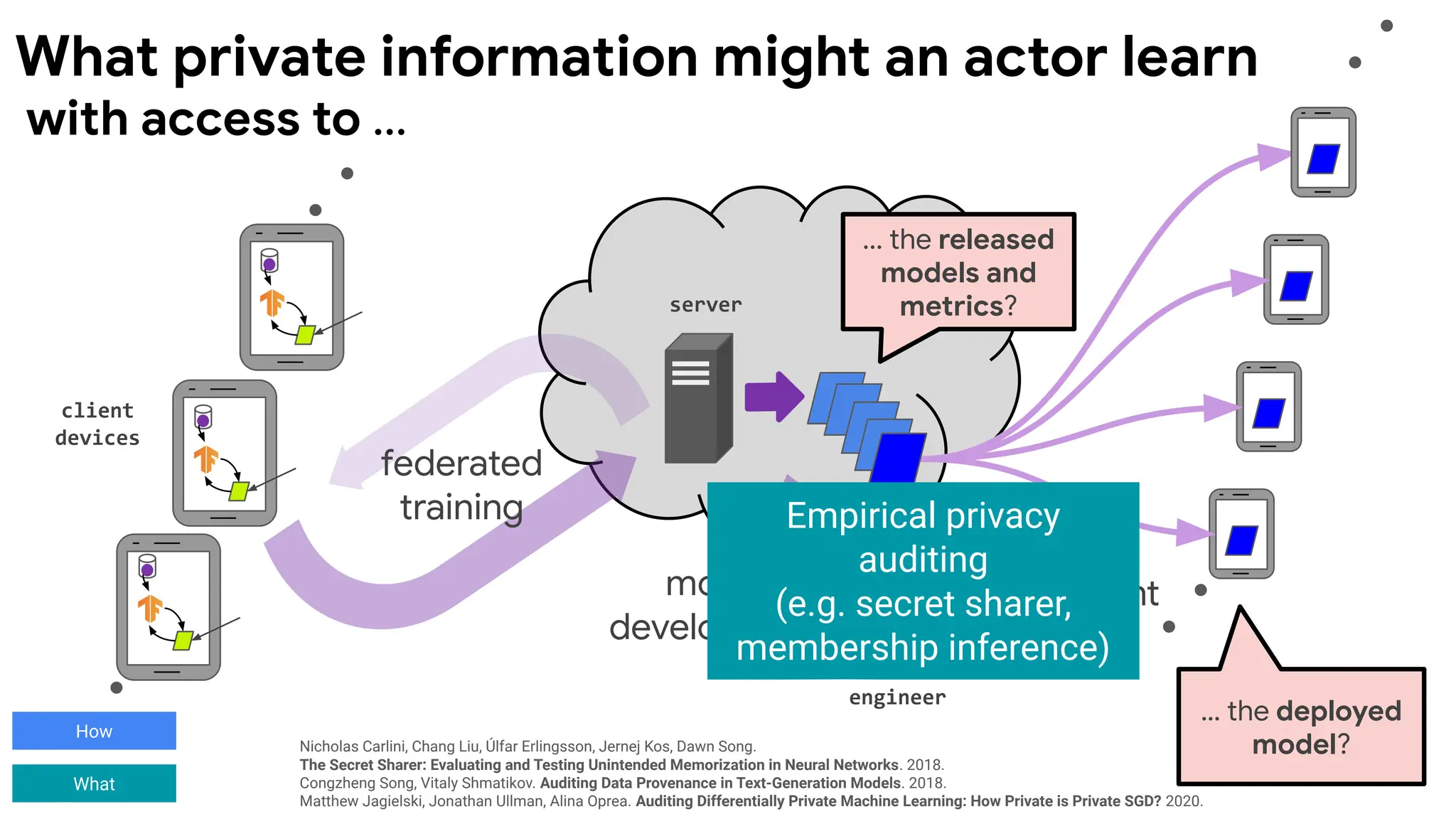
Empirical privacy
auditing
(e.g. secret sharer,
membership inference)
… the deployed
model?
with access to ...
What private information might an actor learn
Nicholas Carlini, Chang Liu, Úlfar Erlingsson, Jernej Kos, Dawn Song.
The Secret Sharer: Evaluating and Testing Unintended Memorization in Neural Networks. 2018.
Congzheng Song, Vitaly Shmatikov. Auditing Data Provenance in Text-Generation Models. 2018.
Matthew Jagielski, Jonathan Ullman, Alina Oprea. Auditing Differentially Private Machine Learning: How Private is Private SGD? 2020.
How
What
Private Aggregation & Trust
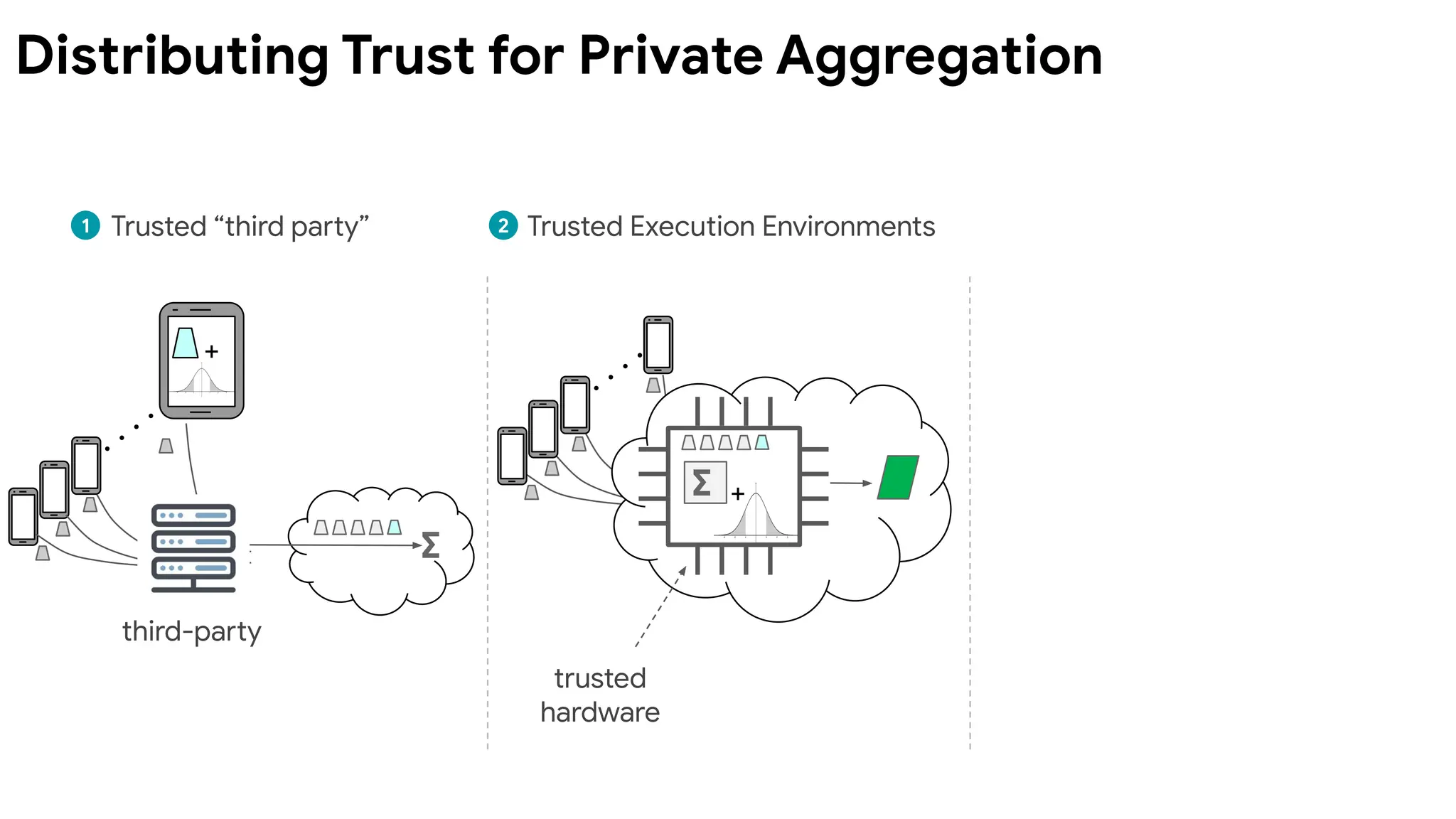
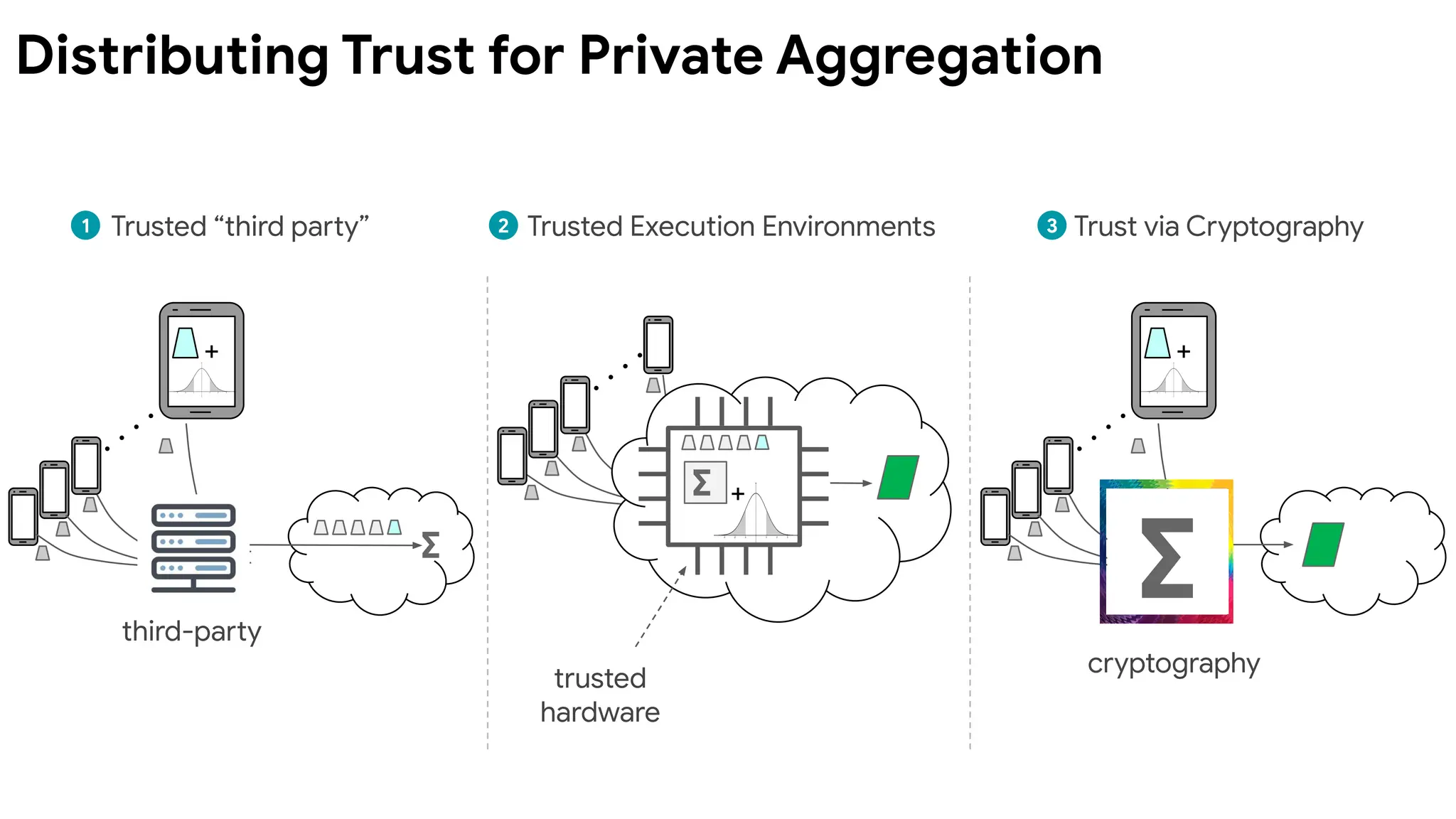
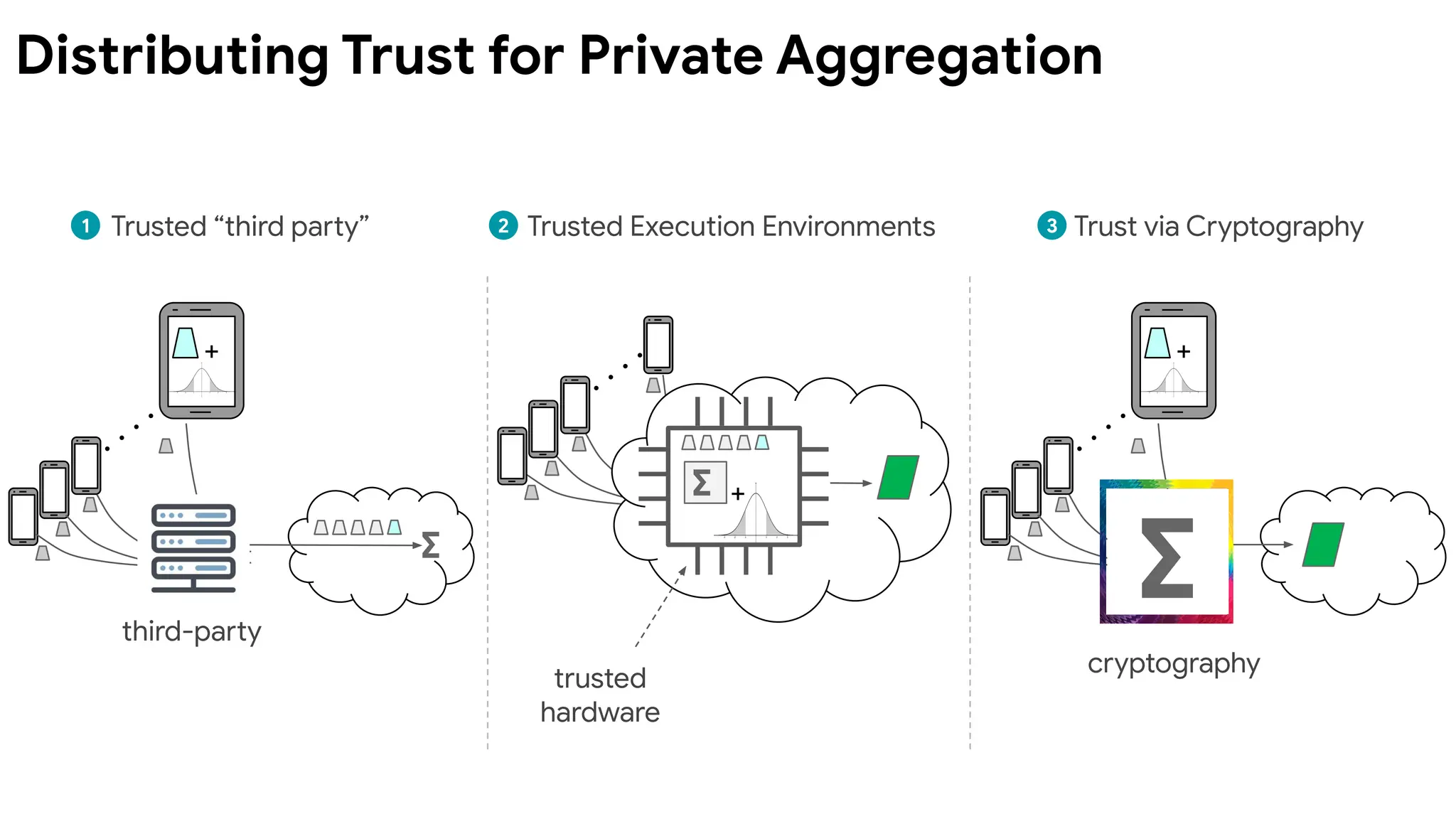
Distributing Trust for Private Aggregation
Trusted “third party”
∑
+
1
Distributing Trust for Private Aggregation
third-party
Trusted “third party” Trusted Execution Environments
∑
+
+
∑
1 2
Distributing Trust for Private Aggregation
third-party
trusted
hardware
Trusted “third party” Trusted Execution Environments
∑
+
+
∑
+
Trust via Cryptography
1 2 3
∑
Distributing Trust for Private Aggregation
third-party
trusted
hardware
cryptography
Confidential + Proprietary
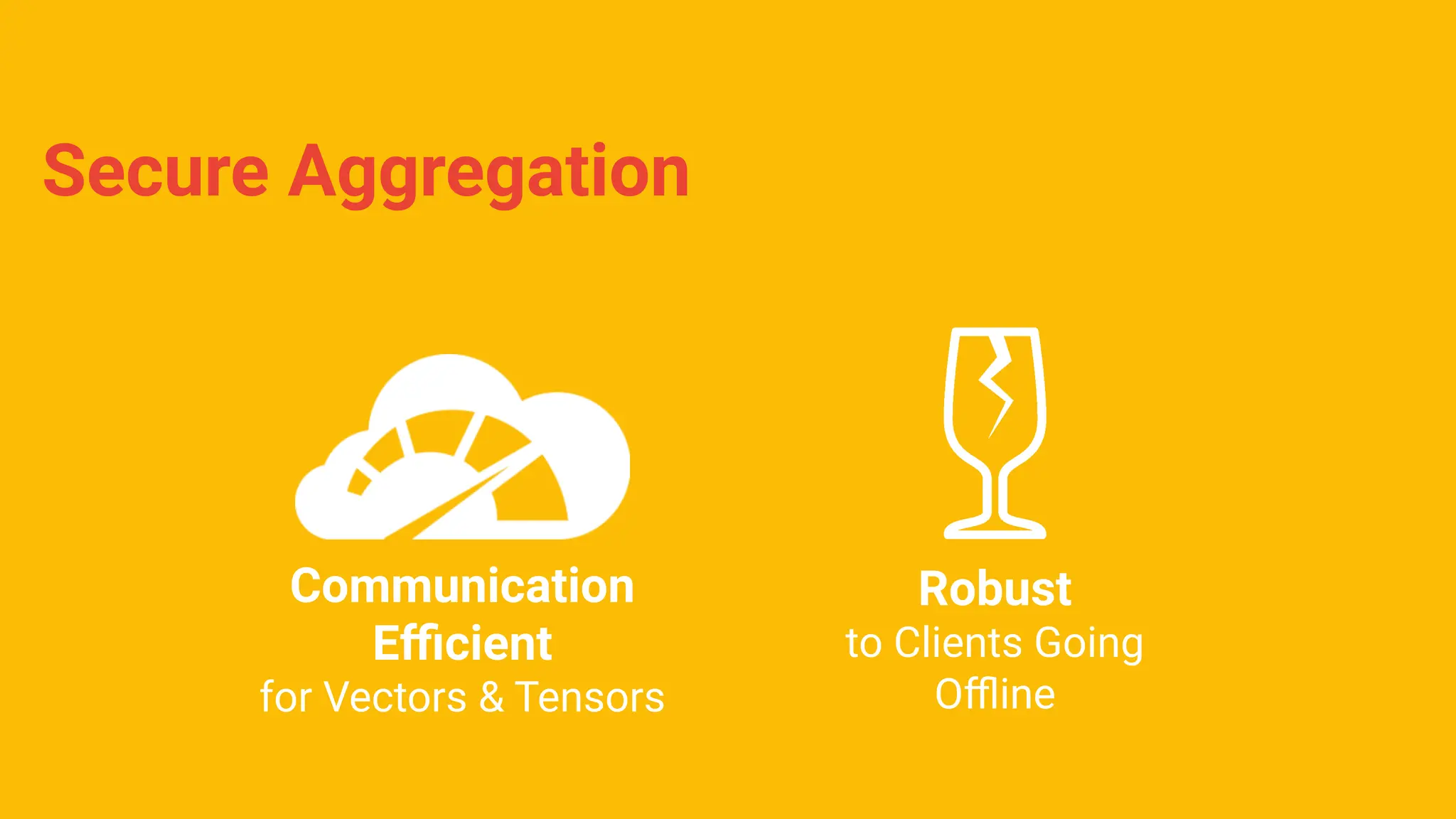
Secure Aggregation
Communication
Efficient
for Vectors & Tensors
Robust
to Clients Going
Offline
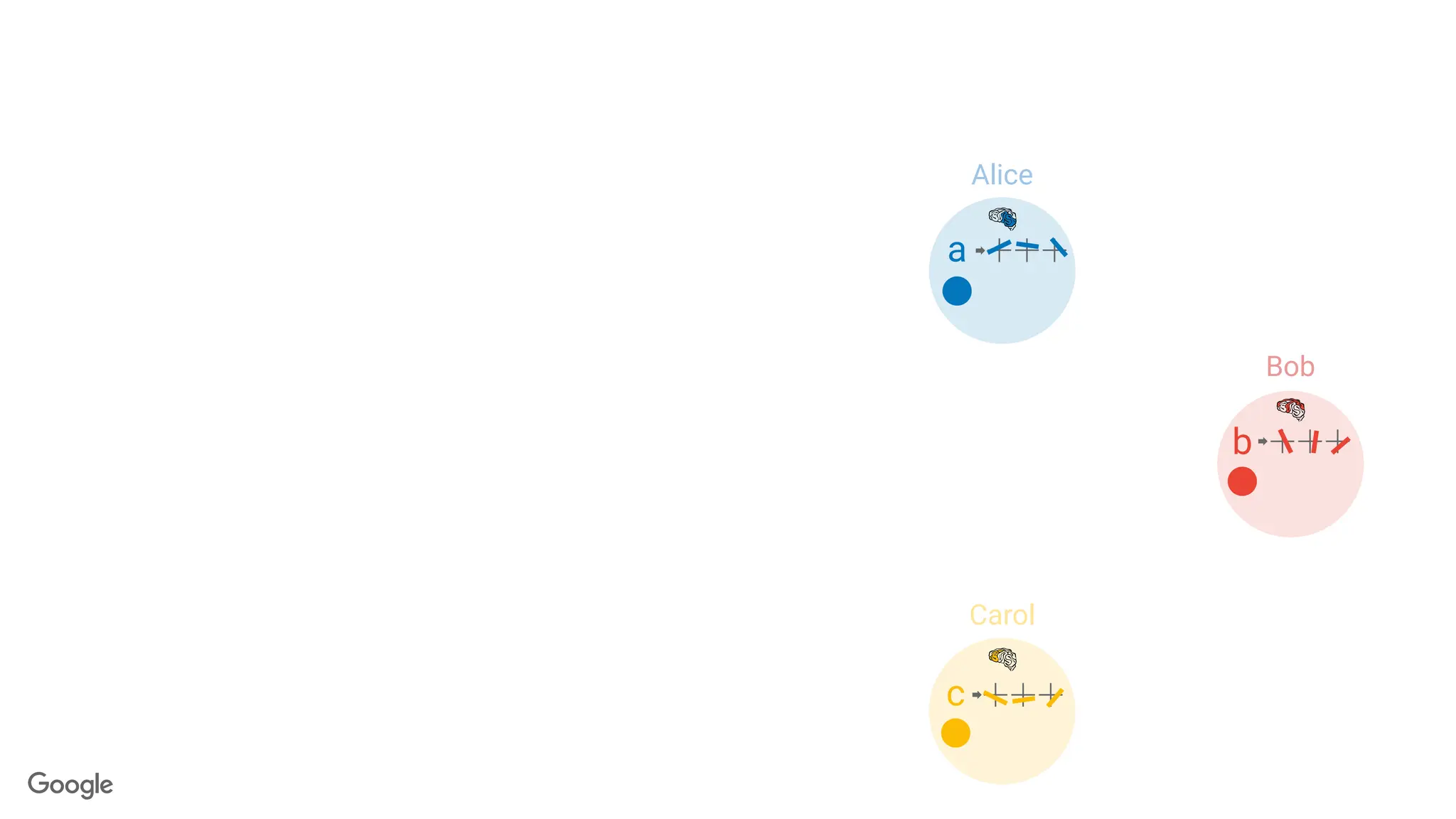
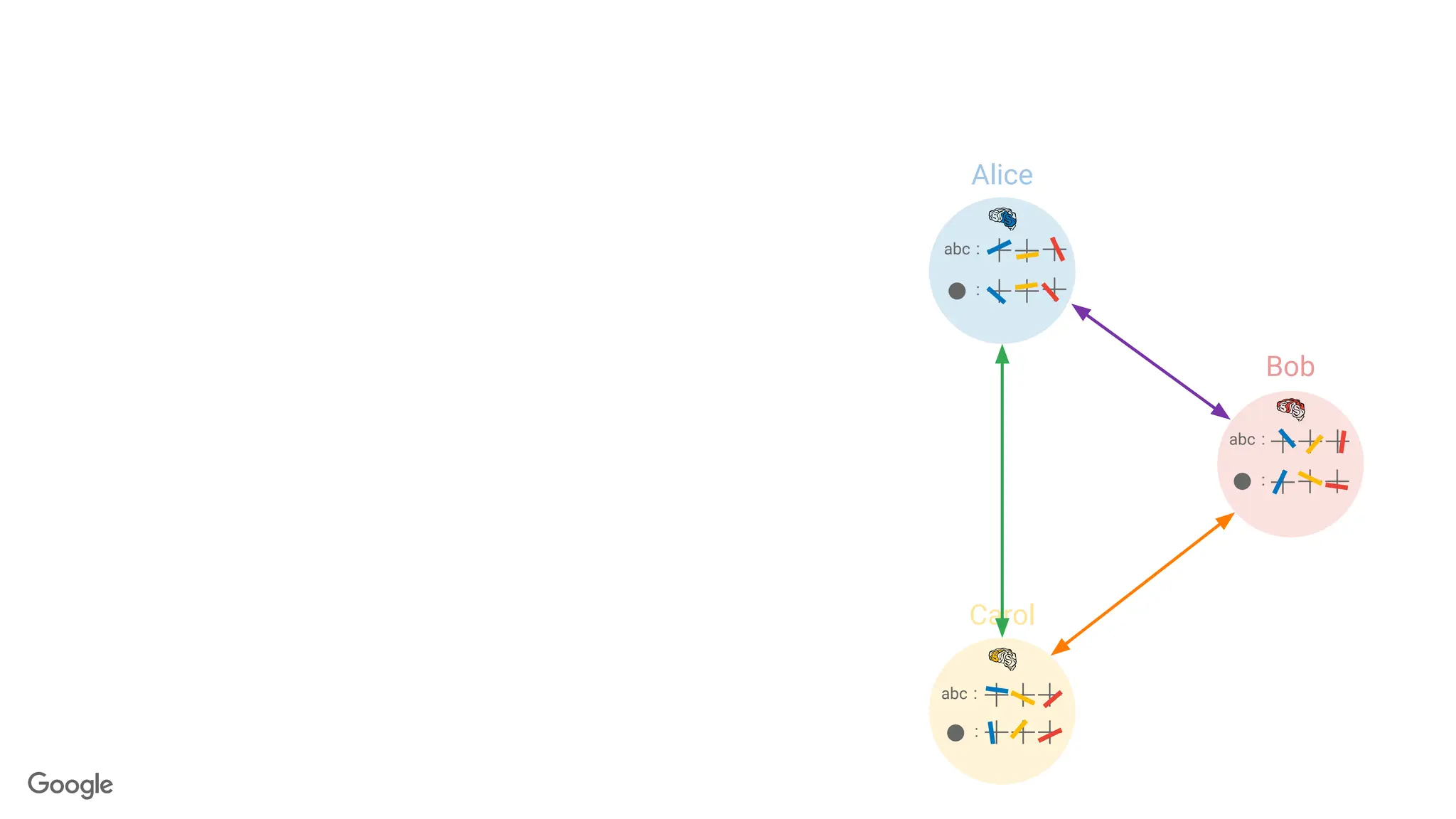
Alice
Bob
Carol
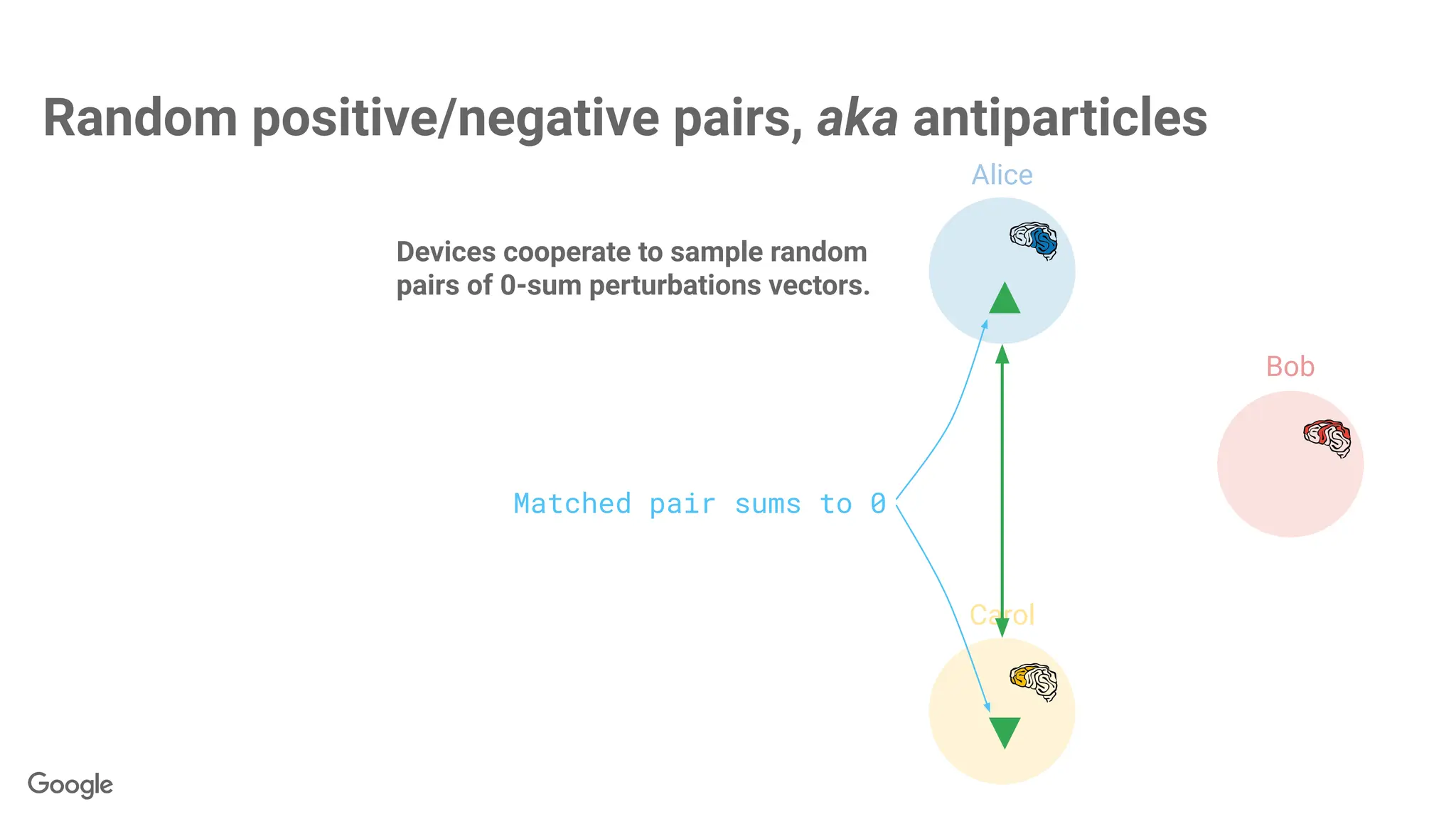
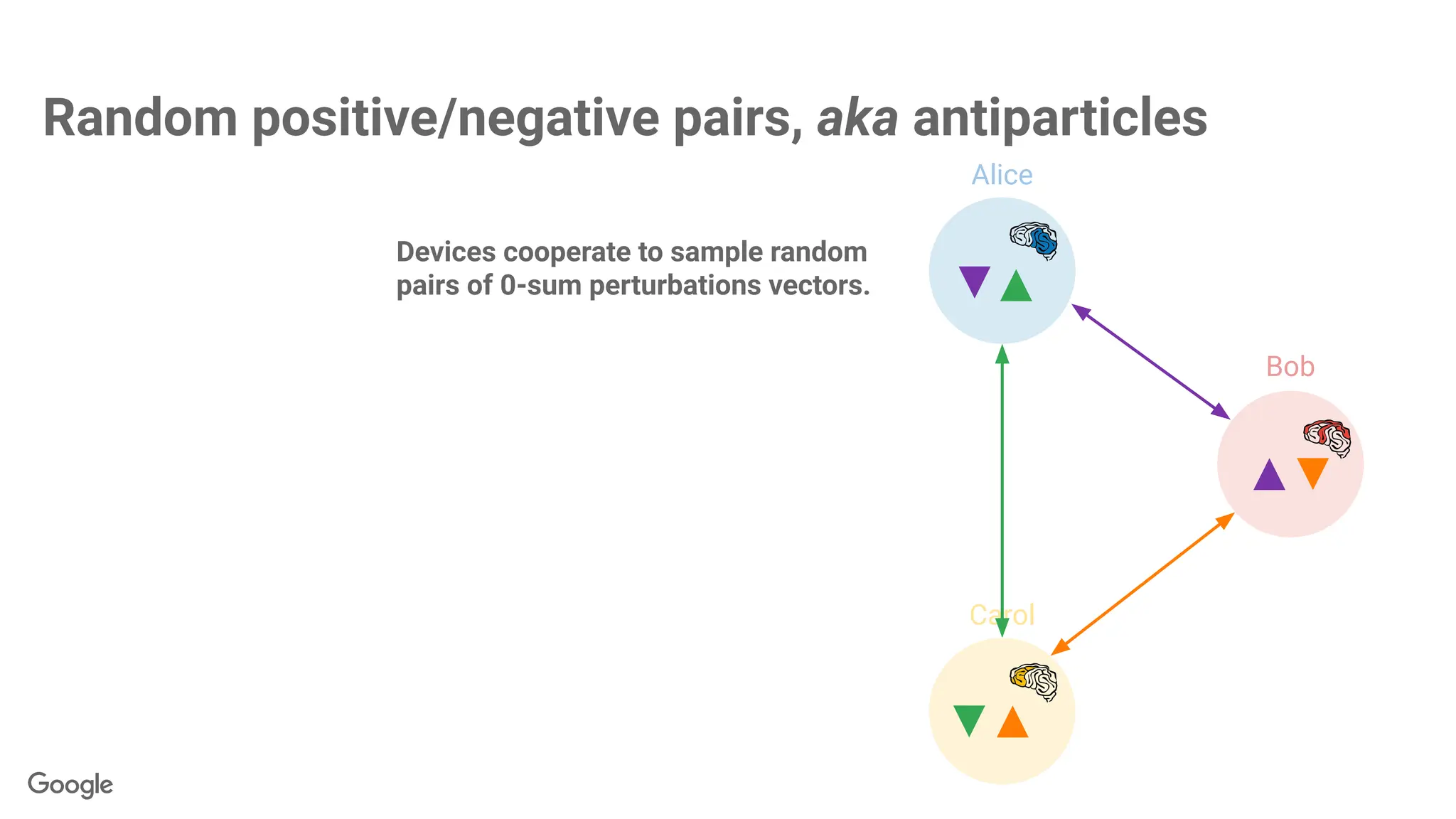
Random positive/negative pairs, aka antiparticles
Devices cooperate to sample random
pairs of 0-sum perturbations vectors.
Matched pair sums to 0
Alice
Bob
Carol
Random positive/negative pairs, aka antiparticles
Devices cooperate to sample random
pairs of 0-sum perturbations vectors.
Alice
Bob
Carol
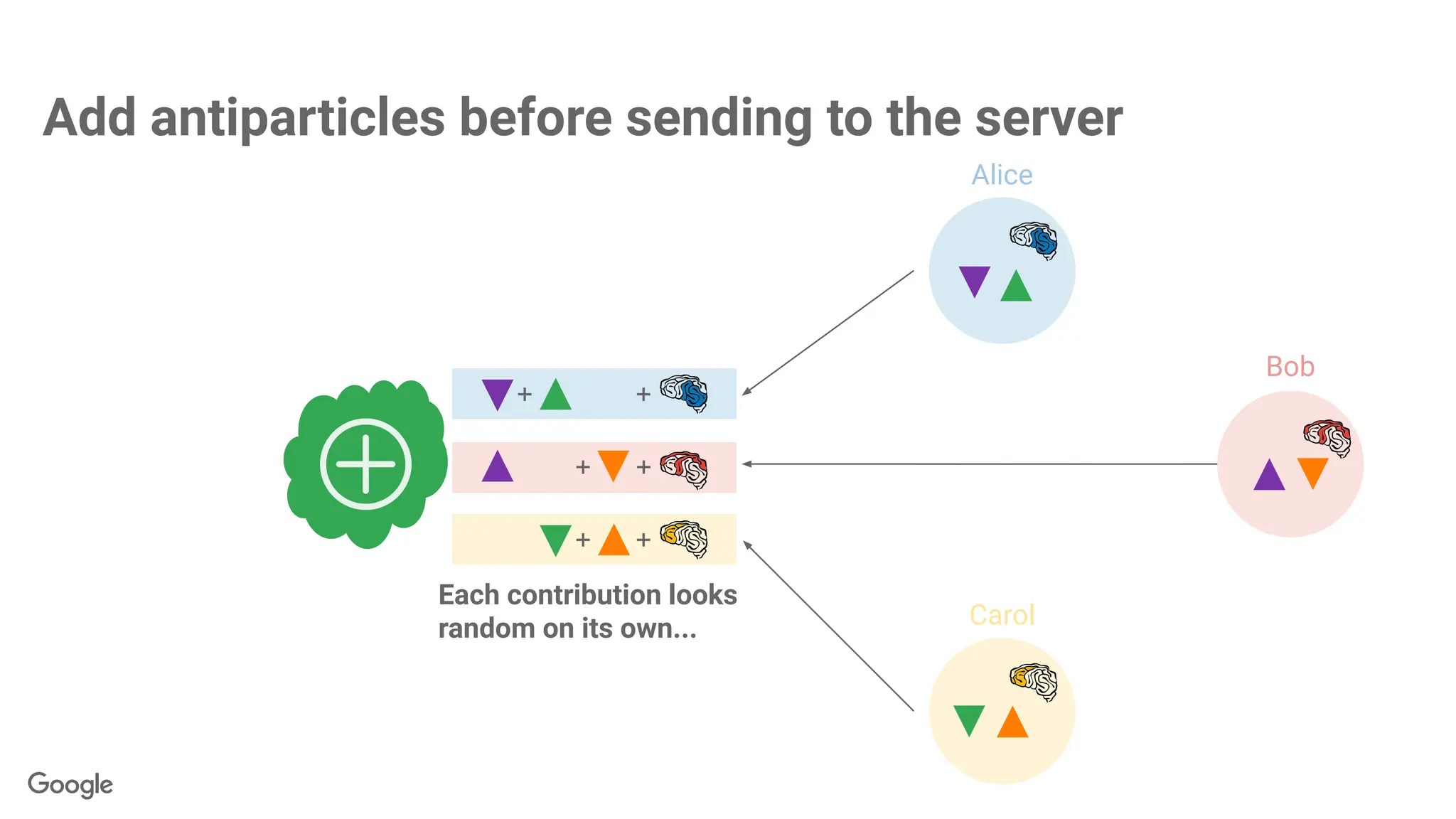
Add antiparticles before sending to the server
Each contribution looks
random on its own...
+
+
+
+
+
+
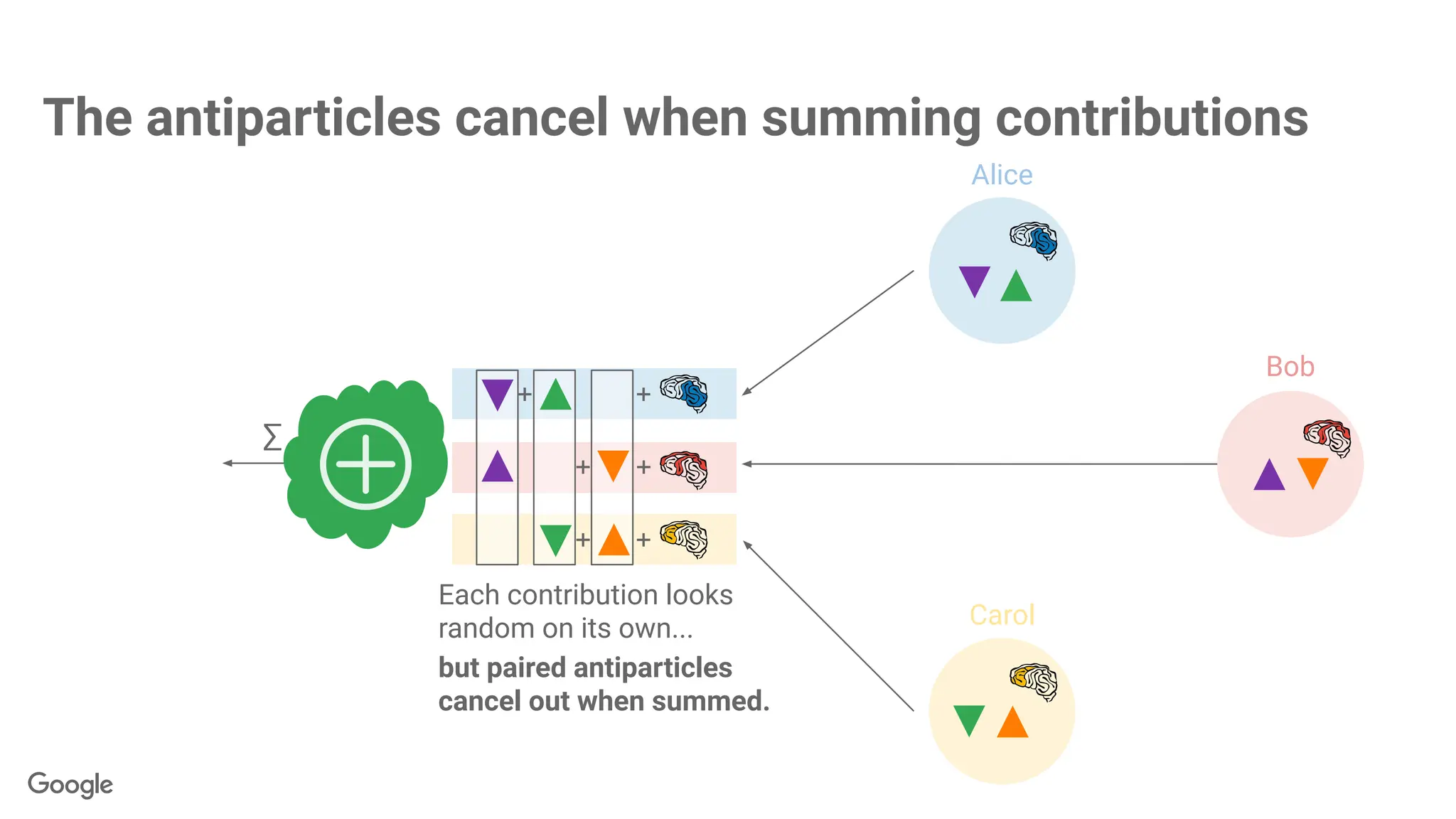
The antiparticles cancel when summing contributions
+
+
+
+
+
but paired antiparticles
cancel out when summed.
Each contribution looks
random on its own...
+
∑
Alice
Bob
Carol
Revealing the sum.
+
+
+
but paired antiparticles
cancel out when summed.
Each contribution looks
random on its own...
+
+
+
∑
Alice
Bob
Carol
Confidential + Proprietary
But there are two challenges...
Carol
1. These vectors are big!
How do users agree efficiently?
Alice
Bob
2. What if someone drops out?
+
+
+
+
+
+
∑
Alice
Bob
Carol
+
+
+
+
That's
bad.
2. What if someone drops out?
∑
Alice
Bob
Carol
Alice
Bob
Carol
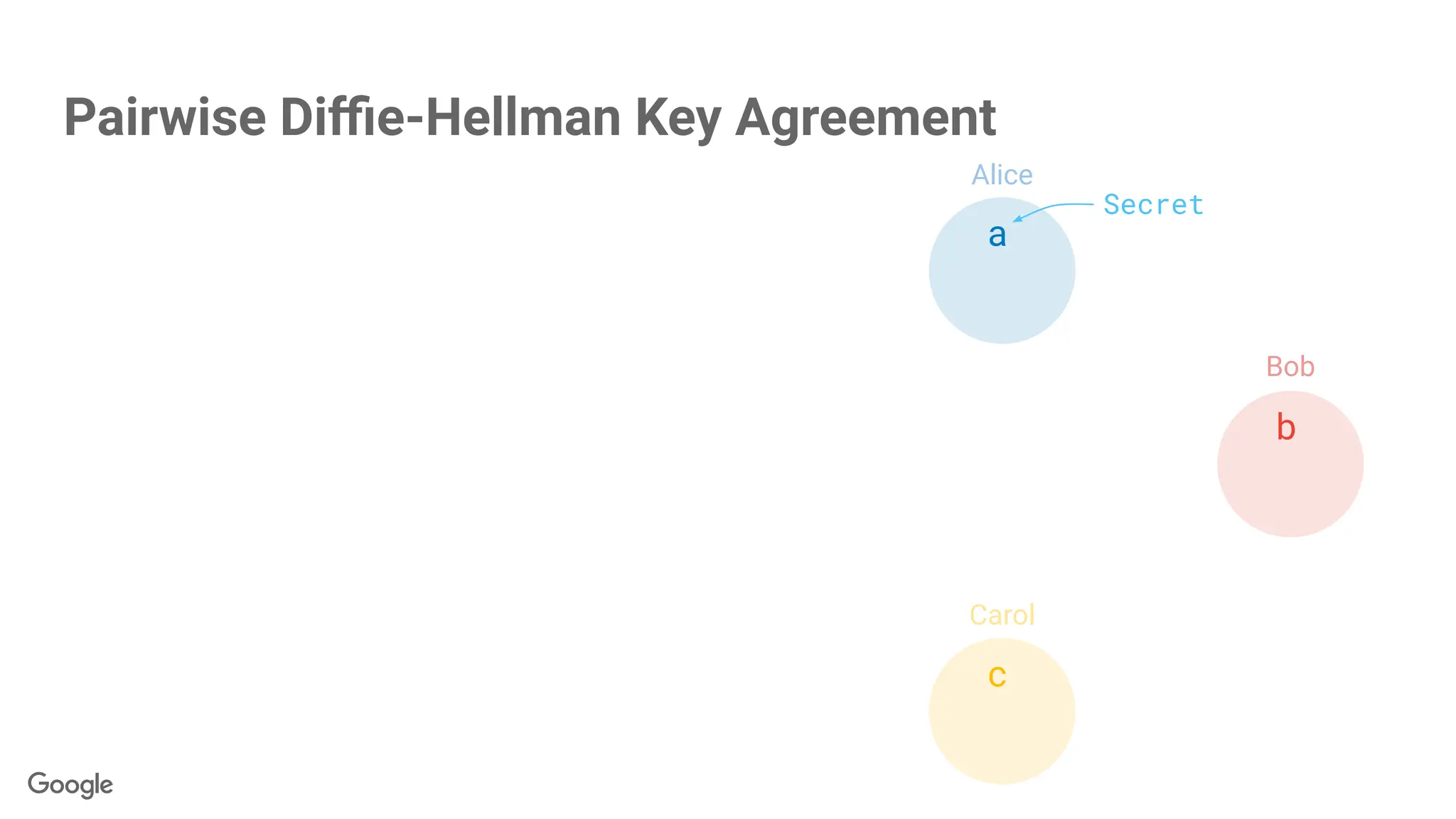
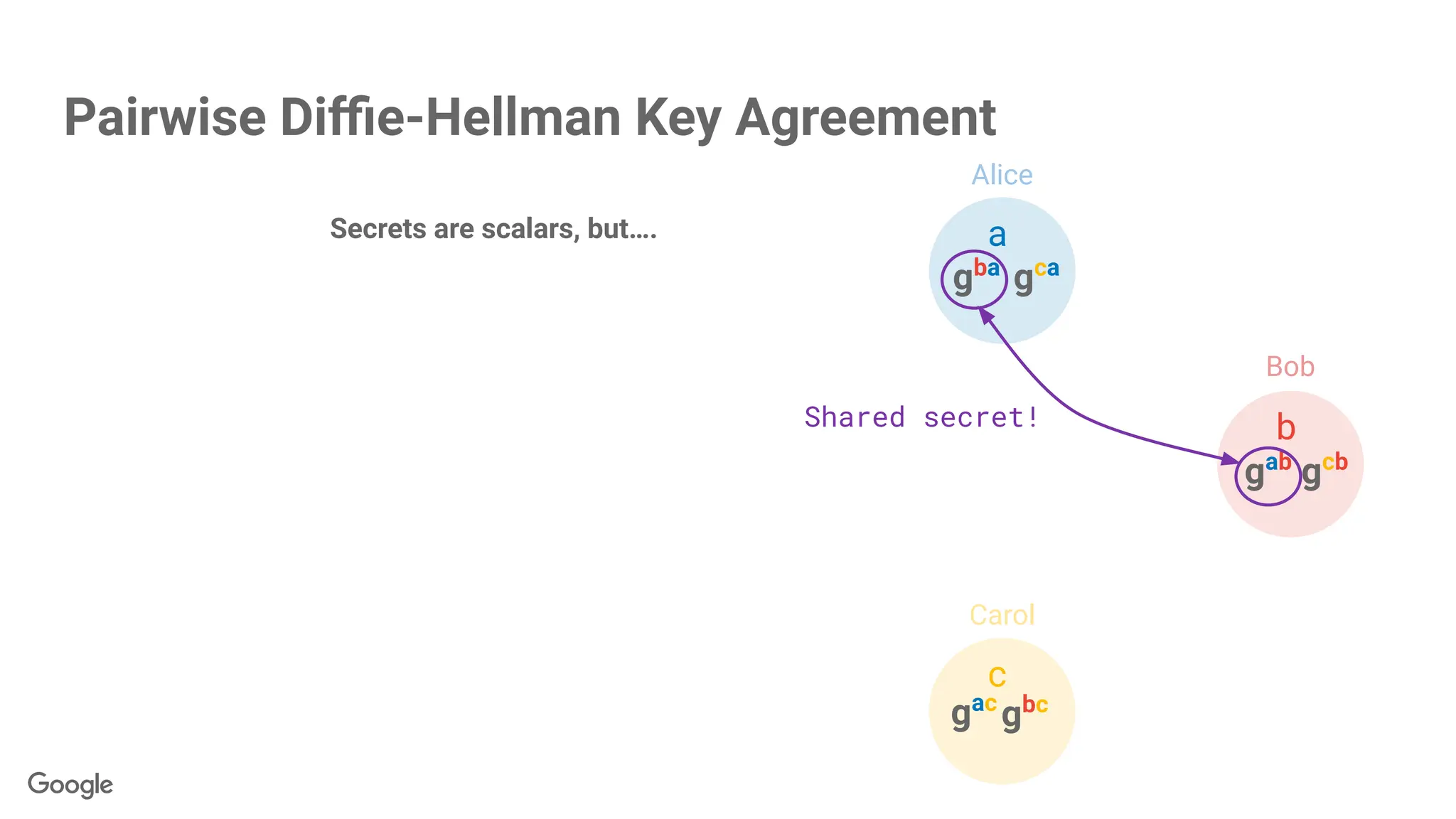
Pairwise Diffie-Hellman Key Agreement
a
b
Secret
c
Alice
Bob
Carol
Pairwise Diffie-Hellman Key Agreement
a
b
Safe to reveal
(cryptographically
hard to infer secret)
Secret
Public parameters: g, (mod p)
c
gc
ga
gb
Alice
Bob
Carol
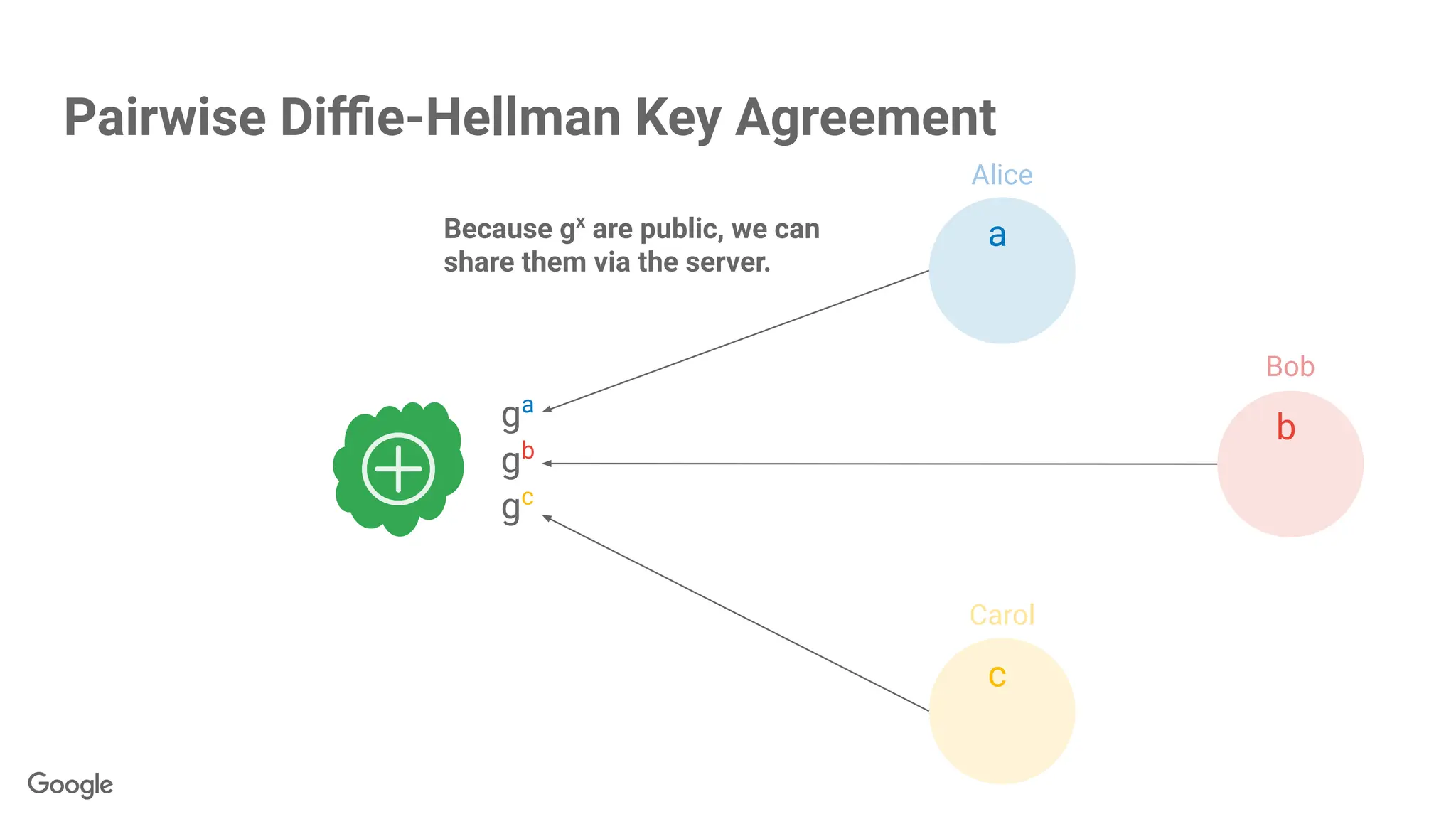
ga
gb
gc
a
b
Because gx
are public, we can
share them via the server.
c
Pairwise Diffie-Hellman Key Agreement
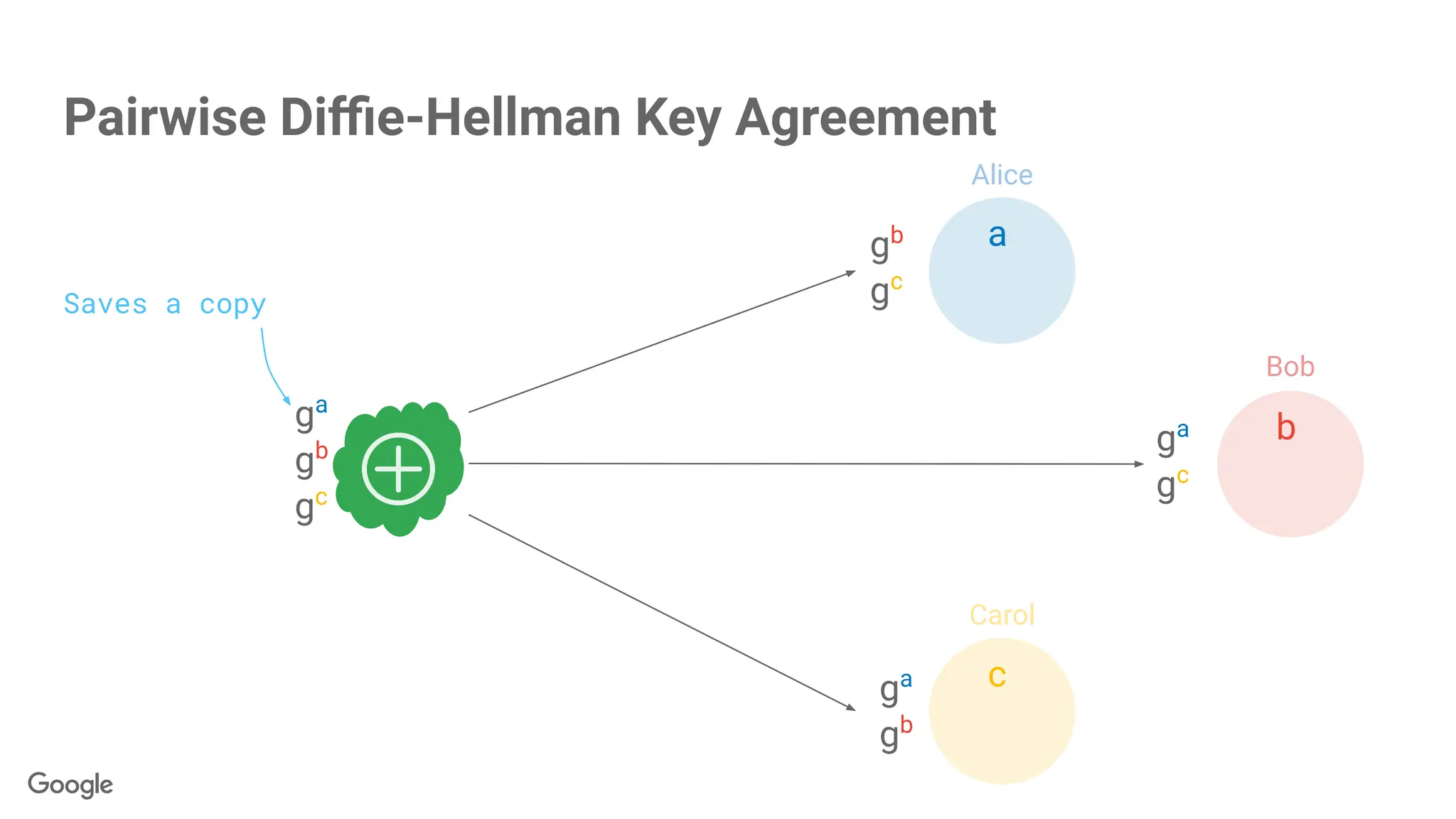
Alice
Bob
Carol
ga
gb
gc
ga
gc
gb
gc
ga
gb
a
b
c
Saves a copy
Pairwise Diffie-Hellman Key Agreement
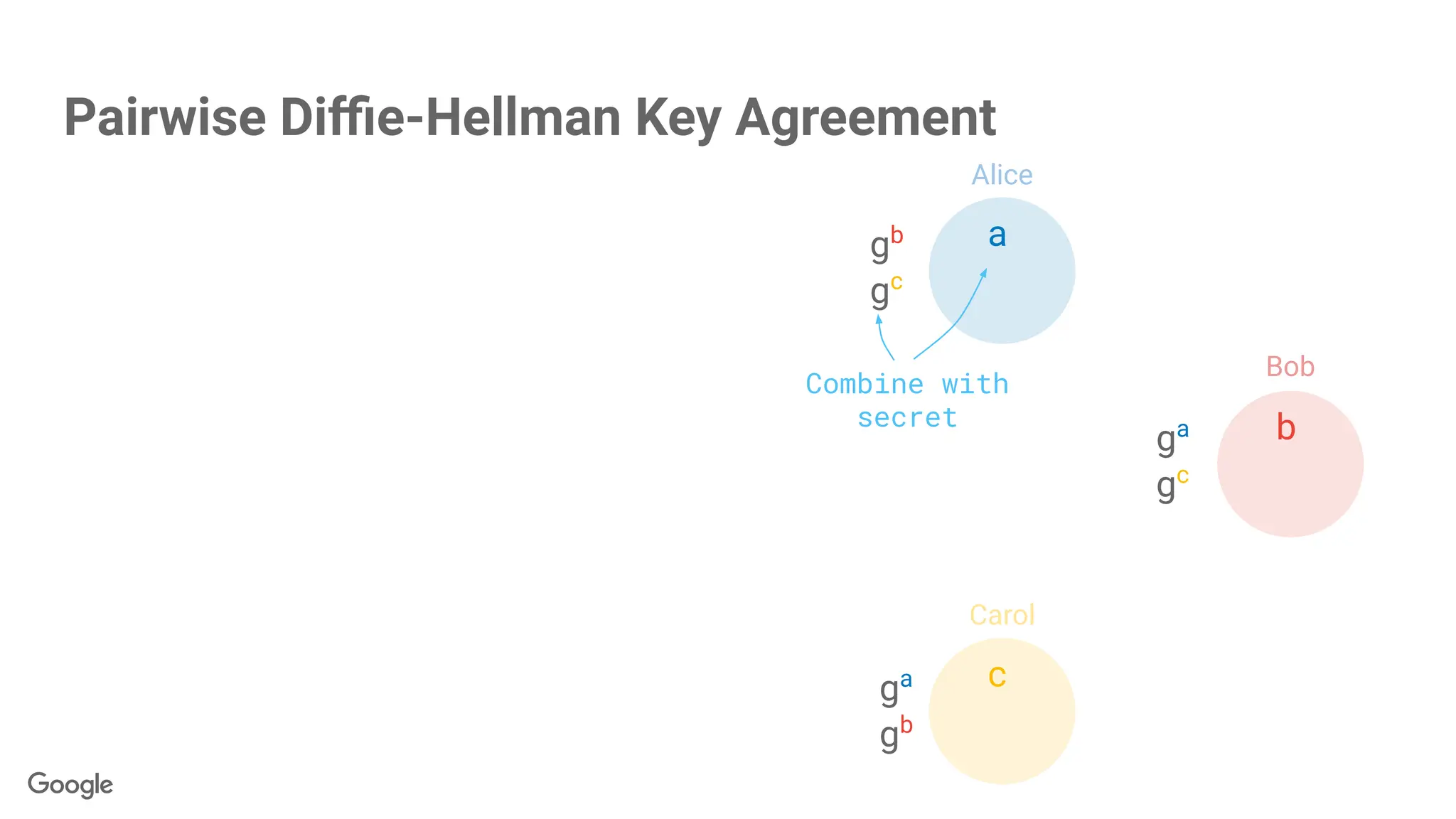
ga
gc
gb
gc
ga
gb
a
b
c
Combine with
secret
Pairwise Diffie-Hellman Key Agreement
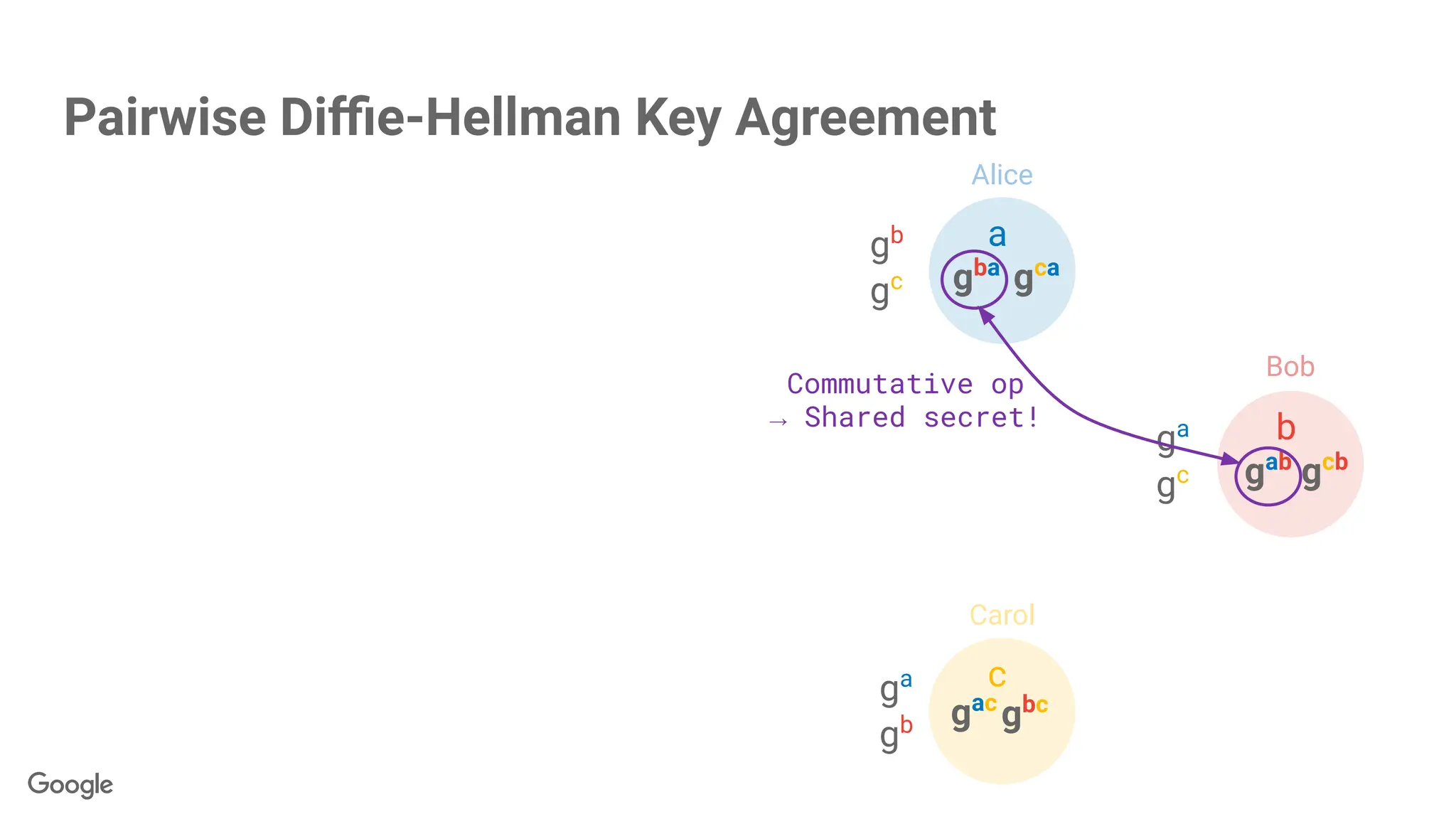
Alice
Bob
Carol
gba
gab
c
gac
gca
gcb
gbc
a
b
ga
gc
gb
gc
ga
gb
Commutative op
→ Shared secret!
Pairwise Diffie-Hellman Key Agreement
Alice
Bob
Carol
gba
gab
c
gac
gca
gcb
gbc
a
b
Secrets are scalars, but….
Shared secret!
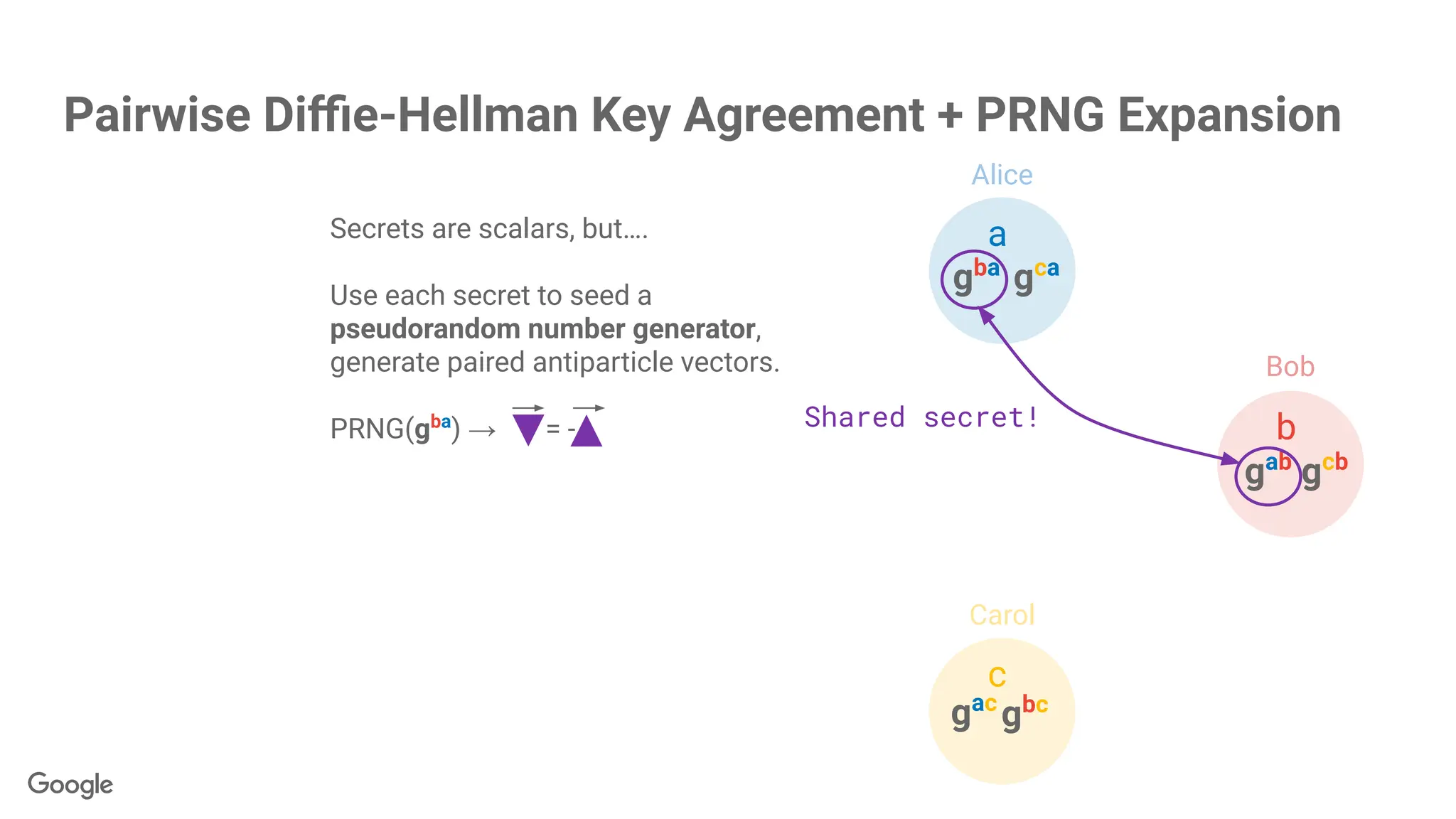
Pairwise Diffie-Hellman Key Agreement
Alice
Bob
Carol
gba
gab
c
gac
gca
gcb
gbc
a
b
Secrets are scalars, but….
Use each secret to seed a
pseudorandom number generator,
generate paired antiparticle vectors.
PRNG(gba
) → = - Shared secret!
Pairwise Diffie-Hellman Key Agreement + PRNG Expansion
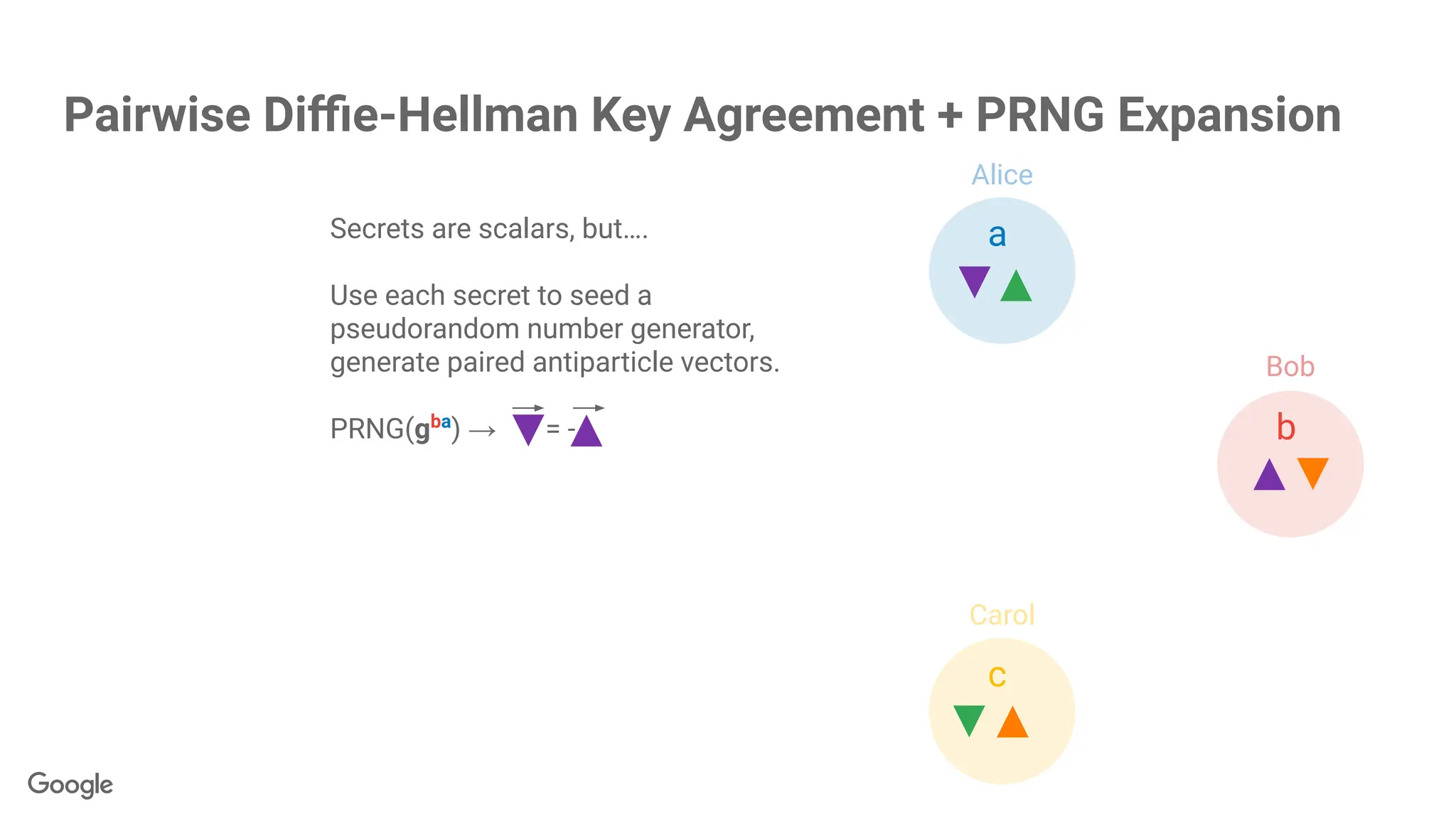
Alice
Bob
Carol
a
b
c
Pairwise Diffie-Hellman Key Agreement + PRNG Expansion
Secrets are scalars, but….
Use each secret to seed a
pseudorandom number generator,
generate paired antiparticle vectors.
PRNG(gba
) → = -
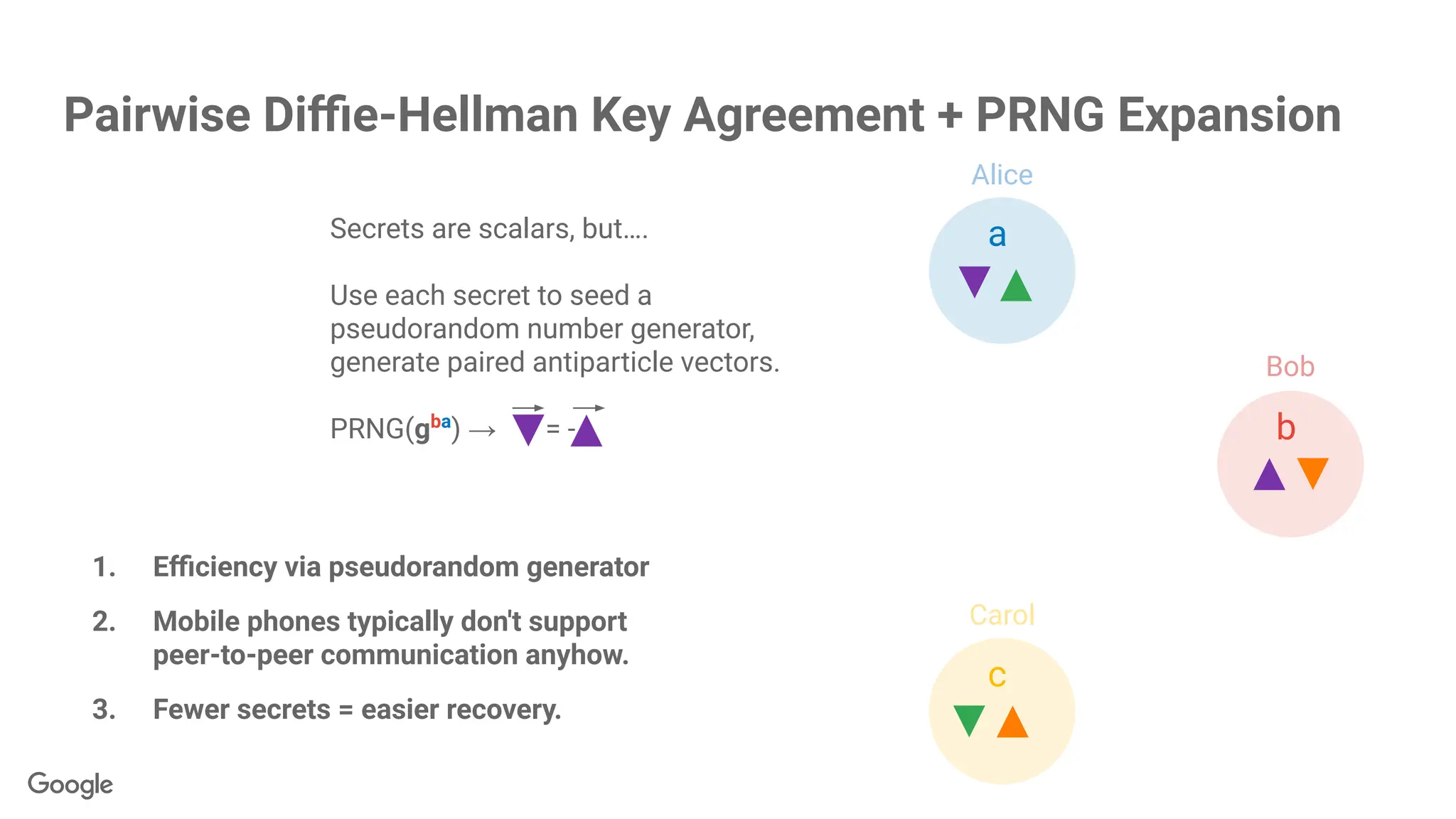
Alice
Bob
Carol
a
b
c
1. Efficiency via pseudorandom generator
2. Mobile phones typically don't support
peer-to-peer communication anyhow.
3. Fewer secrets = easier recovery.
Pairwise Diffie-Hellman Key Agreement + PRNG Expansion
Secrets are scalars, but….
Use each secret to seed a
pseudorandom number generator,
generate paired antiparticle vectors.
PRNG(gba
) → = -
Alice
Bob
Carol
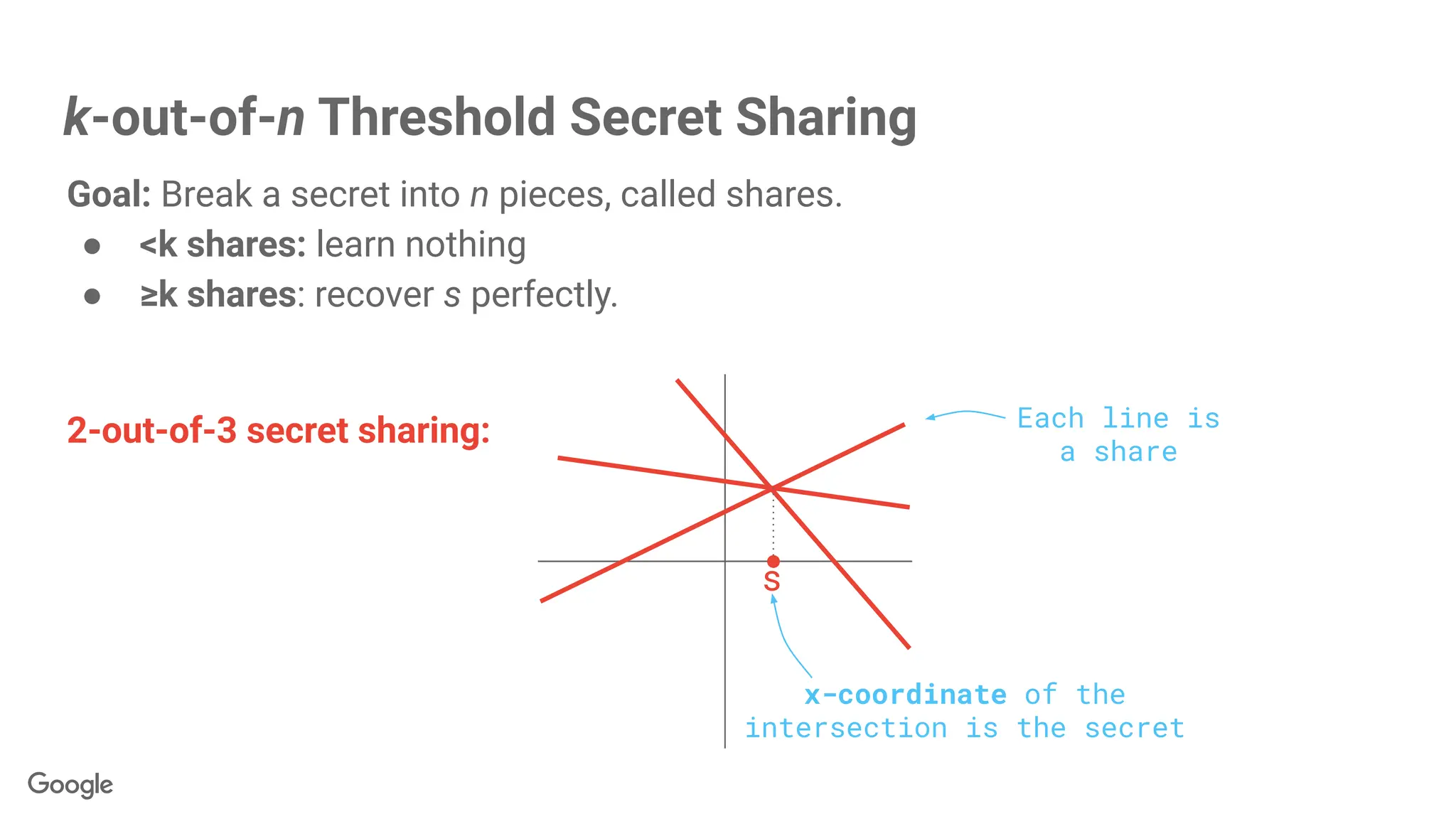
k-out-of-n Threshold Secret Sharing
Goal: Break a secret into n pieces, called shares.
● <k shares: learn nothing
● ≥k shares: recover s perfectly.
s
2-out-of-3 secret sharing: Each line is
a share
x-coordinate of the
intersection is the secret
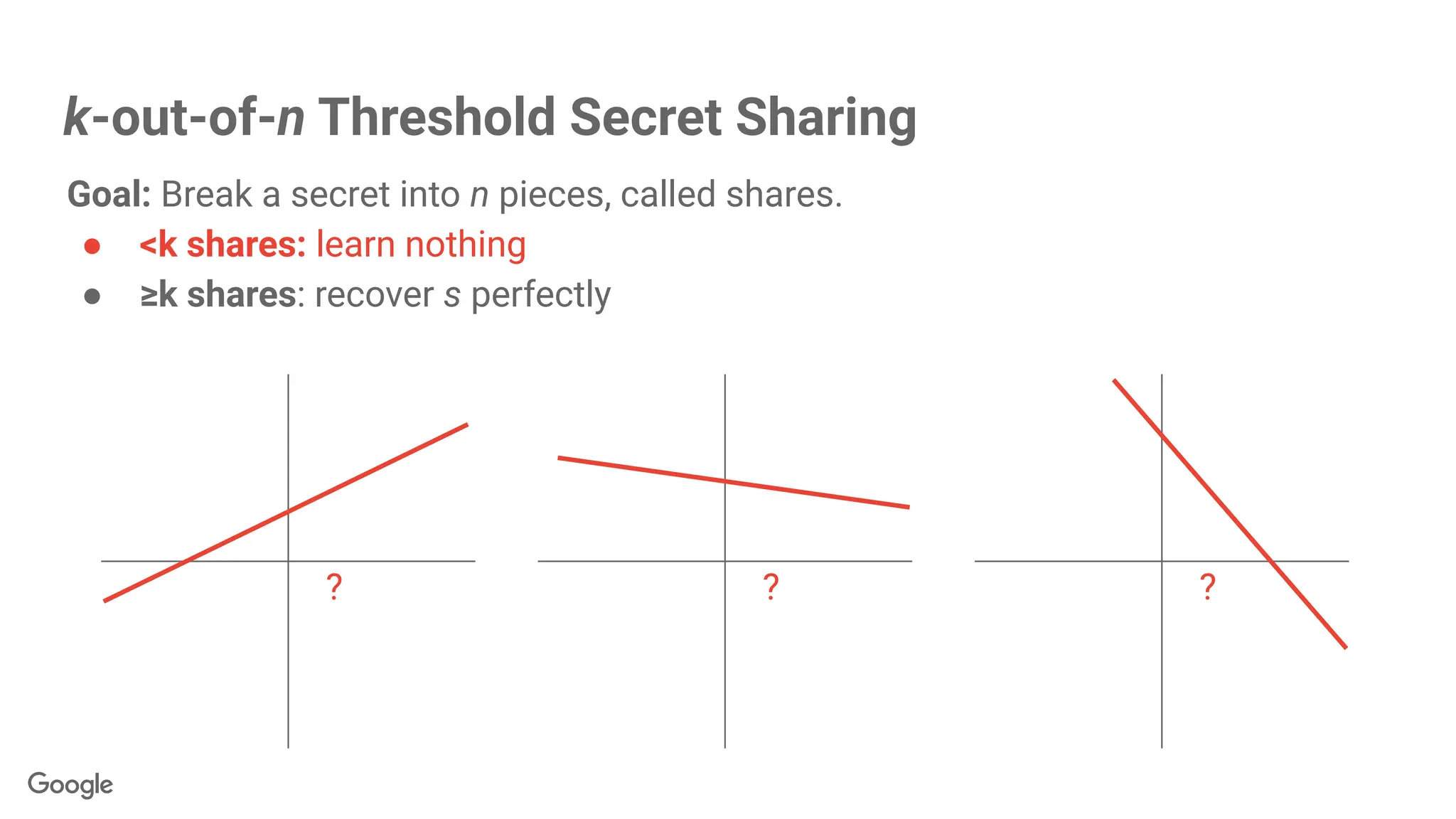
k-out-of-n Threshold Secret Sharing
?
? ?
Goal: Break a secret into n pieces, called shares.
● <k shares: learn nothing
● ≥k shares: recover s perfectly
k-out-of-n Threshold Secret Sharing
s
s s
Goal: Break a secret into n pieces, called shares.
● <k shares: learn nothing
● ≥k shares: recover s perfectly
c
a
b
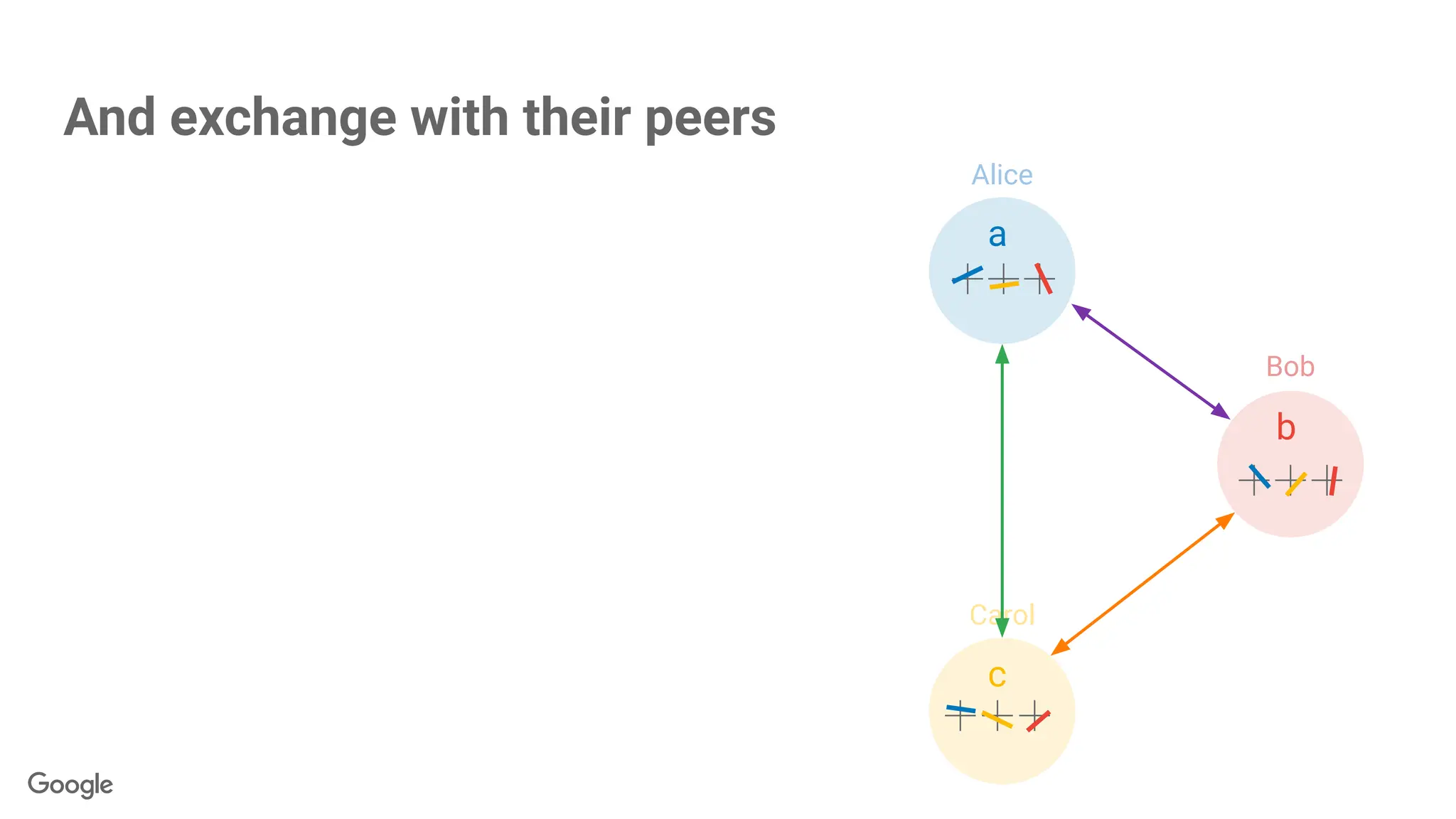
Users make shares of their secrets
Alice
Bob
Carol
Alice
Bob
Carol
c
a
b
And exchange with their peers
+
+
+
+
That's
bad.
∑
Alice
Bob
Carol
b?
ga
gb
gc
+
+
+
+
∑
Alice
Bob
Carol
gc
ga
gb
+
+
+
+
∑
Alice
Bob
Carol
gc
ga
+
+
+
+
∑
gb
Alice
Bob
Carol
b
gc
ga
gb
+
+
+
+
∑
Alice
Bob
Carol
+
+
+
+
ga
b
gc
∑
Alice
Bob
Carol
+
+
+
+
ga
b
gc
∑
Alice
Bob
Carol
ga
b
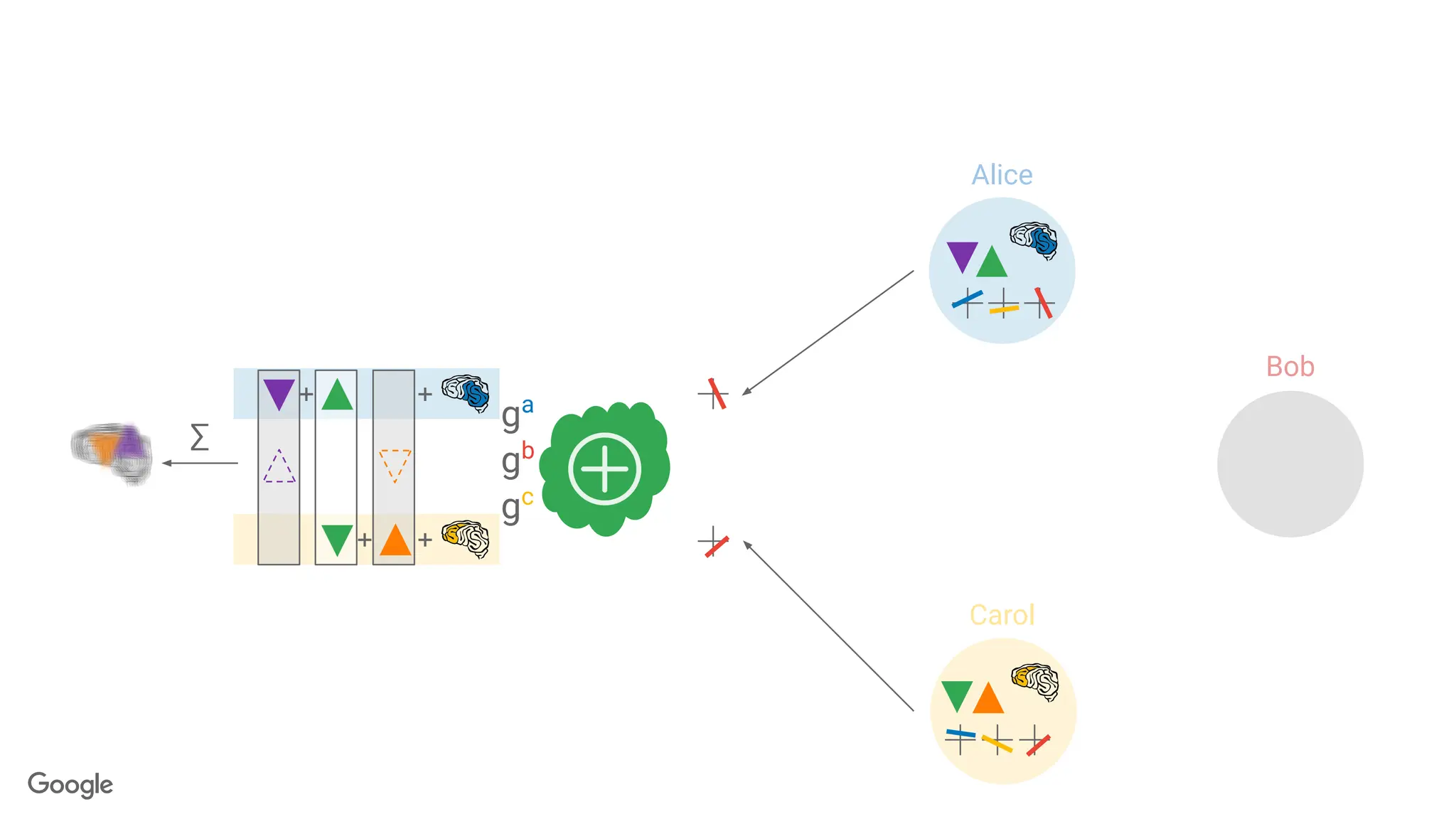
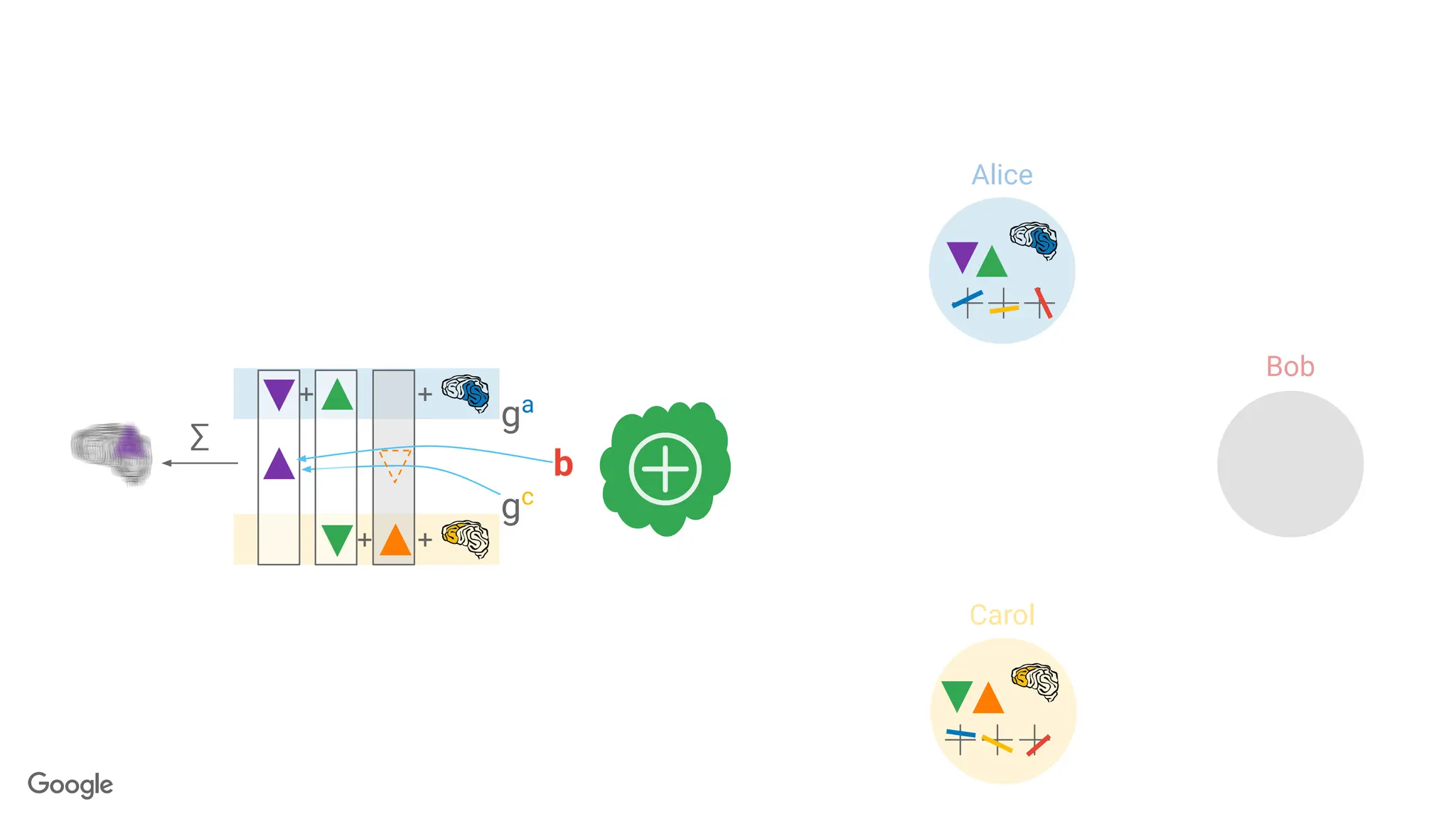
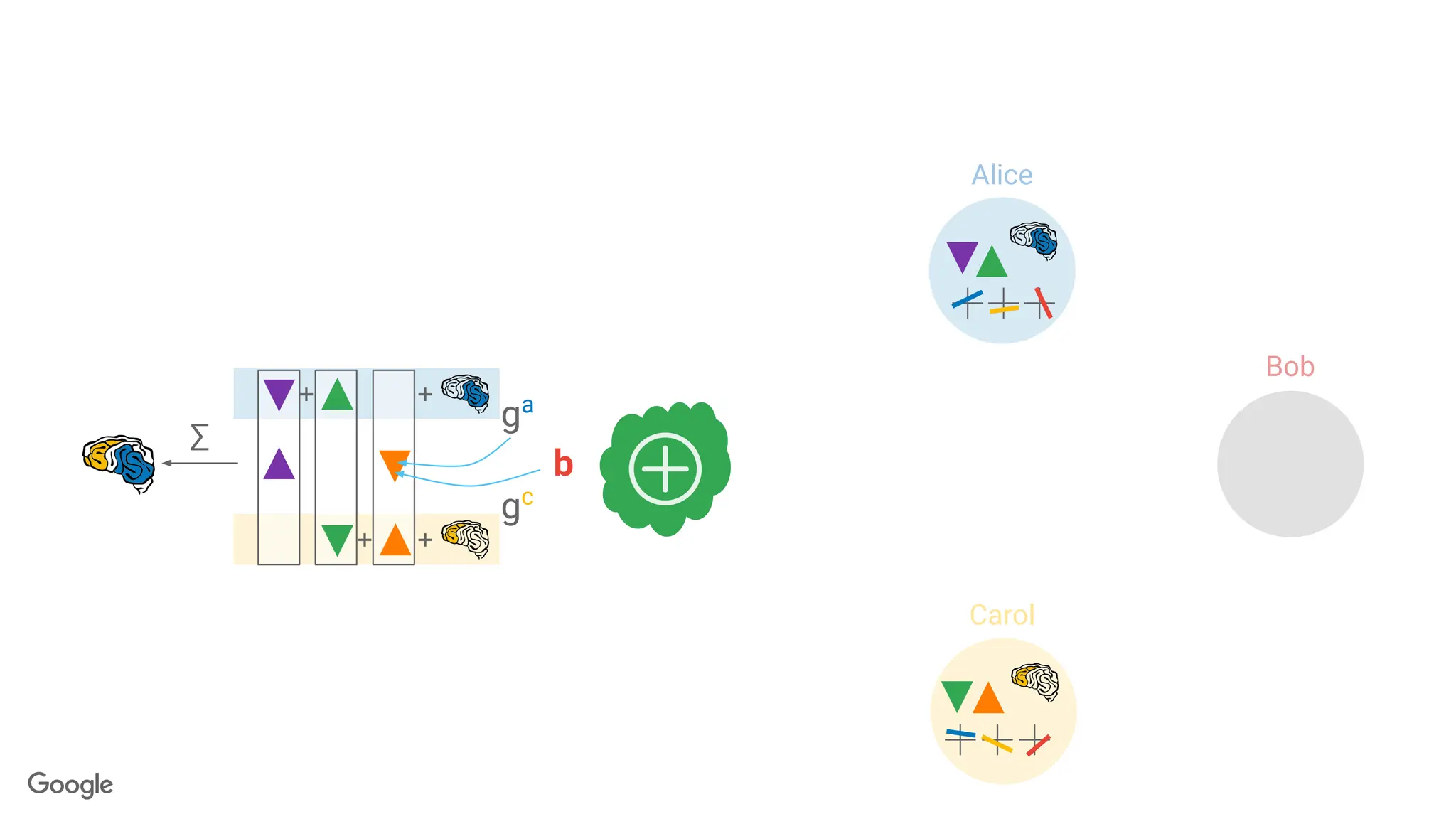
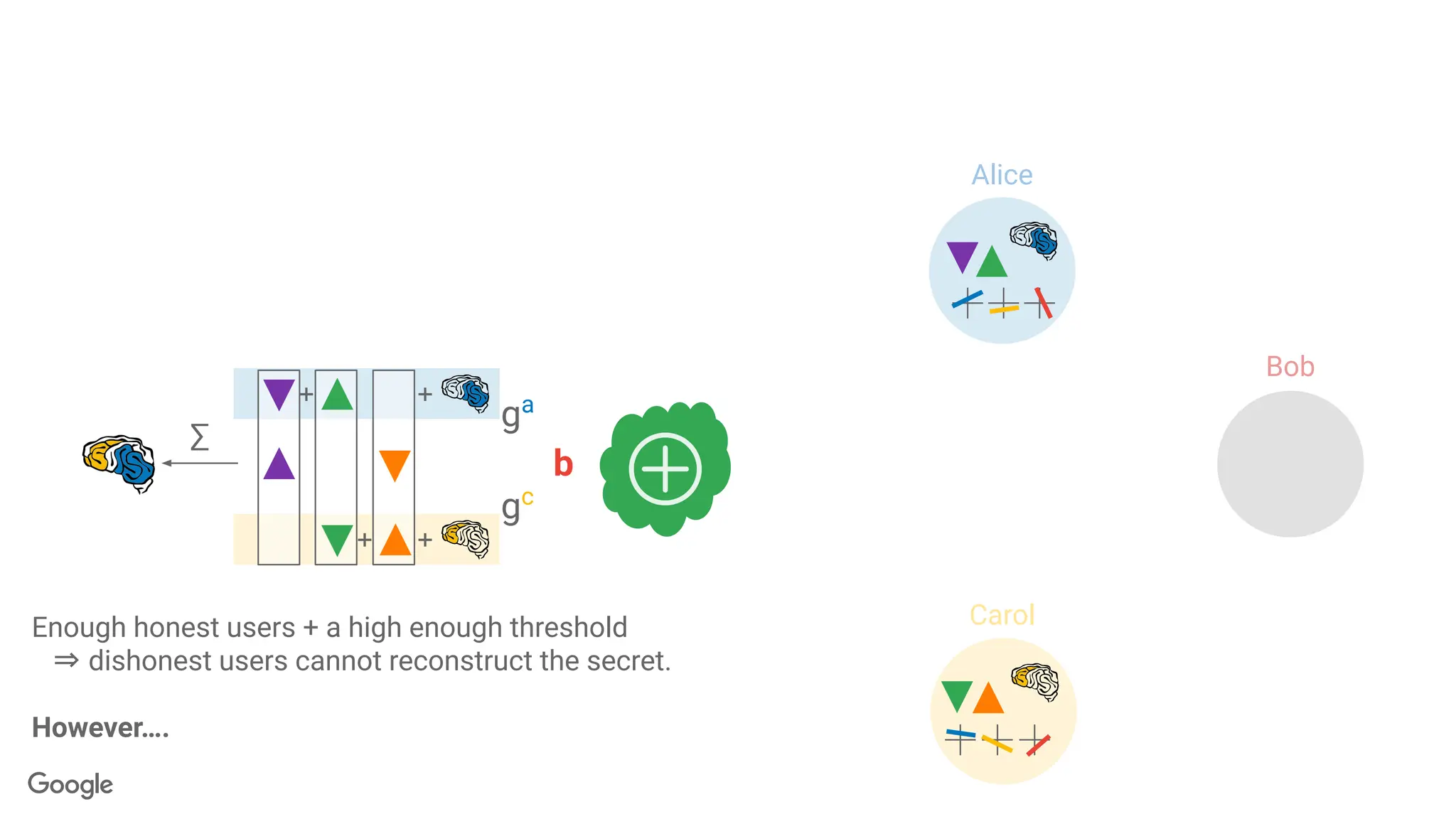
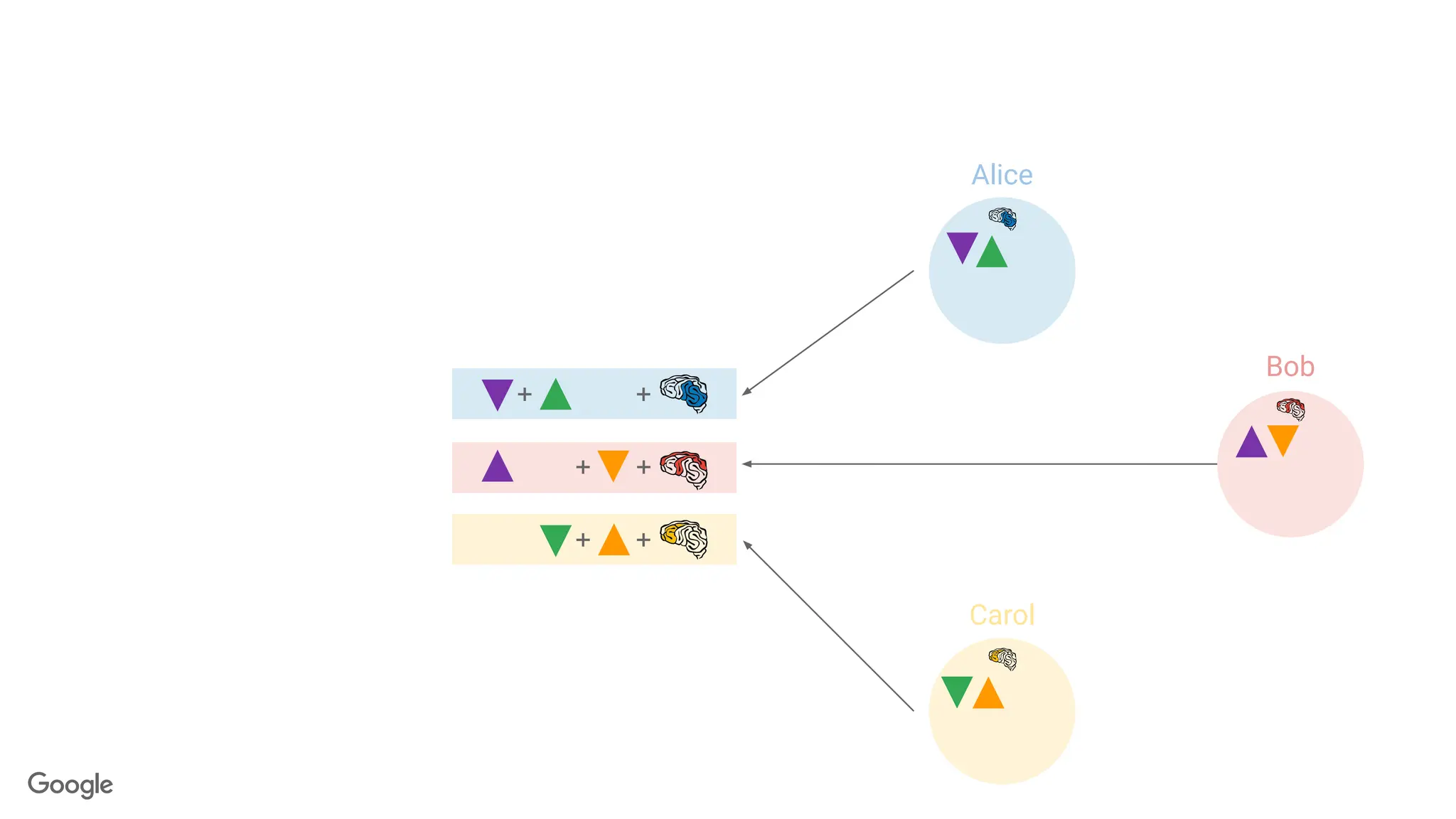
Enough honest users + a high enough threshold
⇒ dishonest users cannot reconstruct the secret.
gc
+
+
+
+
∑
Alice
Bob
Carol
ga
b
Enough honest users + a high enough threshold
⇒ dishonest users cannot reconstruct the secret.
However….
gc
+
+
+
+
∑
Alice
Bob
Carol
ga
b + +
late.
gc
+
+
+
+
∑
Alice
Bob
Carol
+
+
+
+
+ +
ga
b
late.
Oops.
gc
∑
Alice
Bob
Carol
+
+
+
+
+
+
Alice
Bob
Carol
+
+
+
+
+
+
+
+
+
Alice
Bob
Carol
c
a
b
Alice
Bob
Carol
c
a
b
Alice
Bob
Carol
Alice
Bob
Carol
abc :
abc :
:
abc :
:
:
+
+
+
+
+
+
abc :
:
abc :
:
Alice
Bob
Carol
abc :
:
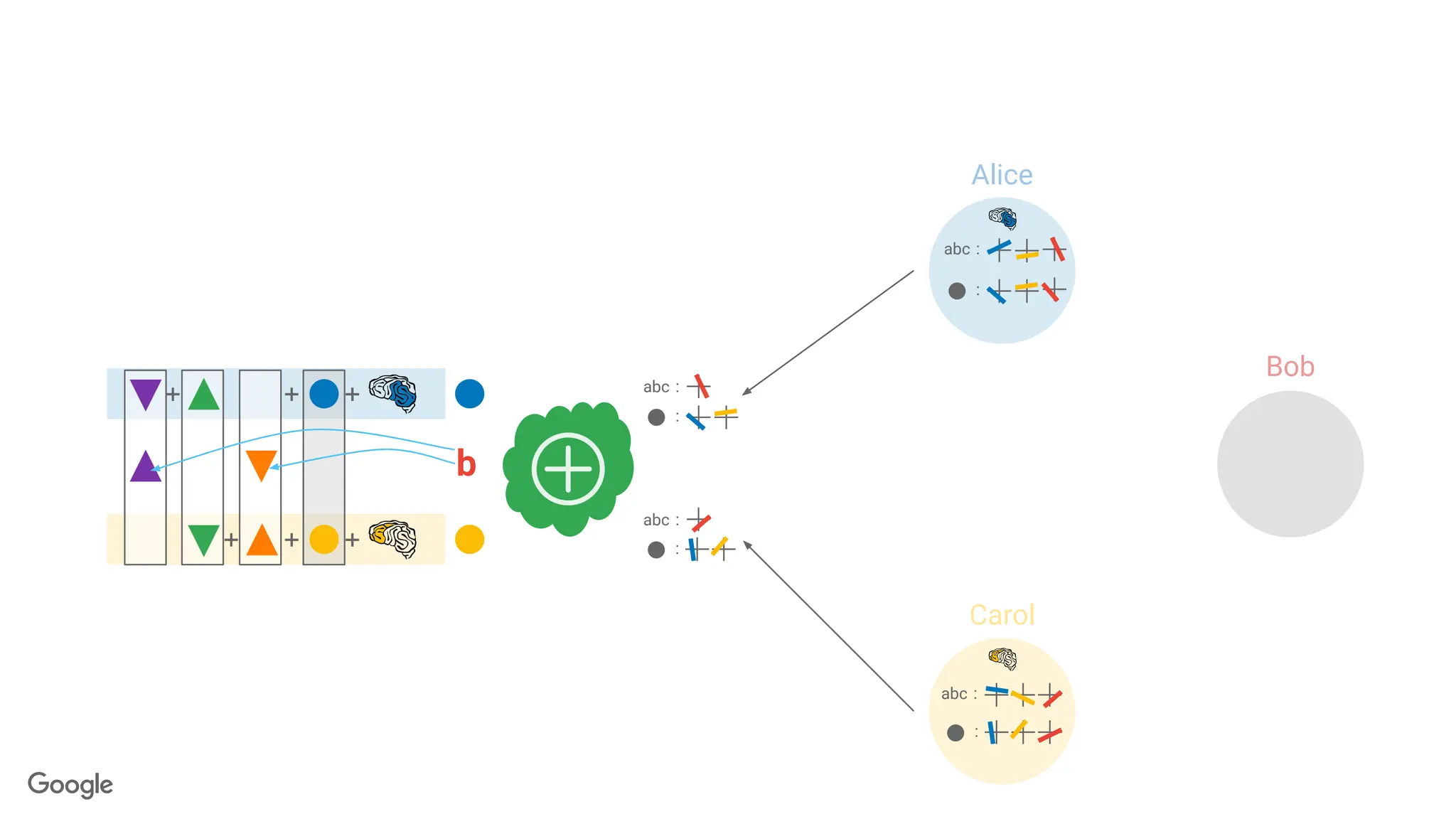
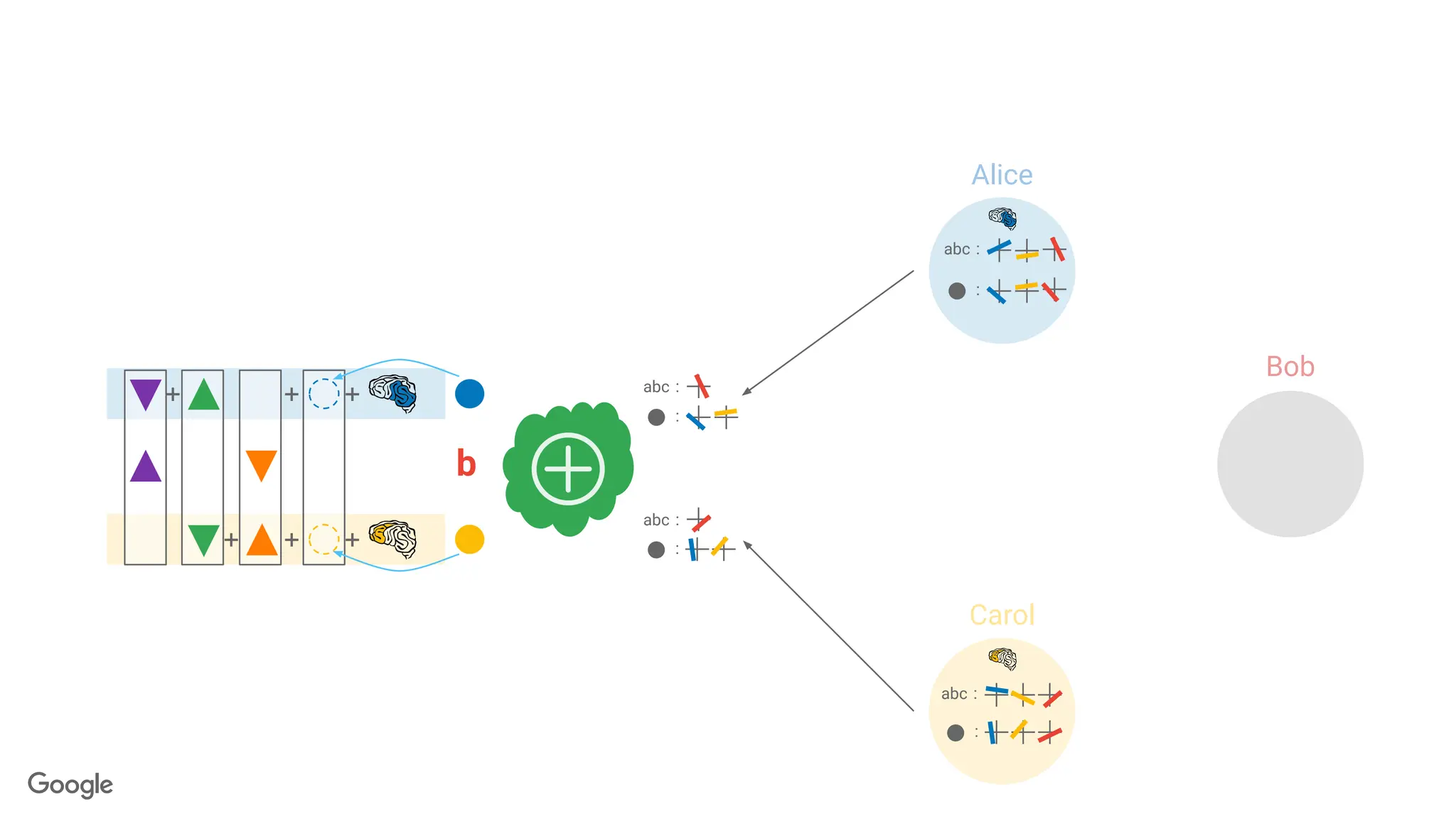
( , b, )?
abc :
:
+
+
+
+
+
+
Alice
Bob
Carol
abc :
:
abc :
:
abc :
:
abc :
:
+
+
+
+
+
+
Alice
Bob
Carol
+
+
+
+
+
+
b
abc :
:
abc :
:
abc :
:
abc :
:
Alice
Bob
Carol
+
+
+
+
+
+
b
abc :
:
abc :
:
abc :
:
abc :
:
Alice
Bob
Carol
+
+
+
+
+
+
b
abc :
:
abc :
:
abc :
:
abc :
:
Alice
Bob
Carol
abc :
abc :
:
:
abc :
:
abc :
:
b
+
+
+
+
+
+
∑
Alice
Bob
Carol
b + +
+
late.
abc :
abc :
:
:
abc :
:
+
+
+
+
+
+
∑
Alice
Bob
Carol
+ +
+
b
late.
Permanent.
(honest users
already gave b)
abc :
abc :
:
:
abc :
:
+
+
+
+
+
+
∑
Alice
Bob
Carol
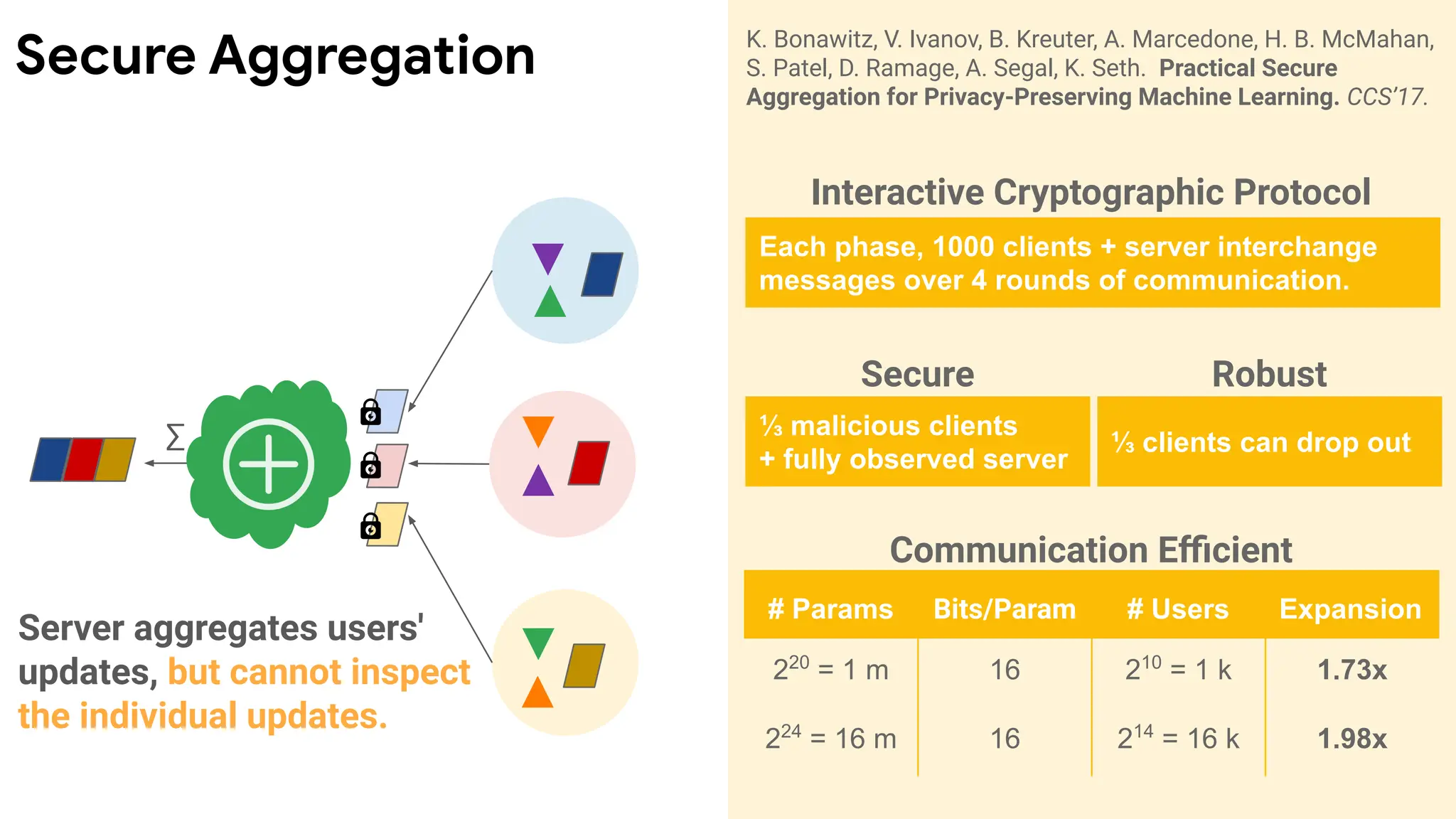
Server aggregates users'
updates, but cannot inspect
the individual updates.
∑
# Params Bits/Param # Users Expansion
220
= 1 m 16 210
= 1 k 1.73x
224
= 16 m 16 214
= 16 k 1.98x
Communication Efficient
Secure
⅓ malicious clients
+ fully observed server
Robust
⅓ clients can drop out
Interactive Cryptographic Protocol
Each phase, 1000 clients + server interchange
messages over 4 rounds of communication.
K. Bonawitz, V. Ivanov, B. Kreuter, A. Marcedone, H. B. McMahan,
S. Patel, D. Ramage, A. Segal, K. Seth. Practical Secure
Aggregation for Privacy-Preserving Machine Learning. CCS’17.
Secure Aggregation
CCS 2017
K. Bonawitz, V. Ivanov, B. Kreuter, A. Marcedone, H. B. McMahan,
S. Patel, D. Ramage, A. Segal, K. Seth. Practical Secure
Aggregation for Privacy-Preserving Machine Learning.
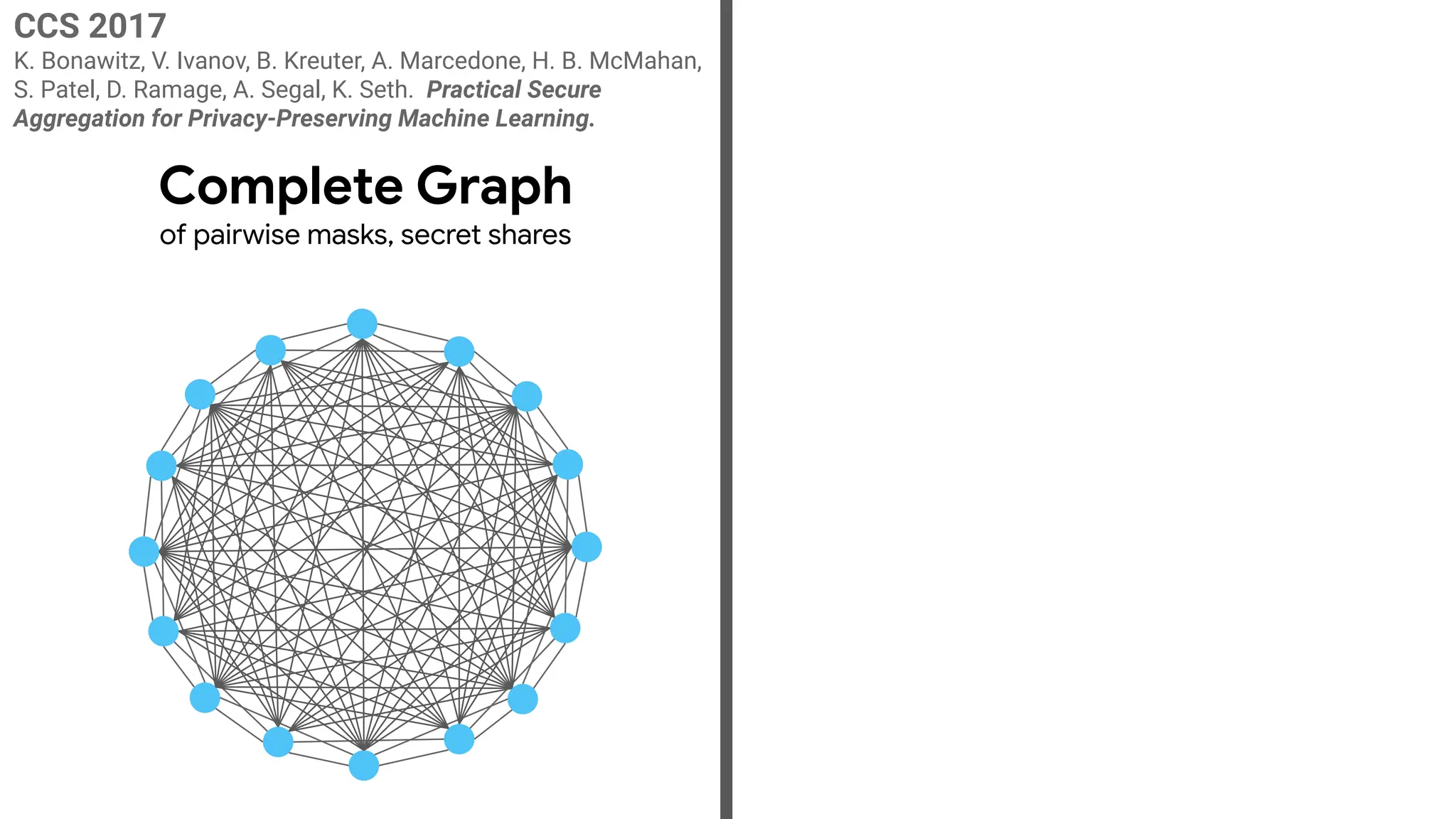
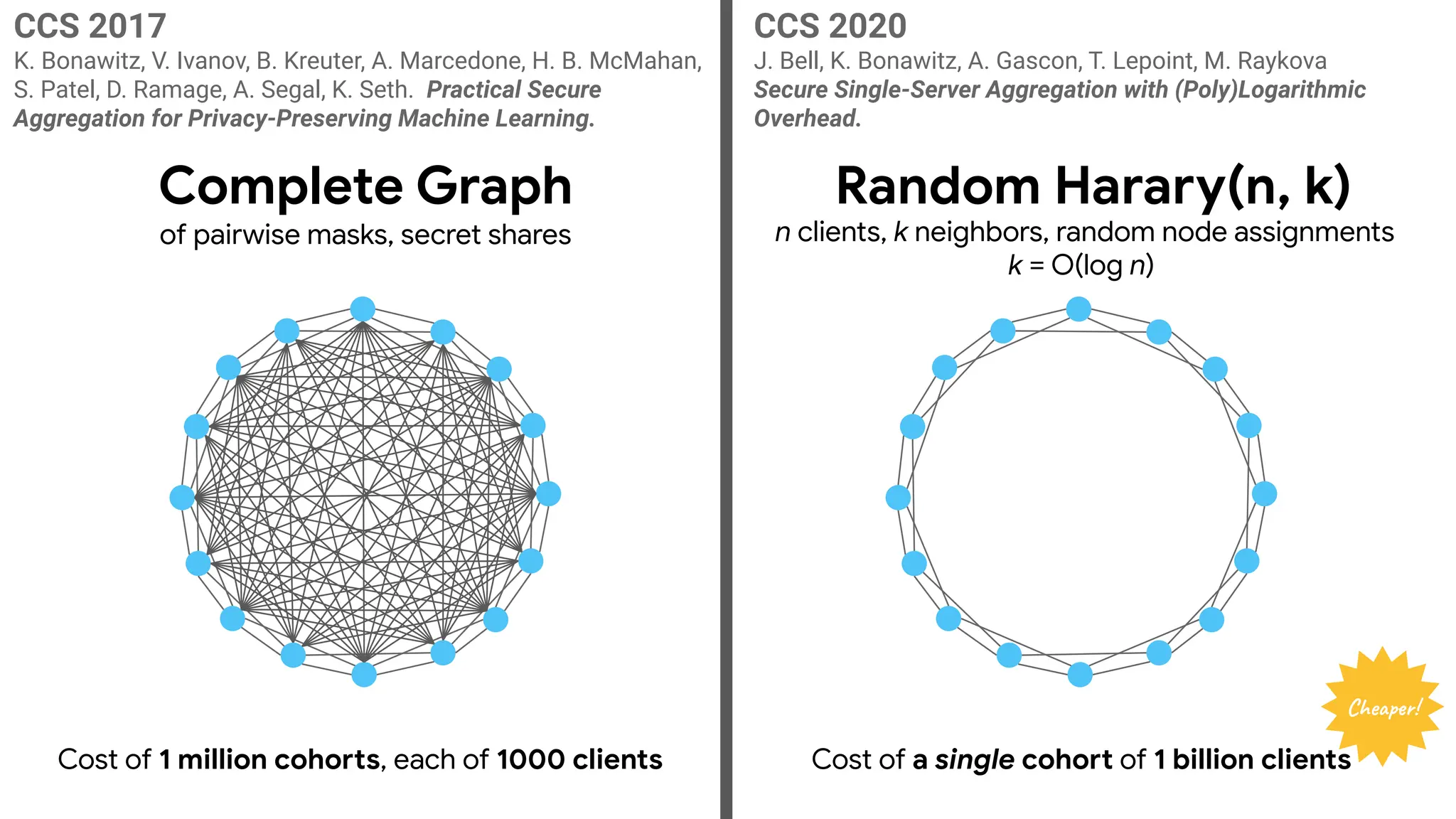
Complete Graph
of pairwise masks, secret shares
Random Harary(n, k)
n clients, k neighbors, random node assignments
k = O(log n)
CCS 2017
K. Bonawitz, V. Ivanov, B. Kreuter, A. Marcedone, H. B. McMahan,
S. Patel, D. Ramage, A. Segal, K. Seth. Practical Secure
Aggregation for Privacy-Preserving Machine Learning.
CCS 2020
J. Bell, K. Bonawitz, A. Gascon, T. Lepoint, M. Raykova
Secure Single-Server Aggregation with (Poly)Logarithmic
Overhead.
Complete Graph
of pairwise masks, secret shares
Secure Aggregation
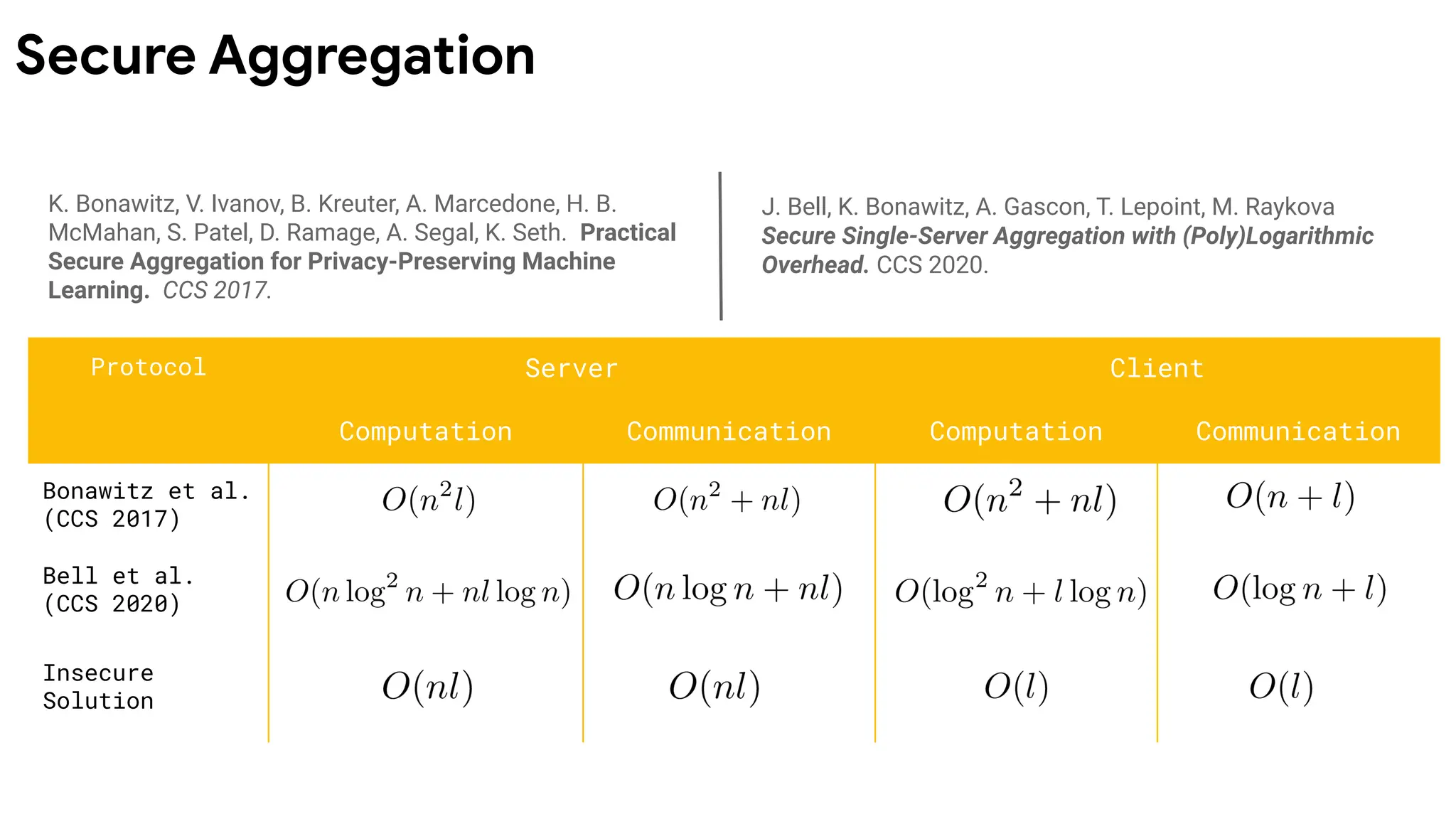
K. Bonawitz, V. Ivanov, B. Kreuter, A. Marcedone, H. B.
McMahan, S. Patel, D. Ramage, A. Segal, K. Seth. Practical
Secure Aggregation for Privacy-Preserving Machine
Learning. CCS 2017.
Protocol Server Client
Computation Communication Computation Communication
Bonawitz et al.
(CCS 2017)
Bell et al.
(CCS 2020)
Insecure
Solution
J. Bell, K. Bonawitz, A. Gascon, T. Lepoint, M. Raykova
Secure Single-Server Aggregation with (Poly)Logarithmic
Overhead. CCS 2020.
Random Harary(n, k)
n clients, k neighbors, random node assignments
k = O(log n)
CCS 2017
K. Bonawitz, V. Ivanov, B. Kreuter, A. Marcedone, H. B. McMahan,
S. Patel, D. Ramage, A. Segal, K. Seth. Practical Secure
Aggregation for Privacy-Preserving Machine Learning.
CCS 2020
J. Bell, K. Bonawitz, A. Gascon, T. Lepoint, M. Raykova
Secure Single-Server Aggregation with (Poly)Logarithmic
Overhead.
Complete Graph
of pairwise masks, secret shares
Cost of 1 million cohorts, each of 1000 clients Cost of a single cohort of 1 billion clients
Cheaper!
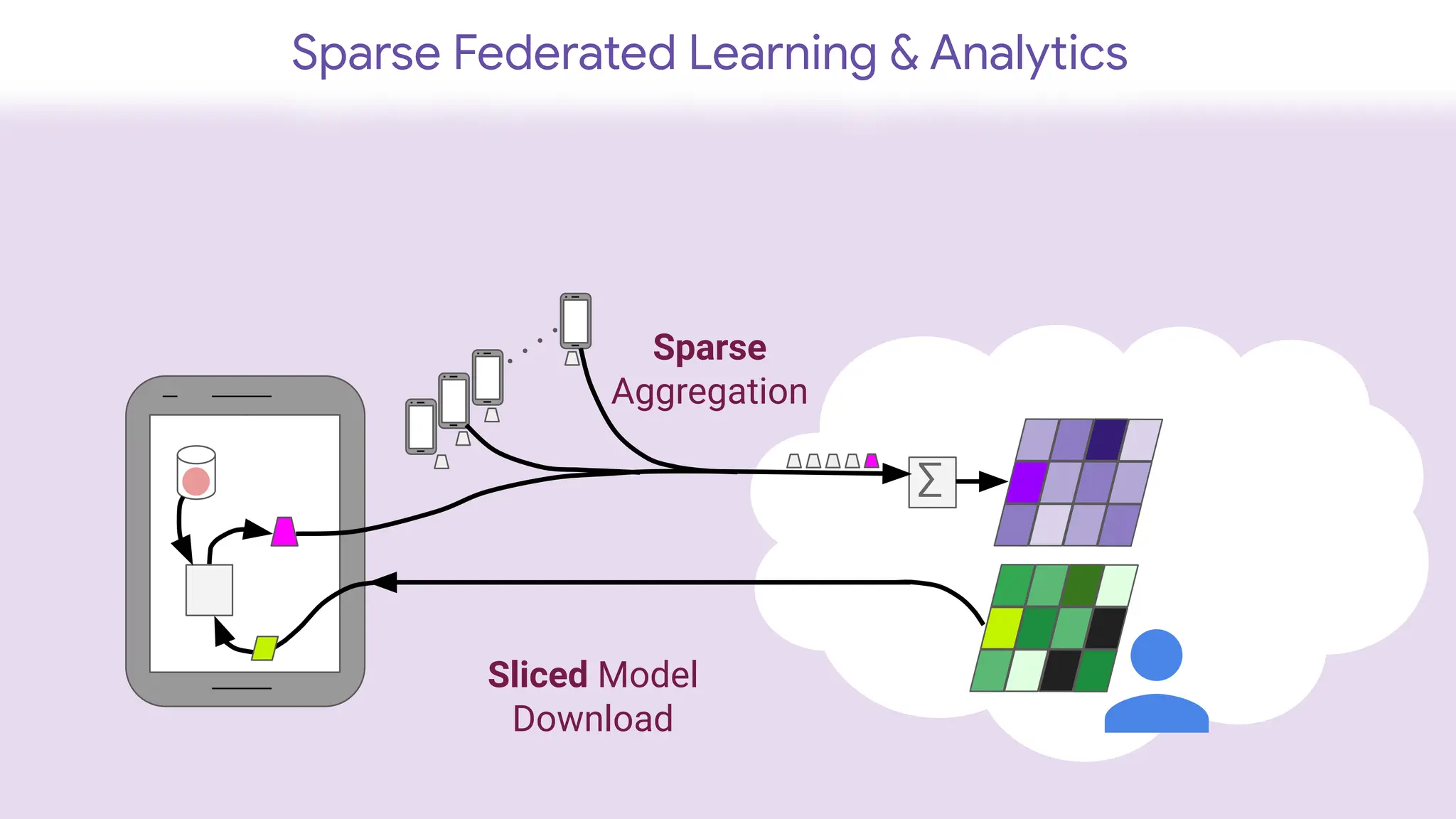
Sparse Federated Learning & Analytics
● Embedding-based models
○ Word-based Language Models
○ Object Recognition
● Compound models
○ Multiple fixed domains
e.g. locations, companies, etc
○ Genre/cluster models
○ Pluralistic models
● Federated Analytics
Sparse Federated Learning & Analytics
∑
Sparse
Aggregation
Sliced Model
Download
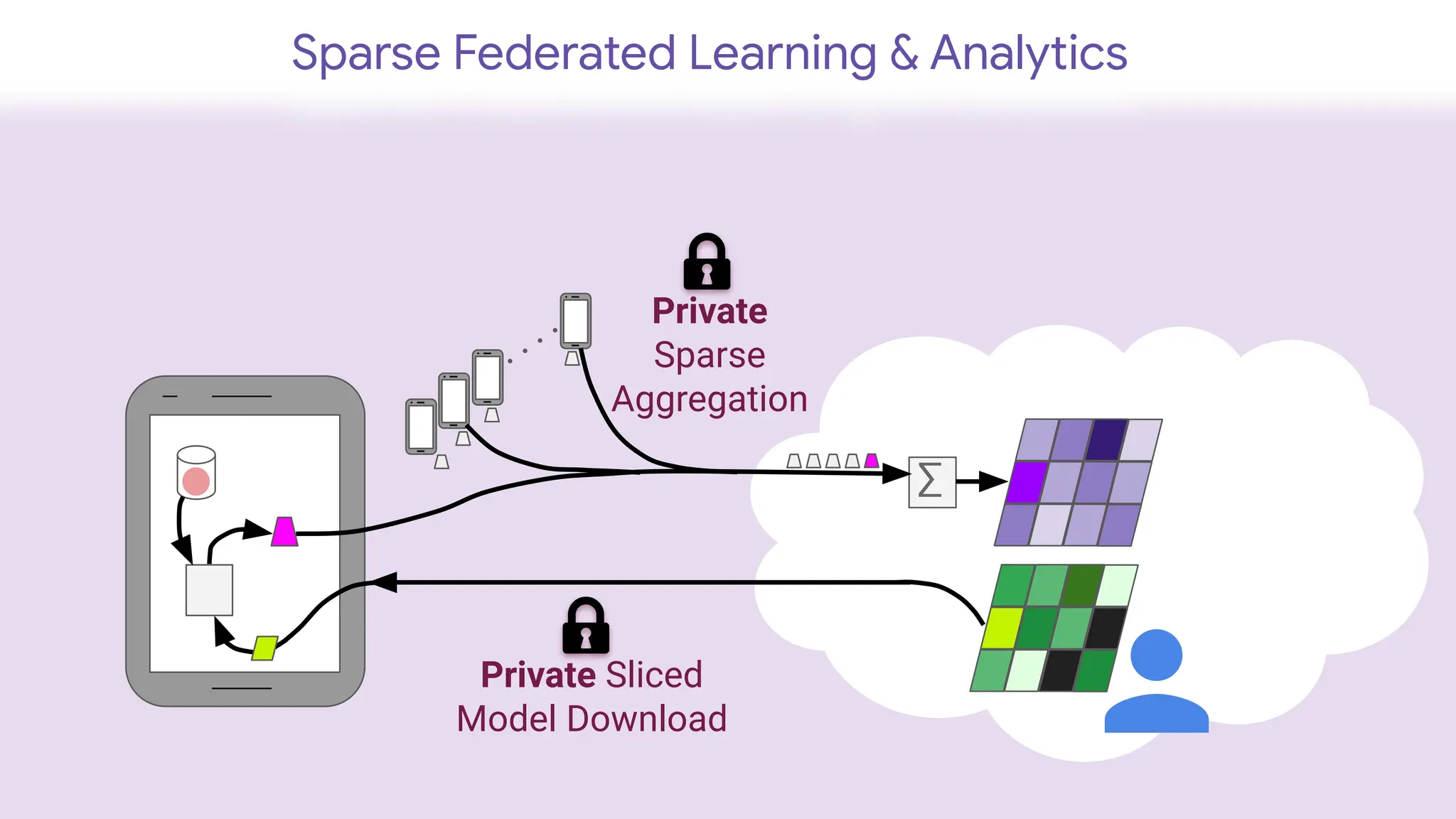
Sparse Federated Learning & Analytics
∑
Private Sliced
Model Download
Private
Sparse
Aggregation
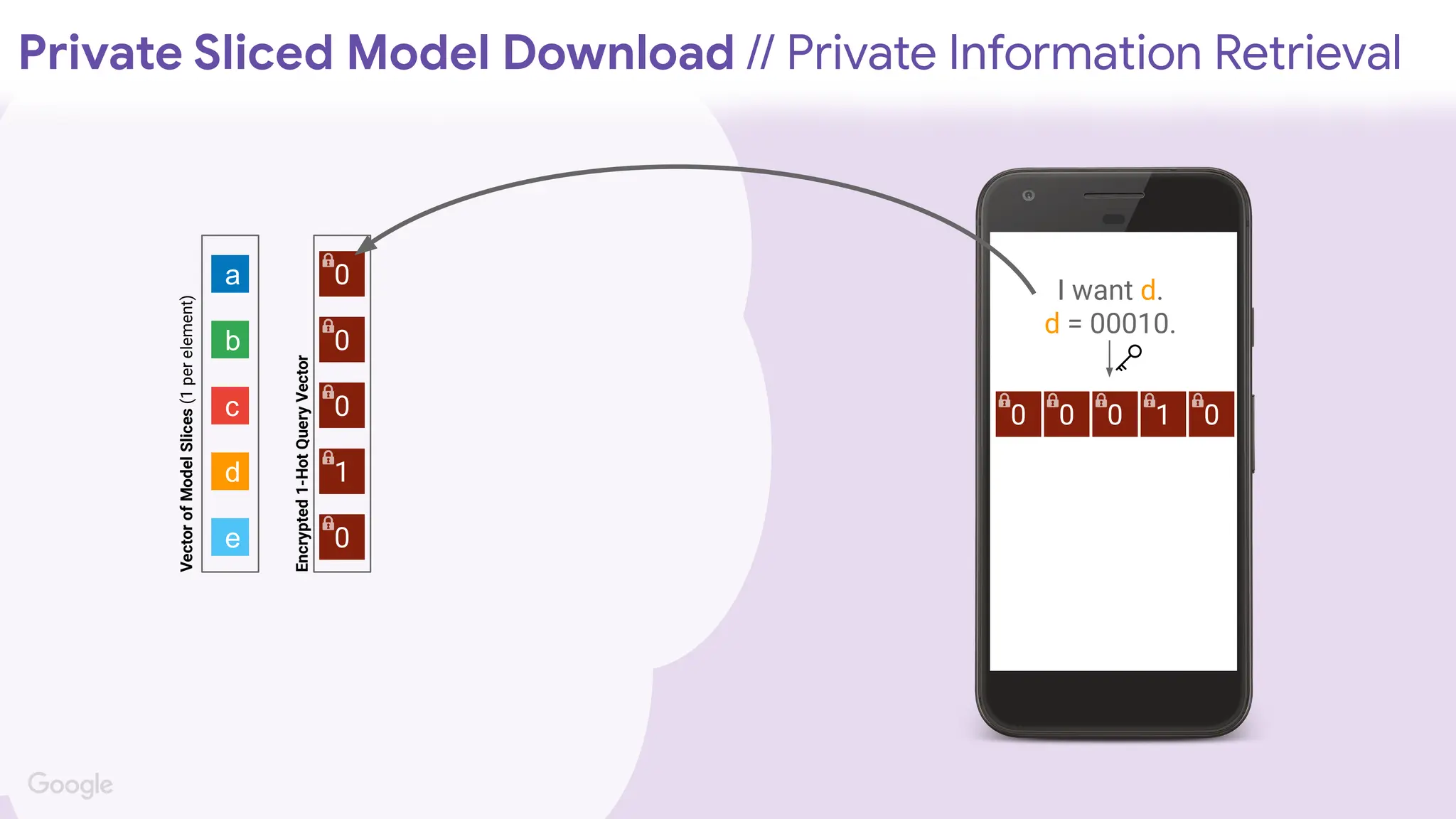
I want d.
d = 00010.
0 0 0 1 0
0
0
0
1
0
a
b
c
d
e
Private Sliced Model Download // Private Information Retrieval
Vector
of
Model
Slices
(1
per
element)
Encrypted
1-Hot
Query
Vector
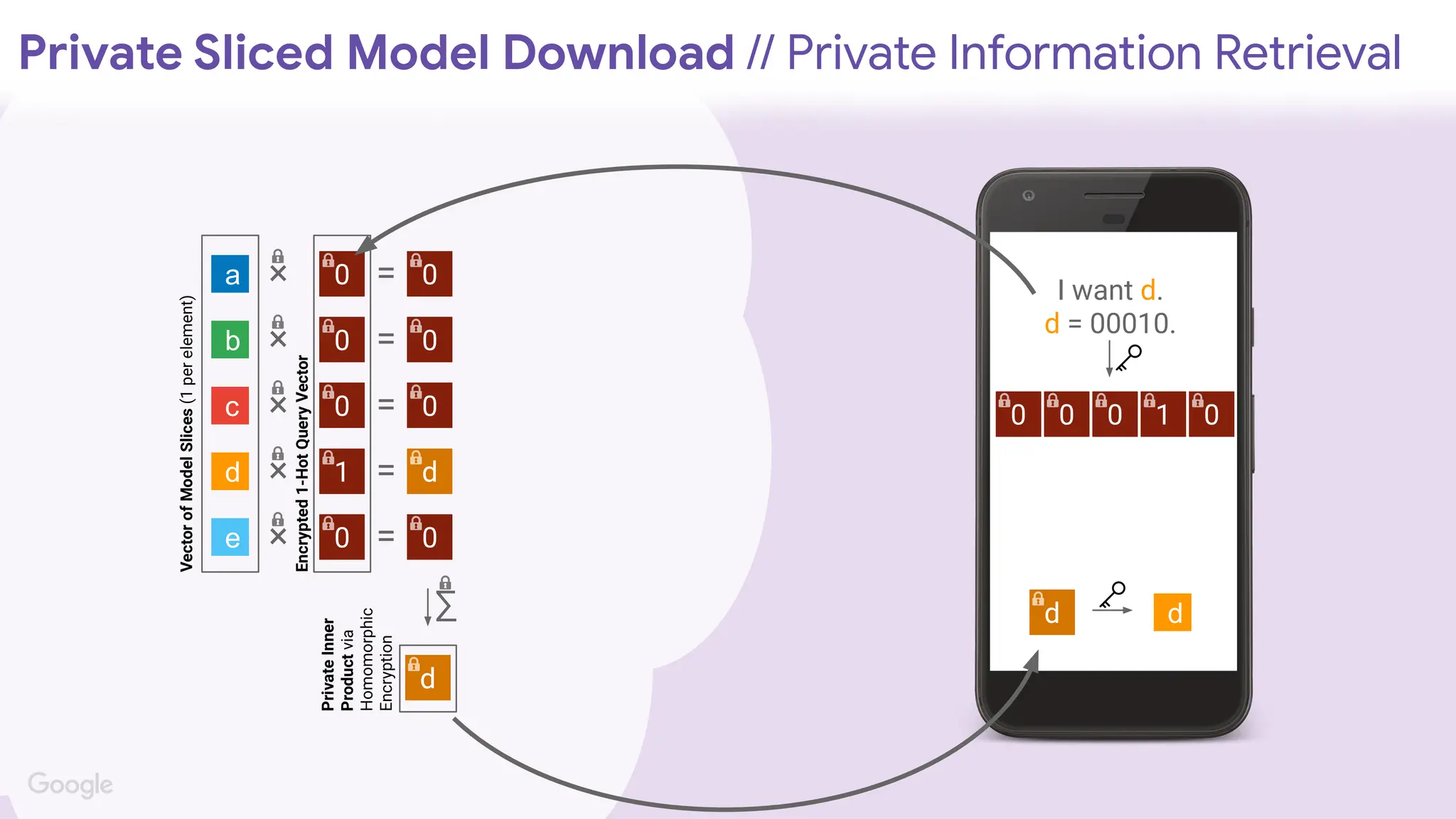
×
×
×
×
×
=
=
=
=
=
∑
I want d.
d = 00010.
0 0 0 1 0
0
0
0
1
0
0
0
0
0
d
d
d
d
d
d
a
b
c
d
e
d
Private Sliced Model Download // Private Information Retrieval
Vector
of
Model
Slices
(1
per
element)
Encrypted
1-Hot
Query
Vector
Private
Inner
Product
via
Homomorphic
Encryption
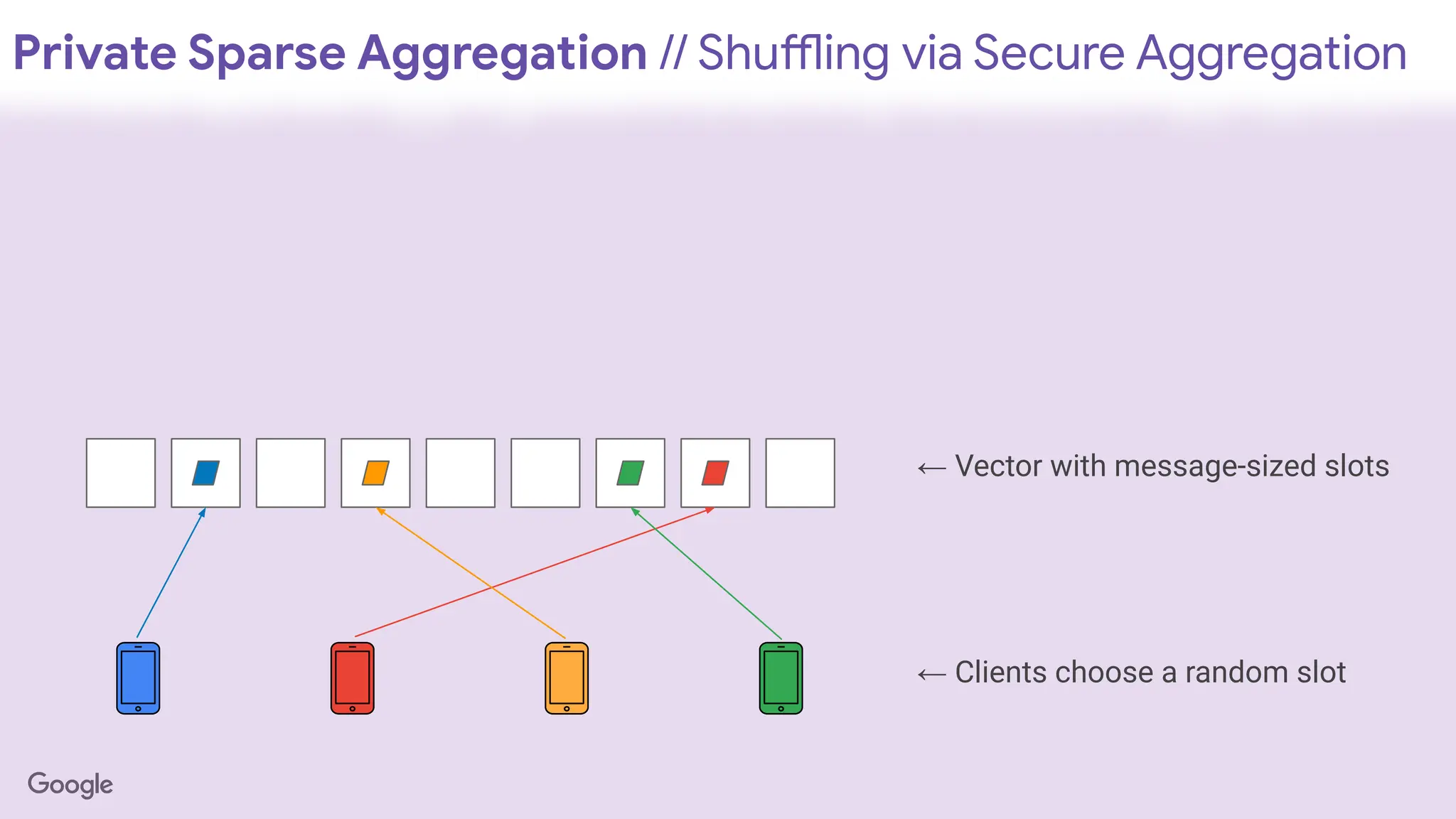
Private Sparse Aggregation // Shuffling via Secure Aggregation
← Vector with message-sized slots
← Clients choose a random slot
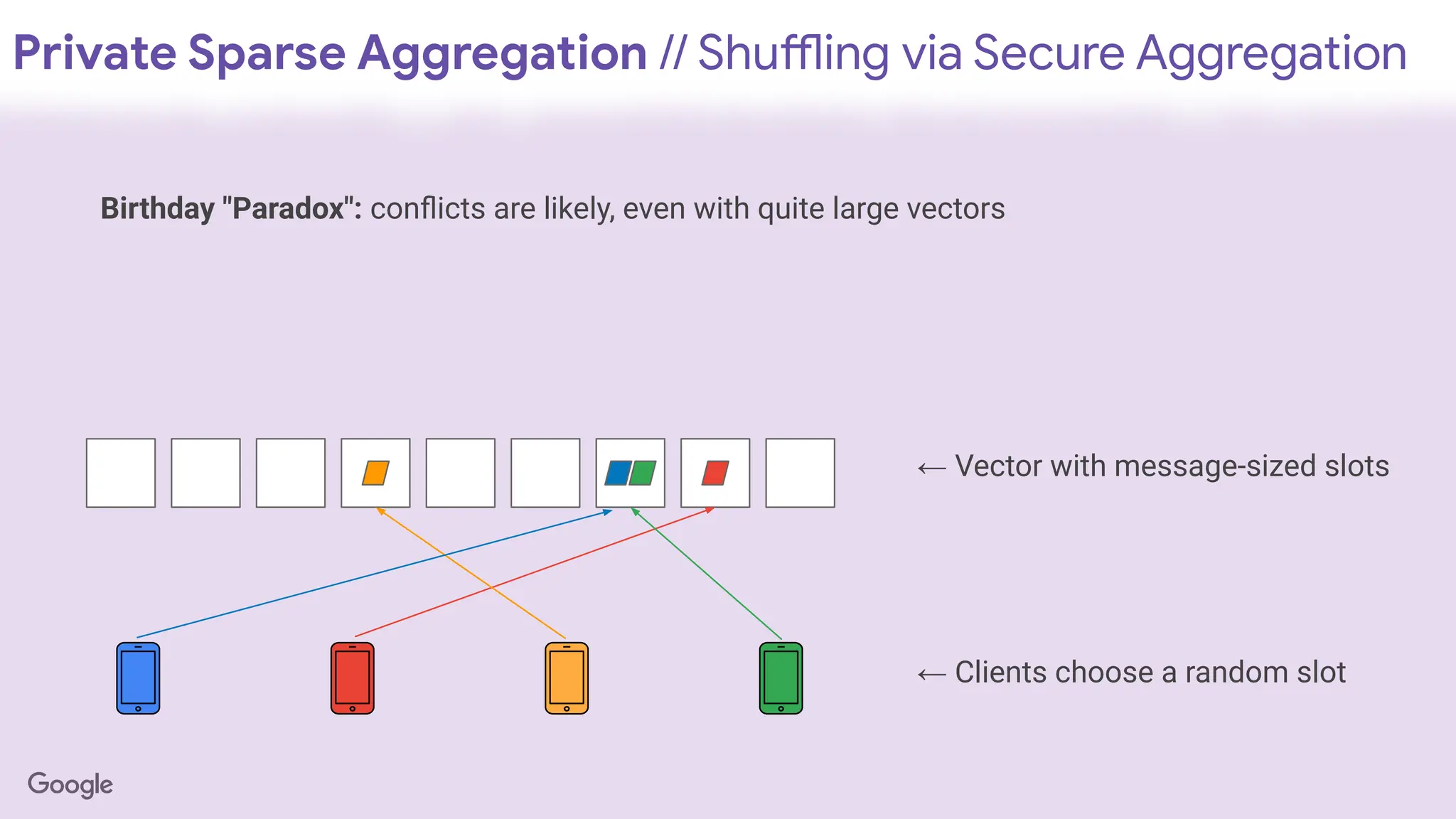
Private Sparse Aggregation // Shuffling via Secure Aggregation
← Vector with message-sized slots
← Clients choose a random slot
Birthday "Paradox": conflicts are likely, even with quite large vectors
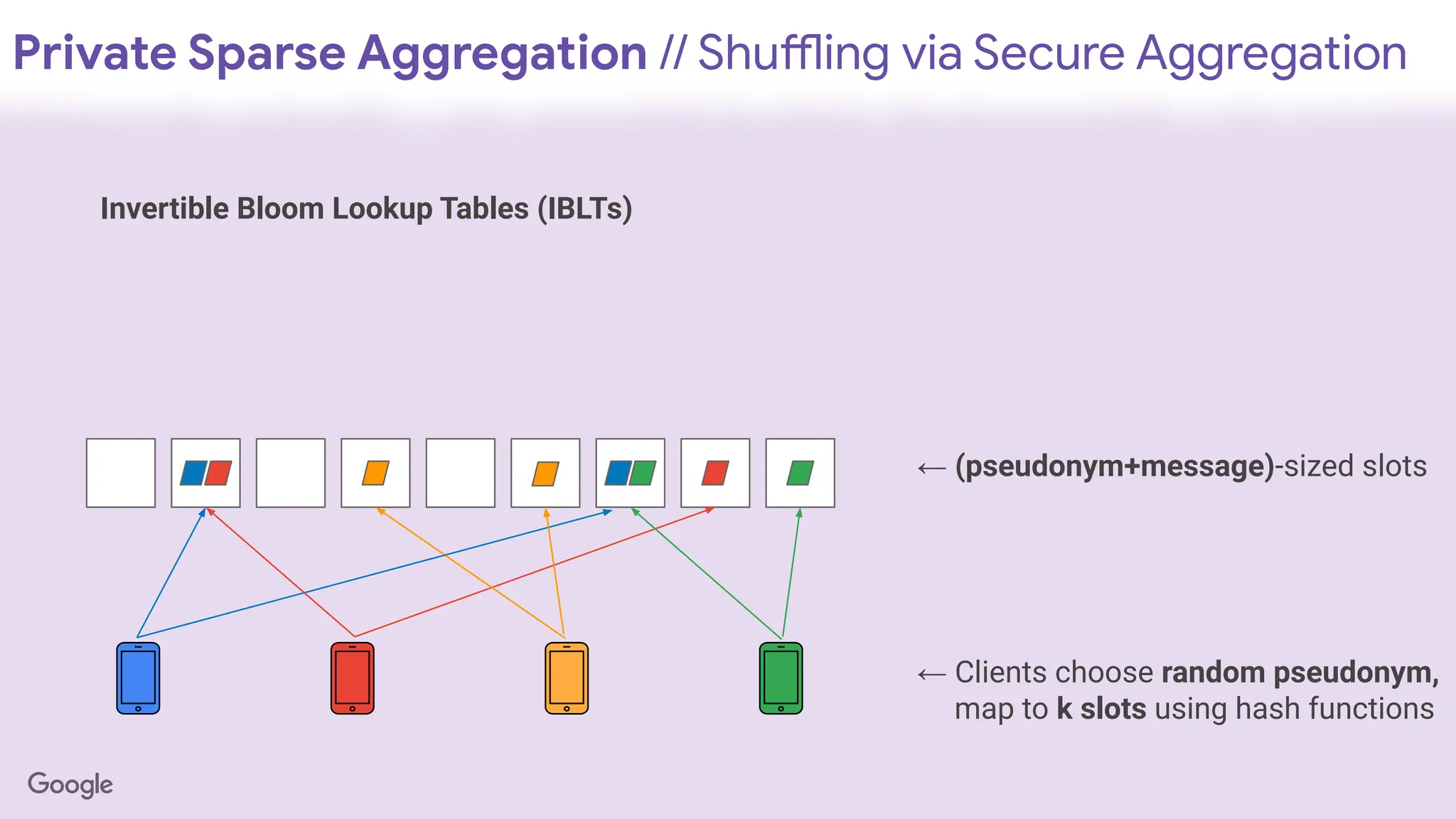
Private Sparse Aggregation // Shuffling via Secure Aggregation
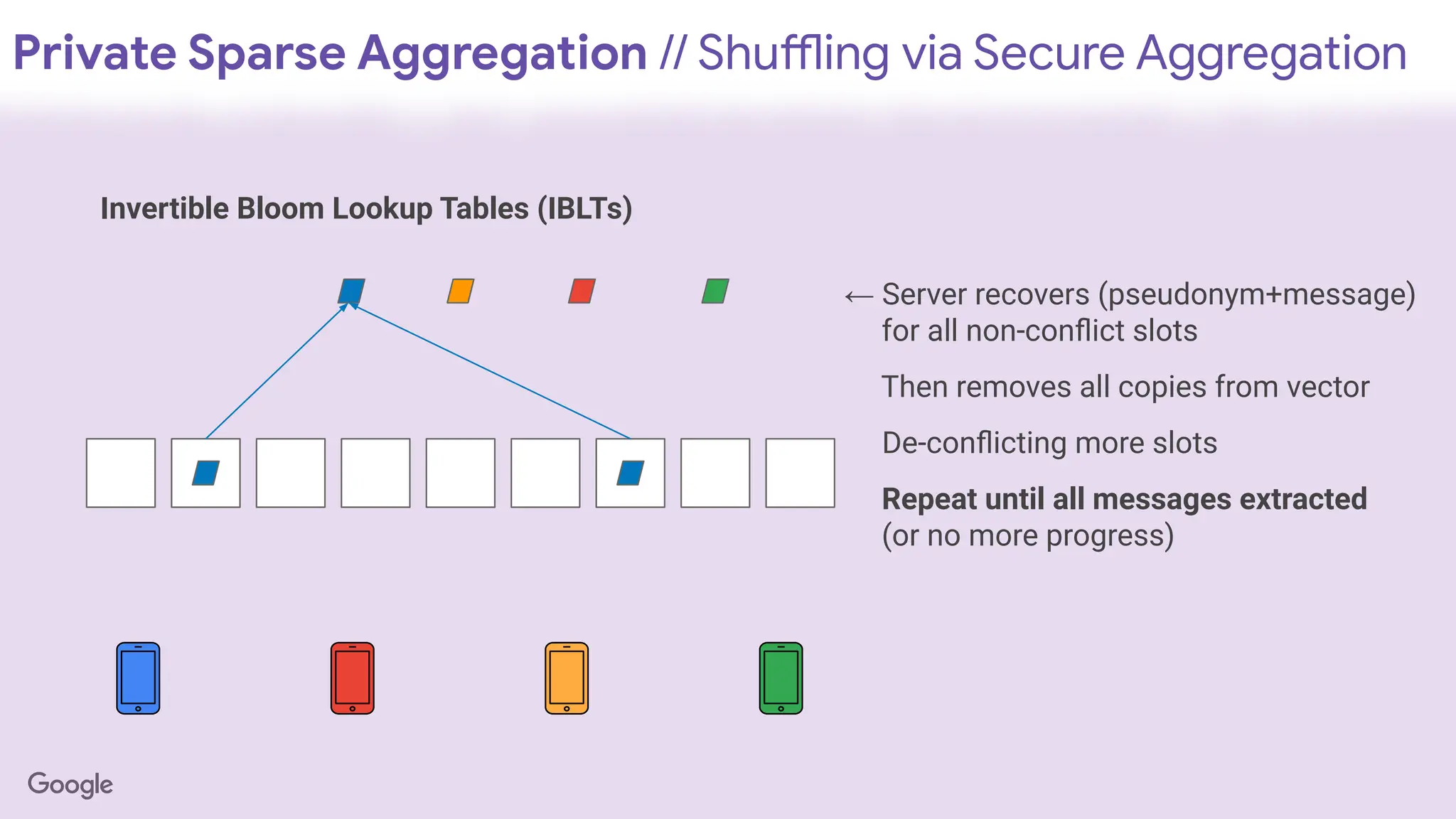
Invertible Bloom Lookup Tables (IBLTs)
← (pseudonym+message)-sized slots
← Clients choose random pseudonym,
map to k slots using hash functions
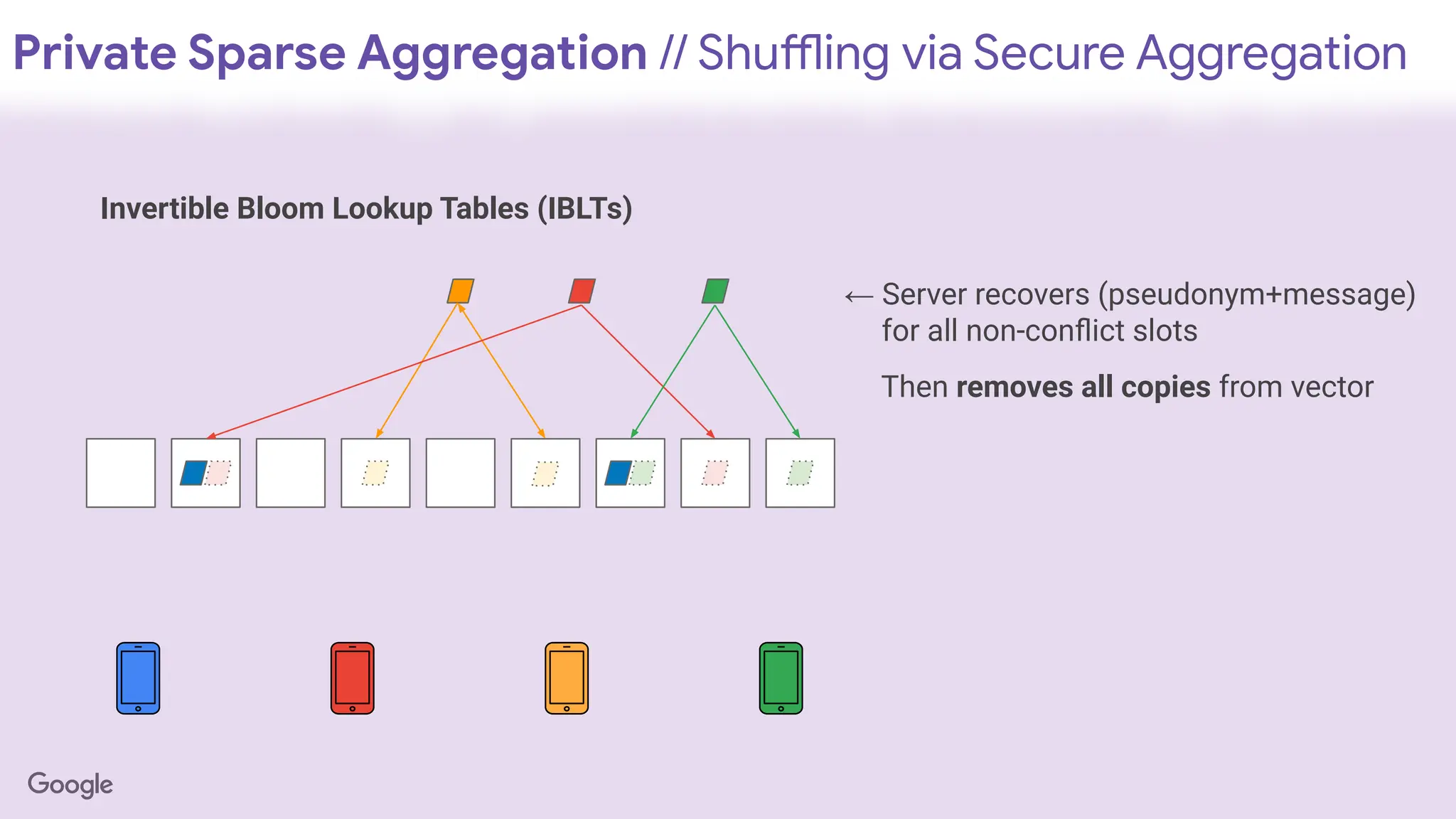
Private Sparse Aggregation // Shuffling via Secure Aggregation
Invertible Bloom Lookup Tables (IBLTs)
← Server recovers (pseudonym+message)
for all non-conflict slots
Private Sparse Aggregation // Shuffling via Secure Aggregation
Invertible Bloom Lookup Tables (IBLTs)
← Server recovers (pseudonym+message)
for all non-conflict slots
Then removes all copies from vector
Private Sparse Aggregation // Shuffling via Secure Aggregation
Invertible Bloom Lookup Tables (IBLTs)
← Server recovers (pseudonym+message)
for all non-conflict slots
Then removes all copies from vector
De-conflicting more slots
Private Sparse Aggregation // Shuffling via Secure Aggregation
Invertible Bloom Lookup Tables (IBLTs)
← Server recovers (pseudonym+message)
for all non-conflict slots
Then removes all copies from vector
De-conflicting more slots
Repeat until all messages extracted
(or no more progress)
Private Sparse Aggregation // Shuffling via Secure Aggregation
Invertible Bloom Lookup Tables (IBLTs)
J. Bell, K. Bonawitz, A. Gascon, T. Lepoint, M. Raykova
Secure Single-Server Aggregation with (Poly)Logarithmic
Overhead. CCS 2020.
Vector Length ~= 1.3x messages!
Figure 4. Expected fraction of messages recovered and probability
of recovering all messages against the length 𝑙 of the vectors
used. For this the number of clients is 𝑛 = 10000 and each inserts
their message in 𝑐 = 3 places.
Differentially Private Federated
Training
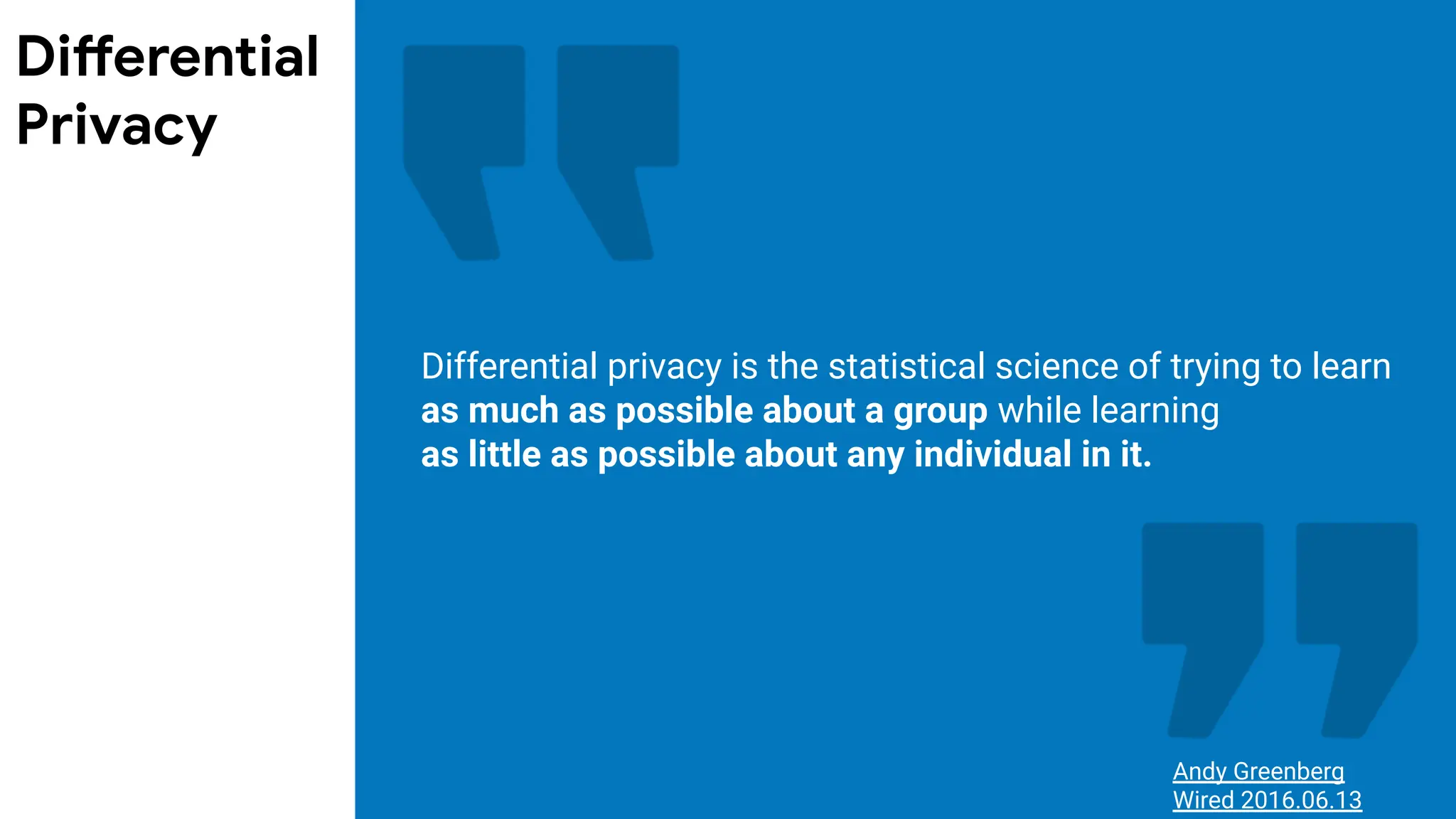
Differential privacy is the statistical science of trying to learn
as much as possible about a group while learning
as little as possible about any individual in it.
Andy Greenberg
Wired 2016.06.13
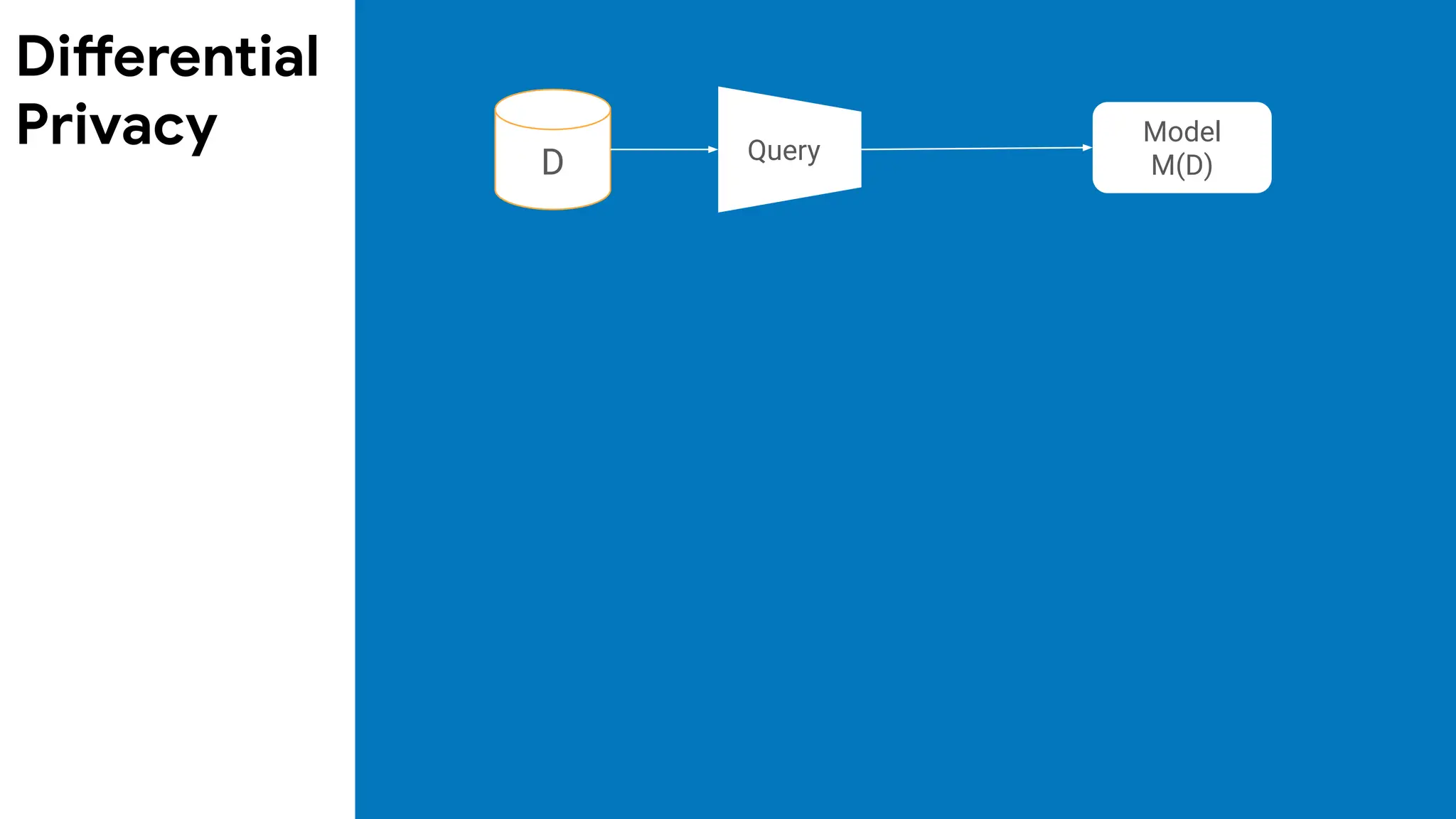
Differential
Privacy
Query
Model
M(D)
D
Differential
Privacy
Query
Model
M(D)
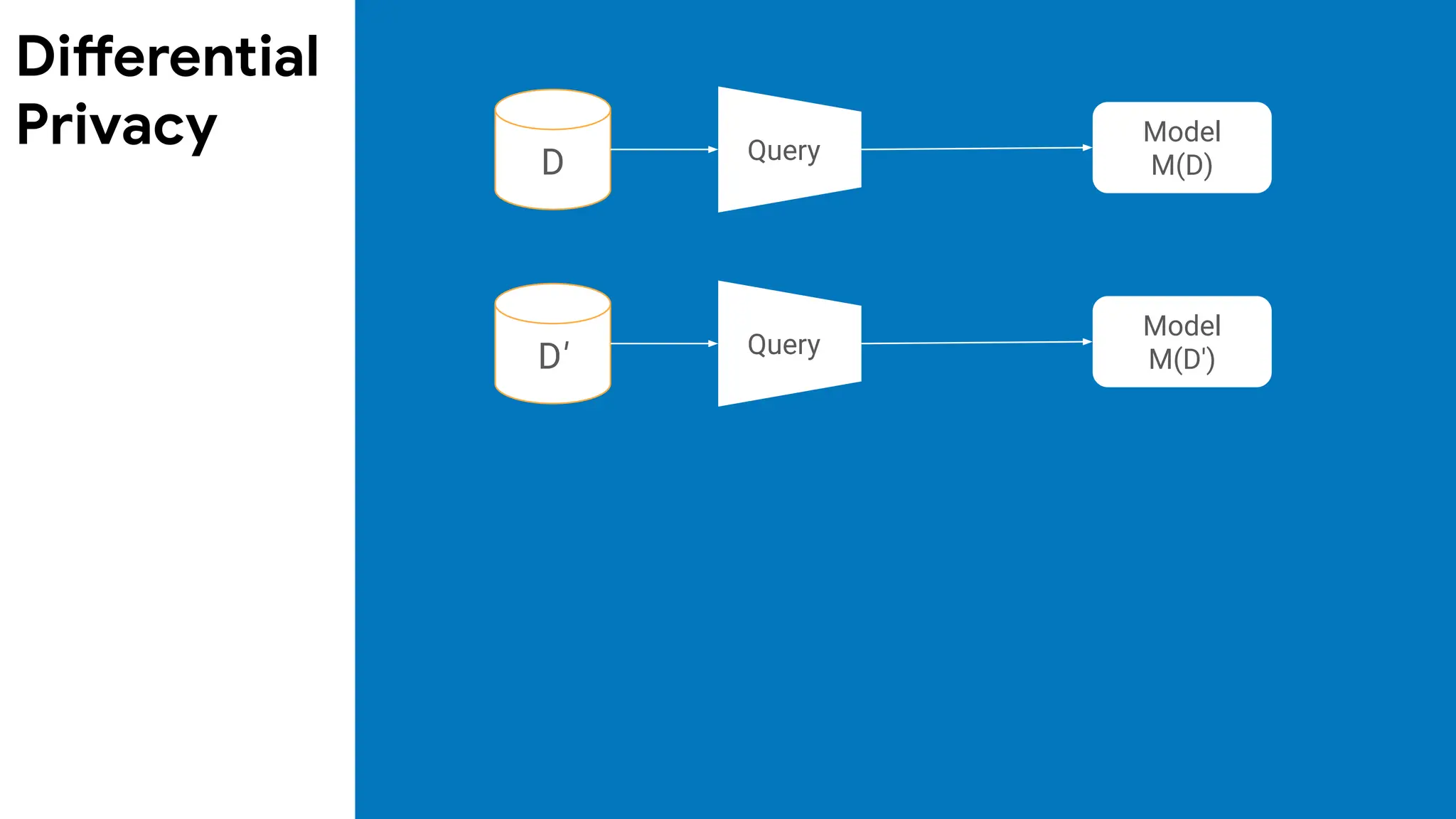
Query
Model
M(D')
D
D'
Differential
Privacy
Query
Model
M(D)
Query
Model
M(D')
D
D'
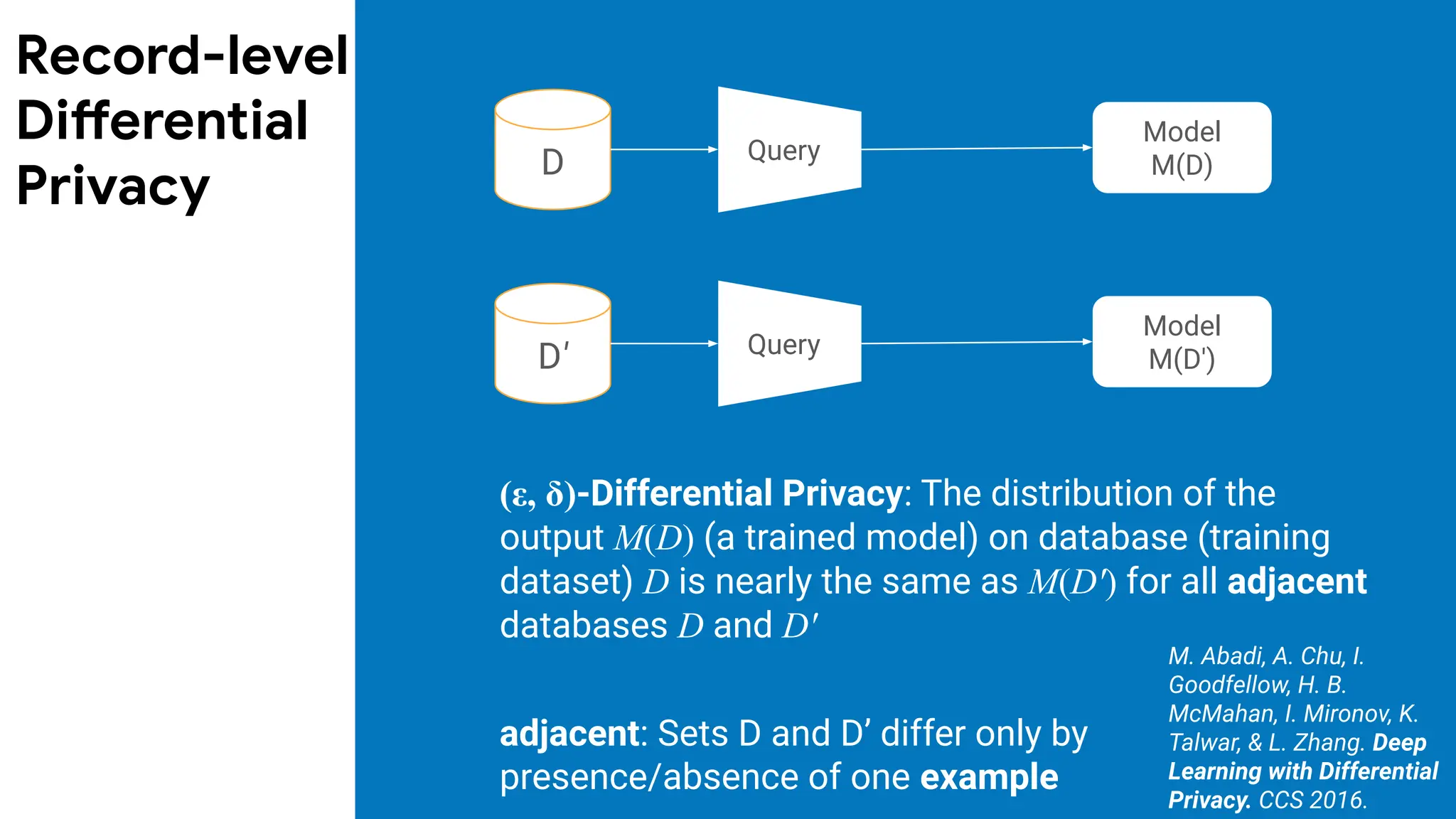
(ε, δ)-Differential Privacy: The distribution of the
output M(D) (a trained model) on database (training
dataset) D is nearly the same as M(D′) for all
adjacent databases D and D′
∀S: Pr[M(D)∊S] ≤ exp(ε) ∙ Pr[M(D′)∊S] + δ
Differential
Privacy
Query
Model
M(D)
Query
Model
M(D')
D
D'
(ε, δ)-Differential Privacy: The distribution of the
output M(D) (a trained model) on database (training
dataset) D is nearly the same as M(D′) for all adjacent
databases D and D′
adjacent: Sets D and D’ differ only by
presence/absence of one example
M. Abadi, A. Chu, I.
Goodfellow, H. B.
McMahan, I. Mironov, K.
Talwar, & L. Zhang. Deep
Learning with Differential
Privacy. CCS 2016.
Record-level
Differential
Privacy
Query
Model
M(D)
Query
Model
M(D')
D
D'
(ε, δ)-Differential Privacy: The distribution of the
output M(D) (a trained model) on database (training
dataset) D is nearly the same as M(D′) for all adjacent
databases D and D′
adjacent: Sets D and D’ differ only by
presence/absence of one example user
H. B. McMahan, et al.
Learning Differentially
Private Recurrent
Language Models.
ICLR 2018.
User-level
Differential
Privacy
D
r4
r7
r10
r1780
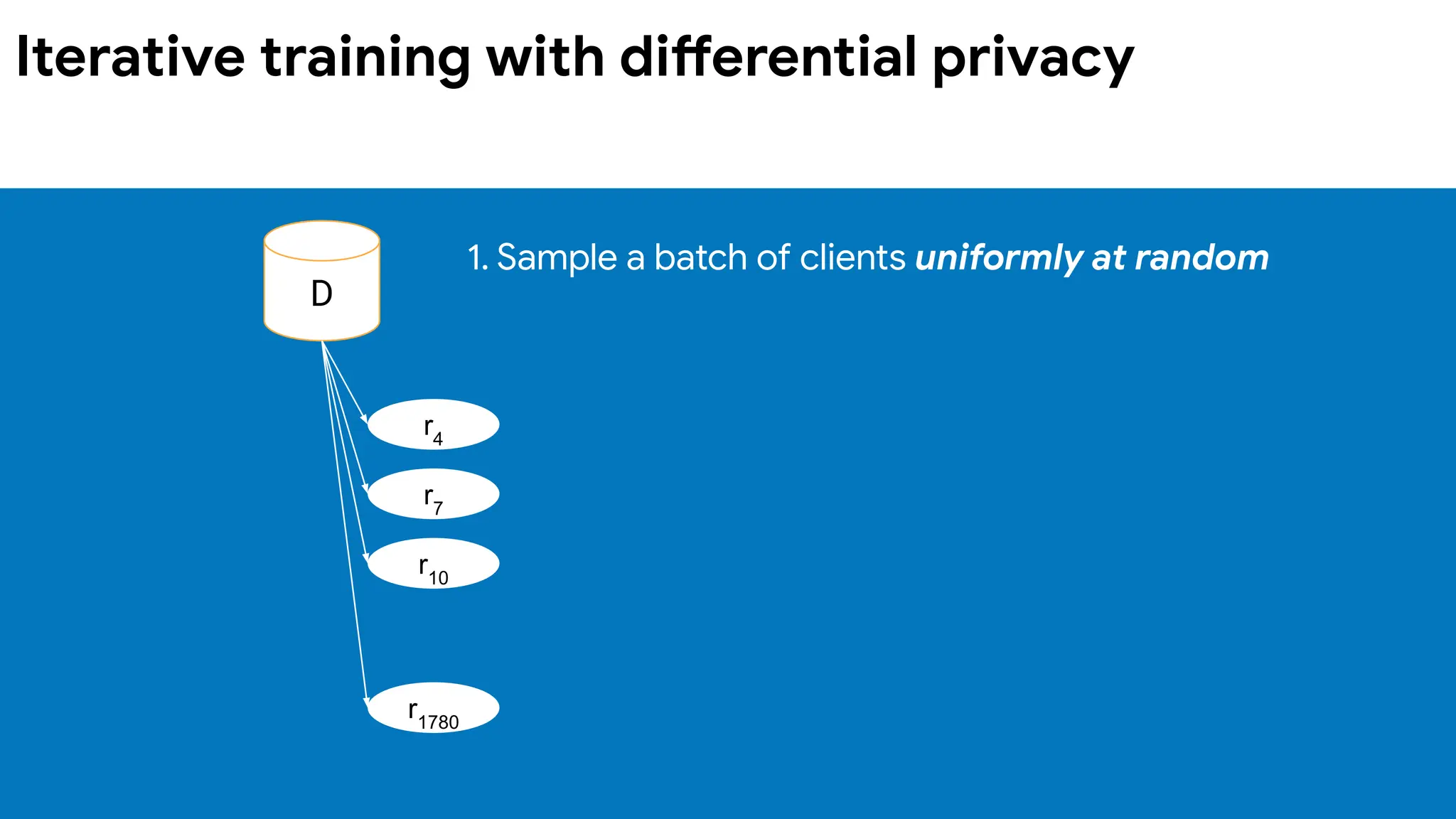
1. Sample a batch of clients uniformly at random
Iterative training with differential privacy
D
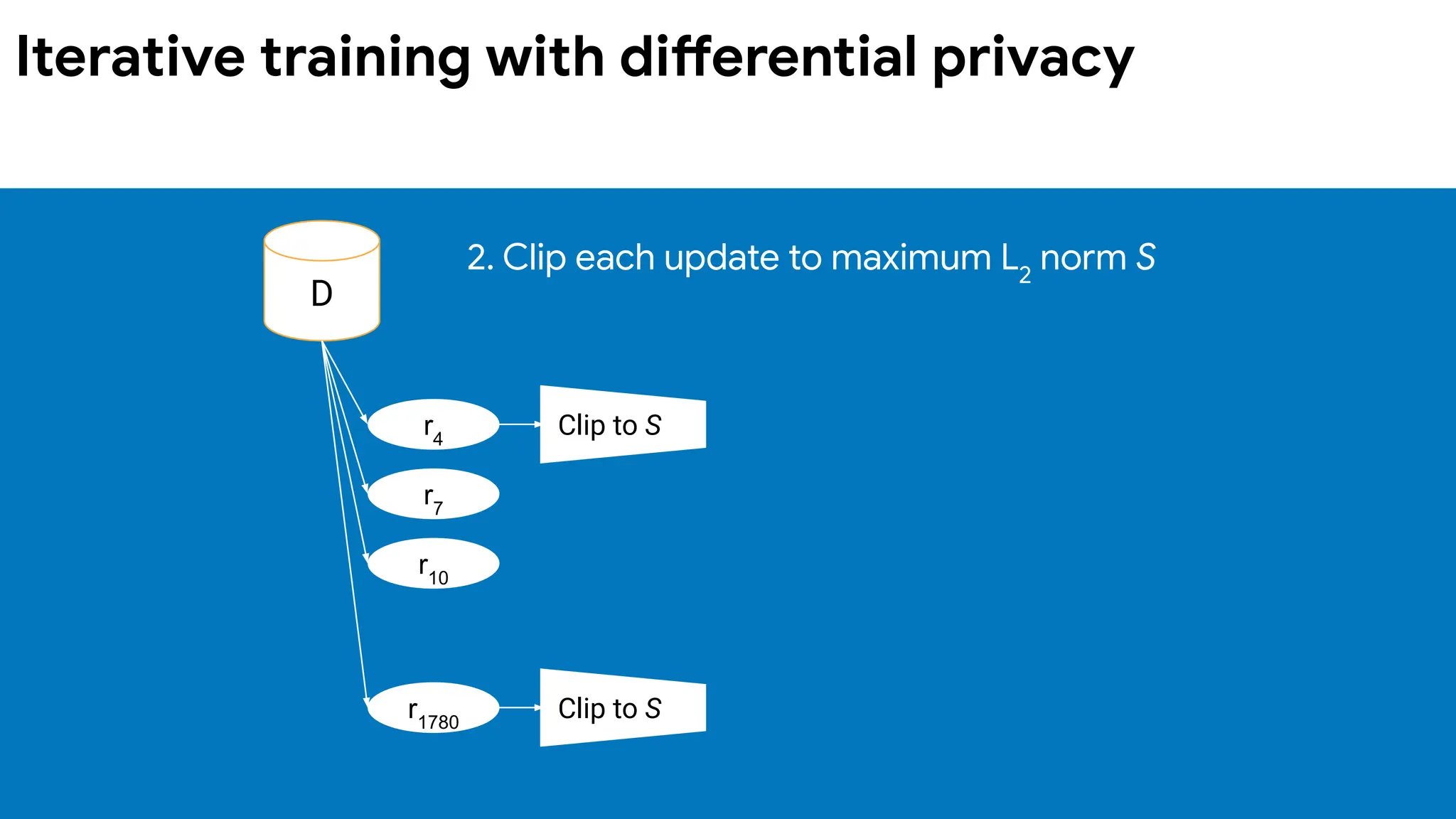
2. Clip each update to maximum L2
norm S
Clip to S
Clip to S
r4
r7
r10
r1780
Iterative training with differential privacy
D
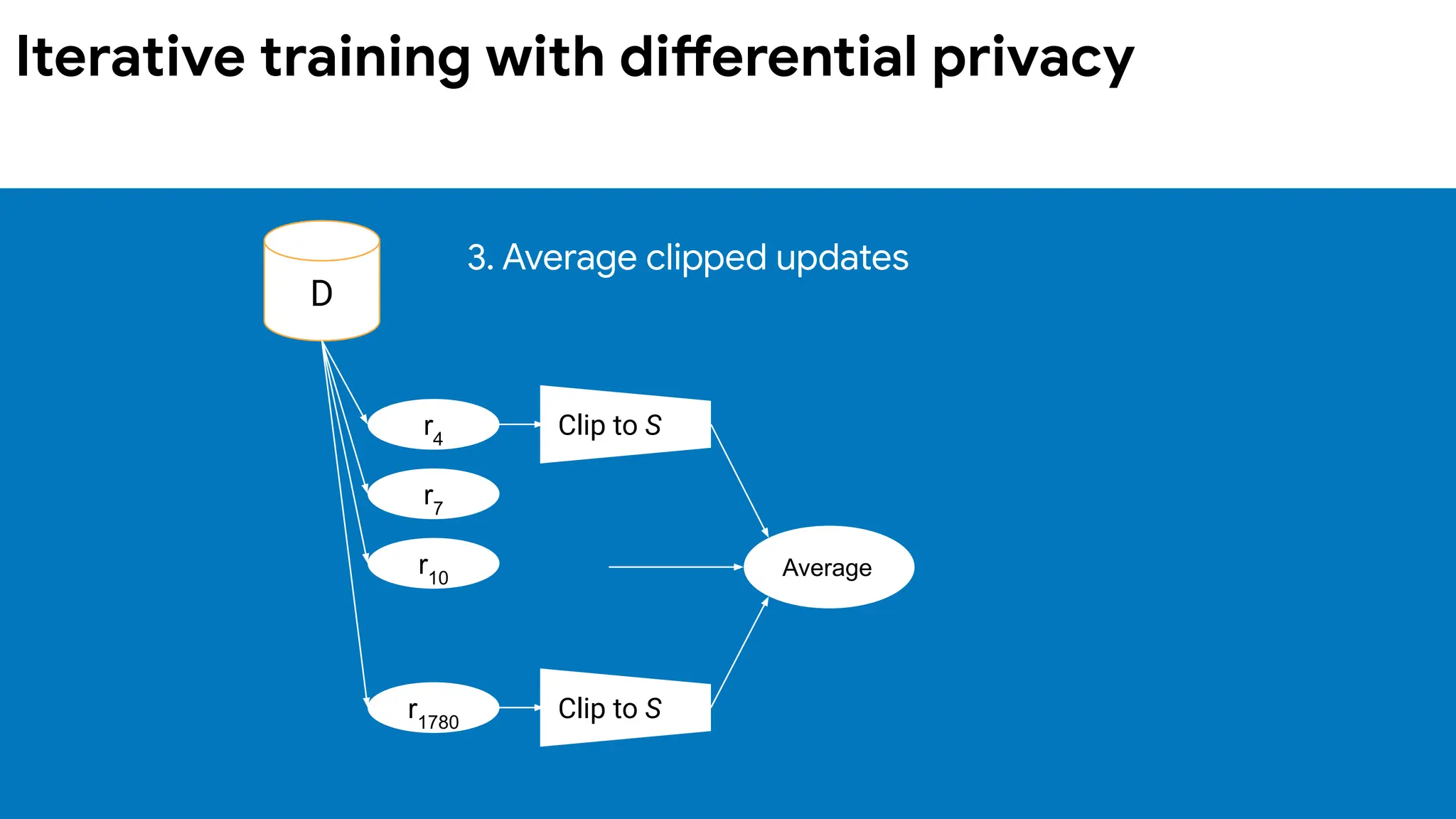
3. Average clipped updates
Average
Clip to S
Clip to S
r4
r7
r10
r1780
Iterative training with differential privacy
D
4. Add noise
+
Average
Clip to S
Clip to S
r4
r7
r10
r1780
Iterative training with differential privacy
5. Incorporate into model
Update
model
D
+
Average
Clip to S
Clip to S
r4
r7
r10
r1780
Iterative training with differential privacy
There are many details and possibilities
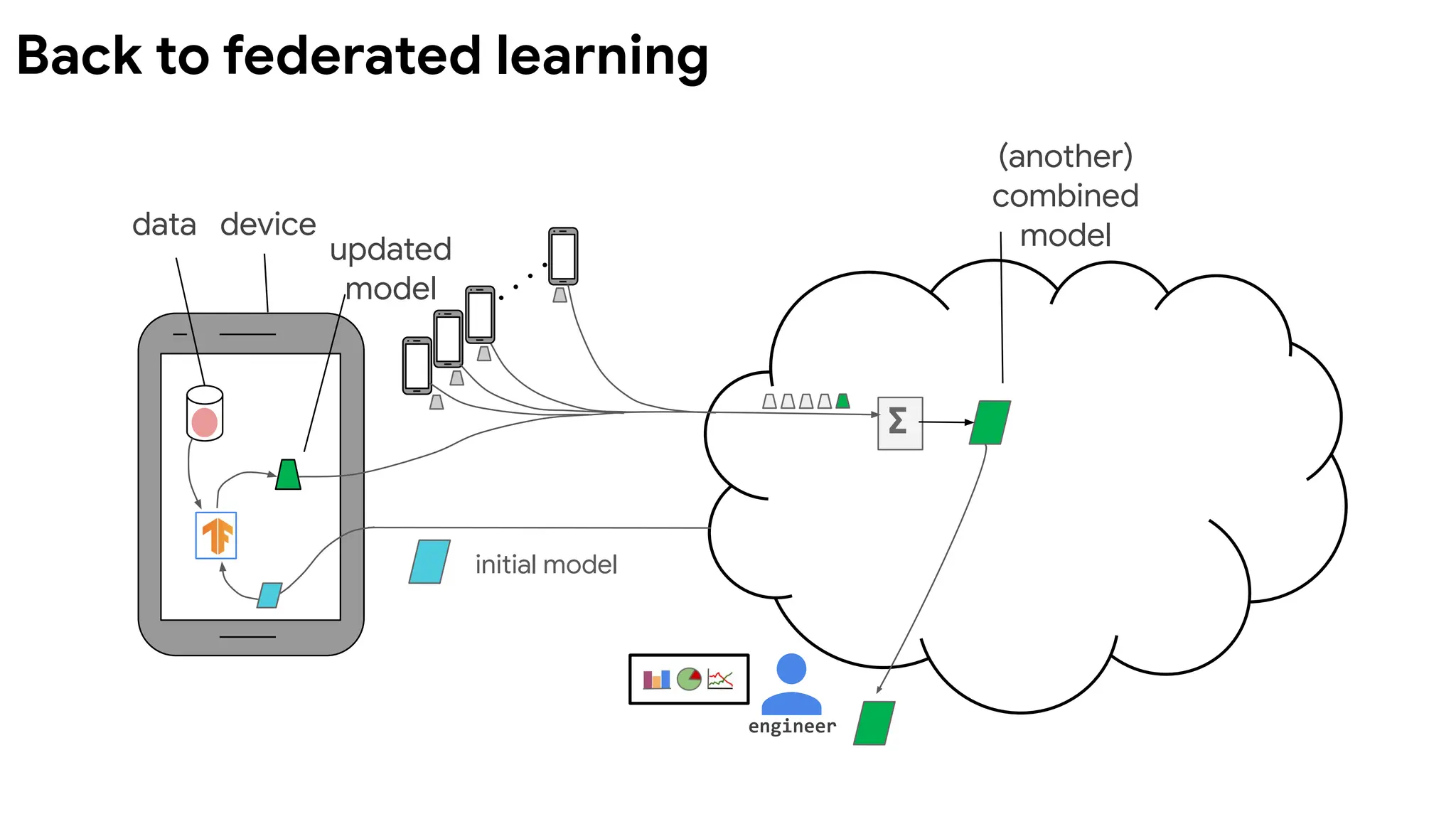
data device
∑
updated
model
engineer
(another)
combined
model
initial model
Back to federated learning
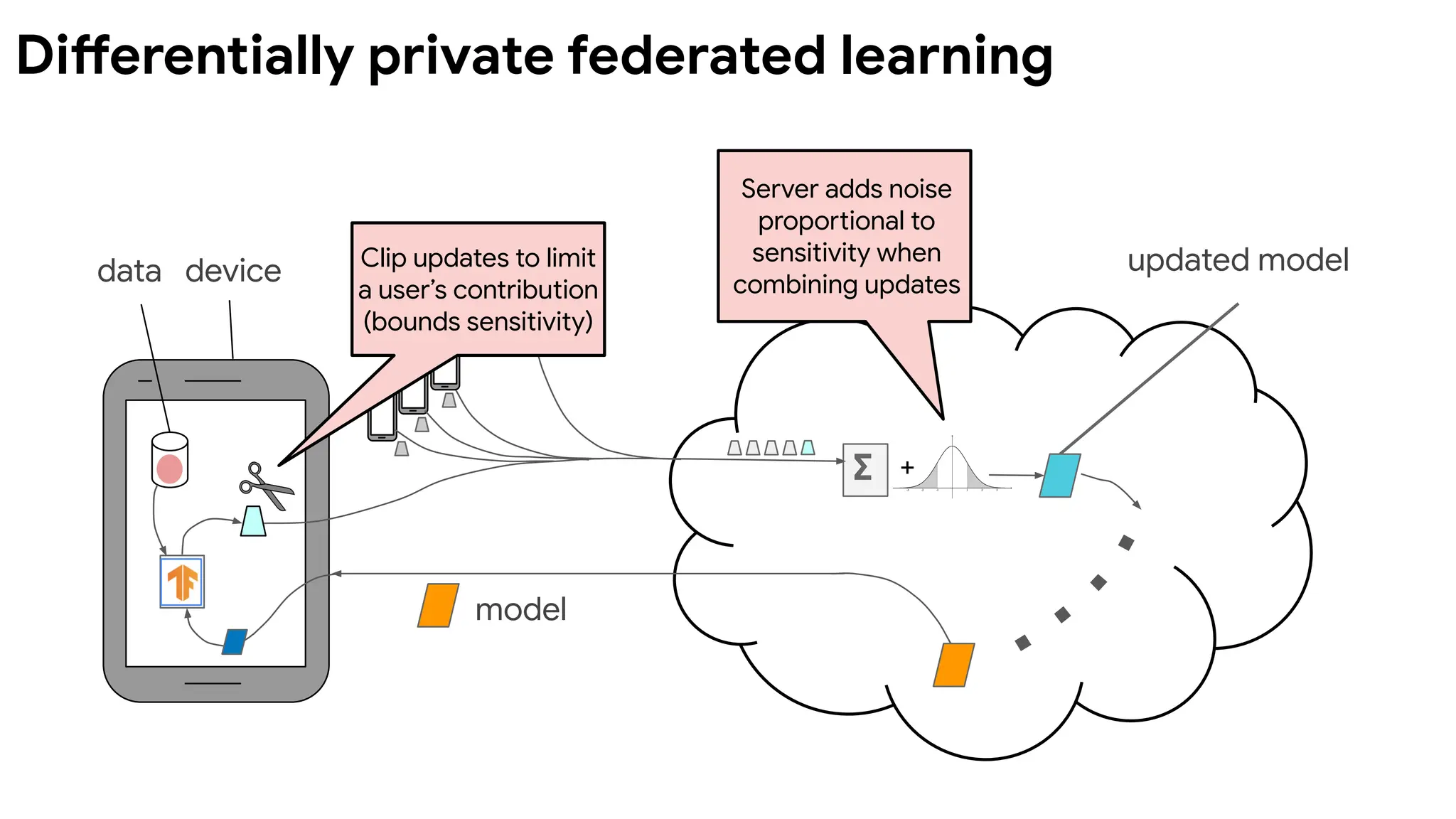
data device updated model
model
+
∑
Clip updates to limit
a user’s contribution
(bounds sensitivity)
Server adds noise
proportional to
sensitivity when
combining updates
Differentially private federated learning
(4.634, 1e-9)-DP with 763k users
(1.152, 1e-9)-DP with 1e8 users
𝔼[users per minibatch] = 5k
𝔼[tokens per minibatch] = 8m
Differential privacy for language models
LSTM-based predictive language model.
10K word dictionary, word embeddings ∊ℝ96
, state ∊ℝ256
, parameters: 1.35M. Corpus=Reddit posts, by author.
H. B. McMahan, et al. Learning
Differentially Private Recurrent
Language Models. ICLR 2018.
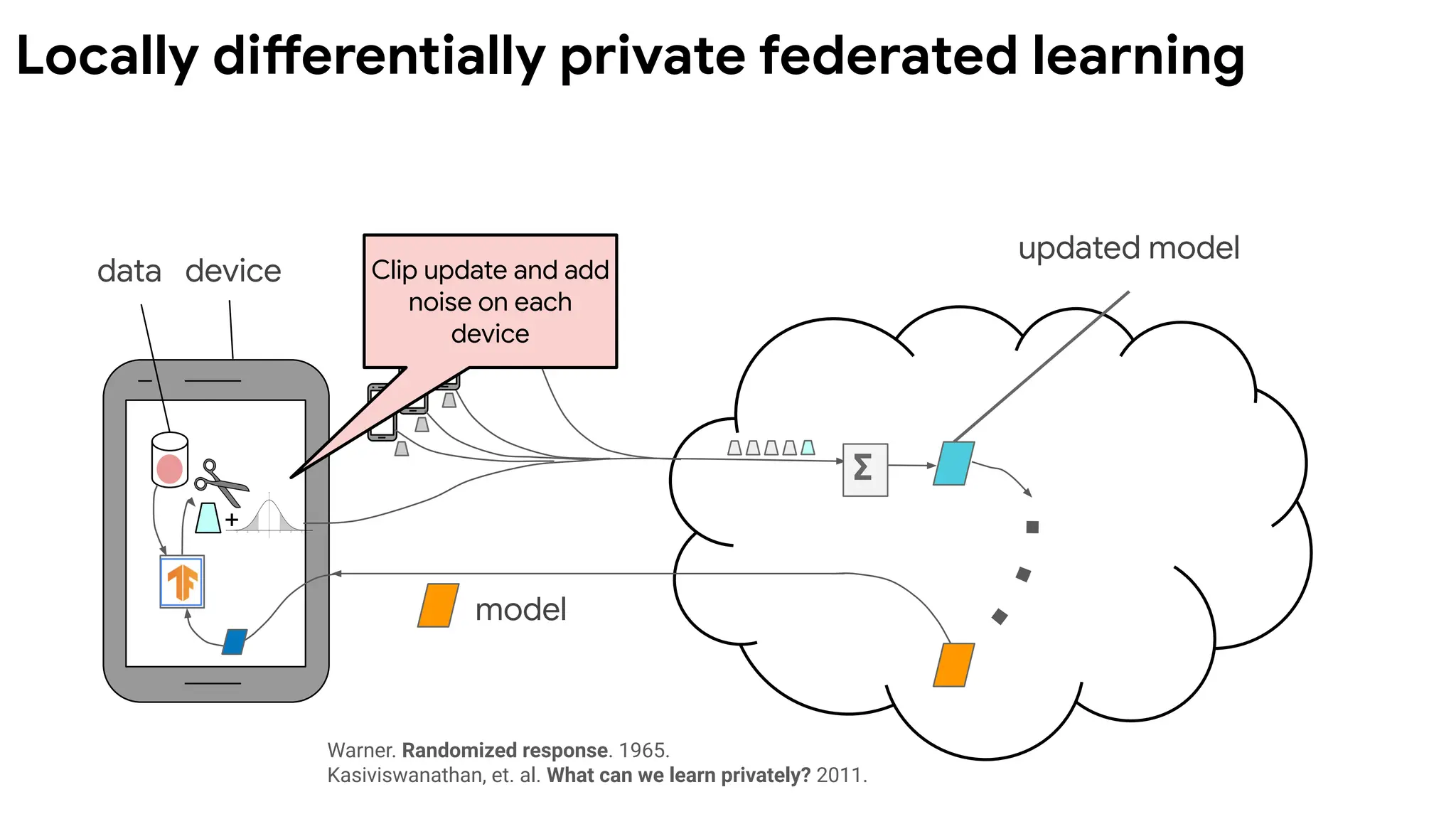
data device
updated model
model
+
Clip update and add
noise on each
device
∑
Locally differentially private federated learning
Warner. Randomized response. 1965.
Kasiviswanathan, et. al. What can we learn privately? 2011.
Can we combine the best of both worlds?
Central DP:
easier to get high utility with good privacy
Local DP:
requires much weaker trust assumptions
Distributed Differential Privacy
Trusted “third party” Trusted Execution Environments
∑
+
+
∑
+
Trust via Cryptography
1 2 3
∑
Distributing Trust for Private Aggregation
third-party
trusted
hardware
cryptography
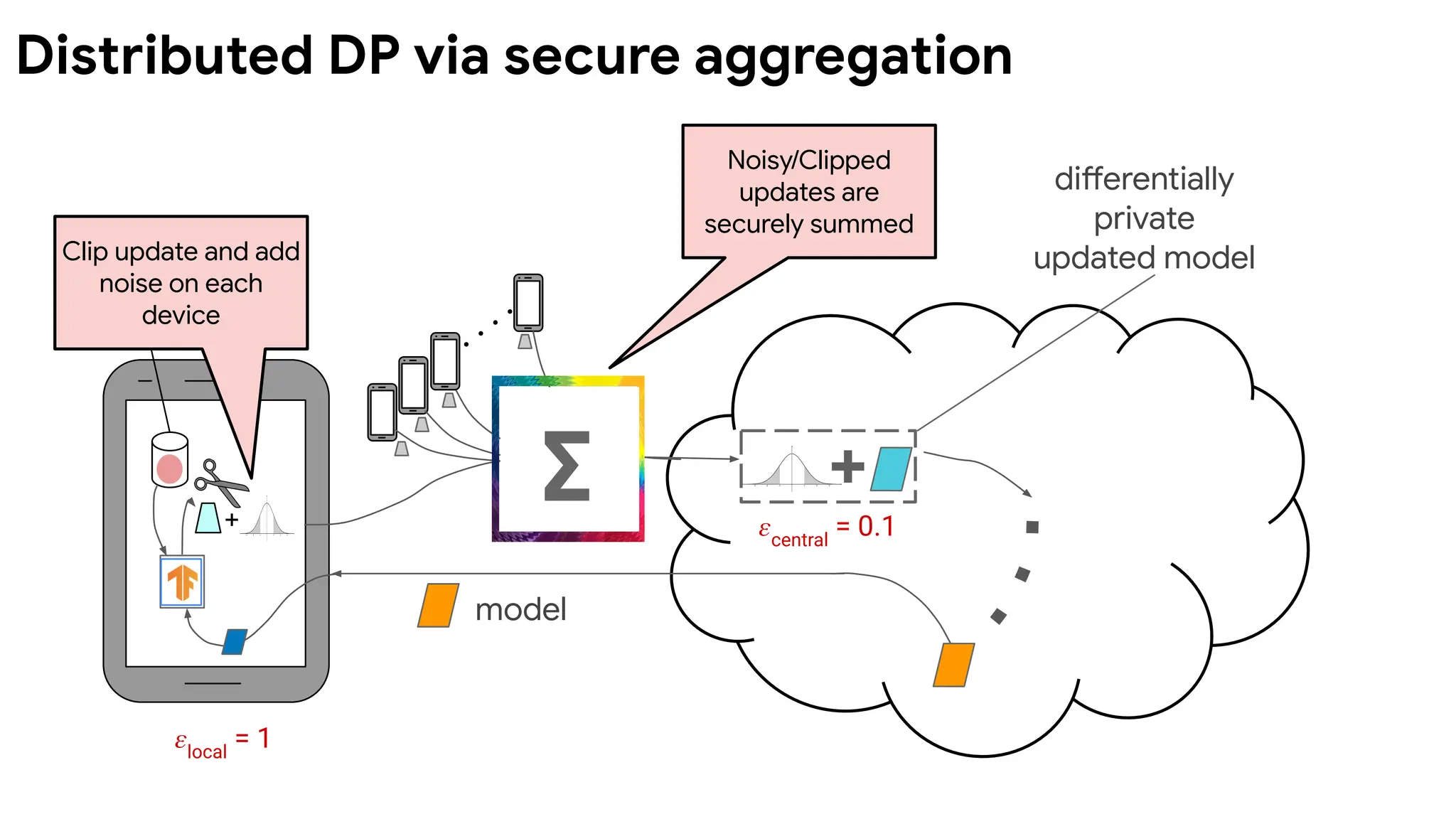
data device
differentially
private
updated model
model
+
Clip update and add
noise on each
device
Noisy/Clipped
updates are
securely summed
∑
𝜀local
= 1
+
𝜀central
= 0.1
Distributed DP via secure aggregation
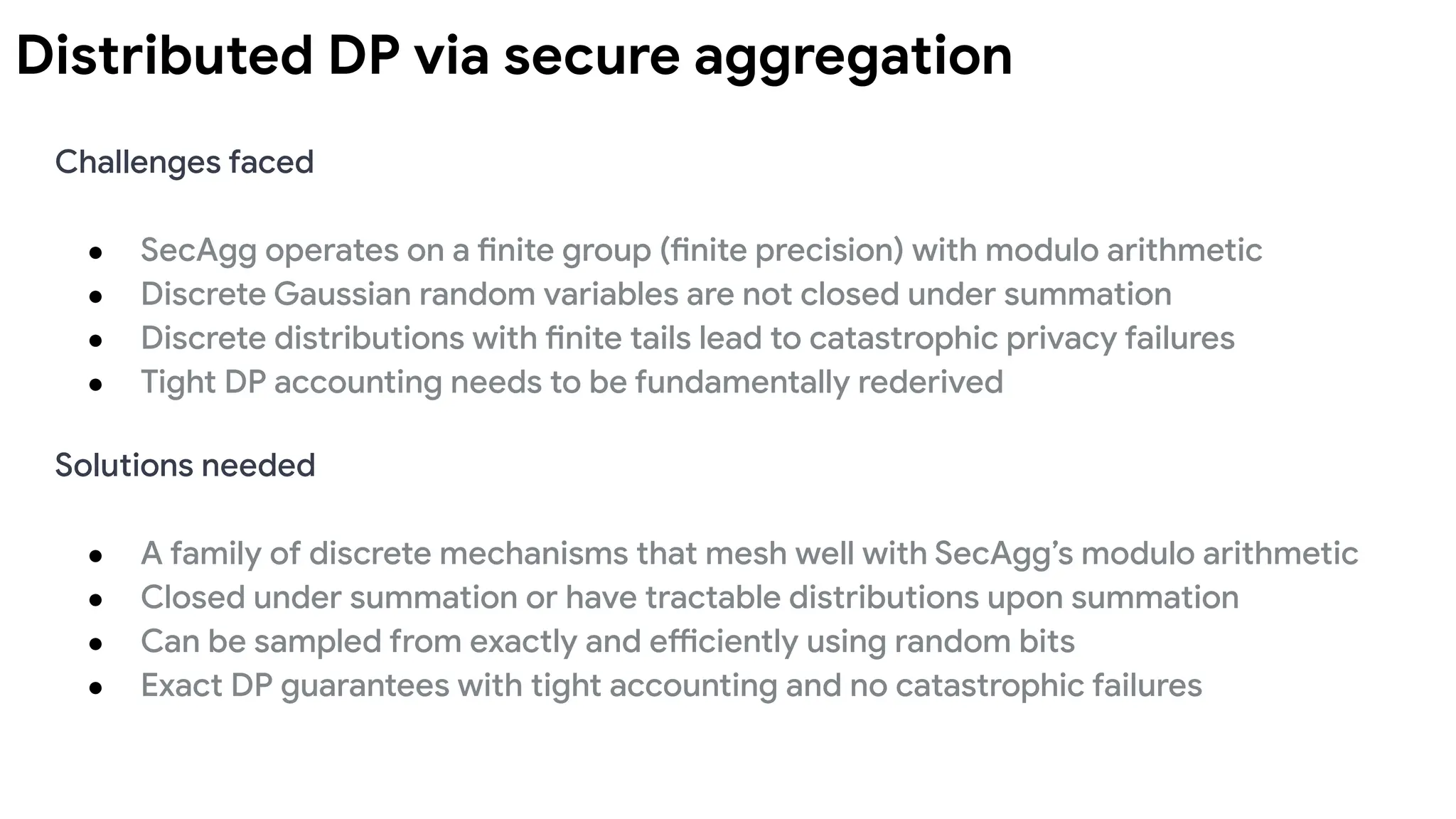
Challenges faced
● SecAgg operates on a finite group (finite precision) with modulo arithmetic
● Discrete Gaussian random variables are not closed under summation
● Discrete distributions with finite tails lead to catastrophic privacy failures
● Tight DP accounting needs to be fundamentally rederived
Solutions needed
● A family of discrete mechanisms that mesh well with SecAgg’s modulo arithmetic
● Closed under summation or have tractable distributions upon summation
● Can be sampled from exactly and efficiently using random bits
● Exact DP guarantees with tight accounting and no catastrophic failures
The distributed discrete Gaussian mechanism
The Distributed Discrete Gaussian Mechanism for Federated Learning with Secure Aggregation (on arXiv)
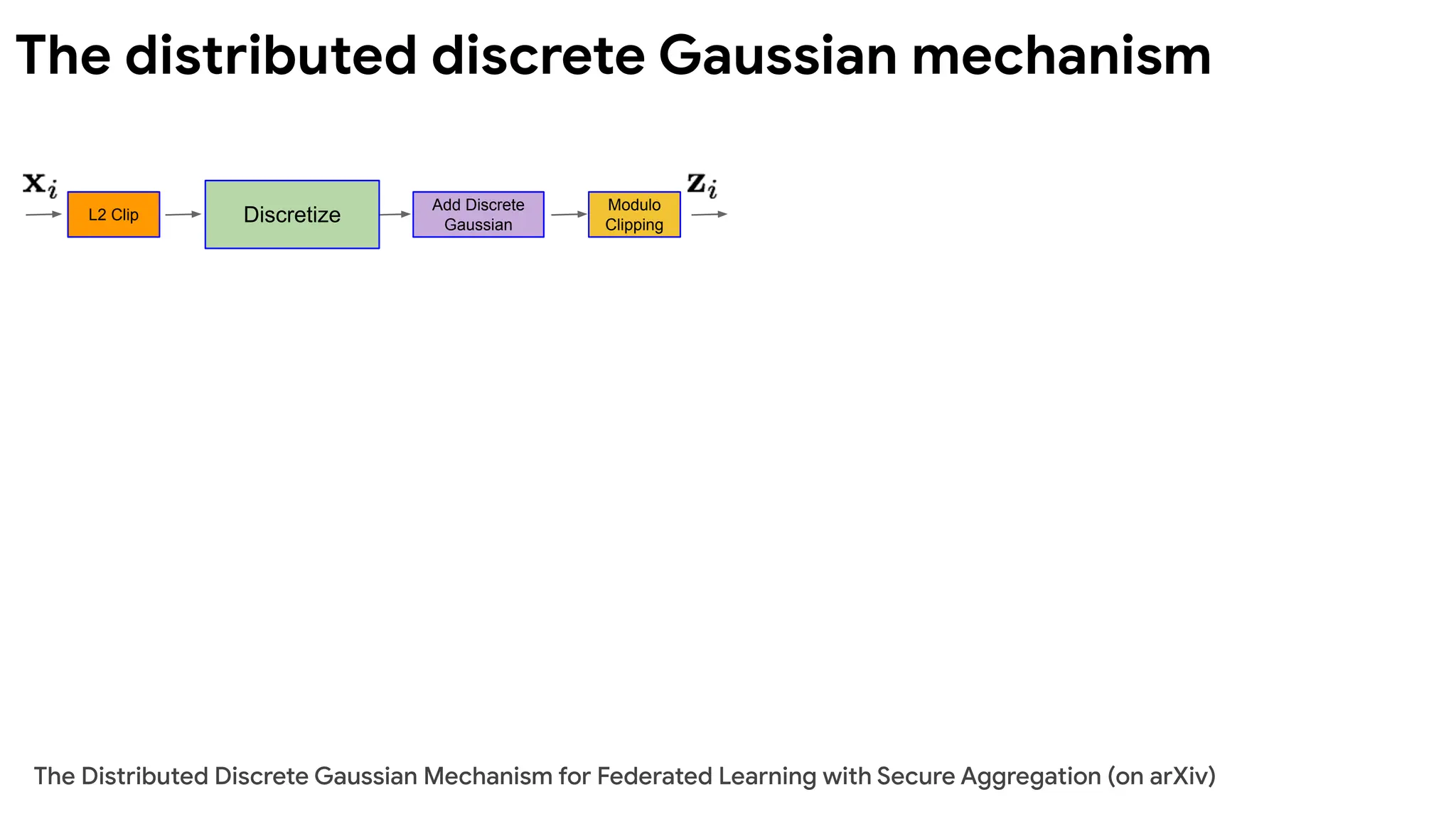
The distributed discrete Gaussian mechanism
L2 Clip
Add Discrete
Gaussian
Modulo
Clipping
Discretize
The Distributed Discrete Gaussian Mechanism for Federated Learning with Secure Aggregation (on arXiv)
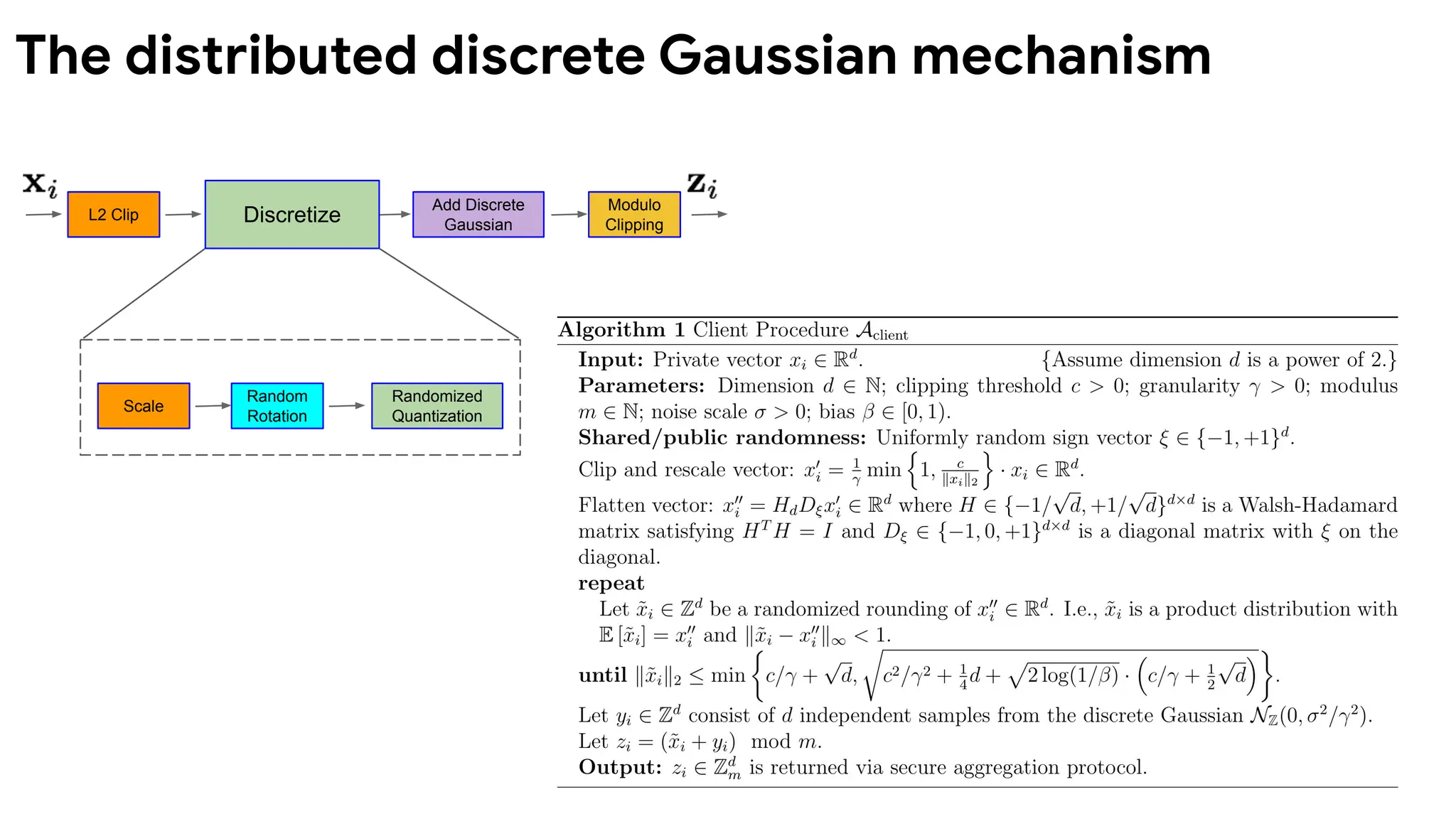
The distributed discrete Gaussian mechanism
L2 Clip
Add Discrete
Gaussian
Modulo
Clipping
Discretize
Random
Rotation
Randomized
Quantization
Scale
The distributed discrete Gaussian mechanism
...
...
∑
L2 Clip
Add Discrete
Gaussian
Modulo
Clipping
Discretize Back to Reals
Inverse
Scale
Dequantization
Inverse
Rotation
Federated EMNIST Classification
● Classifying handwritten digits/letters grouped by their writers
● Total writers/clients = 3400, number of clients per round = 100
● 671,585 training examples, 62 classes, model size = 1M parameters
Centralized Continuous Gaussian
Distributed Discrete Gaussian (18 bits)
Distributed Discrete Gaussian (16 bits)
Distributed Discrete Gaussian (14 bits)
Distributed Discrete Gaussian (12 bits)
The Distributed Discrete Gaussian Mechanism for Federated Learning with Secure Aggregation (on arXiv)
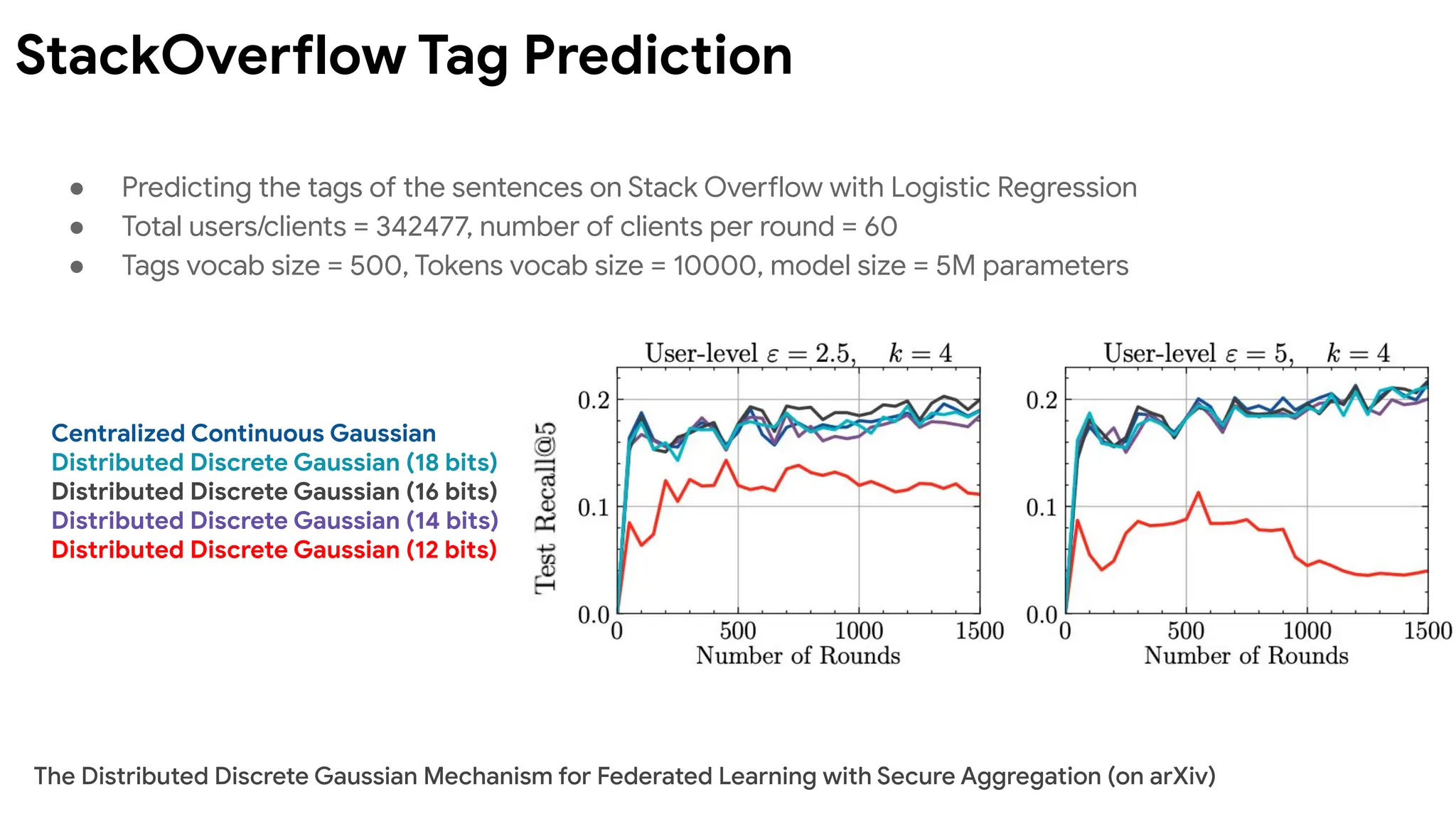
StackOverflow Tag Prediction
Centralized Continuous Gaussian
Distributed Discrete Gaussian (18 bits)
Distributed Discrete Gaussian (16 bits)
Distributed Discrete Gaussian (14 bits)
Distributed Discrete Gaussian (12 bits)
● Predicting the tags of the sentences on Stack Overflow with Logistic Regression
● Total users/clients = 342477, number of clients per round = 60
● Tags vocab size = 500, Tokens vocab size = 10000, model size = 5M parameters
The Distributed Discrete Gaussian Mechanism for Federated Learning with Secure Aggregation (on arXiv)
Precise DP Guarantees for
Real-World Cross-Device FL
D
r4
r7
r10
r1780
1. Sample a batch of clients uniformly at random
Iterative training with differential privacy
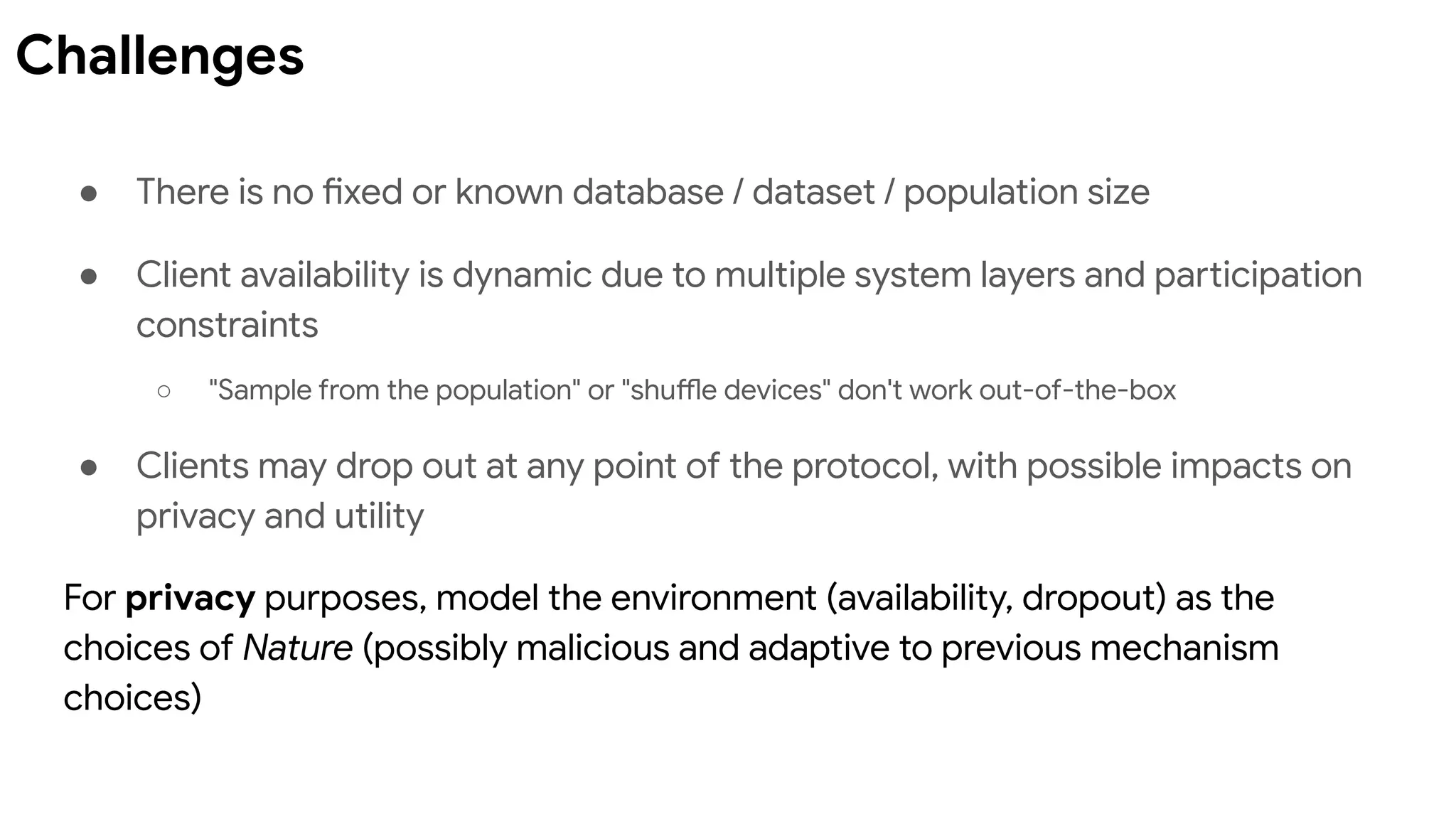
● There is no fixed or known database / dataset / population size
● Client availability is dynamic due to multiple system layers and participation
constraints
○ "Sample from the population" or "shuffle devices" don't work out-of-the-box
● Clients may drop out at any point of the protocol, with possible impacts on
privacy and utility
For privacy purposes, model the environment (availability, dropout) as the
choices of Nature (possibly malicious and adaptive to previous mechanism
choices)
Challenges
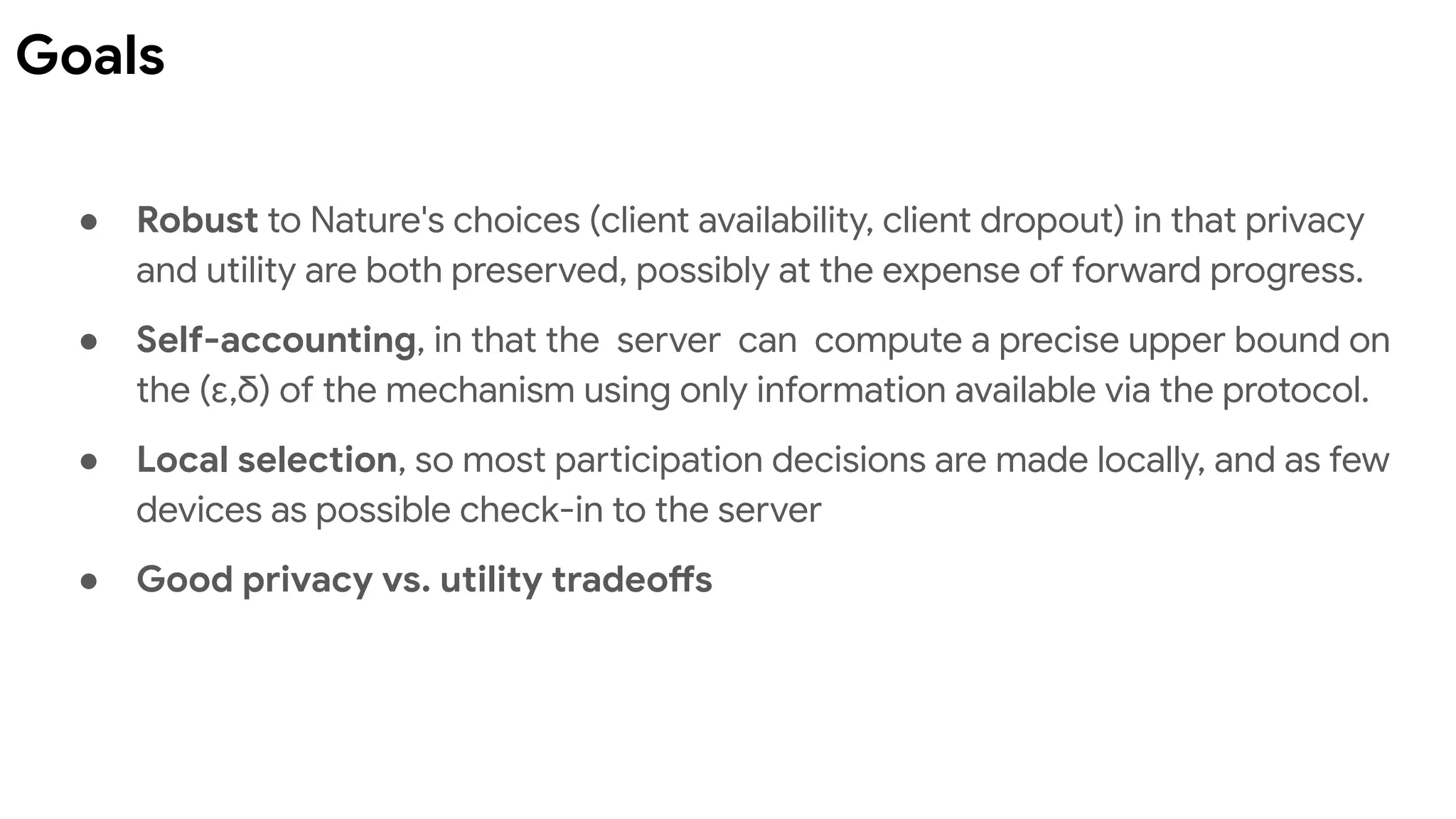
● Robust to Nature's choices (client availability, client dropout) in that privacy
and utility are both preserved, possibly at the expense of forward progress.
● Self-accounting, in that the server can compute a precise upper bound on
the (ε,δ) of the mechanism using only information available via the protocol.
● Local selection, so most participation decisions are made locally, and as few
devices as possible check-in to the server
● Good privacy vs. utility tradeoffs
Goals
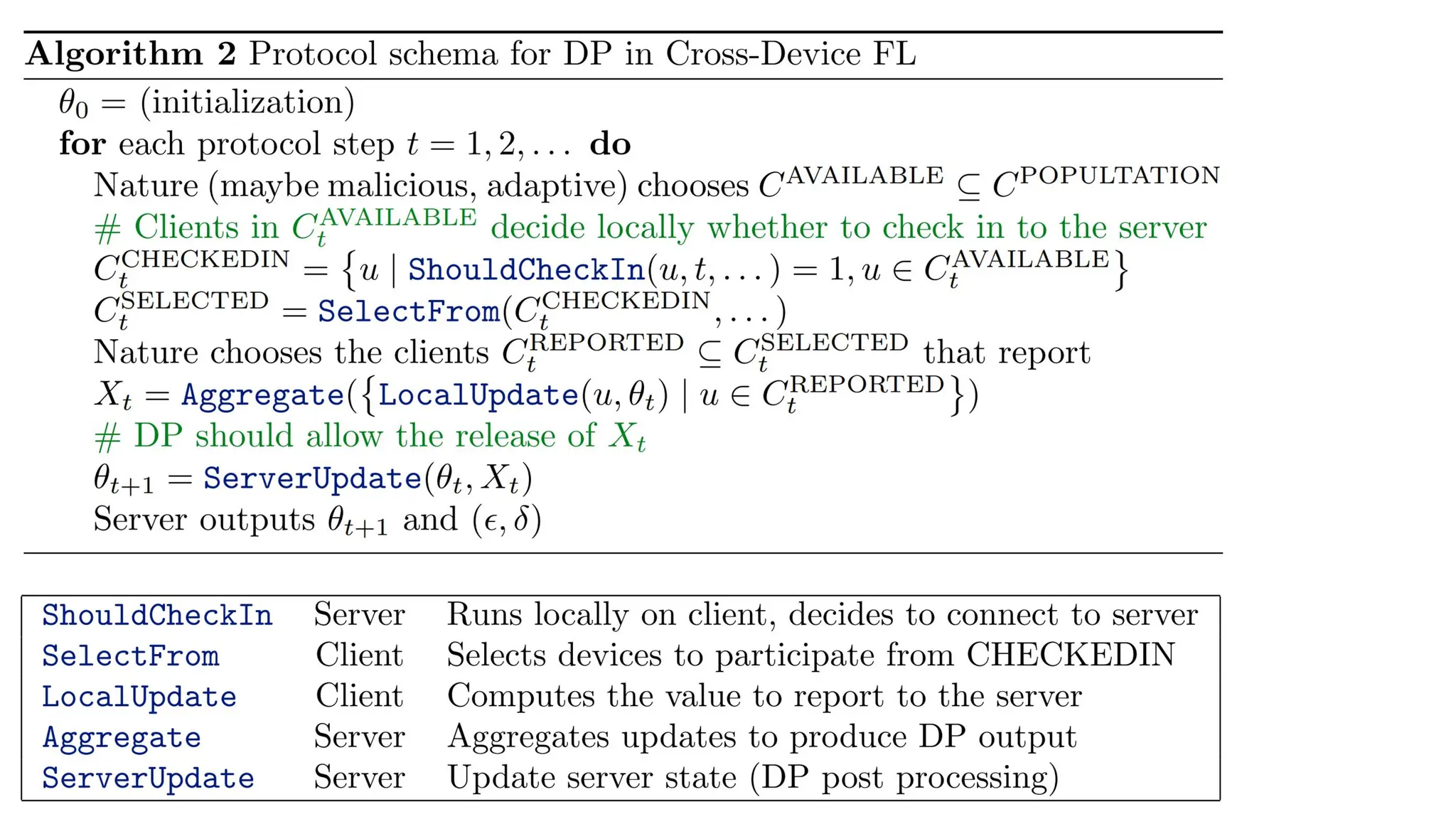
Clients Training
Round
Random
Check-Ins
1
2
...
Random Check-ins
Part III: Other topics
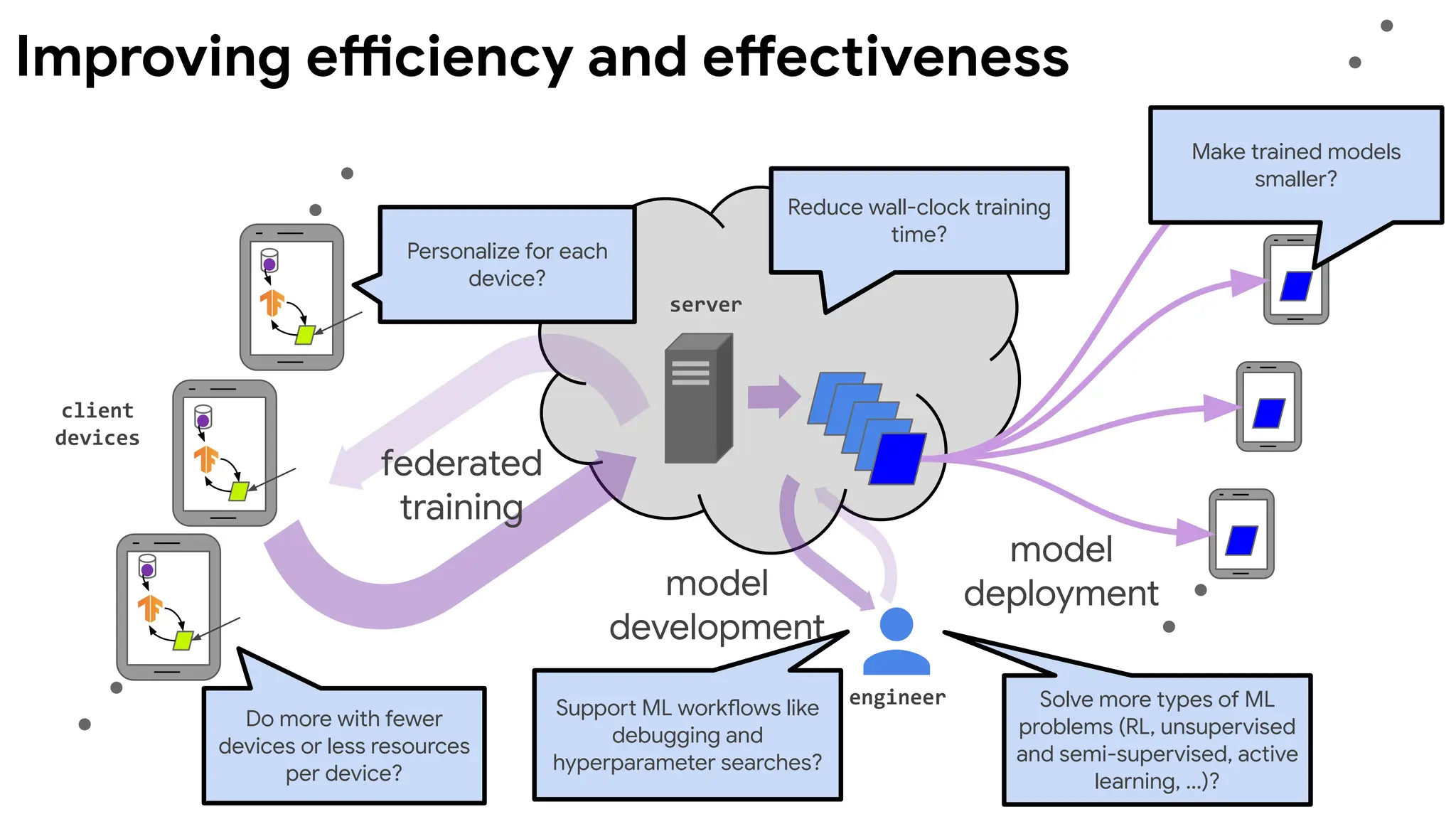
Improving efficiency and effectiveness
client
devices
server
engineer
model
deployment
federated
training
model
development
Reduce wall-clock training
time?
Do more with fewer
devices or less resources
per device?
Make trained models
smaller?
Personalize for each
device?
Support ML workflows like
debugging and
hyperparameter searches?
Solve more types of ML
problems (RL, unsupervised
and semi-supervised, active
learning, ...)?
Ensuring fairness and addressing sources of bias
client
devices
server
engineer
model
deployment
federated
training
model
development
Bias in device availability?
Inference population
different than training
population?
Bias in training data
(amount, distribution)?
Bias in which devices
successfully send updates?
Robustness to attacks and failures
client
devices
server
engineer
model
deployment
federated
training
model
development
Compromised device
sending malicious
updates
Devices training on
compromised data (data
poisoning)
Device dropout, data
corruption in transmission
Inference-time evasion
attacks
Advances and Open Problems in FL
58 authors from 25 top institutions
arxiv.org/abs/1912.04977
BM_KB_PK-slides.pdfssssssssssssssssssssssssssssssssss

  • 1.
    Privacy and FederatedLearning: Principles, Techniques and Emerging Frontiers AAAI Workshop of Privacy Preserving Artificial Intelligence (PPAI-21) Peter Kairouz Presenting the work of many Brendan McMahan Kallista Bonawitz
  • 2.
    Tutorial Outline Part 1:What is Federated Learning? Part 2: Privacy for Federated Technologies Part 2.1: Private Aggregation & Trust Part 2.2: Differentially Private Federated Training Part 3: Other topics (very brief)
  • 3.
    Part I: Whatis Federated Learning?
  • 4.
    Billions of phones& IoT devices constantly generate data Data enables better products and smarter models Data is born at the edge
  • 5.
    Data processing ismoving on device: ● Improved latency ● Works offline ● Better battery life ● Privacy advantages E.g., on-device inference for mobile keyboards and cameras. Can data live at the edge?
  • 6.
    Data processing ismoving on device: ● Improved latency ● Works offline ● Better battery life ● Privacy advantages E.g., on-device inference for mobile keyboards and cameras. Can data live at the edge? What about analytics? What about learning?
  • 7.
  • 8.
    What makes agood application? ● On-device data is more relevant than server-side proxy data ● On-device data is privacy sensitive or large ● Labels can be inferred naturally from user interaction Example applications ● Language modeling for mobile keyboards and voice recognition ● Image classification for predicting which photos people will share ● ... Applications of cross-device federating learning
  • 9.
    Gboard: next-word prediction FederatedRNN (compared to prior n-gram model): ● Better next-word prediction accuracy: +24% ● More useful prediction strip: +10% more clicks Federated model compared to baseline A. Hard, et al. Federated Learning for Mobile Keyboard Prediction. arXiv:1811.03604
  • 10.
    Other federated modelsin Gboard Emoji prediction ● 7% more accurate emoji predictions ● prediction strip clicks +4% more ● 11% more users share emojis! Action prediction When is it useful to suggest a gif, sticker, or search query? ● 47% reduction in unhelpful suggestions ● increasing overall emoji, gif, and sticker shares Discovering new words Federated discovery of what words people are typing that Gboard doesn’t know. T. Yang, et al. Applied Federated Learning: Improving Google Keyboard Query Suggestions. arXiv:1812.02903 M. Chen, et al. Federated Learning Of Out-Of-Vocabulary Words. arXiv:1903.10635 Ramaswamy, et al. Federated Learning for Emoji Prediction in a Mobile Keyboard. arXiv:1906.04329.
  • 11.
    "Instead, it reliesprimarily on a technique called federated learning, Apple’s head of privacy, Julien Freudiger, told an audience at the Neural Processing Information Systems conference on December 8. Federated learning is a privacy-preserving machine-learning method that was first introduced by Google in 2017. It allows Apple to train different copies of a speaker recognition model across all its users’ devices, using only the audio data available locally. It then sends just the updated models back to a central server to be combined into a master model. In this way, raw audio of users’ Siri requests never leaves their iPhones and iPads, but the assistant continuously gets better at identifying the right speaker." https://www.technologyreview.com/2019/12/11/131629/apple-ai-personalizes-siri-federated-learning/ Cross-device federated learning at Apple
  • 12.
    Federated learning isa machine learning setting where multiple entities (clients) collaborate in solving a machine learning problem, under the coordination of a central server or service provider. Each client's raw data is stored locally and not exchanged or transferred; instead, focused updates intended for immediate aggregation are used to achieve the learning objective. definition proposed in Advances and Open Problems in Federated Learning (arxiv/1912.04977) Federated Learning
  • 13.
    clients server Federated learning -defining characteristics Data is generated locally and remains decentralized. Each client stores its own data and cannot read the data of other clients. Data is not independently or identically distributed. A central orchestration server/service coordinates the training, but never sees raw data.
  • 14.
  • 15.
    "The University ofPennsylvania and chipmaker Intel are forming a partnership to enable 29 heatlhcare and medical research institutions around the world to train artificial intelligence models to detect brain tumors early." "The program will rely on a technique known as federated learning, which enables institutions to collaborate on deep learning projects without sharing patient data. The partnership will bring in institutions in the U.S., Canada, U.K., Germany, Switzerland and India. The centers – which include Washington University of St. Louis; Queen’s University in Kingston, Ontario; University of Munich; Tata Memorial Hospital in Mumbai and others – will use Intel’s federated learning hardware and software." [1] https://medcitynews.com/2020/05/upenn-intel-partner-to-use-federated-learning-ai-for-early-brain-tumor-detection/ [2] https://www.allaboutcircuits.com/news/can-machine-learning-keep-patient-privacy-for-tumor-research-intel-says-yes-with-federated-learning/ [3] https://venturebeat.com/2020/05/11/intel-partners-with-penn-medicine-to-develop-brain-tumor-classifier-with-federated-learning/ [4] http://www.bio-itworld.com/2020/05/28/intel-penn-medicine-launch-federated-learning-model-for-brain-tumors.aspx Cross-silo federated learning from Intel
  • 16.
    "Federated learning addressesthis challenge, enabling different institutions to collaborate on AI model development without sharing sensitive clinical data with each other. The goal is to end up with more generalizable models that perform well on any dataset, instead of an AI biased by the patient demographics or imaging equipment of one specific radiology department." [1] https://blogs.nvidia.com/blog/2020/04/15/federated-learning-mammogram-assessment/ [2] https://venturebeat.com/2020/04/15/healthcare-organizations-use-nvidias-clara-federated-learning-to-improve-mammogram-analysis-ai/ [3] https://medcitynews.com/2020/01/nvidia-says-it-has-a-solution-for-healthcares-data-problems/ [4] https://venturebeat.com/2020/06/23/nvidia-and-mercedes-benz-detail-self-driving-system-with-automated-routing-and-parking/ Cross-silo federated learning from NVIDIA
  • 17.
    millions of intermittently availableclient devices coordinating server Cross-device federated learning X coordinating server small number of clients (institutions, data silos), high availability Cross-silo federated learning
  • 18.
    clients cannot beindexed directly (i.e., no use of client identifiers) coordinating server Cross-device federated learning X coordinating server each client has an identity or name that allows the system to access it specifically Cross-silo federated learning Alice Bob Updates are anonymous Selection is coarse-grained
  • 19.
    Server can onlyaccess a (possibly biased) random sample of clients on each round. Large population => most clients only participate once. coordinating server Cross-device federated learning coordinating server Most clients participate in every round. Clients can run algorithms that maintain local state across rounds. Cross-silo federated learning round 1 round 1
  • 20.
    coordinating server Cross-device federated learning coordinating server Cross-silofederated learning round 2 (completely new set of devices participate) round 2 (same clients) Server can only access a (possibly biased) random sample of clients on each round. Large population => most clients only participate once. Most clients participate in every round. Clients can run algorithms that maintain local state across rounds.
  • 21.
    communication is oftenthe primary bottleneck coordinating server Cross-device federated learning X coordinating server communication or computation might be the primary bottleneck Cross-silo federated learning
  • 22.
    coordinating server Cross-device federated learning X coordinating server Cross-silofederated learning features examples horizontally partitioned data features examples horizontal or vertically partitioned data
  • 23.
    Distributed datacenter machinelearning servers cloud data engineer
  • 24.
    ● Clients -Compute nodes also holding local data, usually belonging to one entity: ○ IoT devices ○ Mobile devices ○ Data silos ○ Data centers in different geographic regions ● Server - Additional compute nodes that coordinate the FL process but don't access raw data. Usually not a single physical machine. FL terminology
  • 25.
    Characteristics of thefederated learning setting Datacenter distributed learning Cross-silo federated learning Cross-device federated learning Setting Training a model on a large but "flat" dataset. Clients are compute nodes in a single cluster or datacenter. Training a model on siloed data. Clients are different organizations (e.g., medical or financial) or datacenters in different geographical regions. The clients are a very large number of mobile or IoT devices. Data distribution Data is centrally stored, so it can be shuffled and balanced across clients. Any client can read any part of the dataset. Data is generated locally and remains decentralized. Each client stores its own data and cannot read the data of other clients. Data is not independently or identically distributed. Orchestration Centrally orchestrated. A central orchestration server/service organizes the training, but never sees raw data. Wide-area communication None (fully connected clients in one datacenter/cluster). Typically hub-and-spoke topology, with the hub representing a coordinating service provider (typically without data) and the spokes connecting to clients. Data availability All clients are almost always available. Only a fraction of clients are available at any one time, often with diurnal and other variations. Distribution scale Typically 1 - 1000 clients. Typically 2 - 100 clients. Massively parallel, up to 1010 clients. Adapted from Table 1 in Advances and Open Problems in Federated Learning (arxiv/1912.04977)
  • 26.
    Characteristics of thefederated learning setting Datacenter distributed learning Cross-silo federated learning Cross-device federated learning Addressability Each client has an identity or name that allows the system to access it specifically. Clients cannot be indexed directly (i.e., no use of client identifiers) Client statefulness Stateful --- each client may participate in each round of the computation, carrying state from round to round. Generally stateless --- each client will likely participate only once in a task, so generally we assume a fresh sample of never before seen clients in each round of computation. Primary bottleneck Computation is more often the bottleneck in the datacenter, where very fast networks can be assumed. Might be computation or communication. Communication is often the primary bottleneck, though it depends on the task. Generally, federated computations uses wi-fi or slower connections. Reliability of clients Relatively few failures. Highly unreliable --- 5% or more of the clients participating in a round of computation are expected to fail or drop out (e.g., because the device becomes ineligible when battery, network, or idleness requirements for training/computation are violated). Data partition axis Data can be partitioned / re-partitioned arbitrarily across clients. Partition is fixed. Could be example-partitioned (horizontal) or feature-partitioned (vertical). Fixed partitioning by example (horizontal). Adapted from Table 1 in Advances and Open Problems in Federated Learning (arxiv/1912.04977)
  • 27.
  • 28.
  • 29.
    Federated learning Fullydecentralized (peer-to-peer) learning Orchestration A central orchestration server/service organizes the training, but never sees raw data. No centralized orchestration. Wide-area communication pattern Typically hub-and-spoke topology, with the hub representing a coordinating service provider (typically without data) and the spokes connecting to clients. Peer-to-peer topology. Adapted from Table 3 in Advances and Open Problems in Federated Learning (arxiv/1912.04977) Characteristics of FL vs decentralized learning
  • 30.
  • 31.
    engineer cloud data Train & evaluate oncloud data server Model development workflow
  • 32.
  • 33.
    clients server engineer Deploy model to devices foron-device inference Model development workflow
  • 34.
    Train & evaluate ondecentralized data clients server engineer Federated training
  • 35.
  • 36.
    data device Need me? Notnow Federated learning
  • 37.
  • 38.
    initial model engineer data deviceupdated model Federated learning
  • 39.
  • 40.
    data device initial model engineer updated model Privacyprinciple Focused collection Devices report only what is needed for this computation Federated learning
  • 41.
    data device initial model engineer updated model Privacyprinciple Ephemeral reports Server never persists per-device reports Federated learning
  • 42.
    data device combined model ∑ initial model engineer updated model Privacyprinciple Only-in-aggregate Engineer may only access combined device reports Federated learning
  • 43.
  • 44.
  • 45.
    data device (another) combined model (another) initial model ∑ Typicalorders-of-magnitude 100-1000s of clients per round 1000s of rounds to convergence 1-10 minutes per round engineer Federated learning
  • 46.
    data device (another) combined model (another) initial model ∑ engineer Devicesrun multiple steps of SGD on their local data to compute an update. Server computes overall update using a simple weighted average. McMahan, et al. Communication-Efficient Learning of Deep Networks from Decentralized Data. AISTATS 2017. Federated Averaging (FedAvg) algorithm
  • 47.
  • 48.
    Beyond learning: federatedanalytics Sunflower Dance Monkey Rockstar Shape of You Closer 19% 33% 36% 38% 23% moon$ moon$ sun$ sun$ covid-19$ covid-19$ Geo-location heatmaps Frequently typed out-of-dictionary words Popular songs, trends, and activities R e s t T V W a l k S l e e p W o r k F a m i l y R e a d E a t
  • 49.
    Federated analytics isthe practice of applying data science methods to the analysis of raw data that is stored locally on users’ devices. Like federated learning, it works by running local computations over each device’s data, and only making the aggregated results — and never any data from a particular device — available to product engineers. Unlike federated learning, however, federated analytics aims to support basic data science needs. definition proposed in https://ai.googleblog.com/2020/05/federated-analytics-collaborative-data.html Federated analytics
  • 50.
    ● Federated histogramsover closed sets ● Federated quantiles and distinct element counts ● Federated heavy hitters discovery over open sets ● Federated density of vector spaces ● Federated selection of random data subsets ● Federated SQL ● Federated computations? ● etc... Federated analytics
  • 51.
    Similar to learning,the on-device computation is a function of a server state Interactive algorithms Unlike learning, the on-device computation does not depend on a server state Non-interactive algorithms coordinating server coordinating server Zhu et. al. Federated Heavy Hitters Discovery with Differential Privacy AISTATS’20. Erlingsson et. al. RAPPOR: Randomized Aggregatable Privacy-Preserving Ordinal Response CCS’14.
  • 52.
    Part II: Privacyfor Federated Learning and Analytics
  • 53.
    Aspects of Privacy Thewhy, what, and how of using data. Why? Transparency & consent Why use this data? The user understands and supports the intended use of the data. What? Limited influence of any individual What is computed? When data is released, ensure it does not reveal any user's private information. How? Security & data minimization How and where does the computation happen? Release data to as few parties as possible. Minimize the attack surface where private information could be accessed.
  • 54.
    Aspects of Privacy Thewhy, what, and how of using data. Why? Transparency & consent Why use this data? The user understands and supports the intended use of the data. What? Limited influence of any individual What is computed? When data is released, ensure it does not reveal any user's private information. How? Security & data minimization How and where does the computation happen? Release data to as few parties as possible. Minimize the attack surface where private information could be accessed.
  • 55.
    Privacy Utility ML on sensitivedata: privacy vs. utility
  • 56.
  • 57.
  • 58.
    Privacy Utility goal 1. Policy 2.New Technology Push the pareto frontier with better technology. Make achieving high privacy and utility possible. today ML on sensitive data: privacy vs. utility (?)
  • 59.
    Privacy Utility goal 1. Policy 2.New Technology Push the pareto frontier with better technology. Make achieving high privacy and utility possible with less work. ML on sensitive data: privacy vs. utility (?) Computation, effort
  • 60.
  • 61.
  • 62.
  • 63.
    client devices server engineer federated training model development ... the released modelsand metrics? … the server? with access to ... What private information might an actor learn
  • 64.
  • 65.
    client devices server engineer model deployment federated training model development … the deployed model? ...the network? … the device? ... the released models and metrics? … the server? with access to ... What private information might an actor learn
  • 66.
    client devices server engineer model deployment federated training model development … the deployed model? ...the network? … the device? ... the released models and metrics? … the server? How much do I need to trust …
  • 67.
  • 68.
  • 69.
  • 70.
  • 71.
    client devices server engineer model deployment federated training model development … the server? Local Differential Privacy Warner.Randomized response. 1965. Kasiviswanathan, et. al. What can we learn privately? 2011. with access to ... What private information might an actor learn How What
  • 72.
    client devices server engineer model deployment federated training model development … the server? Ideally,nothing, even with root access. with access to ... What private information might an actor learn How What
  • 73.
    client devices server engineer model deployment model development Secure Enclaves, (hardware), Secure Multi-Party Computation (crypto) …the server? How What Ideally, nothing, even with root access. What private information might an actor learn
  • 74.
    client devices server engineer model deployment federated training model development ... the released modelsand metrics? with access to ... What private information might an actor learn … the deployed model? How What
  • 75.
    client devices server engineer model deployment federated training model development ... the released modelsand metrics? Central Differential Privacy Dwork and Roth. The Algorithmic Foundations of Differential Privacy. 2014. … the deployed model? with access to ... What private information might an actor learn How What
  • 76.
    client devices server engineer model deployment federated training model development ... the released modelsand metrics? Empirical privacy auditing (e.g. secret sharer, membership inference) … the deployed model? with access to ... What private information might an actor learn Nicholas Carlini, Chang Liu, Úlfar Erlingsson, Jernej Kos, Dawn Song. The Secret Sharer: Evaluating and Testing Unintended Memorization in Neural Networks. 2018. Congzheng Song, Vitaly Shmatikov. Auditing Data Provenance in Text-Generation Models. 2018. Matthew Jagielski, Jonathan Ullman, Alina Oprea. Auditing Differentially Private Machine Learning: How Private is Private SGD? 2020. How What
  • 77.
  • 78.
    Distributing Trust forPrivate Aggregation
  • 79.
    Trusted “third party” ∑ + 1 DistributingTrust for Private Aggregation third-party
  • 80.
    Trusted “third party”Trusted Execution Environments ∑ + + ∑ 1 2 Distributing Trust for Private Aggregation third-party trusted hardware
  • 81.
    Trusted “third party”Trusted Execution Environments ∑ + + ∑ + Trust via Cryptography 1 2 3 ∑ Distributing Trust for Private Aggregation third-party trusted hardware cryptography
  • 82.
    Confidential + Proprietary SecureAggregation Communication Efficient for Vectors & Tensors Robust to Clients Going Offline
  • 83.
    Alice Bob Carol Random positive/negative pairs,aka antiparticles Devices cooperate to sample random pairs of 0-sum perturbations vectors. Matched pair sums to 0
  • 84.
    Alice Bob Carol Random positive/negative pairs,aka antiparticles Devices cooperate to sample random pairs of 0-sum perturbations vectors.
  • 85.
    Alice Bob Carol Add antiparticles beforesending to the server Each contribution looks random on its own... + + + + + +
  • 86.
    The antiparticles cancelwhen summing contributions + + + + + but paired antiparticles cancel out when summed. Each contribution looks random on its own... + ∑ Alice Bob Carol
  • 87.
    Revealing the sum. + + + butpaired antiparticles cancel out when summed. Each contribution looks random on its own... + + + ∑ Alice Bob Carol
  • 88.
    Confidential + Proprietary Butthere are two challenges...
  • 89.
    Carol 1. These vectorsare big! How do users agree efficiently? Alice Bob
  • 90.
    2. What ifsomeone drops out? + + + + + + ∑ Alice Bob Carol
  • 91.
    + + + + That's bad. 2. What ifsomeone drops out? ∑ Alice Bob Carol
  • 92.
  • 93.
    Alice Bob Carol Pairwise Diffie-Hellman KeyAgreement a b Safe to reveal (cryptographically hard to infer secret) Secret Public parameters: g, (mod p) c gc ga gb
  • 94.
    Alice Bob Carol ga gb gc a b Because gx are public,we can share them via the server. c Pairwise Diffie-Hellman Key Agreement
  • 95.
  • 96.
  • 97.
    gba gab c gac gca gcb gbc a b ga gc gb gc ga gb Commutative op → Sharedsecret! Pairwise Diffie-Hellman Key Agreement Alice Bob Carol
  • 98.
    gba gab c gac gca gcb gbc a b Secrets are scalars,but…. Shared secret! Pairwise Diffie-Hellman Key Agreement Alice Bob Carol
  • 99.
    gba gab c gac gca gcb gbc a b Secrets are scalars,but…. Use each secret to seed a pseudorandom number generator, generate paired antiparticle vectors. PRNG(gba ) → = - Shared secret! Pairwise Diffie-Hellman Key Agreement + PRNG Expansion Alice Bob Carol
  • 100.
    a b c Pairwise Diffie-Hellman KeyAgreement + PRNG Expansion Secrets are scalars, but…. Use each secret to seed a pseudorandom number generator, generate paired antiparticle vectors. PRNG(gba ) → = - Alice Bob Carol
  • 101.
    a b c 1. Efficiency viapseudorandom generator 2. Mobile phones typically don't support peer-to-peer communication anyhow. 3. Fewer secrets = easier recovery. Pairwise Diffie-Hellman Key Agreement + PRNG Expansion Secrets are scalars, but…. Use each secret to seed a pseudorandom number generator, generate paired antiparticle vectors. PRNG(gba ) → = - Alice Bob Carol
  • 102.
    k-out-of-n Threshold SecretSharing Goal: Break a secret into n pieces, called shares. ● <k shares: learn nothing ● ≥k shares: recover s perfectly. s 2-out-of-3 secret sharing: Each line is a share x-coordinate of the intersection is the secret
  • 103.
    k-out-of-n Threshold SecretSharing ? ? ? Goal: Break a secret into n pieces, called shares. ● <k shares: learn nothing ● ≥k shares: recover s perfectly
  • 104.
    k-out-of-n Threshold SecretSharing s s s Goal: Break a secret into n pieces, called shares. ● <k shares: learn nothing ● ≥k shares: recover s perfectly
  • 105.
    c a b Users make sharesof their secrets Alice Bob Carol
  • 106.
  • 107.
  • 108.
  • 109.
  • 110.
  • 111.
  • 112.
  • 113.
  • 114.
    ga b Enough honest users+ a high enough threshold ⇒ dishonest users cannot reconstruct the secret. gc + + + + ∑ Alice Bob Carol
  • 115.
    ga b Enough honest users+ a high enough threshold ⇒ dishonest users cannot reconstruct the secret. However…. gc + + + + ∑ Alice Bob Carol
  • 116.
  • 117.
  • 118.
  • 119.
  • 120.
  • 121.
  • 122.
  • 123.
  • 124.
    abc : : ( ,b, )? abc : : + + + + + + Alice Bob Carol
  • 125.
    abc : : abc : : abc: : abc : : + + + + + + Alice Bob Carol
  • 126.
    + + + + + + b abc : : abc : : abc: : abc : : Alice Bob Carol
  • 127.
    + + + + + + b abc : : abc : : abc: : abc : : Alice Bob Carol
  • 128.
    + + + + + + b abc : : abc : : abc: : abc : : Alice Bob Carol
  • 129.
    abc : abc : : : abc: : abc : : b + + + + + + ∑ Alice Bob Carol
  • 130.
    b + + + late. abc: abc : : : abc : : + + + + + + ∑ Alice Bob Carol
  • 131.
    + + + b late. Permanent. (honest users alreadygave b) abc : abc : : : abc : : + + + + + + ∑ Alice Bob Carol
  • 132.
    Server aggregates users' updates,but cannot inspect the individual updates. ∑ # Params Bits/Param # Users Expansion 220 = 1 m 16 210 = 1 k 1.73x 224 = 16 m 16 214 = 16 k 1.98x Communication Efficient Secure ⅓ malicious clients + fully observed server Robust ⅓ clients can drop out Interactive Cryptographic Protocol Each phase, 1000 clients + server interchange messages over 4 rounds of communication. K. Bonawitz, V. Ivanov, B. Kreuter, A. Marcedone, H. B. McMahan, S. Patel, D. Ramage, A. Segal, K. Seth. Practical Secure Aggregation for Privacy-Preserving Machine Learning. CCS’17. Secure Aggregation
  • 133.
    CCS 2017 K. Bonawitz,V. Ivanov, B. Kreuter, A. Marcedone, H. B. McMahan, S. Patel, D. Ramage, A. Segal, K. Seth. Practical Secure Aggregation for Privacy-Preserving Machine Learning. Complete Graph of pairwise masks, secret shares
  • 134.
    Random Harary(n, k) nclients, k neighbors, random node assignments k = O(log n) CCS 2017 K. Bonawitz, V. Ivanov, B. Kreuter, A. Marcedone, H. B. McMahan, S. Patel, D. Ramage, A. Segal, K. Seth. Practical Secure Aggregation for Privacy-Preserving Machine Learning. CCS 2020 J. Bell, K. Bonawitz, A. Gascon, T. Lepoint, M. Raykova Secure Single-Server Aggregation with (Poly)Logarithmic Overhead. Complete Graph of pairwise masks, secret shares
  • 135.
    Secure Aggregation K. Bonawitz,V. Ivanov, B. Kreuter, A. Marcedone, H. B. McMahan, S. Patel, D. Ramage, A. Segal, K. Seth. Practical Secure Aggregation for Privacy-Preserving Machine Learning. CCS 2017. Protocol Server Client Computation Communication Computation Communication Bonawitz et al. (CCS 2017) Bell et al. (CCS 2020) Insecure Solution J. Bell, K. Bonawitz, A. Gascon, T. Lepoint, M. Raykova Secure Single-Server Aggregation with (Poly)Logarithmic Overhead. CCS 2020.
  • 136.
    Random Harary(n, k) nclients, k neighbors, random node assignments k = O(log n) CCS 2017 K. Bonawitz, V. Ivanov, B. Kreuter, A. Marcedone, H. B. McMahan, S. Patel, D. Ramage, A. Segal, K. Seth. Practical Secure Aggregation for Privacy-Preserving Machine Learning. CCS 2020 J. Bell, K. Bonawitz, A. Gascon, T. Lepoint, M. Raykova Secure Single-Server Aggregation with (Poly)Logarithmic Overhead. Complete Graph of pairwise masks, secret shares Cost of 1 million cohorts, each of 1000 clients Cost of a single cohort of 1 billion clients Cheaper!
  • 137.
    Sparse Federated Learning& Analytics ● Embedding-based models ○ Word-based Language Models ○ Object Recognition ● Compound models ○ Multiple fixed domains e.g. locations, companies, etc ○ Genre/cluster models ○ Pluralistic models ● Federated Analytics
  • 138.
    Sparse Federated Learning& Analytics ∑ Sparse Aggregation Sliced Model Download
  • 139.
    Sparse Federated Learning& Analytics ∑ Private Sliced Model Download Private Sparse Aggregation
  • 140.
    I want d. d= 00010. 0 0 0 1 0 0 0 0 1 0 a b c d e Private Sliced Model Download // Private Information Retrieval Vector of Model Slices (1 per element) Encrypted 1-Hot Query Vector
  • 141.
    × × × × × = = = = = ∑ I want d. d= 00010. 0 0 0 1 0 0 0 0 1 0 0 0 0 0 d d d d d d a b c d e d Private Sliced Model Download // Private Information Retrieval Vector of Model Slices (1 per element) Encrypted 1-Hot Query Vector Private Inner Product via Homomorphic Encryption
  • 142.
    Private Sparse Aggregation// Shuffling via Secure Aggregation ← Vector with message-sized slots ← Clients choose a random slot
  • 143.
    Private Sparse Aggregation// Shuffling via Secure Aggregation ← Vector with message-sized slots ← Clients choose a random slot Birthday "Paradox": conflicts are likely, even with quite large vectors
  • 144.
    Private Sparse Aggregation// Shuffling via Secure Aggregation Invertible Bloom Lookup Tables (IBLTs) ← (pseudonym+message)-sized slots ← Clients choose random pseudonym, map to k slots using hash functions
  • 145.
    Private Sparse Aggregation// Shuffling via Secure Aggregation Invertible Bloom Lookup Tables (IBLTs) ← Server recovers (pseudonym+message) for all non-conflict slots
  • 146.
    Private Sparse Aggregation// Shuffling via Secure Aggregation Invertible Bloom Lookup Tables (IBLTs) ← Server recovers (pseudonym+message) for all non-conflict slots Then removes all copies from vector
  • 147.
    Private Sparse Aggregation// Shuffling via Secure Aggregation Invertible Bloom Lookup Tables (IBLTs) ← Server recovers (pseudonym+message) for all non-conflict slots Then removes all copies from vector De-conflicting more slots
  • 148.
    Private Sparse Aggregation// Shuffling via Secure Aggregation Invertible Bloom Lookup Tables (IBLTs) ← Server recovers (pseudonym+message) for all non-conflict slots Then removes all copies from vector De-conflicting more slots Repeat until all messages extracted (or no more progress)
  • 149.
    Private Sparse Aggregation// Shuffling via Secure Aggregation Invertible Bloom Lookup Tables (IBLTs) J. Bell, K. Bonawitz, A. Gascon, T. Lepoint, M. Raykova Secure Single-Server Aggregation with (Poly)Logarithmic Overhead. CCS 2020. Vector Length ~= 1.3x messages! Figure 4. Expected fraction of messages recovered and probability of recovering all messages against the length 𝑙 of the vectors used. For this the number of clients is 𝑛 = 10000 and each inserts their message in 𝑐 = 3 places.
  • 150.
  • 151.
    Differential privacy isthe statistical science of trying to learn as much as possible about a group while learning as little as possible about any individual in it. Andy Greenberg Wired 2016.06.13 Differential Privacy
  • 152.
  • 153.
  • 154.
    Query Model M(D) Query Model M(D') D D' (ε, δ)-Differential Privacy:The distribution of the output M(D) (a trained model) on database (training dataset) D is nearly the same as M(D′) for all adjacent databases D and D′ ∀S: Pr[M(D)∊S] ≤ exp(ε) ∙ Pr[M(D′)∊S] + δ Differential Privacy
  • 155.
    Query Model M(D) Query Model M(D') D D' (ε, δ)-Differential Privacy:The distribution of the output M(D) (a trained model) on database (training dataset) D is nearly the same as M(D′) for all adjacent databases D and D′ adjacent: Sets D and D’ differ only by presence/absence of one example M. Abadi, A. Chu, I. Goodfellow, H. B. McMahan, I. Mironov, K. Talwar, & L. Zhang. Deep Learning with Differential Privacy. CCS 2016. Record-level Differential Privacy
  • 156.
    Query Model M(D) Query Model M(D') D D' (ε, δ)-Differential Privacy:The distribution of the output M(D) (a trained model) on database (training dataset) D is nearly the same as M(D′) for all adjacent databases D and D′ adjacent: Sets D and D’ differ only by presence/absence of one example user H. B. McMahan, et al. Learning Differentially Private Recurrent Language Models. ICLR 2018. User-level Differential Privacy
  • 157.
    D r4 r7 r10 r1780 1. Sample abatch of clients uniformly at random Iterative training with differential privacy
  • 158.
    D 2. Clip eachupdate to maximum L2 norm S Clip to S Clip to S r4 r7 r10 r1780 Iterative training with differential privacy
  • 159.
    D 3. Average clippedupdates Average Clip to S Clip to S r4 r7 r10 r1780 Iterative training with differential privacy
  • 160.
    D 4. Add noise + Average Clipto S Clip to S r4 r7 r10 r1780 Iterative training with differential privacy
  • 161.
    5. Incorporate intomodel Update model D + Average Clip to S Clip to S r4 r7 r10 r1780 Iterative training with differential privacy
  • 162.
    There are manydetails and possibilities
  • 163.
  • 164.
    data device updatedmodel model + ∑ Clip updates to limit a user’s contribution (bounds sensitivity) Server adds noise proportional to sensitivity when combining updates Differentially private federated learning
  • 165.
    (4.634, 1e-9)-DP with763k users (1.152, 1e-9)-DP with 1e8 users 𝔼[users per minibatch] = 5k 𝔼[tokens per minibatch] = 8m Differential privacy for language models LSTM-based predictive language model. 10K word dictionary, word embeddings ∊ℝ96 , state ∊ℝ256 , parameters: 1.35M. Corpus=Reddit posts, by author. H. B. McMahan, et al. Learning Differentially Private Recurrent Language Models. ICLR 2018.
  • 166.
    data device updated model model + Clipupdate and add noise on each device ∑ Locally differentially private federated learning Warner. Randomized response. 1965. Kasiviswanathan, et. al. What can we learn privately? 2011.
  • 167.
    Can we combinethe best of both worlds? Central DP: easier to get high utility with good privacy Local DP: requires much weaker trust assumptions
  • 168.
  • 169.
    Trusted “third party”Trusted Execution Environments ∑ + + ∑ + Trust via Cryptography 1 2 3 ∑ Distributing Trust for Private Aggregation third-party trusted hardware cryptography
  • 170.
    data device differentially private updated model model + Clipupdate and add noise on each device Noisy/Clipped updates are securely summed ∑ 𝜀local = 1 + 𝜀central = 0.1 Distributed DP via secure aggregation
  • 171.
    Distributed DP viasecure aggregation Challenges faced ● SecAgg operates on a finite group (finite precision) with modulo arithmetic ● Discrete Gaussian random variables are not closed under summation ● Discrete distributions with finite tails lead to catastrophic privacy failures ● Tight DP accounting needs to be fundamentally rederived Solutions needed ● A family of discrete mechanisms that mesh well with SecAgg’s modulo arithmetic ● Closed under summation or have tractable distributions upon summation ● Can be sampled from exactly and efficiently using random bits ● Exact DP guarantees with tight accounting and no catastrophic failures
  • 172.
    The distributed discreteGaussian mechanism The Distributed Discrete Gaussian Mechanism for Federated Learning with Secure Aggregation (on arXiv)
  • 173.
    The distributed discreteGaussian mechanism L2 Clip Add Discrete Gaussian Modulo Clipping Discretize The Distributed Discrete Gaussian Mechanism for Federated Learning with Secure Aggregation (on arXiv)
  • 174.
    The distributed discreteGaussian mechanism L2 Clip Add Discrete Gaussian Modulo Clipping Discretize Random Rotation Randomized Quantization Scale
  • 175.
    The distributed discreteGaussian mechanism ... ... ∑ L2 Clip Add Discrete Gaussian Modulo Clipping Discretize Back to Reals Inverse Scale Dequantization Inverse Rotation
  • 176.
    Federated EMNIST Classification ●Classifying handwritten digits/letters grouped by their writers ● Total writers/clients = 3400, number of clients per round = 100 ● 671,585 training examples, 62 classes, model size = 1M parameters Centralized Continuous Gaussian Distributed Discrete Gaussian (18 bits) Distributed Discrete Gaussian (16 bits) Distributed Discrete Gaussian (14 bits) Distributed Discrete Gaussian (12 bits) The Distributed Discrete Gaussian Mechanism for Federated Learning with Secure Aggregation (on arXiv)
  • 177.
    StackOverflow Tag Prediction CentralizedContinuous Gaussian Distributed Discrete Gaussian (18 bits) Distributed Discrete Gaussian (16 bits) Distributed Discrete Gaussian (14 bits) Distributed Discrete Gaussian (12 bits) ● Predicting the tags of the sentences on Stack Overflow with Logistic Regression ● Total users/clients = 342477, number of clients per round = 60 ● Tags vocab size = 500, Tokens vocab size = 10000, model size = 5M parameters The Distributed Discrete Gaussian Mechanism for Federated Learning with Secure Aggregation (on arXiv)
  • 178.
    Precise DP Guaranteesfor Real-World Cross-Device FL
  • 179.
    D r4 r7 r10 r1780 1. Sample abatch of clients uniformly at random Iterative training with differential privacy
  • 180.
    ● There isno fixed or known database / dataset / population size ● Client availability is dynamic due to multiple system layers and participation constraints ○ "Sample from the population" or "shuffle devices" don't work out-of-the-box ● Clients may drop out at any point of the protocol, with possible impacts on privacy and utility For privacy purposes, model the environment (availability, dropout) as the choices of Nature (possibly malicious and adaptive to previous mechanism choices) Challenges
  • 181.
    ● Robust toNature's choices (client availability, client dropout) in that privacy and utility are both preserved, possibly at the expense of forward progress. ● Self-accounting, in that the server can compute a precise upper bound on the (ε,δ) of the mechanism using only information available via the protocol. ● Local selection, so most participation decisions are made locally, and as few devices as possible check-in to the server ● Good privacy vs. utility tradeoffs Goals
  • 183.
  • 184.
  • 185.
    Improving efficiency andeffectiveness client devices server engineer model deployment federated training model development Reduce wall-clock training time? Do more with fewer devices or less resources per device? Make trained models smaller? Personalize for each device? Support ML workflows like debugging and hyperparameter searches? Solve more types of ML problems (RL, unsupervised and semi-supervised, active learning, ...)?
  • 186.
    Ensuring fairness andaddressing sources of bias client devices server engineer model deployment federated training model development Bias in device availability? Inference population different than training population? Bias in training data (amount, distribution)? Bias in which devices successfully send updates?
  • 187.
    Robustness to attacksand failures client devices server engineer model deployment federated training model development Compromised device sending malicious updates Devices training on compromised data (data poisoning) Device dropout, data corruption in transmission Inference-time evasion attacks
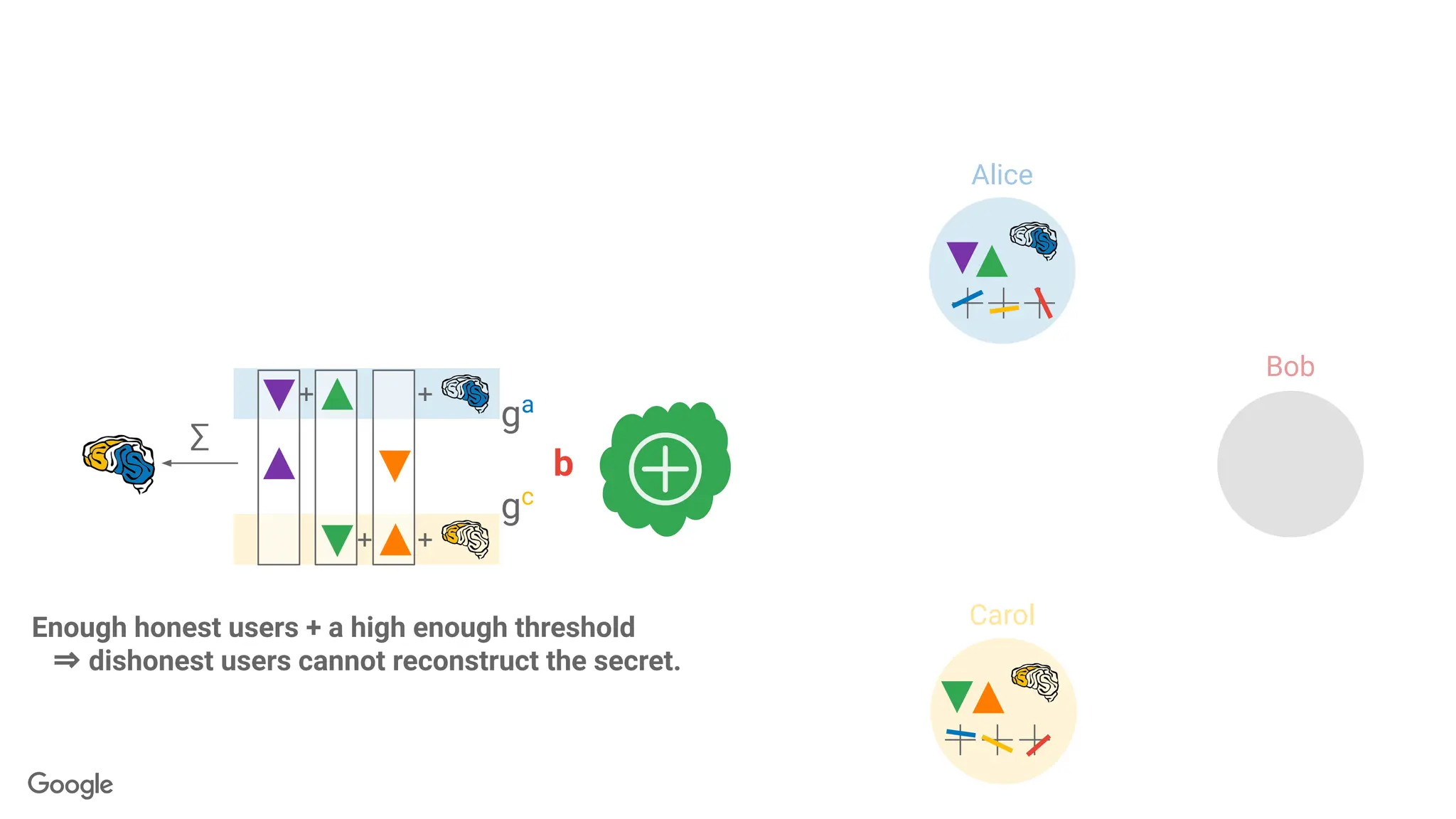
  • 188.
    Advances and OpenProblems in FL 58 authors from 25 top institutions arxiv.org/abs/1912.04977