Discussion
• Description ofData Privacy Act 2012
• Definition of terms
• Not covered by the Act
• Extraterritorial Application
• Function of National Privacy Commission
• Processing of Personal Information
• Criteria for Lawful Processing of Personal Information
• Right of Data Subject
• Penalties
3.
Data Privacy Act2012
• Republic Act 10173
• It is a comprehensive and strict privacy legislation in the Philippines.
• It aims to protect individual personal information in Information and
Communication Systems in government and private sector.
4.
Terminologies
• Commission
• Consentof the Data Subject
• Data Subject
• Direct Marketing
• Filing System
• Information and Communication System
• Personal Information
• Personal Information Controller
• Personal Information Processor
• Processing
• Privilege Information
• Sensitive Personal Information
Consent of DataSubject
• refers to any freely given, specific, informed indication of will,
whereby the data subject agrees to the collection and processing of
personal information about and/or relating to him or her.
• Consent shall be evidenced by written, electronic or recorded means.
• It may also be given on behalf of the data subject by an agent
specifically authorized by the data subject to do so.
Direct Marketing
• refersto communication by whatever means of any advertising or
marketing material which is directed to particular individuals.
9.
Filing System
• refersto any act of information relating to natural or juridical persons
to the extent that, although the information is not processed by
equipment operating automatically in response to instructions given
for that purpose, the set is structured, either by reference to
individuals or by reference to criteria relating to individuals, in such a
way that specific information relating to a particular person is readily
accessible.
10.
Information and CommunicationSystem
• refers to a system for generating, sending, receiving, storing or
otherwise processing electronic data messages or electronic
documents and includes the computer system or other similar device
by or which data is recorded, transmitted or stored and any
procedure related to the recording, transmission or storage of
electronic data, electronic message, or electronic document.
11.
Personal Information
• Refersto any information whether recorded in a material form or
not, from which the identity of an individual is apparent or can be
reasonably and directly ascertained by the entity holding the
information, or when put together with other information would
directly and certainly identify an individual.
12.
Personal Information Controller
•refers to a person or organization who controls the collection,
holding, processing or use of personal information, including a person
or organization who instructs another person or organization to
collect, hold, process, use, transfer or disclose personal information
on his or her behalf.
13.
Personal Information Processor
•refers to any natural or juridical person qualified to act as such under
this Act to whom a personal information controller may outsource
the processing of personal data pertaining to a data subject.
14.
Processing
• Refers toany operation or any set of operations performed upon
personal information including, but not limited to, the collection,
recording, organization, storage, updating or modification, retrieval,
consultation, use, consolidation, blocking, erasure, or destruction of
data.
15.
Privileged Information
• refersto any and all forms of data which under the Rules of Court and
other pertinent laws constitute privileged communication.
16.
Sensitive Personal Information
•Refers to personal information
• Individual race, ethnic origin, marital status, age, color, religious
Philosophical or political affiliations.
• About individual health, education, genetic or sexual life of a person, or to any
proceeding for any offense committed or alleged to have been committed by
such person, the disposal of such proceedings, or the sentence of any court in
such proceedings.
• Issued by government agencies peculiar to an individual which includes, but not
limited to, social security numbers, previous or current health records, licenses
or its denials, suspensions or revocation, and tax returns
Information about anyindividual who is or was an officer or
employee of a government institution that relates to the
position or functions of the individual, including:
1. The fact that the individual is or was an officer or employee of the
government institution
2. The title, business address and office telephone number of the
individual
3. The classification, salary range and responsibilities of the
position held by the individual
4. The name of the individual on a document prepared by the
individual in the course of employment with the government
19.
Information about anindividual who is or was performing
service under contract for a government institution that
relates to the services performed, including the terms of the
contract, and the name of the individual given in the course of
the performance of those services;
20.
Information relating toany discretionary benefit of a financial
nature such as the granting of a license or permit given by the
government to an individual, including the name of the
individual and the exact nature of the benefit;
Information necessary inorder to carry out the functions of
public authority which includes the processing of personal data
for the performance by the independent, central monetary
authority and law enforcement and regulatory agencies of
their constitutionally and statutorily mandated functions.
Nothing in this Act shall be construed as to have amended or
repealed Republic Act No. 1405, otherwise known as the
Secrecy of Bank Deposits Act; Republic Act No. 6426, otherwise
known as the Foreign Currency Deposit Act; and Republic Act
No. 9510, otherwise known as the Credit Information System
Act (CISA);
24.
Information necessary forbanks and other financial
institutions under the jurisdiction of the independent, central
monetary authority or Bangko Sentral ng Pilipinas to comply
with Republic Act No. 9510, and Republic Act No. 9160, as
amended, otherwise known as the Anti-Money Laundering Act
and other applicable laws; and
25.
Personal information originallycollected from residents of
foreign jurisdictions in accordance with the laws of those
foreign jurisdictions, including any applicable data privacy laws,
which is being processed in the Philippines.
Function National PrivacyCommission (NPC)
• Ensure compliance of personal information controllers with
the provisions of this Act
• Receive complaints, institute investigations, facilitate or enable settlement of
complaints through the use of alternative dispute resolution processes,
adjudicate, award indemnity on matters affecting any personal information,
prepare reports on disposition of complaints and resolution of any investigation
it initiates, and, in cases it deems appropriate, publicize any such report:
Provided, That in resolving any complaint or investigation (except where
amicable settlement is reached by the parties), the Commission shall act as a
collegial body. For this purpose, the Commission may be given access to personal
information that is subject of any complaint and to collect the information
necessary to perform its functions under this Act;
28.
Function National PrivacyCommission (NPC)
• Issue cease and desist orders, impose a temporary or
permanent ban on the processing of personal information,
upon finding that the processing will be detrimental to
national security and public interest;
29.
Function National PrivacyCommission (NPC)
• Compel or petition any entity, government agency or
instrumentality to abide by its orders or take action on a
matter affecting data privacy
30.
Function National PrivacyCommission (NPC)
• Monitor the compliance of other government agencies or
instrumentalities on their security and technical measures
and recommend the necessary action in order to meet
minimum standards for protection of personal information
pursuant to this Act;;
31.
Function National PrivacyCommission (NPC)
• Coordinate with other government agencies and the private
sector on efforts to formulate and implement plans and
policies to strengthen the protection of personal
information in the country;
32.
Function National PrivacyCommission (NPC)
• Publish on a regular basis a guide to all laws relating to
data protection;
33.
Function National PrivacyCommission (NPC)
• Publish a compilation of agency system of records and
notices, including index and other finding aids;
34.
Function National PrivacyCommission (NPC)
• Recommend to the Department of Justice (DOJ) the
prosecution and imposition of penalties specified in Sections
25 to 29 of this Act
35.
Function National PrivacyCommission (NPC)
• Review, approve, reject or require modification of privacy codes
voluntarily adhered to by personal information controllers:Provided,
That the privacy codes shall adhere to the underlying data privacy
principles embodied in this Act: Provided, further,That such privacy
codes may include private dispute resolution mechanisms for
complaints against any participating personal information controller.
For this purpose, the Commission shall consult with relevant regulatory
agencies in the formulation and administration of privacy codes
applying the standards set out in this Act, with respect to the persons,
entities, business activities and business sectors that said regulatory
bodies are authorized to principally regulate pursuant to the law:
Provided, finally. That the Commission may review such privacy codes
and require changes thereto for purposes of complying with this Act;
36.
Function National PrivacyCommission (NPC)
• Provide assistance on matters relating to privacy or data protection at the
request of a national or local agency, a private entity or any person;
37.
Function National PrivacyCommission (NPC)
• Provide assistance on matters relating to privacy or data protection at the
request of a national or local agency, a private entity or any person;
38.
Function National PrivacyCommission (NPC)
• Comment on the implication on data privacy of proposed national or local
statutes, regulations or procedures, issue advisory opinions and interpret the
provisions of this Act and other data privacy laws
39.
Function National PrivacyCommission (NPC)
• Propose legislation, amendments or modifications to Philippine laws on privacy
or data protection as may be necessary
40.
Function National PrivacyCommission (NPC)
• Ensure proper and effective coordination with data privacy regulators in other
countries and private accountability agents, participate in international and
regional initiatives for data privacy protection;
41.
Function National PrivacyCommission (NPC)
• Negotiate and contract with other data privacy authorities of other countries for
cross-border application and implementation of respective privacy laws;
42.
Function National PrivacyCommission (NPC)
• Assist Philippine companies doing business abroad to respond to foreign privacy
or data protection laws and regulations;
43.
Function National PrivacyCommission (NPC)
• Generally perform such acts as may be necessary to facilitate cross-border
enforcement of data privacy protection.
General Data PrivacyPrinciple
• The processing of personal information shall be allowed, subject to
compliance with the requirements of this Act and other laws allowing
disclosure of information to the public and adherence to the
principles of transparency, legitimate purpose and proportionality.
46.
Personal Information mustbe
• Collected for specified and legitimate purposes determined and
declared before, or as soon as reasonably practicable after collection,
and later processed in a way compatible with such declared, specified
and legitimate purposes only
Personal Information mustbe
• Accurate, relevant and, where necessary for purposes for which it is
to be used the processing of personal information, kept up to date;
inaccurate or incomplete data must be rectified, supplemented,
destroyed or their further processing restricted
49.
Personal Information mustbe
• Adequate and not excessive in relation to the purposes for which they
are collected and processed;
50.
Personal Information mustbe
• Retained only for as long as necessary for the fulfillment of the
purposes for which the data was obtained or for the establishment,
exercise or defense of legal claims, or for legitimate business
purposes, or as provided by law; and
51.
Personal Information mustbe
• Kept in a form which permits identification of data subjects for no
longer than is necessary for the purposes for which the data were
collected and processed: Provided, That personal information
collected for other purposes may lie processed for historical,
statistical or scientific purposes, and in cases laid down in law may be
stored for longer periods: Provided, further,That adequate safeguards
are guaranteed by said laws authorizing their processing.
The processing ofpersonal information shall be
permitted only if not otherwise prohibited by law, and
when at least one of the following conditions exists:
a) The data subject has given his or her consent;
b) The processing of personal information is necessary and is related to the fulfillment of a
contract with the data subject or in order to take steps at the request of the data subject prior
to entering into a contract
c) The processing is necessary for compliance with a legal obligation to which the personal
information controller is subject;
d) The processing is necessary to protect vitally important interests of the data subject, including
life and health;
e) The processing is necessary in order to respond to national emergency, to comply with the
requirements of public order and safety, or to fulfill functions of public authority which
necessarily includes the processing of personal data for the fulfillment of its mandate;
54.
The processing ofpersonal information shall be
permitted only if not otherwise prohibited by law, and
when at least one of the following conditions exists:
The processing is necessary for the purposes of the
legitimate interests pursued by the personal information
controller or by a third party or parties to whom the data is
disclosed, except where such interests are overridden by
fundamental rights and freedoms of the data subject which
require protection under the Philippine Constitution.
The processing ofsensitive personal information and privileged
information shall be prohibited. Except in the following cases
• The data subject has given his or her consent, specific to the purpose
prior to the processing, or in the case of privileged information, all
parties to the exchange have given their consent prior to processing;
57.
The processing ofsensitive personal information and privileged
information shall be prohibited. Except in the following cases
• The processing of the same is provided for by existing laws and
regulations: Provided, That such regulatory enactments guarantee
the protection of the sensitive personal information and the
privileged information: Provided, further, That the consent of the
data subjects are not required by law or regulation permitting the
processing of the sensitive personal information or the privileged
information;
58.
The processing ofsensitive personal information and privileged
information shall be prohibited. Except in the following cases
• The processing is necessary to protect the life and health of the data
subject or another person, and the data subject is not legally or
physically able to express his or her consent prior to the processing;
59.
The processing ofsensitive personal information and privileged
information shall be prohibited. Except in the following cases
• The processing is necessary to achieve the lawful and noncommercial objectives
of public organizations and their associations: Provided, That such processing is
only confined and related to the bona fide members of these organizations or
their associations: Provided, further, That the sensitive personal information are
not transferred to third parties: Provided, finally, That consent of the data
subject was obtained prior to processing;
60.
The processing ofsensitive personal information and privileged
information shall be prohibited. Except in the following cases
• The processing is necessary for purposes of medical treatment, is carried out by
a medical practitioner or a medical treatment institution, and an adequate level
of protection of personal information is ensured;
61.
The processing ofsensitive personal information and privileged
information shall be prohibited. Except in the following cases
• The processing concerns such personal information as is necessary for the
protection of lawful rights and interests of natural or legal persons in court
proceedings, or the establishment, exercise or defense of legal claims, or when
provided to government or public authority.
62.
Subcontract of PersonalInformation
• A personal information controller may subcontract the processing of
personal information: Provided, That the personal information
controller shall be responsible for ensuring that proper safeguards are
in place to ensure the confidentiality of the personal information
processed, prevent its use for unauthorized purposes, and generally,
comply with the requirements of this Act and other laws for
processing of personal information. The personal information
processor shall comply with all the requirements of this Act and other
applicable laws.
63.
Extension of PrivilegedCommunication
• Personal information controllers may invoke the principle of
privileged communication over privileged information that they
lawfully control or process. Subject to existing laws and regulations,
any evidence gathered on privileged information is inadmissible.
Right of DataSubject
• Be informed whether personal information pertaining to
him or her shall be, are being or have been processed.
66.
Right of DataSubject
• Be furnished the information indicated hereunder before the
entry of his or her personal information into the processing
system of the personal information controller, or at the next
practical opportunity:
1. Description of the personal information to be entered into the system;
2. Purposes for which they are being or are to be processed;
3. Scope and method of the personal information processing
4. The recipients or classes of recipients to whom they are or may be disclosed
5. Methods utilized for automated access, if the same is allowed by the data subject,
and the extent to which such access is authorized
6. The identity and contact details of the personal information controller or its
representative
67.
Right of DataSubject
• Be furnished the information indicated hereunder before the
entry of his or her personal information into the processing
system of the personal information controller, or at the next
practical opportunity:
1. Description of the personal information to be entered into the system;
2. Purposes for which they are being or are to be processed;
3. Scope and method of the personal information processing
4. The recipients or classes of recipients to whom they are or may be disclosed
5. Methods utilized for automated access, if the same is allowed by the data subject,
and the extent to which such access is authorized
6. The identity and contact details of the personal information controller or its
representative
68.
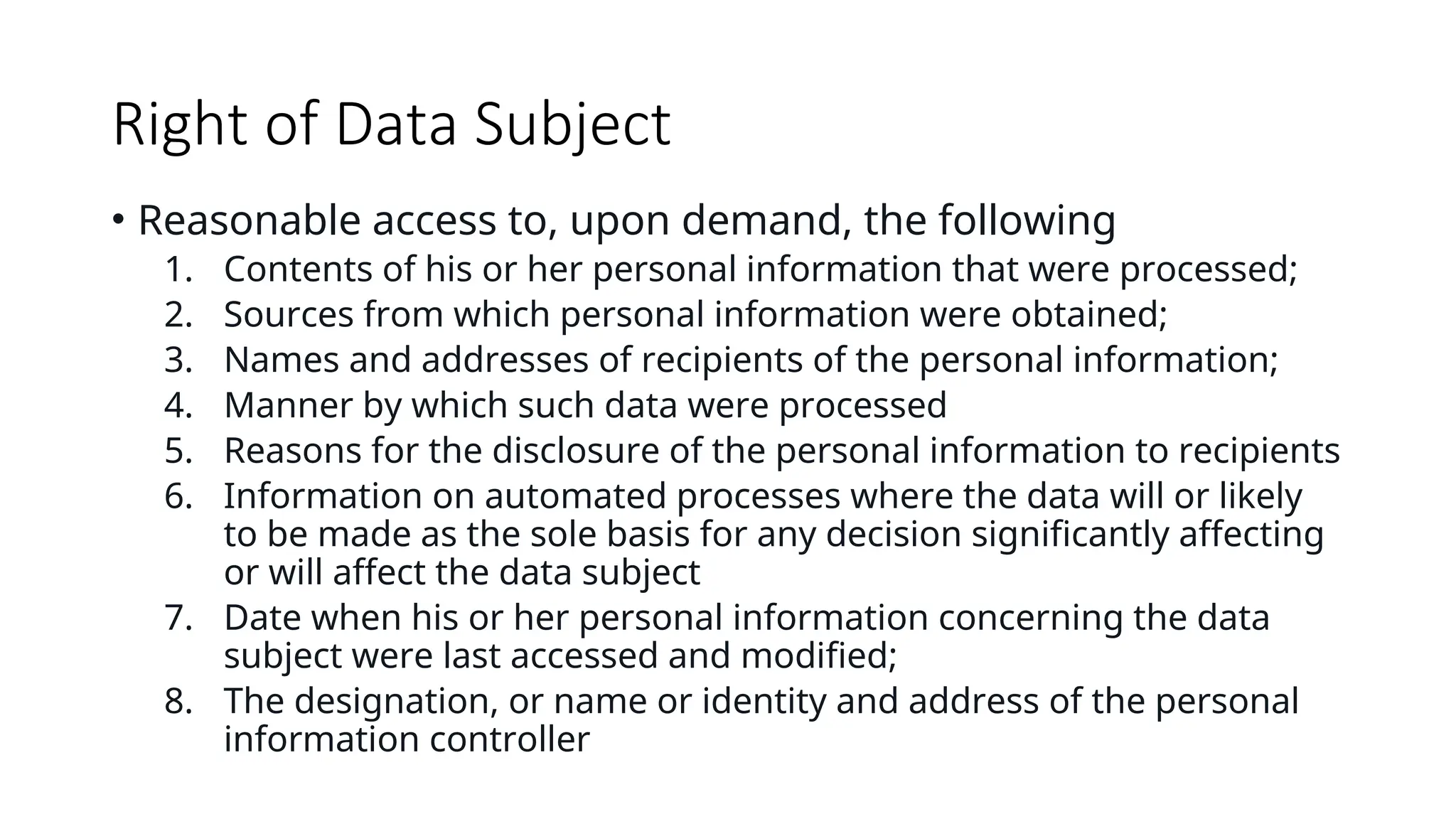
Right of DataSubject
• Reasonable access to, upon demand, the following
1. Contents of his or her personal information that were processed;
2. Sources from which personal information were obtained;
3. Names and addresses of recipients of the personal information;
4. Manner by which such data were processed
5. Reasons for the disclosure of the personal information to recipients
6. Information on automated processes where the data will or likely
to be made as the sole basis for any decision significantly affecting
or will affect the data subject
7. Date when his or her personal information concerning the data
subject were last accessed and modified;
8. The designation, or name or identity and address of the personal
information controller
69.
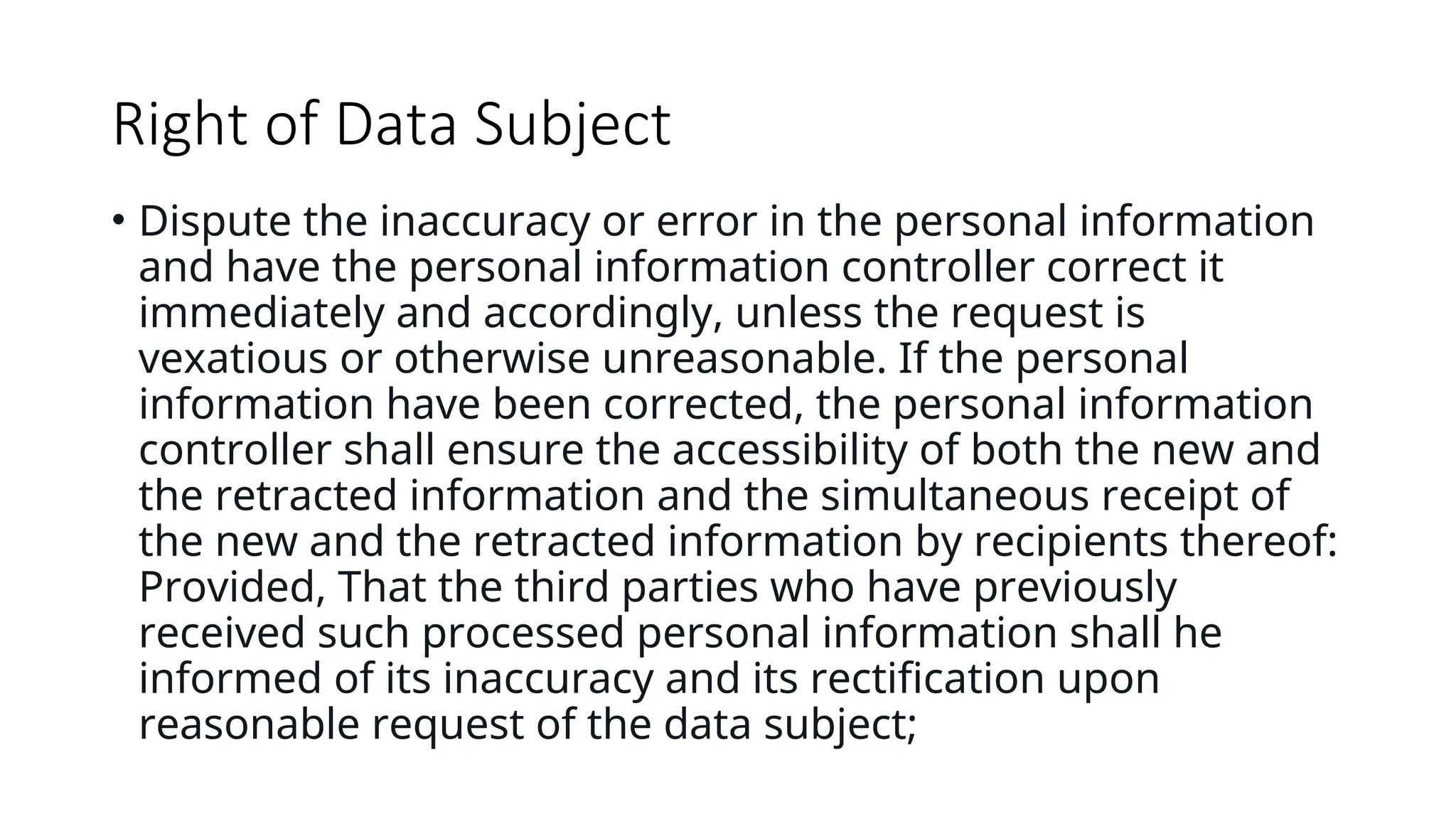
Right of DataSubject
• Dispute the inaccuracy or error in the personal information
and have the personal information controller correct it
immediately and accordingly, unless the request is
vexatious or otherwise unreasonable. If the personal
information have been corrected, the personal information
controller shall ensure the accessibility of both the new and
the retracted information and the simultaneous receipt of
the new and the retracted information by recipients thereof:
Provided, That the third parties who have previously
received such processed personal information shall he
informed of its inaccuracy and its rectification upon
reasonable request of the data subject;
70.
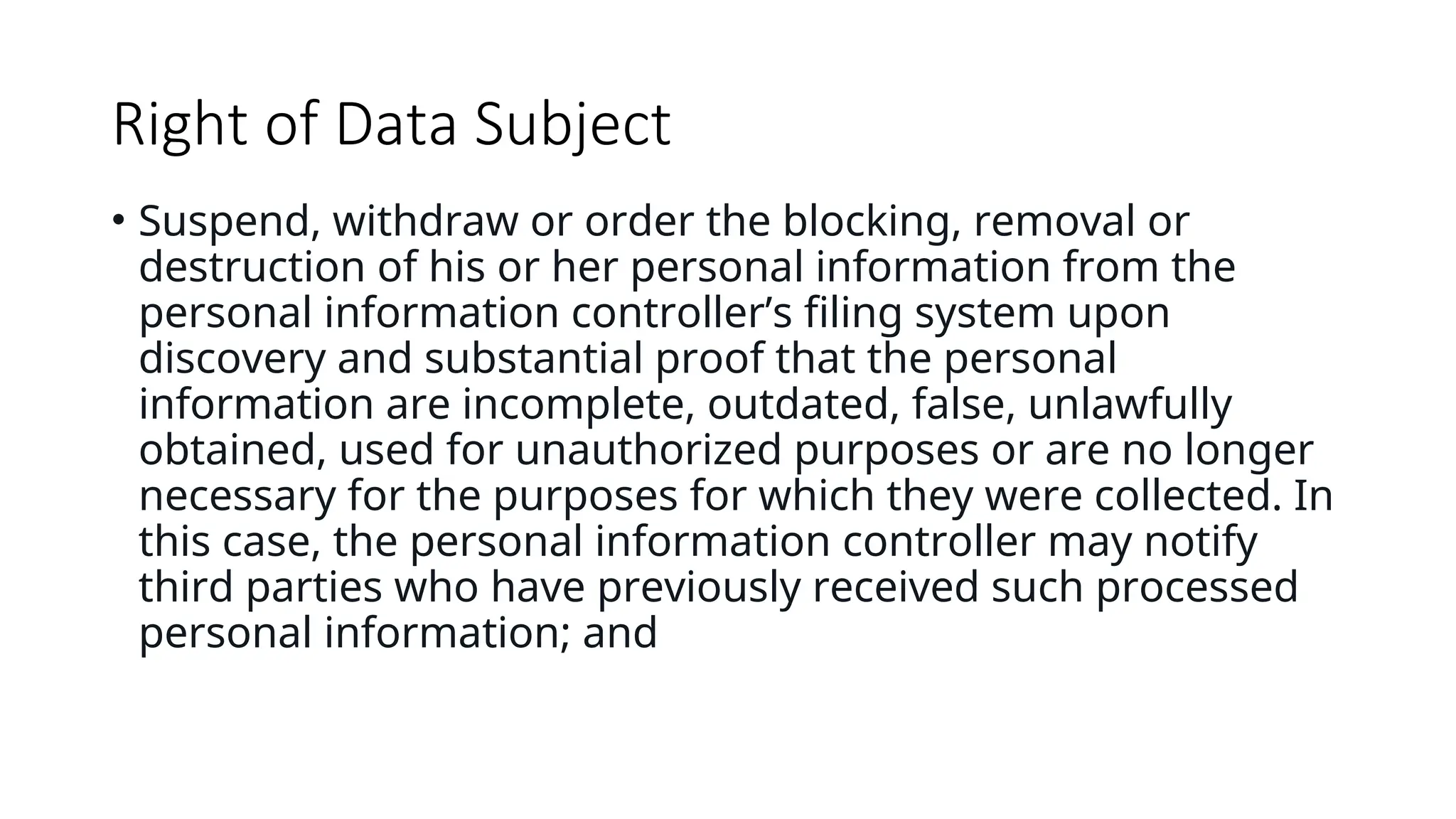
Right of DataSubject
• Suspend, withdraw or order the blocking, removal or
destruction of his or her personal information from the
personal information controller’s filing system upon
discovery and substantial proof that the personal
information are incomplete, outdated, false, unlawfully
obtained, used for unauthorized purposes or are no longer
necessary for the purposes for which they were collected. In
this case, the personal information controller may notify
third parties who have previously received such processed
personal information; and
71.
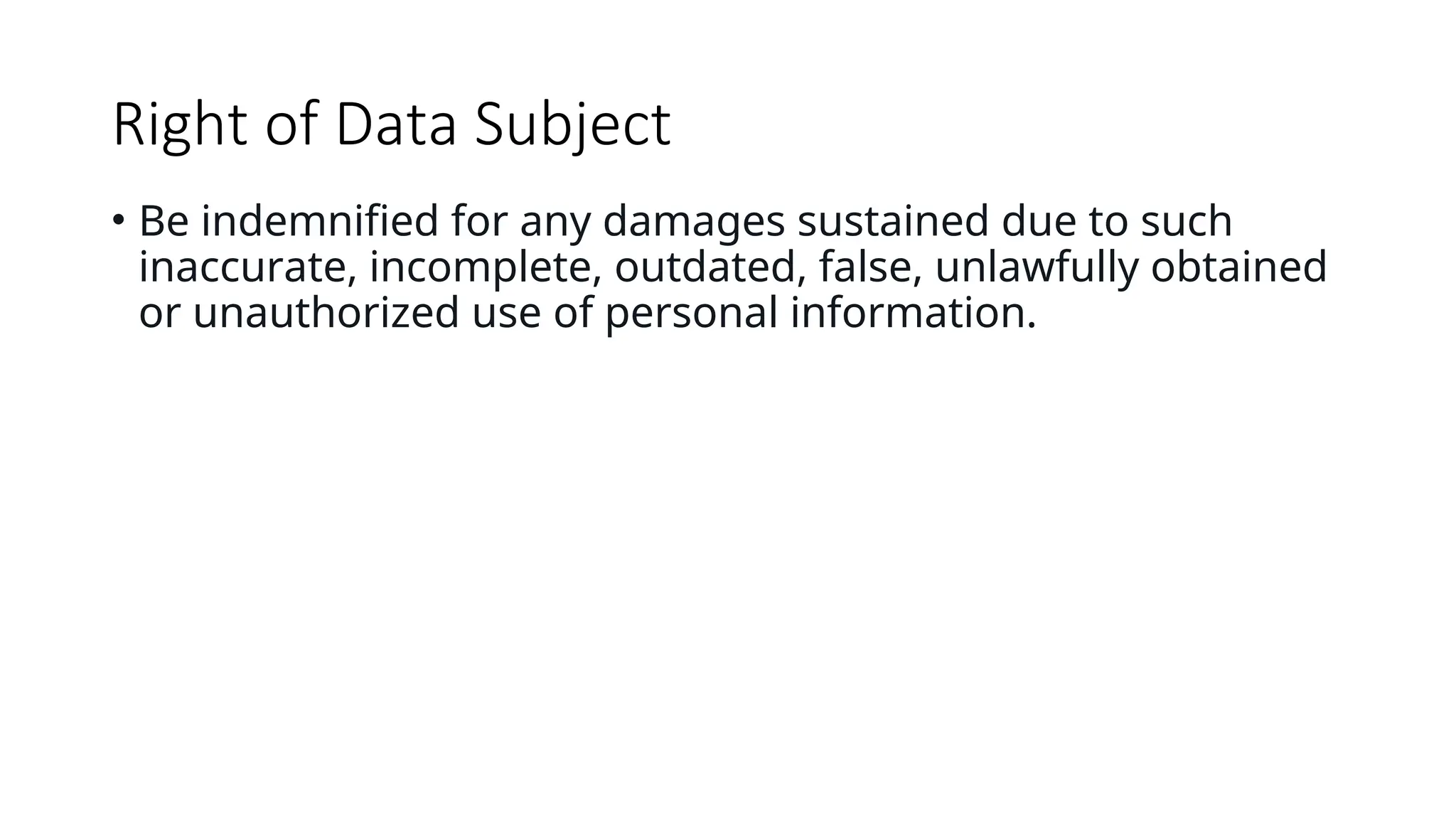
Right of DataSubject
• Be indemnified for any damages sustained due to such
inaccurate, incomplete, outdated, false, unlawfully obtained
or unauthorized use of personal information.
72.
Transmissibility of Rightsof the Data Subject
• The lawful heirs and assigns of the data subject may invoke the rights
of the data subject for, which he or she is an heir or assignee at any
time after the death of the data subject or when the data subject is
incapacitated or incapable of exercising the rights as enumerated in
the immediately preceding section.
73.
Right to DataPortability
• The data subject shall have the right, where personal information is
processed by electronic means and in a structured and commonly
used format, to obtain from the personal information controller a
copy of data undergoing processing in an electronic or structured
format, which is commonly used and allows for further use by the
data subject. The Commission may specify the electronic format
referred to above, as well as the technical standards, modalities and
procedures for their transfer.
74.
Non-Applicability.
• The immediatelypreceding sections are not applicable if the
processed personal information are used only for the needs of
scientific and statistical research and, on the basis of such, no
activities are carried out and no decisions are taken regarding the
data subject: Provided, That the personal information shall be held
under strict confidentiality and shall be used only for the declared
purpose. Likewise, the immediately preceding sections are not
applicable to processing of personal information gathered for the
purpose of investigations in relation to any criminal, administrative or
tax liabilities of a data subject..
Unauthorized Processing ofPersonal Information
and Sensitive Personal Information
• (a) The unauthorized processing of personal information
shall be penalized by imprisonment ranging from one (1)
year to three (3) years and a fine of not less than Five
hundred thousand pesos (Php500,000.00) but not more
than Two million pesos (Php2,000,000.00) shall be imposed
on persons who process personal information without the
consent of the data subject, or without being authorized
under this Act or any existing law.
77.
Unauthorized Processing ofPersonal Information
and Sensitive Personal Information
• The unauthorized processing of personal sensitive
information shall be penalized by imprisonment ranging
from three (3) years to six (6) years and a fine of not less
than Five hundred thousand pesos (Php500,000.00) but not
more than Four million pesos (Php4,000,000.00) shall be
imposed on persons who process personal information
without the consent of the data subject, or without being
authorized under this Act or any existing law..
78.
Accessing Personal Informationand Sensitive Personal
Information Due to Negligence.
• The unauthorized processing of personal sensitive
information shall be penalized by imprisonment ranging
from three (3) years to six (6) years and a fine of not less
than Five hundred thousand pesos (Php500,000.00) but not
more than Four million pesos (Php4,000,000.00) shall be
imposed on persons who process personal information
without the consent of the data subject, or without being
authorized under this Act or any existing law.
79.
Accessing Personal Informationand Sensitive Personal
Information Due to Negligence.
• Accessing sensitive personal information due to negligence
shall be penalized by imprisonment ranging from three (3)
years to six (6) years and a fine of not less than Five hundred
thousand pesos (Php500,000.00) but not more than Four
million pesos (Php4,000,000.00) shall be imposed on
persons who, due to negligence, provided access to
personal information without being authorized under this
Act or any existing law..
80.
Improper Disposal ofPersonal Information
and Sensitive Personal Information
• (a) The improper disposal of personal information shall be penalized
by imprisonment ranging from six (6) months to two (2) years and a
fine of not less than One hundred thousand pesos (Php100,000.00)
but not more than Five hundred thousand pesos (Php500,000.00)
shall be imposed on persons who knowingly or negligently dispose,
discard or abandon the personal information of an individual in an
area accessible to the public or has otherwise placed the personal
information of an individual in its container for trash collection.
81.
Improper Disposal ofPersonal Information
and Sensitive Personal Information
• (b) The improper disposal of sensitive personal information
shall be penalized by imprisonment ranging from one (1)
year to three (3) years and a fine of not less than One
hundred thousand pesos (Php100,000.00) but not more
than One million pesos (Php1,000,000.00) shall be imposed
on persons who knowingly or negligently dispose, discard
or abandon the personal information of an individual in an
area accessible to the public or has otherwise placed the
personal information of an individual in its container for
trash collection.
82.
Processing of PersonalInformation and Sensitive Personal
Information for Unauthorized Purposes
• The processing of personal information for unauthorized purposes
shall be penalized by imprisonment ranging from one (1) year and six
(6) months to five (5) years and a fine of not less than Five hundred
thousand pesos (Php500,000.00) but not more than One million
pesos (Php1,000,000.00) shall be imposed on persons processing
personal information for purposes not authorized by the data subject,
or otherwise authorized under this Act or under existing laws.
83.
Processing of PersonalInformation and Sensitive Personal
Information for Unauthorized Purposes
• The processing of sensitive personal information for unauthorized
purposes shall be penalized by imprisonment ranging from two (2)
years to seven (7) years and a fine of not less than Five hundred
thousand pesos (Php500,000.00) but not more than Two million
pesos (Php2,000,000.00) shall be imposed on persons processing
sensitive personal information for purposes not authorized by the
data subject, or otherwise authorized under this Act or under existing
laws.
84.
Unauthorized Access orIntentional Breach
• The penalty of imprisonment ranging from one (1) year to three (3)
years and a fine of not less than Five hundred thousand pesos
(Php500,000.00) but not more than Two million pesos
(Php2,000,000.00) shall be imposed on persons who knowingly and
unlawfully, or violating data confidentiality and security data systems,
breaks in any way into any system where personal and sensitive
personal information is stored.
85.
Concealment of SecurityBreaches Involving
Sensitive Personal Information
• The penalty of imprisonment of one (1) year and six (6) months to
five (5) years and a fine of not less than Five hundred thousand pesos
(Php500,000.00) but not more than One million pesos
(Php1,000,000.00) shall be imposed on persons who, after having
knowledge of a security breach and of the obligation to notify the
Commission pursuant to Section 20(f), intentionally or by omission
conceals the fact of such security breach.
86.
Malicious Disclosure
• Anypersonal information controller or personal information processor or any of
its officials, employees or agents, who, with malice or in bad faith, discloses
unwarranted or false information relative to any personal information or
personal sensitive information obtained by him or her, shall be subject to
imprisonment ranging from one (1) year and six (6) months to five (5) years and a
fine of not less than Five hundred thousand pesos (Php500,000.00) but not more
than One million pesos (Php1,000,000.00).
87.
Unauthorized Disclosure.
• (a)Any personal information controller or personal information
processor or any of its officials, employees or agents, who discloses to
a third party personal information not covered by the immediately
preceding section without the consent of the data subject, shall he
subject to imprisonment ranging from one (1) year to three (3) years
and a fine of not less than Five hundred thousand pesos
(Php500,000.00) but not more than One million pesos
(Php1,000,000.00).
88.
Unauthorized Disclosure.
• (b)Any personal information controller or personal information
processor or any of its officials, employees or agents, who discloses to
a third party sensitive personal information not covered by the
immediately preceding section without the consent of the data
subject, shall be subject to imprisonment ranging from three (3) years
to five (5) years and a fine of not less than Five hundred thousand
pesos (Php500,000.00) but not more than Two million pesos
(Php2,000,000.00).
89.
Combination or Seriesof Acts
• Any combination or series of acts as defined in Sections 25 to 32 shall
make the person subject to imprisonment ranging from three (3)
years to six (6) years and a fine of not less than One million pesos
(Php1,000,000.00) but not more than Five million pesos
(Php5,000,000.00).
90.
Offense Committed byPublic Officer.
• When the offender or the person responsible for the offense is a
public officer as defined in the Administrative Code of the Philippines
in the exercise of his or her duties, an accessory penalty consisting in
the disqualification to occupy public office for a term double the term
of criminal penalty imposed shall he applied.