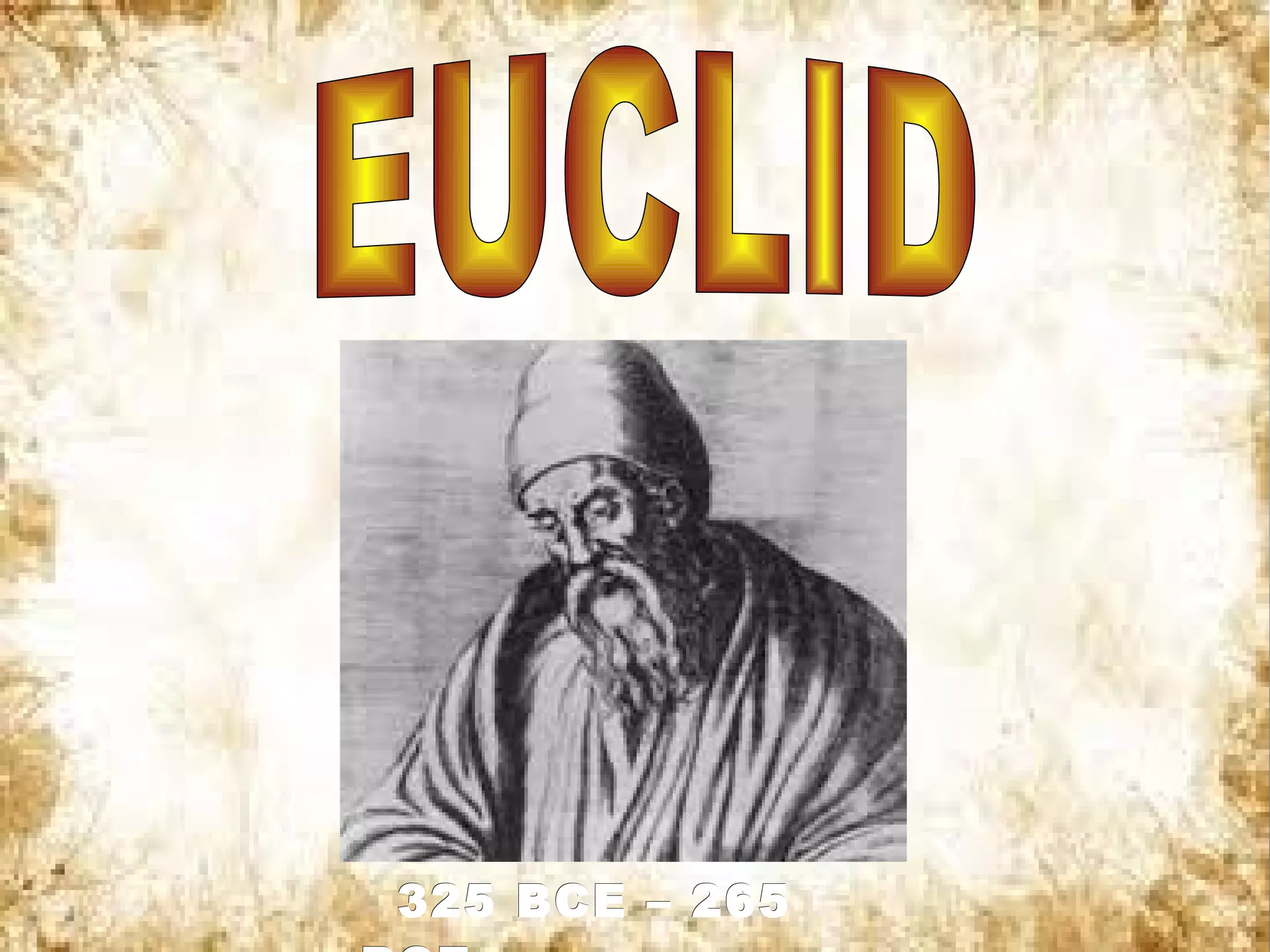
332255 BBCCEE –– 226655 
BBCCEE
Eclids Work in the field 
Eclids Work in the field of 
of Mathematics 
Mathematics 
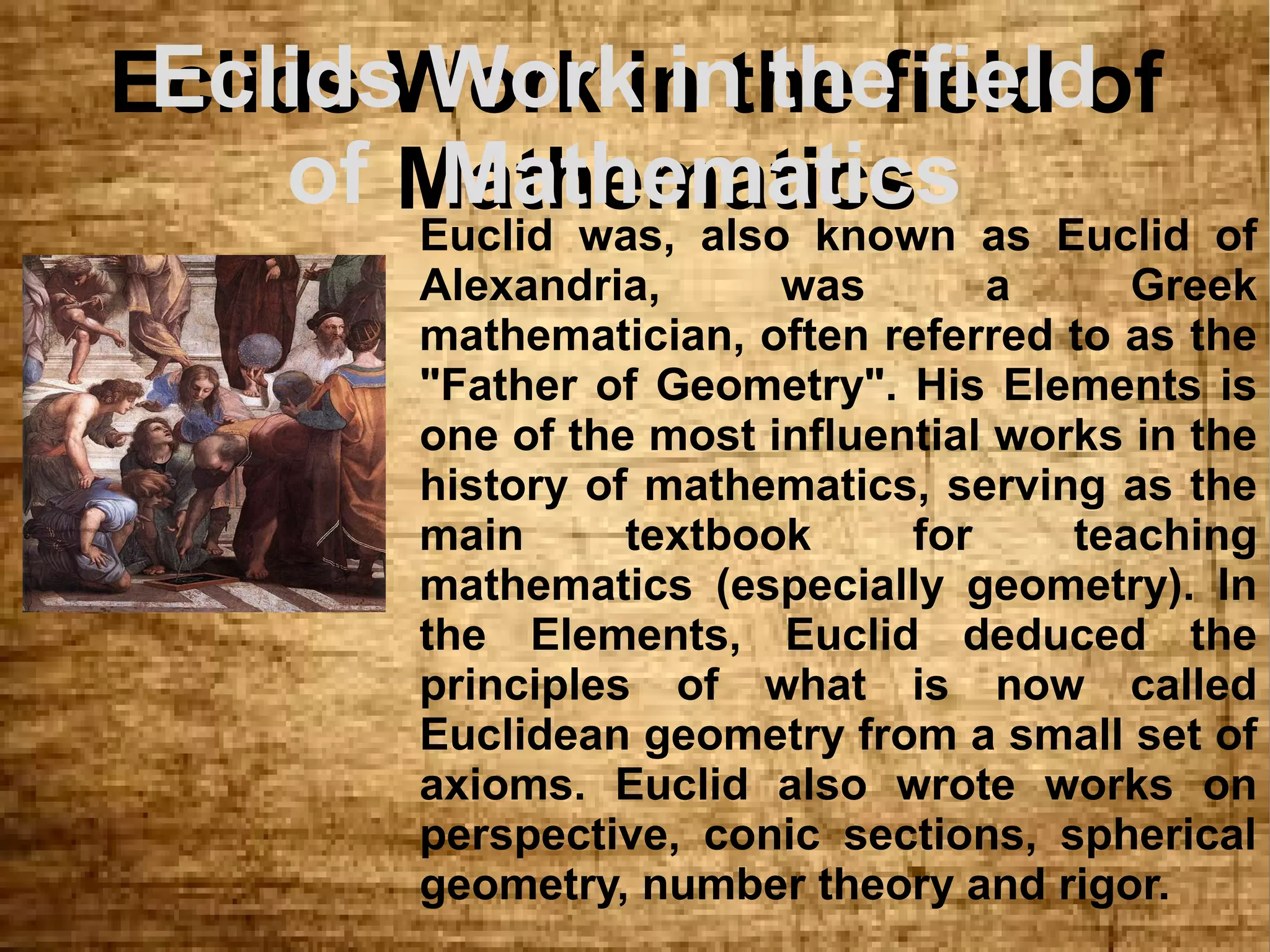
Euclid was, also known as Euclid of 
Alexandria, was a Greek 
mathematician, often referred to as the 
"Father of Geometry". His Elements is 
one of the most influential works in the 
history of mathematics, serving as the 
main textbook for teaching 
mathematics (especially geometry). In 
the Elements, Euclid deduced the 
principles of what is now called 
Euclidean geometry from a small set of 
axioms. Euclid also wrote works on 
perspective, conic sections, spherical 
geometry, number theory and rigor.
Euclid's Geometry 
● The word 'geometry' is derived from the greek 
word 'geo' meaning 'Earth' and 'metron' 
meaning 'measuring'. Thus, the word geometry 
means 'earth measurement'. 
● Euclid was the first mathematician who initiated 
a new way of thinking the study of geometry 
results by deductive reasoning based upon 
previously proved results and some self-evident 
specific assumptions called axioms. 
AXIOMS : The basic fact which are taken for 
granted, without proofs, are called axioms.
EUCLID's Definations 
In the first Book of Elements, Euclid gave 23 
definations and some of them are as follows :- 
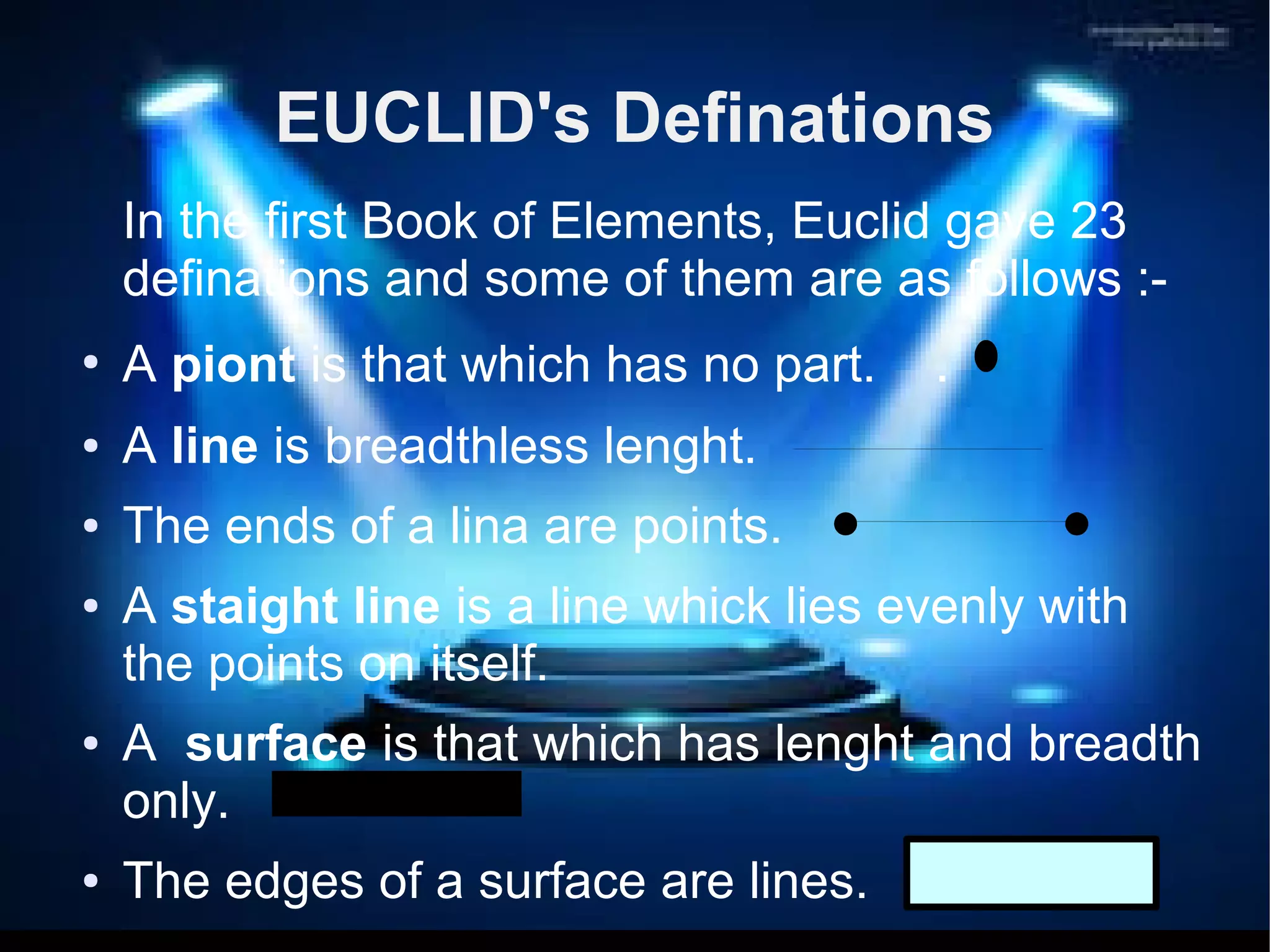
● A piont is that which has no part. . 
● A line is breadthless lenght. 
● The ends of a lina are points. 
● A staight line is a line whick lies evenly with 
the points on itself. 
● A surface is that which has lenght and breadth 
only. 
● The edges of a surface are lines.
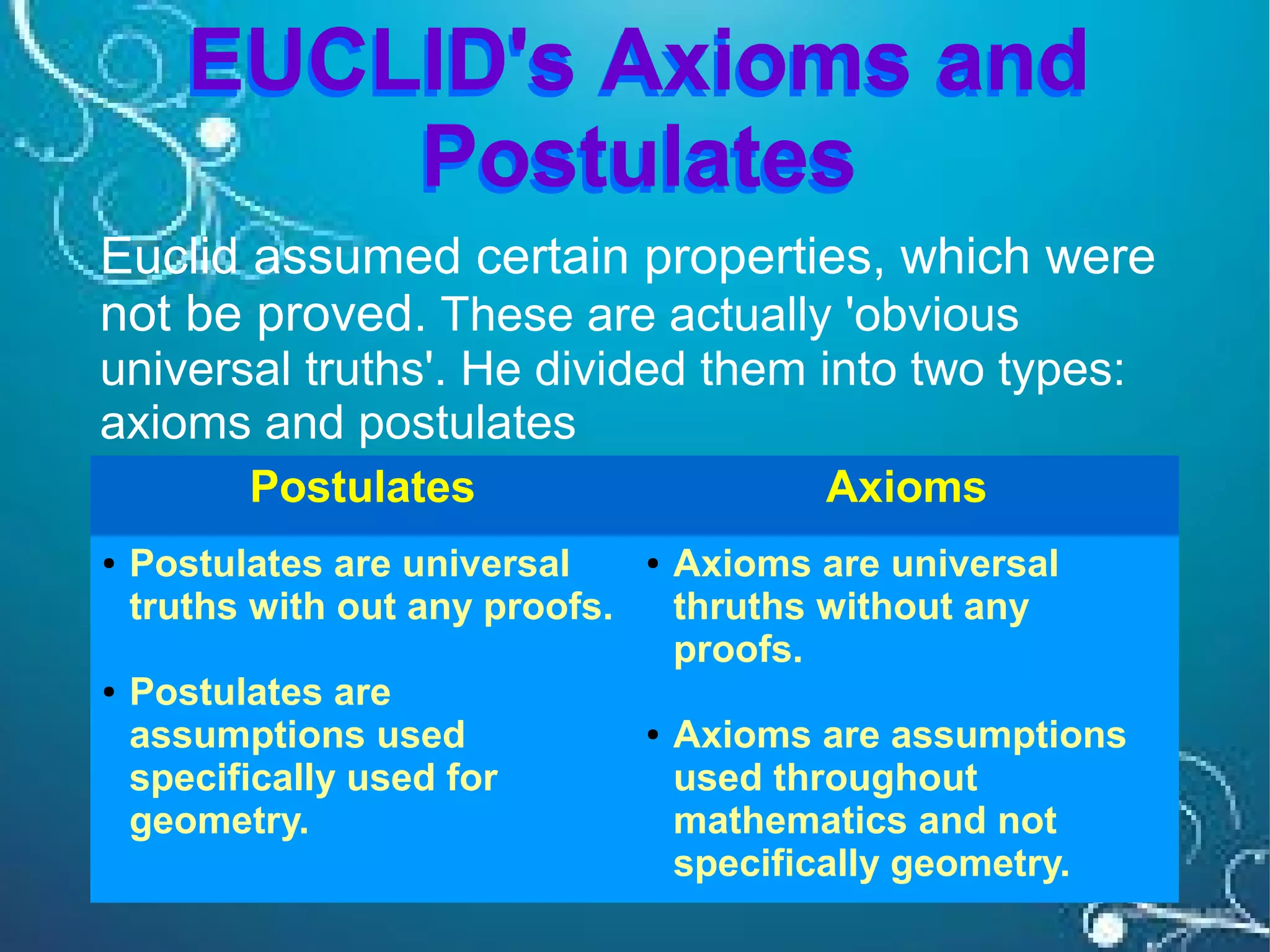
EUCLID's Axioms and 
Postulates 
Euclid assumed certain properties, which were 
not be proved. These are actually 'obvious 
universal truths'. He divided them into two types: 
axioms and postulates 
Postulates Axioms 
● Postulates are universal 
truths with out any proofs. 
● Postulates are 
assumptions used 
specifically used for 
geometry. 
● Axioms are universal 
thruths without any 
proofs. 
● Axioms are assumptions 
used throughout 
mathematics and not 
specifically geometry.
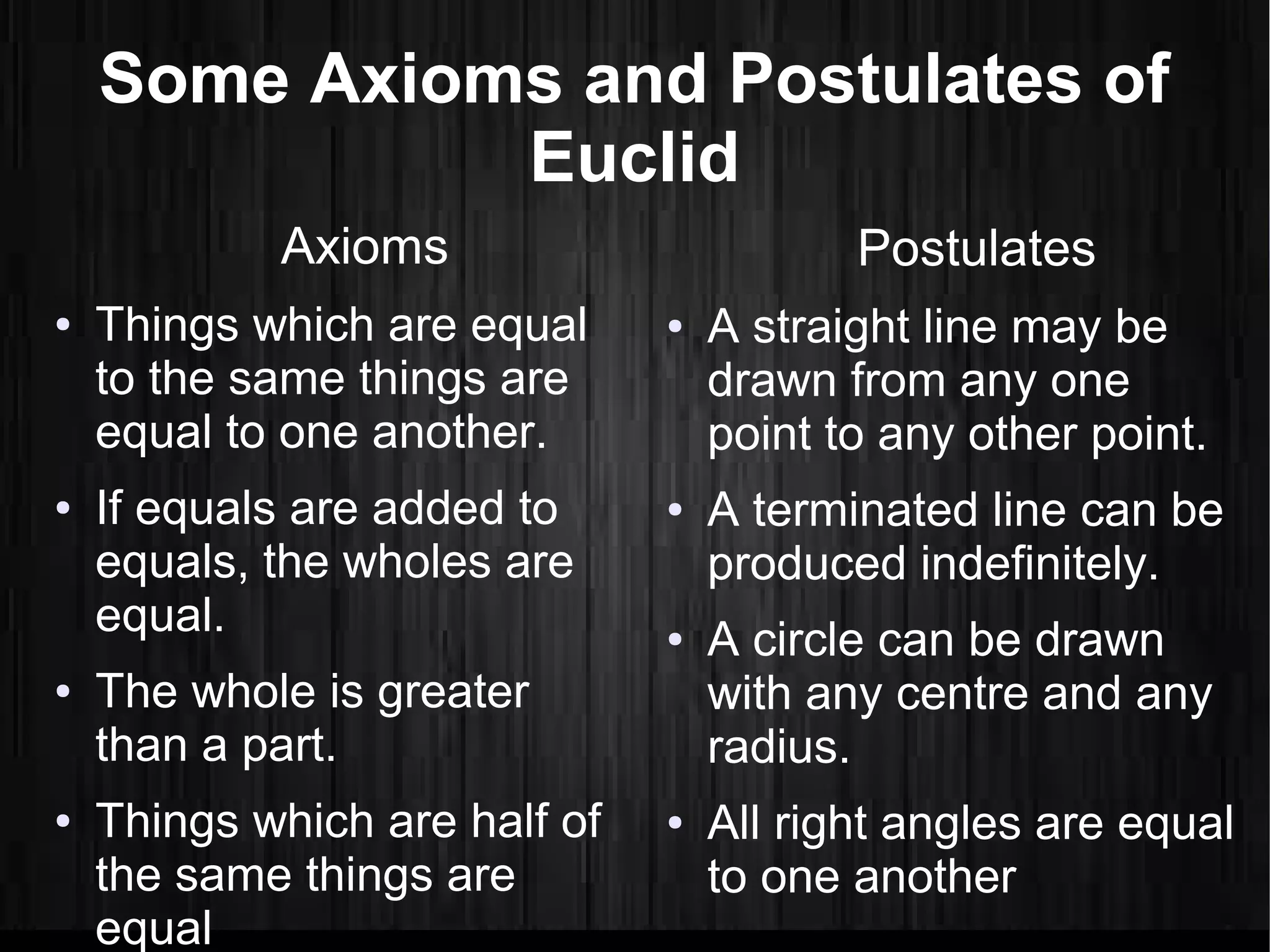
Some Axioms and Postulates of 
Euclid 
Axioms 
● Things which are equal 
to the same things are 
equal to one another. 
● If equals are added to 
equals, the wholes are 
equal. 
● The whole is greater 
than a part. 
● Things which are half of 
the same things are 
equal 
Postulates 
● A straight line may be 
drawn from any one 
point to any other point. 
● A terminated line can be 
produced indefinitely. 
● A circle can be drawn 
with any centre and any 
radius. 
● All right angles are equal 
to one another
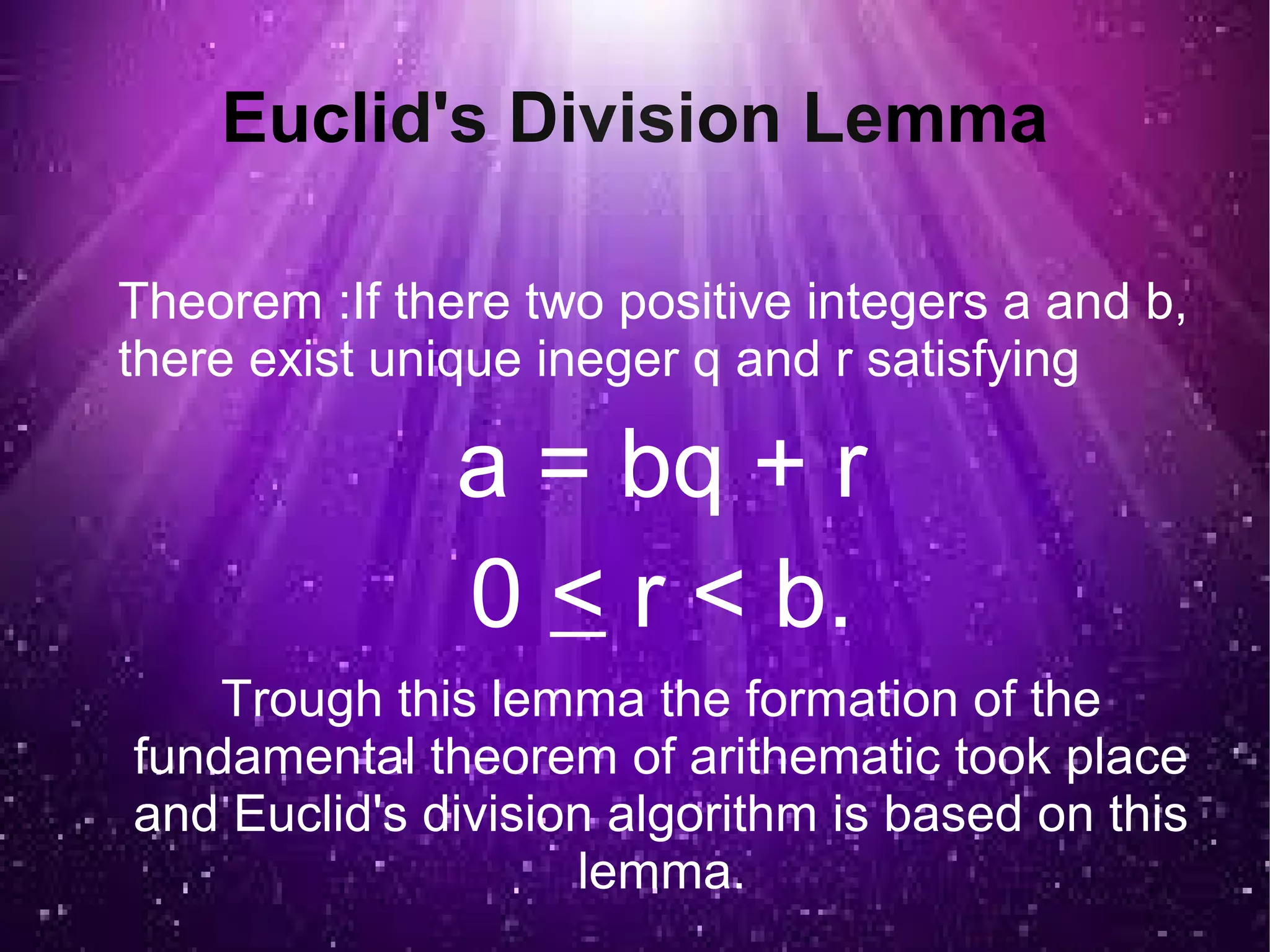
Euclid's Division Lemma 
Theorem :If there two positive integers a and b, 
there exist unique ineger q and r satisfying 
a = bq + r 
0 < r < b. 
Trough this lemma the formation of the 
fundamental theorem of arithematic took place 
and Euclid's division algorithm is based on this 
lemma.
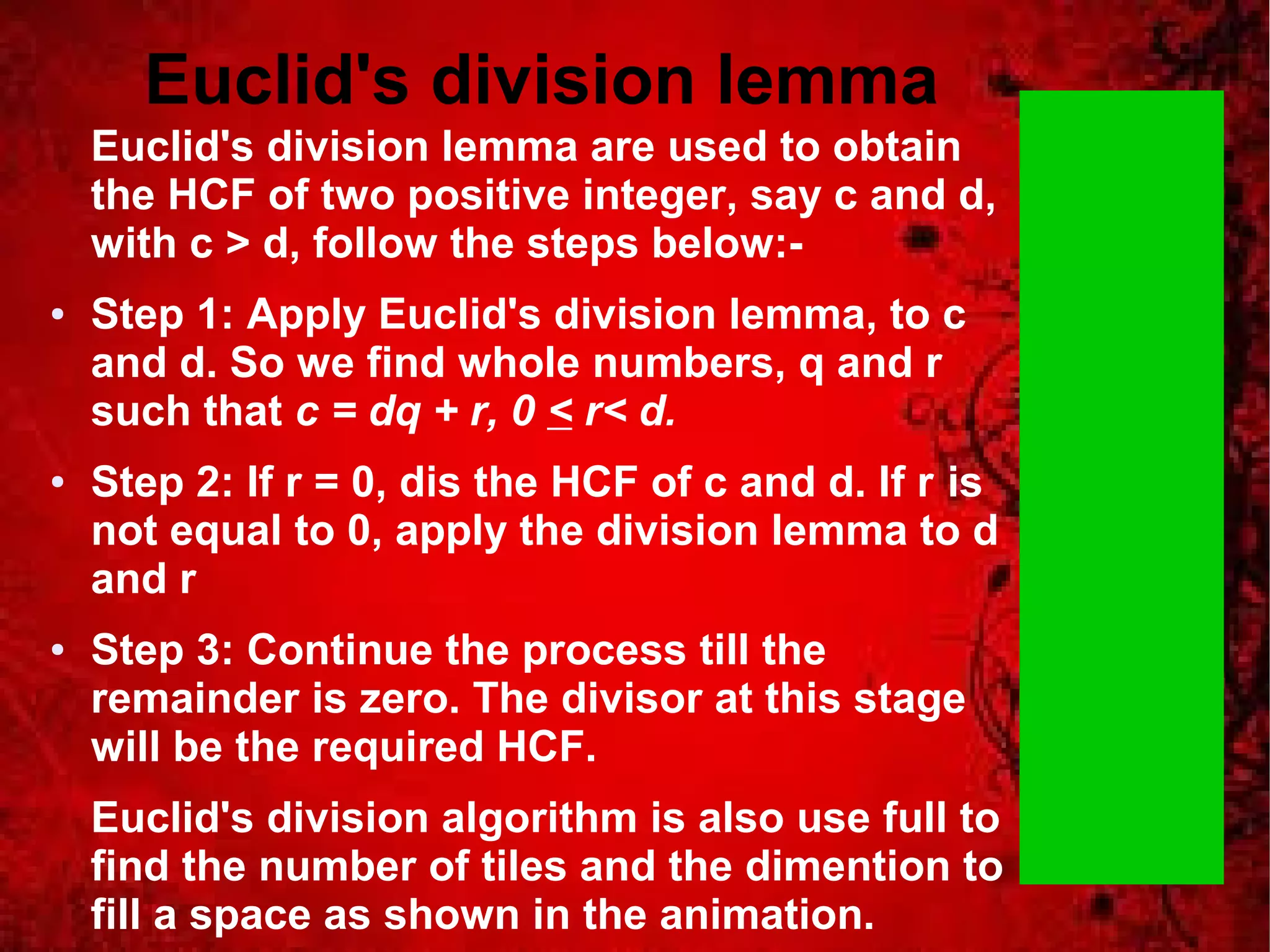
Euclid's division lemma 
Euclid's division lemma are used to obtain 
the HCF of two positive integer, say c and d, 
with c > d, follow the steps below:- 
● Step 1: Apply Euclid's division lemma, to c 
and d. So we find whole numbers, q and r 
such that c = dq + r, 0 < r< d. 
● Step 2: If r = 0, dis the HCF of c and d. If r is 
not equal to 0, apply the division lemma to d 
and r 
● Step 3: Continue the process till the 
remainder is zero. The divisor at this stage 
will be the required HCF. 
Euclid's division algorithm is also use full to 
find the number of tiles and the dimention to 
fill a space as shown in the animation.
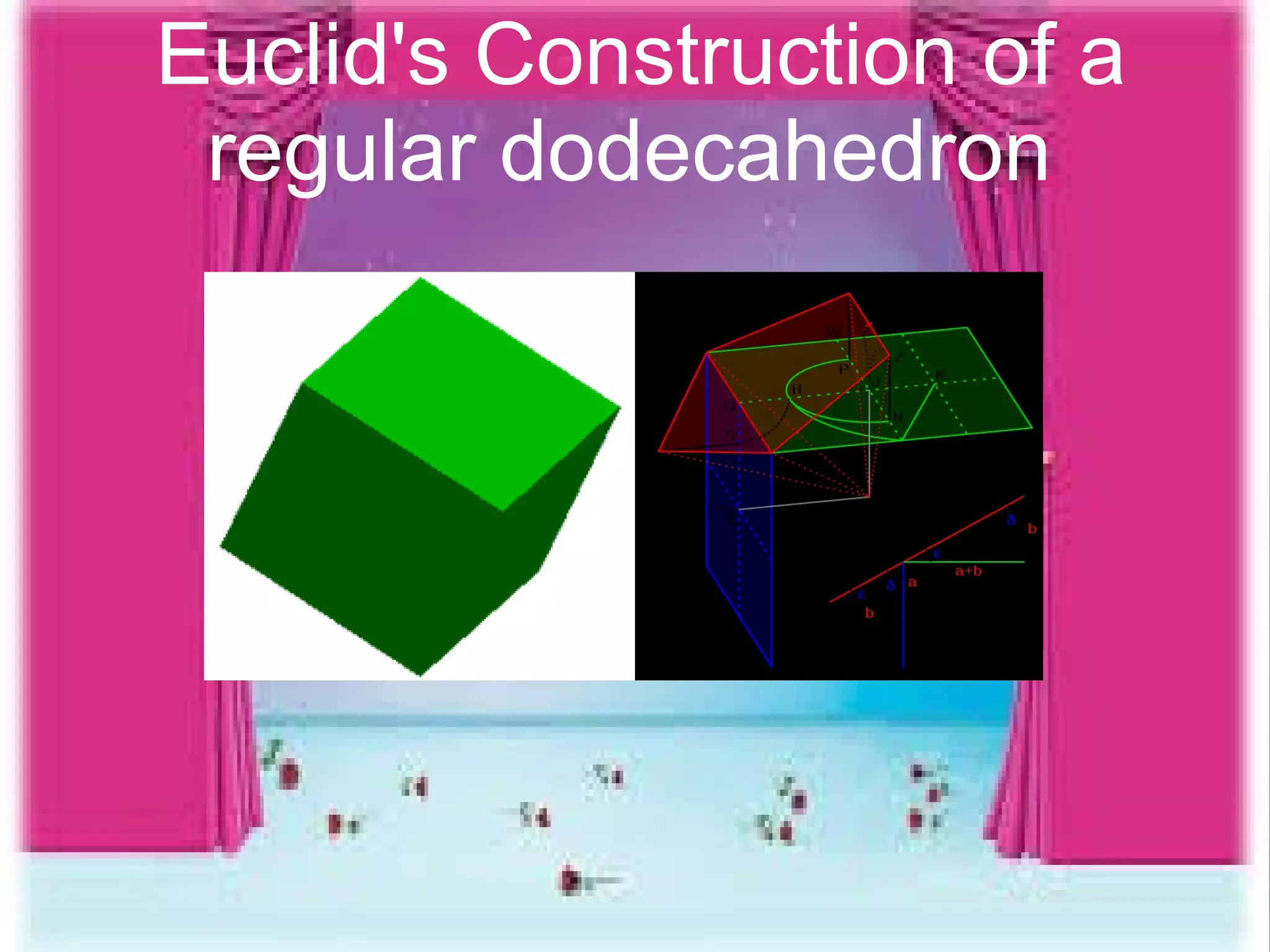
Euclid's Construction of a 
regular dodecahedron
Euclid's work on Data 
The Data is closely related to the first 
four books of the Elements. It opens 
with definitions of the different senses 
in which things are said to be ``given.'' 
Thus lines, angles, and ratios may be 
given in magnitude, rectilinear figures 
may be given in species or given in 
form, points and lines may be given in 
position,etc.
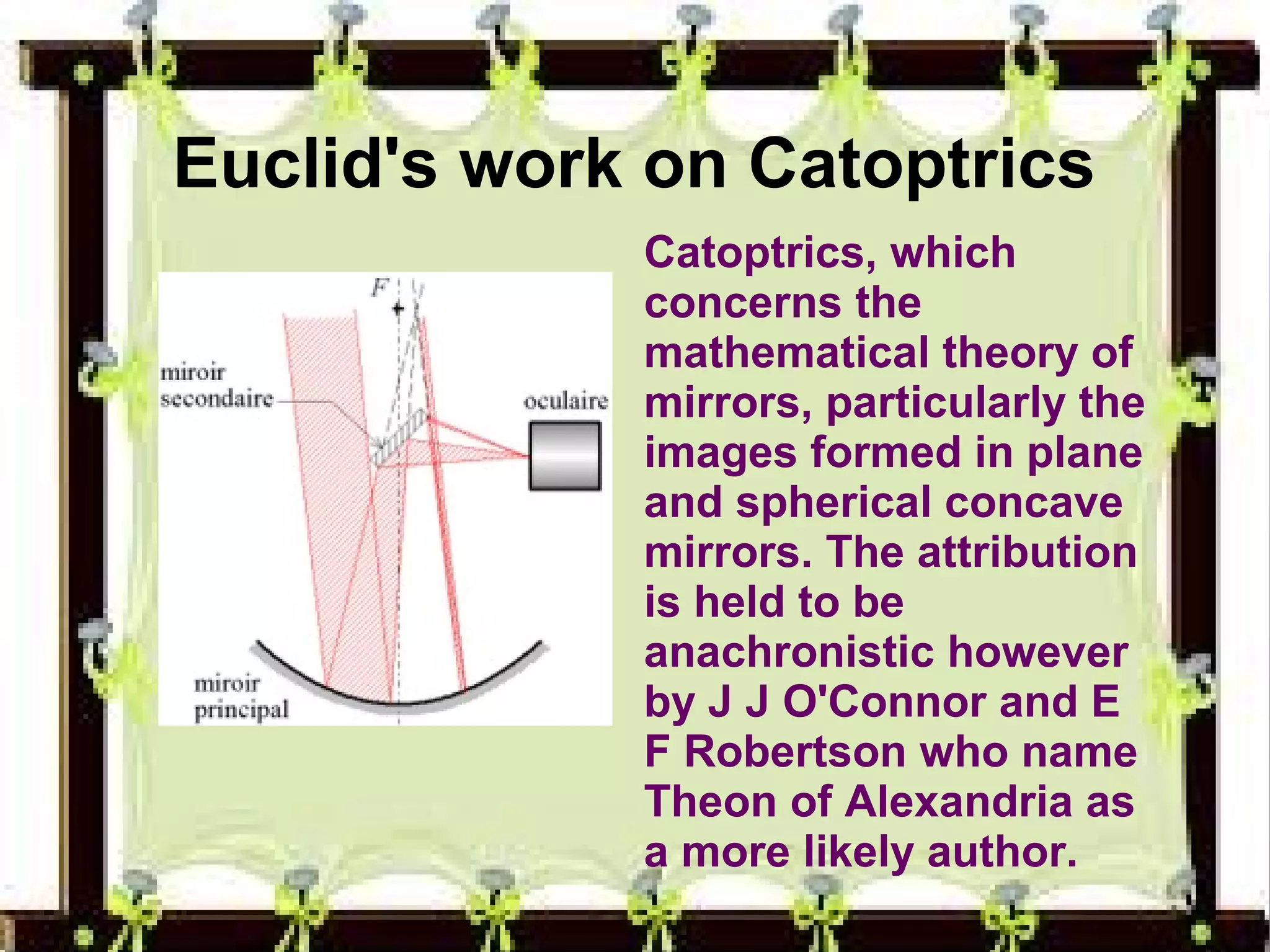
Euclid's work on Catoptrics 
Catoptrics, which 
concerns the 
mathematical theory of 
mirrors, particularly the 
images formed in plane 
and spherical concave 
mirrors. The attribution 
is held to be 
anachronistic however 
by J J O'Connor and E 
F Robertson who name 
Theon of Alexandria as 
a more likely author.
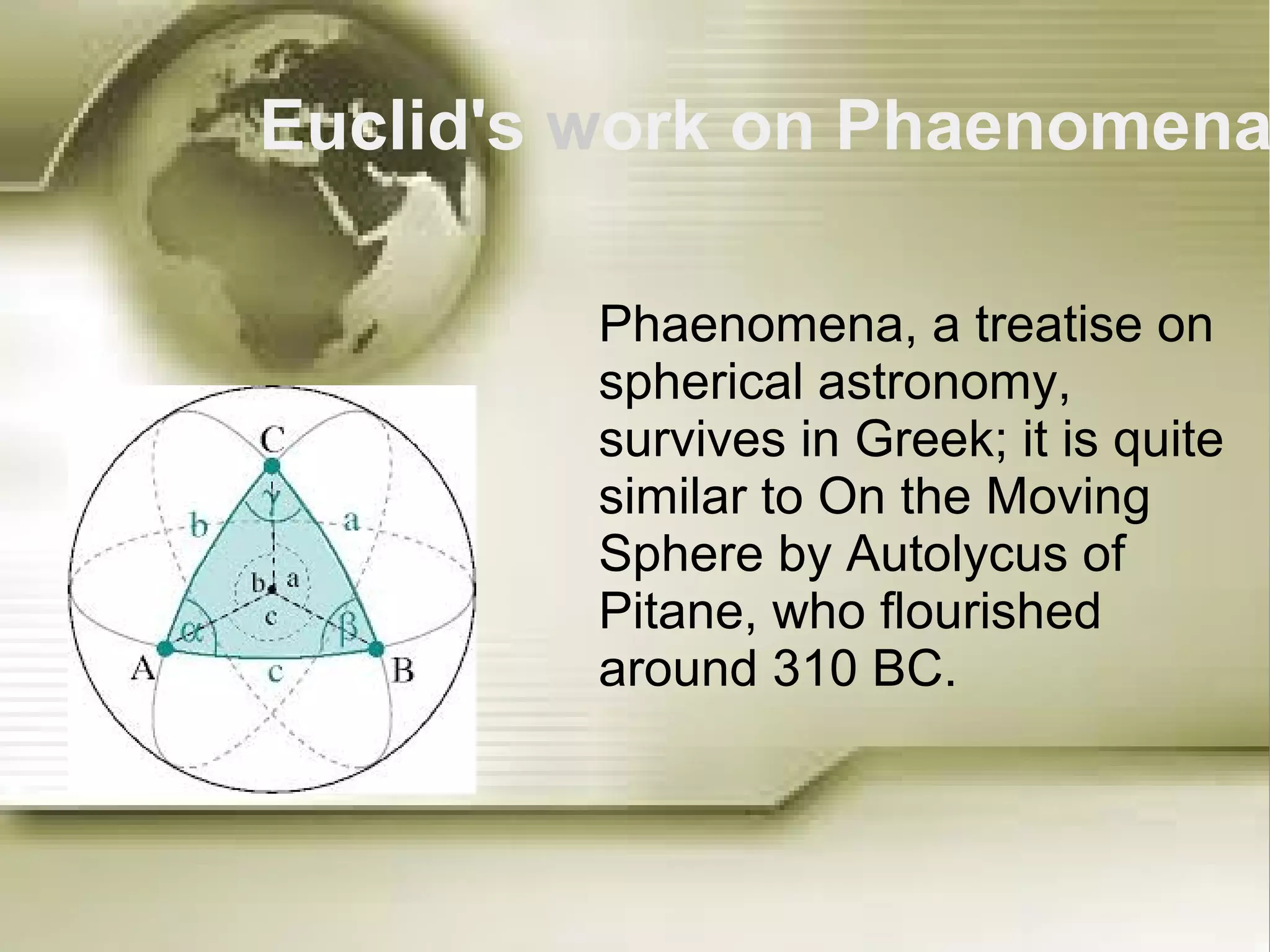
Euclid's work on Phaenomena 
Phaenomena, a treatise on 
spherical astronomy, 
survives in Greek; it is quite 
similar to On the Moving 
Sphere by Autolycus of 
Pitane, who flourished 
around 310 BC.
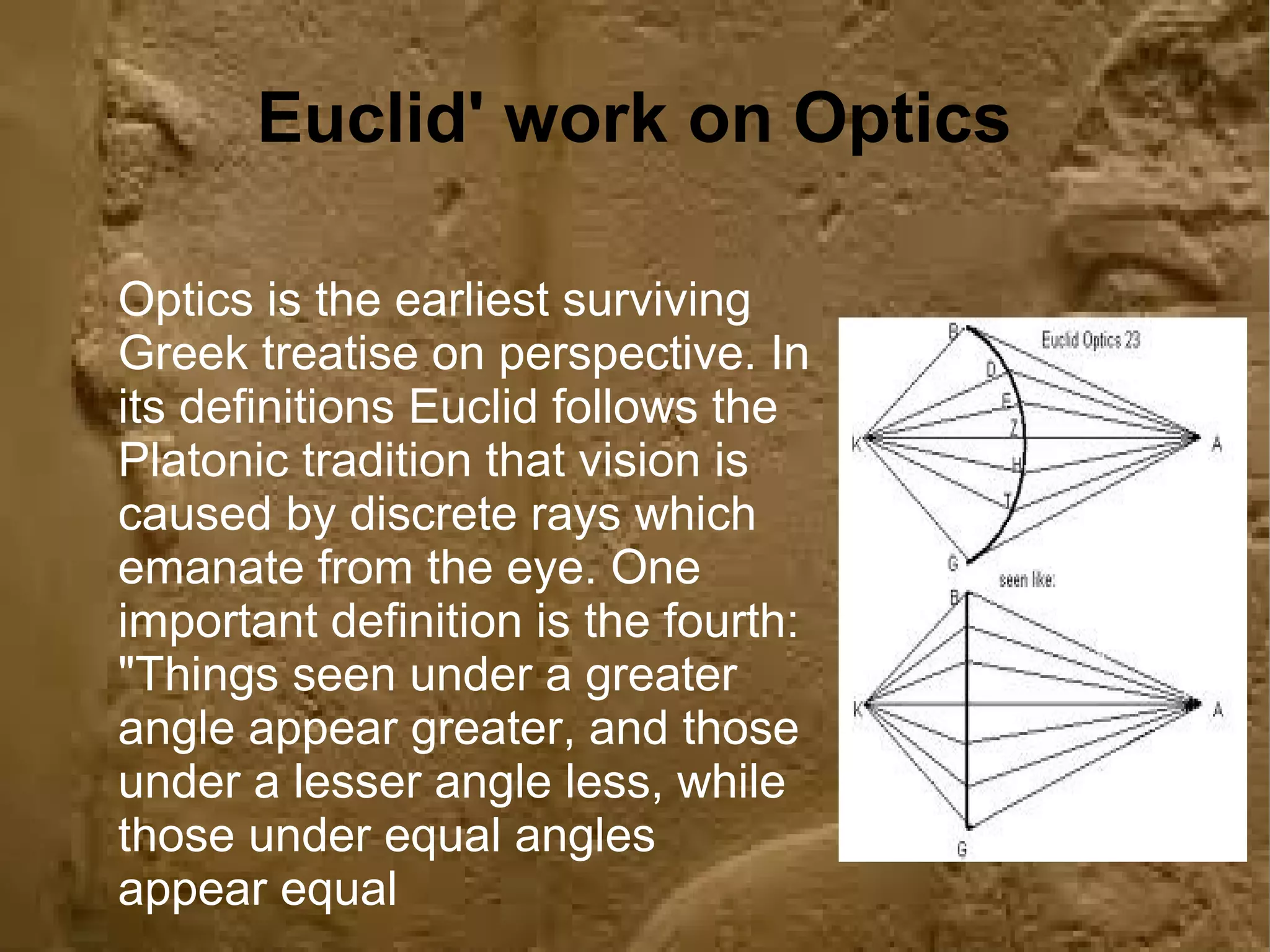
Euclid' work on Optics 
Optics is the earliest surviving 
Greek treatise on perspective. In 
its definitions Euclid follows the 
Platonic tradition that vision is 
caused by discrete rays which 
emanate from the eye. One 
important definition is the fourth: 
"Things seen under a greater 
angle appear greater, and those 
under a lesser angle less, while 
those under equal angles 
appear equal
Euclid's Elements 
● The Euclid's Elements is a collection of 13 
books. Each book contains a sequence of 
propositions or theorems, around 10 to 100, 
introduced with proper definitions. For 
instance in Book I, 23 definitions are followed 
by five postulates, after which five common 
notions or axioms are included. 
● These Elements are dividedinto 13 books in 
which 
1-6 are of plane geometry 
7-9 are of number theory 
10 is the theory of irrational numbers 
11-13 are of 3-D geometry
Made by 
Rahul Jaiswal 
X-A 
6

Euclid

  • 1.
    332255 BBCCEE ––226655 BBCCEE
  • 2.
    Eclids Work inthe field Eclids Work in the field of of Mathematics Mathematics Euclid was, also known as Euclid of Alexandria, was a Greek mathematician, often referred to as the "Father of Geometry". His Elements is one of the most influential works in the history of mathematics, serving as the main textbook for teaching mathematics (especially geometry). In the Elements, Euclid deduced the principles of what is now called Euclidean geometry from a small set of axioms. Euclid also wrote works on perspective, conic sections, spherical geometry, number theory and rigor.
  • 3.
    Euclid's Geometry ●The word 'geometry' is derived from the greek word 'geo' meaning 'Earth' and 'metron' meaning 'measuring'. Thus, the word geometry means 'earth measurement'. ● Euclid was the first mathematician who initiated a new way of thinking the study of geometry results by deductive reasoning based upon previously proved results and some self-evident specific assumptions called axioms. AXIOMS : The basic fact which are taken for granted, without proofs, are called axioms.
  • 4.
    EUCLID's Definations Inthe first Book of Elements, Euclid gave 23 definations and some of them are as follows :- ● A piont is that which has no part. . ● A line is breadthless lenght. ● The ends of a lina are points. ● A staight line is a line whick lies evenly with the points on itself. ● A surface is that which has lenght and breadth only. ● The edges of a surface are lines.
  • 5.
    EUCLID's Axioms and Postulates Euclid assumed certain properties, which were not be proved. These are actually 'obvious universal truths'. He divided them into two types: axioms and postulates Postulates Axioms ● Postulates are universal truths with out any proofs. ● Postulates are assumptions used specifically used for geometry. ● Axioms are universal thruths without any proofs. ● Axioms are assumptions used throughout mathematics and not specifically geometry.
  • 6.
    Some Axioms andPostulates of Euclid Axioms ● Things which are equal to the same things are equal to one another. ● If equals are added to equals, the wholes are equal. ● The whole is greater than a part. ● Things which are half of the same things are equal Postulates ● A straight line may be drawn from any one point to any other point. ● A terminated line can be produced indefinitely. ● A circle can be drawn with any centre and any radius. ● All right angles are equal to one another
  • 7.
    Euclid's Division Lemma Theorem :If there two positive integers a and b, there exist unique ineger q and r satisfying a = bq + r 0 < r < b. Trough this lemma the formation of the fundamental theorem of arithematic took place and Euclid's division algorithm is based on this lemma.
  • 8.
    Euclid's division lemma Euclid's division lemma are used to obtain the HCF of two positive integer, say c and d, with c > d, follow the steps below:- ● Step 1: Apply Euclid's division lemma, to c and d. So we find whole numbers, q and r such that c = dq + r, 0 < r< d. ● Step 2: If r = 0, dis the HCF of c and d. If r is not equal to 0, apply the division lemma to d and r ● Step 3: Continue the process till the remainder is zero. The divisor at this stage will be the required HCF. Euclid's division algorithm is also use full to find the number of tiles and the dimention to fill a space as shown in the animation.
  • 9.
    Euclid's Construction ofa regular dodecahedron
  • 10.
    Euclid's work onData The Data is closely related to the first four books of the Elements. It opens with definitions of the different senses in which things are said to be ``given.'' Thus lines, angles, and ratios may be given in magnitude, rectilinear figures may be given in species or given in form, points and lines may be given in position,etc.
  • 11.
    Euclid's work onCatoptrics Catoptrics, which concerns the mathematical theory of mirrors, particularly the images formed in plane and spherical concave mirrors. The attribution is held to be anachronistic however by J J O'Connor and E F Robertson who name Theon of Alexandria as a more likely author.
  • 12.
    Euclid's work onPhaenomena Phaenomena, a treatise on spherical astronomy, survives in Greek; it is quite similar to On the Moving Sphere by Autolycus of Pitane, who flourished around 310 BC.
  • 13.
    Euclid' work onOptics Optics is the earliest surviving Greek treatise on perspective. In its definitions Euclid follows the Platonic tradition that vision is caused by discrete rays which emanate from the eye. One important definition is the fourth: "Things seen under a greater angle appear greater, and those under a lesser angle less, while those under equal angles appear equal
  • 14.
    Euclid's Elements ●The Euclid's Elements is a collection of 13 books. Each book contains a sequence of propositions or theorems, around 10 to 100, introduced with proper definitions. For instance in Book I, 23 definitions are followed by five postulates, after which five common notions or axioms are included. ● These Elements are dividedinto 13 books in which 1-6 are of plane geometry 7-9 are of number theory 10 is the theory of irrational numbers 11-13 are of 3-D geometry
  • 15.
    Made by RahulJaiswal X-A 6