EUCLID
GEOMETRY
PRESENTED BY:-
SHOBHIT CHAUDHARY
IX A3
NWS
TABLE OF CONTENT
•Introduction
•Euclid’s Definition
•Euclid’s Axioms
•Euclid’s Five Postulates
•Theorems with Proof
INTRODUCTION
• The word ‘Geometry’ comes from
Greek word ‘geo’ meaning the ‘earth’
and ‘metrein’ meaning to ‘measure’.
Geometry appears to have originated
from the need for measuring land.
• Nearly 5000 years ago geometry
originated in Egypt as an art of earth
measurement. Egyptian geometry was
the statements of results.
• The knowledge of geometry passed
from Egyptians to the Greeks and many
EUCLID’S
DEFINITONSSome of the definitions made by Euclid in volume I of ‘The
Elements’ that we take for granted today are as follows :-
A point is that which has no part .
A line is breadth less length.
The ends of a line are points .
A straight line is that which has length only.
EUCLID’S AXIOMs
SOME OF EUCLID’S AXIOMS
WERE :-
 Things which are equal to the
same thing are equal to one
another.
i.e. if a=c and b=c then a=b.
Here a, b and c are same kind of
things.
axioms
If equals are subtracted, the
remainders are equal.
Things which coincide with one
another are equal to one another.
Things which are double of the same
things are equal to one another
Things which are halves of the same
things are equal to one another.
axioms
The whole is greater than the part.
That is if a > b then there exists c such
that a =b + c.
Here, b is a part of a and therefore, a is
greater than b.
EUCLID’S POSTULATES
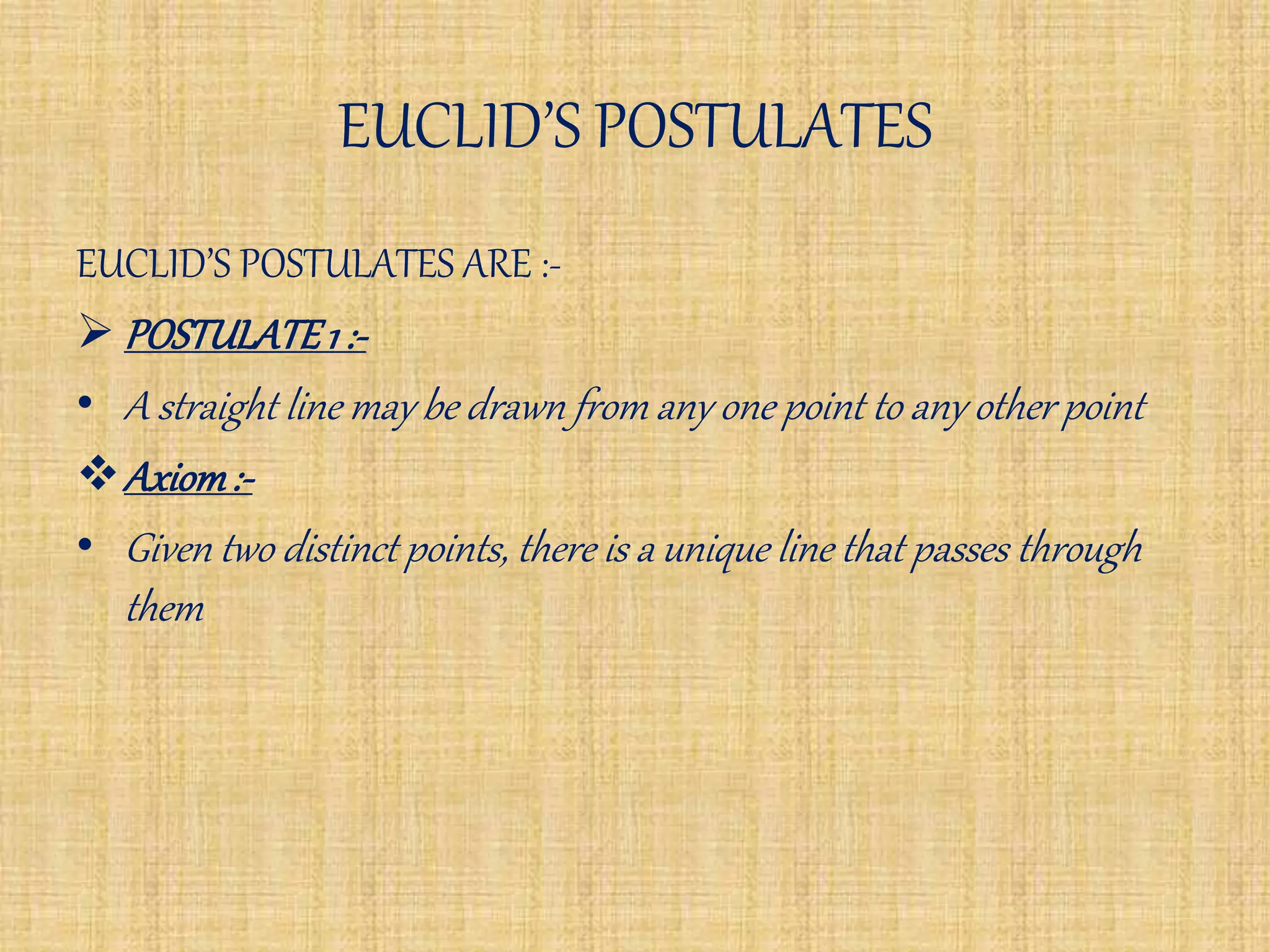
EUCLID’S POSTULATES ARE :-
 POSTULATE1 :-
• A straight line may be drawn from any one point to any other point
Axiom:-
• Given two distinct points, there is a unique line that passes through
them
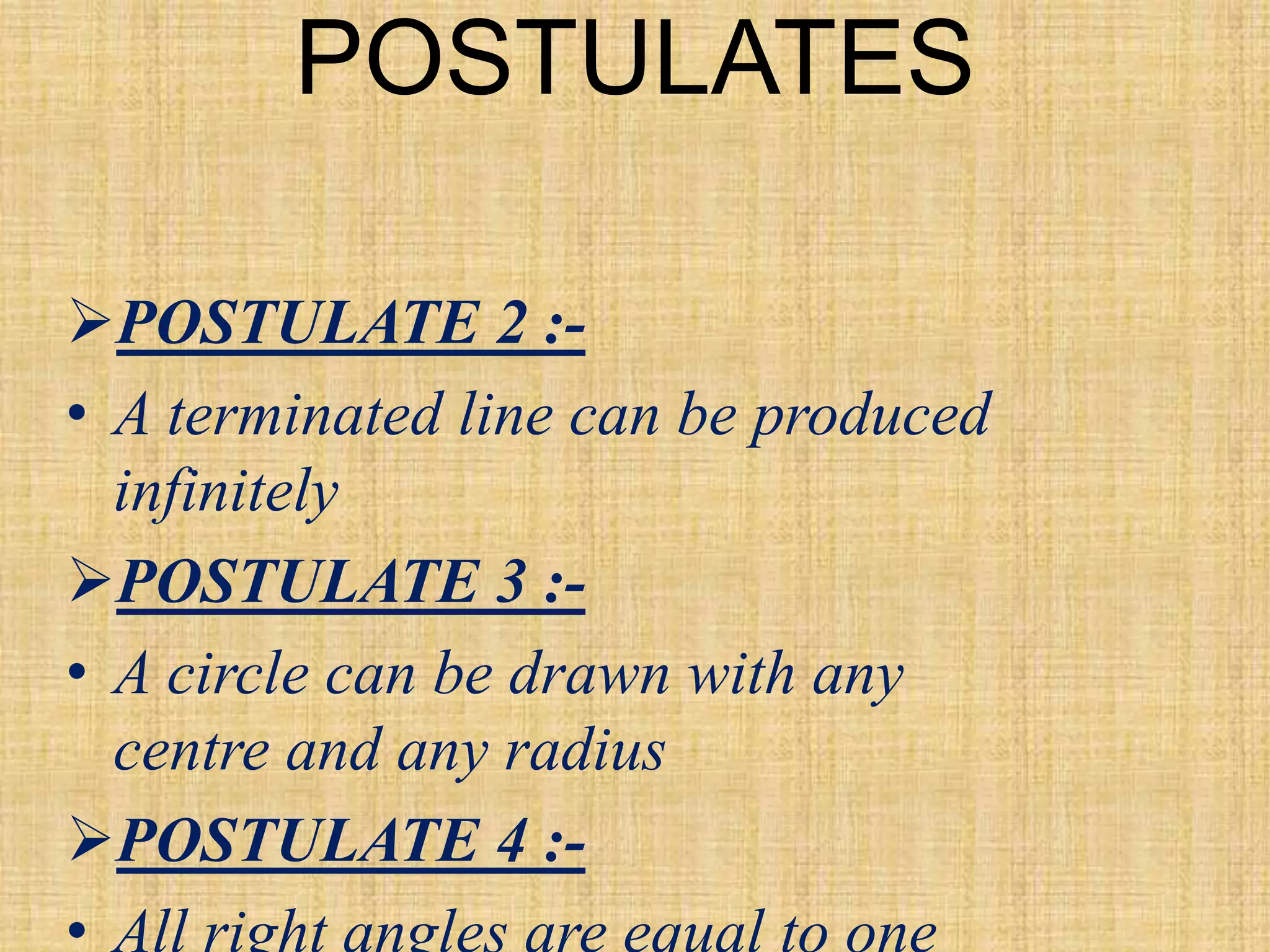
POSTULATES
POSTULATE 2 :-
• A terminated line can be produced
infinitely
POSTULATE 3 :-
• A circle can be drawn with any
centre and any radius
POSTULATE 4 :-
POSTULATES
POSTULATE 5 :-
• If a straight line falling on two
straight lines makes the
interior angles on the same
side of it taken together less
than two right angles, then
the two straight lines, if
Made by-shobhit chaudhary

introduction to euclid geometry

  • 1.
  • 2.
    TABLE OF CONTENT •Introduction •Euclid’sDefinition •Euclid’s Axioms •Euclid’s Five Postulates •Theorems with Proof
  • 3.
    INTRODUCTION • The word‘Geometry’ comes from Greek word ‘geo’ meaning the ‘earth’ and ‘metrein’ meaning to ‘measure’. Geometry appears to have originated from the need for measuring land. • Nearly 5000 years ago geometry originated in Egypt as an art of earth measurement. Egyptian geometry was the statements of results. • The knowledge of geometry passed from Egyptians to the Greeks and many
  • 4.
    EUCLID’S DEFINITONSSome of thedefinitions made by Euclid in volume I of ‘The Elements’ that we take for granted today are as follows :- A point is that which has no part . A line is breadth less length. The ends of a line are points . A straight line is that which has length only.
  • 5.
    EUCLID’S AXIOMs SOME OFEUCLID’S AXIOMS WERE :-  Things which are equal to the same thing are equal to one another. i.e. if a=c and b=c then a=b. Here a, b and c are same kind of things.
  • 6.
    axioms If equals aresubtracted, the remainders are equal. Things which coincide with one another are equal to one another. Things which are double of the same things are equal to one another Things which are halves of the same things are equal to one another.
  • 7.
    axioms The whole isgreater than the part. That is if a > b then there exists c such that a =b + c. Here, b is a part of a and therefore, a is greater than b.
  • 8.
    EUCLID’S POSTULATES EUCLID’S POSTULATESARE :-  POSTULATE1 :- • A straight line may be drawn from any one point to any other point Axiom:- • Given two distinct points, there is a unique line that passes through them
  • 9.
    POSTULATES POSTULATE 2 :- •A terminated line can be produced infinitely POSTULATE 3 :- • A circle can be drawn with any centre and any radius POSTULATE 4 :-
  • 10.
    POSTULATES POSTULATE 5 :- •If a straight line falling on two straight lines makes the interior angles on the same side of it taken together less than two right angles, then the two straight lines, if
  • 11.