Introduction to Embedded Systems
Contents
• Definition
• Embedded Systems and
General Purpose Computer
Systems
• Examples
• Classifications
• Applications
• Purpose
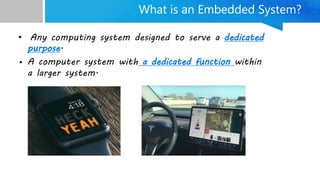
What is an Embedded System?
• Any computing system designed to serve a dedicated
purpose.
• A computer system with a dedicated function within
a larger system.
Continued...
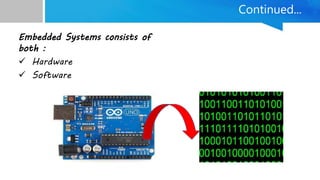
Embedded Systems consists of
both :
 Hardware
 Software
Continued...
Definition of Embedded
System:
An embedded
system is an electro-
mechanical system designed to
perform a specific function
and combination of hardware
and software.
Embedded Systems & General Purpose Computer
System
General Purpose Computer System Embedded System
Continued...
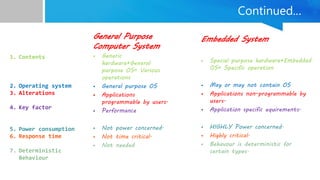
General Purpose
Computer System
• Generic
hardware+General
purpose OS= Various
operations
• General purpose OS
• Applications
programmable by users.
• Performance
• Not power concerned.
• Not time critical.
• Not needed
Embedded System
• Special purpose hardware+Embedded
OS= Specific operation
• May or may not contain OS
• Applications non-programmable by
users.
• Application specific equirements.
• HIGHLY Power concerned.
• Highly critical.
• Behavour is deterministic for
certain types.
1. Contents
2. Operating system
3. Alterations
4. Key factor
5. Power consumption
6. Response time
7. Deterministic
Behaviour
History of Embedded Systems
Continued...
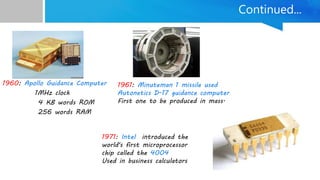
1960: Apollo Guidance Computer
1MHz clock
4 KB words ROM
256 words RAM
1961: Minuteman 1 missile used
Autonetics D-17 guidance computer
First one to be produced in mass.
1971: Intel introduced the
world's first microprocessor
chip called the 4004
Used in business calculators
Examples
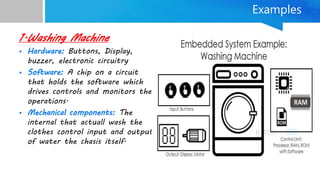
1.Washing Machine
• Hardware: Buttons, Display,
buzzer, electronic circuitry
• Software: A chip on a circuit
that holds the software which
drives controls and monitors the
operations.
• Mechanical components: The
internal that actuall wash the
clothes control input and output
of water the chasis itself.
Examples
2. Air Conditioner
• Hardware: Remote, display, buzzer, infrred
sensors, electronic circuitry
• Software: A chip on the circuit that holds the
software that drives controls and monitors
operstions.
• Mechanicl compnents: The internals, motor, the
chasis, the outlet.
Continued...
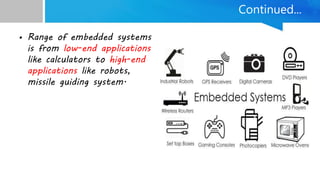
• Range of embedded systems
is from low-end applications
like calculators to high-end
applications like robots,
missile guiding system.
Classification
Classification of Embedded Systems:
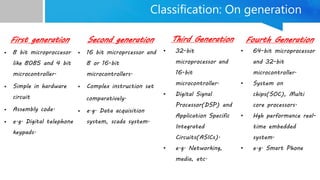
• On generation
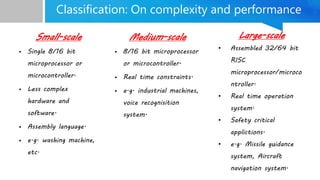
• On complexity and performance
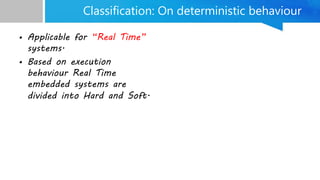
• On deterministic behaviour
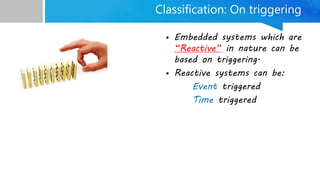
• On triggering
Classification: On generation
First generation
• 8 bit microproccesor
like 8085 and 4 bit
microcontroller.
• Simple in hardware
circuit
• Assembly code.
• e.g. Digital telephone
keypads.
Second generation
• 16 bit microprcessor and
8 or 16-bit
microcontrollers.
• Complex instruction set
comparatively.
• e.g. Data acquisition
system, scada system.
Third Generation
• 32-bit
microprocessor and
16-bit
microcontroller.
• Digital Signal
Processor(DSP) and
Application Specific
Integrated
Circuits(ASICs).
• e.g. Networking,
media, etc.
Fourth Generation
• 64-bit microprocessor
and 32-bit
microcontroller.
• System on
chips(SOC), Multi
core processors.
• Hgh performance real-
time embedded
system.
• e.g. Smart Phone
Classification: On complexity and performance
Small-scale
• Single 8/16 bit
microprocessor or
microcontroller.
• Less complex
hardware and
software.
• Assembly language.
• e.g. washing machine,
etc.
Medium-scale
• 8/16 bit microprocessor
or microcontroller.
• Real time constraints.
• e.g. industrial machines,
voice recognisition
system.
Large-scale
• Assembled 32/64 bit
RISC
microprocessor/microco
ntroller.
• Real time operation
system.
• Safety critical
applictions.
• e.g. Missile guidance
system, Aircraft
navigation system.
Classification: On deterministic behaviour
• Applicable for “Real Time”
systems.
• Based on execution
behaviour Real Time
embedded systems are
divided into Hard and Soft.
Classification: On triggering
• Embedded systems which are
“Reactive” in nature can be
based on triggering.
• Reactive systems can be:
Event triggered
Time triggered
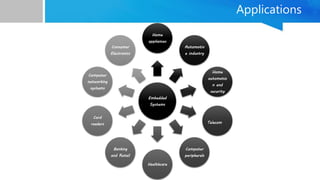
Applications
Embedded
Systems
Home
appliances
Automotiv
e industry
Home
automatio
n and
security
Telecom
Computer
peripherals
Healthcare
Banking
and Retail
Card
readers
Computer
networking
systems
Consumer
Electronics
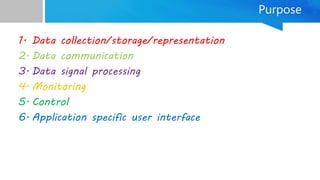
Purpose
1. Data collection/storage/representation
2. Data communication
3. Data signal processing
4. Monitoring
5. Control
6. Application specific user interface
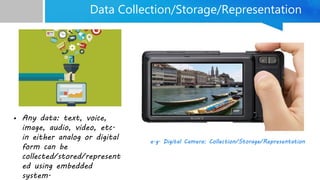
Data Collection/Storage/Representation
• Any data: text, voice,
image, audio, video, etc.
in either analog or digital
form can be
collected/stored/represent
ed using embedded
system.
e.g. Digital Camera: Collection/Storage/Representation
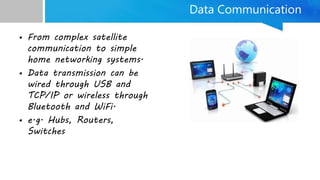
Data Communication
• From complex satellite
communication to simple
home networking systems.
• Data transmission can be
wired through USB and
TCP/IP or wireless through
Bluetooth and WiFi.
• e.g. Hubs, Routers,
Switches
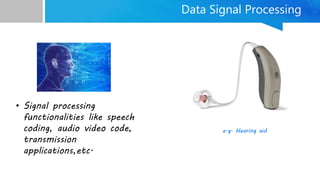
Data Signal Processing
• Signal processing
functionalities like speech
coding, audio video code,
transmission
applications,etc.
e.g. Hearing aid
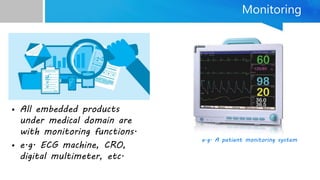
Monitoring
• All embedded products
under medical domain are
with monitoring functions.
• e.g. ECG machine, CRO,
digital multimeter, etc.
e.g. A patient monitoring system
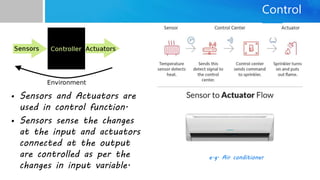
Control
• Sensors and Actuators are
used in control function.
• Sensors sense the changes
at the input and actuators
connected at the output
are controlled as per the
changes in input variable.
e.g. Air conditioner
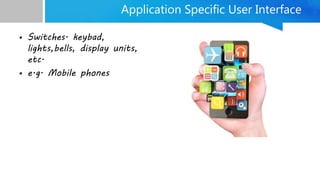
Application Specific User Interface
• Switches. keybad,
lights,bells, display units,
etc.
• e.g. Mobile phones
Summary
• Embedded systems are designed to do a specific task.
• Differ from general purpose computer system.
• Embedded systems have evolved to great extent.
• There are various applications of embedded systems.
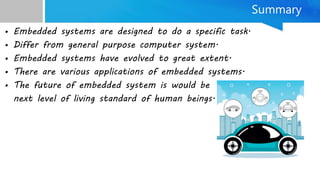
• The future of embedded system is would be
next level of living standard of human beings.

Introduction to embedded systems

  • 1.
  • 2.
    Contents • Definition • EmbeddedSystems and General Purpose Computer Systems • Examples • Classifications • Applications • Purpose
  • 3.
    What is anEmbedded System? • Any computing system designed to serve a dedicated purpose. • A computer system with a dedicated function within a larger system.
  • 4.
    Continued... Embedded Systems consistsof both :  Hardware  Software
  • 5.
    Continued... Definition of Embedded System: Anembedded system is an electro- mechanical system designed to perform a specific function and combination of hardware and software.
  • 6.
    Embedded Systems &General Purpose Computer System General Purpose Computer System Embedded System
  • 7.
    Continued... General Purpose Computer System •Generic hardware+General purpose OS= Various operations • General purpose OS • Applications programmable by users. • Performance • Not power concerned. • Not time critical. • Not needed Embedded System • Special purpose hardware+Embedded OS= Specific operation • May or may not contain OS • Applications non-programmable by users. • Application specific equirements. • HIGHLY Power concerned. • Highly critical. • Behavour is deterministic for certain types. 1. Contents 2. Operating system 3. Alterations 4. Key factor 5. Power consumption 6. Response time 7. Deterministic Behaviour
  • 8.
  • 9.
    Continued... 1960: Apollo GuidanceComputer 1MHz clock 4 KB words ROM 256 words RAM 1961: Minuteman 1 missile used Autonetics D-17 guidance computer First one to be produced in mass. 1971: Intel introduced the world's first microprocessor chip called the 4004 Used in business calculators
  • 10.
    Examples 1.Washing Machine • Hardware:Buttons, Display, buzzer, electronic circuitry • Software: A chip on a circuit that holds the software which drives controls and monitors the operations. • Mechanical components: The internal that actuall wash the clothes control input and output of water the chasis itself.
  • 11.
    Examples 2. Air Conditioner •Hardware: Remote, display, buzzer, infrred sensors, electronic circuitry • Software: A chip on the circuit that holds the software that drives controls and monitors operstions. • Mechanicl compnents: The internals, motor, the chasis, the outlet.
  • 12.
    Continued... • Range ofembedded systems is from low-end applications like calculators to high-end applications like robots, missile guiding system.
  • 13.
    Classification Classification of EmbeddedSystems: • On generation • On complexity and performance • On deterministic behaviour • On triggering
  • 14.
    Classification: On generation Firstgeneration • 8 bit microproccesor like 8085 and 4 bit microcontroller. • Simple in hardware circuit • Assembly code. • e.g. Digital telephone keypads. Second generation • 16 bit microprcessor and 8 or 16-bit microcontrollers. • Complex instruction set comparatively. • e.g. Data acquisition system, scada system. Third Generation • 32-bit microprocessor and 16-bit microcontroller. • Digital Signal Processor(DSP) and Application Specific Integrated Circuits(ASICs). • e.g. Networking, media, etc. Fourth Generation • 64-bit microprocessor and 32-bit microcontroller. • System on chips(SOC), Multi core processors. • Hgh performance real- time embedded system. • e.g. Smart Phone
  • 15.
    Classification: On complexityand performance Small-scale • Single 8/16 bit microprocessor or microcontroller. • Less complex hardware and software. • Assembly language. • e.g. washing machine, etc. Medium-scale • 8/16 bit microprocessor or microcontroller. • Real time constraints. • e.g. industrial machines, voice recognisition system. Large-scale • Assembled 32/64 bit RISC microprocessor/microco ntroller. • Real time operation system. • Safety critical applictions. • e.g. Missile guidance system, Aircraft navigation system.
  • 16.
    Classification: On deterministicbehaviour • Applicable for “Real Time” systems. • Based on execution behaviour Real Time embedded systems are divided into Hard and Soft.
  • 17.
    Classification: On triggering •Embedded systems which are “Reactive” in nature can be based on triggering. • Reactive systems can be: Event triggered Time triggered
  • 18.
  • 19.
    Purpose 1. Data collection/storage/representation 2.Data communication 3. Data signal processing 4. Monitoring 5. Control 6. Application specific user interface
  • 20.
    Data Collection/Storage/Representation • Anydata: text, voice, image, audio, video, etc. in either analog or digital form can be collected/stored/represent ed using embedded system. e.g. Digital Camera: Collection/Storage/Representation
  • 21.
    Data Communication • Fromcomplex satellite communication to simple home networking systems. • Data transmission can be wired through USB and TCP/IP or wireless through Bluetooth and WiFi. • e.g. Hubs, Routers, Switches
  • 22.
    Data Signal Processing •Signal processing functionalities like speech coding, audio video code, transmission applications,etc. e.g. Hearing aid
  • 23.
    Monitoring • All embeddedproducts under medical domain are with monitoring functions. • e.g. ECG machine, CRO, digital multimeter, etc. e.g. A patient monitoring system
  • 24.
    Control • Sensors andActuators are used in control function. • Sensors sense the changes at the input and actuators connected at the output are controlled as per the changes in input variable. e.g. Air conditioner
  • 25.
    Application Specific UserInterface • Switches. keybad, lights,bells, display units, etc. • e.g. Mobile phones
  • 26.
    Summary • Embedded systemsare designed to do a specific task. • Differ from general purpose computer system. • Embedded systems have evolved to great extent. • There are various applications of embedded systems. • The future of embedded system is would be next level of living standard of human beings.