An Introduction To CrowdFunding
www.farm-edge.com
Dawid van der Walt
dawid@farm-edge.com
1
Introducing Farm-Edge
• Farm-Edge is an agricultural supply chain planning and
management consultancy.
• We work with our partners and clients to improve the
efficiency of the extended supply chain in order to:
– Reduce cost
– Increase revenue
– Reduce risk
– Increase asset utilisation.
• Working across company and industry borders allows
Farm-Edge to help improve supply chain relationships,
drive efficiency and measure the value we deliver.
2
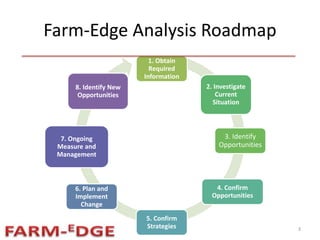
Farm-Edge Analysis Roadmap
1. Obtain
Required
Information
3. Identify
Opportunities
2. Investigate
Current
Situation
4. Confirm
Opportunities
5. Confirm
Strategies
6. Plan and
Implement
Change
7. Ongoing
Measure and
Management
8. Identify New
Opportunities
3
Farm-Edge guiding principles
(snapshot)
• Help clients and partners:
– Become a business, not a way of life
– Manage for profit per hectare
– Meet market requirements
– Develop outsource activities to drive efficiencies
– Optimise investment in land, buildings, equipment, stock and
debtors.
– Expand partner activities horizontally (more land under
management)
– Facilitate vertical supply chain development through ‘virtual
corporations”
– Have long-term contracts and relationships, not spot
markets.
– Develop supply chain finance models
4
Why Family Farms and Agri-Businesses
Should Take Note Of CrowdFunding
• Federal Government’s focus on financial education as part of its
Agricultural Competitiveness White Paper plan to help safeguard the
future and diversity of Australian agribusiness.
• The $13.8 million earmarked for a Rural Industries Research and
Development Corporation (RIRDC) pilot program to help educate farmers
about alternative business models was important for both current and
future farming generations.
• FinTech and CrowdFunding will play an important role in enabling
alternative farming business models.
• CrowdFunding allow farmers to obtain investment from investors who’s
goals and aspirations is aligned with the agri-business.
• Aligned investors is a source of skill, contact and market access – in
addition to being a source of capital.
5
What is CrowdFunding?
• Crowdfunding is exactly what it sounds like:
– A business owner or entrepreneurial individual
seeks the capital necessary to grow their business
via appealing to the global investing public. (the
Crowd)
– Think of it as social media for the fundraising
spectrum.
– Investors may be individuals, SMSF, Venture
Capital Funds etc.
Types of Crowdfunding
• Equity Crowdfunding:
– with this method, investors receive a stake or share in the company in
exchange for investing into the business.
• Dept Crowdfunding:
– with this method, investors loan the desired amount to the business. Investors
do not receive a share in the company, but the company’s assests and equity
may be required as security.
• Donation-based Crowdfunding:
– in this type of crowd funding, most investors get nothing in return for their
donation. Generally, these types of crowdfunding campaigns support causes
or charities.
• Reward-based Crowdfunding:
– in a reward-based crowdfunding campaign, investors are given different levels
of “rewards” based on the amount of their donation. These rewards vary
greatly from being put on the product’s email newsletter recipient list, to
receiving the product ahead of retail, to even having a small share in the
company.
Farm-Edge Focus – Equity and Dept
Based CrowdFunding
• Assist interested parties in building, promoting and
managing Agri-Business focussed CrowdFunding
Platforms in partnership with GrowVC .
• Assist Agri-Businesses in preparing to raise capital via
a CrowdFunding platform.
• Assist Agri-Businesses in developing processes,
systems and strategies to work with 3rd party
investors.
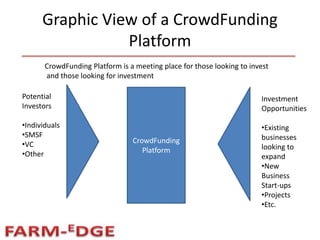
Graphic View of a CrowdFunding
Platform
CrowdFunding
Platform
Potential
Investors
•Individuals
•SMSF
•VC
•Other
Investment
Opportunities
•Existing
businesses
looking to
expand
•New
Business
Start-ups
•Projects
•Etc.
CrowdFunding Platform is a meeting place for those looking to invest
and those looking for investment
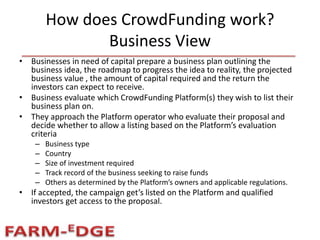
How does CrowdFunding work?
Business View
• Businesses in need of capital prepare a business plan outlining the
business idea, the roadmap to progress the idea to reality, the projected
business value , the amount of capital required and the return the
investors can expect to receive.
• Business evaluate which CrowdFunding Platform(s) they wish to list their
business plan on.
• They approach the Platform operator who evaluate their proposal and
decide whether to allow a listing based on the Platform’s evaluation
criteria
– Business type
– Country
– Size of investment required
– Track record of the business seeking to raise funds
– Others as determined by the Platform’s owners and applicable regulations.
• If accepted, the campaign get’s listed on the Platform and qualified
investors get access to the proposal.
How does CrowdFunding work?
Investor View
• Most CrowdFunding Platforms require potential
investors to be ‘qualified” before they are allowed to
participate in funding initiatives.
• The term ‘qualified investor” has many and varied
definitions across the world.
• The Platform owners determine their criteria based on
regulations, domicile, best business practises etc.
• When an investor is deemed ‘qualified” they get access
to the deal flow on the platform.
• It is up to the individual investors to decide whether to
participate and to what level to participate.
Deals get done!
• A CrowdFunding Platform can be seen as a marketplace
where willing buyers and sellers meet and transact.
• Most Platforms operate on an “All or Nothing” funding
principle.
– If the business does not reach the desired funding level, the
entrepreneur does not receive any funds. Pledged funds are
returned to the investors.
– If the business does reach the desired funding level, the
entrepreneur receives the funding (usually less the Platform’s
fees).
– The business and investors complete the legal aspects of share
transfers and registration – usually outside of the Platform.
Who can raise capital through
CrowdFunding?
• In general – anyone!
• In practise, using a legal structure such as a Limited
Company offer protection to the entity raising capital.
• IMPORTANT – When you are raising capital for a
business or project, you have to apply the funds for
that purpose!
– Fraud and other criminal laws, rules and regulations apply.
• For this reason it is important to have a detailed
business plan that you share with your investors, and
that the company manage it’s operations according to
the plan. If the plan has to change, communicate with
your shareholders and gain approval.
Who can invest in CrowdFunding
initiatives?
• Globally, there are different rules and
regulations governing who can invest.
• These rules are changing as the CrowdFunding
space evolve.
• Generally, they are getting less strenuous and
restrictive.
Advantages of CrowdFunding for
Business
• New source of funding and investors.
• Opportunity to access strategic investors that
provide skills, contacts and market access – in
addition to capital.
• Opportunity to reduce business risk – equity
investment can be used to reduce dept and
strengthen the business’s balance sheet.
• Allow more businesses to use their shares as
currency to finance expansion.
Advantages of CrowdFunding for
Investors
• New source of investment opportunities.
• Opportunity to be a strategic investor that provide skills,
contacts and market access – in addition to capital.
• Opportunity to reduce investment risk – having access to
many more investment opportunities, and investing “closer
to home” reduce the risk of having all you investments in
one market.
• Investors in “unlisted” shares tend to want to own a part of
the business – not trade the shares for a capital gain.
• As investor restrictions are relaxed, more people can invest
in opportunities that may be the next “big thing”, or just to
invest in businesses and people they like.
Who own and manage the platforms?
• CrowdFunding platforms are businesses
owned by their founders and shareholders.
• Most are privately owned but can also be
owned by industry bodies, universities, local
and federal governments, NGO’s etc.
What does a business usually provide
to potential investors?
• Most “Pitch Decks” consist of the following, ranked
according the importance to investors
– Financials
– Team
– Competition
– Why Now
– Company Purpose
– Business Model
– Product
– Market Size
– Problem
– Solution
Next Steps - Platforms
• Groups and industry wanting to investigate creating a CrowdFunding
Platform is invited to contact dawid@farm-edge.com.
• Through our association with GrowVC and GrowAdvisors, you partner with
the experts who laid the path.
• Grow Advisors works with the public and private sector, and at all levels of
business.
• From startup communities to leading investment banks, and from
economic development agencies to government legislators, we offer
advisory and project management services in fintech.
• Our approach is based on guiding governments to enact balanced
regulations while helping industry with cutting edge fintech solutions.
• In the world of fintech, we are uniquely set up to advise and oversee
implementation of solutions through our network of business units.
19
Next Steps -Agri-Business
• Family farms, agri-businesses and supply
chains wanting to investigate raising capital
through CrowdFunding, please contact
michael@farm-edge.com
• Drawing on years of agricultural experience
and leverage all Farm-Edge partnerships
ensure you receive world class supplychain
and fintech advise to build your future
enterprise on.
20
Dawid van der Walt
• Born and raised in South Africa, Dawid studied Economics and
Engineering, before working as an Industrial Engineer specialising in
cost optimisation.
• Seeing the value that can be unlocked from existing business led to
experiences in buying, optimising and selling businesses in South
Africa and New Zealand.
• Based on the Sunshine Coast, Queensland since 2006, Dawid has
concentrated on applying his 20 plus years business experience for
the benefit of the family office.
• Key capabilities include:
– Business and market analysis
– Opportunity identification and evaluation
– Strategic, tactical and operational planning and execution
– Financial management
21
Michael Burgis
• University educated with 35 years of management and executive
management experience in professional agribusiness, to include sales and
marketing and management of a non-for profit business.
•
• Key Capabilities include:
•
• Business & financial operation responsibilities.
• Strategic and business planning.
• Project application, design, management and delivery.
• Development and application of business structures and procedures.
• Strong relationships with farmers, industry and Government agencies.
• Industry, product and sales training.
• Analytical and creative thinking.
• Team leadership.
22

Introduction to crowdfunding platforms

  • 1.
    An Introduction ToCrowdFunding www.farm-edge.com Dawid van der Walt dawid@farm-edge.com 1
  • 2.
    Introducing Farm-Edge • Farm-Edgeis an agricultural supply chain planning and management consultancy. • We work with our partners and clients to improve the efficiency of the extended supply chain in order to: – Reduce cost – Increase revenue – Reduce risk – Increase asset utilisation. • Working across company and industry borders allows Farm-Edge to help improve supply chain relationships, drive efficiency and measure the value we deliver. 2
  • 3.
    Farm-Edge Analysis Roadmap 1.Obtain Required Information 3. Identify Opportunities 2. Investigate Current Situation 4. Confirm Opportunities 5. Confirm Strategies 6. Plan and Implement Change 7. Ongoing Measure and Management 8. Identify New Opportunities 3
  • 4.
    Farm-Edge guiding principles (snapshot) •Help clients and partners: – Become a business, not a way of life – Manage for profit per hectare – Meet market requirements – Develop outsource activities to drive efficiencies – Optimise investment in land, buildings, equipment, stock and debtors. – Expand partner activities horizontally (more land under management) – Facilitate vertical supply chain development through ‘virtual corporations” – Have long-term contracts and relationships, not spot markets. – Develop supply chain finance models 4
  • 5.
    Why Family Farmsand Agri-Businesses Should Take Note Of CrowdFunding • Federal Government’s focus on financial education as part of its Agricultural Competitiveness White Paper plan to help safeguard the future and diversity of Australian agribusiness. • The $13.8 million earmarked for a Rural Industries Research and Development Corporation (RIRDC) pilot program to help educate farmers about alternative business models was important for both current and future farming generations. • FinTech and CrowdFunding will play an important role in enabling alternative farming business models. • CrowdFunding allow farmers to obtain investment from investors who’s goals and aspirations is aligned with the agri-business. • Aligned investors is a source of skill, contact and market access – in addition to being a source of capital. 5
  • 6.
    What is CrowdFunding? •Crowdfunding is exactly what it sounds like: – A business owner or entrepreneurial individual seeks the capital necessary to grow their business via appealing to the global investing public. (the Crowd) – Think of it as social media for the fundraising spectrum. – Investors may be individuals, SMSF, Venture Capital Funds etc.
  • 7.
    Types of Crowdfunding •Equity Crowdfunding: – with this method, investors receive a stake or share in the company in exchange for investing into the business. • Dept Crowdfunding: – with this method, investors loan the desired amount to the business. Investors do not receive a share in the company, but the company’s assests and equity may be required as security. • Donation-based Crowdfunding: – in this type of crowd funding, most investors get nothing in return for their donation. Generally, these types of crowdfunding campaigns support causes or charities. • Reward-based Crowdfunding: – in a reward-based crowdfunding campaign, investors are given different levels of “rewards” based on the amount of their donation. These rewards vary greatly from being put on the product’s email newsletter recipient list, to receiving the product ahead of retail, to even having a small share in the company.
  • 8.
    Farm-Edge Focus –Equity and Dept Based CrowdFunding • Assist interested parties in building, promoting and managing Agri-Business focussed CrowdFunding Platforms in partnership with GrowVC . • Assist Agri-Businesses in preparing to raise capital via a CrowdFunding platform. • Assist Agri-Businesses in developing processes, systems and strategies to work with 3rd party investors.
  • 9.
    Graphic View ofa CrowdFunding Platform CrowdFunding Platform Potential Investors •Individuals •SMSF •VC •Other Investment Opportunities •Existing businesses looking to expand •New Business Start-ups •Projects •Etc. CrowdFunding Platform is a meeting place for those looking to invest and those looking for investment
  • 10.
    How does CrowdFundingwork? Business View • Businesses in need of capital prepare a business plan outlining the business idea, the roadmap to progress the idea to reality, the projected business value , the amount of capital required and the return the investors can expect to receive. • Business evaluate which CrowdFunding Platform(s) they wish to list their business plan on. • They approach the Platform operator who evaluate their proposal and decide whether to allow a listing based on the Platform’s evaluation criteria – Business type – Country – Size of investment required – Track record of the business seeking to raise funds – Others as determined by the Platform’s owners and applicable regulations. • If accepted, the campaign get’s listed on the Platform and qualified investors get access to the proposal.
  • 11.
    How does CrowdFundingwork? Investor View • Most CrowdFunding Platforms require potential investors to be ‘qualified” before they are allowed to participate in funding initiatives. • The term ‘qualified investor” has many and varied definitions across the world. • The Platform owners determine their criteria based on regulations, domicile, best business practises etc. • When an investor is deemed ‘qualified” they get access to the deal flow on the platform. • It is up to the individual investors to decide whether to participate and to what level to participate.
  • 12.
    Deals get done! •A CrowdFunding Platform can be seen as a marketplace where willing buyers and sellers meet and transact. • Most Platforms operate on an “All or Nothing” funding principle. – If the business does not reach the desired funding level, the entrepreneur does not receive any funds. Pledged funds are returned to the investors. – If the business does reach the desired funding level, the entrepreneur receives the funding (usually less the Platform’s fees). – The business and investors complete the legal aspects of share transfers and registration – usually outside of the Platform.
  • 13.
    Who can raisecapital through CrowdFunding? • In general – anyone! • In practise, using a legal structure such as a Limited Company offer protection to the entity raising capital. • IMPORTANT – When you are raising capital for a business or project, you have to apply the funds for that purpose! – Fraud and other criminal laws, rules and regulations apply. • For this reason it is important to have a detailed business plan that you share with your investors, and that the company manage it’s operations according to the plan. If the plan has to change, communicate with your shareholders and gain approval.
  • 14.
    Who can investin CrowdFunding initiatives? • Globally, there are different rules and regulations governing who can invest. • These rules are changing as the CrowdFunding space evolve. • Generally, they are getting less strenuous and restrictive.
  • 15.
    Advantages of CrowdFundingfor Business • New source of funding and investors. • Opportunity to access strategic investors that provide skills, contacts and market access – in addition to capital. • Opportunity to reduce business risk – equity investment can be used to reduce dept and strengthen the business’s balance sheet. • Allow more businesses to use their shares as currency to finance expansion.
  • 16.
    Advantages of CrowdFundingfor Investors • New source of investment opportunities. • Opportunity to be a strategic investor that provide skills, contacts and market access – in addition to capital. • Opportunity to reduce investment risk – having access to many more investment opportunities, and investing “closer to home” reduce the risk of having all you investments in one market. • Investors in “unlisted” shares tend to want to own a part of the business – not trade the shares for a capital gain. • As investor restrictions are relaxed, more people can invest in opportunities that may be the next “big thing”, or just to invest in businesses and people they like.
  • 17.
    Who own andmanage the platforms? • CrowdFunding platforms are businesses owned by their founders and shareholders. • Most are privately owned but can also be owned by industry bodies, universities, local and federal governments, NGO’s etc.
  • 18.
    What does abusiness usually provide to potential investors? • Most “Pitch Decks” consist of the following, ranked according the importance to investors – Financials – Team – Competition – Why Now – Company Purpose – Business Model – Product – Market Size – Problem – Solution
  • 19.
    Next Steps -Platforms • Groups and industry wanting to investigate creating a CrowdFunding Platform is invited to contact dawid@farm-edge.com. • Through our association with GrowVC and GrowAdvisors, you partner with the experts who laid the path. • Grow Advisors works with the public and private sector, and at all levels of business. • From startup communities to leading investment banks, and from economic development agencies to government legislators, we offer advisory and project management services in fintech. • Our approach is based on guiding governments to enact balanced regulations while helping industry with cutting edge fintech solutions. • In the world of fintech, we are uniquely set up to advise and oversee implementation of solutions through our network of business units. 19
  • 20.
    Next Steps -Agri-Business •Family farms, agri-businesses and supply chains wanting to investigate raising capital through CrowdFunding, please contact michael@farm-edge.com • Drawing on years of agricultural experience and leverage all Farm-Edge partnerships ensure you receive world class supplychain and fintech advise to build your future enterprise on. 20
  • 21.
    Dawid van derWalt • Born and raised in South Africa, Dawid studied Economics and Engineering, before working as an Industrial Engineer specialising in cost optimisation. • Seeing the value that can be unlocked from existing business led to experiences in buying, optimising and selling businesses in South Africa and New Zealand. • Based on the Sunshine Coast, Queensland since 2006, Dawid has concentrated on applying his 20 plus years business experience for the benefit of the family office. • Key capabilities include: – Business and market analysis – Opportunity identification and evaluation – Strategic, tactical and operational planning and execution – Financial management 21
  • 22.
    Michael Burgis • Universityeducated with 35 years of management and executive management experience in professional agribusiness, to include sales and marketing and management of a non-for profit business. • • Key Capabilities include: • • Business & financial operation responsibilities. • Strategic and business planning. • Project application, design, management and delivery. • Development and application of business structures and procedures. • Strong relationships with farmers, industry and Government agencies. • Industry, product and sales training. • Analytical and creative thinking. • Team leadership. 22