Crowdfunding
A Statistical View on Crowdfunding
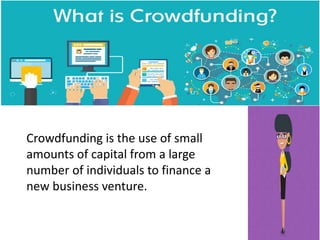
Crowdfunding is the use of small
amounts of capital from a large
number of individuals to finance a
new business venture.
Definition
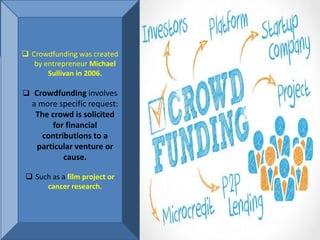
 Crowdfunding was created
by entrepreneur Michael
Sullivan in 2006.
 Crowdfunding involves
a more specific request:
The crowd is solicited
for financial
contributions to a
particular venture or
cause.
 Such as a film project or
cancer research.
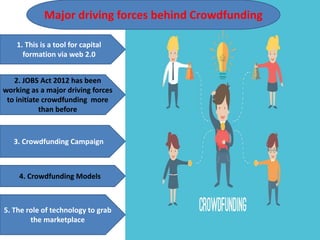
Major driving forces behind Crowdfunding
1. This is a tool for capital
formation via web 2.0
2. JOBS Act 2012 has been
working as a major driving forces
to initiate crowdfunding more
than before
3. Crowdfunding Campaign
4. Crowdfunding Models
5. The role of technology to grab
the marketplace
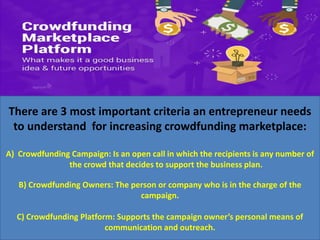
There are 3 most important criteria an entrepreneur needs
to understand for increasing crowdfunding marketplace:
A) Crowdfunding Campaign: Is an open call in which the recipients is any number of
the crowd that decides to support the business plan.
B) Crowdfunding Owners: The person or company who is in the charge of the
campaign.
C) Crowdfunding Platform: Supports the campaign owner’s personal means of
communication and outreach.
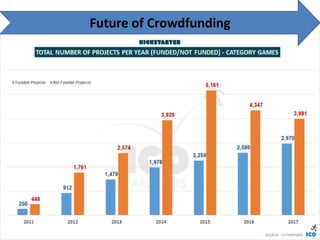
Future of Crowdfunding
The Crowdfunding World Map
 Campaign owners reaches out for support
into initial channel.
 High market growth among the countries.
 Acceleration the awareness in globally.
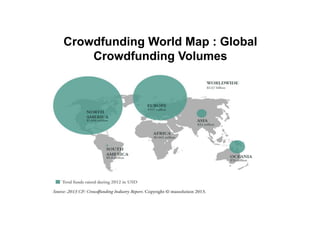
Crowdfunding World Map : Global
Crowdfunding Volumes
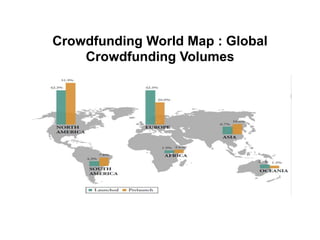
Crowdfunding World Map : Global
Crowdfunding Volumes
The Market Outlook
Anticipated healthy growth rate of crowdfunding;
Rising more capital through the social media
Platforms offering reward-based crowdfunding,
CFPs will advance their crowdfunding models
It continues increasing number of business and
individual
Crowdfunding cons in outlook
Your idea will be out directly in front of the public
It may drum up your interest in your project
Success requires investing tireless effort
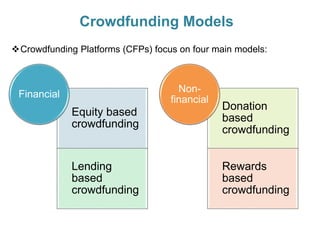
Crowdfunding Models
Crowdfunding Platforms (CFPs) focus on four main models:
Equity based
crowdfunding
Lending
based
crowdfunding
Financial
Donation
based
crowdfunding
Rewards
based
crowdfunding
Non-
financial
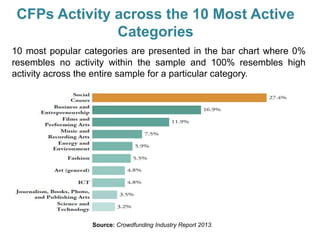
CFPs Activity across the 10 Most Active
Categories
10 most popular categories are presented in the bar chart where 0%
resembles no activity within the sample and 100% resembles high
activity across the entire sample for a particular category.
Source: Crowdfunding Industry Report 2013.
Financial versus Nonfinancial Return
Crowdfunding
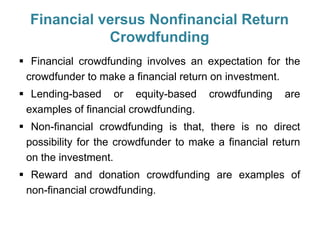
 Financial crowdfunding involves an expectation for the
crowdfunder to make a financial return on investment.
 Lending-based or equity-based crowdfunding are
examples of financial crowdfunding.
 Non-financial crowdfunding is that, there is no direct
possibility for the crowdfunder to make a financial return
on the investment.
 Reward and donation crowdfunding are examples of
non-financial crowdfunding.
Donation-Based Crowdfunding
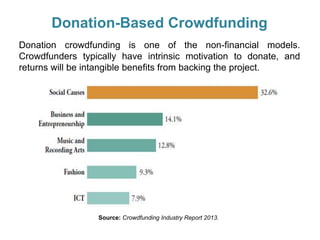
Donation crowdfunding is one of the non-financial models.
Crowdfunders typically have intrinsic motivation to donate, and
returns will be intangible benefits from backing the project.
Source: Crowdfunding Industry Report 2013.
Rewards-Based Crowdfunding
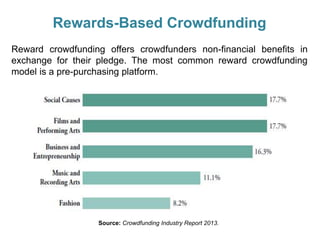
Reward crowdfunding offers crowdfunders non-financial benefits in
exchange for their pledge. The most common reward crowdfunding
model is a pre-purchasing platform.
Source: Crowdfunding Industry Report 2013.
Lending-Based Crowdfunding
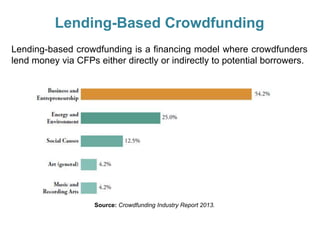
Lending-based crowdfunding is a financing model where crowdfunders
lend money via CFPs either directly or indirectly to potential borrowers.
Source: Crowdfunding Industry Report 2013.
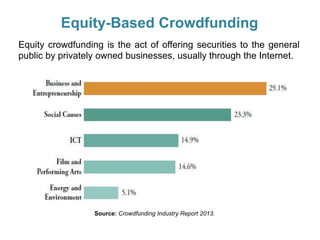
Equity-Based Crowdfunding
Equity crowdfunding is the act of offering securities to the general
public by privately owned businesses, usually through the Internet.
Source: Crowdfunding Industry Report 2013.
Crowdfunding Campaign
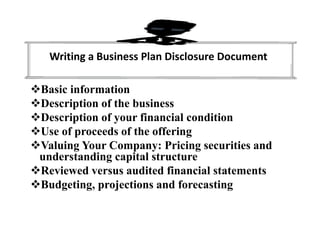
Writing a Business Plan Disclosure Document
Basic information
Description of the business
Description of your financial condition
Use of proceeds of the offering
Valuing Your Company: Pricing securities and
understanding capital structure
Reviewed versus audited financial statements
Budgeting, projections and forecasting
Basic information
Company’s name
Legal status,
Physical address
Web site address
Names of the
directors and officers
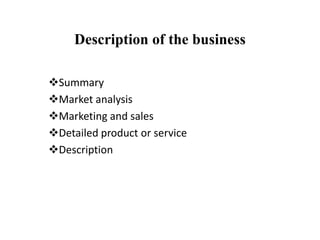
Description of the business
Summary
Market analysis
Marketing and sales
Detailed product or service
Description
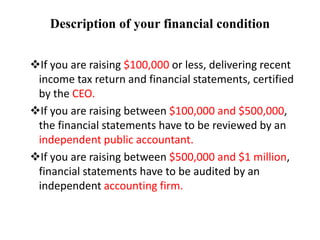
Description of your financial condition
If you are raising $100,000 or less, delivering recent
income tax return and financial statements, certified
by the CEO.
If you are raising between $100,000 and $500,000,
the financial statements have to be reviewed by an
independent public accountant.
If you are raising between $500,000 and $1 million,
financial statements have to be audited by an
independent accounting firm.
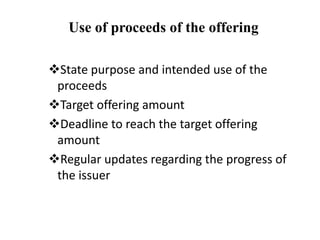
Use of proceeds of the offering
State purpose and intended use of the
proceeds
Target offering amount
Deadline to reach the target offering
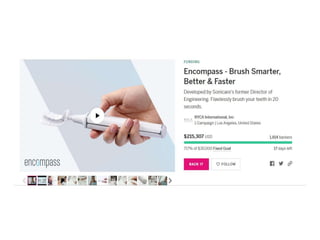
amount
Regular updates regarding the progress of
the issuer
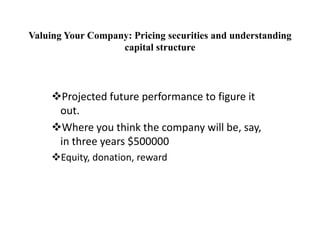
Valuing Your Company: Pricing securities and understanding
capital structure
Projected future performance to figure it
out.
Where you think the company will be, say,
in three years $500000
Equity, donation, reward
Budgeting, projections and forecasting
Cost allocation and disbursement
Assumption
Multiple projection
Presentation on crowdfunding

Presentation on crowdfunding

  • 2.
  • 4.
    A Statistical Viewon Crowdfunding
  • 5.
    Crowdfunding is theuse of small amounts of capital from a large number of individuals to finance a new business venture.
  • 7.
    Definition  Crowdfunding wascreated by entrepreneur Michael Sullivan in 2006.  Crowdfunding involves a more specific request: The crowd is solicited for financial contributions to a particular venture or cause.  Such as a film project or cancer research.
  • 8.
    Major driving forcesbehind Crowdfunding 1. This is a tool for capital formation via web 2.0 2. JOBS Act 2012 has been working as a major driving forces to initiate crowdfunding more than before 3. Crowdfunding Campaign 4. Crowdfunding Models 5. The role of technology to grab the marketplace
  • 9.
    There are 3most important criteria an entrepreneur needs to understand for increasing crowdfunding marketplace: A) Crowdfunding Campaign: Is an open call in which the recipients is any number of the crowd that decides to support the business plan. B) Crowdfunding Owners: The person or company who is in the charge of the campaign. C) Crowdfunding Platform: Supports the campaign owner’s personal means of communication and outreach.
  • 10.
  • 11.
    The Crowdfunding WorldMap  Campaign owners reaches out for support into initial channel.  High market growth among the countries.  Acceleration the awareness in globally.
  • 12.
    Crowdfunding World Map: Global Crowdfunding Volumes
  • 13.
    Crowdfunding World Map: Global Crowdfunding Volumes
  • 14.
    The Market Outlook Anticipatedhealthy growth rate of crowdfunding; Rising more capital through the social media Platforms offering reward-based crowdfunding, CFPs will advance their crowdfunding models It continues increasing number of business and individual
  • 15.
    Crowdfunding cons inoutlook Your idea will be out directly in front of the public It may drum up your interest in your project Success requires investing tireless effort
  • 16.
    Crowdfunding Models Crowdfunding Platforms(CFPs) focus on four main models: Equity based crowdfunding Lending based crowdfunding Financial Donation based crowdfunding Rewards based crowdfunding Non- financial
  • 17.
    CFPs Activity acrossthe 10 Most Active Categories 10 most popular categories are presented in the bar chart where 0% resembles no activity within the sample and 100% resembles high activity across the entire sample for a particular category. Source: Crowdfunding Industry Report 2013.
  • 18.
    Financial versus NonfinancialReturn Crowdfunding  Financial crowdfunding involves an expectation for the crowdfunder to make a financial return on investment.  Lending-based or equity-based crowdfunding are examples of financial crowdfunding.  Non-financial crowdfunding is that, there is no direct possibility for the crowdfunder to make a financial return on the investment.  Reward and donation crowdfunding are examples of non-financial crowdfunding.
  • 19.
    Donation-Based Crowdfunding Donation crowdfundingis one of the non-financial models. Crowdfunders typically have intrinsic motivation to donate, and returns will be intangible benefits from backing the project. Source: Crowdfunding Industry Report 2013.
  • 20.
    Rewards-Based Crowdfunding Reward crowdfundingoffers crowdfunders non-financial benefits in exchange for their pledge. The most common reward crowdfunding model is a pre-purchasing platform. Source: Crowdfunding Industry Report 2013.
  • 21.
    Lending-Based Crowdfunding Lending-based crowdfundingis a financing model where crowdfunders lend money via CFPs either directly or indirectly to potential borrowers. Source: Crowdfunding Industry Report 2013.
  • 22.
    Equity-Based Crowdfunding Equity crowdfundingis the act of offering securities to the general public by privately owned businesses, usually through the Internet. Source: Crowdfunding Industry Report 2013.
  • 24.
  • 25.
    Writing a BusinessPlan Disclosure Document Basic information Description of the business Description of your financial condition Use of proceeds of the offering Valuing Your Company: Pricing securities and understanding capital structure Reviewed versus audited financial statements Budgeting, projections and forecasting
  • 26.
    Basic information Company’s name Legalstatus, Physical address Web site address Names of the directors and officers
  • 27.
    Description of thebusiness Summary Market analysis Marketing and sales Detailed product or service Description
  • 28.
    Description of yourfinancial condition If you are raising $100,000 or less, delivering recent income tax return and financial statements, certified by the CEO. If you are raising between $100,000 and $500,000, the financial statements have to be reviewed by an independent public accountant. If you are raising between $500,000 and $1 million, financial statements have to be audited by an independent accounting firm.
  • 29.
    Use of proceedsof the offering State purpose and intended use of the proceeds Target offering amount Deadline to reach the target offering amount Regular updates regarding the progress of the issuer

  • 30.
    Valuing Your Company:Pricing securities and understanding capital structure Projected future performance to figure it out. Where you think the company will be, say, in three years $500000 Equity, donation, reward
  • 31.
    Budgeting, projections andforecasting Cost allocation and disbursement Assumption Multiple projection