Introduction to
Credit Risk Management
1
Toshifumi Kuga CEO of TOSHI STATS SDN. BHD
Ver1.0
What is credit risk ?
• Definition of credit risk
• Risk where borrower cannot pay interest
rate nor principle according to contracts
2
How serious credit risk is !
• In early1990s, economic bubble bursted in
Japan and major domestic banks were in critical
condition because of failure of credit risk
management
• In 2008, a lot of CDOs, which were financial
products related counterparty credit risk, were
defaulted and financial system in U.S. got into
critical condition
3
Framework of
credit risk management
1. Control of individual loans
2. Risk management of the loan portfolio
4
1. Control of individual loans
• creditworthiness of customers
• ability to pay
• willingness to pay
• amount of credit granted
• When creditworthiness is good, amount of
credit can be increased
5
How to measure creditworthiness
• Probability of default (PD)
• Probability in which customers will default in
certain time horizon
• PD can be calculated by using data of
customers and statistical models → page 12
• PD is assigned to each customer
6
How to measure creditworthiness
• Credit rating
• Rating is assigned to each customer
according to probability of default
and other information of customers
• AAA is usually the highest rating
• C- is usually the lowest rating
7
Dynamics of creditworthiness
• Creditworthiness of each customer has been
changing based on...
• change of conditions and status of each
customer
• change of environment over macro economy
• Updating of PD and Credit rating is critical for
credit risk management in practice
8
2. Risk management of the loan portfolio
• Basic concept
• avoid the concentration in the portfolio
• correlation over expected defaults
among customers should be controlled
• Do not put all eggs in the same basket
9
Diversification
• Diversification is highly important for portfolio management
• Diversification over
• products
• customers
• countries
• industries
• currencies, etc.
10
Hidden concentrations
• Concentration of risk under same root causes
• increase of unemployment rate may trigger increase of
defaults in lower income customers at the same time
• Although each loan is small and loans are diversified over
many customers, this diversification may not work to
reduce risk as these loans are exposed to same cause of
the risk
• Diversifications should be carefully scrutinized periodically
11
Calculation for Probabilty default
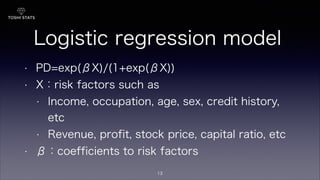
• Logistic regression model is usually used to calculate
probability of default (PD)
• Data should have the results where customers are default
or not default
• Logistic regression model produces outputs between 0
and 1 from data
• These outputs are considered as probability
12
Logistic regression model
• PD=exp(βX)/(1+exp(βX))
• X:risk factors such as
• Income, occupation, age, sex, credit history,
etc
• Revenue, profit, stock price, capital ratio, etc
• β:coefficients to risk factors
13
Thanks for your attentions
!
• TOSHI STATS SDN. BHD, Digital-learning center for statistical computing in Asia
• CEO : Toshifumi Kuga, Certified financial services auditor
• Company web site : www.toshistats.net
• Company FB page : www.facebook.com/toshistatsco
• Please do not hesitate to send your opinion and massages about our courses to
us !
14
Disclaimer
• TOSHI STATS SDN. BHD. and I do not accept any responsibility or
liability for loss or damage occasioned to any person or property
through using materials, instructions, methods or ideas contained
herein, or acting or refraining from acting as a result of such use.
TOSHI STATS SDN. BHD. and I expressly disclaim all implied
warranties, including merchantability or fitness for any particular
purpose. There will be no duty on TOSHI STATS SDN. BHD. and me
to correct any errors or defects in the codes and the software.
© 2014 TOSHI STATS SDN. BHD. All rights reserved
15

Introduction to credit risk management

  • 1.
    Introduction to Credit RiskManagement 1 Toshifumi Kuga CEO of TOSHI STATS SDN. BHD Ver1.0
  • 2.
    What is creditrisk ? • Definition of credit risk • Risk where borrower cannot pay interest rate nor principle according to contracts 2
  • 3.
    How serious creditrisk is ! • In early1990s, economic bubble bursted in Japan and major domestic banks were in critical condition because of failure of credit risk management • In 2008, a lot of CDOs, which were financial products related counterparty credit risk, were defaulted and financial system in U.S. got into critical condition 3
  • 4.
    Framework of credit riskmanagement 1. Control of individual loans 2. Risk management of the loan portfolio 4
  • 5.
    1. Control ofindividual loans • creditworthiness of customers • ability to pay • willingness to pay • amount of credit granted • When creditworthiness is good, amount of credit can be increased 5
  • 6.
    How to measurecreditworthiness • Probability of default (PD) • Probability in which customers will default in certain time horizon • PD can be calculated by using data of customers and statistical models → page 12 • PD is assigned to each customer 6
  • 7.
    How to measurecreditworthiness • Credit rating • Rating is assigned to each customer according to probability of default and other information of customers • AAA is usually the highest rating • C- is usually the lowest rating 7
  • 8.
    Dynamics of creditworthiness •Creditworthiness of each customer has been changing based on... • change of conditions and status of each customer • change of environment over macro economy • Updating of PD and Credit rating is critical for credit risk management in practice 8
  • 9.
    2. Risk managementof the loan portfolio • Basic concept • avoid the concentration in the portfolio • correlation over expected defaults among customers should be controlled • Do not put all eggs in the same basket 9
  • 10.
    Diversification • Diversification ishighly important for portfolio management • Diversification over • products • customers • countries • industries • currencies, etc. 10
  • 11.
    Hidden concentrations • Concentrationof risk under same root causes • increase of unemployment rate may trigger increase of defaults in lower income customers at the same time • Although each loan is small and loans are diversified over many customers, this diversification may not work to reduce risk as these loans are exposed to same cause of the risk • Diversifications should be carefully scrutinized periodically 11
  • 12.
    Calculation for Probabiltydefault • Logistic regression model is usually used to calculate probability of default (PD) • Data should have the results where customers are default or not default • Logistic regression model produces outputs between 0 and 1 from data • These outputs are considered as probability 12
  • 13.
    Logistic regression model •PD=exp(βX)/(1+exp(βX)) • X:risk factors such as • Income, occupation, age, sex, credit history, etc • Revenue, profit, stock price, capital ratio, etc • β:coefficients to risk factors 13
  • 14.
    Thanks for yourattentions ! • TOSHI STATS SDN. BHD, Digital-learning center for statistical computing in Asia • CEO : Toshifumi Kuga, Certified financial services auditor • Company web site : www.toshistats.net • Company FB page : www.facebook.com/toshistatsco • Please do not hesitate to send your opinion and massages about our courses to us ! 14
  • 15.
    Disclaimer • TOSHI STATSSDN. BHD. and I do not accept any responsibility or liability for loss or damage occasioned to any person or property through using materials, instructions, methods or ideas contained herein, or acting or refraining from acting as a result of such use. TOSHI STATS SDN. BHD. and I expressly disclaim all implied warranties, including merchantability or fitness for any particular purpose. There will be no duty on TOSHI STATS SDN. BHD. and me to correct any errors or defects in the codes and the software. © 2014 TOSHI STATS SDN. BHD. All rights reserved 15