1
Introduction to
Conscious Leadership
Conscious Leadership Summit
2
Workshop Details
© Transformational Learning™ Institute
▪ Introductions
▪ Schedule
▪ Health and lunch breaks
▪ Electronic devices policy
▪ Materials
▪ Your learning journal
3
Objectifs
© Transformational Learning Institute
▪ Explore leadership from a developmental and transformational
framework
▪ Understand that we are evolutionary beings and that we need to “grow
up and wake up” to achieve higher levels of leadership effectiveness
▪ Experience a transformational framework including a step-by-step
methodology that will guide you in becoming a more conscious leader
▪ Explore the three main reactive leadership patterns and how they
impede personal power and leadership effectiveness
▪ Explore and align with the five most powerful competencies of
conscious and creative leaders
▪ Design and engage in developmental practices to sustain your growth
beyond the workshop
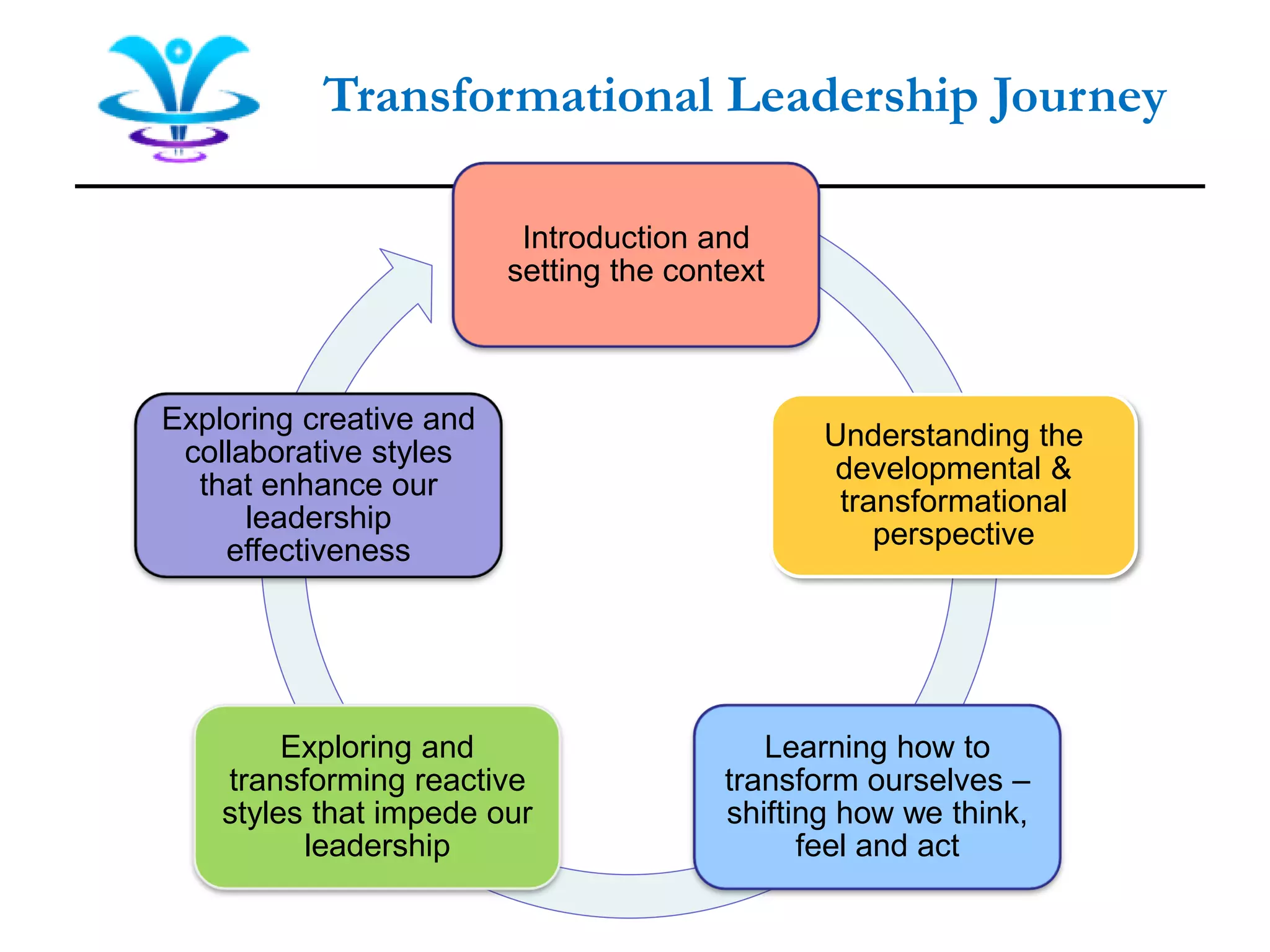
Introduction and
setting the context
Understanding the
developmental &
transformational
perspective
Learning how to
transform ourselves –
shifting how we think,
feel and act
Exploring and
transforming reactive
styles that impede our
leadership
Exploring creative and
collaborative styles
that enhance our
leadership
effectiveness
Transformational Leadership Journey
5
Transformational Learning
Methodology
© Transformational Learning™ Institute
Transformational learning is:
both reflective and experiential – it requires patience:
✓We will slow things down
✓Look “behind the scene” of your own thinking
✓Focus on “how to be” rather than “what to do”
6
Learning Contract &
Being Present
© Transformational Learning™ Institute
✓ Learning Contract
✓ Exercise on Being
Present
7
Definition of Leadership
© Transformational Learning™ Institute
“Leadership is the capacity
to individually and
collectively shape our
own future by providing
direction and alignment,
fostering collaboration
and teamwork, and
driving execution.”
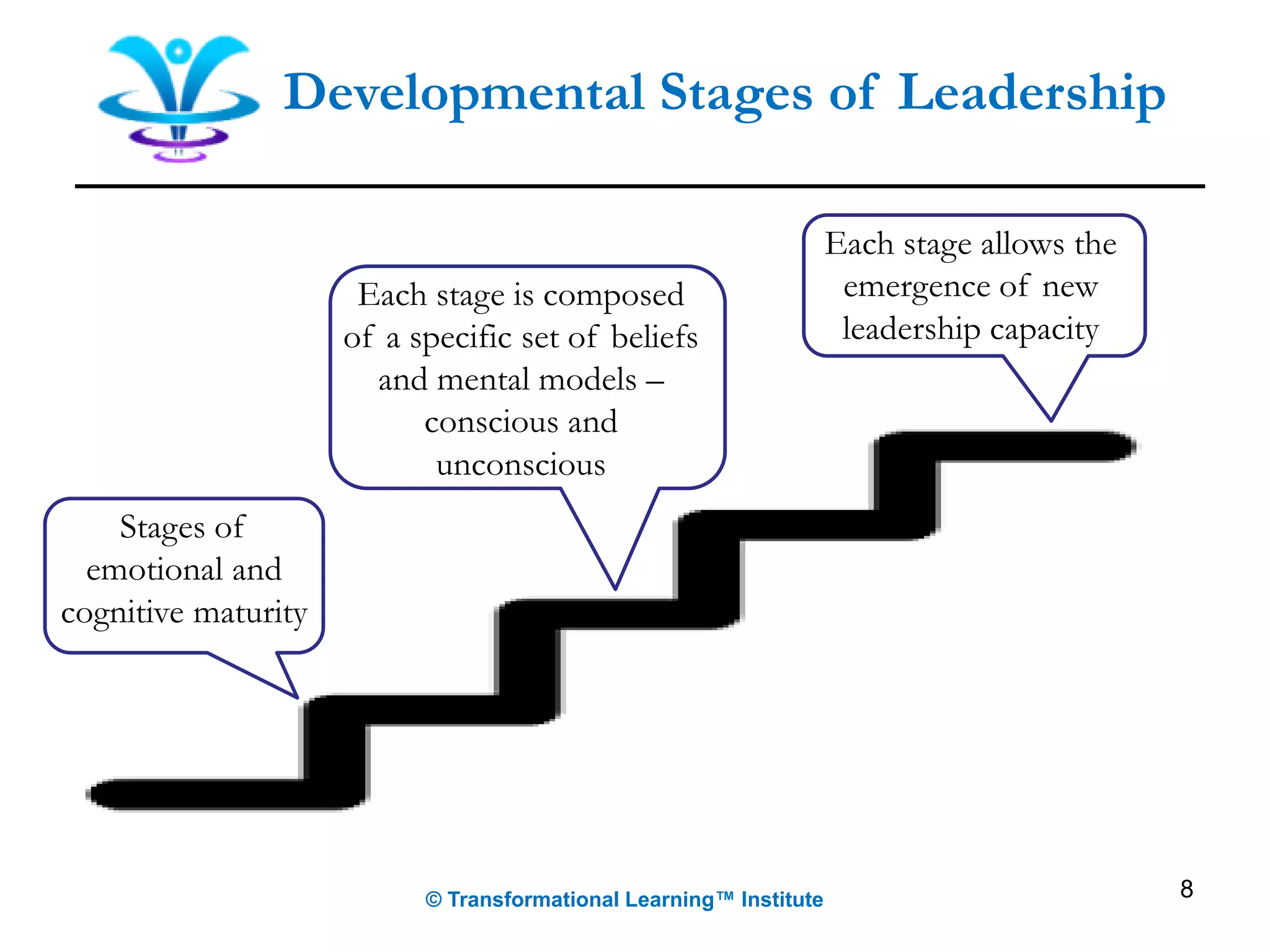
8
Developmental Stages of Leadership
© Transformational Learning™ Institute
Stages of
emotional and
cognitive maturity
Each stage allows the
emergence of new
leadership capacity
Each stage is composed
of a specific set of beliefs
and mental models –
conscious and
unconscious
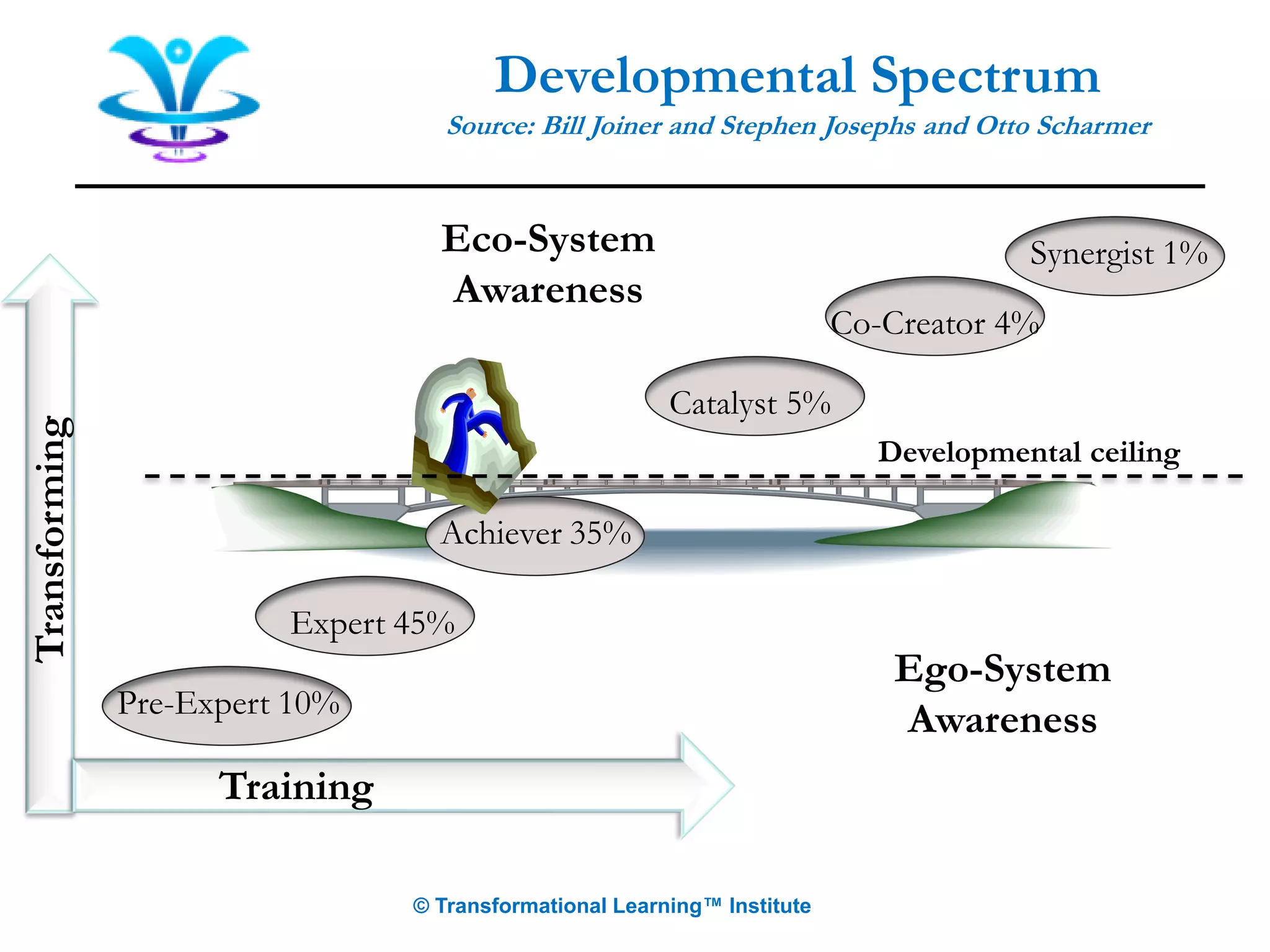
Developmental Spectrum
Source: Bill Joiner and Stephen Josephs and Otto Scharmer
Expert 45%
Achiever 35%
Co-Creator 4%
Synergist 1%
Catalyst 5%
Ego-System
Awareness
Eco-System
Awareness
Developmental ceiling
Pre-Expert 10%
Transforming
Training
© Transformational Learning™ Institute
10
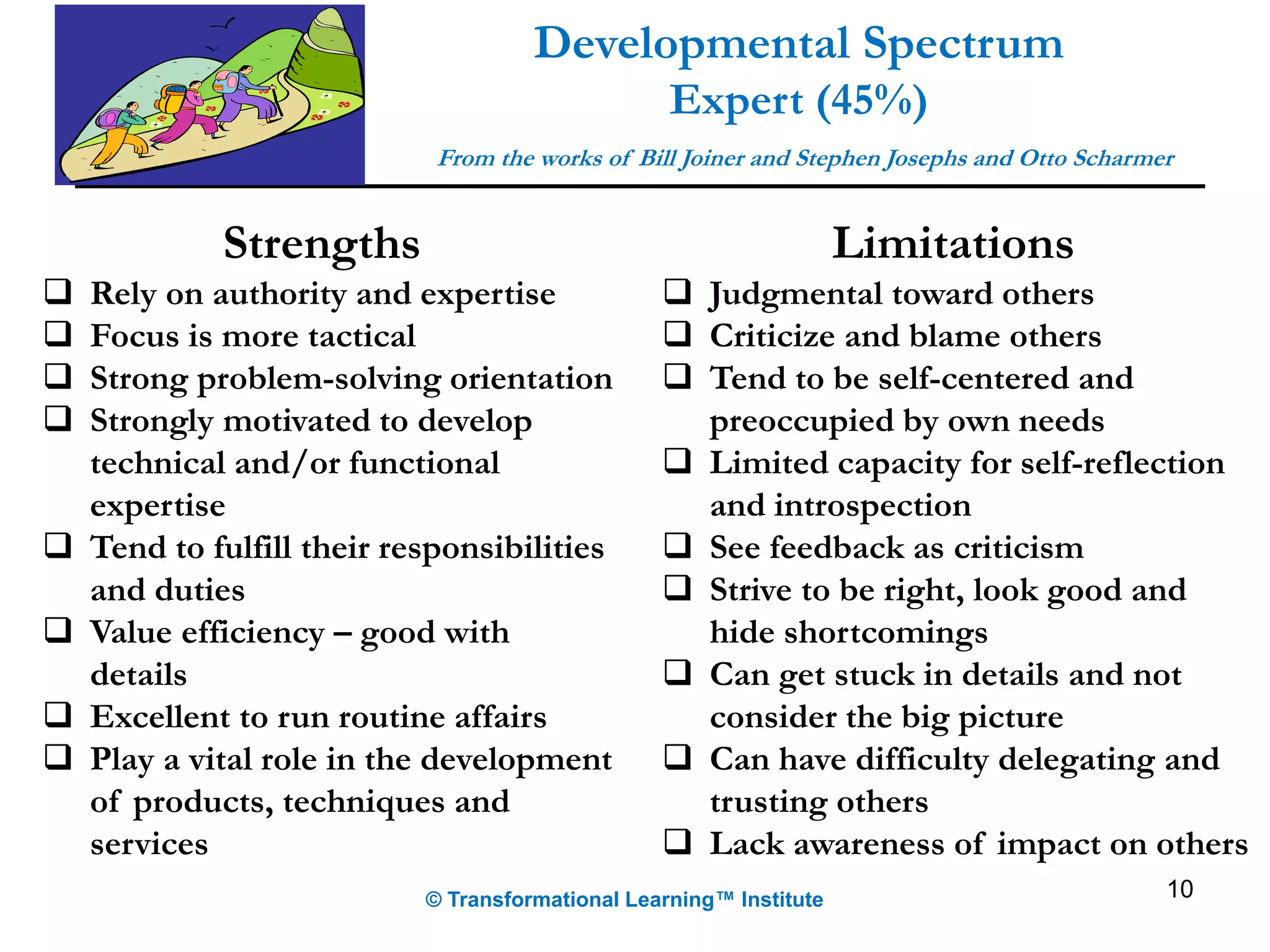
Developmental Spectrum
Expert (45%)
From the works of Bill Joiner and Stephen Josephs and Otto Scharmer
© Transformational Learning™ Institute
Strengths
 Rely on authority and expertise
 Focus is more tactical
 Strong problem-solving orientation
 Strongly motivated to develop
technical and/or functional
expertise
 Tend to fulfill their responsibilities
and duties
 Value efficiency – good with
details
 Excellent to run routine affairs
 Play a vital role in the development
of products, techniques and
services
Limitations
 Judgmental toward others
 Criticize and blame others
 Tend to be self-centered and
preoccupied by own needs
 Limited capacity for self-reflection
and introspection
 See feedback as criticism
 Strive to be right, look good and
hide shortcomings
 Can get stuck in details and not
consider the big picture
 Can have difficulty delegating and
trusting others
 Lack awareness of impact on others
11
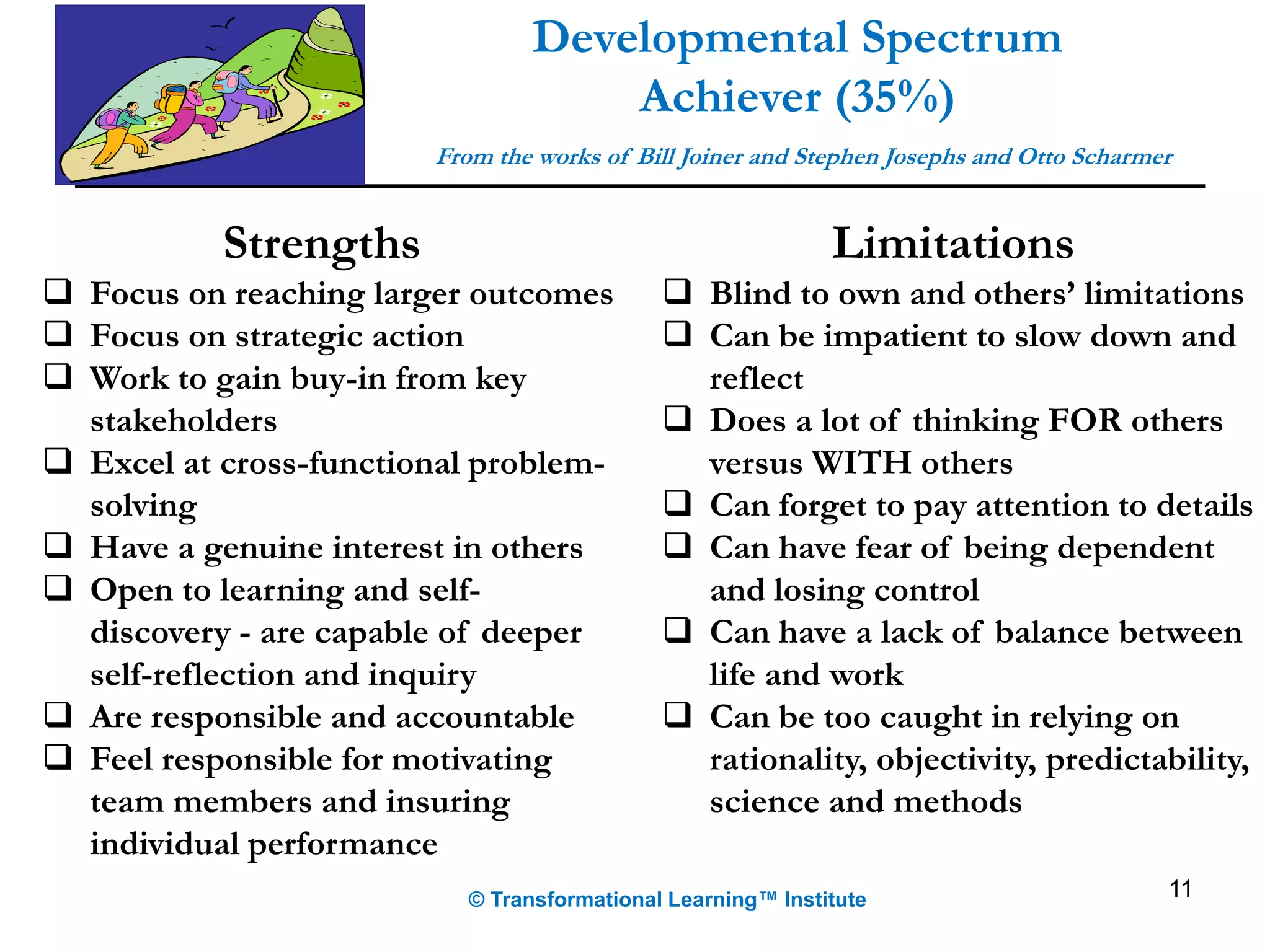
Developmental Spectrum
Achiever (35%)
From the works of Bill Joiner and Stephen Josephs and Otto Scharmer
© Transformational Learning™ Institute
Limitations
 Blind to own and others’ limitations
 Can be impatient to slow down and
reflect
 Does a lot of thinking FOR others
versus WITH others
 Can forget to pay attention to details
 Can have fear of being dependent
and losing control
 Can have a lack of balance between
life and work
 Can be too caught in relying on
rationality, objectivity, predictability,
science and methods
Strengths
 Focus on reaching larger outcomes
 Focus on strategic action
 Work to gain buy-in from key
stakeholders
 Excel at cross-functional problem-
solving
 Have a genuine interest in others
 Open to learning and self-
discovery - are capable of deeper
self-reflection and inquiry
 Are responsible and accountable
 Feel responsible for motivating
team members and insuring
individual performance
12
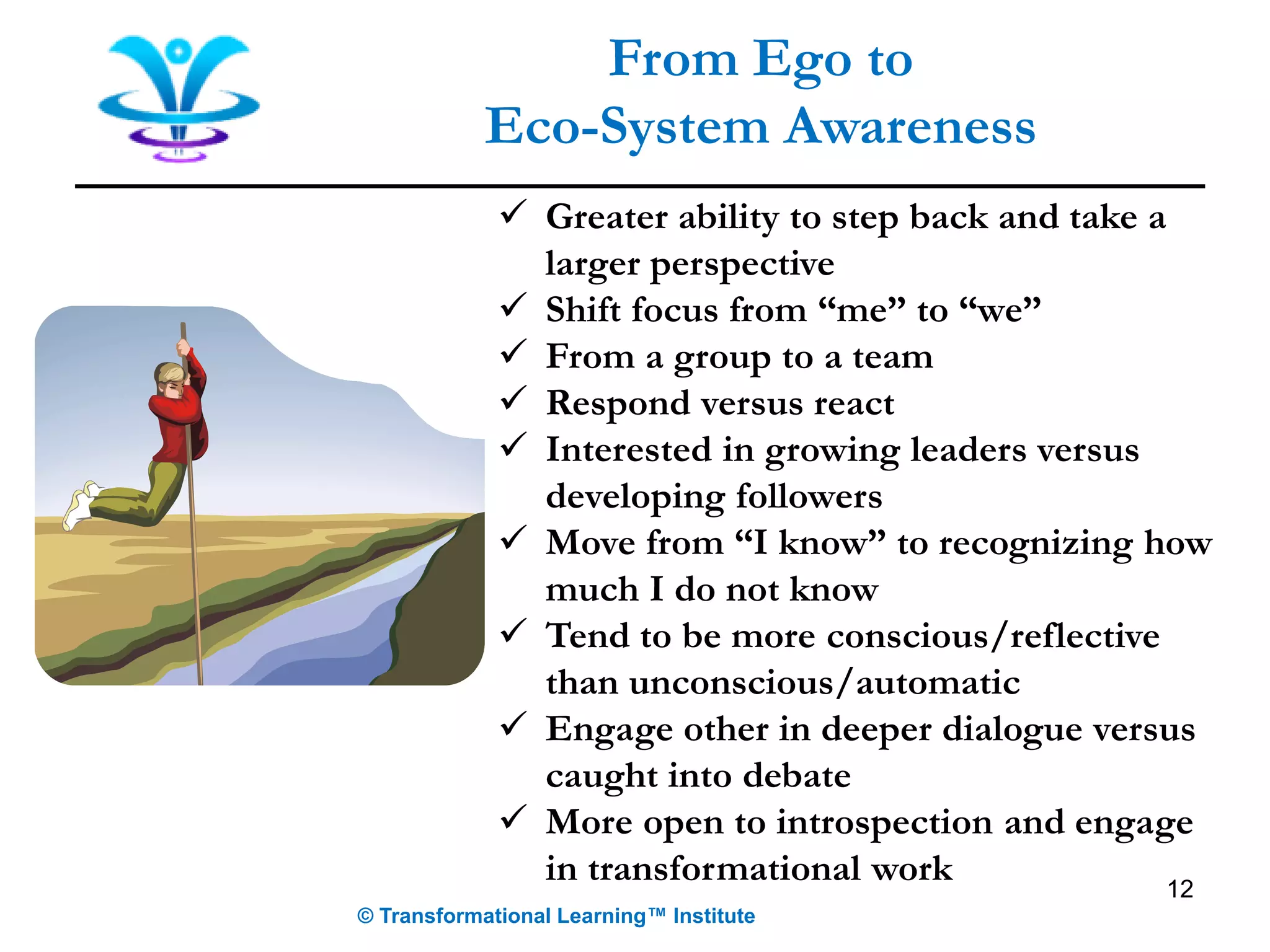
From Ego to
Eco-System Awareness
✓ Greater ability to step back and take a
larger perspective
✓ Shift focus from “me” to “we”
✓ From a group to a team
✓ Respond versus react
✓ Interested in growing leaders versus
developing followers
✓ Move from “I know” to recognizing how
much I do not know
✓ Tend to be more conscious/reflective
than unconscious/automatic
✓ Engage other in deeper dialogue versus
caught into debate
✓ More open to introspection and engage
in transformational work
© Transformational Learning™ Institute
13
Developmental Spectrum
Catalyst (5%)
From the works of Bill Joiner and Stephen Josephs and Otto Scharmer
© Transformational Learning™ Institute
Strengths
 Focus on visionary leadership
 Engage diverse stakeholders in
collaborative dialogue (inclusion)
 Facilitate creative problem solving
 Empowering and coach others
 Value and harness individual and
collective differences
 Anticipate and initiate change
 Greater emotional intelligence
 Capable of systems thinking
 More creative and capable of
thinking outside of the box
 Access to multiple perspectives
 Can see one’s own reactive
patterns in the moment
Limitations
 May be slower at making decisions
– tend to consider all options
 Can be perceived as inconsistent
and ambivalent
 May be irritated by the achiever’s
main rational mode or drive for
results
 Tend to provide less certainty and a
less firm leadership style
14
Developmental Spectrum
Co-Creator (4%)
From the works of Bill Joiner and Stephen Josephs and Otto Scharmer
© Transformational Learning™ Institute
Strengths
 Oriented toward shared purpose
and collaboration
 Believes leadership is ultimately a
service to others
 Tend to collaborate with others to
develop a shared vision that each
experiences as deeply purposeful
 Value reflective action
 Value authentic self-expression i.e.
being real vs looking good
 Create contexts that support
mutual accountability and
synergistic effects
 Capable of generating
transformational changes
Limitations
 Can be overly forceful with their
own convictions
 May be impatient with other’s
slower development
15
Developmental Spectrum
Synergist (1%)
From the works of Bill Joiner and Stephen Josephs and Otto Scharmer
© Transformational Learning™ Institute
Strengths
 Value deep meaning and purpose
 Great concern about human issues
on a global scale
 Cultivate the here-and-now
awareness that has a fresh and
immediate quality
 They are highly transparent
 They have transformative ability to
draw together opposites and
initiate new directions
 Look for developing themselves
and others
 They are highly intuitive
Limitations
 May feel isolated
 Can come across as superior
 Can be seen as abstract, unrealistic
or even “off the wall”
 Sometimes they may express a sense
of envy at the simplicity of the
earlier periods
16
Stages of Leadership Development
“Research continues to indicate that, although stages
cannot be skipped or bypassed, they can be accelerated –
and on of the first and most basic ways to do this is to
simply learn any general overview or summary of the
stages...” “Research shows that somebody who does
nothing more than learn the rudimentary basics of any
good developmental map or model, for example, will
develop through the basic 6-to-8 levels in a more rapid and
accelerated fashion – these developmental maps are
psychoactive…”
Ken Wilber, Integral Meditation
© Transformational Learning™ Institute
17
Stages of Leadership
Development - Exercise
Goal: Explore the 3 most common stages of leadership
observed in organizations: Expert, Achiever and Catalyst
Work: Divide into 3 groups. Discuss and answer the following
questions with your assigned group:
1. What does a leader/team player who operates from this
stage of development look like in action – both
strengths and limitations?
2. What is the impact of these attitudes and behaviours on
other team members and team productivity?
Prepare to share your reflection with the group
© Transformational Learning™ Institute
18
Stages of Leadership Development –
Exploring Your Centre of Gravity
1. Among the 3 stages of development what is your main centre of
gravity?
2. What are your own strengths and limitations?
A. Strengths:
B. Limitations
© Transformational Learning™ Institute
19
Stages of Leadership Development –
Exploring Your Centre of Gravity
In the context of the current projects you are involved with or
for which you are accountable...
3. How are these strengths and limitations impacting your way of leading?
What could I do more of? What should I do less of?
4. What behaviors and attitudes should you focus on to develop your
capacity to lead more from an eco-system awareness/catalyst
perspective?
© Transformational Learning™ Institute
20
Conscious and Transformational
Leadership
© Transformational Learning™ Institute
“The essence of leadership is to shift the inner place
from which we operate both individually and
collectively.”
Otto Scharmer – Theory U
21
© Transformational Learning™ Institute
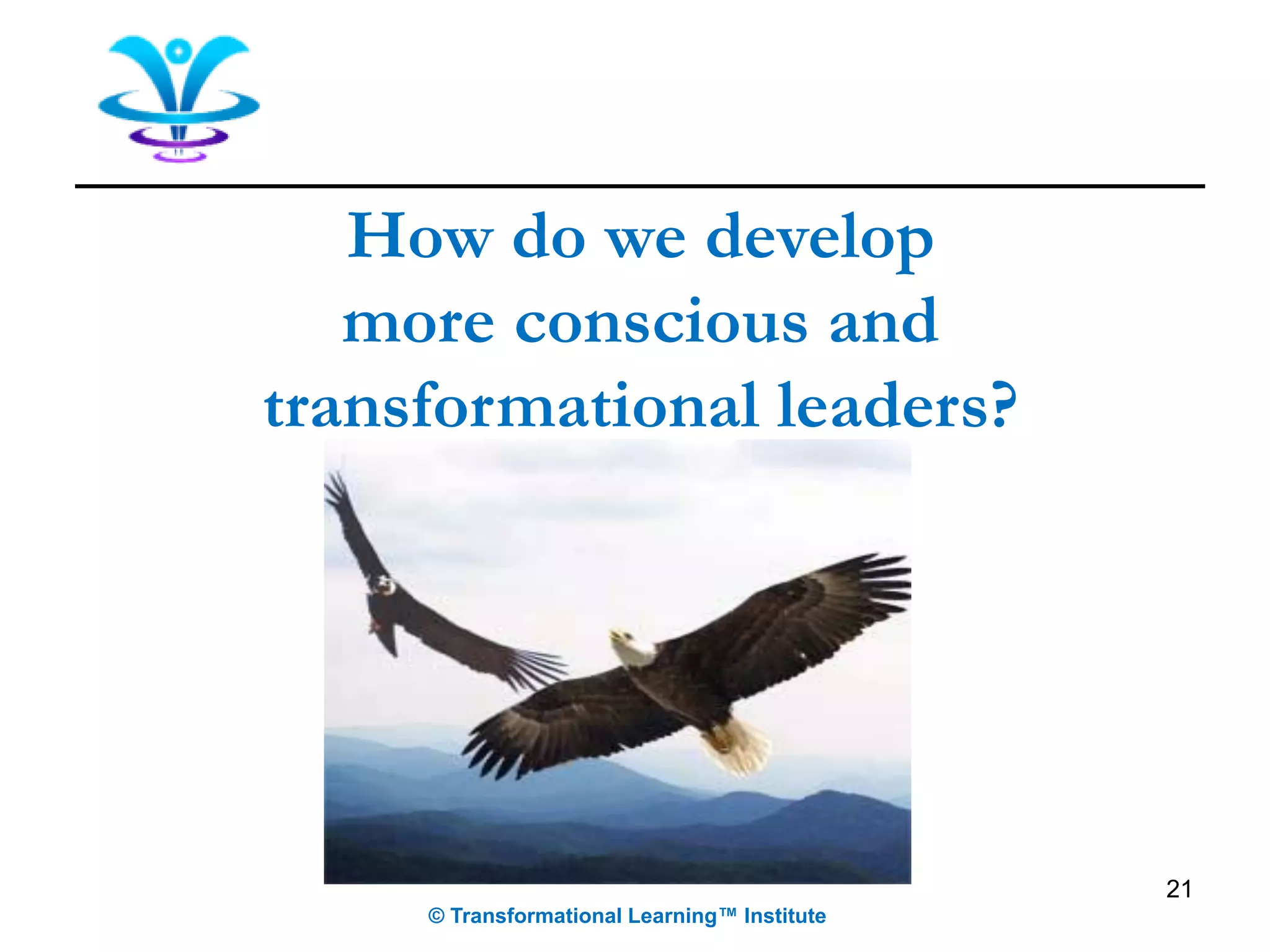
How do we develop
more conscious and
transformational leaders?
22
Transformation of Consciousness
“…research strongly suggests that developing leaders for
the future has as much to do with consciousness as
competence. …the main thing that is developing when
leadership becomes extraordinary, is the internal operating
system of the leader. It is not merely the development of
skill, but the consciousness required to skillfully deploy
one’s leadership in ways that are well matched to the
complexity of the organizational challenges. In short, great
leadership requires higher order consciousness.”
Bob Anderson, Founder of The Leadership Circle
© Transformational Learning™ Institute
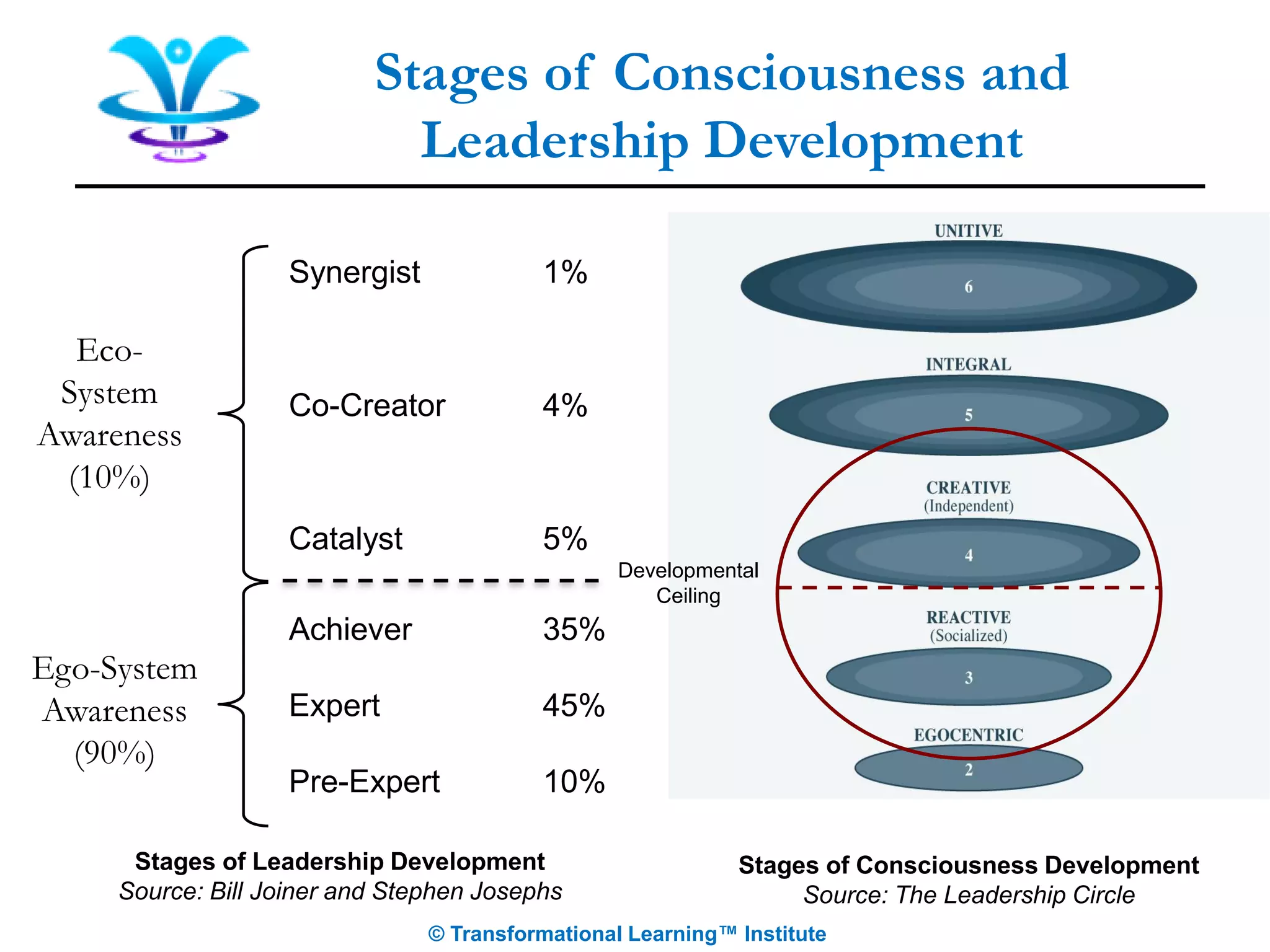
Stages of Consciousness and
Leadership Development
Synergist 1%
Co-Creator 4%
Catalyst 5%
Achiever 35%
Expert 45%
Pre-Expert 10%
Stages of Leadership Development
Source: Bill Joiner and Stephen Josephs
Stages of Consciousness Development
Source: The Leadership Circle
Developmental
Ceiling
Eco-
System
Awareness
(10%)
Ego-System
Awareness
(90%)
© Transformational Learning™ Institute
Observe the role play and
describe what you see.
24
What do you see?
Exercise
© Transformational Learning™ Institute
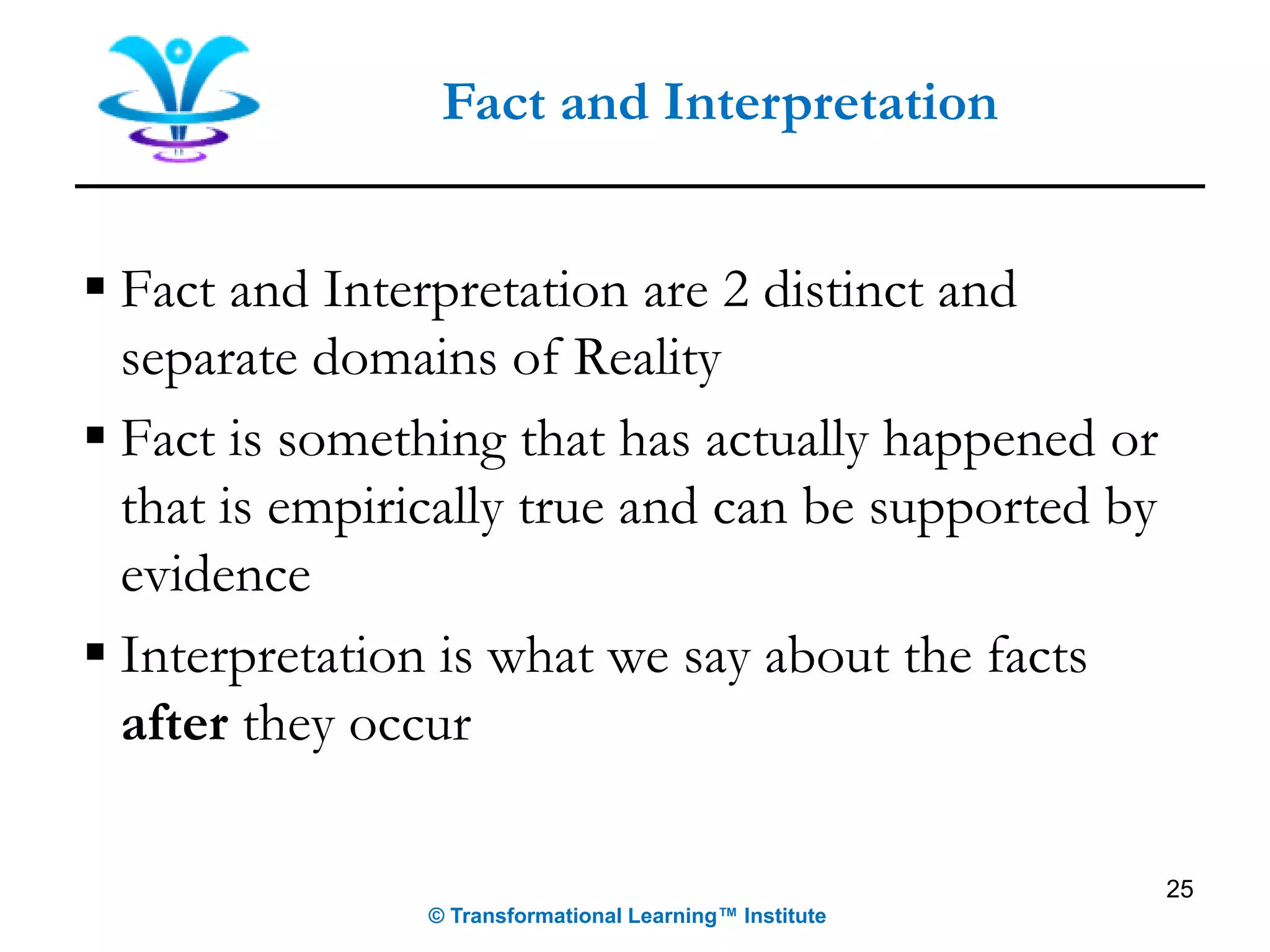
▪ Fact and Interpretation are 2 distinct and
separate domains of Reality
▪ Fact is something that has actually happened or
that is empirically true and can be supported by
evidence
▪ Interpretation is what we say about the facts
after they occur
25
Fact and Interpretation
© Transformational Learning™ Institute
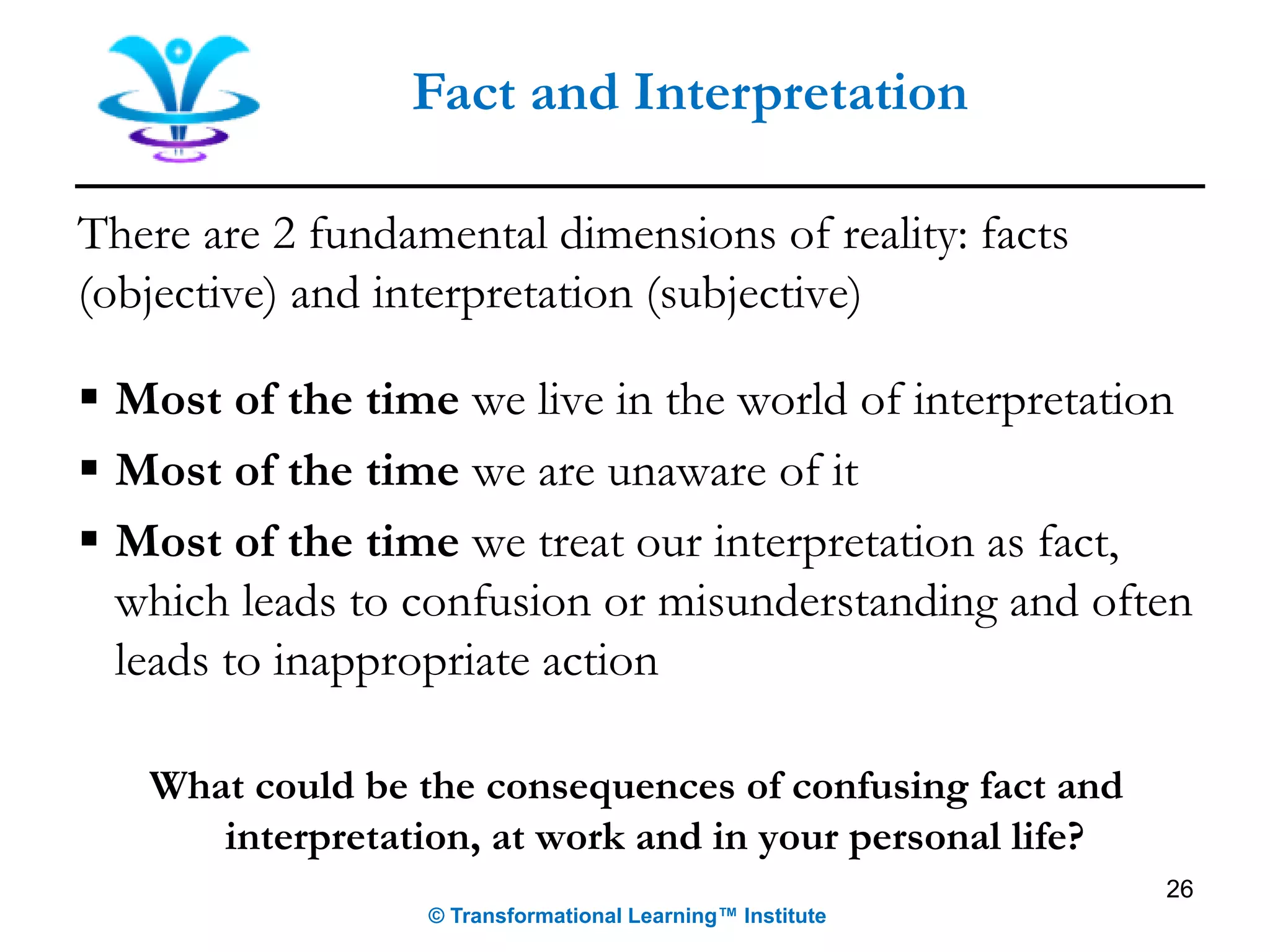
Fact and Interpretation
There are 2 fundamental dimensions of reality: facts
(objective) and interpretation (subjective)
▪ Most of the time we live in the world of interpretation
▪ Most of the time we are unaware of it
▪ Most of the time we treat our interpretation as fact,
which leads to confusion or misunderstanding and often
leads to inappropriate action
What could be the consequences of confusing fact and
interpretation, at work and in your personal life?
26
© Transformational Learning™ Institute
Fact and Interpretation
27
© Transformational Learning™ Institute
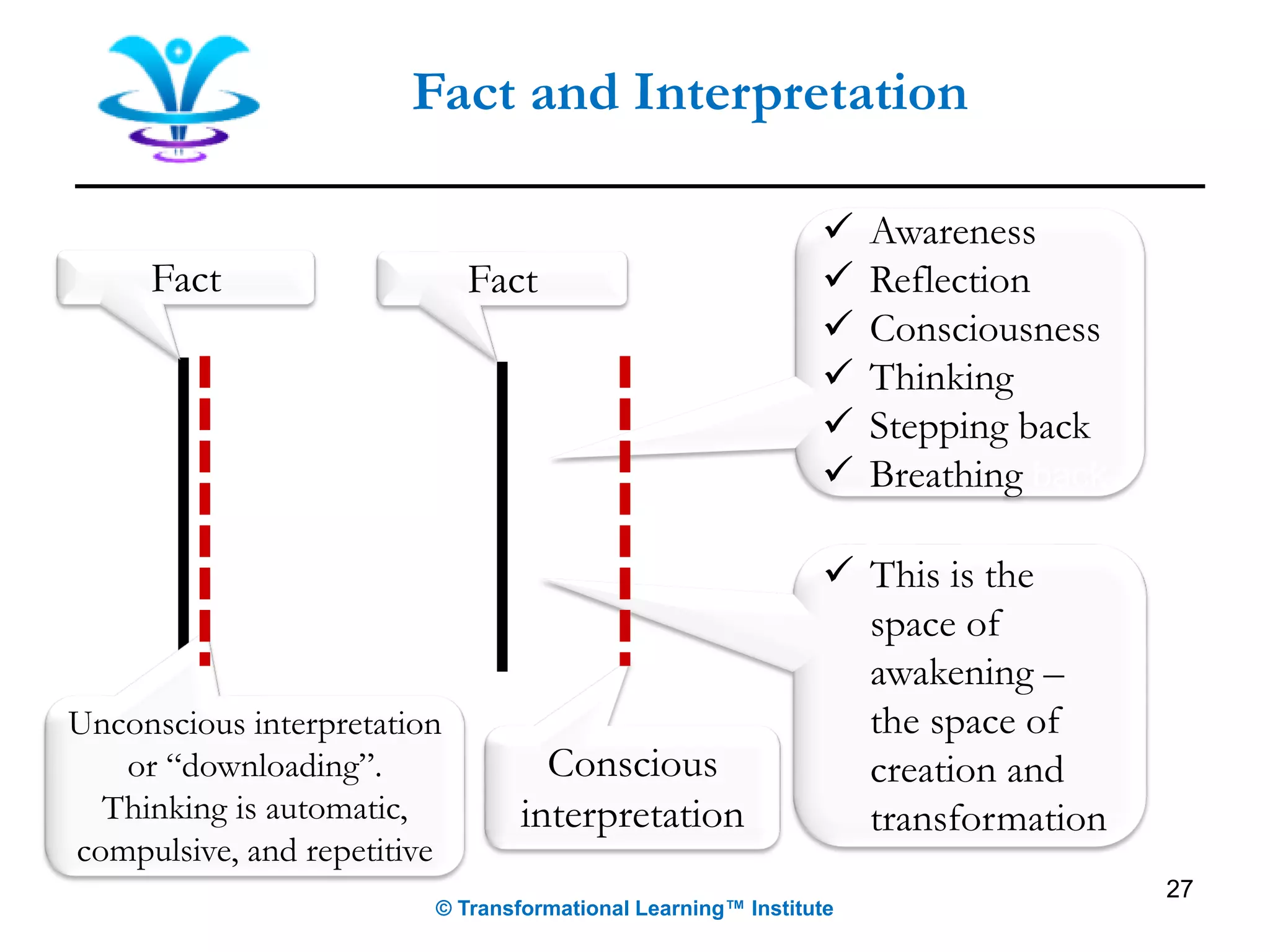
Fact
Unconscious interpretation
or “downloading”.
Thinking is automatic,
compulsive, and repetitive
Fact
Conscious
interpretation
✓ Awareness
✓ Reflection
✓ Consciousness
✓ Thinking
✓ Stepping back
✓ Breathing back
✓ This is the
space of
awakening –
the space of
creation and
transformation
Fact and Interpretation
28© Transformational Learning™ Institute
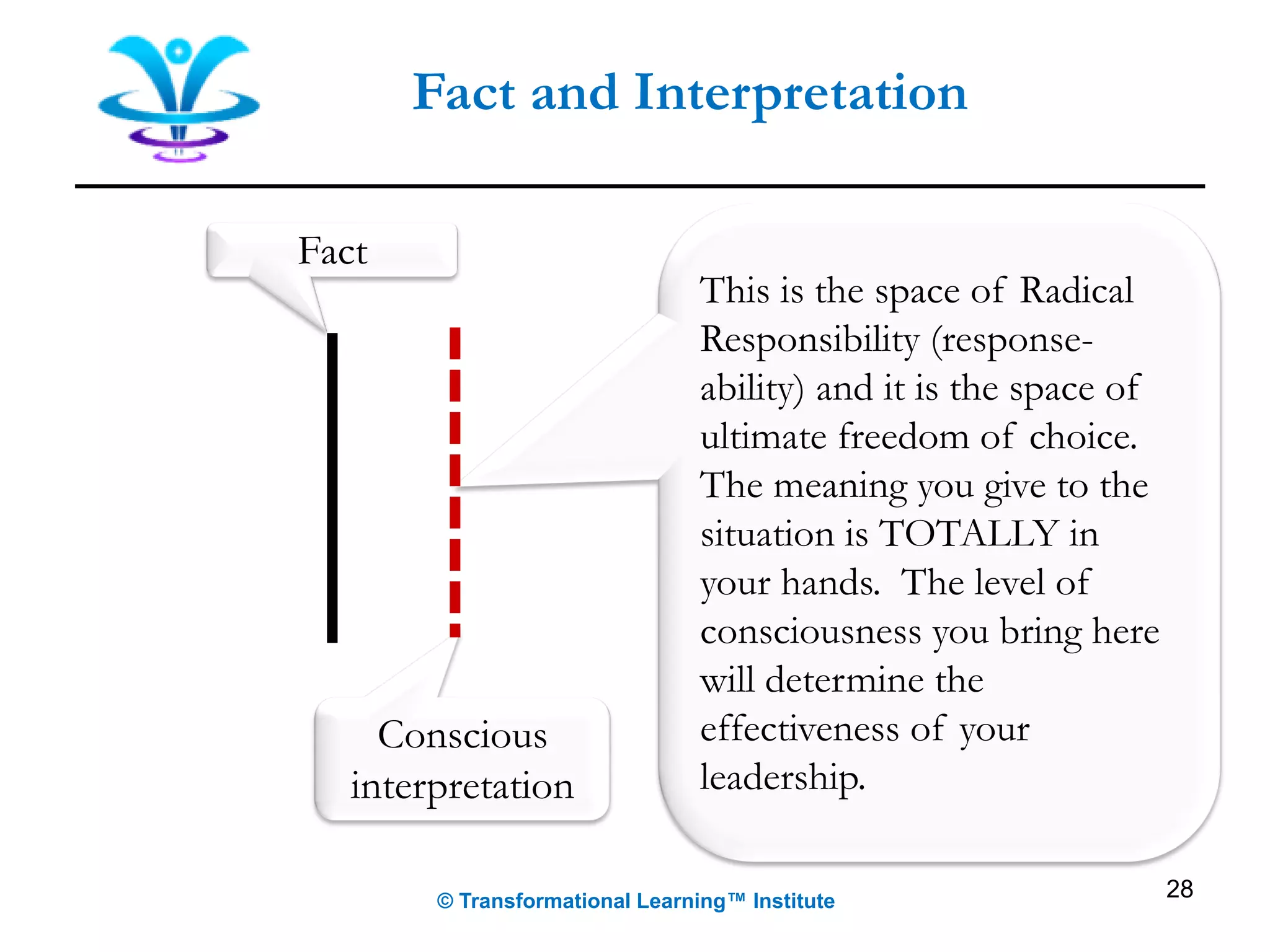
Fact
Conscious
interpretation
This is the space of Radical
Responsibility (response-
ability) and it is the space of
ultimate freedom of choice.
The meaning you give to the
situation is TOTALLY in
your hands. The level of
consciousness you bring here
will determine the
effectiveness of your
leadership.
Fact and Interpretation
▪ Undistinguished interpretation becomes our
truth/reality which we identify with and will defend
when challenged
▪ When interpretation is distinguished as an
interpretation, it can co-exist with other interpretations
which leads to deeper dialogue and possibilities
otherwise not accessible
The nature of our interpretations is directly linked to the
stage of development/consciousness we operate from
29
© Transformational Learning™ Institute
30
What is a Mental Model?
© Transformational Learning™ Institute
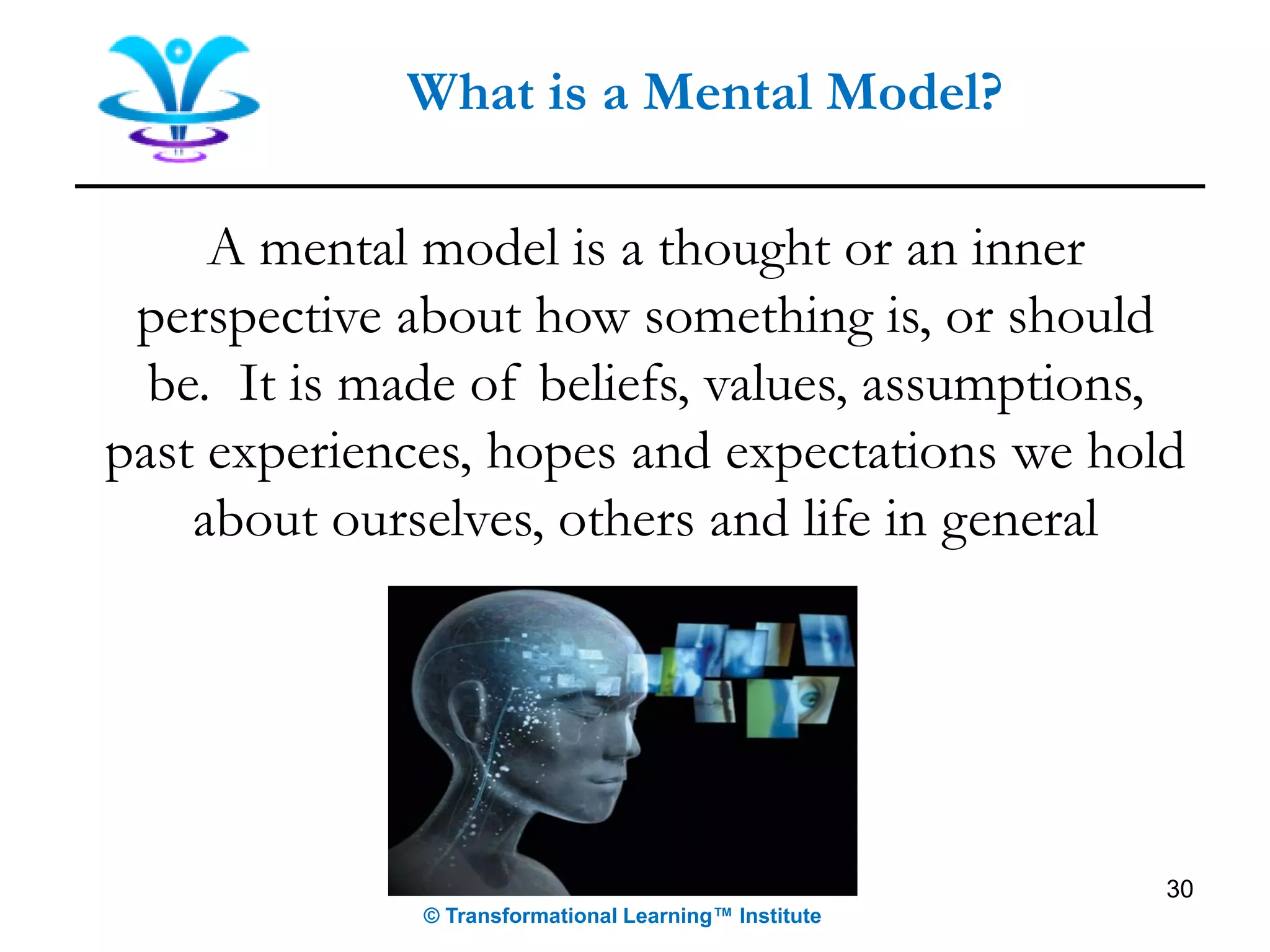
A mental model is a thought or an inner
perspective about how something is, or should
be. It is made of beliefs, values, assumptions,
past experiences, hopes and expectations we hold
about ourselves, others and life in general
31
What is the Role of Mental Models?
© Transformational Learning™ Institute
To give MEANING to the world
we interact with
1. Interpret and give meaning to what is observed,
circumstances, events, relationships and people
2. Disguise our interpretations as reality by providing
explanations and justifications
3. Determine what’s possible in relation with an
interpretation and excludes all other possibilities as
impossible, unreasonable, etc.
4. Dictate attitudes, behaviours, and actions in
correlation with the interpretation
32
The Four Functions of a Mental Model
© Transformational Learning™ Institute
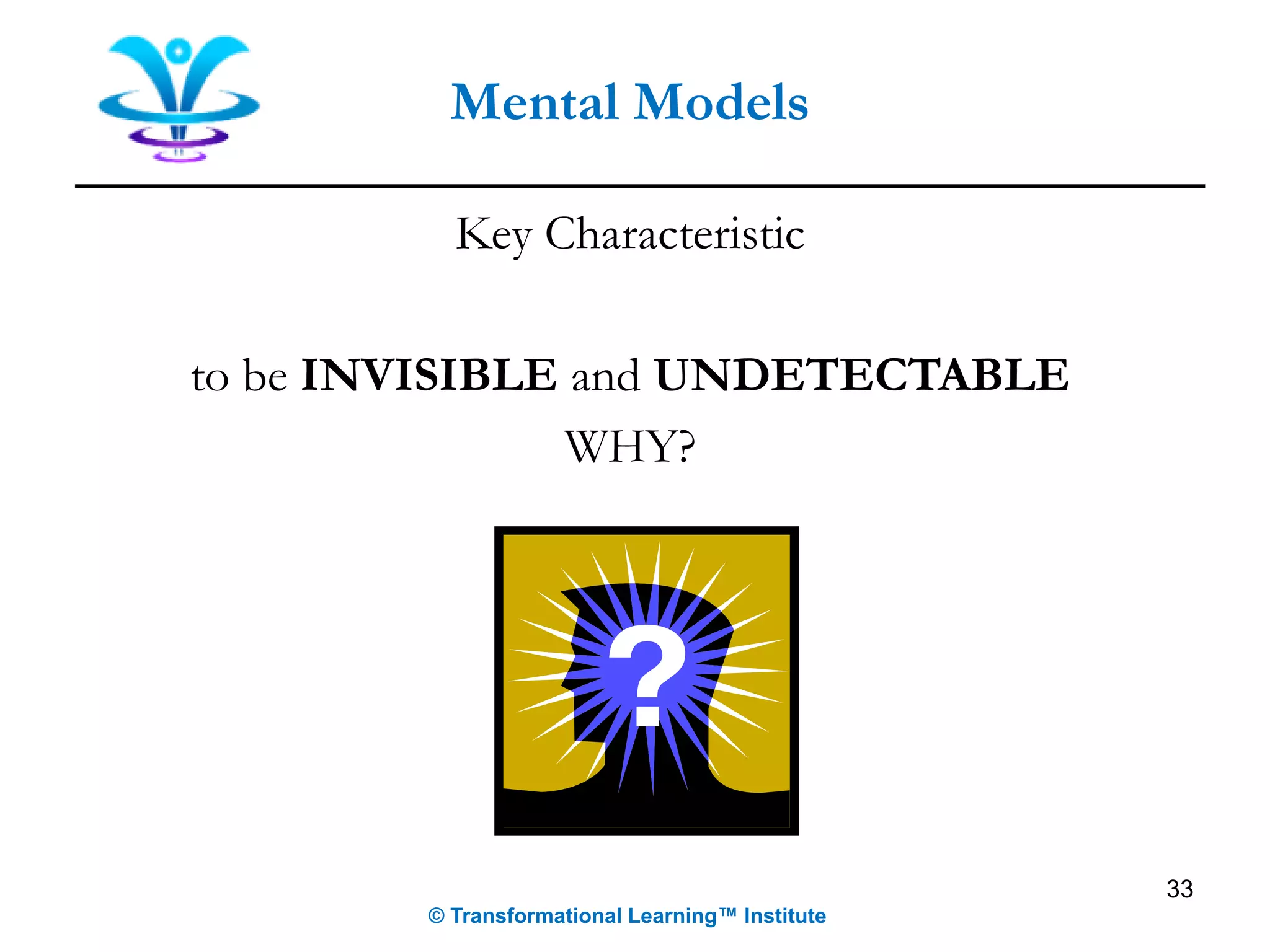
Key Characteristic
to be INVISIBLE and UNDETECTABLE
WHY?
33
Mental Models
© Transformational Learning™ Institute
To grow up means that we are able to look at what we
could only look through before.
“If one is not to be forever captive of one’s own
theory, system, script, (mental model), framework or
ideology, one needs to develop an even more complex
way of knowing that permits one to look at, rather than
choicelessly through, one’s framework.”
Robert Kegan, Lisa Laskow Lahey: Immunity to Change
Growing up means distinguishing and
transcending our current mental models
© Transformational Learning™ Institute
34
“Seeing these hidden map means you have
converted it into an object of awareness, you’ve
made it “un-hidden,” and so it stops governing
your behavior, making room for higher maps that
are more accurate and more adequate.”
“…this is probably the single most important item
that we ever learned about human growth,
development, and evolution.”
Integral Meditation by Ken Wilber
Growing up means distinguishing and
transcending our current mental models
© Transformational Learning™ Institute
35
36
The Power of Mental Models
Aoccdrnig to recheearch at an Elingsh
uinervtisy, it deosn’t mttaer in what oredr the
ltteers in a wrod are, olny that the frst and lsat
ltteres are at the rghit pcleas. The rset can be a
toatl mses and you can sitll raed it wouthit a
porbelm. This is bcuseae we do not raed ervey
lteter, but the wrod as a wlohe.
© Transformational Learning™ Institute
▪ Mental models are invisible and undetectable because they hide in
the objective world they give birth to
▪ What we think and believe – which is our personal subjective
interpretation – is unconsciously projected onto the objective world
around us which makes it appear exactly as what we think and
believe. What we see is exactly the copy of what we think
▪ By being unaware of that unconscious projection we therefore
confuse what we project – our subjective mental model - with the
objective world. This is how our mental models hide or disappear in
the world they create. We do not detect (see) our mental models
because we are convinced that what we see exist independently of
our ways of perceiving
Why and How Mental Models Are Invisible
© Transformational Learning™ Institute
37
“Almost every aspect of our lives is shaped is some way by how
we make sense of the world. Our thinking and our actions are
affected by the mental models we hold. These models define
our limits or open our possibilities. Despite their power and
pervasiveness, these models are usually virtually invisible to us.
We don’t realize they are there at all… They not only shape
what we see and how we understand the world but also how we
act in it. In a real sense, what we think is what we see, and
what we see is what we think.”
Yoram Wind & Colin Crook,
The Power of Impossible Thinking
38
The Power of Mental Models
© Transformational Learning™ Institute
Consequences of Confusing our Mental
Models with the Objective World
▪ The first and most important consequence is that we are not grounded
in the objective world
▪ Leadership starts with good decision-making. Good decision-making
starts with confronting your mental models with objective reality. As
Jim Collins said in his book Good to Great, “You absolutely cannot
make a series of good decisions without first confronting the brutal
facts.” “Leadership begins with getting people to confront the brutal
facts and to act on the implications”
▪ If you do not get the facts and you act on your mental models you are
at risk of making wrong interpretations which lead to making wrong
decisions therefore leading you to take wrong actions
© Transformational Learning™ Institute 39
▪ The objective world in which we live is filtered through our
subjective interpretation (thoughts, beliefs, mental models)
▪ Most of our mental models are rooted in earlier stages of
development, therefore are under-developed and unconscious
▪ Most often we do not think, we simply reactivate and “download”
the past into the present
▪ Consciousness of our mental models = self-awareness
▪ Becoming aware and transforming our mental models is the path to
personal transformation leading to deeper and wider perspectives
▪ Most of our emotional discomforts or reactions are pointing to
mental models that are unhappy with the present moment.
Therefore, if we explore these discomforts, we will most likely find
reactive patterns and limiting mental models that need to grow and
evolve
40
Mental Models – Key Points
© Transformational Learning™ Institute
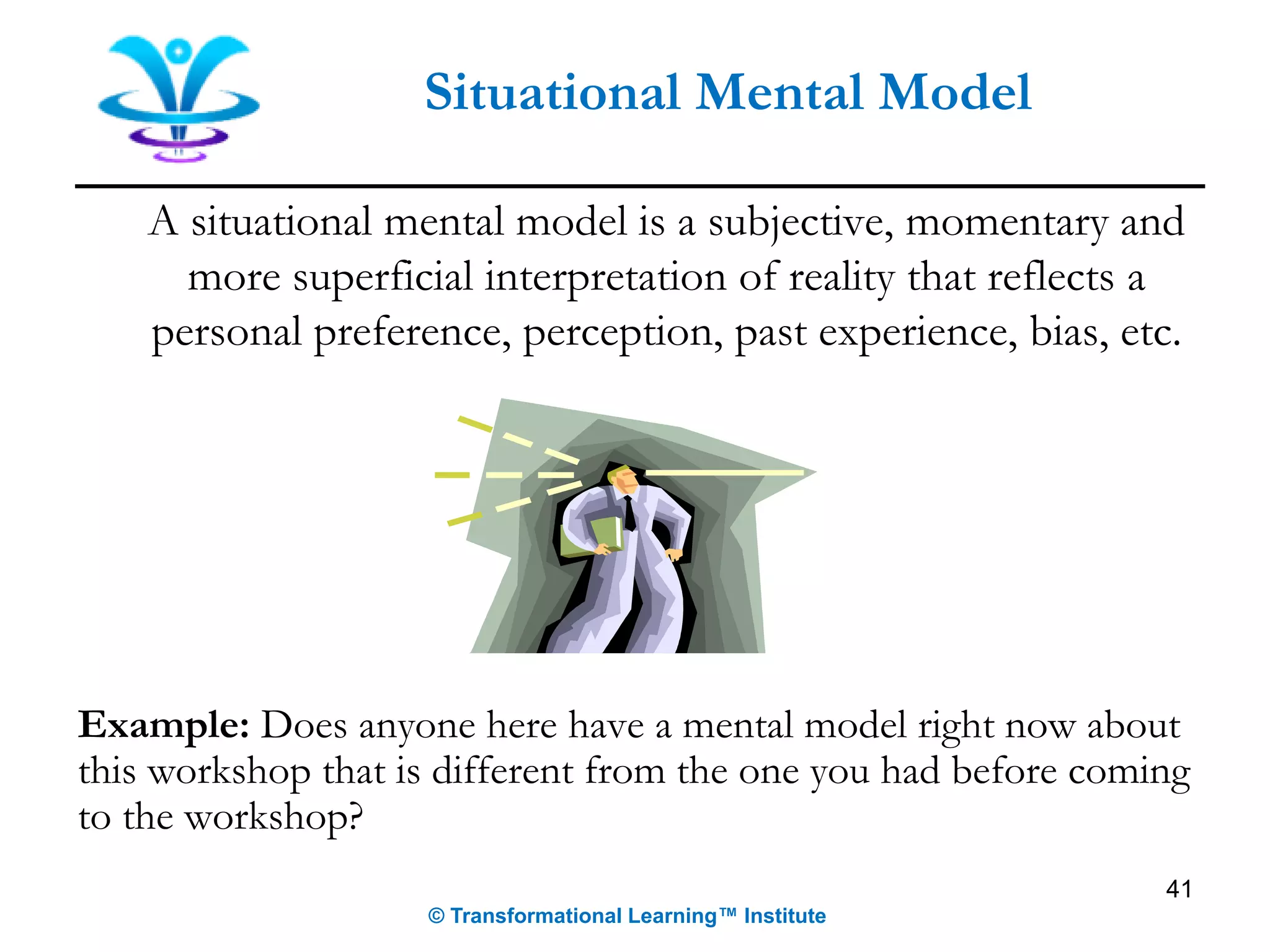
A situational mental model is a subjective, momentary and
more superficial interpretation of reality that reflects a
personal preference, perception, past experience, bias, etc.
Example: Does anyone here have a mental model right now about
this workshop that is different from the one you had before coming
to the workshop?
41
Situational Mental Model
© Transformational Learning™ Institute
From the same facts of the previous role play, create a
totally new interpretation that could very well explain
what you observed
42
Situational Mental Model
Exercise
© Transformational Learning™ Institute
Step I: Think back to the situation you chose for the
homework
1. Write the mental models you have about this person (blame, label,
judgement…)
2. What are the emotions you experience in this situation?
3. What are the strengths and qualities of this person?
Discovering and Transforming
Mental Models - Exercise
© Transformational Learning™ Institute
43
Step II: Shifting the way you think
1. See the situation through their eyes… What new mental models could
you use to describe their intention?
2. From these new mental models and their perspective what new
emotions and sensations are you experiencing?
3. From this new perspective, what opening do you see for shifting your
relationship with this person? What might you do differently?
Discovering and Transforming
Mental Models - Exercise
© Transformational Learning™ Institute
44
Anderson, Robert & Adams, Willian. Mastering Leadership, 2015
Gafni, Marc. Your Unique Self, Integral Publishers, 2012
Goleman, Daniel. Emotional Intelligence, Bantam, 1995
Joiner, Bill & Josephs, Stephen. Leadership Agility, Jossey-Bass, 2007
Kegan, Robert. Immunity to Change, Harvard University Press, 2009
Scharmer, Otto. Theory U: Leading from the Future as it Emerges, Presencing Institute, 2009
Senge, Peter. The Fifth Discipline, Doubleday, 1990
Thompson, Michael. The Congruent Life: Following the Inward Path to Fulfilling Work and Inspired
Leadership, 2000
Torbert, William. Action Inquiry , Berrett-Koehler Publishers Inc., 2004
Wilber, Ken. Integral Psychology, Shambala, 2000
Yoram Wind & Colin Crook. The Power of Impossible Thinking, Wharton School Publishing, 2006
45
Conscious/Transformational Leadership
References - Books
© Transformational Learning™ Institute
Rooke, David & Torbert, William. Seven Transformations of Leadership, HBR, 2005
Scharmer, Otto. Theory U: Leading from the Future as it Emerges, Presencing
Institute, 2009
Senge, Peter. The Fifth Discipline, Doubleday, 1990
Thompson, Michael. The Congruent Life: Following the Inward Path to Fulfilling Work
and Inspired Leadership, 2000
Torbert, William. Action Inquiry, Berrett-Koehler Publishers Inc., 2004
Wilber, Ken. Integral Psychology, Shambhala, 2000
Yoram Wind & Colin Crook. The Power of Impossible Thinking, Wharton School
Publishing, 2006
46
Conscious/Transformational Leadership
References - Articles
© Transformational Learning™ Institute
47
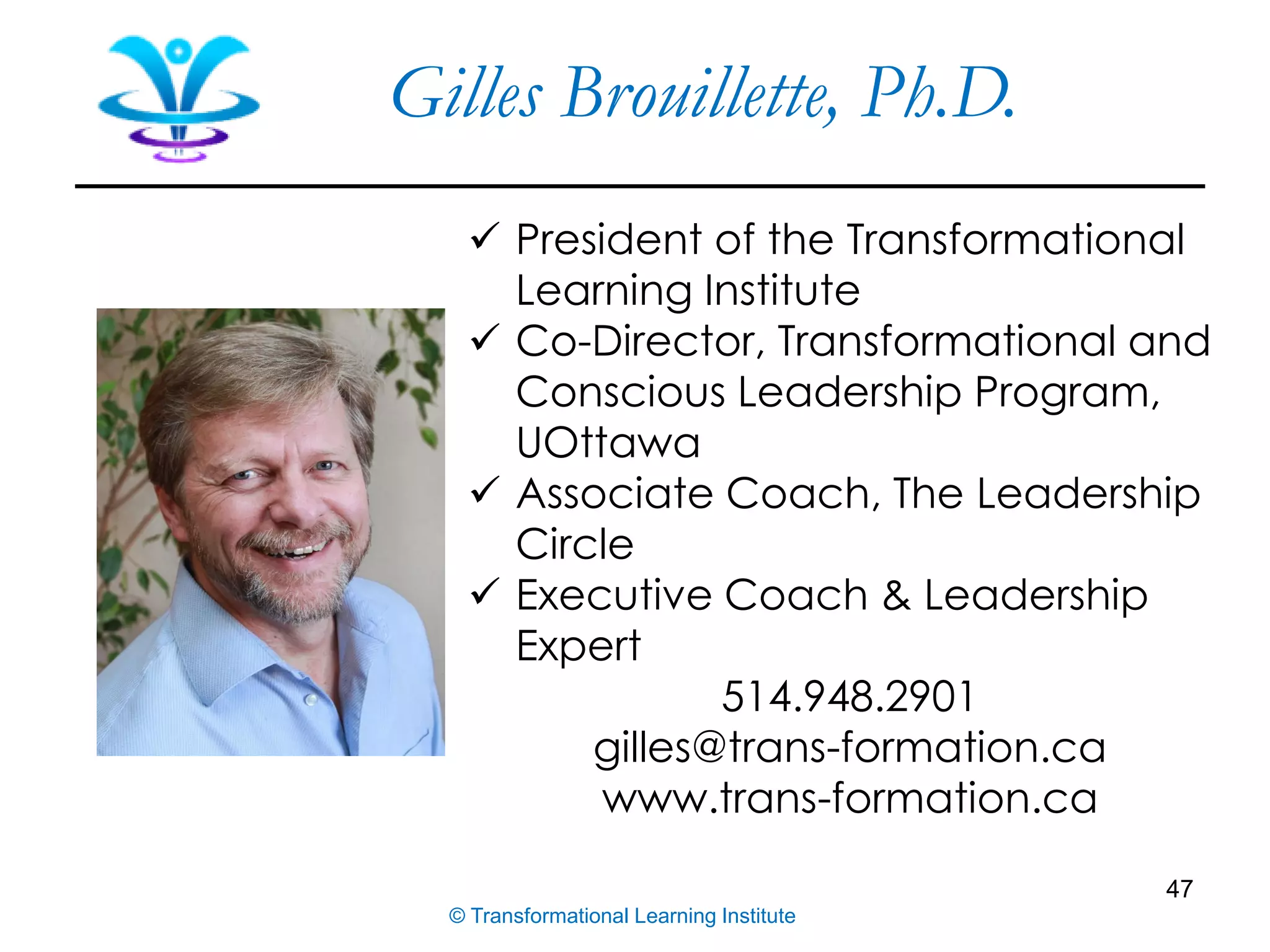
✓ President of the Transformational
Learning Institute
✓ Co-Director, Transformational and
Conscious Leadership Program,
UOttawa
✓ Associate Coach, The Leadership
Circle
✓ Executive Coach & Leadership
Expert
514.948.2901
gilles@trans-formation.ca
www.trans-formation.ca
© Transformational Learning Institute
Gilles Brouillette, Ph.D.

Introduction to Conscious Leadership

  • 1.
  • 2.
    2 Workshop Details © TransformationalLearning™ Institute ▪ Introductions ▪ Schedule ▪ Health and lunch breaks ▪ Electronic devices policy ▪ Materials ▪ Your learning journal
  • 3.
    3 Objectifs © Transformational LearningInstitute ▪ Explore leadership from a developmental and transformational framework ▪ Understand that we are evolutionary beings and that we need to “grow up and wake up” to achieve higher levels of leadership effectiveness ▪ Experience a transformational framework including a step-by-step methodology that will guide you in becoming a more conscious leader ▪ Explore the three main reactive leadership patterns and how they impede personal power and leadership effectiveness ▪ Explore and align with the five most powerful competencies of conscious and creative leaders ▪ Design and engage in developmental practices to sustain your growth beyond the workshop
  • 4.
    Introduction and setting thecontext Understanding the developmental & transformational perspective Learning how to transform ourselves – shifting how we think, feel and act Exploring and transforming reactive styles that impede our leadership Exploring creative and collaborative styles that enhance our leadership effectiveness Transformational Leadership Journey
  • 5.
    5 Transformational Learning Methodology © TransformationalLearning™ Institute Transformational learning is: both reflective and experiential – it requires patience: ✓We will slow things down ✓Look “behind the scene” of your own thinking ✓Focus on “how to be” rather than “what to do”
  • 6.
    6 Learning Contract & BeingPresent © Transformational Learning™ Institute ✓ Learning Contract ✓ Exercise on Being Present
  • 7.
    7 Definition of Leadership ©Transformational Learning™ Institute “Leadership is the capacity to individually and collectively shape our own future by providing direction and alignment, fostering collaboration and teamwork, and driving execution.”
  • 8.
    8 Developmental Stages ofLeadership © Transformational Learning™ Institute Stages of emotional and cognitive maturity Each stage allows the emergence of new leadership capacity Each stage is composed of a specific set of beliefs and mental models – conscious and unconscious
  • 9.
    Developmental Spectrum Source: BillJoiner and Stephen Josephs and Otto Scharmer Expert 45% Achiever 35% Co-Creator 4% Synergist 1% Catalyst 5% Ego-System Awareness Eco-System Awareness Developmental ceiling Pre-Expert 10% Transforming Training © Transformational Learning™ Institute
  • 10.
    10 Developmental Spectrum Expert (45%) Fromthe works of Bill Joiner and Stephen Josephs and Otto Scharmer © Transformational Learning™ Institute Strengths  Rely on authority and expertise  Focus is more tactical  Strong problem-solving orientation  Strongly motivated to develop technical and/or functional expertise  Tend to fulfill their responsibilities and duties  Value efficiency – good with details  Excellent to run routine affairs  Play a vital role in the development of products, techniques and services Limitations  Judgmental toward others  Criticize and blame others  Tend to be self-centered and preoccupied by own needs  Limited capacity for self-reflection and introspection  See feedback as criticism  Strive to be right, look good and hide shortcomings  Can get stuck in details and not consider the big picture  Can have difficulty delegating and trusting others  Lack awareness of impact on others
  • 11.
    11 Developmental Spectrum Achiever (35%) Fromthe works of Bill Joiner and Stephen Josephs and Otto Scharmer © Transformational Learning™ Institute Limitations  Blind to own and others’ limitations  Can be impatient to slow down and reflect  Does a lot of thinking FOR others versus WITH others  Can forget to pay attention to details  Can have fear of being dependent and losing control  Can have a lack of balance between life and work  Can be too caught in relying on rationality, objectivity, predictability, science and methods Strengths  Focus on reaching larger outcomes  Focus on strategic action  Work to gain buy-in from key stakeholders  Excel at cross-functional problem- solving  Have a genuine interest in others  Open to learning and self- discovery - are capable of deeper self-reflection and inquiry  Are responsible and accountable  Feel responsible for motivating team members and insuring individual performance
  • 12.
    12 From Ego to Eco-SystemAwareness ✓ Greater ability to step back and take a larger perspective ✓ Shift focus from “me” to “we” ✓ From a group to a team ✓ Respond versus react ✓ Interested in growing leaders versus developing followers ✓ Move from “I know” to recognizing how much I do not know ✓ Tend to be more conscious/reflective than unconscious/automatic ✓ Engage other in deeper dialogue versus caught into debate ✓ More open to introspection and engage in transformational work © Transformational Learning™ Institute
  • 13.
    13 Developmental Spectrum Catalyst (5%) Fromthe works of Bill Joiner and Stephen Josephs and Otto Scharmer © Transformational Learning™ Institute Strengths  Focus on visionary leadership  Engage diverse stakeholders in collaborative dialogue (inclusion)  Facilitate creative problem solving  Empowering and coach others  Value and harness individual and collective differences  Anticipate and initiate change  Greater emotional intelligence  Capable of systems thinking  More creative and capable of thinking outside of the box  Access to multiple perspectives  Can see one’s own reactive patterns in the moment Limitations  May be slower at making decisions – tend to consider all options  Can be perceived as inconsistent and ambivalent  May be irritated by the achiever’s main rational mode or drive for results  Tend to provide less certainty and a less firm leadership style
  • 14.
    14 Developmental Spectrum Co-Creator (4%) Fromthe works of Bill Joiner and Stephen Josephs and Otto Scharmer © Transformational Learning™ Institute Strengths  Oriented toward shared purpose and collaboration  Believes leadership is ultimately a service to others  Tend to collaborate with others to develop a shared vision that each experiences as deeply purposeful  Value reflective action  Value authentic self-expression i.e. being real vs looking good  Create contexts that support mutual accountability and synergistic effects  Capable of generating transformational changes Limitations  Can be overly forceful with their own convictions  May be impatient with other’s slower development
  • 15.
    15 Developmental Spectrum Synergist (1%) Fromthe works of Bill Joiner and Stephen Josephs and Otto Scharmer © Transformational Learning™ Institute Strengths  Value deep meaning and purpose  Great concern about human issues on a global scale  Cultivate the here-and-now awareness that has a fresh and immediate quality  They are highly transparent  They have transformative ability to draw together opposites and initiate new directions  Look for developing themselves and others  They are highly intuitive Limitations  May feel isolated  Can come across as superior  Can be seen as abstract, unrealistic or even “off the wall”  Sometimes they may express a sense of envy at the simplicity of the earlier periods
  • 16.
    16 Stages of LeadershipDevelopment “Research continues to indicate that, although stages cannot be skipped or bypassed, they can be accelerated – and on of the first and most basic ways to do this is to simply learn any general overview or summary of the stages...” “Research shows that somebody who does nothing more than learn the rudimentary basics of any good developmental map or model, for example, will develop through the basic 6-to-8 levels in a more rapid and accelerated fashion – these developmental maps are psychoactive…” Ken Wilber, Integral Meditation © Transformational Learning™ Institute
  • 17.
    17 Stages of Leadership Development- Exercise Goal: Explore the 3 most common stages of leadership observed in organizations: Expert, Achiever and Catalyst Work: Divide into 3 groups. Discuss and answer the following questions with your assigned group: 1. What does a leader/team player who operates from this stage of development look like in action – both strengths and limitations? 2. What is the impact of these attitudes and behaviours on other team members and team productivity? Prepare to share your reflection with the group © Transformational Learning™ Institute
  • 18.
    18 Stages of LeadershipDevelopment – Exploring Your Centre of Gravity 1. Among the 3 stages of development what is your main centre of gravity? 2. What are your own strengths and limitations? A. Strengths: B. Limitations © Transformational Learning™ Institute
  • 19.
    19 Stages of LeadershipDevelopment – Exploring Your Centre of Gravity In the context of the current projects you are involved with or for which you are accountable... 3. How are these strengths and limitations impacting your way of leading? What could I do more of? What should I do less of? 4. What behaviors and attitudes should you focus on to develop your capacity to lead more from an eco-system awareness/catalyst perspective? © Transformational Learning™ Institute
  • 20.
    20 Conscious and Transformational Leadership ©Transformational Learning™ Institute “The essence of leadership is to shift the inner place from which we operate both individually and collectively.” Otto Scharmer – Theory U
  • 21.
    21 © Transformational Learning™Institute How do we develop more conscious and transformational leaders?
  • 22.
    22 Transformation of Consciousness “…researchstrongly suggests that developing leaders for the future has as much to do with consciousness as competence. …the main thing that is developing when leadership becomes extraordinary, is the internal operating system of the leader. It is not merely the development of skill, but the consciousness required to skillfully deploy one’s leadership in ways that are well matched to the complexity of the organizational challenges. In short, great leadership requires higher order consciousness.” Bob Anderson, Founder of The Leadership Circle © Transformational Learning™ Institute
  • 23.
    Stages of Consciousnessand Leadership Development Synergist 1% Co-Creator 4% Catalyst 5% Achiever 35% Expert 45% Pre-Expert 10% Stages of Leadership Development Source: Bill Joiner and Stephen Josephs Stages of Consciousness Development Source: The Leadership Circle Developmental Ceiling Eco- System Awareness (10%) Ego-System Awareness (90%) © Transformational Learning™ Institute
  • 24.
    Observe the roleplay and describe what you see. 24 What do you see? Exercise © Transformational Learning™ Institute
  • 25.
    ▪ Fact andInterpretation are 2 distinct and separate domains of Reality ▪ Fact is something that has actually happened or that is empirically true and can be supported by evidence ▪ Interpretation is what we say about the facts after they occur 25 Fact and Interpretation © Transformational Learning™ Institute
  • 26.
    Fact and Interpretation Thereare 2 fundamental dimensions of reality: facts (objective) and interpretation (subjective) ▪ Most of the time we live in the world of interpretation ▪ Most of the time we are unaware of it ▪ Most of the time we treat our interpretation as fact, which leads to confusion or misunderstanding and often leads to inappropriate action What could be the consequences of confusing fact and interpretation, at work and in your personal life? 26 © Transformational Learning™ Institute
  • 27.
    Fact and Interpretation 27 ©Transformational Learning™ Institute Fact Unconscious interpretation or “downloading”. Thinking is automatic, compulsive, and repetitive Fact Conscious interpretation ✓ Awareness ✓ Reflection ✓ Consciousness ✓ Thinking ✓ Stepping back ✓ Breathing back ✓ This is the space of awakening – the space of creation and transformation
  • 28.
    Fact and Interpretation 28©Transformational Learning™ Institute Fact Conscious interpretation This is the space of Radical Responsibility (response- ability) and it is the space of ultimate freedom of choice. The meaning you give to the situation is TOTALLY in your hands. The level of consciousness you bring here will determine the effectiveness of your leadership.
  • 29.
    Fact and Interpretation ▪Undistinguished interpretation becomes our truth/reality which we identify with and will defend when challenged ▪ When interpretation is distinguished as an interpretation, it can co-exist with other interpretations which leads to deeper dialogue and possibilities otherwise not accessible The nature of our interpretations is directly linked to the stage of development/consciousness we operate from 29 © Transformational Learning™ Institute
  • 30.
    30 What is aMental Model? © Transformational Learning™ Institute A mental model is a thought or an inner perspective about how something is, or should be. It is made of beliefs, values, assumptions, past experiences, hopes and expectations we hold about ourselves, others and life in general
  • 31.
    31 What is theRole of Mental Models? © Transformational Learning™ Institute To give MEANING to the world we interact with
  • 32.
    1. Interpret andgive meaning to what is observed, circumstances, events, relationships and people 2. Disguise our interpretations as reality by providing explanations and justifications 3. Determine what’s possible in relation with an interpretation and excludes all other possibilities as impossible, unreasonable, etc. 4. Dictate attitudes, behaviours, and actions in correlation with the interpretation 32 The Four Functions of a Mental Model © Transformational Learning™ Institute
  • 33.
    Key Characteristic to beINVISIBLE and UNDETECTABLE WHY? 33 Mental Models © Transformational Learning™ Institute
  • 34.
    To grow upmeans that we are able to look at what we could only look through before. “If one is not to be forever captive of one’s own theory, system, script, (mental model), framework or ideology, one needs to develop an even more complex way of knowing that permits one to look at, rather than choicelessly through, one’s framework.” Robert Kegan, Lisa Laskow Lahey: Immunity to Change Growing up means distinguishing and transcending our current mental models © Transformational Learning™ Institute 34
  • 35.
    “Seeing these hiddenmap means you have converted it into an object of awareness, you’ve made it “un-hidden,” and so it stops governing your behavior, making room for higher maps that are more accurate and more adequate.” “…this is probably the single most important item that we ever learned about human growth, development, and evolution.” Integral Meditation by Ken Wilber Growing up means distinguishing and transcending our current mental models © Transformational Learning™ Institute 35
  • 36.
    36 The Power ofMental Models Aoccdrnig to recheearch at an Elingsh uinervtisy, it deosn’t mttaer in what oredr the ltteers in a wrod are, olny that the frst and lsat ltteres are at the rghit pcleas. The rset can be a toatl mses and you can sitll raed it wouthit a porbelm. This is bcuseae we do not raed ervey lteter, but the wrod as a wlohe. © Transformational Learning™ Institute
  • 37.
    ▪ Mental modelsare invisible and undetectable because they hide in the objective world they give birth to ▪ What we think and believe – which is our personal subjective interpretation – is unconsciously projected onto the objective world around us which makes it appear exactly as what we think and believe. What we see is exactly the copy of what we think ▪ By being unaware of that unconscious projection we therefore confuse what we project – our subjective mental model - with the objective world. This is how our mental models hide or disappear in the world they create. We do not detect (see) our mental models because we are convinced that what we see exist independently of our ways of perceiving Why and How Mental Models Are Invisible © Transformational Learning™ Institute 37
  • 38.
    “Almost every aspectof our lives is shaped is some way by how we make sense of the world. Our thinking and our actions are affected by the mental models we hold. These models define our limits or open our possibilities. Despite their power and pervasiveness, these models are usually virtually invisible to us. We don’t realize they are there at all… They not only shape what we see and how we understand the world but also how we act in it. In a real sense, what we think is what we see, and what we see is what we think.” Yoram Wind & Colin Crook, The Power of Impossible Thinking 38 The Power of Mental Models © Transformational Learning™ Institute
  • 39.
    Consequences of Confusingour Mental Models with the Objective World ▪ The first and most important consequence is that we are not grounded in the objective world ▪ Leadership starts with good decision-making. Good decision-making starts with confronting your mental models with objective reality. As Jim Collins said in his book Good to Great, “You absolutely cannot make a series of good decisions without first confronting the brutal facts.” “Leadership begins with getting people to confront the brutal facts and to act on the implications” ▪ If you do not get the facts and you act on your mental models you are at risk of making wrong interpretations which lead to making wrong decisions therefore leading you to take wrong actions © Transformational Learning™ Institute 39
  • 40.
    ▪ The objectiveworld in which we live is filtered through our subjective interpretation (thoughts, beliefs, mental models) ▪ Most of our mental models are rooted in earlier stages of development, therefore are under-developed and unconscious ▪ Most often we do not think, we simply reactivate and “download” the past into the present ▪ Consciousness of our mental models = self-awareness ▪ Becoming aware and transforming our mental models is the path to personal transformation leading to deeper and wider perspectives ▪ Most of our emotional discomforts or reactions are pointing to mental models that are unhappy with the present moment. Therefore, if we explore these discomforts, we will most likely find reactive patterns and limiting mental models that need to grow and evolve 40 Mental Models – Key Points © Transformational Learning™ Institute
  • 41.
    A situational mentalmodel is a subjective, momentary and more superficial interpretation of reality that reflects a personal preference, perception, past experience, bias, etc. Example: Does anyone here have a mental model right now about this workshop that is different from the one you had before coming to the workshop? 41 Situational Mental Model © Transformational Learning™ Institute
  • 42.
    From the samefacts of the previous role play, create a totally new interpretation that could very well explain what you observed 42 Situational Mental Model Exercise © Transformational Learning™ Institute
  • 43.
    Step I: Thinkback to the situation you chose for the homework 1. Write the mental models you have about this person (blame, label, judgement…) 2. What are the emotions you experience in this situation? 3. What are the strengths and qualities of this person? Discovering and Transforming Mental Models - Exercise © Transformational Learning™ Institute 43
  • 44.
    Step II: Shiftingthe way you think 1. See the situation through their eyes… What new mental models could you use to describe their intention? 2. From these new mental models and their perspective what new emotions and sensations are you experiencing? 3. From this new perspective, what opening do you see for shifting your relationship with this person? What might you do differently? Discovering and Transforming Mental Models - Exercise © Transformational Learning™ Institute 44
  • 45.
    Anderson, Robert &Adams, Willian. Mastering Leadership, 2015 Gafni, Marc. Your Unique Self, Integral Publishers, 2012 Goleman, Daniel. Emotional Intelligence, Bantam, 1995 Joiner, Bill & Josephs, Stephen. Leadership Agility, Jossey-Bass, 2007 Kegan, Robert. Immunity to Change, Harvard University Press, 2009 Scharmer, Otto. Theory U: Leading from the Future as it Emerges, Presencing Institute, 2009 Senge, Peter. The Fifth Discipline, Doubleday, 1990 Thompson, Michael. The Congruent Life: Following the Inward Path to Fulfilling Work and Inspired Leadership, 2000 Torbert, William. Action Inquiry , Berrett-Koehler Publishers Inc., 2004 Wilber, Ken. Integral Psychology, Shambala, 2000 Yoram Wind & Colin Crook. The Power of Impossible Thinking, Wharton School Publishing, 2006 45 Conscious/Transformational Leadership References - Books © Transformational Learning™ Institute
  • 46.
    Rooke, David &Torbert, William. Seven Transformations of Leadership, HBR, 2005 Scharmer, Otto. Theory U: Leading from the Future as it Emerges, Presencing Institute, 2009 Senge, Peter. The Fifth Discipline, Doubleday, 1990 Thompson, Michael. The Congruent Life: Following the Inward Path to Fulfilling Work and Inspired Leadership, 2000 Torbert, William. Action Inquiry, Berrett-Koehler Publishers Inc., 2004 Wilber, Ken. Integral Psychology, Shambhala, 2000 Yoram Wind & Colin Crook. The Power of Impossible Thinking, Wharton School Publishing, 2006 46 Conscious/Transformational Leadership References - Articles © Transformational Learning™ Institute
  • 47.
    47 ✓ President ofthe Transformational Learning Institute ✓ Co-Director, Transformational and Conscious Leadership Program, UOttawa ✓ Associate Coach, The Leadership Circle ✓ Executive Coach & Leadership Expert 514.948.2901 gilles@trans-formation.ca www.trans-formation.ca © Transformational Learning Institute Gilles Brouillette, Ph.D.