


















Micro
satellite
instability
D E P A R T M E N T O F S U R G I C A L
O N C O L O G Y
C E N T R E F O R O N C O L O G Y
G R H , R O Y A P E T T A H
PROF.S.SUBBIAH et al.
Journal
Bio- Medical Central journal – UK based non profit open access publisher
Impact Factor is 7.86
Kai Li, Haiqing Luo, Lianfang Huang , Hui Luo2 and Xiao Zhu
Guangdong Medical University, Zhanjiang 524023, China
PROF.S.SUBBIAH et al.
Introduction
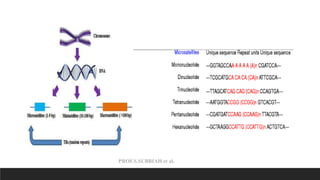
• Microsatellite (MS), also called Short Tandem Repeats (STRs) or Simple Sequence Repeat
(SSRs), consists of repeated sequences of 1–6 nucleotides.
-widely distributed and mostly is located near the coding region.
- Can be located others region like intron or non-coding region
-- Each MS specific site  two parts: the central core and the peripheral flanks,
 the specificity of MS is mainly due to the change in the number of
core repeating units
PROF.S.SUBBIAH et al.
Definition : Change in cells where number of inherited repeated bases of micro
satellite are different
Mechanism: i) to be DNA slippage in the process of replication
ii) Defective DNA match in replication
Mismatch repair (MMR) can correct in the process of DNA replication.
MSI is an important factor in the occurrence and development of tumours
PROF.S.SUBBIAH et al.
High microsatellite instability (MSI-H), low microsatellite instability (MSI-L) and microsatellite
stability (MSS).
Presently MSI (L) and MSS are classified as single entity
Colorectal cancer – Microsatellite instability mechanisms sporadic and Lynch syndrome
MSI H tumours respond well to immunotherapy
PROF.S.SUBBIAH et al.
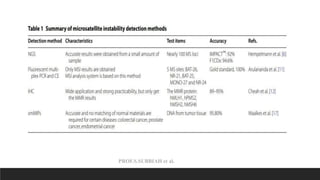
Fluorescent PCR and Capillary
electrophoresis.
- Polymerase Chain Reaction (PCR) is to compare the microsatellite loci detected in tumor
tissues
with normal DNA,
- Two single nucleotide repeat loci BAT25 and BAT-26 and three multi-nucleotide repeat loci
D2S123, D5S346 and D17S250 as microsatellite markers to determine the status of MSI.
-. Fluorescence multiplex PCR and CE is used to detect genes after amplification after
fluorescence labeled PCR amplification.
- The gold standard for MSI detection.
PROF.S.SUBBIAH et al.
Immunohistochemistry:
- Detection of MMR gene deletion can indirectly reflect the status of MSI.
- Detects the expression of MMR protein which consists of hMLH1, hPMS2, hMSH2 and
hMSH6.
- MMR deficient and MMR proficient.
- molecular analysis to IHC and MSI analysis can reduce the incompatibility of results .
PROF.S.SUBBIAH et al.
- Single molecule inversion probes:
- MANTIS
MSI score after calculating the allele distribution difference value of each microsatellite site
by comparing tumor and normal samples.
quantitative analysis
PROF.S.SUBBIAH et al.
Mechanism of MMR:
Slipped Strand Mispairing : in the process of DNA replication and synthesis, the allele
region of MS repeat sequence between new chain and template chain may be mismatched.
This results in the instantaneous separation of new chain and template chain or the
formation of stable single chain structure by several repeat units.
When slip mutation occurs, MS with small number of repeat units expands more frequently,
MMR deficient:
PROF.S.SUBBIAH et al.
- the germline mutations of MMR gene, POLE (polymerase E)/POLD1 (human DNA
polymerase δ) are more common.
- The loss of miRNA (microRNA) mediated regulation.
- A class of noncoding RNA molecules can trigger human immune response and accelerate
the development of cancer.
- MSI-H cases occur some tumor specific loci.
- The occurrence of frameshift MSI in TGFBR2 is more common in Colon adenocarcinoma
and Stomach adenocarcinoma.
- MSI occurs mostly in ion-binding genes in gastric adenocarcinoma
PROF.S.SUBBIAH et al.
Treatment options in MSI tumours:
- MSI-H treatment, such as PD-L1 (programed cell death ligand 1) immunosuppressant, can
produce heteroantigens that are easy to be recognized by T cells.
- RecQDNA helicase WRN (Werner syndrome, RecQ helicase-like) is an essential factor for
the MSI model  Silencing WRN can induce DNA double-strand breakage
PROF.S.SUBBIAH et al.
Clinical Applications:
- dMMR is common in patients with Lynch syndrome (LS), so patients with MSI-H or dMMR
tumors can predict Lynch syndrome through MSI related tests.
- NCCN panel includes MMR genes (hMLH1, hMSH2, hMSH6, hPMS2) and EpCAM genes.
- the hMLH1 promoter needs to be tested to determine whether there is methylation.
- when EpCAM immunostaining is negative  indicates hMSH2 mutation.
- combination of IHC and genetic evaluation  ideal
PROF.S.SUBBIAH et al.
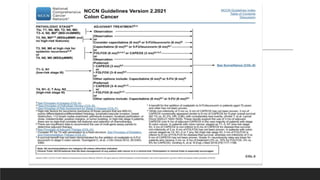
Colorectal Cancers
- Tumours are infltrated with dense cytotoxic T cells.
- NR-21, BAT-26 and BAT-25 markers play an important role in judging MSI status
- Prognosis of MSI-H colorectal cancer was good while the prognosis of MSS and MSI-L
CRC was poor.
- Early stage cancers vs late stage cancers.
PROF.S.SUBBIAH et al.
Gastric Cancers:
Choi et al. suggested that microsatellite instability is also found in gastric cancer.
Using hMLH1 and hMSH2 in IHC and MSI analysis system, patients with MSI related gastric
cancer can be detected.
MSI-H patients with gastric cancer is common in women and most of them occur in non-
cardia area.
Good prognostic factor
PD L1 , CD8 expression
Siewerts type 2 and 3 tumours .
PROF.S.SUBBIAH et al.
Breast
- BRCA1 expression function can affect the silencing mechanism.
- The mutation of BRCA1, which can make the repair function of DNA loss, will cause
microsatellite instability and abnormal cell
-- Poor prognosis
PROSTATE:
-pathogenic embryonic mutants carrying Lynch syndrome-related genes
- targetable mutation  good prognosis
PROF.S.SUBBIAH et al.
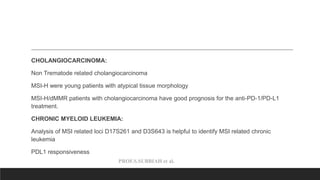
CHOLANGIOCARCINOMA:
Non Trematode related cholangiocarcinoma
MSI-H were young patients with atypical tissue morphology
MSI-H/dMMR patients with cholangiocarcinoma have good prognosis for the anti-PD-1/PD-L1
treatment.
CHRONIC MYELOID LEUKEMIA:
Analysis of MSI related loci D17S261 and D3S643 is helpful to identify MSI related chronic
leukemia
PDL1 responsiveness
PROF.S.SUBBIAH et al.
BLADDER CANCER:
IHC detection of hMLH1, hMSH2 and hMSH6 and MSI analysis can detect MSI associated
bladder cancer.
a low risk of bladder cancer when they get MSI-H Lynch syndrome.
MSI related loci D16S476, D9S171 of MSI-H patients with bladder cancer
MSI of urine sediment can be considered as a clinical assistant diagnosis.
PROF.S.SUBBIAH et al.
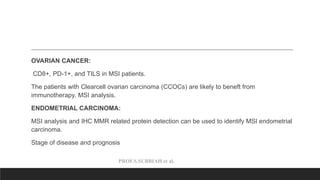
OVARIAN CANCER:
CD8+, PD-1+, and TILS in MSI patients.
The patients with Clearcell ovarian carcinoma (CCOCs) are likely to beneft from
immunotherapy. MSI analysis.
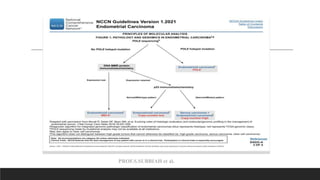
ENDOMETRIAL CARCINOMA:
MSI analysis and IHC MMR related protein detection can be used to identify MSI endometrial
carcinoma.
Stage of disease and prognosis
PROF.S.SUBBIAH et al.
PANCREATIC CANCER:
Poor prognosis
THYROID CANCERS:
Prolonged survival and seen in Follicular Carcinoma Thyroid.
ADRENAL CORTICAL CARCINOMA:
Prognosis is not yet determined
PROF.S.SUBBIAH et al.
Preventive Measures
MSI or MMR testing should be considered for all types of colorectal cancer.
Aspirin/Sulindac may play a preventive role in reducing the risk of Lynch syndrome-related
cancer
HLA-A0201-restricted cytotoxic T cell epitope (FSP11) is expected to become an integral part
of MSI-H tumor vaccine in the future,
PROF.S.SUBBIAH et al.
- 5-FU is not used as adjuvant chemotherapy for patients with MSI-H and dMMR
characteristics for the reason that patients with MSI-H/dMMR have poor results.
- Early vs late stage cancer.
- Benson et al - MMR status of patients with stage III to IV CRC does not affect the outcome
of 5-FU treatment.
MSI-H can be used as one of the predictors of the efficacy of immunotherapy at present.
FDA approved Nivolumab with advanced metastatic colon cancer
PROF.S.SUBBIAH et al.
The FDA approved the combination therapy of Nivolumab and Ipilimumab as the frst
immunosuppressive combination therapy for metastatic CRC with worsened MSI-H/dMMR
after first line treatment.
Check mate 142 trial.
Bevaczimumab in MSI H tumours
PDL1 inhibtors role in gastric cancer – doubtful
Immune check point inhibitors combined with radiotherapy is recommended as a treatment
plan for patients with advanced biliary tumors
PROF.S.SUBBIAH et al.
- Tumors with high mutation rates may respond well to checkpoint inhibitors (CPI and scope
for additional testing.
PROF.S.SUBBIAH et al.
Conclusions and Perspectives:
The development of PCR and IHC promote the development of MSI detection.
The need of large scale studies to expand uses
Early diagnosis of MSI is of great significance to the prognosis and treatment of MSI.
Early use of aspirin in patients with hMSH2 and hMLH1 gene changes is of great signifcance
to reduce the risk of cancer related to Lynch syndrome
Anti tumour vaccines
PROF.S.SUBBIAH et al.
More clinical studies on the relationship between MSI related sites and tumor drug resistance
are needed to improve the therapeutic effect of chemotherapy.
MSI will open up a new field for the diagnosis, prevention and treatment of diseases

Microsatellite instability

  • 1.
    Micro satellite instability D E PA R T M E N T O F S U R G I C A L O N C O L O G Y C E N T R E F O R O N C O L O G Y G R H , R O Y A P E T T A H
  • 2.
  • 3.
    PROF.S.SUBBIAH et al. Journal Bio-Medical Central journal – UK based non profit open access publisher Impact Factor is 7.86 Kai Li, Haiqing Luo, Lianfang Huang , Hui Luo2 and Xiao Zhu Guangdong Medical University, Zhanjiang 524023, China
  • 4.
    PROF.S.SUBBIAH et al. Introduction •Microsatellite (MS), also called Short Tandem Repeats (STRs) or Simple Sequence Repeat (SSRs), consists of repeated sequences of 1–6 nucleotides. -widely distributed and mostly is located near the coding region. - Can be located others region like intron or non-coding region -- Each MS specific site  two parts: the central core and the peripheral flanks,  the specificity of MS is mainly due to the change in the number of core repeating units
  • 5.
  • 6.
    PROF.S.SUBBIAH et al. Definition: Change in cells where number of inherited repeated bases of micro satellite are different Mechanism: i) to be DNA slippage in the process of replication ii) Defective DNA match in replication Mismatch repair (MMR) can correct in the process of DNA replication. MSI is an important factor in the occurrence and development of tumours
  • 7.
    PROF.S.SUBBIAH et al. Highmicrosatellite instability (MSI-H), low microsatellite instability (MSI-L) and microsatellite stability (MSS). Presently MSI (L) and MSS are classified as single entity Colorectal cancer – Microsatellite instability mechanisms sporadic and Lynch syndrome MSI H tumours respond well to immunotherapy
  • 8.
  • 9.
    PROF.S.SUBBIAH et al. FluorescentPCR and Capillary electrophoresis. - Polymerase Chain Reaction (PCR) is to compare the microsatellite loci detected in tumor tissues with normal DNA, - Two single nucleotide repeat loci BAT25 and BAT-26 and three multi-nucleotide repeat loci D2S123, D5S346 and D17S250 as microsatellite markers to determine the status of MSI. -. Fluorescence multiplex PCR and CE is used to detect genes after amplification after fluorescence labeled PCR amplification. - The gold standard for MSI detection.
  • 10.
    PROF.S.SUBBIAH et al. Immunohistochemistry: -Detection of MMR gene deletion can indirectly reflect the status of MSI. - Detects the expression of MMR protein which consists of hMLH1, hPMS2, hMSH2 and hMSH6. - MMR deficient and MMR proficient. - molecular analysis to IHC and MSI analysis can reduce the incompatibility of results .
  • 11.
    PROF.S.SUBBIAH et al. -Single molecule inversion probes: - MANTIS MSI score after calculating the allele distribution difference value of each microsatellite site by comparing tumor and normal samples. quantitative analysis
  • 12.
    PROF.S.SUBBIAH et al. Mechanismof MMR: Slipped Strand Mispairing : in the process of DNA replication and synthesis, the allele region of MS repeat sequence between new chain and template chain may be mismatched. This results in the instantaneous separation of new chain and template chain or the formation of stable single chain structure by several repeat units. When slip mutation occurs, MS with small number of repeat units expands more frequently, MMR deficient:
  • 13.
    PROF.S.SUBBIAH et al. -the germline mutations of MMR gene, POLE (polymerase E)/POLD1 (human DNA polymerase δ) are more common. - The loss of miRNA (microRNA) mediated regulation. - A class of noncoding RNA molecules can trigger human immune response and accelerate the development of cancer. - MSI-H cases occur some tumor specific loci. - The occurrence of frameshift MSI in TGFBR2 is more common in Colon adenocarcinoma and Stomach adenocarcinoma. - MSI occurs mostly in ion-binding genes in gastric adenocarcinoma
  • 14.
    PROF.S.SUBBIAH et al. Treatmentoptions in MSI tumours: - MSI-H treatment, such as PD-L1 (programed cell death ligand 1) immunosuppressant, can produce heteroantigens that are easy to be recognized by T cells. - RecQDNA helicase WRN (Werner syndrome, RecQ helicase-like) is an essential factor for the MSI model  Silencing WRN can induce DNA double-strand breakage
  • 15.
    PROF.S.SUBBIAH et al. ClinicalApplications: - dMMR is common in patients with Lynch syndrome (LS), so patients with MSI-H or dMMR tumors can predict Lynch syndrome through MSI related tests. - NCCN panel includes MMR genes (hMLH1, hMSH2, hMSH6, hPMS2) and EpCAM genes. - the hMLH1 promoter needs to be tested to determine whether there is methylation. - when EpCAM immunostaining is negative  indicates hMSH2 mutation. - combination of IHC and genetic evaluation  ideal
  • 16.
    PROF.S.SUBBIAH et al. ColorectalCancers - Tumours are infltrated with dense cytotoxic T cells. - NR-21, BAT-26 and BAT-25 markers play an important role in judging MSI status - Prognosis of MSI-H colorectal cancer was good while the prognosis of MSS and MSI-L CRC was poor. - Early stage cancers vs late stage cancers.
  • 17.
  • 18.
    PROF.S.SUBBIAH et al. GastricCancers: Choi et al. suggested that microsatellite instability is also found in gastric cancer. Using hMLH1 and hMSH2 in IHC and MSI analysis system, patients with MSI related gastric cancer can be detected. MSI-H patients with gastric cancer is common in women and most of them occur in non- cardia area. Good prognostic factor PD L1 , CD8 expression Siewerts type 2 and 3 tumours .
  • 19.
    PROF.S.SUBBIAH et al. Breast -BRCA1 expression function can affect the silencing mechanism. - The mutation of BRCA1, which can make the repair function of DNA loss, will cause microsatellite instability and abnormal cell -- Poor prognosis PROSTATE: -pathogenic embryonic mutants carrying Lynch syndrome-related genes - targetable mutation  good prognosis
  • 20.
    PROF.S.SUBBIAH et al. CHOLANGIOCARCINOMA: NonTrematode related cholangiocarcinoma MSI-H were young patients with atypical tissue morphology MSI-H/dMMR patients with cholangiocarcinoma have good prognosis for the anti-PD-1/PD-L1 treatment. CHRONIC MYELOID LEUKEMIA: Analysis of MSI related loci D17S261 and D3S643 is helpful to identify MSI related chronic leukemia PDL1 responsiveness
  • 21.
    PROF.S.SUBBIAH et al. BLADDERCANCER: IHC detection of hMLH1, hMSH2 and hMSH6 and MSI analysis can detect MSI associated bladder cancer. a low risk of bladder cancer when they get MSI-H Lynch syndrome. MSI related loci D16S476, D9S171 of MSI-H patients with bladder cancer MSI of urine sediment can be considered as a clinical assistant diagnosis.
  • 22.
    PROF.S.SUBBIAH et al. OVARIANCANCER: CD8+, PD-1+, and TILS in MSI patients. The patients with Clearcell ovarian carcinoma (CCOCs) are likely to beneft from immunotherapy. MSI analysis. ENDOMETRIAL CARCINOMA: MSI analysis and IHC MMR related protein detection can be used to identify MSI endometrial carcinoma. Stage of disease and prognosis
  • 23.
  • 24.
    PROF.S.SUBBIAH et al. PANCREATICCANCER: Poor prognosis THYROID CANCERS: Prolonged survival and seen in Follicular Carcinoma Thyroid. ADRENAL CORTICAL CARCINOMA: Prognosis is not yet determined
  • 25.
    PROF.S.SUBBIAH et al. PreventiveMeasures MSI or MMR testing should be considered for all types of colorectal cancer. Aspirin/Sulindac may play a preventive role in reducing the risk of Lynch syndrome-related cancer HLA-A0201-restricted cytotoxic T cell epitope (FSP11) is expected to become an integral part of MSI-H tumor vaccine in the future,
  • 26.
    PROF.S.SUBBIAH et al. -5-FU is not used as adjuvant chemotherapy for patients with MSI-H and dMMR characteristics for the reason that patients with MSI-H/dMMR have poor results. - Early vs late stage cancer. - Benson et al - MMR status of patients with stage III to IV CRC does not affect the outcome of 5-FU treatment. MSI-H can be used as one of the predictors of the efficacy of immunotherapy at present. FDA approved Nivolumab with advanced metastatic colon cancer
  • 27.
    PROF.S.SUBBIAH et al. TheFDA approved the combination therapy of Nivolumab and Ipilimumab as the frst immunosuppressive combination therapy for metastatic CRC with worsened MSI-H/dMMR after first line treatment. Check mate 142 trial. Bevaczimumab in MSI H tumours PDL1 inhibtors role in gastric cancer – doubtful Immune check point inhibitors combined with radiotherapy is recommended as a treatment plan for patients with advanced biliary tumors
  • 28.
    PROF.S.SUBBIAH et al. -Tumors with high mutation rates may respond well to checkpoint inhibitors (CPI and scope for additional testing.
  • 29.
    PROF.S.SUBBIAH et al. Conclusionsand Perspectives: The development of PCR and IHC promote the development of MSI detection. The need of large scale studies to expand uses Early diagnosis of MSI is of great significance to the prognosis and treatment of MSI. Early use of aspirin in patients with hMSH2 and hMLH1 gene changes is of great signifcance to reduce the risk of cancer related to Lynch syndrome Anti tumour vaccines
  • 30.
    PROF.S.SUBBIAH et al. Moreclinical studies on the relationship between MSI related sites and tumor drug resistance are needed to improve the therapeutic effect of chemotherapy. MSI will open up a new field for the diagnosis, prevention and treatment of diseases