Introduction to
Blockchains
J J ADRI JOVIN, M.Tech., PhD., Dip. Yoga, BGL,
Assistant Professor (Sl. Gr.)
Department of Information Technology
Distributed Ledger Technologies (DLT)
“The arc of the internet is now bending towards decentralization.”
— Naval Ravikant
• Decentralization – a major transformation
• Giving the rights to the user
• Crypto-economy
• Computer security engineer, applied cryptographer, and
distributed systems engineer
25-02-2020 Intro. to Blockchains 2
DLT (Contd…)
• Distributed Ledger – a type of data structure
• Includes blockchains and smart contracts
• 3 basic components
• Data Model – maintains the current state of the ledger
• Language of transactions – changes the state of the ledger
• Protocol – used to build consensus among participants
25-02-2020 Intro. to Blockchains 3
What is blockchain?
• Peer-to-peer distributed ledger
• Forged by consensus
• Combined with a system
• Used to build transactional applications that establish
• Trust
• Accountability
• Transparency
25-02-2020 Intro. to Blockchains 4
Definition of blockchain
• According to Hyperledger
A blockchain is a peer-to-peer distributed ledger forged by consensus,
combined with a system for "smart contracts" and other assistive
technologies.
Smart contracts are computer programs that execute predefined
actions when certain conditions within the system are met.
Consensus refers to a system of ensuring that parties agree to a certain
state of the system as the true state.
25-02-2020 Intro. to Blockchains 5
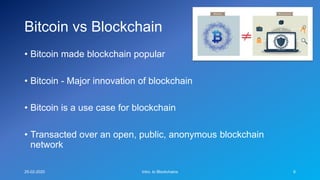
Bitcoin vs Blockchain
• Bitcoin made blockchain popular
• Bitcoin - Major innovation of blockchain
• Bitcoin is a use case for blockchain
• Transacted over an open, public, anonymous blockchain
network
25-02-2020 Intro. to Blockchains 6
Blockchain – a little deeper perspective
• Subset of DLT
• Block - set of transactions that are bundled together and added
to the chain at the same time
• Block contains 4 pieces of metadata
• Reference of the previous block
• Proof of work, also known as nonce
• Timestamp
• Merkle tree root for the transactions included in this block
25-02-2020 Intro. to Blockchains 7
Components of Blockchain
• Ledger: A distributed, immutable historical record
• Peer Network: Stores, updates, and maintains the ledger
• Membership Services: User authentication, authorization, and identity management
• Smart Contract: Program that runs on the blockchain
• Wallet: Stores users' credentials
• Events: Notifications of updates and actions on the blockchain
• Systems Management: Component creation, modification, and monitoring
• Systems Integration: Integration of blockchain with external systems.
25-02-2020 Intro. to Blockchains 8
Blockchain Is Immutable
• If the data is tampered with anywhere in the chain, the links will
break
• This provides immutability and security.
25-02-2020 Intro. to Blockchains 9
Transactions
• Record of an event, cryptographically secured with a digital
signature, that is verified, ordered, and bundled together into
blocks
• Cryptography has a key role to play both in the security, as well
as in the immutability of the transactions recorded on
blockchains.
25-02-2020 Intro. to Blockchains 10
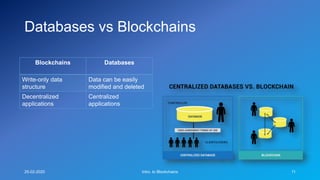
Databases vs Blockchains
Blockchains Databases
Write-only data
structure
Data can be easily
modified and deleted
Decentralized
applications
Centralized
applications
25-02-2020 Intro. to Blockchains 11
Consensus Algorithm
• Ensures that the data on the ledger is the same for all the
nodes in the network
• Prevents malicious actors from manipulating the data
• Varies with different implementations
25-02-2020 Intro. to Blockchains 12
Types
• Proof of Work
• Proof of Stake
• Proof of Burn
• Proof of Capacity
• Proof of Elapsed Time
25-02-2020 Intro. to Blockchains 13
Proof of Work
• Involves solving a computational challenging puzzle in order to create new blocks
• Requires a huge amount of energy to be expended, given the computationally
heavy algorithm
• Has a high latency of transaction validation
• Concentration of mining power is located in countries where electricity is cheap
Proof-of-work (PoW) is the outcome of a successful mining process and, although the proof
is hard to create, [it] is easy to verify.
- 2016 Kudelski Security report
25-02-2020 Intro. to Blockchains 14
Proof of Stake (PoS)
• Generalization of the Proof of Work
• Nodes are known as the 'validators‘ that validate the
transactions to earn a transaction fee
• Nodes are randomly selected to validate blocks
• PoS algorithm saves expensive computational resources that
are spent in mining under a PoW consensus
25-02-2020 Intro. to Blockchains 15
Proof of Elapsed Time (PoET)
• Developed by Intel
• Hybrid of a random lottery and first-come-first-serve basis
• Each validator is given a random wait time
• The validator with the shortest wait time for a particular transaction
block is elected the leader.
• This "leader" gets to create the next block on the chain
25-02-2020 Intro. to Blockchains 16
Proof of Authority
• Used for permissioned ledgers
• Uses a set of 'authorities', which are designated nodes that are
allowed to create new blocks and secure the ledger
• Require sign-off by a majority of authorities in order for a block
to be created
25-02-2020 Intro. to Blockchains 17
References
• http://hyperledger.org/about
• https://github.com/hyperledger-archives/education/tree/master/LFS171x
• https://hbr.org/2017/02/a-brief-history-of-blockchain
• https://www.investopedia.com/terms/m/merkle-root-cryptocurrency.asp
• http://chimera.labs.oreilly.com/books/1234000001802/ch07.html
#_structure_of_a_block
25-02-2020 Intro. to Blockchains 18

Introduction to blockchains

  • 1.
    Introduction to Blockchains J JADRI JOVIN, M.Tech., PhD., Dip. Yoga, BGL, Assistant Professor (Sl. Gr.) Department of Information Technology
  • 2.
    Distributed Ledger Technologies(DLT) “The arc of the internet is now bending towards decentralization.” — Naval Ravikant • Decentralization – a major transformation • Giving the rights to the user • Crypto-economy • Computer security engineer, applied cryptographer, and distributed systems engineer 25-02-2020 Intro. to Blockchains 2
  • 3.
    DLT (Contd…) • DistributedLedger – a type of data structure • Includes blockchains and smart contracts • 3 basic components • Data Model – maintains the current state of the ledger • Language of transactions – changes the state of the ledger • Protocol – used to build consensus among participants 25-02-2020 Intro. to Blockchains 3
  • 4.
    What is blockchain? •Peer-to-peer distributed ledger • Forged by consensus • Combined with a system • Used to build transactional applications that establish • Trust • Accountability • Transparency 25-02-2020 Intro. to Blockchains 4
  • 5.
    Definition of blockchain •According to Hyperledger A blockchain is a peer-to-peer distributed ledger forged by consensus, combined with a system for "smart contracts" and other assistive technologies. Smart contracts are computer programs that execute predefined actions when certain conditions within the system are met. Consensus refers to a system of ensuring that parties agree to a certain state of the system as the true state. 25-02-2020 Intro. to Blockchains 5
  • 6.
    Bitcoin vs Blockchain •Bitcoin made blockchain popular • Bitcoin - Major innovation of blockchain • Bitcoin is a use case for blockchain • Transacted over an open, public, anonymous blockchain network 25-02-2020 Intro. to Blockchains 6
  • 7.
    Blockchain – alittle deeper perspective • Subset of DLT • Block - set of transactions that are bundled together and added to the chain at the same time • Block contains 4 pieces of metadata • Reference of the previous block • Proof of work, also known as nonce • Timestamp • Merkle tree root for the transactions included in this block 25-02-2020 Intro. to Blockchains 7
  • 8.
    Components of Blockchain •Ledger: A distributed, immutable historical record • Peer Network: Stores, updates, and maintains the ledger • Membership Services: User authentication, authorization, and identity management • Smart Contract: Program that runs on the blockchain • Wallet: Stores users' credentials • Events: Notifications of updates and actions on the blockchain • Systems Management: Component creation, modification, and monitoring • Systems Integration: Integration of blockchain with external systems. 25-02-2020 Intro. to Blockchains 8
  • 9.
    Blockchain Is Immutable •If the data is tampered with anywhere in the chain, the links will break • This provides immutability and security. 25-02-2020 Intro. to Blockchains 9
  • 10.
    Transactions • Record ofan event, cryptographically secured with a digital signature, that is verified, ordered, and bundled together into blocks • Cryptography has a key role to play both in the security, as well as in the immutability of the transactions recorded on blockchains. 25-02-2020 Intro. to Blockchains 10
  • 11.
    Databases vs Blockchains BlockchainsDatabases Write-only data structure Data can be easily modified and deleted Decentralized applications Centralized applications 25-02-2020 Intro. to Blockchains 11
  • 12.
    Consensus Algorithm • Ensuresthat the data on the ledger is the same for all the nodes in the network • Prevents malicious actors from manipulating the data • Varies with different implementations 25-02-2020 Intro. to Blockchains 12
  • 13.
    Types • Proof ofWork • Proof of Stake • Proof of Burn • Proof of Capacity • Proof of Elapsed Time 25-02-2020 Intro. to Blockchains 13
  • 14.
    Proof of Work •Involves solving a computational challenging puzzle in order to create new blocks • Requires a huge amount of energy to be expended, given the computationally heavy algorithm • Has a high latency of transaction validation • Concentration of mining power is located in countries where electricity is cheap Proof-of-work (PoW) is the outcome of a successful mining process and, although the proof is hard to create, [it] is easy to verify. - 2016 Kudelski Security report 25-02-2020 Intro. to Blockchains 14
  • 15.
    Proof of Stake(PoS) • Generalization of the Proof of Work • Nodes are known as the 'validators‘ that validate the transactions to earn a transaction fee • Nodes are randomly selected to validate blocks • PoS algorithm saves expensive computational resources that are spent in mining under a PoW consensus 25-02-2020 Intro. to Blockchains 15
  • 16.
    Proof of ElapsedTime (PoET) • Developed by Intel • Hybrid of a random lottery and first-come-first-serve basis • Each validator is given a random wait time • The validator with the shortest wait time for a particular transaction block is elected the leader. • This "leader" gets to create the next block on the chain 25-02-2020 Intro. to Blockchains 16
  • 17.
    Proof of Authority •Used for permissioned ledgers • Uses a set of 'authorities', which are designated nodes that are allowed to create new blocks and secure the ledger • Require sign-off by a majority of authorities in order for a block to be created 25-02-2020 Intro. to Blockchains 17
  • 18.
    References • http://hyperledger.org/about • https://github.com/hyperledger-archives/education/tree/master/LFS171x •https://hbr.org/2017/02/a-brief-history-of-blockchain • https://www.investopedia.com/terms/m/merkle-root-cryptocurrency.asp • http://chimera.labs.oreilly.com/books/1234000001802/ch07.html #_structure_of_a_block 25-02-2020 Intro. to Blockchains 18

Editor's Notes

  • #8 A Merkle root is the hash of all the hashes of all the transactions that are part of a block in a blockchain network. According to Andreas M. Antonopoulos, in the Bitcoin protocol, "Merkle trees are used to summarize all the transactions in a block, producing an overall digital fingerprint of the entire set of transactions, providing a very efficient process to verify whether a transaction is included in a block."