Introduction to
Biology for Engineers
Dr. G. Shanmugavel,
Assistant Professor of Biology (Contract),
Department of HSS,
Puducherry Technological University
Email : shanmugavel.g@pec.edu
Introduction
• There are a number of options for undergraduate study in our country that
nowadays seem acceptable to the society and are considered worthy
enough to pursue.
• This is a healthy situation and the social acceptance of many
undergraduate study options needs to improve further.
• Not so long ago in our country, there were only two socially preferred
undergraduate streams for study—Engineering and Medicine.
• For engineering, mathematics is required and biology is not.
• Irrespective of the group they choose to pursue at the higher secondary
level, some students have an innate interest in biology, whereas others do
not.
• The students who do not have an interest in biology or are neutral, when
exposed to uninspired teaching of biology as a part of science at the high
school, most likely develop a hatred toward it.
NEED FOR BIOLOGY
• The previous few centuries saw a better fundamental understanding of the
physical and chemical world through advances in physics and chemistry.
• The better understanding and advances gave rise to technologies and products,
such as computers, communication devices, aircraft, and others that
revolutionized life.
• Since this is the century of biology, a similar phenomenon is expected, which will
lead to probably another revolution.
• Many engineers are expected to contribute to a biological aspect to fuel this
revolution.
• Therefore, the engineering undergraduates need to be suitably exposed atleast to
the very minimum biology.
• So that they would atleast be able to consider a biological system/aspect in which
they could later make appropriate contributions, through their main expertise,
say electrical engineering, mechanical engineering, computer science, materials
engineering, or any other.
Why do engineers need to study the principles
of biology?
• Principles of mechanics applied to understand biological systems.
• Biomechanics – is the application of mechanical principles in the study of
living organisms including their kinematics and kinetics, it views human
body as a collection of levers, made of bones which are moved by its
muscles. In sport, used to analyze the performance level of athletes.
Focuses on body segments and its interaction with the surrounding
environment.
• Understanding Pharmacokinetics and Pharmacodynamics of medicines.
Why do engineers need to study the principles
of biology? cont.
• Mechanobiology – in the level of cells – it dwells on the behavior of physical
forces and transfer in cell and/ or tissues.
• Nanotechnology – carbon nanotubes as drug delivery systems used in cancer
therapy
• Computational Fluid Dynamics (CFD) – an engineering tool that connects
mechanics to mathematics and software programming to execute simulation
performing how a fluid (liquid or gas) flows based on Navier-Stokes equations
(used to describe the motion of viscous fluid substances).
• Bionics or biologically inspired engineering is the application of biological
methods and systems found in nature to the study and design
of engineering systems and modern technology.
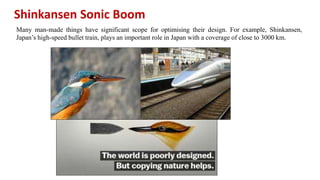
Shinkansen Sonic Boom
Many man-made things have significant scope for optimising their design. For example, Shinkansen,
Japan’s high-speed bullet train, plays an important role in Japan with a coverage of close to 3000 km.
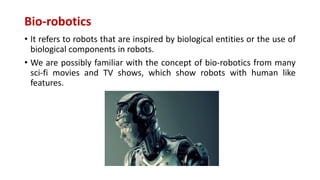
Bio-robotics
• It refers to robots that are inspired by biological entities or the use of
biological components in robots.
• We are possibly familiar with the concept of bio-robotics from many
sci-fi movies and TV shows, which show robots with human like
features.
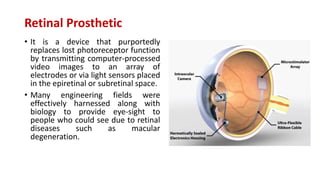
Retinal Prosthetic
• It is a device that purportedly
replaces lost photoreceptor function
by transmitting computer-processed
video images to an array of
electrodes or via light sensors placed
in the epiretinal or subretinal space.
• Many engineering fields were
effectively harnessed along with
biology to provide eye-sight to
people who could see due to retinal
diseases such as macular
degeneration.
Biopolymer
• Biopolymers are polymers that are produced by or derived from living organisms,
such as plants and microbes, rather than from petroleum, the traditional source
of polymers.
• The primary sources of biopolymers are renewable.
• Many biopolymers are biodegradable, but not all. Polythioesters are non-
biodegradable by microorganisms, which represent a novel non-biodegradable
bioplastic material.
• Biopolymers consist of monomeric units that are covalently bonded to form
larger molecules. There are three main classes of biopolymers, 1.
polynucleotides, 2. polypeptides and 3. polysaccharides.
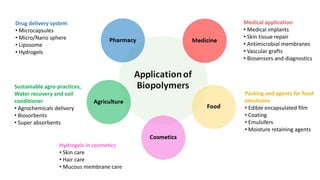
Drug delivery system
• Microcapsules
• Micro/Nano sphere
• Liposome
• Hydrogels
Sustainable agro-practices,
Water recovery and soil
conditioner
• Agrochemicals delivery
• Biosorbents
• Super absorbents
Hydrogels in cosmetics
• Skin care
• Hair care
• Mucous membrane care
Medical application
• Medical implants
• Skin tissue repair
• Antimicrobial membranes
• Vascular grafts
• Biosensors and diagnostics
Packing and agents for food
emulsions
• Edible encapsulated film
• Coating
• Emulsifers
• Moisture retaining agents
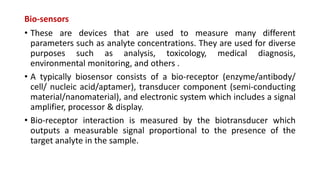
Bio-sensors
• These are devices that are used to measure many different
parameters such as analyte concentrations. They are used for diverse
purposes such as analysis, toxicology, medical diagnosis,
environmental monitoring, and others .
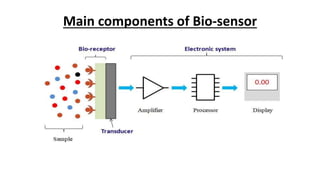
• A typically biosensor consists of a bio-receptor (enzyme/antibody/
cell/ nucleic acid/aptamer), transducer component (semi-conducting
material/nanomaterial), and electronic system which includes a signal
amplifier, processor & display.
• Bio-receptor interaction is measured by the biotransducer which
outputs a measurable signal proportional to the presence of the
target analyte in the sample.
Main components of Bio-sensor
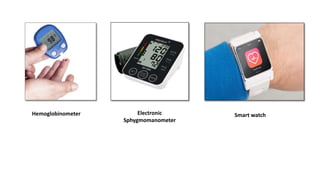
Hemoglobinometer Electronic
Sphygmomanometer
Smart watch
Bio-chips
• Bio-chips are miniaturized laboratories in which thousands of
biochemical reactions can be carried out simultaneously at micron
scales for useful purposes such as disease studies or safety studies.
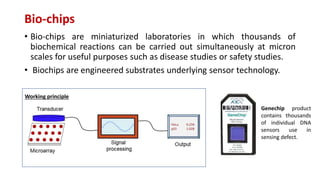
• Biochips are engineered substrates underlying sensor technology.
Genechip product
contains thousands
of individual DNA
sensors use in
sensing defect.
Working principle
Bio-filters
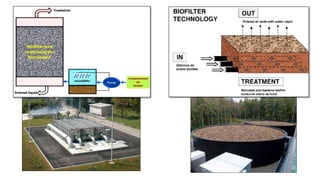
• Biofilters are technical applications that use the biofiltration process
to remove pollutants in environment.
• Biofiltration is a pollution control technique using
a bioreactor containing living material to capture and biologically
degrade pollutants.
• It is application are used to remove the pollutants from air and water.
• Some examples of biofiltration: Slow sand filters, Treatment ponds,
Constructed wetlands and natural wetlands. Filters like
Bioswales, biostrips, biobags, bioscrubbers, Vermifilters and trickling
filters.
Bio-pesticides
• Bio-pesticides are biological substances
or organisms that can be used instead
of chemicals for pest control and thus
they overcome the negative effects of
chemical pesticides.
• The effective control of bio-pesticides
requires appropriate formulation and
application.
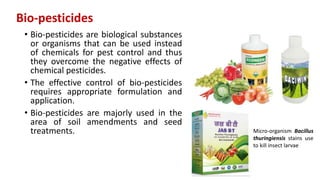
• Bio-pesticides are majorly used in the
area of soil amendments and seed
treatments. Micro-organism Bacillus
thuringiensis stains use
to kill insect larvae
Concrete Self-heal
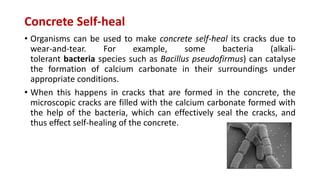
• Organisms can be used to make concrete self-heal its cracks due to
wear-and-tear. For example, some bacteria (alkali-
tolerant bacteria species such as Bacillus pseudofirmus) can catalyse
the formation of calcium carbonate in their surroundings under
appropriate conditions.
• When this happens in cracks that are formed in the concrete, the
microscopic cracks are filled with the calcium carbonate formed with
the help of the bacteria, which can effectively seal the cracks, and
thus effect self-healing of the concrete.
System biology
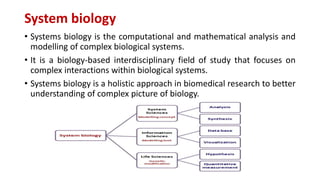
• Systems biology is the computational and mathematical analysis and
modelling of complex biological systems.
• It is a biology-based interdisciplinary field of study that focuses on
complex interactions within biological systems.
• Systems biology is a holistic approach in biomedical research to better
understanding of complex picture of biology.
Bioinformatics
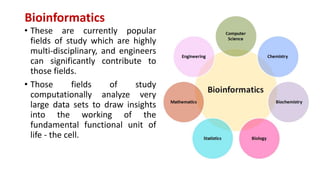
• These are currently popular
fields of study which are highly
multi-disciplinary, and engineers
can significantly contribute to
those fields.
• Those fields of study
computationally analyze very
large data sets to draw insights
into the working of the
fundamental functional unit of
life - the cell.
Reference
• Biology for Engineers, G. K. Suraishkumar, Oxford University Press.
• Bionics and Engineering: The Relevance of Biology to Engineering, presented
at Society of Women Engineers Convention, Seattle, WA, 1983, Jill E. Steele.
• Biopolymers – Application in Nanoscience and Nanotechnology. Mohan,
Sneha; Oluwafemi, Oluwatobi S.; Kalarikkal, Nandakumar; Thomas, Sabu;
Songca, Sandile P. Recent Advances in Biopolymers.
• Self‐Healing Materials: Fundamentals, Design Strategies, and
Applications, Ghosh, Swapan Kumar, (1 ed.). Wiley.
• Microbial Insecticides: Principles and Applications. Francis Borgio J, Sahayaraj
K and Alper Susurluk I (eds). Nova Publishers, USA.
Introduction to Biology for Engineers.pptx

Introduction to Biology for Engineers.pptx

  • 1.
    Introduction to Biology forEngineers Dr. G. Shanmugavel, Assistant Professor of Biology (Contract), Department of HSS, Puducherry Technological University Email : shanmugavel.g@pec.edu
  • 2.
    Introduction • There area number of options for undergraduate study in our country that nowadays seem acceptable to the society and are considered worthy enough to pursue. • This is a healthy situation and the social acceptance of many undergraduate study options needs to improve further. • Not so long ago in our country, there were only two socially preferred undergraduate streams for study—Engineering and Medicine. • For engineering, mathematics is required and biology is not. • Irrespective of the group they choose to pursue at the higher secondary level, some students have an innate interest in biology, whereas others do not. • The students who do not have an interest in biology or are neutral, when exposed to uninspired teaching of biology as a part of science at the high school, most likely develop a hatred toward it.
  • 3.
    NEED FOR BIOLOGY •The previous few centuries saw a better fundamental understanding of the physical and chemical world through advances in physics and chemistry. • The better understanding and advances gave rise to technologies and products, such as computers, communication devices, aircraft, and others that revolutionized life. • Since this is the century of biology, a similar phenomenon is expected, which will lead to probably another revolution. • Many engineers are expected to contribute to a biological aspect to fuel this revolution. • Therefore, the engineering undergraduates need to be suitably exposed atleast to the very minimum biology. • So that they would atleast be able to consider a biological system/aspect in which they could later make appropriate contributions, through their main expertise, say electrical engineering, mechanical engineering, computer science, materials engineering, or any other.
  • 4.
    Why do engineersneed to study the principles of biology? • Principles of mechanics applied to understand biological systems. • Biomechanics – is the application of mechanical principles in the study of living organisms including their kinematics and kinetics, it views human body as a collection of levers, made of bones which are moved by its muscles. In sport, used to analyze the performance level of athletes. Focuses on body segments and its interaction with the surrounding environment. • Understanding Pharmacokinetics and Pharmacodynamics of medicines.
  • 5.
    Why do engineersneed to study the principles of biology? cont. • Mechanobiology – in the level of cells – it dwells on the behavior of physical forces and transfer in cell and/ or tissues. • Nanotechnology – carbon nanotubes as drug delivery systems used in cancer therapy • Computational Fluid Dynamics (CFD) – an engineering tool that connects mechanics to mathematics and software programming to execute simulation performing how a fluid (liquid or gas) flows based on Navier-Stokes equations (used to describe the motion of viscous fluid substances). • Bionics or biologically inspired engineering is the application of biological methods and systems found in nature to the study and design of engineering systems and modern technology.
  • 6.
    Shinkansen Sonic Boom Manyman-made things have significant scope for optimising their design. For example, Shinkansen, Japan’s high-speed bullet train, plays an important role in Japan with a coverage of close to 3000 km.
  • 7.
    Bio-robotics • It refersto robots that are inspired by biological entities or the use of biological components in robots. • We are possibly familiar with the concept of bio-robotics from many sci-fi movies and TV shows, which show robots with human like features.
  • 8.
    Retinal Prosthetic • Itis a device that purportedly replaces lost photoreceptor function by transmitting computer-processed video images to an array of electrodes or via light sensors placed in the epiretinal or subretinal space. • Many engineering fields were effectively harnessed along with biology to provide eye-sight to people who could see due to retinal diseases such as macular degeneration.
  • 9.
    Biopolymer • Biopolymers arepolymers that are produced by or derived from living organisms, such as plants and microbes, rather than from petroleum, the traditional source of polymers. • The primary sources of biopolymers are renewable. • Many biopolymers are biodegradable, but not all. Polythioesters are non- biodegradable by microorganisms, which represent a novel non-biodegradable bioplastic material. • Biopolymers consist of monomeric units that are covalently bonded to form larger molecules. There are three main classes of biopolymers, 1. polynucleotides, 2. polypeptides and 3. polysaccharides.
  • 10.
    Drug delivery system •Microcapsules • Micro/Nano sphere • Liposome • Hydrogels Sustainable agro-practices, Water recovery and soil conditioner • Agrochemicals delivery • Biosorbents • Super absorbents Hydrogels in cosmetics • Skin care • Hair care • Mucous membrane care Medical application • Medical implants • Skin tissue repair • Antimicrobial membranes • Vascular grafts • Biosensors and diagnostics Packing and agents for food emulsions • Edible encapsulated film • Coating • Emulsifers • Moisture retaining agents
  • 11.
    Bio-sensors • These aredevices that are used to measure many different parameters such as analyte concentrations. They are used for diverse purposes such as analysis, toxicology, medical diagnosis, environmental monitoring, and others . • A typically biosensor consists of a bio-receptor (enzyme/antibody/ cell/ nucleic acid/aptamer), transducer component (semi-conducting material/nanomaterial), and electronic system which includes a signal amplifier, processor & display. • Bio-receptor interaction is measured by the biotransducer which outputs a measurable signal proportional to the presence of the target analyte in the sample.
  • 12.
  • 13.
  • 14.
    Bio-chips • Bio-chips areminiaturized laboratories in which thousands of biochemical reactions can be carried out simultaneously at micron scales for useful purposes such as disease studies or safety studies. • Biochips are engineered substrates underlying sensor technology. Genechip product contains thousands of individual DNA sensors use in sensing defect. Working principle
  • 15.
    Bio-filters • Biofilters aretechnical applications that use the biofiltration process to remove pollutants in environment. • Biofiltration is a pollution control technique using a bioreactor containing living material to capture and biologically degrade pollutants. • It is application are used to remove the pollutants from air and water. • Some examples of biofiltration: Slow sand filters, Treatment ponds, Constructed wetlands and natural wetlands. Filters like Bioswales, biostrips, biobags, bioscrubbers, Vermifilters and trickling filters.
  • 17.
    Bio-pesticides • Bio-pesticides arebiological substances or organisms that can be used instead of chemicals for pest control and thus they overcome the negative effects of chemical pesticides. • The effective control of bio-pesticides requires appropriate formulation and application. • Bio-pesticides are majorly used in the area of soil amendments and seed treatments. Micro-organism Bacillus thuringiensis stains use to kill insect larvae
  • 18.
    Concrete Self-heal • Organismscan be used to make concrete self-heal its cracks due to wear-and-tear. For example, some bacteria (alkali- tolerant bacteria species such as Bacillus pseudofirmus) can catalyse the formation of calcium carbonate in their surroundings under appropriate conditions. • When this happens in cracks that are formed in the concrete, the microscopic cracks are filled with the calcium carbonate formed with the help of the bacteria, which can effectively seal the cracks, and thus effect self-healing of the concrete.
  • 19.
    System biology • Systemsbiology is the computational and mathematical analysis and modelling of complex biological systems. • It is a biology-based interdisciplinary field of study that focuses on complex interactions within biological systems. • Systems biology is a holistic approach in biomedical research to better understanding of complex picture of biology.
  • 20.
    Bioinformatics • These arecurrently popular fields of study which are highly multi-disciplinary, and engineers can significantly contribute to those fields. • Those fields of study computationally analyze very large data sets to draw insights into the working of the fundamental functional unit of life - the cell.
  • 21.
    Reference • Biology forEngineers, G. K. Suraishkumar, Oxford University Press. • Bionics and Engineering: The Relevance of Biology to Engineering, presented at Society of Women Engineers Convention, Seattle, WA, 1983, Jill E. Steele. • Biopolymers – Application in Nanoscience and Nanotechnology. Mohan, Sneha; Oluwafemi, Oluwatobi S.; Kalarikkal, Nandakumar; Thomas, Sabu; Songca, Sandile P. Recent Advances in Biopolymers. • Self‐Healing Materials: Fundamentals, Design Strategies, and Applications, Ghosh, Swapan Kumar, (1 ed.). Wiley. • Microbial Insecticides: Principles and Applications. Francis Borgio J, Sahayaraj K and Alper Susurluk I (eds). Nova Publishers, USA.