SPARQL
SPARQL	Protocol	And	RDF	Query	Language		
Amrapali	Zaveri,	Ph.D.
What is SPARQL?
SPARQL	(pronounced	sparkle)	stands	for:	SPARQL	Protocol	And	
RDF	Query	Language		
• SPARQL	1.0	W3C-RecommendaFon	since	January	15th	2008	
• SPARQL	1.1	W3C-RecommendaFon	since	March	21st	2013	
• Query	language	to	query	instances	in	RDF	documents	
• Great	pracFcal	importance	(almost	all	applicaFons	need	it)
SPARQL Example
SELECT		
*		
WHERE

{		
?subject					?predicate					?object		.	
}
Similar to SQL !
SPARQL Components
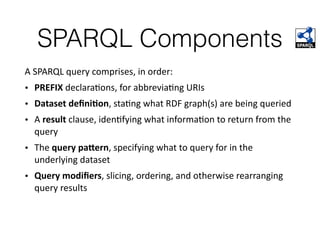
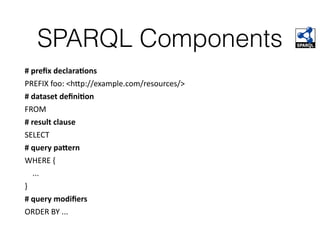
A	SPARQL	query	comprises,	in	order:	
• PREFIX	declaraFons,	for	abbreviaFng	URIs	
• Dataset	defini;on,	staFng	what	RDF	graph(s)	are	being	queried	
• A	result	clause,	idenFfying	what	informaFon	to	return	from	the	
query	
• The	query	pa@ern,	specifying	what	to	query	for	in	the	
underlying	dataset	
• Query	modifiers,	slicing,	ordering,	and	otherwise	rearranging	
query	results
SPARQL Components
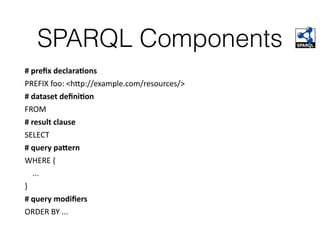
#	prefix	declara;ons	
PREFIX	foo:	<h`p://example.com/resources/>	
#	dataset	defini;on	
FROM		
#	result	clause	
SELECT		
#	query	pa@ern	
WHERE	{	
				...	
}	
#	query	modifiers	
ORDER	BY	...
SPARQL Example
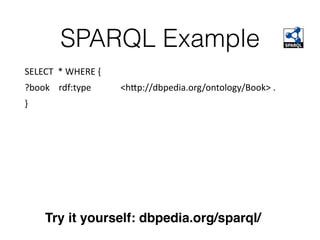
SELECT		*	WHERE	{		
?book				rdf:type													<h`p://dbpedia.org/ontology/Book>	.	
}
Try it yourself: dbpedia.org/sparql/
SPARQL Example
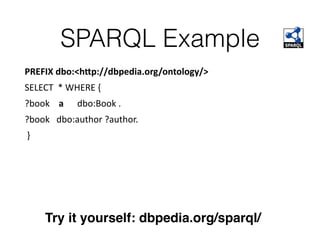
PREFIX	dbo:<h@p://dbpedia.org/ontology/>	
SELECT		*	WHERE	{		
?book				a						dbo:Book	.	
?book			dbo:author	?author.	
	}
Try it yourself: dbpedia.org/sparql/
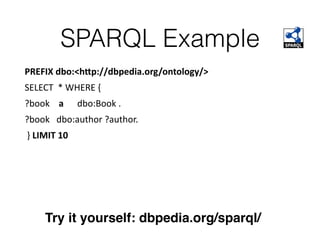
SPARQL Example
PREFIX	dbo:<h@p://dbpedia.org/ontology/>	
SELECT		*	WHERE	{		
?book				a						dbo:Book	.	
?book			dbo:author	?author.	
	}	LIMIT	10
Try it yourself: dbpedia.org/sparql/
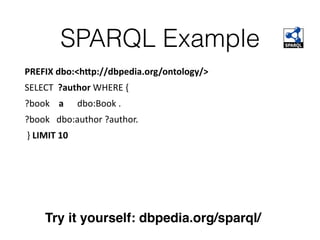
SPARQL Example
PREFIX	dbo:<h@p://dbpedia.org/ontology/>	
SELECT		?author	WHERE	{		
?book				a						dbo:Book	.	
?book			dbo:author	?author.	
	}	LIMIT	10
Try it yourself: dbpedia.org/sparql/
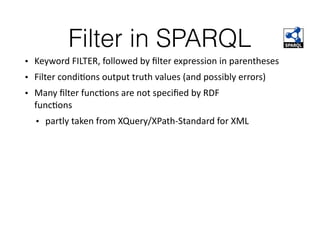
Filter in SPARQL
• Keyword	FILTER,	followed	by	filter	expression	in	parentheses		
• Filter	condiFons	output	truth	values	(and	possibly	errors)		
• Many	filter	funcFons	are	not	specified	by	RDF

funcFons		
• partly	taken	from	XQuery/XPath-Standard	for	XML
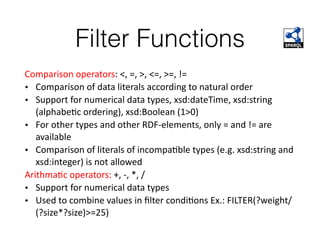
Filter Functions
Comparison	operators:	<,	=,	>,	<=,	>=,	!=		
• Comparison	of	data	literals	according	to	natural	order		
• Support	for	numerical	data	types,	xsd:dateTime,	xsd:string	
(alphabeFc	ordering),	xsd:Boolean	(1>0)		
• For	other	types	and	other	RDF-elements,	only	=	and	!=	are	
available	
• Comparison	of	literals	of	incompaFble	types	(e.g.	xsd:string	and	
xsd:integer)	is	not	allowed		
ArithmaFc	operators:	+,	-,	*,	/		
• Support	for	numerical	data	types		
• Used	to	combine	values	in	filter	condiFons	Ex.:	FILTER(?weight/
(?size*?size)>=25)
SPARQL Example
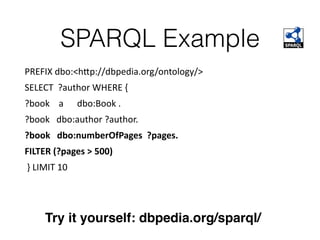
PREFIX	dbo:<h`p://dbpedia.org/ontology/>	
SELECT		?author	WHERE	{		
?book				a						dbo:Book	.	
?book			dbo:author	?author.	
?book			dbo:numberOfPages		?pages.	
FILTER	(?pages	>	500)	
	}	LIMIT	10
Try it yourself: dbpedia.org/sparql/
Special Filter Functions
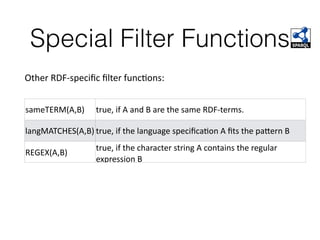
Other	RDF-specific	filter	funcFons:		
sameTERM(A,B) true,	if	A	and	B	are	the	same	RDF-terms.
langMATCHES(A,B) true,	if	the	language	specificaFon	A	fits	the	pa`ern	B
REGEX(A,B)
true,	if	the	character	string	A	contains	the	regular	
expression	B
SPARQL Example
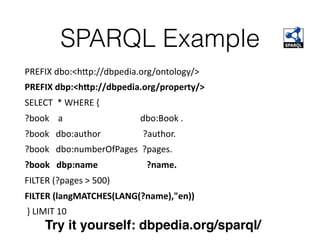
PREFIX	dbo:<h`p://dbpedia.org/ontology/>	
PREFIX	dbp:<h@p://dbpedia.org/property/>	
SELECT		*	WHERE	{		
?book				a																																			dbo:Book	.	
?book			dbo:author																			?author.	
?book			dbo:numberOfPages		?pages.	
?book			dbp:name																						?name.	
FILTER	(?pages	>	500)	
FILTER	(langMATCHES(LANG(?name),"en))	
	}	LIMIT	10
Try it yourself: dbpedia.org/sparql/
Filter Functions: Boolean
operators
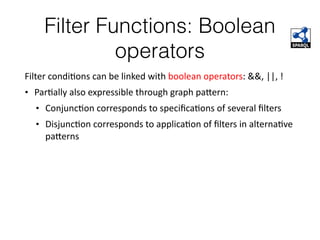
Filter	condiFons	can	be	linked	with	boolean	operators:	&&,	||,	!		
• ParFally	also	expressible	through	graph	pa`ern:	
• ConjuncFon	corresponds	to	specificaFons	of	several	filters	
• DisjuncFon	corresponds	to	applicaFon	of	filters	in	alternaFve	
pa`erns
Filter Functions: Boolean
operators
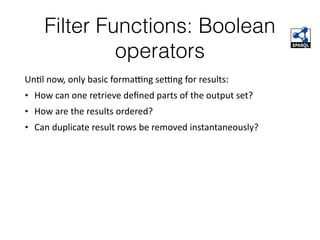
UnFl	now,	only	basic	formaong	seong	for	results:	
• How	can	one	retrieve	defined	parts	of	the	output	set?	
• How	are	the	results	ordered?	
• Can	duplicate	result	rows	be	removed	instantaneously?
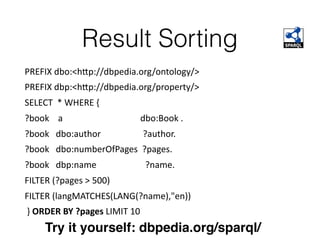
Result Sorting
PREFIX	dbo:<h`p://dbpedia.org/ontology/>	
PREFIX	dbp:<h`p://dbpedia.org/property/>	
SELECT		*	WHERE	{		
?book				a																																			dbo:Book	.	
?book			dbo:author																			?author.	
?book			dbo:numberOfPages		?pages.	
?book			dbp:name																						?name.	
FILTER	(?pages	>	500)	
FILTER	(langMATCHES(LANG(?name),"en))	
	}	ORDER	BY	?pages	LIMIT	10
Try it yourself: dbpedia.org/sparql/
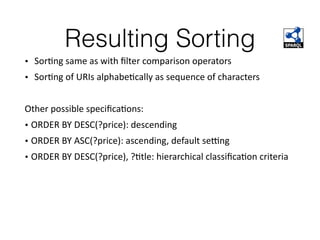
Resulting Sorting
• SorFng	same	as	with	filter	comparison	operators		
• SorFng	of	URIs	alphabeFcally	as	sequence	of	characters		
Other	possible	specificaFons:		
•	ORDER	BY	DESC(?price):	descending	
•	ORDER	BY	ASC(?price):	ascending,	default	seong	
•	ORDER	BY	DESC(?price),	?Ftle:	hierarchical	classificaFon	criteria
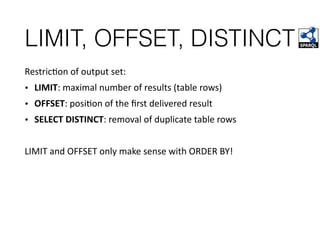
LIMIT, OFFSET, DISTINCT
RestricFon	of	output	set:	
• LIMIT:	maximal	number	of	results	(table	rows)	
• OFFSET:	posiFon	of	the	first	delivered	result	
• SELECT	DISTINCT:	removal	of	duplicate	table	rows		
LIMIT	and	OFFSET	only	make	sense	with	ORDER	BY!
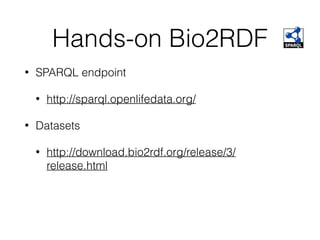
Hands-on Bio2RDF
• SPARQL endpoint
• http://sparql.openlifedata.org/
• Datasets
• http://download.bio2rdf.org/release/3/
release.html
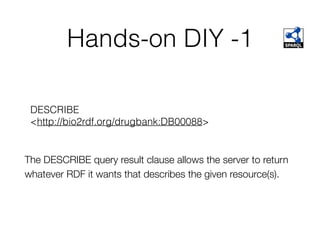
Hands-on DIY -1
DESCRIBE
<http://bio2rdf.org/drugbank:DB00088>
The DESCRIBE query result clause allows the server to return
whatever RDF it wants that describes the given resource(s).
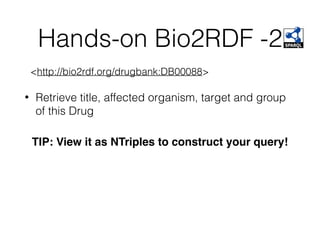
Hands-on Bio2RDF -2
<http://bio2rdf.org/drugbank:DB00088>
• Retrieve title, affected organism, target and group
of this Drug
TIP: View it as NTriples to construct your query!
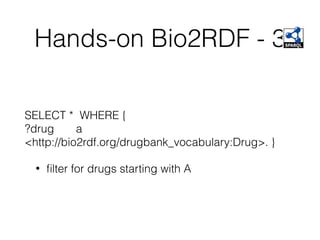
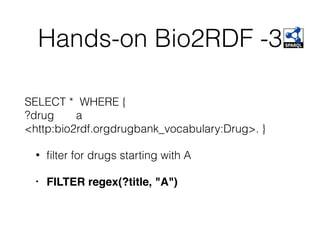
Hands-on Bio2RDF - 3
SELECT * WHERE {
?drug a
<http://bio2rdf.org/drugbank_vocabulary:Drug>. }
• filter for drugs starting with A
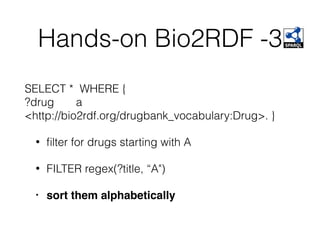
Hands-on Bio2RDF -3
SELECT * WHERE {
?drug a
<http:bio2rdf.orgdrugbank_vocabulary:Drug>. }
• filter for drugs starting with A
• FILTER regex(?title, "A")
Hands-on Bio2RDF -3
SELECT * WHERE {
?drug a
<http://bio2rdf.org/drugbank_vocabulary:Drug>. }
• filter for drugs starting with A
• FILTER regex(?title, “A")
• sort them alphabetically
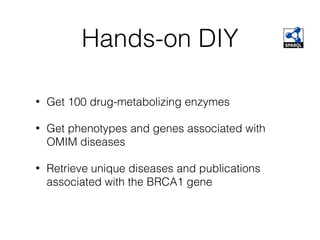
Hands-on DIY
• Get 100 drug-metabolizing enzymes
• Get phenotypes and genes associated with
OMIM diseases
• Retrieve unique diseases and publications
associated with the BRCA1 gene
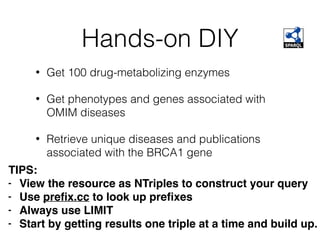
Hands-on DIY
• Get 100 drug-metabolizing enzymes
• Get phenotypes and genes associated with
OMIM diseases
• Retrieve unique diseases and publications
associated with the BRCA1 gene
TIPS:
- View the resource as NTriples to construct your query
- Use prefix.cc to look up prefixes
- Always use LIMIT
- Start by getting results one triple at a time and build up.
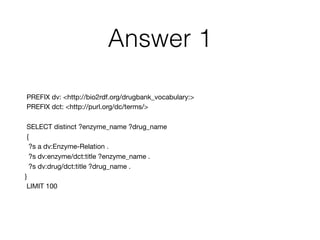
Answer 1
PREFIX dv: <http://bio2rdf.org/drugbank_vocabulary:>

PREFIX dct: <http://purl.org/dc/terms/>

SELECT distinct ?enzyme_name ?drug_name 

{

?s a dv:Enzyme-Relation .

?s dv:enzyme/dct:title ?enzyme_name .

?s dv:drug/dct:title ?drug_name .

} 

LIMIT 100
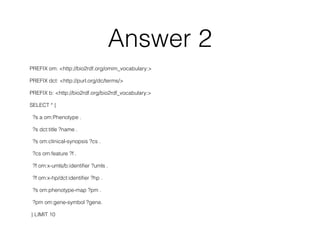
Answer 2
PREFIX om: <http://bio2rdf.org/omim_vocabulary:>
PREFIX dct: <http://purl.org/dc/terms/>
PREFIX b: <http://bio2rdf.org/bio2rdf_vocabulary:>
SELECT * {
?s a om:Phenotype .
?s dct:title ?name .
?s om:clinical-synopsis ?cs .
?cs om:feature ?f .
?f om:x-umls/b:identifier ?umls .
?f om:x-hp/dct:identifier ?hp .
?s om:phenotype-map ?pm .
?pm om:gene-symbol ?gene.
} LIMIT 10
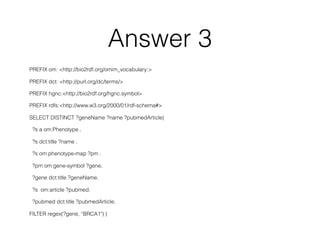
Answer 3
PREFIX om: <http://bio2rdf.org/omim_vocabulary:>
PREFIX dct: <http://purl.org/dc/terms/>
PREFIX hgnc:<http://bio2rdf.org/hgnc.symbol>
PREFIX rdfs:<http://www.w3.org/2000/01/rdf-schema#>
SELECT DISTINCT ?geneName ?name ?pubmedArticle{
?s a om:Phenotype .
?s dct:title ?name .
?s om:phenotype-map ?pm .
?pm om:gene-symbol ?gene.
?gene dct:title ?geneName.
?s om:article ?pubmed.
?pubmed dct:title ?pubmedArticle.
FILTER regex(?gene, “BRCA1") }
SPARQL Components
#	prefix	declara;ons	
PREFIX	foo:	<h`p://example.com/resources/>	
#	dataset	defini;on	
FROM		
#	result	clause	
SELECT		
#	query	pa@ern	
WHERE	{	
				...	
}	
#	query	modifiers	
ORDER	BY	...
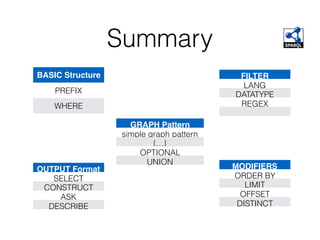
Summary
BASIC Structure
PREFIX
WHERE
GRAPH Pattern
simple graph pattern
{…}
OPTIONAL
UNION
FILTER
LANG
DATATYPE
REGEX
OUTPUT Format
SELECT
CONSTRUCT
ASK
DESCRIBE
MODIFIERS
ORDER BY
LIMIT
OFFSET
DISTINCT
THANK YOU!
QUESTIONS?
@AmrapaliZ
amrapali.j.zaveri@maastrichtuniversity.nl
Contact me if you are interested in doing a project
at the Institute of Data Science, Uni Maastricht!

Introduction to Bio SPARQL