Behind the Scenes of KnetMiner:
Towards Standardised and Interoperable
Knowledge Graphs
Harpenden, 3/6/2018

Marco Brandizi <marco.brandizi@rothamsted.ac.uk>
Find these slides on SlideShare
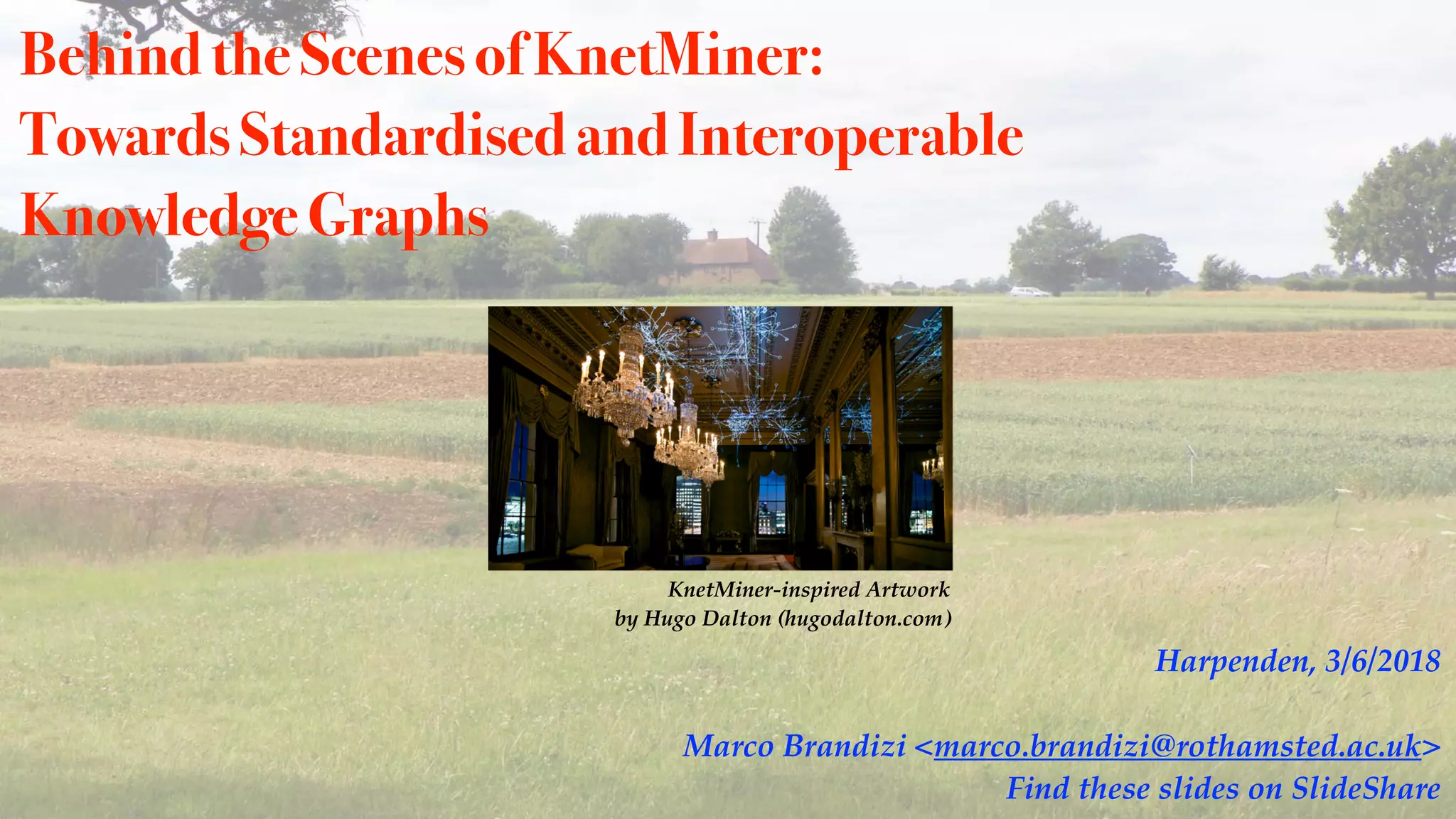
KnetMiner-inspired Artwork

by Hugo Dalton (hugodalton.com)
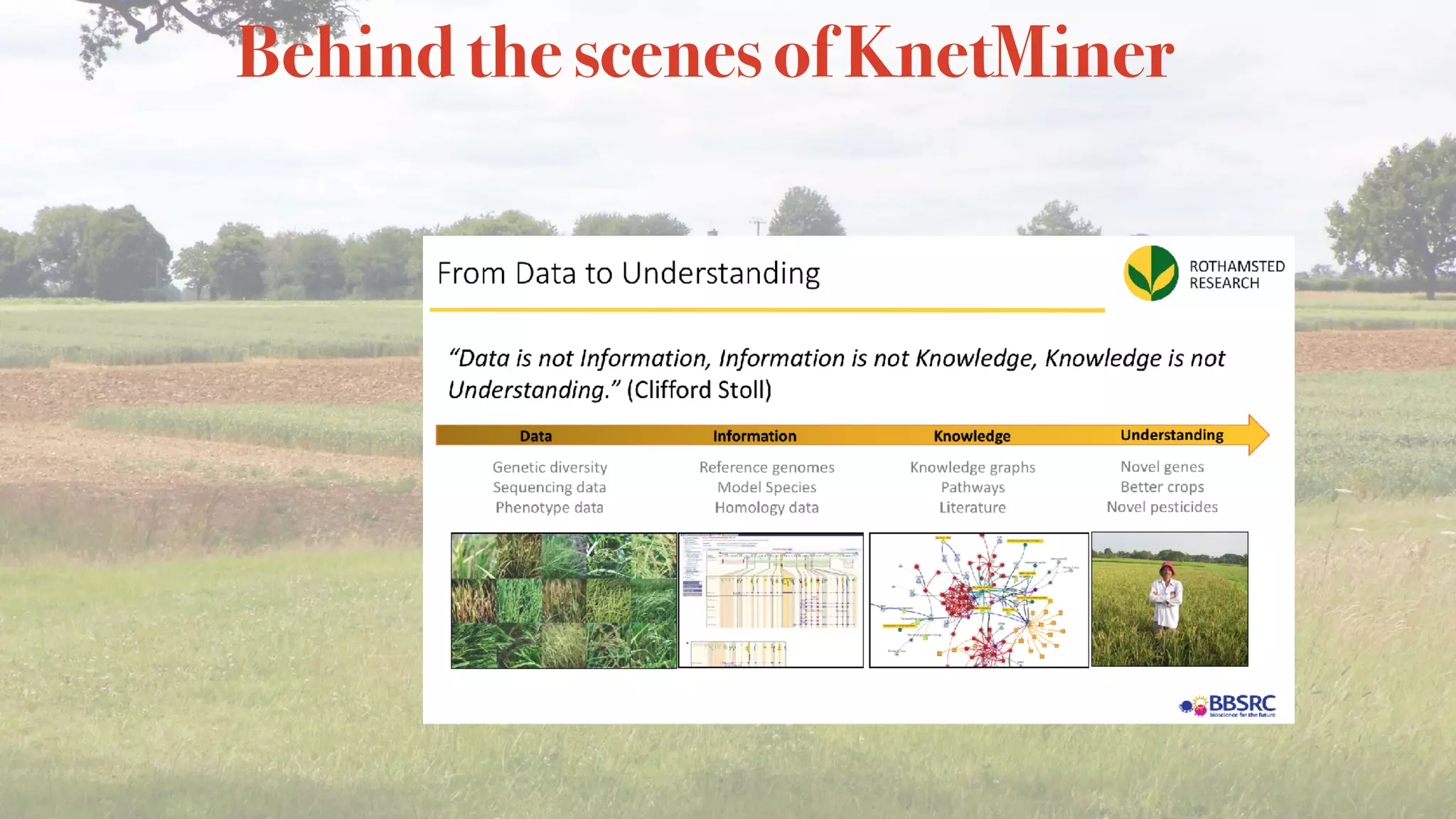
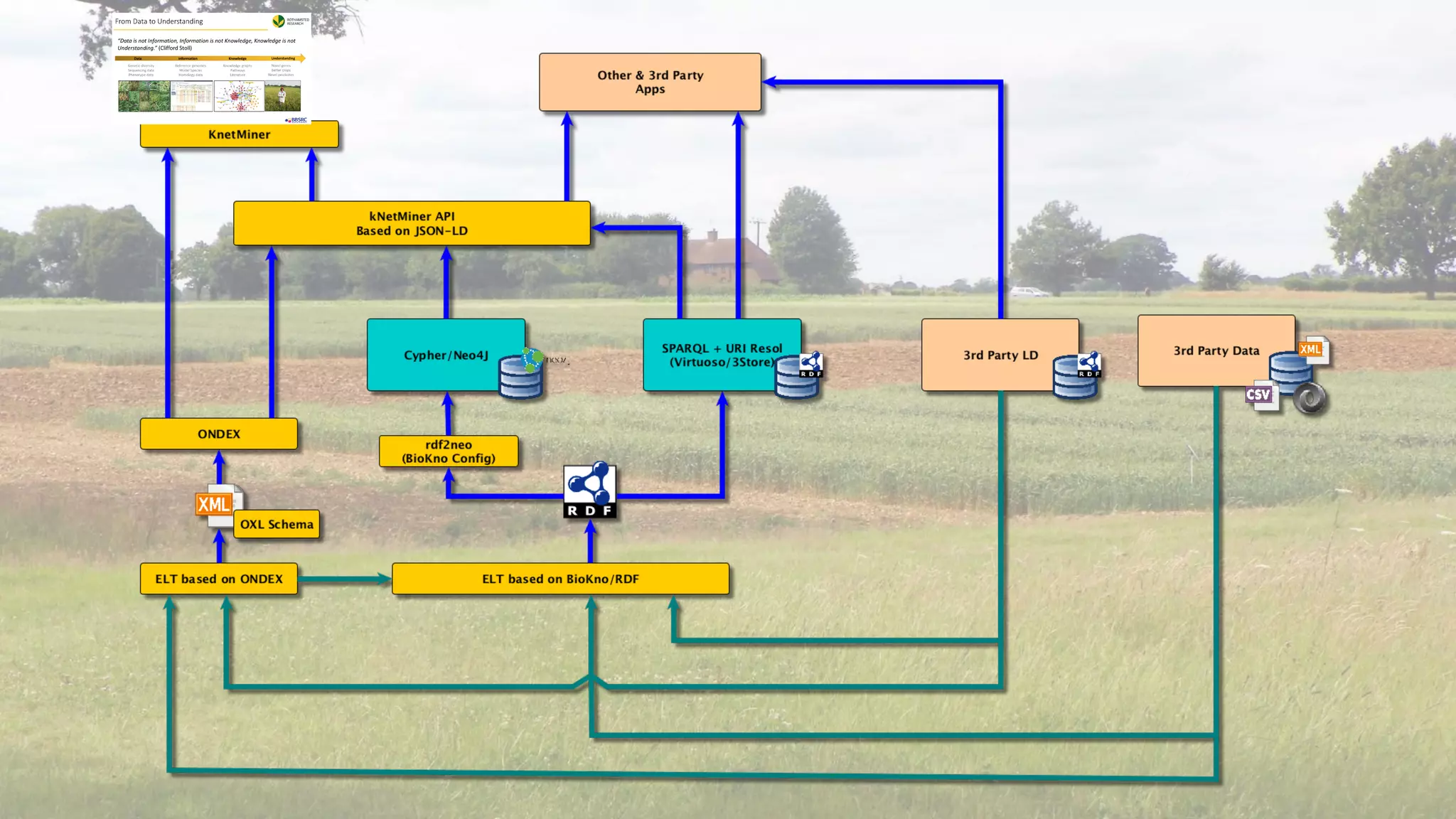
Behind the scenes of KnetMiner
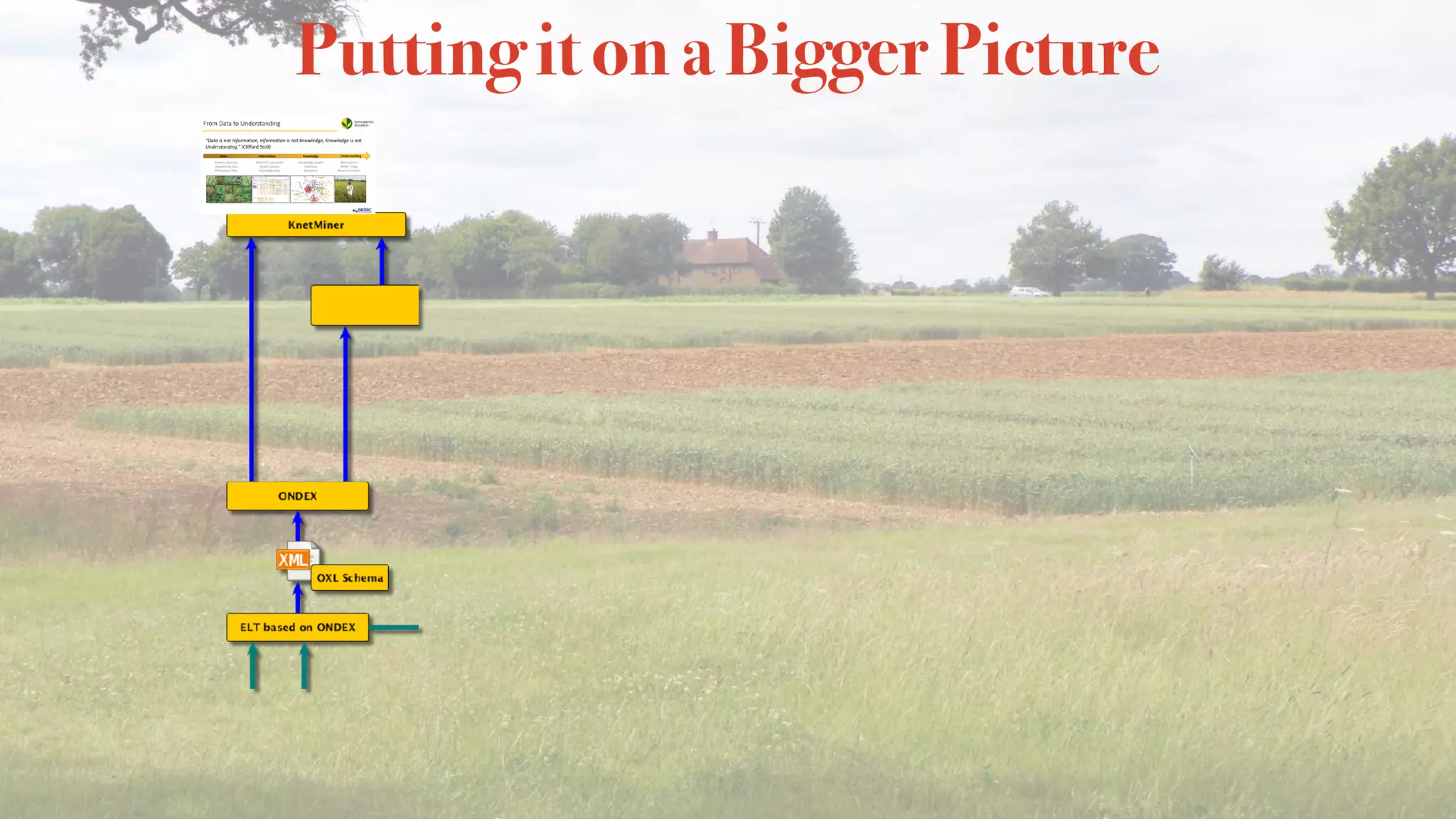
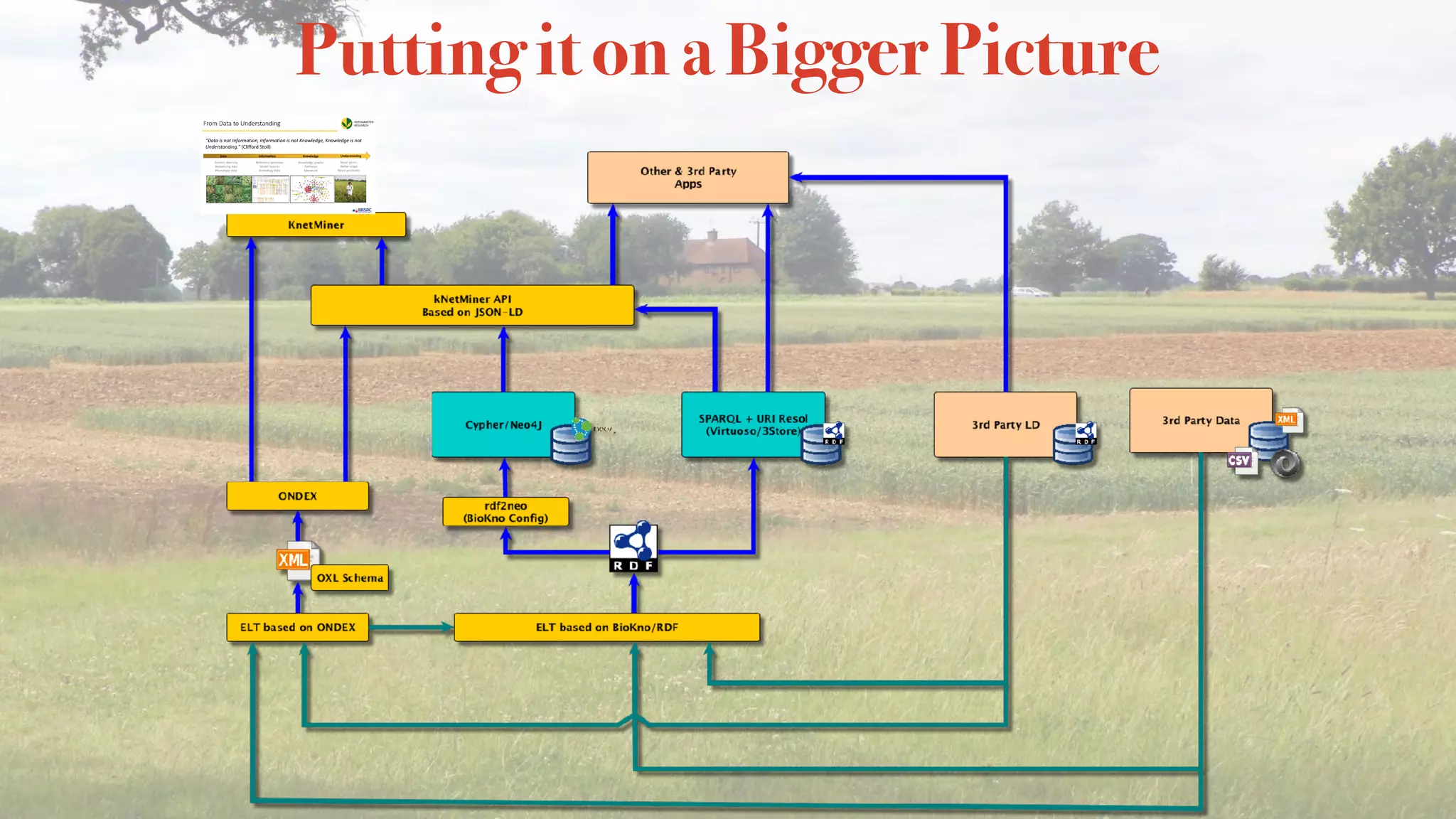
Putting it on a Bigger Picture
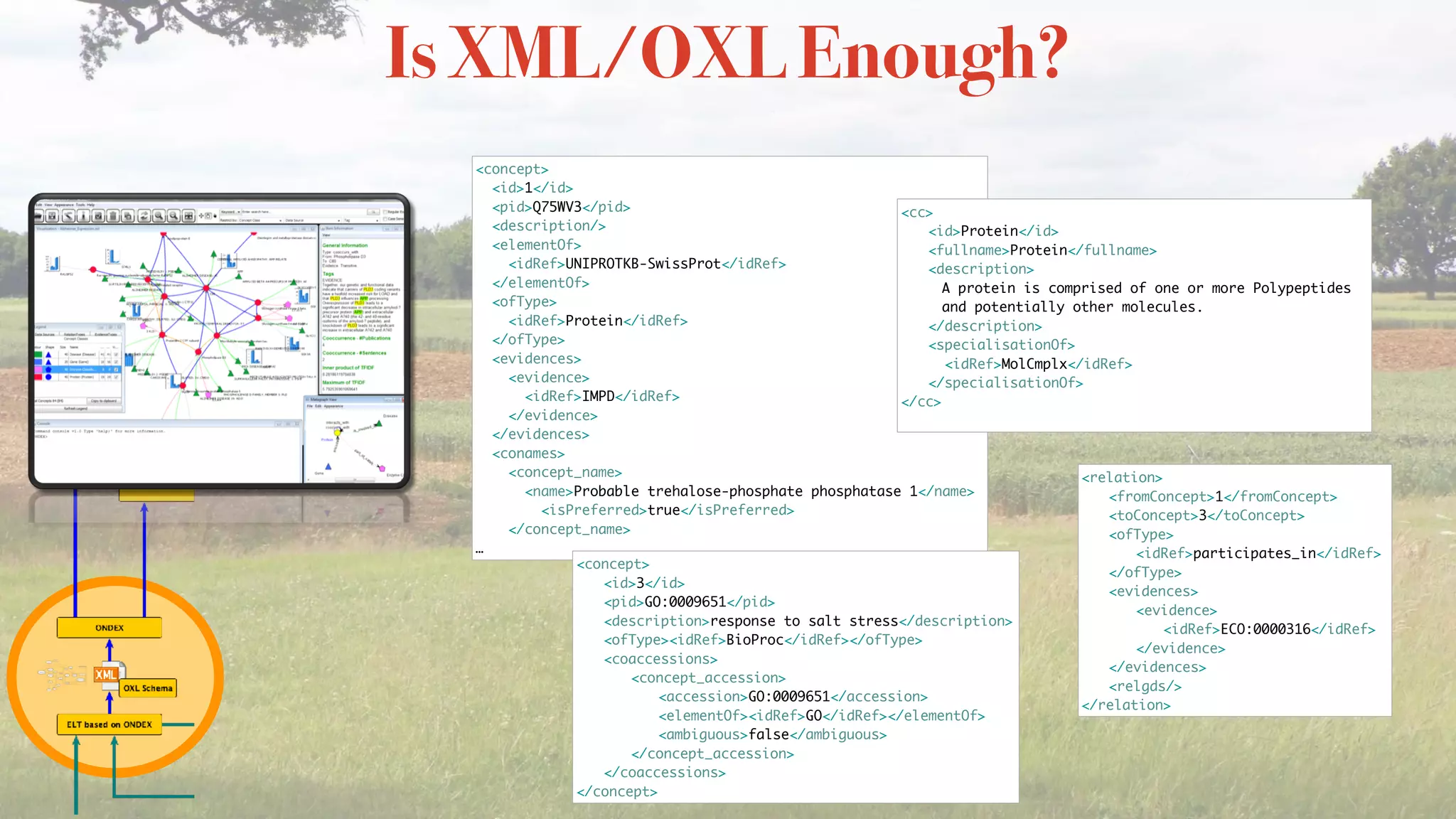
<concept>
<id>1</id>
<pid>Q75WV3</pid>
<description/>
<elementOf>
<idRef>UNIPROTKB-SwissProt</idRef>
</elementOf>
<ofType>
<idRef>Protein</idRef>
</ofType>
<evidences>
<evidence>
<idRef>IMPD</idRef>
</evidence>
</evidences>
<conames>
<concept_name>
<name>Probable trehalose-phosphate phosphatase 1</name>
<isPreferred>true</isPreferred>
</concept_name>
…
<cc>
<id>Protein</id>
<fullname>Protein</fullname>
<description>
A protein is comprised of one or more Polypeptides
and potentially other molecules.
</description>
<specialisationOf>
<idRef>MolCmplx</idRef>
</specialisationOf>
</cc>
<relation>
<fromConcept>1</fromConcept>
<toConcept>3</toConcept>
<ofType>
<idRef>participates_in</idRef>
</ofType>
<evidences>
<evidence>
<idRef>ECO:0000316</idRef>
</evidence>
</evidences>
<relgds/>
</relation>
<concept>
<id>3</id>
<pid>GO:0009651</pid>
<description>response to salt stress</description>
<ofType><idRef>BioProc</idRef></ofType>
<coaccessions>
<concept_accession>
<accession>GO:0009651</accession>
<elementOf><idRef>GO</idRef></elementOf>
<ambiguous>false</ambiguous>
</concept_accession>
</coaccessions>
</concept>
Is XML/OXL Enough?
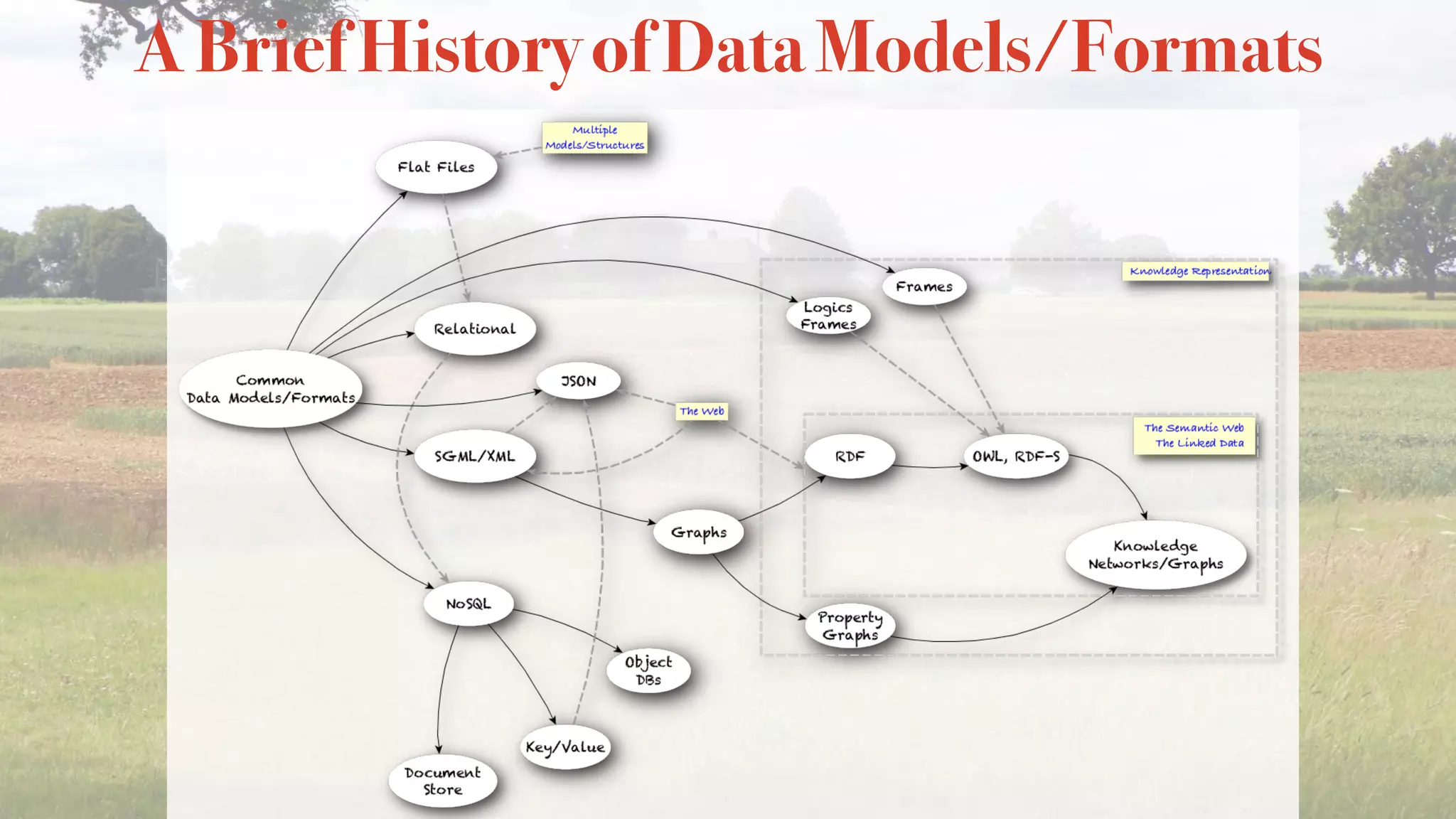
A Brief History of Data Models/Formats
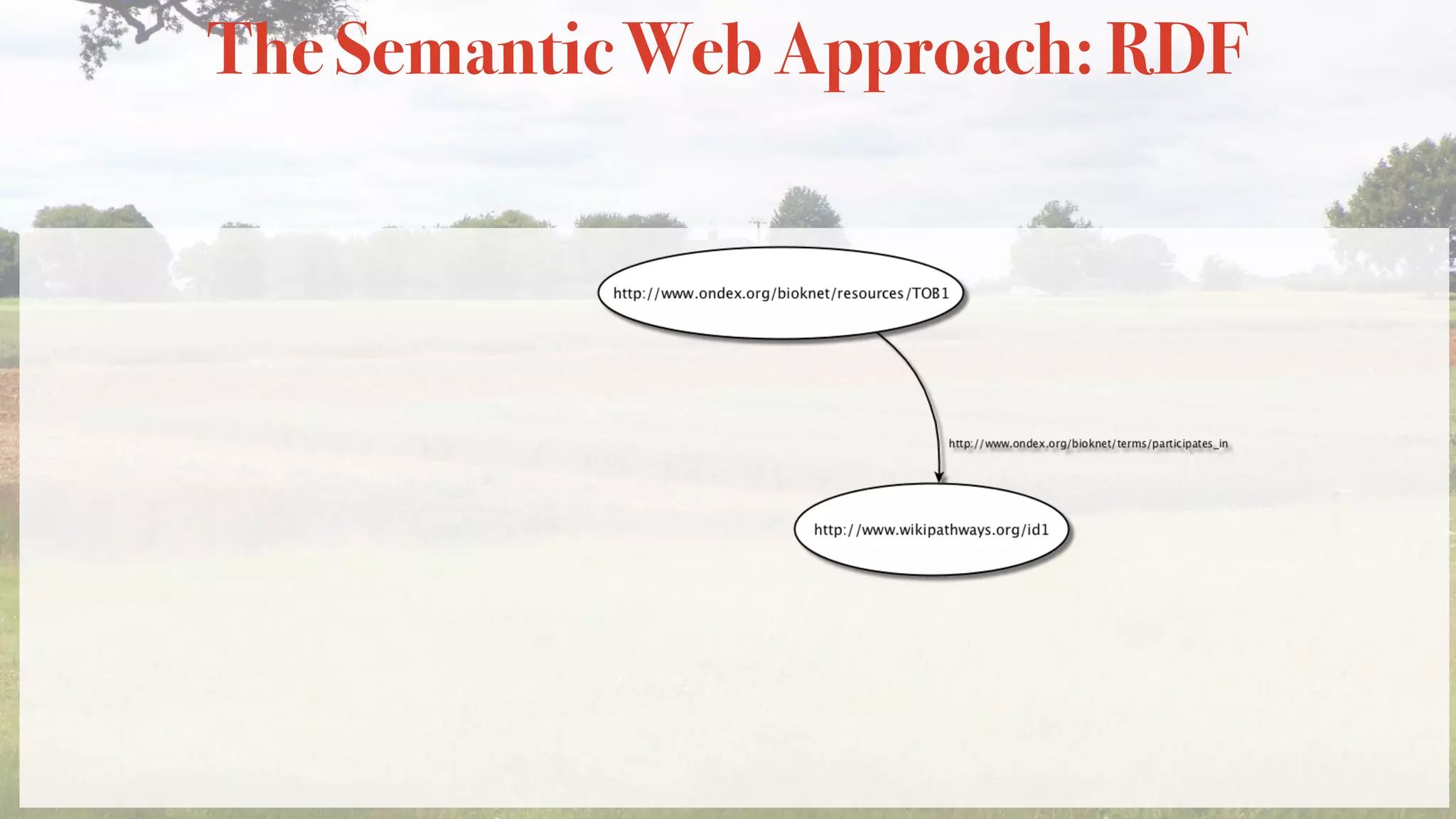
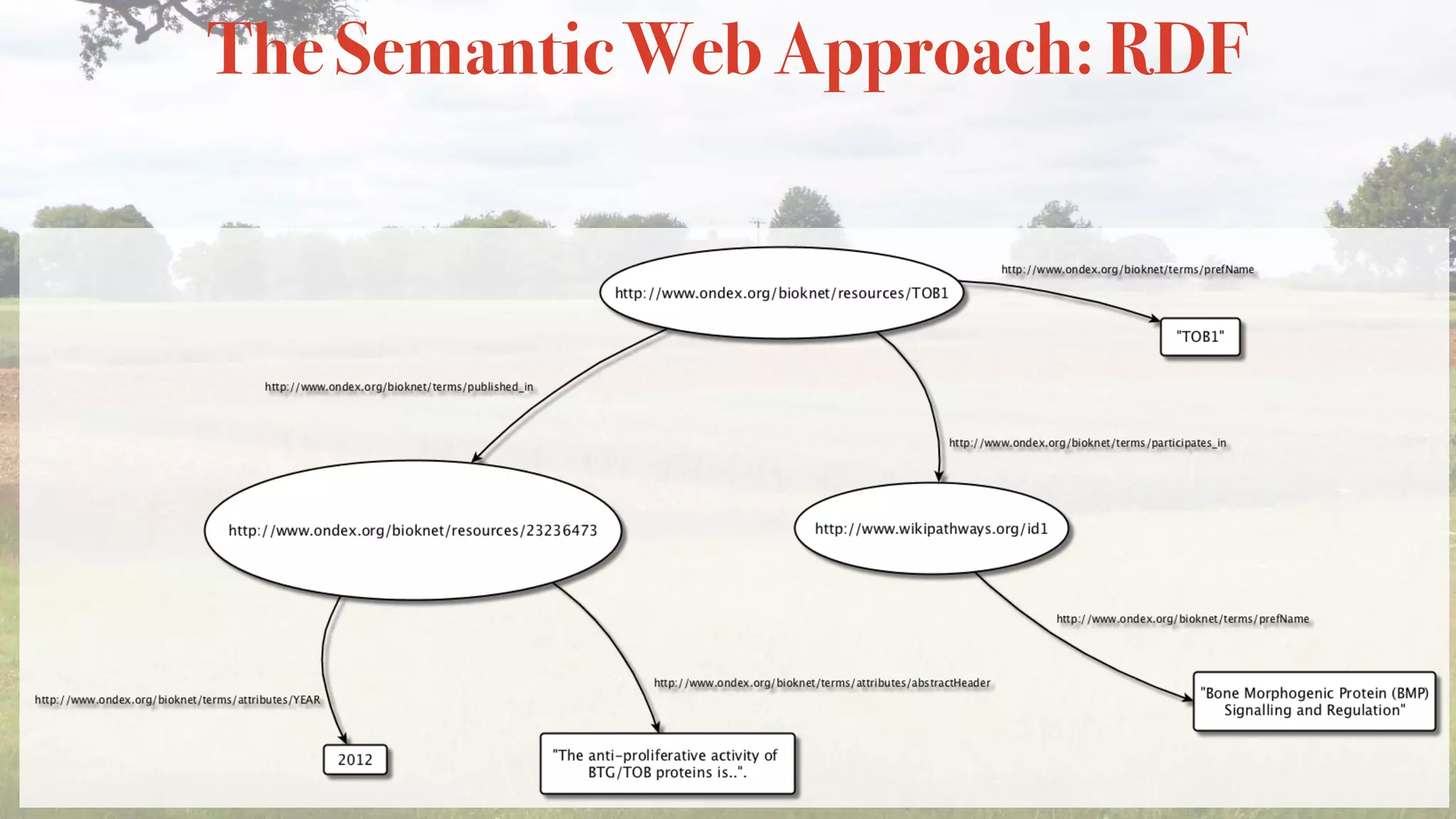
The Semantic Web Approach: RDF
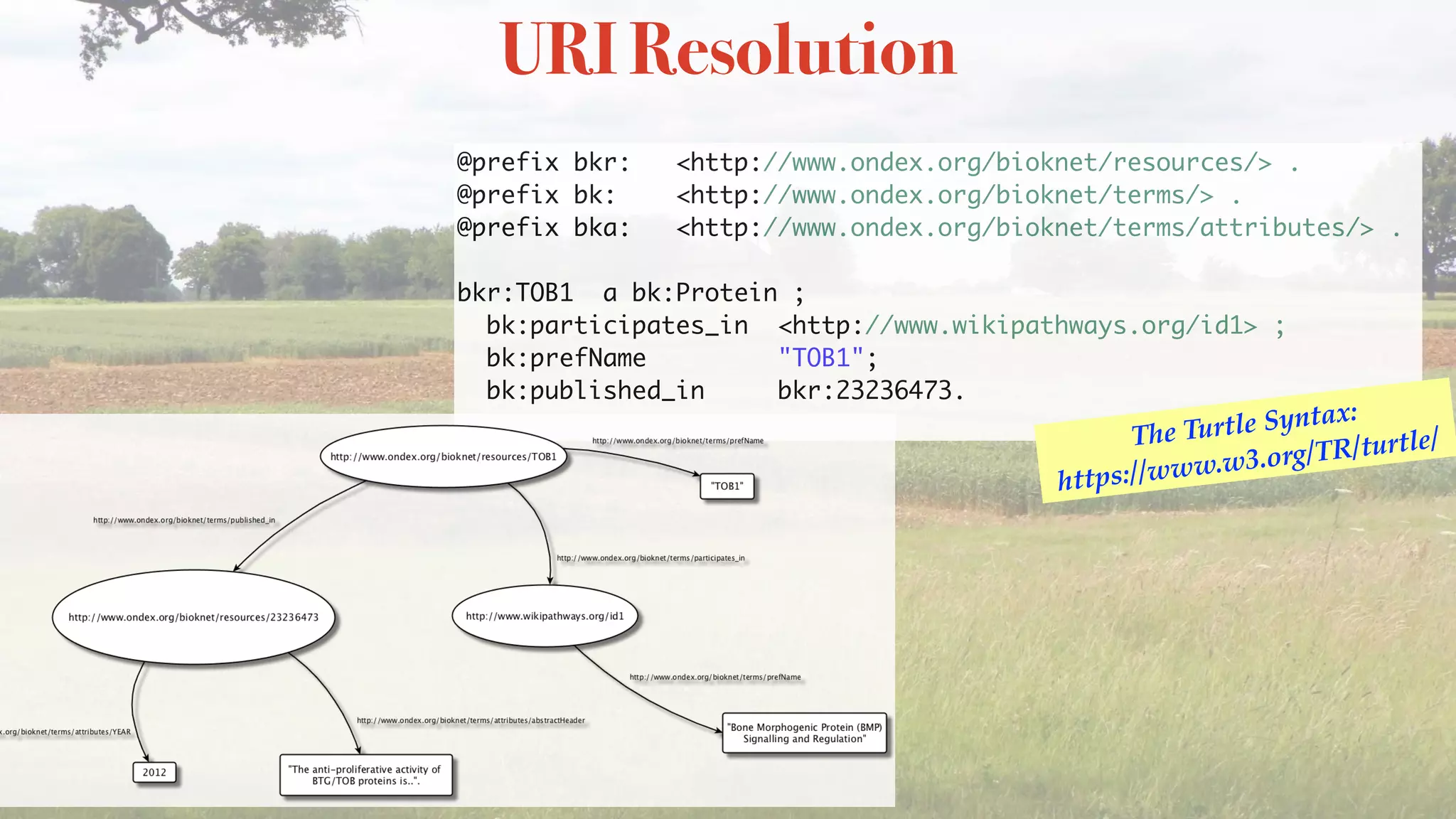
URI Resolution
@prefix bkr: <http://www.ondex.org/bioknet/resources/> .
@prefix bk: <http://www.ondex.org/bioknet/terms/> .
@prefix bka: <http://www.ondex.org/bioknet/terms/attributes/> .
bkr:TOB1 a bk:Protein ;
bk:participates_in <http://www.wikipathways.org/id1> ;
bk:prefName "TOB1";
bk:published_in bkr:23236473.

The Turtle Syntax:
https://www.w3.org/TR/turtle/
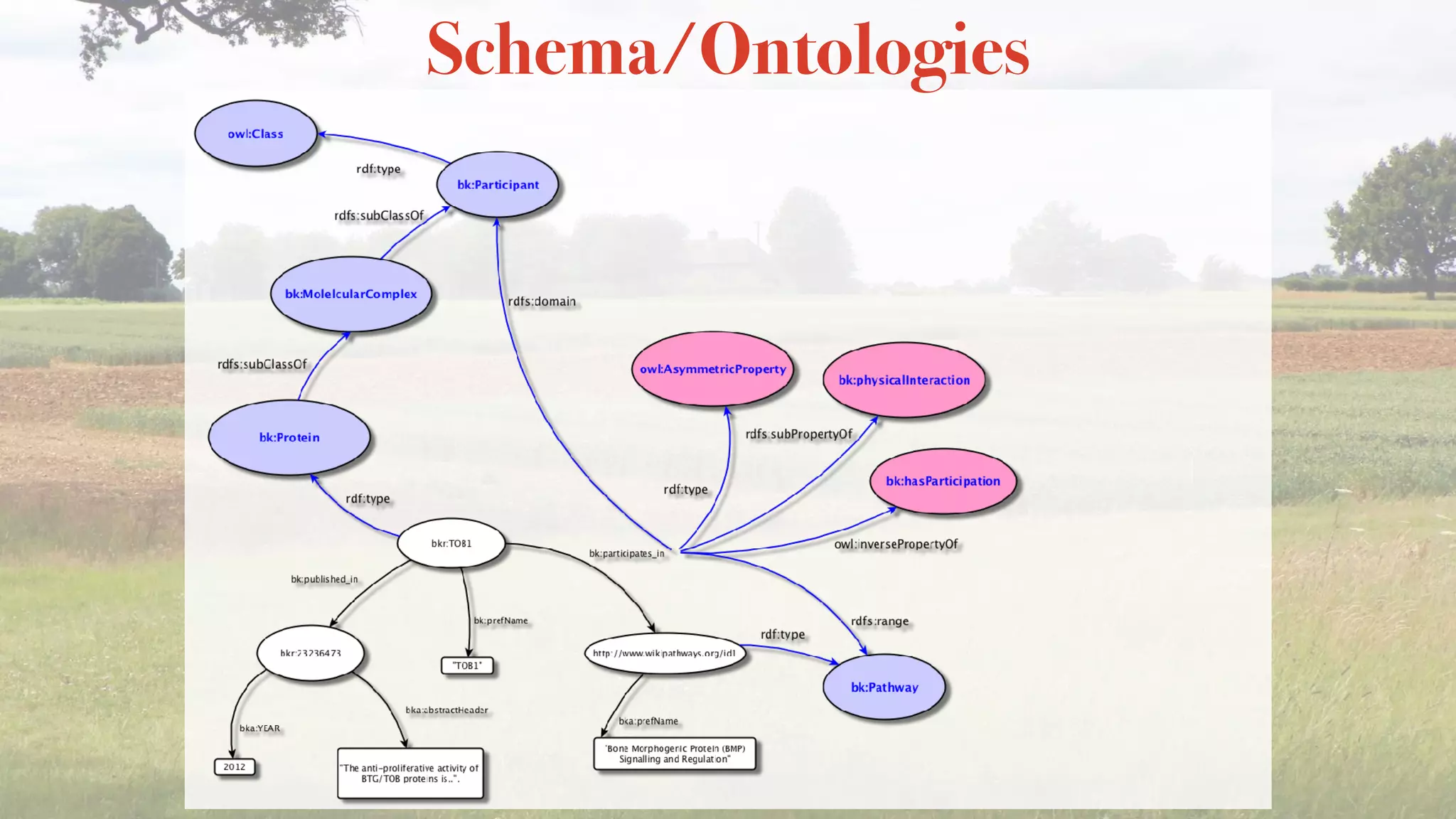
Schema/Ontologies
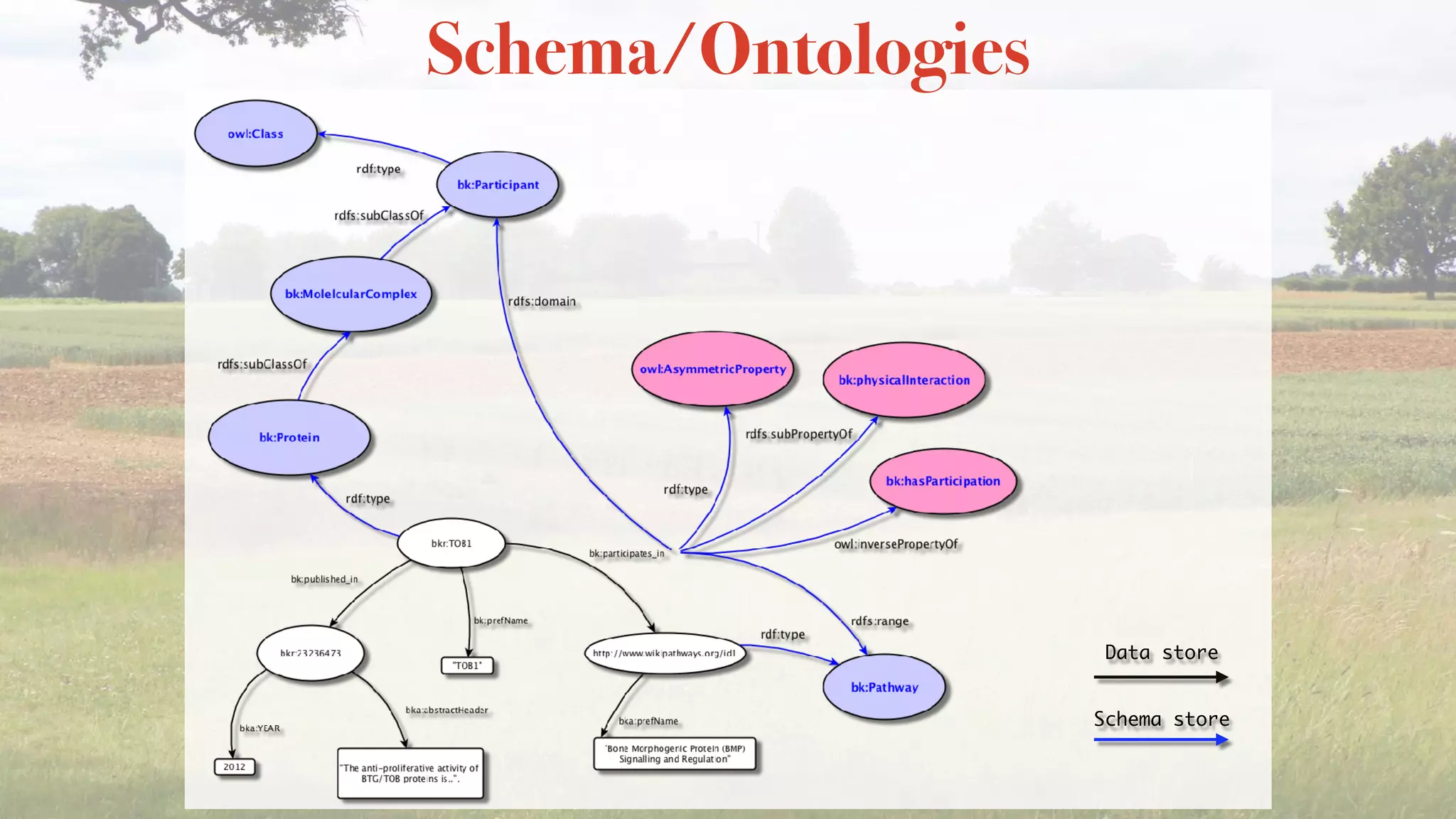
Schema/Ontologies
Data store
Schema store
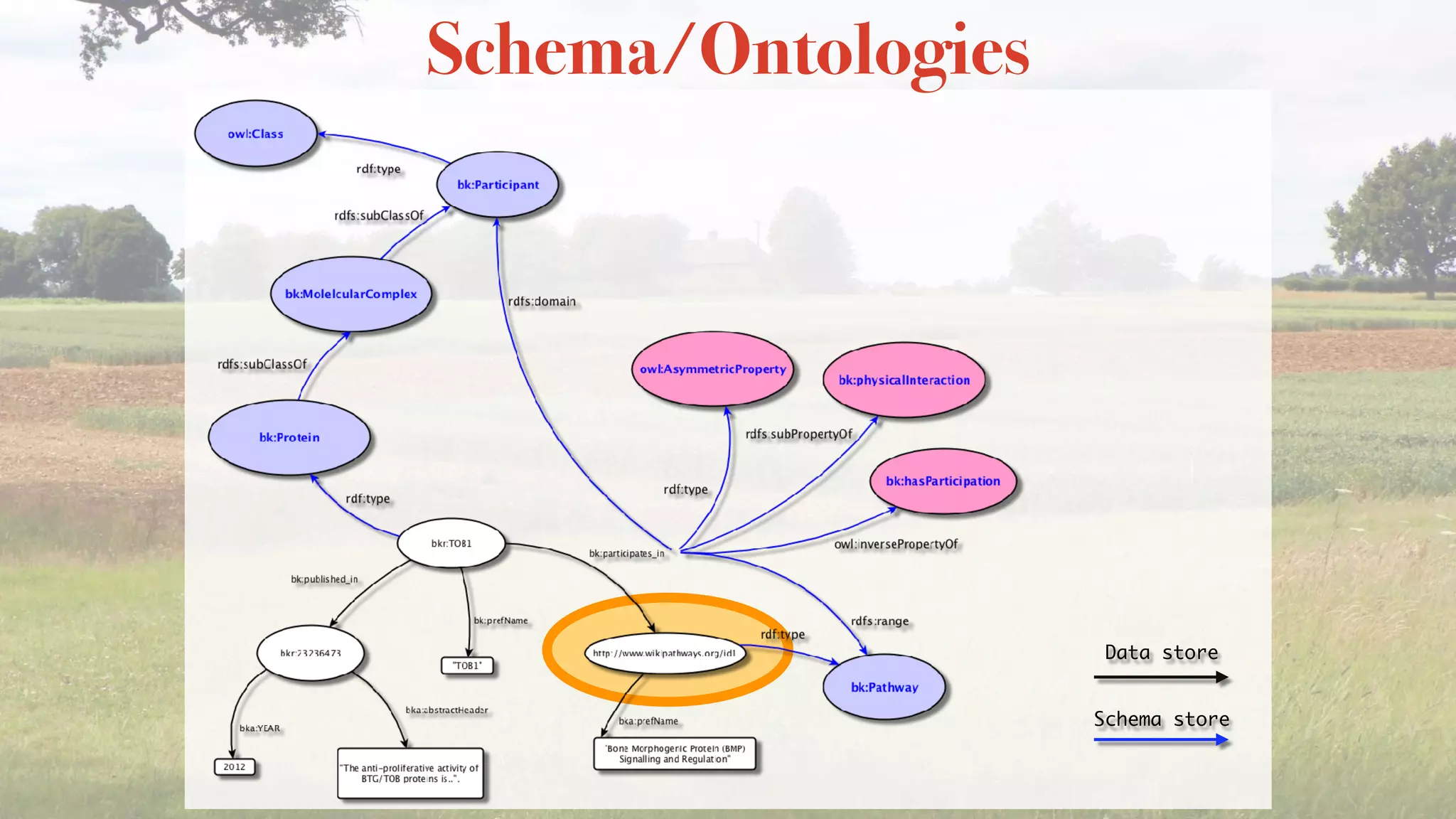
Schema/Ontologies
Data store
Schema store
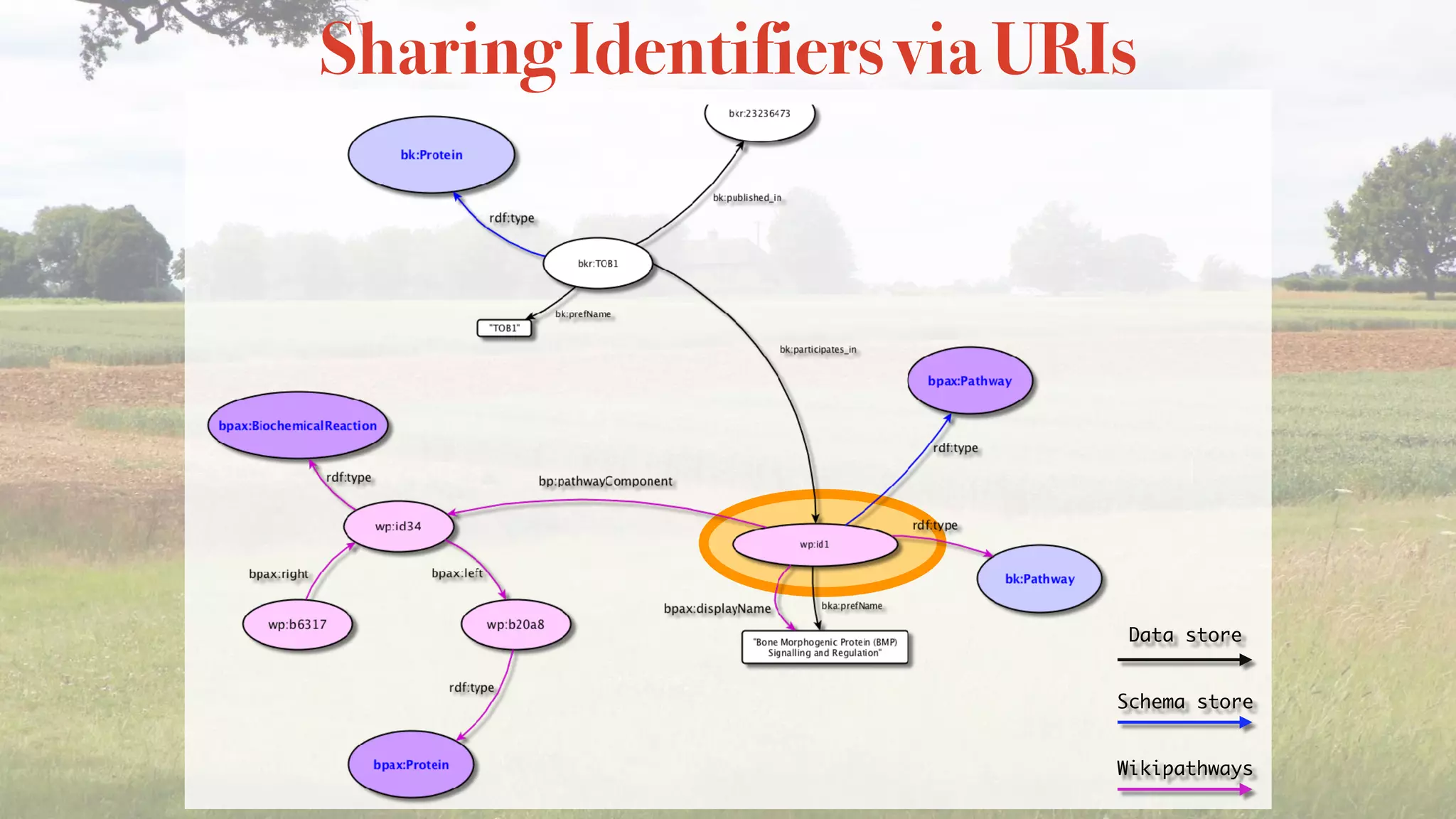
Sharing Identifiers via URIs
Data store
Schema store
Wikipathways
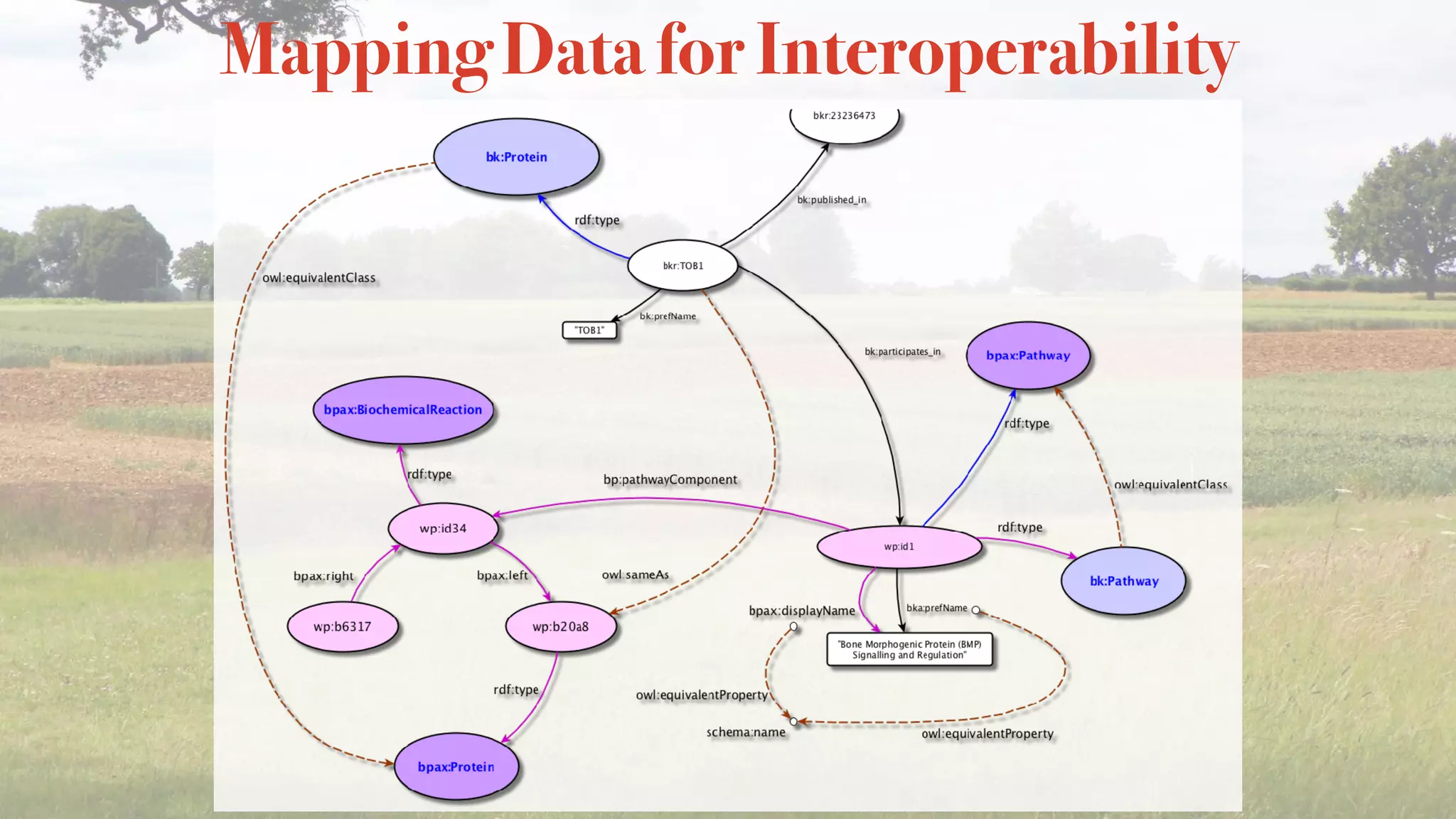
Mapping Data for Interoperability
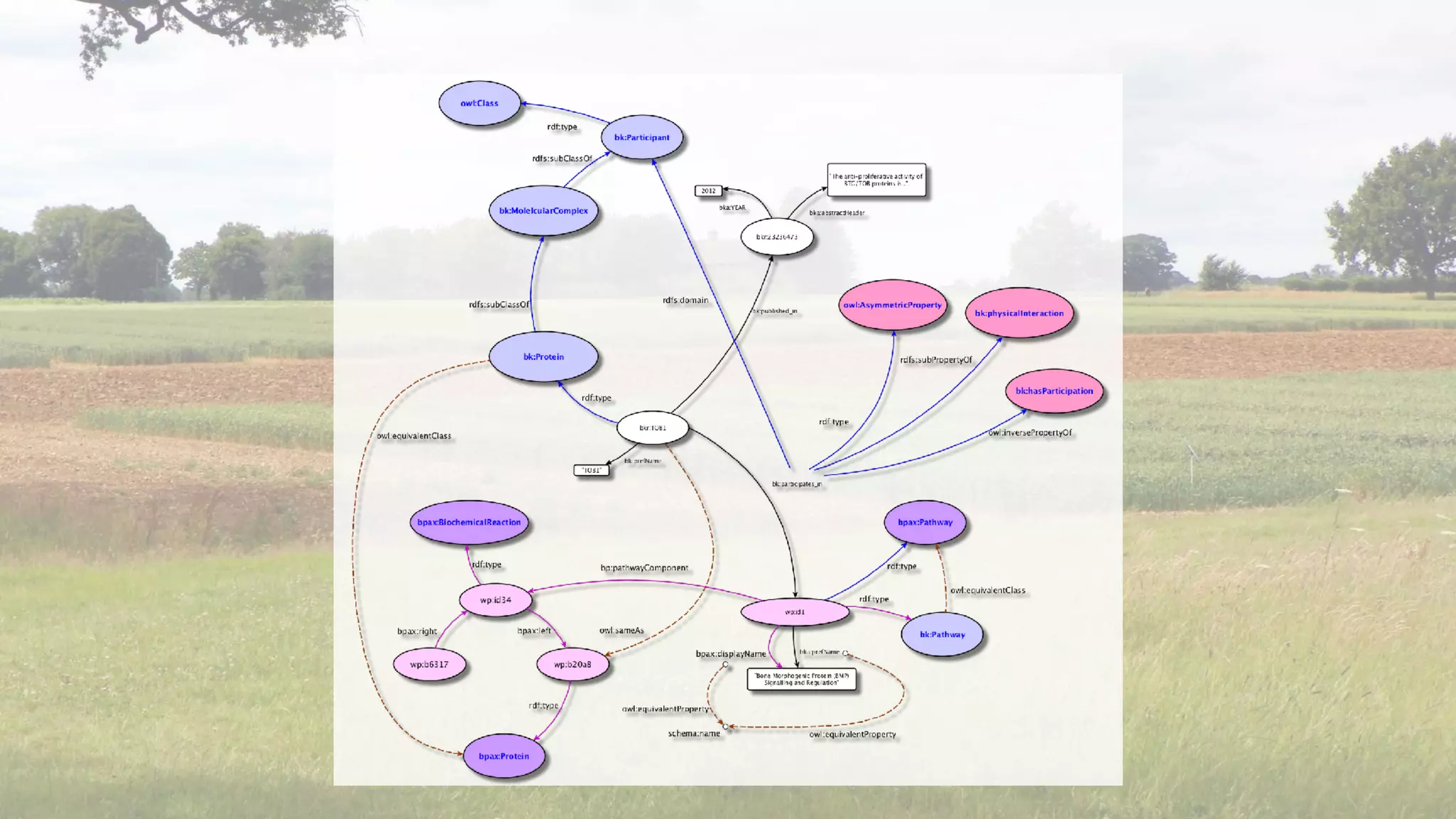
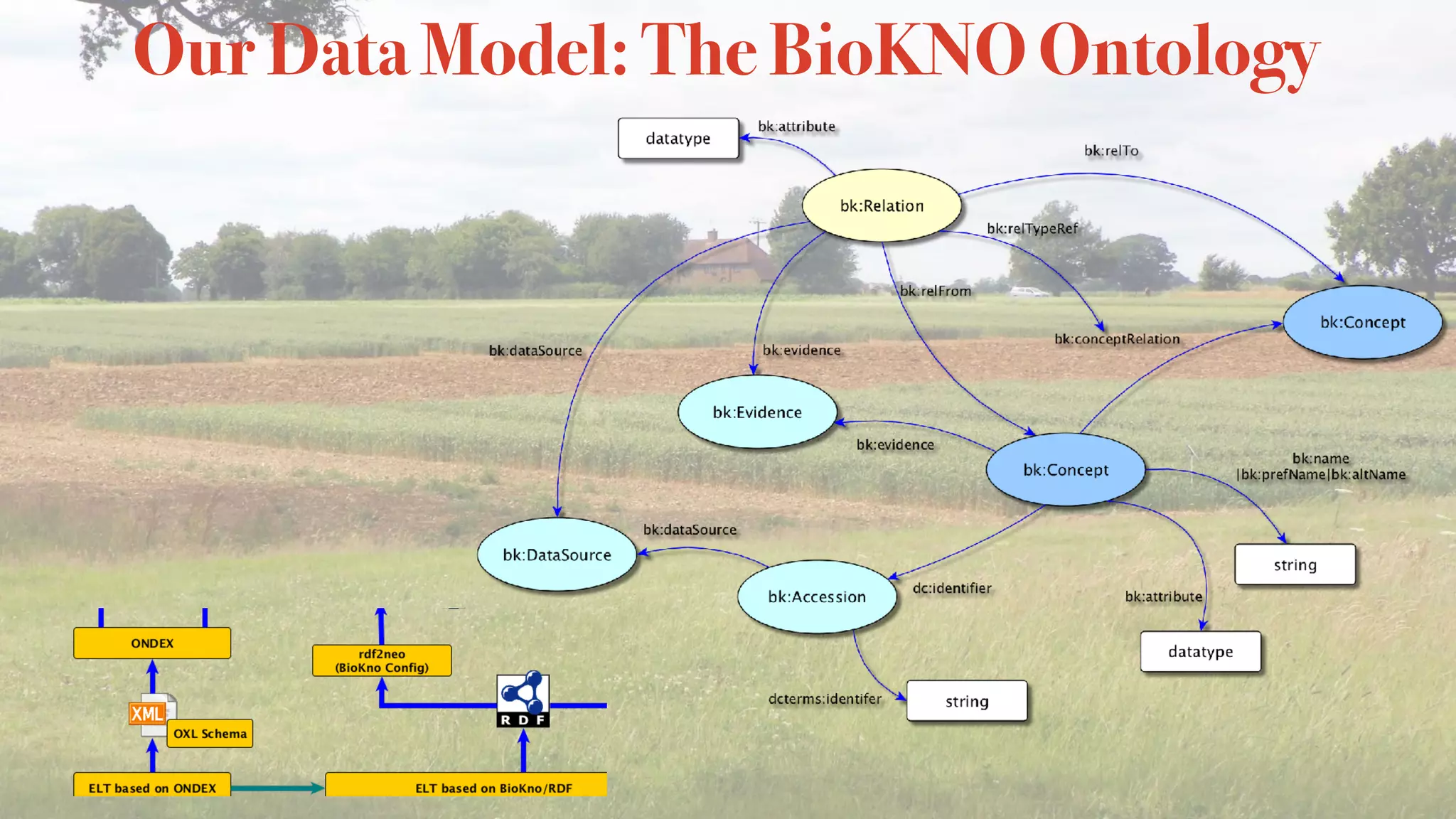
Our Data Model: The BioKNO Ontology
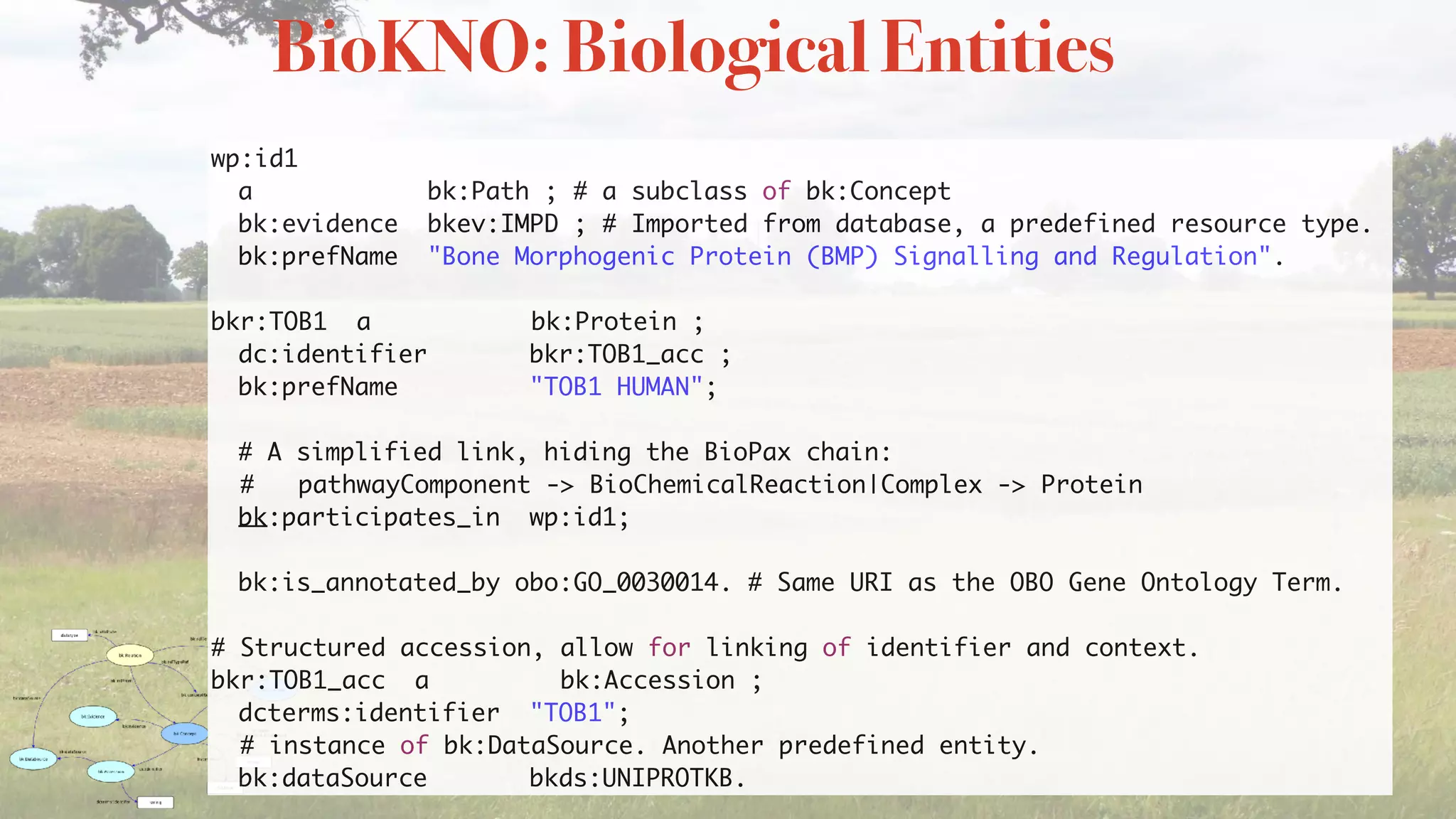
wp:id1
a bk:Path ; # a subclass of bk:Concept
bk:evidence bkev:IMPD ; # Imported from database, a predefined resource type.
bk:prefName "Bone Morphogenic Protein (BMP) Signalling and Regulation".
bkr:TOB1 a bk:Protein ;
dc:identifier bkr:TOB1_acc ;
bk:prefName "TOB1 HUMAN";

# A simplified link, hiding the BioPax chain:
# pathwayComponent -> BioChemicalReaction|Complex -> Protein
bk:participates_in wp:id1;


bk:is_annotated_by obo:GO_0030014. # Same URI as the OBO Gene Ontology Term.
# Structured accession, allow for linking of identifier and context.
bkr:TOB1_acc a bk:Accession ;
dcterms:identifier "TOB1";
# instance of bk:DataSource. Another predefined entity.
bk:dataSource bkds:UNIPROTKB.
BioKNO: Biological Entities
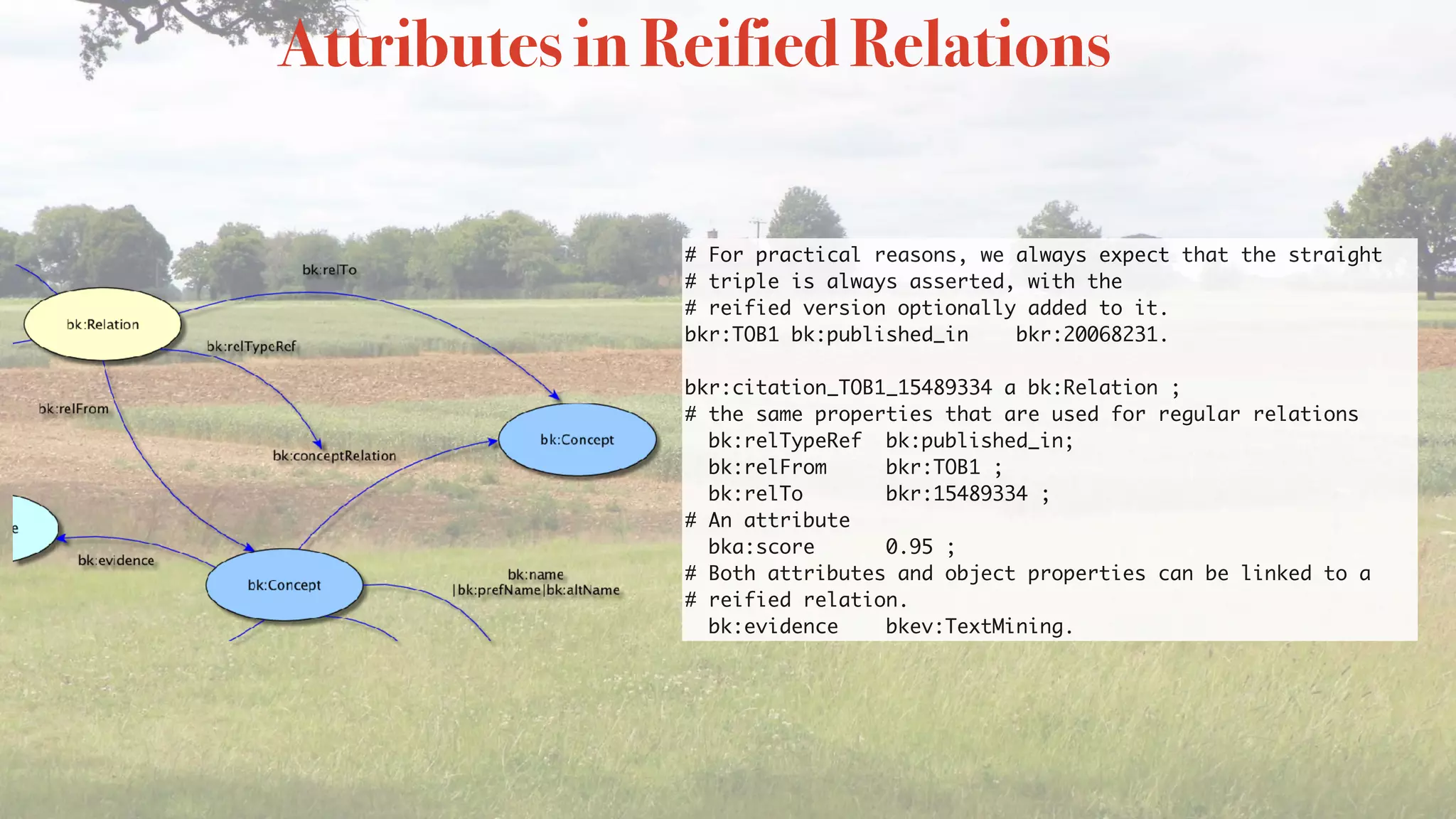
# For practical reasons, we always expect that the straight
# triple is always asserted, with the
# reified version optionally added to it.
bkr:TOB1 bk:published_in bkr:20068231.
bkr:citation_TOB1_15489334 a bk:Relation ;
# the same properties that are used for regular relations
bk:relTypeRef bk:published_in;
bk:relFrom bkr:TOB1 ;
bk:relTo bkr:15489334 ;
# An attribute
bka:score 0.95 ;

# Both attributes and object properties can be linked to a
# reified relation.
bk:evidence bkev:TextMining.
Attributes in Reified Relations
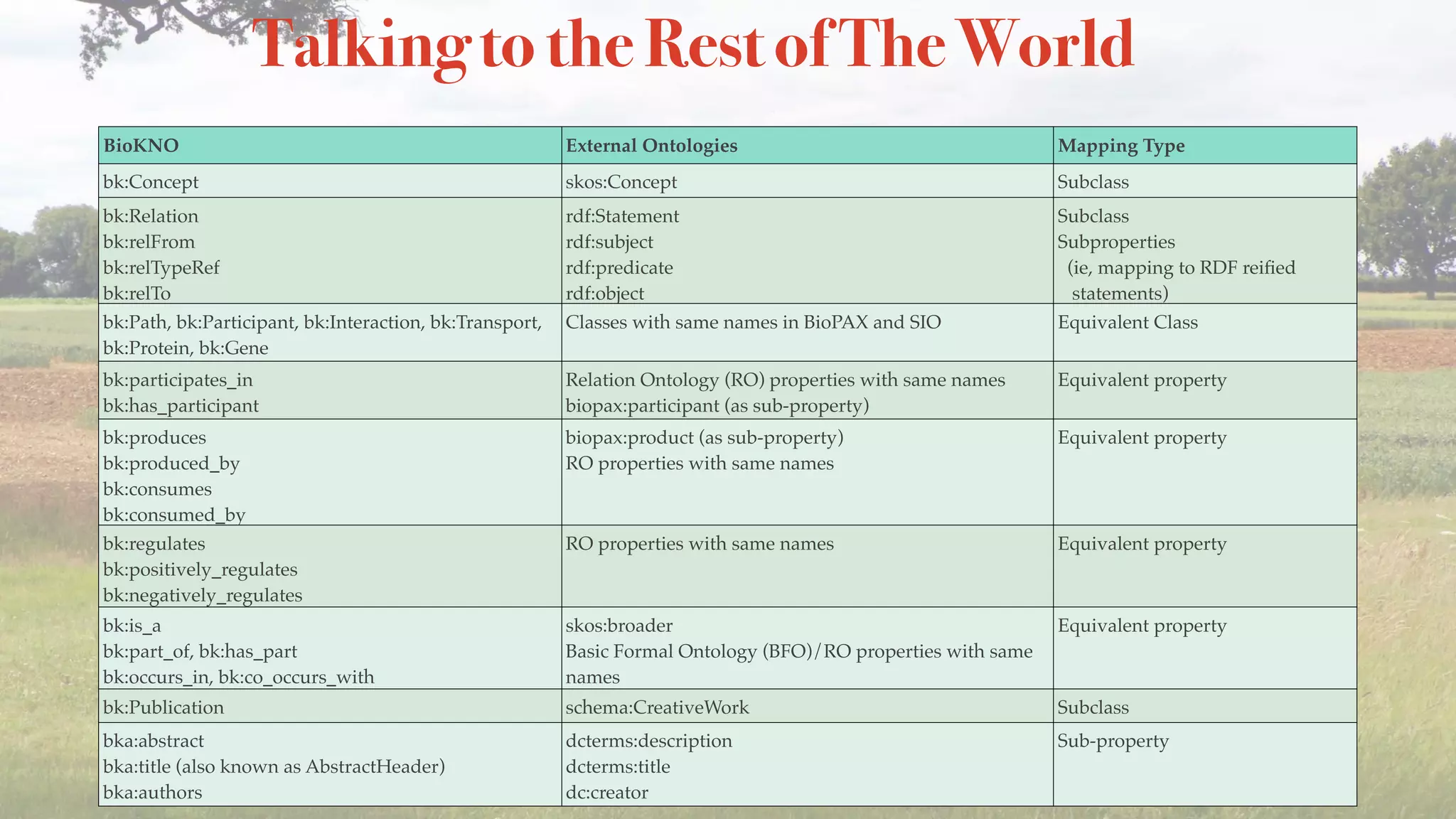
Talking to the Rest of The World
BioKNO External Ontologies Mapping Type
bk:Concept skos:Concept Subclass
bk:Relation
bk:relFrom
bk:relTypeRef
bk:relTo
rdf:Statement

rdf:subject
rdf:predicate
rdf:object
Subclass
Subproperties
(ie, mapping to RDF reified
statements)
bk:Path, bk:Participant, bk:Interaction, bk:Transport,
bk:Protein, bk:Gene
Classes with same names in BioPAX and SIO Equivalent Class
bk:participates_in
bk:has_participant
Relation Ontology (RO) properties with same names

biopax:participant (as sub-property)
Equivalent property
bk:produces
bk:produced_by
bk:consumes
bk:consumed_by
biopax:product (as sub-property)
RO properties with same names
Equivalent property
bk:regulates
bk:positively_regulates
bk:negatively_regulates
RO properties with same names Equivalent property
bk:is_a
bk:part_of, bk:has_part
bk:occurs_in, bk:co_occurs_with
skos:broader
Basic Formal Ontology (BFO)/RO properties with same
names
Equivalent property
bk:Publication schema:CreativeWork Subclass
bka:abstract
bka:title (also known as AbstractHeader)
bka:authors
dcterms:description
dcterms:title
dc:creator
Sub-property
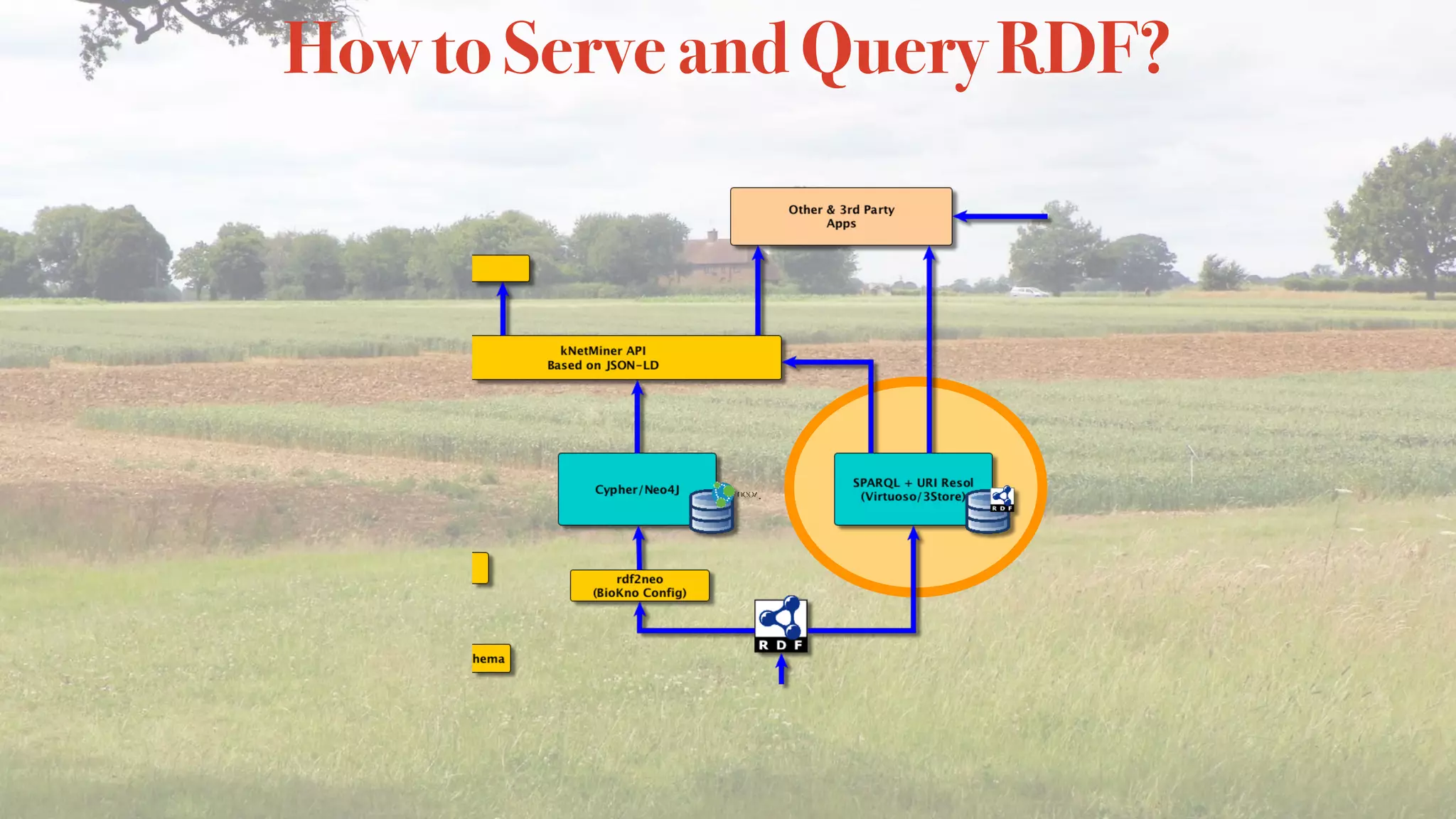
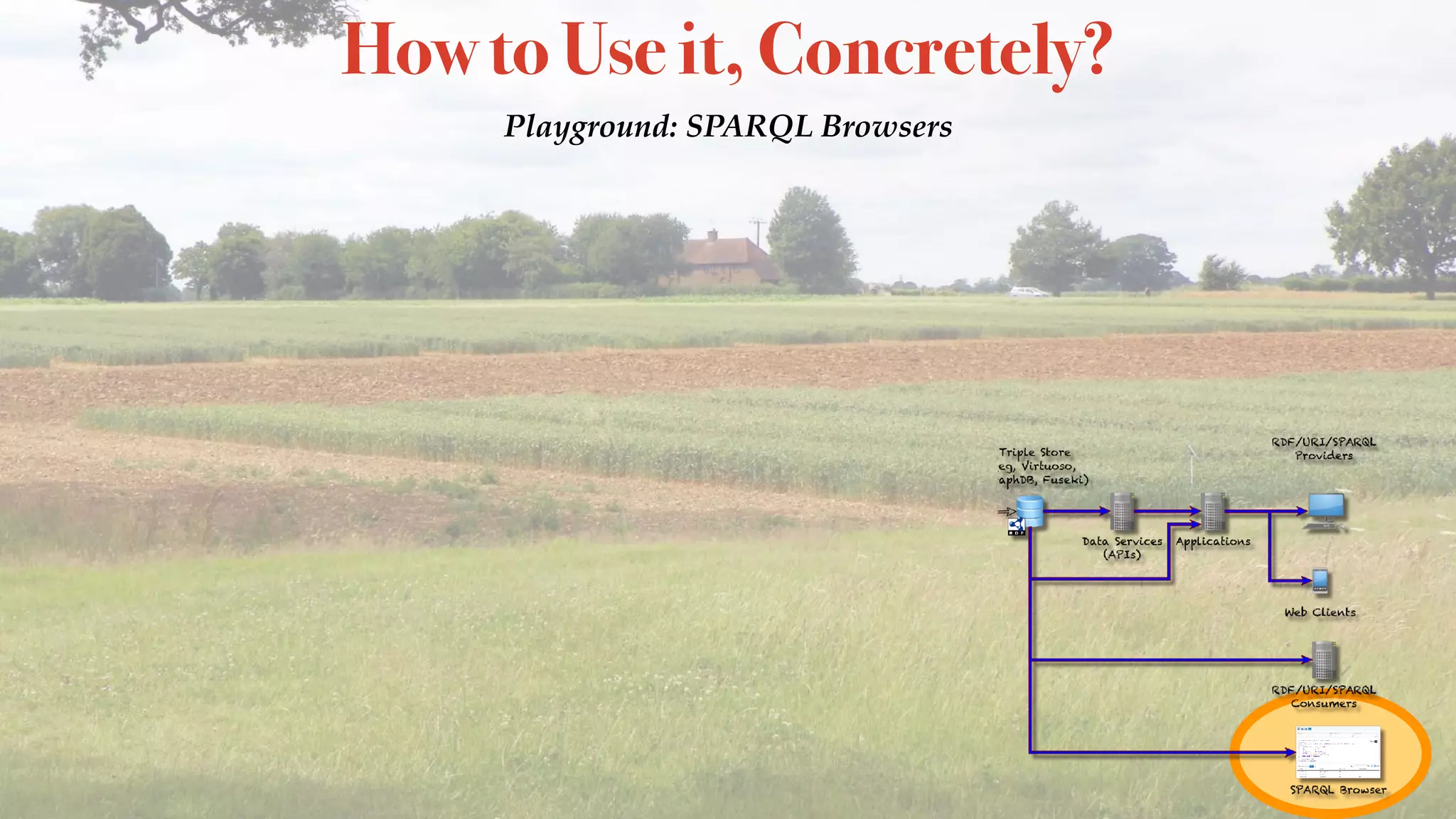
How to Serve and Query RDF?
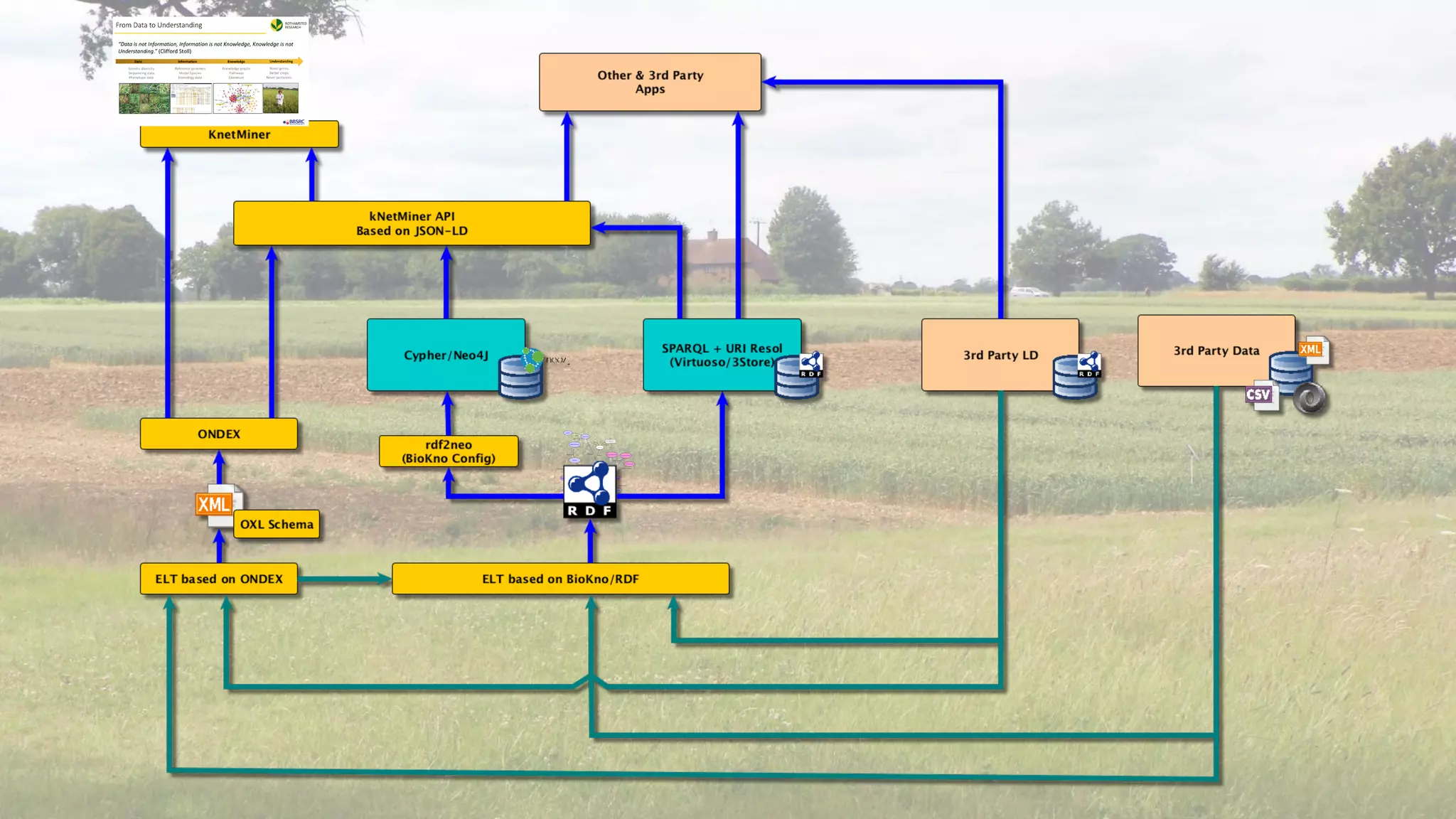
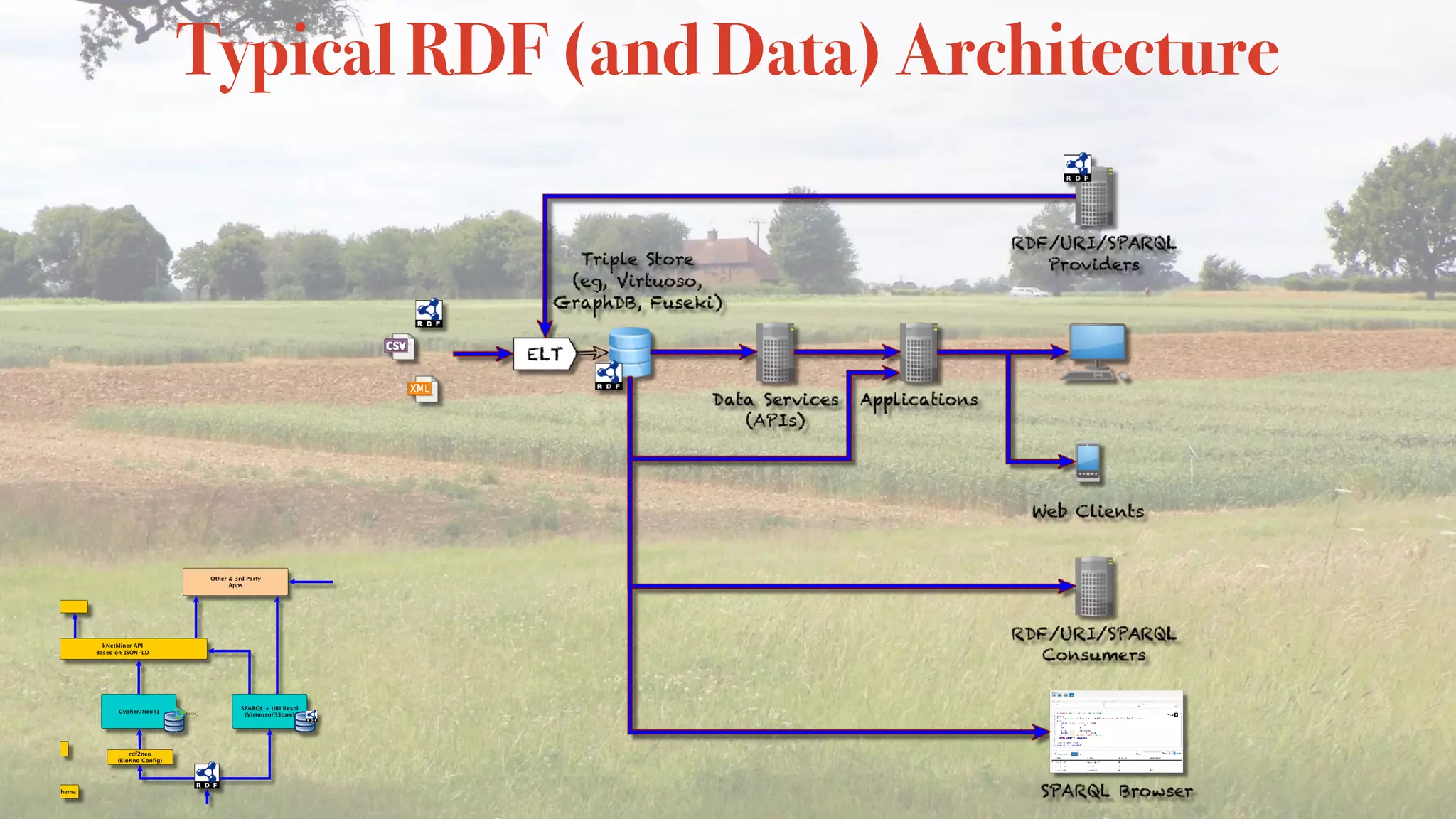
Typical RDF (and Data) Architecture
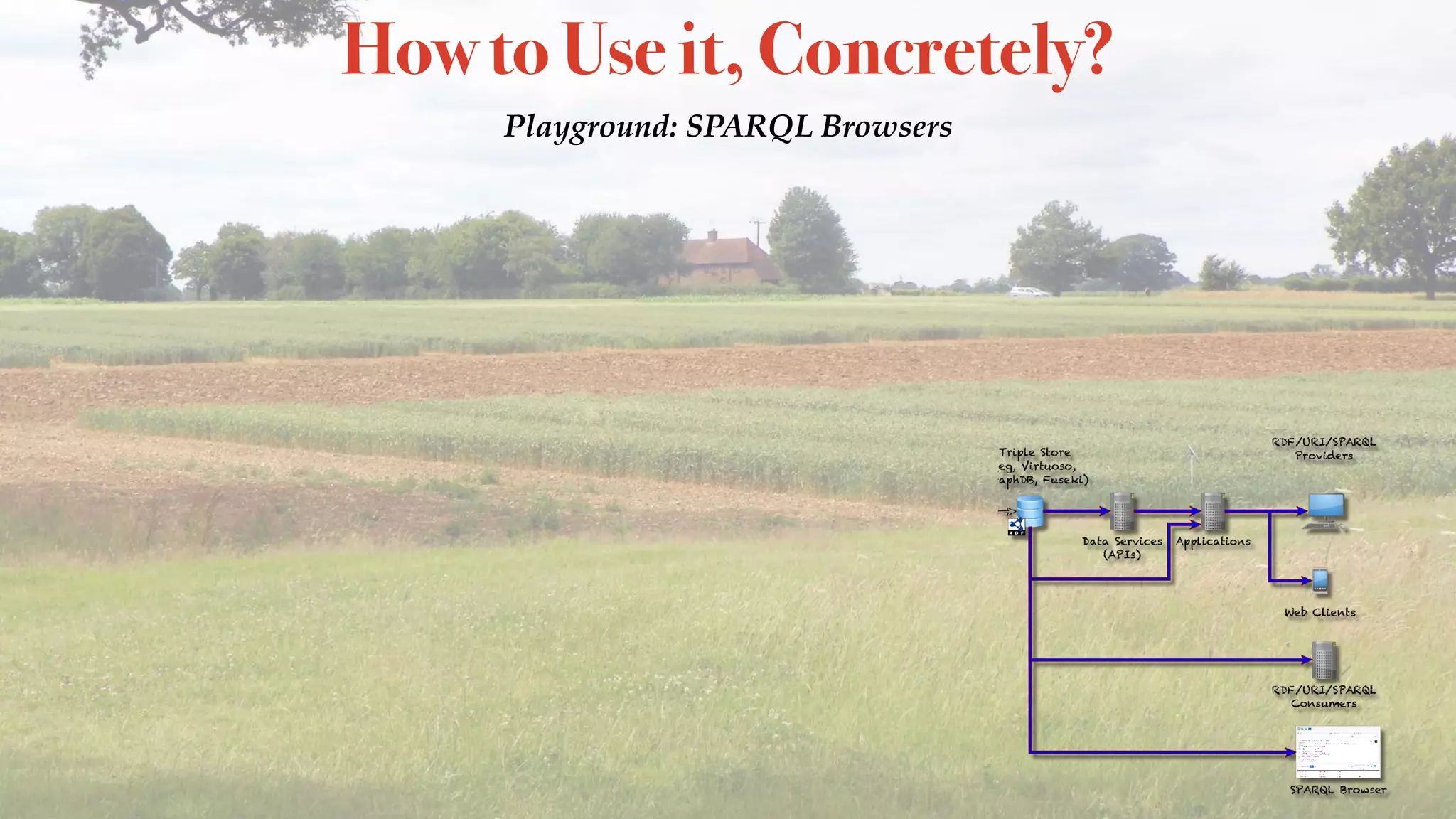
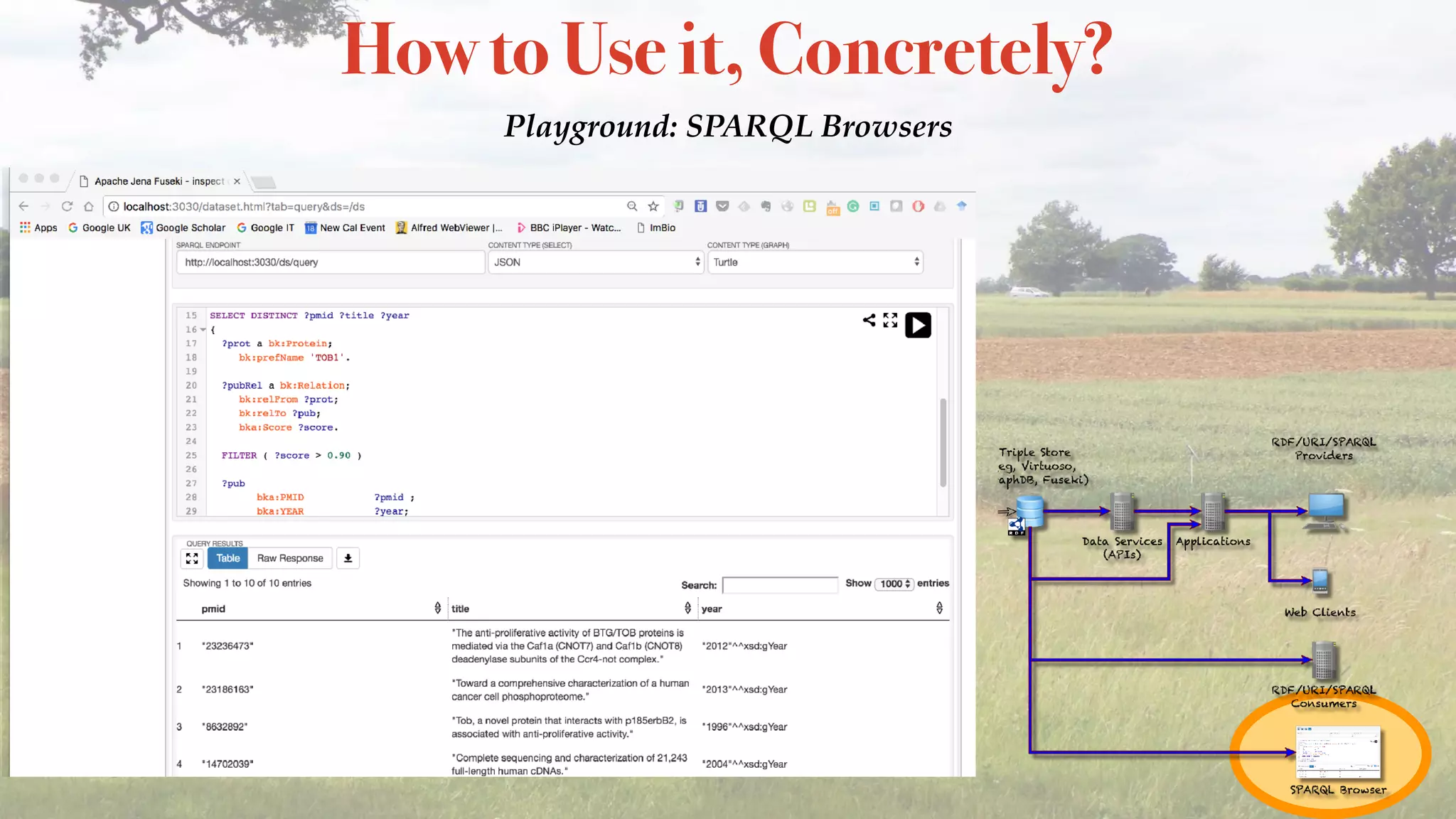
How to Use it, Concretely?
Playground: SPARQL Browsers
How to Use it, Concretely?
Playground: SPARQL Browsers
How to Use it, Concretely?
Playground: SPARQL Browsers
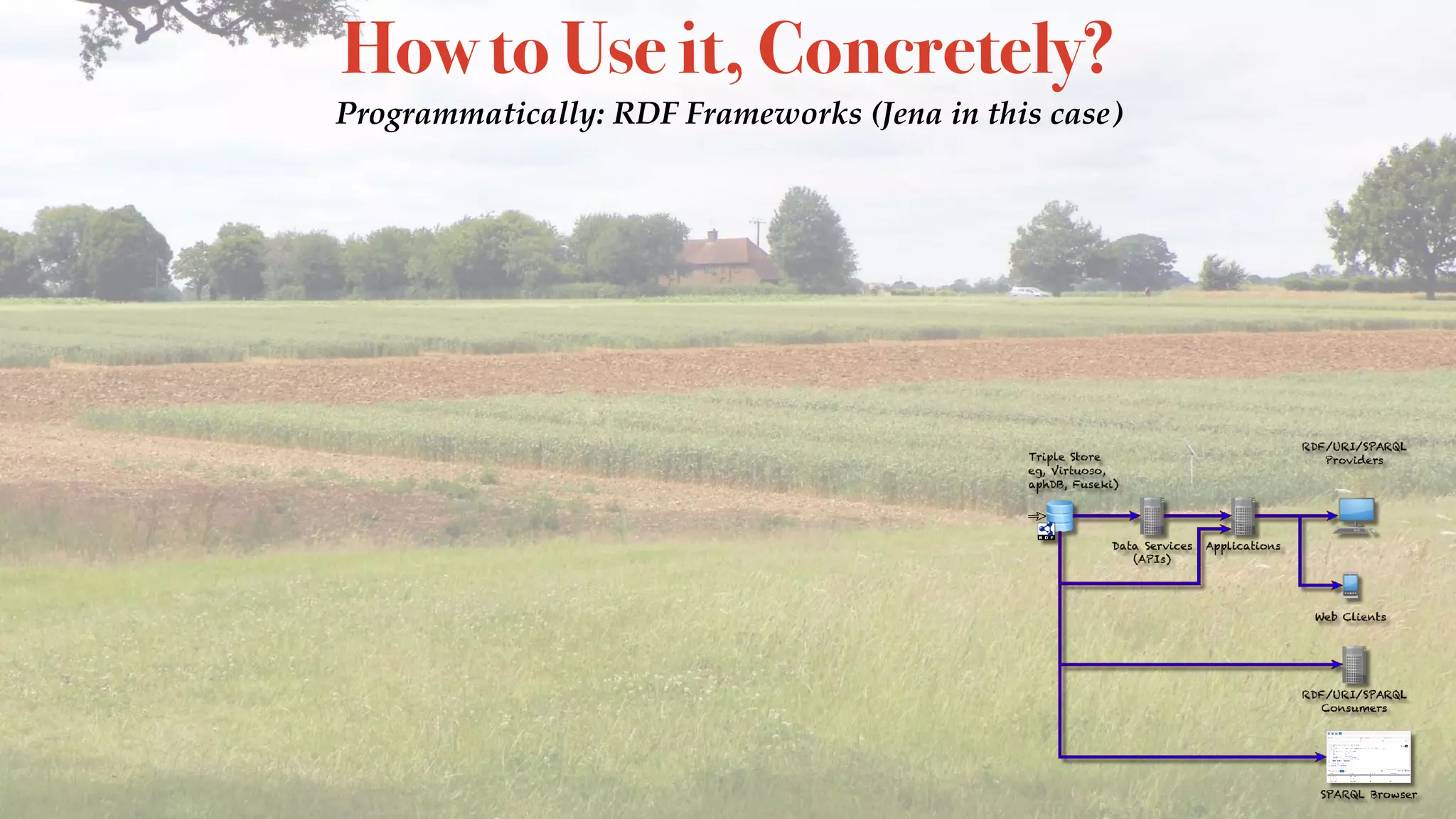
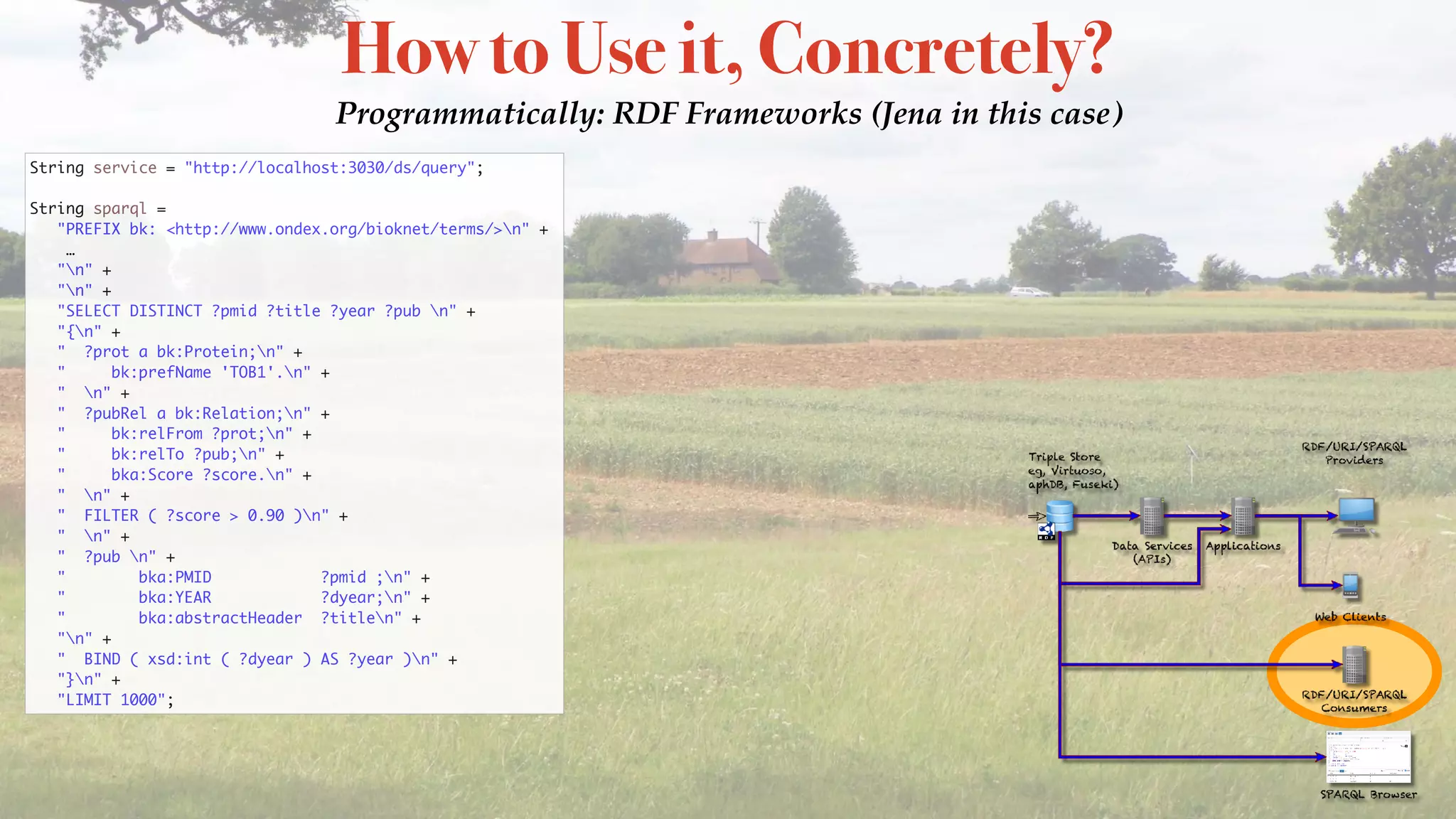
How to Use it, Concretely?
Programmatically: RDF Frameworks (Jena in this case)
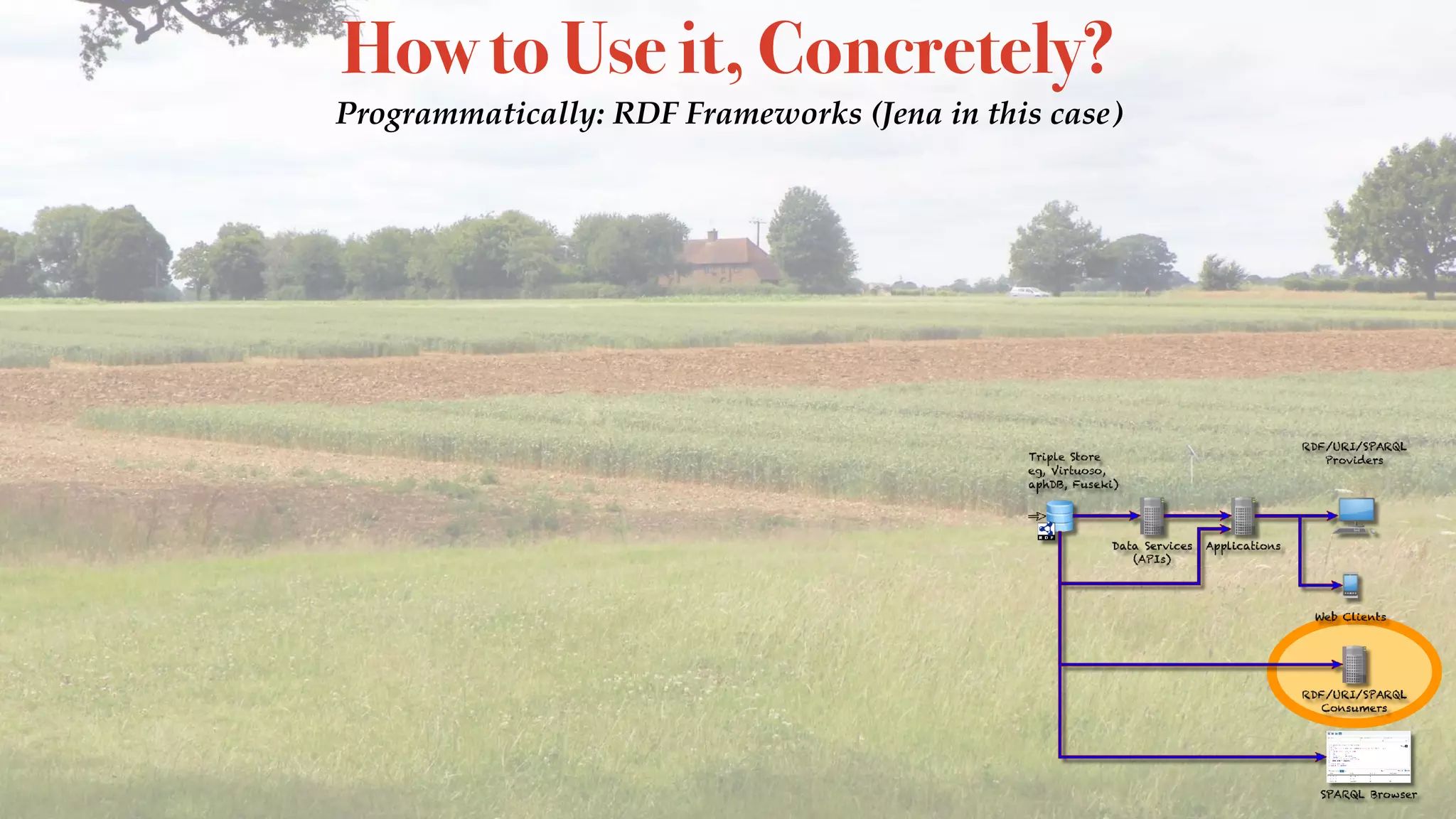
How to Use it, Concretely?
Programmatically: RDF Frameworks (Jena in this case)
How to Use it, Concretely?
Programmatically: RDF Frameworks (Jena in this case)
String service = "http://localhost:3030/ds/query";
String sparql =
"PREFIX bk: <http://www.ondex.org/bioknet/terms/>n" + 

…
"n" +
"n" +
"SELECT DISTINCT ?pmid ?title ?year ?pub n" +
"{n" +
" ?prot a bk:Protein;n" +
" bk:prefName 'TOB1'.n" +
" n" +
" ?pubRel a bk:Relation;n" +
" bk:relFrom ?prot;n" +
" bk:relTo ?pub;n" +
" bka:Score ?score.n" +
" n" +
" FILTER ( ?score > 0.90 )n" +
" n" +
" ?pub n" +
" bka:PMID ?pmid ;n" +
" bka:YEAR ?dyear;n" +
" bka:abstractHeader ?titlen" +
"n" +
" BIND ( xsd:int ( ?dyear ) AS ?year )n" +
"}n" +
"LIMIT 1000";
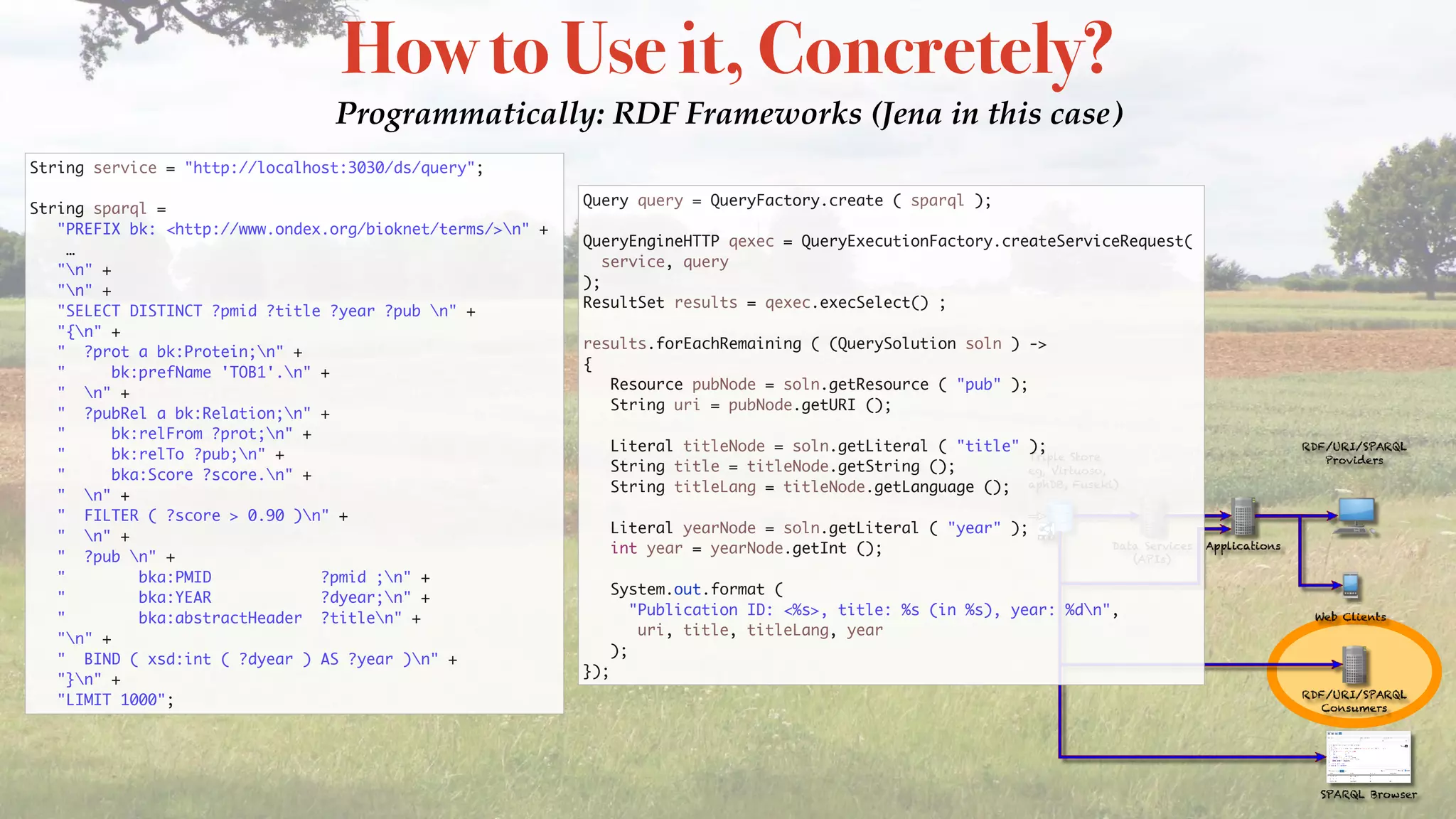
How to Use it, Concretely?
Programmatically: RDF Frameworks (Jena in this case)
String service = "http://localhost:3030/ds/query";
String sparql =
"PREFIX bk: <http://www.ondex.org/bioknet/terms/>n" + 

…
"n" +
"n" +
"SELECT DISTINCT ?pmid ?title ?year ?pub n" +
"{n" +
" ?prot a bk:Protein;n" +
" bk:prefName 'TOB1'.n" +
" n" +
" ?pubRel a bk:Relation;n" +
" bk:relFrom ?prot;n" +
" bk:relTo ?pub;n" +
" bka:Score ?score.n" +
" n" +
" FILTER ( ?score > 0.90 )n" +
" n" +
" ?pub n" +
" bka:PMID ?pmid ;n" +
" bka:YEAR ?dyear;n" +
" bka:abstractHeader ?titlen" +
"n" +
" BIND ( xsd:int ( ?dyear ) AS ?year )n" +
"}n" +
"LIMIT 1000";
Query query = QueryFactory.create ( sparql );
QueryEngineHTTP qexec = QueryExecutionFactory.createServiceRequest(
service, query
);
ResultSet results = qexec.execSelect() ;
results.forEachRemaining ( (QuerySolution soln ) ->
{
Resource pubNode = soln.getResource ( "pub" );
String uri = pubNode.getURI ();
Literal titleNode = soln.getLiteral ( "title" );
String title = titleNode.getString ();
String titleLang = titleNode.getLanguage ();
Literal yearNode = soln.getLiteral ( "year" );
int year = yearNode.getInt ();
System.out.format (
"Publication ID: <%s>, title: %s (in %s), year: %dn",
uri, title, titleLang, year
);
});
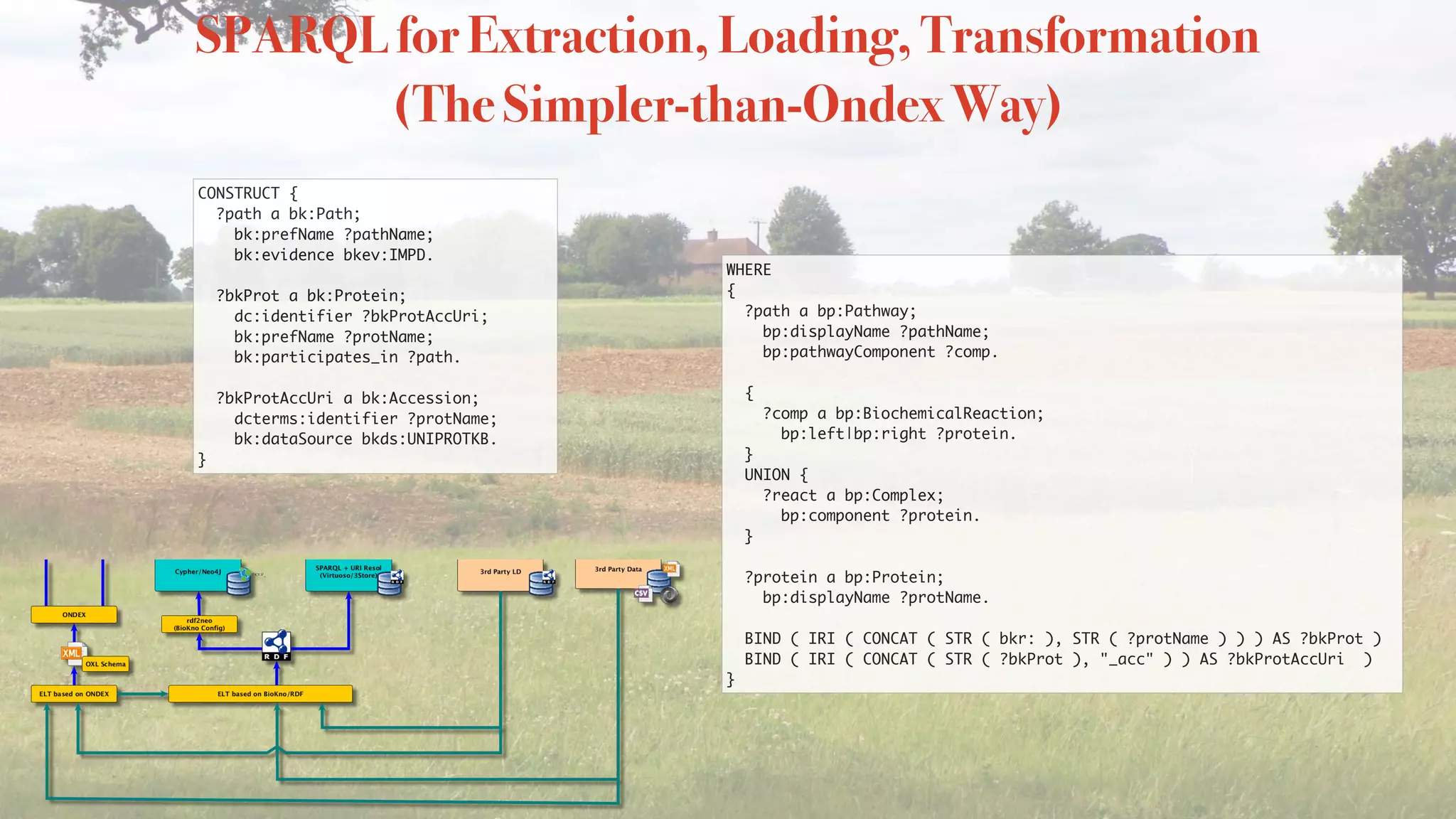
CONSTRUCT {
?path a bk:Path;
bk:prefName ?pathName;
bk:evidence bkev:IMPD.
?bkProt a bk:Protein;
dc:identifier ?bkProtAccUri;
bk:prefName ?protName;
bk:participates_in ?path.
?bkProtAccUri a bk:Accession;
dcterms:identifier ?protName;
bk:dataSource bkds:UNIPROTKB.
}
SPARQL for Extraction, Loading, Transformation
(The Simpler-than-Ondex Way)
WHERE
{
?path a bp:Pathway;
bp:displayName ?pathName;
bp:pathwayComponent ?comp.
{
?comp a bp:BiochemicalReaction;
bp:left|bp:right ?protein.
}
UNION {
?react a bp:Complex;
bp:component ?protein.
}
?protein a bp:Protein;
bp:displayName ?protName.
BIND ( IRI ( CONCAT ( STR ( bkr: ), STR ( ?protName ) ) ) AS ?bkProt )
BIND ( IRI ( CONCAT ( STR ( ?bkProt ), "_acc" ) ) AS ?bkProtAccUri )
}
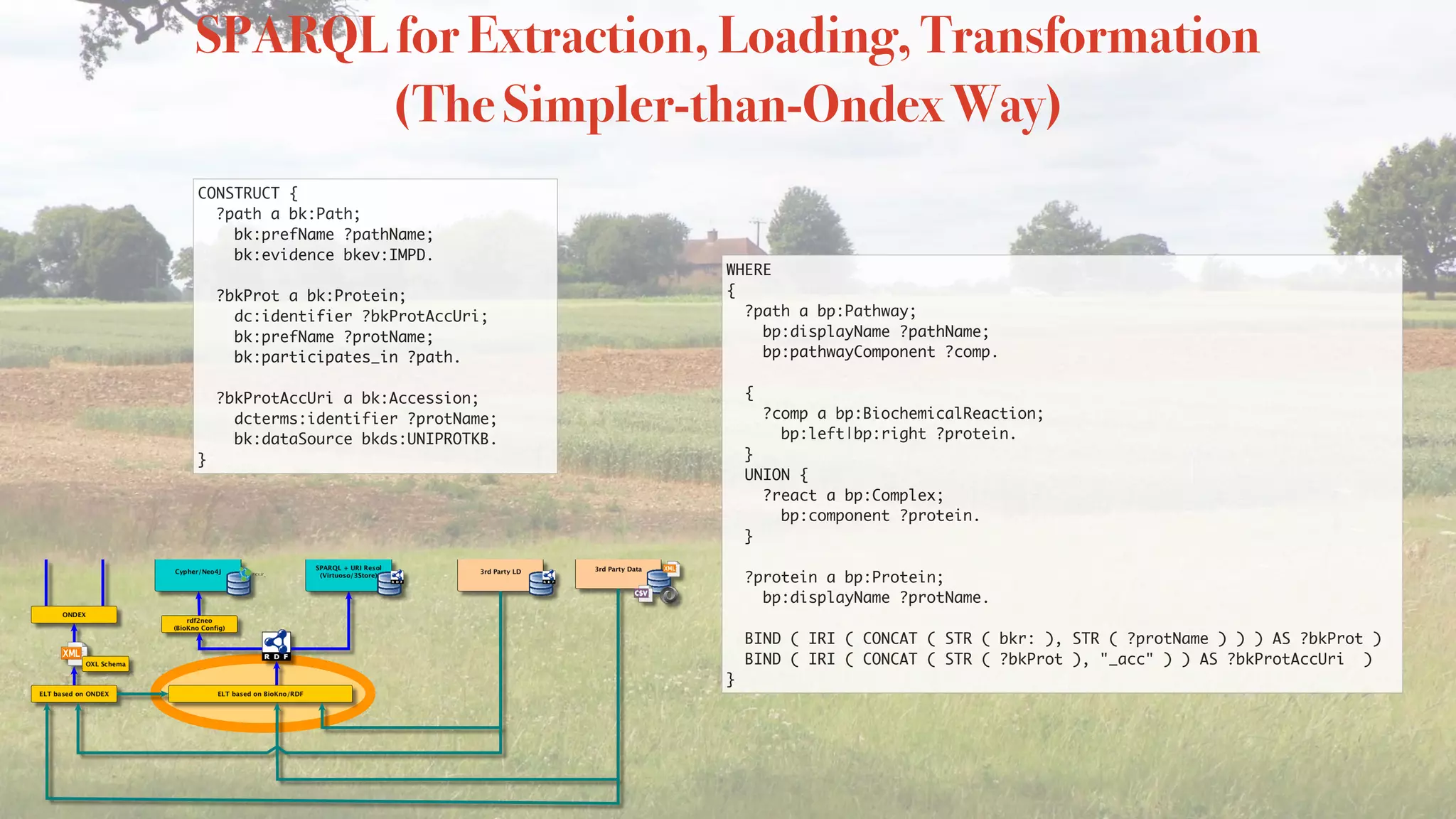
CONSTRUCT {
?path a bk:Path;
bk:prefName ?pathName;
bk:evidence bkev:IMPD.
?bkProt a bk:Protein;
dc:identifier ?bkProtAccUri;
bk:prefName ?protName;
bk:participates_in ?path.
?bkProtAccUri a bk:Accession;
dcterms:identifier ?protName;
bk:dataSource bkds:UNIPROTKB.
}
SPARQL for Extraction, Loading, Transformation
(The Simpler-than-Ondex Way)
WHERE
{
?path a bp:Pathway;
bp:displayName ?pathName;
bp:pathwayComponent ?comp.
{
?comp a bp:BiochemicalReaction;
bp:left|bp:right ?protein.
}
UNION {
?react a bp:Complex;
bp:component ?protein.
}
?protein a bp:Protein;
bp:displayName ?protName.
BIND ( IRI ( CONCAT ( STR ( bkr: ), STR ( ?protName ) ) ) AS ?bkProt )
BIND ( IRI ( CONCAT ( STR ( ?bkProt ), "_acc" ) ) AS ?bkProtAccUri )
}
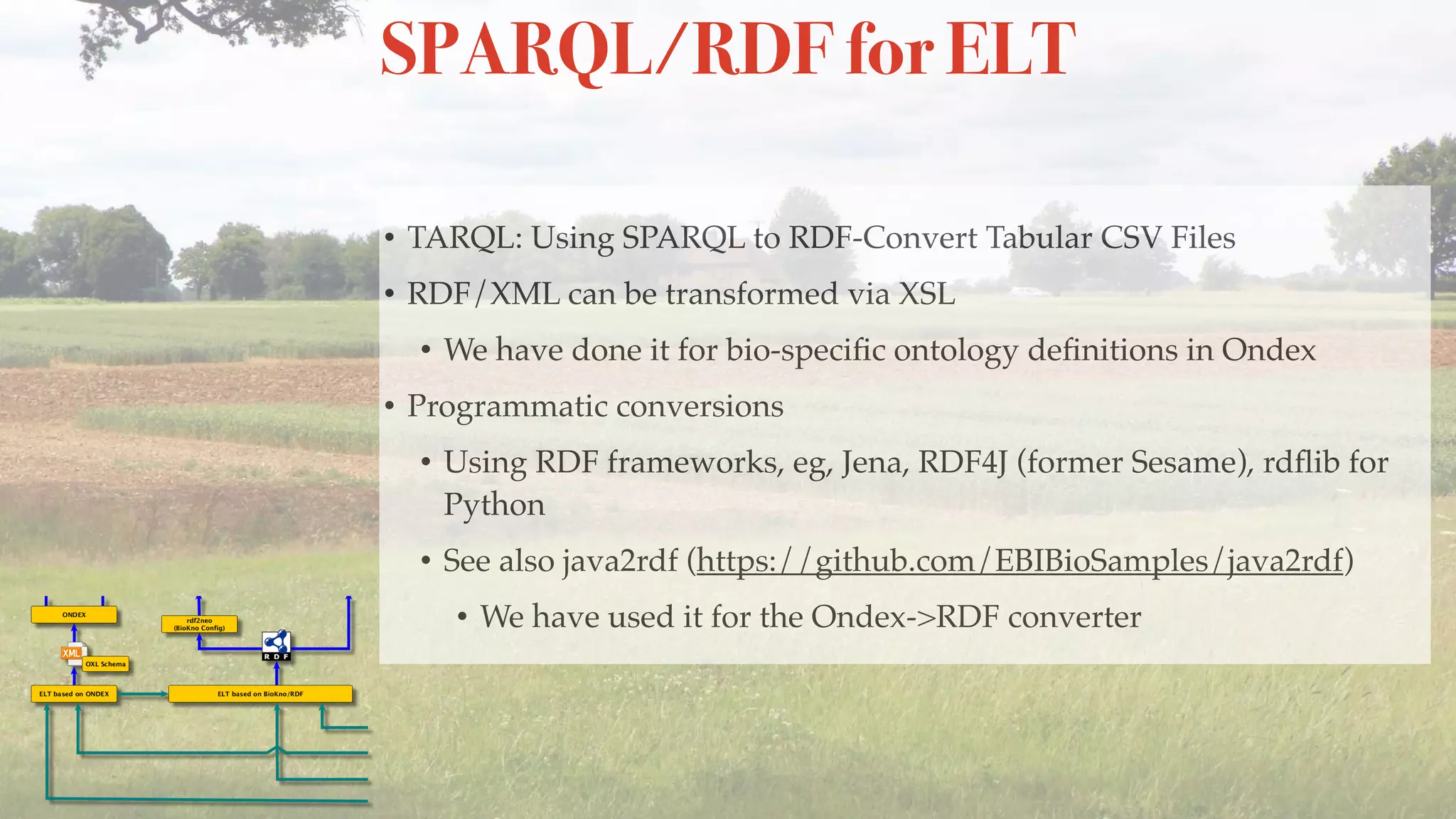
SPARQL/RDF for ELT
• TARQL: Using SPARQL to RDF-Convert Tabular CSV Files
• RDF/XML can be transformed via XSL
• We have done it for bio-specific ontology definitions in Ondex
• Programmatic conversions
• Using RDF frameworks, eg, Jena, RDF4J (former Sesame), rdflib for
Python
• See also java2rdf (https://github.com/EBIBioSamples/java2rdf)
• We have used it for the Ondex->RDF converter
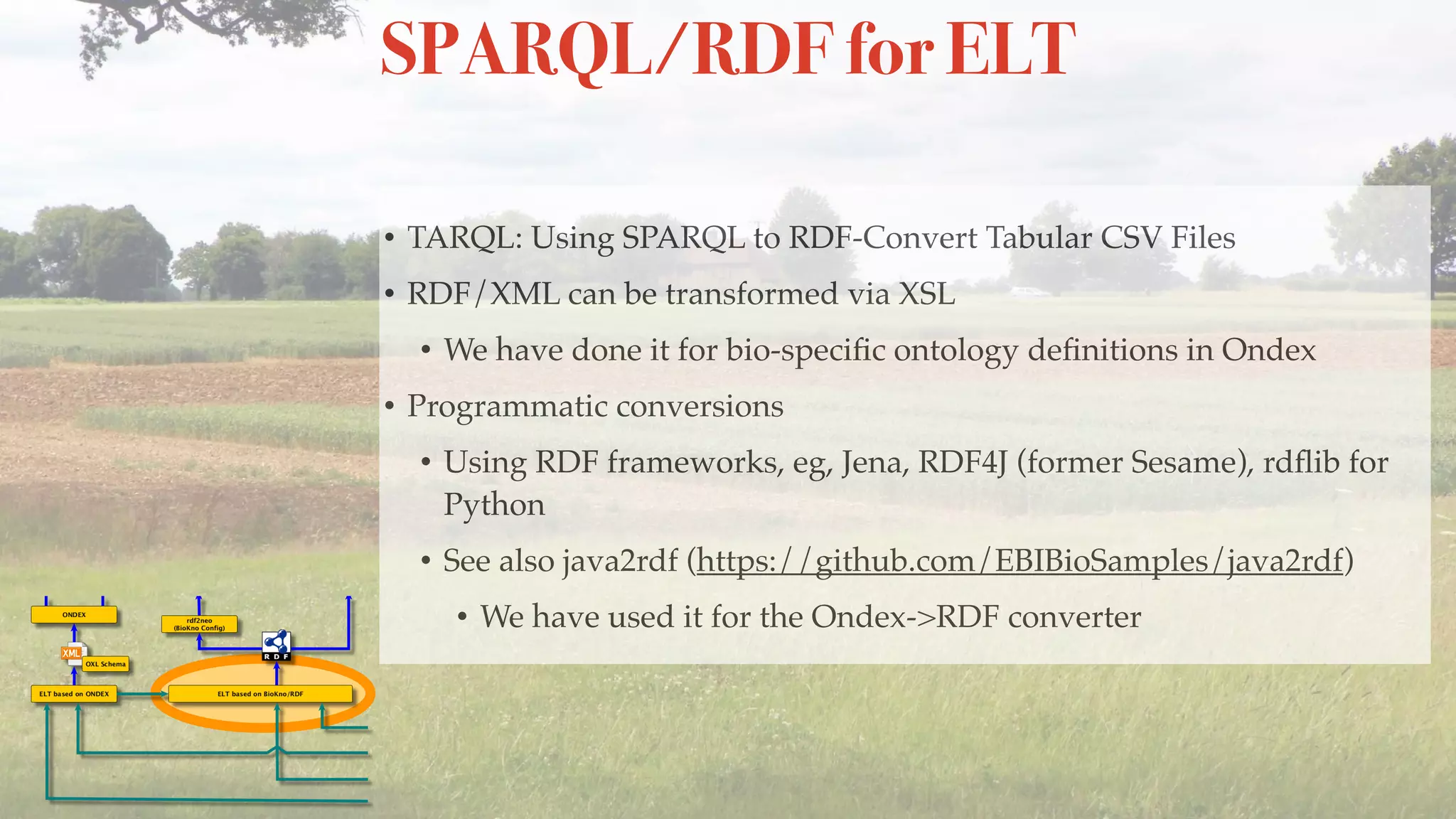
SPARQL/RDF for ELT
• TARQL: Using SPARQL to RDF-Convert Tabular CSV Files
• RDF/XML can be transformed via XSL
• We have done it for bio-specific ontology definitions in Ondex
• Programmatic conversions
• Using RDF frameworks, eg, Jena, RDF4J (former Sesame), rdflib for
Python
• See also java2rdf (https://github.com/EBIBioSamples/java2rdf)
• We have used it for the Ondex->RDF converter
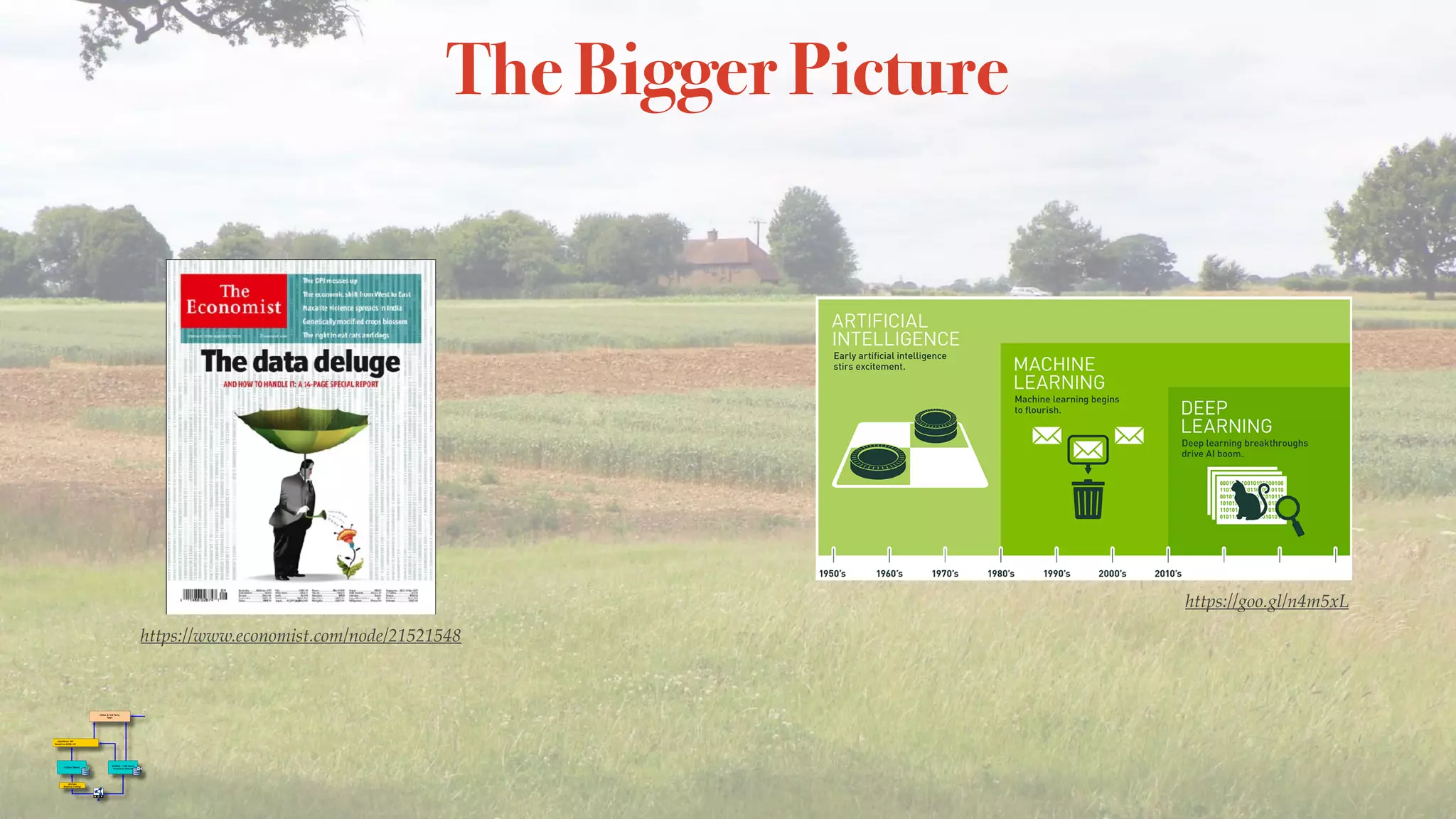
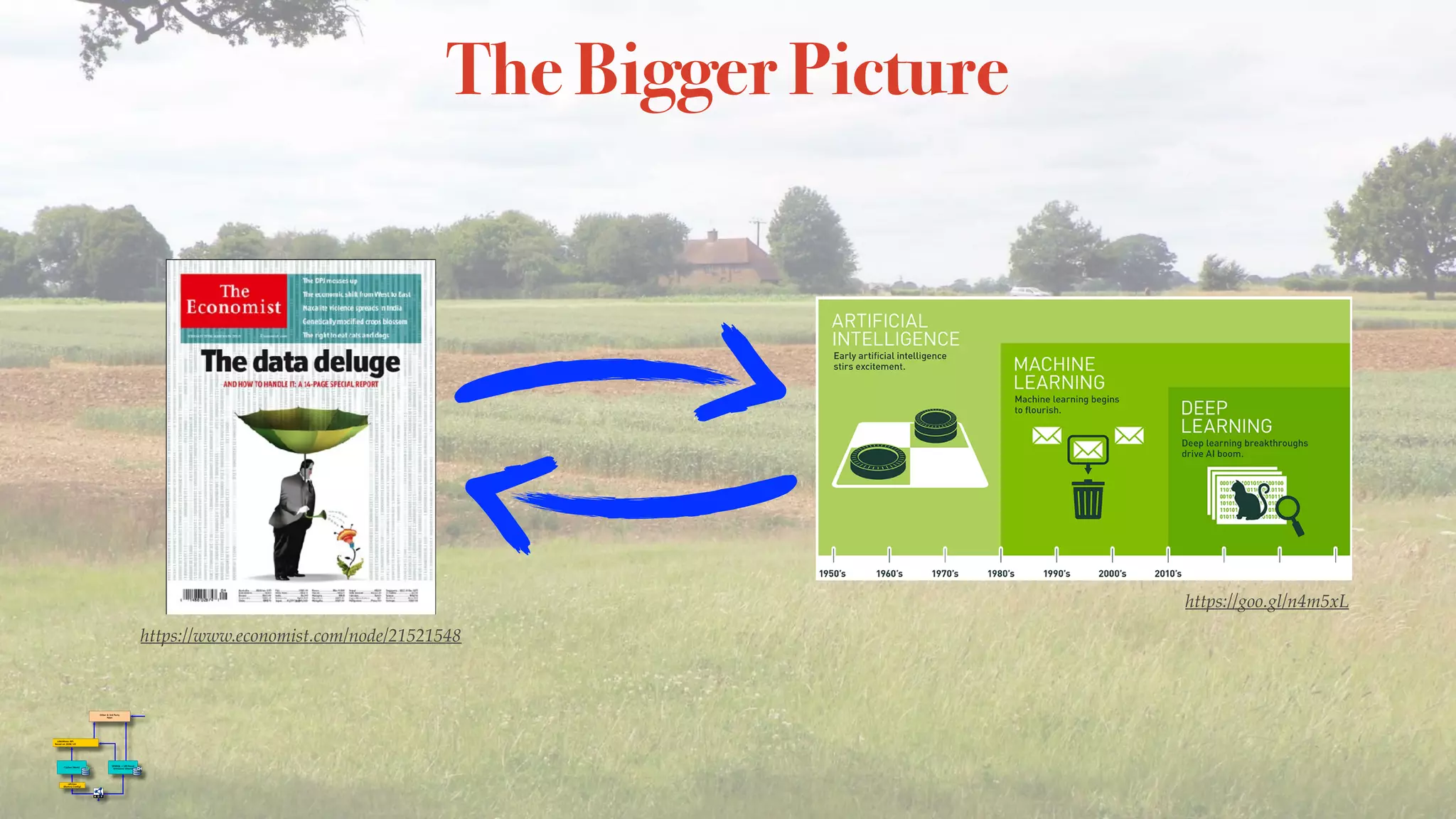
The Bigger Picture
The Bigger Picture
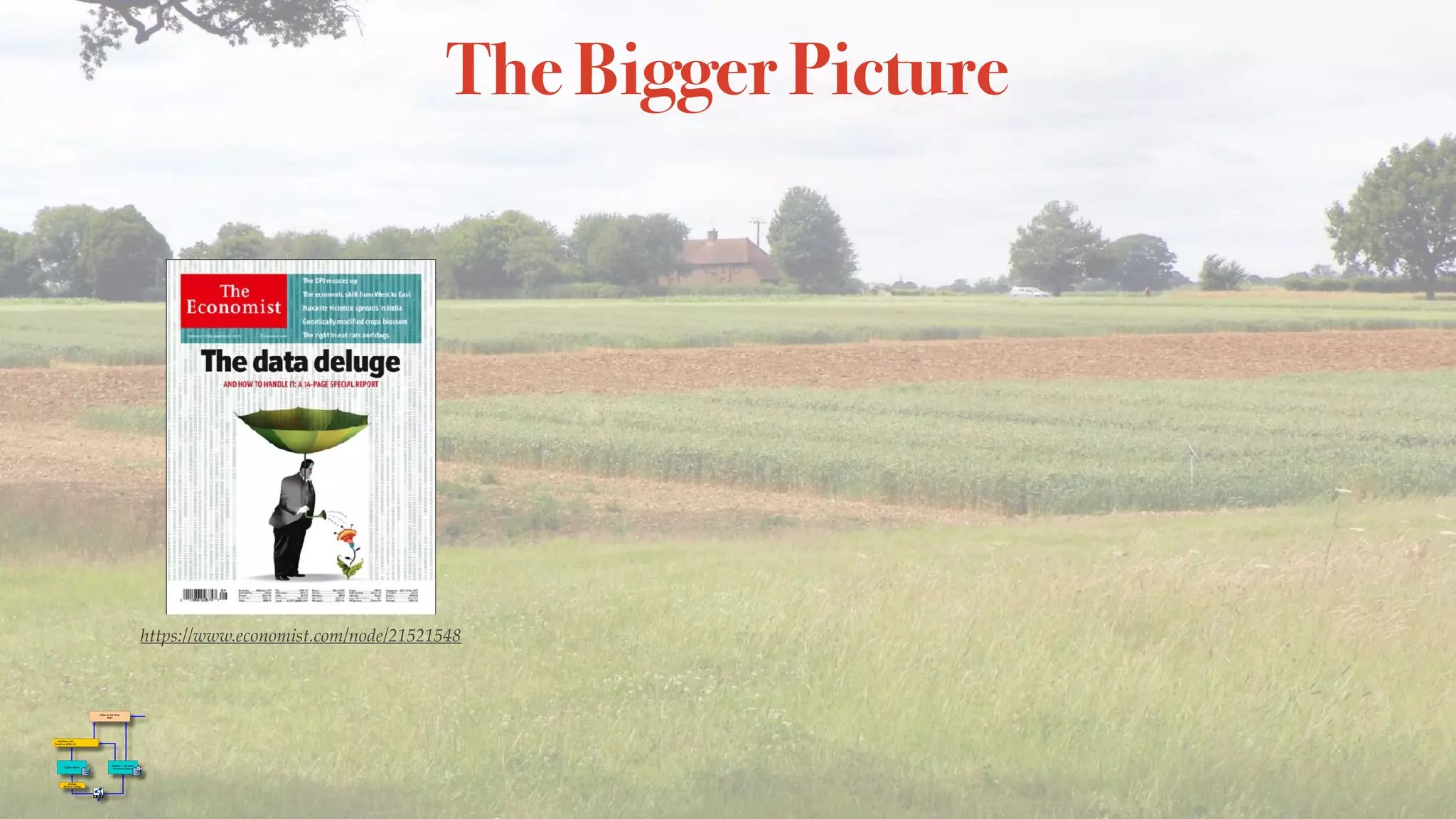
https://www.economist.com/node/21521548
The Bigger Picture
https://goo.gl/n4m5xL
Artificial	Intelligence	(AI)
8
https://www.economist.com/node/21521548
The Bigger Picture
https://goo.gl/n4m5xL
Artificial	Intelligence	(AI)
8
https://www.economist.com/node/21521548
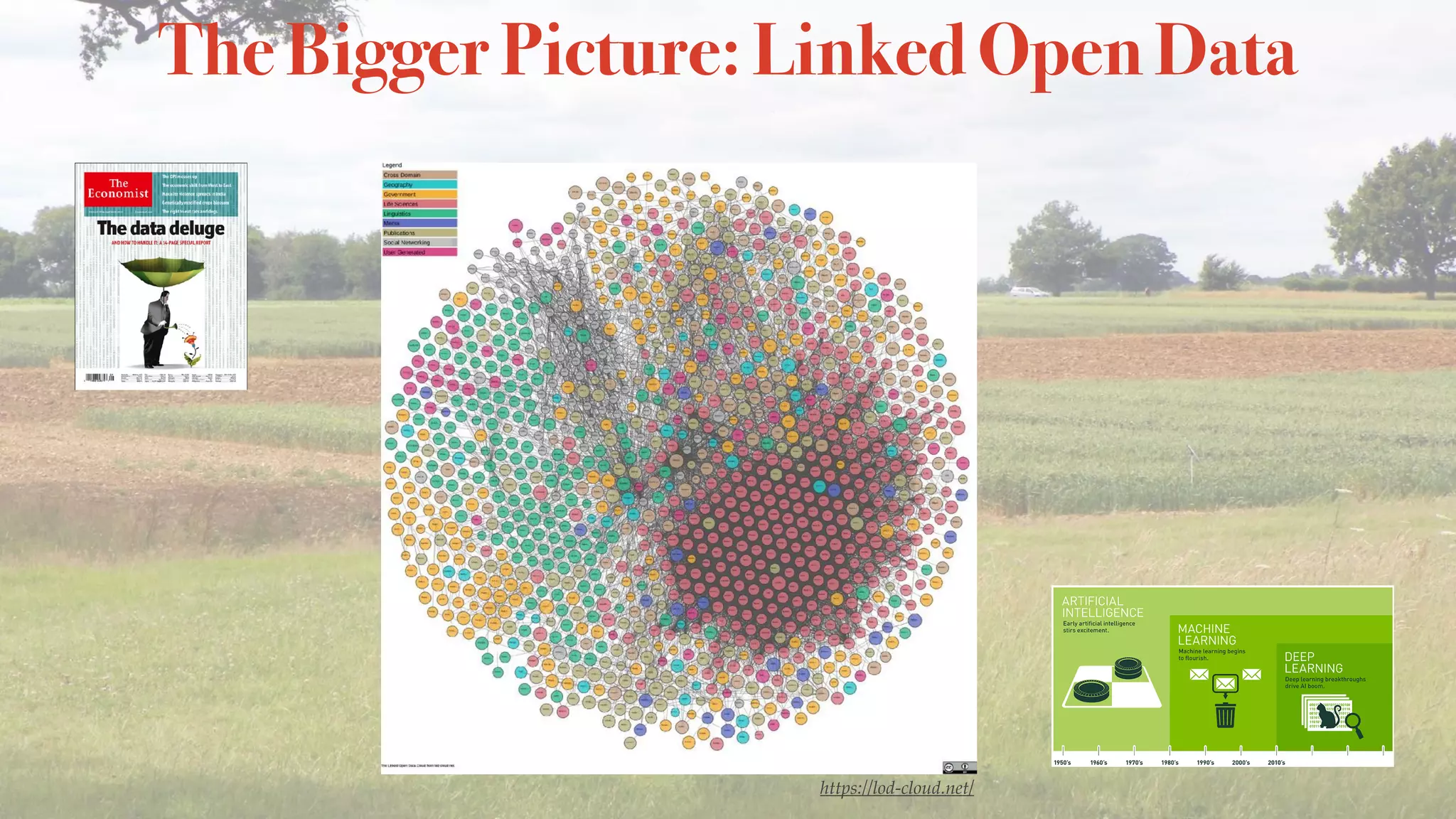
The Bigger Picture: Linked Open Data
Artificial	Intelligence	(AI)
8
https://lod-cloud.net/
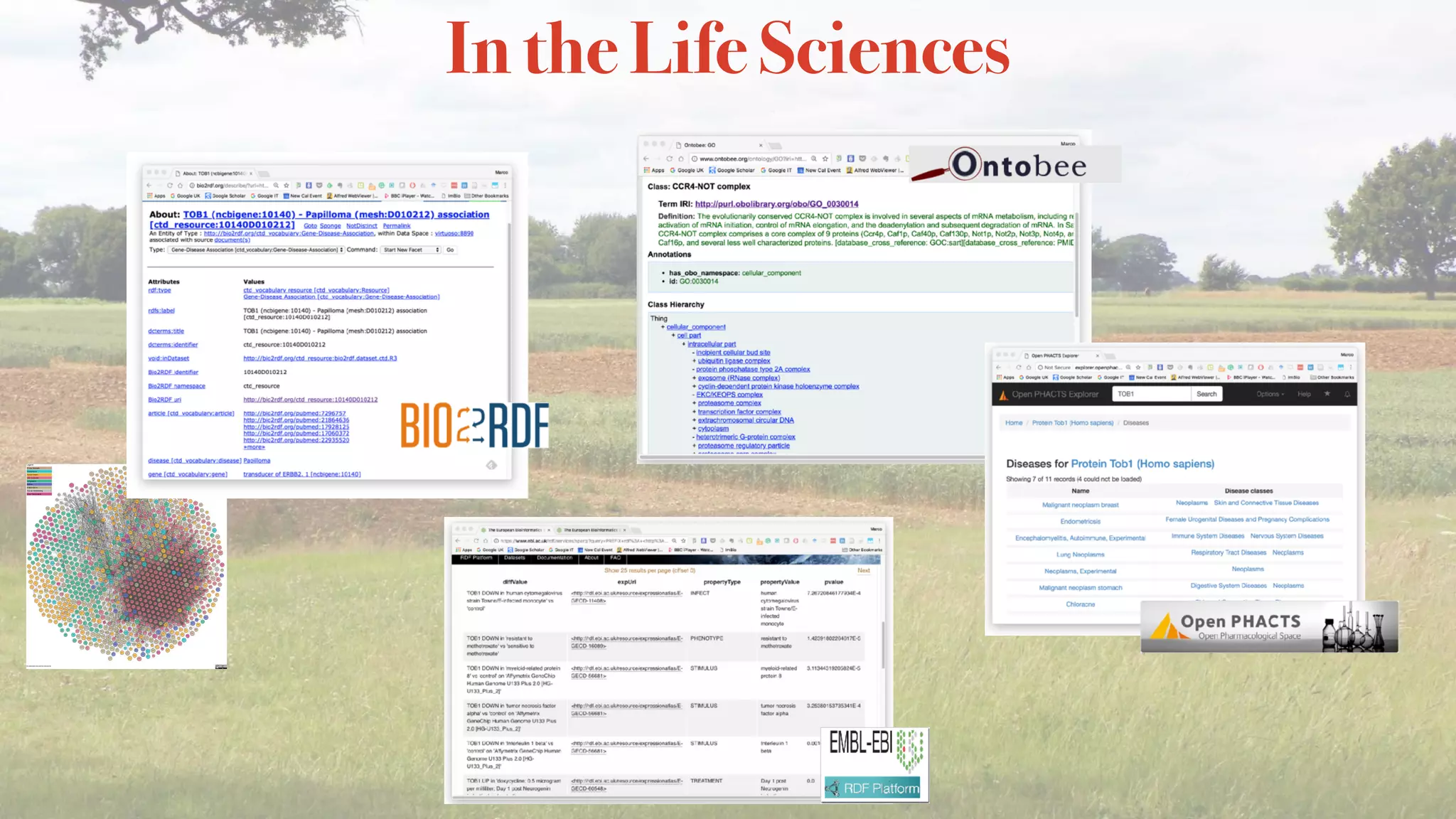
In the Life Sciences
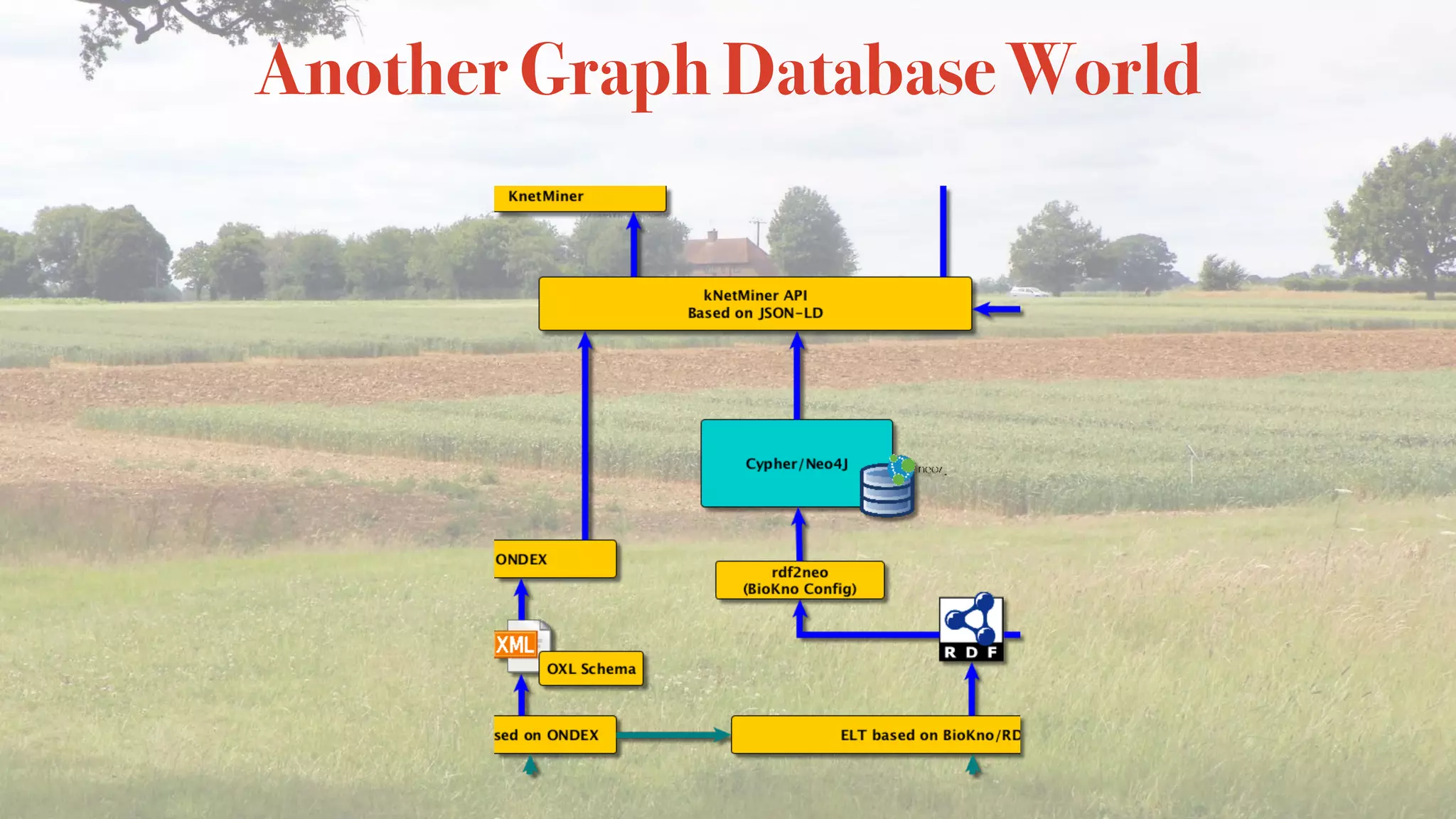
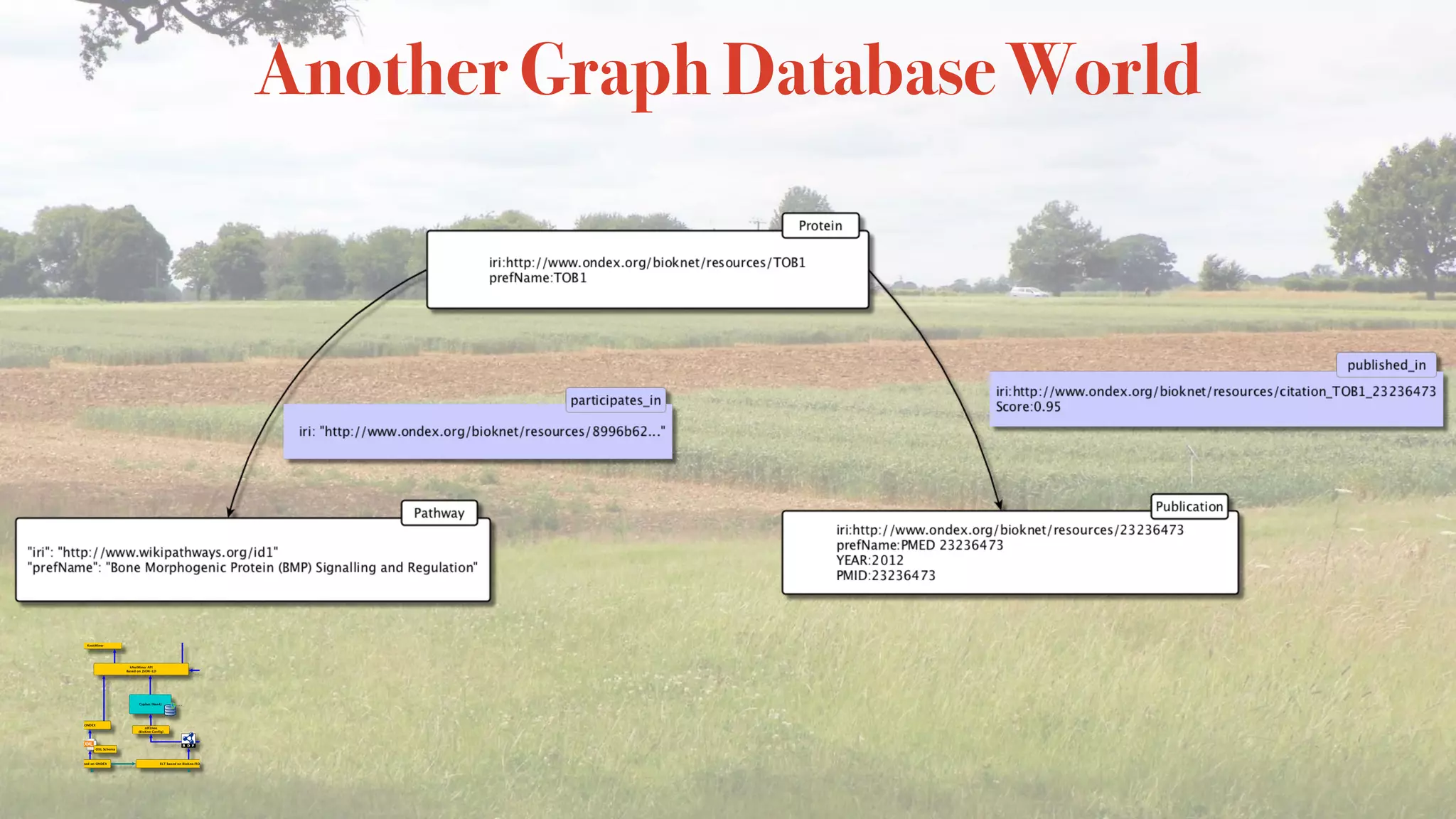
Another Graph Database World
The Cypher Query/DML Language
Proteins->Reactions->Pathways:

// chain of paths, node selection via property (exploits indices)

MATCH (prot:Protein) - [csby:consumed_by] -> (:Reaction) -
[:part_of] -> (pway:Path{ title: ‘apoptosis’ })

// further conditions, not always so performant

WHERE prot.name =~ ‘(?i)^DNA.+’

// Usual projection and post-selection operators

RETURN prot.name, pway

// Relations can have properties

ORDER BY csby.pvalue

LIMIT 1000
Proteins->Reactions->Pathways:
// Single-path (or same-direction branching) easy to write

MATCH (prot:Protein) - [:produced_by|consumed_by] -> (:Reaction) 

- [:part_of*1..3] -> (pway:Path)

RETURN ID(prot), ID(pway) LIMIT 1000

// Very compact forms available, depending on the data

MATCH (prot:Protein) - (pway:Path) RETURN pway
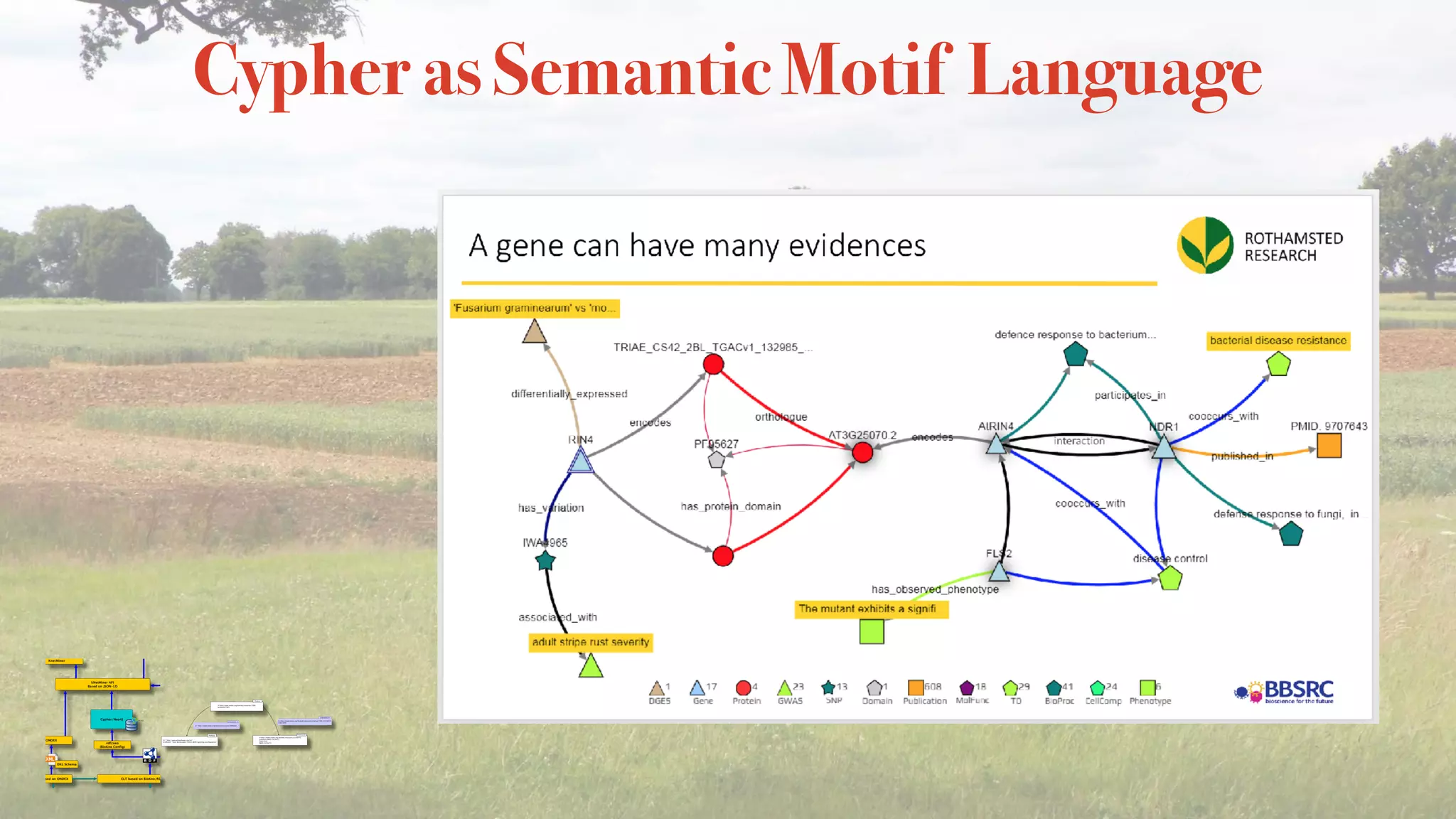
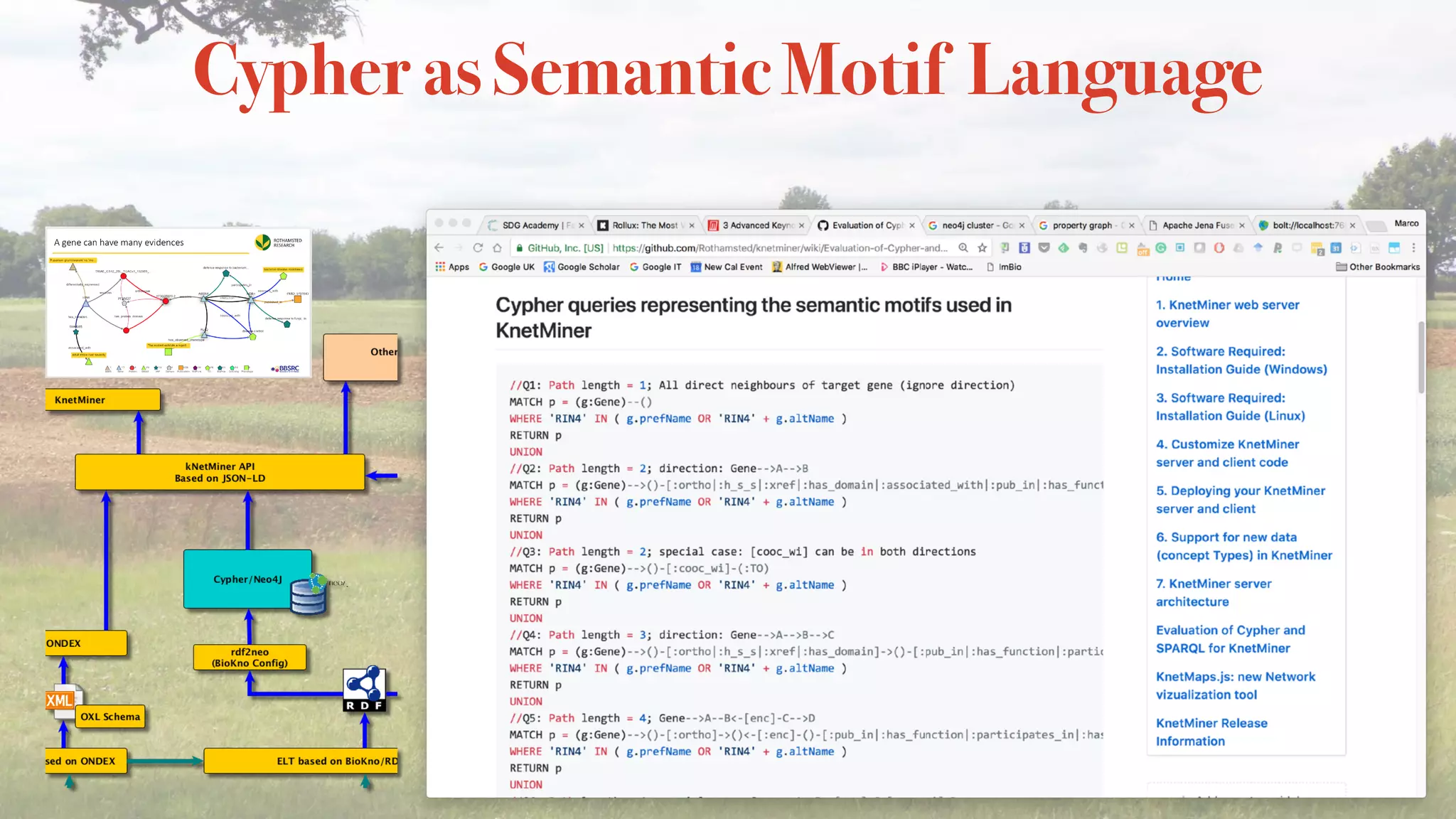
Cypher as Semantic Motif Language
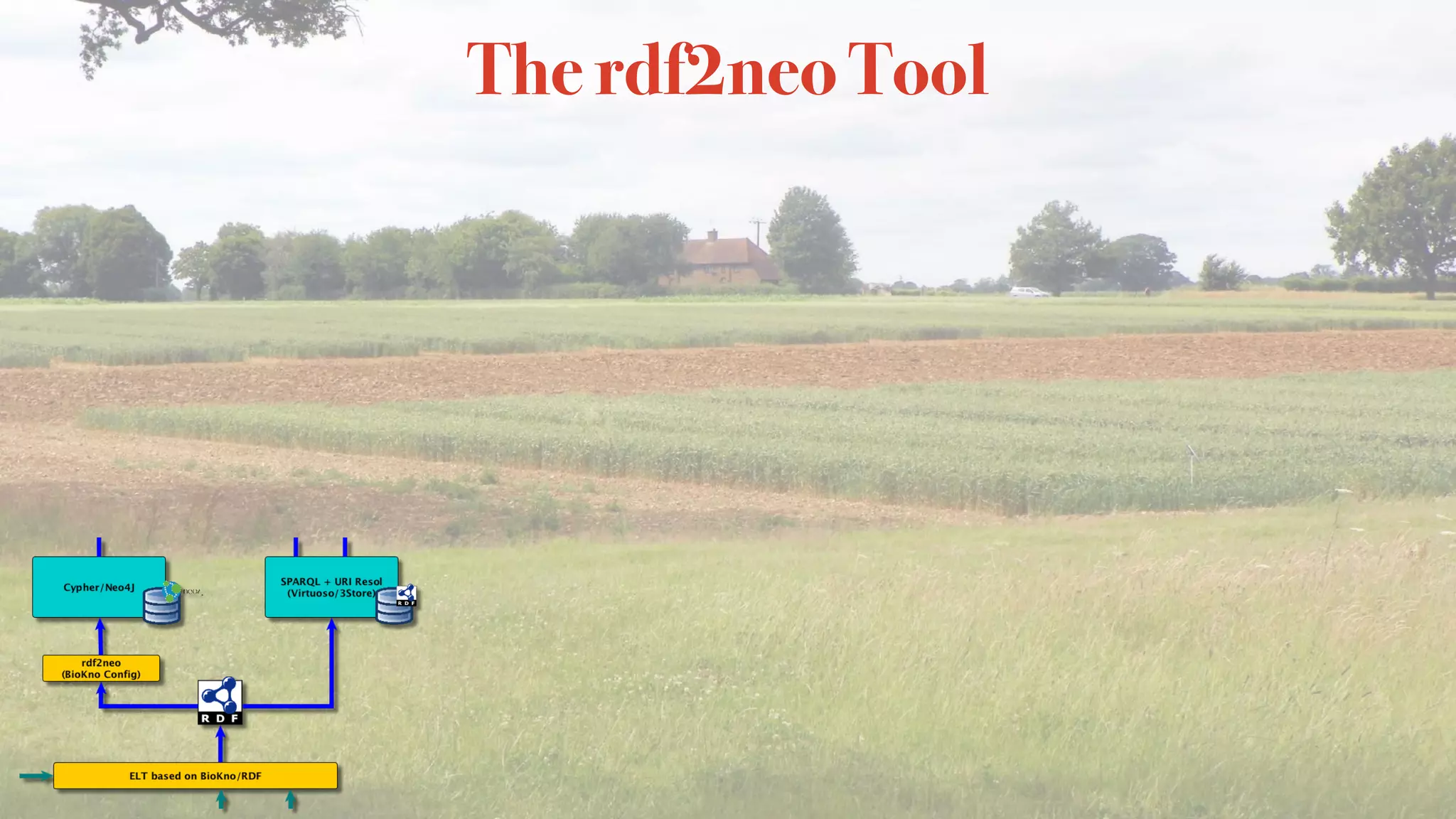
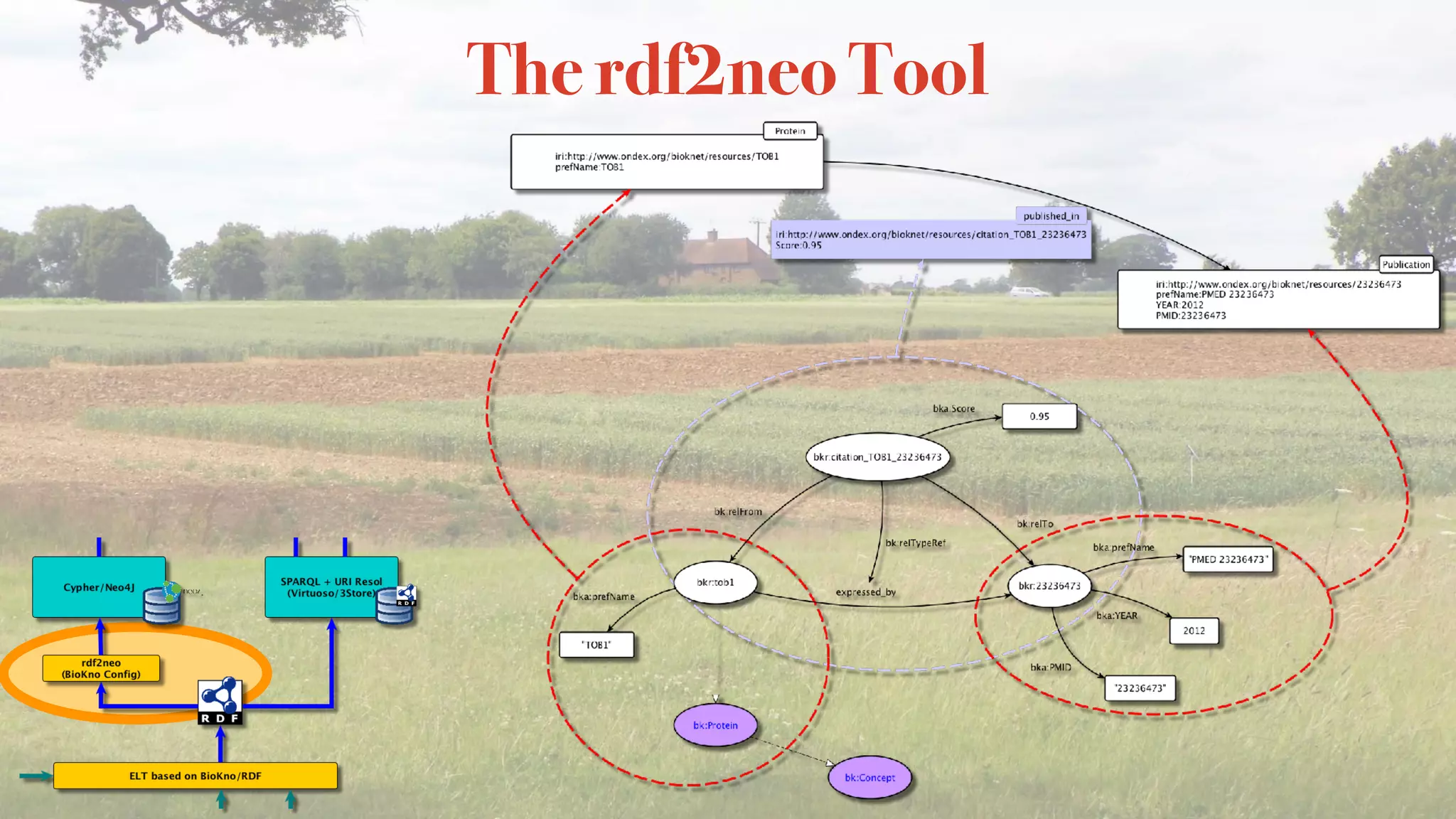
The rdf2neo Tool
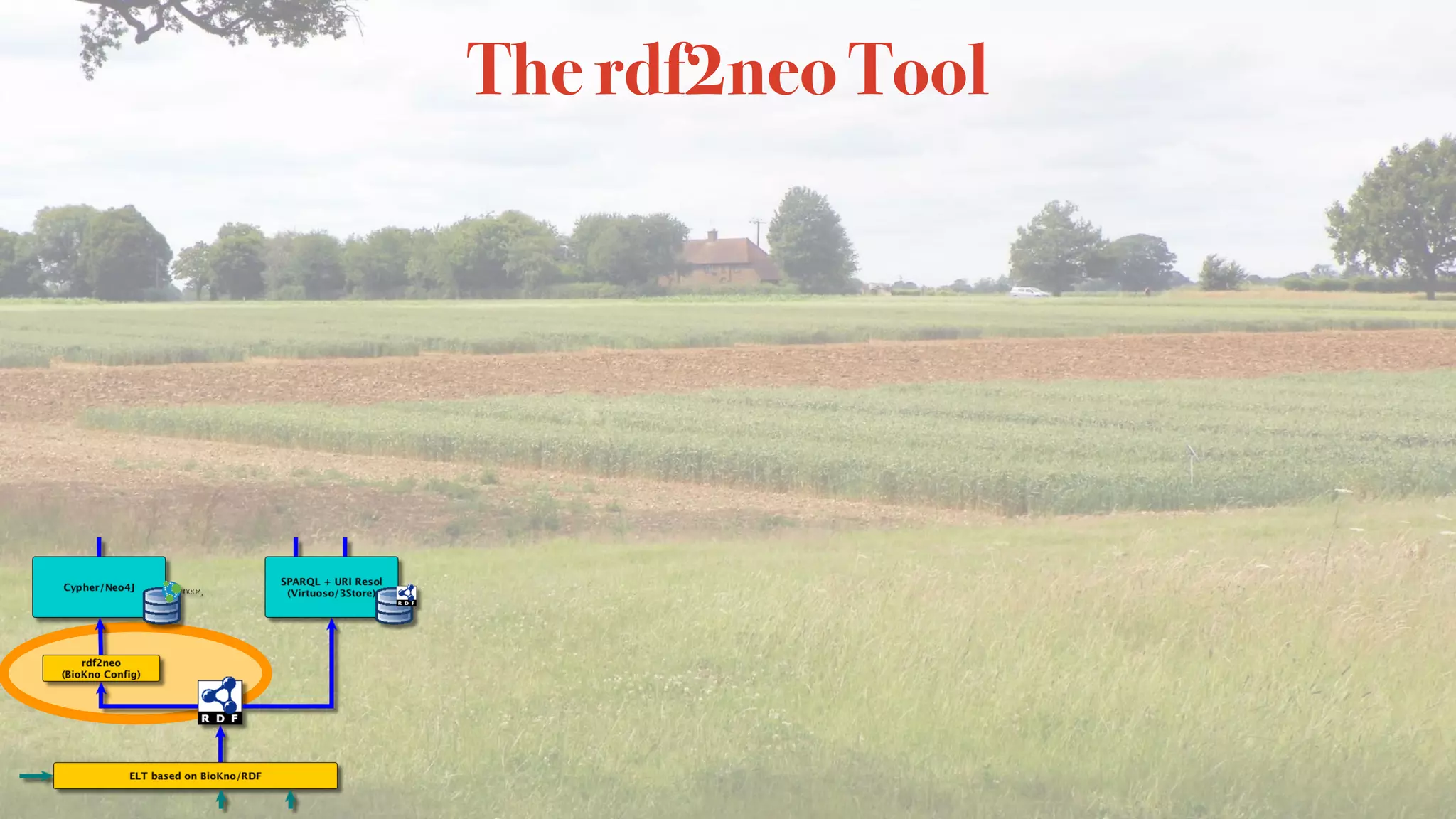
The rdf2neo Tool
The rdf2neo Tool
The rdf2neo Tool
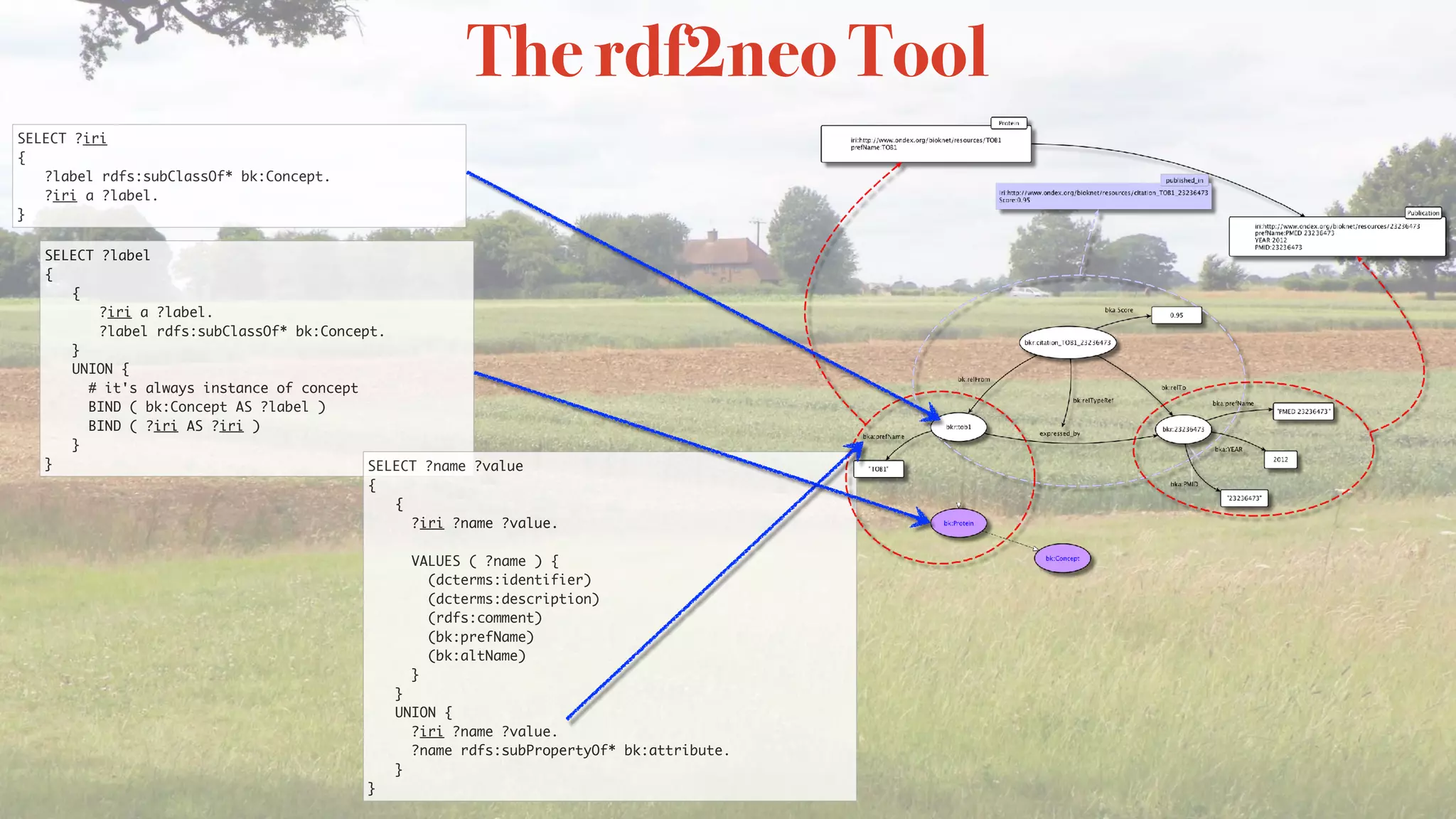
SELECT ?iri
{
?label rdfs:subClassOf* bk:Concept.
?iri a ?label.
}
SELECT ?label
{
{
?iri a ?label.
?label rdfs:subClassOf* bk:Concept.
}
UNION {
# it's always instance of concept
BIND ( bk:Concept AS ?label )
BIND ( ?iri AS ?iri )
}
} SELECT ?name ?value
{
{
?iri ?name ?value.
VALUES ( ?name ) {
(dcterms:identifier)
(dcterms:description)
(rdfs:comment)
(bk:prefName)
(bk:altName)
}
}
UNION {
?iri ?name ?value.
?name rdfs:subPropertyOf* bk:attribute.
}
}
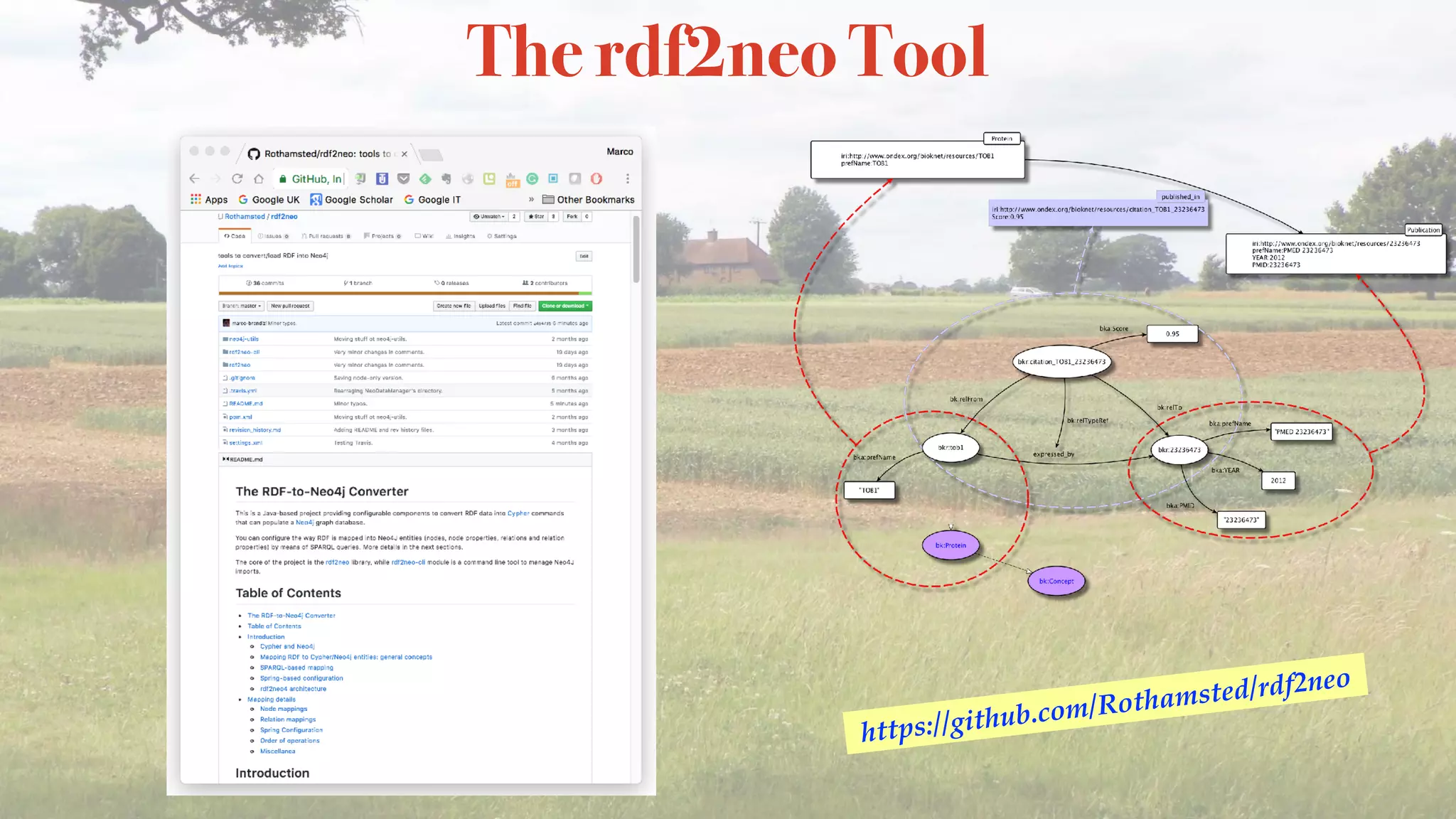
The rdf2neo Tool
https://github.com/Rothamsted/rdf2neo
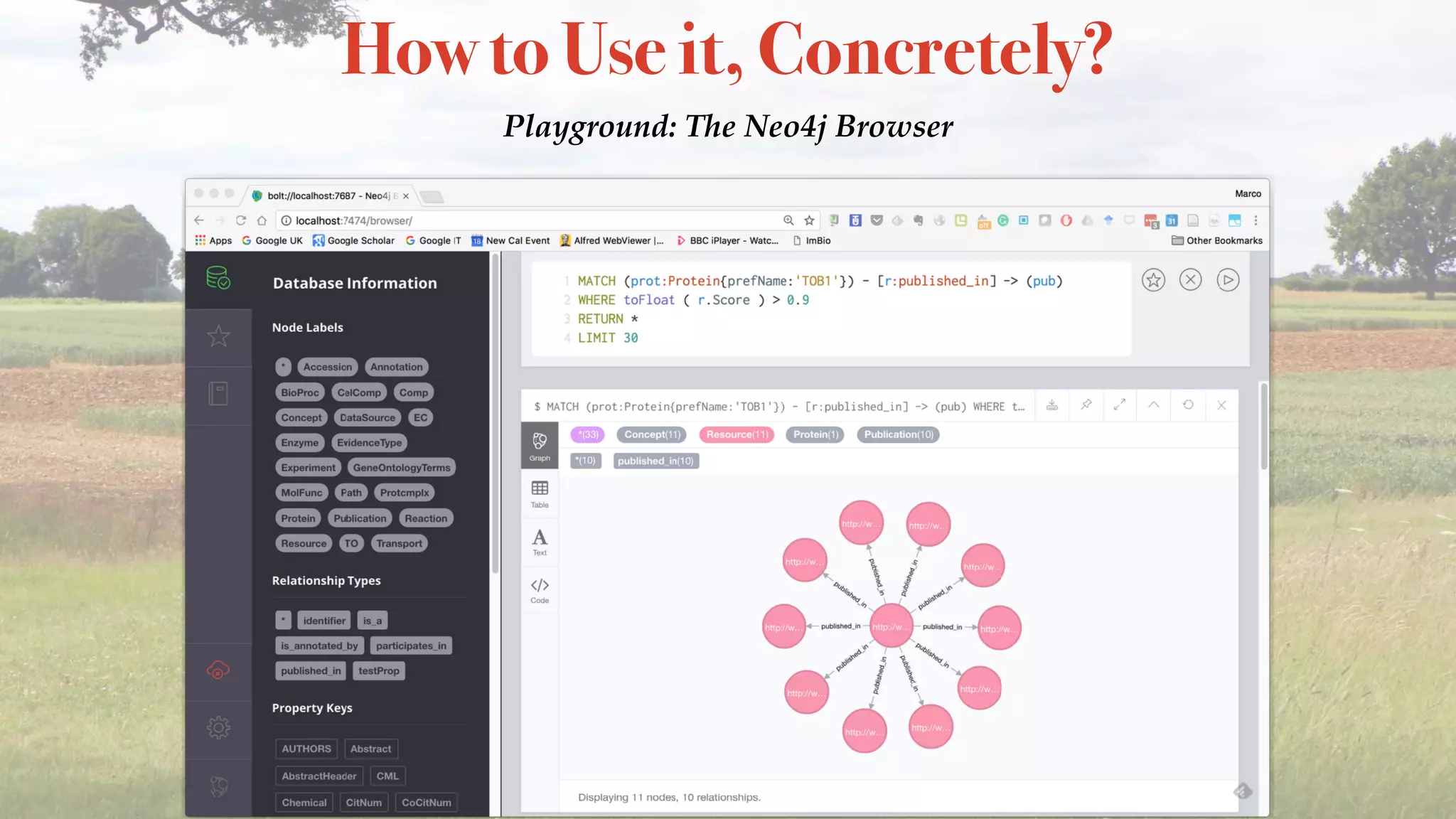
How to Use it, Concretely?
Playground: The Neo4j Browser
How to Use it, Concretely?
Programmatically: The Neo4j Drivers (for Java in this case)
How to Use it, Concretely?
Programmatically: The Neo4j Drivers (for Java in this case)
AuthToken auth = AuthTokens.basic ( "neo4j", "test" );
try (
Driver neodb = GraphDatabase.driver ( "bolt://127.0.0.1:7687", auth );
Session session = neodb.session ();
)
{
String cypher =
"MATCH (prot:Protein{ prefName:'TOB1' }) - [r:published_in] -> (pub)n" +
"WHERE toFloat ( r.Score ) > 0.9n" +
"RETURN pub.PMID, pub.AbstractHeader, pub.YEARn" +
"ORDER BY pub.YEAR DESCn" +
"LIMIT 30";
Statement stmt = new Statement ( cypher );
StatementResult rs = session.run ( stmt );
rs.forEachRemaining ( rec -> {
String pmid = rec.get ( "pub.PMID" ).asString ();
String title = rec.get ( "pub.AbstractHeader" ).asString ();
String year = rec.get ( "pub.YEAR" ).asString ();
System.out.format (
"PMID: %s, Title: "%s", year: %sn",
pmid, title, year
);
});
}
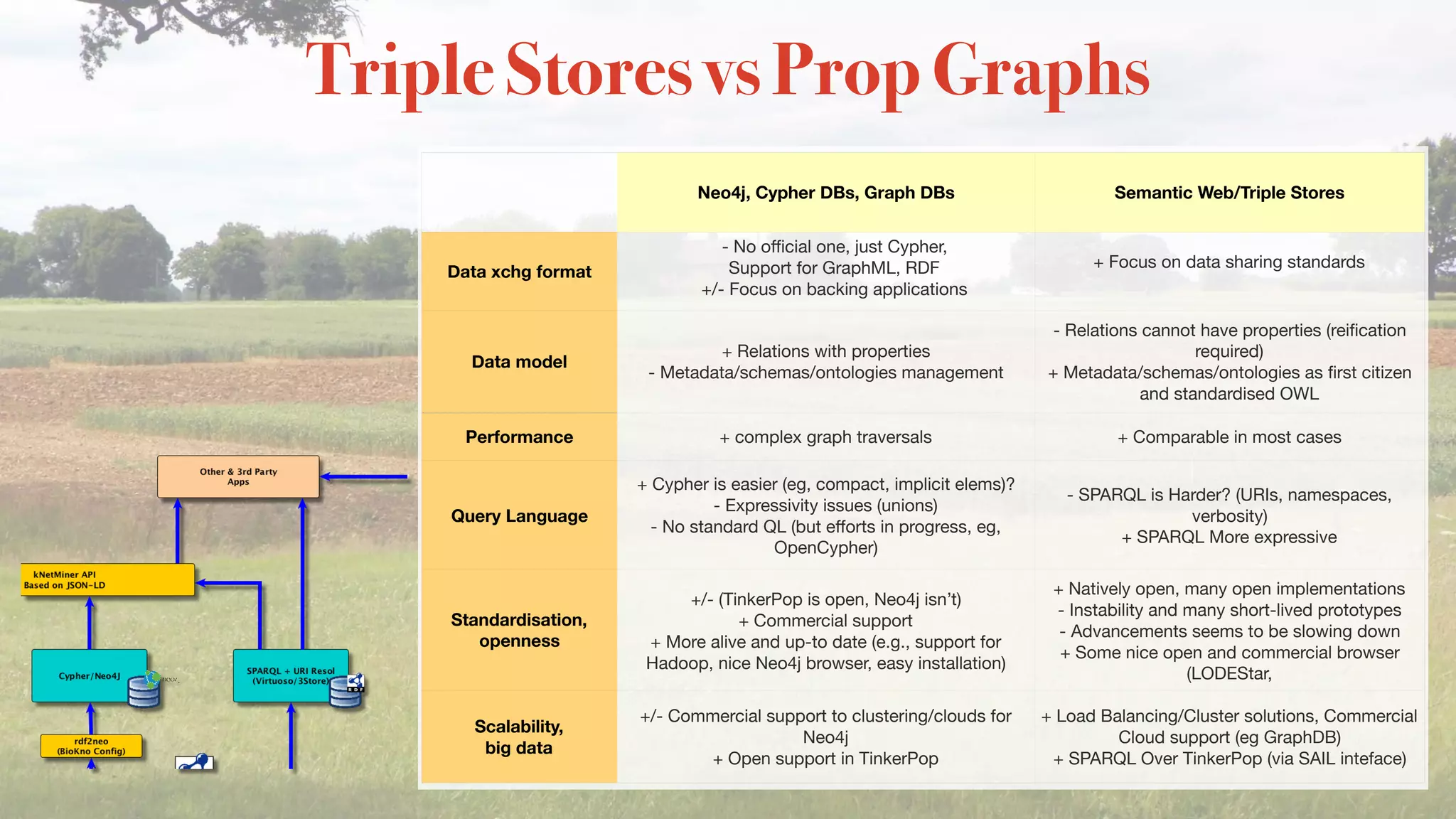
Triple Stores vs Prop Graphs
Neo4j, Cypher DBs, Graph DBs Semantic Web/Triple Stores
Data xchg format
- No official one, just Cypher, 

Support for GraphML, RDF

+/- Focus on backing applications

+ Focus on data sharing standards

Data model
+ Relations with properties

- Metadata/schemas/ontologies management
- Relations cannot have properties (reification
required)

+ Metadata/schemas/ontologies as first citizen
and standardised OWL
Performance + complex graph traversals + Comparable in most cases
Query Language
+ Cypher is easier (eg, compact, implicit elems)?

- Expressivity issues (unions)

- No standard QL (but efforts in progress, eg,
OpenCypher)
- SPARQL is Harder? (URIs, namespaces,
verbosity)

+ SPARQL More expressive
Standardisation,
openness
+/- (TinkerPop is open, Neo4j isn’t)

+ Commercial support

+ More alive and up-to date (e.g., support for
Hadoop, nice Neo4j browser, easy installation)
+ Natively open, many open implementations

- Instability and many short-lived prototypes

- Advancements seems to be slowing down

+ Some nice open and commercial browser
(LODEStar,
Scalability,

big data
+/- Commercial support to clustering/clouds for
Neo4j

+ Open support in TinkerPop
+ Load Balancing/Cluster solutions, Commercial
Cloud support (eg GraphDB)

+ SPARQL Over TinkerPop (via SAIL inteface)
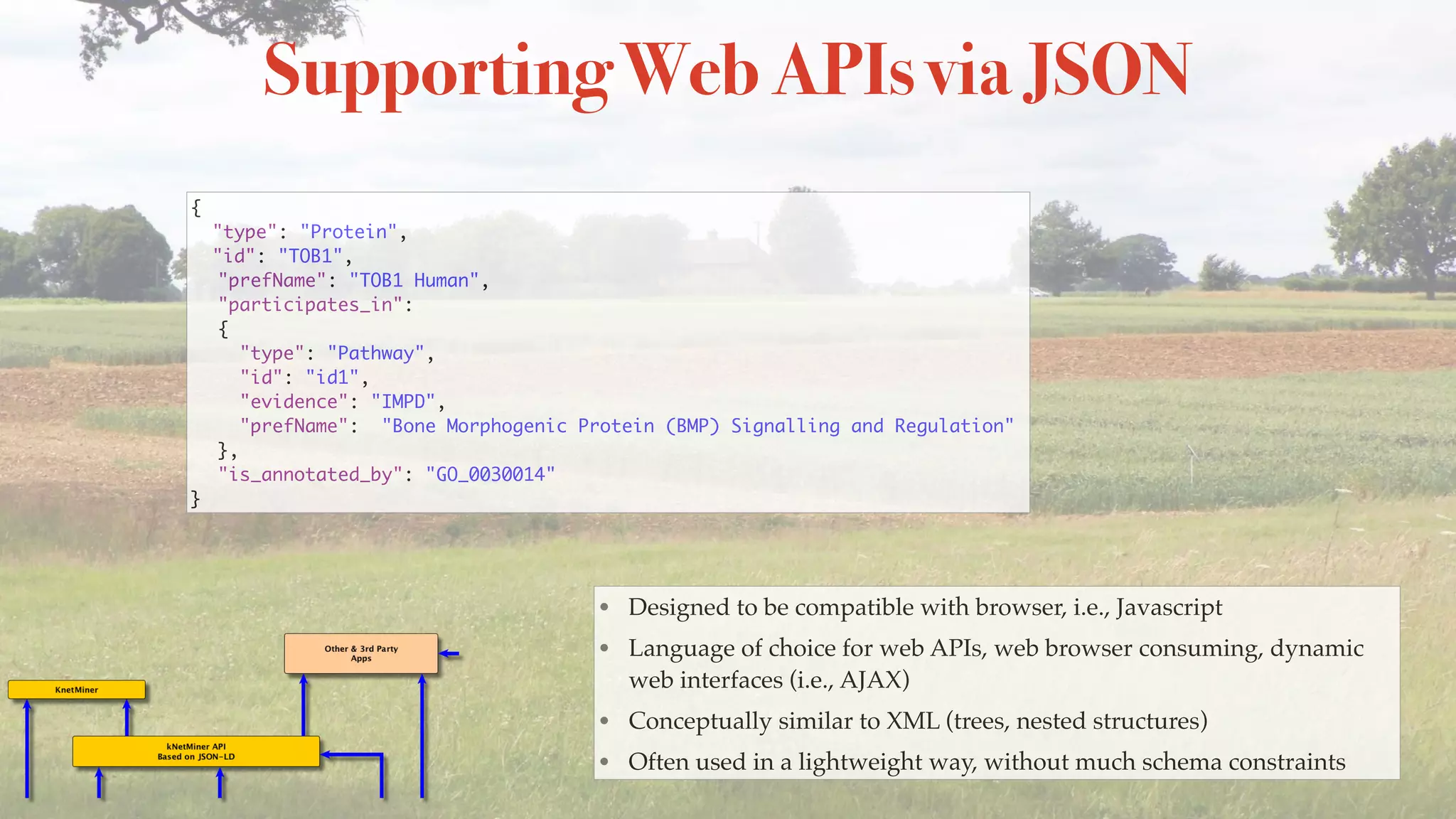
Supporting Web APIs via JSON
{
"type": "Protein",
"id": "TOB1",
"prefName": "TOB1 Human",
"participates_in":
{
"type": "Pathway",
"id": "id1",
"evidence": "IMPD",
"prefName": "Bone Morphogenic Protein (BMP) Signalling and Regulation"
},
"is_annotated_by": "GO_0030014"
}
• Designed to be compatible with browser, i.e., Javascript
• Language of choice for web APIs, web browser consuming, dynamic
web interfaces (i.e., AJAX)
• Conceptually similar to XML (trees, nested structures)
• Often used in a lightweight way, without much schema constraints
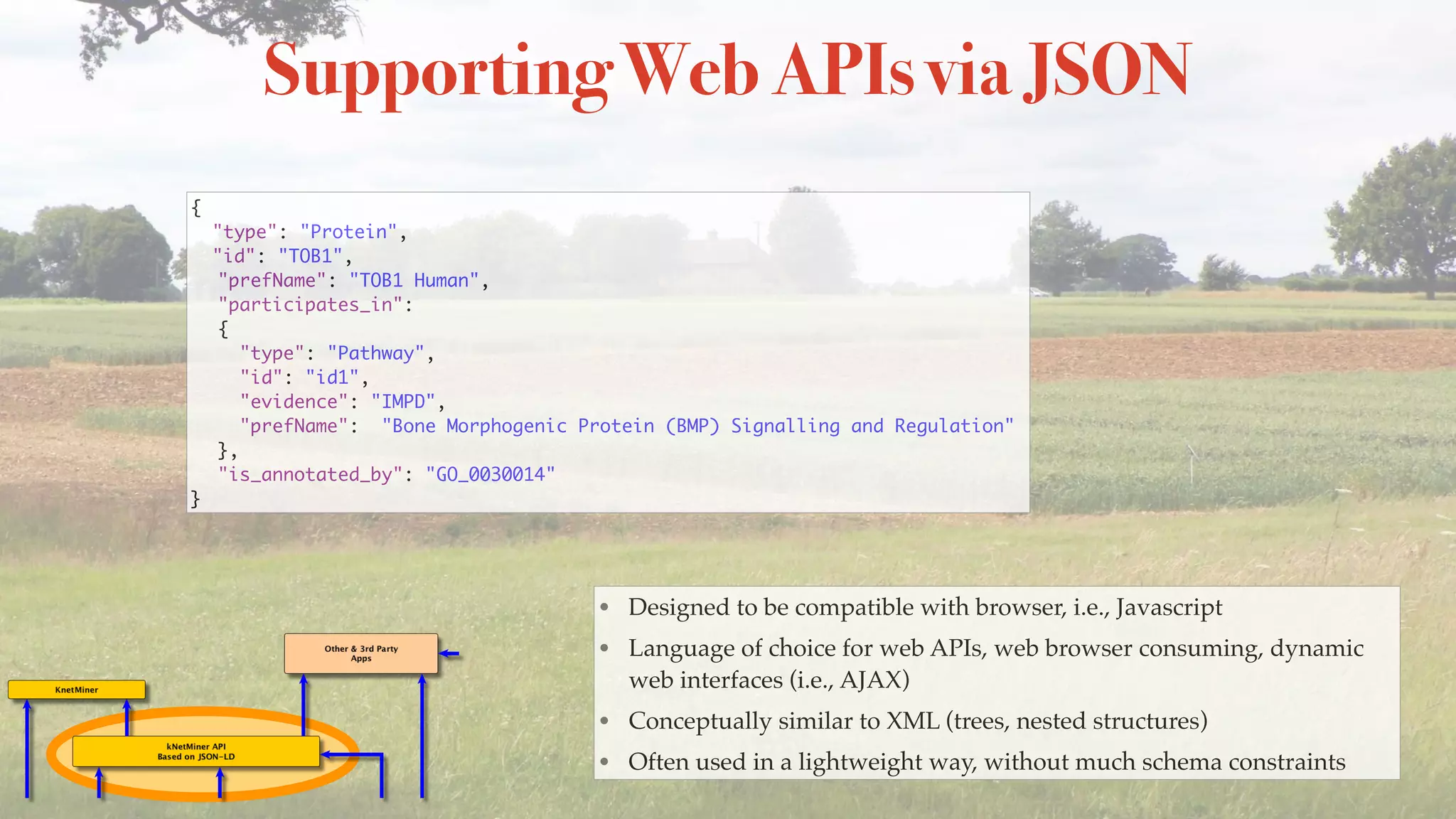
Supporting Web APIs via JSON
{
"type": "Protein",
"id": "TOB1",
"prefName": "TOB1 Human",
"participates_in":
{
"type": "Pathway",
"id": "id1",
"evidence": "IMPD",
"prefName": "Bone Morphogenic Protein (BMP) Signalling and Regulation"
},
"is_annotated_by": "GO_0030014"
}
• Designed to be compatible with browser, i.e., Javascript
• Language of choice for web APIs, web browser consuming, dynamic
web interfaces (i.e., AJAX)
• Conceptually similar to XML (trees, nested structures)
• Often used in a lightweight way, without much schema constraints
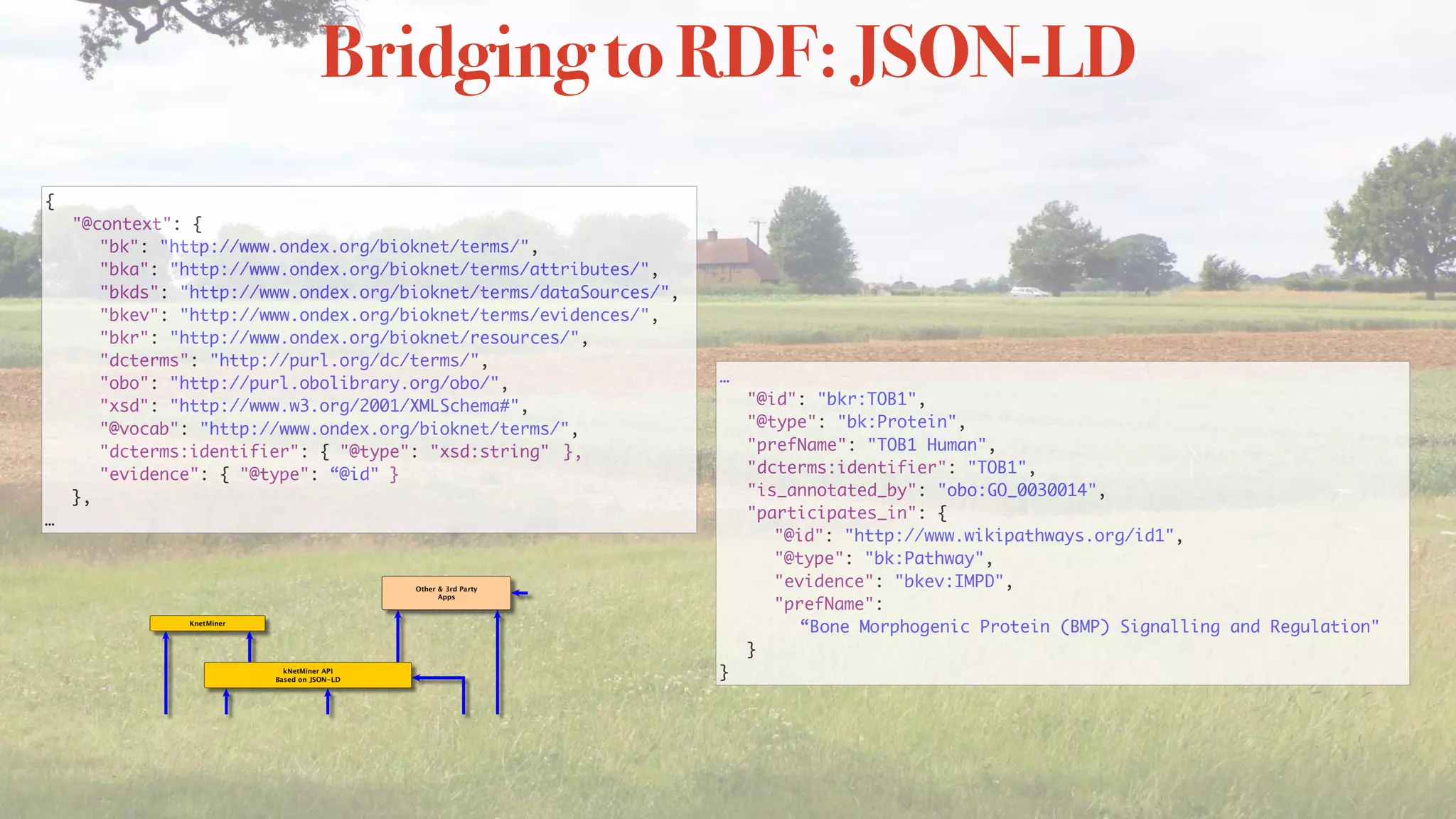
Bridging to RDF: JSON-LD
…
"@id": "bkr:TOB1",
"@type": "bk:Protein",
"prefName": "TOB1 Human",
"dcterms:identifier": "TOB1",
"is_annotated_by": "obo:GO_0030014",
"participates_in": {
"@id": "http://www.wikipathways.org/id1",
"@type": "bk:Pathway",
"evidence": "bkev:IMPD",
"prefName":

“Bone Morphogenic Protein (BMP) Signalling and Regulation"
}
}
{
"@context": {
"bk": "http://www.ondex.org/bioknet/terms/",
"bka": "http://www.ondex.org/bioknet/terms/attributes/",
"bkds": "http://www.ondex.org/bioknet/terms/dataSources/",
"bkev": "http://www.ondex.org/bioknet/terms/evidences/",
"bkr": "http://www.ondex.org/bioknet/resources/",
"dcterms": "http://purl.org/dc/terms/",
"obo": "http://purl.obolibrary.org/obo/",
"xsd": "http://www.w3.org/2001/XMLSchema#",
"@vocab": "http://www.ondex.org/bioknet/terms/",
"dcterms:identifier": { "@type": "xsd:string" },
"evidence": { "@type": “@id" }
},
…
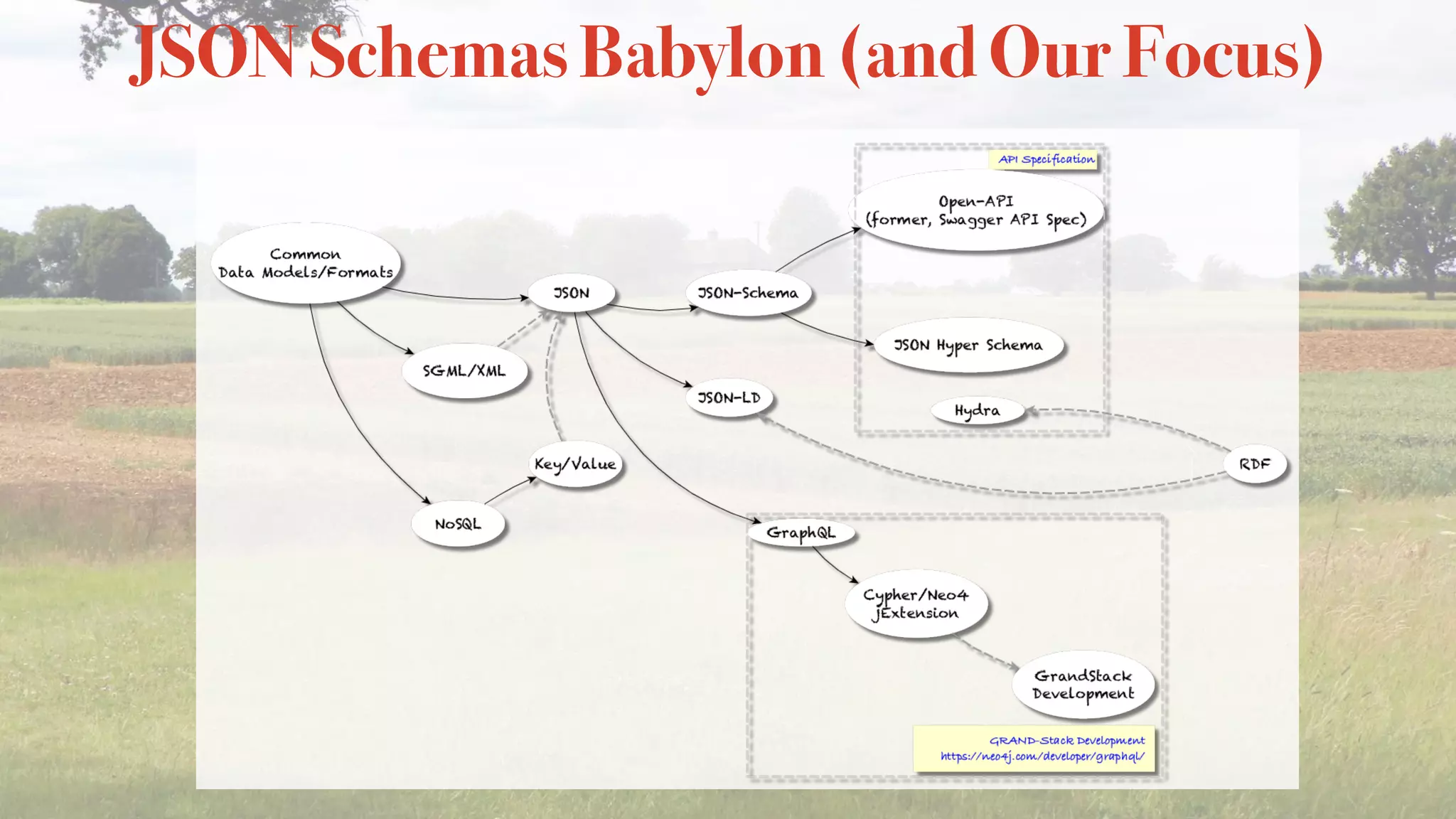
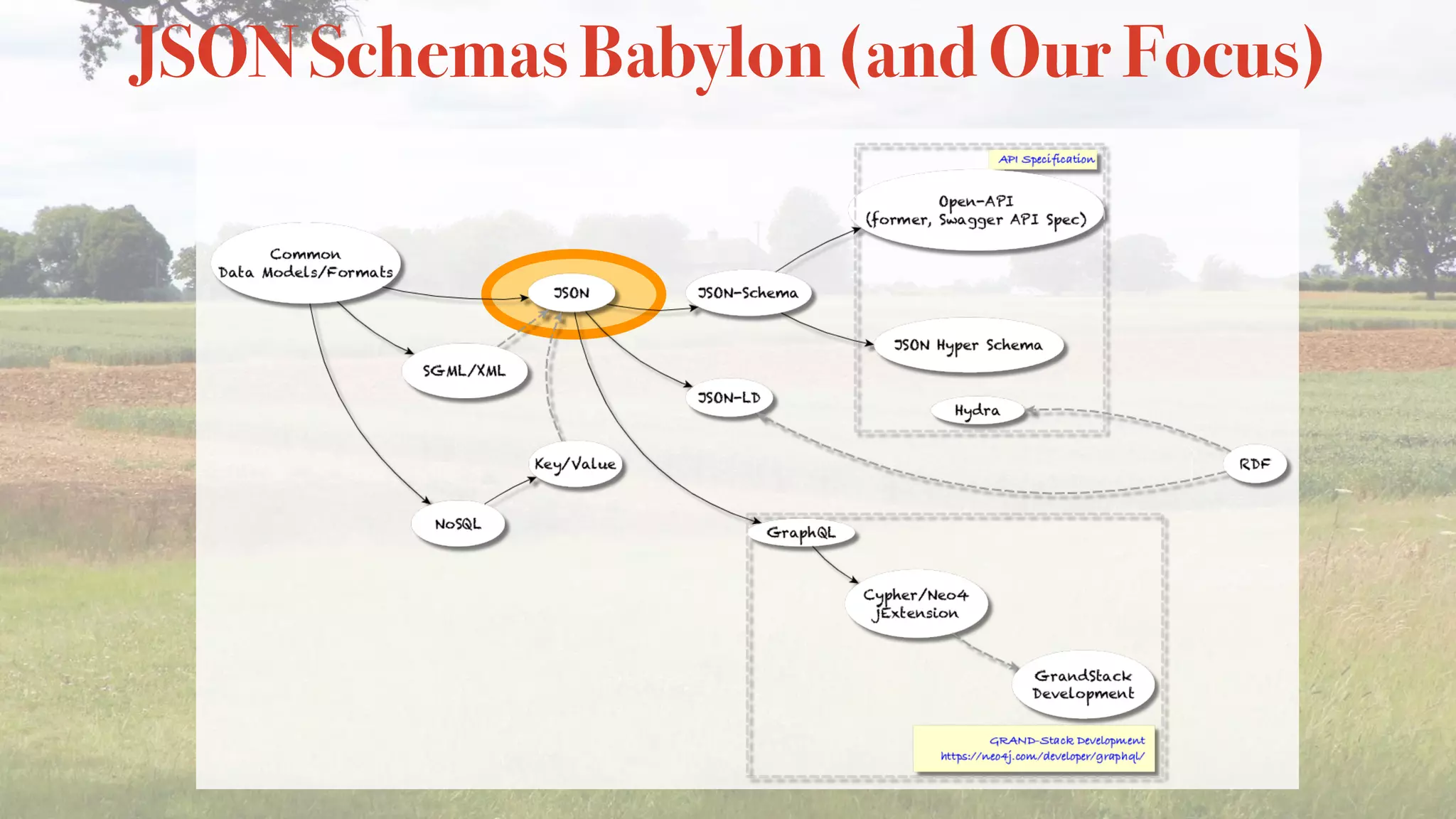
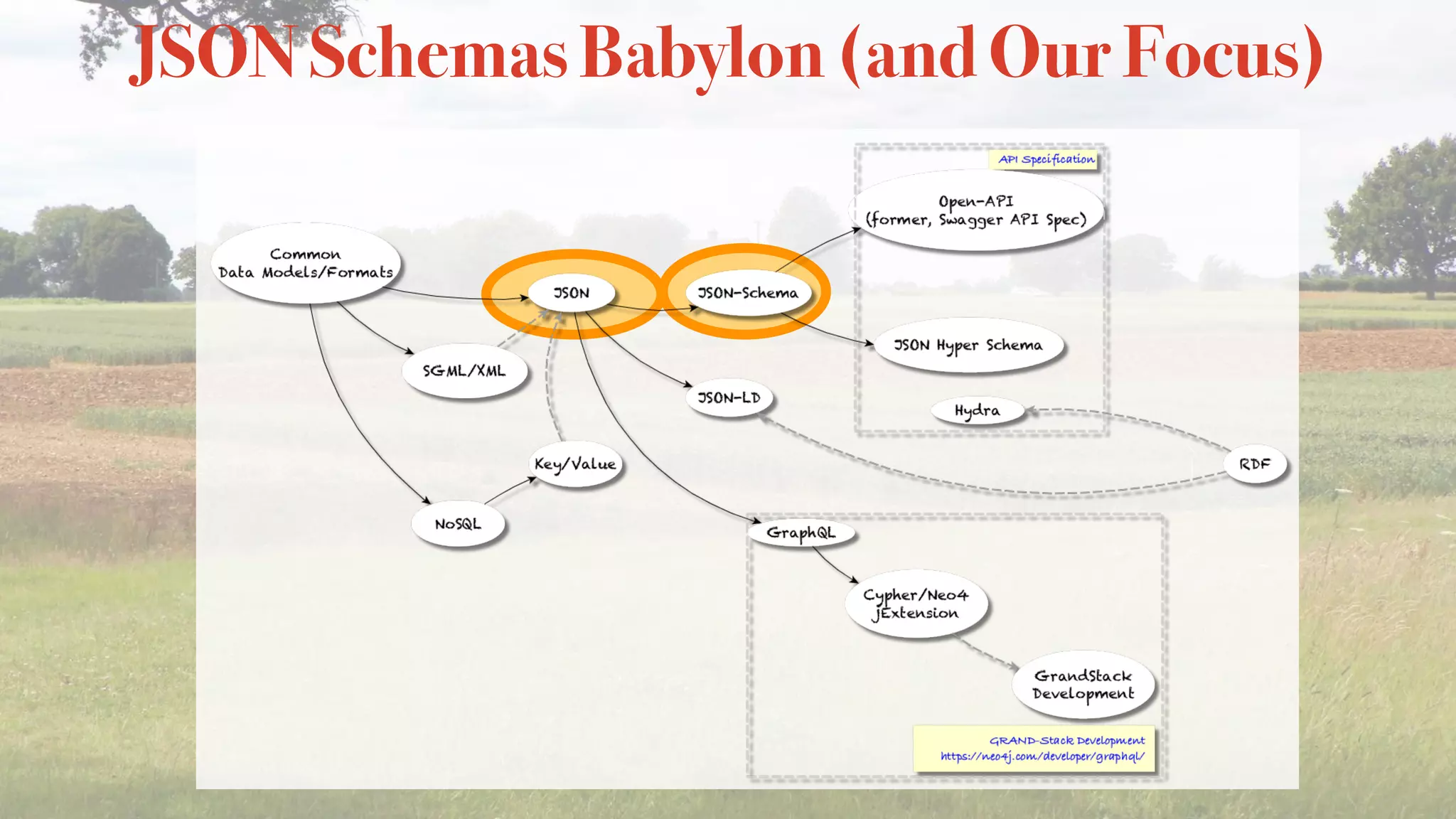
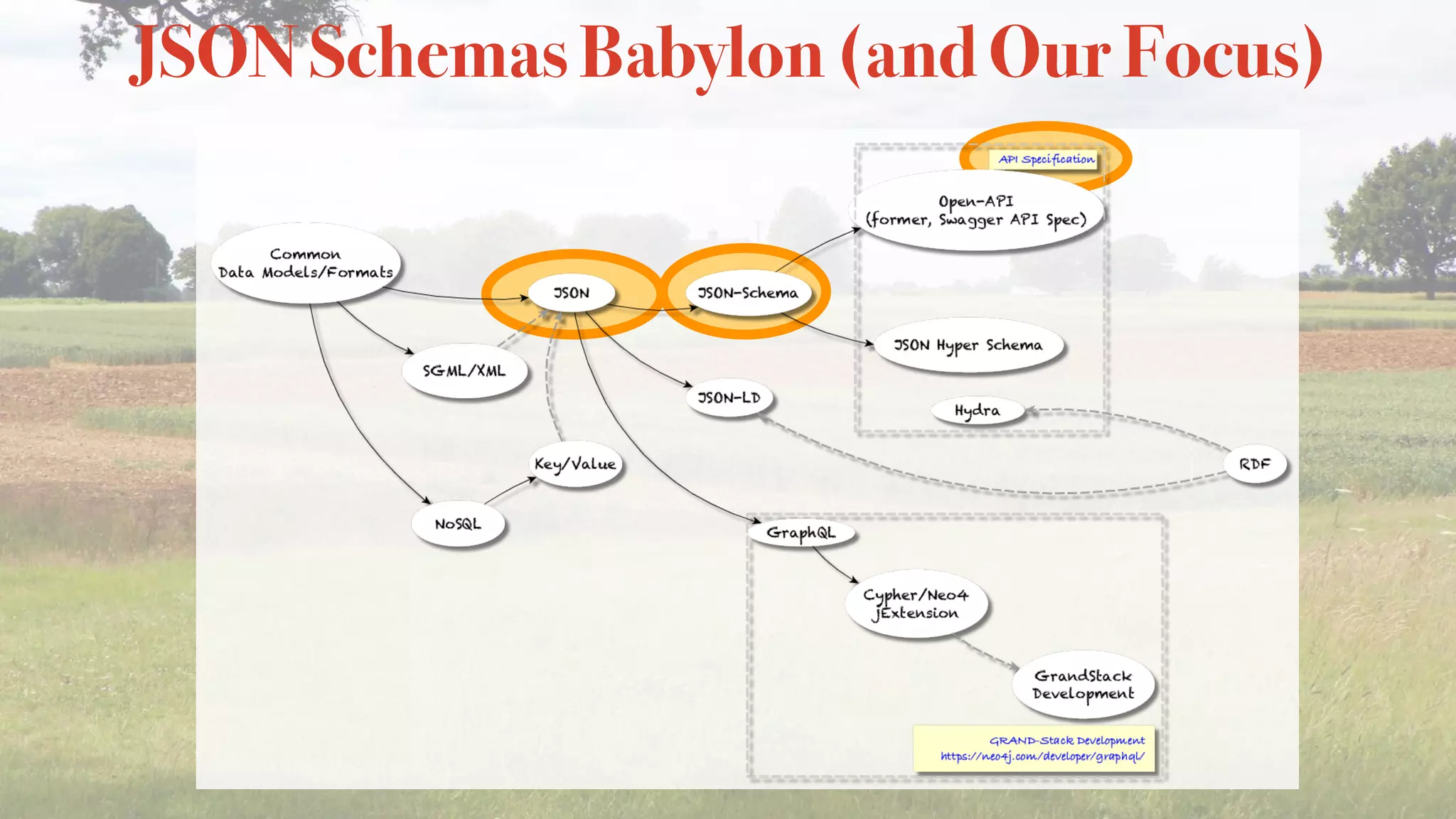
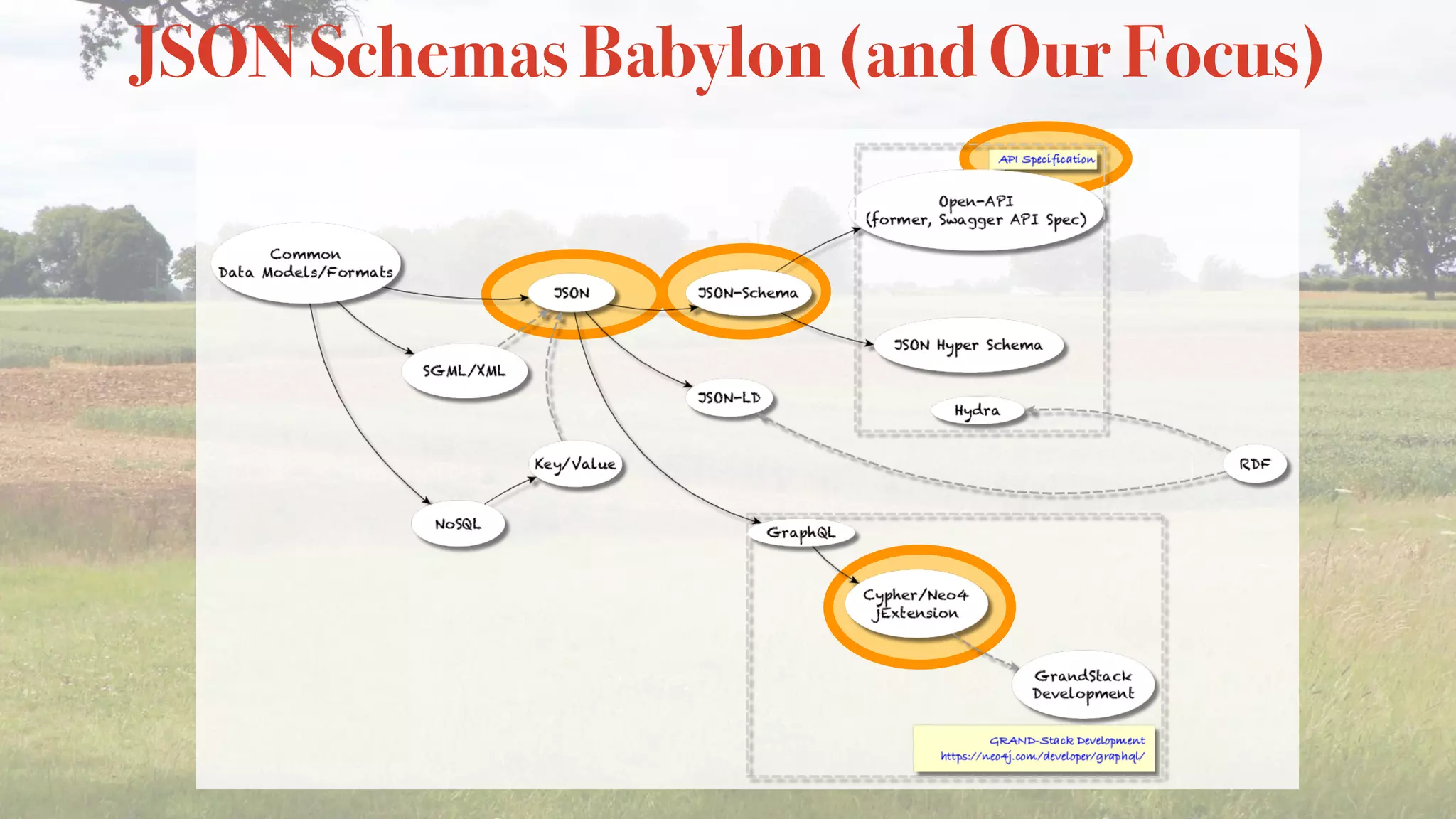
JSON Schemas Babylon (and Our Focus)
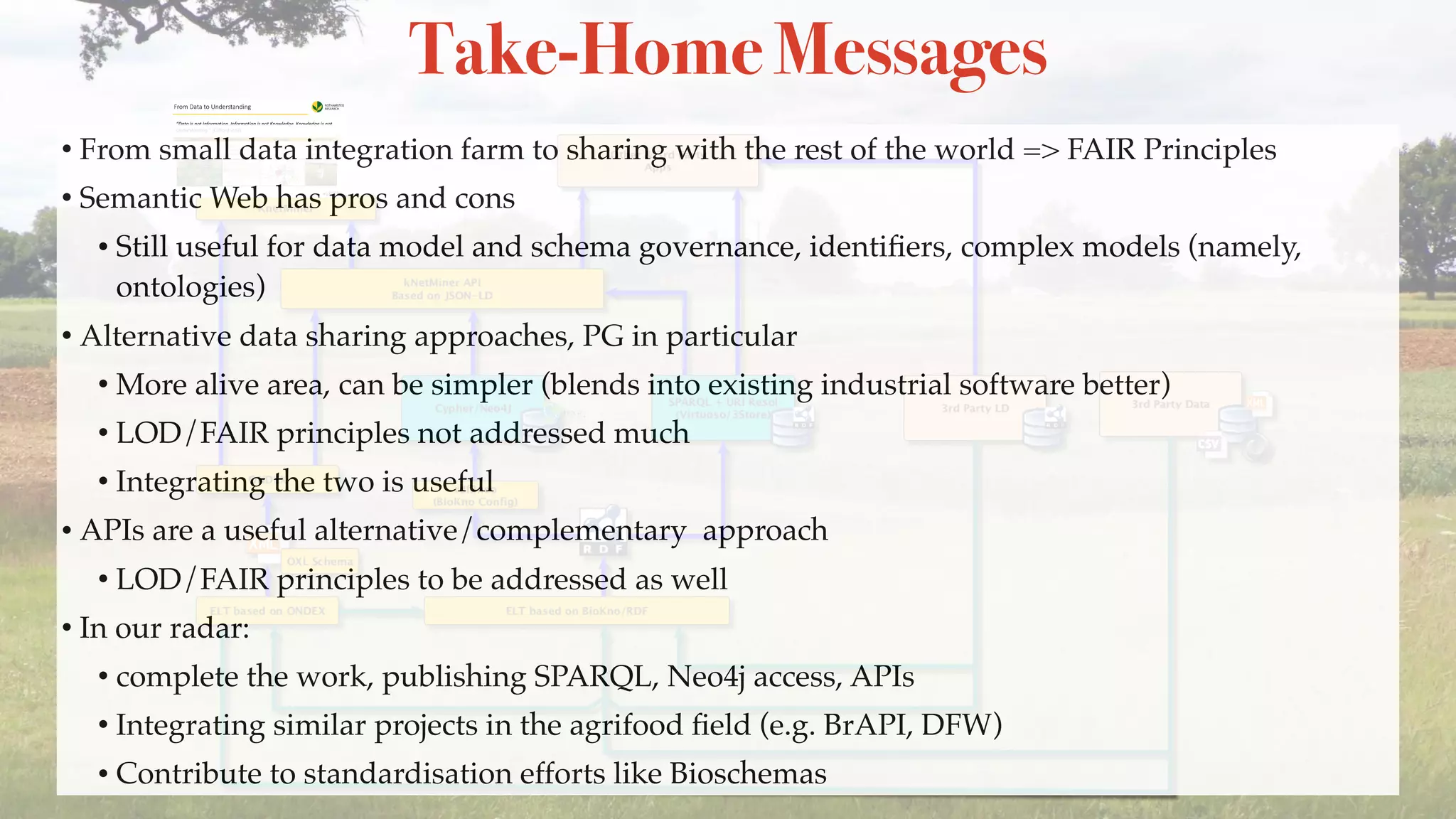
Take-Home Messages
• From small data integration farm to sharing with the rest of the world => FAIR Principles
• Semantic Web has pros and cons
• Still useful for data model and schema governance, identifiers, complex models (namely,
ontologies)
• Alternative data sharing approaches, PG in particular
• More alive area, can be simpler (blends into existing industrial software better)
• LOD/FAIR principles not addressed much
• Integrating the two is useful
• APIs are a useful alternative/complementary approach
• LOD/FAIR principles to be addressed as well
• In our radar:
• complete the work, publishing SPARQL, Neo4j access, APIs
• Integrating similar projects in the agrifood field (e.g. BrAPI, DFW)
• Contribute to standardisation efforts like Bioschemas
Behind the Scenes of KnetMiner: Towards Standardised and Interoperable Knowledge Graphs

Behind the Scenes of KnetMiner: Towards Standardised and Interoperable Knowledge Graphs

  • 1.
    Behind the Scenesof KnetMiner: Towards Standardised and Interoperable Knowledge Graphs Harpenden, 3/6/2018
 Marco Brandizi <marco.brandizi@rothamsted.ac.uk> Find these slides on SlideShare KnetMiner-inspired Artwork
 by Hugo Dalton (hugodalton.com)
  • 2.
    Behind the scenesof KnetMiner
  • 3.
    Putting it ona Bigger Picture
  • 4.
    Putting it ona Bigger Picture
  • 5.
    <concept> <id>1</id> <pid>Q75WV3</pid> <description/> <elementOf> <idRef>UNIPROTKB-SwissProt</idRef> </elementOf> <ofType> <idRef>Protein</idRef> </ofType> <evidences> <evidence> <idRef>IMPD</idRef> </evidence> </evidences> <conames> <concept_name> <name>Probable trehalose-phosphate phosphatase1</name> <isPreferred>true</isPreferred> </concept_name> … <cc> <id>Protein</id> <fullname>Protein</fullname> <description> A protein is comprised of one or more Polypeptides and potentially other molecules. </description> <specialisationOf> <idRef>MolCmplx</idRef> </specialisationOf> </cc> <relation> <fromConcept>1</fromConcept> <toConcept>3</toConcept> <ofType> <idRef>participates_in</idRef> </ofType> <evidences> <evidence> <idRef>ECO:0000316</idRef> </evidence> </evidences> <relgds/> </relation> <concept> <id>3</id> <pid>GO:0009651</pid> <description>response to salt stress</description> <ofType><idRef>BioProc</idRef></ofType> <coaccessions> <concept_accession> <accession>GO:0009651</accession> <elementOf><idRef>GO</idRef></elementOf> <ambiguous>false</ambiguous> </concept_accession> </coaccessions> </concept> Is XML/OXL Enough?
  • 6.
    A Brief Historyof Data Models/Formats
  • 7.
    The Semantic WebApproach: RDF
  • 8.
    The Semantic WebApproach: RDF
  • 9.
    URI Resolution @prefix bkr:<http://www.ondex.org/bioknet/resources/> . @prefix bk: <http://www.ondex.org/bioknet/terms/> . @prefix bka: <http://www.ondex.org/bioknet/terms/attributes/> . bkr:TOB1 a bk:Protein ; bk:participates_in <http://www.wikipathways.org/id1> ; bk:prefName "TOB1"; bk:published_in bkr:23236473.
 The Turtle Syntax: https://www.w3.org/TR/turtle/
  • 10.
  • 11.
  • 12.
  • 13.
    Sharing Identifiers viaURIs Data store Schema store Wikipathways
  • 14.
    Mapping Data forInteroperability
  • 17.
    Our Data Model:The BioKNO Ontology
  • 18.
    wp:id1 a bk:Path ;# a subclass of bk:Concept bk:evidence bkev:IMPD ; # Imported from database, a predefined resource type. bk:prefName "Bone Morphogenic Protein (BMP) Signalling and Regulation". bkr:TOB1 a bk:Protein ; dc:identifier bkr:TOB1_acc ; bk:prefName "TOB1 HUMAN";
 # A simplified link, hiding the BioPax chain: # pathwayComponent -> BioChemicalReaction|Complex -> Protein bk:participates_in wp:id1; 
 bk:is_annotated_by obo:GO_0030014. # Same URI as the OBO Gene Ontology Term. # Structured accession, allow for linking of identifier and context. bkr:TOB1_acc a bk:Accession ; dcterms:identifier "TOB1"; # instance of bk:DataSource. Another predefined entity. bk:dataSource bkds:UNIPROTKB. BioKNO: Biological Entities
  • 19.
    # For practicalreasons, we always expect that the straight # triple is always asserted, with the # reified version optionally added to it. bkr:TOB1 bk:published_in bkr:20068231. bkr:citation_TOB1_15489334 a bk:Relation ; # the same properties that are used for regular relations bk:relTypeRef bk:published_in; bk:relFrom bkr:TOB1 ; bk:relTo bkr:15489334 ; # An attribute bka:score 0.95 ;
 # Both attributes and object properties can be linked to a # reified relation. bk:evidence bkev:TextMining. Attributes in Reified Relations
  • 20.
    Talking to theRest of The World BioKNO External Ontologies Mapping Type bk:Concept skos:Concept Subclass bk:Relation bk:relFrom bk:relTypeRef bk:relTo rdf:Statement
 rdf:subject rdf:predicate rdf:object Subclass Subproperties (ie, mapping to RDF reified statements) bk:Path, bk:Participant, bk:Interaction, bk:Transport, bk:Protein, bk:Gene Classes with same names in BioPAX and SIO Equivalent Class bk:participates_in bk:has_participant Relation Ontology (RO) properties with same names
 biopax:participant (as sub-property) Equivalent property bk:produces bk:produced_by bk:consumes bk:consumed_by biopax:product (as sub-property) RO properties with same names Equivalent property bk:regulates bk:positively_regulates bk:negatively_regulates RO properties with same names Equivalent property bk:is_a bk:part_of, bk:has_part bk:occurs_in, bk:co_occurs_with skos:broader Basic Formal Ontology (BFO)/RO properties with same names Equivalent property bk:Publication schema:CreativeWork Subclass bka:abstract bka:title (also known as AbstractHeader) bka:authors dcterms:description dcterms:title dc:creator Sub-property
  • 22.
    How to Serveand Query RDF?
  • 23.
    Typical RDF (andData) Architecture
  • 24.
    How to Useit, Concretely? Playground: SPARQL Browsers
  • 25.
    How to Useit, Concretely? Playground: SPARQL Browsers
  • 26.
    How to Useit, Concretely? Playground: SPARQL Browsers
  • 27.
    How to Useit, Concretely? Programmatically: RDF Frameworks (Jena in this case)
  • 28.
    How to Useit, Concretely? Programmatically: RDF Frameworks (Jena in this case)
  • 29.
    How to Useit, Concretely? Programmatically: RDF Frameworks (Jena in this case) String service = "http://localhost:3030/ds/query"; String sparql = "PREFIX bk: <http://www.ondex.org/bioknet/terms/>n" + 
 … "n" + "n" + "SELECT DISTINCT ?pmid ?title ?year ?pub n" + "{n" + " ?prot a bk:Protein;n" + " bk:prefName 'TOB1'.n" + " n" + " ?pubRel a bk:Relation;n" + " bk:relFrom ?prot;n" + " bk:relTo ?pub;n" + " bka:Score ?score.n" + " n" + " FILTER ( ?score > 0.90 )n" + " n" + " ?pub n" + " bka:PMID ?pmid ;n" + " bka:YEAR ?dyear;n" + " bka:abstractHeader ?titlen" + "n" + " BIND ( xsd:int ( ?dyear ) AS ?year )n" + "}n" + "LIMIT 1000";
  • 30.
    How to Useit, Concretely? Programmatically: RDF Frameworks (Jena in this case) String service = "http://localhost:3030/ds/query"; String sparql = "PREFIX bk: <http://www.ondex.org/bioknet/terms/>n" + 
 … "n" + "n" + "SELECT DISTINCT ?pmid ?title ?year ?pub n" + "{n" + " ?prot a bk:Protein;n" + " bk:prefName 'TOB1'.n" + " n" + " ?pubRel a bk:Relation;n" + " bk:relFrom ?prot;n" + " bk:relTo ?pub;n" + " bka:Score ?score.n" + " n" + " FILTER ( ?score > 0.90 )n" + " n" + " ?pub n" + " bka:PMID ?pmid ;n" + " bka:YEAR ?dyear;n" + " bka:abstractHeader ?titlen" + "n" + " BIND ( xsd:int ( ?dyear ) AS ?year )n" + "}n" + "LIMIT 1000"; Query query = QueryFactory.create ( sparql ); QueryEngineHTTP qexec = QueryExecutionFactory.createServiceRequest( service, query ); ResultSet results = qexec.execSelect() ; results.forEachRemaining ( (QuerySolution soln ) -> { Resource pubNode = soln.getResource ( "pub" ); String uri = pubNode.getURI (); Literal titleNode = soln.getLiteral ( "title" ); String title = titleNode.getString (); String titleLang = titleNode.getLanguage (); Literal yearNode = soln.getLiteral ( "year" ); int year = yearNode.getInt (); System.out.format ( "Publication ID: <%s>, title: %s (in %s), year: %dn", uri, title, titleLang, year ); });
  • 31.
    CONSTRUCT { ?path abk:Path; bk:prefName ?pathName; bk:evidence bkev:IMPD. ?bkProt a bk:Protein; dc:identifier ?bkProtAccUri; bk:prefName ?protName; bk:participates_in ?path. ?bkProtAccUri a bk:Accession; dcterms:identifier ?protName; bk:dataSource bkds:UNIPROTKB. } SPARQL for Extraction, Loading, Transformation (The Simpler-than-Ondex Way) WHERE { ?path a bp:Pathway; bp:displayName ?pathName; bp:pathwayComponent ?comp. { ?comp a bp:BiochemicalReaction; bp:left|bp:right ?protein. } UNION { ?react a bp:Complex; bp:component ?protein. } ?protein a bp:Protein; bp:displayName ?protName. BIND ( IRI ( CONCAT ( STR ( bkr: ), STR ( ?protName ) ) ) AS ?bkProt ) BIND ( IRI ( CONCAT ( STR ( ?bkProt ), "_acc" ) ) AS ?bkProtAccUri ) }
  • 32.
    CONSTRUCT { ?path abk:Path; bk:prefName ?pathName; bk:evidence bkev:IMPD. ?bkProt a bk:Protein; dc:identifier ?bkProtAccUri; bk:prefName ?protName; bk:participates_in ?path. ?bkProtAccUri a bk:Accession; dcterms:identifier ?protName; bk:dataSource bkds:UNIPROTKB. } SPARQL for Extraction, Loading, Transformation (The Simpler-than-Ondex Way) WHERE { ?path a bp:Pathway; bp:displayName ?pathName; bp:pathwayComponent ?comp. { ?comp a bp:BiochemicalReaction; bp:left|bp:right ?protein. } UNION { ?react a bp:Complex; bp:component ?protein. } ?protein a bp:Protein; bp:displayName ?protName. BIND ( IRI ( CONCAT ( STR ( bkr: ), STR ( ?protName ) ) ) AS ?bkProt ) BIND ( IRI ( CONCAT ( STR ( ?bkProt ), "_acc" ) ) AS ?bkProtAccUri ) }
  • 33.
    SPARQL/RDF for ELT •TARQL: Using SPARQL to RDF-Convert Tabular CSV Files • RDF/XML can be transformed via XSL • We have done it for bio-specific ontology definitions in Ondex • Programmatic conversions • Using RDF frameworks, eg, Jena, RDF4J (former Sesame), rdflib for Python • See also java2rdf (https://github.com/EBIBioSamples/java2rdf) • We have used it for the Ondex->RDF converter
  • 34.
    SPARQL/RDF for ELT •TARQL: Using SPARQL to RDF-Convert Tabular CSV Files • RDF/XML can be transformed via XSL • We have done it for bio-specific ontology definitions in Ondex • Programmatic conversions • Using RDF frameworks, eg, Jena, RDF4J (former Sesame), rdflib for Python • See also java2rdf (https://github.com/EBIBioSamples/java2rdf) • We have used it for the Ondex->RDF converter
  • 35.
  • 36.
  • 37.
  • 38.
  • 39.
    The Bigger Picture:Linked Open Data Artificial Intelligence (AI) 8 https://lod-cloud.net/
  • 40.
    In the LifeSciences
  • 41.
  • 42.
  • 43.
    The Cypher Query/DMLLanguage Proteins->Reactions->Pathways:
 // chain of paths, node selection via property (exploits indices)
 MATCH (prot:Protein) - [csby:consumed_by] -> (:Reaction) - [:part_of] -> (pway:Path{ title: ‘apoptosis’ })
 // further conditions, not always so performant
 WHERE prot.name =~ ‘(?i)^DNA.+’
 // Usual projection and post-selection operators
 RETURN prot.name, pway
 // Relations can have properties
 ORDER BY csby.pvalue
 LIMIT 1000 Proteins->Reactions->Pathways: // Single-path (or same-direction branching) easy to write
 MATCH (prot:Protein) - [:produced_by|consumed_by] -> (:Reaction) 
 - [:part_of*1..3] -> (pway:Path)
 RETURN ID(prot), ID(pway) LIMIT 1000
 // Very compact forms available, depending on the data
 MATCH (prot:Protein) - (pway:Path) RETURN pway
  • 44.
    Cypher as SemanticMotif Language
  • 45.
    Cypher as SemanticMotif Language
  • 46.
  • 47.
  • 48.
  • 49.
    The rdf2neo Tool SELECT?iri { ?label rdfs:subClassOf* bk:Concept. ?iri a ?label. } SELECT ?label { { ?iri a ?label. ?label rdfs:subClassOf* bk:Concept. } UNION { # it's always instance of concept BIND ( bk:Concept AS ?label ) BIND ( ?iri AS ?iri ) } } SELECT ?name ?value { { ?iri ?name ?value. VALUES ( ?name ) { (dcterms:identifier) (dcterms:description) (rdfs:comment) (bk:prefName) (bk:altName) } } UNION { ?iri ?name ?value. ?name rdfs:subPropertyOf* bk:attribute. } }
  • 50.
  • 51.
    How to Useit, Concretely? Playground: The Neo4j Browser
  • 52.
    How to Useit, Concretely? Programmatically: The Neo4j Drivers (for Java in this case)
  • 53.
    How to Useit, Concretely? Programmatically: The Neo4j Drivers (for Java in this case) AuthToken auth = AuthTokens.basic ( "neo4j", "test" ); try ( Driver neodb = GraphDatabase.driver ( "bolt://127.0.0.1:7687", auth ); Session session = neodb.session (); ) { String cypher = "MATCH (prot:Protein{ prefName:'TOB1' }) - [r:published_in] -> (pub)n" + "WHERE toFloat ( r.Score ) > 0.9n" + "RETURN pub.PMID, pub.AbstractHeader, pub.YEARn" + "ORDER BY pub.YEAR DESCn" + "LIMIT 30"; Statement stmt = new Statement ( cypher ); StatementResult rs = session.run ( stmt ); rs.forEachRemaining ( rec -> { String pmid = rec.get ( "pub.PMID" ).asString (); String title = rec.get ( "pub.AbstractHeader" ).asString (); String year = rec.get ( "pub.YEAR" ).asString (); System.out.format ( "PMID: %s, Title: "%s", year: %sn", pmid, title, year ); }); }
  • 54.
    Triple Stores vsProp Graphs Neo4j, Cypher DBs, Graph DBs Semantic Web/Triple Stores Data xchg format - No official one, just Cypher, 
 Support for GraphML, RDF
 +/- Focus on backing applications + Focus on data sharing standards Data model + Relations with properties - Metadata/schemas/ontologies management - Relations cannot have properties (reification required) + Metadata/schemas/ontologies as first citizen and standardised OWL Performance + complex graph traversals + Comparable in most cases Query Language + Cypher is easier (eg, compact, implicit elems)?
 - Expressivity issues (unions) - No standard QL (but efforts in progress, eg, OpenCypher) - SPARQL is Harder? (URIs, namespaces, verbosity)
 + SPARQL More expressive Standardisation, openness +/- (TinkerPop is open, Neo4j isn’t) + Commercial support + More alive and up-to date (e.g., support for Hadoop, nice Neo4j browser, easy installation) + Natively open, many open implementations - Instability and many short-lived prototypes - Advancements seems to be slowing down + Some nice open and commercial browser (LODEStar, Scalability,
 big data +/- Commercial support to clustering/clouds for Neo4j
 + Open support in TinkerPop + Load Balancing/Cluster solutions, Commercial Cloud support (eg GraphDB)
 + SPARQL Over TinkerPop (via SAIL inteface)
  • 55.
    Supporting Web APIsvia JSON { "type": "Protein", "id": "TOB1", "prefName": "TOB1 Human", "participates_in": { "type": "Pathway", "id": "id1", "evidence": "IMPD", "prefName": "Bone Morphogenic Protein (BMP) Signalling and Regulation" }, "is_annotated_by": "GO_0030014" } • Designed to be compatible with browser, i.e., Javascript • Language of choice for web APIs, web browser consuming, dynamic web interfaces (i.e., AJAX) • Conceptually similar to XML (trees, nested structures) • Often used in a lightweight way, without much schema constraints
  • 56.
    Supporting Web APIsvia JSON { "type": "Protein", "id": "TOB1", "prefName": "TOB1 Human", "participates_in": { "type": "Pathway", "id": "id1", "evidence": "IMPD", "prefName": "Bone Morphogenic Protein (BMP) Signalling and Regulation" }, "is_annotated_by": "GO_0030014" } • Designed to be compatible with browser, i.e., Javascript • Language of choice for web APIs, web browser consuming, dynamic web interfaces (i.e., AJAX) • Conceptually similar to XML (trees, nested structures) • Often used in a lightweight way, without much schema constraints
  • 57.
    Bridging to RDF:JSON-LD … "@id": "bkr:TOB1", "@type": "bk:Protein", "prefName": "TOB1 Human", "dcterms:identifier": "TOB1", "is_annotated_by": "obo:GO_0030014", "participates_in": { "@id": "http://www.wikipathways.org/id1", "@type": "bk:Pathway", "evidence": "bkev:IMPD", "prefName":
 “Bone Morphogenic Protein (BMP) Signalling and Regulation" } } { "@context": { "bk": "http://www.ondex.org/bioknet/terms/", "bka": "http://www.ondex.org/bioknet/terms/attributes/", "bkds": "http://www.ondex.org/bioknet/terms/dataSources/", "bkev": "http://www.ondex.org/bioknet/terms/evidences/", "bkr": "http://www.ondex.org/bioknet/resources/", "dcterms": "http://purl.org/dc/terms/", "obo": "http://purl.obolibrary.org/obo/", "xsd": "http://www.w3.org/2001/XMLSchema#", "@vocab": "http://www.ondex.org/bioknet/terms/", "dcterms:identifier": { "@type": "xsd:string" }, "evidence": { "@type": “@id" } }, …
  • 58.
    JSON Schemas Babylon(and Our Focus)
  • 59.
    JSON Schemas Babylon(and Our Focus)
  • 60.
    JSON Schemas Babylon(and Our Focus)
  • 61.
    JSON Schemas Babylon(and Our Focus)
  • 62.
    JSON Schemas Babylon(and Our Focus)
  • 63.
    Take-Home Messages • Fromsmall data integration farm to sharing with the rest of the world => FAIR Principles • Semantic Web has pros and cons • Still useful for data model and schema governance, identifiers, complex models (namely, ontologies) • Alternative data sharing approaches, PG in particular • More alive area, can be simpler (blends into existing industrial software better) • LOD/FAIR principles not addressed much • Integrating the two is useful • APIs are a useful alternative/complementary approach • LOD/FAIR principles to be addressed as well • In our radar: • complete the work, publishing SPARQL, Neo4j access, APIs • Integrating similar projects in the agrifood field (e.g. BrAPI, DFW) • Contribute to standardisation efforts like Bioschemas