Downloaded 34 times


![Shell Function
function log {
if [ $# gt 0 ]; then
echo "[$(date +"%D %T")] $@" >> $LOG_FILE
db "$@"
else
while read data
do
echo "[$(date +"%D %T")] $data" >>
$LOG_FILE
db "$data"
done
fi
}
log “Hello World!”
echo “Hello World!” | log](https://image.slidesharecdn.com/csi-conference-tkm-bash-presentation-zyxware-anoop-2012-09-15-121106044348-phpapp01/85/Introduction-to-Bash-Scripting-Zyxware-Technologies-CSI-Students-Convention-Sep-15-2012-10-320.jpg)
![If Command
if [[ expression ]] then
commands;
elif [[ expression ]] then
commands;
else
commands;
fi](https://image.slidesharecdn.com/csi-conference-tkm-bash-presentation-zyxware-anoop-2012-09-15-121106044348-phpapp01/85/Introduction-to-Bash-Scripting-Zyxware-Technologies-CSI-Students-Convention-Sep-15-2012-13-320.jpg)
![For Loop
for NAME [in LIST ]; do
COMMANDS;
done
i=0
for filename in `ls`; do
i=$(( i + 1));
printf "%5s %sn" $i “$filename”;
done;
for name in Anoop John; do
echo “Hello ${name}”;
done;](https://image.slidesharecdn.com/csi-conference-tkm-bash-presentation-zyxware-anoop-2012-09-15-121106044348-phpapp01/85/Introduction-to-Bash-Scripting-Zyxware-Technologies-CSI-Students-Convention-Sep-15-2012-15-320.jpg)
![While Loop
while [[ expression ]]; do
COMMANDS;
done
i=0; while [[ $i lt 10 ]]; do
echo Counting $i;
((i+=1));
done;
while read line
do
echo $line
done < path/to/file](https://image.slidesharecdn.com/csi-conference-tkm-bash-presentation-zyxware-anoop-2012-09-15-121106044348-phpapp01/85/Introduction-to-Bash-Scripting-Zyxware-Technologies-CSI-Students-Convention-Sep-15-2012-16-320.jpg)
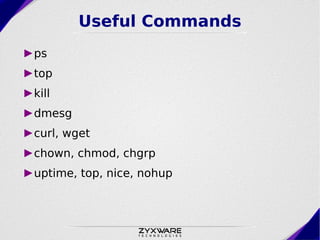
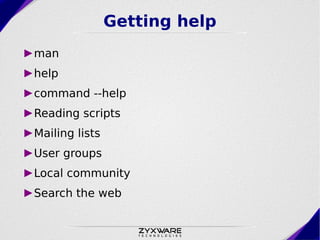
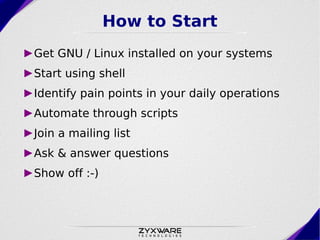
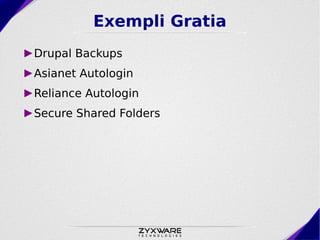


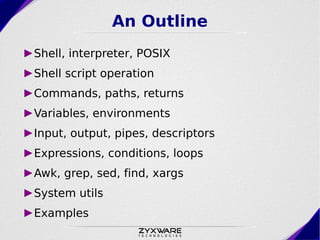
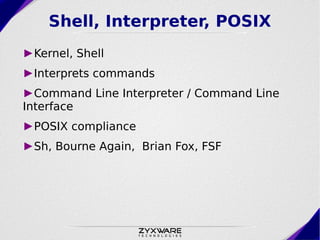
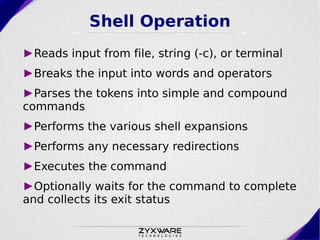
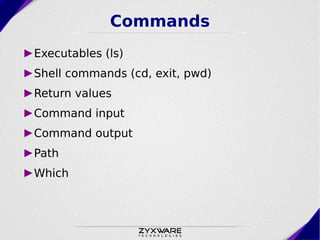
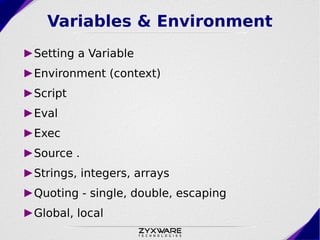
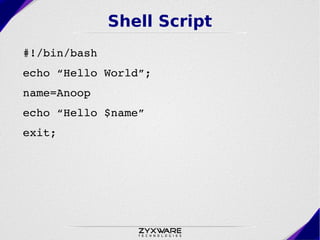
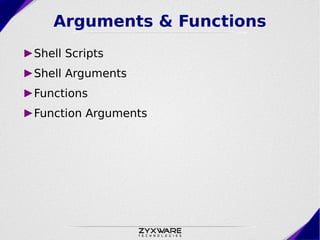
The document introduces Bash shell scripting, covering topics like shell operation, commands, environment variables, and scripting structures such as loops and conditionals. It also discusses tools like awk, grep, and sed, alongside practical examples and useful commands. Additionally, it provides guidance on getting started with GNU/Linux and automating tasks through scripts.


