Professor of OB/GYN
Benha University
2018
Dr/ Ahmed Walid Anwar Morad
โ€ข Introduction.
โ€ข Adjuvant procedures in IVF
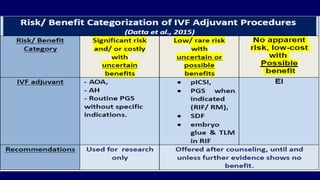
โ€ข Risk/ Benefit Categorization
โ€ข Change practice or wait for the future?
โ€ข Conclusions.
Introduction
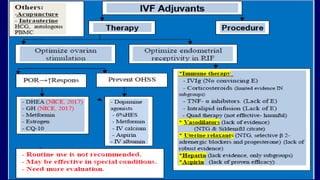
IVF adjuvants (add-ons): refer to optional treatment
and procedures alongside the standard IVF protocol to
increase the chance of a live birth.
( Harper et al.,2017& ESHRE, 2017)
Why IVF Adjuvants? (Nardo et al.,2015)
โ€“ Increase the chances of a fresh embryo transfer by:
โ€“ Optimizing ovarian response.
โ€“ Reducing the risk of OHSS.
โ€“ Counteract causes of repeated implantation failure.
-Majority:
โ–ชEmpirical treatment.
โ–ชWithout strong evidence of effectiveness.
โ–ชResults: non-useful, uncertain, or equivocal.
-Few: EB effectiveness
-Drawbacks:
โ–ชExtra cost.
โ–ชHealth hazards: overtreatment or malpractice.
A plethora of IVF adjuvants had been introduced in the last
decade (Nardo et al.,2015; Datta et al., 2015; Spencer et al., 2016)
โ€ข Adjuvant pre-treatment procedures
โ€ข Adjuvant pro-implantation procedures
โ€ข Adjuvants in the IVF laboratory
1) Ovarian reserve test: AMH and/ or antral
follicle count help to determine appropriate
protocol for ovarian stimulation.
(NICE
2017)
Adjuvant pre-treatment
procedures
โ€“ The most commonly requested immune testing :
โ€ข Anticardiolipin antibody (ACA), lupus
anticoagulant (LA), thyroid peroxidase antibodies
(TPA), anti-nuclear antibody and tests for
inherited thrombophilia.
2) Testing for reproductive immunology
ASRM 2018: No evidence to be tested routinely
in asymptomatic population.
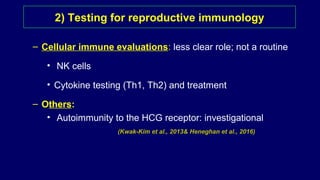
โ€“ Cellular immune evaluations: less clear role; not a routine
โ€ข NK cells
โ€ข Cytokine testing (Th1, Th2) and treatment
โ€“ Others:
โ€ข Autoimmunity to the HCG receptor: investigational
(Kwak-Kim et al., 2013& Heneghan et al., 2016)
2) Testing for reproductive immunology
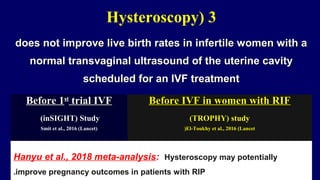
Hanyu et al., 2018 meta-analysis: Hysteroscopy may potentially
improve pregnancy outcomes in patients with RIP.
3(Hysteroscopy
does not improve live birth rates in infertile women with adoes not improve live birth rates in infertile women with a
normal transvaginal ultrasound of the uterine cavitynormal transvaginal ultrasound of the uterine cavity
scheduled for an IVF treatmentscheduled for an IVF treatment
Before 1Before 1stst
trial IVFtrial IVF Before IVF in women with RIFBefore IVF in women with RIF
(inSIGHT((inSIGHT( Study
Smit et al., 2016 (Lancet(
(TROPHY((TROPHY( study
El-Toukhy et al., 2016 (Lancet(
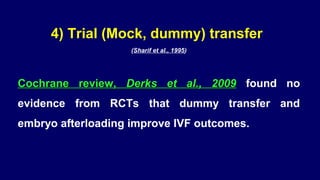
4) Trial (Mock, dummy) transfer
(Sharif et al., 1995)
Cochrane review,Cochrane review, Derks et al., 2009Derks et al., 2009 found no
evidence from RCTs that dummy transfer and
embryo afterloading improve IVF outcomes.
Adjuvant Pro-implantation
procedures
1) Endometrial (Injury) scratching
โ€ข Work by?
โ€ข Evidences (Cochrane SR, Nastri et al., 2015)
โ€“ Significant โ†‘ LBR and CPR when EI performed between day 7
of the previous cycle and day 7 of the embryo transfer (ET)
cycle in women with more than two previous embryo transfers.
(Moderate-quality evidence)
1) Endometrial (Injury) scratching
โ€“ Value of EI in women undergoing their first IVF cycle. (Lack
evidence)
โ€“ Endometrial injury on the day of oocyte retrieval is associated
with a reduction of CPR & LBR
โ€“ No evidence of an effect on miscarriage, multiple pregnancies
or bleeding.
2) Embryo glue and adherence compounds
Embryo glue:??
Evidences:
-Cochrane SR, Bontekoe et al., 2014 found higher CPR and LBRs and
significant increase in the incidence of multiple pregnancies after using
embryo glue. (Moderate-quality evidence(
-Francsovits et al., 2014, reported the reverse but higher birth-weight.
Recommendations: RCTs with single embryo transfer &RIF.
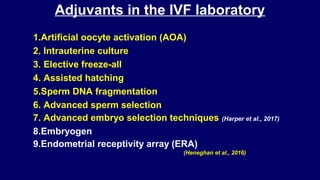
Adjuvants in the IVF laboratory
1.Artificial oocyte activation (AOA)
2. Intrauterine culture
3. Elective freeze-all
4. Assisted hatching
5.Sperm DNA fragmentation
6. Advanced sperm selection
7. Advanced embryo selection techniques (Harper et al., 2017)
8.Embryogen
9.Endometrial receptivity array (ERA)
(Heneghan et al., 2016)
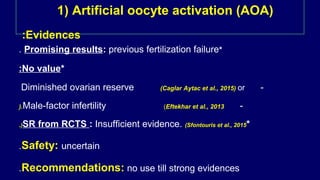
1) Artificial oocyte activation (AOA)
Evidences:
*Promising results: previous fertilization failure.
*No value:
-Diminished ovarian reserve (Caglar Aytac et al., 2015) or
-Male-factor infertility (Eftekhar et al., 2013).
*SR from RCTS : Insufficient evidence. (Sfontouris et al., 2015).
Safety: uncertain.
Recommendations: no use till strong evidences.
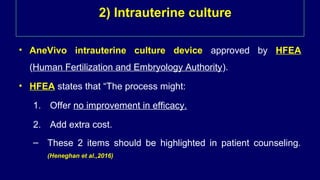
2) Intrauterine culture
โ€ข AneVivo intrauterine culture device approved by HFEA
(Human Fertilization and Embryology Authority).
โ€ข HFEA states that โ€œThe process might:
1. Offer no improvement in efficacy.
2. Add extra cost.
โ€“ These 2 items should be highlighted in patient counseling.
(Heneghan et al.,2016)
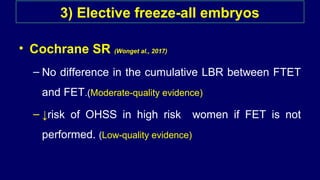
3) Elective freeze-all embryos
โ€ข Cochrane SR (Wonget al., 2017)
โ€“ No difference in the cumulative LBR between FTET
and FET.(Moderate-quality evidence)
โ€“ โ†“risk of OHSS in high risk women if FET is not
performed. (Low-quality evidence)
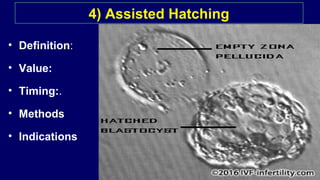
โ€ข Definition:
โ€ข Value:
โ€ข Timing:.
โ€ข Methods
โ€ข Indications
4) Assisted Hatching
NICE 2017:
AH is not recommended as it has not
been shown to improve pregnancy rates.
4) Assisted Hatching
5) Sperm DNA fragmentation
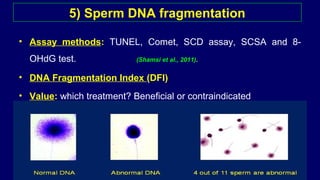
โ€ข Assay methods: TUNEL, Comet, SCD assay, SCSA and 8-
OHdG test. (Shamsi et al., 2011).
โ€ข DNA Fragmentation Index (DFI)
โ€ข Value: which treatment? Beneficial or contraindicated
(Muratori et al., 2015).
5) Sperm DNA fragmentation
โ€“ Men with low SDF had a higher LBR than those with high SDF.
(Osman et al.,2015 & Simon et al., 2016)
โ€“ ASRM, 2014: current SDF assessment methods do not reliably
predict treatment outcomes, and cannot be used routinely.
โ€˜โ€˜insufficient evidenceโ€™
โ€“ Cochrane report, 2014: antioxidant in male with spermatozoa
oxidative stress, increase CPR and LBR. (Low-quality evidence).
6) Advanced sperm selection
โ€“ Cochrane reviews
1. Intracytoplasmic morphologically selected sperm injection,
(IMSI). (Teixeira et al., 2013; McDowell et al., 2014)}.
2. Hyaluronic acid (HA) binding:
โ€“ Physiological intracytoplasmic sperm injection (PICSI). (Worrilow et al., 2013)
โ€“ SpermSlow. (McDowell et al., 2014)
7) Advanced embryo selection
techniques
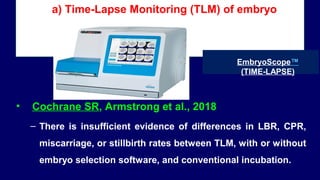
a) Time-Lapse Monitoring (TLM) of embryo
โ€ข Cochrane SR, Armstrong et al., 2018
โ€“ There is insufficient evidence of differences in LBR, CPR,
miscarriage, or stillbirth rates between TLM, with or without
embryo selection software, and conventional incubation.
EmbryoScopeโ„ข
(TIME-LAPSE)
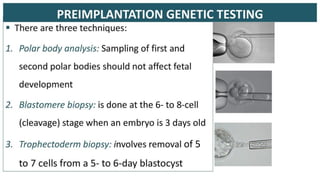
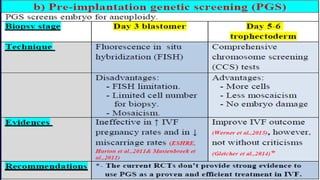
Preimplantation genetic testing
(3 types)
โ€ข PGT-A: Preimplantation genetic testing for aneuploidy.
{formerly called (PGS) screening }
โ€ข PGT-SR: Preimplantation genetic testing for structural
rearrangements.
โ€ข PGT-M: Preimplantation genetic testing for monogenic
(single-gene) disorders.
c) Mitochondrial DNA load measurement
โ€ขAn association between higher mtDNA level and lower
implantation potential in blastocysts (Diez-Juan et al., 2015; Fragouli et al.,
2015).
โ€ขThere is no evidence that selection through mtDNA load
measurement increases LBR.
โ€ขLimited to researches.
(Harper et al., 2017)
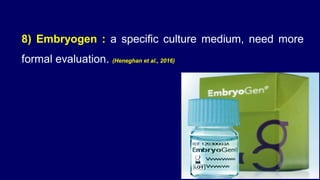
8) Embryogen : a specific culture medium, need more
formal evaluation. (Heneghan et al., 2016)
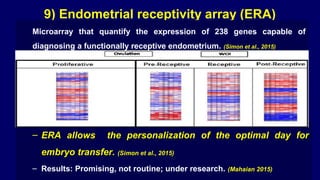
9) Endometrial receptivity array (ERA)
โ€“ ERA allows the personalization of the optimal day forERA allows the personalization of the optimal day for
embryo transfer.embryo transfer. (Simon et al., 2015)
โ€“ Results: Promising, not routine; under research. (Mahaian 2015)
Microarray that quantify the expression of 238 genes capable of
diagnosing a functionally receptive endometrium. (Simon et al., 2015)
Change the practice or wait for the future?
โ€ข Any new idea:
โ€“ Generate widespread media publicity.
โ€“ Raises patients expectations.
โ€“ Push the clinician to make their own clinical
judgment.
โ€ข Unfair to deny certain treatment with
โ€“ Some emerging evidence of benefit
โ€“ Low risk profile.
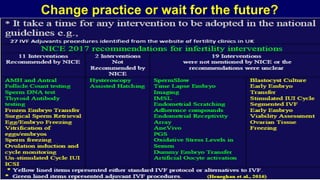
Change practice or wait for the future?
Conclusions
โ€ข IVF adjuvants are widely applied:
โ€“ Empirical
โ€“ Without strong evidence of effectiveness,
โ€“ May be expensive
โ€“ May be harmful, which clearly isn't ethical.
Conclusions
โ€ข General use of the IVF adjuvant procedures is not
advisable until evidenced by high-quality RCTs trials.
โ€ข The patient should be counseled regards the current
evidence for benefit and risks associated with the
adjuvant to be offered.
Conclusions
โ€ข Most adjuvant procedures are either unproven or they
are expensive for a small potential benefit, therefore;
they are not in routine use.
โ€ข Regulators and professional bodies ensure that only
suitable practices are used in the IVF clinic.
Adjuvant procedures in IVF

Adjuvant procedures in IVF

  • 1.
    Professor of OB/GYN BenhaUniversity 2018 Dr/ Ahmed Walid Anwar Morad
  • 2.
    โ€ข Introduction. โ€ข Adjuvantprocedures in IVF โ€ข Risk/ Benefit Categorization โ€ข Change practice or wait for the future? โ€ข Conclusions.
  • 3.
    Introduction IVF adjuvants (add-ons):refer to optional treatment and procedures alongside the standard IVF protocol to increase the chance of a live birth. ( Harper et al.,2017& ESHRE, 2017)
  • 4.
    Why IVF Adjuvants?(Nardo et al.,2015) โ€“ Increase the chances of a fresh embryo transfer by: โ€“ Optimizing ovarian response. โ€“ Reducing the risk of OHSS. โ€“ Counteract causes of repeated implantation failure.
  • 5.
    -Majority: โ–ชEmpirical treatment. โ–ชWithout strongevidence of effectiveness. โ–ชResults: non-useful, uncertain, or equivocal. -Few: EB effectiveness -Drawbacks: โ–ชExtra cost. โ–ชHealth hazards: overtreatment or malpractice. A plethora of IVF adjuvants had been introduced in the last decade (Nardo et al.,2015; Datta et al., 2015; Spencer et al., 2016)
  • 7.
    โ€ข Adjuvant pre-treatmentprocedures โ€ข Adjuvant pro-implantation procedures โ€ข Adjuvants in the IVF laboratory
  • 8.
    1) Ovarian reservetest: AMH and/ or antral follicle count help to determine appropriate protocol for ovarian stimulation. (NICE 2017) Adjuvant pre-treatment procedures
  • 9.
    โ€“ The mostcommonly requested immune testing : โ€ข Anticardiolipin antibody (ACA), lupus anticoagulant (LA), thyroid peroxidase antibodies (TPA), anti-nuclear antibody and tests for inherited thrombophilia. 2) Testing for reproductive immunology ASRM 2018: No evidence to be tested routinely in asymptomatic population.
  • 10.
    โ€“ Cellular immuneevaluations: less clear role; not a routine โ€ข NK cells โ€ข Cytokine testing (Th1, Th2) and treatment โ€“ Others: โ€ข Autoimmunity to the HCG receptor: investigational (Kwak-Kim et al., 2013& Heneghan et al., 2016) 2) Testing for reproductive immunology
  • 11.
    Hanyu et al.,2018 meta-analysis: Hysteroscopy may potentially improve pregnancy outcomes in patients with RIP. 3(Hysteroscopy does not improve live birth rates in infertile women with adoes not improve live birth rates in infertile women with a normal transvaginal ultrasound of the uterine cavitynormal transvaginal ultrasound of the uterine cavity scheduled for an IVF treatmentscheduled for an IVF treatment Before 1Before 1stst trial IVFtrial IVF Before IVF in women with RIFBefore IVF in women with RIF (inSIGHT((inSIGHT( Study Smit et al., 2016 (Lancet( (TROPHY((TROPHY( study El-Toukhy et al., 2016 (Lancet(
  • 13.
    4) Trial (Mock,dummy) transfer (Sharif et al., 1995) Cochrane review,Cochrane review, Derks et al., 2009Derks et al., 2009 found no evidence from RCTs that dummy transfer and embryo afterloading improve IVF outcomes.
  • 14.
  • 15.
    1) Endometrial (Injury)scratching โ€ข Work by? โ€ข Evidences (Cochrane SR, Nastri et al., 2015) โ€“ Significant โ†‘ LBR and CPR when EI performed between day 7 of the previous cycle and day 7 of the embryo transfer (ET) cycle in women with more than two previous embryo transfers. (Moderate-quality evidence)
  • 16.
    1) Endometrial (Injury)scratching โ€“ Value of EI in women undergoing their first IVF cycle. (Lack evidence) โ€“ Endometrial injury on the day of oocyte retrieval is associated with a reduction of CPR & LBR โ€“ No evidence of an effect on miscarriage, multiple pregnancies or bleeding.
  • 17.
    2) Embryo glueand adherence compounds Embryo glue:?? Evidences: -Cochrane SR, Bontekoe et al., 2014 found higher CPR and LBRs and significant increase in the incidence of multiple pregnancies after using embryo glue. (Moderate-quality evidence( -Francsovits et al., 2014, reported the reverse but higher birth-weight. Recommendations: RCTs with single embryo transfer &RIF.
  • 18.
    Adjuvants in theIVF laboratory 1.Artificial oocyte activation (AOA) 2. Intrauterine culture 3. Elective freeze-all 4. Assisted hatching 5.Sperm DNA fragmentation 6. Advanced sperm selection 7. Advanced embryo selection techniques (Harper et al., 2017) 8.Embryogen 9.Endometrial receptivity array (ERA) (Heneghan et al., 2016)
  • 19.
    1) Artificial oocyteactivation (AOA) Evidences: *Promising results: previous fertilization failure. *No value: -Diminished ovarian reserve (Caglar Aytac et al., 2015) or -Male-factor infertility (Eftekhar et al., 2013). *SR from RCTS : Insufficient evidence. (Sfontouris et al., 2015). Safety: uncertain. Recommendations: no use till strong evidences.
  • 20.
    2) Intrauterine culture โ€ขAneVivo intrauterine culture device approved by HFEA (Human Fertilization and Embryology Authority). โ€ข HFEA states that โ€œThe process might: 1. Offer no improvement in efficacy. 2. Add extra cost. โ€“ These 2 items should be highlighted in patient counseling. (Heneghan et al.,2016)
  • 21.
    3) Elective freeze-allembryos โ€ข Cochrane SR (Wonget al., 2017) โ€“ No difference in the cumulative LBR between FTET and FET.(Moderate-quality evidence) โ€“ โ†“risk of OHSS in high risk women if FET is not performed. (Low-quality evidence)
  • 22.
    โ€ข Definition: โ€ข Value: โ€ขTiming:. โ€ข Methods โ€ข Indications 4) Assisted Hatching
  • 23.
    NICE 2017: AH isnot recommended as it has not been shown to improve pregnancy rates. 4) Assisted Hatching
  • 24.
    5) Sperm DNAfragmentation โ€ข Assay methods: TUNEL, Comet, SCD assay, SCSA and 8- OHdG test. (Shamsi et al., 2011). โ€ข DNA Fragmentation Index (DFI) โ€ข Value: which treatment? Beneficial or contraindicated (Muratori et al., 2015).
  • 25.
    5) Sperm DNAfragmentation โ€“ Men with low SDF had a higher LBR than those with high SDF. (Osman et al.,2015 & Simon et al., 2016) โ€“ ASRM, 2014: current SDF assessment methods do not reliably predict treatment outcomes, and cannot be used routinely. โ€˜โ€˜insufficient evidenceโ€™ โ€“ Cochrane report, 2014: antioxidant in male with spermatozoa oxidative stress, increase CPR and LBR. (Low-quality evidence).
  • 26.
    6) Advanced spermselection โ€“ Cochrane reviews 1. Intracytoplasmic morphologically selected sperm injection, (IMSI). (Teixeira et al., 2013; McDowell et al., 2014)}. 2. Hyaluronic acid (HA) binding: โ€“ Physiological intracytoplasmic sperm injection (PICSI). (Worrilow et al., 2013) โ€“ SpermSlow. (McDowell et al., 2014)
  • 27.
    7) Advanced embryoselection techniques
  • 28.
    a) Time-Lapse Monitoring(TLM) of embryo โ€ข Cochrane SR, Armstrong et al., 2018 โ€“ There is insufficient evidence of differences in LBR, CPR, miscarriage, or stillbirth rates between TLM, with or without embryo selection software, and conventional incubation. EmbryoScopeโ„ข (TIME-LAPSE)
  • 29.
    Preimplantation genetic testing (3types) โ€ข PGT-A: Preimplantation genetic testing for aneuploidy. {formerly called (PGS) screening } โ€ข PGT-SR: Preimplantation genetic testing for structural rearrangements. โ€ข PGT-M: Preimplantation genetic testing for monogenic (single-gene) disorders.
  • 32.
    c) Mitochondrial DNAload measurement โ€ขAn association between higher mtDNA level and lower implantation potential in blastocysts (Diez-Juan et al., 2015; Fragouli et al., 2015). โ€ขThere is no evidence that selection through mtDNA load measurement increases LBR. โ€ขLimited to researches. (Harper et al., 2017)
  • 33.
    8) Embryogen :a specific culture medium, need more formal evaluation. (Heneghan et al., 2016)
  • 34.
    9) Endometrial receptivityarray (ERA) โ€“ ERA allows the personalization of the optimal day forERA allows the personalization of the optimal day for embryo transfer.embryo transfer. (Simon et al., 2015) โ€“ Results: Promising, not routine; under research. (Mahaian 2015) Microarray that quantify the expression of 238 genes capable of diagnosing a functionally receptive endometrium. (Simon et al., 2015)
  • 36.
    Change the practiceor wait for the future? โ€ข Any new idea: โ€“ Generate widespread media publicity. โ€“ Raises patients expectations. โ€“ Push the clinician to make their own clinical judgment. โ€ข Unfair to deny certain treatment with โ€“ Some emerging evidence of benefit โ€“ Low risk profile.
  • 37.
    Change practice orwait for the future?
  • 38.
    Conclusions โ€ข IVF adjuvantsare widely applied: โ€“ Empirical โ€“ Without strong evidence of effectiveness, โ€“ May be expensive โ€“ May be harmful, which clearly isn't ethical.
  • 39.
    Conclusions โ€ข General useof the IVF adjuvant procedures is not advisable until evidenced by high-quality RCTs trials. โ€ข The patient should be counseled regards the current evidence for benefit and risks associated with the adjuvant to be offered.
  • 40.
    Conclusions โ€ข Most adjuvantprocedures are either unproven or they are expensive for a small potential benefit, therefore; they are not in routine use. โ€ข Regulators and professional bodies ensure that only suitable practices are used in the IVF clinic.