11/26/2024 BBA-5th BIS Unit-6 1
Unit 6
Information System within
Organization
11/26/2024 BBA-5th BIS Unit-6 2
Transaction Processing
Systems
• Millions (sometimes billions) of transactions occur in large organizations
every day.
• A transaction is any business event that generates data worthy of being
captured and stored in a database.
• Examples of transactions are a product manufactured, a service sold, a
person hired, and a payroll check generated.
• In another example, when you are checking out of Walmart, each time
11/26/2024 BBA-5th BIS Unit-6 3
• A transaction processing system (TPS) supports the monitoring, collection,
storage, and processing of data from the organization’s basic business
transactions, each of which generates data.
• The TPS collects data continuously, typically in real time—that is, as soon as
the data are generated—and it provides the input data for the corporate
databases.
• The TPSs are critical to the success of any enterprise because they support
core operations.
• In the modern business world, TPSs are inputs for the functional area
information systems and business intelligence systems, as well as business
operations such as customer relationship management, knowledge
management, and e-commerce.
11/26/2024 BBA-5th BIS Unit-6 4
11/26/2024 BBA-5th BIS Unit-6 5
Consider these examples of how TPSs manage the complexities of
transactional data:
• When more than one person or application program can access the
database at the same time, the database has to be protected from errors
resulting from overlapping updates. The most common error is losing the
results of one of the updates.
• When processing a transaction involves more than one computer, the
database and all users must be protected against inconsistencies arising
from a failure of any component at any time. For example, an error that
occurs at some point in an ATM withdrawal can enable a customer to
receive cash, although the bank’s computer indicates that he or she did
11/26/2024 BBA-5th BIS Unit-6 6
• It must be possible to reverse a transaction in its entirety if it turns out to
have been entered in error. It is also necessary to reverse a transaction when
a purchased item is returned. For example, if you return a sweater that you
have purchased, the store must credit your credit card for the amount of the
purchase, refund your cash, or offer you an in-store credit to purchase
another item. In addition, the store must update its inventory.
• It is frequently important to preserve an audit trail. In fact, for certain
transactions an audit trail may be legally required.
11/26/2024 BBA-5th BIS Unit-6 7
• In online transaction processing (OLTP), business
transactions are processed online as soon as they occur.
• For example, when you pay for an item at a store, the
system records the sale by reducing the inventory on hand
by one unit, increasing sales figures for the item by one
unit, and increasing the store’s cash position by the
amount you paid.
• The system performs these tasks in real time by means of
online technologies.
11/26/2024 BBA-5th BIS Unit-6 8
Functional Area Information Systems
• Each department or functional area within an organization has
its own collection of application programs, or information
systems.
• Each of these functional area information systems (FAISs)
supports a particular functional area in the organization by
increasing each area’s internal efficiency and effectiveness.
• Examples of FAISs include accounting IS, finance IS,
production/operations management (POM) IS, marketing IS,
11/26/2024 BBA-5th BIS Unit-6 9
Information Systems for Accounting and
Finance
• A primary mission of the accounting and finance functional
areas is to manage money flows into, within, and out of
organizations.
• This mission is very broad because money is involved in all
organizational functions.
• Therefore, accounting and finance information systems are
very diverse and comprehensive.
11/26/2024 BBA-5th BIS Unit-6 10
Financial Planning and Budgeting. Appropriate management of
financial assets is a
major task in financial planning and budgeting. Managers must plan for both
acquiring and utilizing resources.
• Financial and economic forecasting. Knowledge about the availability and cost
of money is a key ingredient for successful financial planning. Cash flow
projections are particularly important because they inform organizations what
funds they need, when they need them, and how they will acquire them.
Budgeting. An essential component of the accounting/finance function is the
annual budget, which allocates the organization’s financial resources among
participants and activities. The budget allows management to distribute
11/26/2024 BBA-5th BIS Unit-6 11
Managing Financial Transactions. Many
accounting/finance software packages are integrated
with other functional areas. For example, Peachtree by
Sage (www.peachtree.com) offers a sales ledger, a
purchase ledger, a cash book, sales order processing,
invoicing, stock control, a fixed assets register, and
more.
11/26/2024 BBA-5th BIS Unit-6 12
Companies involved in electronic commerce need to access customers’ financial data (e.g., credit
line), inventory levels, and manufacturing databases (to determine available capacity and place
orders). For example, Microsoft Dynamics GP (formerly Great Plains Software) offers 50 modules
that meet the most common financial, project, distribution, manufacturing, and e-business needs.
Organizations, business processes, and business activities operate with, and manage, financial
transactions. Consider these examples:
• Global stock exchanges. Financial markets operate in global, 24/7/365, distributed electronic stock
exchanges that use the Internet both to buy and sell stocks and to broadcast real-time stock prices.
• Managing multiple currencies. Global trade involves financial transactions that are carried out in
different currencies. The conversion ratios of these currencies are constantly in flux. Financial and
accounting systems utilize financial data from different countries and convert the currencies from
and to any other currency in seconds.
• Virtual close. Companies traditionally closed their books (accounting records) quarterly, usually to
meet regulatory requirements. Today, many companies want to be able to close their books at any
11/26/2024 BBA-5th BIS Unit-6 13
Investment Management.
• Organizations invest large amounts of money in stocks, bonds, real estate, and other
assets. Managing these investments is a complex task, for several reasons.
• First, organizations have literally thousands of investment alternatives dispersed
throughout the world to choose from. In addition, these investments are subject to
complex regulations and tax laws, which vary from one location to another.
Investment decisions require managers to evaluate financial and economic reports
provided by diverse institutions, including federal and state agencies, universities,
research institutions, and financial services firms. In addition, thousands of Web sites
provide financial data, many of them for free.
To monitor, interpret, and analyze the huge amounts of online financial data, financial
analysts employ two major types of IT tools: (1) Internet search engines and (2)
business intelligence and decision support software.
11/26/2024 BBA-5th BIS Unit-6 14
Control and Auditing. One major reason why organizations go out of
business is their inability to forecast and/or secure a sufficient cash flow.
Underestimating expenses, overspending, engaging in fraud, and
mismanaging financial statements can lead to disaster. Consequently, it is
essential that organizations effectively control their finances and financial
statements. Let us examine some of the most common forms of financial
control.
• Budgetary control. After an organization has finalized its annual budget, it
divides those monies into monthly allocations. Managers at various levels
monitor departmental expenditures and compare them against the budget
and the operational progress of corporate plans.
11/26/2024 BBA-5th BIS Unit-6 15
• Auditing. Auditing has two basic purposes:
(1)to monitor how the organization’s monies are being spent and
(2)to assess the organization’s financial health.
Internal auditing is performed by the organization’s accounting/finance
personnel. Financial ratio analysis. Another major accounting/finance
function is to monitor the company’s financial health by assessing a set of
financial ratios. Included here are liquidity ratios (the availability of cash to
pay debt), activity ratios (how quickly a firm converts noncash assets to
cash assets), debt ratios (measure the firm’s ability to repay long-term
debt), and profitability ratios (measure the fi rm’s use of its assets and
control of its expenses to generate an acceptable rate of return).
11/26/2024 BBA-5th BIS Unit-6 16
Information Systems for Marketing
It is impossible to overestimate the importance of customers to any
organization. Therefore, any successful organization must understand its
customers’ needs and wants and then develop its marketing and advertising
strategies around them. Information systems provide numerous types of
support to the marketing function.
Information Systems for Production/Operations Management
The POM function in an organization is responsible for the processes that
transform inputs into useful outputs as well as for the overall operation of the
business. Because of the breadth and variety of POM functions, you see only
four here: in-house logistics and materials management, planning production
11/26/2024 BBA-5th BIS Unit-6 17
In-House Logistics and Materials Management. Logistics
management deals with ordering, purchasing, inbound logistics
(receiving), and outbound logistics (shipping) activities. Related
activities include inventory management and quality control.
Inventory Management. As the name suggests, inventory
management determines how much inventory an organization should
maintain. Both excessive inventory and insufficient inventory create
problems. Overstocking can be expensive, because of storage costs
and the costs of spoilage and obsolescence. However, keeping
insufficient inventory is also expensive, because of last-minute orders
11/26/2024 BBA-5th BIS Unit-6 18
Quality Control. Quality-control systems used by manufacturing units provide
information about the quality of incoming material and parts, as well as the
quality of in-process semifinished and finished products. These systems record
the results of all inspections and compare the actual results to established
metrics. They also generate periodic reports containing information about
quality—for example, the percentage of products that contain defects or that
need to be reworked. Quality control data, collected by Web-based sensors, can
be interpreted in real time.
Alternatively, they can be stored in a database for future analysis.
Planning Production and Operations. In many fi rms, POM planning is
supported by IT. POM planning has evolved from material requirements
11/26/2024 BBA-5th BIS Unit-6 19
Computer-Integrated Manufacturing. Computer-integrated manufacturing
(CIM; also called digital manufacturing) is an approach that integrates various
automated factory systems. CIM has three basic goals:
(1)to simplify all manufacturing technologies and techniques,
(2)to automate as many of the manufacturing processes as possible, and
(3)To integrate and coordinate all aspects of design, manufacturing, and related
functions via computer systems.
Product Life Cycle Management. Even within a single organization, designing
and developing new products can be expensive and time consuming. When
multiple organizations are involved, the process can become very complex.
Product life cycle management is a business strategy that enables manufacturers to
share product-related data that support product design and development and
11/26/2024 BBA-5th BIS Unit-6 20
Information Systems for Human Resource Management
• Initial human resource information system (HRIS) applications dealt
primarily with transaction processing systems, such as managing
benefits and keeping records of vacation days.
• As organizational systems have moved to intranets and the Web,
however, so have HRIS applications.
• Many HRIS applications are delivered via an HR portal.
• For example, numerous organizations use their Web portals to
advertise job openings and to conduct online hiring and training.
11/26/2024 BBA-5th BIS Unit-6 21
Recruitment.
• Recruitment involves finding potential employees, evaluating them, and deciding
which ones to hire. Some companies are flooded with viable applicants; others have
difficulty finding the right people.
• IT can be helpful in both cases.
• In addition, IT can assist in related activities such as testing and screening job
applicants. With millions of resumes available online (in particular, LinkedIn), it is not
surprising that companies are trying to find appropriate candidates on the Web,
usually with the help of specialized search engines.
• Companies also advertise hundreds of thousands of jobs on the Web. Online
recruiting can reach more candidates, which may bring in better applicants.
• In addition, the costs of online recruitment are usually lower than traditional
recruiting methods such as advertising in newspapers or in trade journals.
11/26/2024 BBA-5th BIS Unit-6 22
Human Resources Development. After employees are recruited, they become
part of the corporate human resources pool, which means they must be
evaluated and developed.
• IT provides support for these activities. Most employees are periodically
evaluated by their immediate supervisors.
• In addition, in some organizations, peers or subordinates also evaluate other
employees.
• Evaluations are typically digitized, and they are used to support many
decisions, ranging from rewards to transfers to layoffs.
• IT also plays an important role in training and retraining. Some of the most
innovative developments are taking place in the areas of intelligent
computer-aided instruction and the application of multimedia support for
11/26/2024 BBA-5th BIS Unit-6 23
Human Resources Planning and Management. Managing human
resources in large organizations requires extensive planning and detailed
strategy. The following areas are where IT can provide support:
• Payroll and employees’ records. The HR department is responsible for
payroll preparation. This process is typically automated with paychecks
being printed or money being transferred electronically into employees’
bank accounts.
• Benefits administration. Employees’ work contributions to their
organizations are rewarded by wages, bonuses, and other benefits.
Benefits include health and dental care, pension contributions, wellness
centers, and child care centers.
11/26/2024 BBA-5th BIS Unit-6 24
11/26/2024 BBA-5th BIS Unit-6 25
11/26/2024 BBA-5th BIS Unit-6 26
11/26/2024 BBA-5th BIS Unit-6 27
Enterprise Resource Planning Systems
• Enterprise resource planning systems are designed to correct a lack of
communication among the functional area IS.
• ERP systems resolve this problem by tightly integrating the functional area IS via a
common database.
• For this reason, experts credit ERP systems with greatly increasing organizational
productivity.
• ERP systems adopt a business process view of the overall organization to integrate
the planning, management, and use of all of an organization’s resources,
employing a common software platform and database.
• The major objectives of ERP systems are to tightly integrate the functional areas of
the organization and to enable information to flow seamlessly across them.
• Tight integration means that changes in one functional area are immediately
11/26/2024 BBA-5th BIS Unit-6 28
ERP II Systems
• ERP systems were originally deployed to facilitate business processes associated with
manufacturing, such as raw materials management, inventory control, order entry,
and distribution.
• However, these early ERP systems did not extend to other functional areas, such as
sales and marketing.
• They also did not include any customer relationship management (CRM) capabilities
that enable organizations to capture customer-specific information.
• Finally, they did not provide Web-enabled customer service or order fulfillment. Over
time, ERP systems evolved to include administrative, sales, marketing, and human
resources processes. Companies now employ an enterprise wide approach to ERP
that utilizes the Web and connects all facets of the value chain.
• These systems are called ERP II.
11/26/2024 BBA-5th BIS Unit-6 29
• ERP II systems are interorganizational ERP systems that provide Web-enabled
links among a company’s key business systems—such as inventory and
production—and its customers, suppliers, distributors, and other relevant parties.
• These links integrate internal-facing ERP applications with the external-focused
applications of supply chain management and customer relationship
management. The various functions of ERP II systems are now delivered as e-
business suites.
• The major ERP vendors have developed modular, Web-enabled software suites
that integrate ERP, customer relationship management, supply chain
management, procurement, decision support, enterprise portals, and other
business applications and functions. Examples are Oracle’s e-Business Suite and SAP’s
mySAP.
• The goal of these systems is to enable companies to execute most of their business
11/26/2024 BBA-5th BIS Unit-6 30
11/26/2024 BBA-5th BIS Unit-6 31
Benefits and Limitation of ERP Systems
ERP systems can generate significant business benefits for an organization. The major
benefits fall into the following categories:
• Organizational flexibility and agility. As you have seen, ERP systems break down many
former departmental and functional silos of business processes, information systems,
and information resources. In this way, they make organizations more flexible, agile,
and adaptive. The organizations can therefore respond quickly to changing business
conditions and capitalize on new business opportunities.
• Decision support. ERP systems provide essential information on business performance
across functional areas. This information significantly improves managers’ ability to
make better, more timely decisions.
• Quality and efficiency. ERP systems integrate and improve an organization’s business
processes, generating significant improvements in the quality of production,
11/26/2024 BBA-5th BIS Unit-6 32
Despite all of their benefits, however, ERP systems do have drawbacks. The
major limitations of ERP implementations include:
• The business processes in ERP software are often predefined by the best
practices that the ERP vendor has developed.
• Best practices are the most successful solutions or problem-solving methods
for achieving a business objective.
• As a result, companies may need to change their existing business
processes to fit the predefined business processes incorporated into the ERP
software.
• For companies with well-established procedures, this requirement can
create serious problems, especially if employees do not want to abandon
their old ways of working and therefore resist the changes.
• At the same time, however, an ERP implementation can provide an
opportunity to improve and in some cases completely redesign inefficient,
ineffective, or outdated procedures.
• In fact, many companies benefit from implementing best practices for their
accounting, finance, and human resource processes, as well as other
support activities that companies do not consider a source of competitive
11/26/2024 BBA-5th BIS Unit-6 33
The major causes of ERP implementation failure include:
• Failure to involve affected employees in the planning and
development phases and in change management
processes;
• Trying to do too much too fast in the conversion process;
• Insufficient training in the new work tasks required by
the ERP system;
• The failure to perform proper data conversion and
testing for the new system.
11/26/2024 BBA-5th BIS Unit-6 34
Implementing ERP Systems
Companies can implement ERP systems in two ways, using on-premise
software or using
software-as-a-service (SaaS)
On-Premise ERP Implementation.
• Depending on the types of value chain processes managed by the ERP
system and a company’s specific value chain, there are three strategic
approaches to implementing an on-premise ERP system.
• These approaches are:
1. The vanilla approach: In this approach, a company implements a standard
ERP package, using the package’s built-in configuration options. When the
system is implemented in this way, it will deviate only minimally from the
package’s standardized settings. The vanilla approach can make the
implementation quicker, but the extent to which the software is adapted
to the organization’s specific processes is limited. Fortunately, a vanilla
implementation provides general functions that can support the firm’s
common business processes with relative ease, even if they are not a
11/26/2024 BBA-5th BIS Unit-6 35
2. The custom approach:
• In this approach, a company implements a more customized ERP system by
developing new ERP functions designed specifically for that firm.
• Decisions concerning the ERP’s degree of customization are specific to each
organization. To utilize the custom approach, the organization must
carefully analyze its existing business processes to develop a system that
conforms to the organizations particular characteristics and processes.
• In addition, customization is expensive and risky because computer code
must be written and updated every time a new version of the ERP software
is released.
• Going further, if the customization does not perfectly match the
organization’s needs, then the system can be very difficult to use.
3. The best of breed approach: This approach combines the benefits of the
vanilla and customized systems while avoiding the extensive costs and risks
associated with complete customization.
11/26/2024 BBA-5th BIS Unit-6 36
• Companies that adopt this approach mix and match core ERP modules as well as
other extended ERP modules from different software providers to best fit their
unique internal processes and value chains.
• Thus, a company may choose several core ERP modules from an established
vendor to take advantage of industry best practices—for example, for financial
management and human resource management.
• At the same time, it may also choose specialized software to support its unique
business processes—for example, for manufacturing, warehousing and
distribution.
• Sometimes companies arrive at the best of breed approach the hard way.
• For example, Dell wasted millions of dollars trying to customize an integrated ERP
system from a major vendor to match its unique processes before it realized that a
smaller, more flexible system that integrated well with other corporate
11/26/2024 BBA-5th BIS Unit-6 37
Software-as-a-Service ERP Implementation.
• Companies can acquire ERP systems without having to buy a complete
software solution (i.e., on-premise ERP implementation).
• In this business model, the company rents the software from an ERP
vendor who offers its products over the Internet using the SaaS model.
The ERP cloud vendor manages software updates and is responsible for
the system’s security and availability.
• Cloud-based ERP systems can be a perfect fi t for some companies. For
instance, companies that cannot afford to make large investments in IT,
yet which already have relatively structured business processes that need
to be tightly integrated, might benefit from cloud computing.
• The relationship between the company and the cloud vendor is regulated
by contracts and by service level agreements (SLAs).
• The SLAs defi ne the characteristics and quality of service; for instance, a
guaranteed uptime, or the percentage of time that the system is available.
• Cloud vendors that fail to meet these conditions can face penalties.
11/26/2024 BBA-5th BIS Unit-6 38
Enterprise Application Integration
• For some organizations, integrated ERP systems are not appropriate. This situation is
particularly true for companies that find the process of converting from their existing
system too difficult or time-consuming.
• Such companies, however, may still have isolated information systems that need to be
connected with one another. To accomplish this task, these companies can use
enterprise application integration.
• An enterprise application integration (EAI) system integrates existing systems by
providing software, called middleware, that connects multiple applications.
• In essence, the EAI system allows existing applications to communicate and share
data, thereby enabling organizations to utilize existing applications while eliminating
many of the problems caused by isolated information systems. EAI systems also
support implementation of “best of breed” ERP solutions by connecting software
11/26/2024 BBA-5th BIS Unit-6 39
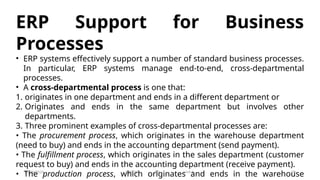
ERP Support for Business
Processes
• ERP systems effectively support a number of standard business processes.
In particular, ERP systems manage end-to-end, cross-departmental
processes.
• A cross-departmental process is one that:
1. originates in one department and ends in a different department or
2. Originates and ends in the same department but involves other
departments.
3. Three prominent examples of cross-departmental processes are:
• The procurement process, which originates in the warehouse department
(need to buy) and ends in the accounting department (send payment).
• The fulfillment process, which originates in the sales department (customer
request to buy) and ends in the accounting department (receive payment).
• The production process, which originates and ends in the warehouse
11/26/2024 BBA-5th BIS Unit-6 40
The Procurement, Fulfillment, and
Production Processes
Three common cross-functional business processes are procurement,
fulfillment, and production.
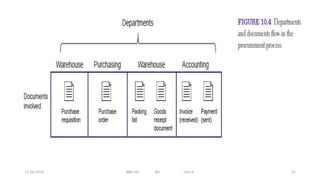
The Procurement Process. The procurement process originates when a
company needs to acquire goods or services from external sources, and it
concludes when the company receives and pays for them. Let’s consider a
procurement process where the company needs to acquire physical goods.
This process involves three main departments—Warehouse, Purchasing, and
Accounting—and consists of the following steps:
• The process originates in the Warehouse department, which generates a
purchase requisition to buy the needed products.
• The Warehouse forwards the purchase requisition to the Purchasing
department, which creates a purchase order (PO) and forwards it to a vendor.
Generally, companies can choose from a number of vendors, and they select
the one that best meets their requirements in terms of convenience, speed,
11/26/2024 BBA-5th BIS Unit-6 41
• After the company places the order, it receives the goods in its
Warehouse department, where someone physically checks the delivery to
make certain that it corresponds to what the company ordered. He or she
performs this task by comparing a packing list attached to the shipment
against the PO.
• If the shipment matches the order, then the Warehouse issues a goods
receipt document.
• At the same time or shortly thereafter, the Accounting department
receives an invoice from the vendor. Accounting then checks that the PO,
the goods receipt document, and the invoice match. This process is called
the three-way-match.
11/26/2024 BBA-5th BIS Unit-6 42
The Order Fulfillment Process. In contrast to procurement, in which the
company purchases goods from a vendor, in the order fulfillment process,
also known as the order to- cash process, the company sells goods to a
customer. Fulfillment originates when the company receives a customer order,
and it concludes when it receives a payment from the customer.
The fulfillment process can follow two basic strategies: sell-from-stock and
configure-to order.
Sell-from-stock involves fulfilling customers directly using goods that are in the
warehouse (stock). These goods are standard, meaning that the company
does not customize them for buyers. In contrast, in configure-to-order, the
company customizes the product in response to a customer request.
11/26/2024 BBA-5th BIS Unit-6 43
A fulfillment process involves three main departments: Sales, Warehouse,
and Accounting. The steps in a fulfillment process include the following:
1. The Sales department receives a customer inquiry, which essentially is a
request for information concerning the availability and price of a specific
good. (We restrict our discussion here to fulfilling a customer order for
physical goods rather than services.)
2. After Sales receives the inquiry, it issues a quotation that indicates
availability and price.
3. If the customer agrees to the price and terms, then Sales creates a
customer purchase order and a sales order.
11/26/2024 BBA-5th BIS Unit-6 44
4. Sales forwards the sales order to the Warehouse. The sales order is an
inter-departmental document that helps the company keep track of the
internal processes that are involved in fulfilling a specific customer order. In
addition, it provides details of the quantity, price, and other characteristics
of the product.
5. The Warehouse prepares the shipment and produces two other internal
documents: the picking document, which it uses to remove goods from the
Warehouse, and the packing list, which accompanies the shipment and
provides details about the delivery.
6. At the same time, Accounting issues an invoice for the customer.
7. The process concludes when Accounting receives a payment that is
consistent with the invoice.
11/26/2024 BBA-5th BIS Unit-6 45
11/26/2024 BBA-5th BIS Unit-6 46
The Production Process. The production process does not occur in all
companies because not all companies produce physical goods. In fact, many
businesses limit their activities to buying (procurement) and selling products
(e.g., retailers). The production process can follow two different strategies:
make-to-stock and make-to-order.
Make-to-stock occurs when the company produces goods to create or
increase an inventory; that is, finished products that are stored in the
warehouse and are available for sales.
In contrast, make-to-order occurs when the production is generated by a
specific customer order. Manufacturing companies that produce their own
goods manage their inter-departmental production process across the
Production and Warehouse departments.
11/26/2024 BBA-5th BIS Unit-6 47
The steps in the production process are as follows:
• The Warehouse department issues a planned order when the
company needs to produce a finished product, either because the
Warehouse has insufficient inventory or because the customer placed a
specific order for goods that are not currently in stock.
• Once the planned order reaches Production, the production controller
authorizes the order and issues a production order, which is a written
authorization to start the production of a certain amount of a specific
product.
11/26/2024 BBA-5th BIS Unit-6 48
To assemble a finished product, Production requires a number of materials (or
parts). To acquire these materials, Production generates a material withdrawal
slip, which lists all of the needed parts, and forwards it to the Warehouse.
• If the parts are available in the Warehouse, then the Warehouse delivers
them to Production. If the parts are not available, then the company must
purchase them via the procurement process.
• After Production has created the products, it updates the production order
specifying that, as planned, a specific number of units of product can now be
shipped to the Warehouse.
• As soon as the Warehouse receives the finished goods, it issues a goods
receipt document that certifies how many units of a product it received that are
available for sales.
11/26/2024 BBA-5th BIS Unit-6 49
11/26/2024 BBA-5th BIS Unit-6 50
A number of events can occur that create exceptions or deviations in the
procurement, fulfillment, and production processes. Deviations can include:
• A delay in the receipt of products;
• Issues related to an unsuccessful three-way-match regarding a shipment and
its associated invoice (procurement);
• Rejection of a quotation;
• A delay in a shipment;
• A mistake in preparing the shipment or in invoicing the customer
(fulfillment);
• Overproduction of a product;
• Reception of parts that cannot be used in the production process;
• Non-availability of certain parts from a supplier.
11/26/2024 BBA-5th BIS Unit-6 51
11/26/2024 BBA-5th BIS Unit-6 52
Reports
• All information systems produce reports: transaction processing systems,
functional area information systems, ERP systems, customer relationship
management systems, business intelligence systems, and so on. These
reports generally fall into three categories:
1. routine,
2. ad-hoc (on-demand), and
3. exception.
11/26/2024 BBA-5th BIS Unit-6 53
Routine reports are produced at scheduled intervals. They range from
hourly quality control reports to daily reports on absenteeism rates.
Although routine reports are extremely valuable to an organization,
managers frequently need special information that is not included in
these reports. At other times, they need the information that is normally
included in routine reports, but at different times (“I need the report
today, for the last three days, not for one week”).
Such out-of-the routine reports are called ad-hoc (on-demand) reports.
Ad-hoc reports also can include requests for the following types of
information:
11/26/2024 BBA-5th BIS Unit-6 54
• Drill-down reports display a greater level of detail. For example, a
manager might examine sales by region and decide to “drill down” to
more detail by focusing specifically on sales by store and then by
salesperson.
• Key-indicator reports summarize the performance of critical
activities. For example, a chief financial officer might want to monitor
cash flow and cash on hand.
• Comparative reports compare, for example, the performances of
different business units or of a single unit during different times.
11/26/2024 BBA-5th BIS Unit-6 55
Some managers prefer exception reports. Exception reports
include only information that falls outside certain threshold
standards. To implement management by exception, management
first creates performance standards. The company then creates
systems to monitor performance (via the incoming data about
business transactions such as expenditures), compare actual
performance to the standards, and identify exceptions to the
standards. The system alerts managers to the exceptions via
exception reports.

Information system within organization Chapter VI.pptx

  • 1.
    11/26/2024 BBA-5th BISUnit-6 1 Unit 6 Information System within Organization
  • 2.
    11/26/2024 BBA-5th BISUnit-6 2 Transaction Processing Systems • Millions (sometimes billions) of transactions occur in large organizations every day. • A transaction is any business event that generates data worthy of being captured and stored in a database. • Examples of transactions are a product manufactured, a service sold, a person hired, and a payroll check generated. • In another example, when you are checking out of Walmart, each time
  • 3.
    11/26/2024 BBA-5th BISUnit-6 3 • A transaction processing system (TPS) supports the monitoring, collection, storage, and processing of data from the organization’s basic business transactions, each of which generates data. • The TPS collects data continuously, typically in real time—that is, as soon as the data are generated—and it provides the input data for the corporate databases. • The TPSs are critical to the success of any enterprise because they support core operations. • In the modern business world, TPSs are inputs for the functional area information systems and business intelligence systems, as well as business operations such as customer relationship management, knowledge management, and e-commerce.
  • 4.
  • 5.
    11/26/2024 BBA-5th BISUnit-6 5 Consider these examples of how TPSs manage the complexities of transactional data: • When more than one person or application program can access the database at the same time, the database has to be protected from errors resulting from overlapping updates. The most common error is losing the results of one of the updates. • When processing a transaction involves more than one computer, the database and all users must be protected against inconsistencies arising from a failure of any component at any time. For example, an error that occurs at some point in an ATM withdrawal can enable a customer to receive cash, although the bank’s computer indicates that he or she did
  • 6.
    11/26/2024 BBA-5th BISUnit-6 6 • It must be possible to reverse a transaction in its entirety if it turns out to have been entered in error. It is also necessary to reverse a transaction when a purchased item is returned. For example, if you return a sweater that you have purchased, the store must credit your credit card for the amount of the purchase, refund your cash, or offer you an in-store credit to purchase another item. In addition, the store must update its inventory. • It is frequently important to preserve an audit trail. In fact, for certain transactions an audit trail may be legally required.
  • 7.
    11/26/2024 BBA-5th BISUnit-6 7 • In online transaction processing (OLTP), business transactions are processed online as soon as they occur. • For example, when you pay for an item at a store, the system records the sale by reducing the inventory on hand by one unit, increasing sales figures for the item by one unit, and increasing the store’s cash position by the amount you paid. • The system performs these tasks in real time by means of online technologies.
  • 8.
    11/26/2024 BBA-5th BISUnit-6 8 Functional Area Information Systems • Each department or functional area within an organization has its own collection of application programs, or information systems. • Each of these functional area information systems (FAISs) supports a particular functional area in the organization by increasing each area’s internal efficiency and effectiveness. • Examples of FAISs include accounting IS, finance IS, production/operations management (POM) IS, marketing IS,
  • 9.
    11/26/2024 BBA-5th BISUnit-6 9 Information Systems for Accounting and Finance • A primary mission of the accounting and finance functional areas is to manage money flows into, within, and out of organizations. • This mission is very broad because money is involved in all organizational functions. • Therefore, accounting and finance information systems are very diverse and comprehensive.
  • 10.
    11/26/2024 BBA-5th BISUnit-6 10 Financial Planning and Budgeting. Appropriate management of financial assets is a major task in financial planning and budgeting. Managers must plan for both acquiring and utilizing resources. • Financial and economic forecasting. Knowledge about the availability and cost of money is a key ingredient for successful financial planning. Cash flow projections are particularly important because they inform organizations what funds they need, when they need them, and how they will acquire them. Budgeting. An essential component of the accounting/finance function is the annual budget, which allocates the organization’s financial resources among participants and activities. The budget allows management to distribute
  • 11.
    11/26/2024 BBA-5th BISUnit-6 11 Managing Financial Transactions. Many accounting/finance software packages are integrated with other functional areas. For example, Peachtree by Sage (www.peachtree.com) offers a sales ledger, a purchase ledger, a cash book, sales order processing, invoicing, stock control, a fixed assets register, and more.
  • 12.
    11/26/2024 BBA-5th BISUnit-6 12 Companies involved in electronic commerce need to access customers’ financial data (e.g., credit line), inventory levels, and manufacturing databases (to determine available capacity and place orders). For example, Microsoft Dynamics GP (formerly Great Plains Software) offers 50 modules that meet the most common financial, project, distribution, manufacturing, and e-business needs. Organizations, business processes, and business activities operate with, and manage, financial transactions. Consider these examples: • Global stock exchanges. Financial markets operate in global, 24/7/365, distributed electronic stock exchanges that use the Internet both to buy and sell stocks and to broadcast real-time stock prices. • Managing multiple currencies. Global trade involves financial transactions that are carried out in different currencies. The conversion ratios of these currencies are constantly in flux. Financial and accounting systems utilize financial data from different countries and convert the currencies from and to any other currency in seconds. • Virtual close. Companies traditionally closed their books (accounting records) quarterly, usually to meet regulatory requirements. Today, many companies want to be able to close their books at any
  • 13.
    11/26/2024 BBA-5th BISUnit-6 13 Investment Management. • Organizations invest large amounts of money in stocks, bonds, real estate, and other assets. Managing these investments is a complex task, for several reasons. • First, organizations have literally thousands of investment alternatives dispersed throughout the world to choose from. In addition, these investments are subject to complex regulations and tax laws, which vary from one location to another. Investment decisions require managers to evaluate financial and economic reports provided by diverse institutions, including federal and state agencies, universities, research institutions, and financial services firms. In addition, thousands of Web sites provide financial data, many of them for free. To monitor, interpret, and analyze the huge amounts of online financial data, financial analysts employ two major types of IT tools: (1) Internet search engines and (2) business intelligence and decision support software.
  • 14.
    11/26/2024 BBA-5th BISUnit-6 14 Control and Auditing. One major reason why organizations go out of business is their inability to forecast and/or secure a sufficient cash flow. Underestimating expenses, overspending, engaging in fraud, and mismanaging financial statements can lead to disaster. Consequently, it is essential that organizations effectively control their finances and financial statements. Let us examine some of the most common forms of financial control. • Budgetary control. After an organization has finalized its annual budget, it divides those monies into monthly allocations. Managers at various levels monitor departmental expenditures and compare them against the budget and the operational progress of corporate plans.
  • 15.
    11/26/2024 BBA-5th BISUnit-6 15 • Auditing. Auditing has two basic purposes: (1)to monitor how the organization’s monies are being spent and (2)to assess the organization’s financial health. Internal auditing is performed by the organization’s accounting/finance personnel. Financial ratio analysis. Another major accounting/finance function is to monitor the company’s financial health by assessing a set of financial ratios. Included here are liquidity ratios (the availability of cash to pay debt), activity ratios (how quickly a firm converts noncash assets to cash assets), debt ratios (measure the firm’s ability to repay long-term debt), and profitability ratios (measure the fi rm’s use of its assets and control of its expenses to generate an acceptable rate of return).
  • 16.
    11/26/2024 BBA-5th BISUnit-6 16 Information Systems for Marketing It is impossible to overestimate the importance of customers to any organization. Therefore, any successful organization must understand its customers’ needs and wants and then develop its marketing and advertising strategies around them. Information systems provide numerous types of support to the marketing function. Information Systems for Production/Operations Management The POM function in an organization is responsible for the processes that transform inputs into useful outputs as well as for the overall operation of the business. Because of the breadth and variety of POM functions, you see only four here: in-house logistics and materials management, planning production
  • 17.
    11/26/2024 BBA-5th BISUnit-6 17 In-House Logistics and Materials Management. Logistics management deals with ordering, purchasing, inbound logistics (receiving), and outbound logistics (shipping) activities. Related activities include inventory management and quality control. Inventory Management. As the name suggests, inventory management determines how much inventory an organization should maintain. Both excessive inventory and insufficient inventory create problems. Overstocking can be expensive, because of storage costs and the costs of spoilage and obsolescence. However, keeping insufficient inventory is also expensive, because of last-minute orders
  • 18.
    11/26/2024 BBA-5th BISUnit-6 18 Quality Control. Quality-control systems used by manufacturing units provide information about the quality of incoming material and parts, as well as the quality of in-process semifinished and finished products. These systems record the results of all inspections and compare the actual results to established metrics. They also generate periodic reports containing information about quality—for example, the percentage of products that contain defects or that need to be reworked. Quality control data, collected by Web-based sensors, can be interpreted in real time. Alternatively, they can be stored in a database for future analysis. Planning Production and Operations. In many fi rms, POM planning is supported by IT. POM planning has evolved from material requirements
  • 19.
    11/26/2024 BBA-5th BISUnit-6 19 Computer-Integrated Manufacturing. Computer-integrated manufacturing (CIM; also called digital manufacturing) is an approach that integrates various automated factory systems. CIM has three basic goals: (1)to simplify all manufacturing technologies and techniques, (2)to automate as many of the manufacturing processes as possible, and (3)To integrate and coordinate all aspects of design, manufacturing, and related functions via computer systems. Product Life Cycle Management. Even within a single organization, designing and developing new products can be expensive and time consuming. When multiple organizations are involved, the process can become very complex. Product life cycle management is a business strategy that enables manufacturers to share product-related data that support product design and development and
  • 20.
    11/26/2024 BBA-5th BISUnit-6 20 Information Systems for Human Resource Management • Initial human resource information system (HRIS) applications dealt primarily with transaction processing systems, such as managing benefits and keeping records of vacation days. • As organizational systems have moved to intranets and the Web, however, so have HRIS applications. • Many HRIS applications are delivered via an HR portal. • For example, numerous organizations use their Web portals to advertise job openings and to conduct online hiring and training.
  • 21.
    11/26/2024 BBA-5th BISUnit-6 21 Recruitment. • Recruitment involves finding potential employees, evaluating them, and deciding which ones to hire. Some companies are flooded with viable applicants; others have difficulty finding the right people. • IT can be helpful in both cases. • In addition, IT can assist in related activities such as testing and screening job applicants. With millions of resumes available online (in particular, LinkedIn), it is not surprising that companies are trying to find appropriate candidates on the Web, usually with the help of specialized search engines. • Companies also advertise hundreds of thousands of jobs on the Web. Online recruiting can reach more candidates, which may bring in better applicants. • In addition, the costs of online recruitment are usually lower than traditional recruiting methods such as advertising in newspapers or in trade journals.
  • 22.
    11/26/2024 BBA-5th BISUnit-6 22 Human Resources Development. After employees are recruited, they become part of the corporate human resources pool, which means they must be evaluated and developed. • IT provides support for these activities. Most employees are periodically evaluated by their immediate supervisors. • In addition, in some organizations, peers or subordinates also evaluate other employees. • Evaluations are typically digitized, and they are used to support many decisions, ranging from rewards to transfers to layoffs. • IT also plays an important role in training and retraining. Some of the most innovative developments are taking place in the areas of intelligent computer-aided instruction and the application of multimedia support for
  • 23.
    11/26/2024 BBA-5th BISUnit-6 23 Human Resources Planning and Management. Managing human resources in large organizations requires extensive planning and detailed strategy. The following areas are where IT can provide support: • Payroll and employees’ records. The HR department is responsible for payroll preparation. This process is typically automated with paychecks being printed or money being transferred electronically into employees’ bank accounts. • Benefits administration. Employees’ work contributions to their organizations are rewarded by wages, bonuses, and other benefits. Benefits include health and dental care, pension contributions, wellness centers, and child care centers.
  • 24.
  • 25.
  • 26.
  • 27.
    11/26/2024 BBA-5th BISUnit-6 27 Enterprise Resource Planning Systems • Enterprise resource planning systems are designed to correct a lack of communication among the functional area IS. • ERP systems resolve this problem by tightly integrating the functional area IS via a common database. • For this reason, experts credit ERP systems with greatly increasing organizational productivity. • ERP systems adopt a business process view of the overall organization to integrate the planning, management, and use of all of an organization’s resources, employing a common software platform and database. • The major objectives of ERP systems are to tightly integrate the functional areas of the organization and to enable information to flow seamlessly across them. • Tight integration means that changes in one functional area are immediately
  • 28.
    11/26/2024 BBA-5th BISUnit-6 28 ERP II Systems • ERP systems were originally deployed to facilitate business processes associated with manufacturing, such as raw materials management, inventory control, order entry, and distribution. • However, these early ERP systems did not extend to other functional areas, such as sales and marketing. • They also did not include any customer relationship management (CRM) capabilities that enable organizations to capture customer-specific information. • Finally, they did not provide Web-enabled customer service or order fulfillment. Over time, ERP systems evolved to include administrative, sales, marketing, and human resources processes. Companies now employ an enterprise wide approach to ERP that utilizes the Web and connects all facets of the value chain. • These systems are called ERP II.
  • 29.
    11/26/2024 BBA-5th BISUnit-6 29 • ERP II systems are interorganizational ERP systems that provide Web-enabled links among a company’s key business systems—such as inventory and production—and its customers, suppliers, distributors, and other relevant parties. • These links integrate internal-facing ERP applications with the external-focused applications of supply chain management and customer relationship management. The various functions of ERP II systems are now delivered as e- business suites. • The major ERP vendors have developed modular, Web-enabled software suites that integrate ERP, customer relationship management, supply chain management, procurement, decision support, enterprise portals, and other business applications and functions. Examples are Oracle’s e-Business Suite and SAP’s mySAP. • The goal of these systems is to enable companies to execute most of their business
  • 30.
  • 31.
    11/26/2024 BBA-5th BISUnit-6 31 Benefits and Limitation of ERP Systems ERP systems can generate significant business benefits for an organization. The major benefits fall into the following categories: • Organizational flexibility and agility. As you have seen, ERP systems break down many former departmental and functional silos of business processes, information systems, and information resources. In this way, they make organizations more flexible, agile, and adaptive. The organizations can therefore respond quickly to changing business conditions and capitalize on new business opportunities. • Decision support. ERP systems provide essential information on business performance across functional areas. This information significantly improves managers’ ability to make better, more timely decisions. • Quality and efficiency. ERP systems integrate and improve an organization’s business processes, generating significant improvements in the quality of production,
  • 32.
    11/26/2024 BBA-5th BISUnit-6 32 Despite all of their benefits, however, ERP systems do have drawbacks. The major limitations of ERP implementations include: • The business processes in ERP software are often predefined by the best practices that the ERP vendor has developed. • Best practices are the most successful solutions or problem-solving methods for achieving a business objective. • As a result, companies may need to change their existing business processes to fit the predefined business processes incorporated into the ERP software. • For companies with well-established procedures, this requirement can create serious problems, especially if employees do not want to abandon their old ways of working and therefore resist the changes. • At the same time, however, an ERP implementation can provide an opportunity to improve and in some cases completely redesign inefficient, ineffective, or outdated procedures. • In fact, many companies benefit from implementing best practices for their accounting, finance, and human resource processes, as well as other support activities that companies do not consider a source of competitive
  • 33.
    11/26/2024 BBA-5th BISUnit-6 33 The major causes of ERP implementation failure include: • Failure to involve affected employees in the planning and development phases and in change management processes; • Trying to do too much too fast in the conversion process; • Insufficient training in the new work tasks required by the ERP system; • The failure to perform proper data conversion and testing for the new system.
  • 34.
    11/26/2024 BBA-5th BISUnit-6 34 Implementing ERP Systems Companies can implement ERP systems in two ways, using on-premise software or using software-as-a-service (SaaS) On-Premise ERP Implementation. • Depending on the types of value chain processes managed by the ERP system and a company’s specific value chain, there are three strategic approaches to implementing an on-premise ERP system. • These approaches are: 1. The vanilla approach: In this approach, a company implements a standard ERP package, using the package’s built-in configuration options. When the system is implemented in this way, it will deviate only minimally from the package’s standardized settings. The vanilla approach can make the implementation quicker, but the extent to which the software is adapted to the organization’s specific processes is limited. Fortunately, a vanilla implementation provides general functions that can support the firm’s common business processes with relative ease, even if they are not a
  • 35.
    11/26/2024 BBA-5th BISUnit-6 35 2. The custom approach: • In this approach, a company implements a more customized ERP system by developing new ERP functions designed specifically for that firm. • Decisions concerning the ERP’s degree of customization are specific to each organization. To utilize the custom approach, the organization must carefully analyze its existing business processes to develop a system that conforms to the organizations particular characteristics and processes. • In addition, customization is expensive and risky because computer code must be written and updated every time a new version of the ERP software is released. • Going further, if the customization does not perfectly match the organization’s needs, then the system can be very difficult to use. 3. The best of breed approach: This approach combines the benefits of the vanilla and customized systems while avoiding the extensive costs and risks associated with complete customization.
  • 36.
    11/26/2024 BBA-5th BISUnit-6 36 • Companies that adopt this approach mix and match core ERP modules as well as other extended ERP modules from different software providers to best fit their unique internal processes and value chains. • Thus, a company may choose several core ERP modules from an established vendor to take advantage of industry best practices—for example, for financial management and human resource management. • At the same time, it may also choose specialized software to support its unique business processes—for example, for manufacturing, warehousing and distribution. • Sometimes companies arrive at the best of breed approach the hard way. • For example, Dell wasted millions of dollars trying to customize an integrated ERP system from a major vendor to match its unique processes before it realized that a smaller, more flexible system that integrated well with other corporate
  • 37.
    11/26/2024 BBA-5th BISUnit-6 37 Software-as-a-Service ERP Implementation. • Companies can acquire ERP systems without having to buy a complete software solution (i.e., on-premise ERP implementation). • In this business model, the company rents the software from an ERP vendor who offers its products over the Internet using the SaaS model. The ERP cloud vendor manages software updates and is responsible for the system’s security and availability. • Cloud-based ERP systems can be a perfect fi t for some companies. For instance, companies that cannot afford to make large investments in IT, yet which already have relatively structured business processes that need to be tightly integrated, might benefit from cloud computing. • The relationship between the company and the cloud vendor is regulated by contracts and by service level agreements (SLAs). • The SLAs defi ne the characteristics and quality of service; for instance, a guaranteed uptime, or the percentage of time that the system is available. • Cloud vendors that fail to meet these conditions can face penalties.
  • 38.
    11/26/2024 BBA-5th BISUnit-6 38 Enterprise Application Integration • For some organizations, integrated ERP systems are not appropriate. This situation is particularly true for companies that find the process of converting from their existing system too difficult or time-consuming. • Such companies, however, may still have isolated information systems that need to be connected with one another. To accomplish this task, these companies can use enterprise application integration. • An enterprise application integration (EAI) system integrates existing systems by providing software, called middleware, that connects multiple applications. • In essence, the EAI system allows existing applications to communicate and share data, thereby enabling organizations to utilize existing applications while eliminating many of the problems caused by isolated information systems. EAI systems also support implementation of “best of breed” ERP solutions by connecting software
  • 39.
    11/26/2024 BBA-5th BISUnit-6 39 ERP Support for Business Processes • ERP systems effectively support a number of standard business processes. In particular, ERP systems manage end-to-end, cross-departmental processes. • A cross-departmental process is one that: 1. originates in one department and ends in a different department or 2. Originates and ends in the same department but involves other departments. 3. Three prominent examples of cross-departmental processes are: • The procurement process, which originates in the warehouse department (need to buy) and ends in the accounting department (send payment). • The fulfillment process, which originates in the sales department (customer request to buy) and ends in the accounting department (receive payment). • The production process, which originates and ends in the warehouse
  • 40.
    11/26/2024 BBA-5th BISUnit-6 40 The Procurement, Fulfillment, and Production Processes Three common cross-functional business processes are procurement, fulfillment, and production. The Procurement Process. The procurement process originates when a company needs to acquire goods or services from external sources, and it concludes when the company receives and pays for them. Let’s consider a procurement process where the company needs to acquire physical goods. This process involves three main departments—Warehouse, Purchasing, and Accounting—and consists of the following steps: • The process originates in the Warehouse department, which generates a purchase requisition to buy the needed products. • The Warehouse forwards the purchase requisition to the Purchasing department, which creates a purchase order (PO) and forwards it to a vendor. Generally, companies can choose from a number of vendors, and they select the one that best meets their requirements in terms of convenience, speed,
  • 41.
    11/26/2024 BBA-5th BISUnit-6 41 • After the company places the order, it receives the goods in its Warehouse department, where someone physically checks the delivery to make certain that it corresponds to what the company ordered. He or she performs this task by comparing a packing list attached to the shipment against the PO. • If the shipment matches the order, then the Warehouse issues a goods receipt document. • At the same time or shortly thereafter, the Accounting department receives an invoice from the vendor. Accounting then checks that the PO, the goods receipt document, and the invoice match. This process is called the three-way-match.
  • 42.
    11/26/2024 BBA-5th BISUnit-6 42 The Order Fulfillment Process. In contrast to procurement, in which the company purchases goods from a vendor, in the order fulfillment process, also known as the order to- cash process, the company sells goods to a customer. Fulfillment originates when the company receives a customer order, and it concludes when it receives a payment from the customer. The fulfillment process can follow two basic strategies: sell-from-stock and configure-to order. Sell-from-stock involves fulfilling customers directly using goods that are in the warehouse (stock). These goods are standard, meaning that the company does not customize them for buyers. In contrast, in configure-to-order, the company customizes the product in response to a customer request.
  • 43.
    11/26/2024 BBA-5th BISUnit-6 43 A fulfillment process involves three main departments: Sales, Warehouse, and Accounting. The steps in a fulfillment process include the following: 1. The Sales department receives a customer inquiry, which essentially is a request for information concerning the availability and price of a specific good. (We restrict our discussion here to fulfilling a customer order for physical goods rather than services.) 2. After Sales receives the inquiry, it issues a quotation that indicates availability and price. 3. If the customer agrees to the price and terms, then Sales creates a customer purchase order and a sales order.
  • 44.
    11/26/2024 BBA-5th BISUnit-6 44 4. Sales forwards the sales order to the Warehouse. The sales order is an inter-departmental document that helps the company keep track of the internal processes that are involved in fulfilling a specific customer order. In addition, it provides details of the quantity, price, and other characteristics of the product. 5. The Warehouse prepares the shipment and produces two other internal documents: the picking document, which it uses to remove goods from the Warehouse, and the packing list, which accompanies the shipment and provides details about the delivery. 6. At the same time, Accounting issues an invoice for the customer. 7. The process concludes when Accounting receives a payment that is consistent with the invoice.
  • 45.
  • 46.
    11/26/2024 BBA-5th BISUnit-6 46 The Production Process. The production process does not occur in all companies because not all companies produce physical goods. In fact, many businesses limit their activities to buying (procurement) and selling products (e.g., retailers). The production process can follow two different strategies: make-to-stock and make-to-order. Make-to-stock occurs when the company produces goods to create or increase an inventory; that is, finished products that are stored in the warehouse and are available for sales. In contrast, make-to-order occurs when the production is generated by a specific customer order. Manufacturing companies that produce their own goods manage their inter-departmental production process across the Production and Warehouse departments.
  • 47.
    11/26/2024 BBA-5th BISUnit-6 47 The steps in the production process are as follows: • The Warehouse department issues a planned order when the company needs to produce a finished product, either because the Warehouse has insufficient inventory or because the customer placed a specific order for goods that are not currently in stock. • Once the planned order reaches Production, the production controller authorizes the order and issues a production order, which is a written authorization to start the production of a certain amount of a specific product.
  • 48.
    11/26/2024 BBA-5th BISUnit-6 48 To assemble a finished product, Production requires a number of materials (or parts). To acquire these materials, Production generates a material withdrawal slip, which lists all of the needed parts, and forwards it to the Warehouse. • If the parts are available in the Warehouse, then the Warehouse delivers them to Production. If the parts are not available, then the company must purchase them via the procurement process. • After Production has created the products, it updates the production order specifying that, as planned, a specific number of units of product can now be shipped to the Warehouse. • As soon as the Warehouse receives the finished goods, it issues a goods receipt document that certifies how many units of a product it received that are available for sales.
  • 49.
  • 50.
    11/26/2024 BBA-5th BISUnit-6 50 A number of events can occur that create exceptions or deviations in the procurement, fulfillment, and production processes. Deviations can include: • A delay in the receipt of products; • Issues related to an unsuccessful three-way-match regarding a shipment and its associated invoice (procurement); • Rejection of a quotation; • A delay in a shipment; • A mistake in preparing the shipment or in invoicing the customer (fulfillment); • Overproduction of a product; • Reception of parts that cannot be used in the production process; • Non-availability of certain parts from a supplier.
  • 51.
  • 52.
    11/26/2024 BBA-5th BISUnit-6 52 Reports • All information systems produce reports: transaction processing systems, functional area information systems, ERP systems, customer relationship management systems, business intelligence systems, and so on. These reports generally fall into three categories: 1. routine, 2. ad-hoc (on-demand), and 3. exception.
  • 53.
    11/26/2024 BBA-5th BISUnit-6 53 Routine reports are produced at scheduled intervals. They range from hourly quality control reports to daily reports on absenteeism rates. Although routine reports are extremely valuable to an organization, managers frequently need special information that is not included in these reports. At other times, they need the information that is normally included in routine reports, but at different times (“I need the report today, for the last three days, not for one week”). Such out-of-the routine reports are called ad-hoc (on-demand) reports. Ad-hoc reports also can include requests for the following types of information:
  • 54.
    11/26/2024 BBA-5th BISUnit-6 54 • Drill-down reports display a greater level of detail. For example, a manager might examine sales by region and decide to “drill down” to more detail by focusing specifically on sales by store and then by salesperson. • Key-indicator reports summarize the performance of critical activities. For example, a chief financial officer might want to monitor cash flow and cash on hand. • Comparative reports compare, for example, the performances of different business units or of a single unit during different times.
  • 55.
    11/26/2024 BBA-5th BISUnit-6 55 Some managers prefer exception reports. Exception reports include only information that falls outside certain threshold standards. To implement management by exception, management first creates performance standards. The company then creates systems to monitor performance (via the incoming data about business transactions such as expenditures), compare actual performance to the standards, and identify exceptions to the standards. The system alerts managers to the exceptions via exception reports.