Introduction to
Advanced Placement®
for Parents
Edward Biedermann, Executive Director, Advanced Placement
Gail Kaplan, Professor of Mathematics, Towson University
Kelly Stromberg, AP Capstone Teacher, North Central High School
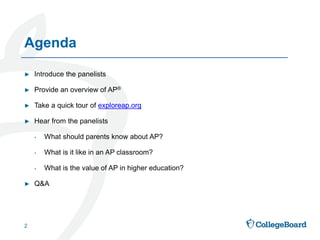
► Introduce the panelists
► Provide an overview of AP®
► Take a quick tour of exploreap.org
► Hear from the panelists
• What should parents know about AP?
• What is it like in an AP classroom?
• What is the value of AP in higher education?
► Q&A
2
Agenda
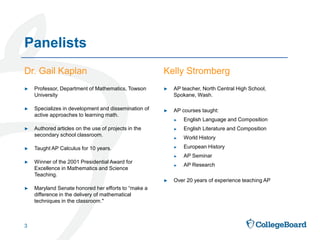
Dr. Gail Kaplan Kelly Stromberg
► AP teacher, North Central High School,
Spokane, Wash.
► AP courses taught:
► English Language and Composition
► English Literature and Composition
► World History
► European History
► AP Seminar
► AP Research
► Over 20 years of experience teaching AP
► Professor, Department of Mathematics, Towson
University
► Specializes in development and dissemination of
active approaches to learning math.
► Authored articles on the use of projects in the
secondary school classroom.
► Taught AP Calculus for 10 years.
► Winner of the 2001 Presidential Award for
Excellence in Mathematics and Science
Teaching.
► Maryland Senate honored her efforts to “make a
difference in the delivery of mathematical
techniques in the classroom."
Panelists
3
4
AP® Overview
► Since 1955, the AP Program has been delivering excellence in education to
students.
► AP lets students pursue college-level studies in high school — with the
opportunity to earn college credit, advanced placement, or both.
► Taking AP shows college admission officers that students have sought the most
challenging courses available to them.
► Students who score a 3 or higher on AP Exams:
► Are more likely to graduate college on time.
► Have the potential to save time and money through placement and credit-
granting policies.
► Research shows that students who score below a 3 on an AP Exam are also
more likely to graduate college on time.
5
About AP®
► AP students perform well in college courses related to their AP subject.
► AP students — and particularly AP STEM students — are more likely to major in
their AP subject or a related discipline.
► AP students take more — not less — course work in college related to their AP
subject.
► AP students are more likely to graduate in four years.
► AP provides opportunities for underrepresented students to succeed.
What AP can do for your students:
Why AP®?
6
► AP offers 38 courses across seven subject areas.
► Each course is developed by a committee of higher education faculty and expert
AP teachers who ensure that the course reflects college-level expectations.
► The committees define the scope and goals of the AP course, clearly indicating
what students should know and be able to do upon completion of the course.
► The committees work with Educational Testing Service to develop exam
questions. They also write and review the course description for each subject.
► Courses are taught by high school teachers using AP Course Descriptions.
Teachers determine how to best present the content.
► AP Exams are based on the content in the course descriptions. All students take
a standardized exam for each course.
7
Developing and Teaching AP®
► AP® English Language and Composition
► AP English Literature and Composition
8
English
► AP® Calculus AB
► AP Calculus BC
► AP Computer Science A
► AP Computer Science Principles*
► AP Statistics
9
Mathematics
* Launches Fall 2016
► AP® Biology
► AP Chemistry
► AP Environmental Science
► AP Physics 1
► AP Physics 2
► AP Physics C: Electricity and Magnetism
► AP Physics C: Mechanics
10
Science
► AP® Comparative Government and Politics
► AP European History
► AP Human Geography
► AP Macroeconomics
► AP Microeconomics
► AP Psychology
► AP United States Government and Politics
► AP United States History
► AP World History
11
History and Social Sciences
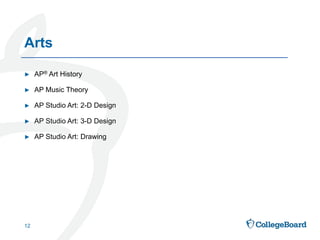
► AP® Art History
► AP Music Theory
► AP Studio Art: 2-D Design
► AP Studio Art: 3-D Design
► AP Studio Art: Drawing
12
Arts
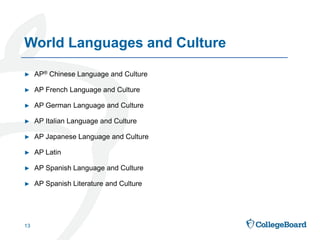
► AP® Chinese Language and Culture
► AP French Language and Culture
► AP German Language and Culture
► AP Italian Language and Culture
► AP Japanese Language and Culture
► AP Latin
► AP Spanish Language and Culture
► AP Spanish Literature and Culture
13
World Languages and Culture
► AP Seminar
► AP Research
14
AP® Capstone
15
Explore AP®
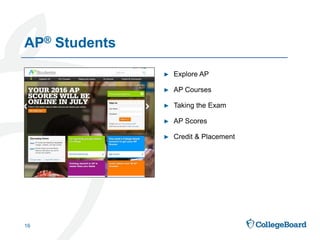
► Explore AP
► AP Courses
► Taking the Exam
► AP Scores
► Credit & Placement
AP® Students
16
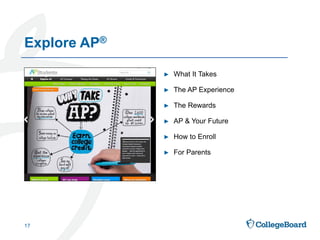
► What It Takes
► The AP Experience
► The Rewards
► AP & Your Future
► How to Enroll
► For Parents
Explore AP®
17
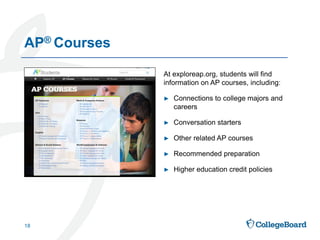
At exploreap.org, students will find
information on AP courses, including:
► Connections to college majors and
careers
► Conversation starters
► Other related AP courses
► Recommended preparation
► Higher education credit policies
AP® Courses
18
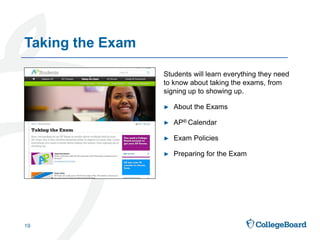
Students will learn everything they need
to know about taking the exams, from
signing up to showing up.
► About the Exams
► AP® Calendar
► Exam Policies
► Preparing for the Exam
Taking the Exam
19
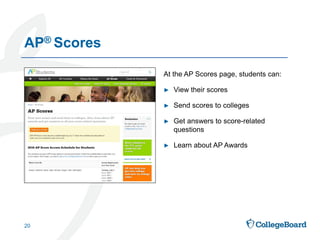
At the AP Scores page, students can:
► View their scores
► Send scores to colleges
► Get answers to score-related
questions
► Learn about AP Awards
AP® Scores
20
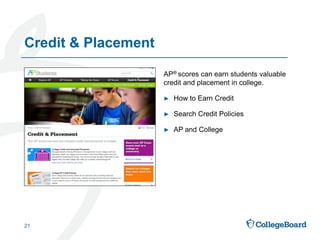
AP® scores can earn students valuable
credit and placement in college.
► How to Earn Credit
► Search Credit Policies
► AP and College
Credit & Placement
21
22
Discussion
► What can a student expect in an AP class?
► What strategies help your students succeed in AP?
► What advice do have for parents of those students?
► What types of students have taken your AP class?
► What can first-time AP students do to succeed?
23
What is it like in an AP® classroom?
► What are the benefits of taking AP classes?
► What did AP mean to your AP Calculus students?
► What would you tell a parent or high school student
who hasn’t taken AP?
► How would you best characterize the college students
in your math classes who took AP?
24
What is the value of AP® in higher
education?
25
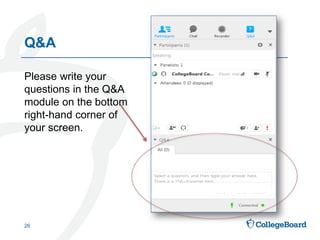
Q&A
Please write your
questions in the Q&A
module on the bottom
right-hand corner of
your screen.
26
Q&A
► For students and parents: exploreap.org
► For international students and parents:
http://international.collegeboard.org/programs/ap-recognition
► Coming soon: More information about College Board parent webinars at
collegeboard.org/parents
27
Resources for reference

Introduction to Advanced Placement for Parents

  • 1.
    Introduction to Advanced Placement® forParents Edward Biedermann, Executive Director, Advanced Placement Gail Kaplan, Professor of Mathematics, Towson University Kelly Stromberg, AP Capstone Teacher, North Central High School
  • 2.
    ► Introduce thepanelists ► Provide an overview of AP® ► Take a quick tour of exploreap.org ► Hear from the panelists • What should parents know about AP? • What is it like in an AP classroom? • What is the value of AP in higher education? ► Q&A 2 Agenda
  • 3.
    Dr. Gail KaplanKelly Stromberg ► AP teacher, North Central High School, Spokane, Wash. ► AP courses taught: ► English Language and Composition ► English Literature and Composition ► World History ► European History ► AP Seminar ► AP Research ► Over 20 years of experience teaching AP ► Professor, Department of Mathematics, Towson University ► Specializes in development and dissemination of active approaches to learning math. ► Authored articles on the use of projects in the secondary school classroom. ► Taught AP Calculus for 10 years. ► Winner of the 2001 Presidential Award for Excellence in Mathematics and Science Teaching. ► Maryland Senate honored her efforts to “make a difference in the delivery of mathematical techniques in the classroom." Panelists 3
  • 4.
  • 5.
    ► Since 1955,the AP Program has been delivering excellence in education to students. ► AP lets students pursue college-level studies in high school — with the opportunity to earn college credit, advanced placement, or both. ► Taking AP shows college admission officers that students have sought the most challenging courses available to them. ► Students who score a 3 or higher on AP Exams: ► Are more likely to graduate college on time. ► Have the potential to save time and money through placement and credit- granting policies. ► Research shows that students who score below a 3 on an AP Exam are also more likely to graduate college on time. 5 About AP®
  • 6.
    ► AP studentsperform well in college courses related to their AP subject. ► AP students — and particularly AP STEM students — are more likely to major in their AP subject or a related discipline. ► AP students take more — not less — course work in college related to their AP subject. ► AP students are more likely to graduate in four years. ► AP provides opportunities for underrepresented students to succeed. What AP can do for your students: Why AP®? 6
  • 7.
    ► AP offers38 courses across seven subject areas. ► Each course is developed by a committee of higher education faculty and expert AP teachers who ensure that the course reflects college-level expectations. ► The committees define the scope and goals of the AP course, clearly indicating what students should know and be able to do upon completion of the course. ► The committees work with Educational Testing Service to develop exam questions. They also write and review the course description for each subject. ► Courses are taught by high school teachers using AP Course Descriptions. Teachers determine how to best present the content. ► AP Exams are based on the content in the course descriptions. All students take a standardized exam for each course. 7 Developing and Teaching AP®
  • 8.
    ► AP® EnglishLanguage and Composition ► AP English Literature and Composition 8 English
  • 9.
    ► AP® CalculusAB ► AP Calculus BC ► AP Computer Science A ► AP Computer Science Principles* ► AP Statistics 9 Mathematics * Launches Fall 2016
  • 10.
    ► AP® Biology ►AP Chemistry ► AP Environmental Science ► AP Physics 1 ► AP Physics 2 ► AP Physics C: Electricity and Magnetism ► AP Physics C: Mechanics 10 Science
  • 11.
    ► AP® ComparativeGovernment and Politics ► AP European History ► AP Human Geography ► AP Macroeconomics ► AP Microeconomics ► AP Psychology ► AP United States Government and Politics ► AP United States History ► AP World History 11 History and Social Sciences
  • 12.
    ► AP® ArtHistory ► AP Music Theory ► AP Studio Art: 2-D Design ► AP Studio Art: 3-D Design ► AP Studio Art: Drawing 12 Arts
  • 13.
    ► AP® ChineseLanguage and Culture ► AP French Language and Culture ► AP German Language and Culture ► AP Italian Language and Culture ► AP Japanese Language and Culture ► AP Latin ► AP Spanish Language and Culture ► AP Spanish Literature and Culture 13 World Languages and Culture
  • 14.
    ► AP Seminar ►AP Research 14 AP® Capstone
  • 15.
  • 16.
    ► Explore AP ►AP Courses ► Taking the Exam ► AP Scores ► Credit & Placement AP® Students 16
  • 17.
    ► What ItTakes ► The AP Experience ► The Rewards ► AP & Your Future ► How to Enroll ► For Parents Explore AP® 17
  • 18.
    At exploreap.org, studentswill find information on AP courses, including: ► Connections to college majors and careers ► Conversation starters ► Other related AP courses ► Recommended preparation ► Higher education credit policies AP® Courses 18
  • 19.
    Students will learneverything they need to know about taking the exams, from signing up to showing up. ► About the Exams ► AP® Calendar ► Exam Policies ► Preparing for the Exam Taking the Exam 19
  • 20.
    At the APScores page, students can: ► View their scores ► Send scores to colleges ► Get answers to score-related questions ► Learn about AP Awards AP® Scores 20
  • 21.
    AP® scores canearn students valuable credit and placement in college. ► How to Earn Credit ► Search Credit Policies ► AP and College Credit & Placement 21
  • 22.
  • 23.
    ► What cana student expect in an AP class? ► What strategies help your students succeed in AP? ► What advice do have for parents of those students? ► What types of students have taken your AP class? ► What can first-time AP students do to succeed? 23 What is it like in an AP® classroom?
  • 24.
    ► What arethe benefits of taking AP classes? ► What did AP mean to your AP Calculus students? ► What would you tell a parent or high school student who hasn’t taken AP? ► How would you best characterize the college students in your math classes who took AP? 24 What is the value of AP® in higher education?
  • 25.
  • 26.
    Please write your questionsin the Q&A module on the bottom right-hand corner of your screen. 26 Q&A
  • 27.
    ► For studentsand parents: exploreap.org ► For international students and parents: http://international.collegeboard.org/programs/ap-recognition ► Coming soon: More information about College Board parent webinars at collegeboard.org/parents 27 Resources for reference