The Advanced Placement Program Louis D. Brandeis High School
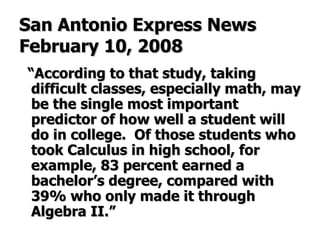
San Antonio Express News February 10, 2008 “ According to that study, taking difficult classes, especially math, may be the single most important predictor of how well a student will do in college.  Of those students who took Calculus in high school, for example, 83 percent earned a bachelor’s degree, compared with 39% who only made it through Algebra II.”
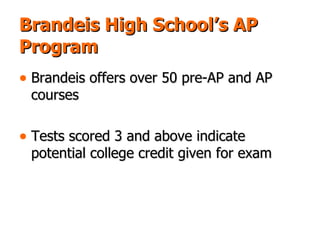
Brandeis High School’s AP Program Brandeis offers over 50 pre-AP and AP courses Tests scored 3 and above indicate potential college credit given for exam
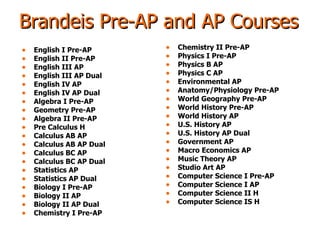
Brandeis Pre-AP and AP Courses English I Pre-AP English II Pre-AP  English III AP English III AP Dual English IV AP English IV AP Dual Algebra I Pre-AP Geometry Pre-AP Algebra II Pre-AP Pre Calculus H Calculus AB AP Calculus AB AP Dual Calculus BC AP  Calculus BC AP Dual Statistics AP Statistics AP Dual Biology I Pre-AP Biology II AP Biology II AP Dual Chemistry I Pre-AP Chemistry II Pre-AP Physics I Pre-AP Physics B AP Physics C AP Environmental AP Anatomy/Physiology Pre-AP World Geography Pre-AP World History Pre-AP World History AP U.S. History AP U.S. History AP Dual Government AP Macro Economics AP Music Theory AP Studio Art AP Computer Science I Pre-AP Computer Science I AP Computer Science II H Computer Science IS H
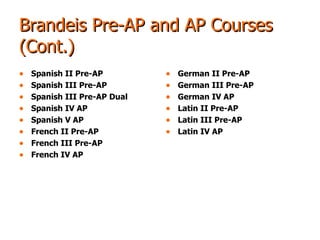
Brandeis Pre-AP and AP Courses (Cont.) Spanish II Pre-AP Spanish III Pre-AP Spanish III Pre-AP Dual Spanish IV AP Spanish V AP French II Pre-AP French III Pre-AP French IV AP German II Pre-AP German III Pre-AP German IV AP Latin II Pre-AP Latin III Pre-AP Latin IV AP
Responsibilities of AP Students A willingness to actively engage with sophisticated concepts A willingness to be judged by rigorous, college-level standards A willingness to complete longer and more complex nightly assignments A willingness to complete the AP  examination in May
Benefits of the AP Program for Students Students earn college credit and/or placement at over 3200 colleges and universities if they successfully complete an AP Examination Students gain college-level analytical and study skills Students gain academic confidence
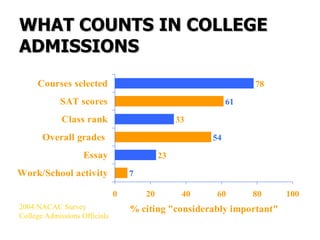
WHAT COUNTS IN COLLEGE ADMISSIONS 2004 NACAC Survey  College Admissions Officials
The AP Exams Administered in May Approximately three hours long Composed of multiple-choice and  free-response questions Free-response questions graded  by college professors and AP  teachers in June
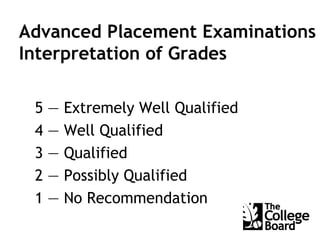
Advanced Placement Examinations Interpretation of Grades 5 — Extremely Well Qualified 4 — Well Qualified 3 — Qualified 2 — Possibly Qualified 1 — No Recommendation
Who Receives AP ®  Grades? AP Grade Reports are sent in July to students, high schools, and colleges designated by individual students. High school principals receive a special  AP Grade Report in August for all classes in which five or more students completed the AP Examination.
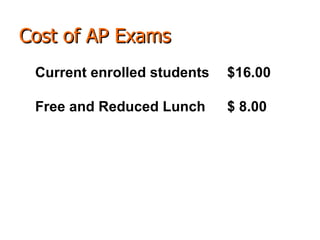
Cost of AP Exams Current enrolled students $16.00 Free and Reduced Lunch  $ 8.00
Most students take five or six years, and sometimes even longer, to earn their bachelor’s degrees at public colleges and universities. Students who take AP courses and exams are much more likely to graduate in four years.  A 2008 study found that AP students had better four-year graduation rates than those who did not take AP. For example, graduation rates for AP English Literature students were 62 percent higher than graduation rates for those who took other English courses in high school. Because more than 3,200 colleges and universities in the United States offer credit and/or advanced placement for qualifying AP scores, AP students have the flexibility to double major or study abroad without putting at risk graduation in four years.
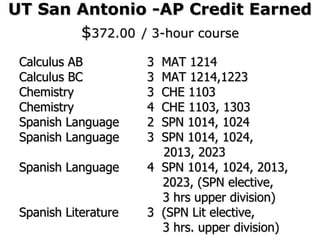
UT San Antonio -AP Credit Earned $ 372.00   / 3-hour course Calculus AB  3  MAT 1214 Calculus BC  3  MAT 1214,1223 Chemistry  3  CHE 1103 Chemistry  4  CHE 1103, 1303 Spanish Language  2  SPN 1014, 1024  Spanish Language  3  SPN 1014, 1024,    2013, 2023  Spanish Language  4  SPN 1014, 1024, 2013,   2023, (SPN elective,    3 hrs upper division) Spanish Literature  3  (SPN Lit elective,    3 hrs. upper division)
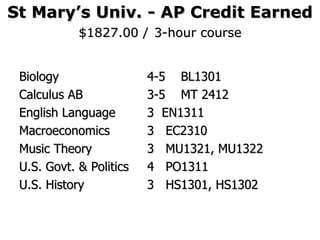
St Mary’s Univ. - AP Credit Earned $1827.00 /   3-hour course Biology  4-5  BL1301 Calculus AB  3-5  MT 2412 English Language  3  EN1311 Macroeconomics  3  EC2310 Music Theory  3  MU1321, MU1322 U.S. Govt. & Politics  4  PO1311 U.S. History  3  HS1301, HS1302
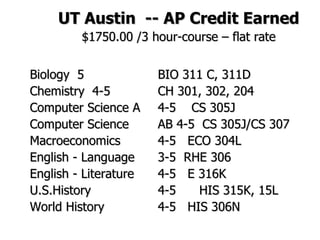
UT Austin  -- AP Credit Earned $1750.00 /3 hour-course – flat rate Biology  5  BIO 311 C, 311D  Chemistry  4-5  CH 301, 302, 204  Computer Science A  4-5  CS 305J Computer Science  AB 4-5  CS 305J/CS 307 Macroeconomics  4-5  ECO 304L  English - Language   3-5  RHE 306  English - Literature   4-5  E 316K  U.S.History  4-5  HIS 315K, 15L World History  4-5  HIS 306N
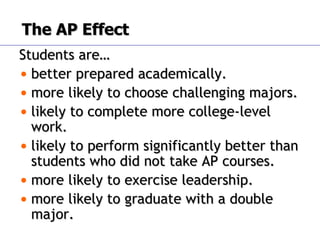
The AP Effect Students are… better prepared academically. more likely to choose challenging majors. likely to complete more college-level work. likely to perform significantly better than students who did not take AP courses. more likely to exercise leadership. more likely to graduate with a double major.
Email from Stacey –former NISD AP and Dual Credit Student Since you don't have to claim all of your AP credits, I claimed only the ones that were toward my major: 22 ($12833). That's a  semester and a half worth of courses. By the time spring registration came around, I was able to register earlier than other first-year  students and get the classes, professors, and times that I wanted.  No more 8:00 classes! =)  Also, I have 19 credits that I did not  claim, and as it turns out, I may go back and claim some of those  credits in order to take higher-level biology courses (recall I am a  Mechanical Engineering major and do not need biology, but am curious as to see my alternative options). It's great knowing that I don't have to take basic courses here. College courses are harder, more time consuming, and faster-paced  than high school classes. Not having to take basic courses like  Rhetoric, Literature, and Economics allows me to focus on the classes  toward my major, such as Computer   Programming, Engineering  Physics, and Differential Calculus.
Students who take longer to graduate from a public college or university typically pay between $8,000 and $19,000 for each additional year. The typical college cost per year for a four-year public institution is $7,662 for in-state students and $18,529 for out-of-state students.2
Taking AP increases eligibility for scholarships and makes candidates more attractive to colleges.   31 percent of colleges and universities consider a student’s AP experience when making decisions about which students will receive scholarships.3 85 percent of selective colleges and universities report that a student’s AP experience favorably impacts admissions decisions.4
“ We often observe a discernible difference between students without any AP experience, who typically only devote a few hours to homework each week, and AP students, who have had to develop the time management skills and the discipline to do the type of time-consuming intellectual work that is required to be successful in college.” ─  Spencer A. Benson Director,  Center for Teaching Excellence Associate Professor,  Department of Cell Biology and  Molecular Genetics University of Maryland

AP Presentation Parent Night

  • 1.
    The Advanced PlacementProgram Louis D. Brandeis High School
  • 2.
    San Antonio ExpressNews February 10, 2008 “ According to that study, taking difficult classes, especially math, may be the single most important predictor of how well a student will do in college. Of those students who took Calculus in high school, for example, 83 percent earned a bachelor’s degree, compared with 39% who only made it through Algebra II.”
  • 3.
    Brandeis High School’sAP Program Brandeis offers over 50 pre-AP and AP courses Tests scored 3 and above indicate potential college credit given for exam
  • 4.
    Brandeis Pre-AP andAP Courses English I Pre-AP English II Pre-AP English III AP English III AP Dual English IV AP English IV AP Dual Algebra I Pre-AP Geometry Pre-AP Algebra II Pre-AP Pre Calculus H Calculus AB AP Calculus AB AP Dual Calculus BC AP Calculus BC AP Dual Statistics AP Statistics AP Dual Biology I Pre-AP Biology II AP Biology II AP Dual Chemistry I Pre-AP Chemistry II Pre-AP Physics I Pre-AP Physics B AP Physics C AP Environmental AP Anatomy/Physiology Pre-AP World Geography Pre-AP World History Pre-AP World History AP U.S. History AP U.S. History AP Dual Government AP Macro Economics AP Music Theory AP Studio Art AP Computer Science I Pre-AP Computer Science I AP Computer Science II H Computer Science IS H
  • 5.
    Brandeis Pre-AP andAP Courses (Cont.) Spanish II Pre-AP Spanish III Pre-AP Spanish III Pre-AP Dual Spanish IV AP Spanish V AP French II Pre-AP French III Pre-AP French IV AP German II Pre-AP German III Pre-AP German IV AP Latin II Pre-AP Latin III Pre-AP Latin IV AP
  • 6.
    Responsibilities of APStudents A willingness to actively engage with sophisticated concepts A willingness to be judged by rigorous, college-level standards A willingness to complete longer and more complex nightly assignments A willingness to complete the AP examination in May
  • 7.
    Benefits of theAP Program for Students Students earn college credit and/or placement at over 3200 colleges and universities if they successfully complete an AP Examination Students gain college-level analytical and study skills Students gain academic confidence
  • 8.
    WHAT COUNTS INCOLLEGE ADMISSIONS 2004 NACAC Survey College Admissions Officials
  • 9.
    The AP ExamsAdministered in May Approximately three hours long Composed of multiple-choice and free-response questions Free-response questions graded by college professors and AP teachers in June
  • 10.
    Advanced Placement ExaminationsInterpretation of Grades 5 — Extremely Well Qualified 4 — Well Qualified 3 — Qualified 2 — Possibly Qualified 1 — No Recommendation
  • 11.
    Who Receives AP® Grades? AP Grade Reports are sent in July to students, high schools, and colleges designated by individual students. High school principals receive a special AP Grade Report in August for all classes in which five or more students completed the AP Examination.
  • 12.
    Cost of APExams Current enrolled students $16.00 Free and Reduced Lunch $ 8.00
  • 13.
    Most students takefive or six years, and sometimes even longer, to earn their bachelor’s degrees at public colleges and universities. Students who take AP courses and exams are much more likely to graduate in four years. A 2008 study found that AP students had better four-year graduation rates than those who did not take AP. For example, graduation rates for AP English Literature students were 62 percent higher than graduation rates for those who took other English courses in high school. Because more than 3,200 colleges and universities in the United States offer credit and/or advanced placement for qualifying AP scores, AP students have the flexibility to double major or study abroad without putting at risk graduation in four years.
  • 14.
    UT San Antonio-AP Credit Earned $ 372.00 / 3-hour course Calculus AB 3 MAT 1214 Calculus BC 3 MAT 1214,1223 Chemistry 3 CHE 1103 Chemistry 4 CHE 1103, 1303 Spanish Language 2 SPN 1014, 1024 Spanish Language 3 SPN 1014, 1024, 2013, 2023 Spanish Language 4 SPN 1014, 1024, 2013, 2023, (SPN elective, 3 hrs upper division) Spanish Literature 3 (SPN Lit elective, 3 hrs. upper division)
  • 15.
    St Mary’s Univ.- AP Credit Earned $1827.00 / 3-hour course Biology 4-5 BL1301 Calculus AB 3-5 MT 2412 English Language 3 EN1311 Macroeconomics 3 EC2310 Music Theory 3 MU1321, MU1322 U.S. Govt. & Politics 4 PO1311 U.S. History 3 HS1301, HS1302
  • 16.
    UT Austin -- AP Credit Earned $1750.00 /3 hour-course – flat rate Biology 5 BIO 311 C, 311D Chemistry 4-5 CH 301, 302, 204 Computer Science A 4-5 CS 305J Computer Science AB 4-5 CS 305J/CS 307 Macroeconomics 4-5 ECO 304L English - Language 3-5 RHE 306 English - Literature 4-5 E 316K U.S.History 4-5 HIS 315K, 15L World History 4-5 HIS 306N
  • 17.
    The AP EffectStudents are… better prepared academically. more likely to choose challenging majors. likely to complete more college-level work. likely to perform significantly better than students who did not take AP courses. more likely to exercise leadership. more likely to graduate with a double major.
  • 18.
    Email from Stacey–former NISD AP and Dual Credit Student Since you don't have to claim all of your AP credits, I claimed only the ones that were toward my major: 22 ($12833). That's a semester and a half worth of courses. By the time spring registration came around, I was able to register earlier than other first-year students and get the classes, professors, and times that I wanted. No more 8:00 classes! =) Also, I have 19 credits that I did not claim, and as it turns out, I may go back and claim some of those credits in order to take higher-level biology courses (recall I am a Mechanical Engineering major and do not need biology, but am curious as to see my alternative options). It's great knowing that I don't have to take basic courses here. College courses are harder, more time consuming, and faster-paced than high school classes. Not having to take basic courses like Rhetoric, Literature, and Economics allows me to focus on the classes toward my major, such as Computer Programming, Engineering Physics, and Differential Calculus.
  • 19.
    Students who takelonger to graduate from a public college or university typically pay between $8,000 and $19,000 for each additional year. The typical college cost per year for a four-year public institution is $7,662 for in-state students and $18,529 for out-of-state students.2
  • 20.
    Taking AP increaseseligibility for scholarships and makes candidates more attractive to colleges. 31 percent of colleges and universities consider a student’s AP experience when making decisions about which students will receive scholarships.3 85 percent of selective colleges and universities report that a student’s AP experience favorably impacts admissions decisions.4
  • 21.
    “ We oftenobserve a discernible difference between students without any AP experience, who typically only devote a few hours to homework each week, and AP students, who have had to develop the time management skills and the discipline to do the type of time-consuming intellectual work that is required to be successful in college.” ─ Spencer A. Benson Director, Center for Teaching Excellence Associate Professor, Department of Cell Biology and Molecular Genetics University of Maryland

Editor's Notes

  • #2 Story about being new to Warren and seeing the tradition of winning establish itself in such a short time. Talk about how I had misconceptions about the AP program and that the purpose of this presentation is to ensure that you guys understand what AP is and isn’t.
  • #4 Like other areas in Warren life, our AP program has grown exponentially over the past few years. As you can see we gave 447 tests last year…this 231 more tests or over twice as many tests as were given in 2006. The main reason for this dramatic jump in numbers was the fact that the district chose to subsidize the cost of the test students only had to pay $13 to take each test, as opposed to the $40 dollars it had cost in previous years. Not only did money help our students afford the exam, but it also shows that the AP program is a priority district-wide.
  • #8 The powerful 2 story about T.J.
  • #10 The powerful 2 story about T.J.
  • #11 Explain how the tests are graded and what the scores mean. This is an extremely difficult exam. Mr. _____ comments Talk about taking the test at the AP institute
  • #15 One thing that makes AP confusing for everybody is that there is no uniformity as to what credit is given by each university once a student gets his/her scores. So teachers and students need to do a bit of research. I’ve looked at three of the most popular universities for our students and given you a taste of the kind of credit kids can earn with particular test scores.
  • #18 One thing that I think is very significant has to do with the effect of just taking the exam, whether the student actually passes or not. As I mentioned before, the exam is very rigorous and just by preparing for it and making it through, students are better prepared to face those kinds of tests once they get to college. I know that’s something that I have worried about as a teacher. Even the TAKS test is untimed…in English we encourage students to take their time. AS we all know, there’s a real talent to having to work and think on a deadline.