Glen Burnie High School
An Introduction to the
Advanced PlacementProgram®
Glen Burnie High School is committed to every student’s success.
We believe access to rigorous course work such as Advanced
Placement® (AP®) plays an important role in that success.
Welcome
•What are Advanced Placement® Courses?
•The Benefits
•AP® Exams
•What Is It Like to Take AP?
•Next Steps: Help Your Child Make the Best Choices & Succe
•Q & A
What We’ll Cover
What Are Advanced Placement®
Courses?
• AP® courses are college-level courses offered in high school
• Courses reflect what is taught in top introductory college
courses
• Students take AP Exams at the end of the course, measuring
their mastery of college-level work
• A score of 3 or higher on an AP exam can typically earn
students college credit and/or placement into advanced
courses in college
Advanced Placement®: The Basics
<Th
• Arts: Art History, Studio Art: Drawing Portfolio, Studio Art: 2-D Design Portfolio, Studio Art: 3-D
Design Portfolio
• English: English Language and Composition, English Literature and Composition
• History and Social Sciences: Human Geography, Macroeconomics, Microeconomics,
Psychology, United States Government and Politics, World History
• Mathematics and Computer Science: Calculus AB, Calculus, Statistics, Computer Science
• Sciences: Biology, Chemistry, Environmental Science, Physics B, Physics C: Electricity and
Magnetism, Physics C: Mechanics
• World languages: French Language and Spanish Language
Our AP® Courses
• Number of exams taken last year.
• 871 exams
• Additional support provided to students:
• Pre-test Boot Camp
• Academic Writing
• Gopher Hour
• Teacher-led Study Groups
AP® at Glen Burnie High School
AP®: The Benefits
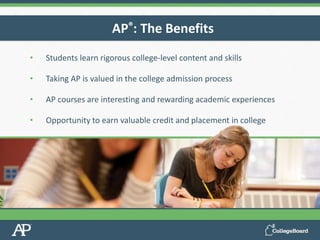
• Students learn rigorous college-level content and skills
• Taking AP is valued in the college admission process
• AP courses are interesting and rewarding academic experiences
• Opportunity to earn valuable credit and placement in college
AP®: The Benefits
• 85% of selective colleges and universities report that a
student’s AP experience favorably impacts admission
decisions*
• Colleges rank grades in college-preparatory courses and
strength of curriculum as the two top factors in the admission
decision
• AP courses tell college admission officials that students are
challenging themselves and preparing for the rigors they'll
encounter in their college careers
*Unpublished institutional research, Crux Research Inc., March 2007
AP® from the College Admissions Perspective
• Taking an AP course helps students build critical thinking skills,
confidence, and the essential time management and study
skills needed for college success
• Nationally, research shows that students who score a 3 or
higher on an AP Exam typically earn higher grade point
averages in college and have higher graduation rates than
their non-AP peers*
*2009, The College Board, “The Relationship Between AP Exam Performance and College Outcomes"
AP®: Skills & Advantages that Last a Lifetime
Students who take AP courses and exams are much more likely to
complete a college degree on time.* Graduating in four years
represents a significant savings on the cost of college.
• Only 1 in 4 college students completes a bachelor’s degree in
4 years.
• The average cost of college for a single year is $21,500** for
in-state schools (tuition, fees, room/board, misc. expenses).
*College Outcomes Comparisons by AP and Non-AP High School Experiences, The College Board, 2008
**The College Board, Trends in College Pricing 2011, Figure 1
AP® Helps Students Graduate on Time & Save Money
AP® Expands Students’ Options
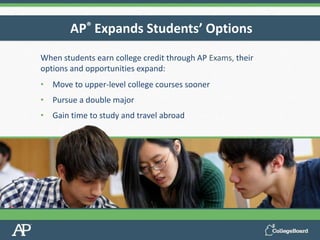
When students earn college credit through AP Exams, their
options and opportunities expand:
• Move to upper-level college courses sooner
• Pursue a double major
• Gain time to study and travel abroad
AP courses challenge students to work and participate at a higher level:
• Opportunities to explore topics in depth
• More time in and out of the classroom required to complete
assignments and projects
• High expectations for critical thinking, analysis, synthesis, evidence,
multiple perspectives, and clear written and verbal communications
AP®: A More Engaging Learning Experience
AP® Exams
AP® Exams
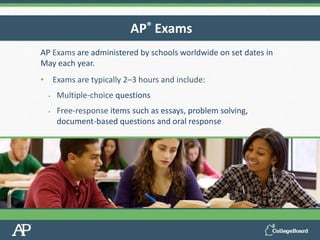
AP Exams are administered by schools worldwide on set dates in
May each year.
• Exams are typically 2–3 hours and include:
• Multiple-choice questions
• Free-response items such as essays, problem solving,
document-based questions and oral response
• The exam fee for 2013 is $89 per exam.
• Assistance is available for eligible students with financial need:
• The College Board offers a $26 fee reduction per exam for eligible students with
financial need.
AP® Exam Fees
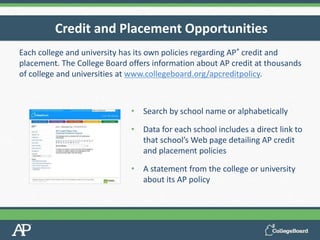
Each college and university has its own policies regarding AP® credit and
placement. The College Board offers information about AP credit at thousands
of college and universities at www.collegeboard.org/apcreditpolicy.
Credit and Placement Opportunities
• Search by school name or alphabetically
• Data for each school includes a direct link to
that school’s Web page detailing AP credit
and placement policies
• A statement from the college or university
about its AP policy
What is it like to take AP®?
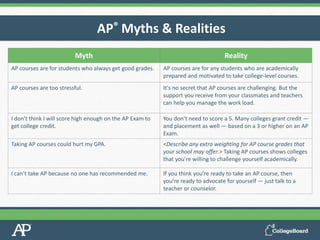
AP® Myths & Realities
Myth Reality
AP courses are for students who always get good grades. AP courses are for any students who are academically
prepared and motivated to take college-level courses.
AP courses are too stressful. It's no secret that AP courses are challenging. But the
support you receive from your classmates and teachers
can help you manage the work load.
I don't think I will score high enough on the AP Exam to
get college credit.
You don’t need to score a 5. Many colleges grant credit —
and placement as well — based on a 3 or higher on an AP
Exam.
Taking AP courses could hurt my GPA. <Describe any extra weighting for AP course grades that
your school may offer.> Taking AP courses shows colleges
that you’re willing to challenge yourself academically.
I can’t take AP because no one has recommended me. If you think you’re ready to take an AP course, then
you’re ready to advocate for yourself — just talk to a
teacher or counselor.
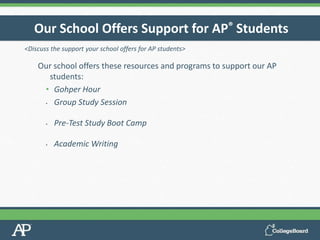
Our school offers these resources and programs to support our AP
students:
• Gohper Hour
• Group Study Session
• Pre-Test Study Boot Camp
• Academic Writing
Our School Offers Support for AP® Students
<Discuss the support your school offers for AP students>
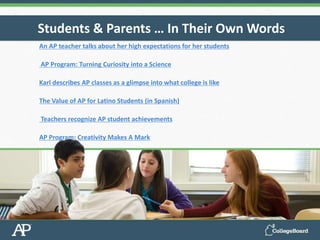
An AP teacher talks about her high expectations for her students
AP Program: Turning Curiosity into a Science
Karl describes AP classes as a glimpse into what college is like
The Value of AP for Latino Students (in Spanish)
Teachers recognize AP student achievements
AP Program: Creativity Makes A Mark
Students & Parents … In Their Own Words
College Admissions Officials In Their Own Words
Note: This is another optional slide for your presentation. The video referenced here features college admission officers
and students talking about the impact of AP® on the college experience.
AP Program: The impact of AP credit and placement on the
college experience
Next Steps: Help Your Child
Make the Best Choices & Be
Successful in AP
Help your child prepare to talk to a teacher or counselor about AP. Here are some questions to encourage
your child to think about:
What AP course is right for me?
Before you talk to a teacher or counselor, think about what interests you:
• Which courses do you enjoy most in school? In which subjects do you excel?
• What college majors are you considering? What careers excite you?
Ask your counselor or teacher the following questions:
• In which AP courses at our school am I likely to do well?
• Are there other courses that can help me succeed in AP or prepare me for college and careers?
What steps do I need to take?
• What is our school’s enrollment deadline?
• May I speak with a student who has taken an AP course?
• Are there study groups or people who can offer help if I need it?
• What can I do next to help me prepare for AP?
AP®: Start the Conversation
• AP information: apstudent.collegeboard.org
• College and Career Planning: bigfuture.org
• Personalized feedback, practice and college planning based on
your PSAT/NMSQT® results: My College QuickStart™
www.collegeboard.org/quickstart
• AP credit policy information from colleges and universities:
www.collegeboard.org/apcreditpolicy
AP®: Resources Worth Exploring for Students and Families
Explore AP®: Take the Next Step
Questions and Answers

Ap parents-night-presentation

  • 1.
    Glen Burnie HighSchool An Introduction to the Advanced PlacementProgram®
  • 2.
    Glen Burnie HighSchool is committed to every student’s success. We believe access to rigorous course work such as Advanced Placement® (AP®) plays an important role in that success. Welcome
  • 3.
    •What are AdvancedPlacement® Courses? •The Benefits •AP® Exams •What Is It Like to Take AP? •Next Steps: Help Your Child Make the Best Choices & Succe •Q & A What We’ll Cover
  • 4.
    What Are AdvancedPlacement® Courses?
  • 5.
    • AP® coursesare college-level courses offered in high school • Courses reflect what is taught in top introductory college courses • Students take AP Exams at the end of the course, measuring their mastery of college-level work • A score of 3 or higher on an AP exam can typically earn students college credit and/or placement into advanced courses in college Advanced Placement®: The Basics
  • 6.
    <Th • Arts: ArtHistory, Studio Art: Drawing Portfolio, Studio Art: 2-D Design Portfolio, Studio Art: 3-D Design Portfolio • English: English Language and Composition, English Literature and Composition • History and Social Sciences: Human Geography, Macroeconomics, Microeconomics, Psychology, United States Government and Politics, World History • Mathematics and Computer Science: Calculus AB, Calculus, Statistics, Computer Science • Sciences: Biology, Chemistry, Environmental Science, Physics B, Physics C: Electricity and Magnetism, Physics C: Mechanics • World languages: French Language and Spanish Language Our AP® Courses
  • 7.
    • Number ofexams taken last year. • 871 exams • Additional support provided to students: • Pre-test Boot Camp • Academic Writing • Gopher Hour • Teacher-led Study Groups AP® at Glen Burnie High School
  • 8.
  • 9.
    • Students learnrigorous college-level content and skills • Taking AP is valued in the college admission process • AP courses are interesting and rewarding academic experiences • Opportunity to earn valuable credit and placement in college AP®: The Benefits
  • 10.
    • 85% ofselective colleges and universities report that a student’s AP experience favorably impacts admission decisions* • Colleges rank grades in college-preparatory courses and strength of curriculum as the two top factors in the admission decision • AP courses tell college admission officials that students are challenging themselves and preparing for the rigors they'll encounter in their college careers *Unpublished institutional research, Crux Research Inc., March 2007 AP® from the College Admissions Perspective
  • 11.
    • Taking anAP course helps students build critical thinking skills, confidence, and the essential time management and study skills needed for college success • Nationally, research shows that students who score a 3 or higher on an AP Exam typically earn higher grade point averages in college and have higher graduation rates than their non-AP peers* *2009, The College Board, “The Relationship Between AP Exam Performance and College Outcomes" AP®: Skills & Advantages that Last a Lifetime
  • 12.
    Students who takeAP courses and exams are much more likely to complete a college degree on time.* Graduating in four years represents a significant savings on the cost of college. • Only 1 in 4 college students completes a bachelor’s degree in 4 years. • The average cost of college for a single year is $21,500** for in-state schools (tuition, fees, room/board, misc. expenses). *College Outcomes Comparisons by AP and Non-AP High School Experiences, The College Board, 2008 **The College Board, Trends in College Pricing 2011, Figure 1 AP® Helps Students Graduate on Time & Save Money
  • 13.
    AP® Expands Students’Options When students earn college credit through AP Exams, their options and opportunities expand: • Move to upper-level college courses sooner • Pursue a double major • Gain time to study and travel abroad
  • 14.
    AP courses challengestudents to work and participate at a higher level: • Opportunities to explore topics in depth • More time in and out of the classroom required to complete assignments and projects • High expectations for critical thinking, analysis, synthesis, evidence, multiple perspectives, and clear written and verbal communications AP®: A More Engaging Learning Experience
  • 15.
  • 16.
    AP® Exams AP Examsare administered by schools worldwide on set dates in May each year. • Exams are typically 2–3 hours and include: • Multiple-choice questions • Free-response items such as essays, problem solving, document-based questions and oral response
  • 17.
    • The examfee for 2013 is $89 per exam. • Assistance is available for eligible students with financial need: • The College Board offers a $26 fee reduction per exam for eligible students with financial need. AP® Exam Fees
  • 18.
    Each college anduniversity has its own policies regarding AP® credit and placement. The College Board offers information about AP credit at thousands of college and universities at www.collegeboard.org/apcreditpolicy. Credit and Placement Opportunities • Search by school name or alphabetically • Data for each school includes a direct link to that school’s Web page detailing AP credit and placement policies • A statement from the college or university about its AP policy
  • 19.
    What is itlike to take AP®?
  • 20.
    AP® Myths &Realities Myth Reality AP courses are for students who always get good grades. AP courses are for any students who are academically prepared and motivated to take college-level courses. AP courses are too stressful. It's no secret that AP courses are challenging. But the support you receive from your classmates and teachers can help you manage the work load. I don't think I will score high enough on the AP Exam to get college credit. You don’t need to score a 5. Many colleges grant credit — and placement as well — based on a 3 or higher on an AP Exam. Taking AP courses could hurt my GPA. <Describe any extra weighting for AP course grades that your school may offer.> Taking AP courses shows colleges that you’re willing to challenge yourself academically. I can’t take AP because no one has recommended me. If you think you’re ready to take an AP course, then you’re ready to advocate for yourself — just talk to a teacher or counselor.
  • 21.
    Our school offersthese resources and programs to support our AP students: • Gohper Hour • Group Study Session • Pre-Test Study Boot Camp • Academic Writing Our School Offers Support for AP® Students <Discuss the support your school offers for AP students>
  • 22.
    An AP teachertalks about her high expectations for her students AP Program: Turning Curiosity into a Science Karl describes AP classes as a glimpse into what college is like The Value of AP for Latino Students (in Spanish) Teachers recognize AP student achievements AP Program: Creativity Makes A Mark Students & Parents … In Their Own Words
  • 23.
    College Admissions OfficialsIn Their Own Words Note: This is another optional slide for your presentation. The video referenced here features college admission officers and students talking about the impact of AP® on the college experience. AP Program: The impact of AP credit and placement on the college experience
  • 24.
    Next Steps: HelpYour Child Make the Best Choices & Be Successful in AP
  • 25.
    Help your childprepare to talk to a teacher or counselor about AP. Here are some questions to encourage your child to think about: What AP course is right for me? Before you talk to a teacher or counselor, think about what interests you: • Which courses do you enjoy most in school? In which subjects do you excel? • What college majors are you considering? What careers excite you? Ask your counselor or teacher the following questions: • In which AP courses at our school am I likely to do well? • Are there other courses that can help me succeed in AP or prepare me for college and careers? What steps do I need to take? • What is our school’s enrollment deadline? • May I speak with a student who has taken an AP course? • Are there study groups or people who can offer help if I need it? • What can I do next to help me prepare for AP? AP®: Start the Conversation
  • 26.
    • AP information:apstudent.collegeboard.org • College and Career Planning: bigfuture.org • Personalized feedback, practice and college planning based on your PSAT/NMSQT® results: My College QuickStart™ www.collegeboard.org/quickstart • AP credit policy information from colleges and universities: www.collegeboard.org/apcreditpolicy AP®: Resources Worth Exploring for Students and Families
  • 27.
    Explore AP®: Takethe Next Step
  • 28.

Editor's Notes

  • #3 Presenter Notes: Some of you may be familiar with our program and for many of you this will be new information. Our program continues to grow and evolve, so we hope you’ll find this information helpful. This is your meeting so as we go through the information, please jot down your questions and I’ll stop periodically to answer them.
  • #4  Presenter reviews agenda with attendees, makes sure everyone can see the screen, hear, etc. Presenter asks for questions prior to launching the next part of the presentation.
  • #6 Presenter can add to this information with the following points: Advanced Placement® is a program developed and overseen by the College Board, the not-for-profit organization that is responsible for the PSAT/NMSQT®, SAT®, and other programs and services in college readiness and college success that help more than seven million students each year prepare for a successful transition to college.
  • #7 Presenter will highlight courses in each content area
  • #8 Presenter can provide stats (if available) about the growth of the school’s AP program. AP Scholars information [if needed]: https://apstudent.collegeboard.org/exploreap/the-rewards/scholar-awards
  • #11 Presenters are encouraged to include the AP® policies and statements of their own local and state universities where applicable to reinforce the importance of AP classes in the competitive college admission process.
  • #13 Presenter can add additional bullets on the college admission/college graduation rates at your school for former students in your AP courses.
  • #21 Presenter: This is a good time to address any other “myths” or misperceptions that you hear from your students about the AP program.
  • #26 Presenter: Encourage families to talk openly and realistically with students about the time commitment, challenges, etc., without exaggerating the difficulties. Many students take multiple AP courses and thrive. Others find better success with one or two AP courses, depending on their other school, work and home commitments.
  • #27 Presenter: Encourage families to explore these resources on their own and with their children as they’re researching college opportunities and options.
  • #28 Presenter: Now presenter asks for questions and discussions.