

Visual Arts Education
Grade 9
Mr. Palmer
Art is the quality, production, or
expression of what is beautiful,
appealing, or of more than ordinary
significance
Work of art - visual expression of
an idea
What is Art?
Art history has historically been understood as the
academic study of objects of art in their historical
development and stylistic contexts, i.e. genre,
design, format, and style.
This includes the "major" arts of painting,
sculpture, and architecture as well as the "minor"
arts of ceramics, furniture, and other decorative
objects.
WHAT IS ART HISTORY?
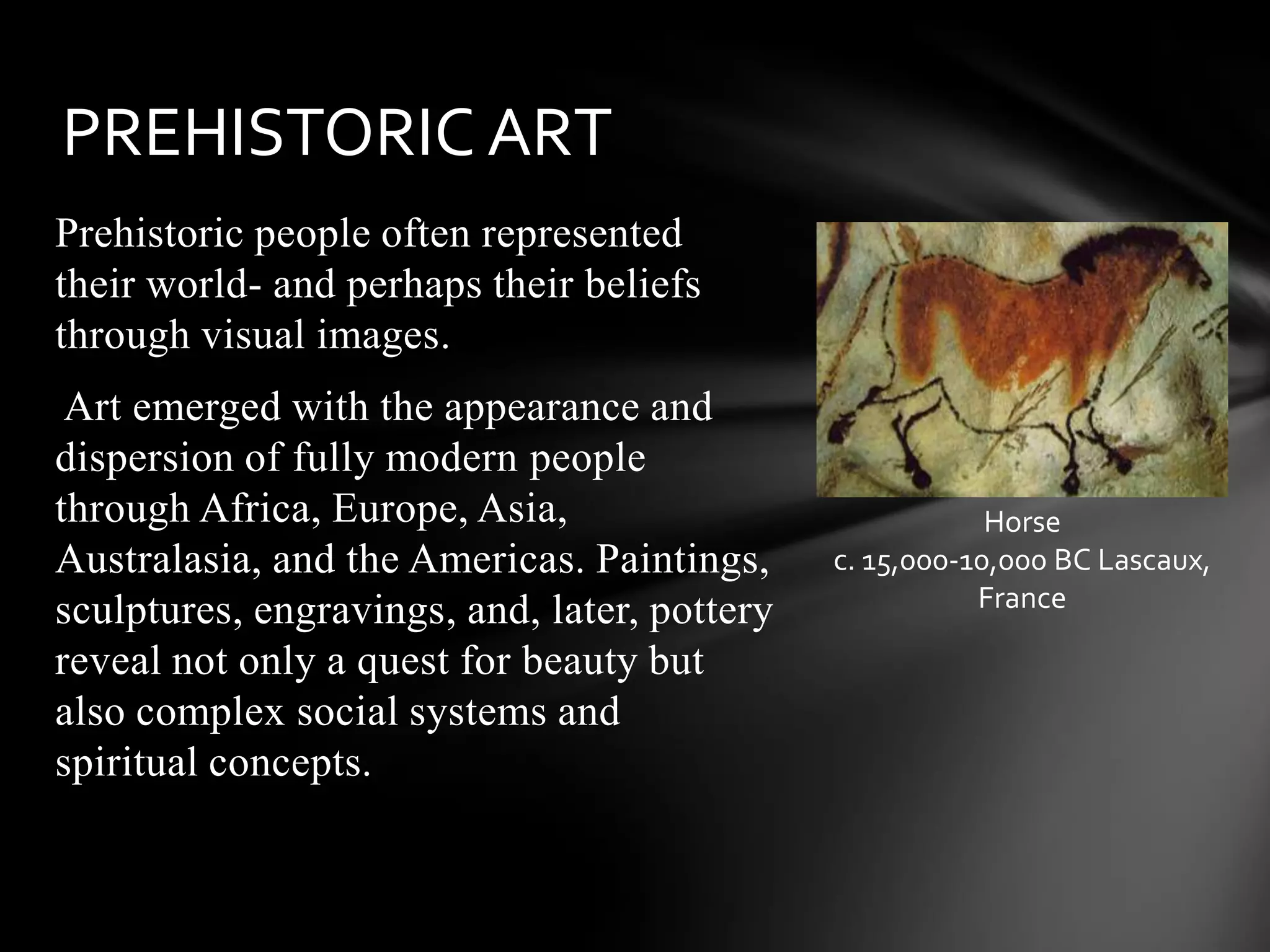
Prehistoric people often represented
their world- and perhaps their beliefs
through visual images.
Art emerged with the appearance and
dispersion of fully modern people
through Africa, Europe, Asia,
Australasia, and the Americas. Paintings,
sculptures, engravings, and, later, pottery
reveal not only a quest for beauty but
also complex social systems and
spiritual concepts.
PREHISTORIC ART
Horse
c. 15,000-10,000 BC Lascaux,
France
The name given to the period between about 2.5
million and 20,000 years ago.
It begins with the earliest human-like behaviors of
crude stone tool manufacture, and ends with fully
modern human hunting and gathering societies.
The Paleolithic is the earliest archaeology;
anything older is paleontology.
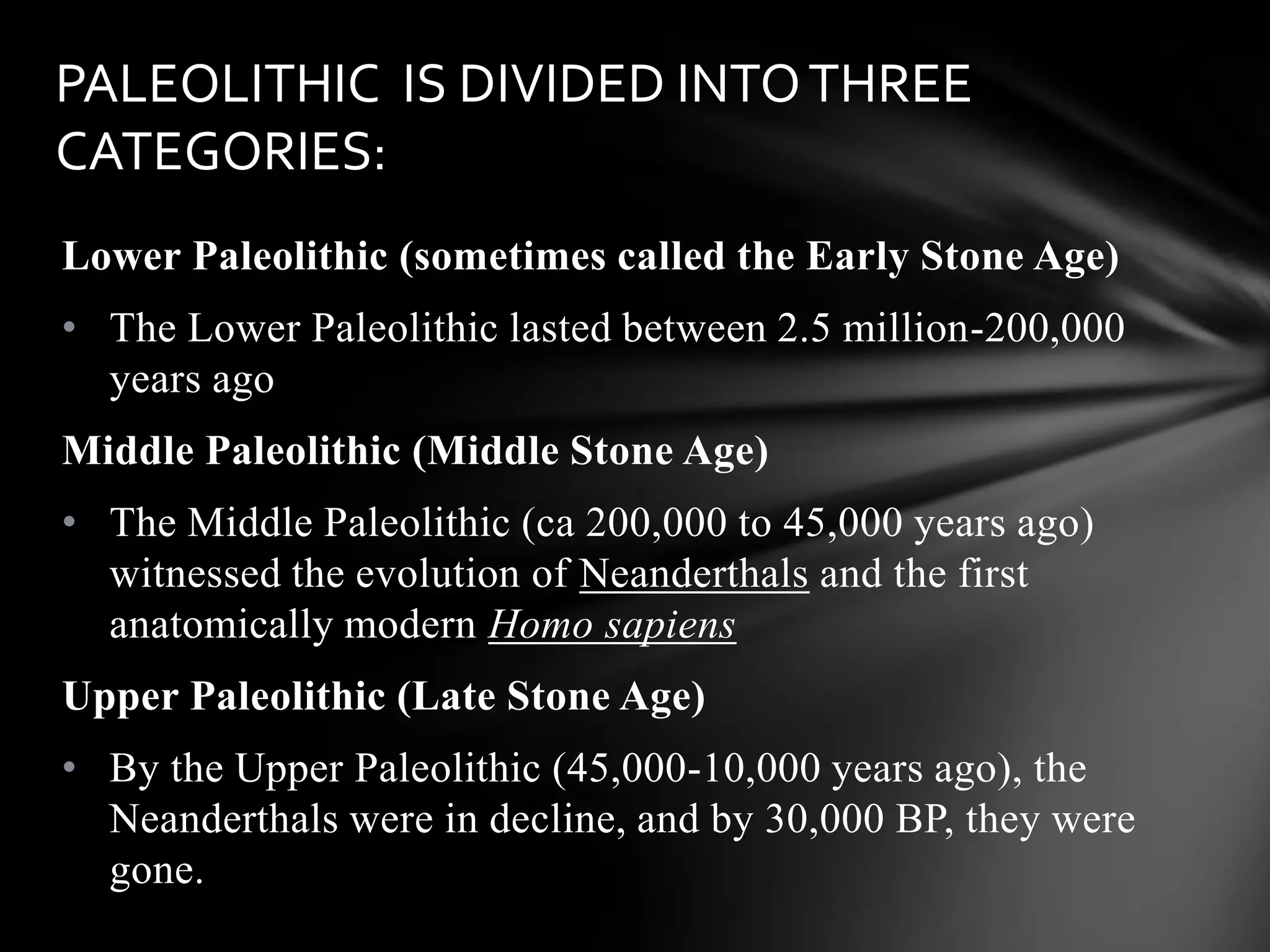
The Stone Age (known to scholars as the
Paleolithic era)
Lower Paleolithic (sometimes called the Early Stone Age)
• The Lower Paleolithic lasted between 2.5 million-200,000
years ago
Middle Paleolithic (Middle Stone Age)
• The Middle Paleolithic (ca 200,000 to 45,000 years ago)
witnessed the evolution of Neanderthals and the first
anatomically modern Homo sapiens
Upper Paleolithic (Late Stone Age)
• By the Upper Paleolithic (45,000-10,000 years ago), the
Neanderthals were in decline, and by 30,000 BP, they were
gone.
PALEOLITHIC IS DIVIDED INTOTHREE
CATEGORIES:
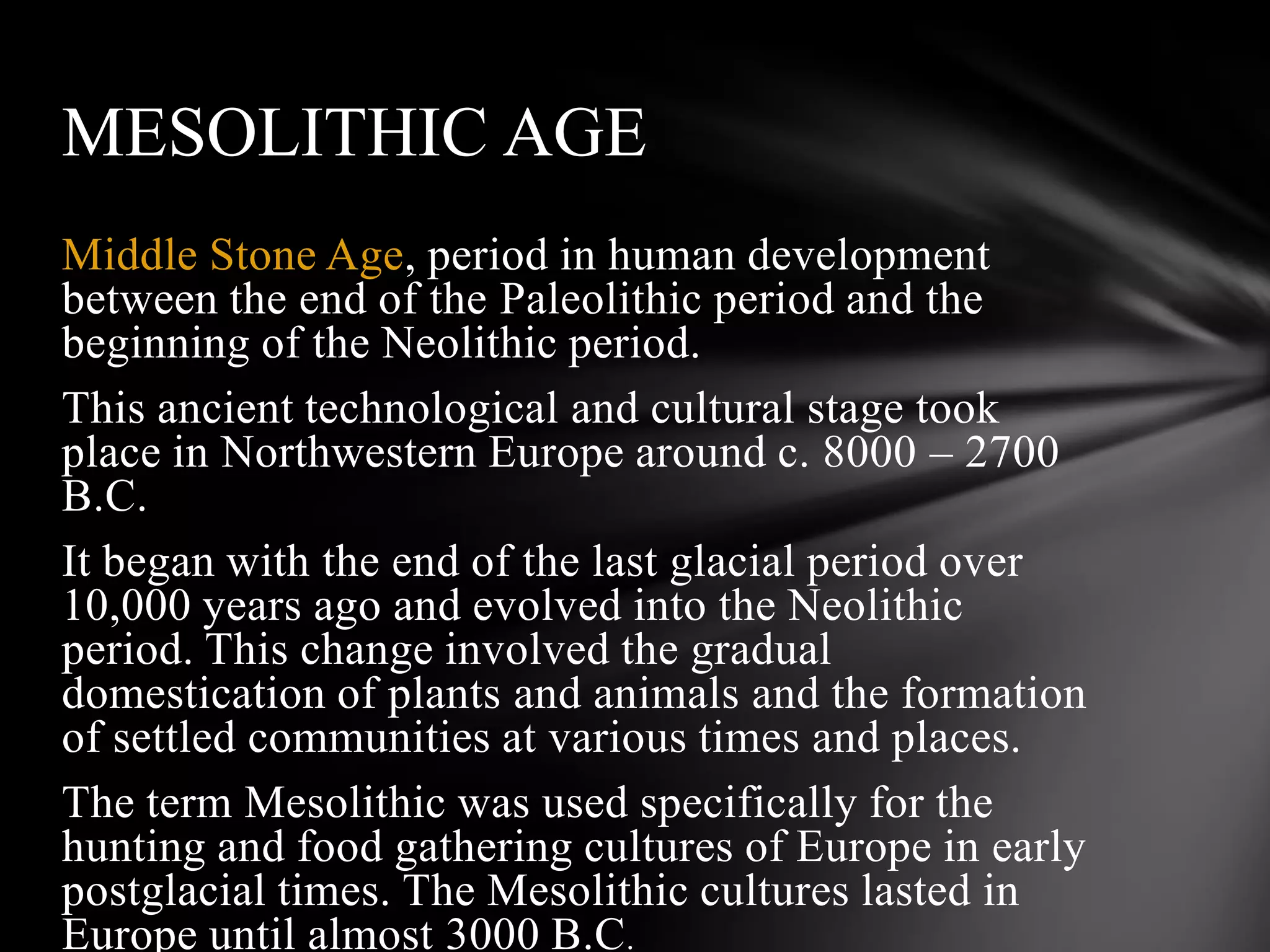
Middle Stone Age, period in human development
between the end of the Paleolithic period and the
beginning of the Neolithic period.
This ancient technological and cultural stage took
place in Northwestern Europe around c. 8000 – 2700
B.C.
It began with the end of the last glacial period over
10,000 years ago and evolved into the Neolithic
period. This change involved the gradual
domestication of plants and animals and the formation
of settled communities at various times and places.
The term Mesolithic was used specifically for the
hunting and food gathering cultures of Europe in early
postglacial times. The Mesolithic cultures lasted in
Europe until almost 3000 B.C.
MESOLITHIC AGE
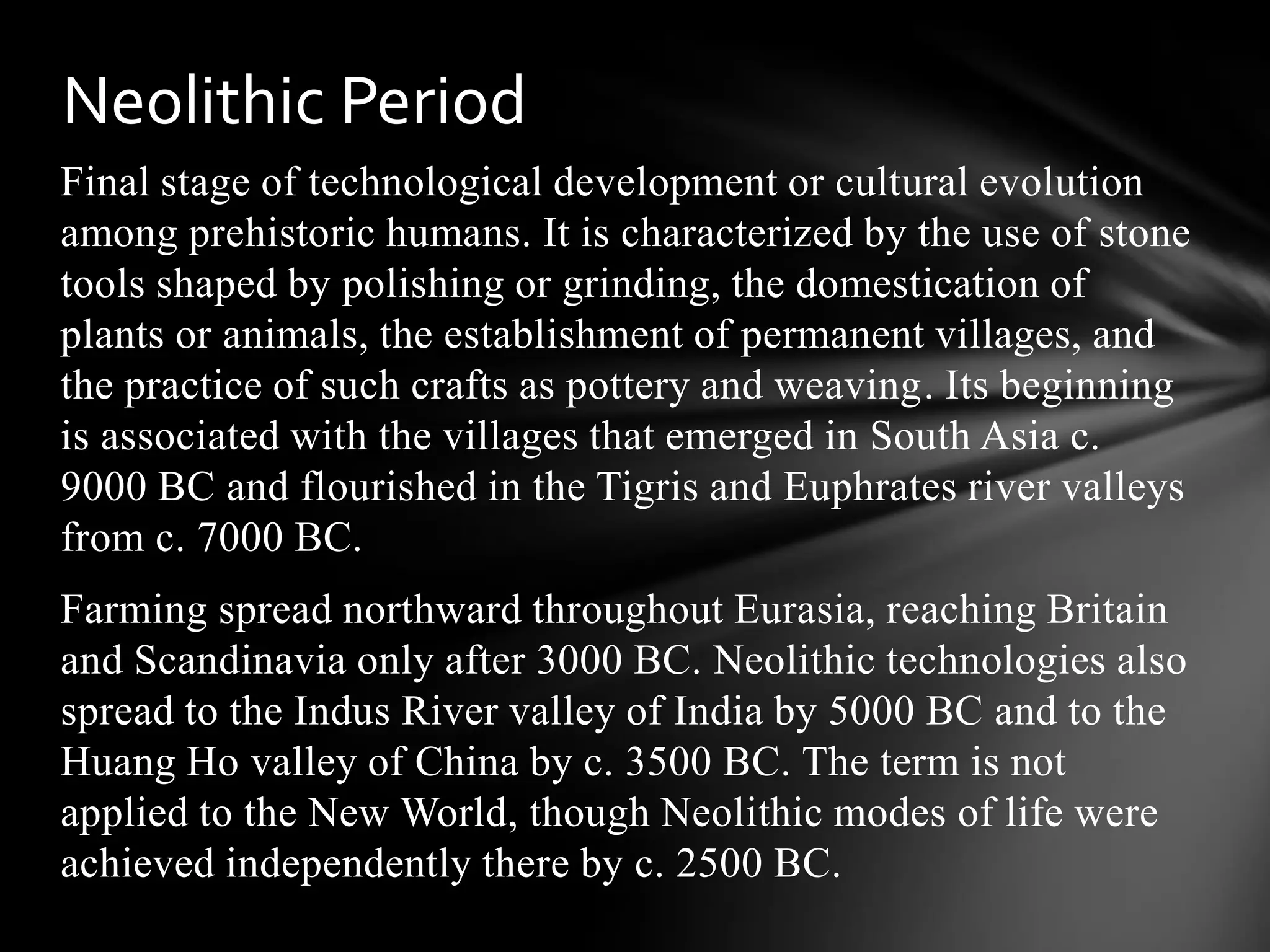
Final stage of technological development or cultural evolution
among prehistoric humans. It is characterized by the use of stone
tools shaped by polishing or grinding, the domestication of
plants or animals, the establishment of permanent villages, and
the practice of such crafts as pottery and weaving. Its beginning
is associated with the villages that emerged in South Asia c.
9000 BC and flourished in the Tigris and Euphrates river valleys
from c. 7000 BC.
Farming spread northward throughout Eurasia, reaching Britain
and Scandinavia only after 3000 BC. Neolithic technologies also
spread to the Indus River valley of India by 5000 BC and to the
Huang Ho valley of China by c. 3500 BC. The term is not
applied to the New World, though Neolithic modes of life were
achieved independently there by c. 2500 BC.
Neolithic Period
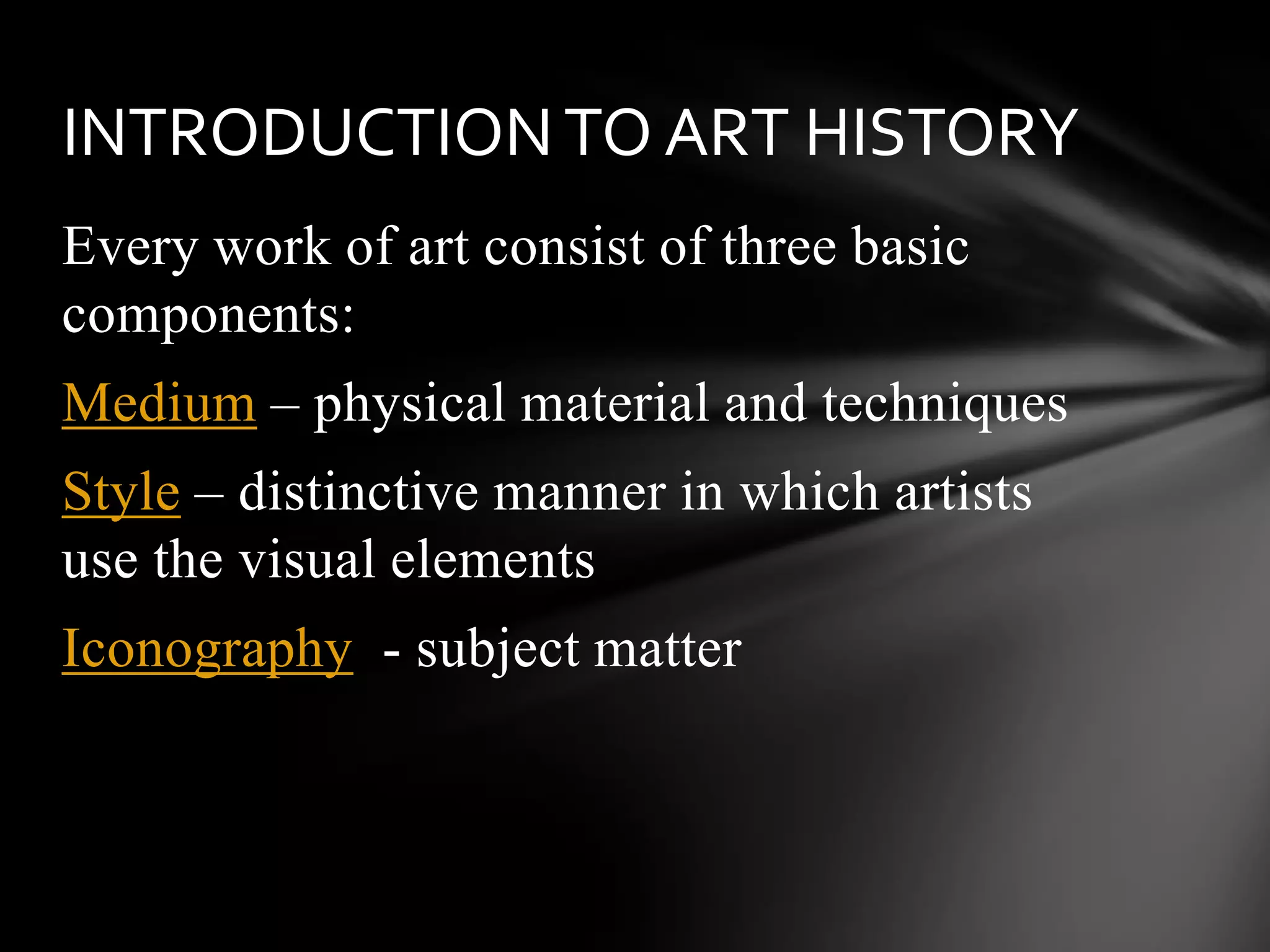
Every work of art consist of three basic
components:
Medium – physical material and techniques
Style – distinctive manner in which artists
use the visual elements
Iconography - subject matter
INTRODUCTIONTO ART HISTORY
Physical material from which a work of
art is made.
It also implies the technique used to
make it.
MEDIUM
Paint media
• Acrylic, Enamel, Gesso, Glaze, Ink, Oil, Tempera,
Watercolor
• Used on: Canvas, Cloth, Glass, Metal, Paper, Wood
Drawing media
• Chalk pastel, Charcoal, Colored pencil, Marker, Oil pastel,
Pen and ink
Sculpture materials
• Beads, Clay, Found objects, Jewels, Marble, Metals, Papier-
mache, Plaster, Plastic, Sand, Stone, Textile, Wax, Wire,
Wood
Popular Media
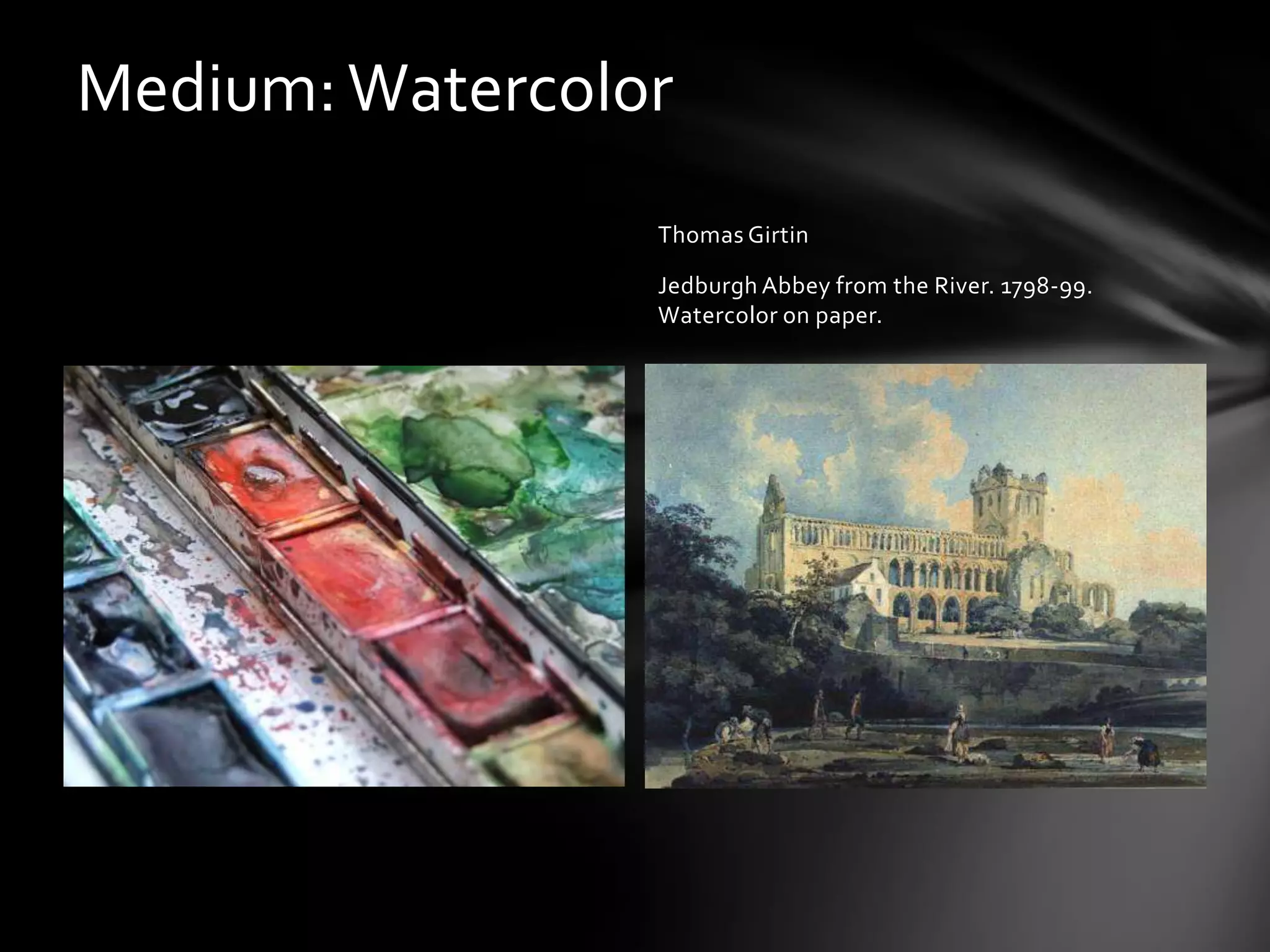
Medium:Watercolor
Thomas Girtin
Jedburgh Abbey from the River. 1798-99.
Watercolor on paper.
Distinctive manner in which artists use the
visual elements
Style
i·co·nog·ra·phy – subject matter in the
visual arts, especially with reference to
the conventions regarding the treatment
of a subject in artistic representation.
ICONOGRAPHY
Introduction to

Introduction to

  • 1.
  • 2.
    Art is thequality, production, or expression of what is beautiful, appealing, or of more than ordinary significance Work of art - visual expression of an idea What is Art?
  • 3.
    Art history hashistorically been understood as the academic study of objects of art in their historical development and stylistic contexts, i.e. genre, design, format, and style. This includes the "major" arts of painting, sculpture, and architecture as well as the "minor" arts of ceramics, furniture, and other decorative objects. WHAT IS ART HISTORY?
  • 4.
    Prehistoric people oftenrepresented their world- and perhaps their beliefs through visual images. Art emerged with the appearance and dispersion of fully modern people through Africa, Europe, Asia, Australasia, and the Americas. Paintings, sculptures, engravings, and, later, pottery reveal not only a quest for beauty but also complex social systems and spiritual concepts. PREHISTORIC ART Horse c. 15,000-10,000 BC Lascaux, France
  • 5.
    The name givento the period between about 2.5 million and 20,000 years ago. It begins with the earliest human-like behaviors of crude stone tool manufacture, and ends with fully modern human hunting and gathering societies. The Paleolithic is the earliest archaeology; anything older is paleontology. The Stone Age (known to scholars as the Paleolithic era)
  • 6.
    Lower Paleolithic (sometimescalled the Early Stone Age) • The Lower Paleolithic lasted between 2.5 million-200,000 years ago Middle Paleolithic (Middle Stone Age) • The Middle Paleolithic (ca 200,000 to 45,000 years ago) witnessed the evolution of Neanderthals and the first anatomically modern Homo sapiens Upper Paleolithic (Late Stone Age) • By the Upper Paleolithic (45,000-10,000 years ago), the Neanderthals were in decline, and by 30,000 BP, they were gone. PALEOLITHIC IS DIVIDED INTOTHREE CATEGORIES:
  • 7.
    Middle Stone Age,period in human development between the end of the Paleolithic period and the beginning of the Neolithic period. This ancient technological and cultural stage took place in Northwestern Europe around c. 8000 – 2700 B.C. It began with the end of the last glacial period over 10,000 years ago and evolved into the Neolithic period. This change involved the gradual domestication of plants and animals and the formation of settled communities at various times and places. The term Mesolithic was used specifically for the hunting and food gathering cultures of Europe in early postglacial times. The Mesolithic cultures lasted in Europe until almost 3000 B.C. MESOLITHIC AGE
  • 8.
    Final stage oftechnological development or cultural evolution among prehistoric humans. It is characterized by the use of stone tools shaped by polishing or grinding, the domestication of plants or animals, the establishment of permanent villages, and the practice of such crafts as pottery and weaving. Its beginning is associated with the villages that emerged in South Asia c. 9000 BC and flourished in the Tigris and Euphrates river valleys from c. 7000 BC. Farming spread northward throughout Eurasia, reaching Britain and Scandinavia only after 3000 BC. Neolithic technologies also spread to the Indus River valley of India by 5000 BC and to the Huang Ho valley of China by c. 3500 BC. The term is not applied to the New World, though Neolithic modes of life were achieved independently there by c. 2500 BC. Neolithic Period
  • 9.
    Every work ofart consist of three basic components: Medium – physical material and techniques Style – distinctive manner in which artists use the visual elements Iconography - subject matter INTRODUCTIONTO ART HISTORY
  • 10.
    Physical material fromwhich a work of art is made. It also implies the technique used to make it. MEDIUM
  • 11.
    Paint media • Acrylic,Enamel, Gesso, Glaze, Ink, Oil, Tempera, Watercolor • Used on: Canvas, Cloth, Glass, Metal, Paper, Wood Drawing media • Chalk pastel, Charcoal, Colored pencil, Marker, Oil pastel, Pen and ink Sculpture materials • Beads, Clay, Found objects, Jewels, Marble, Metals, Papier- mache, Plaster, Plastic, Sand, Stone, Textile, Wax, Wire, Wood Popular Media
  • 12.
    Medium:Watercolor Thomas Girtin Jedburgh Abbeyfrom the River. 1798-99. Watercolor on paper.
  • 13.
    Distinctive manner inwhich artists use the visual elements Style
  • 14.
    i·co·nog·ra·phy – subjectmatter in the visual arts, especially with reference to the conventions regarding the treatment of a subject in artistic representation. ICONOGRAPHY