Training Workshop on Payments for Ecosystem Services (PES) and Reducing Emissions from Deforestation and Degradation (REDD+)Nairobi, Kenya - August 9th, 2011Payments for Ecosystem Services: Policy IssuesSlayde HawkinsForest Trends/Katoomba Group
Clarity on whether PES are permitted under existing lawOwnership and use rights over:LandNatural resourcesCredits for ecosystem servicesApplication of existing laws and regulations to PESClarity on who has authority and how legal or policy conflicts will be handledStability and rule of lawAvailable mechanisms for contract enforcement and appealOverview: Key Policy Issues for PES
PES may be prohibited by Constitution or lawMay be bar on selling ecosystem services, as a public good that is held on behalf of allIf sale of ES credits prohibited, may nevertheless be legal to contract to provide services that restore or conserve ecosystem servicesPES Allowed by Law?
LAND TENURELegal or customary relationship of an individual or group with respect to land and other natural resources.Tenure: DefinitionTenure rules determine:WHO can useWHAT resources For HOW LONGUnder what CONDITIONSExistence of secure long-term use rights is an essential precondition for payments for ecosystem servicesMinimum: Right to ecosystem benefits from project activitiesRight to transfer creditsOften no ecosystem services law so rights must be implied from other lawsMay be tied to rights in land or natural resourcesTenure in Land, Ecosystem ServicesRights in Project AreaMinimum: Use rights to support project activities Right to exclude incompatible usesFor the duration of project activitiesCustomary rights may be sufficient if secure, recognized by lawEcosystem Services Rights
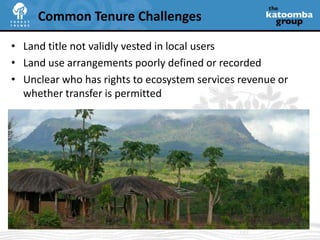
Land title not validly vested in local usersLand use arrangements poorly defined or recordedUnclear who has rights to ecosystem services revenue or whether transfer is permittedCommon Tenure Challenges
Sources of applicable lawFramework environmental, water, forestry lawsLaws on:Land & natural resourcesAgriculturePlanning and infrastructureIndigenous peoplesKey regulatory authorities: Departments or Ministries of Environment & AgriculturePitfalls: conflicting laws or regulations, overlapping or conflicting authoritiesApplication of Existing Law
May apply to transaction in ecosystem services credits or to underlying project activitiesE.g. timber harvests, sales generally taxableTypes of taxes that may apply:Sales Tax & VAT – On value of transferred good, serviceIncome  Tax – On personal or corporate carbon revenueProperty Tax – On property valueDuties/tariffs – On value of imported or exported goodsCarbon Revenue  Tax – On carbon credits or projectsPotential Taxes
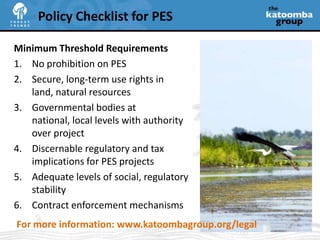
Policy Checklist for PESMinimum Threshold RequirementsNo prohibition on PESSecure, long-term use rights in land, natural resourcesGovernmental bodies at national, local levels with authority over projectDiscernable regulatory and tax implications for PES projectsAdequate levels of social, regulatory stabilityContract enforcement mechanismsFor more information: www.katoombagroup.org/legal
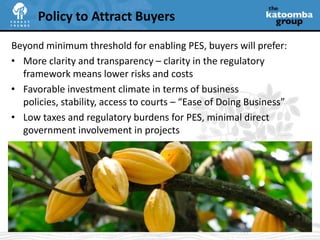
Beyond minimum threshold for enabling PES, buyers will prefer:More clarity and transparency – clarity in the regulatory framework means lower risks and costsFavorable investment climate in terms of business policies, stability, access to courts – “Ease of Doing Business”Low taxes and regulatory burdens for PES, minimal direct government involvement in projectsPolicy to Attract Buyers
THANK YOU!Slayde HawkinsForest Trends/Katoomba Groupshawkins@forest-trends.org
Payments for ecosystem services: policy issues

Payments for ecosystem services: policy issues

  • 1.
    Training Workshop onPayments for Ecosystem Services (PES) and Reducing Emissions from Deforestation and Degradation (REDD+)Nairobi, Kenya - August 9th, 2011Payments for Ecosystem Services: Policy IssuesSlayde HawkinsForest Trends/Katoomba Group
  • 2.
    Clarity on whetherPES are permitted under existing lawOwnership and use rights over:LandNatural resourcesCredits for ecosystem servicesApplication of existing laws and regulations to PESClarity on who has authority and how legal or policy conflicts will be handledStability and rule of lawAvailable mechanisms for contract enforcement and appealOverview: Key Policy Issues for PES
  • 3.
    PES may beprohibited by Constitution or lawMay be bar on selling ecosystem services, as a public good that is held on behalf of allIf sale of ES credits prohibited, may nevertheless be legal to contract to provide services that restore or conserve ecosystem servicesPES Allowed by Law?
  • 4.
    LAND TENURELegal orcustomary relationship of an individual or group with respect to land and other natural resources.Tenure: DefinitionTenure rules determine:WHO can useWHAT resources For HOW LONGUnder what CONDITIONSExistence of secure long-term use rights is an essential precondition for payments for ecosystem servicesMinimum: Right to ecosystem benefits from project activitiesRight to transfer creditsOften no ecosystem services law so rights must be implied from other lawsMay be tied to rights in land or natural resourcesTenure in Land, Ecosystem ServicesRights in Project AreaMinimum: Use rights to support project activities Right to exclude incompatible usesFor the duration of project activitiesCustomary rights may be sufficient if secure, recognized by lawEcosystem Services Rights
  • 5.
    Land title notvalidly vested in local usersLand use arrangements poorly defined or recordedUnclear who has rights to ecosystem services revenue or whether transfer is permittedCommon Tenure Challenges
  • 6.
    Sources of applicablelawFramework environmental, water, forestry lawsLaws on:Land & natural resourcesAgriculturePlanning and infrastructureIndigenous peoplesKey regulatory authorities: Departments or Ministries of Environment & AgriculturePitfalls: conflicting laws or regulations, overlapping or conflicting authoritiesApplication of Existing Law
  • 7.
    May apply totransaction in ecosystem services credits or to underlying project activitiesE.g. timber harvests, sales generally taxableTypes of taxes that may apply:Sales Tax & VAT – On value of transferred good, serviceIncome Tax – On personal or corporate carbon revenueProperty Tax – On property valueDuties/tariffs – On value of imported or exported goodsCarbon Revenue Tax – On carbon credits or projectsPotential Taxes
  • 8.
    Policy Checklist forPESMinimum Threshold RequirementsNo prohibition on PESSecure, long-term use rights in land, natural resourcesGovernmental bodies at national, local levels with authority over projectDiscernable regulatory and tax implications for PES projectsAdequate levels of social, regulatory stabilityContract enforcement mechanismsFor more information: www.katoombagroup.org/legal
  • 9.
    Beyond minimum thresholdfor enabling PES, buyers will prefer:More clarity and transparency – clarity in the regulatory framework means lower risks and costsFavorable investment climate in terms of business policies, stability, access to courts – “Ease of Doing Business”Low taxes and regulatory burdens for PES, minimal direct government involvement in projectsPolicy to Attract Buyers
  • 10.
    THANK YOU!Slayde HawkinsForestTrends/Katoomba Groupshawkins@forest-trends.org

Editor's Notes

  • #5 Landtenure is the legal or customary relationship of an individual or group with respect to land and other natural resources, such as water and trees. Tenure rules define how access is granted to rights to use, control, and transfer land, and associated responsibilities and restraints. Put simply, land tenure rules determine (1) who can use (2) what resources (3) for how long, and (4) under what conditions. FAO. 2002. Land tenure and rural development, 3.1. Rome: FAO Economic & Social Development Department. http://www.fao.org/DOCREP/005/Y4307E/y4307e00.htm
  • #6 Rights in the Project Area Project participants who have insufficient rights in land and natural resources in the project area cannot guarantee that project activities will continue as promised, resulting in risks to ecosystem service generation. At a minimum, project participants must have the right to perform project activities and to exclude incompatible uses for the duration of the project Customary rights may provide sufficient legal certainty, depending upon the circumstances. However, a lack of formal tenure rights exposes project participants and potential buyers to higher risk of challenge or conflict.Rights in Ecosystem Services (i.e. carbon, water quality, biodiversity) Rights to sell ecosystem services credits generally must be implied from laws that are not directly applicable, because there are few official rules that explicitly allocate ecosystem services rights. How to treat these rights is often an open question, although they generally are tied to rights in land or natural resources. For example, a land owner may be considered to have the right to sell ecosystem services credits generated on his or her land. Alternately, the person entitled to manage a forest area for timber could have the right to ecosystem service credits generated from that forest, for example, because of improved forest management, decreased logging, or other actions.
  • #7 In many ecosystems, tenure is unclear or insecure, because land title is not validly vested in local land users, land use arrangements are poorly defined or recorded, or because it is unclear who has rights to ecosystem services revenues, or whether transferring credits to ecosystem services is permitted by law. There may be restrictions on a person or entity’s ability to transfer ecosystem services rights, particularly if natural resources are held by the government in trust for the people as a whole. Transfer restrictions may impair the ability to sell ecosystem services credits, such as carbon credits. If tenure problems are severe, they can make a PES project infeasible because risks to investors or buyers are too high, because relevant standards organizations will not validate and verify credits, and/or because necessary governmental approvals cannot be obtained. Policies and programs that improve titling and registration of tenure rights and provide for demarcation of area that are not officially allocated to local users can be very effective in laying the necessary foundation for PES. The process of demarcating land, however, is likely to be highly politically charged and technically difficult and is not a quick fix, by any means. Beyond minimum requirements, the level of rights in the project area is an important dimension of project risk. In general, the clearer and more secure are project participants’ rights, the lower the risk and the potential for disputes.
  • #8 To evaluate potential policy options, it is necessary to understand how the existing policy, legal, and regulatory frameworks apply to PES projects. Because laws and regulations were not written with PES in mind, their implications for PES can be difficult to identify with certainty. Nevertheless, sources of applicable law and their likely impacts can – and must – be assessed in light of specific local and national circumstances.In general, applicable laws will be found in a country’s framework environmental, water, and forestry laws, as well as their laws on land and natural resources, agriculture, planning and infrastructure, and indigenous peoples. Depending on the host country, national laws and regulations may be readily available on the internet or at a library. However, “common law,” the law developed by judges through court decisions, is also important in many countries (so-called “common law” countries), and is likely to be significantly more difficult to find and interpret. It will also be important to identify applicable local laws and regulations, which may be harder to find than their national counterparts. Furthermore, legal language can be difficult for a layperson to interpret accurately. A local lawyer should be consulted to help identify the likely effect of all applicable laws and regulations.The government bodies that are most likely to have regulatory authority include those in charge of the environment, agriculture, and forestry. If the host country has a climate change office or Designated National Authority (DNA), this would also be a natural place to look for more information specifically about carbon issues. In most places, applicable laws were not written with PES in mind, meaning that project developers must watch out for gaps or overlaps in regulation and missing or inconsistent legal requirements. For example, the ministries of environment and agriculture, which often have overlapping authority over forests, water resources, and land, may each have a valid claim of regulatory authority over PES. In exercising their authority, they may impose inconsistent or even contradictory requirements on sellers and project developers.
  • #9 Tax implications of project activities are important to understand because of the effect they can have on the project’s revenue.Carbon revenue taxes are still uncommon, but apply in some places. Guarantee part of carbon revenues to government.Failure to consider the tax consequences of a carbon project or transaction may mean the difference between a profit and loss.The applicability and impact of these and other taxes depends entirely upon the circumstances of the particular project. For example, a project proponent that is a for-profit private enterprise may face very different tax obligation than a community enterprise or NGO. A formal tax analysis, conducted after the completion of project planning (i.e. when the structure of the project and relationships between the parties are clear) will help project participants structure carbon transactions so as to minimize tax liability while ensuring that the project is in full compliance with tax law.