Students In Free Enterprise Universiti Utara Malaysia
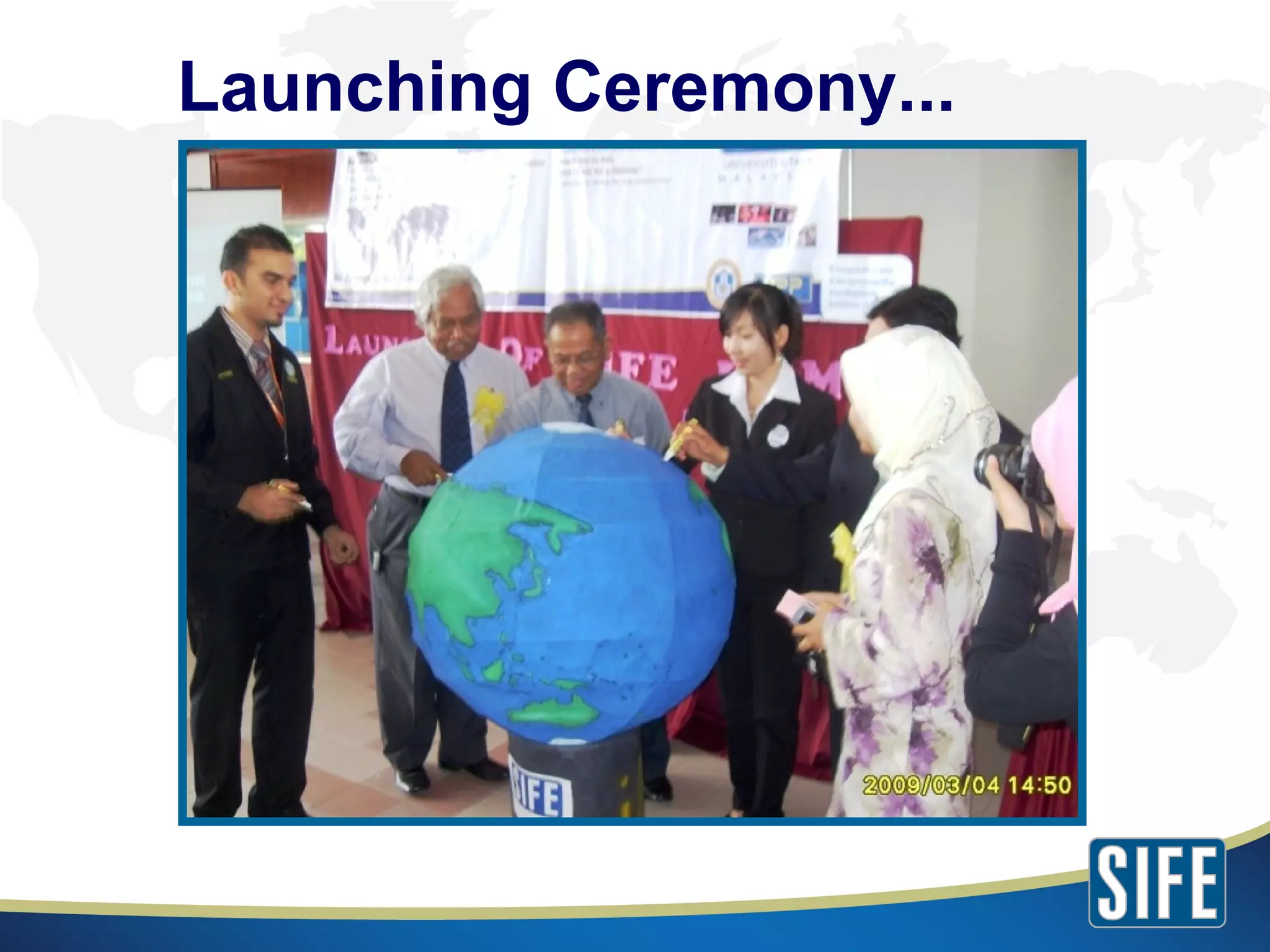
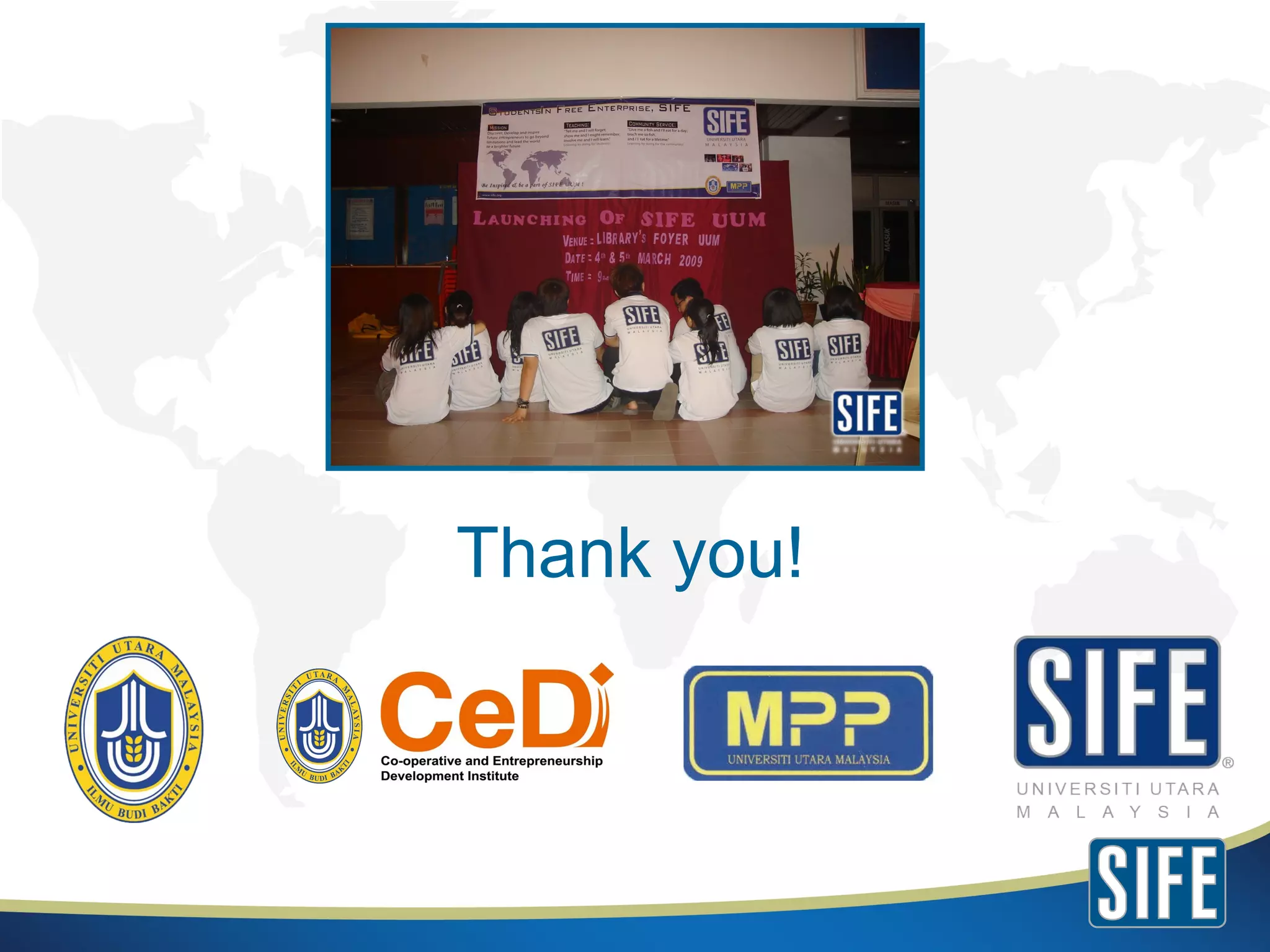
SIFE UUM Launching Ceremony Date : 4th March 2009 Time : 2.00pm Venue : Universiti Utara Malaysia
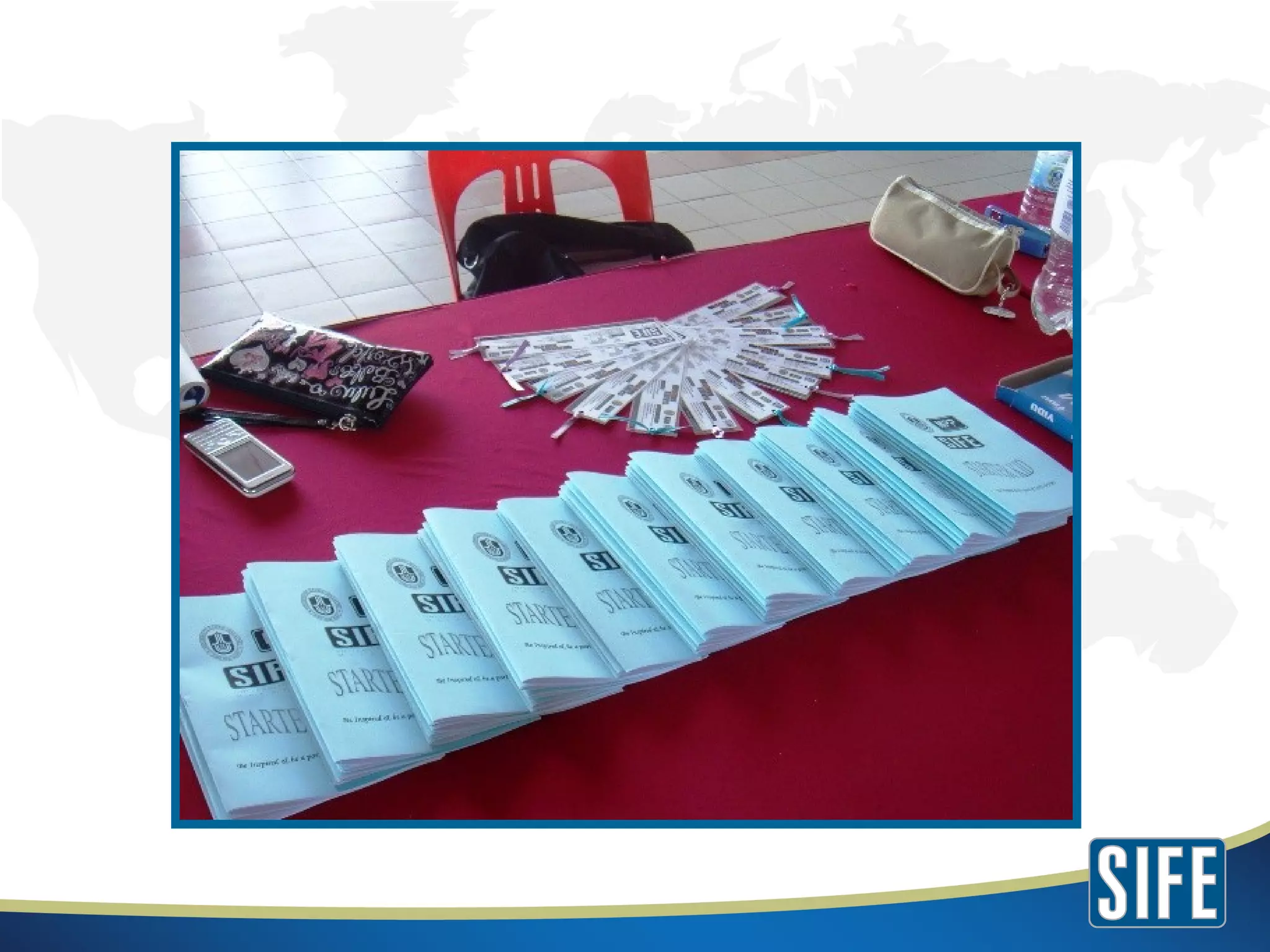
Launching Ceremony...
 
 
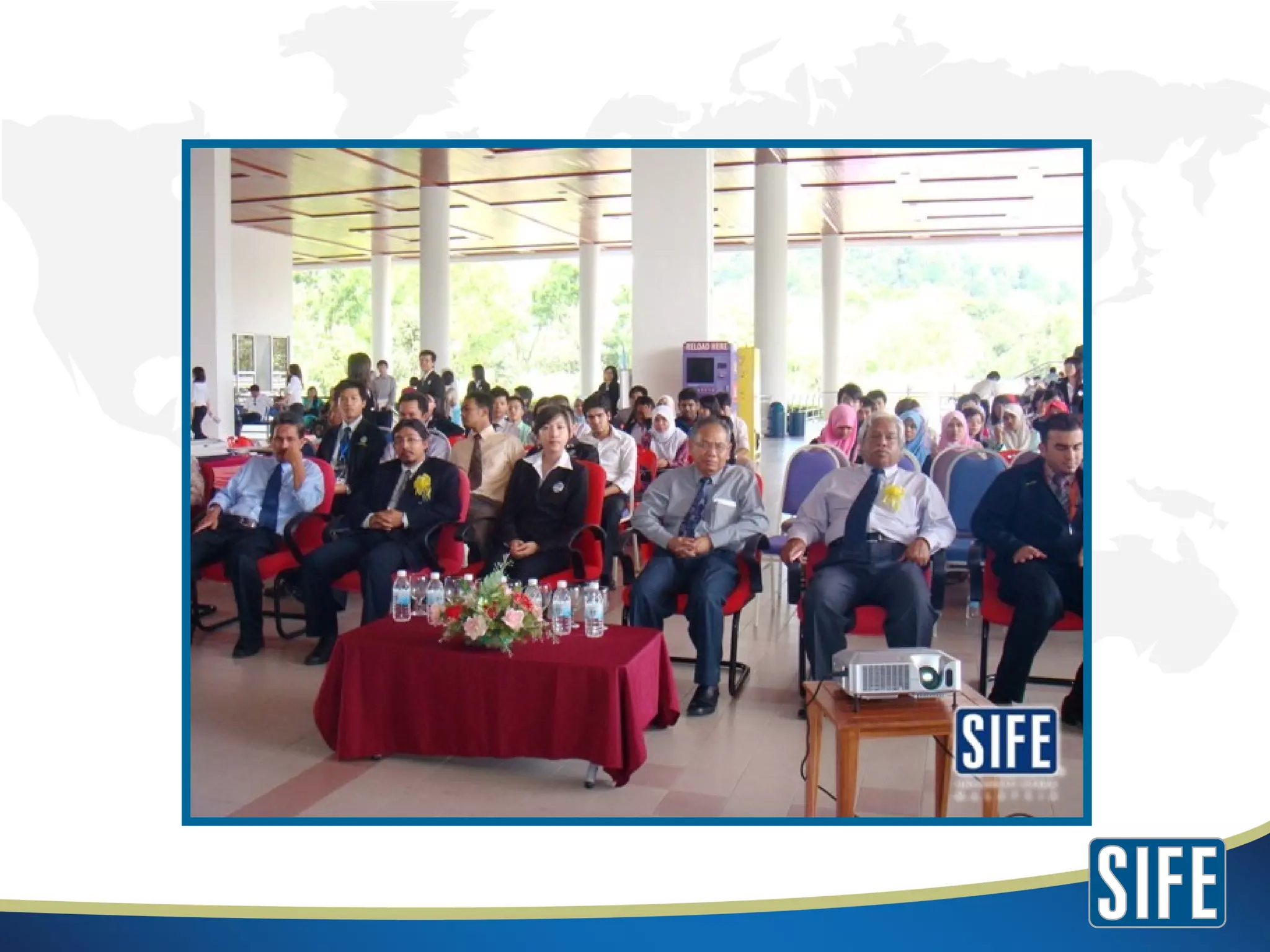
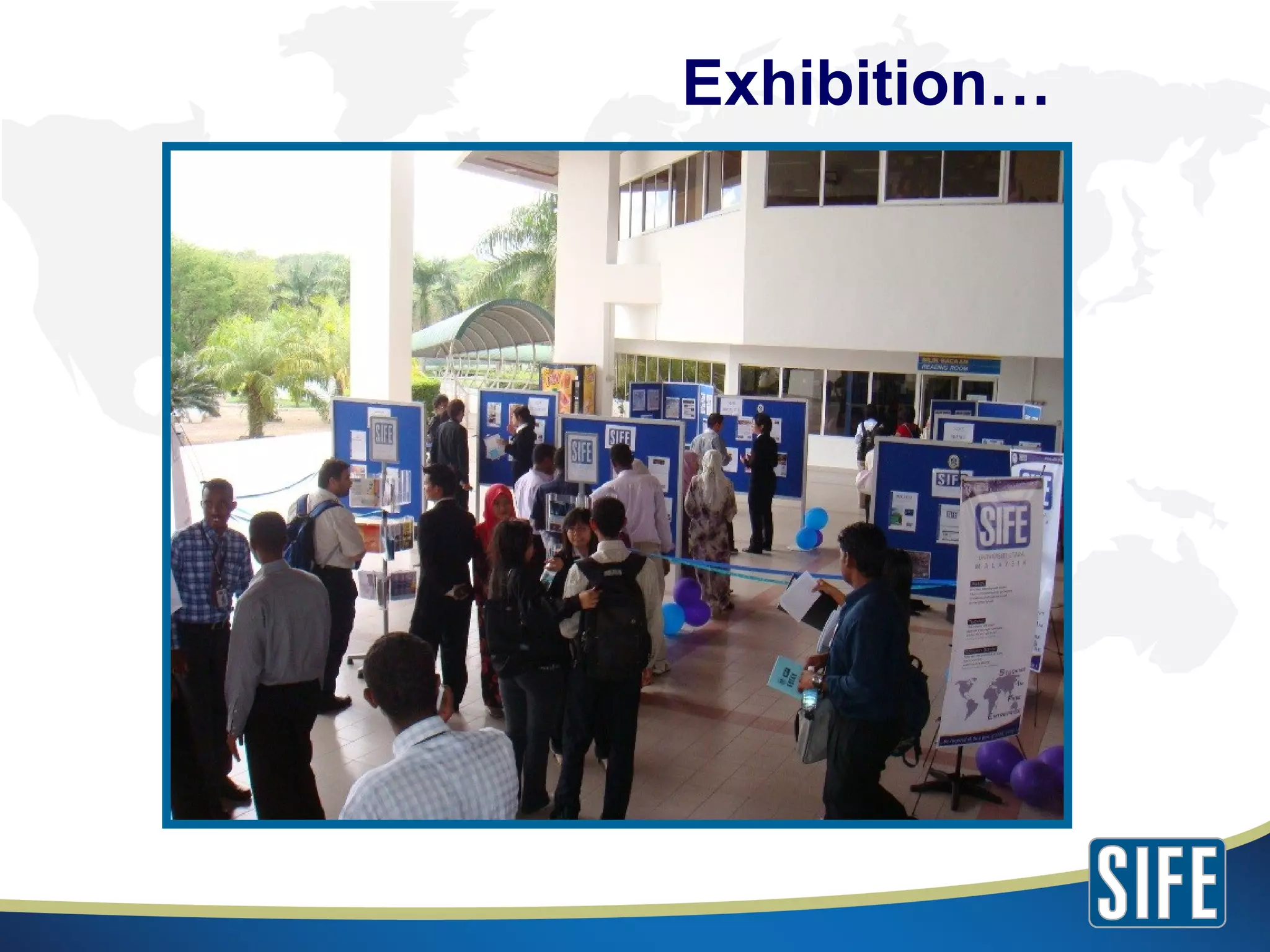
Exhibition…
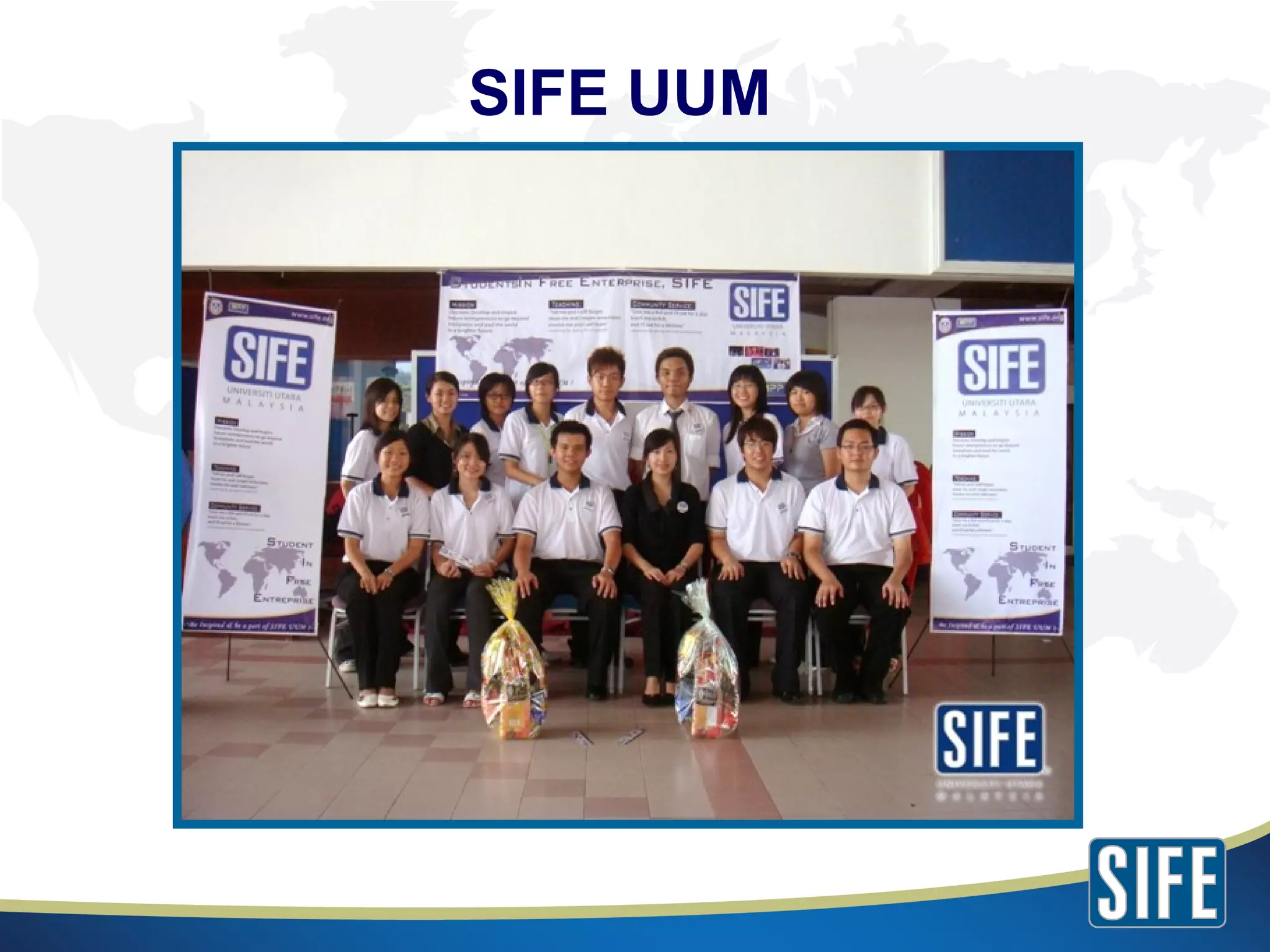
SIFE UUM
Our Mission… Discover, Develop and Inspire  future entrepreneurs to go beyond limitations and lead the world to a brighter future .
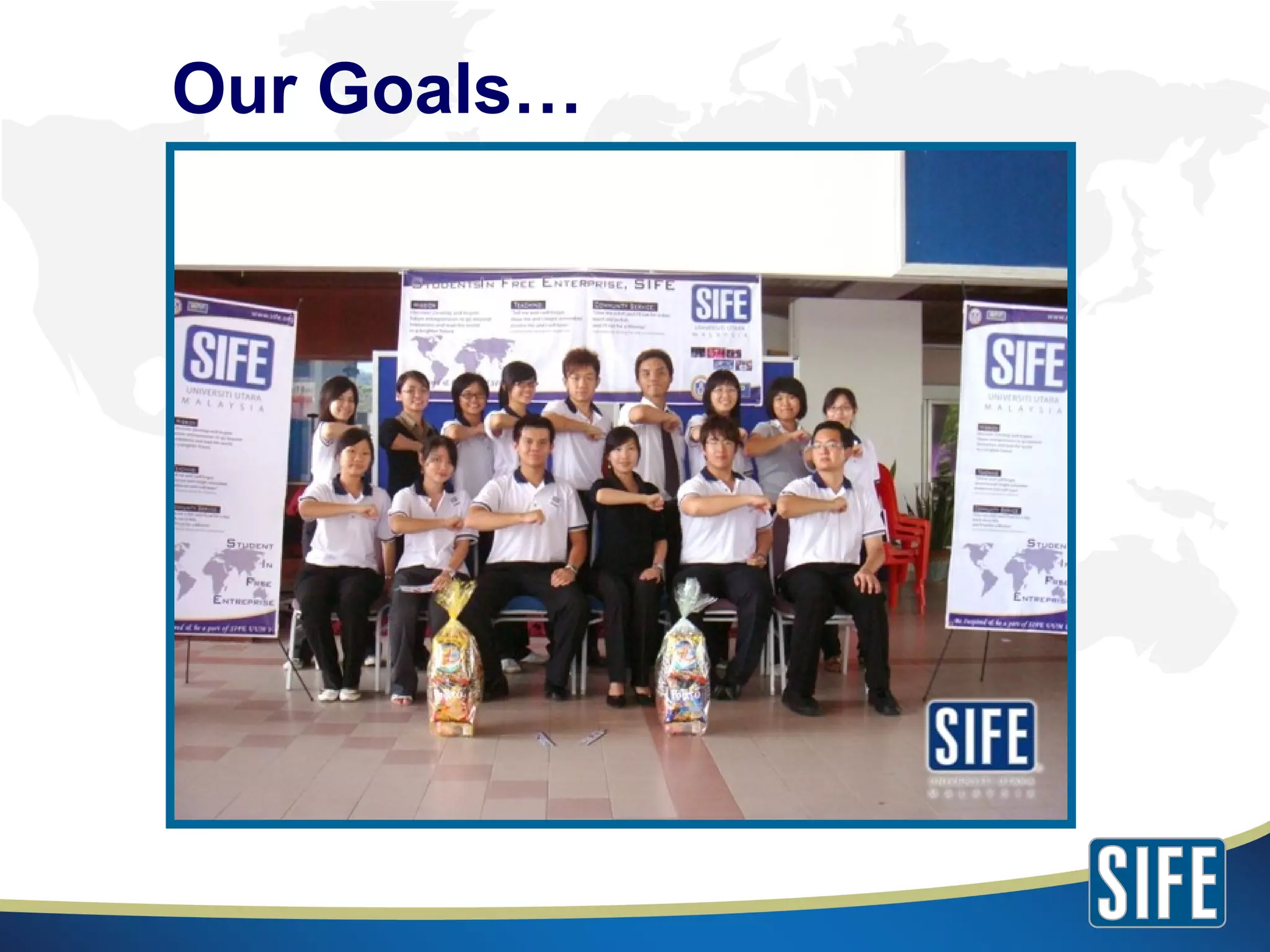
Our Goals…
To build a strong and sustainable SIFE team in UUM To boost the economy in Kubang Pasu To empower the youths of today for the challenge of tomorrow
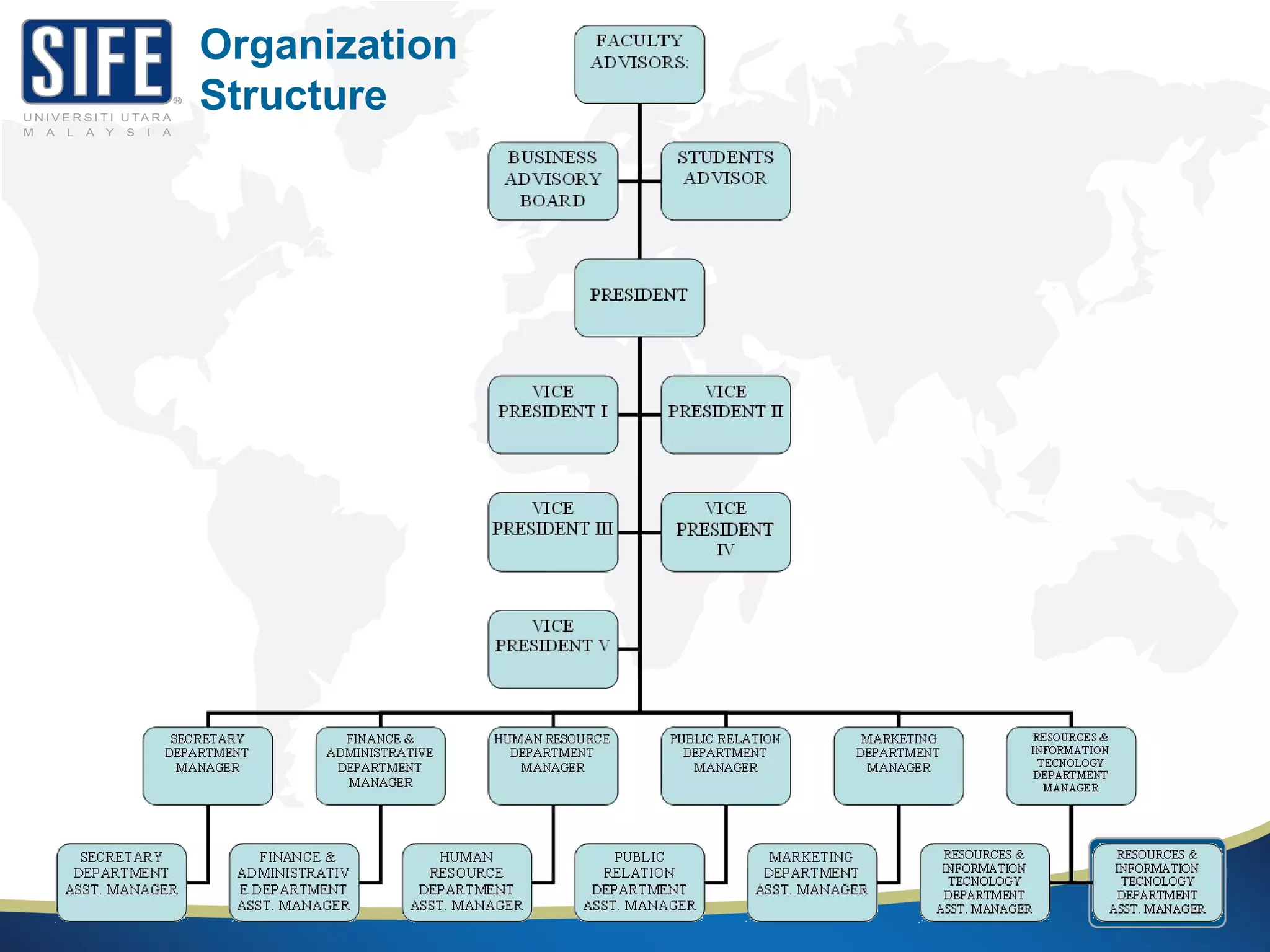
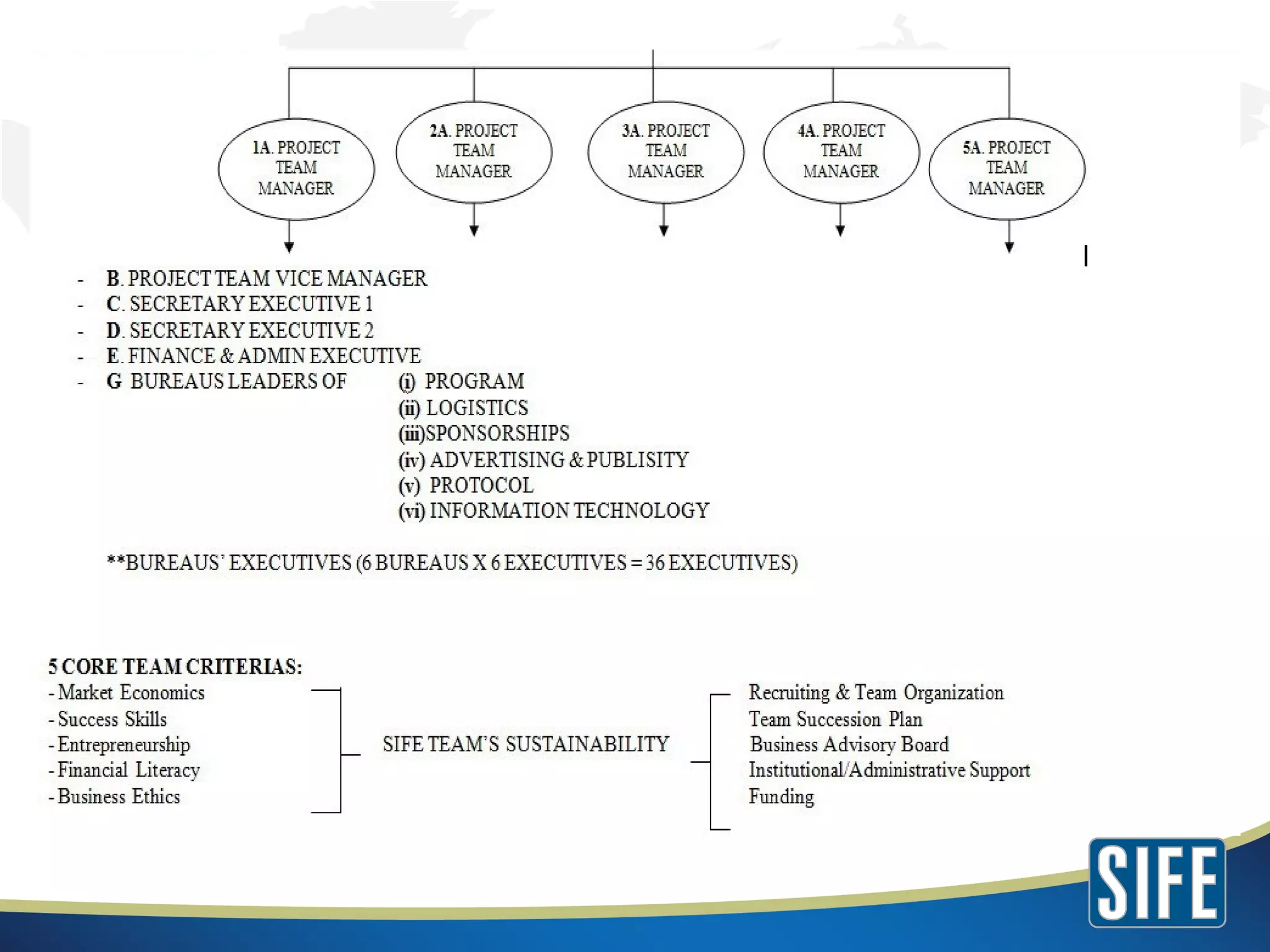
Organization Structure
 
Projects done… SIFE UUM Launching Ceremony Date : 4th March 2009
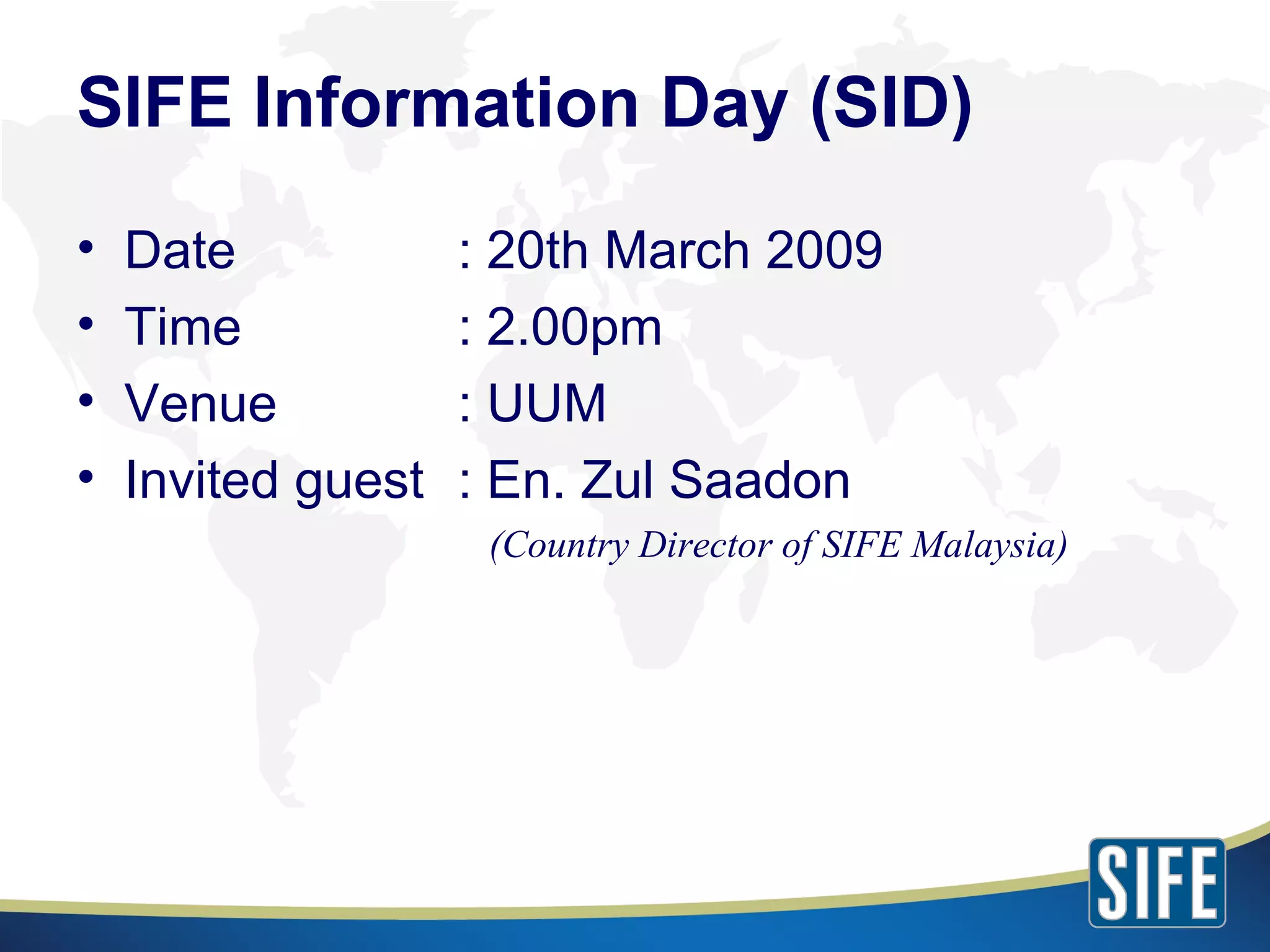
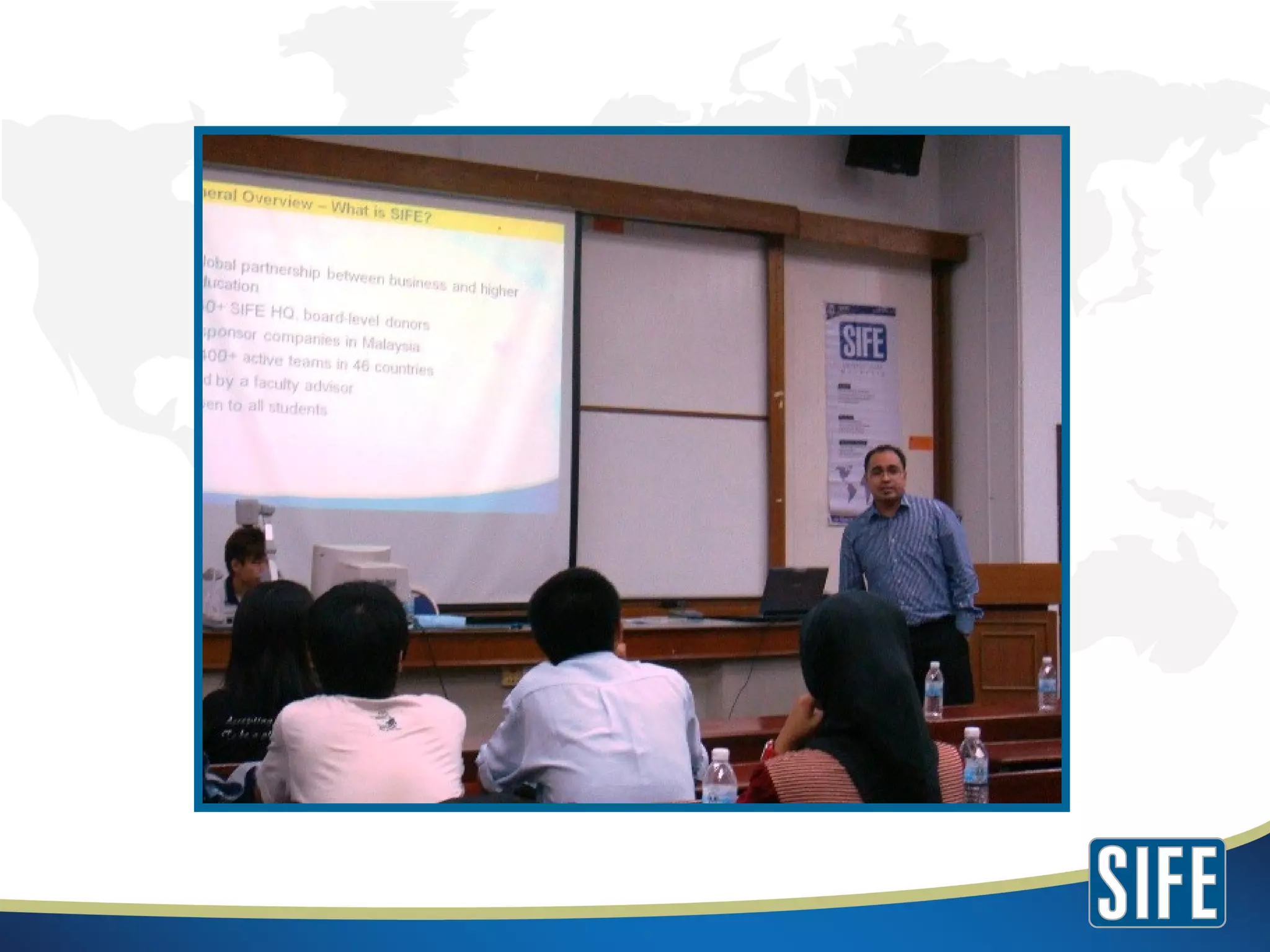
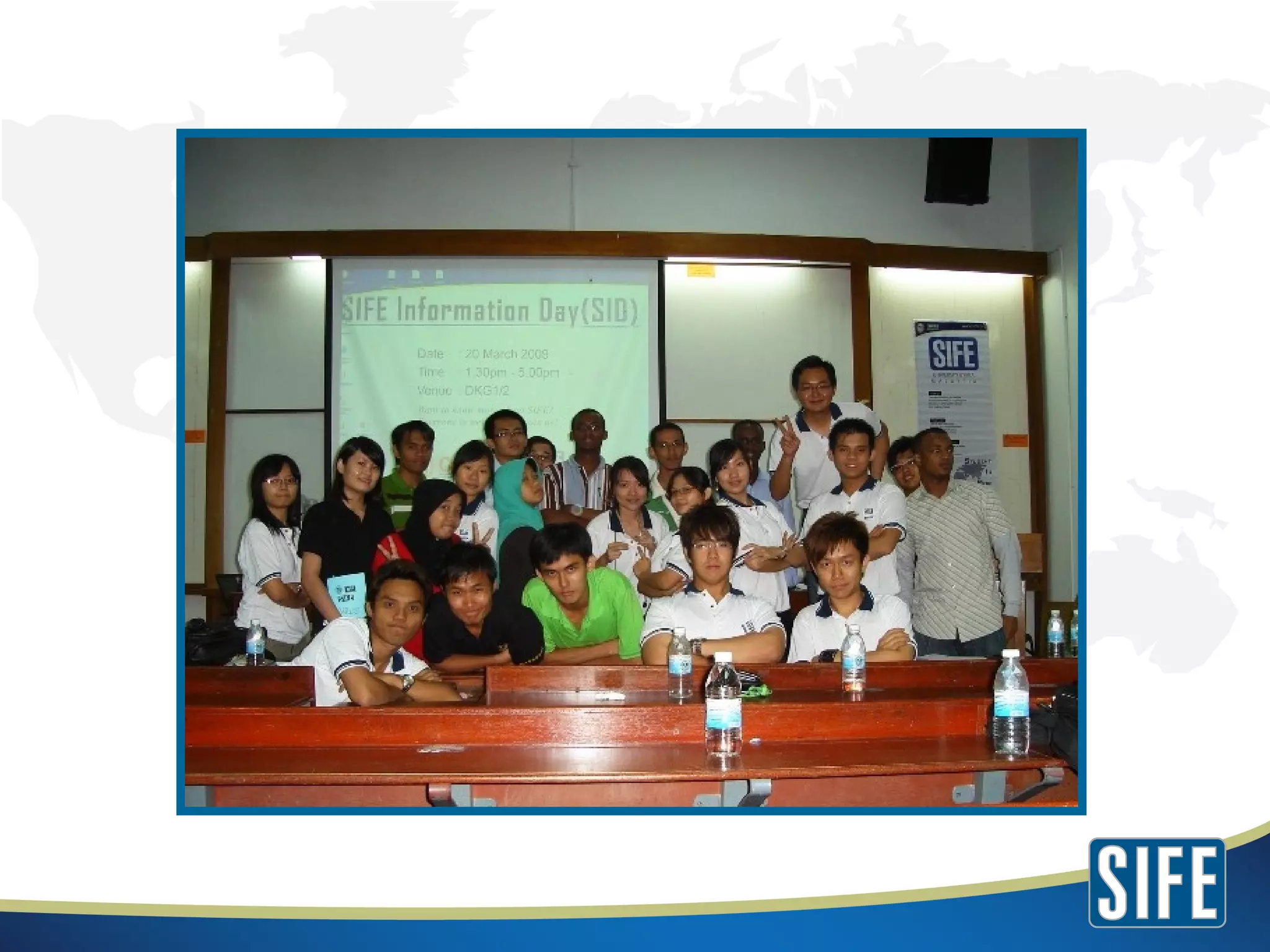
SIFE Information Day (SID) Date : 20th March 2009 Time : 2.00pm Venue : UUM Invited guest : En. Zul Saadon    (Country Director of SIFE Malaysia)
 
 
Coming Projects… Youth Learning Seminar (YLS) Date : 11th April 2009 Venue : Jitra Secondary School
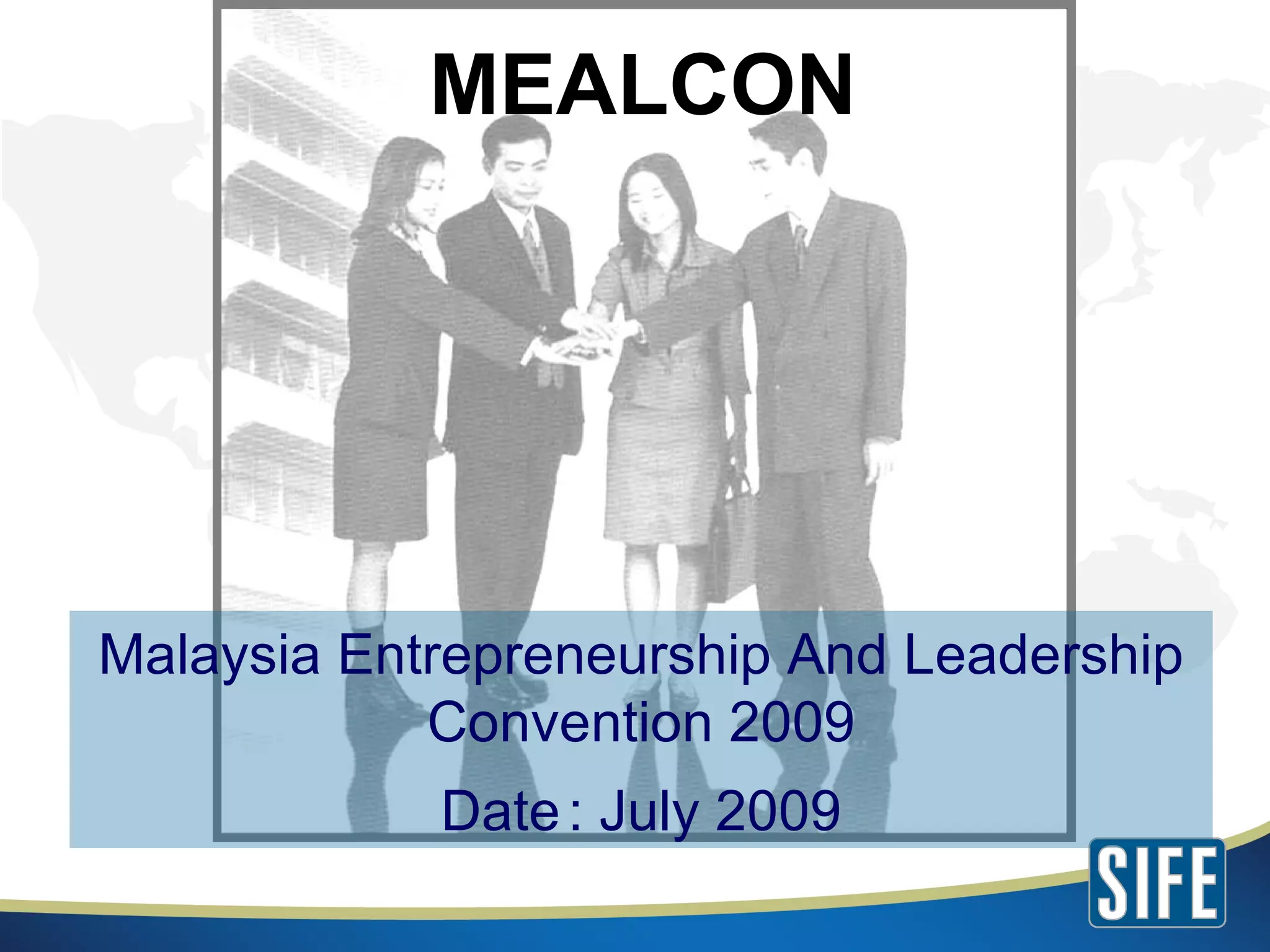
Malaysia Entrepreneurship And Leadership Convention 2009 Date : July 2009 MEALCON
Holiday Community Projects (Date: June) Graphic Design Seminar (GDS) SIFE UUM Annual Grand Dinner (AGD) So You Think You Can Lead! Challenge And many more…..
PASSIONATE - ENERGETIC - CONFIDENT SIFERS OF SIFE UUM are:
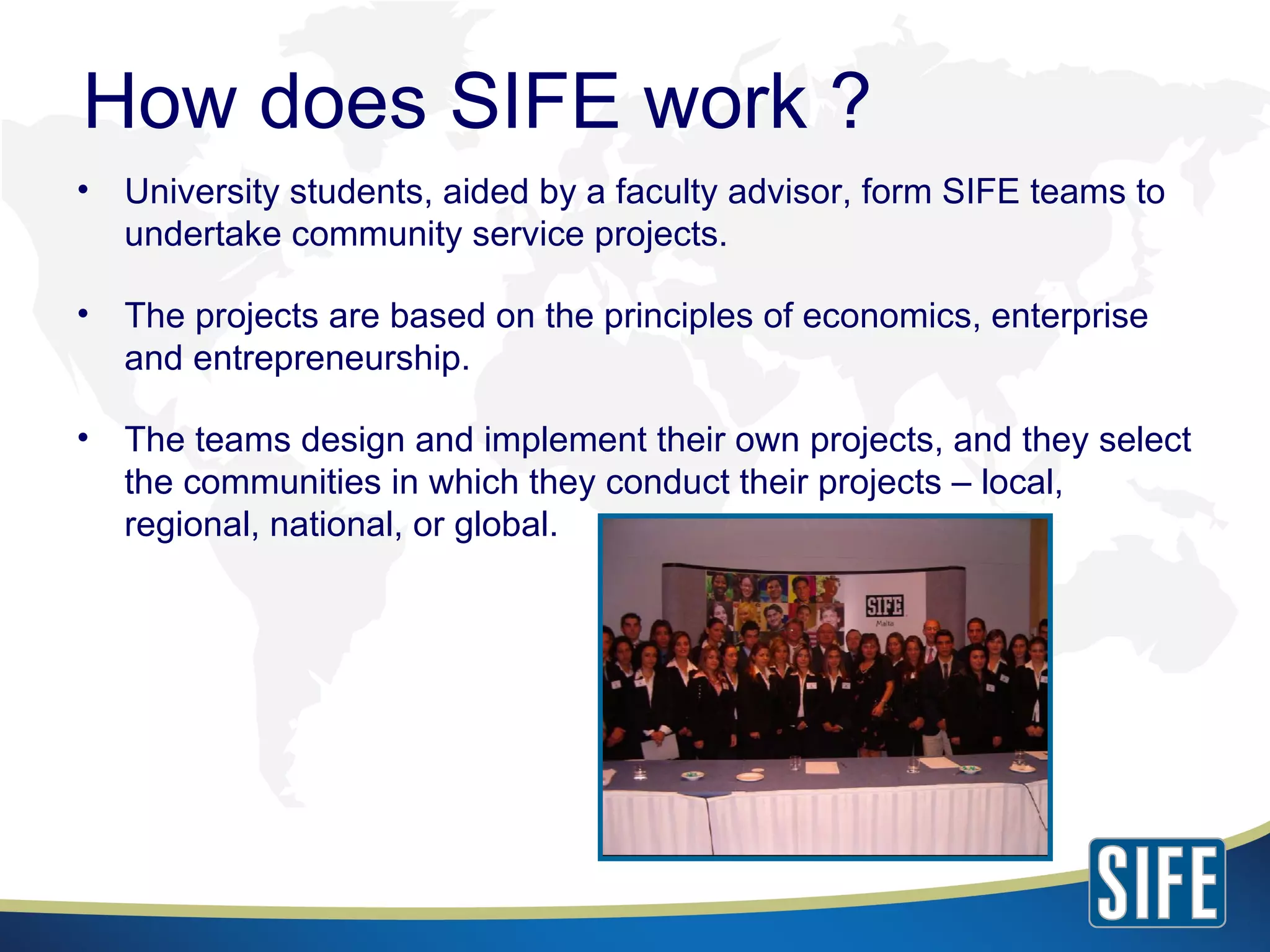
University students, aided by a faculty advisor, form SIFE teams to undertake community service projects. The projects are based on the principles of economics, enterprise and entrepreneurship. The teams design and implement their own projects, and they select the communities in which they conduct their projects – local, regional, national, or global. How does SIFE work ?
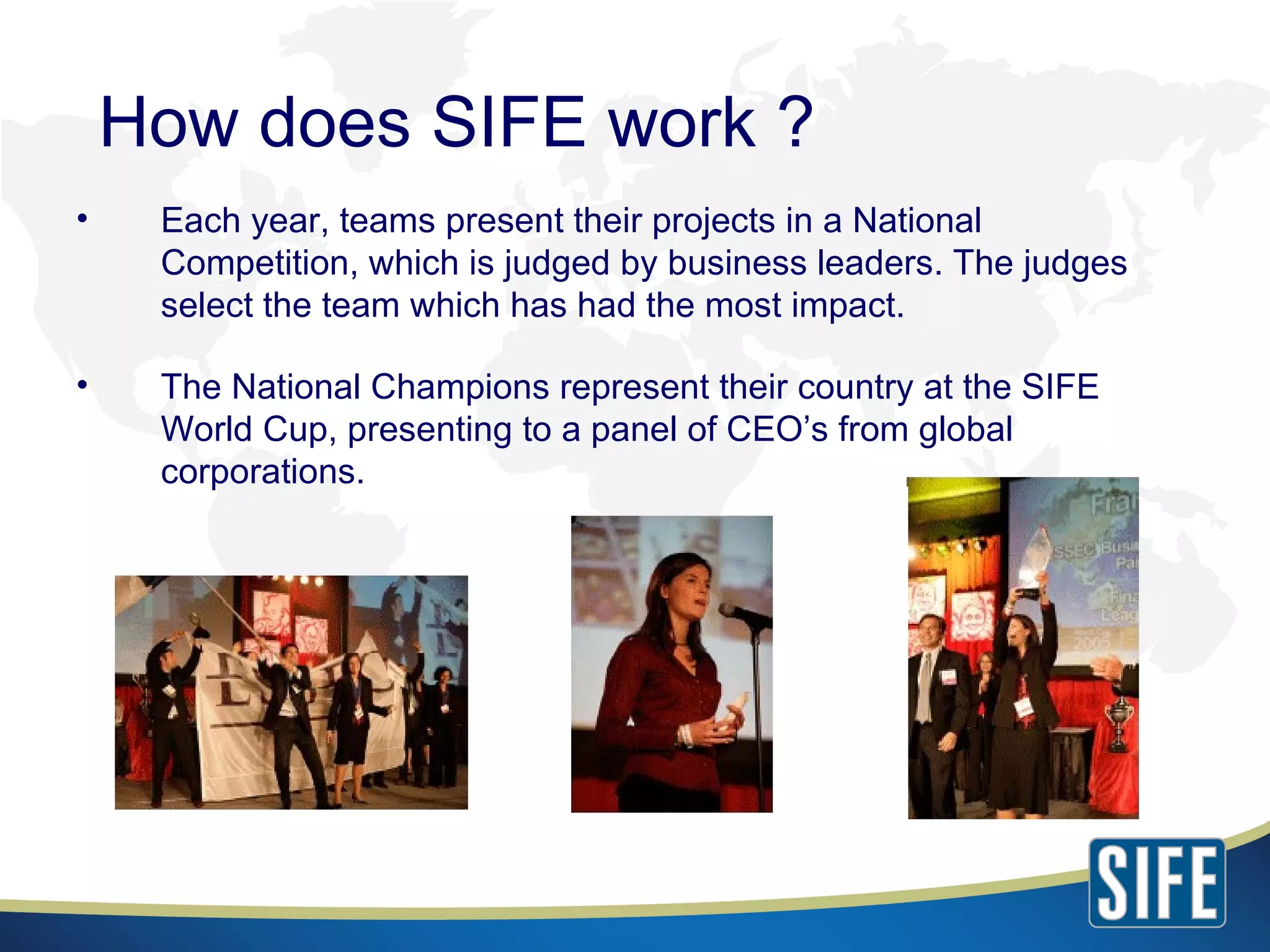
Each year, teams present their projects in a National Competition, which is judged by business leaders. The judges select the team which has had the most impact. The National Champions represent their country at the SIFE World Cup, presenting to a panel of CEO’s from global corporations. How does SIFE work ?
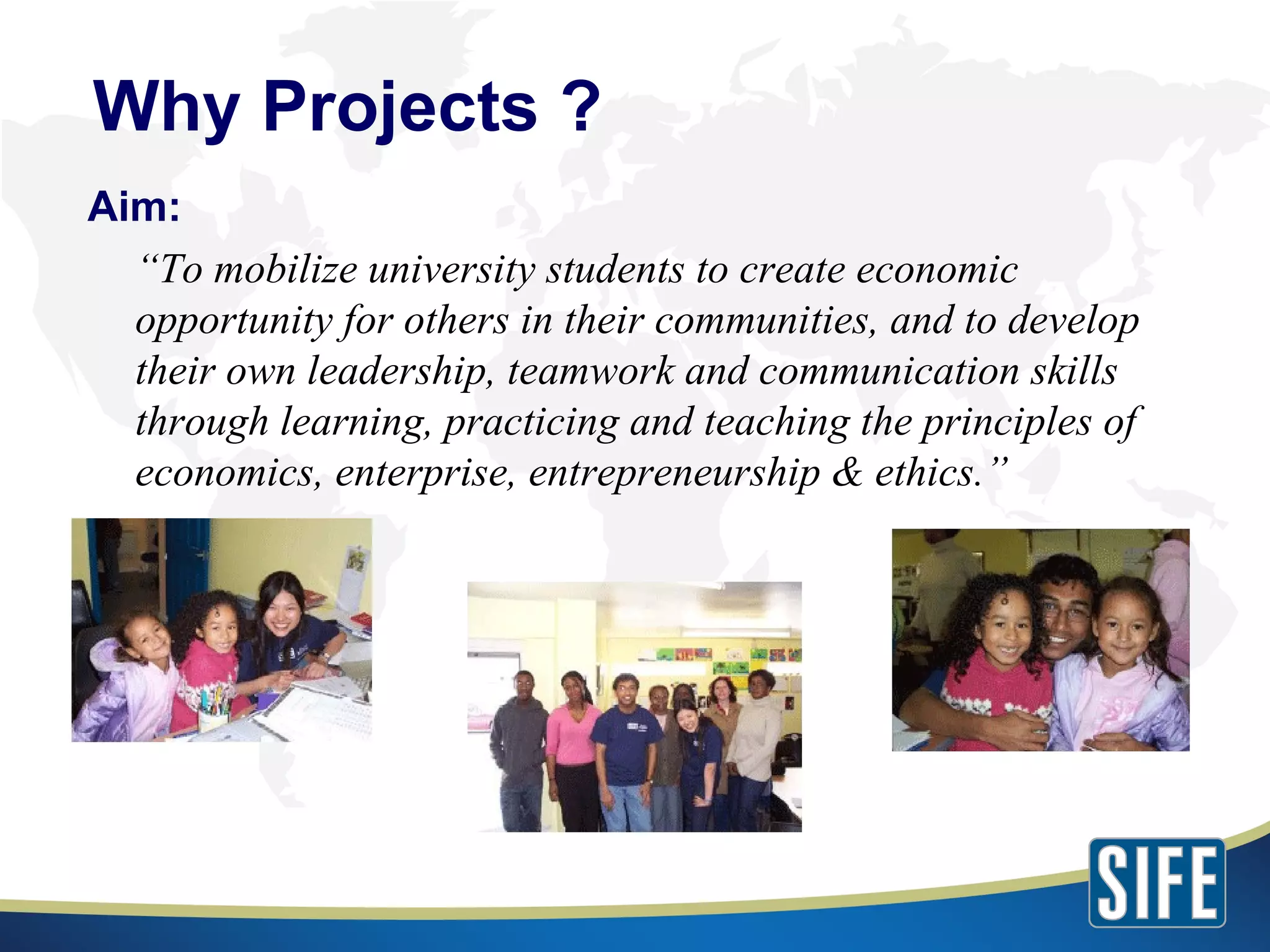
Aim: “ To mobilize university students to create economic opportunity for others in their communities, and to develop their own leadership, teamwork and communication skills through learning, practicing and teaching the principles of economics, enterprise, entrepreneurship & ethics.” Why Projects ?
Philosophies Teaching: “ Tell me and I will forget; show me and I might remember; involve me and I will learn.”  Learning by doing for  students! Community Service: “ Give me a fish and I’ll eat for a day; teach me to fish, and I’ll eat for a lifetime.”  Learning by doing for the  community!
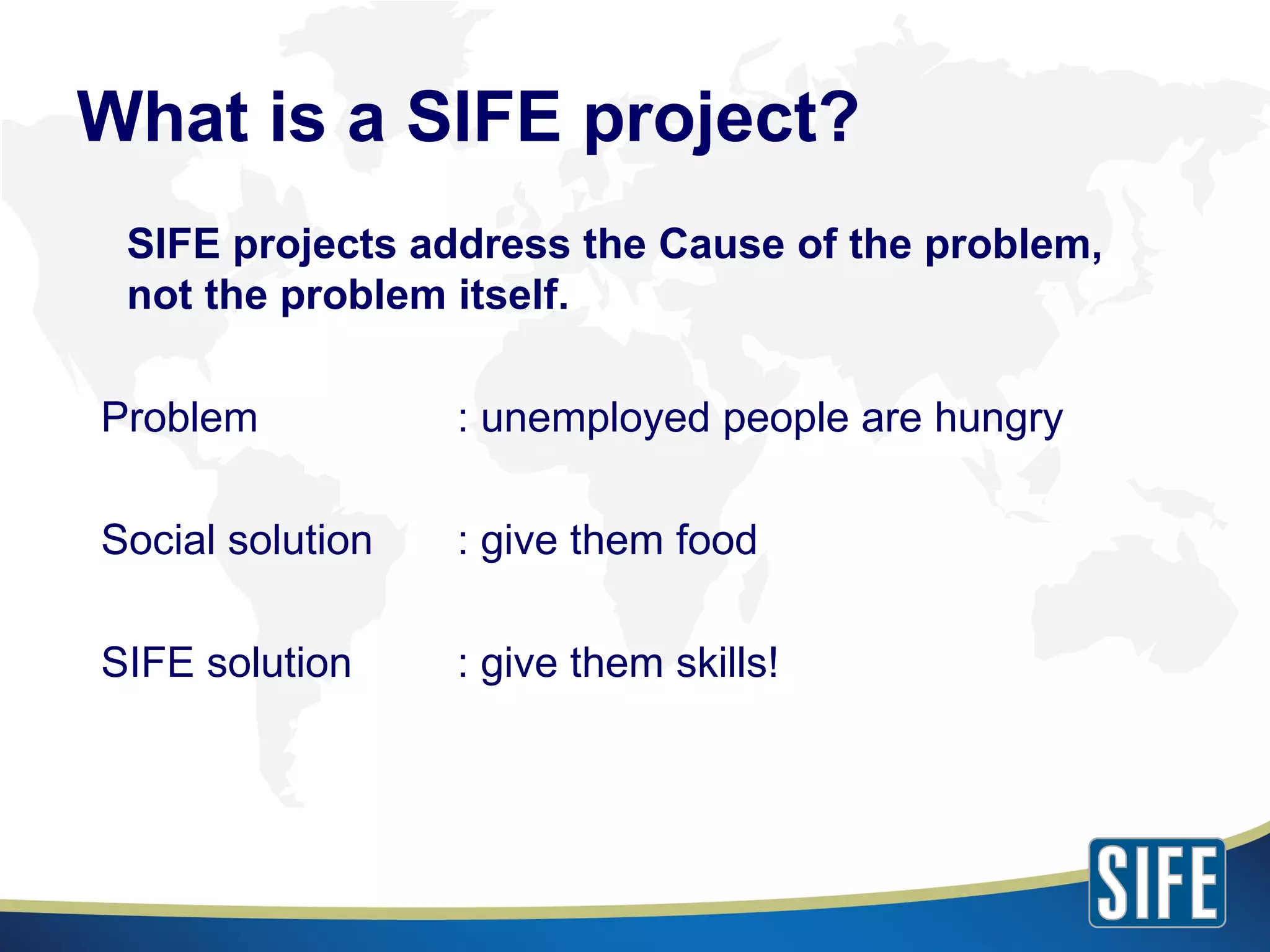
SIFE projects address the Cause of the problem, not the problem itself. Problem  : unemployed people are hungry Social solution : give them food SIFE solution  : give them skills! What is a SIFE project?
To define our program – to create economic opportunity To transfer information, knowledge and skills To shape team projects To encourage team sustainability To allow comparison Why Criteria?
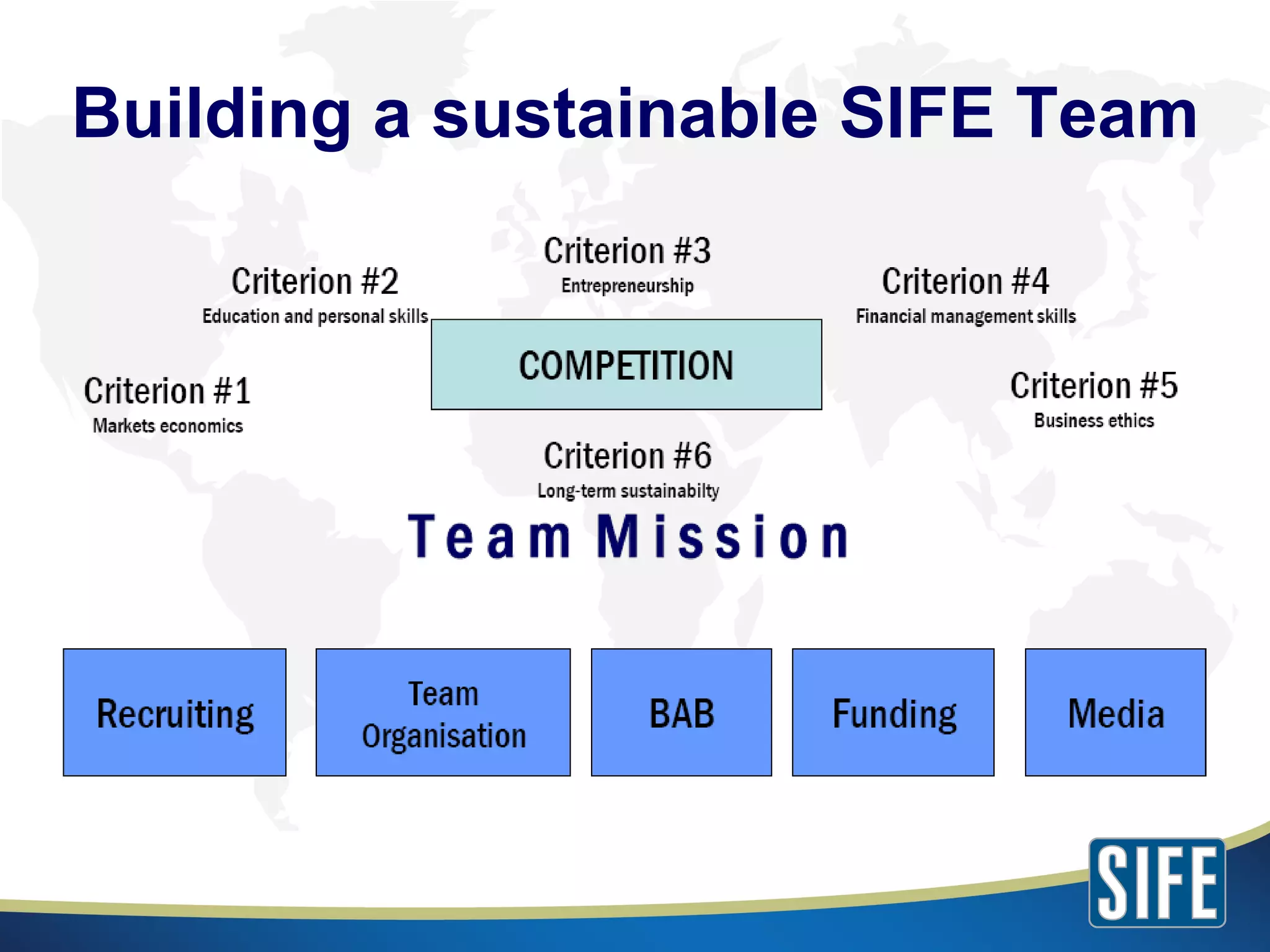
Building a sustainable SIFE Team
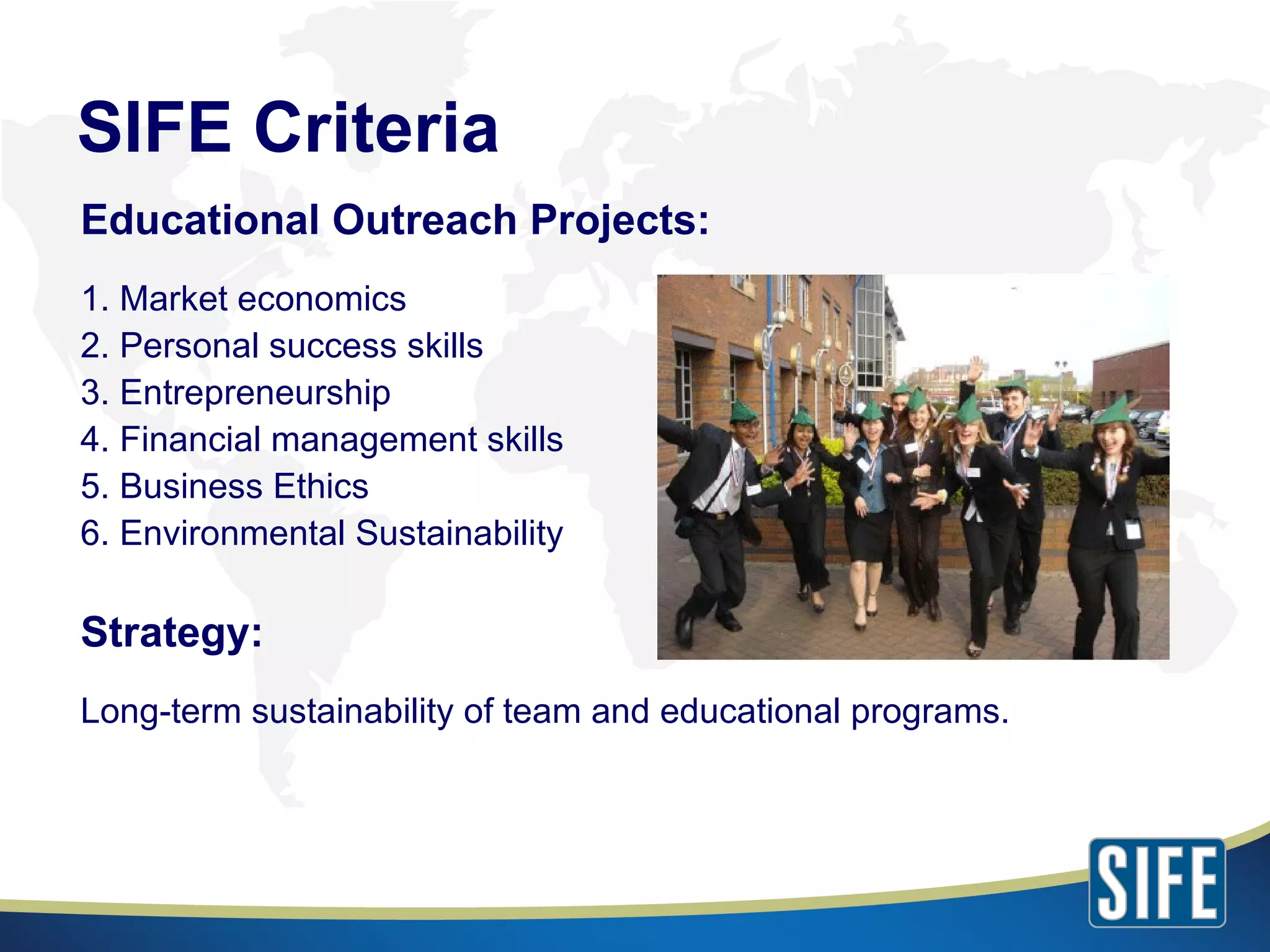
SIFE Criteria Educational Outreach Projects: 1. Market economics 2. Personal success skills 3. Entrepreneurship 4. Financial management skills 5. Business Ethics  6. Environmental Sustainability Strategy: Long-term sustainability of team and educational programs.
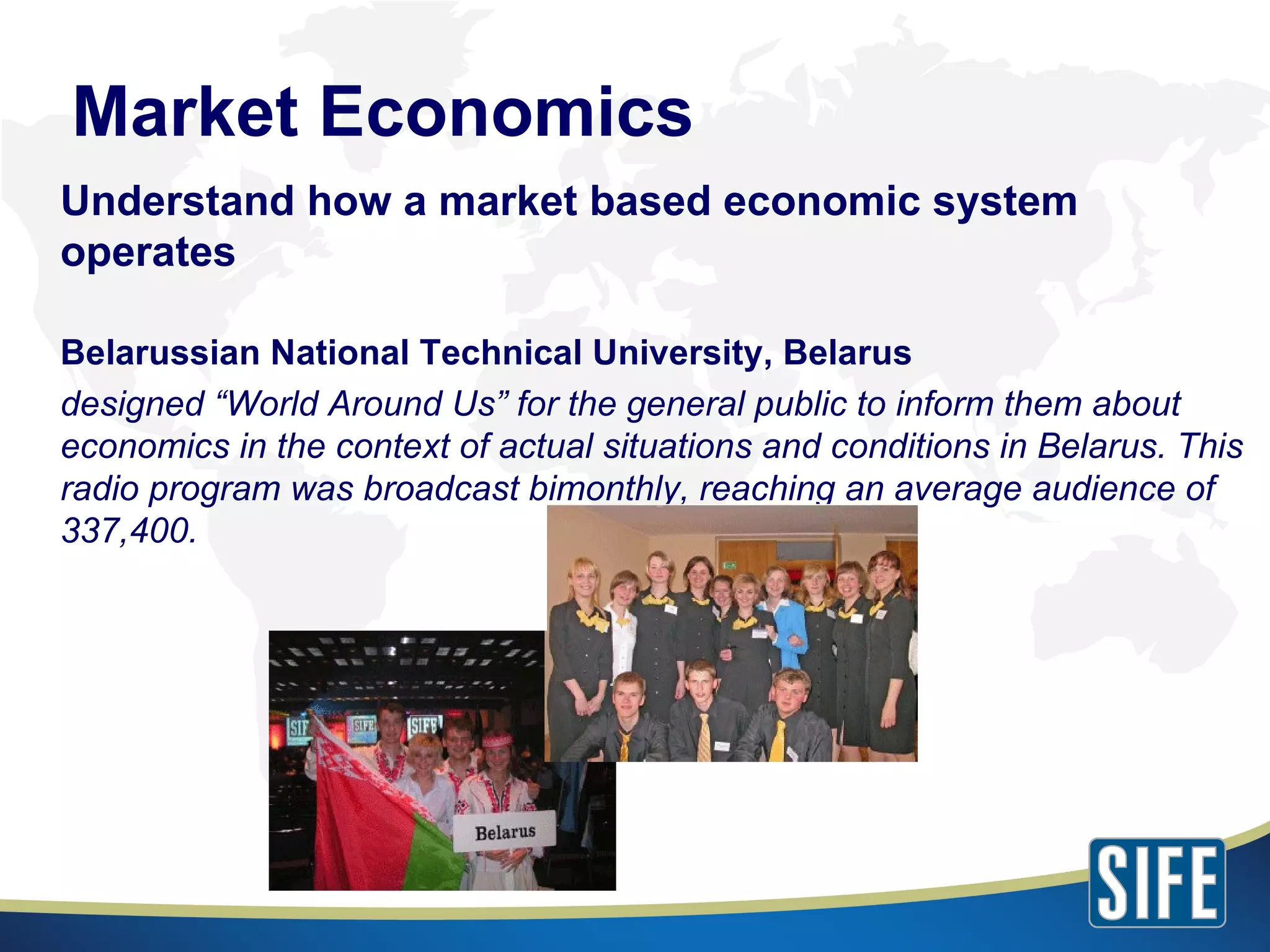
Market Economics Understand how a market based economic system operates Belarussian National Technical University, Belarus designed “World Around Us” for the general public to inform them about economics in the context of actual situations and conditions in Belarus. This radio program was broadcast bimonthly, reaching an average audience of 337,400.
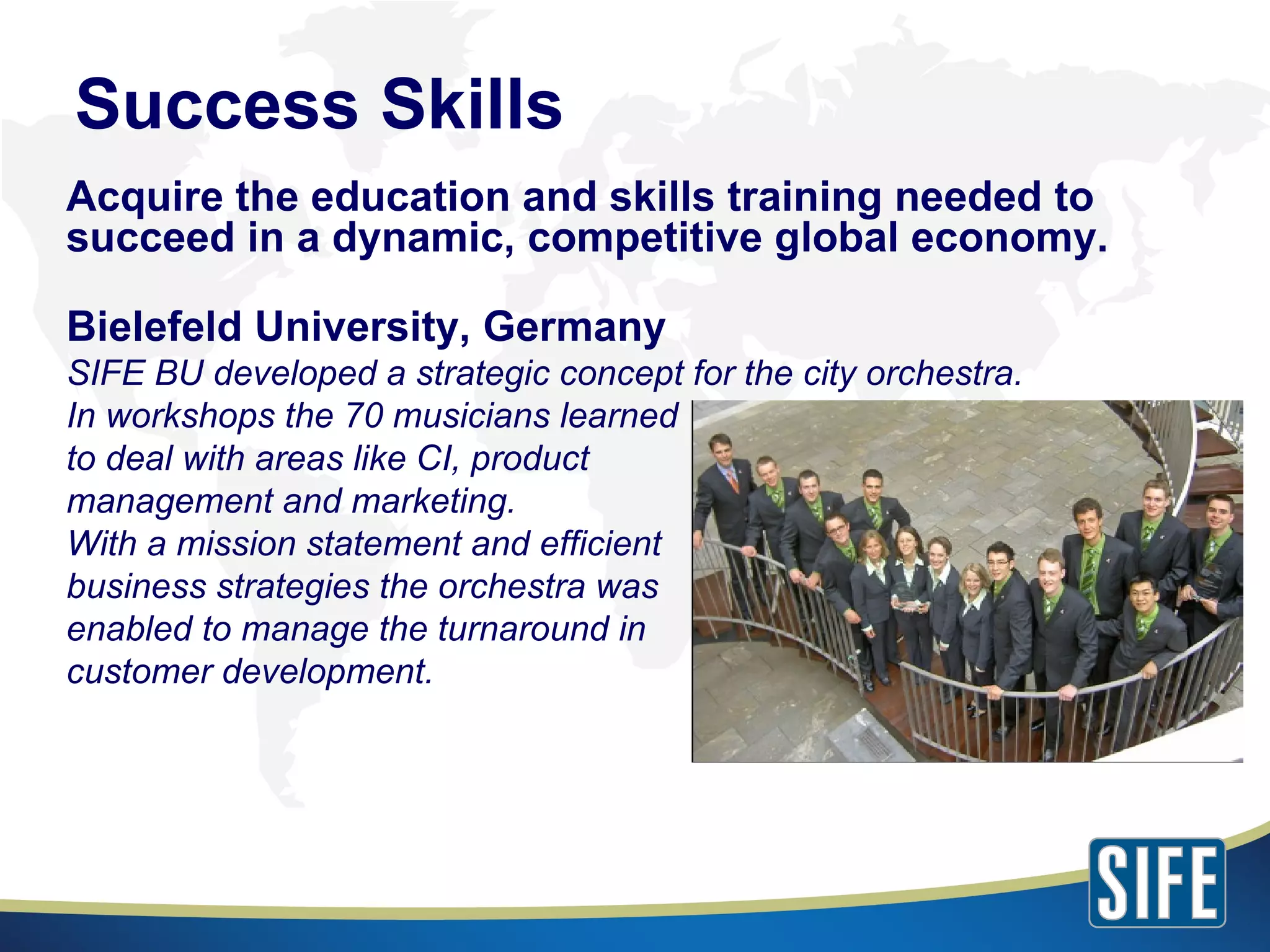
Acquire the education and skills training needed to succeed in a dynamic, competitive global economy. Bielefeld University, Germany SIFE BU developed a strategic concept for the city orchestra. In workshops the 70 musicians learned to deal with areas like CI, product management and marketing. With a mission statement and efficient business strategies the orchestra was enabled to manage the turnaround in customer development. Success Skills
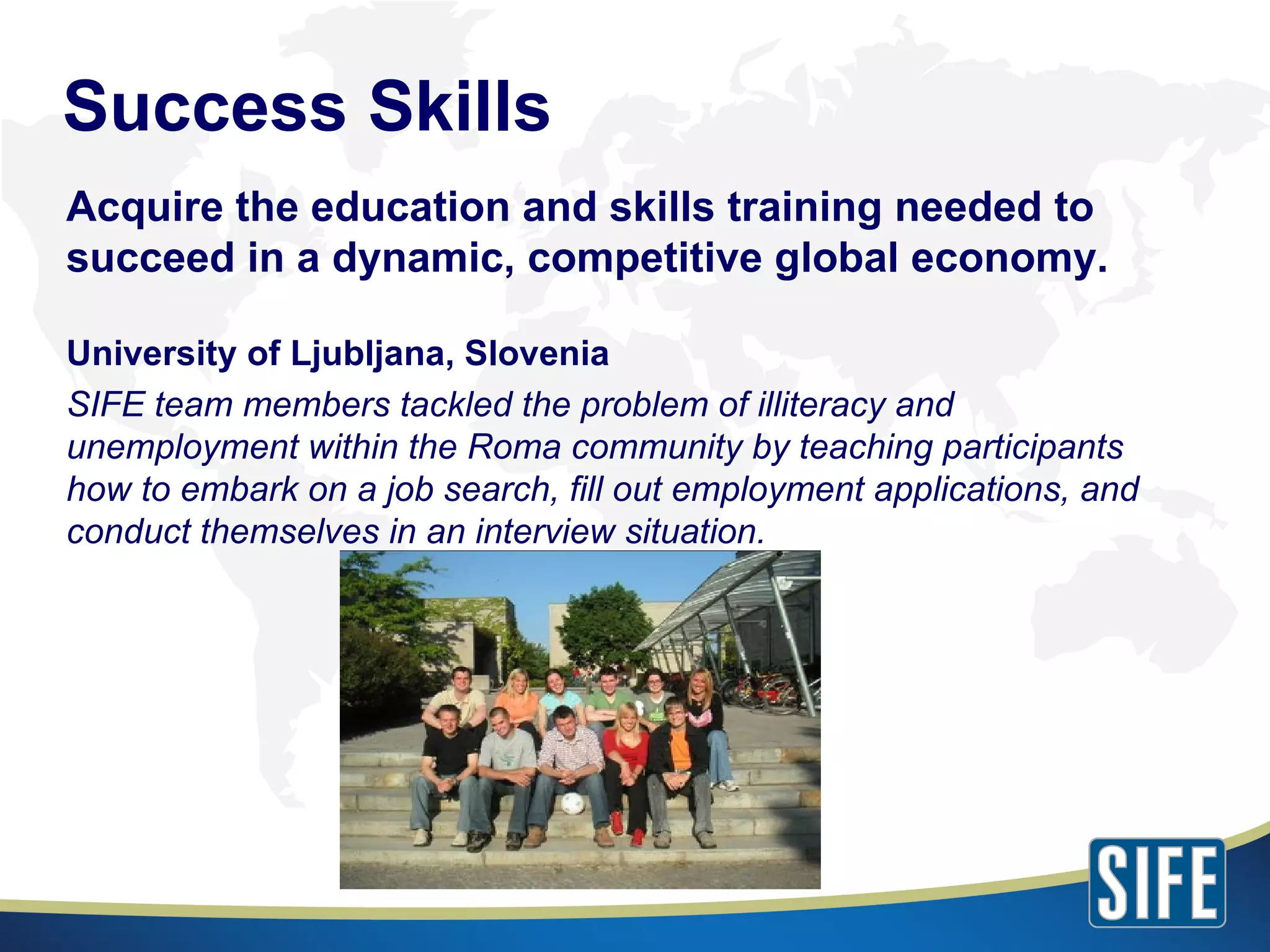
Acquire the education and skills training needed to succeed in a dynamic, competitive global economy. University of Ljubljana, Slovenia SIFE team members tackled the problem of illiteracy and unemployment within the Roma community by teaching participants how to embark on a job search, fill out employment applications, and conduct themselves in an interview situation. Success Skills
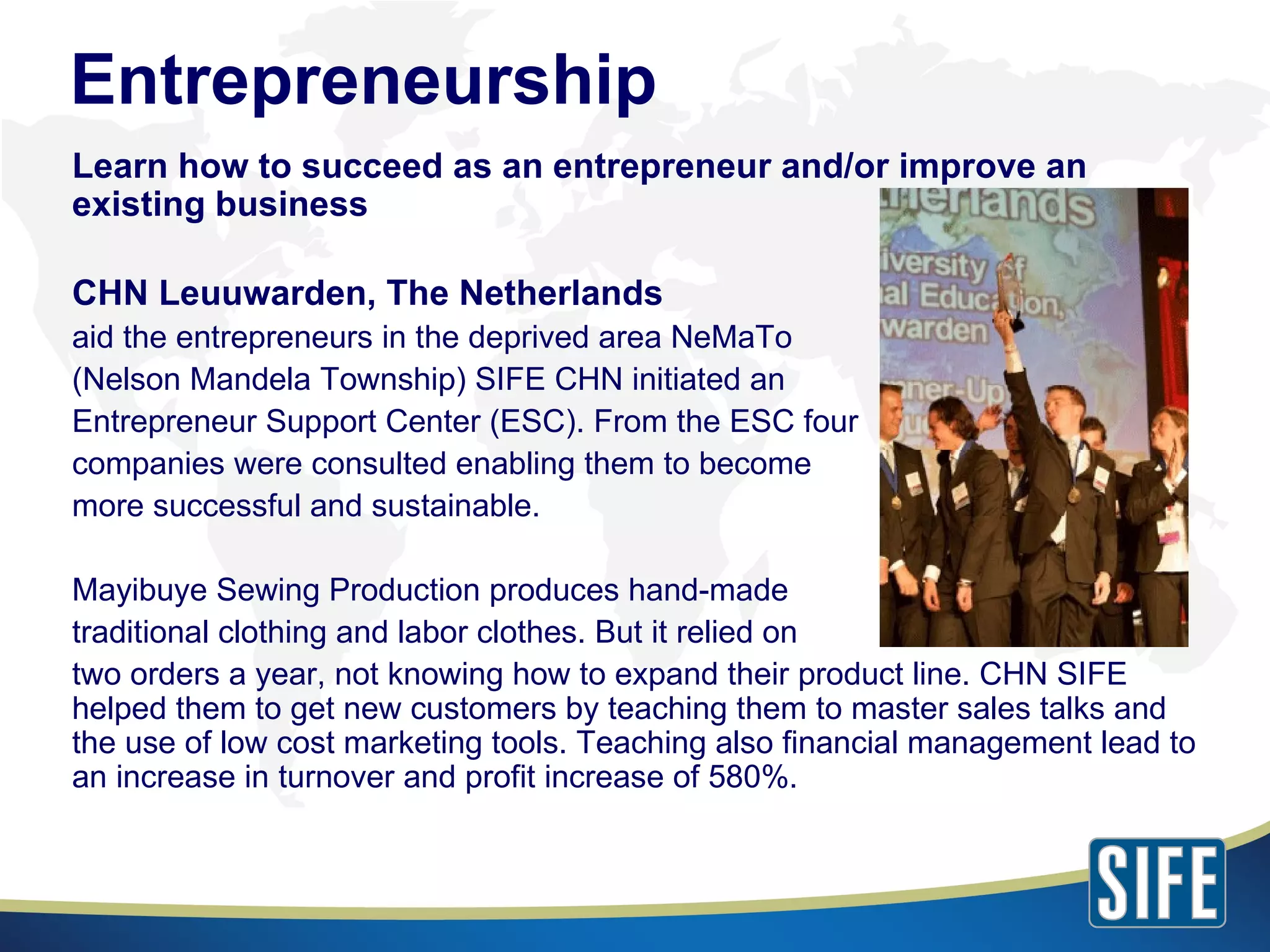
Learn how to succeed as an entrepreneur and/or improve an existing business CHN Leuuwarden, The Netherlands aid the entrepreneurs in the deprived area NeMaTo (Nelson Mandela Township) SIFE CHN initiated an Entrepreneur Support Center (ESC). From the ESC four companies were consulted enabling them to become more successful and sustainable. Mayibuye Sewing Production produces hand-made traditional clothing and labor clothes. But it relied on two orders a year, not knowing how to expand their product line. CHN SIFE helped them to get new customers by teaching them to master sales talks and the use of low cost marketing tools. Teaching also financial management lead to an increase in turnover and profit increase of 580%. Entrepreneurship
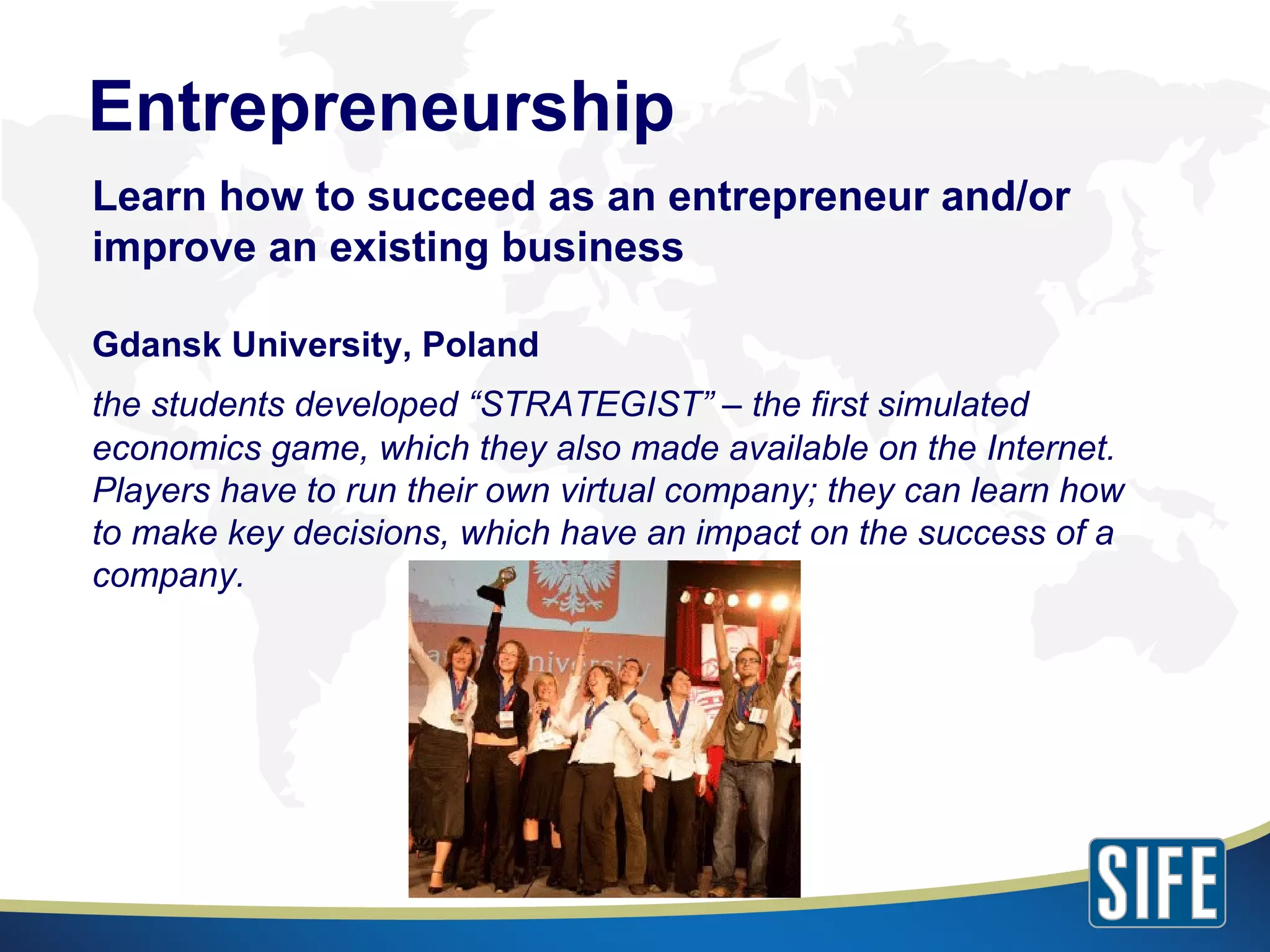
Entrepreneurship Learn how to succeed as an entrepreneur and/or improve an existing business Gdansk University, Poland the students developed “STRATEGIST” – the first simulated economics game, which they also made available on the Internet. Players have to run their own virtual company; they can learn how to make key decisions, which have an impact on the success of a company.
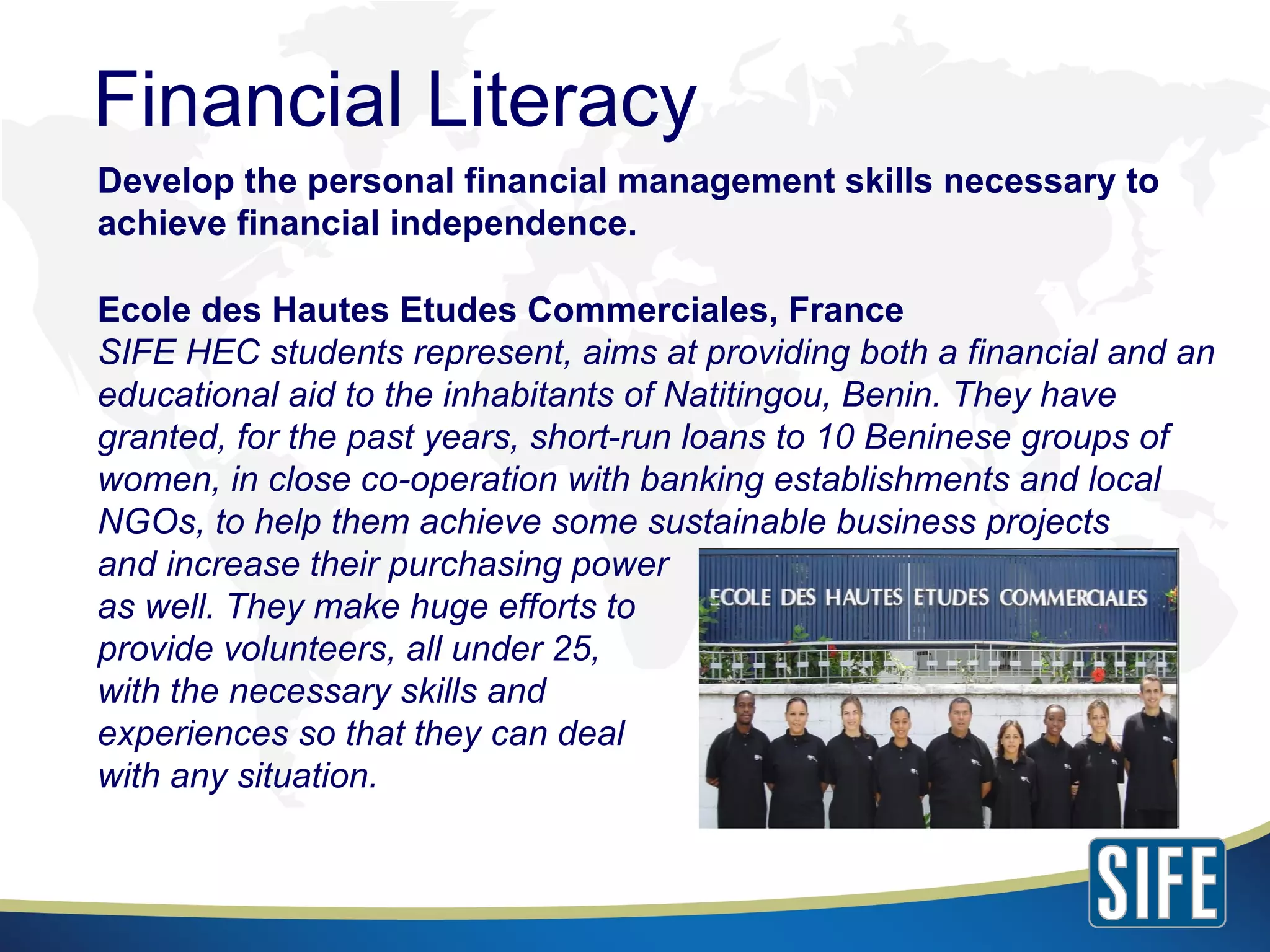
Develop the personal financial management skills necessary to achieve financial independence. Ecole des Hautes Etudes Commerciales, France SIFE HEC students represent, aims at providing both a financial and an educational aid to the inhabitants of Natitingou, Benin. They have granted, for the past years, short-run loans to 10 Beninese groups of women, in close co-operation with banking establishments and local NGOs, to help them achieve some sustainable business projects  and increase their purchasing power  as well. They make huge efforts to  provide volunteers, all under 25,  with the necessary skills and  experiences so that they can deal  with any situation. Financial Literacy
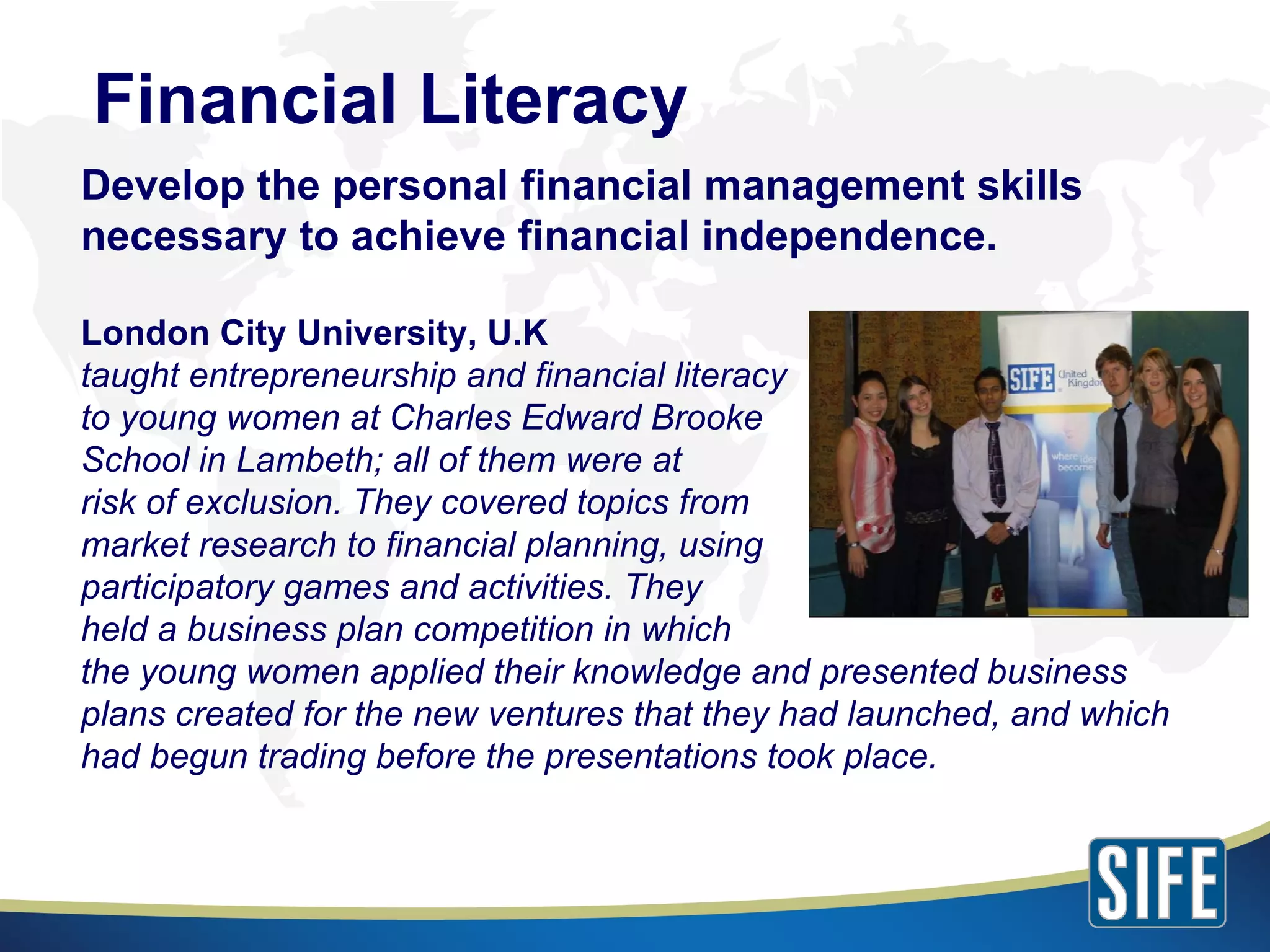
Develop the personal financial management skills necessary to achieve financial independence. London City University, U.K taught entrepreneurship and financial literacy  to young women at Charles Edward Brooke  School in Lambeth; all of them were at  risk of exclusion. They covered topics from  market research to financial planning, using  participatory games and activities. They  held a business plan competition in which  the young women applied their knowledge and presented business plans created for the new ventures that they had launched, and which had begun trading before the presentations took place. Financial Literacy
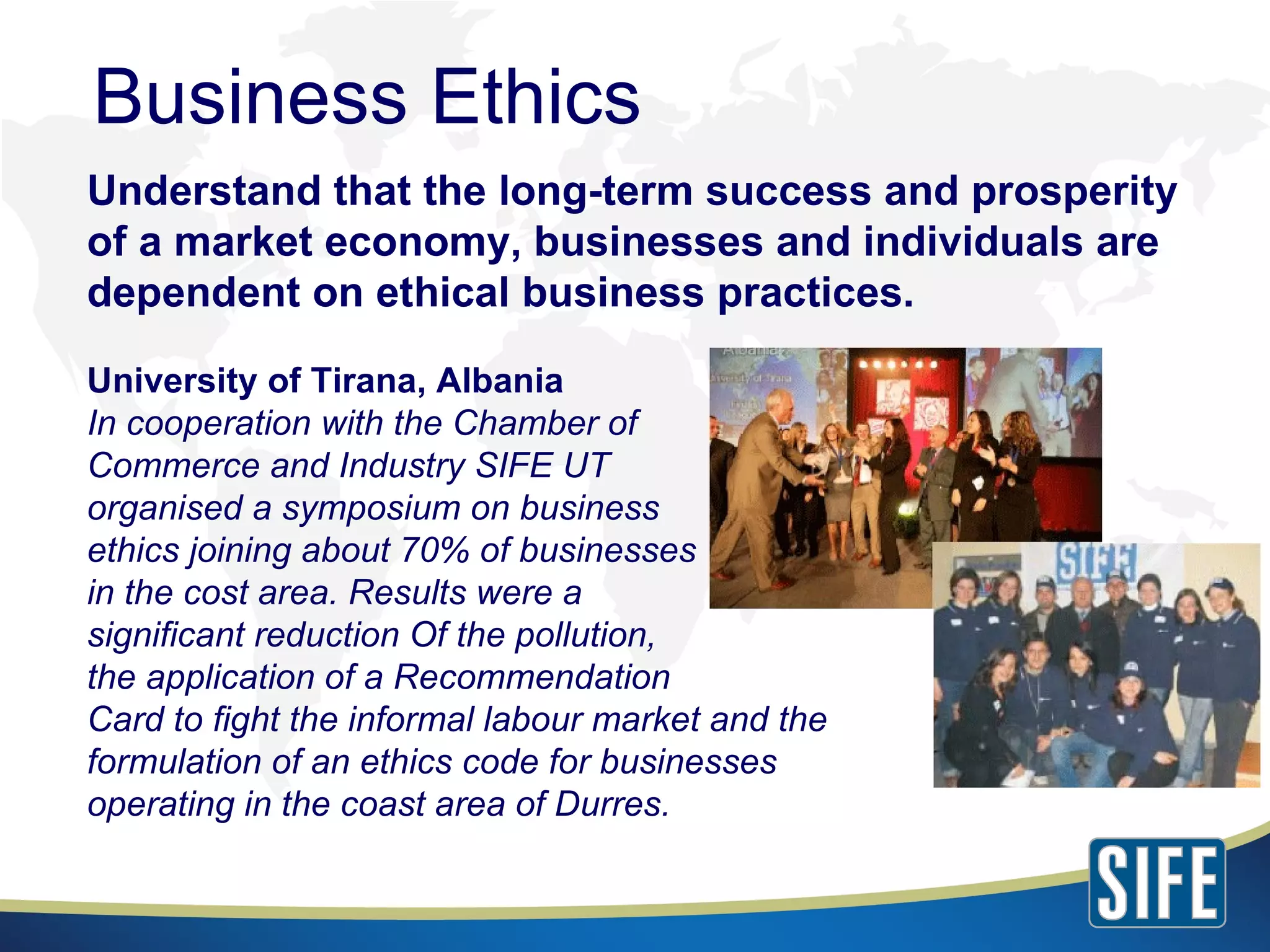
Understand that the long-term success and prosperity of a market economy, businesses and individuals are dependent on ethical business practices. University of Tirana, Albania In cooperation with the Chamber of  Commerce and Industry SIFE UT  organised a symposium on business  ethics joining about 70% of businesses  in the cost area. Results were a  significant reduction Of the pollution,  the application of a Recommendation  Card to fight the informal labour market and the  formulation of an ethics code for businesses  operating in the coast area of Durres. Business Ethics
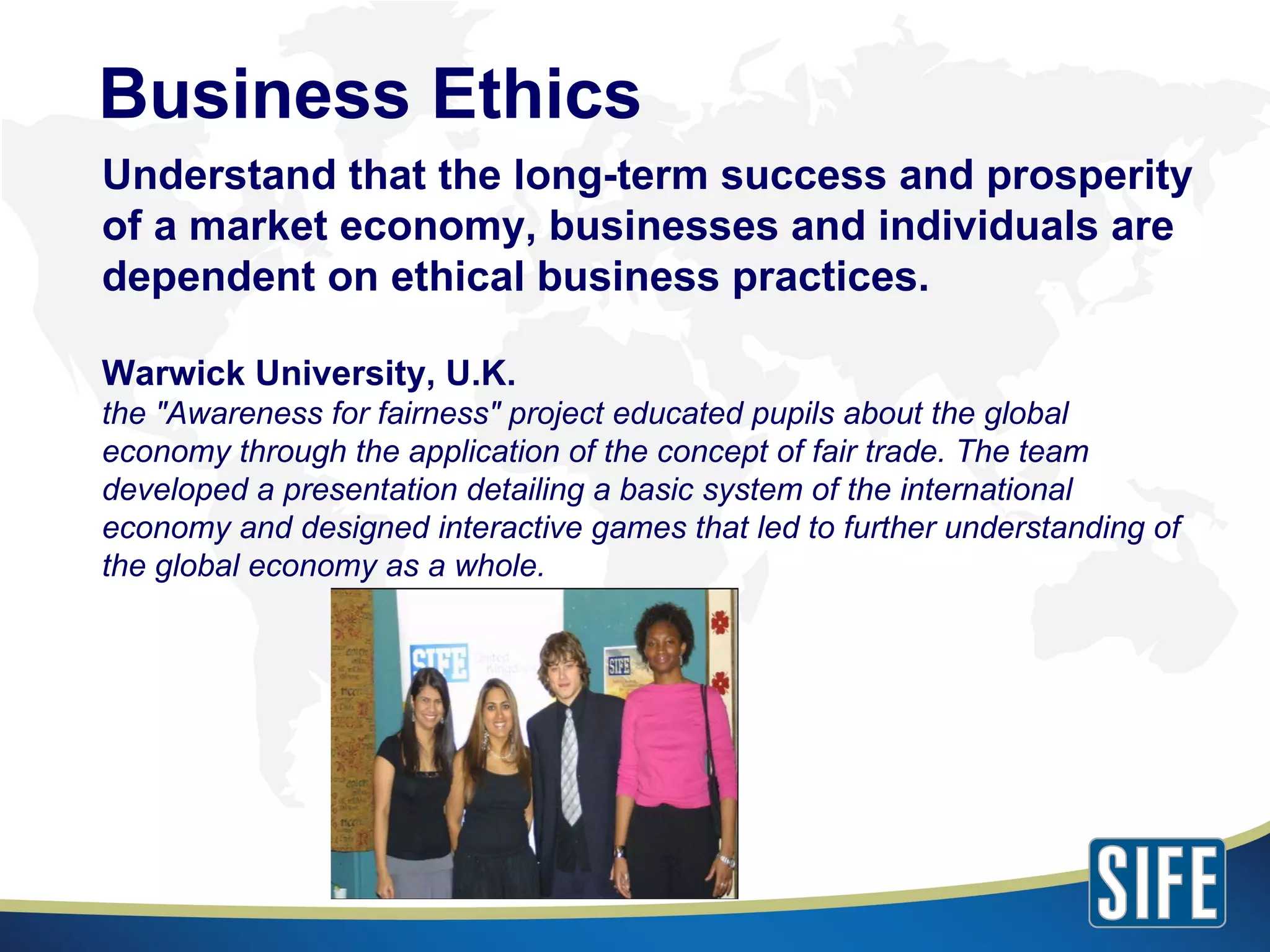
Understand that the long-term success and prosperity of a market economy, businesses and individuals are dependent on ethical business practices. Warwick University, U.K. the "Awareness for fairness" project educated pupils about the global economy through the application of the concept of fair trade. The team developed a presentation detailing a basic system of the international economy and designed interactive games that led to further understanding of the global economy as a whole. Business Ethics
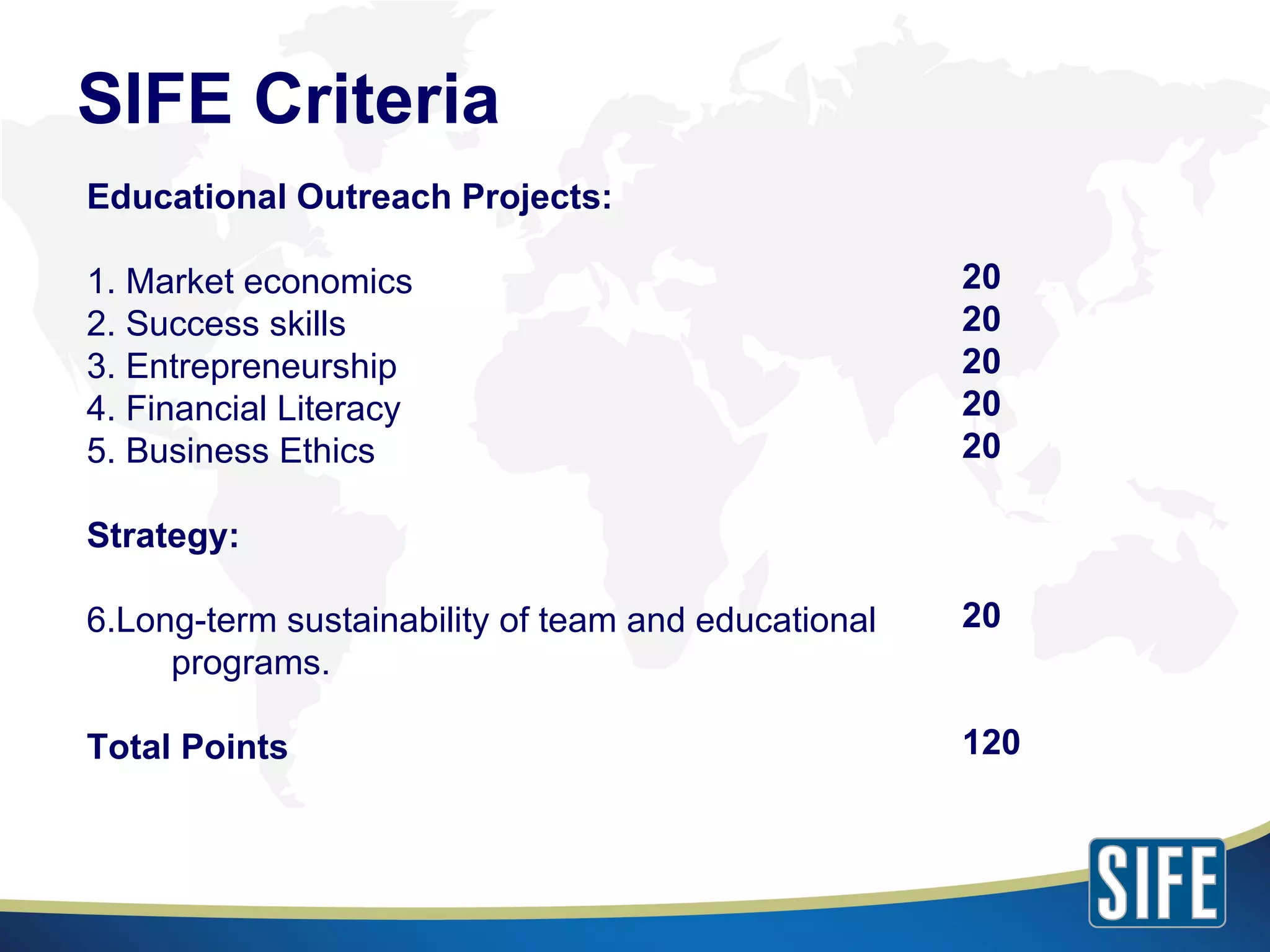
Educational Outreach Projects: 1. Market economics 2. Success skills 3. Entrepreneurship 4. Financial Literacy 5. Business Ethics Strategy: 6.Long-term sustainability of team and educational programs. Total Points SIFE Criteria 20 20 20 20 20 20 120
What Should you Measure? Outputs Outcomes Measuring Your SIFE Educational Projects
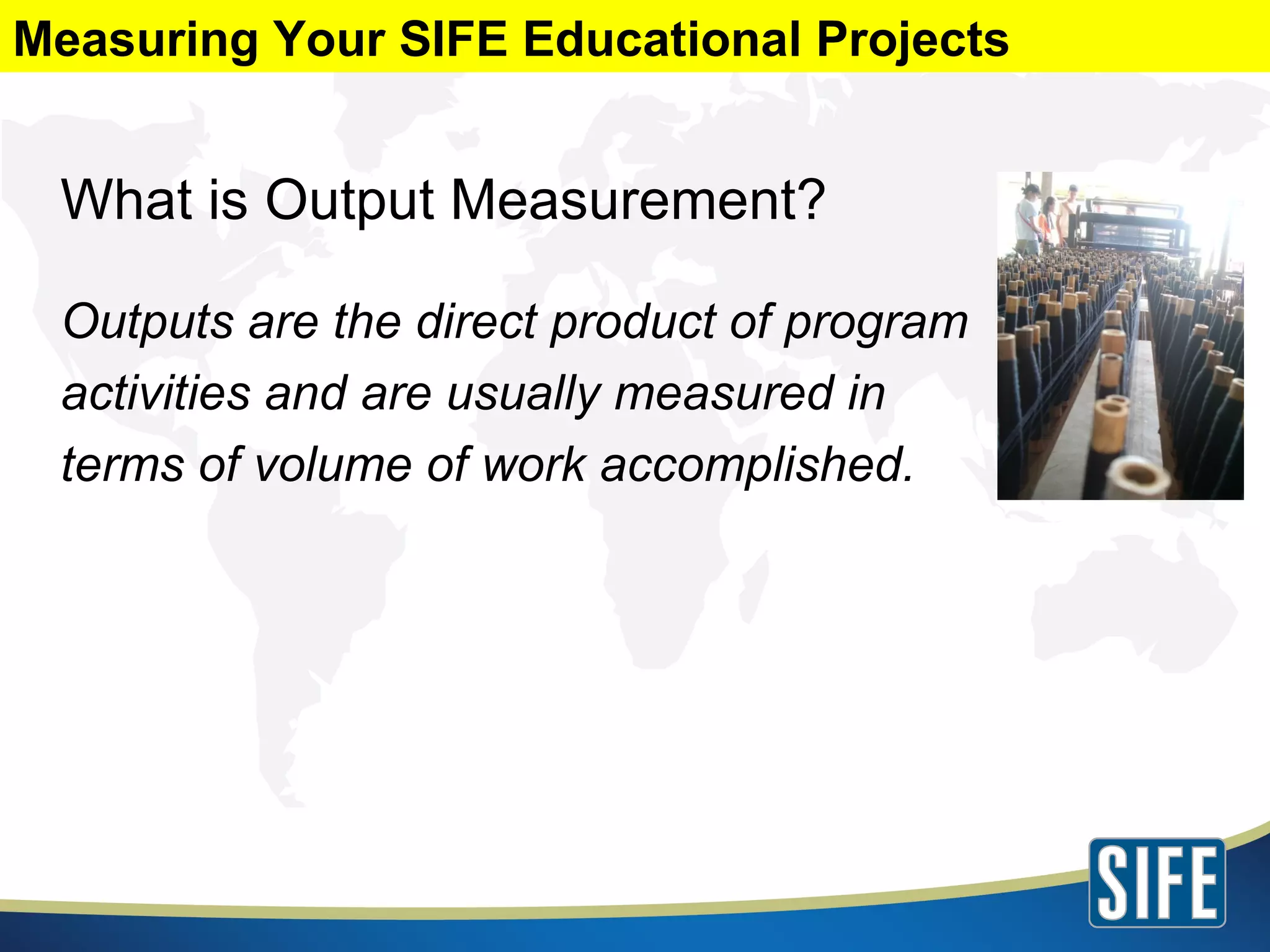
What is Output Measurement? Outputs are the direct product of program activities and are usually measured in  terms of volume of work accomplished. Measuring Your SIFE Educational Projects
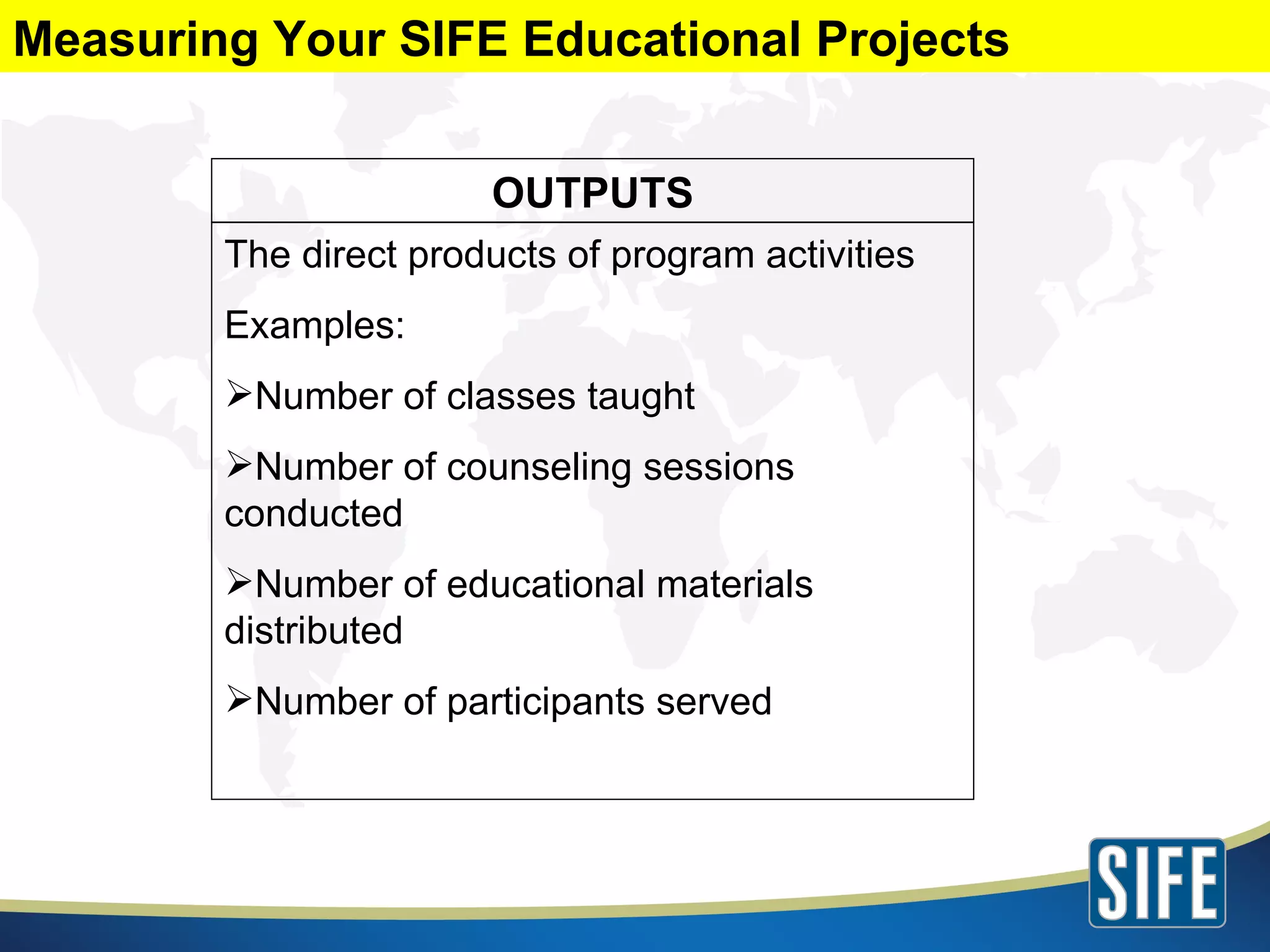
OUTPUTS The direct products of program activities Examples: Number of classes taught Number of counseling sessions conducted Number of educational materials distributed Number of participants served Measuring Your SIFE Educational Projects
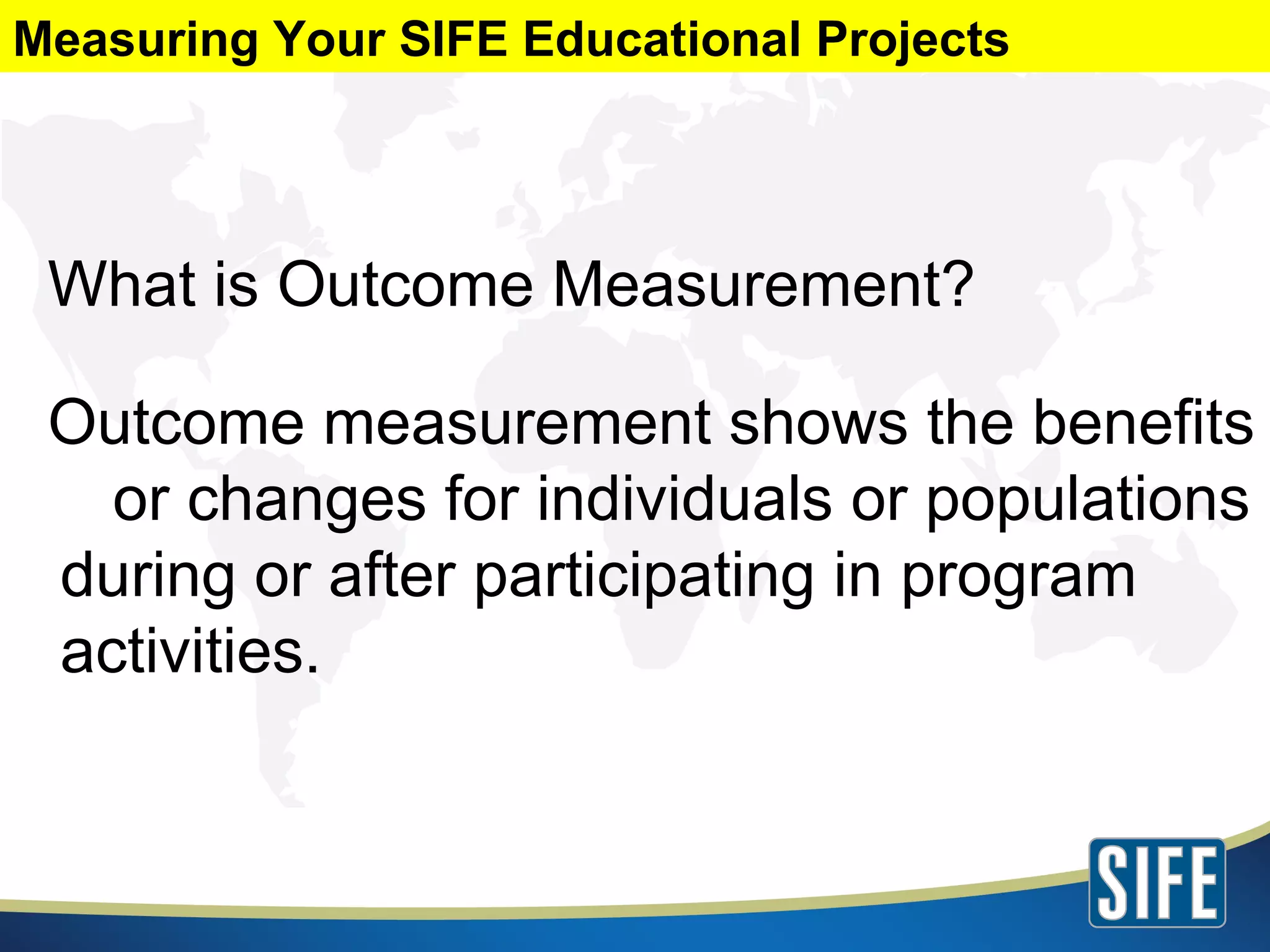
What is Outcome Measurement? Outcome measurement shows the benefits  or changes for individuals or populations during or after participating in program activities. Measuring Your SIFE Educational Projects
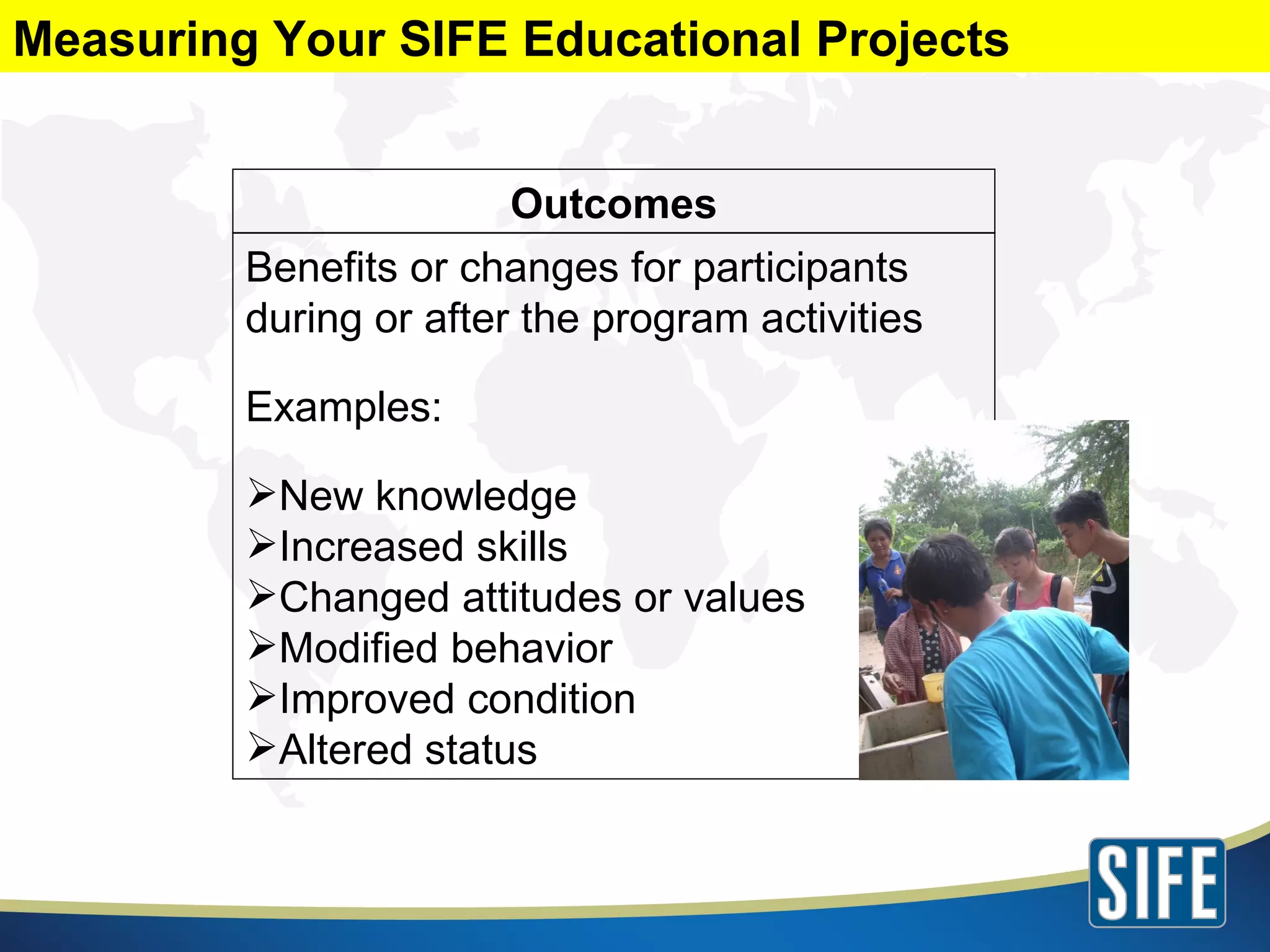
Benefits or changes for participants during or after the program activities Examples: New knowledge Increased skills Changed attitudes or values Modified behavior Improved condition Altered status Outcomes Measuring Your SIFE Educational Projects
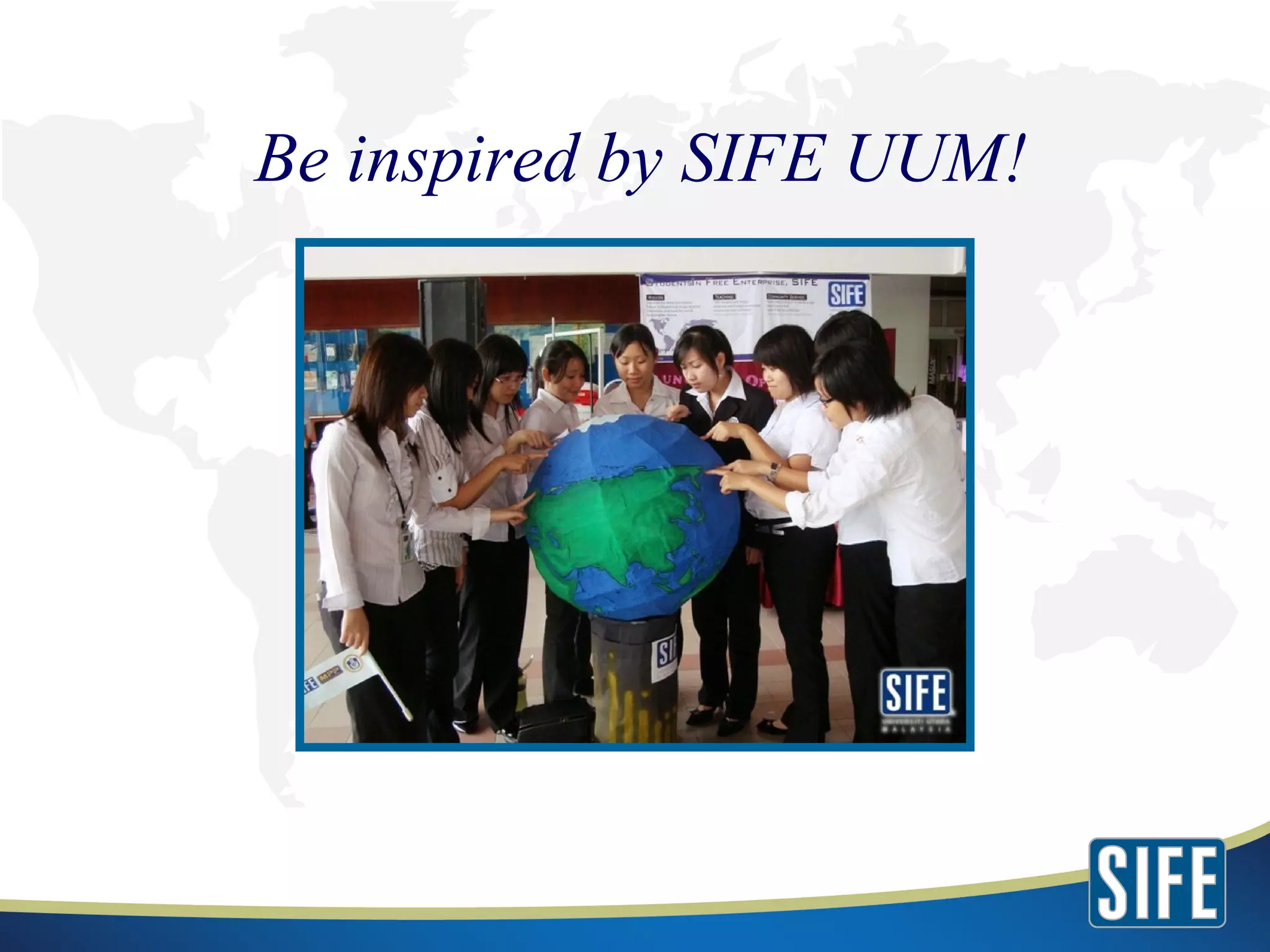
Be inspired by SIFE UUM!
A HEAD FOR BUSINESS, A HEART FOR THE WORLD
Thank you!

Introduction Of Sife Uum

  • 1.
    Students In FreeEnterprise Universiti Utara Malaysia
  • 2.
    SIFE UUM LaunchingCeremony Date : 4th March 2009 Time : 2.00pm Venue : Universiti Utara Malaysia
  • 3.
  • 4.
  • 5.
  • 6.
  • 7.
  • 8.
    Our Mission… Discover,Develop and Inspire future entrepreneurs to go beyond limitations and lead the world to a brighter future .
  • 9.
  • 10.
    To build astrong and sustainable SIFE team in UUM To boost the economy in Kubang Pasu To empower the youths of today for the challenge of tomorrow
  • 11.
  • 12.
  • 13.
    Projects done… SIFEUUM Launching Ceremony Date : 4th March 2009
  • 14.
    SIFE Information Day(SID) Date : 20th March 2009 Time : 2.00pm Venue : UUM Invited guest : En. Zul Saadon (Country Director of SIFE Malaysia)
  • 15.
  • 16.
  • 17.
    Coming Projects… YouthLearning Seminar (YLS) Date : 11th April 2009 Venue : Jitra Secondary School
  • 18.
    Malaysia Entrepreneurship AndLeadership Convention 2009 Date : July 2009 MEALCON
  • 19.
    Holiday Community Projects(Date: June) Graphic Design Seminar (GDS) SIFE UUM Annual Grand Dinner (AGD) So You Think You Can Lead! Challenge And many more…..
  • 20.
    PASSIONATE - ENERGETIC- CONFIDENT SIFERS OF SIFE UUM are:
  • 21.
    University students, aidedby a faculty advisor, form SIFE teams to undertake community service projects. The projects are based on the principles of economics, enterprise and entrepreneurship. The teams design and implement their own projects, and they select the communities in which they conduct their projects – local, regional, national, or global. How does SIFE work ?
  • 22.
    Each year, teamspresent their projects in a National Competition, which is judged by business leaders. The judges select the team which has had the most impact. The National Champions represent their country at the SIFE World Cup, presenting to a panel of CEO’s from global corporations. How does SIFE work ?
  • 23.
    Aim: “ Tomobilize university students to create economic opportunity for others in their communities, and to develop their own leadership, teamwork and communication skills through learning, practicing and teaching the principles of economics, enterprise, entrepreneurship & ethics.” Why Projects ?
  • 24.
    Philosophies Teaching: “Tell me and I will forget; show me and I might remember; involve me and I will learn.” Learning by doing for students! Community Service: “ Give me a fish and I’ll eat for a day; teach me to fish, and I’ll eat for a lifetime.” Learning by doing for the community!
  • 25.
    SIFE projects addressthe Cause of the problem, not the problem itself. Problem : unemployed people are hungry Social solution : give them food SIFE solution : give them skills! What is a SIFE project?
  • 26.
    To define ourprogram – to create economic opportunity To transfer information, knowledge and skills To shape team projects To encourage team sustainability To allow comparison Why Criteria?
  • 27.
  • 28.
    SIFE Criteria EducationalOutreach Projects: 1. Market economics 2. Personal success skills 3. Entrepreneurship 4. Financial management skills 5. Business Ethics 6. Environmental Sustainability Strategy: Long-term sustainability of team and educational programs.
  • 29.
    Market Economics Understandhow a market based economic system operates Belarussian National Technical University, Belarus designed “World Around Us” for the general public to inform them about economics in the context of actual situations and conditions in Belarus. This radio program was broadcast bimonthly, reaching an average audience of 337,400.
  • 30.
    Acquire the educationand skills training needed to succeed in a dynamic, competitive global economy. Bielefeld University, Germany SIFE BU developed a strategic concept for the city orchestra. In workshops the 70 musicians learned to deal with areas like CI, product management and marketing. With a mission statement and efficient business strategies the orchestra was enabled to manage the turnaround in customer development. Success Skills
  • 31.
    Acquire the educationand skills training needed to succeed in a dynamic, competitive global economy. University of Ljubljana, Slovenia SIFE team members tackled the problem of illiteracy and unemployment within the Roma community by teaching participants how to embark on a job search, fill out employment applications, and conduct themselves in an interview situation. Success Skills
  • 32.
    Learn how tosucceed as an entrepreneur and/or improve an existing business CHN Leuuwarden, The Netherlands aid the entrepreneurs in the deprived area NeMaTo (Nelson Mandela Township) SIFE CHN initiated an Entrepreneur Support Center (ESC). From the ESC four companies were consulted enabling them to become more successful and sustainable. Mayibuye Sewing Production produces hand-made traditional clothing and labor clothes. But it relied on two orders a year, not knowing how to expand their product line. CHN SIFE helped them to get new customers by teaching them to master sales talks and the use of low cost marketing tools. Teaching also financial management lead to an increase in turnover and profit increase of 580%. Entrepreneurship
  • 33.
    Entrepreneurship Learn howto succeed as an entrepreneur and/or improve an existing business Gdansk University, Poland the students developed “STRATEGIST” – the first simulated economics game, which they also made available on the Internet. Players have to run their own virtual company; they can learn how to make key decisions, which have an impact on the success of a company.
  • 34.
    Develop the personalfinancial management skills necessary to achieve financial independence. Ecole des Hautes Etudes Commerciales, France SIFE HEC students represent, aims at providing both a financial and an educational aid to the inhabitants of Natitingou, Benin. They have granted, for the past years, short-run loans to 10 Beninese groups of women, in close co-operation with banking establishments and local NGOs, to help them achieve some sustainable business projects and increase their purchasing power as well. They make huge efforts to provide volunteers, all under 25, with the necessary skills and experiences so that they can deal with any situation. Financial Literacy
  • 35.
    Develop the personalfinancial management skills necessary to achieve financial independence. London City University, U.K taught entrepreneurship and financial literacy to young women at Charles Edward Brooke School in Lambeth; all of them were at risk of exclusion. They covered topics from market research to financial planning, using participatory games and activities. They held a business plan competition in which the young women applied their knowledge and presented business plans created for the new ventures that they had launched, and which had begun trading before the presentations took place. Financial Literacy
  • 36.
    Understand that thelong-term success and prosperity of a market economy, businesses and individuals are dependent on ethical business practices. University of Tirana, Albania In cooperation with the Chamber of Commerce and Industry SIFE UT organised a symposium on business ethics joining about 70% of businesses in the cost area. Results were a significant reduction Of the pollution, the application of a Recommendation Card to fight the informal labour market and the formulation of an ethics code for businesses operating in the coast area of Durres. Business Ethics
  • 37.
    Understand that thelong-term success and prosperity of a market economy, businesses and individuals are dependent on ethical business practices. Warwick University, U.K. the "Awareness for fairness" project educated pupils about the global economy through the application of the concept of fair trade. The team developed a presentation detailing a basic system of the international economy and designed interactive games that led to further understanding of the global economy as a whole. Business Ethics
  • 38.
    Educational Outreach Projects:1. Market economics 2. Success skills 3. Entrepreneurship 4. Financial Literacy 5. Business Ethics Strategy: 6.Long-term sustainability of team and educational programs. Total Points SIFE Criteria 20 20 20 20 20 20 120
  • 39.
    What Should youMeasure? Outputs Outcomes Measuring Your SIFE Educational Projects
  • 40.
    What is OutputMeasurement? Outputs are the direct product of program activities and are usually measured in terms of volume of work accomplished. Measuring Your SIFE Educational Projects
  • 41.
    OUTPUTS The directproducts of program activities Examples: Number of classes taught Number of counseling sessions conducted Number of educational materials distributed Number of participants served Measuring Your SIFE Educational Projects
  • 42.
    What is OutcomeMeasurement? Outcome measurement shows the benefits or changes for individuals or populations during or after participating in program activities. Measuring Your SIFE Educational Projects
  • 43.
    Benefits or changesfor participants during or after the program activities Examples: New knowledge Increased skills Changed attitudes or values Modified behavior Improved condition Altered status Outcomes Measuring Your SIFE Educational Projects
  • 44.
    Be inspired bySIFE UUM!
  • 45.
    A HEAD FORBUSINESS, A HEART FOR THE WORLD
  • 46.