RBE 550 MOTION PLANNING
BASED ON DR. DMITRY BERENSON’S RBE
550
Jane Li
Assistant Professor
Mechanical Engineering & Robotics Engineering
http://users.wpi.edu/~zli11
Transformation
Announcement
 Project Presentation
 # individual projectVS # team project
 All or some?
BASED ON PROF. JACOB ROSEN’ MAE 263
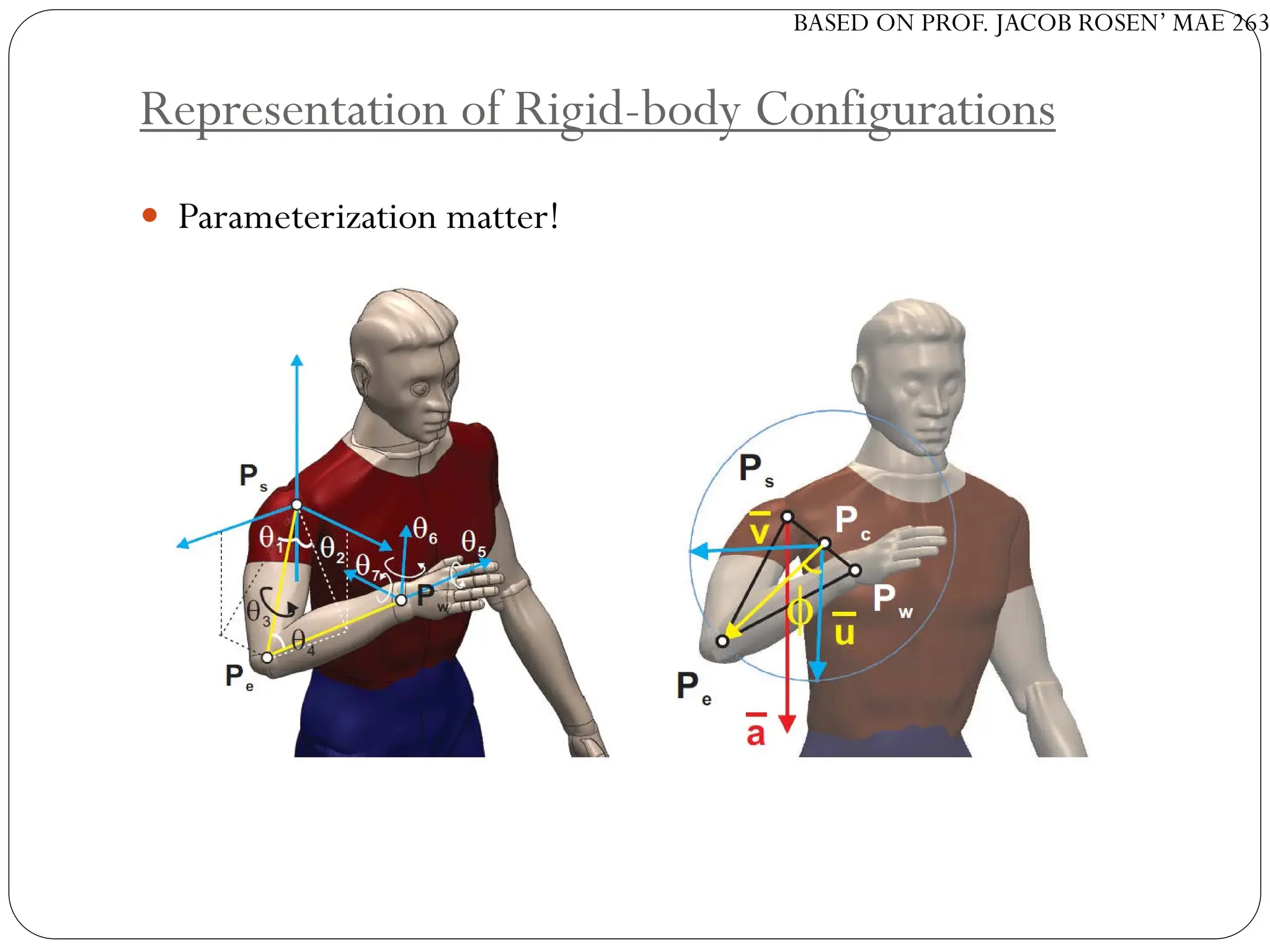
Representation of Rigid-body Configurations
 Parameterization matter!
BASED ON PROF. JACOB ROSEN’ MAE 263
Representation of Rigid-body Configurations
 Many representations
 Euler angle
 Homogeneous transformation
 Quaternions
 Different representations have pros and cons
BASED ON PROF. JACOB ROSEN’ MAE 263
Transformations
 An understanding of 2D and 3D rigid-body transformations is key
to motion planning
 There is no “best” representation
 Each representation is useful in a different way
BASED ON PROF. JACOB ROSEN’ MAE 263
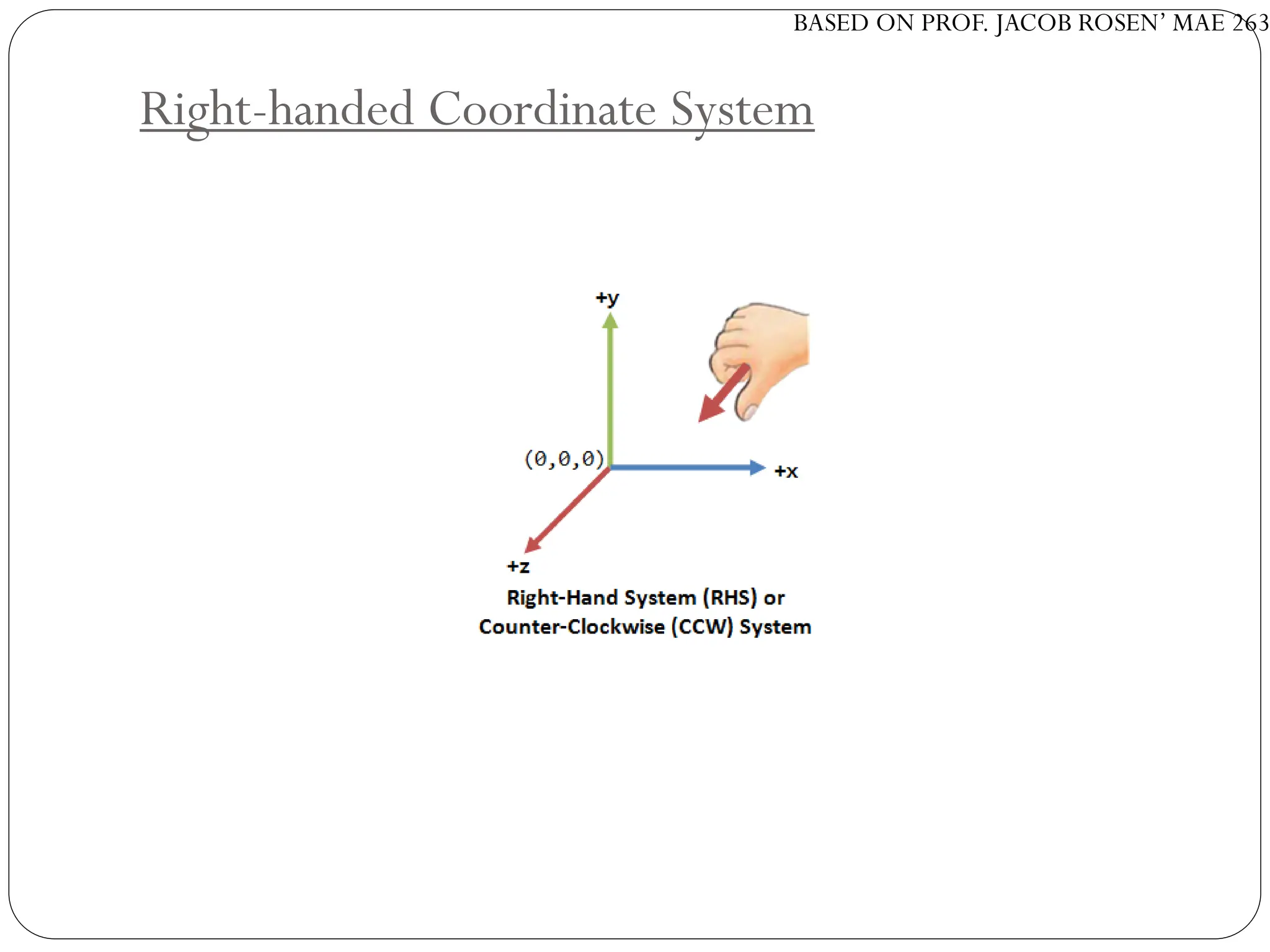
Right-handed Coordinate System
BASED ON PROF. JACOB ROSEN’ MAE 263
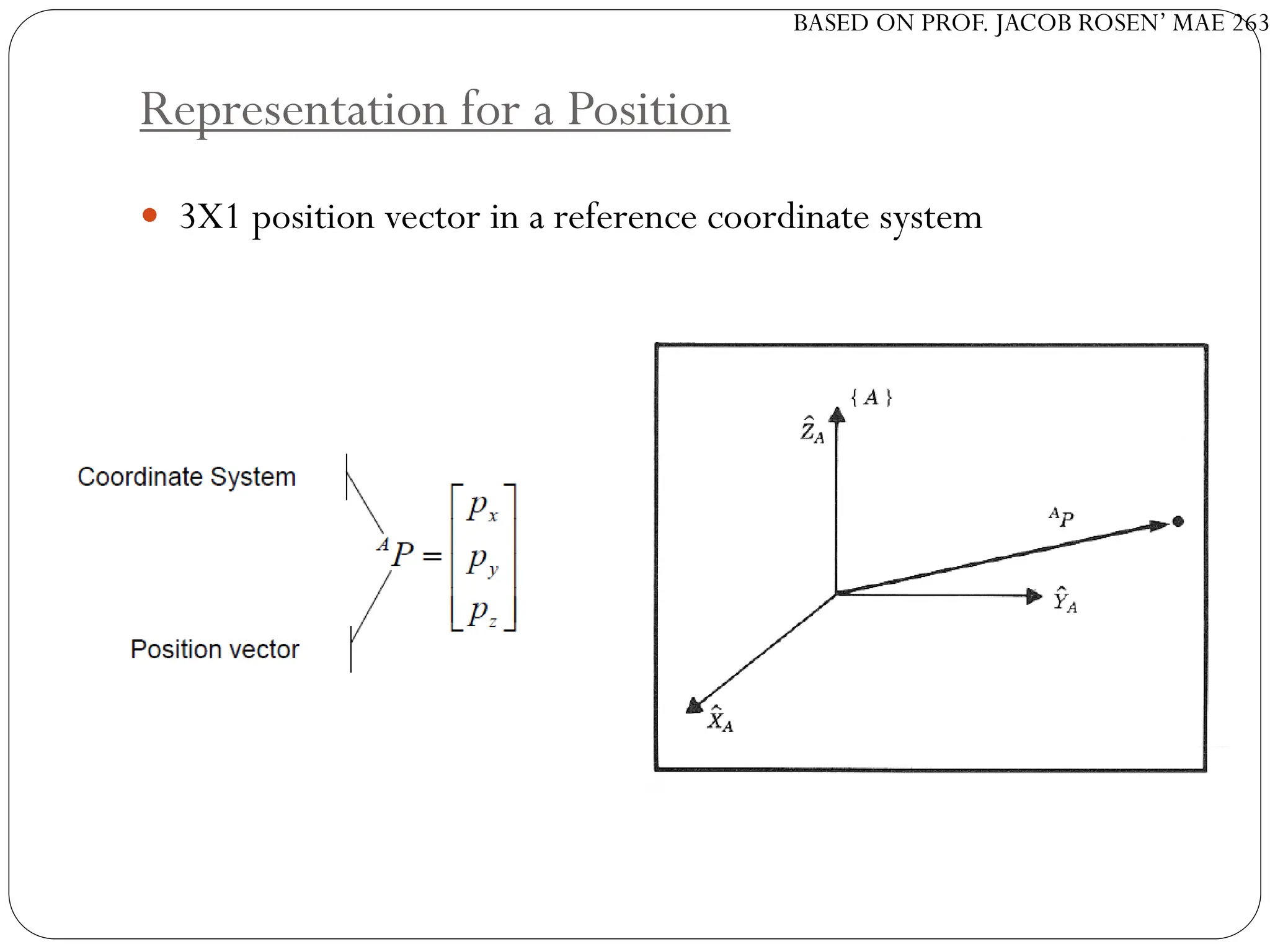
Representation for a Position
 3X1 position vector in a reference coordinate system
BASED ON PROF. JACOB ROSEN’ MAE 263
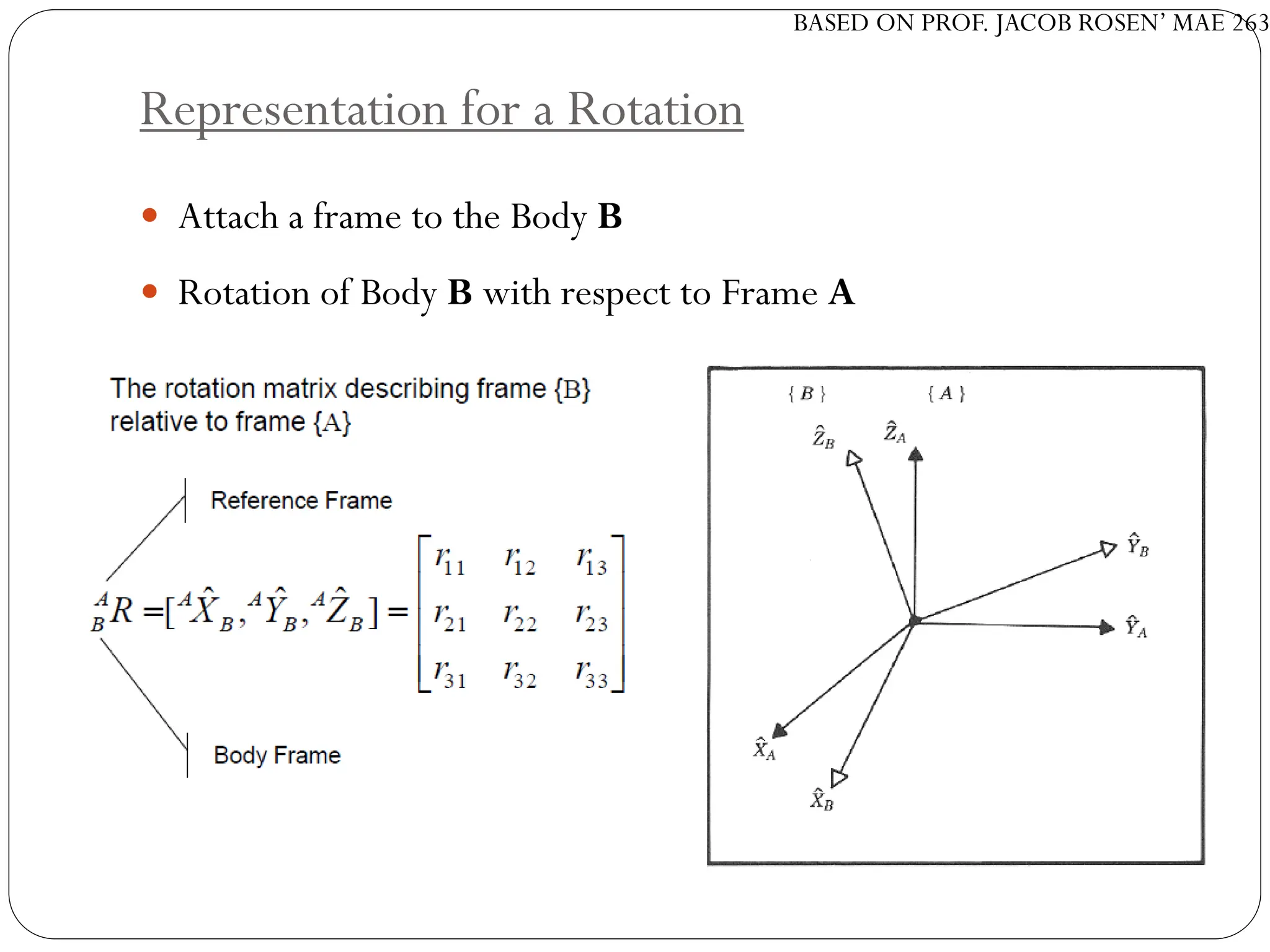
Representation for a Rotation
 Attach a frame to the Body B
 Rotation of Body B with respect to Frame A
BASED ON PROF. JACOB ROSEN’ MAE 263
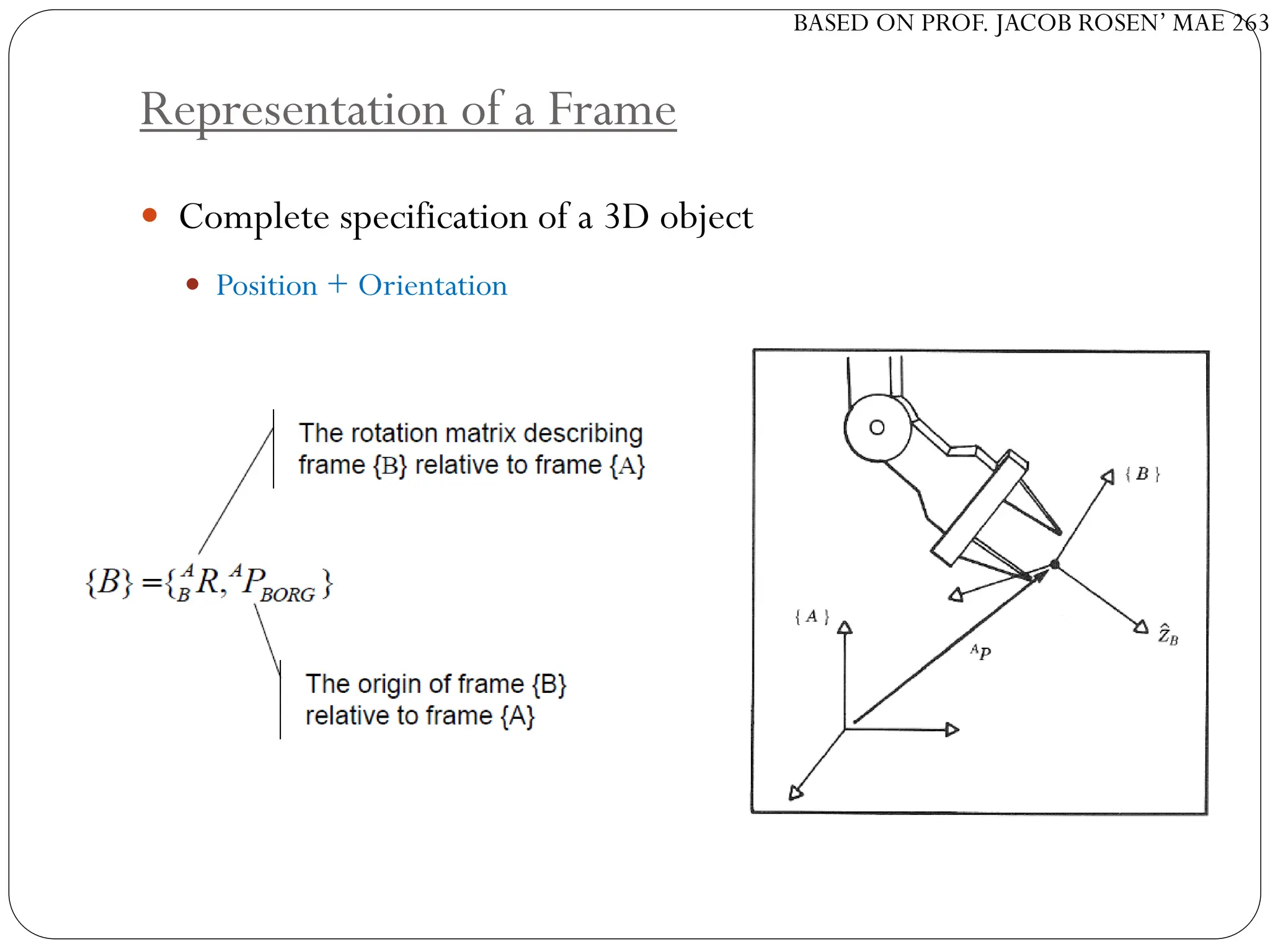
Representation of a Frame
 Complete specification of a 3D object
 Position + Orientation
BASED ON PROF. JACOB ROSEN’ MAE 263
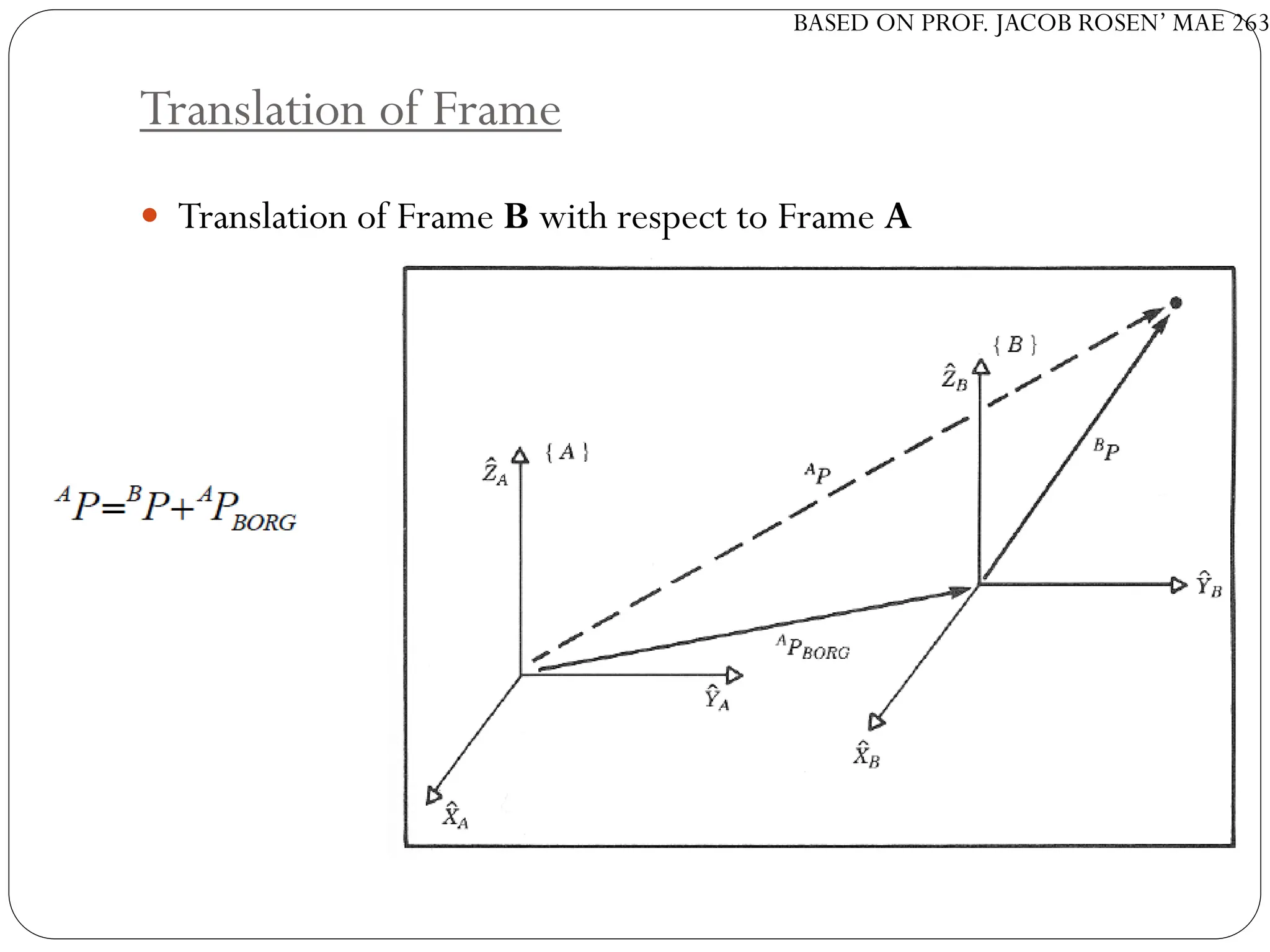
Translation of Frame
 Translation of Frame B with respect to Frame A
BASED ON PROF. JACOB ROSEN’ MAE 263
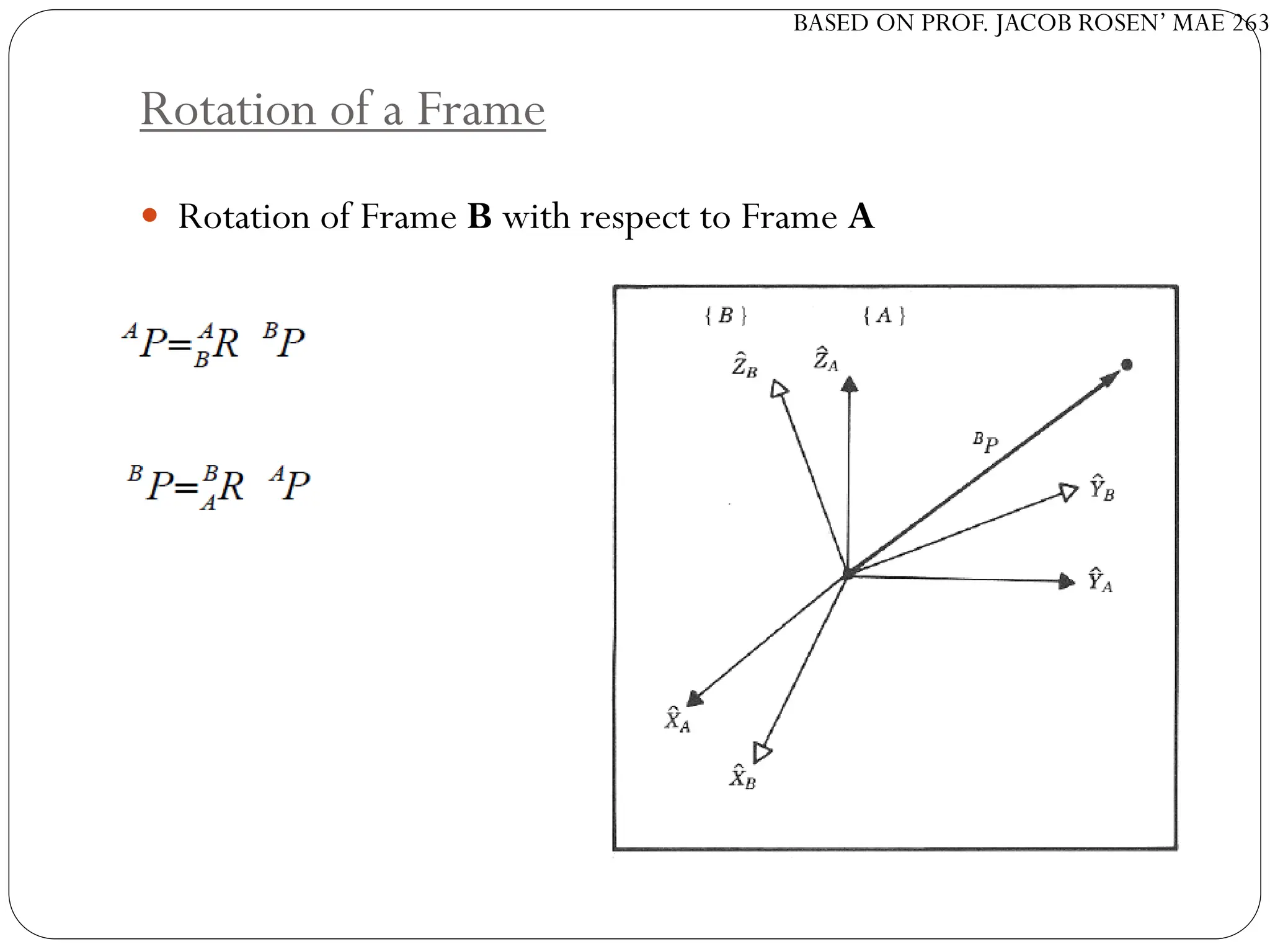
Rotation of a Frame
 Rotation of Frame B with respect to Frame A
BASED ON PROF. JACOB ROSEN’ MAE 263
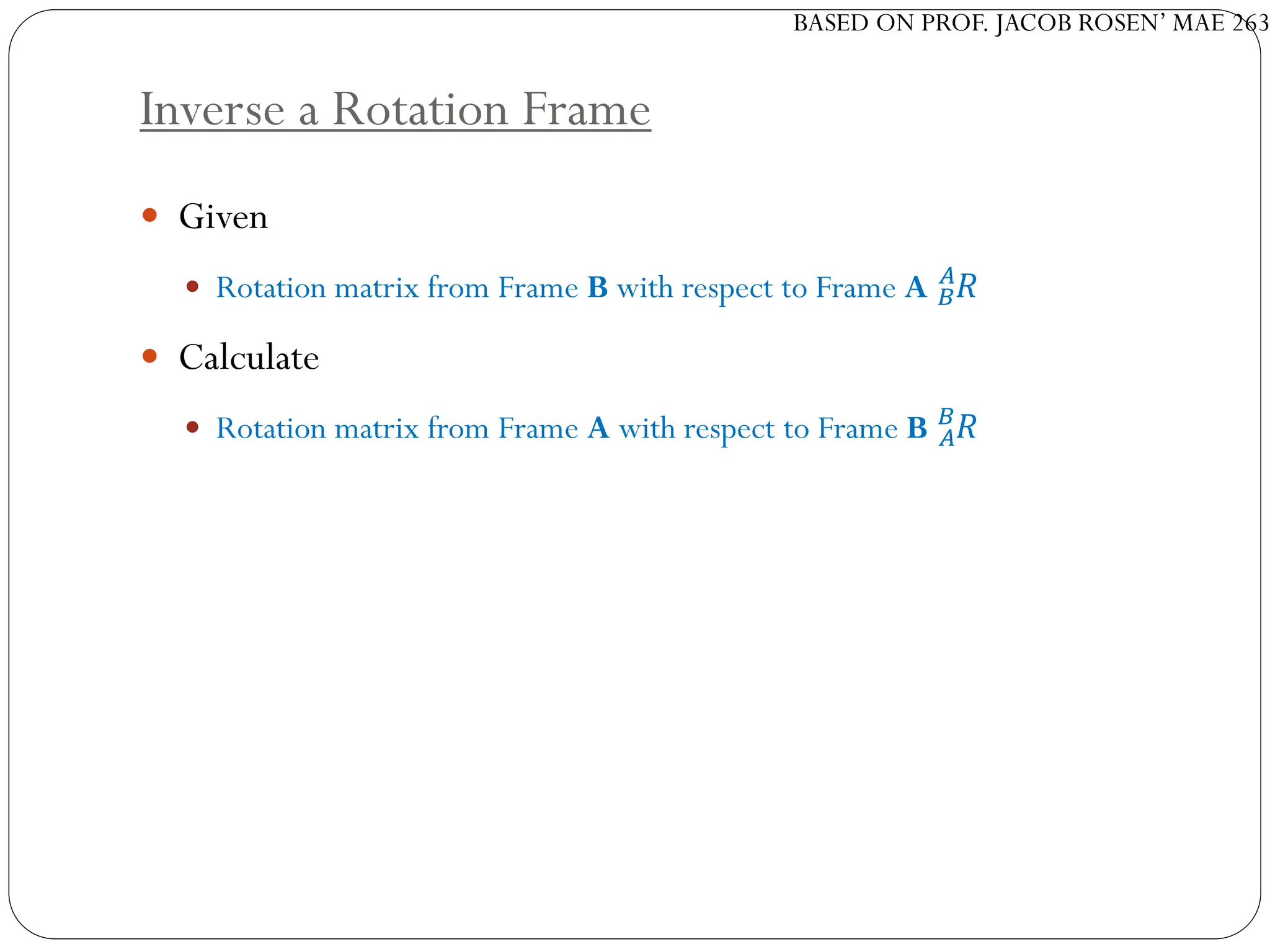
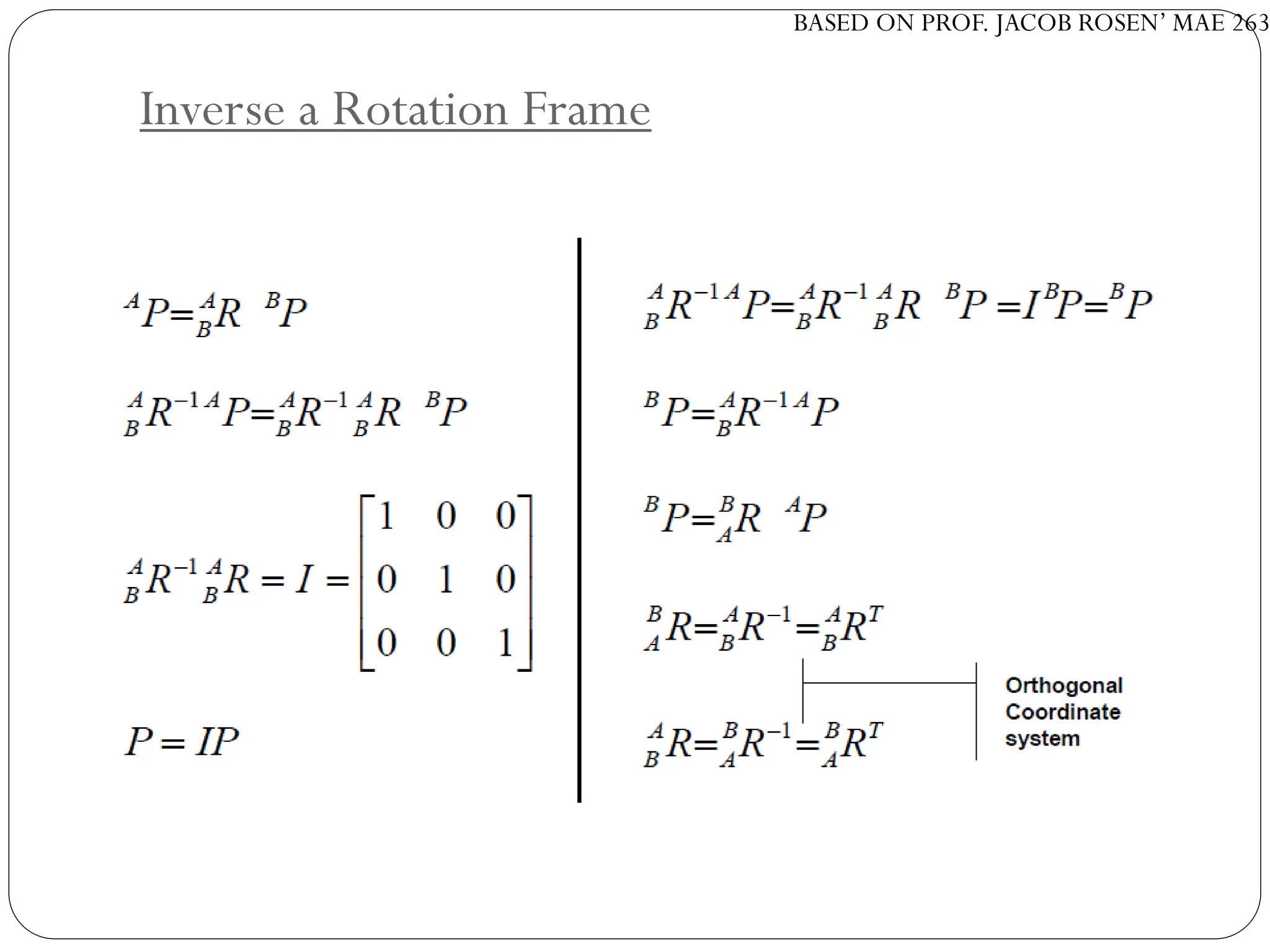
Inverse a Rotation Frame
 Given
 Rotation matrix from Frame B with respect to Frame A 𝑅
𝐵
𝐴
 Calculate
 Rotation matrix from Frame A with respect to Frame B 𝑅
𝐴
𝐵
BASED ON PROF. JACOB ROSEN’ MAE 263
Inverse a Rotation Frame
BASED ON PROF. JACOB ROSEN’ MAE 263
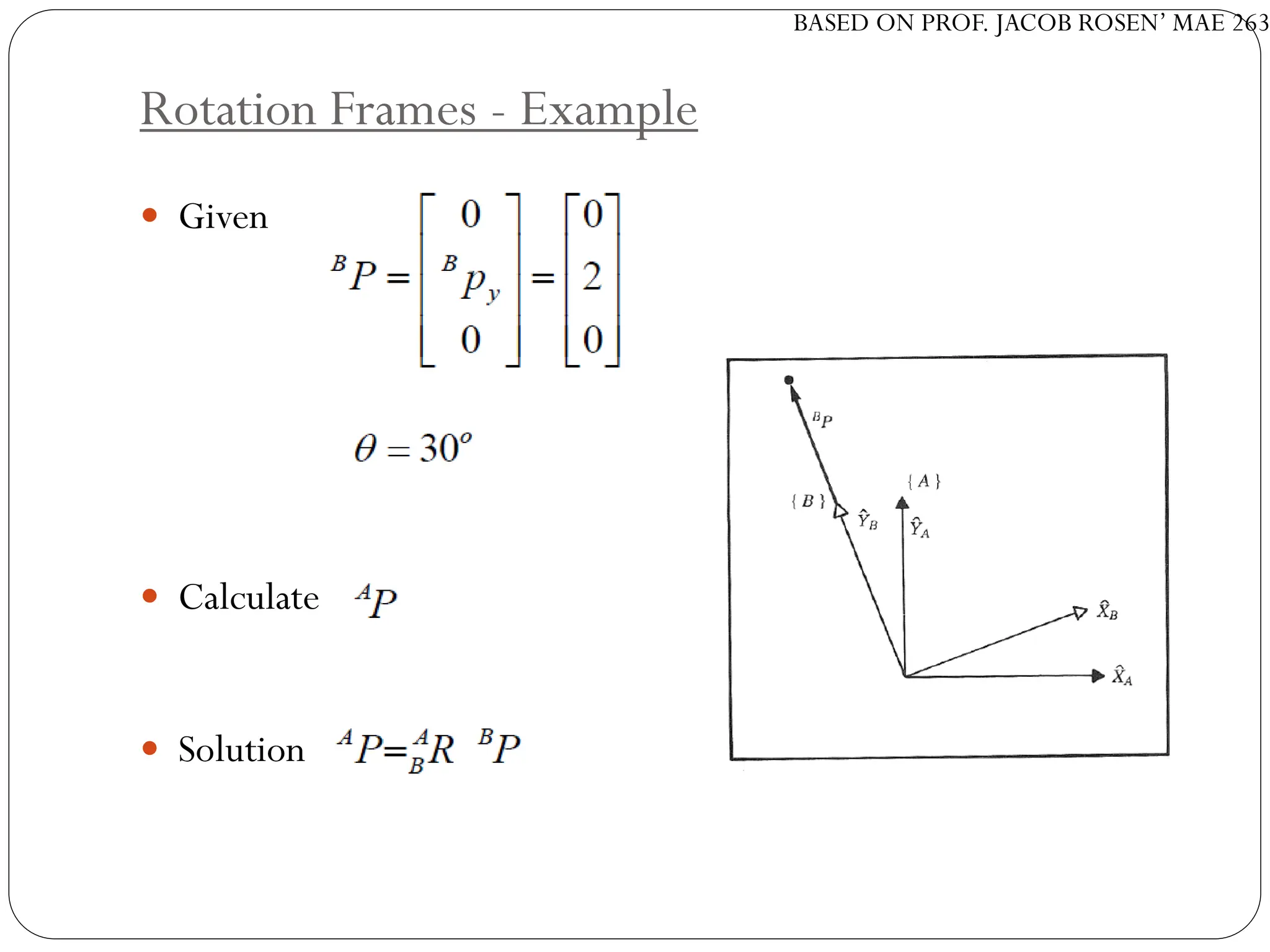
Rotation Frames - Example
 Given
 Calculate
 Solution
BASED ON PROF. JACOB ROSEN’ MAE 263
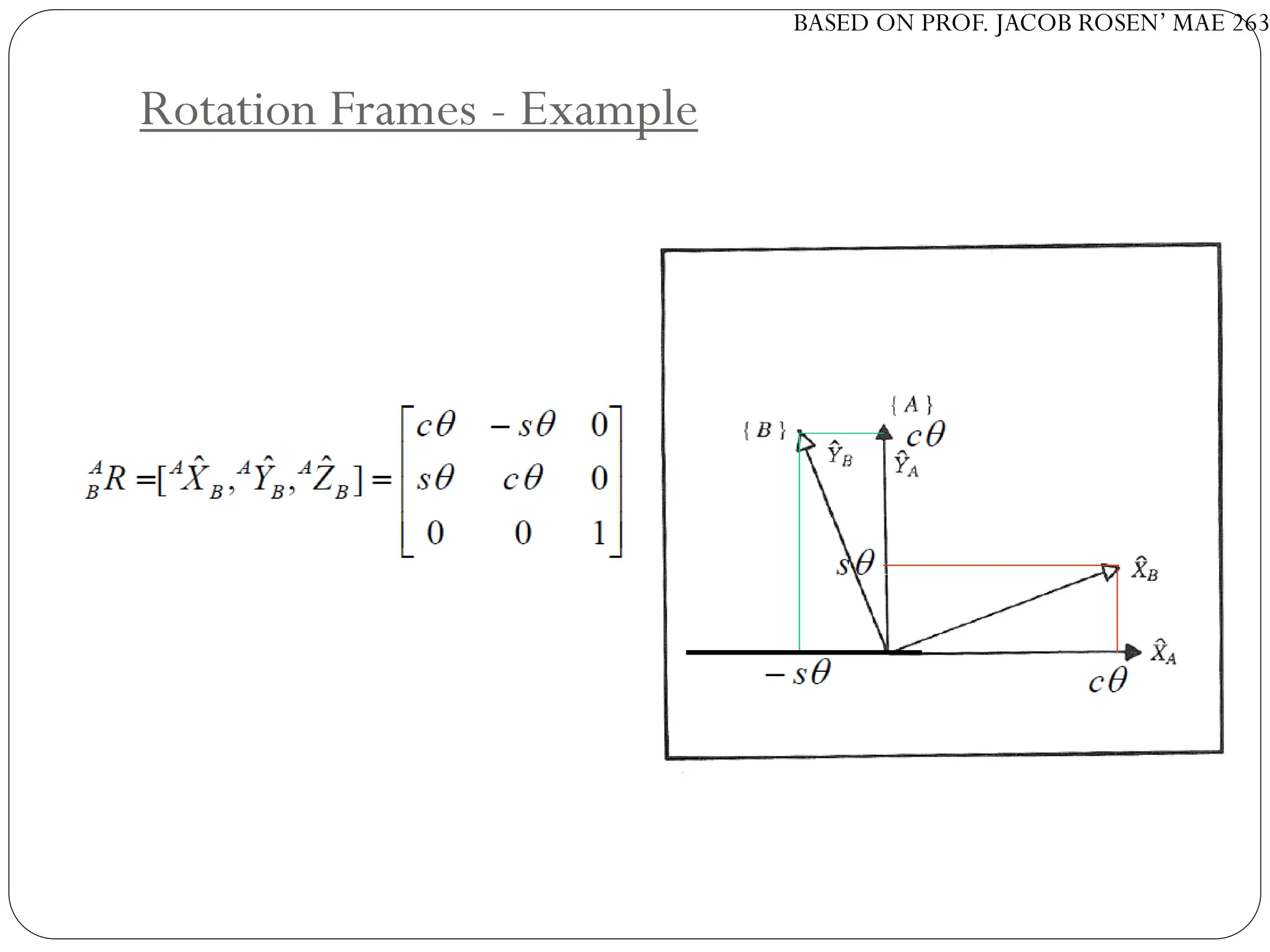
Rotation Frames - Example
BASED ON PROF. JACOB ROSEN’ MAE 263
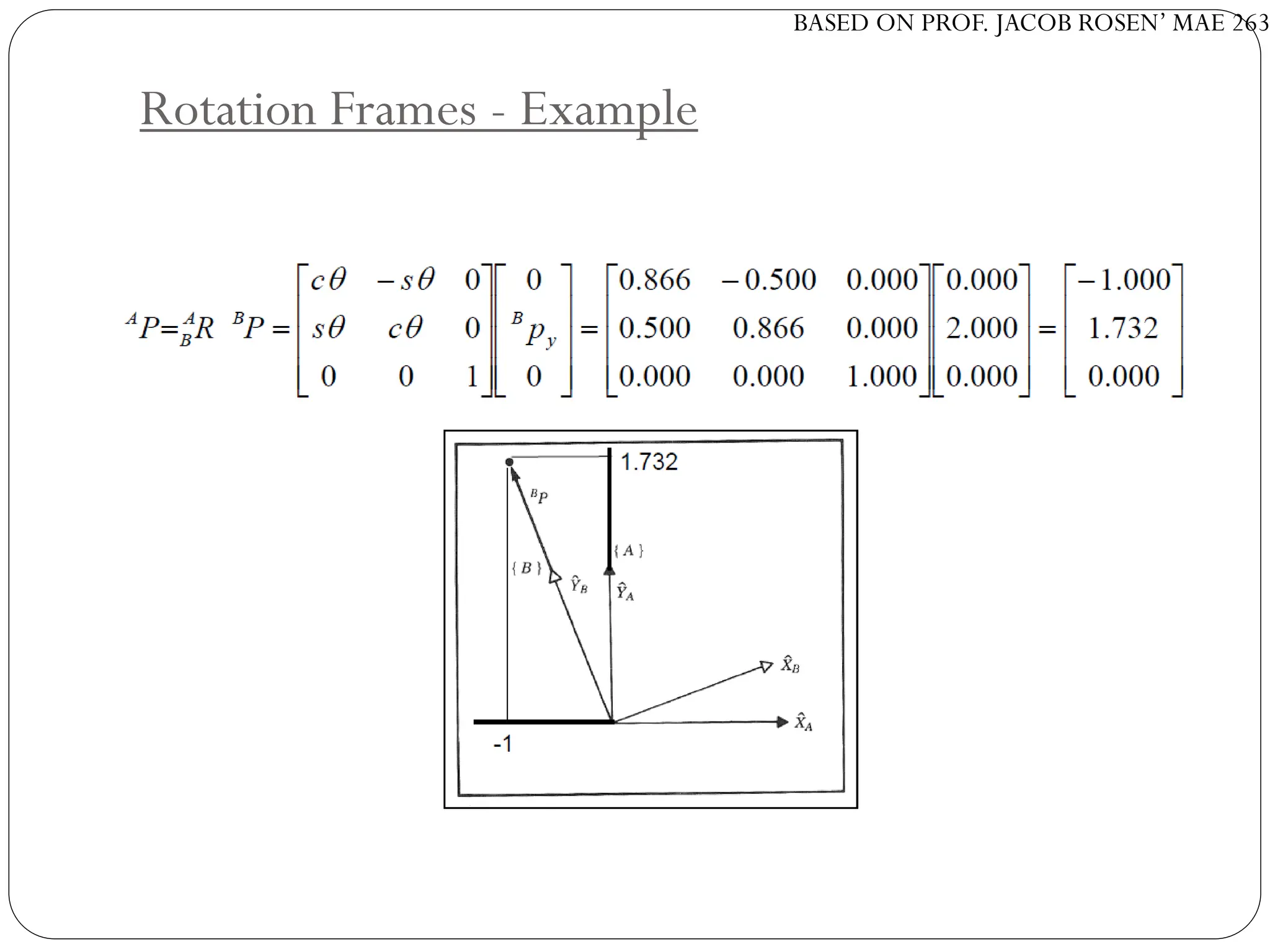
Rotation Frames - Example
BASED ON PROF. JACOB ROSEN’ MAE 263
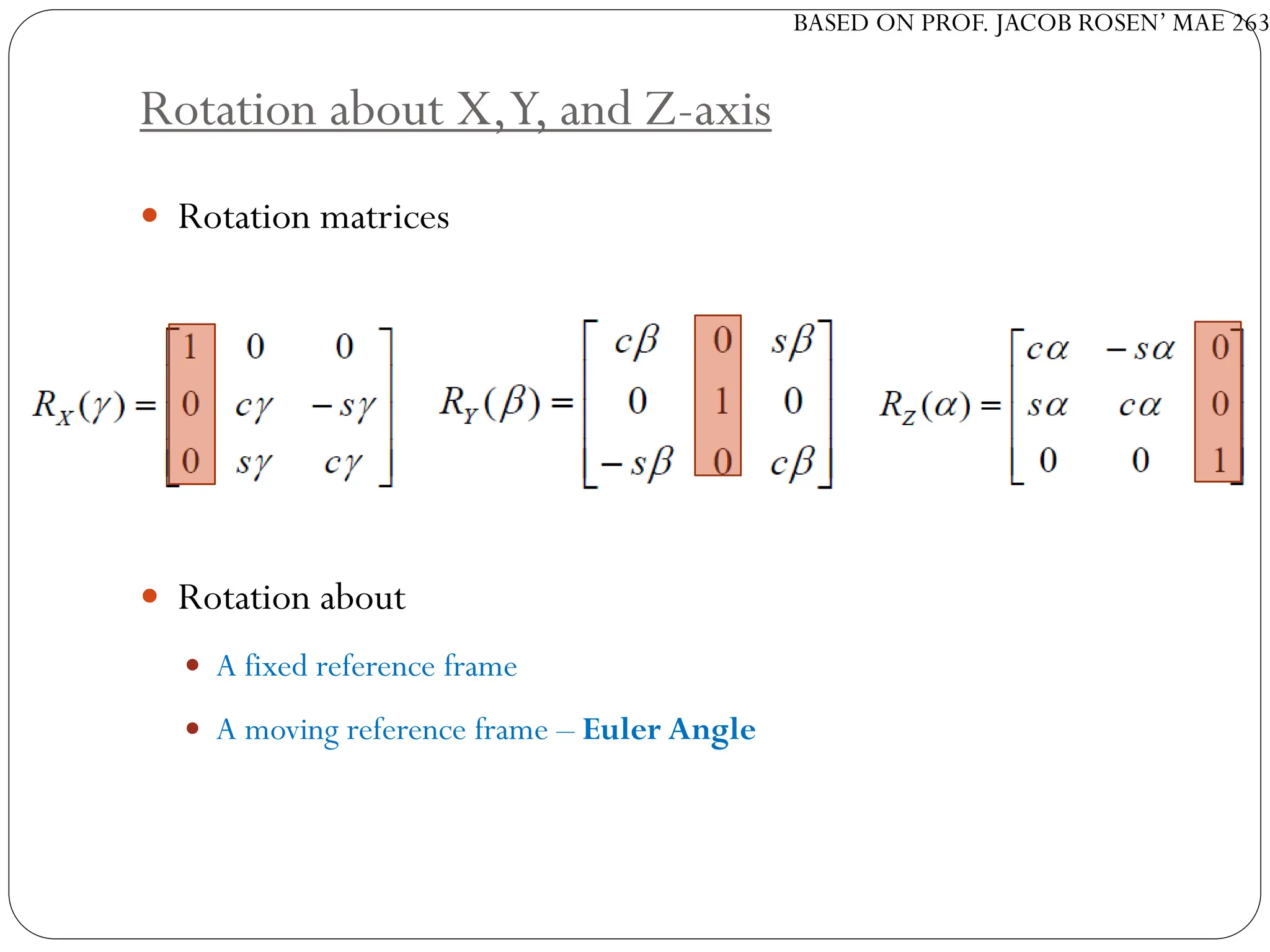
Rotation about X,Y, and Z-axis
 Rotation matrices
 Rotation about
 A fixed reference frame
 A moving reference frame – Euler Angle
BASED ON PROF. JACOB ROSEN’ MAE 263
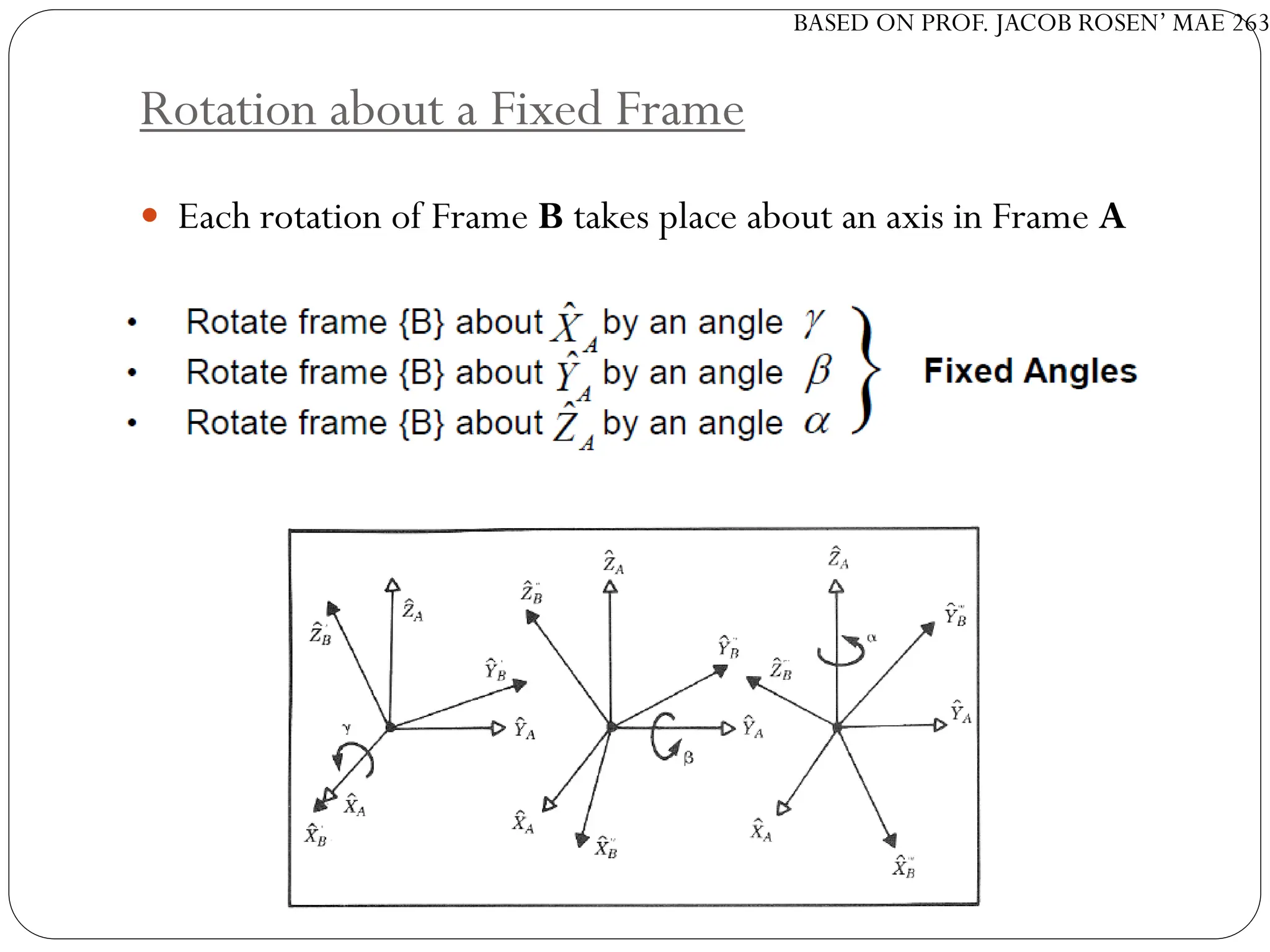
Rotation about a Fixed Frame
 Each rotation of Frame B takes place about an axis in Frame A
BASED ON PROF. JACOB ROSEN’ MAE 263
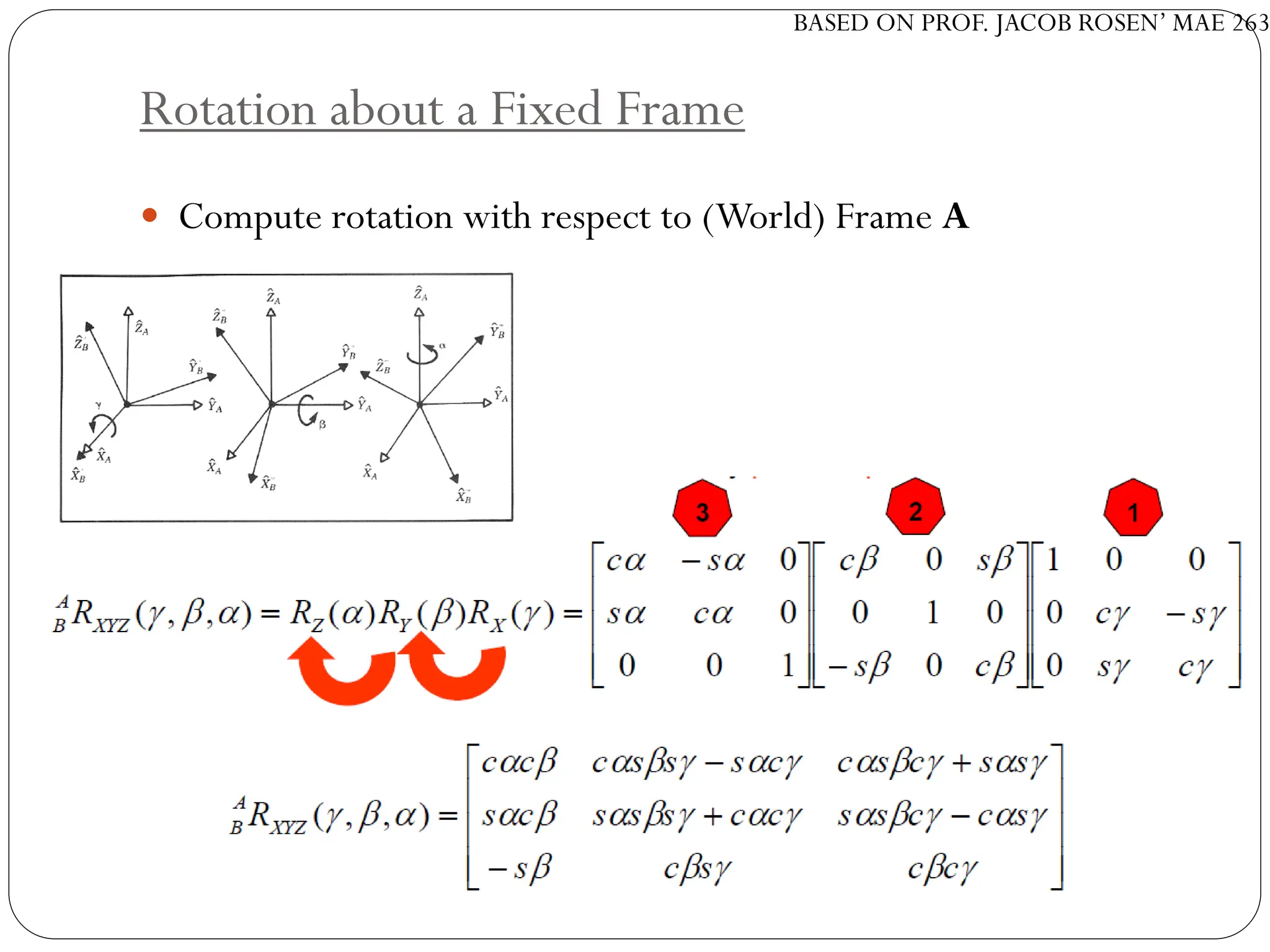
Rotation about a Fixed Frame
 Compute rotation with respect to (World) Frame A
BASED ON PROF. JACOB ROSEN’ MAE 263
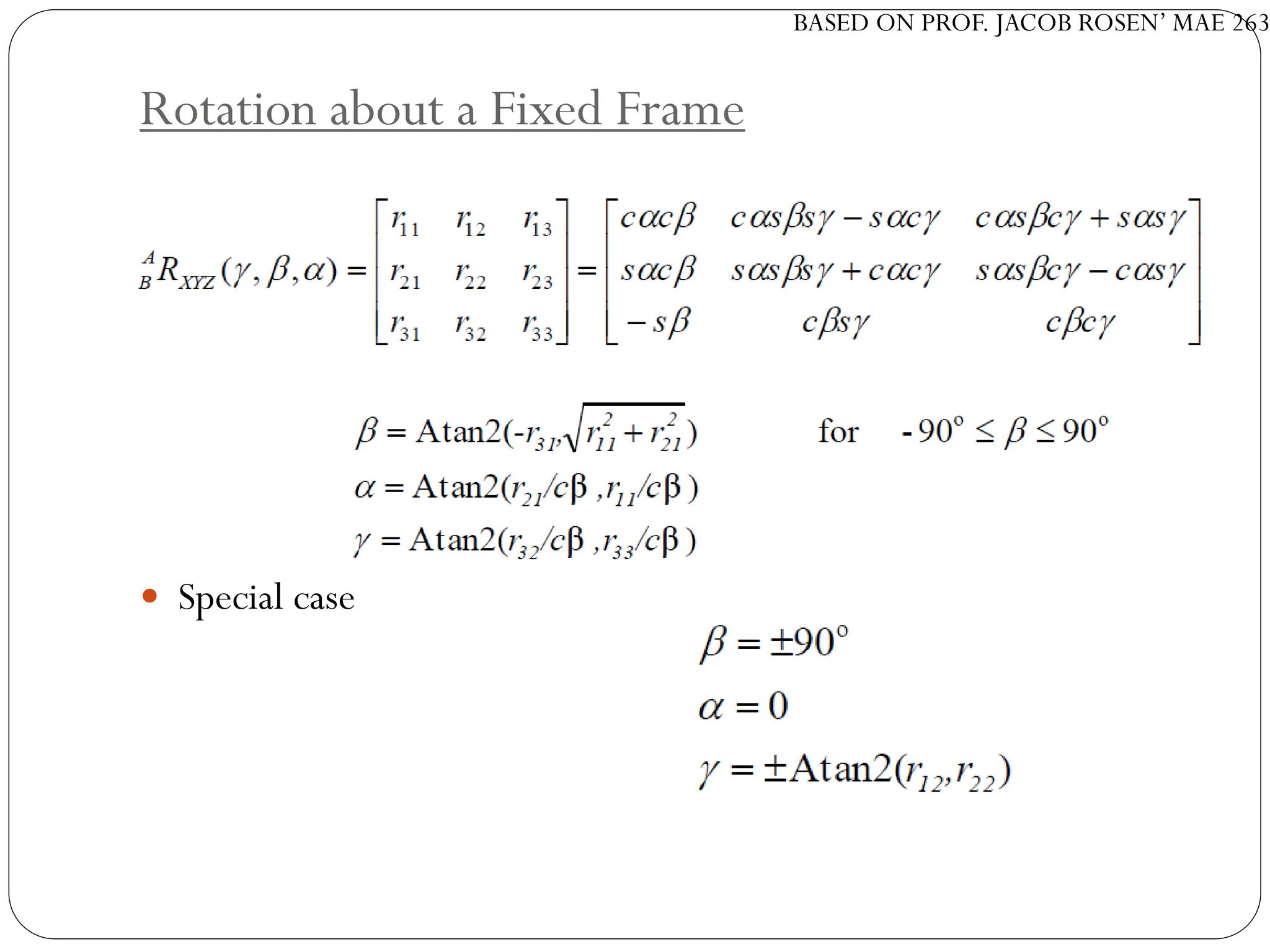
Rotation about a Fixed Frame
 Special case
BASED ON PROF. JACOB ROSEN’ MAE 263
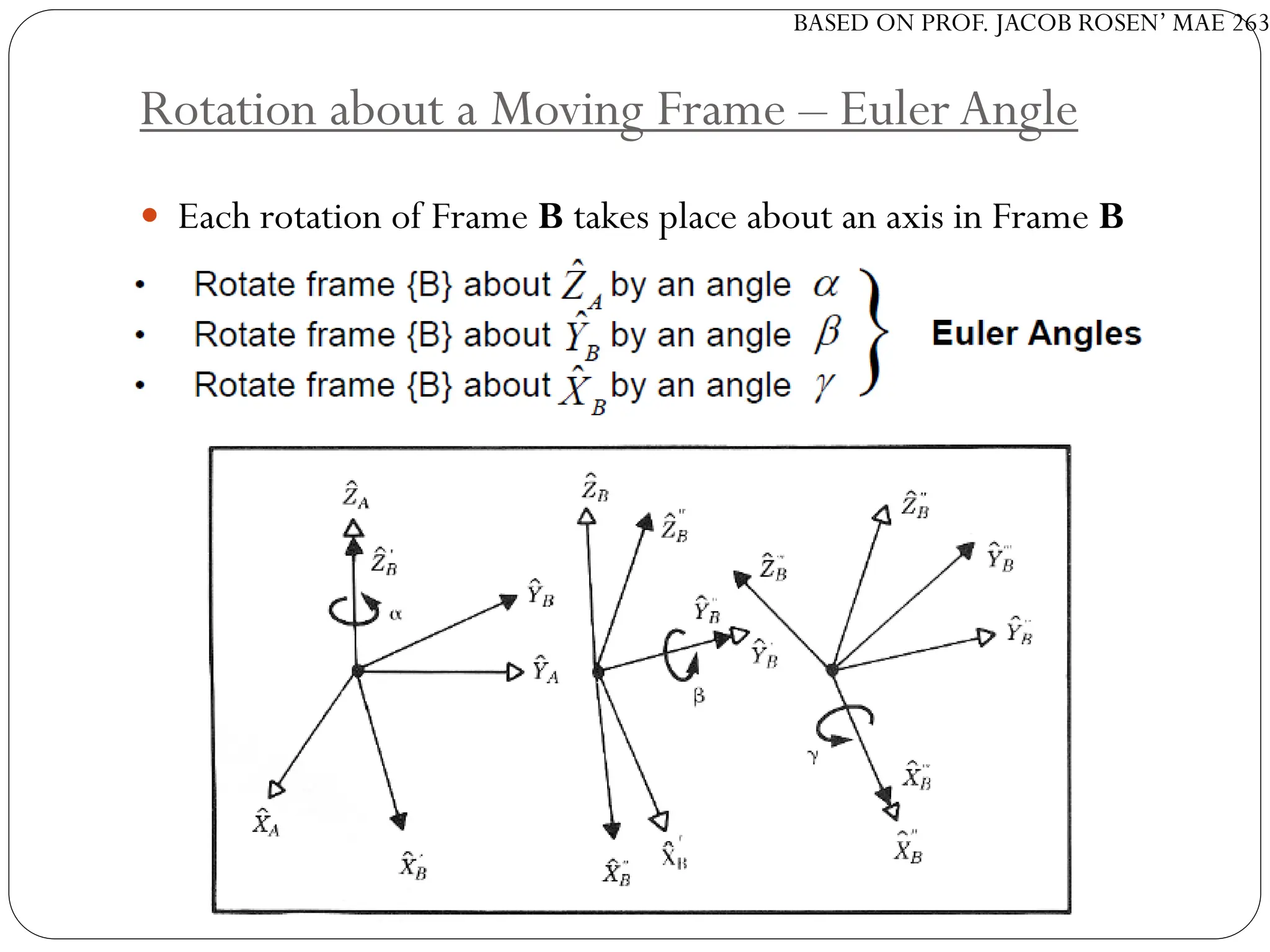
Rotation about a Moving Frame – Euler Angle
 Each rotation of Frame B takes place about an axis in Frame B
BASED ON PROF. JACOB ROSEN’ MAE 263
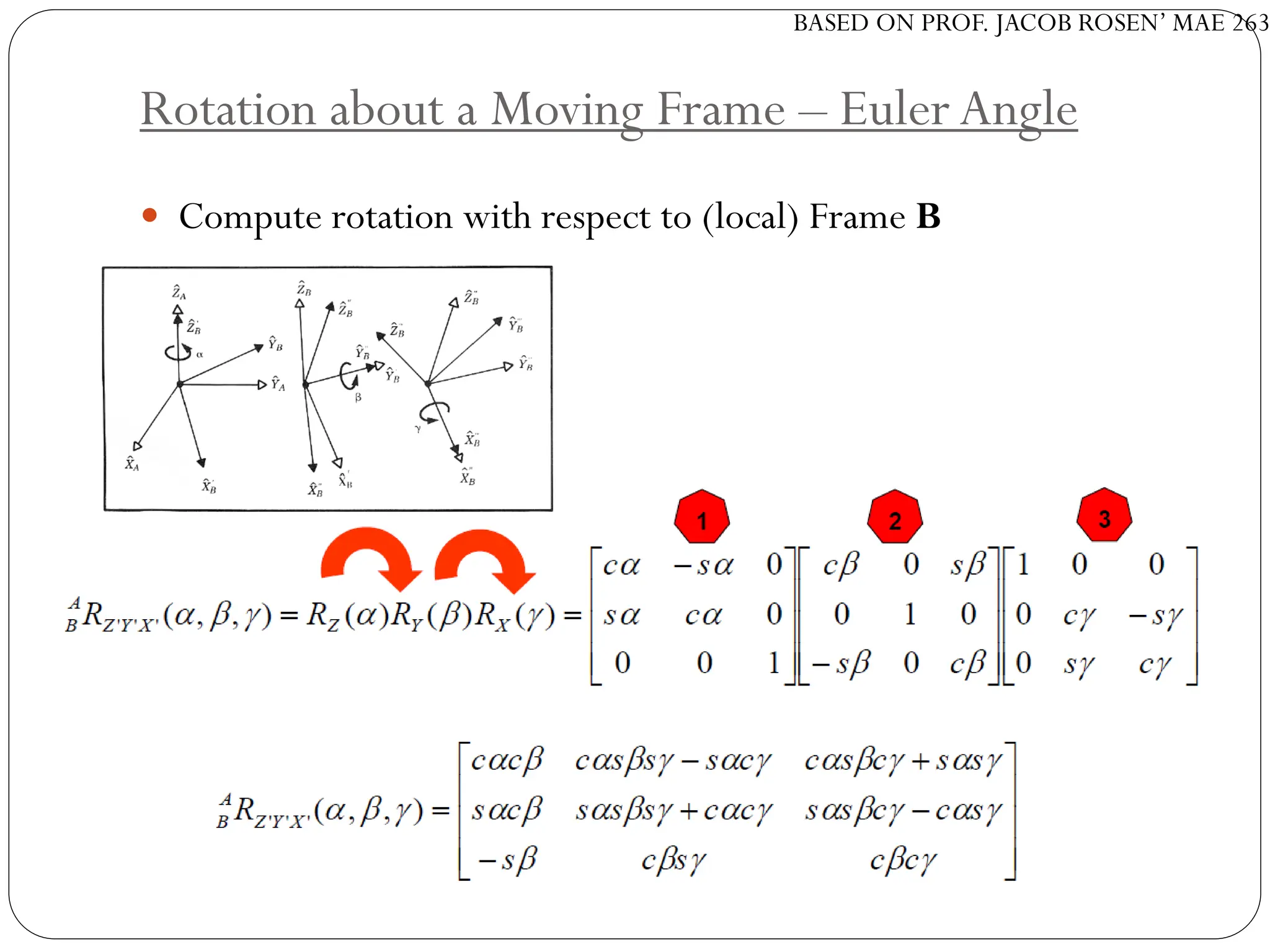
Rotation about a Moving Frame – Euler Angle
 Compute rotation with respect to (local) Frame B
BASED ON PROF. JACOB ROSEN’ MAE 263
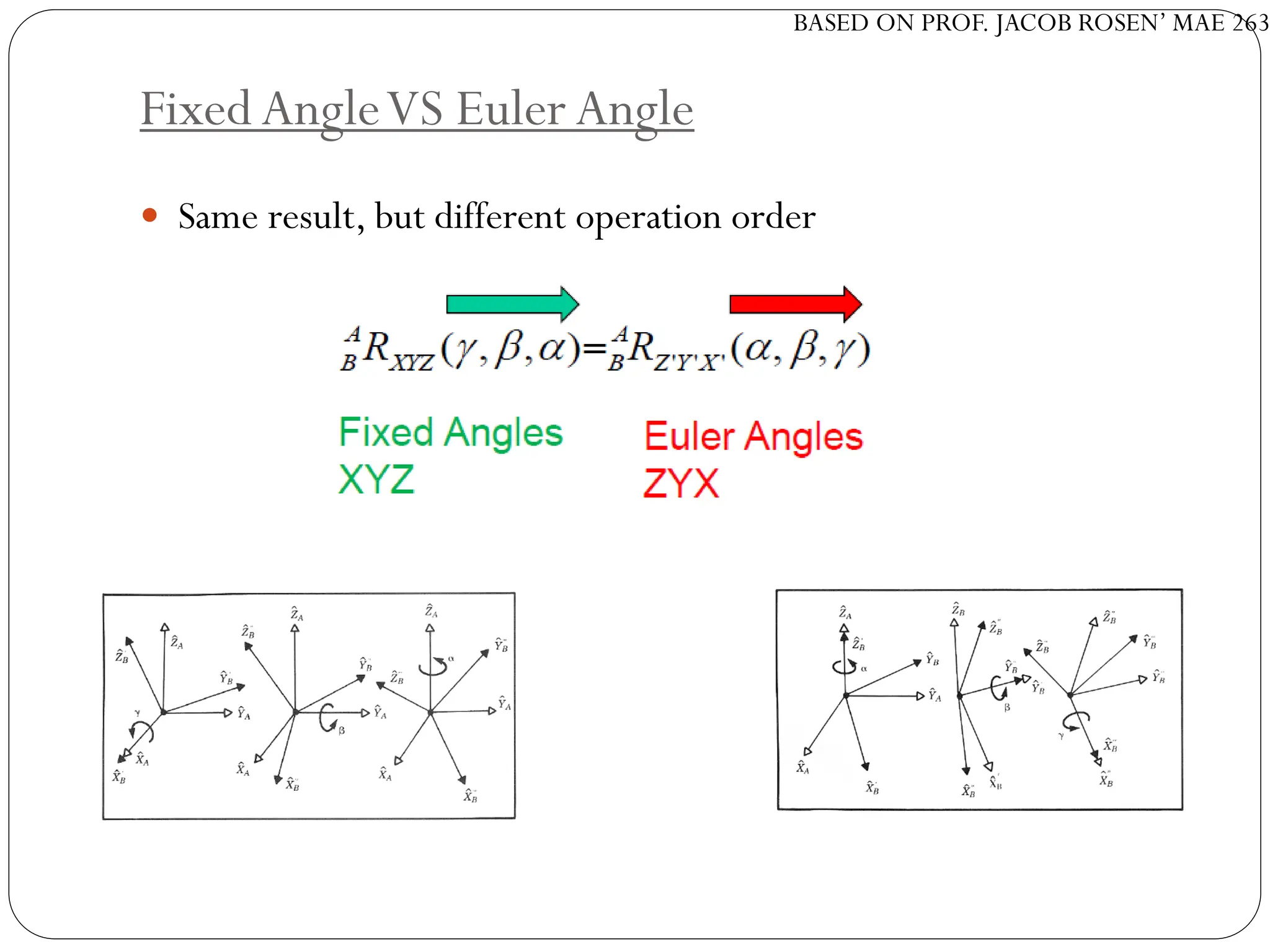
Fixed AngleVS Euler Angle
 Same result, but different operation order
BASED ON PROF. JACOB ROSEN’ MAE 263
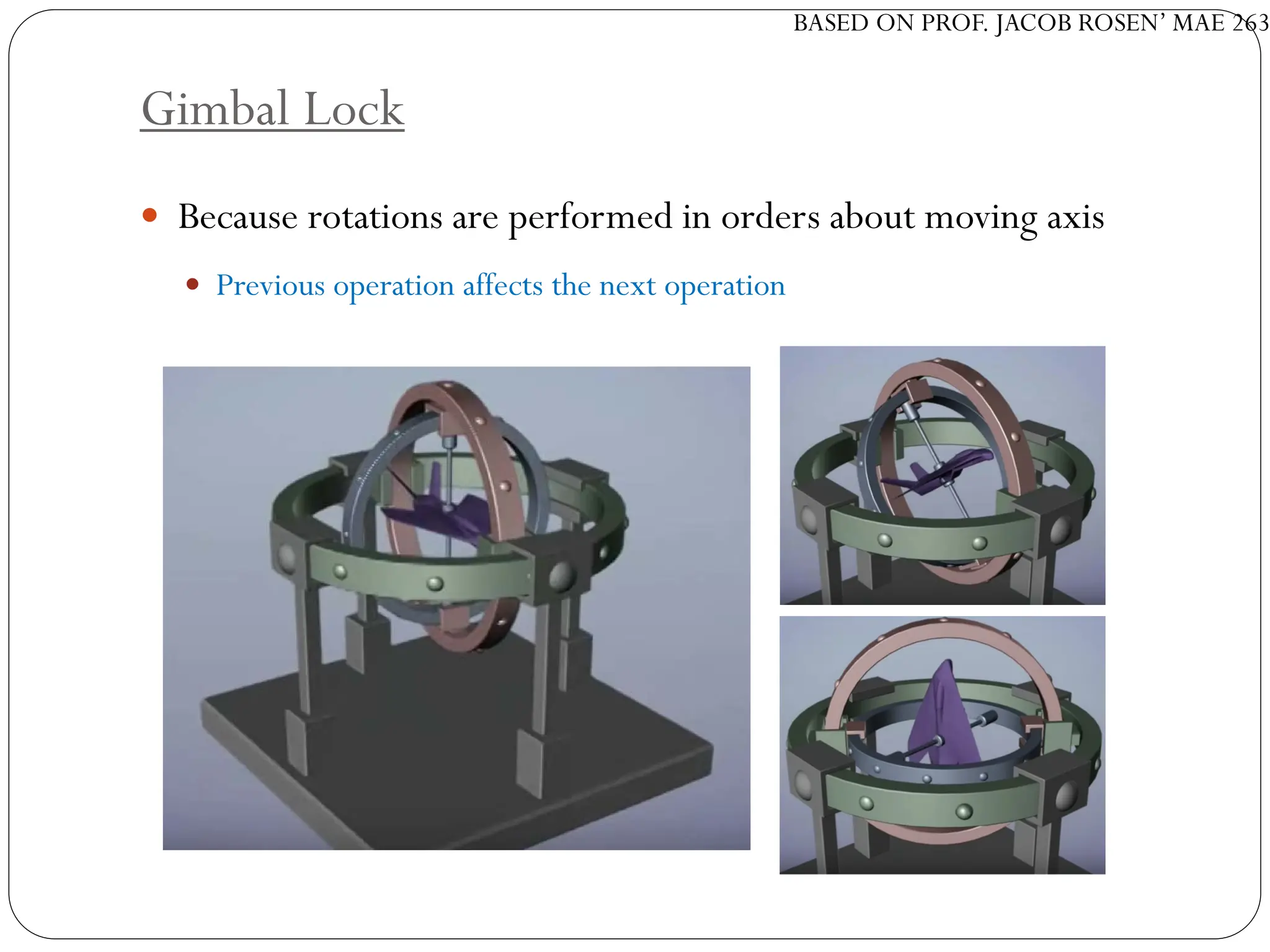
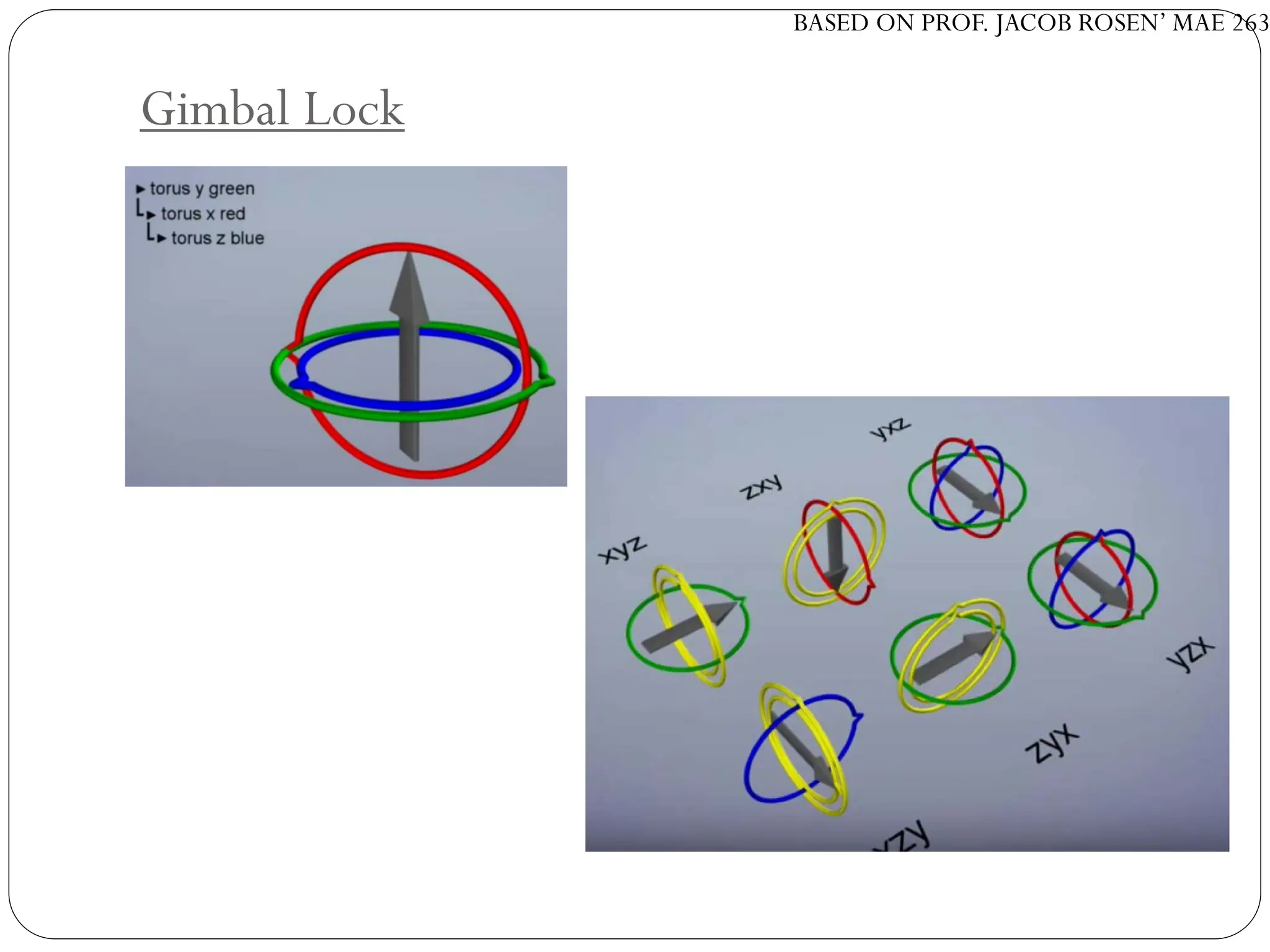
Gimbal Lock
 Because rotations are performed in orders about moving axis
 Previous operation affects the next operation
BASED ON PROF. JACOB ROSEN’ MAE 263
Gimbal Lock
RBE 550 MOTION PLANNING
BASED ON DR. DMITRY BERENSON’S RBE
550
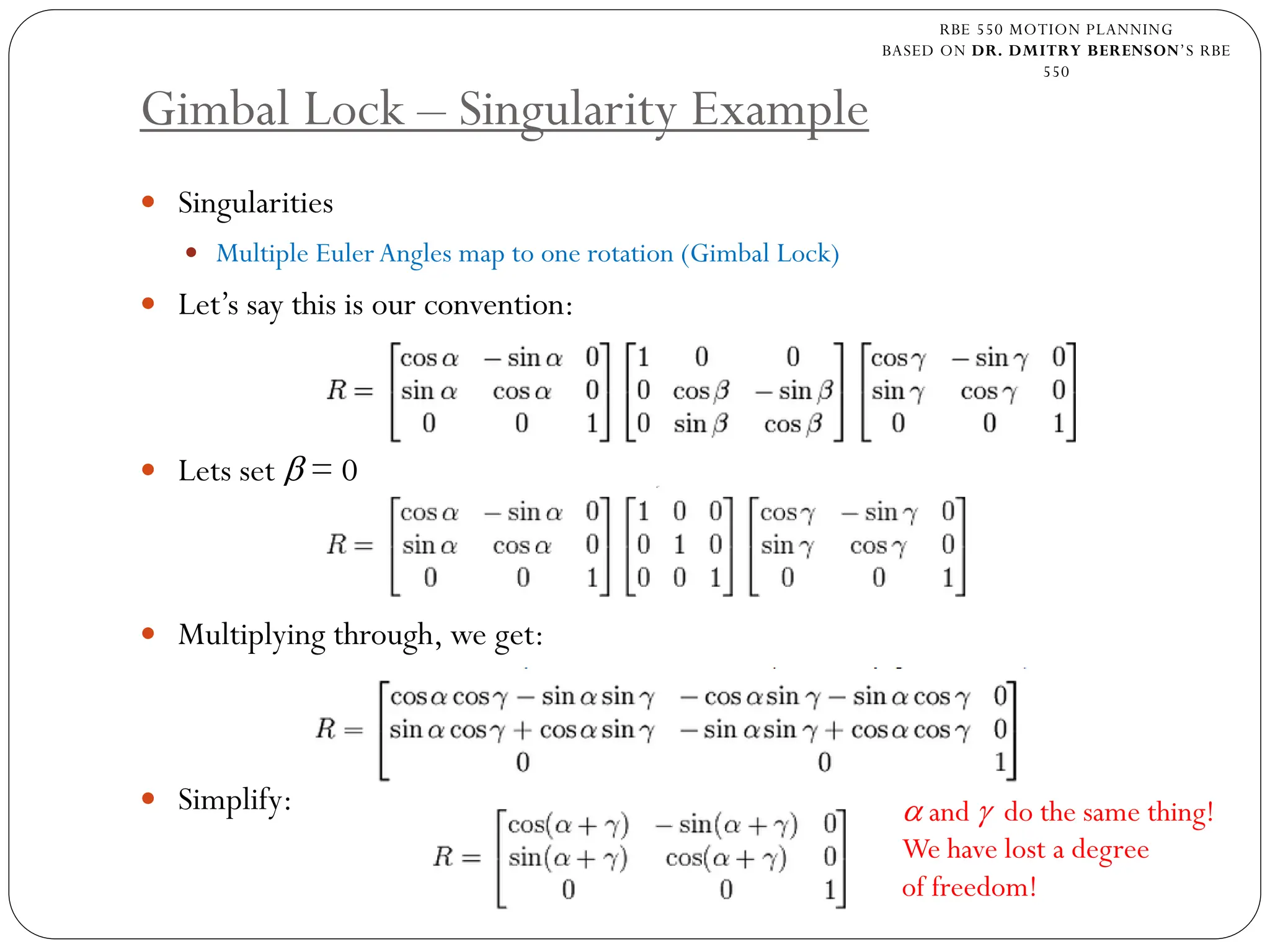
Gimbal Lock – Singularity Example
 Singularities
 Multiple EulerAngles map to one rotation (Gimbal Lock)
 Let’s say this is our convention:
 Lets set β = 0
 Multiplying through, we get:
 Simplify: α and γ do the same thing!
We have lost a degree
of freedom!
HomogeneousTransformation
BASED ON PROF. JACOB ROSEN’ MAE 263
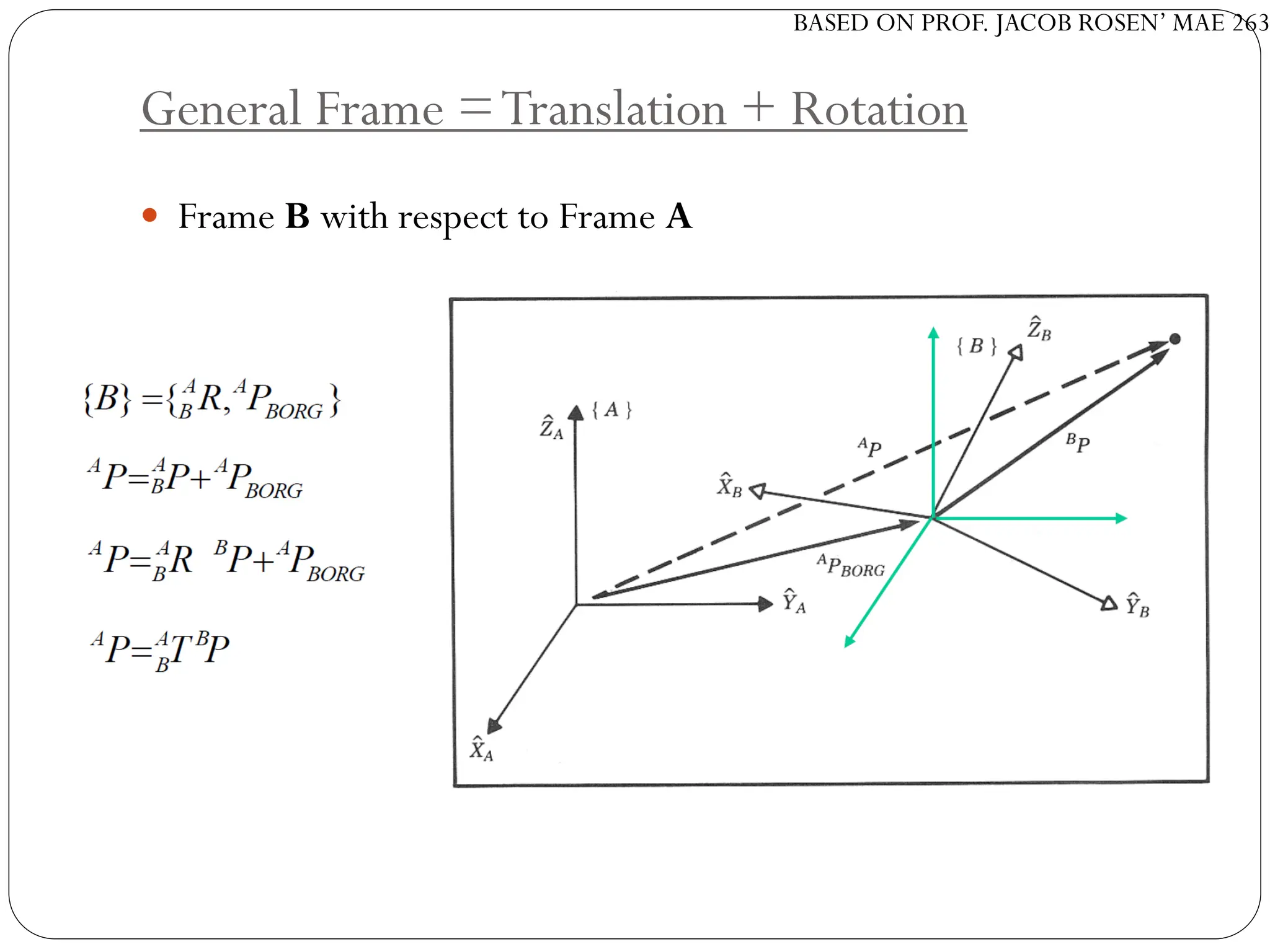
General Frame =Translation + Rotation
 Frame B with respect to Frame A
BASED ON PROF. JACOB ROSEN’ MAE 263
HomogeneousTransformation
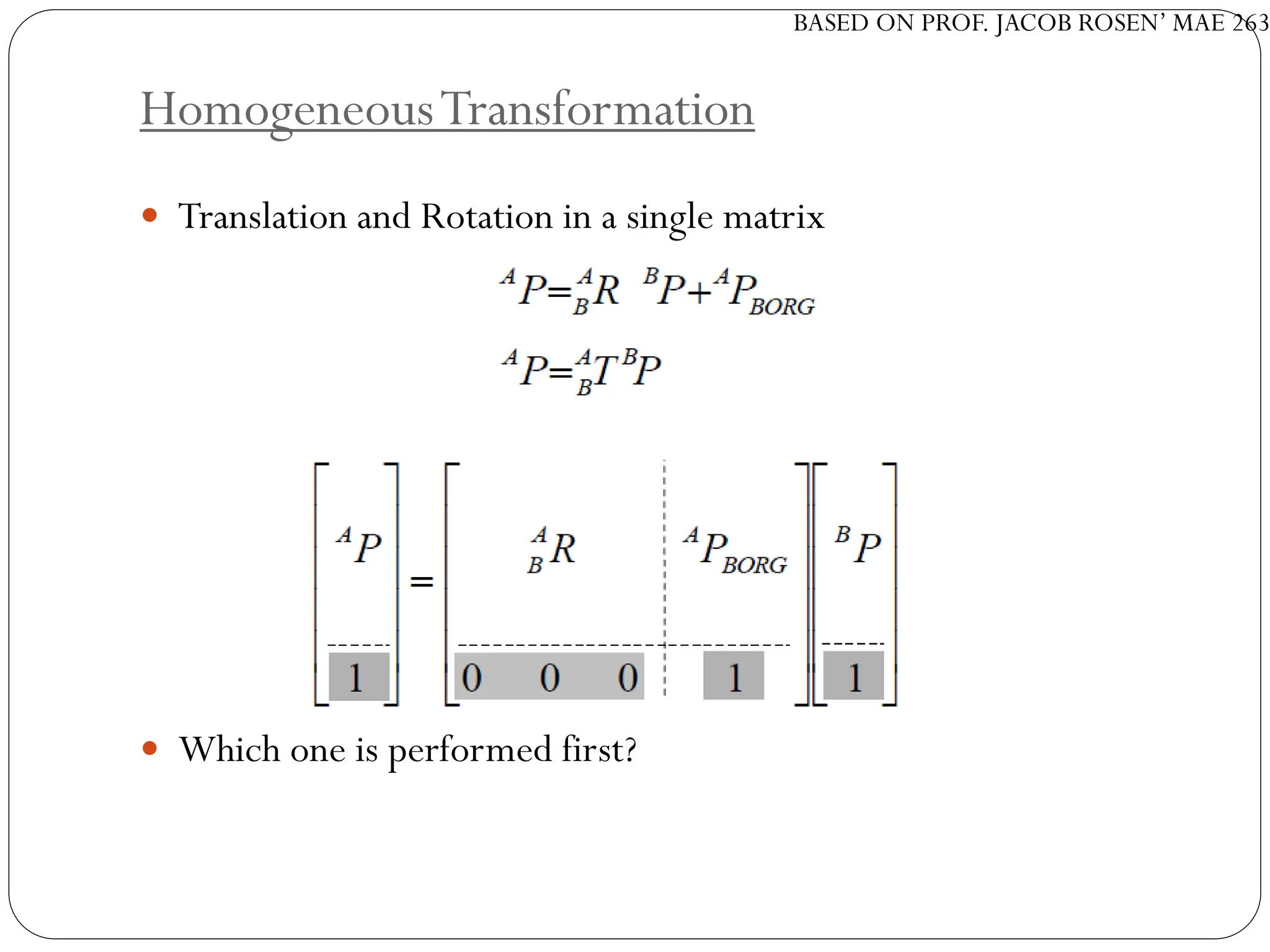
 Translation and Rotation in a single matrix
 Which one is performed first?
BASED ON PROF. JACOB ROSEN’ MAE 263
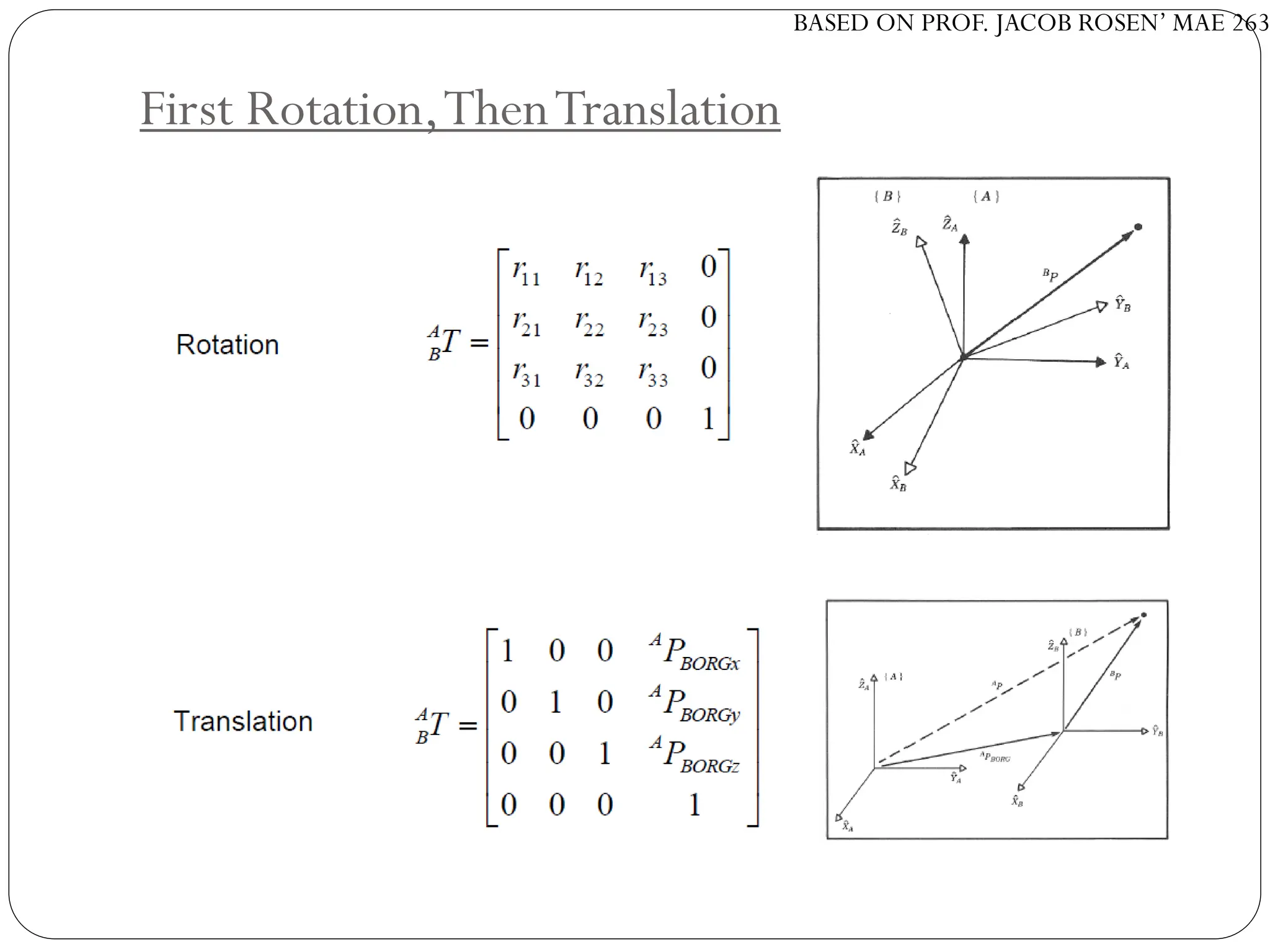
First Rotation,ThenTranslation
BASED ON PROF. JACOB ROSEN’ MAE 263
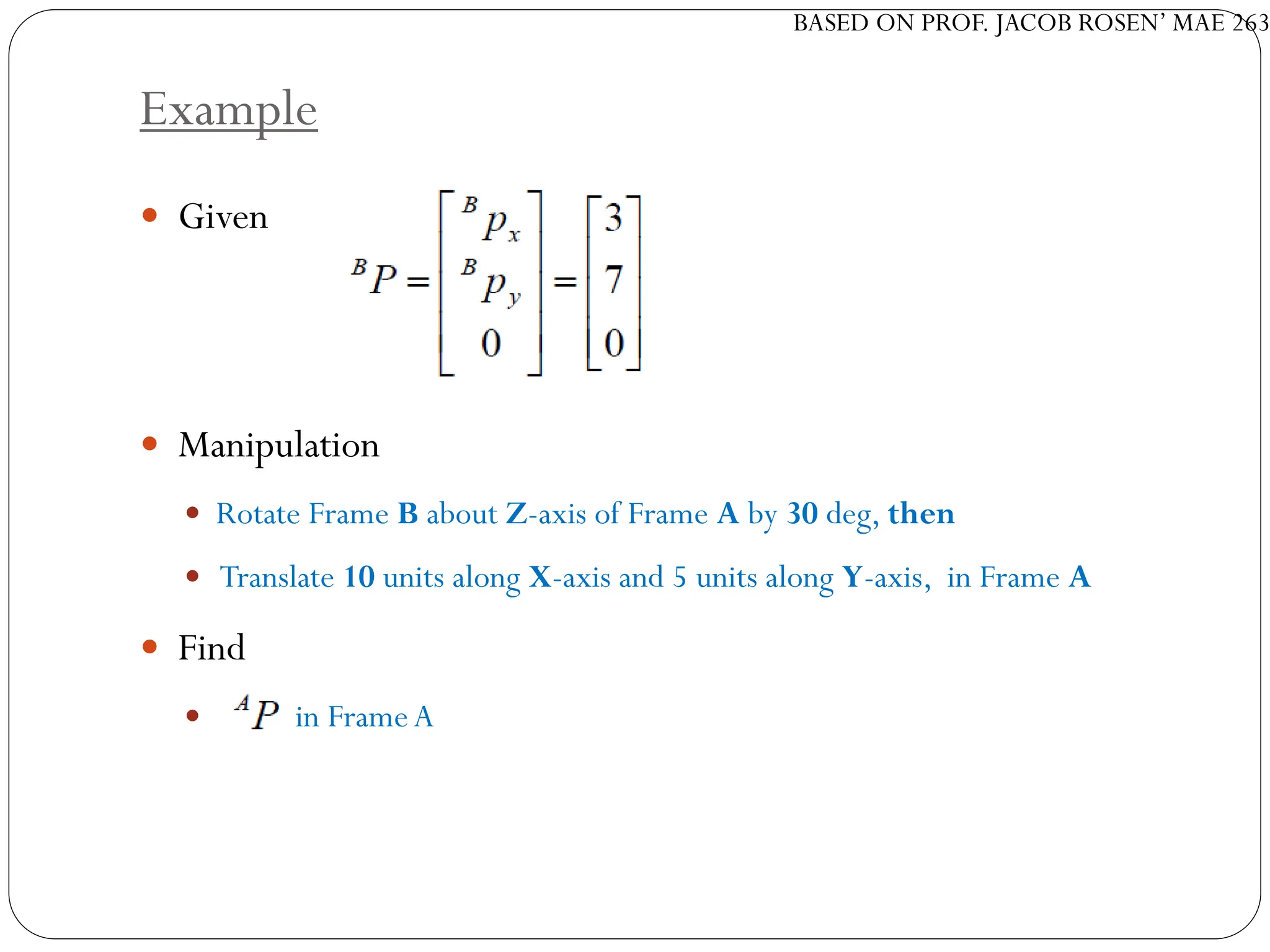
Example
 Given
 Manipulation
 Rotate Frame B about Z-axis of Frame A by 30 deg, then
 Translate 10 units along X-axis and 5 units along Y-axis, in Frame A
 Find
 in FrameA
BASED ON PROF. JACOB ROSEN’ MAE 263
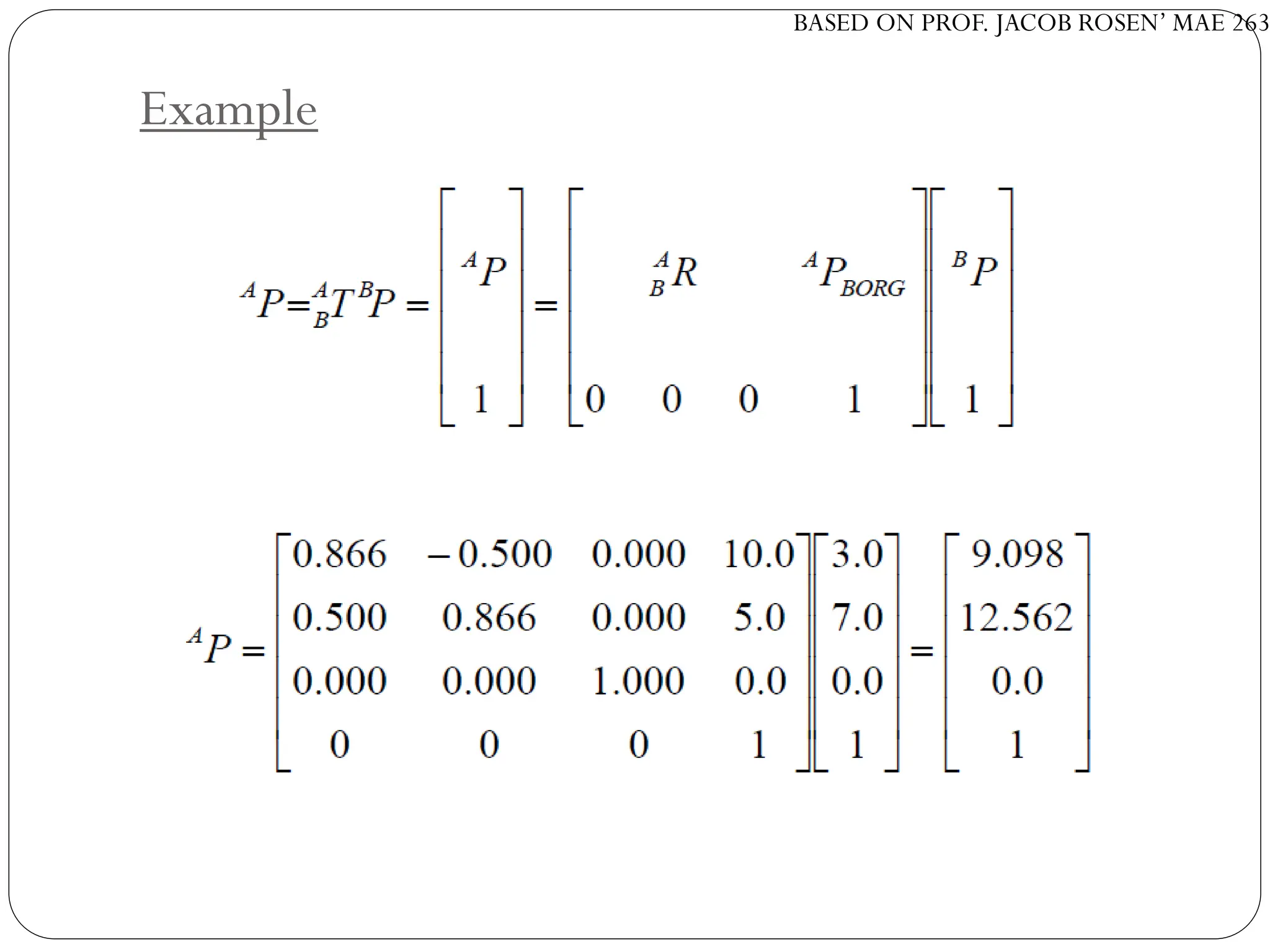
Example
BASED ON PROF. JACOB ROSEN’ MAE 263
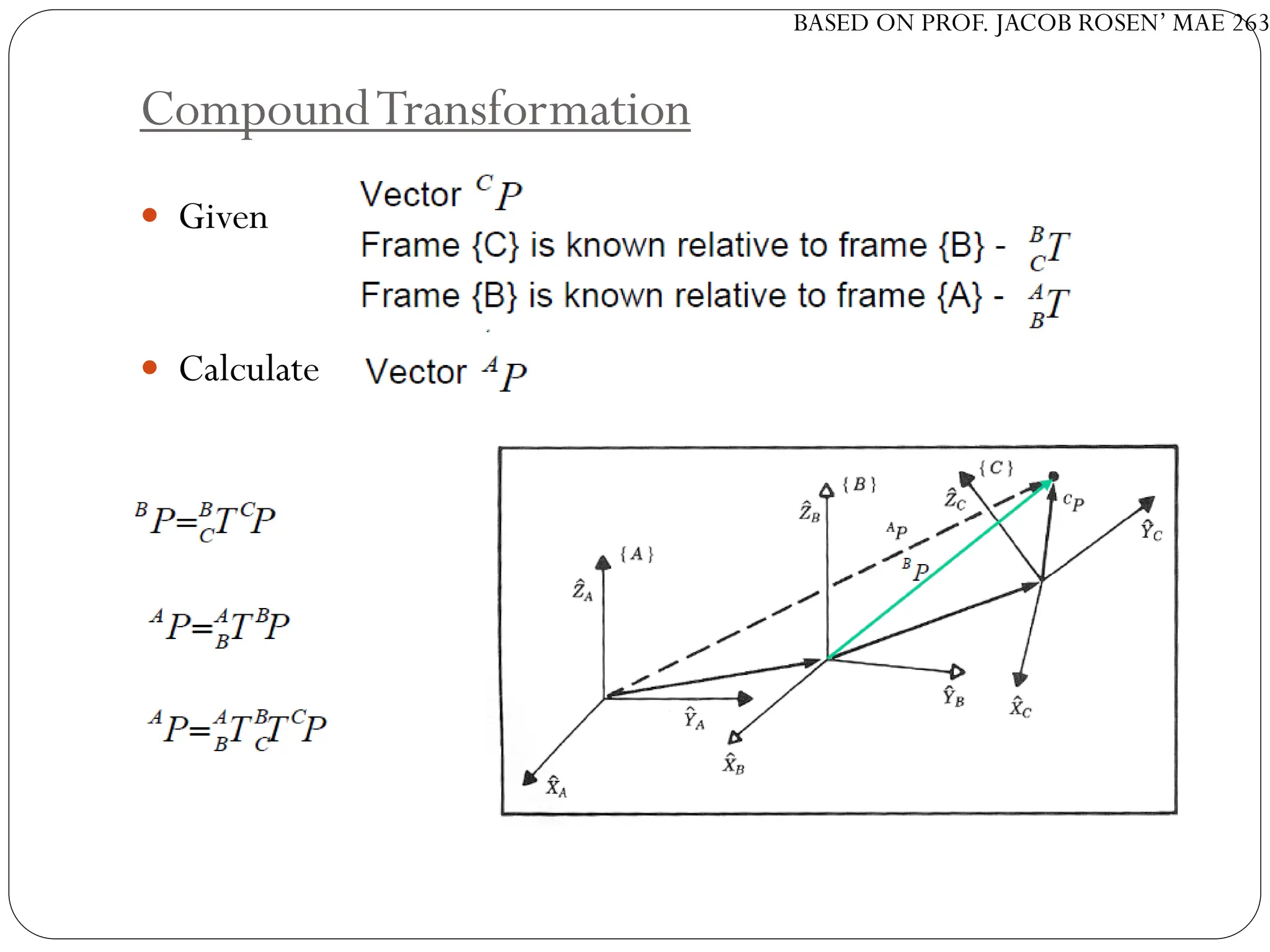
CompoundTransformation
 Given
 Calculate
BASED ON PROF. JACOB ROSEN’ MAE 263
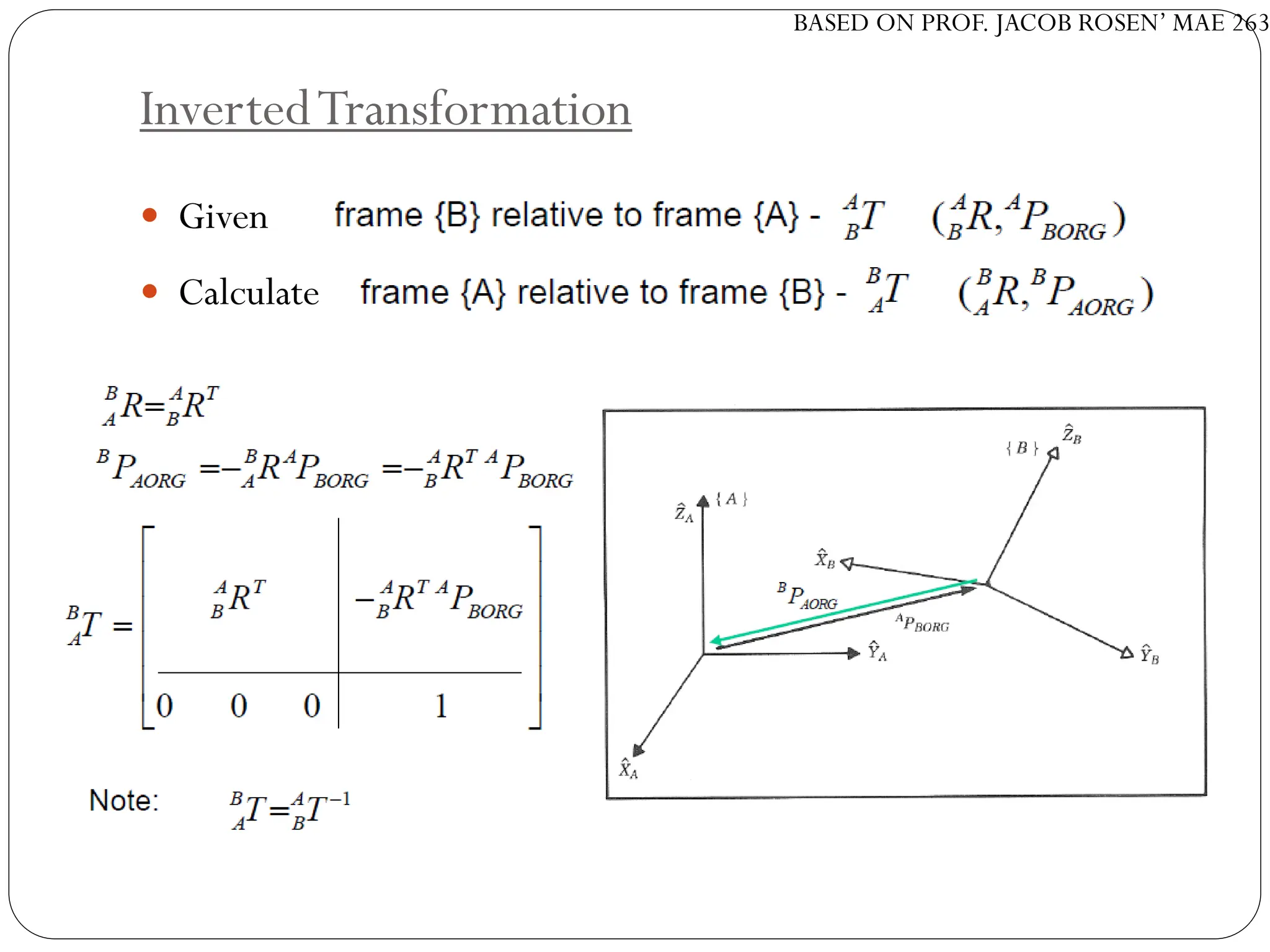
InvertedTransformation
 Given
 Calculate
BASED ON PROF. JACOB ROSEN’ MAE 263
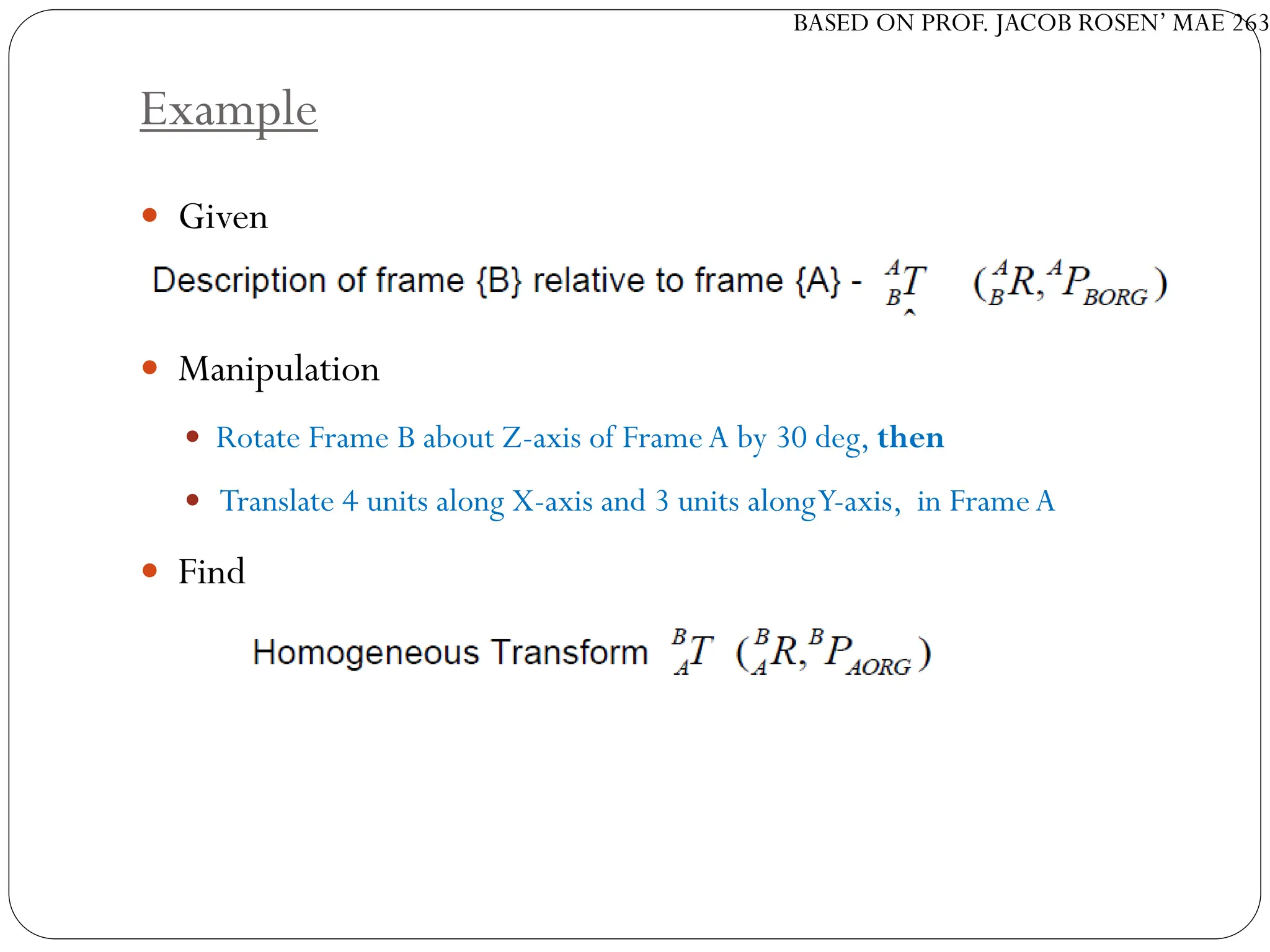
Example
 Given
 Manipulation
 Rotate Frame B about Z-axis of FrameA by 30 deg, then
 Translate 4 units along X-axis and 3 units alongY-axis, in FrameA
 Find
BASED ON PROF. JACOB ROSEN’ MAE 263
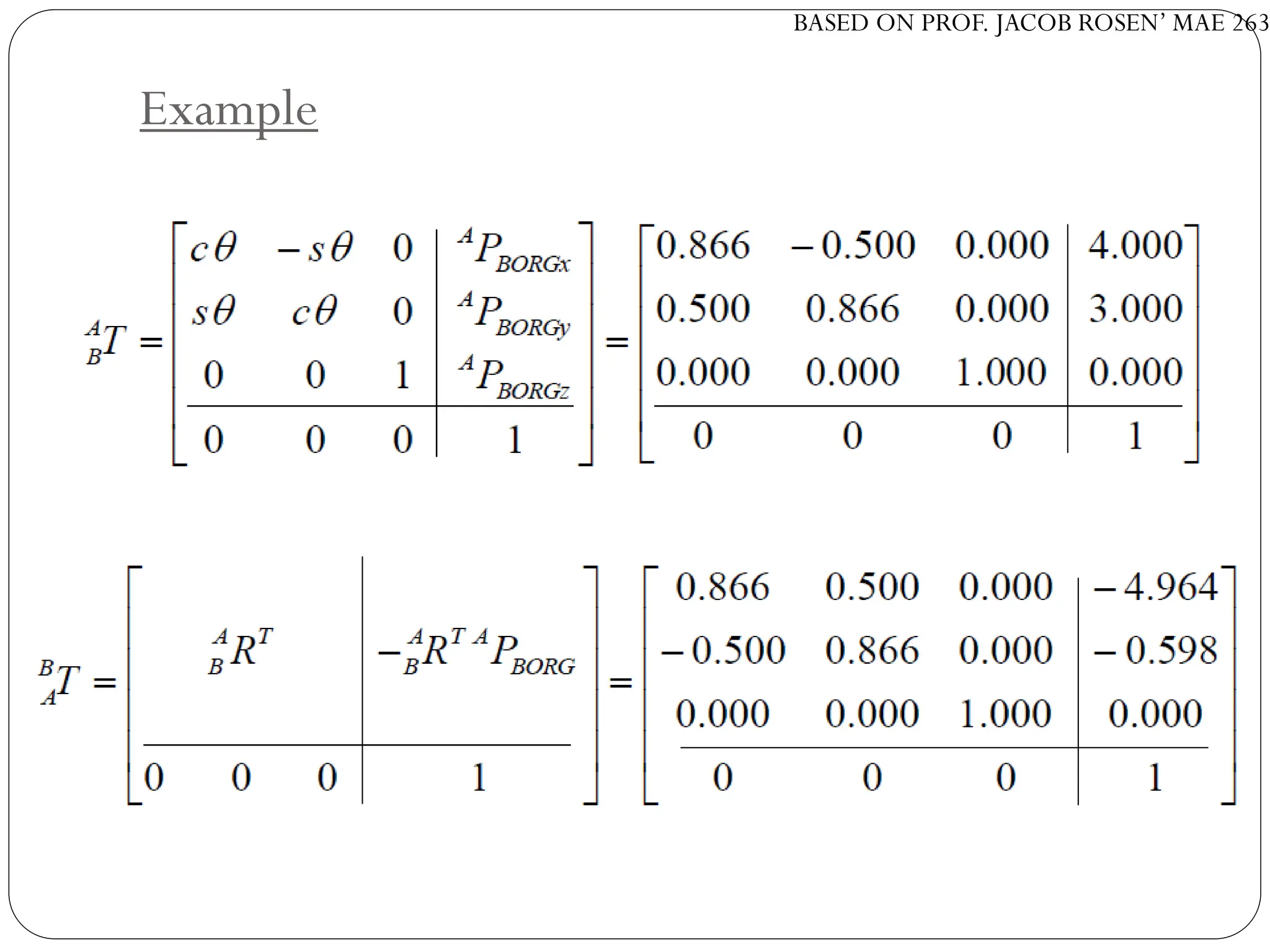
Example
BASED ON PROF. JACOB ROSEN’ MAE 263
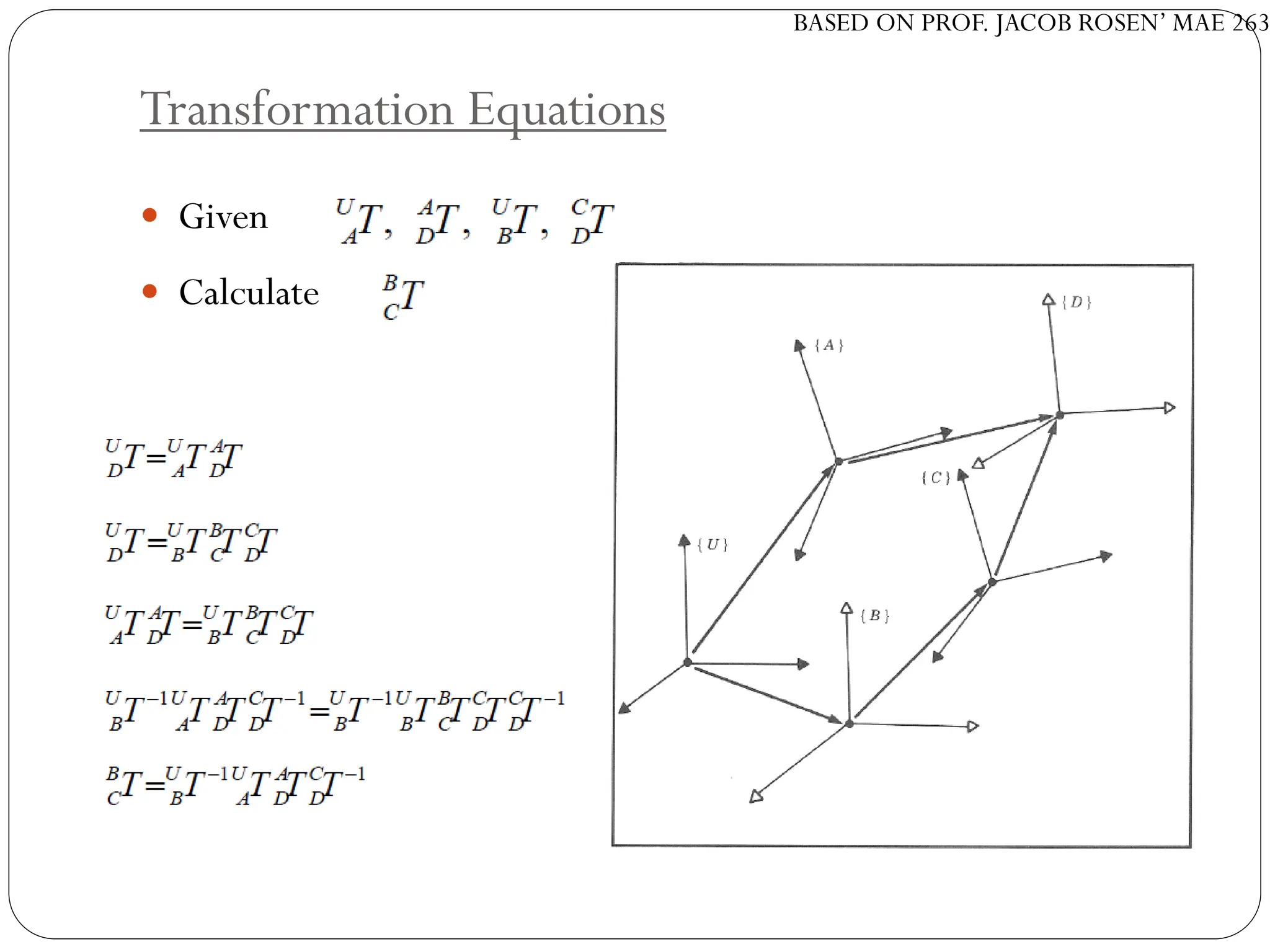
Transformation Equations
 Given
 Calculate
BASED ON PROF. JACOB ROSEN’ MAE 263
Quaternion
BASED ON PROF. JACOB ROSEN’ MAE 263
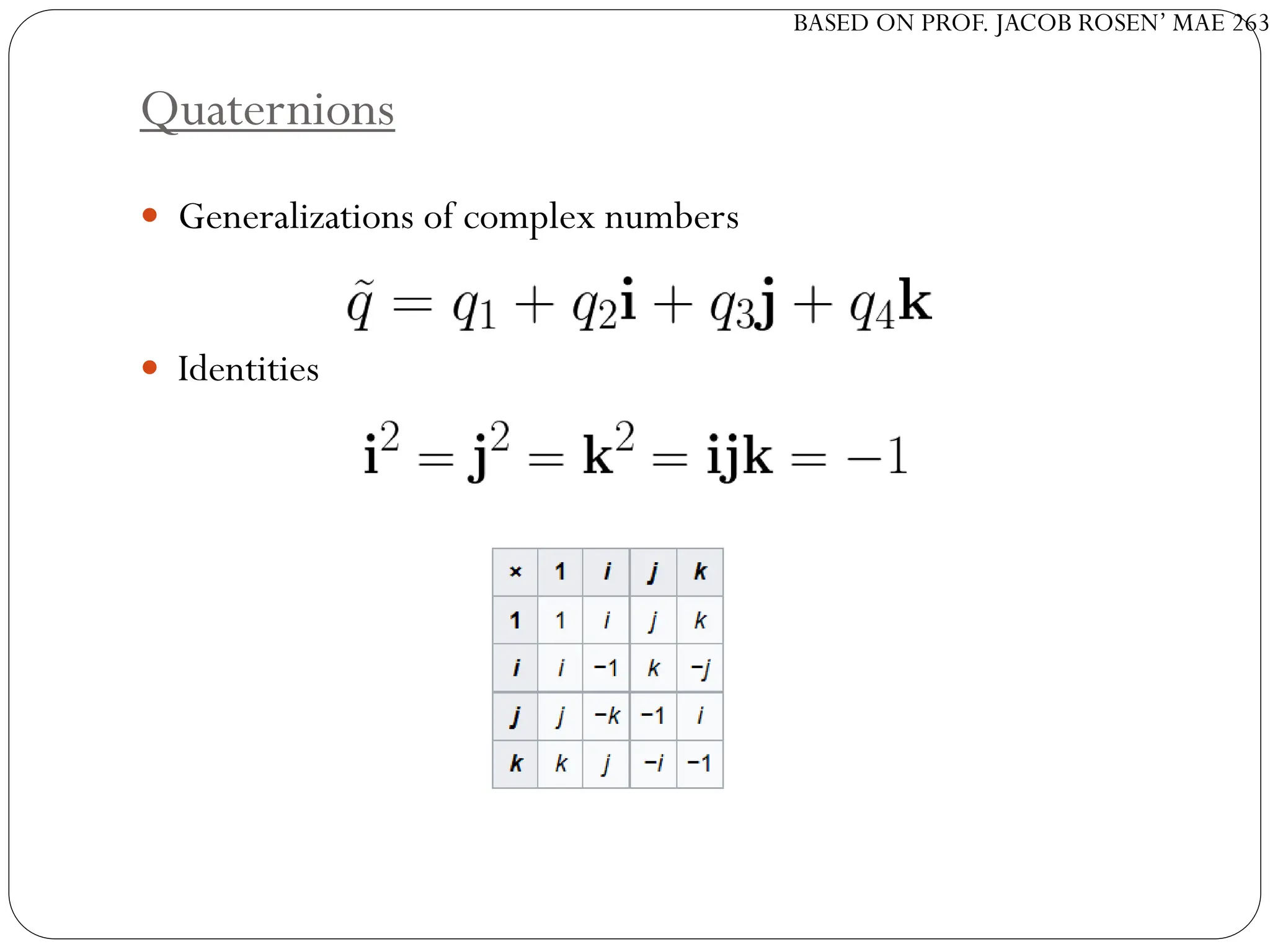
Quaternions
 Generalizations of complex numbers
 Identities
BASED ON PROF. JACOB ROSEN’ MAE 263
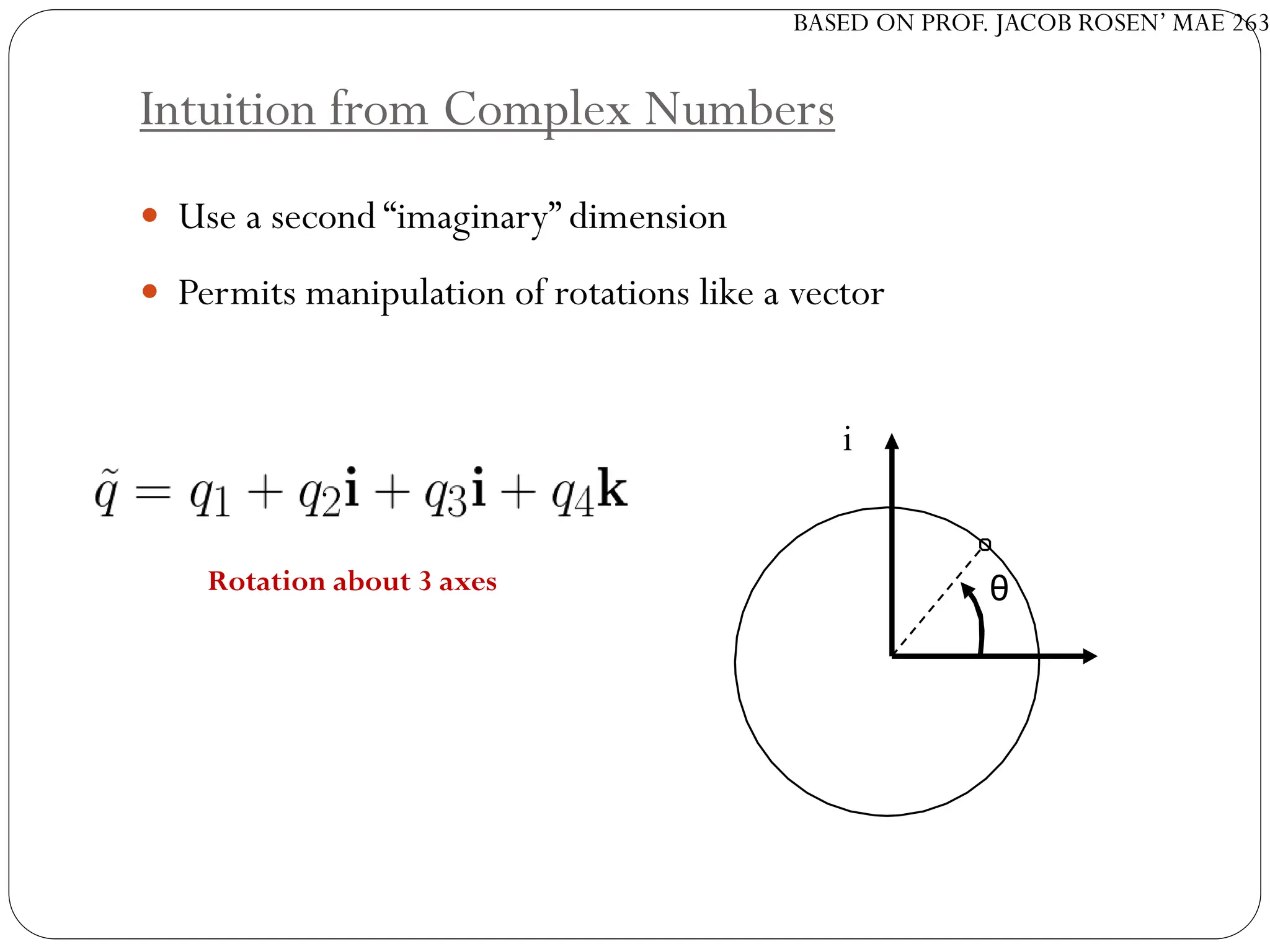
Intuition from Complex Numbers
 Use a second “imaginary” dimension
 Permits manipulation of rotations like a vector
i
θ
Rotation about 3 axes
BASED ON PROF. JACOB ROSEN’ MAE 263
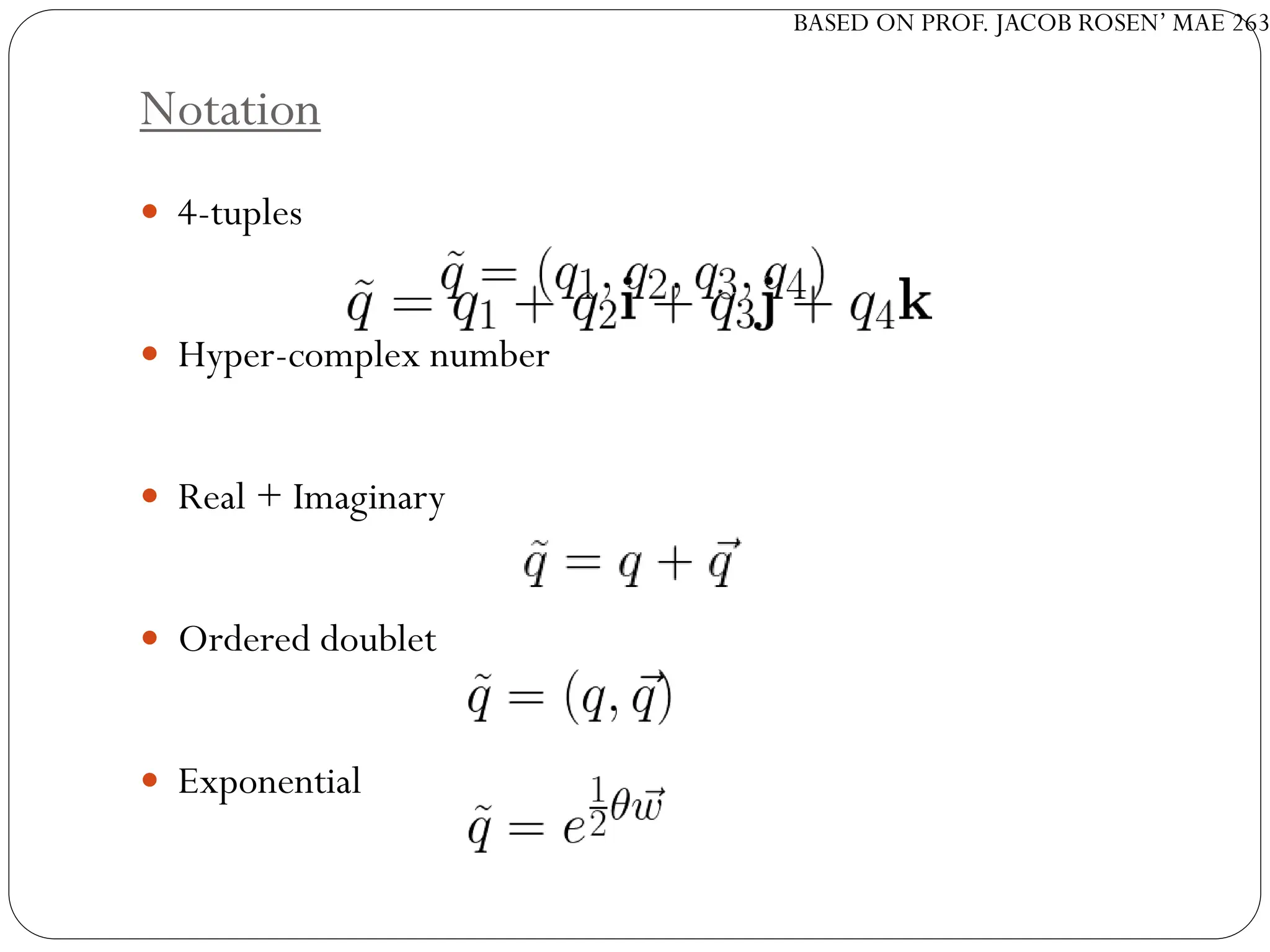
Notation
 4-tuples
 Hyper-complex number
 Real + Imaginary
 Ordered doublet
 Exponential
BASED ON PROF. JACOB ROSEN’ MAE 263
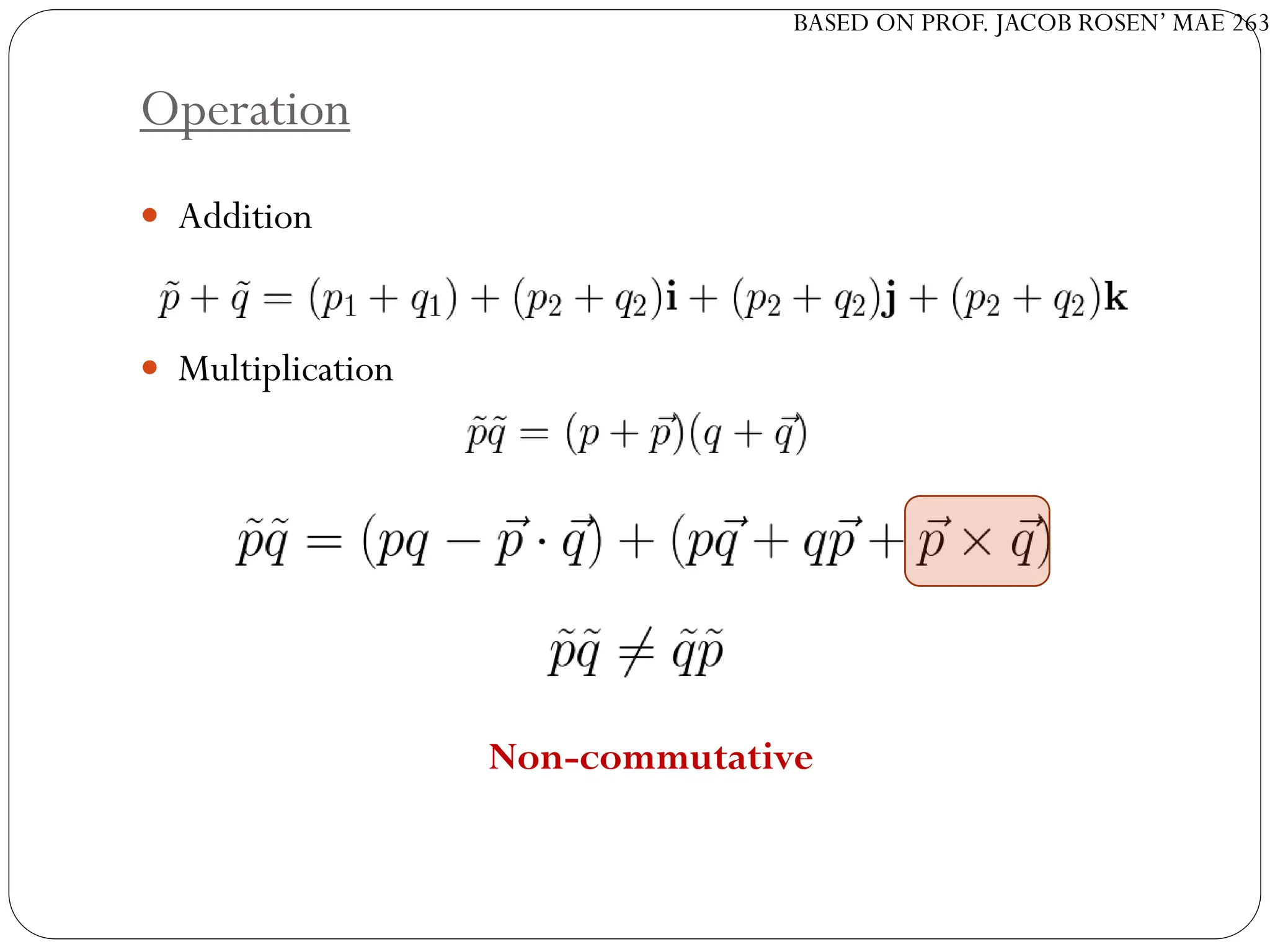
Operation
 Addition
 Multiplication
Non-commutative
BASED ON PROF. JACOB ROSEN’ MAE 263
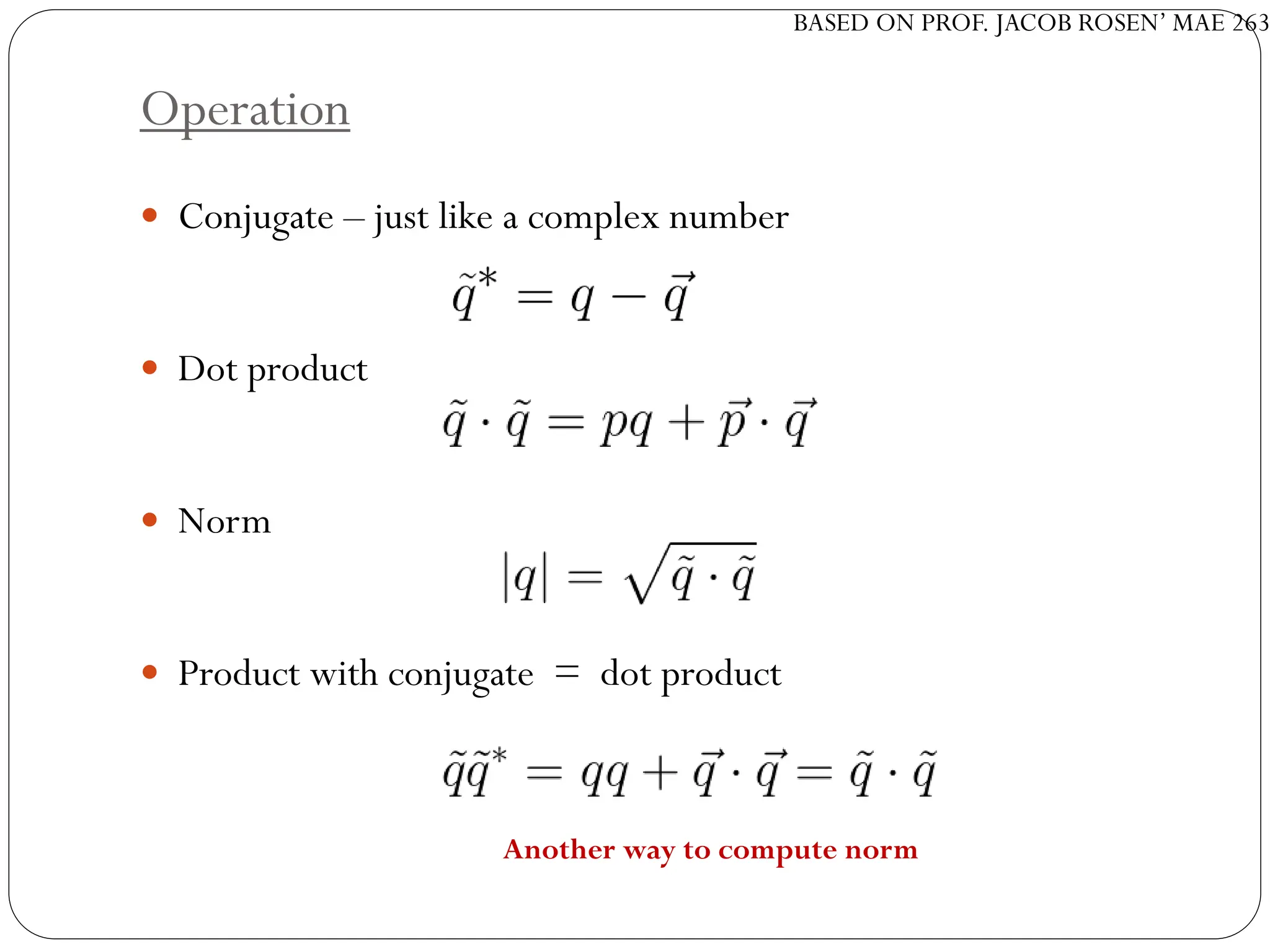
Operation
 Conjugate – just like a complex number
 Dot product
 Norm
 Product with conjugate = dot product
Another way to compute norm
BASED ON PROF. JACOB ROSEN’ MAE 263
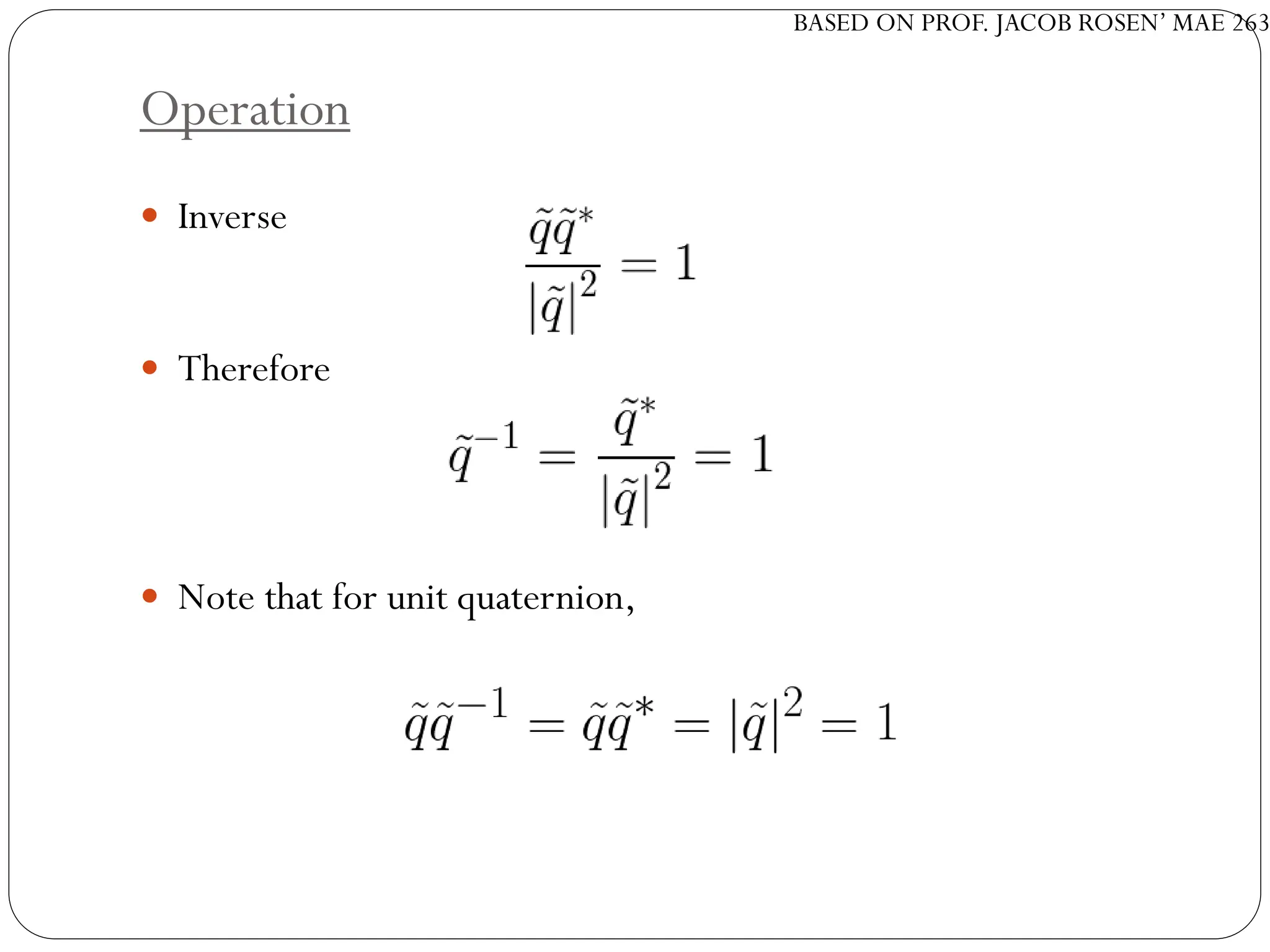
Operation
 Inverse
 Therefore
 Note that for unit quaternion,
BASED ON PROF. JACOB ROSEN’ MAE 263
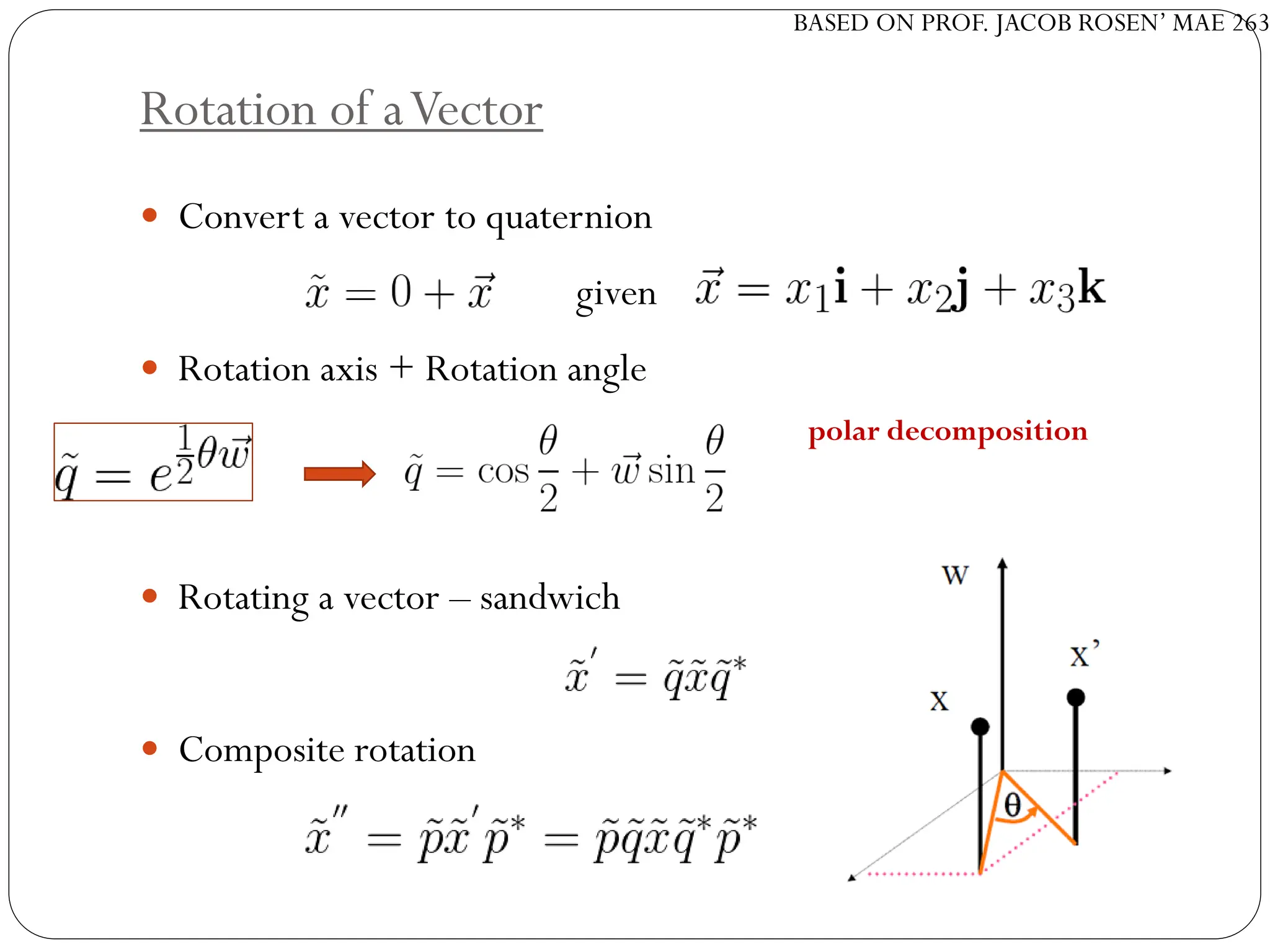
Rotation of aVector
 Convert a vector to quaternion
given
 Rotation axis + Rotation angle
 Rotating a vector – sandwich
 Composite rotation
polar decomposition
BASED ON PROF. JACOB ROSEN’ MAE 263
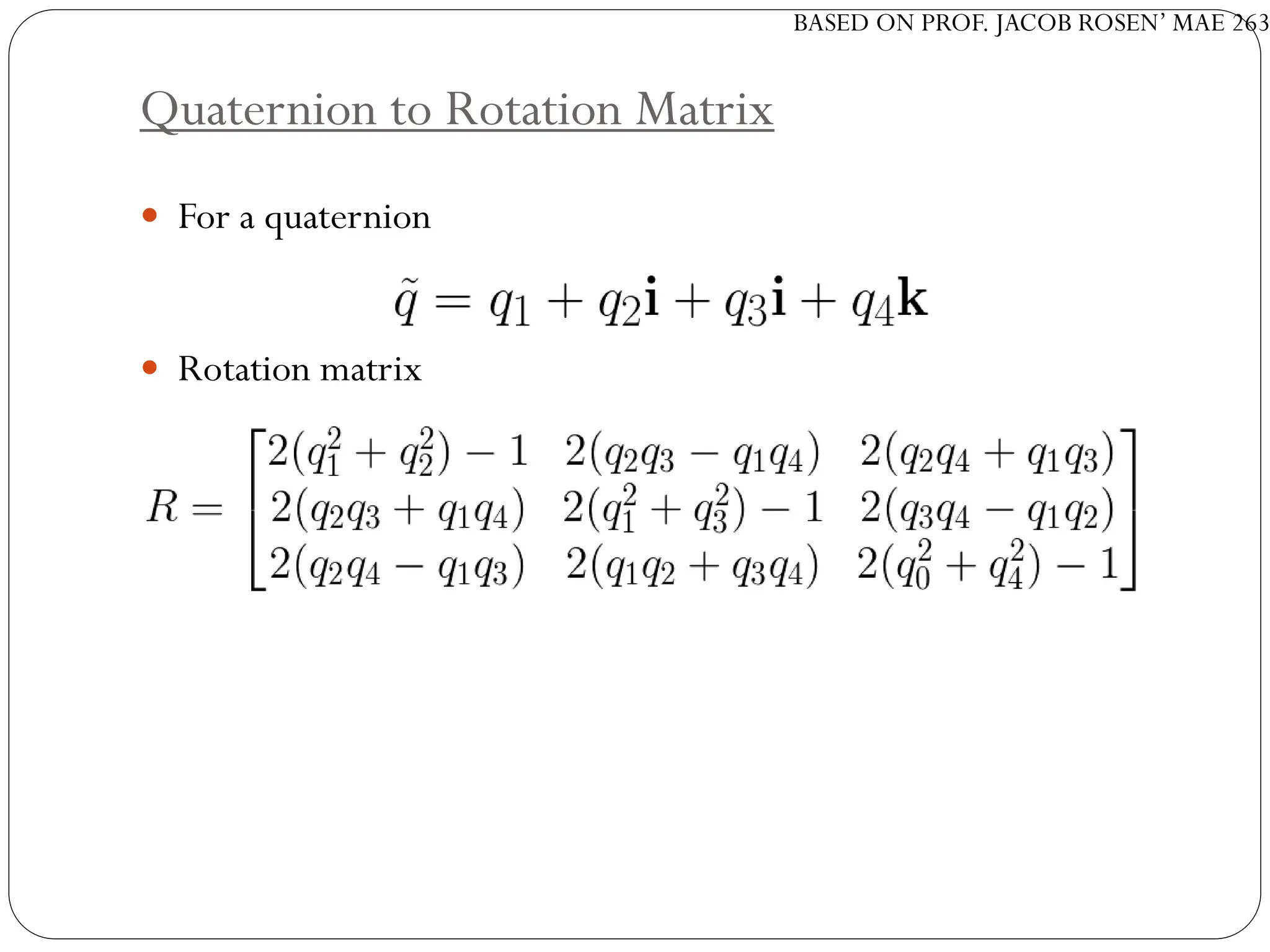
Quaternion to Rotation Matrix
 For a quaternion
 Rotation matrix
BASED ON PROF. JACOB ROSEN’ MAE 263
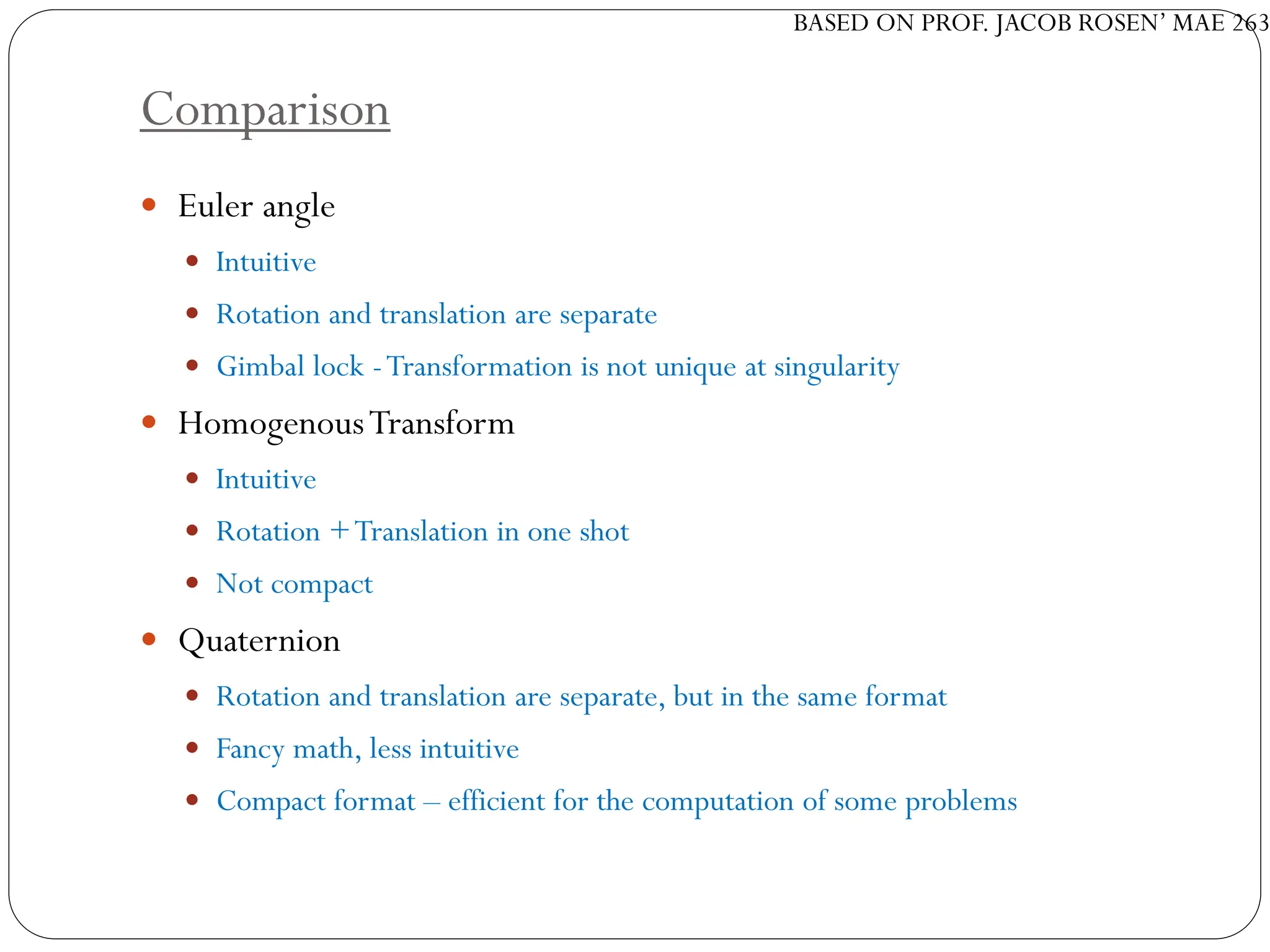
Comparison
 Euler angle
 Intuitive
 Rotation and translation are separate
 Gimbal lock -Transformation is not unique at singularity
 HomogenousTransform
 Intuitive
 Rotation +Translation in one shot
 Not compact
 Quaternion
 Rotation and translation are separate, but in the same format
 Fancy math, less intuitive
 Compact format – efficient for the computation of some problems
BASED ON PROF. JACOB ROSEN’ MAE 263
Readings

Transformation MATRIX IN INDUSTRIAL ROBOTICS.pdf

  • 1.
    RBE 550 MOTIONPLANNING BASED ON DR. DMITRY BERENSON’S RBE 550 Jane Li Assistant Professor Mechanical Engineering & Robotics Engineering http://users.wpi.edu/~zli11 Transformation
  • 2.
    Announcement  Project Presentation # individual projectVS # team project  All or some?
  • 3.
    BASED ON PROF.JACOB ROSEN’ MAE 263 Representation of Rigid-body Configurations  Parameterization matter!
  • 4.
    BASED ON PROF.JACOB ROSEN’ MAE 263 Representation of Rigid-body Configurations  Many representations  Euler angle  Homogeneous transformation  Quaternions  Different representations have pros and cons
  • 5.
    BASED ON PROF.JACOB ROSEN’ MAE 263 Transformations  An understanding of 2D and 3D rigid-body transformations is key to motion planning  There is no “best” representation  Each representation is useful in a different way
  • 6.
    BASED ON PROF.JACOB ROSEN’ MAE 263 Right-handed Coordinate System
  • 7.
    BASED ON PROF.JACOB ROSEN’ MAE 263 Representation for a Position  3X1 position vector in a reference coordinate system
  • 8.
    BASED ON PROF.JACOB ROSEN’ MAE 263 Representation for a Rotation  Attach a frame to the Body B  Rotation of Body B with respect to Frame A
  • 9.
    BASED ON PROF.JACOB ROSEN’ MAE 263 Representation of a Frame  Complete specification of a 3D object  Position + Orientation
  • 10.
    BASED ON PROF.JACOB ROSEN’ MAE 263 Translation of Frame  Translation of Frame B with respect to Frame A
  • 11.
    BASED ON PROF.JACOB ROSEN’ MAE 263 Rotation of a Frame  Rotation of Frame B with respect to Frame A
  • 12.
    BASED ON PROF.JACOB ROSEN’ MAE 263 Inverse a Rotation Frame  Given  Rotation matrix from Frame B with respect to Frame A 𝑅 𝐵 𝐴  Calculate  Rotation matrix from Frame A with respect to Frame B 𝑅 𝐴 𝐵
  • 13.
    BASED ON PROF.JACOB ROSEN’ MAE 263 Inverse a Rotation Frame
  • 14.
    BASED ON PROF.JACOB ROSEN’ MAE 263 Rotation Frames - Example  Given  Calculate  Solution
  • 15.
    BASED ON PROF.JACOB ROSEN’ MAE 263 Rotation Frames - Example
  • 16.
    BASED ON PROF.JACOB ROSEN’ MAE 263 Rotation Frames - Example
  • 17.
    BASED ON PROF.JACOB ROSEN’ MAE 263 Rotation about X,Y, and Z-axis  Rotation matrices  Rotation about  A fixed reference frame  A moving reference frame – Euler Angle
  • 18.
    BASED ON PROF.JACOB ROSEN’ MAE 263 Rotation about a Fixed Frame  Each rotation of Frame B takes place about an axis in Frame A
  • 19.
    BASED ON PROF.JACOB ROSEN’ MAE 263 Rotation about a Fixed Frame  Compute rotation with respect to (World) Frame A
  • 20.
    BASED ON PROF.JACOB ROSEN’ MAE 263 Rotation about a Fixed Frame  Special case
  • 21.
    BASED ON PROF.JACOB ROSEN’ MAE 263 Rotation about a Moving Frame – Euler Angle  Each rotation of Frame B takes place about an axis in Frame B
  • 22.
    BASED ON PROF.JACOB ROSEN’ MAE 263 Rotation about a Moving Frame – Euler Angle  Compute rotation with respect to (local) Frame B
  • 23.
    BASED ON PROF.JACOB ROSEN’ MAE 263 Fixed AngleVS Euler Angle  Same result, but different operation order
  • 24.
    BASED ON PROF.JACOB ROSEN’ MAE 263 Gimbal Lock  Because rotations are performed in orders about moving axis  Previous operation affects the next operation
  • 25.
    BASED ON PROF.JACOB ROSEN’ MAE 263 Gimbal Lock
  • 26.
    RBE 550 MOTIONPLANNING BASED ON DR. DMITRY BERENSON’S RBE 550 Gimbal Lock – Singularity Example  Singularities  Multiple EulerAngles map to one rotation (Gimbal Lock)  Let’s say this is our convention:  Lets set β = 0  Multiplying through, we get:  Simplify: α and γ do the same thing! We have lost a degree of freedom!
  • 27.
  • 28.
    BASED ON PROF.JACOB ROSEN’ MAE 263 General Frame =Translation + Rotation  Frame B with respect to Frame A
  • 29.
    BASED ON PROF.JACOB ROSEN’ MAE 263 HomogeneousTransformation  Translation and Rotation in a single matrix  Which one is performed first?
  • 30.
    BASED ON PROF.JACOB ROSEN’ MAE 263 First Rotation,ThenTranslation
  • 31.
    BASED ON PROF.JACOB ROSEN’ MAE 263 Example  Given  Manipulation  Rotate Frame B about Z-axis of Frame A by 30 deg, then  Translate 10 units along X-axis and 5 units along Y-axis, in Frame A  Find  in FrameA
  • 32.
    BASED ON PROF.JACOB ROSEN’ MAE 263 Example
  • 33.
    BASED ON PROF.JACOB ROSEN’ MAE 263 CompoundTransformation  Given  Calculate
  • 34.
    BASED ON PROF.JACOB ROSEN’ MAE 263 InvertedTransformation  Given  Calculate
  • 35.
    BASED ON PROF.JACOB ROSEN’ MAE 263 Example  Given  Manipulation  Rotate Frame B about Z-axis of FrameA by 30 deg, then  Translate 4 units along X-axis and 3 units alongY-axis, in FrameA  Find
  • 36.
    BASED ON PROF.JACOB ROSEN’ MAE 263 Example
  • 37.
    BASED ON PROF.JACOB ROSEN’ MAE 263 Transformation Equations  Given  Calculate
  • 38.
    BASED ON PROF.JACOB ROSEN’ MAE 263 Quaternion
  • 39.
    BASED ON PROF.JACOB ROSEN’ MAE 263 Quaternions  Generalizations of complex numbers  Identities
  • 40.
    BASED ON PROF.JACOB ROSEN’ MAE 263 Intuition from Complex Numbers  Use a second “imaginary” dimension  Permits manipulation of rotations like a vector i θ Rotation about 3 axes
  • 41.
    BASED ON PROF.JACOB ROSEN’ MAE 263 Notation  4-tuples  Hyper-complex number  Real + Imaginary  Ordered doublet  Exponential
  • 42.
    BASED ON PROF.JACOB ROSEN’ MAE 263 Operation  Addition  Multiplication Non-commutative
  • 43.
    BASED ON PROF.JACOB ROSEN’ MAE 263 Operation  Conjugate – just like a complex number  Dot product  Norm  Product with conjugate = dot product Another way to compute norm
  • 44.
    BASED ON PROF.JACOB ROSEN’ MAE 263 Operation  Inverse  Therefore  Note that for unit quaternion,
  • 45.
    BASED ON PROF.JACOB ROSEN’ MAE 263 Rotation of aVector  Convert a vector to quaternion given  Rotation axis + Rotation angle  Rotating a vector – sandwich  Composite rotation polar decomposition
  • 46.
    BASED ON PROF.JACOB ROSEN’ MAE 263 Quaternion to Rotation Matrix  For a quaternion  Rotation matrix
  • 47.
    BASED ON PROF.JACOB ROSEN’ MAE 263 Comparison  Euler angle  Intuitive  Rotation and translation are separate  Gimbal lock -Transformation is not unique at singularity  HomogenousTransform  Intuitive  Rotation +Translation in one shot  Not compact  Quaternion  Rotation and translation are separate, but in the same format  Fancy math, less intuitive  Compact format – efficient for the computation of some problems
  • 48.
    BASED ON PROF.JACOB ROSEN’ MAE 263 Readings